The Sons of Katie Elder

The Sons of Katie Elder
"First, we reunite, then find Ma and Pa's killer...then read some reviews."
Showing posts with label Laurence Olivier. Show all posts

Wednesday, July 30, 2014

Spartacus

I've been in Spartacus mode for about six months now. This spring I watched the entire run of Starz's Spartacus, I caught up with Howard Fast's novel Spartacus, found a couple non-fiction books about the famous slave turned gladiator at the library and then bought the TV miniseries that aired about 10 years ago. So what is there left? Naturally I tried to save the best for last, catching up recently with one of Hollywood's great historical epics, 1960's Spartacus.

It's the 70s B.C. in Rome when a Thracian slave named Spartacus (Kirk Douglas) is bought from a Libyan mine and sold to a gladiator school in Capua, Italy, several days ride from the city of Rome.  The popularity of gladiators is growing ever stronger, Spartacus thrust into training to become hopefully one of the best. He shows promise but also resents the life, the hatred beginning to grow at Rome's brutal, cruel insistence on slaves and slavery itself. Months into his training, Spartacus incites a brutal takeover, his fellow gladiators joining him in a bloody attack that gives them power and allows them to escape. At first content to be a roving band of marauding bandits, Spartacus organizes his fellow escaped gladiators into an army. They can be more than bandits. They can be an army. An army that with growth and training could challenge Rome itself. His name grows, his army increases with each passing day. In Rome, a powerful Senator and businessman, Marcus Crassus (Laurence Olivier), watches the effect the gladiator slave general has and braces for a reply...if it's not too late.

Wowza, what a good movie, the definition of a historical epic that dominated Hollywood through the 1950s and into the early 1960s. A somewhat checkered production had some issues, a 30-year old Stanley Kubrick replacing Anthony Mann just a week or so into filming. Oddly enough, it is a movie that Kubrick doesn't consider one of his own, not including it in the canon of his films. It is an epic, a smart, well-written, beautifully shot movie with an impressive cast. Composer Alex North turns in a perfect score, large in scale but also very emotional in the quieter moments. I was always a fan of the score, but it really resonated with me on the most recent viewing. There isn't a weakness here, author Howard Fast's novel come to life in truly epic form.

One of the biggest stars working in Hollywood at the time, Kirk Douglas was firmly behind this movie, helping ramrod it right into production and is listed as executive producer. I've always thought this is one of his strongest, if underappreciated, performances. As slave turned gladiator turned general, Douglas is Spartacus. He has several effective so-called "bigger scenes" but the more effective moments are the quiet ones. When he touches the hand of the woman he loves, the rage in his eyes as he's addressed by his superiors, the pride when his army stands up for him, this is an actor doing his absolute best. He brings a real-life character to life, and it's easy to see why so many followed him against Rome. Douglas is charismatic and welcoming from beginning to end. He's furious and full of hate at the Roman system that enlists hundreds of thousands of slaves. Ultimately, he's pushed too far, and his response is something that shakes the world. Just a great performance from a Hollywood legend.

What this flick is able to do so well is to blend so many different moving pieces together. It is an epic with a true ensemble cast, all of the assembled talent given a chance to shine. In one of the best love stories I can think of, Douglas has a great chemistry with Jean Simmons, playing Varinia, a slave from Brittania who becomes Spartacus' wife, friend and confidant. They just work. They're perfect together. There's one of the great actors of all-time, Laurence Olivier, relishing the part of Crassus, a criminally smooth, brilliant manipulator who yearns for power in all forms. There's Tony Curtis in one of his best roles, here as Antoninus, an educated slave who escapes from Olivier's Crassus and joins Spartacus' army. Opposites in most ways, the uneducated leader and the younger, educated fighter become very close, a father-son, brotherly relationship. There's Charles Laughton as Gracchus, the Roman senator with a long, distinguished career behind him, now opposing Crassus, and John Gavin as Caesar, the young and upcoming senator, both giving Rome's perspective as Spartacus' revolt grows and grows. Oh, and there's a scene-stealing Peter Ustinov as Batiatus, the owner of the gladiatoral school that Spartacus escapes from, an Oscar-winning part for Ustinov.

Oh, but there's more. Herbert Lom plays Tigranes, an oily pirate negotiating with Spartacus to get his army out of Italy. As for the gladiators turned army command, look for an underused John Ireland as Crixus with Harold J. Stone and Nick Dennis also standing out from the crowd with smaller supporting parts. One of three performances in 1960 that helped make him more than a physical presence, Woody Strode plays Draba, an experienced gladiator worn down by the constant killing in the arena. A small part but a key one to propel the story forward. And last but not least, gravelly-voiced Charles McGraw as Marcellus, the brutal gladiator instructor, a man tasked with turning slaves into killing machines intended for the gladiator ring. Strength from top to bottom, not a weak link in one of the great casts ever put together.

This is a thinking man's epic, not a true sword and sandal epic. The script from blacklisted author/writer Dalton Trumbo is a gem, giving a window into the politics of the time. The story moves amongst the ensemble from the gladiator school in Capua, to the streets and halls of the Roman Senate, to Spartacus' base at Mount Vesuvius to his camps moving across Italy. Trumbo's script is an idea-script, one about freedom and corruption, living life to its fullest even if the means seem impossible. We see the inner-workings of the Roman senate, of Spartacus' inner circle. You get a feeling of what the times were like in ancient Rome. Just a beautifully written script, Douglas saying "Screw it" to the blacklist that prevented Trumbo from writing for years.

'Spartacus' has moments both big and small here, both working seamlessly. The arena fight between Spartacus and Draba is a gem. Not drawn out but incredibly intense, including a great twist near its conclusion. The revolt in the school is quick and hard-hitting, the tension finally boiling to an unbearable point. As the rebellion grows -- the real-life history was called the Third Servile War -- Spartacus realizes the fight can be as big as his army wants it to be. The entire movie is a treat to watch, but I've always found the second half the film's strongest, especially when the tide turns against the slave army. Maybe the most iconic scene, "I'm Spartacus!," has become a punchline in pop culture, but in context, it is one of the most beautifully constructed, emotionally perfect scenes ever, the camera lingering on Douglas as an ideal conclusion. Watch it HERE with obvious spoilers. The same for a late scene between Spartacus and Antoninus discussing the impact of what they've done, Spartacus willing to Crassus "He'll come back and he'll be millions." Too many great moments to mention.

This isn't an action-heavy movie so beware going in if you're expecting 3 hours of battle scenes. Supposedly more battle scenes were filmed but never used, all in hopes of making the one major battle late in the film far more effective. It is, but this is not a movie interested in the scope and scale of battle. This is a story about the people. We see scenes with literally thousands of extras, but the camera zooms in on the faces, people we see popping up throughout the second half of the movie. Old and young, mothers and fathers, teenagers, kids, thin and fat. The moment where Spartacus walks through his camp on the eve of battle is perfect, the former slave truly realizing the scope of what his army has accomplished. The post-battle scene is that much more gut-wrenching as is the finale itself.

Just a classic. Enjoy it.

Spartacus (1960): ****/****

Tuesday, March 25, 2014

Khartoum

That British Empire, it got around in its heyday. You couldn't go far without stepping on some territory that Great Britain had an interest in. So with so big an empire, things didn't always go well, and in steps film and movies. Today's entry is 1966's Khartoum, an epic story about a little-known part of history (to me at least) with some impressive scale.

In 1883, an English general marches into the Sudan with 10,000 Egyptian troops looking to capture or put down a rebellion of Muslim zealots being led by the Mahdi (Laurence Olivier), believing himself to be the one appointed by Muhammad as a savior. The army is massacred to a man, leaving the British government in a spot.  The Prime Minister, William Gladstone (Ralph Richardson), doesn't want to commit a British army to the Sudan to resolve the situation, but what other measure can be taken? A solution is found in the form of a British military hero, General Charles "Chinese" Gordon (Charlton Heston), the man who helped rid the Sudan of slavery. The plan seems doomed to failure -- the British admitting to him they will only offer military assistance as a last ditch effort -- but Gordon takes the job just the same. What is his reasoning? Can he accomplish a mission with little hope of success? What does the Mahdi have in store? It's all going to be played out on an international stage.

I love a good epic from The Alamo to Spartacus, Ben-Hur to Lawrence of Arabia. This 1966 epic from director Basil Dearden doesn't quite have the huge scale of those other movies, but it is most definitely a gem. It clocks in at a modest 134 minutes (not quite the 3-hour behemoths) but accomplishes a lot in its running time. 'Khartoum' is based on a true story about Britain's quasi-involvement in the Sudan during the 1880s, filming on location in Egypt to give it some authenticity. Most importantly, it has the feel of an epic from the look to the far-reaching story to the music (composer Frank Cordell's score is solid) to the action. It doesn't have quite the reputation or following of so many other historical epics from the 1950s and 1960s, but it is well worth seeking out.

Who better to lead the way in this epic than Mr. Epic himself, Charlton Heston? Here's a case of some excellent casting. This is an underrated performance in a career that featured plenty of memorable roles, his Gordon interesting because there's so much mystery. A military hero, he's religious, loyal, intelligent, stubborn, and so much more. Does he take on this mission because he believes he can accomplish the impossible? Or is it ego, his vanity? Is it more than that? Is it something else? Whatever the answer, this is a layered, deep character who possibly only has one for sure intention...to do good. Gordon himself -- read about him HERE -- was a fascinating person, and Heston more than does him justice. We see all the sides of Gordon, a capable leader, a strong military strategist, and a man brimming with personality. It's easy to see why people believed in him, why people followed him and turned to Gordon when times were tough. An excellent performance from Heston.

The depth of the cast isn't the cast of thousands we've come to expect from an epic, but what's there is excellent. Olivier's part isn't huge -- kinda an extended cameo -- but once you get past the point that the very British actor is playing a very Muslim Arab, it's a good part. His scenes with Heston's Gordon are a high point, two Hollywood legends going toe-to-toe in quiet, underplayed scenes dripping with tension. Richard Johnson is excellent too as Colonel J.D.H. Stewart, the one officer granted to Gordon, working as his aide who sees the writing on the wall with their desperate mission. Richardson leads the government contingent as the wishy-washy prime minister, Michael Hordern, Hugh Williams and Ralph Michael as his government tools. In the military department, Nigel Green plays General Wolseley, the army commander tasked with "rescuing" Gordon, while Peter Arne plays Major Kitchener, the signal corps officer sent somewhat close to Khartoum to aid the defense. Also look for Johnny Sekka as Khaleel, Gordon's house servant, and Alexander Knox as a British official working with Gordon in Khartoum.

Enough with all this acting stuff, let's talk about some epic scale! I liked the story and the characters, feeling like I really learned something from this historic story. What resonated most though in 'Khartoum' was the impressive scale from three extended battle sequences. The opening massacre really sets the tone, the Mahdi's army swarming down hillsides at an exhausted army. Seemingly thousands of extras fill the screen in an amazingly tone-setting sequence. The middle action sequence has Gordon's forces holding off a nighttime ambush of the Mahdi's forces while the final assault on Khartoum packs the screen with Gordon's small forces in the city and the Mahdi's army charging the city in endless waves. Cinematographer Edward Scaife and second unit director Yakima Canutt (a former stunt man, a hugely underrated name in Hollywood stunt/action history) film right there in the dirt and sand with the action. They put the cameras on trucks and speed right into the battle like cavalry charging into its own battle. Great, adrenaline-pumping sequences that belong in the conversation of memorable battle scenes.

I liked a lot about this 1966 epic. It's able to cover a lot of ground, the siege of Khartoum lasting almost a full year. Things never feel rushed as we get to know Gordon, his motivations (sort of), the international situation, the British "solution" to the plan, and the slow-burn Gladstone and Parliament use to hopefully resolve it all. While it's an up and close and personal story, the script from Robert Ardrey does a good job keeping it in an international perspective. All the while, the doom builds right up until the conclusion. I liked it a lot, the expansive look from the opening prologue narrated by Leo Genn to the desert scenes and everything in between. Highly recommended.

Khartoum (1966): ***/****

Friday, August 2, 2013

Wild Geese II

Stumbling across the DVD for 1978's The Wild Geese about five years ago, I was one happy movie fan. An all-star cast and wall-to-wall action in a men-on-a-mission movie, it quickly became one of my favorite movies. A sequel was made some seven years later, but it received generally negative reviews and hasn't even approached the cult status of the original. It is one hard to find movie, but I kept on looking just the same and found it, 1985's Wild Geese II.

A former soldier, Lebanese-American John Haddad (Scott Glenn) has become an effective if high-priced mercenary. Working out of London, he is approached with a seemingly suicidal mission. One of the last remaining Nazis, Rudolf Hess (Laurence Olivier), is wasting away at Spandau Prison in West Berlin having lived in almost complete isolation for 40-plus years. This group is willing to pay whatever it takes to get Hess out, basically offering Haddad a blank check for his services. Looking over the layout of the prison while also planning ahead for what he hopes is an easy getaway, Haddad agrees to take the job. He recruits an old friend and fellow mercenary, Alex Faulkner (Edward Fox), to help him with the job, but upon arriving in Berlin, the duo finds out that their mission isn't so secret. Several underworld types and other intelligence representatives are very aware of what they're up to. Can they still pull off the job?

If I love a movie -- maybe even just really like it -- I'm usually psyched to find out there's a sequel out there for my viewing pleasure. Without giving away any major spoilers, I can say that the original didn't seem to leave much room or storylines for a follow-up story. The only real link (other than an oddly pointless prologue showcasing the original) is that Fox's Alex is the brother of Richard Burton's character from the first movie. Other than that? It's just your typical mercenary action movie, this one from director Peter R. Hunt. While it is far from a classic action movie, I did enjoy it for what it is; a somewhat deliberately paced men on a mission movie with a unique location (the Berlin locations especially stand out). Maybe it's better if it was a stand-alone film, but it ain't so here we sit just the same. Don't expect too much and you should get some entertainment out of it.

Besides the differences in story, the biggest gap between the original and sequel is the lack of star power. Where the first movie had Burton, Roger Moore, Richard Harris and Hardy Kruger among others, the follow-up doesn't have many names that jump off the page. Glenn is solid if unspectacular as Haddad, the chiseled, efficient mercenary who hasn't met a job he won't take on. It's a good anti-hero part, but I never found myself rooting for him. Fox is more of a scene-stealer, hamming it up as the malaria-ridden Alex, a fellow mercenary who always seems to be in the right place at the right time. Robert Webber makes a quick appearance as McCann, the leader of the group who wants Hess with Barbara Carrera as his on-site specialist working with Haddad.

Enlisted to write a follow-up novel to his Wild Geese, author Daniel Carney turned around and wrote The Square Circle, the basis for this sequel. I've yet to read it (currently seeking out the novel), but I'm very curious to see how much the movie differs from it. For starters, the reasoning here for busting Hess out of Spandau seems forced to say the least. Webber's McCann works for a major TV news network who wants to interview Hess about people he worked with, people with higher up positions in other country's governments. Really? A TV network organizing a prison breakout? I don't buy it. There had to be a better choice to reason paying a mercenary to bust a Nazi war criminal out of prison. Second, the ending is brutal. It basically washes away the previous two hours, throwing it in the nearest garbage can. It is a lazy ending, wrapping things up because....well, because. It just ends. Weak stuff.

There is the potential here for a pretty decent movie, and I say that having liked it in spite of its flaws at times. All the intrigue and suspense works well as Haddad must elude hired Russian killers while also dealing with Russian (Robert Freitag) and English (Kenneth Haigh) officials, juggling it with how to manage the breakout and getaway. Even look for future Capt. Picard Patrick Stewart as a Russian general! The mission itself over the last 40 minutes is the high point by far, Haddad's intricate plan coming together detail by detail. Too bad the follow-up is just plain bad.

One other thing, more wasted potential as Haddad puts his team together to pull off the mission. Along with Fox's Faulkner, there's Ali (Stratford Johns), the well-connected underworld member, Hourigan (Derek Thompson), the hateful IRA gunman, Murphy (Paul Antrim), the drill sergeant, Michael (John Terry), the TV network rep, Pierre (Malcolm Jamieson), the driver, and Joseph (David Lumsden) and Jamil (Frederick Warder), two Middle Eastern men. Little background is given to any of these characters unfortunately, leaving more untapped potential.    

Wild Geese II (1985): ** 1/2 /****

Friday, June 3, 2011

49th Parallel

One of the greatest actors of his time, Laurence Olivier was in countless classics, almost always turning in performances that are still remembered today. While I can appreciate his ability as an actor, I've never been a huge fan of his.  Truthfully, I just haven't seen him in much even though he has been in over 60 films.  Held in high regard, 1941's 49th Parallel is one of those films, and oddly enough, one that fans and critics alike seem to watch. It's a prime example of a WWII propaganda film, but not in a good way.

There of course is some background with the propaganda machine that produced this movie. Director Michael Powell was approached by the British government in 1940 to make a film about mine-sweeping, but instead he decided to make a film that he hoped would "scare the pants off the Americans." Still a year away from the Japanese attack on Pearl Harbor, the United States was very much a neutral country. World War II was hanging in the balance as Germany swept across Europe, swallowing up countries at a lightning pace. Powell's motivations were legitimate, but now watching this movie over 70 years later, the effort is almost laughable.

Patrolling and attacking along the Canadian coast in the Atlantic, U-37 (a German U-boat) is gaining notoriety for attacking every ship it comes across.  Hiding out in Hudson Bay from patrolling ships and planes, the submarine is attacked and sunk, leaving only a small landing party alive on-shore to fend for themselves.  As the ranking officer, Lieutenant Hirth (Eric Portman) takes charge, searching with five other survivors for some sort of safety. With little options of where to go or what to do, Hirth decides to head for the U.S./Canadian border (the 49th Parallel) and seek asylum in the still-neutral United States. Thousands of miles stand between them though, and the countryside is alive with people looking for the escaped Germans.

I'm not quite sure what I expected heading into this movie. Maybe I confused it with another movie. Maybe I misread the year. I do know that I didn't expect such an obvious, sometimes painful effort at a propaganda film.  The story is an episodic one broken up by long fades to black.  The survivors make their way across Canada in hopes of reaching freedom. They attack a far-off, lonely trading post. They rest at a village of German farmers, and even come across a pacifist (Leslie Howard) living in the wilderness. The whole purpose of the film is to show how evil, how despicable, how cutthroat these Germans are, doing anything they need to survive. All sides in WWII were capable of atrocities, but the effort here falls short...or far maybe, depending on how you look at it.

Trying to convince neutral Americans that their country should join the war, Powell and the screenplay deliver one of the most heavy-handed attempts I've ever seen at propaganda. The Germans are perfectly evil, reveling in the cold-blooded murders of Canadian shipping, admitting they're killing women and children somewhat proudly. Portman's Hirth and his fellow survivors open fire into a crowd of innocent people, and later he orders the execution of one of his own men, Vogel (Niall MacGinnis), for questioning why they're doing what they're doing. It is a frightening performance for Portman, and a strong one, but it is too exaggerated, too stereotypically and cartoonishly evil to register.

In his efforts, Powell does a somewhat funny thing in demonizing the Germans. He humanizes some of them during their travels. Raymond Lovell plays Lt. Kuhnecke, a capable officer who is killed off almost immediately. MacGinnis' Vogel seeks solace in the farming community, becoming a popular baker and wanting to leave Hirth and the others behind. Instead, Hirth orders his execution at the hands of his most loyal followers/survivors (including Peter Moore, John Chandos, and Basil Appleby). The thought process is an interesting one, showing that all Germans aren't obsessed, driven Nazis, but wouldn't that work against Powell's intentions? Or does it do just the opposite? I guess it does show that the most extremist Nazis were capable of horrific acts, even against their own. It may make sense, but it gives the film an odd two-way feel that never quite clicks into place.

The episodic nature of the story allows for some interesting casting as I mentioned earlier in the intro.  Nominated countless times for Academy Awards and winning several over the course of his career, Olivier's performances are legendary, but this ain't one of them. He plays Johnnie, a French-Canadian trapper who incurs the wrath of Hirth's squad. His attempt at an accent will assuredly produce some chuckles, and the performance is basically one big stereotype to begin with. Howard is more interesting as Philip Armstrong Scott, a pacifist who questions everything about the war.  Raymond Massey saves the best for last, an AWOL Canadian soldier who Hirth meets on the road as he nears the border. The posters push Olivier, Howard and Massey as the stars (even giving Olivier a love interest that doesn't actually exist), but don't be confused. The performances from that trio are more of the cameo nature than leading roles.

This is a movie that is almost....almost...saved by its ending. It is the type of ending that has a mean streak in it a mile wide, the Allies showing the Axis forces who's really the boss.  It delivers a nice little twist, but leading up to it, the movie's flaws are just too much. Visually uninteresting with long monologues, preachy and heavy-handed in its approach (even for a propaganda film), I struggled mightily to make it through this one.

49th Parallel <---trailer (1941): **/****

Tuesday, October 13, 2009

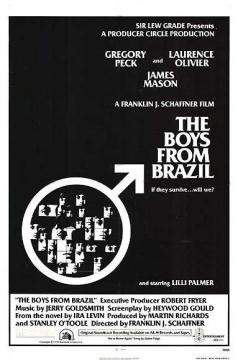
The Boys From Brazil

Depending on what movie you watch, cloning/reanimation/freezing can be handled quite differently. Think of Austin Powers and then compare it to real-life situation with baseball great Ted Williams. I realize they're different situations, but the idea is the same. What if someone from history thought far enough ahead to plan for a clone of themselves? Then think of it as one of the most hated people in history, and you've got 1978's The Boys From Brazil.

The idea of surviving Nazis trying to revive the Third Reich or even just blend in with society is nothing new in movies, with Marathon Man probably the best example. Late in WWII when it was clear the war had turned against Germany, many high-ranking officials and officers began to maneuver on how to survive in the world after the war. Some made their way to South America where support for the Nazi party still existed. Many just tried to get along and hide from the fact that they were still being hunted for their actions during WWII. But what if that wasn't all they were up to? What if they had plans to bring back Nazism into a world power?

In Paraguay in the early 1970s, inexperienced Nazi hunter and member of a young Jew organization, Barry Kohler (Steve Guttenberg) is onto something. He is convinced that retired, hiding Nazis are up to something, and even finds out their plan by bugging the villa they're staying in. Leading the group is Dr. Josef Mengele (Gregory Peck), a German doctor infamously known for his horrific, immoral actions during WWII in the concentration camps where he performed all sorts of scientific experiments on the unwilling prisoners. Convinced he is on to something huge, Barry contacts Ezra Lieberman (Laurence Olivier), a well-known Nazi hunter.

Ezra is not so easily convinced but while he's on the phone with Barry, the line suddenly goes dead and he can hear breathing at the other end. Suspicious of what might have happened, Lieberman begins to investigate the information Barry gave him even if it sounds incredibly strange. Mengele ordered that over a 2 1/2 year span, 94 men, all working in civil services, aged 65 will be murdered in locations all around the world. Confused as to how it all relates, Lieberman begins to look into the matter and does stumble upon Mengele's plan, a revival of the Nazi Party, a new Fourth Reich.

Based on a novel by Ira Levin and using real-life historical figures, The Boys From Brazil is successful as a 'what if?' in history. The true revelation of Mengele's plan is a doozy, and I won't spoil it here because part of the enjoyment from this movie is trying to figure it out as clues are slowly filtered out. The premise seems ridiculously complicated and over-the-top, but that's for after the movie. While watching the plan develop, I was too involved to think about how ridiculous it actually is. Just enjoy the movie and then rip it to pieces afterward.

With stars as huge as Gregory Peck and Laurence Olivier, you would think the leads are as solid as possible, at least I did. Peck plays the villainous Mengele, a brilliant mind who is also completely devoted to Adolf Hitler and his beliefs. With skin-lightening makeup and dyed hair, Peck doesn't look quite right, and his accent is in the evil German, Sgt. Schultz vein. Lines that are supposed to be dramatic and intimidating are instead unintentionally funny. Olivier is better as Nazi hunter Lieberman, a bit of an eccentric himself, but he still seems to go for a stereotypical older Jewis man in his characterization. Maybe I was expecting too much from these two Hollywood icons, but I came away disappointed with their performances.

The supporting cast is much better, especially third-billed James Mason. Playing Siebert, the leader of the extermination squads on the Eastern front in WWII, Mason makes the most of a role that only requires him to be onscreen in a handful of scenes. He is Mengele's security officer, making sure his plan comes to fruition even as that plan becomes more and more unwieldly. Other supporting roles go to Lilli Palmer as Ezra's sister/assistant, Denholm Elliott as a not so cooperative press agent working with Lieberman, John Dehner as a man involved with Mengele's plan whether he knows it or not, Walter Gotell as one of Mengele's key men, John Rubinstein as a friend of Barry's, and surprisingly enough, Guttenberg in a strong key role.

Aided by a solid, creepy score from Jerry Goldsmith, 'Brazil' is at its best when the story keeps you guessing. Mengele's diabolical plan for a Fourth Reich is an unexpected twist that caught me by surprise, both in terms of the story but also the science it involves. Just don't overthink this one while watching, and you'll be fine.

The Boys from Brazil <---trailer (1978): ** 1/2 /****

Sunday, May 24, 2009

Battle of Britain

Heading into May, I had this plan to watch and review a bunch of WWII movies in honor of Memorial Day. Well, Memorial Day is tomorrow so that's not going to happen, but I can still get a couple reviews in at least.

Battle of Britain (1969), directed by Guy Hamilton of James Bond fame, is everything that was good and bad about the epic war movies to come out of the 60s, and really epic movies in general. Growing up in the good old USA, the early parts of WWII were never taught as much as the post-Pearl Harbor years once America got involved in the war so this movie serves as a good introduction to the earlier years of the war. Immediately following the Dunkirk disaster, it appears that Hitler and the Third Reich are one good push away from winning the war. All that's needed for that final push is the invasion of England.

But before a cross-channel invasion can take place, Herman Goring and his illustrious Luftwaffe must knock out the Royal Air Force so an invasion force can go across the channel relatively unmolested. For the RAF though, they're heading into a battle with the odds heavily stacked against them with just 600 pilots to Germany's 2,500. As Laurence Olivier's Air Chief Marshal Dowding so eloquently but effectively states, "Our boys are going to have shoot down their boys at a rate of 4 to 1." So begins the battle of Britain, here's the film's opening, a good sum-up of what's happened and what's to come.

With a movie that focuses exclusively on a key moment in Britain's history, the benefits are obvious. Director Hamilton collects a who's who of British actors to fill out his cast. Olivier and Trevor Howard star as Dowding and Air Vice Marshal Park, the higher-ups in the RAF who oversee the desperate fight in the air. As the pilots, Micheal Caine, Robert Shaw and Christopher Plummer lead the fight with Ian McShane and Edward Fox as two pilots in Shaw's squadron. And then making short appearances are Curd Jurgens, Harry Andrews, Patrick Wymark, Michael Redgrave, Kenneth More, and Ralph Richardson. If that cast doesn't impress you at least a little bit, this might not be your movie.

As I've covered before though, the flaw with such a huge cast is the characterization which suffers. These characters are more outlines of historical figures than flesh and blood people. Plummer stands out mostly because he's given a love interest, the beautiful Susannah York, so we find out something about his squadron leader. You're not hoping Caine's Squadron Leader Canfield makes it, you're hoping Michael Caine makes it. The same with Shaw and Plummer. But that's a minor flaw for me, not something that should stop you from seeing the movie.

And surprise, surprise, what's the actual reason for seeing a movie built around WWII in the air? If you answered 'dogfights' and lots of aerial footage, pat yourself on the back. It's a pre-CGI movie that relies on actual footage being shot of these pilots in action, the British Spitfires tangling with the German Stukas, here's one great scene with Goring asking his officers what they need to win. The film will sink or swim for most viewers on the dogfights, which do eat up most of the movie's 132-minute running time. The best is saved for last appropriately enough as the British throw all their reserves into the battle in one last, desperate ploy to stop the Luftwaffe. It's a 4-minute scene with no dialogue, no sound at all other than Ron Goodwin's score, sampled here, a very British score indeed.

Hamilton's movie then is not so much about the characters as the battle itself. Obviously, without the pilots, WAFs and coast watchers, the battle for Britain could not have happened. But Hamilton goes for the spirit of these people. Maybe we don't know much about them, their personal backgrounds, but they're fighting for what they believe in to stop a power-hungry Adolf Hitler as he swept across Europe. If these pilots hadn't held off the Luftwaffe and ultimately won the battle, who knows how different the world would be right now? It's a frightening thought. And that's why Battle for Britain works, even with its flaws.

Still wavering? Here's a trailer, a long one at that, and a longer preview of the movie as a whole. A WWII movie not as well known as many war movies of the time, but one definitely worth checking out if you've missed it up to now.