The Sons of Katie Elder

The Sons of Katie Elder
"First, we reunite, then find Ma and Pa's killer...then read some reviews."
Showing posts with label Robert Shaw. Show all posts

Tuesday, August 18, 2015

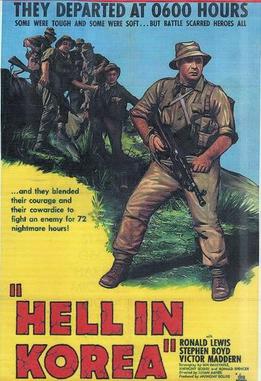
Hell in Korea

When I think of anti-war films, I tend to zoom right in on the 1960's, right as the Vietnam War jumped into full gear and moviegoing audiences amped up their cynicism. Well, sorta. The theme of today's review intro? The Brits, ahead of the game in the dark, gloomy, cynical anti-war film. I'll obviously mention some others later, but for now, here's 1956's Hell in Korea.

Commanded by inexperienced Lieutenant Butler (George Baker), a 15-man patrol leaves its base and heads out on a reconnaissance patrol. The patrol is split up down the middle, half professional soldiers and the other half National Service men called up when the fighting in Korea started. Their objective is simple; march out to a seemingly isolated village and find out if it is garrisoned or being used at all by North Korean and Chinese forces. Short answer? It ain't, but on the way back to base, the patrol is cut off by a much larger Chinese force. Butler tries to pull off a delaying action, but more Chinese troops quickly arrive on the scene. Butler's patrol has only one alternative...cut back through the abandoned village and fort up above it in a mountainside temple cut perched next to a cliff before they're cut to pieces. If they can make it...

There's something to be said for movies like this. By the late 1950's, studios in Hollywood and London alike were starting to focus more on BIG movies, EPIC movies with a huge scale and a bigger cast. Then there's movies like this. Filmed in black and white, 'Korea' focuses on one patrol, its mission, and its fallout when things go wrong. There is no bigger picture of the war. The focus is on one patrol. It was filmed in a barren location (I can't find where) and feels removed from any civilized part of the world. Cut-off from their own forces, the patrol is on their own. It can be stories like this that work so well because for all the huge battles and large-scale clashes, there were far more stories like this when it comes to a realistic war.

Two movies came to mind while watching this 1956 war drama, both like-minded stories and outlooks, as I thought about what to write. Wouldn't you know it? Both are British, 1961's The Long and the Short and the Tall (liked it) and 1959's Yesterday's Enemy (loved it). These aren't movies interested in glorifying war or showing it for all its heroism and bravery. It was about survival, plain and simple. That's where director Julian Amyes' film works best. The men on the patrol come from a variety of backgrounds, some don't like each other to the point it borders on hate, and they aren't looking for medals or notoriety. They want to survive and get home, war be damned. There's honesty in that sentiment. There's nothing heroic about getting your head blown off on a desolate Korean hillside. The stark black and white photography certainly adds something to that bleak, no-hope filled anti-war sentiment.

What originally caught my eye though wasn't the message or anti-war feelings. It was the cast! Featuring a Lost Patrol/Sahara/Bataan-like ensemble, the cast here is the patrol. We don't meet anyone back at HQ, no one on the enemy, NO ONE else. The cast is the patrol. That's it, and that's all. Though none get key, lead parts, it's cool to see Michael Caine (in his screen debut), Robert Shaw and Stephen Boyd in early roles. As the inexperienced but intelligent Lt. Butler, Baker is very solid in the best performance, getting help from Harry Andrews and Stanley Baker as the embattled veterans on the patrol, Andrews the tough as hell sergeant, Baker the Chinese-hating corporal. Also look for familiar faces in Michael Medwin, Ronald Lewis, Victor Maddern, Percy Herbert, Harry Landis and Robert Brown as members of the patrol.

As simple, straightforward and effective as 'Korea' can be at times, there are moments that feel like misfires. There's some key moments in firefights where the camera moves away from where the action should be. Characters being killed off is almost an afterthought, brushed away as quick as the camera can move. Things feel a bit rushed at just 80 minutes, much of the downtime between battles spent with the patrol bitching and moaning about the state they find themselves in. Some of it builds the tension, helps us get to know the men at least a little bit, but it also gets repetitive when it should be getting interesting as the bullets are supposed to start flying.

It is is a good, interesting movie, but not a great one. I loved the temple set, up on a hilltop seemingly in another world. I liked Malcom Arnold's score, somewhat reminiscent of his most famous score, The Bridge on the River Kwai. So while it isn't a great movie with some big flaws, this is still a little-known, mostly forgotten war film that is definitely worth catching up with. Track it down if you can. I happened to stumble across it on Turner Classic Movies recently.

Hell in Korea (1956): ** 1/2 /****

Tuesday, June 25, 2013

Jaws

The ocean is a big old place. Anything could be lurking in that water, right? It's a criminally simplistic fear, that of the unknown and the ocean is a perfect example. In a film that was the first real example of a summer blockbuster, 1975's Jaws is the rare perfect movie. Scared of the water? I am, and I won't be going anywhere near the water after watching this one.

Amity Island is a quiet, little resort town off the coast of New England, a town readying itself for huge crowds of tourists and vacationers on the upcoming Fourth of July weekend. The new police chief, Martin Brody (Roy Scheider), has a problem though as the bloody remains of a teenage girl wash up on shore. The culprit seems obvious; a shark, but no one else is willing to back the Chief up. He gets help -- and a confirmation on the shark -- from marine biologist Matt Hooper (Richard Dreyfuss) who recommends the beaches be closed with the immense, hunting shark in the waters. More attacks come fast and furious though, leaving Amity no choice but to pay for an experienced, grizzled shark hunter, Quint (Robert Shaw) to kill the great white shark once and for all. But as the trio heads to open waters, even they can't imagine what awaits in their hunt.

From a director who would go on to create a halfway decent name for himself, Steven Spielberg, 'Jaws' seemed doomed almost from the start. Based off a novel by Peter Benchley (the rare film better than the book here), the production went overbudget, over schedule and over everything as issues with a mechanical shark delayed shooting. A $4 million budget turned into $9 million. The end result? A classic film that audiences loved, the final product making $470,000,000 million in box office. It spawned three sequels -- none of them even remotely as good -- and changed the way films were made and the type of films Hollywood looked to make, market, and release for audiences. Not a bad formula for success, huh? Not at all.

On a very basic level, 'Jaws' is a horror movie. What is scarier than a creature that seemingly can't be stopped? The dark, gloomy, shadowy water can hide anything, and in this case it is an immensely terrifying 25-foot great white shark. As Hooper explains, all this oceanic creature does is swim and eat, eat and swim, nothing else. Maybe the best thing that could happen to Spielberg's famous film is the mechanical issues he had in shooting the shark. Because there were such issues, Spielberg tried to minimize the shark's actual on-screen time. We don't even get a really clear look/view of the shark until 80 minutes into a 124-minute movie (and it's a doozy of an appearance, watch the iconic scene HERE). It's all about the dread and impending doom. We know the attacks are coming, but that doesn't take away from that sense of doom hanging over every scene. It becomes almost unbearable at times, but more on that later.

I'll get to the actors and more focus on the story, but an additional star here is composer John Williams and his score, maybe the most instantly recognizable score EVER. Who doesn't know the dun-dun-dun-dun-DUNNA-DUNNA! theme that's paired with all of the shark's attacks? What separates a really good score from a great score is that ability to bring you into a movie. Williams' score succeeds on that level in epic fashion. You hear that theme, and for me, I get goosebumps right up my back (and I've seen this movie a ton of times!). It is moving and epic, unsettling and adventurous, a score that runs the gamut over the course of the entire flick.

From the opening scene -- skinny-dipping teenager eaten in pre-dawn darkness -- through the attacks and up to the finale, there's not really a weak point. Are there some parts that are better than others? Yes, most definitely. As good as the first hour is, the second hour is by far the best thing going here as Brody, Hooper and Quint board Quint's beat-up, shark-hunting ship, the Orca, and head out on the hunt. The next hour produces some of the most exciting chases and action scenes ever; just three men on a small boat doing battle with a shark of epic proportions. On a more personal level, the chemistry among Scheider, Dreyfuss and Shaw is phenomenal. It is perfect and simple and natural, three very different individuals forced to work together to accomplish a pretty suicidal mission. The movie is at home most on the high seas, Spielberg filming the entire shark hunt on the ocean. It sounds simple to do so, but it doesn't feel like a studio. It looks and feels like....the OCEAN!

When you think 'blockbuster,' you don't normally go to hugely impressive acting. Working with a scene-stealing shark, the cast here is spot-on and without the benefit of huge A-list stars, just hugely talented, reliable actors. I love Scheider as Brody, land-loving, water-hating Chief who wants to do right by the people nothing else. Dreyfuss as the highly intelligent Hooper is a perfect mix between inexperienced Brody and highly experienced Quint. Shaw of course is the biggest scene-stealer of them all, his grizzled veteran of the sea who's seen it all and done it all. Shaw's monologue explaining his involvement with the USS Indianapolis is a scene to behold as well (watch it HERE). Talk about a captivating, eye-popping scene, it's unreal and unsettling to watch. Kudos Mr. Shaw. Also look for Murray Hamilton as Amity Island's greedy mayor and Lorraine Gray as Ellen, Brody's wife.

It's easy to look past it when we're talking about the shark, the characters, the music and such that Spielberg at a young age is already showing a knack for the director's chair. If it gets lost in the shuffle, it's a shame, but this is an interesting visual movie to watch as Spielberg keeps us on our toes with his camera. Calm, cool long shots with little editing. Close-ups of Quint's eye, of the equipment clicking as the shark goes for the bait, the little things. The moral of the review is simple, I love this movie. It's got it all and features several of the greatest one-liners ever (my personal favorite being the subtle, perfectly delivered 'We're going to need a bigger boat.') It is a classic that deserves any and all of the accolades its received over the years. Look for reviews in the coming weeks of the sequels too.

Jaws (1975): ****/****

Friday, September 7, 2012

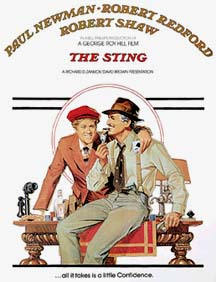
The Sting

Pairing Paul Newman and Robert Redford, the duo ended up being a match made in heaven for 1969's Butch Cassidy and the Sundance Kid. Could the pairing work again? Oh, you bet. Teaming up again for 1973's The Sting, Newman and Redford again show off an impeccable chemistry, a great back and forth, and a whole lot of talent in one of the 1970s best movies and one of my all-time favorites.

Working in 1936 Joliet just outside of Chicago, con man Johnny Hooker (Redford) pushes too far on one con when he and his partner, Luther (Robert Earl Jones), steal some $11,000 from a money runner working for big-time New York mobster Doyle Lonnegan (Robert Shaw). The mobster hears about it and in the aftermath, Luther is killed. On the run and always looking over his shoulder, Hooker seeks out Henry Gondorff (Newman), an infamous con man himself who's now on the run from the F.B.I. after a con of his went south. Hooker teams up with Gondorff, hoping to run a long con on Lonnegan to exact some revenge. With countless thieves, con men and grifters working their magic, a long list of things need to happen to pull the job off, but Gondorff and Hooker go to work knowing if the con fails, they may pay for it with their lives.

 The Newman-Redford pairing -- along with Butch and Sundance director George Roy Hill -- is clearly one that works and is a key reason for the movie's success. I don't say this often because I don't want to overdo and/or overuse it, but The Sting is one of those rare perfect movies. All the scenes work without any extra fat on the bone. Even at 129 minutes, it flows effortlessly. The script (which won an Oscar) is one of the all-time greats. On first viewing, it might be a little difficult to keep up with everything, but in the end it fits together like puzzle pieces clicking into place. Smart, funny and well-written, the script helps bring this criminal underworld to life....in a nice way. It's the 1930s "criminal" underworld that the movies presented.

A period piece like this depends on a couple different thing. The first and usually most important? Does it look and feel authentic to the period it is set in? That's a safe answer here. The look of the movie ends up being an additional character. You genuinely feel like you're watching 1930s Chicago from the sets to the bad-ass suits to the cars zipping around the downtown streets. Much of the film was shot in California backlots, but several scenes were filmed on-location in Chicago, including LaSalle Street Station, Union Station and the Penn Central Freight Yards. What most people will remember from 'Sting' though is the music, starting with Scott Joplin's whistle-worthy theme, The Entertainer. It gives the story a light-hearted touch -- almost a goofy feel -- but it ends up working perfectly with the tone. The locations, sets, costumes, and music all contribute to a great retro style -- along with title cards introducing the scenes -- that is hard to replicate.

So Newman and Redford, pretty cool, huh? They just don't make stars like this anymore. Watching talented actors of this caliber on-screen, it's just fun. Their chemistry never feels forced. It's just two guys playing off each other like they have been doing it their entire lives. While both actors play prominent roles, more focus is given to Redford's Johnny Hooker, a talented if younger grifter looking for some revenge. He learns the ropes from Newman's more experienced, somewhat grizzled con man. Redford was even nominated for an Oscar for his performance, but both have their moments. Newman especially gets some laughs in his scene where he meet Shaw's Lonnegan, posing as a drunken but rather lucky poker player who throws the hook out there so the crew can reel in their target. Putting on a big, boisterous entrance, Newman (entering with "Sorry I was late, I was taking a crap") hits all the right notes in a part that allows Redford most of the spotlight.  

In one of his most memorable roles before his death at the age of 51, Shaw is a great villain to counter Newman and Redford's very likable crooks. His Lonnegan will kill anyone who gets in his way and isn't picky or squeamish about doing so. As for the rest of the cast, Charles Durning is appropriately double-handed as Lt. Snyder, a Joliet cop with a grudge against Hooker. Putting together a team of thieves, Gondorff assembles Kid Twist (Harold Gould), the smooth-talking organizer, J.J. Singleton (Ray Walston), the veteran con man with a knack for investigating, Eddie Niles (John Heffernan), the numbers specialist, Billie (Eileen Brennan), his madam of sorts, and Erie Kid (Jack Kehoe), Hooker's former partner who's down on his luck. Dana Elcar has a small part too as F.B.I. agent Polk, hot on Gondorff's trail.

What I love most about The Sting though is how it all comes together in the end. We're given all these clues, characters and situations early on, but we're never quite sure how it fits together. The title cards sort of help -- The Hook, The Set-Up, The Sting -- but it's great to see the con come together so smoothly. Gondorff has hinted that it's not always the job that's the toughest. It's the aftermath and getting away alive. With that in mind, the last 30 minutes throws a handful of twists our way, all of them working, some working epically well. It's a great finale full of twists, surprises and some laughs. A great movie from start to finish.

The Sting <---trailer (1973): ****/****

Thursday, March 8, 2012

The Taking of Pelham One Two Three (1974)

A trend in movies that seems to be taking root lately is remaking movies that don't need to be remade. Classic movies that resonate with audiences and are still remembered fondly must be ripe for the picking. Studios figure audiences liked it then....well, they'll like it now. That was the case with 2009's The Taking of Pelham 123 (read my review HERE). It was a good enough movie, but it didn't need to be made. The original, 1974's The Taking of Pelham One Two Three is a classic in its own right and hard to improve upon.

It's a typical day in New York City when four men suddenly hijack a subway train, Pelham 1-2-3. They call in to the Transit Authority, talking to Transit cop, Lt. Zach Garber (Walter Matthau). The four men, led by Mr. Blue (Robert Shaw), have uncoupled one train with 18 passengers and have some demands. The city of NY has exactly one hour to produce $1 million dollars and put it right in their hands. If they don't? Blue and his cohorts will start executing one hostage per minute. Garber passes the news along, and the city comes to life, police, SWAT, everyone getting involved. Garber starts to wonder though, what are the hijackers up to? They're underground in a tunnel with nowhere to go and surrounded on all sides. How can they possibly hope to escape?

If an example of a 1970s crime drama/thriller was ever needed, 'Pelham' is a perfect example. It belongs up there with The French Connection, Death Wish and Marathon Man as some of the best crime genre movies to come out of the otherwise pretty stylish 1970s (in films at least). Director Joseph Sargent has made a gritty, realistic gem here, one uninterested in a stylish, flashy story. There isn't a wasted moment in its 104-minute run-time. Watching it feels like a pseudo-documentary with a camera placed in front of the real-life performers, not actors. It isn't interested in being flashy. It only wants to ratchet up the tension to the point where it's unbearable. Blue's hour-long countdown keeps ticking away, and NYC doesn't seem any closer to giving him his money. A police car with the money racing through the streets is one thrill after another, time running out and the executions drawing ever closer.

This would be a fitting time capsule for New York City in the 1970s. Almost the entire film was shot on location in NYC, even using an abandoned stretch of subway for the underground shots. But more than just the visual, 'Pelham' paints a picture of 1970s NYC. The Mayor (Lee Wallace) is sick when the hijack takes place, but with free-falling numbers in popularity polls drags himself out of bed. His wife (Doris Roberts) claims he just earned "18 sure votes." From the police commanders handling the situation to the beat cops delivering the money to the hostages wondering what's happening to Garber and his crew at Transit Authority, there's a cynicism, a dark humor hanging over the situation. David Shire's score isn't used much, but it's jazzy, quirky aggressive sound is perfect. This is NYC. A hostage situation? Eh, just one more problem to deal with.

Thanks to the talents of Matthau and Shaw, a hostage situation handled entirely by radio conversations is surprisingly exciting to watch. They communicate via radio, Shaw's Mr. Blue calmly delivering his demands to a world-weary but shocked Garber sitting in the Transit Authority office. There is an ease to these scenes, a flowing rhythm between these two actors that drives the action. Who better to play a cynical New Yorker than Walter Matthau? I can't think of a single person. And playing Mr. Blue, a hardcore mercenary looking for cash? Robert Shaw is ideal. His Blue even does a crossword while sitting in the train waiting for news. The rest of Blue's crew include a scene-stealing part for Martin Balsam as Mr. Green, a former motorman fired from his duties, Hector Elizondo as Mr. Grey, and Earl Hindman (Yes, Wilson from Home Improvement wants to kill you) as Mr. Brown. Also look for Dick O'Neill as Corelli, a supervisor in Transit Authority worried about the train schedule backing up, and Jerry Stiller as Rico, a police officer working with Matthau's Garber.

As the hostage situation develops, the story's momentum picks up. What exactly do these nuts intend to do? They're trapped, cornered, no way out. How could they possibly manage an escape? The final 20 minutes provide some good twists (including a secret about one of the hostages) and a couple surprising revelations about how things are wrapped up. The best though is the last scene, a final shot so perfect that only Walter Matthau could pull it off.

It's easy now to see how this 1974 crime thriller has influenced countless movies of its ilk since. The most obvious of course is Quentin Tarantino's Reservoir Dogs, naming his heist crew by colors and not their real names. But that's only the start. 'Pelham' gets right to the point and isn't worried about any side stories or truly developing the characters. Here's the situation, they're doing it, sit back and enjoy. Anything else would be needlessly extra. You can watch it HERE at Youtube (Part 1 of 11), but it isn't the greatest quality.

The Taking of Pelham One Two Three <---trailer (1974): *** 1/2 /****

Sunday, May 29, 2011

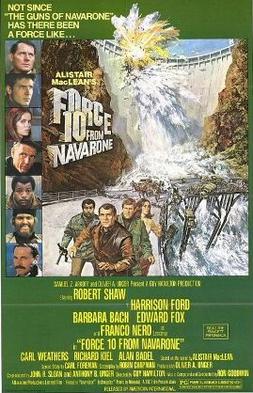
Force 10 from Navarone

Certain war movies rise above the genre, establishing themselves as classics that are more action and adventure romps than hard-hitting war movies. Released in 1961, The Guns of Navarone is definitely one of those, a WWII commando story that is considered to be one of the best WWII movies ever and one that helped liven up the genre heading into the 1960s. Based on a novel by Alistair MacLean, 'Navarone' was very popular, and while it wasn't exactly timely, some 17 years later, a sequel was released, 1978's Force 10 from Navarone.

Sequels are almost always a mixed bag when it comes to any sort of quality or appreciation from the fans. This is the oddest sort of sequel, one released long after the original with no returning cast members.  An aging Gregory Peck and David Niven would have looked quite ridiculous as WWII commandos, wouldn't they? Instead, a whole new cast steps in, taking over parts made famous by other actors.  Is that a bad thing? I never thought so. I read MacLean's Force 10 (the novel) as a kid, pursued the movie, and loved it. It was a favorite of AMC among other channels, and I've lost track of how many times I've watched it. Not as good as the original, but still an underrated WWII flick that doesn't deserve some of the hate it's gotten over the years.

Several months removed from their successful mission in Navarone, Capt. Keith Mallory (Robert Shaw) and Cpl. Dusty Miller (Edward Fox) are called back in to perform another mission. They are to be sent into Yugoslavia to kill an enemy agent, the man who blew their cover in Navarone and is now hiding out as a member of the partisans fighting the Germans. It's believed the man's name is Lescovar (Franco Nero), but Mallory and Miller must make sure. They'll travel with an American commando unit, Force 10, commanded by Lt. Colonel Barnsby (Harrison Ford) who resents having two more men traveling with his own. Almost from the start though, the mission seems doomed to failure, and Barnsby must turn to Mallory and Miller for help. Against impossible odds, they team together to pull off their mission, but also Barnsby's, one that could turn the tide of war in Yugoslavia.

Before the credits even roll, this movie is fighting an uphill battle with any viewer who knows and loves the original Guns of Navarone.  That movie is a classic, and no matter what this one does, it isn't going to live up to expectations. And just to be clear, Force 10 isn't as good as 'Guns.' It's not even close. Viewed as a stand-alone film, I'd like to think this movie would be held in higher regard by viewers and critics alike. It does nothing particularly new for the WWII commando genre, the script is limiting, bouncing around too much, and the production feels like a small budget was used. Call it sentimentality, but I like this movie a lot in spite of its flaws. And like any movie, there are flaws. It is being able to look past them and just enjoy yourself.

The men-on-a-mission movie, where ensemble casts go to thrive. Without the Hollywood legend name recognition of 'Guns,' director Guy Hamilton (of James Bond fame) does not disappoint assembling his cast. One of my all-time favorite actors, Robert Shaw steps in for Gregory Peck as Capt. Mallory, commando extraordinaire, if a little aged. A year removed from the giant success that was the original Star Wars, Harrison Ford looks ridiculously young as Lt. Colonel Barnsby, the commander placed in an impossible situation. Fox is a scene-stealer as Miller, putting his own personal spin on the part Niven played. Joining the team is Carl Weathers as Sgt. Weaver, an accidental tag-along on the mission. Also, watch for Bond alums Richard Kiel as Drazak, an immense Chetnik fighter hunting Mallory and Barnsby's team, and Barbara Bach as Maritza, a tough partisan playing both sides seemingly.

Complain about anything you want, but that assembling of talent is impressive no matter how you cut it. The tone here -- thanks to the cast changes -- is lighter, especially between Shaw's Mallory and Fox's Miller. They bicker like an old married couple, but never pushing the humor too much. It's subtle, some great one-liners thrown about if you're paying attention. This was also Shaw's last completed movie before his death later in 1978. With so many characters, it can't be helped that not everyone is given much to do. Characters drift in and out as needed. It barely resembles MacLean's novel to begin with. Here's what it comes down to though. We've got Quint (Shaw), Han Solo/Indiana Jones (Ford), Django (Nero), Apollo Creed (Weathers), a Bond villain in Jaws (Kiel), the Jackal (Fox), and a Bond girl (Bach). Talk about a great group. Can you name a more eclectic cast than that one?

Different versions of the movie exists (odd for a movie from the late 1970s), but they all clock in at around two hours. The widescreen version on the DVD is the longest at 126 minutes. The story certainly takes its time moving along, an almost episodic pacing keeping things going. There really isn't a pointed, one-way plot, just a series of adventures and misadventures. Some parts just work better than others, but once the missions are established, the movie picks up steam. The ending especially is impressive, Mallory, Barnsby and Co. working together to prevent three divisions of German armor and infantry from wiping out the last remaining partisan brigade. It's typical men on a mission fare, an impossible mission against impossible odds. There's no way they get the job done....unless...oh, wait. This is a movie. Of course they get the job done.

Force 10 from Navarone is a solid if unspectacular (and highly entertaining) WWII commando movie. I've always thought it would be more popular if it wasn't attached in anyway to the original Guns of Navarone, but it is what it is.  Great cast, fun story, whistle-worthy score from Ron Goodwin (listen to a sample HERE), good action, a gratuitous nude scene of Barbara Bach, and a few laughs here and there. Can you ask for much more? It's fun from start to finish.  

Force 10 from Navarone <---trailer (1978): ***/****

Friday, May 6, 2011

Sea Fury

Most well-known for his performances in a handful of John Ford movies, Victor McLaglen was one of the great character actors to come out of Hollywood's Golden Age. In the Ford movies, his theatrics were often a little too much, a little too jokey for my liking, but it doesn't take away from a great career.  It was one that saw him star in over 100 movies (silent and sound), even winning a Best Actor Oscar for his performance in The Informer.  He died in 1959 from a heart attack, just a year after completing his final film, 1958's Sea Fury.

It can be sad watching actors and actresses in their last films, and for McLaglen, that's true on several levels.  In his 70s by the time this movie was made, he looks every inch of 70 if not more.  He's playing a character he often played, a rough, brawling and boozing man who's led a tough life but plans on going out kicking, not lying back in bed.  McLaglen just doesn't look himself though right from the start. What makes it worse is that through all his trademark blustering is that's nearly indecipherable, mumbling his way through lines to the point it's hard to comprehend a thing he says. The performance is far from bad, but it's not up to his standards that he established over a 30-plus year career.

Captaining the Fury II, a tugboat salvage vessel, Captain Bellew (McLaglen) leads his ship into port in the Bay of Biscay hoping to get help for his long-time first officer, severely wounded in an accident.  It's in port that he meets Salgado (Roger Delgado), a poor man who tries to set up Bellew with his very beautiful young daughter, Josita (Luciana Paluzzi). The weathered old captain tries to buy young Josita's affections with many gifts and presents, but she wants nothing to do with him, much less marry him as her father intends.  Instead, she falls for Abel Houston (Stanley Baker), a new crew member aboard the Fury, who returns her affections. Going behind the captain's back, Abel starts to see Josita, knowing that eventually everything with come crashing down. As the confrontation comes to a head, the Fury receives a radio report of a wrecked ship carrying a valuable cargo. It's a race to the wreck with a rival ship, the tension momentarily thrown by the wayside.

A film generally forgotten over the years, 'Sea Fury' is an interesting piece for several reasons. If nothing else, it is McLaglen's last film, the last chance viewers have to see him before his death a year later in 1959.  More than just that though, it's dark look at action on the high seas through the eyes of a salvage vessel (a shady occupation if there ever was one). Director Cy Endfield's film has not aged well over the years, but that could just be the print I saw on TCM. Shot in black and white, 'Fury' still is a pleasure to watch. The little, tucked away coastal village in Cataluna is idyllic, like a picture of a time long since past. The musical score is Spanish-themed, a Spanish guitar playing lightly in the background, giving a soothing feeling to the story that will not end well. More on that later.

I've made no cover-up about my dislike for the love triangle plot-line in movies, TV, books, and generally...pop culture.  It's a lazy way to create conflict among a group of characters, and is about as hackneyed a topic as one you'll come across.  If you are going to go down that route, at least do it the right way, and 'Fury' definitely tries.  It is clear from the start that Paluzzi's Josita is only going along with her father's wishes to make him happy. She has no intention of ending up with McLaglen's much older, unattractive brawler.  There's the tension because Baker's Abel clearly knows it too.  This isn't a lovey-dovey triangle where the cute girl has to decide who she'll end up with. You fear for Baker's life, knowing if McLaglen's Captain finds out, he's going to take him out.  The tension and fear is genuine, even if the execution in the end disappoints.

The three main leads -- McLaglen, Baker, and Paluzzi -- are an interesting bunch. McLaglen was the most established, Baker a rising star, and Paluzzi was fast-becoming a sex kitten on-screen.  The dynamic among the three of them drives the movie, always keeping the story flowing along.  I talked about McLaglen's performance already, disappointing for a last hurrah.  Baker is the more prototypical lead, young, handsome, and strong.  Paluzzi -- at 21 years old -- is drop dead gorgeous, plain and simple.  As an actress, she's still raw, but the potential is there.  Also look for Gregoire Aslan as Fernando, a fellow member of the crew, a young Robert Shaw as a conniving officer on board, and British character actor Percy Herbert as an insubordinate member of the Fury's crew, among others, none of whom I recognized.

The tension is there, the potential for a great ending just waiting to be tapped, and then? Nothing. Happy ending. Everyone walks off into the sunset, happy with how things turned out.  As Mr. Cynical, I Love Downer Endings, it seemed obvious to me to kill Baker's character during a dangerous salvage mission near the end (there's some great footage here of an open sea rescue, very exciting and expertly handled). Even Endfield shoots the action like Baker's Abel will be killed, but he ends up making it. Happy with his big score, Bellew gives Josita to Abel, and credits roll. It was a wasted effort in my mind only because the build-up keeps working toward a downer ending, and then pulls the rug out from under you.  Still a decent enough movie, but not nearly what it could have been.

Sea Fury (1958): ** 1/2 /****

Friday, April 16, 2010

A Town Called Hell

When watching a spaghetti western, there's a certain amount of weirdness to be expected.  After all, these were typically European directors/producers/screenwriters interpreting the American west so weirdness just comes with the territory.  But beyond anti-heroes and crazy villains, the spaghettis were often heavy on graphic violence, religious imagery and symbolism, and no penchant for having to have a happy ending.  Basically, everything I like in a western.

For years, the craziest spaghetti I saw was 1967's Django Kill! which features some truly disgusting violence, a gang of gay cowboys, and...wait, that's enough, violence and gay cowboys is a good explanation.  Last night on Netflix Instant viewing, I checked out 1971's A Town Called Hell for a couple reasons, I've never been able to actually track a copy down, and two, the cast looks ridiculously good.  It's not a straight Italian spaghetti western with British and Spanish backing, but it's got all the right elements.  If anything, it's got too many elements.  This one is all over the place and ranks right up there with Django Kill! for new weirdest spaghetti.

It's 1905 in Mexico (right in the middle of the Mexican revolution for you history buffs).  A widower, Alvira (Stella Stevens) rides into the dusty, rundown town of Bastardo -- not 'Hell' as the title implies.  She is offering $20,000 for the man who murdered her husband, but she doesn't know who he is, only that he's in the town.  Alvira's only clue is a name...'Aguila.'  But other than that, she's got nothing to go on.  Three key people in Bastardo seem to have information.  There's the Priest (Robert Shaw), the Colonel (Martin Landau) with his army detachment, and Don Carlos (Telly Savalas), the town's corrupt mayor/bandit. But nothing comes easy, and the betrayals start flying and the bodies start to add up.

Where to start?  Spaghetti westerns generally had an extremely dark tone full of cynicism and violence, lots of anti-establishment feelings.  'Hell' certainly qualifies because no character is safe.  The violence isn't graphic but it is brutal in its honesty.  There are hangings, stabbings, shootings, and so much more.  The setting for this is a really desert town that has fortress walls on all sides, and even though the movie was made/filmed in Spain, it looks like Mexico in all its dusty, dirty glory.  I'm positive I'm reading too much into this, but the town could be some sort of purgatory, some bizarre version of hell.  Or it could just be a whacked out western, you make the decision. 

The story itself is too interesting with director Robert Parrish mixing and matching left and right.  An IMDB user stated there's at least 15 plots, they just last 2 or 3 minutes before moving on, and really, that's a pretty accurate description of this gothic, dark western.  Stevens sleeps in a coffin at night and has a pale deaf-mute protector, Spectre (Dudley Sutton), with her at all times.  Savalas is a violent dictator with an iron fist on this town...until he doesn't anymore when his men turn on him, crucifying him.  Shaw has a vivid dream where Stevens' Alvira kills him in his sleep.  Landau as a Mexican officer?  That does seem pretty logical.  A flashback with a sped-up version of the Battle of New Orleans and a bizarre, confusing backstory just caps it all off.  That's the movie in a nutshell, always moving and never slowing up enough to know how ridiculous it all sounds.

Through all of the craziness, there's a really cool if sometimes odd cast.  Robert Shaw is one of my favorite actors, and he's the star here.  Simply named 'the Priest,' he has a past that still gnaws at him, and he seems to be the only person who knows who 'Aguila' is.  On a non-consequential level, Shaw is also sporting a badass handlebar mustache and mutton chop-like sideburns.  Savalas is the shirtless bandit mayor (honestly, in his 30 minutes he never has a shirt on) who gets to ham it up.  His departure about 30 minutes does come as a surprise, mostly because we never see how he gets whacked.  Landau is the only one who doesn't work because well, he's not Mexican.  He's loud and obnoxious but still isn't a good villain.  Stevens is wasted -- but looks good doing it -- and appears like she wandered into the set and just started reciting lines.

There's also supporting parts for Fernando Rey as an old blind man who may hold the key to Aguila's identity, spaghetti western regular Aldo Sambrell as Calebra, one of Don Carlos' thugs, TV star Michael Craig in flashback as Paco, one of the Priest's partners, and Al Lettieri as La Bomba, Carlos' not so smart treacherous right hand man.  What I liked about this western -- and I did like it -- was the general weirdness of it all.  There's this great cast and no story (not a coherent one at least), but all the little things add up.  Recommending this almost in spite of itself.

A Town Called Hell <----trailer (1971): ** 1/2 /****

Sunday, May 24, 2009

Battle of Britain

Heading into May, I had this plan to watch and review a bunch of WWII movies in honor of Memorial Day. Well, Memorial Day is tomorrow so that's not going to happen, but I can still get a couple reviews in at least.

Battle of Britain (1969), directed by Guy Hamilton of James Bond fame, is everything that was good and bad about the epic war movies to come out of the 60s, and really epic movies in general. Growing up in the good old USA, the early parts of WWII were never taught as much as the post-Pearl Harbor years once America got involved in the war so this movie serves as a good introduction to the earlier years of the war. Immediately following the Dunkirk disaster, it appears that Hitler and the Third Reich are one good push away from winning the war. All that's needed for that final push is the invasion of England.

But before a cross-channel invasion can take place, Herman Goring and his illustrious Luftwaffe must knock out the Royal Air Force so an invasion force can go across the channel relatively unmolested. For the RAF though, they're heading into a battle with the odds heavily stacked against them with just 600 pilots to Germany's 2,500. As Laurence Olivier's Air Chief Marshal Dowding so eloquently but effectively states, "Our boys are going to have shoot down their boys at a rate of 4 to 1." So begins the battle of Britain, here's the film's opening, a good sum-up of what's happened and what's to come.

With a movie that focuses exclusively on a key moment in Britain's history, the benefits are obvious. Director Hamilton collects a who's who of British actors to fill out his cast. Olivier and Trevor Howard star as Dowding and Air Vice Marshal Park, the higher-ups in the RAF who oversee the desperate fight in the air. As the pilots, Micheal Caine, Robert Shaw and Christopher Plummer lead the fight with Ian McShane and Edward Fox as two pilots in Shaw's squadron. And then making short appearances are Curd Jurgens, Harry Andrews, Patrick Wymark, Michael Redgrave, Kenneth More, and Ralph Richardson. If that cast doesn't impress you at least a little bit, this might not be your movie.

As I've covered before though, the flaw with such a huge cast is the characterization which suffers. These characters are more outlines of historical figures than flesh and blood people. Plummer stands out mostly because he's given a love interest, the beautiful Susannah York, so we find out something about his squadron leader. You're not hoping Caine's Squadron Leader Canfield makes it, you're hoping Michael Caine makes it. The same with Shaw and Plummer. But that's a minor flaw for me, not something that should stop you from seeing the movie.

And surprise, surprise, what's the actual reason for seeing a movie built around WWII in the air? If you answered 'dogfights' and lots of aerial footage, pat yourself on the back. It's a pre-CGI movie that relies on actual footage being shot of these pilots in action, the British Spitfires tangling with the German Stukas, here's one great scene with Goring asking his officers what they need to win. The film will sink or swim for most viewers on the dogfights, which do eat up most of the movie's 132-minute running time. The best is saved for last appropriately enough as the British throw all their reserves into the battle in one last, desperate ploy to stop the Luftwaffe. It's a 4-minute scene with no dialogue, no sound at all other than Ron Goodwin's score, sampled here, a very British score indeed.

Hamilton's movie then is not so much about the characters as the battle itself. Obviously, without the pilots, WAFs and coast watchers, the battle for Britain could not have happened. But Hamilton goes for the spirit of these people. Maybe we don't know much about them, their personal backgrounds, but they're fighting for what they believe in to stop a power-hungry Adolf Hitler as he swept across Europe. If these pilots hadn't held off the Luftwaffe and ultimately won the battle, who knows how different the world would be right now? It's a frightening thought. And that's why Battle for Britain works, even with its flaws.

Still wavering? Here's a trailer, a long one at that, and a longer preview of the movie as a whole. A WWII movie not as well known as many war movies of the time, but one definitely worth checking out if you've missed it up to now.