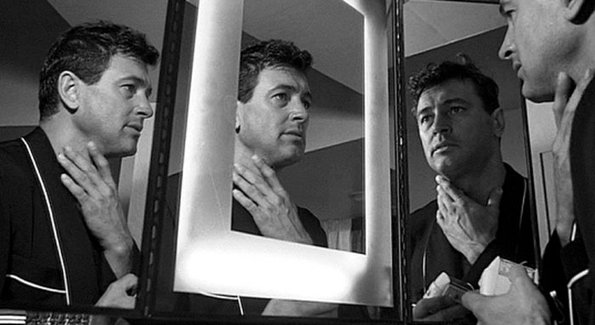
The Wild West in the post-Civil War years was synonymous with a lot of things, but maybe none more than the infamous gunslingers, gunfighters and pistoleros that roamed the country. Some are instantly recognizable like Billy the Kid, Jesse James, Wild Bill Hickok, while others don't have that notoriety. Take John Wesley Hardin for instance, reputed to have killed more than 40 people depending on what you read. Stick with Wikipedia though for any facts because 1953's The Lawless Breed...well, it's a steaming pile of you know what.
It's the years following the Civil War in Texas and young John Wesley Hardin (Rock Hudson) has grown up under a strict, God-fearing father who's tried to instill his own strict beliefs in his son. Wes as he's called, he's not interested. He's worked long and hard to be fast with a six-shooter and wants nothing more than to marry his longtime crush, Jane (Mary Castle), and start working at building up a farm where he can care for and sell horses. That's his plan at least. His father's actions push him away to the point young Wes finds himself in a saloon in a card game that goes poorly quickly. A man across the table draws first, but Wes outdraws him, killing him. Witnesses say otherwise though, forcing Hardin on the run as he tries to prove his innocence. The rewards and bounties grow larger and so does the body count as Wes tries to put the killing behind him (sort of). Can he though or will his name and reputation be too much?
My timing here is interesting. I'm currently reading Larry McMurtry's Streets of Laredo, his sequel to one of my favorite books, Lonesome Dove. John Wesley Hardin is a supporting character in the western novel, portrayed as an unhinged killer with no qualms about shooting anyone for any reason. Then, I saw this pop up on a movie channel and thought I'd give it a try. I shouldn't have...
From director Raoul Walsh, 'Breed' is based off the autobiography Hardin wrote about his life while serving a prison sentence in the 1880s/1890s. To say it stretches the truth a little is a massive understatement. It portrays Hardin as a kid who ends up in the wrong place time and time again and has to kill people over and over again because there's just no alternative. Yuck. Gag me. It's like an anti-revisionist western, hell-bent on portraying one of the west's more dastardly killers as...well, a decent guy! The script is a mess, drifting along far too much even at just 83 minutes, and though the casting is interesting (at times), most of it falls short because that source material is just so weak. Both in character portrayal and visual look, 'Breed' is too clean, too polished and too manicured as it tries to make a killer into the unlikeliest of heroes.
A rising star by 1953, Hudson gives it a go, but this isn't great casting for John Wesley Hardin. It tries to portray him as misunderstood but the next second it shows him as a bit of a scamp, a liar and a gambler who doesn't intend to keep his promises. If we're supposed to feel sympathy for this fella, there's an epic misfire. No matter what happens, the character just keeps digging deeper and deeper, never realizing it's all his fault and that he's to blame. If you're not on our "hero's" side, then things are going to get rough before they get better.
The rest of the cast has some name recognition, but again, the script does them no favors. Julie Adams is Rosie, the saloon girl turned potentially more with Wes, representing herself fairly well with a script that has her wearing very little and leaning forward a lot seductively. I'm sure her back was bothering her, nothing sinister about being able to see down her shirt/dress/blouse. In the oddity department, John McIntire plays dual roles, one as Wes' Bible-thumping Dad and the other as his more fun-loving but hard-working uncle. The Uncle is better than the Dad, but still, it's odd to just go along with. Also look for Dennis Weaver, Lee Van Cleef, Michael Ansara, Forrest Lewis, and Hugh O'Brian in supporting parts.
I kept waiting for something enjoyable, entertaining or interesting to come along but to no avail. By the time the framing device of Wes and his autobiography wraps up...well, it's not good. The newspaper editor looks longingly off-camera and when asked how the story ends says "I'm not sure. It's a story that hasn't ended yet." The ending itself is laughable compared to Hardin's real-life death, read about that HERE with SPOILERS obviously, to the point I actually groaned when "The End" popped up on the screen. It's a B-western, but it's a bad one with very little other than the lovely Julie Adams to recommend giving it a watch. Give it a big, old wide berth!
The Lawless Breed (1953): */****
The Sons of Katie Elder
"First, we reunite, then find Ma and Pa's killer...then read some reviews."
Showing posts with label Rock Hudson. Show all posts
Sunday, December 6, 2015
Wednesday, December 10, 2014
Giant
So there's the United States, but if you ask some people from Texas, there's a different way of looking at it. There's 49 states that make up the U.S., and then there's TEXAS!!! A giant state with some giant personality, it needs a movie just as big as the idea of the state to really get the message across. Here's an epic that certainly tries, 1956's Giant.
It's the early 1910s and young, powerful Texas rancher Jordan 'Bick' Benedict (Rock Hudson) travels to a farm in Maryland to buy a strong, beautiful young horse. There, he finds what he's looking for and much, much more. Instantly struck, Bick marries the seller's daughter, Leslie (Elizabeth Taylor), who's as equally moved by the big, strong Texan. Leslie travels back to Texas with Bick where she's stunned by the immensity of the Benedict ranch, hundreds of thousands of acres with cattle numbering in the thousands. The life is hard but worthwhile...for those accustomed to it. Leslie is used to a certain openness about living and prejudices and beliefs, none of which she finds in Texas. The marriage is just weeks old, but Bick and Leslie begin to butt heads almost immediately. The young couple with everything at their disposal, right at their fingertips, is heading into a turbulent time, both for themselves but also for Texas.
Some movies just scream EPIC, and in the age of the monster budget, historical epics, this 1956 Texas family drama from director George Stevens certainly qualifies. Based off a novel from author Edna Ferber, this is a big old movie. At the time, it was the most expensive film ever made. The scope and scale is gigantic. Stevens took advantage of the widescreen filming techniques, filling the screen with the wide expanses of the Texas plains in all its sunny and sandy glory. Visually, 'Giant' is a stunner. Dimitri Tiomkin's score is solid but more subdued than most of his more well-known scores and with an obvious reliance on some patriotic Texas songs. A must in an epic -- seemingly -- is to get a message across though, to say something. That's where 'Giant' seems to stumble in a big way. I don't know if it's trying to say much of anything. That's for a little later. For now, here's some positives to take away.
So big story, big setting....yeah, we need a big cast. Two rising stars who were definitely on the way to bigger and better things in Rock Hudson and Elizabeth Taylor. I was interested in these characters which is a credit to Hudson and Taylor because let's be honest. These aren't especially likable characters. They bicker, fight and argue about anything and everything. Love at first sight....until real life settles in. So they're not especially likable, but they do a fine job bringing these characters to life. It feels like real life, two madly in love individuals figuring out marriage and love isn't so easy. Neither is a truly great performance, but they're very solid performances just the same.
Unfortunately, 'Giant' was remembered both then and now for the sudden, tragic death of one of its cast members. That actor? The iconic James Dean, star of just three movies before his sudden passing in 1955 before the film was completely finished, just 24 years old when he died. Here, he plays Jett Rink, a lower class cowboy working on the Benedict Ranch, a thorn in Bick's side but liked by everyone else. Jett was my favorite character, a remotely sympathetic anti-hero just trying to make his way, to carve out a niche for himself. A late monologue had to be re-recorded because the dubbing hadn't been completed before his surprising death during post-production. It's a quiet, understated part with some great moments (early on at least), especially when Jett's land proves to be far more valuable than originally thought. An obvious influence on many actors who would rise to stardom in the coming years, Dean is a gem.
Okay, enough with the relative positives. I love epics, especially those from the 1950s and early 1960s. This one pushed even me to the limits to the point I struggled to get through the last hour-plus in a movie that already runs 201 minutes. The first 90-120 minutes are pretty good if nothing classic in my mind. Then from there on in, the story jumps to when Bick and Leslie are far older, their empire grown, their family established and all grown up. At this point, all the issues introduced early are basically brushed aside. The story -- not exactly fast-moving up to this point -- grinds to a complete halt. Characters are introduced and dispatched with little fanfare. It drifts aimlessly until an ending that to put it lightly is disappointing. Was there an ending in mind that actually accomplished something? 'Giant' limps to the finish line after a painfully slow 3-hour road trip.
That's the biggest issue. What -- if anything -- is it trying to say? It's obviously a story focused on family and Texas and all their drama. Let's say this though. There is A LOT of drama. It's everything from marital strife to racism, sexism to political corruption, old school versus new school, parenting methods to manipulation of all sorts and on countless different levels, cattle ranching to becoming an oil baron. Pick one, or even two or three, and run with it. Instead, Giant just barrels ahead with all of the above and lets things fall where they may.
Now back to the casting. The characters may not always be very good, but the star power is impressive. Mercedes McCambridge does what she does best as Luz, Bick's sister who's a tomboy, a bit of a spinster, and if this movie was in 2014...a tough as nails lesbian. Chill Wills is solid in a more subdued part as Bick's very Texas uncle. As for the younger generation that pops up in the last third of the movie, look for Carroll Baker, Sal Mineo, Earl Holliman, and Dennis Hopper. Oh, and for good measure, Paul Fix and Rod Taylor have underused supporting parts so there's that. A big disappointment for me though, one I really, REALLY wanted to love. I came away barely tolerating it. A major disappointment.
Giant (1956): **/****
It's the early 1910s and young, powerful Texas rancher Jordan 'Bick' Benedict (Rock Hudson) travels to a farm in Maryland to buy a strong, beautiful young horse. There, he finds what he's looking for and much, much more. Instantly struck, Bick marries the seller's daughter, Leslie (Elizabeth Taylor), who's as equally moved by the big, strong Texan. Leslie travels back to Texas with Bick where she's stunned by the immensity of the Benedict ranch, hundreds of thousands of acres with cattle numbering in the thousands. The life is hard but worthwhile...for those accustomed to it. Leslie is used to a certain openness about living and prejudices and beliefs, none of which she finds in Texas. The marriage is just weeks old, but Bick and Leslie begin to butt heads almost immediately. The young couple with everything at their disposal, right at their fingertips, is heading into a turbulent time, both for themselves but also for Texas.
Some movies just scream EPIC, and in the age of the monster budget, historical epics, this 1956 Texas family drama from director George Stevens certainly qualifies. Based off a novel from author Edna Ferber, this is a big old movie. At the time, it was the most expensive film ever made. The scope and scale is gigantic. Stevens took advantage of the widescreen filming techniques, filling the screen with the wide expanses of the Texas plains in all its sunny and sandy glory. Visually, 'Giant' is a stunner. Dimitri Tiomkin's score is solid but more subdued than most of his more well-known scores and with an obvious reliance on some patriotic Texas songs. A must in an epic -- seemingly -- is to get a message across though, to say something. That's where 'Giant' seems to stumble in a big way. I don't know if it's trying to say much of anything. That's for a little later. For now, here's some positives to take away.
So big story, big setting....yeah, we need a big cast. Two rising stars who were definitely on the way to bigger and better things in Rock Hudson and Elizabeth Taylor. I was interested in these characters which is a credit to Hudson and Taylor because let's be honest. These aren't especially likable characters. They bicker, fight and argue about anything and everything. Love at first sight....until real life settles in. So they're not especially likable, but they do a fine job bringing these characters to life. It feels like real life, two madly in love individuals figuring out marriage and love isn't so easy. Neither is a truly great performance, but they're very solid performances just the same.
Unfortunately, 'Giant' was remembered both then and now for the sudden, tragic death of one of its cast members. That actor? The iconic James Dean, star of just three movies before his sudden passing in 1955 before the film was completely finished, just 24 years old when he died. Here, he plays Jett Rink, a lower class cowboy working on the Benedict Ranch, a thorn in Bick's side but liked by everyone else. Jett was my favorite character, a remotely sympathetic anti-hero just trying to make his way, to carve out a niche for himself. A late monologue had to be re-recorded because the dubbing hadn't been completed before his surprising death during post-production. It's a quiet, understated part with some great moments (early on at least), especially when Jett's land proves to be far more valuable than originally thought. An obvious influence on many actors who would rise to stardom in the coming years, Dean is a gem.
Okay, enough with the relative positives. I love epics, especially those from the 1950s and early 1960s. This one pushed even me to the limits to the point I struggled to get through the last hour-plus in a movie that already runs 201 minutes. The first 90-120 minutes are pretty good if nothing classic in my mind. Then from there on in, the story jumps to when Bick and Leslie are far older, their empire grown, their family established and all grown up. At this point, all the issues introduced early are basically brushed aside. The story -- not exactly fast-moving up to this point -- grinds to a complete halt. Characters are introduced and dispatched with little fanfare. It drifts aimlessly until an ending that to put it lightly is disappointing. Was there an ending in mind that actually accomplished something? 'Giant' limps to the finish line after a painfully slow 3-hour road trip.
That's the biggest issue. What -- if anything -- is it trying to say? It's obviously a story focused on family and Texas and all their drama. Let's say this though. There is A LOT of drama. It's everything from marital strife to racism, sexism to political corruption, old school versus new school, parenting methods to manipulation of all sorts and on countless different levels, cattle ranching to becoming an oil baron. Pick one, or even two or three, and run with it. Instead, Giant just barrels ahead with all of the above and lets things fall where they may.
Now back to the casting. The characters may not always be very good, but the star power is impressive. Mercedes McCambridge does what she does best as Luz, Bick's sister who's a tomboy, a bit of a spinster, and if this movie was in 2014...a tough as nails lesbian. Chill Wills is solid in a more subdued part as Bick's very Texas uncle. As for the younger generation that pops up in the last third of the movie, look for Carroll Baker, Sal Mineo, Earl Holliman, and Dennis Hopper. Oh, and for good measure, Paul Fix and Rod Taylor have underused supporting parts so there's that. A big disappointment for me though, one I really, REALLY wanted to love. I came away barely tolerating it. A major disappointment.
Giant (1956): **/****
Saturday, April 26, 2014
The Undefeated
Considering the extreme and far-reaching effects the Civil War had on American history, it's odd there haven't been more movies about the most costly war in the United States' relatively young history. The western genre has done its fair share of quasi-Civil War movies, the war becoming a jumping off point for a shoot 'em up story. What to do once the war is over? Like Major Dundee and Vera Cruz, many went south into Mexico. We can add 1969's The Undefeated to that short list.
After four years of bloody fighting, the Civil War has come to a close, leaving both the North and South to figure out where to go forward. With some of his remaining soldiers, a former Union cavalry officer, Colonel John Henry Thomas (John Wayne), rounds up a herd of 3,000 wild horses with the intention of driving them south into Mexico where they'll sell them to Emperor Maximilian's forces. A former Confederate officer, Colonel James Langdon (Rock Hudson), who had outfitted his own regiment, is leaving his plantation behind, moving south to Mexico with his surviving men, along with their wives, children and family in hoping to start a new life. In turbulent times for both the U.S. and Mexico, these two groups' paths may cross, and with wounds from the war still fresh on both sides.
This portion of history has always fascinated me, especially in movies like this, Major Dundee and Vera Cruz. I grew up watching this John Wayne western, and in spite of its flaws, I've always been a fan. From frequent Wayne collaborator and director Andrew V. McLaglen, 'Undefeated' is a fun western with a very good, deep cast, authentic locations in and around Durango, Mexico (Dundee fans will appreciate some familiar spots), a memorable score from composer Hugo Montenegro (listen HERE, disregard the odd video choice), and in general an entertaining quality that lifts it up past the flaws. It plays like a lot of Wayne's later movies; easy to sit back and watch, some action and shootouts, some drama, some romance, and some laughs here and there. When westerns were changing so dramatically in the late 1960s and heading into the 1970s, it can be fun just to watch an old-fashioned western with good guys and bad guys. No more, no less.
In a pretty cool casting choice, Wayne goes toe to toe here with Rock Hudson. It's not the most obvious pairing, but it works, simple as that. Wayne is playing a variation on his archetypal cowboy part, the leader of a small, surviving group of volunteers that rode with him throughout the Civil War. Now, he's looking for some cash to start over with, hence the immense horse drive. Hudson's Langdon too is looking for a clean start, the horrors and severe losses of the war still fresh on his mind. They're two different men, but they also have many similarities. They're fighting men who stand by what's right, loyal to those who ride with them, and ultimately try to do what they should do, not what's easiest. Their scenes together are the high points of the story, an easygoing charm with just a little Union vs. Confederacy animosity lingering. Two parts I liked a lot.
Working with a big story and a whole lot of characters, there's a lot going on in 'Undefeated,' clocking in at 119 minutes. Both halves -- Union and Confederacy -- are interesting, but I liked Wayne's half more. His trail-worn, loyal riders include Ben Johnson as Short Grub, his right hand man, Harry Carey Jr., John Agar (his part was heavily cut, including his early death scene), Don Collier (a familiar face, often a stunt man in Wayne movies), Jerry Gatlin and Dub Taylor as McCartney, the cantankerous cook who's always looking to fight, a mangy cat, High Bred, at his side. NFL quarterback Roman Gabriel joins the cast too as Blue Boy, Thomas' adopted Cherokee son. With so many western regulars, there's an ease to these scenes that are just fun to watch. Also look briefly for small parts for Paul Fix, Royal Dano and Pedro Armendariz Jr.
With the kinda-sorta episodic story that amiably drifts along, half of the focus is on those Confederates. It's never boring, but it's also not as interesting as their Union counterparts. We meet Langdon's wife (Lee Meriwether), his buxom teenage daughter, Charlotte (Melissa Newman), and his widowed sister-in-law (Marian McCargo). His men include Bruce Cabot, NFL star Merlin Olsen, Jan-Michael Vincent, Robert Donner, Edward Faulkner and whiny Big John Hamilton. We get to see young, pretty Charlotte hold off Jan-Michael Vincent's Bubba Wilkes' advances (she like Blue Boy). We get to see worrying wife Lee Meriwether....well, look worried. Olsen's Little George hangs out with the kids, then fights the Union cavalry. There's plenty of familiar faces, some good parts, but it's simply not as interesting to watch. Not bad, just not as good as it could have been.
Certain portions of the episodic story drag, but some certainly stand out. The pre-credits sequence wraps up the Civil War in a quick Union attack on a Confederate position. Later, Wayne and Hudson must team up to hold off a bandit attack on the Confederate wagon train, a good, exciting sequence. My favorite though is a late battle between the Union riders and French cavalry, the horse herd used as a weapon and negotiating ploy with a Mexican officer (Tony Aguilar). I'm wavering here. It's not a great western -- maybe not even a good one -- but I'm always entertained watching it. John Wayne fans, western fans alike should like this one.
The Undefeated (1969): ***/****
After four years of bloody fighting, the Civil War has come to a close, leaving both the North and South to figure out where to go forward. With some of his remaining soldiers, a former Union cavalry officer, Colonel John Henry Thomas (John Wayne), rounds up a herd of 3,000 wild horses with the intention of driving them south into Mexico where they'll sell them to Emperor Maximilian's forces. A former Confederate officer, Colonel James Langdon (Rock Hudson), who had outfitted his own regiment, is leaving his plantation behind, moving south to Mexico with his surviving men, along with their wives, children and family in hoping to start a new life. In turbulent times for both the U.S. and Mexico, these two groups' paths may cross, and with wounds from the war still fresh on both sides.
This portion of history has always fascinated me, especially in movies like this, Major Dundee and Vera Cruz. I grew up watching this John Wayne western, and in spite of its flaws, I've always been a fan. From frequent Wayne collaborator and director Andrew V. McLaglen, 'Undefeated' is a fun western with a very good, deep cast, authentic locations in and around Durango, Mexico (Dundee fans will appreciate some familiar spots), a memorable score from composer Hugo Montenegro (listen HERE, disregard the odd video choice), and in general an entertaining quality that lifts it up past the flaws. It plays like a lot of Wayne's later movies; easy to sit back and watch, some action and shootouts, some drama, some romance, and some laughs here and there. When westerns were changing so dramatically in the late 1960s and heading into the 1970s, it can be fun just to watch an old-fashioned western with good guys and bad guys. No more, no less.
In a pretty cool casting choice, Wayne goes toe to toe here with Rock Hudson. It's not the most obvious pairing, but it works, simple as that. Wayne is playing a variation on his archetypal cowboy part, the leader of a small, surviving group of volunteers that rode with him throughout the Civil War. Now, he's looking for some cash to start over with, hence the immense horse drive. Hudson's Langdon too is looking for a clean start, the horrors and severe losses of the war still fresh on his mind. They're two different men, but they also have many similarities. They're fighting men who stand by what's right, loyal to those who ride with them, and ultimately try to do what they should do, not what's easiest. Their scenes together are the high points of the story, an easygoing charm with just a little Union vs. Confederacy animosity lingering. Two parts I liked a lot.
Working with a big story and a whole lot of characters, there's a lot going on in 'Undefeated,' clocking in at 119 minutes. Both halves -- Union and Confederacy -- are interesting, but I liked Wayne's half more. His trail-worn, loyal riders include Ben Johnson as Short Grub, his right hand man, Harry Carey Jr., John Agar (his part was heavily cut, including his early death scene), Don Collier (a familiar face, often a stunt man in Wayne movies), Jerry Gatlin and Dub Taylor as McCartney, the cantankerous cook who's always looking to fight, a mangy cat, High Bred, at his side. NFL quarterback Roman Gabriel joins the cast too as Blue Boy, Thomas' adopted Cherokee son. With so many western regulars, there's an ease to these scenes that are just fun to watch. Also look briefly for small parts for Paul Fix, Royal Dano and Pedro Armendariz Jr.
With the kinda-sorta episodic story that amiably drifts along, half of the focus is on those Confederates. It's never boring, but it's also not as interesting as their Union counterparts. We meet Langdon's wife (Lee Meriwether), his buxom teenage daughter, Charlotte (Melissa Newman), and his widowed sister-in-law (Marian McCargo). His men include Bruce Cabot, NFL star Merlin Olsen, Jan-Michael Vincent, Robert Donner, Edward Faulkner and whiny Big John Hamilton. We get to see young, pretty Charlotte hold off Jan-Michael Vincent's Bubba Wilkes' advances (she like Blue Boy). We get to see worrying wife Lee Meriwether....well, look worried. Olsen's Little George hangs out with the kids, then fights the Union cavalry. There's plenty of familiar faces, some good parts, but it's simply not as interesting to watch. Not bad, just not as good as it could have been.
Certain portions of the episodic story drag, but some certainly stand out. The pre-credits sequence wraps up the Civil War in a quick Union attack on a Confederate position. Later, Wayne and Hudson must team up to hold off a bandit attack on the Confederate wagon train, a good, exciting sequence. My favorite though is a late battle between the Union riders and French cavalry, the horse herd used as a weapon and negotiating ploy with a Mexican officer (Tony Aguilar). I'm wavering here. It's not a great western -- maybe not even a good one -- but I'm always entertained watching it. John Wayne fans, western fans alike should like this one.
The Undefeated (1969): ***/****
Sunday, December 2, 2012
Bright Victory
Some of my favorite war movies focus almost exclusively on the actual combat and fighting in war. Some of the best focus on the post-war lives of the soldiers. What about the soldiers who were wounded and/or traumatized by what they saw and experienced? The most obvious choices include The Best Years of Our Lives, The Men, Born on the 4th of July, but 1951's Bright Victory belongs in that grouping.
Working with a forward artillery unit laying telephone wire in 1943 North Africa, Larry Nevins (Arthur Kennedy) is struck in the side of the head by a German sniper's bullet. His optic nerves are destroyed, and doctors don't believe that surgery will ever restore his sight. Back in the states at a rehab facility, Nevins goes about the slow work of learning how to live as a blind individual. In a weird way, he has to re-learn how to be a regular person, relying on his other senses, using a walking stick. He has help along the way from other wounded vets (similarly blinded) and one girl, Judy (Peggy Dow), who he hits it off with immediately. All the while though Larry is worried about the reaction he'll get back home, especially from fiance, Chris (Julie Adams).
Released in 1951 from director Mark Robson, 'Bright' is an impressive, well-made movie. Filmed in black and white, it's a meat and potatoes kind of movie. The focus is more on the personal level than any sort of large-scale action. This is Larry's story as he learns how to live as a blind person. We sees his reactions and how he copes; anger, frustration (even attempting suicide once), acceptance and finally a desire to work at it and move on with his life. It was filmed on location at Valley Forge Medical Center -- a nice touch for authenticity -- and detours once or twice to some cool Philadelphia locations. Why focus on the bigger picture when the smaller, more focused picture is more effective?
One of the best things going for 'Bright' comes from its honesty in exploring Larry's plight. He's born and raised in Florida, and living in the deep South, he's developed a racist streak right up his back. However, if you're blind.....Yeah, exactly. Voice inflections aside, how can you tell if someone is black or white? Working through his therapy, Larry strikes up a fast friendship with similarly wounded black soldier, Joe Morgan (James Edwards). Larry doesn't realize it though, one day making a statement about 'n***ers' being moved into the ward. And let the fireworks fly. The developing feeling in Larry is highly effective in its simplicity. It takes a life-altering incident to change his mind, but he starts to realize 'what difference does skin color make?' For a movie in 1951 years ahead of the Civil Rights movement, that's a profound message.
Casting Kennedy as Larry is a match made in heaven. Arthur Kennedy could be a despicable villain like nobody's business. More than that though, he's a great actor, and this is a part that allows him to show off his range. He's more than believable in the part, and when he's going through the life of a blinded veteran, it doesn't feel forced. His relationship with Dow's Judy is interesting without being too cute, and the dilemma he feels about what he said to Joe and also what awaits at home helps develop the character. The racist aspect gives an added dimension to the character too, all for the positive in a great part for Kennedy.
Also look for Will Geer and Nana Bryant as Larry's parents waiting back home in Florida, Joan Banks and a pre-Mr. Howell Jim Backus as Judy's sister and brother-in-law, and Richard Egan and Murray Hamilton as two blinded vets Larry meets in the rehab ward with John Hudson play Cpl. Flagg, a non-com working with the wounded vets. If you watch early, you can also see Rock Hudson in a bit part as one of Larry's repair crew working in North Africa.
An underrated WWII movie that deserves more of a following. Moments like Egan's soldier meeting his wife and son (who's he never seen/met) are perfection in their honesty. That's the feeling the whole movie gives off. It isn't aggressively shoving a story and message in its face. It's content to be what it is. An effective, well-told and well-acted story with some great performances. You can watch the entire movie HERE at Youtube.
Bright Victory <---Youtube clip (1951): *** 1/2 /****
Working with a forward artillery unit laying telephone wire in 1943 North Africa, Larry Nevins (Arthur Kennedy) is struck in the side of the head by a German sniper's bullet. His optic nerves are destroyed, and doctors don't believe that surgery will ever restore his sight. Back in the states at a rehab facility, Nevins goes about the slow work of learning how to live as a blind individual. In a weird way, he has to re-learn how to be a regular person, relying on his other senses, using a walking stick. He has help along the way from other wounded vets (similarly blinded) and one girl, Judy (Peggy Dow), who he hits it off with immediately. All the while though Larry is worried about the reaction he'll get back home, especially from fiance, Chris (Julie Adams).
Released in 1951 from director Mark Robson, 'Bright' is an impressive, well-made movie. Filmed in black and white, it's a meat and potatoes kind of movie. The focus is more on the personal level than any sort of large-scale action. This is Larry's story as he learns how to live as a blind person. We sees his reactions and how he copes; anger, frustration (even attempting suicide once), acceptance and finally a desire to work at it and move on with his life. It was filmed on location at Valley Forge Medical Center -- a nice touch for authenticity -- and detours once or twice to some cool Philadelphia locations. Why focus on the bigger picture when the smaller, more focused picture is more effective?
One of the best things going for 'Bright' comes from its honesty in exploring Larry's plight. He's born and raised in Florida, and living in the deep South, he's developed a racist streak right up his back. However, if you're blind.....Yeah, exactly. Voice inflections aside, how can you tell if someone is black or white? Working through his therapy, Larry strikes up a fast friendship with similarly wounded black soldier, Joe Morgan (James Edwards). Larry doesn't realize it though, one day making a statement about 'n***ers' being moved into the ward. And let the fireworks fly. The developing feeling in Larry is highly effective in its simplicity. It takes a life-altering incident to change his mind, but he starts to realize 'what difference does skin color make?' For a movie in 1951 years ahead of the Civil Rights movement, that's a profound message.
Casting Kennedy as Larry is a match made in heaven. Arthur Kennedy could be a despicable villain like nobody's business. More than that though, he's a great actor, and this is a part that allows him to show off his range. He's more than believable in the part, and when he's going through the life of a blinded veteran, it doesn't feel forced. His relationship with Dow's Judy is interesting without being too cute, and the dilemma he feels about what he said to Joe and also what awaits at home helps develop the character. The racist aspect gives an added dimension to the character too, all for the positive in a great part for Kennedy.
Also look for Will Geer and Nana Bryant as Larry's parents waiting back home in Florida, Joan Banks and a pre-Mr. Howell Jim Backus as Judy's sister and brother-in-law, and Richard Egan and Murray Hamilton as two blinded vets Larry meets in the rehab ward with John Hudson play Cpl. Flagg, a non-com working with the wounded vets. If you watch early, you can also see Rock Hudson in a bit part as one of Larry's repair crew working in North Africa.
An underrated WWII movie that deserves more of a following. Moments like Egan's soldier meeting his wife and son (who's he never seen/met) are perfection in their honesty. That's the feeling the whole movie gives off. It isn't aggressively shoving a story and message in its face. It's content to be what it is. An effective, well-told and well-acted story with some great performances. You can watch the entire movie HERE at Youtube.
Bright Victory <---Youtube clip (1951): *** 1/2 /****
Labels:
1950s,
Arthur Kennedy,
Julie Adams,
Mark Robson,
Murray Hamilton,
Richard Egan,
Rock Hudson,
Will Geer,
WWII
Thursday, January 5, 2012
Ice Station Zebra
Part Cold War thriller, part submarine movie, 1968's Ice Station Zebra has a lot going for it. Good story, better cast and solid directing. For years, it gained more of a cult status because it wasn't even available on DVD. It's even known as one of Howard Hughes' favorite movies. How's that pointless trivia for you? So what happens to it? Somewhere along the line, 'Zebra' goes off the tracks.
Patrolling in the North Atlantic, Capt. James Ferraday (Rock Hudson) and the U.S.S. Tigerfish, a US nuclear submarine, receives a new set of orders. The Tigerfish is to pick up a new passenger, a British agent named Jones (Patrick McGoohan), and head north to find Ice Station Zebra, a civilian weather station floating on a polar ice cap. Jones can say nothing else about the importance of the mission, only that it must be accomplished. Picking up two other passengers, Boris (Ernest Borgnine), a Russian defector, and Capt. Anders (Jim Brown), a Marine officer, the Tigerfish heads north. Ferraday quickly figures out that there is a traitor among the group and maybe even his crew. Can they find out who it is as they desperately attempt to complete their mission?
'Zebra' is based on a novel by adventure/espionage master Alistair MacLean, author of The Guns of Navarone and Where Eagles Dare. This past summer I read 'Zebra' for the first time only to discover it was a mess. I struggled to go along with it unlike any other MacLean novel I'd read. Directed by John Sturges, the film suffers from some of the same problems. In 1968, a nuclear submarine was big news, especially a portrayal on said sub. Much like Tom Clancy would years later, 'Zebra' gets bogged down in the minutiae of day-to-day life on the submarine; traveling under an ice pack, using radar and advanced technology to locate icebergs and drifts, finding a suitable spot to break through the ice. None of this makes for an exciting visual story.
That's a start though, but not a finish. Leisurely doesn't begin to describe the story here, clocking in at 148 minutes with Overture, Intermission, Entre'Acte, and Exit Music. An epic is one thing -- the 1960s were full of them -- but there is no urgency, NONE, through the first half of the movie. Before the intermission, almost nothing happens. Top that off with an explanation of the mission being held off until 105 minutes into the movie, and yeah, we've got a problem. An espionage guessing game is one thing, but almost two hours of guessing? A little much. The MacLean novel wasn't much better, throwing consistently new twists at the reader out of the blue and as needed.
Part of the charm though and cult classic status earned by 'Zebra' over the years is the casting. Big names, yes, especially some solid action stars. Some are utilized better than others. Hudson makes the best impression as Ferraday, the quiet, confident sub commander not really interested in cloak and dagger and espionage. McGoohan too is subtle in his mysterious nature, intensity brimming under his cool, even cold exterior. Borgnine gets to ham it up as Boris Vaslov, a Russian defector turned British agent, managing a quasi-Russian accent of sorts. Unfortunately, Jim Brown is wasted, his Capt. Anders almost serving as a red herring to the twists and turns. Not Brown's fault though because he's trying. Also look for Lloyd Nolan as Admiral Garvey and Tony Bill as Lt. Walker, one of Anders' Marines.
Through all the sometimes tedious underwater shots of the sub and the slow-moving story, there is that charm that I mentioned before. Not quite camp value, but something along those lines. Once some twists are actually laid out, the story picks up speed at a lightning pace. The last 45 minutes are both highly enjoyable and incredibly frustrating, keeping the action flowing and the answers revealing themselves, making me wonder why the rest of the story couldn't have had this urgency. All that said, I like this movie...sometimes in spite of its flaws.
Ice Station Zebra <---TCM trailer/clips (1968): ** 1/2 /****
Patrolling in the North Atlantic, Capt. James Ferraday (Rock Hudson) and the U.S.S. Tigerfish, a US nuclear submarine, receives a new set of orders. The Tigerfish is to pick up a new passenger, a British agent named Jones (Patrick McGoohan), and head north to find Ice Station Zebra, a civilian weather station floating on a polar ice cap. Jones can say nothing else about the importance of the mission, only that it must be accomplished. Picking up two other passengers, Boris (Ernest Borgnine), a Russian defector, and Capt. Anders (Jim Brown), a Marine officer, the Tigerfish heads north. Ferraday quickly figures out that there is a traitor among the group and maybe even his crew. Can they find out who it is as they desperately attempt to complete their mission?
'Zebra' is based on a novel by adventure/espionage master Alistair MacLean, author of The Guns of Navarone and Where Eagles Dare. This past summer I read 'Zebra' for the first time only to discover it was a mess. I struggled to go along with it unlike any other MacLean novel I'd read. Directed by John Sturges, the film suffers from some of the same problems. In 1968, a nuclear submarine was big news, especially a portrayal on said sub. Much like Tom Clancy would years later, 'Zebra' gets bogged down in the minutiae of day-to-day life on the submarine; traveling under an ice pack, using radar and advanced technology to locate icebergs and drifts, finding a suitable spot to break through the ice. None of this makes for an exciting visual story.
That's a start though, but not a finish. Leisurely doesn't begin to describe the story here, clocking in at 148 minutes with Overture, Intermission, Entre'Acte, and Exit Music. An epic is one thing -- the 1960s were full of them -- but there is no urgency, NONE, through the first half of the movie. Before the intermission, almost nothing happens. Top that off with an explanation of the mission being held off until 105 minutes into the movie, and yeah, we've got a problem. An espionage guessing game is one thing, but almost two hours of guessing? A little much. The MacLean novel wasn't much better, throwing consistently new twists at the reader out of the blue and as needed.
Part of the charm though and cult classic status earned by 'Zebra' over the years is the casting. Big names, yes, especially some solid action stars. Some are utilized better than others. Hudson makes the best impression as Ferraday, the quiet, confident sub commander not really interested in cloak and dagger and espionage. McGoohan too is subtle in his mysterious nature, intensity brimming under his cool, even cold exterior. Borgnine gets to ham it up as Boris Vaslov, a Russian defector turned British agent, managing a quasi-Russian accent of sorts. Unfortunately, Jim Brown is wasted, his Capt. Anders almost serving as a red herring to the twists and turns. Not Brown's fault though because he's trying. Also look for Lloyd Nolan as Admiral Garvey and Tony Bill as Lt. Walker, one of Anders' Marines.
Through all the sometimes tedious underwater shots of the sub and the slow-moving story, there is that charm that I mentioned before. Not quite camp value, but something along those lines. Once some twists are actually laid out, the story picks up speed at a lightning pace. The last 45 minutes are both highly enjoyable and incredibly frustrating, keeping the action flowing and the answers revealing themselves, making me wonder why the rest of the story couldn't have had this urgency. All that said, I like this movie...sometimes in spite of its flaws.
Ice Station Zebra <---TCM trailer/clips (1968): ** 1/2 /****
Labels:
1960s,
Alistair MacLean,
Ernest Borgnine,
Jim Brown,
John Sturges,
Rock Hudson
Thursday, June 24, 2010
Something of Value
Think of a movie star from the 1950s or 1960s. There's a long list of possibilities, but chances are you picked a white actor or actress. Now think of a black movie star from the same period. A handful come to mind, but only one was a huge star and for good reason, Sidney Poitier. For most of 20 years, black characters in movies were there for punchlines or for comic relief, but when Poitier burst onto the scene he opened the door for serious roles, including becoming the first African-American to win an Academy Award.
One reason Poitier is held in such high regard is the caliber of the movie he typically starred in. He rarely went slumming, taking a paycheck for any old role. Look up and down at his filmography and there just aren't many duds in the bunch. Some are clearly better than others, but even the ones that don't reach classic status at least tried something new and different. Movies like The Defiant Ones and In the Heat of the Night are probably his most famous roles, both dealing with racism in one form or another. One that's been generally forgotten and past by dealing with similar topics, 1957's Something of Value.
Having grown up together in Africa, Peter (Rock Hudson) and Kimani (Poitier) are somewhat oblivious to their differences in skin color. They've grown up as friends and even more than that, as brothers. But it's 1945 in Kenya, and the differences start to stare them dead in the face. Kimani's father is sentenced to prison for doing something his culture -- not the British law -- observes. Fed up with the system, Kimani joins a violent revolutionary group called 'Mau Mau' that hopes to take Africa back from the British. As the revolution grows and the body count increases daily, Peter tries to find Kimani, hoping to convince him that the way he has chosen is not the correct one, and that peace is possible. It's been years though, and it may be too late to save either man.
I'm a victim of this as much as anyone, but sometimes I look at movies from the 1950s and think of everything as whitewashed and censored to the point where everything is bland -- a la Leave it to Beaver of Happy Days. Those blanket statements can be helpful at times, but they're almost never true. 'Value' certainly pokes holes in my whitewashed theory in showing a particularly bloody, surprisingly gory depiction of an African uprising. It is filmed in black and white, but that doesn't take away the very visceral feeling you get during the battle scenes. Director Richard Brooks would have been hard-pressed to tell this story in any sense of a whitewashed fashion, but he doesn't take the easy way out telling this story, and the movie is better for that decision.
Based on a novel by Robert Ruark, Brooks' movie is clearly divided into two stories after an opening segment introducing us to Peter and Kimani. Once the story divides itself, it's either one or the other character. Long segments focus exclusively on Peter or Kimani through their lives amidst the chaos of the Mau Mau rebellion. Peter marries his longtime sweetheart (Dana Wynter) and has to deal with the massacre of some of his close family. He tries to move on with sister Elizabeth (Wendy Hiller) and father Henry (Walter Fitzgerald), but the fighting might not let them. Kimani too starts a family as he tries to convince fellow revolutionaries that there is a peaceful way to protest but quickly gets nowhere.
Their stories are obviously on a collision course when the two will meet again, vastly different men than they were in their early 20s. The white settlers (including a bloodthirsty Michael Pate) do their best to wipe out the revolution while the Mau Mau fighters plan on fighting to the last man, except for Kimani who sees how futile continuing the fight would be. The ending caught me off guard in some of the decisions made, but not in a negative 'I hated that decision' way. I haven't read the novel to compare, but Brooks goes for a realistic, depressing ending that still somehow offers a glimpse of hope, of survival in the end.
Some complaints spoke to the casting of Hudson as a British settler, and to be fair, he doesn't even attempt an accent of any sort. Is that really a bad thing though? For me, the casting was one of the strongest parts of the movie, especially Hudson and Poitier who play so well off each other in their few scenes together. Wynter and Hiller play strong female characters trying to survive this hellish life they have, and Fitzgerald is the stout father figure that can't be shaken. Pate plays the straight evil villain to perfection while Juano Hernandez plays Njogu, a sympathetic figure of the revolution who keeps his faith through it all. Also look for Ivan Dixon (Sgt. Kinch in Hogan's Heroes) as Lathela, Peter's right-hand man. Generally forgotten, but definitely worth looking for.
Something of Value <---trailer (1957): ***/****
One reason Poitier is held in such high regard is the caliber of the movie he typically starred in. He rarely went slumming, taking a paycheck for any old role. Look up and down at his filmography and there just aren't many duds in the bunch. Some are clearly better than others, but even the ones that don't reach classic status at least tried something new and different. Movies like The Defiant Ones and In the Heat of the Night are probably his most famous roles, both dealing with racism in one form or another. One that's been generally forgotten and past by dealing with similar topics, 1957's Something of Value.
Having grown up together in Africa, Peter (Rock Hudson) and Kimani (Poitier) are somewhat oblivious to their differences in skin color. They've grown up as friends and even more than that, as brothers. But it's 1945 in Kenya, and the differences start to stare them dead in the face. Kimani's father is sentenced to prison for doing something his culture -- not the British law -- observes. Fed up with the system, Kimani joins a violent revolutionary group called 'Mau Mau' that hopes to take Africa back from the British. As the revolution grows and the body count increases daily, Peter tries to find Kimani, hoping to convince him that the way he has chosen is not the correct one, and that peace is possible. It's been years though, and it may be too late to save either man.
I'm a victim of this as much as anyone, but sometimes I look at movies from the 1950s and think of everything as whitewashed and censored to the point where everything is bland -- a la Leave it to Beaver of Happy Days. Those blanket statements can be helpful at times, but they're almost never true. 'Value' certainly pokes holes in my whitewashed theory in showing a particularly bloody, surprisingly gory depiction of an African uprising. It is filmed in black and white, but that doesn't take away the very visceral feeling you get during the battle scenes. Director Richard Brooks would have been hard-pressed to tell this story in any sense of a whitewashed fashion, but he doesn't take the easy way out telling this story, and the movie is better for that decision.
Based on a novel by Robert Ruark, Brooks' movie is clearly divided into two stories after an opening segment introducing us to Peter and Kimani. Once the story divides itself, it's either one or the other character. Long segments focus exclusively on Peter or Kimani through their lives amidst the chaos of the Mau Mau rebellion. Peter marries his longtime sweetheart (Dana Wynter) and has to deal with the massacre of some of his close family. He tries to move on with sister Elizabeth (Wendy Hiller) and father Henry (Walter Fitzgerald), but the fighting might not let them. Kimani too starts a family as he tries to convince fellow revolutionaries that there is a peaceful way to protest but quickly gets nowhere.
Their stories are obviously on a collision course when the two will meet again, vastly different men than they were in their early 20s. The white settlers (including a bloodthirsty Michael Pate) do their best to wipe out the revolution while the Mau Mau fighters plan on fighting to the last man, except for Kimani who sees how futile continuing the fight would be. The ending caught me off guard in some of the decisions made, but not in a negative 'I hated that decision' way. I haven't read the novel to compare, but Brooks goes for a realistic, depressing ending that still somehow offers a glimpse of hope, of survival in the end.
Some complaints spoke to the casting of Hudson as a British settler, and to be fair, he doesn't even attempt an accent of any sort. Is that really a bad thing though? For me, the casting was one of the strongest parts of the movie, especially Hudson and Poitier who play so well off each other in their few scenes together. Wynter and Hiller play strong female characters trying to survive this hellish life they have, and Fitzgerald is the stout father figure that can't be shaken. Pate plays the straight evil villain to perfection while Juano Hernandez plays Njogu, a sympathetic figure of the revolution who keeps his faith through it all. Also look for Ivan Dixon (Sgt. Kinch in Hogan's Heroes) as Lathela, Peter's right-hand man. Generally forgotten, but definitely worth looking for.
Something of Value <---trailer (1957): ***/****
Labels:
1950s,
Africa,
Juano Hernandez,
Michael Pate,
Richard Brooks,
Rock Hudson,
Sidney Poitier
Monday, March 8, 2010
Seconds
Can an ending to a movie save the whole movie? Today I watched 1966's Seconds after taping it last week off of TCM. The first 80 minutes or so I absolutely hated, bored to tears and hoping the ending would salvage something out of this wreck. Surprisingly enough, I was rewarded. How often does that happen? A movie you're not enjoying actually gets better? No way. But still, the build-up was excruciatingly dull at times in an effort to be different. So did the ending save the movie?
Director John Frankenheimer is one of my favorite directors with his unique visual style and storytelling ability. His critics use those things against him, saying that his movies often lacked heart. True to a point but not as a broad, all-covering statement for a director that made his fair share of classics. His 'Seconds' is a deeply flawed movie and one that certainly qualifies as heavy on style, short on heart (until the end at least). It tries to be too different, too groundbreaking in delivering an interesting story that would have sufficed on its own.
A middle-aged loan officer at a bank with a wife and kids, Arthur Hamilton (John Randolph) is in a rut. He's incredibly on edge after he receives several calls in the dead of night from an old friend, Charlie, who Arthur believed was dead. Charlie delivers an ominous message for Arthur to go to a specified address. He somewhat suspiciously goes along and discovers a company that offers people a second chance in life. For a fee, their death is faked and through extensive plastic surgery they are reborn and given a new life. Arthur agrees and in his new life is Tony Wilson (Rock Hudson), a young painter living in California with absolutely no responsibilities. But Arthur/Tony quickly realizes maybe his life wasn't so bad in the first place.
The story itself is pretty trippy and appropriately came from a source novel. Kudos to the author on originality. But that unique-feeling of the story is slowed down to a snail's pace as it is revealed. The premise is great, but Frankenheimer spends too long on the reveal. I won't say he's showing off with the camera, but some shaky-cam and in-your-face shooting is evident in the early segments. The reveal itself with Jeff Corey playing an executive of the 'Seconds' company is pretty good, if somewhat confusing, but post-surgery the slow pacing comes back. One really bizarre sequence has Tony and his new girlfriend, Nora (Salome Jens), taking part in some weird hippie wine-making ritual.
It is in his new life that Tony realizes he still has all the same problems he used to have. He even breaks down and goes and sees his "widow," posing as an old friend of her dead husband. This is when the movie picks up in terms of storytelling, style and a twist so perfect I wouldn't even think of blowing it here. The ending twist isn't one that is hinted at other than a throwaway line early in the movie so when it comes, it should hopefully catch you completely off guard. Credit to Hudson in these final scenes for some of the most emotional, wordless acting I've ever seen.
Other than the obvious physical differences between Randolph and Hudson -- and a 10-year age difference -- that makes the transformation a little too remarkably well done, I have no problem with the acting. Randolph is a depressed middle-aged man looking for a second chance but at the same time is wary of an offer that seems too good to be true. Hudson delivers maybe his best performance as Tony, an older man trying to live again as a younger man. At times a little over the top, his part is still dead-on. Corey and Will Geer are frighteningly calm as two executives at 'the company' with Richard Anderson as the brilliant surgeon rounding out the unholy trilogy.
So all that said, it's hard to recommend this one. The first 75 minutes was extremely difficult for me to watch, even with a very visual style that borders on showing off. Great movie to look at, sure, but in terms of story I wasn't interested. And that's with an incredibly innovative premise! However, the ending is a perfect mix of paranoia, fear and realizing your mistakes too late. Know that the first 3/4 of the movie can be difficult to get through, but the ending makes those struggles worthwhile.
Seconds <----trailer (1966): **/****
Director John Frankenheimer is one of my favorite directors with his unique visual style and storytelling ability. His critics use those things against him, saying that his movies often lacked heart. True to a point but not as a broad, all-covering statement for a director that made his fair share of classics. His 'Seconds' is a deeply flawed movie and one that certainly qualifies as heavy on style, short on heart (until the end at least). It tries to be too different, too groundbreaking in delivering an interesting story that would have sufficed on its own.
A middle-aged loan officer at a bank with a wife and kids, Arthur Hamilton (John Randolph) is in a rut. He's incredibly on edge after he receives several calls in the dead of night from an old friend, Charlie, who Arthur believed was dead. Charlie delivers an ominous message for Arthur to go to a specified address. He somewhat suspiciously goes along and discovers a company that offers people a second chance in life. For a fee, their death is faked and through extensive plastic surgery they are reborn and given a new life. Arthur agrees and in his new life is Tony Wilson (Rock Hudson), a young painter living in California with absolutely no responsibilities. But Arthur/Tony quickly realizes maybe his life wasn't so bad in the first place.
The story itself is pretty trippy and appropriately came from a source novel. Kudos to the author on originality. But that unique-feeling of the story is slowed down to a snail's pace as it is revealed. The premise is great, but Frankenheimer spends too long on the reveal. I won't say he's showing off with the camera, but some shaky-cam and in-your-face shooting is evident in the early segments. The reveal itself with Jeff Corey playing an executive of the 'Seconds' company is pretty good, if somewhat confusing, but post-surgery the slow pacing comes back. One really bizarre sequence has Tony and his new girlfriend, Nora (Salome Jens), taking part in some weird hippie wine-making ritual.
It is in his new life that Tony realizes he still has all the same problems he used to have. He even breaks down and goes and sees his "widow," posing as an old friend of her dead husband. This is when the movie picks up in terms of storytelling, style and a twist so perfect I wouldn't even think of blowing it here. The ending twist isn't one that is hinted at other than a throwaway line early in the movie so when it comes, it should hopefully catch you completely off guard. Credit to Hudson in these final scenes for some of the most emotional, wordless acting I've ever seen.
Other than the obvious physical differences between Randolph and Hudson -- and a 10-year age difference -- that makes the transformation a little too remarkably well done, I have no problem with the acting. Randolph is a depressed middle-aged man looking for a second chance but at the same time is wary of an offer that seems too good to be true. Hudson delivers maybe his best performance as Tony, an older man trying to live again as a younger man. At times a little over the top, his part is still dead-on. Corey and Will Geer are frighteningly calm as two executives at 'the company' with Richard Anderson as the brilliant surgeon rounding out the unholy trilogy.
So all that said, it's hard to recommend this one. The first 75 minutes was extremely difficult for me to watch, even with a very visual style that borders on showing off. Great movie to look at, sure, but in terms of story I wasn't interested. And that's with an incredibly innovative premise! However, the ending is a perfect mix of paranoia, fear and realizing your mistakes too late. Know that the first 3/4 of the movie can be difficult to get through, but the ending makes those struggles worthwhile.
Seconds <----trailer (1966): **/****
Labels:
1960s,
Jeff Corey,
John Frankenheimer,
John Randolph,
Rock Hudson,
Will Geer
Friday, January 29, 2010
Tobruk
Before the History Channel became more interested in reality-based programming in the last year or so, this network focused more on (and it's a novel concept) history programming. Makes sense to me. Some dubbed it 'the Hitler Channel' because so much of their schedule was devoted to WWII shows, but that was just a small portion of their schedule. For years on Sunday mornings, History would show older war movies, ranging from classics to cheap retreads, and when I could be bothered to get up early I'd tune in and see some of my favorites, one of them being 1967's Tobruk.It's a story set in 1942 North Africa as an inexperienced American army joins British forces in trying to keep German commander Erwin Rommel from completely booting the Allies out of the continent. I don't have numbers to back this up, but it seems to me a majority of WWII movies tend to focus on post D-Day stories as the Allies trudge across Europe. Personally though, the early stages of the war are just as interesting to me with TV shows that included The Rat Patrol and movies like The Hill and Play Dirty all set in North Africa with Tobruk added to that list.
Captured by French authorities and about to be shipped off to a German prison camp, Canadian officer Major Donald Craig (Rock Hudson) is rescued by a team of commandos led by Capt. Kurt Bergman (George Peppard), a German Jew fighting with the S.I.G (Special Investigation Group) in the Allied forces. Craig, a member of the Long Range Desert Group, has been busted out to guide a dangerous mission behind enemy lines. The commando commander, Colonel Harker (Nigel Green), has two objectives, destroy the harbor guns in Tobruk to help the invasion force and to destroy Rommel's fuel depot. Harker's men will pose as P.OW.s with Bergman's German Jews posing as their German escorts as the convoy travels over 800-miles across the desert to accomplish their mission.
Threading the needle to get to Tobruk, Harker's commandos and Bergman's unit face German minefields, patrols appearing out of nowhere, even their own fighters attacking what they think is a German column. But worst of all, there seems to be a traitor among Bergman's men, and when they pick up two German sympathizers with news that Egypt will join the fight against the Allies, their mission becomes even more important. It's a large-scale story in the vein of The Guns of Navarone (harbor guns moved from the Mediterranean to Tobruk) and Where Eagles Dare, and while not on par with those WWII action/adventures, it is still an above average flick.
For a WWII adventure to be nominated for an Academy Award -- any award -- says something. Tobruk was nominated for special effects (Howard A. Anderson and Albert Whitlock) and for good reason. The effects during the action sequences were ahead of their time, especially the finale as the commandos try to pull off both aspects of their mission as an invasion force readies to hit the beach. This is one of those battle sequences that really makes you feel like you're there scrunched up behind a rock, hoping a bullet doesn't find you. Even better, with the use of many of these effects it looks like the stars, especially Peppard, did many of their own stunts.
Tobruk's action is so good in fact it was used over again 4 years later in 1971's Raid for Rommel. Whole scenes were cut from Tobruk and inserted right into the 1971 vehicle starring Richard Burton with a similar storyline. And the action is the reason to seek this movie out, and that's considering a story that is pretty decent compared to most shoot 'em up flicks. Right from the start there's a commando rescue, but that is just the beginning. Tobruk never goes too long without some suspense, some adventure of some sort. The ending is something else with tanks, flamethrowers, motorcycles and commandos descending rappel cords off a cliff all thrown into the mix.

Getting to the finale is a lot of fun too with the three leads playing off each other well, especially Peppard and Green. Peppard steals the movie as a German Jew looking for revenge, any sort of vengeance against Germany for what they're doing to his people. He's ruthless in his actions and is more than willing to sacrifice himself for the cause. Green is the stiff upper-lip commander who clashes instantly with Peppard's Bergman, even questioning his motives. Their rivalry drives the movie, both actors rising above what could have been cardboard cutouts of characters. Hudson isn't at his best -- a soldier sick of war who does his job and nothing more -- but it is a decent enough part.
Other supporting parts include one of my personal favorites Jack Watson doing what he does best, playing the tough sergeant, with a similar end result to at least two other movies of his I can think of. Guy Stockwell is Lt. Mohnfeld, one of Bergman's officers, and Norm Rossington and Percy Herbert as two commandos around for some comedic relief. Tobruk's screenwriter Leo Gordon, who usually played tough guys in supporting roles, gets a crack to play one of the good guys for a change as well as Sgt. Krug. A WWII movie that's a lot of fun, a good old-fashioned popcorn flick. Of course, there's no DVD release but who knows, maybe History Channel will put it on one Sunday morning.
Tobruk <---trailer (1967): *** 1/2 /****
Labels:
1960s,
George Peppard,
Jack Watson,
Nigel Green,
Percy Herbert,
Rock Hudson,
WWII
Wednesday, October 7, 2009
Hornets' Nest
Not quite the star he was during his Doris Day movies and not yet a star on TV in McMillan and Wife, Rock Hudson had a bit of a dead period in the late 1960s and early 1970s. So where to go when U.S. studios aren't offering good roles? Why Europe of course! Hudson didn't turn to spaghetti westerns like so many other American actors did, instead he was the lone American star in a unique WWII story, 1970's Hornets' Nest.
When it comes to commando missions in the movies, I thought I'd seen just about every cliche and variation in the book. This Italian war movie goes down a road that I'd never thought of before. It's hard to even come up with a war movie of any nationality that bears any resemblance to this one. Hudson plays Capt. Turner, an American commando dropped into Italy with a demolition team meant to hook up with a group of Italian partisans.
But on the parachute drop, a German detachment led Major Von Hecht (Sergio Fantoni) ambushes the team with Turner the only survivor. Before Von Hecht can get his hands on Turner, a group of local Italian boys rescue the commando and drag him to safety in a cave deep in the forest. Led by 15-year old Aldo (Mark Colleano), the group of 15 boys watched the massacre of their village by a German unit. Their motives are simple; they want this American commando to teach them how to use the machine guns they've stolen so they can exact revenge on the Germans. Aldo kidnaps a German nurse (Sylva Koscina) to help bring Turner back to full health.
Once he's able to move around, Turner finds himself in a power struggle with young Aldo. The commando wants to complete his mission, blow up the monstrous Della Norte Dam, while the boys want to kill as many Germans as possible. He negotiates a deal but begins to realize the only way he'll be able to pull off his objective is with the boys' help. All the while, Von Hecht is hot on their trail looking to kill Turner before he can complete his mission.
The dimension of adding a group of young, scarred refugees to help an American commando in his mission was a great touch. Aldo, at times obnoxious and so completely driven to kill Germans, and the boys with an incredible desire to exact revenge is something that's bizarre to watch. Ranging from six or seven years old to 15, they pick up and use machine guns that are as big as them. And when the shooting starts, they treat it almost like a game, hugging and high-fiving at their victories. In the end, Aldo even goes over the edge in a surprising finale.
As the lone American in the cast, Hudson is probably a little too old for the part of a commando leader, but his presence and size compared to the younger, smaller boys works. Other than an odd-looking, out of place mustache, Hudson fills the role well, trying to encourage and keep reins on the group. Koscina's Bianca, the German nurse, is a somewhat pointless role, but her character brings up some of the moral effects Turner's involvement will have on the boys. As the equally driven Von Hecht, a bleach-blond Fantoni borders on the crazy side in his pursuit of Turner. As the leader of the Italian boys, Colleano delivers a strong performance that never makes it easy to like his character, but when thinking of where he's coming from, he does become at least understandable.
Filmed in Italy, the movie looks good. It sounds obvious, but filming on a soundstage would not have worked. And you know what Italy looks like, even 1970 Italy? It looks like Italy, whudda thunk it? It's a beautiful movie thanks to the Italian countryside the story takes place in. The action is sparse, but still effective as the young commando team helps Turner make his assault on the Della Norte Dam. Lots of use of bloody squibs when the guns do go off but not gratuitiously. The ending does deliver a bit of a surprise as some of the boys get knocked off in the attack.
It's a movie that will be hard to track down because the VHS releases are pricey, and there's no DVD in sight. I taped a widescreen version off of TCM that was as clean-looking as a 40-year old Italian war movie can be. Not well-known but still worthwhile if you stumble across it. Good casting with a good if not great score from Ennio Morricone and a unique spin on the typical commando adventure.
Hornets Nest (1970): ** 1/2 /****
When it comes to commando missions in the movies, I thought I'd seen just about every cliche and variation in the book. This Italian war movie goes down a road that I'd never thought of before. It's hard to even come up with a war movie of any nationality that bears any resemblance to this one. Hudson plays Capt. Turner, an American commando dropped into Italy with a demolition team meant to hook up with a group of Italian partisans.
But on the parachute drop, a German detachment led Major Von Hecht (Sergio Fantoni) ambushes the team with Turner the only survivor. Before Von Hecht can get his hands on Turner, a group of local Italian boys rescue the commando and drag him to safety in a cave deep in the forest. Led by 15-year old Aldo (Mark Colleano), the group of 15 boys watched the massacre of their village by a German unit. Their motives are simple; they want this American commando to teach them how to use the machine guns they've stolen so they can exact revenge on the Germans. Aldo kidnaps a German nurse (Sylva Koscina) to help bring Turner back to full health.
Once he's able to move around, Turner finds himself in a power struggle with young Aldo. The commando wants to complete his mission, blow up the monstrous Della Norte Dam, while the boys want to kill as many Germans as possible. He negotiates a deal but begins to realize the only way he'll be able to pull off his objective is with the boys' help. All the while, Von Hecht is hot on their trail looking to kill Turner before he can complete his mission.
The dimension of adding a group of young, scarred refugees to help an American commando in his mission was a great touch. Aldo, at times obnoxious and so completely driven to kill Germans, and the boys with an incredible desire to exact revenge is something that's bizarre to watch. Ranging from six or seven years old to 15, they pick up and use machine guns that are as big as them. And when the shooting starts, they treat it almost like a game, hugging and high-fiving at their victories. In the end, Aldo even goes over the edge in a surprising finale.
As the lone American in the cast, Hudson is probably a little too old for the part of a commando leader, but his presence and size compared to the younger, smaller boys works. Other than an odd-looking, out of place mustache, Hudson fills the role well, trying to encourage and keep reins on the group. Koscina's Bianca, the German nurse, is a somewhat pointless role, but her character brings up some of the moral effects Turner's involvement will have on the boys. As the equally driven Von Hecht, a bleach-blond Fantoni borders on the crazy side in his pursuit of Turner. As the leader of the Italian boys, Colleano delivers a strong performance that never makes it easy to like his character, but when thinking of where he's coming from, he does become at least understandable.
Filmed in Italy, the movie looks good. It sounds obvious, but filming on a soundstage would not have worked. And you know what Italy looks like, even 1970 Italy? It looks like Italy, whudda thunk it? It's a beautiful movie thanks to the Italian countryside the story takes place in. The action is sparse, but still effective as the young commando team helps Turner make his assault on the Della Norte Dam. Lots of use of bloody squibs when the guns do go off but not gratuitiously. The ending does deliver a bit of a surprise as some of the boys get knocked off in the attack.
It's a movie that will be hard to track down because the VHS releases are pricey, and there's no DVD in sight. I taped a widescreen version off of TCM that was as clean-looking as a 40-year old Italian war movie can be. Not well-known but still worthwhile if you stumble across it. Good casting with a good if not great score from Ennio Morricone and a unique spin on the typical commando adventure.
Hornets Nest (1970): ** 1/2 /****
Subscribe to:
Posts (Atom)