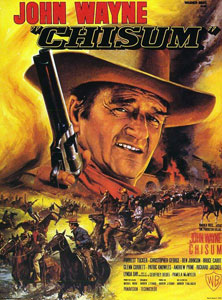
By the late 1960s and into the 1970s, John Wayne's movies became more familiar, more safe. You know what though? There's a comfort in familiarity, and there's some genuinely good movies in the bunch. Today's review is one of those efforts, telling one of the more famous stories of the wild west that ranks up there with the gunfight at the O.K. Corral or the Battle of the Little Big Horn. That story? The Lincoln County War. That movie? 1970's Chisum.
It's 1878 in the New Mexico territory, and aging rancher John Chisum (Wayne) has carved an immense cattle ranch out of the wilderness, made it all into something to behold. He's preparing for his niece, Sallie (Pamela McMyler), to come and visit the ranch, but there's some serious issues to be dealt with. An equally powerful man with some serious financial backing, Lawrence Murphy (Forrest Tucker), has moved into Lincoln County and is looking to take over. Take over EVERYTHING. First up on his list? Buying the sheriff, the bank, and scooping up all the land he can and drive Chisum out as quick as he can. Chisum is well-rooted though, and nothing is going to come easy for the despicably vicious, greedy Murphy. There's a wild card in the entire situation though, a young, fiery gunfighter with a fast-growing reputation and a fast draw with his pistol, William Bonney (Geoffrey Deuel), better known as Billy the Kid.
I've loved John Wayne and his movies since I was a little kid. Hopefully, I always will! I hadn't seen this 1970 western from director Andrew McLaglen in years until a recent showing on Turner Classic Movies gave me the opportunity to revisit it. Am I glad I did! It is different, telling the mostly true story of the Lincoln County War with some artistic license thrown in here and there. A lot of familiar faces, filming locations in Durango, Mexico where other Wayne ventures (The War Wagon, Sons of Katie Elder, The Undefeated, The Train Robbers) were filmed, a memorable score from Dominic Frontiere, and cinematographer William Clothier bringing the Mexican locations to life, yeah, it IS familiar. That's not a bad thing. I loved catching up with the movie and liked it much more than I remember. There's just enough different here to keep things interesting. And let's face it, the story and recognizable historical characters are a great backdrop for that mostly true story.
Okay, one of the most famous stories of the wild west. What do we need? How about a movie star capable of leading the way? In 1970, Wayne was still at the top of his game. He had the tough guy hero part down to an art with decades of practice. That is most definitely a compliment. Wayne was always at home in the western, and that's the case here. His Chisum -- based on the real-life John Chisum -- becomes a figurehead of the west. Years before, Chisum moved west into New Mexico and carved out a cattle ranch out of the land. Now, he's learning to slowly, begrudgingly changing with the times to survive. A testament to Wayne here is that he's not on-screen a ton. Yes, he's the star, but the Hollywood legend is content to let other members of a solid ensemble step into the limelight. When he is in the limelight? It's Duke at his tough as nails best, playing straight man to a bunch of antics while also stealing the camera, especially in a late confrontation with Tucker's Murphy. Nothing flashy, just a western professional.
Part of the fun here is the familiar names and characters popping up. The Billy the Kid story has been told in the Young Guns movies, The Left-Handed Gun, Pat Garrett and Billy the Kid, The Outlaw and many more I'm probably forgetting. I liked the spin Deuel puts on young William Bonney, a brash kid trying to put a checkered past behind him. He may be too good with a gun to let it happen though. Deuel's scenes with Glenn Corbett's Pat Garrett are a highlight, especially knowing where these two men end up. Also look for peaceful, second-chance rancher John Tunstall (Patric Knowles), Alex McSween (Andrew Prine, with his wife Lynda Day George), corrupt Sheriff Brady (Bruce Cabot), and more than a few familiar faces in the background.
The cast is one of Chisum's best features. Tucker is a slimy, nasty, slithery villain, with both Christopher George and Richard Jaeckel as his brutal enforcers. Another Just Hit Play favorite, Ben Johnson is Pepper, Wayne's right-hand man, a mumbling cowboy who'd rather solve a problem with his gun than his words, a part similar to the one he played in both The Undefeated and The Train Robbers. You ready though for some other names? Take a deep breath with me. Also look for John Agar, Robert Donner, Ray Teal, Hank Worden, Pedro Armendariz Jr., Edward Faulkner, Christopher Mitchum and plenty of faces from the John Wayne stock company. Quite the cast. QUITE a group of tough guys, a McLaglen specialty.
About as good as a traditional western can get. There's good guys, dastardly bad guys, shootouts to be had, and set against the backdrop against one of the wild west's most famous/infamous incidents ever. Something really hit me with this most recent watch, and I came away more impressed than I'd been with previous viewings. Hopefully, you'll like it just as much!
Chisum (1970): *** 1/2 /****
The Sons of Katie Elder
"First, we reunite, then find Ma and Pa's killer...then read some reviews."
Showing posts with label Pedro Armendariz Jr.. Show all posts
Wednesday, May 6, 2015
Friday, May 1, 2015
Guns for San Sebastian
You know who’s pretty cool? Anthony
Quinn. I don’t always think of Mr. Quinn as one of my favorite movie
stars, but my goodness, did this man have a hell of a career. Zorba the Greek,
The Guns of Navarone, Viva Zapata, Lawrence of Arabia, he did it all. One of my
favorites though is a little known, generally forgotten quasi-spaghetti western
from 1967,Guns for San Sebastian.
It’s the late 1740s in Mexico, and bandit Leon
Alastray (Quinn) is in trouble and on the run. Wounded after the rest of his
gang is killed or captured, Leon is saved by a faithful, well-meaning old
priest, Father Joseph (Sam
Jaffe). When Joseph refuses to turn Leon over, he quietly accepts his
punishment to the far-off, possibly abandoned desert town of San Sebastian.
Feeling like he owes the old priest, Leon accompanies him far out into the
desert to the town and finds…nothing. When their plan goes awry though and the villagers
return, it is Leon who must pretend to be a priest and help the village not
just recover, but survive. Why? The villagers have come under the “protection”
of a half-breed bandit, Teclo (Charles
Bronson), who is also working with the warring Yaqui Indians. What is
Leon to do?
This quasi-spaghetti western from director Henri
Verneuil has virtually no reputation within the genre. Why? Well,
it’s a spaghetti western in name only really. It isn’t gunfighter anti-heroes
and evil bandits and extreme violence. To call it an epic isn’t fair, but it is
an above average, highly entertaining period piece. It is set in Mexico in the
1740s so not your typical background setting, but for me, it worked because
‘Guns’ is trying something different. This is a gem, one of my favorite
underrated movies that deserves a far bigger reputation.
For starters, it’s Anthony Quinn. What a great actor, what a
great presence. Accused at times of stealing scenes and other times of chewing
the scenery, I’ve always thought just the opposite. He just goes with the part.
His Leon character is fascinating both within the spaghetti western but also
the western genre in general. He’s not a cardboard cutout, an emotionless
killer. Leon goes through a change over the course of the movie. We see him
grow and develop and fight for what he believes is right. It just so happens
that his decision-making now impacts a whole village. I’ll get into this more
in a bit, but the obvious comparison for the film and character is The
Magnificent Seven.
Quinn’s Leon has been a bad, bad dude with bounties over his
head and soldiers always on his trail. Out of desperation and survival, he
follows this priest into a desert wasteland. Once he arrives in San Sebastian,
Leon starts to make tough choices, not just selfish choices. So where The
Magnificent Seven had seven gunfighters, here we have only one, but the premise
is the same, bad guys to anti-heroes to gunfighters doing what’s right, not
necessarily what’s easy. He also gets to cozy up to one of the women in the
village (Anjanette Comer) who knows his secret. It’s just a cool
dynamic though, the supposed savior and the village needing some sort of help,
familiar but tweaked.
So if we have an interesting flawed main character, we need
a worthy opponent, right? Who better than Charles Bronson? In the mid 1960s
headed to Europe and became one of the world’s biggest stars, and he’s having
some fun here. It isn’t the most well-written, developed villain, but it’s a
good part. Who else to look for? Jaffe is excellent in a smaller part and Comer
is good too, shoving aside the helpless female role that’s all too familiar in
the western. Jorge
Martinez de Hoyos too has a fun part as Cayetano, an architect
tasked with building a wall-like fort around San Sebastian to hold back an
attack. Jaime Fernandez plays Golden Lane, the Yaqui
chief, with some familiar faces among the villagers if you’re a fan of
‘Magnificent Seven’ and The Wild Bunch. There’s also small parts for Silvia
Pinal, Leon
Askin, Pedro
Armendariz Jr., and Jorge
Russek.
‘Guns’ has a ton going for it beyond the acting. As
mentioned, the story is both familiar and unique in how it develops. It was
filmed on-location in Mexico with several familiar locations in and around
Durango, including El Saltito waterfalls that’s also been seen in
Major Dundee, The Train Robbers and Sons of Katie Elders among others. It’s the
rare spaghetti western filmed away from Spain and Italy. Also, master of the
genre when it comes to soundtracks, composer Ennio
Morricone delivers an absolute gem, a beautiful score that isn’t
as big and booming as some of his more well-known scores. Listen to an extended
sample HERE. Morricone’s
score playing over the final scene is one of my all-time favorites. As always,
it’s always a plus when the littler things come through in such strong fashion.
I’ve seen this movie three or four times now, and it gets
better each time. Great performances, interesting story, an impressively staged,
large-scale action scene, memorable score, and an excellent, appropriate
ending. Highly recommended and well worth tracking down.
Guns for San Sebastian (1967): *** ½ /****
Wednesday, February 11, 2015
The Mask of Zorro
My first introduction the character of Zorro goes back to a Disney Sing-A-Long VHS tape (Yes, VHS, and it was awesome), the theme imprinting itself on my young brain. Listen HERE, and you're welcome. The Zorro character has gone onto bigger and better things, including a late 90s swashbuckling adventure that I missed out as a 13-year old. Here's 1998's The Mask of Zorro.
It's the early 1820s in California -- then still a Spanish territory -- and the people are constantly kept down by the Spanish governor, Don Rafael Montero (Stuart Wilson). Providing a thorn in his side is Don Diego de la Vega (Anthony Hopkins), a rich landowner who has an alter-ego known as Zorro, a masked bandit and expert swordsman who protects the people and baffles the Spanish governor. Montero finally catches up with Zorro though before being sent back to Spain amidst a revolution, dumping the landowner turned bandit in a dumpy prison while also wreaking havoc on Vega's family. Some 20 years later, Vega is wasting away but he manages to pull off a daring escape. What prompts it? He finds out Montero has returned to California with plans to take over the territory. Vega needs help to exact revenge though and finds it in the form of a vengeful Mexican bandit, Alejandro (Antonio Banderas), who must undergo quite the transformation -- with Vega's help -- to exact his revenge and possibly save California in the process from a whole lot of trouble.
The Zorro character's inception dates back to author Johnston McCulley in the late 1910s, the character appearing in some pulp fiction with his popularity quickly spreading. Zorro has appeared in books since then as well as comic books, TV shows and movies on an international level, not just in the United States. As I mentioned, I missed this 1998 adventure when it first came out -- being a punky teenager and all -- but here I sit to catch up with it. 'Mask' was a big success, earning positive reviews and making $250 million in theaters. The reasoning?
From director Martin Campbell, 'Mask' feels like a throwback to swashbuckling movies of Hollywood's Golden Age dating back to the 1930s and 1940s. What did it remind me of most? Maybe the best adventure flick of all time, 1939's The Adventures of Robin Hood. No, this isn't even remotely classic, but my goodness, what a fun movie. The production was somewhat troubled with some casting drama and Robert Rodriguez dropping out (with Campbell replacing him), but it doesn't affect things in the least. The formula is simple. The good guys are honorable, loyal and heroic. The bad guys are evil, despicable, greedy, backstabbing and will no doubt get their comeuppance. The story is a tad long at 136 minutes, but there's not much downtime with a series of swordfights and action scenes sprinkled throughout. In an age where action movies often have a message, it's fun to see a movie that's just....fun.
Who better to play the suave, smooth swordsman than suave, smooth Antonio Banderas? I submit that NO ONE would have been better. Just like in Desperado, probably his most well-known roles along with Puss-In-Boots, Banderas just commits to the part. He's manic energy on the screen, and it works so effortlessly and well. You like Banderas' Alejandro turned Zorro, you're rooting for him, and Banderas looks to be having a ton of fun every minute he's on-screen. It's the Spanish actor at his best. It doesn't hurt either that his supporting cast is excellent, especially his chemistry with Hopkins (a somewhat unlikely Spaniard) and Catherine Zeta-Jones as Elena, the governor's daughter -- with a secret -- who takes a liking to Alejandro, all the while not knowing who he is or what he's up to. The mentor-student relationship between Hopkins and Banderas is excellent, and the chemistry between Zeta-Jones is palpable, whether it be their salsa dance scene or their later swordfight.
So Banderas, Hopkins and Zeta-Jones, that's enough, right? Those are the best parts, but there's more. Wilson is okay as the bigger villain, that dastardly greedy returning governor, but the best villain is Matt Letscher as Captain Harrison Love, apparently a U.S. Army officer working with the Mexicans? It's never really explained, but who cares I guess, he's easy to hate. Also look for Stuart Wilson and Pedro Armendariz Jr. as two Dons, landowners who team up with Montero in his plot to take over California. Smaller parts go to Victor Rivers as Alejandro's brother, a famous bandit, while western character actor L.Q. Jones delivers a small but memorable part as Three-Fingered Jack, an infamous bandit.
As I read some about the making of the movie, it was cool to find out at least part of the story and characters are based in reality of 1850s California history. Now there are some major freedoms taken with that story, but it's always interesting. With a score from composer James Horner and filming on-location in Mexico, the look, sound and feel of the movie is pretty spot-on. The set pieces from a fun training montage to the action-heavy finale at a gold mine carved into the side of a mountain are all pretty memorable. It's that pretty perfect popcorn movie. Sit back and enjoy.
The Mask of Zorro (1998): ***/****
It's the early 1820s in California -- then still a Spanish territory -- and the people are constantly kept down by the Spanish governor, Don Rafael Montero (Stuart Wilson). Providing a thorn in his side is Don Diego de la Vega (Anthony Hopkins), a rich landowner who has an alter-ego known as Zorro, a masked bandit and expert swordsman who protects the people and baffles the Spanish governor. Montero finally catches up with Zorro though before being sent back to Spain amidst a revolution, dumping the landowner turned bandit in a dumpy prison while also wreaking havoc on Vega's family. Some 20 years later, Vega is wasting away but he manages to pull off a daring escape. What prompts it? He finds out Montero has returned to California with plans to take over the territory. Vega needs help to exact revenge though and finds it in the form of a vengeful Mexican bandit, Alejandro (Antonio Banderas), who must undergo quite the transformation -- with Vega's help -- to exact his revenge and possibly save California in the process from a whole lot of trouble.
The Zorro character's inception dates back to author Johnston McCulley in the late 1910s, the character appearing in some pulp fiction with his popularity quickly spreading. Zorro has appeared in books since then as well as comic books, TV shows and movies on an international level, not just in the United States. As I mentioned, I missed this 1998 adventure when it first came out -- being a punky teenager and all -- but here I sit to catch up with it. 'Mask' was a big success, earning positive reviews and making $250 million in theaters. The reasoning?
From director Martin Campbell, 'Mask' feels like a throwback to swashbuckling movies of Hollywood's Golden Age dating back to the 1930s and 1940s. What did it remind me of most? Maybe the best adventure flick of all time, 1939's The Adventures of Robin Hood. No, this isn't even remotely classic, but my goodness, what a fun movie. The production was somewhat troubled with some casting drama and Robert Rodriguez dropping out (with Campbell replacing him), but it doesn't affect things in the least. The formula is simple. The good guys are honorable, loyal and heroic. The bad guys are evil, despicable, greedy, backstabbing and will no doubt get their comeuppance. The story is a tad long at 136 minutes, but there's not much downtime with a series of swordfights and action scenes sprinkled throughout. In an age where action movies often have a message, it's fun to see a movie that's just....fun.
Who better to play the suave, smooth swordsman than suave, smooth Antonio Banderas? I submit that NO ONE would have been better. Just like in Desperado, probably his most well-known roles along with Puss-In-Boots, Banderas just commits to the part. He's manic energy on the screen, and it works so effortlessly and well. You like Banderas' Alejandro turned Zorro, you're rooting for him, and Banderas looks to be having a ton of fun every minute he's on-screen. It's the Spanish actor at his best. It doesn't hurt either that his supporting cast is excellent, especially his chemistry with Hopkins (a somewhat unlikely Spaniard) and Catherine Zeta-Jones as Elena, the governor's daughter -- with a secret -- who takes a liking to Alejandro, all the while not knowing who he is or what he's up to. The mentor-student relationship between Hopkins and Banderas is excellent, and the chemistry between Zeta-Jones is palpable, whether it be their salsa dance scene or their later swordfight.
So Banderas, Hopkins and Zeta-Jones, that's enough, right? Those are the best parts, but there's more. Wilson is okay as the bigger villain, that dastardly greedy returning governor, but the best villain is Matt Letscher as Captain Harrison Love, apparently a U.S. Army officer working with the Mexicans? It's never really explained, but who cares I guess, he's easy to hate. Also look for Stuart Wilson and Pedro Armendariz Jr. as two Dons, landowners who team up with Montero in his plot to take over California. Smaller parts go to Victor Rivers as Alejandro's brother, a famous bandit, while western character actor L.Q. Jones delivers a small but memorable part as Three-Fingered Jack, an infamous bandit.
As I read some about the making of the movie, it was cool to find out at least part of the story and characters are based in reality of 1850s California history. Now there are some major freedoms taken with that story, but it's always interesting. With a score from composer James Horner and filming on-location in Mexico, the look, sound and feel of the movie is pretty spot-on. The set pieces from a fun training montage to the action-heavy finale at a gold mine carved into the side of a mountain are all pretty memorable. It's that pretty perfect popcorn movie. Sit back and enjoy.
The Mask of Zorro (1998): ***/****
Saturday, April 26, 2014
The Undefeated
Considering the extreme and far-reaching effects the Civil War had on American history, it's odd there haven't been more movies about the most costly war in the United States' relatively young history. The western genre has done its fair share of quasi-Civil War movies, the war becoming a jumping off point for a shoot 'em up story. What to do once the war is over? Like Major Dundee and Vera Cruz, many went south into Mexico. We can add 1969's The Undefeated to that short list.
After four years of bloody fighting, the Civil War has come to a close, leaving both the North and South to figure out where to go forward. With some of his remaining soldiers, a former Union cavalry officer, Colonel John Henry Thomas (John Wayne), rounds up a herd of 3,000 wild horses with the intention of driving them south into Mexico where they'll sell them to Emperor Maximilian's forces. A former Confederate officer, Colonel James Langdon (Rock Hudson), who had outfitted his own regiment, is leaving his plantation behind, moving south to Mexico with his surviving men, along with their wives, children and family in hoping to start a new life. In turbulent times for both the U.S. and Mexico, these two groups' paths may cross, and with wounds from the war still fresh on both sides.
This portion of history has always fascinated me, especially in movies like this, Major Dundee and Vera Cruz. I grew up watching this John Wayne western, and in spite of its flaws, I've always been a fan. From frequent Wayne collaborator and director Andrew V. McLaglen, 'Undefeated' is a fun western with a very good, deep cast, authentic locations in and around Durango, Mexico (Dundee fans will appreciate some familiar spots), a memorable score from composer Hugo Montenegro (listen HERE, disregard the odd video choice), and in general an entertaining quality that lifts it up past the flaws. It plays like a lot of Wayne's later movies; easy to sit back and watch, some action and shootouts, some drama, some romance, and some laughs here and there. When westerns were changing so dramatically in the late 1960s and heading into the 1970s, it can be fun just to watch an old-fashioned western with good guys and bad guys. No more, no less.
In a pretty cool casting choice, Wayne goes toe to toe here with Rock Hudson. It's not the most obvious pairing, but it works, simple as that. Wayne is playing a variation on his archetypal cowboy part, the leader of a small, surviving group of volunteers that rode with him throughout the Civil War. Now, he's looking for some cash to start over with, hence the immense horse drive. Hudson's Langdon too is looking for a clean start, the horrors and severe losses of the war still fresh on his mind. They're two different men, but they also have many similarities. They're fighting men who stand by what's right, loyal to those who ride with them, and ultimately try to do what they should do, not what's easiest. Their scenes together are the high points of the story, an easygoing charm with just a little Union vs. Confederacy animosity lingering. Two parts I liked a lot.
Working with a big story and a whole lot of characters, there's a lot going on in 'Undefeated,' clocking in at 119 minutes. Both halves -- Union and Confederacy -- are interesting, but I liked Wayne's half more. His trail-worn, loyal riders include Ben Johnson as Short Grub, his right hand man, Harry Carey Jr., John Agar (his part was heavily cut, including his early death scene), Don Collier (a familiar face, often a stunt man in Wayne movies), Jerry Gatlin and Dub Taylor as McCartney, the cantankerous cook who's always looking to fight, a mangy cat, High Bred, at his side. NFL quarterback Roman Gabriel joins the cast too as Blue Boy, Thomas' adopted Cherokee son. With so many western regulars, there's an ease to these scenes that are just fun to watch. Also look briefly for small parts for Paul Fix, Royal Dano and Pedro Armendariz Jr.
With the kinda-sorta episodic story that amiably drifts along, half of the focus is on those Confederates. It's never boring, but it's also not as interesting as their Union counterparts. We meet Langdon's wife (Lee Meriwether), his buxom teenage daughter, Charlotte (Melissa Newman), and his widowed sister-in-law (Marian McCargo). His men include Bruce Cabot, NFL star Merlin Olsen, Jan-Michael Vincent, Robert Donner, Edward Faulkner and whiny Big John Hamilton. We get to see young, pretty Charlotte hold off Jan-Michael Vincent's Bubba Wilkes' advances (she like Blue Boy). We get to see worrying wife Lee Meriwether....well, look worried. Olsen's Little George hangs out with the kids, then fights the Union cavalry. There's plenty of familiar faces, some good parts, but it's simply not as interesting to watch. Not bad, just not as good as it could have been.
Certain portions of the episodic story drag, but some certainly stand out. The pre-credits sequence wraps up the Civil War in a quick Union attack on a Confederate position. Later, Wayne and Hudson must team up to hold off a bandit attack on the Confederate wagon train, a good, exciting sequence. My favorite though is a late battle between the Union riders and French cavalry, the horse herd used as a weapon and negotiating ploy with a Mexican officer (Tony Aguilar). I'm wavering here. It's not a great western -- maybe not even a good one -- but I'm always entertained watching it. John Wayne fans, western fans alike should like this one.
The Undefeated (1969): ***/****
After four years of bloody fighting, the Civil War has come to a close, leaving both the North and South to figure out where to go forward. With some of his remaining soldiers, a former Union cavalry officer, Colonel John Henry Thomas (John Wayne), rounds up a herd of 3,000 wild horses with the intention of driving them south into Mexico where they'll sell them to Emperor Maximilian's forces. A former Confederate officer, Colonel James Langdon (Rock Hudson), who had outfitted his own regiment, is leaving his plantation behind, moving south to Mexico with his surviving men, along with their wives, children and family in hoping to start a new life. In turbulent times for both the U.S. and Mexico, these two groups' paths may cross, and with wounds from the war still fresh on both sides.
This portion of history has always fascinated me, especially in movies like this, Major Dundee and Vera Cruz. I grew up watching this John Wayne western, and in spite of its flaws, I've always been a fan. From frequent Wayne collaborator and director Andrew V. McLaglen, 'Undefeated' is a fun western with a very good, deep cast, authentic locations in and around Durango, Mexico (Dundee fans will appreciate some familiar spots), a memorable score from composer Hugo Montenegro (listen HERE, disregard the odd video choice), and in general an entertaining quality that lifts it up past the flaws. It plays like a lot of Wayne's later movies; easy to sit back and watch, some action and shootouts, some drama, some romance, and some laughs here and there. When westerns were changing so dramatically in the late 1960s and heading into the 1970s, it can be fun just to watch an old-fashioned western with good guys and bad guys. No more, no less.
In a pretty cool casting choice, Wayne goes toe to toe here with Rock Hudson. It's not the most obvious pairing, but it works, simple as that. Wayne is playing a variation on his archetypal cowboy part, the leader of a small, surviving group of volunteers that rode with him throughout the Civil War. Now, he's looking for some cash to start over with, hence the immense horse drive. Hudson's Langdon too is looking for a clean start, the horrors and severe losses of the war still fresh on his mind. They're two different men, but they also have many similarities. They're fighting men who stand by what's right, loyal to those who ride with them, and ultimately try to do what they should do, not what's easiest. Their scenes together are the high points of the story, an easygoing charm with just a little Union vs. Confederacy animosity lingering. Two parts I liked a lot.
Working with a big story and a whole lot of characters, there's a lot going on in 'Undefeated,' clocking in at 119 minutes. Both halves -- Union and Confederacy -- are interesting, but I liked Wayne's half more. His trail-worn, loyal riders include Ben Johnson as Short Grub, his right hand man, Harry Carey Jr., John Agar (his part was heavily cut, including his early death scene), Don Collier (a familiar face, often a stunt man in Wayne movies), Jerry Gatlin and Dub Taylor as McCartney, the cantankerous cook who's always looking to fight, a mangy cat, High Bred, at his side. NFL quarterback Roman Gabriel joins the cast too as Blue Boy, Thomas' adopted Cherokee son. With so many western regulars, there's an ease to these scenes that are just fun to watch. Also look briefly for small parts for Paul Fix, Royal Dano and Pedro Armendariz Jr.
With the kinda-sorta episodic story that amiably drifts along, half of the focus is on those Confederates. It's never boring, but it's also not as interesting as their Union counterparts. We meet Langdon's wife (Lee Meriwether), his buxom teenage daughter, Charlotte (Melissa Newman), and his widowed sister-in-law (Marian McCargo). His men include Bruce Cabot, NFL star Merlin Olsen, Jan-Michael Vincent, Robert Donner, Edward Faulkner and whiny Big John Hamilton. We get to see young, pretty Charlotte hold off Jan-Michael Vincent's Bubba Wilkes' advances (she like Blue Boy). We get to see worrying wife Lee Meriwether....well, look worried. Olsen's Little George hangs out with the kids, then fights the Union cavalry. There's plenty of familiar faces, some good parts, but it's simply not as interesting to watch. Not bad, just not as good as it could have been.
Certain portions of the episodic story drag, but some certainly stand out. The pre-credits sequence wraps up the Civil War in a quick Union attack on a Confederate position. Later, Wayne and Hudson must team up to hold off a bandit attack on the Confederate wagon train, a good, exciting sequence. My favorite though is a late battle between the Union riders and French cavalry, the horse herd used as a weapon and negotiating ploy with a Mexican officer (Tony Aguilar). I'm wavering here. It's not a great western -- maybe not even a good one -- but I'm always entertained watching it. John Wayne fans, western fans alike should like this one.
The Undefeated (1969): ***/****
Tuesday, February 4, 2014
Macho Callahan
I take pride in the fact I've seen a lot of westerns. It's my favorite genre, and I do my best to see as many as I can from lousy B-westerns to more polished, big budget ventures. The beauty of having that genre you like though is that if you keep on looking and exploring, you're going to find those little-known gems that don't have a big reputation. I can add 1970's Macho Callahan to that list.
It's late in the Civil War, a man named Macho Callahan (David Janssen) just released from solitary treatment at a brutal Confederate prison camp deep in Texas. He's been waiting to put into operation his plan for a mass escape, and in execution, it works. In a bloody breakout, Callahan escapes the hellish prison camp, managing to meet up with his former partner, Juan (Pedro Armendariz Jr.), with some revenge on his mind. How exactly did Callahan -- not a soldier -- end up in the prison camp? Well, now he's searching for the man, Duffy (Lee J. Cobb) that ended up putting him there. Callahan and Juan must first track Duffy down though, but it's not going to be easy. There is a reward on Callahan's head, a rather lucrative one, and every bounty hunter, gunman and two-bit killer in the state is looking for him.
Wow. This was one nasty, dark, brutal western. The spaghetti westerns had helped tweak the western genre in a big way already in the late 1960s (and continuing into the 1970s), giving it that cynicism, that darkness that just hadn't been there in most American westerns. Well, this entry from director Bernard L. Kowalski is one of the darkest, dirtiest, meanest westerns I've ever seen, and that's a good thing. Part of it is the look of the film, all the characters dirty, sweaty and sporting all sorts of unkempt hair and beards. It sounds simple, but that goes a long way. 'Callahan' looks and feels like we're there with the characters, a visceral, authentic peek into the not so glamorous wild, wild west. I liked composer Patrick Williams' score too, not used a ton but doing a good job of building that tension and doom.
It's more than just the look though. It's something else. This is a movie with a vicious mentality. This is brutality at its worst. This is a meanness that permeates the movie. That starts in the opening, quite-startling sequence set in the Confederate prison camp. The place looks filthy, disease and grime hanging in the air. We see a cook gutting a cow, its entrails falling from the body. The prisoners waste away, waiting for their chance to escape. This sequence was disturbing in its tension, in its reality, but it sets the tone immediately, especially with the bloody, gruesome escape. That incredibly dark mood sticks around throughout the movie. The violence is bloody and graphic and uncomfortable. No one...NO ONE, is safe. Characters are killed off with the snap of a finger. At one point, Janssen's Callahan even shoots a buffalo. There's just something hanging in the air here. No romance, no beauty, no charm of the old west. This is life, where survival reigns above all else.
A TV star from The Fugitive, Janssen doesn't scream western star, but his brooding, intense Callahan is a pretty interesting lead character. Early on, he's almost completely blinded by his desire for revenge. There's more to the character of course, and without giving away much in the way of spoilers, it comes courtesy of Jean Seberg's Alexandra, a widow who wants nothing to do with Callahan but is forced to travel with him and Juan on the trail. It's not quite a love story, but feelings do develop, two lonely people finding a friend of sorts in a nasty world. Janssen also has a solid chemistry with Armendariz Jr., a familiar western dynamic between two partners, two bandits who seem to be constantly on the run. I really liked the duo, neither stars but both very capable actors.
The rest of the cast is just as solid. Along with Lee J. Cobb, look for James Booth, Bo Hopkins, Diane Ladd, David Carradine, Richard Anderson and Matt Clark. Some of the parts are bigger than others, some just a scene or two. As I mentioned earlier though, 'Callahan' isn't interested in reputation or star power. Characters are killed without warning from beginning to end here, keeping you guessing from scene-to-scene what's going to happen. This isn't glorious, romantic death either, but an unceremonious, lightning-quick fate. One second you're there. The next second you're not.
I don't know if saying I liked this movie is an apt description. It's a tough movie to like, but to watch and experience it a little bit? Yeah, that's more appropriate. Things drag some in the second half of the 99-minute movie, but as the ending approaches, momentum picks up to the inevitable, appropriately unceremonious ending. No big shootout, no big gunfight, just an ending. There's touches of the surreal too, Callahan, Alexandra, Juan and a baby bear on the trail. Don't question. Just go with it. The whole movie is a trip.
Macho Callahan (1970): ***/****
It's late in the Civil War, a man named Macho Callahan (David Janssen) just released from solitary treatment at a brutal Confederate prison camp deep in Texas. He's been waiting to put into operation his plan for a mass escape, and in execution, it works. In a bloody breakout, Callahan escapes the hellish prison camp, managing to meet up with his former partner, Juan (Pedro Armendariz Jr.), with some revenge on his mind. How exactly did Callahan -- not a soldier -- end up in the prison camp? Well, now he's searching for the man, Duffy (Lee J. Cobb) that ended up putting him there. Callahan and Juan must first track Duffy down though, but it's not going to be easy. There is a reward on Callahan's head, a rather lucrative one, and every bounty hunter, gunman and two-bit killer in the state is looking for him.
Wow. This was one nasty, dark, brutal western. The spaghetti westerns had helped tweak the western genre in a big way already in the late 1960s (and continuing into the 1970s), giving it that cynicism, that darkness that just hadn't been there in most American westerns. Well, this entry from director Bernard L. Kowalski is one of the darkest, dirtiest, meanest westerns I've ever seen, and that's a good thing. Part of it is the look of the film, all the characters dirty, sweaty and sporting all sorts of unkempt hair and beards. It sounds simple, but that goes a long way. 'Callahan' looks and feels like we're there with the characters, a visceral, authentic peek into the not so glamorous wild, wild west. I liked composer Patrick Williams' score too, not used a ton but doing a good job of building that tension and doom.
It's more than just the look though. It's something else. This is a movie with a vicious mentality. This is brutality at its worst. This is a meanness that permeates the movie. That starts in the opening, quite-startling sequence set in the Confederate prison camp. The place looks filthy, disease and grime hanging in the air. We see a cook gutting a cow, its entrails falling from the body. The prisoners waste away, waiting for their chance to escape. This sequence was disturbing in its tension, in its reality, but it sets the tone immediately, especially with the bloody, gruesome escape. That incredibly dark mood sticks around throughout the movie. The violence is bloody and graphic and uncomfortable. No one...NO ONE, is safe. Characters are killed off with the snap of a finger. At one point, Janssen's Callahan even shoots a buffalo. There's just something hanging in the air here. No romance, no beauty, no charm of the old west. This is life, where survival reigns above all else.
A TV star from The Fugitive, Janssen doesn't scream western star, but his brooding, intense Callahan is a pretty interesting lead character. Early on, he's almost completely blinded by his desire for revenge. There's more to the character of course, and without giving away much in the way of spoilers, it comes courtesy of Jean Seberg's Alexandra, a widow who wants nothing to do with Callahan but is forced to travel with him and Juan on the trail. It's not quite a love story, but feelings do develop, two lonely people finding a friend of sorts in a nasty world. Janssen also has a solid chemistry with Armendariz Jr., a familiar western dynamic between two partners, two bandits who seem to be constantly on the run. I really liked the duo, neither stars but both very capable actors.
The rest of the cast is just as solid. Along with Lee J. Cobb, look for James Booth, Bo Hopkins, Diane Ladd, David Carradine, Richard Anderson and Matt Clark. Some of the parts are bigger than others, some just a scene or two. As I mentioned earlier though, 'Callahan' isn't interested in reputation or star power. Characters are killed without warning from beginning to end here, keeping you guessing from scene-to-scene what's going to happen. This isn't glorious, romantic death either, but an unceremonious, lightning-quick fate. One second you're there. The next second you're not.
I don't know if saying I liked this movie is an apt description. It's a tough movie to like, but to watch and experience it a little bit? Yeah, that's more appropriate. Things drag some in the second half of the 99-minute movie, but as the ending approaches, momentum picks up to the inevitable, appropriately unceremonious ending. No big shootout, no big gunfight, just an ending. There's touches of the surreal too, Callahan, Alexandra, Juan and a baby bear on the trail. Don't question. Just go with it. The whole movie is a trip.
Macho Callahan (1970): ***/****
Wednesday, September 23, 2009
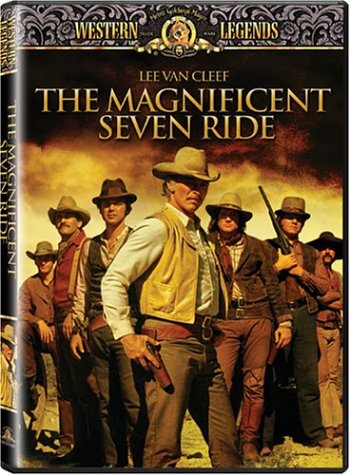
The Magnificent Seven Ride!
Probably the darkest and most cynical of the four movies, 1972's The Magnificent Seven Ride! is undone by any number of things starting from the apparently very cheap budget which affects the sets, the story, and surprisingly enough, the musical score from composer Elmer Bernstein. Ah, who knows? Maybe the studio thought adding an exclamation point in the title would fix all those problems. Close, but no cigar United Artists.A good place to start is with the story/script. It's basically two movies which if done separately might have been good, or at least two hour-long TV shows. But of course, that might be too easy to do. My main issue though is simple, the new Magnificent Seven aren't even introduced as a group until an hour into the movie. Say what you want about the first three Mag7 movies, but Chris in anyone of his forms was putting together each group of 7 within the first 15 minutes or so. Not so here which starts a completely different storyline before even getting to a new group of specialists.
Now with a badge on his shirt, Chris Adams (Lee Van Cleef) is a marshal in a small western town with a new bride, Arilla (Mariette Hartley). Chris has built himself up quite a reputation as a tough law officer, but his wife convinces him to let go of a young prisoner she believes made one bad mistake. He does, but the boy joins a gang and during a bank robbery, they kidnap Arilla and ride out. Chris, joined by a writer, Noah Forbes (Michael Callan) trying to document his heroics, head out after the gang, only to find Arilla raped and murdered and the trio of youngsters split up.
Out on the trail looking for them, Chris meets an old friend, also now a sheriff, who is trying to stop a bandit and his gang from attacking their town. Chris declines the invitation to help, and it's not long before the friend and his posse are shot down. Feeling guilt for what he chose not to do, Chris finds the town, sans men, now occupied by just the widows, including Stefanie Powers (with some big 70s hair too) with the gang's return seemingly imminent. With no other option, Chris and Noah recruit five prisoners from the Tucson Territorial Prison (think crappy Dirty Dozen story) to help them defend the town.
The Seven: Van Cleef is an interesting choice to replace Yul Brynner and George Kennedy as Chris. A huge star because of his success in Europe, Van Cleef brings an edge to the character we haven't seen before. For him after losing his wife, he plans the town's defense like a suicide mission fulling expecting to die in the process. An interesting twist on the character for sure. In the quasi-McQueen sidekick part, Callan plays Noah as a whiny, cheap writer who questions Chris' actions, only to...gasp...come around in the end. It could have been a cool character to add to the mix, but Callan comes across as just plain annoying.
Now for the Mag7: Convict Style which seems like an easy way to keep the story moving by taking an idea from a different movie. Making it worse, none of the five convicts are developed much at all. There's Skinner (Luke Askew) and Pepe (Pedro Armendariz Jr), two gunfighters who'd like nothing more than kill Chris, Walt (William Lucking), the strong, silent type good with a shotgun, Hayes (James Sikking), a former Confederate officer adept at planning battle strategy, and Elliott (Ed Lauter in his first movie), the explosives expert. The only ones making much of an impression are Askew and Armendariz, more so because they act cool than any sort of development they have.
The "Villain": In the original, Eli Wallach's Calvera is introduced, disappears for an hour and then returns with a vengeance late. In 'Ride!' the lead bandit has one line the whole movie (a classic delivery of 'Vamanos!' if you ask me) and is played by acting powerhouse Ron Stein, a stuntman known for his parts in the Planet of the Apes TV series as 'First Gorilla.' The villain is totally wasted here and not a presence at all.
Another test of how good/bad movies can be is the groan test. How many times watching the movie do you groan at some cheesy line, horrible special effect, or set falling apart in the background? This one has its fair share including my personal favorite, 'I, Chris, degrade your woman!' in a message to Stein's De Toro character. Also, the widows left in town were gang-raped by De Toro's men and just found out their husbands are all dead. They sure cozy up to these new men awful quick, including Chris (wife raped and killed) snuggling up with Stefanie Powers (gang-raped, husband murdered, has to care for children...) days after all the bad news hits. Now that's a good script.
Besides the lack of a good story, the film has the look of a made-for-TV movie because it was filmed in the Hollywood backlots on a variety of generic looking sets straight out of Gunsmoke or Bonanza. The positive to take away is the final battle as De Toro and his men finally attack the town, but even then it's a measured positive. We know little to nothing about these men, but are supposed to feel something for them when they begin to drop like flies? Yeah, good luck with that. A disappointment all around and a sorry end to the four Magnificent Seven movies.
The Magnificent Seven Ride! <----trailer (1972): * 1/2 / ****
Labels:
1970s,
Ed Lauter,
Lee Van Cleef,
Luke Askew,
Pedro Armendariz Jr.,
Sequels,
Stefanie Powers,
westerns
Subscribe to:
Posts (Atom)