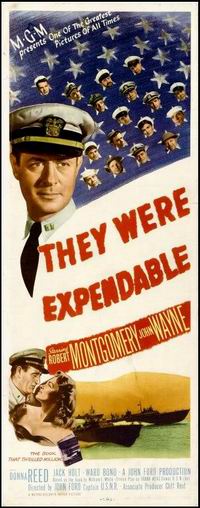
John Ford once famously said "I make westerns." I love a lot of those westerns -- and tolerate some others -- but Ford's career was more than solely westerns. Some of his most respected movies like The Quiet Man, The Grapes of Wrath, and Drums Along the Mohawk are far from westerns. Ford even served during World War II, but the popular director isn't known for making war movies. His last war film? An underrated classic, 1945's They Were Expendable.
It's December 1941 in the Philippines and Lt. John 'Brick' Brickley (Robert Montgomery) is at the head of a small squadron of torpedo boats, a new form of attack boat that hasn't earned a reputation yet as a fighting unit. That ability to fight is about to be tested. When the Japanese unleash their surprise attack on Pearl Harbor, the entire U.S. military in the Pacific is forced to improvise in a desperate attempt to hold off attacking Japanese forces and somehow survive in the process thousands of miles from help. Brick and his second-in-command, Lt. Rusty Ryan (John Wayne), join the fighting too, the PT boats figuring out on the fly how they can help the war effort as Japanese forces surge forward on Bataan and Corregidor. With supplies limited and reinforcements a remote possibility, the PT boats must band together in a last-ditch effort.
The early parts of World War II in the Pacific feature some of the worst defeats the U.S. military has had in its 200-plus year history, including the battle for Bataan, originally leading to the horrific Bataan Death March. It reflected how poorly the U.S. was planned for an attack on such a grand scale. Ford's film -- which he supposedly hated, saying he was forced to make it -- delves right into that. The U.S. government had to make extremely difficult decisions in December 1941 and into 1942. If there was any hope of taking the attack back to the Japanese, the Philippines had to be abandoned, meaning thousands of American and Filipino troops were simply left to fight it out on their own with little in the way of supplies, food, ammunition and most importantly, no help on the way. A horrific American defeat, it makes for an incredibly moving story.
What a somber, unsettling and yes, moving film from Ford. I believe it deserves far more of a reputation, an incredible story that covers a lot of ground in its 135-minute running time. 'Expendable' follows the battle for the Philippines -- about four-plus months -- in a forthright, honest fashion. This isn't a rah-rah! war movie. It tells a story that needs to be told, and I'd imagine, many Americans don't know much about. 'Expendable' is interested in telling the story of the heroic sacrifices made by the thousands of people left to fend for themselves as Japanese forces inched ever closer. Ford's film was shot in black and white, a beautiful, shadowy visual that a crime-ridden 1940s/1950s film noir would have been jealous of. There will be no miracle surprise in the end for these men. Some will be flown out of the Philippines but for most, they will be left behind, forced to choose whether to fight the Japanese or maybe surrender. A downbeat story for sure, but an honest look at war too. Heroes? Yes. A story interested in glory? No, just doing what's difficult because that's what they've been trained to do.
So many moments here stick with me after viewing this 1945 WWII movie. Wayne's Rusty meets Sandy (a scene-stealing Donna Reed), a young nurse trying to help the wounded that keep pouring in. It is a love story that feels real and natural, not forced. Ryan delivers a soft-spoken, emotional eulogy over a fallen comrade with his surviving crew standing around him. A quiet, candlelit dinner has Ryan, Sandy, Brick and their officers quietly enjoying a peaceful turn, the Japanese guns banging miles away. An old man known as Dad (Russell Simpson) who's lived in the Philippines for years waits on his doorstep with a rifle across his lap. Take his land? He'll have something to say about that. Brick and Rusty visit a wounded comrade (Paul Langton), trying to give him a boost even though the prognosis is a mortal wound. There's too many to mention here, but it helps boost the movie up a notch. Ford at times could get overly sappy, too cute with his stories, but 'Expendable' rings true from beginning to end.
There isn't a weakness in the cast. A Navy veteran himself, Montgomery is excellent as Lt. Brick, a tough, capable officer who doesn't let the daunting task at hand slow him down. When Ford had some on-set health problems, Montgomery stepped into the director's chair. Ford was especially tough on Wayne because the Duke had not served during WWII, but Wayne comes through, delivering an excellent performance. The chemistry between Montgomery and Wayne is subtle and perfect, two friends who have almost a brotherly relationship. Along with Reed, also look for Jack Holt and Charles Trowbridge as high-ranking Army and Navy officers, tasked with the impossible, holding together an army that has no backing. As for the PT boat crews, look for Ford regular Ward Bond along with Marshall Thompson, Cameron Mitchell, and Ford favorite Jack Pennick. I also liked Louis Jean Heydt's quick appearance as Ohio, a fellow officer Ryan meets trying to survive one place to another.
This is a war movie, but the action isn't front and center. What's there is impressive though, the footage of the PT boats zipping across the Pacific doing an excellent job of getting your adrenaline pumping. Mixing in some archival WWII footage, the action is spectacular as the Japanese guns blaze away at these small but extremely fast attacking boats armed with two torpedo tubes and a couple of .50 caliber machine guns. The action sequences are highlighted by an escape from a lagoon base under attack, a nighttime attack on a well-guarded Japanese convoy and a desperate run up a river as Japanese planes descend for their own attack runs. The focus is far more on the men, but these battle sequences are excellent whenever they pop up. 'Expendable' was filmed in Key Biscayne, Florida and the Florida Keys, a more than worthy fill-in for the South Pacific.
Just an excellent war movie, one that deserves more attention for what it accomplishes. It deserves its place among John Ford's classics.
They Were Expendable (1945): ****/****
The Sons of Katie Elder
"First, we reunite, then find Ma and Pa's killer...then read some reviews."
Showing posts with label Donna Reed. Show all posts
Monday, May 26, 2014
Friday, May 23, 2014
Trouble Along the Way
John Wayne was a cowboy, a cavalry officer, a marshal, a soldier, an officer, a tough guy, any and all. Name most of his Wayne's most famous, iconic roles, and odds are, you can peg it as one of those descriptions. I've seen most of Wayne's non-serial movies, and I can't think of too many comedies or dramas away from the wild west, a war situation or some sort of historical epic. Well, I found one, and I liked it a lot, 1953's Trouble Along the Way.
The longtime rector at St. Anthony's University in New York City, Father Burke (Charles Coburn) has been given some bad news. His small Catholic university is seriously in debt, and the order of brothers has decided to close the school and relocating the priests on the faculty while allowing its students to transfer to other universities. Not willing to accept the news, Father Burke goes about thinking of ways to raise money to keep St. Anthony's open. One of his best ideas? Reinvigorate the football program which has fallen on some tough times. A successful football team will no doubt bring in tons of money to the university, right? Burke finds his man to coach the team in an ex-coach with a checkered past, Steve Williams (Wayne), a single father who's fallen on some tough times as he tries to care for his young daughter, Carol (Sherry Jackson). Williams has his work cut out for him and not a lot of time to do it in. Can he pull it off?
I've watched John Wayne movies since I was a kid, but this was one of his few movies I haven't seen a second of this 1953 drama from director Michael Curtiz. It was available on Netflix, but that ominous 'Very Long Wait' kept staring back at me. Well, courtesy of Turner Classic Movies and a John Wayne marathon, here we sit. It's a good movie for all the right reasons, reminding me at times of a Frank Capra flick. 'Trouble' is an old-fashioned story that you can comfortably call 'cheesy, sappy, cliched and familiar,' but you know what? Those are good things here. Filmed in black and white at Pomona College and assorted Los Angeles high schools, 'Trouble' plays like a sweet throwback in the wayback machine to a simpler time, a Happy Days and Leave it to Beaver time. A cool change of pace.
John Wayne was all of those things above over a long, distinguished career so if for absolutely nothing else, it's pretty fun to see him in a far-more family role. His tough guy single dad is raising his daughter like a tomboy, father and daughter bonding through sports and football and billiards. Wayne has a great chemistry with Jackson's Carol, a talented young actress who doesn't force things. It's a natural performance, a rarity when you consider how bad some child actors were (especially in the 1950s). There's also a possible love interest in Donna Reed's character, Alice Singleton, a court officer sent to investigate if Carol should stay with her Dad or move in with her mother (oh no, family drama!). Thankfully, 'Trouble' allows most of the pratfalls here involving that budding relationship, keeping it in the background and developing it slowly. The Duke is excellent in the fatherly role, a change of pace but in a good way.
Beyond Wayne and Reed, Charles Coburn is the best supporting part as Father Burke, the idealistic, sweet old priest who wants nothing more than to have his St. Anthony's remain open, helping students struggling with money with an education. His fellow priests include Tom Tully and Dabbs Greer with Leif Erickson and Douglas Spencer as the two priests who bear the bad news to Burke. Marie Windsor plays the over the top evil, manipulative ex-wife of Steve's with Tom Helmore as her rich new beau. Also look for Chuck Connors and former NFL player Bill Radovich as Steve's assistants.
Now all that said -- and I did enjoy this movie -- there are some moments that will no doubt make some viewers cringe. Politically incorrect 'Trouble' is not, especially some scenes between Wayne and Reed, Wayne's Steve "analyzing" how Alice came to the job with a wrap-up compliment of 'And you've got nice legs.' As well, any sports fan will get a kick out of the 1950s-era college rules. The script has some fun with Steve's background, a coach who's been run out of a handful of college coaching jobs using some questionable players with eligibility issues. The school completely turns a blind eye to his coaching tactics. A dealbreaker it is not, but it certainly adds another fun, entertaining level to the story.
An interesting change of pace. Definitely worth a watch, especially for John Wayne fans.
Trouble Along the Way (1953): ***/****
The longtime rector at St. Anthony's University in New York City, Father Burke (Charles Coburn) has been given some bad news. His small Catholic university is seriously in debt, and the order of brothers has decided to close the school and relocating the priests on the faculty while allowing its students to transfer to other universities. Not willing to accept the news, Father Burke goes about thinking of ways to raise money to keep St. Anthony's open. One of his best ideas? Reinvigorate the football program which has fallen on some tough times. A successful football team will no doubt bring in tons of money to the university, right? Burke finds his man to coach the team in an ex-coach with a checkered past, Steve Williams (Wayne), a single father who's fallen on some tough times as he tries to care for his young daughter, Carol (Sherry Jackson). Williams has his work cut out for him and not a lot of time to do it in. Can he pull it off?
I've watched John Wayne movies since I was a kid, but this was one of his few movies I haven't seen a second of this 1953 drama from director Michael Curtiz. It was available on Netflix, but that ominous 'Very Long Wait' kept staring back at me. Well, courtesy of Turner Classic Movies and a John Wayne marathon, here we sit. It's a good movie for all the right reasons, reminding me at times of a Frank Capra flick. 'Trouble' is an old-fashioned story that you can comfortably call 'cheesy, sappy, cliched and familiar,' but you know what? Those are good things here. Filmed in black and white at Pomona College and assorted Los Angeles high schools, 'Trouble' plays like a sweet throwback in the wayback machine to a simpler time, a Happy Days and Leave it to Beaver time. A cool change of pace.
John Wayne was all of those things above over a long, distinguished career so if for absolutely nothing else, it's pretty fun to see him in a far-more family role. His tough guy single dad is raising his daughter like a tomboy, father and daughter bonding through sports and football and billiards. Wayne has a great chemistry with Jackson's Carol, a talented young actress who doesn't force things. It's a natural performance, a rarity when you consider how bad some child actors were (especially in the 1950s). There's also a possible love interest in Donna Reed's character, Alice Singleton, a court officer sent to investigate if Carol should stay with her Dad or move in with her mother (oh no, family drama!). Thankfully, 'Trouble' allows most of the pratfalls here involving that budding relationship, keeping it in the background and developing it slowly. The Duke is excellent in the fatherly role, a change of pace but in a good way.
Beyond Wayne and Reed, Charles Coburn is the best supporting part as Father Burke, the idealistic, sweet old priest who wants nothing more than to have his St. Anthony's remain open, helping students struggling with money with an education. His fellow priests include Tom Tully and Dabbs Greer with Leif Erickson and Douglas Spencer as the two priests who bear the bad news to Burke. Marie Windsor plays the over the top evil, manipulative ex-wife of Steve's with Tom Helmore as her rich new beau. Also look for Chuck Connors and former NFL player Bill Radovich as Steve's assistants.
Now all that said -- and I did enjoy this movie -- there are some moments that will no doubt make some viewers cringe. Politically incorrect 'Trouble' is not, especially some scenes between Wayne and Reed, Wayne's Steve "analyzing" how Alice came to the job with a wrap-up compliment of 'And you've got nice legs.' As well, any sports fan will get a kick out of the 1950s-era college rules. The script has some fun with Steve's background, a coach who's been run out of a handful of college coaching jobs using some questionable players with eligibility issues. The school completely turns a blind eye to his coaching tactics. A dealbreaker it is not, but it certainly adds another fun, entertaining level to the story.
An interesting change of pace. Definitely worth a watch, especially for John Wayne fans.
Trouble Along the Way (1953): ***/****
Labels:
1950s,
Chuck Connors,
Donna Reed,
John Wayne,
Michael Curtiz,
Sports
Friday, August 23, 2013
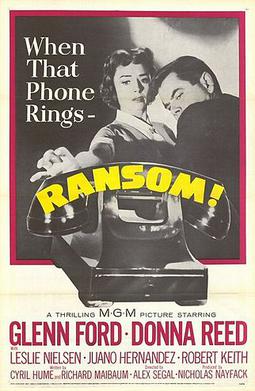
Ransom!
In an age of remakes, sequels, prequels, series and what not, it can be fun sometimes to stumble across an original you didn't even know existed. I can't remember for sure if I saw 1996's Ransom as I was growing up, but I've always been aware of it if nothing else. Well, I can also say I wasn't aware of its predecessor, 1956's Ransom! Forty years apart, is it enough time between original and remake?
A very well-to-do executive of a vacuum cleaner company, Dave Stannard (Glenn Ford) has created quite a life for himself with his beautiful wife, Edith (Donna Reed) and eight-year old son, Andy (Bobby Clark). Their idyllic home life is broken up one day when Andy doesn't return home from school. His teacher tells Edith that a nurse took him from school that morning, claiming to go to the doctor's office. The doctor though has no knowledge of Andy's whereabouts, leaving Dave and Edith to fear for the worst. The call comes later that night....Andy has been kidnapped, and his kidnappers are asking for $500,000. With some help from the police, including Chief Backett (Robert Keith), Dave and Edith discuss what to do. Should they come up with the ransom? Do the police have any chance of catching the kidnappers? As they weigh their options though, Andy is more at risk with each passing hour.
I was really worried about this movie for about 10-15 minutes, worried to the point I was wavering over whether to stick with it. The opening 15 minutes presents that idyllic Leave It to Beaver/Happy Days family life that is so sugary sweet it's almost impossible to take. Andy is the precocious kid who's always up to some shenanigans, but goshdarnit! His parents love him! Aw shucks, he stole slats from all the beds in the house to build a fort?!? What a crazy kid! I'm assuming the goal early on was to show what a good life Dave has from his wife and son to his house to his highly successful job. The problem is, it's so aggressively happy that it made me laugh, and I'm betting that wasn't the goal here. If I'm wrong, so be it, but I don't think I am.
But because I like reviewing movies, I stuck with it, wanting to give it a fair shot. I'm glad I stuck with it. In a way that most 1950s just didn't seem capable of, 'Ransom' is dark in a way I would associate more with the late 1960s or throughout the 1970s. Director Alex Segal turns in quite the thriller, low-key in terms of action but very high strung in terms of the personal level, in terms of an emotional attachment to the situation. The scenes where Dave and Edith begin to put two and two together are unsettling to say the least, some odd, unanswered questions turning into every parent's worst fear, someone has taken their child. Segal films in black and white, much of his story relegated to indoor sets for the Stannard's house as the ransom/kidnapping and case develop.
Why does it work so well? Mostly, it's the personal involvement. Other than a brief shot from behind a kidnapper watching TV, we don't see the kidnappers in the least. We don't know how many there are, what their motivations are, what drove them to do this. It's a gutsy decision in telling a story, one that works because it puts the spotlight entirely on Dave and Edith and those helping them. One of my favorite actors, Ford does a fine job as Stannard, an everyman type of father who loves his family more than anything. He has a good chemistry with Reed (similarly very good), including an early scene I'm assuming is one of the earliest mentions of a "quickie" in movie history. Seriously, it's there. Mostly though, we see their disintegration as parents, as adults, their world crumbling around them. Edith loses it, Dave doing the same but trying to keep a hold on reality, anything that will help bring his son back. His plea on TV is an effective scene, probably the movie's most effective scene.
The rest of the cast is solid too. The cast benefits from Segal and the script from Cyril Hume and Richard Maibaum showing how the community responds, from the police to the curious onlookers and everyone in between. Making his screen debut, Leslie Nielsen is very good as Charlie Telfer, the hardened journalist who has an in for the case and is allowed in the Stannard house. Juano Hernandez plays Jesse Chapman, the Stannard's longtime servant. He's called Uncle Jesse so just a little on the politically incorrect meter. Keith as Chief Backett is interesting because he's not just a pure cop. He's also worrying about his reelection coming up too. Ainslie Pryor plays Al, Dave's brother who begins to question his brother's thinking once the ransom demands are made.
If you've watched any police shows since 1956, from Perry Mason to Law and Order and everything in between, you've no doubt seen at least a show or two dealing with ransom. What have we learned? Just because the family pays the ransom doesn't mean they'll be getting their loved one back. I'm guessing though that in 1956, this was a new concept for moviegoers. This information provides an interesting twist in the second half of the movie as Ford's Stannard learns the possibilities of what could happen. I wasn't sure exactly which ending this flick would go for, but it's a decent enough ending. It could have been one epic ending, but it works, capping off a tense, uncomfortable 1950s thriller.
Ransom! (1956): ***/****
A very well-to-do executive of a vacuum cleaner company, Dave Stannard (Glenn Ford) has created quite a life for himself with his beautiful wife, Edith (Donna Reed) and eight-year old son, Andy (Bobby Clark). Their idyllic home life is broken up one day when Andy doesn't return home from school. His teacher tells Edith that a nurse took him from school that morning, claiming to go to the doctor's office. The doctor though has no knowledge of Andy's whereabouts, leaving Dave and Edith to fear for the worst. The call comes later that night....Andy has been kidnapped, and his kidnappers are asking for $500,000. With some help from the police, including Chief Backett (Robert Keith), Dave and Edith discuss what to do. Should they come up with the ransom? Do the police have any chance of catching the kidnappers? As they weigh their options though, Andy is more at risk with each passing hour.
I was really worried about this movie for about 10-15 minutes, worried to the point I was wavering over whether to stick with it. The opening 15 minutes presents that idyllic Leave It to Beaver/Happy Days family life that is so sugary sweet it's almost impossible to take. Andy is the precocious kid who's always up to some shenanigans, but goshdarnit! His parents love him! Aw shucks, he stole slats from all the beds in the house to build a fort?!? What a crazy kid! I'm assuming the goal early on was to show what a good life Dave has from his wife and son to his house to his highly successful job. The problem is, it's so aggressively happy that it made me laugh, and I'm betting that wasn't the goal here. If I'm wrong, so be it, but I don't think I am.
But because I like reviewing movies, I stuck with it, wanting to give it a fair shot. I'm glad I stuck with it. In a way that most 1950s just didn't seem capable of, 'Ransom' is dark in a way I would associate more with the late 1960s or throughout the 1970s. Director Alex Segal turns in quite the thriller, low-key in terms of action but very high strung in terms of the personal level, in terms of an emotional attachment to the situation. The scenes where Dave and Edith begin to put two and two together are unsettling to say the least, some odd, unanswered questions turning into every parent's worst fear, someone has taken their child. Segal films in black and white, much of his story relegated to indoor sets for the Stannard's house as the ransom/kidnapping and case develop.
Why does it work so well? Mostly, it's the personal involvement. Other than a brief shot from behind a kidnapper watching TV, we don't see the kidnappers in the least. We don't know how many there are, what their motivations are, what drove them to do this. It's a gutsy decision in telling a story, one that works because it puts the spotlight entirely on Dave and Edith and those helping them. One of my favorite actors, Ford does a fine job as Stannard, an everyman type of father who loves his family more than anything. He has a good chemistry with Reed (similarly very good), including an early scene I'm assuming is one of the earliest mentions of a "quickie" in movie history. Seriously, it's there. Mostly though, we see their disintegration as parents, as adults, their world crumbling around them. Edith loses it, Dave doing the same but trying to keep a hold on reality, anything that will help bring his son back. His plea on TV is an effective scene, probably the movie's most effective scene.
The rest of the cast is solid too. The cast benefits from Segal and the script from Cyril Hume and Richard Maibaum showing how the community responds, from the police to the curious onlookers and everyone in between. Making his screen debut, Leslie Nielsen is very good as Charlie Telfer, the hardened journalist who has an in for the case and is allowed in the Stannard house. Juano Hernandez plays Jesse Chapman, the Stannard's longtime servant. He's called Uncle Jesse so just a little on the politically incorrect meter. Keith as Chief Backett is interesting because he's not just a pure cop. He's also worrying about his reelection coming up too. Ainslie Pryor plays Al, Dave's brother who begins to question his brother's thinking once the ransom demands are made.
If you've watched any police shows since 1956, from Perry Mason to Law and Order and everything in between, you've no doubt seen at least a show or two dealing with ransom. What have we learned? Just because the family pays the ransom doesn't mean they'll be getting their loved one back. I'm guessing though that in 1956, this was a new concept for moviegoers. This information provides an interesting twist in the second half of the movie as Ford's Stannard learns the possibilities of what could happen. I wasn't sure exactly which ending this flick would go for, but it's a decent enough ending. It could have been one epic ending, but it works, capping off a tense, uncomfortable 1950s thriller.
Ransom! (1956): ***/****
Labels:
1950s,
Donna Reed,
Glenn Ford,
Juano Hernandez,
Leslie Nielsen,
Robert Keith
Thursday, May 27, 2010
They Rode West
Just four movies into his young career, Robert Francis tragically died at the age of 25 when a plane he was piloting lost power and crashed, killing him and another passenger. His name hasn't bee remembered like others from the 1950s and 1960s who died long before their time, but that doesn't mean he wasn't a talented actor. Maybe a little stiff at times, Francis still showed an ability to stand out from his co-stars in the four films he did make.
In just his second film after the success of 1954's The Caine Mutiny, Francis sticks with the army genre, albeit about 100 years before WWII. The movie is They Rode West, a solid western that tries to put its own spin on the U.S. cavalry picture. John Ford had already had his cavalry trilogy hit theaters and be a huge success, and in general, cavalry westerns tended to do well with audiences. There is something iconic about a patrol riding across the horizon of the American west. 'Rode West' isn't told from the point of view of the soldiers though, instead it's the perspective of the doctor working with the soldiers.
Looking to get a chance to improve his doctoring skills and medical knowledge, young Dr. Allen Seward (Francis) enlists with the U.S. army and is sent to a frontier outpost where the cavalry is dealing with a possible Comanche and Kiowa breakout from their reservation. The outpost's previous surgeons/medics were drunks and misfits so Seward arrives with little expectations from his fellow officers as to his ability. One officer, Captain Blake (Philip Carey), particularly resents Seward as much for his beliefs about the Indians as his interest in Laura McKay (Donna Reed), the visiting niece of the fort's commander. The problems escalate though when the Indians at the reservation contract malaria, and Seward is forced to make a decision; obey orders or do what he's sworn to do as a doctor.
Seeing a cavalry western from the outpost doctor/surgeon instead of the battalion commander or the veteran sergeant is a refreshing change in storytelling. For one, Seward's naivete is appealing because he looks at things in a very black and white manner. Someone's hurt or sick? I'd better help them. Oh, they're Comanche? I'll still help. He isn't biased by prior judgments or preconceived notions on people just because of who they are or their culture. This of course bites him in the ass with basically everyone in the fort because a recommendation he makes convinces a group of Comanches to leave the reservation and head for ground more suited to living. Oops, my bad.
Francis' acting and delivery can be a little wooden, but I'm chalking some of that up to his voice. He talks in an almost-stilted deep voice that doesn't differ much whether he's talking regularly, angry with an order, or trying to be smooth and get on Donna Reed's good side. But even with all that, the character is likable because what he is doing is right no matter what anyone else tells him he should be doing. Donna Reed does get to play against type here, sexing it up a bit as a bachelorette with a long list of suitors vying for her hand. Carey plays the type of a-hole character you just hope gets shot in the face but of course...doesn't. He argues for the sake of arguing and in general, you just hope he gets his comeuppance by the end.
Of course for all the good thing offered here, not everything works. Seward communicates with the Indians through Manyi-Ten (May Wynn), a white woman taken captive many years ago who now lives as a squaw. The good doctor seems genuinely perplexed that no one knows anything about her, and the duo even exchanges some glances that, uh-oh, they have feelings for each other. But once Donna Reed comes back into the picture, it's game over for that relationship. A fair amount of time is spent building up this possible relationship and then nothing happens. One supporting character is a fixture in the cavalry movie, the veteran sergeant, played here by TV star Roy Roberts (I can imagine Ward Bond or Victor McLaglen playing the part). He's a hard-drinking Irish sergeant and all the attempts at drinking humor come off as half-hearted and not funny in the least.
For a lower budget movie the action finale is surprisingly enjoyable if a little disjointed. The fort is the same one Fort Apache was filmed at along with several other films -- you'll recognize the set. The attack on the fort isn't on a large scale, but it isn't two or three soldiers firing at four or five Indians because a fair number of extras take part. Violent but not graphic -- with one very cheesy squib used -- it's a fitting end to a good if not great B-western.
They Rode West (1954): ** 1/2 / ****
In just his second film after the success of 1954's The Caine Mutiny, Francis sticks with the army genre, albeit about 100 years before WWII. The movie is They Rode West, a solid western that tries to put its own spin on the U.S. cavalry picture. John Ford had already had his cavalry trilogy hit theaters and be a huge success, and in general, cavalry westerns tended to do well with audiences. There is something iconic about a patrol riding across the horizon of the American west. 'Rode West' isn't told from the point of view of the soldiers though, instead it's the perspective of the doctor working with the soldiers.
Looking to get a chance to improve his doctoring skills and medical knowledge, young Dr. Allen Seward (Francis) enlists with the U.S. army and is sent to a frontier outpost where the cavalry is dealing with a possible Comanche and Kiowa breakout from their reservation. The outpost's previous surgeons/medics were drunks and misfits so Seward arrives with little expectations from his fellow officers as to his ability. One officer, Captain Blake (Philip Carey), particularly resents Seward as much for his beliefs about the Indians as his interest in Laura McKay (Donna Reed), the visiting niece of the fort's commander. The problems escalate though when the Indians at the reservation contract malaria, and Seward is forced to make a decision; obey orders or do what he's sworn to do as a doctor.
Seeing a cavalry western from the outpost doctor/surgeon instead of the battalion commander or the veteran sergeant is a refreshing change in storytelling. For one, Seward's naivete is appealing because he looks at things in a very black and white manner. Someone's hurt or sick? I'd better help them. Oh, they're Comanche? I'll still help. He isn't biased by prior judgments or preconceived notions on people just because of who they are or their culture. This of course bites him in the ass with basically everyone in the fort because a recommendation he makes convinces a group of Comanches to leave the reservation and head for ground more suited to living. Oops, my bad.
Francis' acting and delivery can be a little wooden, but I'm chalking some of that up to his voice. He talks in an almost-stilted deep voice that doesn't differ much whether he's talking regularly, angry with an order, or trying to be smooth and get on Donna Reed's good side. But even with all that, the character is likable because what he is doing is right no matter what anyone else tells him he should be doing. Donna Reed does get to play against type here, sexing it up a bit as a bachelorette with a long list of suitors vying for her hand. Carey plays the type of a-hole character you just hope gets shot in the face but of course...doesn't. He argues for the sake of arguing and in general, you just hope he gets his comeuppance by the end.
Of course for all the good thing offered here, not everything works. Seward communicates with the Indians through Manyi-Ten (May Wynn), a white woman taken captive many years ago who now lives as a squaw. The good doctor seems genuinely perplexed that no one knows anything about her, and the duo even exchanges some glances that, uh-oh, they have feelings for each other. But once Donna Reed comes back into the picture, it's game over for that relationship. A fair amount of time is spent building up this possible relationship and then nothing happens. One supporting character is a fixture in the cavalry movie, the veteran sergeant, played here by TV star Roy Roberts (I can imagine Ward Bond or Victor McLaglen playing the part). He's a hard-drinking Irish sergeant and all the attempts at drinking humor come off as half-hearted and not funny in the least.
For a lower budget movie the action finale is surprisingly enjoyable if a little disjointed. The fort is the same one Fort Apache was filmed at along with several other films -- you'll recognize the set. The attack on the fort isn't on a large scale, but it isn't two or three soldiers firing at four or five Indians because a fair number of extras take part. Violent but not graphic -- with one very cheesy squib used -- it's a fitting end to a good if not great B-western.
They Rode West (1954): ** 1/2 / ****
Friday, December 25, 2009
It's a Wonderful Life
As much as possible here with my reviews, I do my best to avoid huge, sweeping generalities about moviegoers and their likes and dislikes...this is not one of those times. Released in 1946 to mixed reviews and a horrific showing in theaters, It's a Wonderful Life was pretty much left by the wayside for many years only to be given new life as a new generation of moviegoers rediscovered it in the 1970s and 1980s. Let me say this about critics and audiences in 1946 who didn't think too highly of this movie; they are IDIOTS.If director Frank Capra can be accused of anything for his abilities as a moviemaker, it was that his films tended to be on the sentimental, downright sappy side. The description 'Capra-esque' is used all the time now to describe a movie that doesn't have a mean bone in its body. Is that really a bad thing? Coming from a movie fan who can be pretty cynical, doesn't really enjoy Hollywood happy endings, and is ready to roll his eyes at a moment's notice, that's saying something. 'Wonderful Life' is sappy, sentimental and meant to tug at your heart strings. What's wrong with a movie that is content being wholesome and entertaining?
For those people who haven't seen the movie -- I think they're called Communists -- here's the quick breakdown. George Bailey (James Stewart) is a family man in the town of Bedford Falls with his wife Mary (Donna Reed) and their four kids. George runs the Building and Loan, a small business that is basically all that remains in town not owning to rich old curmudgeon Mr. Potter (played to evil perfection by Lionel Barrymore). After years of struggling to stay above water financially, George has hit his breaking point. His partner and family relative Uncle Billy (Thomas Mitchell) lost $8,000 that the Building and Loan needs to survive. Looking at a lengthy jail sentence, George seeks a way out and comes to the conclusion he's worth more to his family dead than alive.
But standing on a bridge ready to jump into the freezing waters below, George instead has to jump in after another man that fell in. His name is Clarence (Henry Travers), an angel 2nd Class -- he doesn't have his wings yet -- and he's been sent to save George. But to convince him he's real, Clarence gives George a rare gift...to see what the world would be like if he was never born. Given this opportunity, George sees what a profound affect he's had on people all his life.
Much of the story is George's life seen in flashback as Clarence learns about the man he's supposed to save. This first 75 minutes is key, absolutely essential to show what George's makeup is. His life didn't turn out anywhere near what he had planned, but even with some detours and changes, he has a happy life through his marriage with Mary and his four children. He has family and friends and almost a whole town that needs him. These parts set the stage perfectly for the last hour of the movie as George is forced to take stock of his life and see what he's really accomplished with a life he thinks has been a waste to a certain point.
But the highlight of the movie is that final hour, one of the best extended sequences in the history of the movies. Watching George realize what's going on as he sees how different the world would be if he'd never been born is a series of perfect little vignettes. This leads him to realize his life was actually pretty great, building up to one of the all time great endings to a movie -- seen HERE if you've never seen it. Now I'm not usually a crier with movies, but I'll admit to crying like a little baby at this ending. It is the perfect ending to this story, well almost, but more on that later.
Jimmy Stewart had a lot of classics in his distinguished career, but this movie easily goes Top 5 with much of the praise coming from his performance. He brings George Bailey to life in creating one of Hollywood's greatest characters. As his wife, Donna Reed is the all-American girl everyone wants to marry, and the two do have great chemistry. On a side note, I find it hard to believe that Reed's Mary could not have found a husband if George wasn't around, but maybe that's just me. The supporting cast is just as good with Barrymore never more evil, Travers very funny as Clarence, the 293-year old angel, and Mitchell as bumbling Uncle Billy. There's also Ward Bond, Frank Faylen, Beulah Bondi, Gloria Grahame, and many more recognizable faces.
As absolutely perfect as the ending is in terms of producing an emotion in the audience, there is a question left unresolved. What about evil Mr. Potter? Saturday Night Live answered that question with one of their most inspired skits ever, check it out HERE at Hulu. The original though is the definition of a Christmas classic that's success just keeps on growing. If you haven't seen this movie yet, first what's wrong with you, and second go find it now.
It's a Wonderful Life <----trailer (1946): ****/****
Sunday, October 4, 2009
Hangman's Knot
By now I've made my enjoyment of historical movies pretty well known, and I'm not too picky. I'll watch just about anything. So how about some more movies about the Civil War? I understand producing a movie with thousands of extras like Gettysburg or Gods and Generals can be expensive, but hey, it's not my money now, is it? Just like I wrote about the lack of Revolutionary War movies, there's a ton of stories out there. It's just a matter of fleshing them out.Westerns have tried to incorporate the Civil War into many different types of story, but most often as a jumping off point. In John Wayne's 1968 western The Undefeated, the war between the states serves as a jumping off point for the rest of the movie. Beginning a story amid the bloodiest war the U.S. has ever seen sets the tone right away and is a formula that's been used by many similar movies, including 1952's Hangman's Knot.
Led by Major Matt Stewart (Randolph Scott), an eight-man squad from the Army of Northern Virginia is sent west to Nevada to rob and take a Union gold shipment of over a quarter of a million dollars to help aid the Confederate war effort. The ambush works as Stewart and his men get the gold, but at a heavy cost as three of the men are killed. But meeting up with their commanding officer (Glenn Langan), the survivors find out the war is over. Even though their actions were those of soldiers doing their duty, others look at them as outlaws who massacred a Union cavalry squad.
With posses closing in all around them, including one particulary nasty bunch of drifters (led by Ray Teal and Guinn 'Big Boy' Williams) not looking to bring them to justice but to get their hands on the gold, Stewart and his men take over a stagecoach carrying two passengers, Lee Kemper (Richard Denning), a contractor for the Union army and Molly Hull (Donna Reed), a nurse traveling west. They make it to a stagecoach station with the posse close behind and prepare for a siege. The setting of the end of the Civil War open up the door for any number of story possibilities and provides a strong jumping off point for the story.
The robbery of a gold shipment seems simple enough a story for a western, but very little is black and white here. 'Knot' serves up conflict between just about every character. The posse is ready to turn on each other if it helps them get the gold, and they don't care who gets in their way, innocent or enemy. Inside the stagecoach station, Stewart also has to worry about one of his men, Rolf (Lee Marvin in tough guy psycho mode), killing them all and raping Molly. With so much conflict, the actual violence is left until the end mostly as a flashstorm descends on the station in a great, moody shootout. The gunplay is ahead of its time in its presentation as squibs are used and blood is visible when a character is shot, not just a clutch at an arm or leg.
As I've called him before, Randolph Scott is John Wayne-lite in many ways. A great western star, Scott is not necessarily a hugely well-known actor mostly because he made a career out of above average B-westerns, not epic classic westerns. He has an easygoing natural delivery that makes him likable from the get-go. His squad includes Marvin before he became a huge star, Claude Jarman JR as young Jamie, an inexperienced soldier who's family was killed during Sherman's march, and Frank Faylen as Cass, the quick with a one-liner soldier who's equally good with a gun, and John Call as Egan, the quiet one who just wants to get home to his wife. Denning is good as the sniveling, conniving weakling, and Reed makes the most of the damsel in distress part.
While 'Knot' isn't a classic or even a well-known western, I really enjoyed this one. It tries things that other westerns wouldn't do for another 10 years or so. The Civil War was a tragic time in U.S. history, and the story shows that. The stagecoach station owner (Clem Bevans) and his daughter-in-law (Jeanette Nolan) have a hatred of Stewart's Confederates that isn't easily forgotten as they're held prisoner. And that's the whole movie; greed, killing, and betrayals run rampant in this little-known western. It has been released on DVD, but also keep your eye out for it on the TCM schedule.
Hangman's Knot (1952): ***/****
Labels:
1950s,
Donna Reed,
Guinn Williams,
Lee Marvin,
Randolph Scott,
westerns
Tuesday, January 27, 2009
The Far Horizons
Certain stories are synonymous with Manifest Destiny, the idea that Americans were supposed to move across the country and settle the land, with maybe the most well known story being that of the Lewis and Clark expedition. It's too bad then that the only movie made on the subject was such a bust, 1955's The Far Horizons. Just about all school kids know the story of Lewis and Clark and their expeditionary party being helped out by a Shoshone woman, Sacagewea. Now of all the actresses in the 1950s, who would be the most unlikely one to play the young Indian girl? If you guessed Donna Reed, you're a winner!
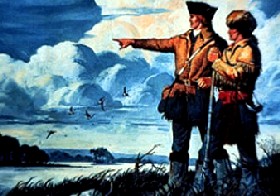
The surprising thing is that Reed isn't even the most distracting aspect of the movie. Her performance is actually pretty good, even if she looks ridiculous. That casting has to rank up there with John Wayne as Genghis Khan or Omar Sharif as Che Guevara as the most bizarre to ever come out of Hollywood. What was the worst part of the movie was Fred MacMurray as Meriwether Lewis. Talk about a wooden actor. This role could have been played by any number of people, Wayne, Henry Fonda, Robert Mitchum, anybody but MacMurray who just seems out of place.
His counterpart, William Clark, is perfectly cast with Charlton Heston filling those shoes. Heston made a career out of big, lavish historical epics and period pieces, and for good reason, his performances were always very strong whether it be as Moses or Michelangelo. But the movie plays loosely with historical fact, which isn't a sure deal-breaker, but so much could have been done with the story. Prior to leaving, Clark proposes to Julia Hamilton, who Lewis has been a friend with for years and is sweet on. She accepts and so the tension begins.
Along the trail after meeting Sacagewea, Clark starts to fall for her, making Lewis mad at him for falling in love and at the same time forgetting about his fiance back in Washington. That's right, one of the best stories in American history has turned into a love triangle, a completely inaccurate one at that. It's just an odd movie from beginning to end. I'm a sucker for historical period pieces, but this one is not worth it. Watch "Horizons" for the gorgeous location shooting in Grand Teton National Park, but don't expect much else.
The Far Horizons (1955): **/****
Labels:
1950s,
Charlton Heston,
Donna Reed,
Fred MacMurray,
westerns
Subscribe to:
Posts (Atom)