The Sons of Katie Elder

The Sons of Katie Elder
"First, we reunite, then find Ma and Pa's killer...then read some reviews."
Showing posts with label Cameron Mitchell. Show all posts

Wednesday, March 11, 2015

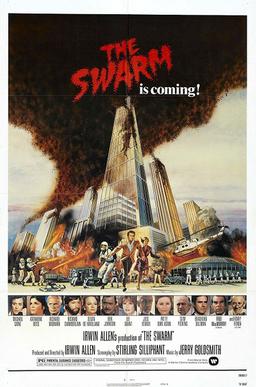
The Swarm

I'm not always the quickest learner so I'll take the blame for this one. I guess I should have learned quicker. While there are exceptions, there just weren't many good disaster movies in the 1970s and then into the 1980s. So for every Airport, Towering Inferno and Poseidon Adventure, there are movies like 1978's The Swarm. Yep, another nail in the coffin of a genre struggling to hold on for dear life.

At an isolated army installation in the American Southwest, a heavily armed patrol slowly navigates the eerily empty facility. What the hell happened here? Deep underground at the installation, the investigating patrol finds several dead bodies and a few lucky survivors, including a mysterious doctor, Brad Crane (Michael Caine), who says he's an expert on the world of insects. A much larger army force, commanded by crotchety General Slater (Richard Widmark), arrives soon after, and they're too stunned at what they find and what Crane claims is behind the mysterious attack. The responsibility goes to....an immense swarm of African killer bees. Bees!!!! Making the situation worse, there's no cure for the bees' surprisingly venomous sting and seemingly no one is immune. It looks like nothing can stop the not-so-fast moving bees, and they're heading for Houston.

Sometimes you DO just know. When this 1978 disaster flick from director Irwin Allen -- Master of Disaster flicks -- popped up on Turner Classic Movies' schedule, I had to set it to record. I HAD to. Movies with casts like this don't pop up too often so I had to at least give it a try. Worst case, it's just entertaining in a bad, guilty pleasure fashion, right? Well, that's what you would think. This wasn't even good in a 'So bad it's good' way. It just isn't entertaining. Apparently, I'm not the only one who thinks so. 'Swarm' is on all sorts of worst movies ever made lists and bombed in epic fashion in theaters back in 1978. If that's not a recipe for success, I don't know what is!

Maybe the most frightening thing to take away from this bee-disaster flick is that there's a director's cut available out there clocking in at 156 minutes. The TCM version I saw was an already painfully long 116 minutes. God knows what else could be expanded on in an additional 40 minutes because I was losing interest in the shortened version at the 60-minute mark. For goodness sake, 'Swarm' utilizes a love triangle featuring Olivia de Havilland, Ben Johnson and Fred MacMurray (in his last role) as a subplot! Yes, because that's what we need, three Hollywood legends in a senior citizen love triangle in a disaster flick where a swarm of killer bees are the villains. Seems reasonable, don't it? I can't say I'd be too interested in seeking out that longer version of a dud like this.

Star Michael Caine has said this is the worst movie he ever made, and it's hard to disagree. As the insect/bug specialist, Caine looks to be immensely bored throughout. If there's a slightly redeeming quality in 'Swarm,' it's that the cast is epically impressive. Now are any of them given much of anything to do? That would be a big N-O, but still, look at all those Hollywood stars! Along with Caine and perpetually angry Widmark, look for Katharine Ross, Henry Fonda and Richard Chamberlain as some of the scientists tasked with halting the advance of the bees.  Also look for Lee Grant, Jose Ferrer, Patty Duke, Bradford Dillman, Slim Pickens, and Cameron Mitchell in other supporting parts, some more painfully forced than others.

Things unfortunately develop in more spoof-fashion than straight disaster flick. How many slow motion bee attack scenes can we witness before it just becomes laughable? Because the movie is about bees, we get one hilarious scene after another about our very talented cast discussing what the bees' intentions are, if they're seeking revenge, if there is a major bee plan to take over the world. It's all done so straight that it becomes spoof-like, and that's never a good thing. The problem is there just isn't that one reason to sit back and watch this one, and that's considering the star power on hand. The cast is given little to nothing to do, the killer bees are a laughable "villain," and the entertainment value just isn't there. Give this one a wide berth.

The Swarm (1978): */****

Thursday, February 12, 2015

The Klansman

It seems pretty simple if you ask me. You're making a movie so you want to assemble the best group of talent you can to make a successful movie. Right? Well, sometimes even that isn't enough. Sometimes even a ton of talent can't prevent a stinker. Here we are with another iTunes discovery I found, 1974's The Klansman.

In a small Southern town during the Civil Rights movement, Sheriff Track Bascomb (Lee Marvin) constantly has his hands full keeping the peace. His work is cut out for him with the KKK boasting a strong contingent in the county, but a majority of the population is African-American. The problem? It's the whites who control his job security come election time. It's a lose-lose battle, and it's about to be much, much worse. A white woman is raped by a black man and soon after the bodies begin to pile up until ultimately part of the KKK rapes a black woman. An upcoming demonstration to get the African-Americans in town to get out and vote is fast approaching, and the county has turned into a powder keg just waiting to be set off. Track is in trouble and his saving grace may be a rich local man, Breck Stancill (Richard Burton), who has absolutely no use for the KKK or its "objectives." The problem though...Stancill may be too extreme in his counter to help.

I was born in 1985 so it's difficult for me to get my ahead around the Civil Rights movement. Sure, I can read books, watch movies, shows and documentaries about it, but I'll never really know horrific the time truly was. It is a time period often explored through film, recently with movies like Selma but also including Malcolm X, In the Heat of the Night, Mississippi Burning and many more. This may sound obvious, but if you're going to take on a Civil Rights movie, it should probably have...well, a serious tone. Or at least I'd think so. You don't want to get too over the top. Just let the story and characters speak for themselves. 'Klansman' decided not to go down that route.

Yikes. What a stinker. This racially-charged drama is from director Terence Young who directed far better movies like Dr. No, Thunderball, From Russia With Love, Triple Cross and several others. This is just a lousy movie. It starts with the tone. Frighteningly enough, the racism we see on display from our KKK members was probably pretty accurate. On the other hand, it plays out here in almost cartoonish fashion to the point I was laughing out loud at this dreck. The n-word is used so many times by sneering, driveling hillbilly yokels you become numb to it. And that becomes the issue. 'Klansman' is so overdone and over the top that any potential impact or message is beyond muddled. Instead, it plays out like a spoof of sorts. If the message is 'No one wins with racism'.....well, thanks. Quite the message.

Searching through the iTunes movie library, this one caught my eye because of the cast assembled. Unfortunately, that's as far as it went. I didn't look any further into it, and I most definitely should have. There goes $2.99 (even off a gift card) I'll never get back. The production stories indicated that star Richard Burton needed three bottles of vodka a day to get over a back injury. It shows. Delivering his lines in an odd Southern(ish) accent, Burton mumbles and stumbles his way through the movie in a really bad part. The scary part? Co-star Lee Marvin supposedly matched Burton drink-for-drink and ends up delivering the movie's best performance. His Sheriff is torn between his duty, what he believes, what the job means in support of his family, and what he knows is right and wrong.

Too bad then that Marvin's pretty decent performance is lost in a winding, kinda episodic story that doesn't really know where it's going or how to get there. There are too many characters, too many subplots that go by the wayside. The rest of the cast includes Cameron Mitchell as Deputy Butt Cutt Cates, hamming it up with hate, O.J. Simpson (taking a break from football) as Garth, a rifle-wielding vigilante, Lola Falana as Loretta, a friend of Breck's who becomes a KKK target, David Huddleston as the mayor and KKK head honcho, Luciana Paluzzi (obviously dubbed) as Trixie, the police secretary who has a thing with Breck, and Linda Evans as Nancy, the white woman raped in the movie's opening scenes.

It's just a bad movie that doesn't deserve too much more analysis. Bad script, out of place soundtrack, and an ending that would have been halfway decent if the build-up wasn't so painful. I wouldn't have continued watching if I hadn't paid $2.99 to rent it. Watch at your own risk!!!

The Klansman (1974): */****

Friday, November 7, 2014

Ride in the Whirlwind

I think one of the best ways to describe director Monte Hellman is interesting, maybe even quirky. A director with movies like Two Lane Blacktop, Cockfighter, and China 9, Liberty 37 to his name, Hellman specialized in odd, typically pretty low budget flicks. He also had a friendship and solid working relationship with a huge rising star in the 1960s. That name? Keep reading with 1966's Ride in the Whirlwind.

Riding south through Texas to find more work in the border country, three cowboys, Vern (Cameron Mitchell), Wes (Jack Nicholson) and Otis (Tom Filer) are casually making their way down the trail. They ride up to an isolated line shack in the mountains, a group of five men hiding out there and suspicious of this trio of newcomers. Why? The men are what's left of a gang of stagecoach robbers led by Blind Dick (Harry Dean Stanton) on the run from a posse after a robbery produced a dead stagecoach guard. Upon seeing that the three cowboys don't present a challenge, Dick allows them to eat and drink with them, even staying the night. Seeing the clues all around them, Vern, Wes and Otis immediately know they're not being told everything. They need the rest though and agree to ride out the next morning. They wait too long though. A posse shows up the next morning, and now these cowboys are in some serious trouble.

Shot back-to-back with another 1966 Hellman western, The Shooting, 'Whirlwind' is a little-known, mostly forgotten western. It was released in a time when the perception of the western genre was changing to a more cynical, realistic and sinister outlook. These flicks were dubbed revisionist westerns as they gave a new look at a genre that was always good guys vs. bad guys. Nothing is clean or easy. It's a dirty, gritty world where survival reigns above all else. Both Shooting and Whirlwind were filmed in Utah, the budget for both films a combined $150,000. That wouldn't cover the catering for most modern movies!

In the revisionist vein, 'Whirlwind' is worthwhile because of that darkness. If there was a such thing as a tragic western, this would be it. The iconic image of the cowboy is a genre archetype, maybe the most important western archetype. The three cowboys we meet -- Vern, Wes and Otis -- aren't heroes. They're not lightning-fast gunslingers. They're not maniacal killers. They are cowboys, plain and simple. We learn little to nothing about them, only that they're hard-working saddle tramps who are most comfortable in the saddle. Their laconic, easy-going demeanor feels real, very natural and not forced at the least. They sit around a campfire talking about where they hope to go, what jobs they hope to get. They don't want the trouble they find themselves in, but there's no clean way out of it. They have to make decisions about how far they want to go to make sure they get out unscathed.

It sounds so criminally simple, but the mistaken identity angle works perfectly. That's where the tragic element comes into play. They're just trying to do their job. They don't want anything to do with this trouble. The focus is on Nicholson and Mitchell, the younger cowboy with a lot of experience just the same and the more veteran cowboy with a few more miles on his backside. Without knowing much about them, I found myself liking them. The rest of the cast is generally unknown, Harry Dean Stanton as Blind Dick the lone exception. George Mitchell and Kathleen Squire are a husband and wife on their small ranch the cowboys meet on the trail with Millie Perkins as their semi-curious daughter.

So what's the big issue? Almost everything I've brought up until now seems like a glowing review. It could have been a classic, but it isn't. At 82 minutes, 'Whirlwind' is a short movie but it ain't a quick movie. Hellman has said in interviews he tries to focus on the visual and leave dialogue by the wayside. That's fine but when nothing happens for long stretches of an already short, slightly sluggish movie, we've got an issue. Reality is almost always a plus in a western -- and it is here -- but there just isn't much in the way of energy as our cowboys are on the run with the posse closing in not too far behind. I liked where it went late with a dark ending that could have been far darker. I liked the movie for a lot of reasons, but it could and probably should have been better. Still worth checking out if you can track it down.

Ride in the Whirlwind (1966): ** 1/2 /****

Monday, May 26, 2014

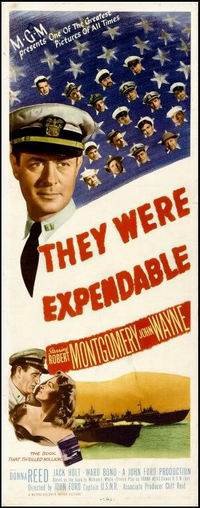
They Were Expendable

John Ford once famously said "I make westerns." I love a lot of those westerns -- and tolerate some others -- but Ford's career was more than solely westerns. Some of his most respected movies like The Quiet Man, The Grapes of Wrath, and Drums Along the Mohawk are far from westerns. Ford even served during World War II, but the popular director isn't known for making war movies. His last war film? An underrated classic, 1945's They Were Expendable.

It's December 1941 in the Philippines and Lt. John 'Brick' Brickley (Robert Montgomery) is at the head of a small squadron of torpedo boats, a new form of attack boat that hasn't earned a reputation yet as a fighting unit. That ability to fight is about to be tested. When the Japanese unleash their surprise attack on Pearl Harbor, the entire U.S. military in the Pacific is forced to improvise in a desperate attempt to hold off attacking Japanese forces and somehow survive in the process thousands of miles from help. Brick and his second-in-command, Lt. Rusty Ryan (John Wayne), join the fighting too, the PT boats figuring out on the fly how they can help the war effort as Japanese forces surge forward on Bataan and Corregidor. With supplies limited and reinforcements a remote possibility, the PT boats must band together in a last-ditch effort.

The early parts of World War II in the Pacific feature some of the worst defeats the U.S. military has had in its 200-plus year history, including the battle for Bataan, originally leading to the horrific Bataan Death March. It reflected how poorly the U.S. was planned for an attack on such a grand scale. Ford's film -- which he supposedly hated, saying he was forced to make it -- delves right into that. The U.S. government had to make extremely difficult decisions in December 1941 and into 1942. If there was any hope of taking the attack back to the Japanese, the Philippines had to be abandoned, meaning thousands of American and Filipino troops were simply left to fight it out on their own with little in the way of supplies, food, ammunition and most importantly, no help on the way. A horrific American defeat, it makes for an incredibly moving story.

What a somber, unsettling and yes, moving film from Ford. I believe it deserves far more of a reputation, an incredible story that covers a lot of ground in its 135-minute running time. 'Expendable' follows the battle for the Philippines -- about four-plus months -- in a forthright, honest fashion. This isn't a rah-rah! war movie. It tells a story that needs to be told, and I'd imagine, many Americans don't know much about. 'Expendable' is interested in telling the story of the heroic sacrifices made by the thousands of people left to fend for themselves as Japanese forces inched ever closer. Ford's film was shot in black and white, a beautiful, shadowy visual that a crime-ridden 1940s/1950s film noir would have been jealous of.  There will be no miracle surprise in the end for these men. Some will be flown out of the Philippines but for most, they will be left behind, forced to choose whether to fight the Japanese or maybe surrender. A downbeat story for sure, but an honest look at war too. Heroes? Yes. A story interested in glory? No, just doing what's difficult because that's what they've been trained to do.

So many moments here stick with me after viewing this 1945 WWII movie. Wayne's Rusty meets Sandy (a scene-stealing Donna Reed), a young nurse trying to help the wounded that keep pouring in. It is a love story that feels real and natural, not forced. Ryan delivers a soft-spoken, emotional eulogy over a fallen comrade with his surviving crew standing around him. A quiet, candlelit dinner has Ryan, Sandy, Brick and their officers quietly enjoying a peaceful turn, the Japanese guns banging miles away. An old man known as Dad (Russell Simpson) who's lived in the Philippines for years waits on his doorstep with a rifle across his lap. Take his land? He'll have something to say about that. Brick and Rusty visit a wounded comrade (Paul Langton), trying to give him a boost even though the prognosis is a mortal wound. There's too many to mention here, but it helps boost the movie up a notch. Ford at times could get overly sappy, too cute with his stories, but 'Expendable' rings true from beginning to end.

There isn't a weakness in the cast. A Navy veteran himself, Montgomery is excellent as Lt. Brick, a tough, capable officer who doesn't let the daunting task at hand slow him down. When Ford had some on-set health problems, Montgomery stepped into the director's chair. Ford was especially tough on Wayne because the Duke had not served during WWII, but Wayne comes through, delivering an excellent performance. The chemistry between Montgomery and Wayne is subtle and perfect, two friends who have almost a brotherly relationship. Along with Reed, also look for Jack Holt and Charles Trowbridge as high-ranking Army and Navy officers, tasked with the impossible, holding together an army that has no backing. As for the PT boat crews, look for Ford regular Ward Bond along with Marshall Thompson, Cameron Mitchell, and Ford favorite Jack Pennick. I also liked Louis Jean Heydt's quick appearance as Ohio, a fellow officer Ryan meets trying to survive one place to another.

This is a war movie, but the action isn't front and center. What's there is impressive though, the footage of the PT boats zipping across the Pacific doing an excellent job of getting your adrenaline pumping. Mixing in some archival WWII footage, the action is spectacular as the Japanese guns blaze away at these small but extremely fast attacking boats armed with two torpedo tubes and a couple of .50 caliber machine guns. The action sequences are highlighted by an escape from a lagoon base under attack, a nighttime attack on a well-guarded Japanese convoy and a desperate run up a river as Japanese planes descend for their own attack runs. The focus is far more on the men, but these battle sequences are excellent whenever they pop up. 'Expendable' was filmed in Key Biscayne, Florida and the Florida Keys, a more than worthy fill-in for the South Pacific.

Just an excellent war movie, one that deserves more attention for what it accomplishes. It deserves its place among John Ford's classics.

They Were Expendable (1945): ****/****

Wednesday, April 16, 2014

Minnesota Clay

For right or wrong, movie fans think Sergio Leone created the spaghetti western genre. They would be wrong. With his Dollars trilogy, especially Fistful of Dollars, he didn't create the genre but instead put it squarely on the map, put it in the spotlight. Spaghetti westerns had been around for several years but in an earlier, nicer form. Leone would flip that formula. One pre-Leone spaghetti is pretty decent, a mix of an American and Italian western, 1964's Minnesota Clay.

Wasting away for years at a labor camp in the desert, Minnesota Clay (Cameron Mitchell) has had enough, vowing to prove his innocence. Years before, Clay was sent to prison in a frame-up job, found guilty for gunning down two men. In reality, it was self-defense, but a bribed court didn't see it that way.  He manages to escape, heading for home but in his hometown of Mesa Encantada, Clay finds the town being run by two rival gangs, one a gang of Mexican bandits led by General Ortiz (Fernando Sancho), the other run by a man called Fox (Georges Riviere), an old friend originally hired to protect the town. Looking to clear his name, Clay finds himself pitted against both gangs, working to save his own skin before they turn on him. His reputation as one of the fastest guns around is about to be tested in a big way.

Part of the 50 Spaghetti Western collection I bought several years ago, I was pleasantly surprised by this one. I knew this next tidbit but didn't remember it going in, but 'Minnesota' is from director Sergio Corbucci, later of Django, The Great Silence, The Mercenary and Companeros fame, among others. Corbucci's big hit, Django, would hit theaters internationally two years later, but here in 1964 with the genre still in its infancy, Corbucci shows his potential with a middling movie. It still has touches of American westerns (forced love interest, forced comedic moments), but there's also some clear, early examples of where the genre is/was heading. There's some familiar locations, decent if not memorable music from Piero Piccioni (he did much better) and a story eerily similar to Fistful of Dollars which was based off Akira Kurosawa's Yojimbo. Not great, but better in general than some early spaghetti entries.

Over the last year, I've been watching The High Chaparral, a TV western that aired for four seasons and is now on syndication, letting me catch up two episodes at a time. One of the stars? Cameron Mitchell who I like a lot as Buck Cannon, a loving life cowboy. I've seen plenty of movies with him, but nothing quite like this. A recognizable face in American westerns, it's cool to see him head to Italy and star in this early spaghetti. It isn't a flashy part but a good one just the same. Gravelly-voiced, steely-eyed and looking for redemption, Mitchell's Minnesota Clay is a good example of where the spaghetti western anti-hero would go in the coming years. Some time is wasted with his daughter (Diana Martin) who doesn't know her father and her bumbling suitor (Alberto Cevenini), not enough focus on his possibly doomed attempt to clear his name. Not the biggest name to lead the way in a western but Mitchell more than holds his own.

The supporting cast is a good example of how the spaghetti western genre helped change the western in general. We've got some very good characters and very evil characters with little in between. Riviere is the slimy, smooth Fox, a manipulative businessman with a gang of killers to back him up, Gino Pernice as his main enforcer, Scratchy (quite an imposing name, huh?). Sancho does what he did best, the crazy, overacting, cliched, stereotypical Mexican bandit right down to the crossed bandoliers, the greasy mustache, the maniacal laughing, all a lot of fun. Ethel Rojo gets to femme fatale it up as Estella, a saloon girl who attaches herself to anyone who can help her out. Rounding out 'the good' department, Antonio Casas plays Jonathan Mulligan, Clay's old friend who took his daughter in as his own.

Maybe the biggest thing that audiences ate up with spaghetti westerns was the brutality, just the out and out violent, vicious qualities. No one was safe. NO ONE. Everyone was a possible target. Corbucci especially took those qualities to heart in his movies (Django, Silence, The Hellbenders), and this 1964 western is a good preview. Corbucci loved torturing his anti-heroes, gunslingers who were crippled, maimed, wounded and handicapped, forced to overcome these things to save the day in the end...and sometimes fail. There isn't a ton of gunplay here, most of it saved for two shootouts late. The finale especially is pretty cool, a partially blinded Clay forced to take on a small gang of gunmen. The American and Italian versions had different endings, and for a change, the American ending was better.

A solid spaghetti western all-around.

Minnesota Clay (1964): ** 1/2 /****

Saturday, April 10, 2010

Tension at Table Rock

In a career that spanned over 30 years, Richard Egan was in over 60 movies and made guest appearances on several TV shows.  But like so many Hollywood actors/actresses from the time, he's been mostly forgotten in the years since his death in 1987.  Some of it surely has to do with his films -- not one is a true classic -- but that doesn't mean he was in good movies.  Where some stars reach the heights of the profession, Egan became more known for his work in B-movies.  I'll never consider him a great actor, but even in his lesser roles, he had presence to spare.

A good example of his abilities is on display in the 1956 western Tension at Table Rock.  Egan plays the main character -- a gunfighter running from his past -- in a story that uses just about every western cliche available and still manages to be halfway decent.  Egan has one emotion in this movie, if you can call it an emotion, and it's monotone.  His voice never goes up or down whether he's angry, wooing a lady, or just having a conversation.  His face seems to be stuck in the one position for the whole 93 minutes, and through it all still makes it an interesting character.

Wes Tancred (Egan) is dealing with his name becoming legendary -- and not in a good way -- after he shot his best friend and partner, a fellow gunslinger, who was turning on him.  The legend builds that Wes gunned him down in the back, and soon enough, a ballad pops up describing the killing.  Wes is pardoned by the governor and moves further west under a new name. He takes a job at a stagecoach station but is forced to move on after a robbery with the loner survivor of the attempt, young Jody (Billy Chapin) in tow.  Jody has an uncle living in the nearby town of Table Rock who happens to be the sheriff, Fred Miller (Cameron Mitchell).  Some well-hidden sparks start to fly between Wes (alias 'Bailey') and Miller's wife Lorna (Dorothy Malone), but that's the least of the problems.  Fred is still recovering from a brutal attack and with a cattle drive coming his way, he will have to stick up for the town against the rowdy cowboys, with or without Wes's help.

The story does take its time setting everything up, and it's over 45 minutes in before the cattle drive and its boss (John Dehner) is even introduced.  The different storylines bounce every which way with just about every possibility imaginable taken into account in one way or another.  'Table Rock' borrows liberally from other 1950s westerns but still manages to put its own spin on things.  All the important elements of a good western are there; honesty, loyalty, doing what's right no matter the cost, and being true to yourself.  Still, it's hard not to shake the idea that the plot was never really settled on.  Everything wraps up nicely though in the end with the heroic Egan moving on to another town rather than cause a disruption where he is.

The western drifter/gunfighter has been done to death although on a positive note this was well before Sergio Leone got his hand on the genre and infused a bit of cynicism into the western.  Egan's Wes is a flawed man who's made out to be something he's not.  Sure, he's good with a gun, but he's not a cold-blooded killer.  1950s westerns love flawed characters like these because they're not bad guys, but they're not white hatted good guys either.  These sort of anti-heroes usually end up making some sort of personal sacrifice -- not usually involving their own death, it is the 1950s -- so that a family or a town can move on from their pasts.

Joining Egan is a strong supporting cast, especially Mitchell as Sheriff Fred Miller.  He's still recovering from a horrific beating that almost killed him and is thrown right into the fire to protect his town from the incoming rowdy cowpokes.  Mitchell makes Miller a character who wavers over what to do but ends up figuring out what's right and what's wrong, consequences be damned.  Malone is good as Miller's wife Lorna who can't help but be attracted to the steely-eyed, mysterious gunfighter.  Dehner is wasted as a quasi-villain with Royal Dano having some fun with his part as the crotchety old newspaper man.  Only in one scene, DeForest Kelly (pre Star Trek) makes a strong impression as Jim Breck, a hired gun with a unique mission.

Nothing really remarkable about this B-western, but as several IMDB reviewers point out, doing a well-worn formula picture well has to count for something.  At Youtube, several clips have been posted focusing on child star Billy Chapin's performance for those curious and looking for more about the movie.  Also look for a young Angie Dickinson in a small part, playing against the image she would become known for when she became a star.  Innocent enough western that is a pleasant enough way to spend 90 minutes.

Tension at Table Rock <----trailer (1956): ** 1/2 /****

Friday, September 25, 2009

Buck and the Preacher

Just more proof that studios don't have to rely solely on remakes and rehashes? 1972's Buck And the Preacher, a western documenting the story of former slaves moving west in the years following the Civil War. It's a unique story that I can't even think of a similar movie to compare it to. But no, we get remakes of remakes or high quality movies like 'I Hope They Serve Beer in Hell' which I haven't seen but feel safe saying it's not an instant classic. The stories are out there, studios just have to find them.

In his directorial debut, star Sidney Poitier presents a story unique in both its presentation and characters. But before I get long-winded, it all boils down to this; the story of African American families moving west for a new, better life following the Civil War. Westerns so often focus on the gunfighters and the Indian wars that stories like this get lost in the shuffle. Black characters are often supporting characters or in the background but not here. The main characters are all black, and to be honest I can't think of another western even remotely like it.

Trail guide Buck (Poitier) makes his money guiding wagon trains of black families west with hopes of establishing them with new lives in their new found freedom. The memories of the Civil War are still fresh in people's minds and maybe more importantly, the prejudices and racism still exist. Group of riders called 'Nightriders' harass and terrorize these wagon trains, shooting them up and scaring them into heading back east. One particular group, led by a man named Deshay (Cameron Mitchell), attacks one of Buck's trains leaving them with no money and little food to last out the coming winter.

Forced to work together with a con man preacher (Harry Belafonte) he keeps crossing trails with, Buck must think of some way to not only get money for the stranded wagon train but also avoid Deshay and his men. The unlikely duo is forced to take drastic measures, enlisting the help of Buck's wife Ruth (Ruby Dee) along the way as Deshay's murdering posse closes in to finish them off.

A buddy movie rolled together with a story that actually has to say something worthwhile, Buck and the Preacher was a pleasant surprise for me. Reading about it in advance, I got the sense it was a comedy, and while there are several funny moments, it's much more of a serious drama. Poitier as Buck is the typical western hero, resolute in his plans and a man who's word is as good as gold. He will stop at nothing to help the people he's promised to lead. Belafonte gets the scenery-chewing role as the Preacher, a man always ready with a Bible verse but who will also pull a gun on you if need be. Their uneasy friendship/alliance is a pleasure to watch from beginning to end, and in some ways reminded me of Paul Newman and Robert Redford in Butch Cassidy and the Sundance Kid with their bickering.

Background information is slowly filtered out about Belafonte's character, but even then it is a hard character to read. He is clearly out to help himself, others be damned, but when backed into a corner he fights as hard as anyone else. The finale is a good one as Buck and the Preacher seem to be cornered on a rocky summit with a posse quickly surrounding them. As Buck's wife Ruth, Dee is a strong presence with Poitier. It's a small role, but just like her husband, Ruth is willing to stand up for what's right when the time comes. As the villain, Mitchell isn't given much to do other than look menacing, which he pulls off well.

Other important supporting parts include Enrique Lucero and Julie Robinson (Belafonte's wife in real life) as an Indian chief and wife who is a somewhat unwilling ally of Buck. While the movie's focus is on the black families moving west, it's interesting to see the interaction with the Indians. It's two different groups of people, but in many ways they are very similar in the way they were treated by other cultures, especially whites. It's just one more aspect of a unique, interesting western with a message. Definitely give this one a shot.

Buck and the Preacher <----trailer (1972): ***/****