The Sons of Katie Elder

The Sons of Katie Elder
"First, we reunite, then find Ma and Pa's killer...then read some reviews."
Showing posts with label Fernando Sancho. Show all posts

Wednesday, April 16, 2014

Minnesota Clay

For right or wrong, movie fans think Sergio Leone created the spaghetti western genre. They would be wrong. With his Dollars trilogy, especially Fistful of Dollars, he didn't create the genre but instead put it squarely on the map, put it in the spotlight. Spaghetti westerns had been around for several years but in an earlier, nicer form. Leone would flip that formula. One pre-Leone spaghetti is pretty decent, a mix of an American and Italian western, 1964's Minnesota Clay.

Wasting away for years at a labor camp in the desert, Minnesota Clay (Cameron Mitchell) has had enough, vowing to prove his innocence. Years before, Clay was sent to prison in a frame-up job, found guilty for gunning down two men. In reality, it was self-defense, but a bribed court didn't see it that way.  He manages to escape, heading for home but in his hometown of Mesa Encantada, Clay finds the town being run by two rival gangs, one a gang of Mexican bandits led by General Ortiz (Fernando Sancho), the other run by a man called Fox (Georges Riviere), an old friend originally hired to protect the town. Looking to clear his name, Clay finds himself pitted against both gangs, working to save his own skin before they turn on him. His reputation as one of the fastest guns around is about to be tested in a big way.

Part of the 50 Spaghetti Western collection I bought several years ago, I was pleasantly surprised by this one. I knew this next tidbit but didn't remember it going in, but 'Minnesota' is from director Sergio Corbucci, later of Django, The Great Silence, The Mercenary and Companeros fame, among others. Corbucci's big hit, Django, would hit theaters internationally two years later, but here in 1964 with the genre still in its infancy, Corbucci shows his potential with a middling movie. It still has touches of American westerns (forced love interest, forced comedic moments), but there's also some clear, early examples of where the genre is/was heading. There's some familiar locations, decent if not memorable music from Piero Piccioni (he did much better) and a story eerily similar to Fistful of Dollars which was based off Akira Kurosawa's Yojimbo. Not great, but better in general than some early spaghetti entries.

Over the last year, I've been watching The High Chaparral, a TV western that aired for four seasons and is now on syndication, letting me catch up two episodes at a time. One of the stars? Cameron Mitchell who I like a lot as Buck Cannon, a loving life cowboy. I've seen plenty of movies with him, but nothing quite like this. A recognizable face in American westerns, it's cool to see him head to Italy and star in this early spaghetti. It isn't a flashy part but a good one just the same. Gravelly-voiced, steely-eyed and looking for redemption, Mitchell's Minnesota Clay is a good example of where the spaghetti western anti-hero would go in the coming years. Some time is wasted with his daughter (Diana Martin) who doesn't know her father and her bumbling suitor (Alberto Cevenini), not enough focus on his possibly doomed attempt to clear his name. Not the biggest name to lead the way in a western but Mitchell more than holds his own.

The supporting cast is a good example of how the spaghetti western genre helped change the western in general. We've got some very good characters and very evil characters with little in between. Riviere is the slimy, smooth Fox, a manipulative businessman with a gang of killers to back him up, Gino Pernice as his main enforcer, Scratchy (quite an imposing name, huh?). Sancho does what he did best, the crazy, overacting, cliched, stereotypical Mexican bandit right down to the crossed bandoliers, the greasy mustache, the maniacal laughing, all a lot of fun. Ethel Rojo gets to femme fatale it up as Estella, a saloon girl who attaches herself to anyone who can help her out. Rounding out 'the good' department, Antonio Casas plays Jonathan Mulligan, Clay's old friend who took his daughter in as his own.

Maybe the biggest thing that audiences ate up with spaghetti westerns was the brutality, just the out and out violent, vicious qualities. No one was safe. NO ONE. Everyone was a possible target. Corbucci especially took those qualities to heart in his movies (Django, Silence, The Hellbenders), and this 1964 western is a good preview. Corbucci loved torturing his anti-heroes, gunslingers who were crippled, maimed, wounded and handicapped, forced to overcome these things to save the day in the end...and sometimes fail. There isn't a ton of gunplay here, most of it saved for two shootouts late. The finale especially is pretty cool, a partially blinded Clay forced to take on a small gang of gunmen. The American and Italian versions had different endings, and for a change, the American ending was better.

A solid spaghetti western all-around.

Minnesota Clay (1964): ** 1/2 /****

Monday, April 8, 2013

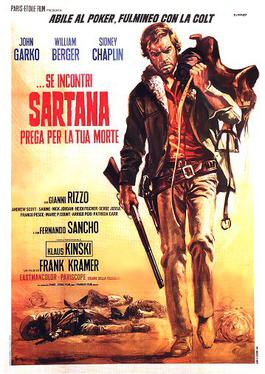
If You Meet Sartana, Pray For Your Death

The Man with No Name Dollars trilogy, Trinity, Django, Sabata, all characters that have their own series in the spaghetti western genre. I've seen at least parts of all those character series, and recently jumped into another, the Sartana series, starting with 1968's If You Meet Sartana, Pray for Your Death

A stagecoach has been robbed, and all its passengers lay dead. As the robbers loot the bodies, a mysterious gunman, Sartana (Gianni Garko), steps in front of them and guns them down. Not long after, a second stagecoach is attacked, this time carrying a huge gold shipment for a town up the trail. The only issue? The strongbox doesn't contain any gold at all....it's just heavily loaded with rocks. Who's up to something? Sartana seems to know, pitting all sides against each other. Another gunman, Lasky (William Berger), has been well-involved with all the robbery, murder and betrayal and is suspicious of what Sartana is up to. Sartana has too many enemies though as he investigates the disappearance of the gold. His only option is simple; pit all sides against each other and swoop in at the opportune time.

This spaghetti western is everything that's both good and bad about the genre. When it's entertaining, it's very entertaining (movie specific: this one's bad but entertaining). When it's bad.....it's very bad. For director Gianfranco Parolini, 'Pray' plays more like a test run for his infinitely better 1969 spaghetti classic, Sabata. The basic premise is almost entirely the same story. Garko's Sartana is a younger Sabata (played to perfection by Lee Van Cleef). The tone is light with some acrobatic gunmen and generally goofy atmosphere. The music from composer Piero Piccioni is pretty forgettable, a disappointment considering how good some of his other scores (The Deserter) were. There are some cool locations although the movie hamstrings itself by using the same locations repeatedly. I swear Sartana rides through the same hilly sand dune at least four different times.

Belonging in the short list of coolest spaghetti western title characters, Sartana is a pretty cool anti-hero gunfighter. He's a gentleman and dresses the part, favoring a suit, vest, cravat and overcoat that resembles a cape. He uses a long-range Winchester rifle and a multi-barreled derringer pistol. Sartana is a gambler as well as an accomplished gun, an ability that plays well in an early card game. Mostly I like the character because it hints -- in not so subtle fashion -- that Sartana is some sort of angelic killer, an angel of death. He seemingly can't be shot (check out the opening scene HERE) or hurt by enemies while appearing at will out of thin air. I like Garko a lot in the role, one he would play three more times, bringing a lighter touch to the anti-hero gunslinger. He's smooth with a gun and a bit of a smartass with whoever he meets. It's different, and I liked it a lot.

Spaghetti western diehards will eat this one up in the casting department with some really odd and really cool casting. Berger is over the top and goofy as Lansky, a brutally efficient hired gun with murder and blackmail on his mind. He's also completely undone whenever Sartana plays the tune from the watch of a man Lansky has killed. Klaus Kinski shows up in a bizarre cameo as Morgan, a knife-throwing killer with little bells for spurs. He's around for about 3 minutes, but it's Kinski so it's cool. Fernando Sancho does what he does best, playing a slimy, greasy, cackling Mexican bandit/general -- here General Tampico Mendoza -- who gets caught up in the killing. Sydney Chaplin and Gianni Rizzo play the two conniving businessmen in town who are up to something, Heidi Fischer playing Rizzo's equally conniving wife. Spaghetti western regular Salvatore Borghese makes a too quick appearance as Moreno, one of Sancho's main henchman.

There is a part of almost all spaghetti westerns that are inherently stupid, but you just go along (well, if you're a fan at least). Unfortunately, 'Pray' has so many of these moments it's hard to take even remotely serious. I liked the movie, but I can appreciate it and all its badness. If you did a drinking game after every time someone maniacally laughs, you'd be drunk in minutes thanks to maniacal laughing coffin maker Dusty (Franco Pesce). Sancho cackles and laughs, eating the same greasy piece of chicken in countless scenes. Berger's Lansky literally crumbles at just the sound of a musical watch. The script is pretty bad in itself -- Sartana's bedroom kinkiness a highlight -- and doesn't offer much of a story. The "story" requires people to connive and worry, Sartana shows up, plans are thrown out and started over. An impressive body count here with some fun action scenes too. It's bad. No doubt about it, but I was entertained throughout.     

If You Meet Sartana, Pray for Your Death (1968): ** 1/2 /****

Thursday, October 20, 2011

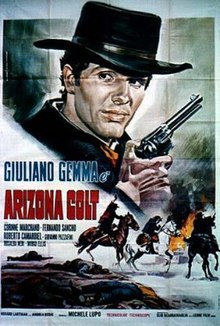
Arizona Colt

With a sub-genre like spaghetti westerns that produced around 600 movies in a span of just over 10 years, you're going to see familiar faces popping up over and over again. But with the spaghettis and as many stars as the genre produced, no one was in more Italian westerns than Spanish actor Fernando Sancho. This new wave of westerns had all sorts of vicious bad guys, and Sancho specialized in just those roles, typically playing a variation on a Mexican bandit chief, like in 1966's Arizona Colt.

Leading his ruthless band of outlaws -- the Sidewinders -- bandit chief Gordo Watch (Sancho) busts out a large group of prisoners from a poorly guarded prison. He's looking to fill out the ranks of his gang, offering the released prisoners a simple offer...join or die. All except the offer except one, a gunfighter by the name of Arizona Colt (Giuliano Gemma), who escapes before he can be shot down. Arizona taunts Gordo, betting he can't exact his revenge. Gordo and his gang are planning a robbery in the nearby desert town of Blackstone Hills, but Arizona seems to have other ideas. Even when the town turns on him for being just like the bandits, he must now decide to help the town or turn his back on them.

As was pretty typical of Sancho's parts in spaghetti westerns, he plays the stereotypical over-the-top bandit chieftain. He's outfitted in a ridiculous-looking, bright red general's outfit, bandoleers strapped across his chest, and that permanent squinty eyed glare. His Gordo has his band of equally menacing bandits, always laughing at their leader's actions. He's got a bit of that maniacally evil bandit that's so familiar in spaghetti westerns, but he's never intimidating here, more comedically funny than I'd like in my villain. Gordo throws bad one-liner after another, randomly shoots his victims out of the blue, and in general is pretty nutty. It doesn't quite work though.

Those problems go more toward the movie as a whole, not just Sancho as the villain. 'Arizona' doesn't know what it is in terms of a spaghetti western. It's too light and fluffy to be truly dark and cynical, and when it does try to be darker, it's too late. Gemma's Arizona backflips out of a tree to dispatch some bad guys, and for a second I thought I was watching an acrobatic gymnastic western like Sabata (which I actually like). As for the kill count, it's significant. Watch every Gemma kill in the movie HERE with obvious spoilers of course. This movie has some of the most ridiculous-looking deaths ever, gunshot victims spinning around like crazy before falling to the ground, loud, pained screams to boot. At one point, a wave of bandits just runs without actually shooting at Arizona, almost inviting him to kill them. He obliges if you were curious.

This is the second spaghetti western I've seen starring Gemma (that I can remember at least) after Day of Anger.  Where other spaghetti stars like Eastwood, Van Cleef, even Franco Nero, had that rugged anti-hero look, Gemma leans more toward the pretty boy. I didn't dislike his Arizona Colt, but I wasn't a huge fan of his either. There are some interesting elements to the story and character -- he cheats at cards for one -- but he's too fun-loving and at times gullible. Spaghetti western anti-heroes are at their best when they're mean. Arizona might be more at home in a comedic western -- like the Trinity movies -- but in this entry that bounces back and forth between comedy and dark, he feels out of place.

What else? With 600 movies, just like recurring roles for actors, you're going to see some similar storylines popping up, but this stretches it a little bit.  'Arizona' was released in 1966, just two years removed from Sergio Leone's A Fistful of Dollars.  Did director Michele Lupo think viewers would forget that movie? Part of the final showdown between Arizona and Gordo is a blatant rip-off of Leone's much-better movie, from the explosive, dynamite opening to Arizona's "trick" once the shooting actually starts. It was a lazy effort, only partially saved by the shootout between Arizona and Gordo in a darkened barn full of empty coffins.

There were some positives to take away. Composer Francesco De Masi's score is used a little too much with virtually no quiet moments, but at least the score is a memorable one. It switches from soft, soothing Mexican-themed samples to bigger and louder as needed. The theme song (listen HERE) is pretty awful too, so bad it is memorably good. In the supporting cast, Corinne Marchand is Jane, the saloon owner's daughter, Nello Pazzafini is Kay, Gordo's right hand man, and Roberto Camardiel is Whiskey, a dynamite-toting, whiskey-guzzling bandit who can "smell" money. Not a strong effort in the spaghetti western department, but I've seen worse. You can watch the full movie HERE at Youtube.

Arizona Colt <---trailer (1966): **/****