The Sons of Katie Elder

The Sons of Katie Elder
"First, we reunite, then find Ma and Pa's killer...then read some reviews."
Showing posts with label Gianfranco Parolini. Show all posts

Monday, September 23, 2013

Sabata

Mostly a supporting player in countless film and TV westerns, Lee Van Cleef had a solid if unspectacular career as an on-screen tough guy through the 1950s and early 1960s. He was given rebirth though with the ever-increasing popularity of the spaghetti western genre, especially working with Italian director Sergio Leone in For a Few Dollars More and The Good, the Bad and the Ugly. It was a rejuvenation of sorts with a long line of some classic and near-classic spagettis to the point he was given his own genre iconic character, 1969's Sabata.

A $100,000 Army payroll has been robbed from the bank in Daugherty City, but in the getaway outside of town, a mysterious gunman, Sabata (Van Cleef), guns down seven of the bandits, returning the money to the town and earning himself a $5,000 reward. There's a problem though. Three of the town's most prominent citizens, including local ranch and land owner, Stengel (Franco Ressel), was behind the robbery and are now worried if they can be implicated for the job. Sabata is able to put the pieces together of how the robbery is pulled off and quickly figures out who was behind it, seeing a chance for a huge payday. Stengel and his cohorts are less than convinced paying him off will accomplish anything, sending a litany of hired guns and killers after Sabata. With an unlikely duo backing him, Sabata readies for each and every attack, worrying all the time about a similarly talented hired gun, Banjo (William Berger), who hasn't made his allegiance known just yet.  

This would be the first of three Sabata movies, followed by Adios, Sabata and The Return of Sabata and both released in 1971, all of them directed by Gianfranco Parolini. Where the Sergio Leone westerns are classics above the genre and others are message-oriented with an action shell, the Sabata movies are about as good as they get in terms of pure entertainment. They even border on campy at times. We've got great characters -- good and bad -- with a fun story, a non-stop line of quickly-paced and choreographed gunfights and enough cool guns, gadgets and contraptions to keep everyone interested. It's not so much a story as a series of showdowns and gunfights followed by some negotiations that never amount to much and another series of showdowns and gunfights. If it sounds simple, it is, and it's a lot of fun for all 111 minutes.

Right up there on par with Colonel Douglas Mortimer as his coolest character, Van Cleef nails the part as the mysterious gunman, Sabata. It starts with the style, the gunman in black, his flat-brimmed hat, the impeccable suit, the flowing coat. It continues with his weaponry, Sabata a deadshot with just about anything that shoots. He doesn't wear a gunbelt, favoring an odd four-barrelled derringer and a rifle with an extended barrel. He's ready for anything thrown at him, almost like an other-worldly specter hovering over the town. As far as cool factor goes, Van Cleef has it in spades. It's that ever-present smirk, that quick mocking laugh. He speaks almost solely in one-liners, but it works without being too goofy. Van Cleef found a home in the genre and by 1969 he was a star (the Leone flicks, Day of Anger, Death Rides a Horse, The Big Gundown), but this is one of my favorites for him, and he's cooler than ever.

That's part of the beauty of the weirdness and eccentricity of the spaghetti westerns. We get these bizarre quirky characters that are so goofy it works. Start with Berger's Banjo, a gunman who's seemingly worked with Sabata in the past (in some capacity) and always totes a banjo...with a surprise inside. His long red hair hangs to his shoulder, he wears bells on his pants and around his neck, and he's always ready with a one-liner of his own. His scenes with Van Cleef are pretty perfect, two badass gunfighters going toe to toe. Sabata's crew are gems themselves including Carrincha (Ignazio Spalla), a drunken, knife-throwing Mexican veteran of the Civil War and Alley Cat (Aldo Canti), an athletic, acrobatic Indian. It's the weirdest crew of western characters, but it just works.

Also look for Ressel as the manipulatively evil and combover wearing Stenger, wielding a knife-shooting cane, with Antonio Gradoli and Gianni Rizzo as Ferguson and Judge O'Hara, his two partners in crime. Spaghetti western babe Linda Veras plays Jane, Banjo's dancehall girl with familiar faces Spartaco Conversi, Marco Zuanelli and Claudio Undari as Oswald, a Stengel henchman, rounding out the cast.  

With a character that's seemingly indestructible at the forefront, you'd think it might not be that interesting a flick to watch. You'd be wrong. It becomes a test of how he'll defeat his enemies, not a test of if. As my buddy Steve said as we watched Sabata at the Music Box Theatre, Sabata becomes the MacGyver of westerns. He shoots with a variety of trick shots, well-placed shots, and gimmicks galore. The shootouts are fun throughout, with the finale including Sabata, Carrincha and Alley Cat attacking Stengel's heavily fortified ranch with gunfire, gatling guns, dynamite, acrobatics and explosions galore. I loved the ending too, holding back on the meanness or cynical qualities of the other darker westerns, but still has some great twists.

Also worth mentioning is the score from Marcello Giombini. The main theme especially is a gem -- listen HERE -- but it works well throughout. Listen to more of the score HERE with some clips in the video. It incorporates everything from Banjo playing his banjo to some lighter touches, like recurring sound effects leading up to gunfights and even some uses of church organ. It all combines to give the movie that lighter touch, that fun touch. That's the movie. It's got can't miss gunmen, a banjo-wielding gunman, an acrobatic Indian who bounces through the movie and never slows down. A real gem of the spaghetti western genre.

Sabata (1969): *** 1/2 /****
Rewrite of October 2009 review

Monday, April 8, 2013

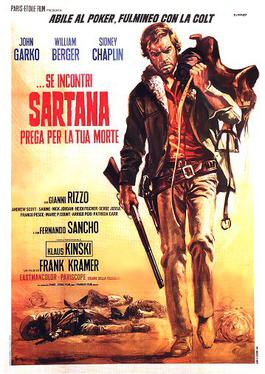
If You Meet Sartana, Pray For Your Death

The Man with No Name Dollars trilogy, Trinity, Django, Sabata, all characters that have their own series in the spaghetti western genre. I've seen at least parts of all those character series, and recently jumped into another, the Sartana series, starting with 1968's If You Meet Sartana, Pray for Your Death. 

A stagecoach has been robbed, and all its passengers lay dead. As the robbers loot the bodies, a mysterious gunman, Sartana (Gianni Garko), steps in front of them and guns them down. Not long after, a second stagecoach is attacked, this time carrying a huge gold shipment for a town up the trail. The only issue? The strongbox doesn't contain any gold at all....it's just heavily loaded with rocks. Who's up to something? Sartana seems to know, pitting all sides against each other. Another gunman, Lasky (William Berger), has been well-involved with all the robbery, murder and betrayal and is suspicious of what Sartana is up to. Sartana has too many enemies though as he investigates the disappearance of the gold. His only option is simple; pit all sides against each other and swoop in at the opportune time.

This spaghetti western is everything that's both good and bad about the genre. When it's entertaining, it's very entertaining (movie specific: this one's bad but entertaining). When it's bad.....it's very bad. For director Gianfranco Parolini, 'Pray' plays more like a test run for his infinitely better 1969 spaghetti classic, Sabata. The basic premise is almost entirely the same story. Garko's Sartana is a younger Sabata (played to perfection by Lee Van Cleef). The tone is light with some acrobatic gunmen and generally goofy atmosphere. The music from composer Piero Piccioni is pretty forgettable, a disappointment considering how good some of his other scores (The Deserter) were. There are some cool locations although the movie hamstrings itself by using the same locations repeatedly. I swear Sartana rides through the same hilly sand dune at least four different times.

Belonging in the short list of coolest spaghetti western title characters, Sartana is a pretty cool anti-hero gunfighter. He's a gentleman and dresses the part, favoring a suit, vest, cravat and overcoat that resembles a cape. He uses a long-range Winchester rifle and a multi-barreled derringer pistol. Sartana is a gambler as well as an accomplished gun, an ability that plays well in an early card game. Mostly I like the character because it hints -- in not so subtle fashion -- that Sartana is some sort of angelic killer, an angel of death. He seemingly can't be shot (check out the opening scene HERE) or hurt by enemies while appearing at will out of thin air. I like Garko a lot in the role, one he would play three more times, bringing a lighter touch to the anti-hero gunslinger. He's smooth with a gun and a bit of a smartass with whoever he meets. It's different, and I liked it a lot.

Spaghetti western diehards will eat this one up in the casting department with some really odd and really cool casting. Berger is over the top and goofy as Lansky, a brutally efficient hired gun with murder and blackmail on his mind. He's also completely undone whenever Sartana plays the tune from the watch of a man Lansky has killed. Klaus Kinski shows up in a bizarre cameo as Morgan, a knife-throwing killer with little bells for spurs. He's around for about 3 minutes, but it's Kinski so it's cool. Fernando Sancho does what he does best, playing a slimy, greasy, cackling Mexican bandit/general -- here General Tampico Mendoza -- who gets caught up in the killing. Sydney Chaplin and Gianni Rizzo play the two conniving businessmen in town who are up to something, Heidi Fischer playing Rizzo's equally conniving wife. Spaghetti western regular Salvatore Borghese makes a too quick appearance as Moreno, one of Sancho's main henchman.

There is a part of almost all spaghetti westerns that are inherently stupid, but you just go along (well, if you're a fan at least). Unfortunately, 'Pray' has so many of these moments it's hard to take even remotely serious. I liked the movie, but I can appreciate it and all its badness. If you did a drinking game after every time someone maniacally laughs, you'd be drunk in minutes thanks to maniacal laughing coffin maker Dusty (Franco Pesce). Sancho cackles and laughs, eating the same greasy piece of chicken in countless scenes. Berger's Lansky literally crumbles at just the sound of a musical watch. The script is pretty bad in itself -- Sartana's bedroom kinkiness a highlight -- and doesn't offer much of a story. The "story" requires people to connive and worry, Sartana shows up, plans are thrown out and started over. An impressive body count here with some fun action scenes too. It's bad. No doubt about it, but I was entertained throughout.     

If You Meet Sartana, Pray for Your Death (1968): ** 1/2 /****

Thursday, October 15, 2009

Adios, Sabata

Spaghetti westerns had any number of popular characters from Eastwood's Man With No Name to Franco Nero's Django and even Giani Garko's Sartana. Their popularity and success often led to a series of movies that tried to capitalize on the name only. Like 1971's Adios, Sabata which was originally titled Indio Black during filming. But following the big-time success of 1969's Sabata starring Lee Van Cleef, the title got changed, and we get the 2nd movie in the Sabata trilogy.

With Yul Brynner taking over the role of Sabata (Van Cleef was making Magnificent Seven Ride!), this is one of the more eccentric spaghetti westerns with any number of weird little oddities sprinkled throughout the story from director Gianfranco Parolini. Following in the footsteps of the first Sabata, there's lots of acrobatics, characters/stunt men jumping off of hidden trampolines into action. It looks ridiculous, but at the same time it's a lot of fun. Usually, I hate it when people bring up gay subtexts in movies, but this one had it's fair share too, more on that later.

It's 1867 and French emperor Maximilian is still ruling over Mexico. Near the border, one of his officers, Austrian colonel Skimmel (Gerard Herter) is trying to put down the revolution in his district, keeping his keen eye by shooting Mexican prisoners as they attempt to escape his walled fortress. Skimmel is sending a large gold shipment north across the border into the U.S., but the Mexican revolutionaries catch wind of the plan and send a team, led by the portly Escudo (Ignazio Spalla), to attack the convoy and take the shipment. Joining him is gun for hire and soldier of fortune, Sabata (Brynner). But everything with the gold shipment is not what it seems, and there's double-crossings and betrayals at work, not to mention the slippery Ballantine (Dean Reed), a good source of info who's joined up for a crack at the gold.

It's a shame the character was changed to Sabata because Brynner is a cool enough actor/presence to pull off a new western gunfighter. His outfit is a little flamboyant with leather bellbottom pants with fringes, tight shirt cut low with fringes, and a red serape hanging over his shoulder, but otherwise Brynner's Sabata is a worthy addition to the list of supremely cool spaghetti western anti-heroes. Using an odd sawed-off rifle that loads from the side, Sabata must pick off about 50 people alone. His reward? A cigar that's at the end of every cartridge magazine.

As for some other eccentricities, let's start with the cast. Reed's Ballantine is a bit of a foppish westerner with his ruffled shirts and generally out of place wardrode, his painting prowess, his ability to play the piano, and his desire to always write everything down in his journal. Maybe I'm overanalyzing the character, but if there was ever a gay caballero in a western, this is it. The only link to the first Sabata is Spalla, who plays a similar character and gets to ham it up, including one great last line 'Why you son of a....I mean, I never knew your mother.' Escudo's men include Septiembre (Sal Borgese) -- maybe the coolest sidekick to come out of a spaghetti --, a mute who dispatches enemies with tiny metal spheres he flings from his shoetops, and Gitano (Joseph Persaud), a revolutionary who dances the 'flamenco of death' before a showdown. Odd little touches like that with characters is what makes these spaghetti westerns so crazy and so fun to watch.

Thinking of Leone's Dollars trilogy, he took a lot of criticism for the amount and type of violence in his movies, but in reality, there isn't a ton of actual violence. It was always in the build-up and the tension. Not so here with Adios, Sabata racking up an impressive kill count as revolutionaries and henchmen and Austrian and French soldiers are mowed down by the dozen. This western is action-packed with barely five minutes going by without a gunfight of some sort, and good action too thanks to some strong stunt work. Helping things out is composer Bruno Nicolai's musical score which is about as good as any other spaghetti score you'll hear made by someone not named Morricone. Listen to the music in the opening credits in that link, and try not to whistle along.

About as mindless as a spaghetti western can get, Adios, Sabata is near the top of my list when it comes to the genre. It's stupid and ridiculous with more crazy touches than I could even cover here, but that's the fun of it all. Shut the 'ole brain off for 2 hours and watch Yul Brynner throw one-liners left and right and mow down waves of bad guys in the process.

Adios, Sabata <---trailer (1971): ***/****