Some movies just defy description. They're just that bad. Now, you know what movie is pretty great? 1975's Jaws, the first true summer blockbuster. You know what isn't so good about it? The seemingly countless sequels, ripoffs and countless quasi-remakes. Some of them are pretty awful but pretty entertaining if you're looking for a laugh. Then there's 1977's Tentacles. It isn't entertaining. It. Is. Just. Bad.
At Ocean Beach, a quiet seaside resort, not much in terms of danger ever goes on....until now. Several people have gone missing in the water, including one diver who went looking for the missing persons. Their bodies have been discovered, their skeletons stripped almost entirely of skin and the marrow sucked out of their bones. What could possibly doing this? A veteran newspaper reporter, Ned Turner (John Huston), is on the prowl, suspecting a huge corporation drilling in the ocean may be at fault. Keeping on the trail, Turner continues to look for an explanation, even turning to a famed animal trainer and experienced diver, Will Gleason (Bo Hopkins), for help. Looking at those who've been attacked and the mounting piles of evidence, Gleason suspects the attacks could have come from a giant octopus, a creature not known for attacking humans. Could Turner be onto something, linking the attacks to the corporation? Lives depend on them finding the answer.
Wow, what a bad, just plain awful, lousy movie. I like some of the Jaws ripoffs from Orca to Grizzly, both lousy movies, but my goodness, are they entertaining in their lousiness. This U.S./Italian co-production from director Ovidio G. Assonitis doesn't even qualify in the lousiness department. You know what the best thing going for this movie is? The music, composer Stelvio Cipriani turning in a memorable, foreboding score. Listen HERE for an extended sample. In a disaster-themed, killer animal on the loose movie, when the music is the biggest positive, you know you're in trouble. It just isn't good to the point it is painfully boring. 'Tentacles' follows the Jaws formula to a T, duplicating entire scenes, characters and story development. At no point is it ever scary or foreboding so go watch Jaws or even Jaws 2, Orca, or Grizzly for a far better time.
I'll give disaster movies credit where it's due. You get to see a lot of movie stars in one place at the same time. Now.....the performances aren't going to be very good, but it's an abundance of movie stars!!! How can you lose?!? Well, we do so there's that. No one seems particularly interested, but there is name recognition. Huston is a good choice to play a crotchety, grizzled reporter with Shelley Winters starring as his sister, a single mom who's always looking to seduce a younger man. Give him credit, Bo Hopkins commits to the material, even if his part is a pretty odd one. He's at one with animals, especially when his wife (Delia Boccardo) comes into danger. Also starring is Claude Akins as the overworked, overstressed town sheriff trying to save his townspeople. Cesare Danova plays the maligned corporation representative who must answer all the questions, knowing his company could be held responsible for the attacks. The rest of the speaking parts are badly dubbed English from Italian-speaking actors.
A master of the 1970s disaster movie cameo, Henry Fonda also makes a quick appearance as Mr. Whitehead, the President of Trojan Construction who's looking to make a buck. If some people get killed in the process....meh, whatever happens.
I don't know what to say here. It's not that the movie is bad because it is more than that. A bad movie can be entertaining, but this disaster knockoff is pure and simple boring as watching paint dry on a wall, as watching grass grow. The octopus attacks are laughable, seemingly also making an octopus a killing creature that sprints across the top of the ocean. Oh, no! It's shooting ink at me!!! The reasoning seems far-fetched even for a poorly written script, construction vibrations deep on the ocean floor infuriating the creature to the point it feels the need to kill and to kill often. A seemingly unstoppable killing machine in nature is a cool premise and a great jumping off point, but this one never does anything with it.
Then there's the end. Hopkins' animal trainer who's coming off an extreme incident with the bends unleashes his two killer whales to take out the octopus. I can't say I've seen too many movies where animals become hired killers, but this one counts. When things should be raring to go in the finale, it just doesn't. The underwater scenes go on and on without a sense of urgency. That's the entire movie, long stretches of boredom broken up by slightly less boring animal attacks. Some cool names in the cast, but even that is wasted. Steer clear or the tentacles may get you!
Tentacles (1977): */****
The Sons of Katie Elder
"First, we reunite, then find Ma and Pa's killer...then read some reviews."
Showing posts with label John Huston. Show all posts
Monday, July 28, 2014
Monday, March 3, 2014
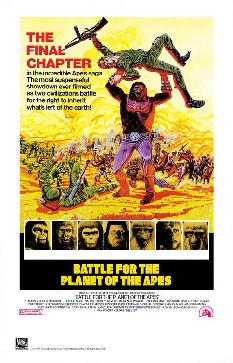
Battle for the Planet of the Apes
Here we sit. It's been a long ride full of ups and downs, but we made it through, and I'd like to thank all of those who supported me along the way. Yes, it is officially time to wrap up the Planet of the Apes series. It is time for 1973's Battle for the Planet of the Apes. Pretty dramatic, huh?!? I should totally do voiceover work.
It has been 12 years since the highly intelligent, thoughtful talking chimp, Caesar (Roddy McDowall) led the bloody revolt that gained apes -- the chimps, orangutans, and gorillas -- their freedom from their cruel human masters. It was a revolt that set off a chain reaction, countries and cities turning on each other, nuclear weapons wiping whole cities off the face of the Earth. Caesar and a small community of apes and humans manage to escape the destruction, building a city in the wilderness and starting their own civilization of sorts. It is a tenuous situation though, Caesar dealing with the apes' control over the humans, an ape general, Aldo (Claude Akins), eager to gain power, and the possibility of another group of human survivors -- mutated beings -- invading his territory. Can he hold it all together?
I've long been a fan of the Planet of the Apes series so it's been fun catching up with the series, especially watching all five movies straight through for the first time ever. It's cool to see the continuity among the five flicks, see recurring characters, recurring stories and plotlines. This fifth entry, from director J. Lee Thompson (who also directed Conquest), was released as part of the collection as an 'Extended Version,' running 93 minutes with about 10 minutes of additional footage reinserted. Not going to lie here, I was kinda disappointed with this final entry. There are positives -- more in that department later -- but there are also far too many negatives. The story seems like a jumbled collection of the previous storylines -- especially Beneath and Conquest -- and doesn't create enough of its own identity. Fans of the series will definitely enjoy it, but as far as series finales go, this one could have been better.
What are the biggest issues? Well, the script for starters. Reading about the Extended Cut (with spoilers), it's cool to see what footage was added back into the movie. Some scenes work better than others, some lack any rhythm or pacing. The exploration of the bombed-out city should be adrenaline-pumping, but the build-up is slow that it loses any momentum. It also seems thrown together for the sake of a sequel, an unnecessary one at that. It's only 12 years since the end of 'Conquest,' but the apes speak clearly and perfectly understandable. A whole species learns to speak in a little over a decade? Why did the humans go with the apes? Was it for survival? A whole sub-culture comes together so quickly, rushed backstory like the entire movie. There are portions that work as it tries to connect and wrap up with the rest of the series, especially the connection to Beneath, the villain, Governor Kolp (Severn Dearden), having an assistant, Mendez (Paul Stevens), the same name as the leader of the mutants in Beneath, the Alpha bomb there too. Little touches like that are pretty cool, especially for nerds like me
The biggest positive is the face of the franchise right there with Charlton Heston, Roddy McDowall, who starred in four of the five movies playing two different roles. His Caesar is the intelligent, thoughtful leader of the ape civilization, juggling countless roles. He's a leader, a father, a friend, and he's got to keep all the plates spinning at once. McDowall is the heart of it all, and not surprisingly, he kills the part. He is the link through it all, the best aspect of the character being his interest, his curiosity about his past. What were his parents like? How did they end up on a human-ruled Earth? What led to their tragic deaths? As a family man, we meet his wife, Lisa (Natalie Trundy, who also starred in four Ape movies), and his teenage son, Cornelius (Bobby Porter), who just wants to be a kid, Caesar doing his best to make his son's life smooth and easy. Any issues the movie may have, McDowall is above it. A fitting lead performance to wrap things up.
The rest of the cast is okay, some solid names, some recognizable faces, but nothing really eye-popping. Akins hams it up like a crazy person, his General Aldo really just a child in a position of power. He's the polar opposite of Caesar, fiery and emotional, but an action he takes certainly takes drives the story forward. For some of the other key ape performances, Lew Ayres is a scene-stealer as Mandemus, the senior citizen ape placed in charge of the armory, his logical thinking tripping everyone up, and Paul Williams as Virgil, the intellectual, the thinker who plays Devil's Advocate to just about everything Caesar does, but in a helpful fashion. Austin Stoker plays MacDonald, the face of the human group living with the apes. He has a good chemistry with McDowall's Caesar in their scenes together in an underused part.
I don't know. I came away disappointed. Maybe it tries to do too much, maybe it's just not very good. If you're a fan of the series, you've got to see it to wrap things up. There, plain and simple. It lacks that special something to hold it all together. A framing device with John Huston making a quick appearance as the Lawgiver tries to show that the Apes timeline can and should be adjusted, but everything else in the series seems to suggest otherwise. If it didn't, everything would collapse in on itself in the space time continuum. Yeah, time travel analysis. Didn't see that coming, did you?!? Watch it for the series, for the sci-fi aspect, just enough positives in a movie that lacked some energy. Still, it's been a hugely entertaining series, a fun ride over five movies. Thanks to the girlfriend for the Christmas present. Now, I've just gotta get her to watch them...
Battle for the Planet of the Apes (1973): ** 1/2 /****
It has been 12 years since the highly intelligent, thoughtful talking chimp, Caesar (Roddy McDowall) led the bloody revolt that gained apes -- the chimps, orangutans, and gorillas -- their freedom from their cruel human masters. It was a revolt that set off a chain reaction, countries and cities turning on each other, nuclear weapons wiping whole cities off the face of the Earth. Caesar and a small community of apes and humans manage to escape the destruction, building a city in the wilderness and starting their own civilization of sorts. It is a tenuous situation though, Caesar dealing with the apes' control over the humans, an ape general, Aldo (Claude Akins), eager to gain power, and the possibility of another group of human survivors -- mutated beings -- invading his territory. Can he hold it all together?
I've long been a fan of the Planet of the Apes series so it's been fun catching up with the series, especially watching all five movies straight through for the first time ever. It's cool to see the continuity among the five flicks, see recurring characters, recurring stories and plotlines. This fifth entry, from director J. Lee Thompson (who also directed Conquest), was released as part of the collection as an 'Extended Version,' running 93 minutes with about 10 minutes of additional footage reinserted. Not going to lie here, I was kinda disappointed with this final entry. There are positives -- more in that department later -- but there are also far too many negatives. The story seems like a jumbled collection of the previous storylines -- especially Beneath and Conquest -- and doesn't create enough of its own identity. Fans of the series will definitely enjoy it, but as far as series finales go, this one could have been better.
What are the biggest issues? Well, the script for starters. Reading about the Extended Cut (with spoilers), it's cool to see what footage was added back into the movie. Some scenes work better than others, some lack any rhythm or pacing. The exploration of the bombed-out city should be adrenaline-pumping, but the build-up is slow that it loses any momentum. It also seems thrown together for the sake of a sequel, an unnecessary one at that. It's only 12 years since the end of 'Conquest,' but the apes speak clearly and perfectly understandable. A whole species learns to speak in a little over a decade? Why did the humans go with the apes? Was it for survival? A whole sub-culture comes together so quickly, rushed backstory like the entire movie. There are portions that work as it tries to connect and wrap up with the rest of the series, especially the connection to Beneath, the villain, Governor Kolp (Severn Dearden), having an assistant, Mendez (Paul Stevens), the same name as the leader of the mutants in Beneath, the Alpha bomb there too. Little touches like that are pretty cool, especially for nerds like me
The biggest positive is the face of the franchise right there with Charlton Heston, Roddy McDowall, who starred in four of the five movies playing two different roles. His Caesar is the intelligent, thoughtful leader of the ape civilization, juggling countless roles. He's a leader, a father, a friend, and he's got to keep all the plates spinning at once. McDowall is the heart of it all, and not surprisingly, he kills the part. He is the link through it all, the best aspect of the character being his interest, his curiosity about his past. What were his parents like? How did they end up on a human-ruled Earth? What led to their tragic deaths? As a family man, we meet his wife, Lisa (Natalie Trundy, who also starred in four Ape movies), and his teenage son, Cornelius (Bobby Porter), who just wants to be a kid, Caesar doing his best to make his son's life smooth and easy. Any issues the movie may have, McDowall is above it. A fitting lead performance to wrap things up.
The rest of the cast is okay, some solid names, some recognizable faces, but nothing really eye-popping. Akins hams it up like a crazy person, his General Aldo really just a child in a position of power. He's the polar opposite of Caesar, fiery and emotional, but an action he takes certainly takes drives the story forward. For some of the other key ape performances, Lew Ayres is a scene-stealer as Mandemus, the senior citizen ape placed in charge of the armory, his logical thinking tripping everyone up, and Paul Williams as Virgil, the intellectual, the thinker who plays Devil's Advocate to just about everything Caesar does, but in a helpful fashion. Austin Stoker plays MacDonald, the face of the human group living with the apes. He has a good chemistry with McDowall's Caesar in their scenes together in an underused part.
I don't know. I came away disappointed. Maybe it tries to do too much, maybe it's just not very good. If you're a fan of the series, you've got to see it to wrap things up. There, plain and simple. It lacks that special something to hold it all together. A framing device with John Huston making a quick appearance as the Lawgiver tries to show that the Apes timeline can and should be adjusted, but everything else in the series seems to suggest otherwise. If it didn't, everything would collapse in on itself in the space time continuum. Yeah, time travel analysis. Didn't see that coming, did you?!? Watch it for the series, for the sci-fi aspect, just enough positives in a movie that lacked some energy. Still, it's been a hugely entertaining series, a fun ride over five movies. Thanks to the girlfriend for the Christmas present. Now, I've just gotta get her to watch them...
Battle for the Planet of the Apes (1973): ** 1/2 /****
Friday, January 6, 2012
The Deserter
When a poster at a message board brought the movie up, I didn't believe him, thinking the movie he talked about was made up. As a western fan, how had this one slipped past me? Somehow it did, probably thanks to no U.S. DVD release and an old VHS (thank you Amazon vendors). The movie? A spaghetti western of sorts, think The Dirty Dozen in the West. It's 1970's The Deserter.
Returning from a patrol, Captain Viktor Caleb (Bekim Fehmiu) finds his wife on the brink of death, raped and tortured by an Apache war party. He mercifully ends her suffering, shooting her, and abandons his post but not before shooting the commander, Maj. Brown (Richard Crenna), who he blames. Two years pass and the cavalry Border Command has a new commander, General Miles (John Huston). Caleb has spent two years waging his own war on the Apaches, but Miles needs his help. An Apache chief, Mangus Durango, is organizing a huge war party that threatens to wipe out everyone in the territory. Their only hope? Caleb selects a small group of men and train them to fight like Apaches, striking the Apache camp in Mexico before the slaughter begins.
From American director Burt Kennedy, 'Deserter' isn't your prototypical spaghetti western. It was filmed in Almeria, Spain -- with some familiar locations for spaghetti fans -- and features a quirky but memorable score from Piero Piccioni. Listen to the main theme HERE. As opposed to bandits and gunslingers, the story obviously focuses on the cavalry and the Apaches so it's a cool change of pace. Mostly though, it is an above average men on a mission story, one of my favorite sub-genres in movies. A small group of men, all experts and specialists in their own way assigned an almost impossible, nearly suicidal mission. The movie follows the cookie-cutter formula, but in a good way. First, lay things out and assemble the team. Second, train them. And third, unleash them for their mission.
My rating far down below may be high in the eyes of some readers, but there's a reason. This isn't a great, classic movie that will live on in movie history. On the other hand, it is a great, fun and entertaining movie that quickly climbed into my list of favorites upon first viewing. Kennedy was a workmanlike director more than an auteur, but he knows how to manage this movie. The screenplay by western regular Clair Huffaker is a gem, nothing original but full of great one-liners, the perfect dialogue for a team of tough as nails "volunteers." This always sounds like a cop-out to me, but it's just a fun movie. Sit back and enjoy 100 minutes of running and gunning action in the desert.
Read some reviews about this generally forgotten western, and you'll find plenty of criticism of the casting of star Fehmiu in the lead. A Yugoslavian actor, this is one of his few English-speaking roles. I had absolutely no problem with him as Caleb and even think his steely-eyed, ice water running through his veins acting style is a high point of the film. Caleb doesn't care about living or dying, just avenging his wife's brutal death. That can be an appealing trait in a lead character. While I came to like Fehmiu as Caleb, what drew me into this movie was the supporting cast.
Big names? No, not especially, but reading the cast listing should put a smile on any western fan's face. Crenna is solid as needed as Caleb's opposition, and Huston is a scene-stealer as General Miles, chewing the scenery like only he can. Then there's Caleb's squad, a who's who of western characters. Start with Slim Pickens and Ricardo Montalban as Tattinger, a crotchety veteran scout, and Natchai, an Apache scout, both of them Caleb's closest friends. Not enough? There's also Chuck Connors as Reynolds, a dynamite-wielding chaplain, Ian Bannen as Crawford, an English soldier touring the Southwest, Brandon De Wilde as Ferguson, the young, unproven officer, Woody Strode as Jackson, the strong man and troublemaker, Albert Salmi as Schmidt, the soldier with a grudge against Caleb, Patrick Wayne as Robinson, the Gatling gun operator with his brother, Doc Greaves as Scott, the doctor, and recognizable spaghetti face Fausto Tozzi as Orozco, the knife fighter.
Good cast much? If you can't go along with that group, westerns probably aren't your thing. It is a men on a mission movie, and that means....wait for it...action! Most of it is saved for the last 40 minutes, but the training sequences leading up to it are equally as fun, a quick montage highlighting all the mayhem. The mission is the high point though, and even though some night scenes are limited by obviously indoor sets, it isn't a deal breaker. Men on a mission movie means casualties though, and the results here were surprising as to who makes it and who doesn't. Violent, bloody and chaotic, a worthwhile end to an underrated western.
Now this link won't be to a pristine, widescreen print, but it you're curious about seeing the movie you can see it at Youtube HERE. It's a Public Domain print and looks to be missing about 6 minutes from the VHS I have, but when a movie is as hard to find as this one, take what you can. Hope you enjoy it as much as I do!
The Deserter <---trailer (1971): ****/****
Returning from a patrol, Captain Viktor Caleb (Bekim Fehmiu) finds his wife on the brink of death, raped and tortured by an Apache war party. He mercifully ends her suffering, shooting her, and abandons his post but not before shooting the commander, Maj. Brown (Richard Crenna), who he blames. Two years pass and the cavalry Border Command has a new commander, General Miles (John Huston). Caleb has spent two years waging his own war on the Apaches, but Miles needs his help. An Apache chief, Mangus Durango, is organizing a huge war party that threatens to wipe out everyone in the territory. Their only hope? Caleb selects a small group of men and train them to fight like Apaches, striking the Apache camp in Mexico before the slaughter begins.
From American director Burt Kennedy, 'Deserter' isn't your prototypical spaghetti western. It was filmed in Almeria, Spain -- with some familiar locations for spaghetti fans -- and features a quirky but memorable score from Piero Piccioni. Listen to the main theme HERE. As opposed to bandits and gunslingers, the story obviously focuses on the cavalry and the Apaches so it's a cool change of pace. Mostly though, it is an above average men on a mission story, one of my favorite sub-genres in movies. A small group of men, all experts and specialists in their own way assigned an almost impossible, nearly suicidal mission. The movie follows the cookie-cutter formula, but in a good way. First, lay things out and assemble the team. Second, train them. And third, unleash them for their mission.
My rating far down below may be high in the eyes of some readers, but there's a reason. This isn't a great, classic movie that will live on in movie history. On the other hand, it is a great, fun and entertaining movie that quickly climbed into my list of favorites upon first viewing. Kennedy was a workmanlike director more than an auteur, but he knows how to manage this movie. The screenplay by western regular Clair Huffaker is a gem, nothing original but full of great one-liners, the perfect dialogue for a team of tough as nails "volunteers." This always sounds like a cop-out to me, but it's just a fun movie. Sit back and enjoy 100 minutes of running and gunning action in the desert.
Read some reviews about this generally forgotten western, and you'll find plenty of criticism of the casting of star Fehmiu in the lead. A Yugoslavian actor, this is one of his few English-speaking roles. I had absolutely no problem with him as Caleb and even think his steely-eyed, ice water running through his veins acting style is a high point of the film. Caleb doesn't care about living or dying, just avenging his wife's brutal death. That can be an appealing trait in a lead character. While I came to like Fehmiu as Caleb, what drew me into this movie was the supporting cast.
Big names? No, not especially, but reading the cast listing should put a smile on any western fan's face. Crenna is solid as needed as Caleb's opposition, and Huston is a scene-stealer as General Miles, chewing the scenery like only he can. Then there's Caleb's squad, a who's who of western characters. Start with Slim Pickens and Ricardo Montalban as Tattinger, a crotchety veteran scout, and Natchai, an Apache scout, both of them Caleb's closest friends. Not enough? There's also Chuck Connors as Reynolds, a dynamite-wielding chaplain, Ian Bannen as Crawford, an English soldier touring the Southwest, Brandon De Wilde as Ferguson, the young, unproven officer, Woody Strode as Jackson, the strong man and troublemaker, Albert Salmi as Schmidt, the soldier with a grudge against Caleb, Patrick Wayne as Robinson, the Gatling gun operator with his brother, Doc Greaves as Scott, the doctor, and recognizable spaghetti face Fausto Tozzi as Orozco, the knife fighter.
Good cast much? If you can't go along with that group, westerns probably aren't your thing. It is a men on a mission movie, and that means....wait for it...action! Most of it is saved for the last 40 minutes, but the training sequences leading up to it are equally as fun, a quick montage highlighting all the mayhem. The mission is the high point though, and even though some night scenes are limited by obviously indoor sets, it isn't a deal breaker. Men on a mission movie means casualties though, and the results here were surprising as to who makes it and who doesn't. Violent, bloody and chaotic, a worthwhile end to an underrated western.
Now this link won't be to a pristine, widescreen print, but it you're curious about seeing the movie you can see it at Youtube HERE. It's a Public Domain print and looks to be missing about 6 minutes from the VHS I have, but when a movie is as hard to find as this one, take what you can. Hope you enjoy it as much as I do!
The Deserter <---trailer (1971): ****/****
Friday, February 4, 2011
Casino Royale (1966)
After a four-year gap since Pierce Brosnan's final James Bond movie, MI6 agent 007 returned in a big way in 2006 with Daniel Craig taking over the part of the secret agent. It was a huge success and served as an excellent reboot for the franchise, quickly climbing into my top 5 all-time Bond flicks. Why did it work? Like most of the best movies from the franchise, it stuck close to the Ian Fleming source novel that had not been made previously...in a serious fashion at least. That's where 1966's awful Casino Royale jumps in.
By 1966, star Sean Connery had already completed four 007 movies and had turned James Bond into one of the world's biggest stars. It was so popular that spoofs started popping up like James Coburn as Derek Flint and Dean Martin as Matt Helm among others. I get it, strike when the iron is hot, but in a saturated market of spy and espionage movies -- serious and spoof -- don't you want to at least turn out a quality product? With six different directors shooting different portions of the movie, this was like How the West Was Won: 007 Style. Besides an occasional laugh here and there, the only redeeming quality is an out-of-this world (if wasted) cast, but more on that later.
All over the world, American, British, Russian, and French agents are turning up dead and their agencies don't have the slightest clue or evidence as to who's pulling off the jobs. The agency heads turn to retired MI6 agent, Sir James Bond (David Niven), to root out the problem. Bond is a legend in the espionage business, but his best days are behind him, and he questions what has happened to the field he worked so well in, carving out a name and reputation for himself. He concocts a crazy plan to smoke out whoever is behind the murders; using his name, agents all over the world (Peter Sellers, Ursula Andress, Daliah Lavi, Joanna Pettet, Woody Allen, Terence Cooper) will see if working as bait draws the mastermind out of his lair. The plan might be too good though because SMERSH and mastermind Le Chiffre (Orson Welles) send agents to kill the original and still best James Bond around.
Now anyone familiar with Casino Royale -- Fleming's novel or the Craig movie -- knows that the plot described there is nothing like the book or the movie. Bond's effort to detain Le Chiffre at the baccarat table is handled in a scene that takes about 10 minutes, not an entire movie. Using other spy spoofs as an example, there is clearly potential here. A character as ripe for the picking as James Bond is hard to mess up in the humor department, but this movie is a mess. For all the subtle, perfectly delivered lines that pepper the script, there's huge scenes of excess of physical and slapstick humor that even Mel Brooks must have shaken his head at. The finale is the worst of all with one of the 14 directors obviously not knowing where to cut things off.
Let's start with the crazy amount of talent involved here behind the camera, including John Huston (also playing M in one scene) and Robert Parrish among four other less notable names. The writing too includes Sellers, Billy Wilder, and Joseph Heller. How did this much talent put together such an awful movie? On top of the cast listed above, there's also parts for Deborah Kerr, William Holden, Jean-Paul Belmondo, Peter O'Toole (on-screen for about 6 seconds), Charles Boyer, George Raft, Jacqueline Bisset, and Barbara Bouchet. What's worse is that the cast appears to be having a blast making the picture. It's just that much worse that what they're working with is beneath all of their talent. Bit parts and extended cameos for almost all of these names limit actual on-screen time, but just in terms of name power, this movie is impressive.
The only star that I thought was legitimately good was David Niven as retired 007, Sir James Bond, enjoying his retirement in an isolated English country villa only to be thrust back into the world of espionage. Because it is an older Bond, Niven has some fun with the part, poking fun at Connery's portrayal especially. He gets some good laughs from his constant curiosity of how all secret agents have become sex fiends, leaving lonely, beautiful women in every city all over the Earth. He shakes his head at all the changes he sees in the life of a spy only to embrace them once he's back into it. A professional plain and simple, Niven makes the most of the material, rising above it to deliver a worthwhile performance.
So this movie was bad, downright awful at times, okay? I am scraping the bottom of the barrel here looking for something to write about. Most of the movie was just so stupid and dumb I can't even complain. It's so bad it is surreal at times. So what can I recommend? If nothing else with this overabundance of characters, the script calls for a long list of beautiful actresses who are required to wear slinky outfits and do little else. Kerr, Lavi, Pettet, Andress, and Bouchet are all half-naked for about 90% of the movie, and that's all I've got. So stupidly bad, this movie has to be seen to be believed.
Casino Royale <---trailer (1966): */****
By 1966, star Sean Connery had already completed four 007 movies and had turned James Bond into one of the world's biggest stars. It was so popular that spoofs started popping up like James Coburn as Derek Flint and Dean Martin as Matt Helm among others. I get it, strike when the iron is hot, but in a saturated market of spy and espionage movies -- serious and spoof -- don't you want to at least turn out a quality product? With six different directors shooting different portions of the movie, this was like How the West Was Won: 007 Style. Besides an occasional laugh here and there, the only redeeming quality is an out-of-this world (if wasted) cast, but more on that later.
All over the world, American, British, Russian, and French agents are turning up dead and their agencies don't have the slightest clue or evidence as to who's pulling off the jobs. The agency heads turn to retired MI6 agent, Sir James Bond (David Niven), to root out the problem. Bond is a legend in the espionage business, but his best days are behind him, and he questions what has happened to the field he worked so well in, carving out a name and reputation for himself. He concocts a crazy plan to smoke out whoever is behind the murders; using his name, agents all over the world (Peter Sellers, Ursula Andress, Daliah Lavi, Joanna Pettet, Woody Allen, Terence Cooper) will see if working as bait draws the mastermind out of his lair. The plan might be too good though because SMERSH and mastermind Le Chiffre (Orson Welles) send agents to kill the original and still best James Bond around.
Now anyone familiar with Casino Royale -- Fleming's novel or the Craig movie -- knows that the plot described there is nothing like the book or the movie. Bond's effort to detain Le Chiffre at the baccarat table is handled in a scene that takes about 10 minutes, not an entire movie. Using other spy spoofs as an example, there is clearly potential here. A character as ripe for the picking as James Bond is hard to mess up in the humor department, but this movie is a mess. For all the subtle, perfectly delivered lines that pepper the script, there's huge scenes of excess of physical and slapstick humor that even Mel Brooks must have shaken his head at. The finale is the worst of all with one of the 14 directors obviously not knowing where to cut things off.
Let's start with the crazy amount of talent involved here behind the camera, including John Huston (also playing M in one scene) and Robert Parrish among four other less notable names. The writing too includes Sellers, Billy Wilder, and Joseph Heller. How did this much talent put together such an awful movie? On top of the cast listed above, there's also parts for Deborah Kerr, William Holden, Jean-Paul Belmondo, Peter O'Toole (on-screen for about 6 seconds), Charles Boyer, George Raft, Jacqueline Bisset, and Barbara Bouchet. What's worse is that the cast appears to be having a blast making the picture. It's just that much worse that what they're working with is beneath all of their talent. Bit parts and extended cameos for almost all of these names limit actual on-screen time, but just in terms of name power, this movie is impressive.
The only star that I thought was legitimately good was David Niven as retired 007, Sir James Bond, enjoying his retirement in an isolated English country villa only to be thrust back into the world of espionage. Because it is an older Bond, Niven has some fun with the part, poking fun at Connery's portrayal especially. He gets some good laughs from his constant curiosity of how all secret agents have become sex fiends, leaving lonely, beautiful women in every city all over the Earth. He shakes his head at all the changes he sees in the life of a spy only to embrace them once he's back into it. A professional plain and simple, Niven makes the most of the material, rising above it to deliver a worthwhile performance.
So this movie was bad, downright awful at times, okay? I am scraping the bottom of the barrel here looking for something to write about. Most of the movie was just so stupid and dumb I can't even complain. It's so bad it is surreal at times. So what can I recommend? If nothing else with this overabundance of characters, the script calls for a long list of beautiful actresses who are required to wear slinky outfits and do little else. Kerr, Lavi, Pettet, Andress, and Bouchet are all half-naked for about 90% of the movie, and that's all I've got. So stupidly bad, this movie has to be seen to be believed.
Casino Royale <---trailer (1966): */****
Tuesday, December 14, 2010
The Life and Times of Judge Roy Bean
When people get more cynical, so do their movies. In the 1930s, westerns portrayed good guys wearing white hats and bad guys in black duds. By the time Clint Eastwood came along in the spaghetti westerns gunning down anything that would net him a buck, things were up for grabs. Then in the late 1960s and 1970s, somebody decided to put a new spin on the old west, stories that were more cynical in nature that attempted to show what the west was really like. Goodbye romantic, hello cynicism. Say howdy to the revisionist western.
If you look at the list of westerns included in the Wikipedia entry, there are some good entries, but for the most part I don't necessarily like revisionist westerns. They try much too hard to show you that what you've been watching all these years is garbage. Take 1972's The Life and Times of Judge Roy Bean, directed by one of my favorites, John Huston. In telling the story of real-life Roy Bean, this western blends some really awkward comedic moments, overlong sub-plots that go nowhere, some hypocritical views on just about everything (can't decide if that was intended), and in general a waste of a very strong cast.
Sometime around the turn of the century, "outlaw" Roy Bean (Paul Newman) rides into west Texas past the Pecos River, an area notorious for hiding bandits and criminals. At one saloon, they turn on him and leave him for dead only to have the wounded man come back and gun them all down. Disgusted by what he's seen, Bean sets up shop as a judge, administering his unique brand of justice to anyone and everyone looking for trouble. Word spreads and soon he even has deputies who help him out, all in the name of Texas and Lilly Langtry (Ava Gardner), a stage actress from the east, a woman Bean has always been in love with. But Bean's style of justice may catch up with him as civilization follows him around every corner, and his time may be running out.
I don't know where to start with this one because to be fair, Huston doesn't know where to start either. Roy Bean was a real-life judge in west Texas who ended up becoming a legendary figure after he died. So with this revisionist western instead of telling a story that showed what the actual man was like, Huston goes for the ridiculous legend. At a run-time of 120 minutes (a very long 120 minutes), 'Life' is all over the place with no sense of where it's going. The tone ranges from slapstick comedy that produces its fair share of groans -- it did from me at least -- to an oddly serious finale. It tries to be funny while also delivering a hacked up message about the changing times and the last few years of the wild west. Pick one or the other and go with it, but don't waver between the two.
A bright spot not surprisingly is Newman in the titular role, rising above materiel that at times is just beneath him. Newman's parts in the 1970s typically covered a wide variety of movies, and this surely doesn't disappoint. What works is that he commits so fully to this part. His beliefs are ridiculously hypocritical, and he'll string anyone up at the drop of a hat if he disagrees with what's been said or done. If you're loyal to him, he'll be loyal to you, but for heaven's sake don't turn on him. This isn't a part on par with his best performances like Butch Cassidy or Lucas Jackson, but it's a quality one. Even when the movie is dull to watch, it's worthwhile to check out Newman.
So with a story that is light on story and heavy on non-related vignettes, we get a chance to see a long list of actors play small parts (some being on-screen no more than a few seconds). Gardner makes an appearance in the movie's final scene in a moving scene that comes along a little too late. Anthony Perkins is a scene-stealer as a traveling preacher who realizes Newman's Bean may be a little off his rocker but doesn't want to get shot bringing the topic up. Ned Beatty, Matt Clark, Jim Burk, Bill McKinney, and Steve Kanaly are underused but all solid as Bean's loyal deputies. Also watch for Victoria Principal, Tab Hunter, Huston as a grizzled old mountain man, Stacy Keach as an albino gunman, Roddy McDowall, Anthony Zerbe, and Jacqueline Bisset in parts that range from bad to good, your decision on where they fall.
I will give Huston credit for trying new things. Early on, we get narration from Perkins and Hunter, but instead of just hearing it, the camera is placed right in front of them as they ride into town. They're looking right at the audience, addressing us in a cool change of pace, a unique little technique. But then the narration resorts to been there, done that voiceovers. It's just an odd movie overall, one with plenty of flaws but enough positives to give it a mild recommendation.
The Life and Times of Judge Roy Bean <---trailer (1972): **/****
If you look at the list of westerns included in the Wikipedia entry, there are some good entries, but for the most part I don't necessarily like revisionist westerns. They try much too hard to show you that what you've been watching all these years is garbage. Take 1972's The Life and Times of Judge Roy Bean, directed by one of my favorites, John Huston. In telling the story of real-life Roy Bean, this western blends some really awkward comedic moments, overlong sub-plots that go nowhere, some hypocritical views on just about everything (can't decide if that was intended), and in general a waste of a very strong cast.
Sometime around the turn of the century, "outlaw" Roy Bean (Paul Newman) rides into west Texas past the Pecos River, an area notorious for hiding bandits and criminals. At one saloon, they turn on him and leave him for dead only to have the wounded man come back and gun them all down. Disgusted by what he's seen, Bean sets up shop as a judge, administering his unique brand of justice to anyone and everyone looking for trouble. Word spreads and soon he even has deputies who help him out, all in the name of Texas and Lilly Langtry (Ava Gardner), a stage actress from the east, a woman Bean has always been in love with. But Bean's style of justice may catch up with him as civilization follows him around every corner, and his time may be running out.
I don't know where to start with this one because to be fair, Huston doesn't know where to start either. Roy Bean was a real-life judge in west Texas who ended up becoming a legendary figure after he died. So with this revisionist western instead of telling a story that showed what the actual man was like, Huston goes for the ridiculous legend. At a run-time of 120 minutes (a very long 120 minutes), 'Life' is all over the place with no sense of where it's going. The tone ranges from slapstick comedy that produces its fair share of groans -- it did from me at least -- to an oddly serious finale. It tries to be funny while also delivering a hacked up message about the changing times and the last few years of the wild west. Pick one or the other and go with it, but don't waver between the two.
A bright spot not surprisingly is Newman in the titular role, rising above materiel that at times is just beneath him. Newman's parts in the 1970s typically covered a wide variety of movies, and this surely doesn't disappoint. What works is that he commits so fully to this part. His beliefs are ridiculously hypocritical, and he'll string anyone up at the drop of a hat if he disagrees with what's been said or done. If you're loyal to him, he'll be loyal to you, but for heaven's sake don't turn on him. This isn't a part on par with his best performances like Butch Cassidy or Lucas Jackson, but it's a quality one. Even when the movie is dull to watch, it's worthwhile to check out Newman.
So with a story that is light on story and heavy on non-related vignettes, we get a chance to see a long list of actors play small parts (some being on-screen no more than a few seconds). Gardner makes an appearance in the movie's final scene in a moving scene that comes along a little too late. Anthony Perkins is a scene-stealer as a traveling preacher who realizes Newman's Bean may be a little off his rocker but doesn't want to get shot bringing the topic up. Ned Beatty, Matt Clark, Jim Burk, Bill McKinney, and Steve Kanaly are underused but all solid as Bean's loyal deputies. Also watch for Victoria Principal, Tab Hunter, Huston as a grizzled old mountain man, Stacy Keach as an albino gunman, Roddy McDowall, Anthony Zerbe, and Jacqueline Bisset in parts that range from bad to good, your decision on where they fall.
I will give Huston credit for trying new things. Early on, we get narration from Perkins and Hunter, but instead of just hearing it, the camera is placed right in front of them as they ride into town. They're looking right at the audience, addressing us in a cool change of pace, a unique little technique. But then the narration resorts to been there, done that voiceovers. It's just an odd movie overall, one with plenty of flaws but enough positives to give it a mild recommendation.
The Life and Times of Judge Roy Bean <---trailer (1972): **/****
Tuesday, July 20, 2010
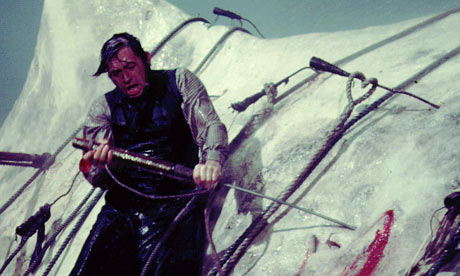
Moby Dick
Just the name of certain books have the ability to send chills down the spines of high school and college students. War and Peace, The Grapes of Wrath, Moby Dick, and any number of books from authors like Hemingway, Joyce, Hawthorne, Shakespeare, and many, many more. They're classics and are recommended for a reason, but that doesn't always mean they are good. Honors English in high school and advanced English/Literature/Composition sure proved that to me. Want the easy way out? I avoided it during my high school and college career, but how about watch the movie? I've never read Herman Melville's source novel, but I'm "halfway" caught up having seen 1956's Moby Dick.
Melville's novel is a pretty good example of a book students are afraid to even go near. For starters, it's a long book no matter what edition you pick up. That's not necessarily a breaking point because long books can still be good books. More importantly though, what style is it written in? Is it period appropriate? Is it heavy on words and vocabulary readers won't understand without looking up? I had that problem with director John Huston's movie version of Melville's novel. A movie with some issues, but a fair share of positives too. Bear in mind I'm reviewing the movie, not the novel as I jump in.
It's 1841 and a young sailor Ishmael (Richard Basehart) signs up on a whaler named the Pequod with hopes of experiencing and exploring the high seas and making some good money in the process. Even having sailed before on previous non-whaling voyages, Ishmael isn't quite sure what to expect of the journey that awaits him, but the crew seems a likable enough group. There's second-in-command Starbuck (Leo Genn), officer Stubb (Harry Andrews) and a multi-international crew with men from all over the world. For days though, no one sees the captain on deck, a man known only as Ahab (Gregory Peck), a veteran of the sea. When he does reveal himself, he delivers a speech about the success the Pequod's crew is about to have, but he has other plans. Above all else, he wants to kill a white sperm whale named Moby Dick, and nothing is going to stop him.
Reading the critical reviews of this 1956 version, one aspect of the movie seems to polarize critics more than anything else; the casting of Gregory Peck as Captain Ahab. I was surprised to read these complaints because I thought Peck's performance was one of the better things about the movie. The criticisms state that he was too young an actor to play one of literature's most notorious characters. Ahab was an old, grizzled veteran of the sea, his leg bitten off by Moby Dick, and now he wants revenge. His descent into madness, his obsession in killing Moby Dick worked in terms of character and story. Peck admitted later in his career it wasn't his best performance, stating there was too much prose from the novel in the film. For me, that was a problem throughout the film. Peck's performance? Not so much.
My biggest complaint of Huston's film was the feeling of being talked at, of being preached to. Many scenes drag on as characters talk in a very proper Victorian sounding conversation. These are whalers, not exactly upper class, high end sailors so they should talk naturally. Instead, much of the conversation feels stilted and generally a little off, and there is a lot of it. Early on, Orson Welles makes a cameo as a priest giving a sermon about Jonah and the whale (ooooohhh, foreboding!) that moves at a pace paint drying would be jealous of. These long-winded conversations take away from the movie's pacing which is otherwise able to move along at a good rate. Authentic to the book in terms of being true to the source, but maybe not so much commitment would have been better.
I'll be the first to say that I know little to nothing about whaling and its history. Seeing the movie's depiction of whaling certainly gives you an appreciation of how dangerous the job actually was. Men in small boats leave their bigger ships and chase after whales near the ocean's surface, then hurl harpoons and spears at the beast until they're dead. These are the scenes I enjoyed most as Huston gives us a feel of what sea life had to be like. Because for every hunt on the waters, there's time where the crew is bored to tears waiting for some action on-deck. I don't know if it was the quality of TCM's print or how Huston filmed the movie, but a washed-out almost sepia coloring certainly adds to the doom and gloom of this horrific hunt.
For a movie that clocks in at just under 2 hours, one thing I realize looking back is how little actually happens until the end. I don't know about the novel, but the pacing is all over the place. Ahab is introduced by face until 30 minutes into the film, Moby Dick doesn't make an appearance until the last 30 minutes, and in the end it all feels rushed, especially the sea battle with this giant white sperm whale. Behind Peck, the cast is all right, Basehart wasted as Ishmael because he's given little to do while Genn solid as Starbuck. I liked the movie, but the more I thought about it, the more problems I had. Still, it's worth a watch, if for nothing else than for you to decide what you think of Peck's performance.
Moby Dick <----trailer (1956): ** 1/2 /****
Melville's novel is a pretty good example of a book students are afraid to even go near. For starters, it's a long book no matter what edition you pick up. That's not necessarily a breaking point because long books can still be good books. More importantly though, what style is it written in? Is it period appropriate? Is it heavy on words and vocabulary readers won't understand without looking up? I had that problem with director John Huston's movie version of Melville's novel. A movie with some issues, but a fair share of positives too. Bear in mind I'm reviewing the movie, not the novel as I jump in.
It's 1841 and a young sailor Ishmael (Richard Basehart) signs up on a whaler named the Pequod with hopes of experiencing and exploring the high seas and making some good money in the process. Even having sailed before on previous non-whaling voyages, Ishmael isn't quite sure what to expect of the journey that awaits him, but the crew seems a likable enough group. There's second-in-command Starbuck (Leo Genn), officer Stubb (Harry Andrews) and a multi-international crew with men from all over the world. For days though, no one sees the captain on deck, a man known only as Ahab (Gregory Peck), a veteran of the sea. When he does reveal himself, he delivers a speech about the success the Pequod's crew is about to have, but he has other plans. Above all else, he wants to kill a white sperm whale named Moby Dick, and nothing is going to stop him.
Reading the critical reviews of this 1956 version, one aspect of the movie seems to polarize critics more than anything else; the casting of Gregory Peck as Captain Ahab. I was surprised to read these complaints because I thought Peck's performance was one of the better things about the movie. The criticisms state that he was too young an actor to play one of literature's most notorious characters. Ahab was an old, grizzled veteran of the sea, his leg bitten off by Moby Dick, and now he wants revenge. His descent into madness, his obsession in killing Moby Dick worked in terms of character and story. Peck admitted later in his career it wasn't his best performance, stating there was too much prose from the novel in the film. For me, that was a problem throughout the film. Peck's performance? Not so much.
My biggest complaint of Huston's film was the feeling of being talked at, of being preached to. Many scenes drag on as characters talk in a very proper Victorian sounding conversation. These are whalers, not exactly upper class, high end sailors so they should talk naturally. Instead, much of the conversation feels stilted and generally a little off, and there is a lot of it. Early on, Orson Welles makes a cameo as a priest giving a sermon about Jonah and the whale (ooooohhh, foreboding!) that moves at a pace paint drying would be jealous of. These long-winded conversations take away from the movie's pacing which is otherwise able to move along at a good rate. Authentic to the book in terms of being true to the source, but maybe not so much commitment would have been better.
I'll be the first to say that I know little to nothing about whaling and its history. Seeing the movie's depiction of whaling certainly gives you an appreciation of how dangerous the job actually was. Men in small boats leave their bigger ships and chase after whales near the ocean's surface, then hurl harpoons and spears at the beast until they're dead. These are the scenes I enjoyed most as Huston gives us a feel of what sea life had to be like. Because for every hunt on the waters, there's time where the crew is bored to tears waiting for some action on-deck. I don't know if it was the quality of TCM's print or how Huston filmed the movie, but a washed-out almost sepia coloring certainly adds to the doom and gloom of this horrific hunt.
For a movie that clocks in at just under 2 hours, one thing I realize looking back is how little actually happens until the end. I don't know about the novel, but the pacing is all over the place. Ahab is introduced by face until 30 minutes into the film, Moby Dick doesn't make an appearance until the last 30 minutes, and in the end it all feels rushed, especially the sea battle with this giant white sperm whale. Behind Peck, the cast is all right, Basehart wasted as Ishmael because he's given little to do while Genn solid as Starbuck. I liked the movie, but the more I thought about it, the more problems I had. Still, it's worth a watch, if for nothing else than for you to decide what you think of Peck's performance.
Moby Dick <----trailer (1956): ** 1/2 /****
Labels:
1950s,
Gregory Peck,
Harry Andrews,
John Huston,
Leo Genn,
Orson Welles,
Richard Basehart
Tuesday, June 29, 2010
Victory
In line with all the World Cup coverage on ESPN the last few weeks, I thought it only fitting that I throw in a soccer review in a timely fashion. Here in the U.S., soccer seems fated to always be the 5th or 6th most popular sport around -- if even that high. It just can't pick up enough momentum into becoming as popular in the U.S. as it is around the world. Too bad because watching good soccer being played can be as exciting as any sport out there. As for the movies, there's been a handful (mostly based out of England), and one that I catch every so often on ESPN Classic and finally decided to watch from beginning to end, 1981's Victory.
If a soccer movie doesn't appeal to you, how about a soccer movie set during World War II Paris? That still doesn't do it for you? Add one of the most eclectic casts ever assembled for a sports movie that includes Americans, Brits, Germans and famous soccer players from all over the world. Director John Huston turns in a movie that is definitely not your typical sports flick, but for all its weirdness the movie lives on if somewhat under the radar. It is by no means a classic, but it is entertaining and certainly rather unique. Soccer critics complain about slow-pacing, faking injuries, low scoring games, but none of that is a worry in movie form. For all the weirdness in fictitious story and interesting casting, 'Victory' almost demands at least one watch.
Early in 1942 in a large prisoner of war camp, German officer Major Steiner (Max von Sydow) approaches British P.O.W. Captain John Colby (Michael Caine) with a proposition. Steiner asks Colby -- a professional soccer player before the war -- if the prisoners would be interested in a friendly match between the Germans. Colby accepts and goes about assembling a team that includes talent from all over Europe as former soccer stars languish in prison camps. But not so fast, the little game thought up develops into something much bigger when the German High Command catches wind of the game. The stakes get bigger and bigger for everyone involved, while one American POW/player, Capt. Robert Hatch (Sylvester Stallone), tries to get in contact with the French resistance. The plan? To help the Allied team escape at halftime of the game that is to be played in front of 50,000 fans in a packed stadium in the middle of Paris.
Prisoner of war movies have been handled in any number of different ways, but nothing quite like this before. Along with all the known elements of the POW movie, there's the added storyline of this international, mid-war soccer game. The story does suffer some bouncing back and forth between the resistance effort and the prisoners' attempts to escape with the training and preparation for the game, but you're having so much fun you barely notice some of the lagging moments in the middle of the movie. At just two hours, it does feel like the movie bit off more than it could chew, but in the end, the final result is worth it.
The thing that caught my eye when looking at this movie was the cast. Stallone, Caine, von Sydow, and Brazilian soccer superstar Pele all in the same movie? That sounds just weird enough to work. Fresh off the success of the first two Rocky movies, Stallone lost 40 lbs. to make himself look like an actual POW instead of a ripped, rather healthy prisoner of war. I'll never say Stallone was a great actor, but the guy's got presence. For his character, basically imagine tough-talking Rocky Balboa in a German POW camp not taking crap from anybody. He even looks somewhat credible as the Allied team goalie in the big game. Caine is solid as always as Capt. Colby, the team leader just trying to keep his squad together while putting up with all sorts of outside distractions. He's easily the most likable of all the characters. Playing the German major, von Sydow is given little to do, but still manages to give his character some depth. He's a German officer first and foremost, but he's also a soccer fan at heart.
Of all the sports to turn into a visually pleasing movie, soccer has to be one of the most difficult. Whole games can go on without a single goal, much less an actual attack. Thankfully that's not the case here. Soccer legend Pele choreographed all the soccer in the movie -- training sequences and game scenes alike -- and right off the bat gives these scenes some credibility. The Germany vs. Allies game is about 35 minutes long and is the high point of the movie in terms of excitement and quality. Pele saves the coolest goal for himself, the bicycle kick (maybe the coolest thing in sports, period). The whole game is a treat to watch at the thuggish Germans and the bribed officials do everything in their power to hand the win to Germany and show they are the superior race to the world. The movie ends on a positive note as the 50,000 screaming fans get behind the upstart Allies playing the German national team. On a sidenote, I love the Allied jerseys (white with red and blue stripes down the left side). Can the U.S. National team adapt these and get rid of the pageant jerseys they wear now?
Amidst all this soccer craziness is the fact that the Allies players are prisoners of war. Caine's Colby balances orders from above basically telling him he's a traitor if he plays to the senior ranking prisoner telling him his duty is to escape and help the team do the same. These provide the main drama and some surprisingly emotional moments. Requesting the best players he can for his team, Colby asks for 6 players from Eastern European countries who have been captured. Pulled out of horrific conditions in labor camps, they're basically walking skeletons. Undeterred, he keeps them on and buy them at least a few weeks more of living. Come game time, the team must balance escaping thanks to the French resistance with delivering a blow to German morale by even staying in the game.
It is the balance among all these elements that made me like this flick so much. There's a nice balance of humor and drama, all in a setting that would seem the unlikeliest place for a World War II soccer game. Whether you're a soccer fan, sports fan or even just a history buff looking for a different sort of movie, give 'Victory' a try. Good soccer movies can be few and far between so embrace them when you find them.
Victory <----trailer (1981): ***/****
If a soccer movie doesn't appeal to you, how about a soccer movie set during World War II Paris? That still doesn't do it for you? Add one of the most eclectic casts ever assembled for a sports movie that includes Americans, Brits, Germans and famous soccer players from all over the world. Director John Huston turns in a movie that is definitely not your typical sports flick, but for all its weirdness the movie lives on if somewhat under the radar. It is by no means a classic, but it is entertaining and certainly rather unique. Soccer critics complain about slow-pacing, faking injuries, low scoring games, but none of that is a worry in movie form. For all the weirdness in fictitious story and interesting casting, 'Victory' almost demands at least one watch.
Early in 1942 in a large prisoner of war camp, German officer Major Steiner (Max von Sydow) approaches British P.O.W. Captain John Colby (Michael Caine) with a proposition. Steiner asks Colby -- a professional soccer player before the war -- if the prisoners would be interested in a friendly match between the Germans. Colby accepts and goes about assembling a team that includes talent from all over Europe as former soccer stars languish in prison camps. But not so fast, the little game thought up develops into something much bigger when the German High Command catches wind of the game. The stakes get bigger and bigger for everyone involved, while one American POW/player, Capt. Robert Hatch (Sylvester Stallone), tries to get in contact with the French resistance. The plan? To help the Allied team escape at halftime of the game that is to be played in front of 50,000 fans in a packed stadium in the middle of Paris.
Prisoner of war movies have been handled in any number of different ways, but nothing quite like this before. Along with all the known elements of the POW movie, there's the added storyline of this international, mid-war soccer game. The story does suffer some bouncing back and forth between the resistance effort and the prisoners' attempts to escape with the training and preparation for the game, but you're having so much fun you barely notice some of the lagging moments in the middle of the movie. At just two hours, it does feel like the movie bit off more than it could chew, but in the end, the final result is worth it.
The thing that caught my eye when looking at this movie was the cast. Stallone, Caine, von Sydow, and Brazilian soccer superstar Pele all in the same movie? That sounds just weird enough to work. Fresh off the success of the first two Rocky movies, Stallone lost 40 lbs. to make himself look like an actual POW instead of a ripped, rather healthy prisoner of war. I'll never say Stallone was a great actor, but the guy's got presence. For his character, basically imagine tough-talking Rocky Balboa in a German POW camp not taking crap from anybody. He even looks somewhat credible as the Allied team goalie in the big game. Caine is solid as always as Capt. Colby, the team leader just trying to keep his squad together while putting up with all sorts of outside distractions. He's easily the most likable of all the characters. Playing the German major, von Sydow is given little to do, but still manages to give his character some depth. He's a German officer first and foremost, but he's also a soccer fan at heart.
Of all the sports to turn into a visually pleasing movie, soccer has to be one of the most difficult. Whole games can go on without a single goal, much less an actual attack. Thankfully that's not the case here. Soccer legend Pele choreographed all the soccer in the movie -- training sequences and game scenes alike -- and right off the bat gives these scenes some credibility. The Germany vs. Allies game is about 35 minutes long and is the high point of the movie in terms of excitement and quality. Pele saves the coolest goal for himself, the bicycle kick (maybe the coolest thing in sports, period). The whole game is a treat to watch at the thuggish Germans and the bribed officials do everything in their power to hand the win to Germany and show they are the superior race to the world. The movie ends on a positive note as the 50,000 screaming fans get behind the upstart Allies playing the German national team. On a sidenote, I love the Allied jerseys (white with red and blue stripes down the left side). Can the U.S. National team adapt these and get rid of the pageant jerseys they wear now?
Amidst all this soccer craziness is the fact that the Allies players are prisoners of war. Caine's Colby balances orders from above basically telling him he's a traitor if he plays to the senior ranking prisoner telling him his duty is to escape and help the team do the same. These provide the main drama and some surprisingly emotional moments. Requesting the best players he can for his team, Colby asks for 6 players from Eastern European countries who have been captured. Pulled out of horrific conditions in labor camps, they're basically walking skeletons. Undeterred, he keeps them on and buy them at least a few weeks more of living. Come game time, the team must balance escaping thanks to the French resistance with delivering a blow to German morale by even staying in the game.
It is the balance among all these elements that made me like this flick so much. There's a nice balance of humor and drama, all in a setting that would seem the unlikeliest place for a World War II soccer game. Whether you're a soccer fan, sports fan or even just a history buff looking for a different sort of movie, give 'Victory' a try. Good soccer movies can be few and far between so embrace them when you find them.
Victory <----trailer (1981): ***/****
Labels:
1980s,
John Huston,
Max von Sydow,
Michael Caine,
Prisoners of War,
Sports,
Sylvester Stallone,
WWII
Sunday, June 27, 2010
The Asphalt Jungle
Whether he was behind the camera directing or in front of the camera acting, there were few directors or actors as tough/cool/badass as John Huston. As an actor, he always played characters with an edge and with his gravelly voice and not so classic looks, he always sold the part. As a director, he excelled with movies that were as tough as the stories they told. They were 'guy's guys movies' that rarely disappointed and one of his best was 1950's The Asphalt Jungle.
This 1950 heist movie is worth talking about for two reasons. One, released at the height of film noir popularity, 'Jungle' finds a way to put its own spin on the story and it ends up being a classic in the genre. Two, you can judge it by the impact it had on later underworld heist movies. Watch a heist movie released since 1950, and it's almost impossible not to make some connection or influence Huston's flick had. At just under two hours, there is not a wasted minute in the build-up, heist, and fall out of a jewelry robbery.
Just out of jail after seven years inside, Doc Reidenschneider (Sam Jaffe) wastes no time setting up a job that could net him and his partners almost a million dollars. With some help and financial backing from a crooked lawyer, Alonzo Emmerich (Louis Calhern), Doc reveals his plan to knock off a diamond exchange. He'll need some help though and recruits three men, Dix Handley (Sterling Hayden), the muscle, Gus Minnisi (James Whitmore), the getaway driver, and Louis Ciavelli (Anthony Caruso), the safe-cracker to help him pull off the job. The Doc has everything figured out down to the second, but all the planning in the world can't account for the unexpected. And then there's Emmerich, who may have ulterior motives for the heist.
The 'jungle' of the title is the underworld, the crime figures who threaten to take over cities and ruin the lives of good people all across the country, or at least that's how Police Commissioner Hardy (John McIntire) explains it. Like most noir movies, Huston shoots in black and white in this unnamed midwest city. The characters live and die in smokey rooms and dark, shadowy alleys as they go about their heist. Like few other movies, Huston creates a real feeling of the underworld, the seedier parts of town that you don't want to be caught in after a certain hour. With composer Miklos Rozsa's score, you've got the right start to a winner.
Working with an ensemble cast, Huston gets the best out of this talented crew. Often stiff and a little wooden in starring roles, Hayden delivers a career-best performance as Dix Handley (other than the pornstar-sounding name). Handley is a two-bit thug -- dubbed a 'hooligan' -- who dreams (watch HERE) of raising enough money to buy his childhood farm and leaving this dirty city life. I don't think he was ever better than he was here. Jaffe too is beyond perfect casting as the small in stature but brilliant planner of crimes and heists, earning an Oscar nomination for his part. His Doc is incredibly intelligent and a gentleman to boot, seemingly involved in crime because he's good at it. These two characters end up forming an unlikely friendship based on truth and hard knocks, a surprising friendship to come out of a heist movie.
The rest of the cast isn't anything to sneeze at as well. Calhern as Emmerich is the prototypical slimy villain. From the moment the heist is brought up, you know he's looking to double-cross Doc and his crew (with some help from equally slimy Brad Dexter). Where Handley might beat you with his fists, Emmerich would do the same with words and intellect, never ruffling a hair on his head or putting a crease in his suit. Jean Hagen is solid as Doll, a wandering young woman attracted to Handley in who she sees something good where no one else does. Whitmore too is great in his quick appearance as Gus, the hunchback getaway driver who will be loyal to the end. Also look for an actress you might have heard of, Marilyn Monroe in just her 3rd credited role, as Emmerich's mistress. You look at her and understand what Emmerich was thinking.
The beauty of 'Jungle' is in the execution because it never slows down. The actual heist -- an exciting if not groundbreaking sequence -- is over less than an hour into the movie. The fallout from the heist is where the movie revels because even Doc can't plan for everything, in this case unforeseen accidents popping up when least expected. It's an idea and a premise used in so many types of movies, but it is has never been used so well as it is in the heist movie. Without giving too much a way, it's safe to say 'Jungle' doesn't exactly have a happy ending -- it is 1950 -- but overall it works better because there wasn't a happy ending.
Because so many heist movies have been made since, The Asphalt Jungle may play like a movie that you've seen many times before...been there, done that. But watch it thinking that when it was released in 1950, there hadn't been a movie quite like this before. Director Huston puts together a doozy of a cast with Hayden delivering a career-best part leading the way, and there isn't an aspect of the movie that fails. A winner in every sense of the word.
The Asphalt Jungle <----trailer (1950): ****/****
This 1950 heist movie is worth talking about for two reasons. One, released at the height of film noir popularity, 'Jungle' finds a way to put its own spin on the story and it ends up being a classic in the genre. Two, you can judge it by the impact it had on later underworld heist movies. Watch a heist movie released since 1950, and it's almost impossible not to make some connection or influence Huston's flick had. At just under two hours, there is not a wasted minute in the build-up, heist, and fall out of a jewelry robbery.
Just out of jail after seven years inside, Doc Reidenschneider (Sam Jaffe) wastes no time setting up a job that could net him and his partners almost a million dollars. With some help and financial backing from a crooked lawyer, Alonzo Emmerich (Louis Calhern), Doc reveals his plan to knock off a diamond exchange. He'll need some help though and recruits three men, Dix Handley (Sterling Hayden), the muscle, Gus Minnisi (James Whitmore), the getaway driver, and Louis Ciavelli (Anthony Caruso), the safe-cracker to help him pull off the job. The Doc has everything figured out down to the second, but all the planning in the world can't account for the unexpected. And then there's Emmerich, who may have ulterior motives for the heist.
The 'jungle' of the title is the underworld, the crime figures who threaten to take over cities and ruin the lives of good people all across the country, or at least that's how Police Commissioner Hardy (John McIntire) explains it. Like most noir movies, Huston shoots in black and white in this unnamed midwest city. The characters live and die in smokey rooms and dark, shadowy alleys as they go about their heist. Like few other movies, Huston creates a real feeling of the underworld, the seedier parts of town that you don't want to be caught in after a certain hour. With composer Miklos Rozsa's score, you've got the right start to a winner.
Working with an ensemble cast, Huston gets the best out of this talented crew. Often stiff and a little wooden in starring roles, Hayden delivers a career-best performance as Dix Handley (other than the pornstar-sounding name). Handley is a two-bit thug -- dubbed a 'hooligan' -- who dreams (watch HERE) of raising enough money to buy his childhood farm and leaving this dirty city life. I don't think he was ever better than he was here. Jaffe too is beyond perfect casting as the small in stature but brilliant planner of crimes and heists, earning an Oscar nomination for his part. His Doc is incredibly intelligent and a gentleman to boot, seemingly involved in crime because he's good at it. These two characters end up forming an unlikely friendship based on truth and hard knocks, a surprising friendship to come out of a heist movie.
The rest of the cast isn't anything to sneeze at as well. Calhern as Emmerich is the prototypical slimy villain. From the moment the heist is brought up, you know he's looking to double-cross Doc and his crew (with some help from equally slimy Brad Dexter). Where Handley might beat you with his fists, Emmerich would do the same with words and intellect, never ruffling a hair on his head or putting a crease in his suit. Jean Hagen is solid as Doll, a wandering young woman attracted to Handley in who she sees something good where no one else does. Whitmore too is great in his quick appearance as Gus, the hunchback getaway driver who will be loyal to the end. Also look for an actress you might have heard of, Marilyn Monroe in just her 3rd credited role, as Emmerich's mistress. You look at her and understand what Emmerich was thinking.
The beauty of 'Jungle' is in the execution because it never slows down. The actual heist -- an exciting if not groundbreaking sequence -- is over less than an hour into the movie. The fallout from the heist is where the movie revels because even Doc can't plan for everything, in this case unforeseen accidents popping up when least expected. It's an idea and a premise used in so many types of movies, but it is has never been used so well as it is in the heist movie. Without giving too much a way, it's safe to say 'Jungle' doesn't exactly have a happy ending -- it is 1950 -- but overall it works better because there wasn't a happy ending.
Because so many heist movies have been made since, The Asphalt Jungle may play like a movie that you've seen many times before...been there, done that. But watch it thinking that when it was released in 1950, there hadn't been a movie quite like this before. Director Huston puts together a doozy of a cast with Hayden delivering a career-best part leading the way, and there isn't an aspect of the movie that fails. A winner in every sense of the word.
The Asphalt Jungle <----trailer (1950): ****/****
Wednesday, March 3, 2010
The Night of the Iguana
Making his directorial debut in 1941, John Huston did the equivalent of sprinting out of the box, making 1941's The Maltese Falcon for his first movie. Huston just kept on going, turning in classic after classic in a career that spanned five decades and almost 50 movies. Of course, they weren't all classics, and the Hollywood veteran did slow down by the late 1950s. His movies always had a hard, realistic edge that never pulled any punches with their storytelling.
One of his lesser known but highly regarded movies among critics, 1964's The Night of the Iguana, was ahead of its time in its ability to tackle some controversial subject matter and deal with it in an honest and forthright fashion. So a couple years before the drug culture and hippies and Woodstock came along -- and all the freeing attitudes movies dealt with in the late 60s and early 70s -- Huston's movie deals with lesbians, statutory rape, threesomes, pot, and a defrocked priest who may or may not have had an inappropriate relationship with a minor, and all of this taking place at a run-down Mexican resort.
Leading a tour bus through Mexico, a former priest, Reverend T. Lawrence Shannon (Richard Burton), doesn't seem to be able to avoid trouble. One of the women on his tour believes he's trying to seduce an underage girl (Sue Lyon) when really the girl, Charlotte, is pursuing Shannon. Pushed to his limit, Shannon freaks out and drives the bus to an old inn cut into a mountainside overlooking the sea near Puerto Vallarta. The women running the inn, Maxine (Ava Gardner), is an old friend of his and is only a few weeks removed from her husband's death. While Shannon deals with the problems among his customers, a woman shows up at the inn, Hannah Jelkes (Deborah Kerr), who with her poet grandfather is traveling around the world with what little money they have.
Watching this over the last couple days, my first reaction was that the proceedings are all very theatrical from the limited sets to the verbose, larger than life characters. Needless to say, finding out 'Iguana' is based on a play by Tennessee Williams didn't come as much of a surprise. Huston filmed the movie in Mexico -- one of his favorite locations -- and more specifically Puerto Vallarta, but limits much of the story to this seaside inn. The story is almost completely self-contained at the inn and limits the number of people/characters around. It's secluded and because of this, the story keys in exclusively on this variety of people and their issues. No distractions, no diversions, just some weird folks working things out.
The casting is phenomenal with Huston giving his leads -- Burton, Gardner, and Kerr -- a lot of leeway in how to bring their characters to life. I would have paid to listen to Burton read a phone book, his voice is perfect for movies. His Rev. T. Lawrence Shannon is a tough one to read because we don't see the incidents from his past that caused him to be kicked out of the priesthood. Did he or didn't he do it? Who really knows for sure? However you decide to interpret the character, Shannon is fascinating as Burton presents him. This is a good example of a scenery-chewing role with lots of yelling, screaming and theatrics a-plenty. Kerr is just the opposite -- as she almost always was onscreen. She's quiet, well-spoken, dignified and a lady, in the process stealing the scenes the duo have together.
One particular scene with Burton and Kerr late in the movie is the high point and really allows you to get to know these characters. But the real star of the movie is Gardner from character introduction to final scene. She's often remembered as all beauty and no ability because, let's face it, she's drop dead gorgeous. But Ava Gardner was a great actress as well and could easily carry a movie if it was required. She isn't needed to carry 'Iguana' but she does it anyway. Her Maxine lives her life as she tries to transition with her husband's death, and in the process really doesn't care what people think of her or her actions. Throw in a group of middle-aged religious women staying at her inn, and we've got ourselves a situation.
It's a good thing these three main performances are so good -- as is the small supporting cast -- because the subject matter could have easily overshadowed the characters. Of all the things mentioned before, none of them are in your face with an aggressive 'hey, look at what we're talking about style!' Huston doesn't linger on these moments, instead mentioning them and moving on. At one point, Burton's Shannon urinates on the luggage of one of the women, but unless you listen closely you'd never know what he did. He may go for the shock value, but it's over so quick it never gets old, repetitive, or exploitative. It's still more than a little odd hearing about some of these things -- like lesbians or Ava Gardner having a threesome in the ocean with two young Mexican men -- but Huston handles it in a way that is appropriate for the time and the story.
This was a weird movie all-around that got better as the story developed. The first hour was a little slow-going for my taste but picks up when Kerr shows up, seemingly out of nowhere, at Gardner's little inn. The last hour is great with the leads really getting a chance to show off their chops and dive right into the story. It's a beautiful movie filmed in black and white that if nothing else will surely bring up some interesting conversations. Very different from most movies made in 1964, and for that reason alone worth checking out. Available to watch on Youtube, starting with Part 1 of 11.
The Night of the Iguana <----trailer (1964): ***/****
One of his lesser known but highly regarded movies among critics, 1964's The Night of the Iguana, was ahead of its time in its ability to tackle some controversial subject matter and deal with it in an honest and forthright fashion. So a couple years before the drug culture and hippies and Woodstock came along -- and all the freeing attitudes movies dealt with in the late 60s and early 70s -- Huston's movie deals with lesbians, statutory rape, threesomes, pot, and a defrocked priest who may or may not have had an inappropriate relationship with a minor, and all of this taking place at a run-down Mexican resort.
Leading a tour bus through Mexico, a former priest, Reverend T. Lawrence Shannon (Richard Burton), doesn't seem to be able to avoid trouble. One of the women on his tour believes he's trying to seduce an underage girl (Sue Lyon) when really the girl, Charlotte, is pursuing Shannon. Pushed to his limit, Shannon freaks out and drives the bus to an old inn cut into a mountainside overlooking the sea near Puerto Vallarta. The women running the inn, Maxine (Ava Gardner), is an old friend of his and is only a few weeks removed from her husband's death. While Shannon deals with the problems among his customers, a woman shows up at the inn, Hannah Jelkes (Deborah Kerr), who with her poet grandfather is traveling around the world with what little money they have.
Watching this over the last couple days, my first reaction was that the proceedings are all very theatrical from the limited sets to the verbose, larger than life characters. Needless to say, finding out 'Iguana' is based on a play by Tennessee Williams didn't come as much of a surprise. Huston filmed the movie in Mexico -- one of his favorite locations -- and more specifically Puerto Vallarta, but limits much of the story to this seaside inn. The story is almost completely self-contained at the inn and limits the number of people/characters around. It's secluded and because of this, the story keys in exclusively on this variety of people and their issues. No distractions, no diversions, just some weird folks working things out.
The casting is phenomenal with Huston giving his leads -- Burton, Gardner, and Kerr -- a lot of leeway in how to bring their characters to life. I would have paid to listen to Burton read a phone book, his voice is perfect for movies. His Rev. T. Lawrence Shannon is a tough one to read because we don't see the incidents from his past that caused him to be kicked out of the priesthood. Did he or didn't he do it? Who really knows for sure? However you decide to interpret the character, Shannon is fascinating as Burton presents him. This is a good example of a scenery-chewing role with lots of yelling, screaming and theatrics a-plenty. Kerr is just the opposite -- as she almost always was onscreen. She's quiet, well-spoken, dignified and a lady, in the process stealing the scenes the duo have together.
One particular scene with Burton and Kerr late in the movie is the high point and really allows you to get to know these characters. But the real star of the movie is Gardner from character introduction to final scene. She's often remembered as all beauty and no ability because, let's face it, she's drop dead gorgeous. But Ava Gardner was a great actress as well and could easily carry a movie if it was required. She isn't needed to carry 'Iguana' but she does it anyway. Her Maxine lives her life as she tries to transition with her husband's death, and in the process really doesn't care what people think of her or her actions. Throw in a group of middle-aged religious women staying at her inn, and we've got ourselves a situation.
It's a good thing these three main performances are so good -- as is the small supporting cast -- because the subject matter could have easily overshadowed the characters. Of all the things mentioned before, none of them are in your face with an aggressive 'hey, look at what we're talking about style!' Huston doesn't linger on these moments, instead mentioning them and moving on. At one point, Burton's Shannon urinates on the luggage of one of the women, but unless you listen closely you'd never know what he did. He may go for the shock value, but it's over so quick it never gets old, repetitive, or exploitative. It's still more than a little odd hearing about some of these things -- like lesbians or Ava Gardner having a threesome in the ocean with two young Mexican men -- but Huston handles it in a way that is appropriate for the time and the story.
This was a weird movie all-around that got better as the story developed. The first hour was a little slow-going for my taste but picks up when Kerr shows up, seemingly out of nowhere, at Gardner's little inn. The last hour is great with the leads really getting a chance to show off their chops and dive right into the story. It's a beautiful movie filmed in black and white that if nothing else will surely bring up some interesting conversations. Very different from most movies made in 1964, and for that reason alone worth checking out. Available to watch on Youtube, starting with Part 1 of 11.
The Night of the Iguana <----trailer (1964): ***/****
Labels:
1960s,
Ava Gardner,
Deborah Kerr,
John Huston,
Richard Burton
Saturday, January 23, 2010
The Kremlin Letter
Sometimes I get fed up with movies spoon-feeding their stories, their twists and turns with supposedly shocking revelations. They are the type of movies where you don't even have to be fully conscious to follow the story. Call it attention deficit disorder in younger viewers -- I'm 24 and resent people saying 'younger audiences' can't sit still for more than 10 minutes -- but for whatever reason movies more and more go down the road where original stories are dummied down so the average chimp can keep up.
So when I stumble across a movie that requires your attention for every second of screen time I jump at the chance. Movies with lots of information thrown your way in a short period of time can be frustrating and enjoyable at the same time. And where would this all work better because the genre framework is already established? Spy movies where betrayals, deceptions and double crosses are part of the landscape. Virtually forgotten 40 years since its release -- thanks to no DVD or VHS release -- 1970's The Kremlin Letter, directed by John Huston, is a nice little twist on the spy movie.
Released in the midst of the James Bond craze, The Kremlin Letter is basically the anti-007 in terms of action and storytelling. Huston's take is heavy on dialogue with almost no action from start to finish. Instead of action, there's tension to spare as a team of American and British agents go undercover in Moscow to accomplish a perilous mission. Countless bits of information and explanations about the setting and the characters are thrown your way without warning, forcing you to file away little bits of information in your head so a scene or a line makes sense later in the movie. With all that said, the "twist" revealed late isn't that much of a surprise -- if you're paying attention or have seen even a couple spy movie or two you'll spot it early -- but it does work because of how the twist affects the story.
In the midst of the Cold War, a single letter could tear apart the world if it falls into the wrong hands. A high-ranking American official has written a letter saying the U.S. would help the USSR in taking out China's nuclear weapons program, and the agent holding the letter turns up dead...without the letter. A new agent, Charles Rone (Patrick O'Neal), is assigned to assemble a team with the help of agents who have experience dating back to WWII. This group of American and British agents will be headed by Ward (Richard Boone) who will lead a group of specialists (Nigel Green, Dean Jagger, George Sanders, and Barbara Parkins) in hopes of getting the letter back before all-out war breaks out. Getting that letter won't be so easy though with two Russian agents, Kosnov (Max von Sydow) and Bresnavitch (Orson Welles) also involved.
Reading through that cast listing when I saw this movie on TCM's schedule, I'm not going to lie; I was a little disappointed in myself I'd never even heard of this movie...not even in passing, even a little bit. It's not a classic spy movie, but it is an above average entry. Most of that credit goes to Huston's directing and the performances he gets from this very impressive grouping of actors and actresses. With very little action, the spotlight is squarely on the cast to carry the movie. Some are in it more than others -- Jagger, Green and Sanders are criminally underused with some great eccentric characters -- but even the smaller performances leave an impression.
Never a huge star but always a reliable lead, O'Neal is the anti-007 in his portrayal of a spy. His Rone doesn't carry a gun, is a last-minute replacement for his position, and with his photographic memory and ability to remember everything told to him is a valuable member of the team. Instead of fighting his way out of a situation, Rone thinks things out before putting his life on the line, especially in a key subplot that sees him develop a relationship with von Sydow's Kosnov's wife, Erika (Bibi Andersson). As the veteran agent working with Rone, Richard Boone makes the biggest impression, and that's saying something considering the cast. His Ward is a scene-stealer, always addressing Rone as 'Nephew' with his Texan drawl, and demanding your attention every minute he's on-screen.
Their counterparts, von Sydow and Welles, have less time and development but don't waste a second. And really can you think of two better actors to play imposing, always intimidating Russian agents? Much like his role in 3 Days of the Condor, von Sydow is frightening with his steely glare, and when wasn't Welles an intimidating presence? The whole cast seems to be enjoying themselves with Green as a pimp/drug dealer, Sanders as a transvestite, and Parkins as a wet behind the ears safecracker. Raf Vallone even makes a quick appearance as an espionage teacher. They play the type of characters that could probably carry a movie on their own, but instead play supporting roles here. If I can find a copy of Noel Behn's source novel, I'll be sure to pick it up just to see if how much had to be cut for a feature film.
An interesting movie for any number of reasons, especially considering the year and time it was released in. It's hard to figure out why this little gem has been forgotten over the years (maybe it was too different from what audiences were seeing with the Bond series), but it is worth tracking down just to watch this great cast go to town with an interesting spy story. Convoluted at times but everything clears up in the end, including one last twist in the final scene.
The Kremlin Letter <----TCM clips (1970): ***/****
So when I stumble across a movie that requires your attention for every second of screen time I jump at the chance. Movies with lots of information thrown your way in a short period of time can be frustrating and enjoyable at the same time. And where would this all work better because the genre framework is already established? Spy movies where betrayals, deceptions and double crosses are part of the landscape. Virtually forgotten 40 years since its release -- thanks to no DVD or VHS release -- 1970's The Kremlin Letter, directed by John Huston, is a nice little twist on the spy movie.
Released in the midst of the James Bond craze, The Kremlin Letter is basically the anti-007 in terms of action and storytelling. Huston's take is heavy on dialogue with almost no action from start to finish. Instead of action, there's tension to spare as a team of American and British agents go undercover in Moscow to accomplish a perilous mission. Countless bits of information and explanations about the setting and the characters are thrown your way without warning, forcing you to file away little bits of information in your head so a scene or a line makes sense later in the movie. With all that said, the "twist" revealed late isn't that much of a surprise -- if you're paying attention or have seen even a couple spy movie or two you'll spot it early -- but it does work because of how the twist affects the story.
In the midst of the Cold War, a single letter could tear apart the world if it falls into the wrong hands. A high-ranking American official has written a letter saying the U.S. would help the USSR in taking out China's nuclear weapons program, and the agent holding the letter turns up dead...without the letter. A new agent, Charles Rone (Patrick O'Neal), is assigned to assemble a team with the help of agents who have experience dating back to WWII. This group of American and British agents will be headed by Ward (Richard Boone) who will lead a group of specialists (Nigel Green, Dean Jagger, George Sanders, and Barbara Parkins) in hopes of getting the letter back before all-out war breaks out. Getting that letter won't be so easy though with two Russian agents, Kosnov (Max von Sydow) and Bresnavitch (Orson Welles) also involved.
Reading through that cast listing when I saw this movie on TCM's schedule, I'm not going to lie; I was a little disappointed in myself I'd never even heard of this movie...not even in passing, even a little bit. It's not a classic spy movie, but it is an above average entry. Most of that credit goes to Huston's directing and the performances he gets from this very impressive grouping of actors and actresses. With very little action, the spotlight is squarely on the cast to carry the movie. Some are in it more than others -- Jagger, Green and Sanders are criminally underused with some great eccentric characters -- but even the smaller performances leave an impression.
Never a huge star but always a reliable lead, O'Neal is the anti-007 in his portrayal of a spy. His Rone doesn't carry a gun, is a last-minute replacement for his position, and with his photographic memory and ability to remember everything told to him is a valuable member of the team. Instead of fighting his way out of a situation, Rone thinks things out before putting his life on the line, especially in a key subplot that sees him develop a relationship with von Sydow's Kosnov's wife, Erika (Bibi Andersson). As the veteran agent working with Rone, Richard Boone makes the biggest impression, and that's saying something considering the cast. His Ward is a scene-stealer, always addressing Rone as 'Nephew' with his Texan drawl, and demanding your attention every minute he's on-screen.
Their counterparts, von Sydow and Welles, have less time and development but don't waste a second. And really can you think of two better actors to play imposing, always intimidating Russian agents? Much like his role in 3 Days of the Condor, von Sydow is frightening with his steely glare, and when wasn't Welles an intimidating presence? The whole cast seems to be enjoying themselves with Green as a pimp/drug dealer, Sanders as a transvestite, and Parkins as a wet behind the ears safecracker. Raf Vallone even makes a quick appearance as an espionage teacher. They play the type of characters that could probably carry a movie on their own, but instead play supporting roles here. If I can find a copy of Noel Behn's source novel, I'll be sure to pick it up just to see if how much had to be cut for a feature film.
An interesting movie for any number of reasons, especially considering the year and time it was released in. It's hard to figure out why this little gem has been forgotten over the years (maybe it was too different from what audiences were seeing with the Bond series), but it is worth tracking down just to watch this great cast go to town with an interesting spy story. Convoluted at times but everything clears up in the end, including one last twist in the final scene.
The Kremlin Letter <----TCM clips (1970): ***/****
Sunday, January 3, 2010
Chinatown
Look back through Hollywood history and each decade had a few stars that rose above the others, those with movies that are often as much remembered and revered for the performances as the movie itself. There was Clark Gable and Spencer Tracy in the 1930s all the way through to the 2000s with George Clooney and Johnny Depp. Looking at the 1970s, several names pop up, but one especially stands out, Lakers fan extraordinaire and three-time Oscar winner Jack Nicholson.Now officially one of Nicholson's best roles was in the closing months of 1969 -- an Oscar-nominated role in Easy Rider -- but he just kept on rolling into the 70s. And while his turn as Randall MacMurphy in One Flew Over the Cuckoo's Nest will most likely always be remembered as Nicholson's best and most famous role, another part deserves recognition, his turn as private detective Jake 'J.J.' Gittes in Roman Polanski's 1974 detective story and period piece Chinatown.
This may come across more critically than I intend it to, but Nicholson in his personal life has become a caricature of himself in certain ways. It's easy to forget what a great actor he really is with 12 Oscar nominations to his name. His turn as Jake Gittes is typically solid Nicholson, both fiery and emotional but also calm and understated at times when the scene calls for it. He brings some charm to a character that could easily be despicable in the hands of a lesser actor, and as the lead character serves as the audience's guide because he sees exactly what we see and little else as a 1930s murder sets off an odd set of circumstances.
Working as a private detective in 1930s Los Angeles, Jake 'J.J.' Gittes (Nicholson) specializes in marriage cases and one day takes on a contract from a woman questioning if her husband is cheating on her. The husband, Hollis Mulwray (Darrell Zwerling), has become a notable public figure recently as head of the water department for a city suffering through a drought. Jake discovers Hollis is seeing a woman, but soon after the story breaks, the real Mrs. Mulwray, Evelyn (Faye Dunaway), shows up questioning how Jake got onto her husband's case. But before Jake can resolve anything, Hollis turns up dead in one of the city's water reservoirs. So starts a mystery that begins to unravel for Jake that includes corruption, phony business deals, and all sorts of shady dealings that Evelyn may or may not be involved with.
Made and released in 1974, Chinatown brings late 1930s Los Angeles to life so perfectly, so vividly that it's incredibly easy to get caught up in this winding murder mystery. Polanski films all over the city in a wide variety of locations, and everything looks immaculate from the backgrounds to the clothes -- all the guys go for the cool, stylish suit and a fedora look -- to the period cars. Everything looks and feels so authentic you're waiting for Robert Mitchum or Barbara Stanwyck to walk onto the set and join Nicholson and Dunaway in their scenes. All this is helped by Jerry Goldsmith's score that blends jazzy themes with understated music that helps drive the story and action along.
The DVD special features offered interviews with screenwriter Robert Towne, Polanski, and producer Robert Evans, all of them agreeing that this is a movie that would be difficult to make for today's audiences, and they're right. I try to avoid huge generalities about audiences because movies are subjective to each and every person watching, but movies now in 2010 and their audiences are different. Chinatown is never slow-paced, but Polanski does take his time building the story. It is a mystery that requires you to pay attention with clues hinted at and then dealt with later. This all comes together in a famously downbeat ending -- very 70s in its cynicism -- with one of the all-time great lines, 'Forget it, Jake. It's Chinatown.'
As I wrote before, Nicholson's private detective is a great performance and Dunaway is an ideal choice for a character we're led to believe is the femme fatale present in almost every noir ever made. Not so fast though as her Evelyn isn't letting Jake in on everything he needs to know, including one rather large twist toward the end. A great counter to Nicholson, and one of Dunaway's best parts which also earned an Oscar nomination (the movie earned 11 overall). Hollywood legend John Huston is on-screen for maybe 10 minutes tops in an 130-minute movie, but leaves a huge impression, as for what that impression is I'll let you find out what. Perry Lopez, Burt Young, Richard Bakalyan, Diane Ladd, Roy Jenson and John Hillerman round out the cast.
A classic film on many levels starting with the acting and continuing on down the line with Polanski's directing and John Alonzo's cinematography that echoes movies made 30 and 40 years earlier, Chinatown should definitely be on your list to see.
Chinatown <----trailer (1974): ****/****
Labels:
1970s,
Burt Young,
Faye Dunaway,
Film Noir,
Jack Nicholson,
John Huston,
Perry Lopez
Thursday, November 12, 2009
We Were Strangers
Thanks to the local cable provider's high quality product, the three movies I taped off of TCM Monday night turned into one and a half movies. With about 5 minutes to go in 1979's Cuba, the screen freezes so I sit it out for a minute or two. Then onto the fast forward and next thing I know I'm 45 minutes into the next movie. Great, grand, awesome, but in looking for that bright spot the third movie, 1949's We Were Strangers, made it all the way through without any freezes...thankfully.The theme for TCM's Monday schedule was Cuba so the common thread among the three movies I attempted to record was assassination, murder, coups, and generally death and mayhem around every corner. Cuba has never been a real model for stability, especially in the 20th Century beginning with the Spanish American war through several revolutions after that and then Fidel Castro's dictatorship dominating the country from 1959 and on. All this political instability provides some interesting storylines and settings, often told directly and frankly, politically correct feelings be damned.
It's 1933 in Cuba and the senate has ruled that any congregation of more than three people is illegal because those folks must be plotting some evil revolutionary plans. Following her brother's murder at the hands of the Porra (the secret police like the SS or KGB), China Valdez (Jennifer Jones), pronounced Chee-na, seeks out the resistance movement. She hopes to find a way to kill the man, Ariete (Pedro Armendariz), who shot her brother in cold blood. Instead, she is set up with Tony Fenner (John Garfield), a mysterious American, involved with the resistance.
Fenner concocts a detailed plan that could bring about the end of the current dictatorship. Using China's house that stands near a cemetery, Fenner and his small crew of revolutionaries will dig a tunnel under the street into the cemetery until they reach the tomb of Vicente Contreras, a local higher-up and businessman. His plan calls for the group to murder Contreras, and when all of the government powers that be -- including the president -- show up, they will set the bomb off and hopefully knock out the Cuban power structure. But as Fenner's crew works, Ariete stays on their trail, suspicious of what they're up to.
Released just four years after the end of WWII, 'Strangers' is incredibly frank in dealing with its subject matter. China, Fenner and the group believe they are in the right in attempting to assassinate Cuba's president and his cabinet. As presented, it is a rather nasty government that callously murders its citizens believed to be working against them so that makes it easier to side with the revolutionaries. Still, it is about as straightforward as possible. The collateral damage of innocents is mentioned but considered worth the death toll that a bomb will produce. But whether the group is in the right or not is beyond the point. 'Strangers' tells the story of a group of assassins which is a difficult subject to handle. Credit to tough-guy director John Huston for pulling it off so well.
This was the first Jennifer Jones part that I actually thought was pretty good although to be fair I've only seen two others. Jones was not a classical Hollywood beauty with her somewhat exotic look so she was often cast as minorities, Spanish, Asian, Native American, and here, Cuban. Her China is a strong female character looking for revenge. She's believable and completely sympathetic in the part. As the tough guy lead, Garfield is a good choice to play Fenner. Before his sudden death in 1952, Garfield made himself quite a name as a star, and it's easy to see why here. With little in the way of backstory or even in lines, Garfield's Fenner is a tough, no-nonsense leader. Typically playing good guys in a trio of John Ford westerns, Armendariz pulls off the villain perfectly, the secret policeman with little to no scruples. The rest of Fenner's team includes Gilbert Roland as Guillermo, a dock worker, Wally Cassell as Miguel, a bike mechanic, David Bond as Ramon, a law student, and Jose Perez as Toto.
With some rather obvious green screen efforts filling in for outdoor scenes in Havana, some scenes have a fake look to them as Jones and Garfield 'walk' through the downtown area. Other than those studio-manufactured backdrops, 'Strangers' looks like a typically dark, shadowy film noir. Filmed on soundstages for China's house and cellar, the characters are always half in shadow with faces covered and those shadows dancing around the floors and walls. It's a great looking movie -- not a surprise with Huston directing -- and an interesting time capsule of how a movie from the late 1940s handles the touchy subject of assassination. Well worth a watch.
We Were Strangers (1949): ***/****
Sunday, August 16, 2009
The Unforgiven
Some westerns are content to go for the lowest common denominator, an entertaining story with ridiculous amounts of action. I don't mean that as negatively as it sounds, I own a lot of movies like that. But some westerns strive for something else whether it be getting a message across or trying to make a statement about the times. These can be hit or miss because sometimes they strive to do too much, but every so often they find that balance, like John Huston's 1960 adult western The Unforgiven.
Based on a novel by author Alan Le May, who also wrote The Searchers, you have to figure you're not getting a typical shoot 'em up western. And in general, westerns were getting away from the old stereotypes, especially in the 1950s with some adult, psychological westerns like Anthony Mann's movies teaming up with Jimmy Stewart (all highly recommended). The Unforgiven doesn't settle for anything easy in it's story about a western family dealing with the revelation that their adopted daughter may be a Kiowa.
The Zacharys are a frontier family working their spread in the Texas panhandle and looking to put together a cattle herd to drive north to Wichita. The patriarch of the family since his father died years before, Ben (Burt Lancaster) is the leader, the oldest brother who keeps everyone else in check. His mother, Mattilde (Lillian Gish), runs the house and makes sure the family stays together. Helping Ben around the spread are his two younger brothers, Cash (Audie Murphy), a fiery, hot-tempered cowboy, and Andy (Doug McClure), the youngest brother who's still growing up. Then, there's Rachel (Audrey Hepburn), their adopted sister who their father supposedly found after her parents were massacred by Kiowas.
One day, a mysterious rider (Joseph Wiseman) rides into town with some revealing news. He says that Rachel has Indian blood in her, and that the story her father told was a lie. Everyone around turns on the Zacharys, and the news even tears the family itself apart with Cash refusing to live in the same house as a 'red-skinned' Indian. Even Ben's longtime partner and neighbor Zed Rawlings (Charles Bickford) refuses to deal with the family. All the while, Ben must hold the family together, even when the Kiowas come to take Rachel back.
Any movie, including a western, that deals with racism as straight forward and honest as this one is going to be polarizing. The Unforgiven can be brutally honest in that sense. We're introduced to all these characters, get to know them, and across the board they seem like good people. But the moment the possibility arises that one among them could be an Indian, they turn on each other. That could have been what the times were like, but it's a story that could be set in any decade or time in American history. It works because it doesn't try to whitewash the story.
Credit for that goes to Huston and his cast, an impressive listing of actors. It's not Lancaster's best part, but he's solid in the lead role. Hepburn is a bit of an odd choice as Rachel, but she pulls it off even if she looks little to nothing like a young Kiowa woman. This movie is known as much for the behind the scenes issues with Hepburn, but her role as Rachel works because she makes the character easy to identify with and very sympathetic.
Surprisingly enough with Lancaster and Hepburn in the leads, it's Audie Murphy that has the best part. His Cash Zachary is a deeply flawed character, a racist at the most basic who wants nothing to do with Indians of any sort, even his own adopted sister. Always known for playing the good guy in a white hat, the WWII hero plays completely against part here as the racist cowboy and comes across the best because he puts it all into the part. Of the rest of the cast, Gish and McClure round out the family, a believable representation of a frontier family, and John Saxon has a cool if small part as Johnny Portugal, an Indian horse wrangler/breaker, including this well choreographed chase scene.
Judging the movie apart from its story is a lot easier because Huston presents such a well-package western. Visually, he gets the spectacle down, the epic feel of what living in the west was like. The movie was shot in Durango, Mexico where many westerns were filmed, and it looks beautiful. The west was full of big, wide open spaces and Huston utilizes that feeling with some memorable long shots, some seemingly from miles away on a rock butte or hill. Composer Dimitri Tiomkin's score isn't as consistently strong as some of his others, but his music in those scenes fits perfectly.
A western that's dark and gloomy and doesn't pull any punches with its story dealing with racism and prejudices in the wild west. The movie benefits from some great performances, including a career-best part from Audie Murphy, and location shooting in Durango. This isn't as well known as Alan Le May's other highly respected western The Searchers, but it deserves more recognition than it's gotten in the years since.
The Unforgiven (1960): *** 1/2 /****
Based on a novel by author Alan Le May, who also wrote The Searchers, you have to figure you're not getting a typical shoot 'em up western. And in general, westerns were getting away from the old stereotypes, especially in the 1950s with some adult, psychological westerns like Anthony Mann's movies teaming up with Jimmy Stewart (all highly recommended). The Unforgiven doesn't settle for anything easy in it's story about a western family dealing with the revelation that their adopted daughter may be a Kiowa.
The Zacharys are a frontier family working their spread in the Texas panhandle and looking to put together a cattle herd to drive north to Wichita. The patriarch of the family since his father died years before, Ben (Burt Lancaster) is the leader, the oldest brother who keeps everyone else in check. His mother, Mattilde (Lillian Gish), runs the house and makes sure the family stays together. Helping Ben around the spread are his two younger brothers, Cash (Audie Murphy), a fiery, hot-tempered cowboy, and Andy (Doug McClure), the youngest brother who's still growing up. Then, there's Rachel (Audrey Hepburn), their adopted sister who their father supposedly found after her parents were massacred by Kiowas.
One day, a mysterious rider (Joseph Wiseman) rides into town with some revealing news. He says that Rachel has Indian blood in her, and that the story her father told was a lie. Everyone around turns on the Zacharys, and the news even tears the family itself apart with Cash refusing to live in the same house as a 'red-skinned' Indian. Even Ben's longtime partner and neighbor Zed Rawlings (Charles Bickford) refuses to deal with the family. All the while, Ben must hold the family together, even when the Kiowas come to take Rachel back.
Any movie, including a western, that deals with racism as straight forward and honest as this one is going to be polarizing. The Unforgiven can be brutally honest in that sense. We're introduced to all these characters, get to know them, and across the board they seem like good people. But the moment the possibility arises that one among them could be an Indian, they turn on each other. That could have been what the times were like, but it's a story that could be set in any decade or time in American history. It works because it doesn't try to whitewash the story.
Credit for that goes to Huston and his cast, an impressive listing of actors. It's not Lancaster's best part, but he's solid in the lead role. Hepburn is a bit of an odd choice as Rachel, but she pulls it off even if she looks little to nothing like a young Kiowa woman. This movie is known as much for the behind the scenes issues with Hepburn, but her role as Rachel works because she makes the character easy to identify with and very sympathetic.
Surprisingly enough with Lancaster and Hepburn in the leads, it's Audie Murphy that has the best part. His Cash Zachary is a deeply flawed character, a racist at the most basic who wants nothing to do with Indians of any sort, even his own adopted sister. Always known for playing the good guy in a white hat, the WWII hero plays completely against part here as the racist cowboy and comes across the best because he puts it all into the part. Of the rest of the cast, Gish and McClure round out the family, a believable representation of a frontier family, and John Saxon has a cool if small part as Johnny Portugal, an Indian horse wrangler/breaker, including this well choreographed chase scene.
Judging the movie apart from its story is a lot easier because Huston presents such a well-package western. Visually, he gets the spectacle down, the epic feel of what living in the west was like. The movie was shot in Durango, Mexico where many westerns were filmed, and it looks beautiful. The west was full of big, wide open spaces and Huston utilizes that feeling with some memorable long shots, some seemingly from miles away on a rock butte or hill. Composer Dimitri Tiomkin's score isn't as consistently strong as some of his others, but his music in those scenes fits perfectly.
A western that's dark and gloomy and doesn't pull any punches with its story dealing with racism and prejudices in the wild west. The movie benefits from some great performances, including a career-best part from Audie Murphy, and location shooting in Durango. This isn't as well known as Alan Le May's other highly respected western The Searchers, but it deserves more recognition than it's gotten in the years since.
The Unforgiven (1960): *** 1/2 /****
Labels:
1960s,
Audie Murphy,
Audrey Hepburn,
Burt Lancaster,
John Huston,
John Saxon,
Joseph Wiseman,
westerns
Monday, April 20, 2009
Netflix review #16: Heaven Knows, Mr. Allison
For every movie with a cast of thousands, there's plenty that counter with only one or two leads and a few extras in the background. What's tricky about movies with so small a cast is that success depends almost completely on whether the audience likes those leads. Thanks to Deborah Kerr and Robert Mitchum, John Huston's Heaven Knows, Mr. Allison can be considered quite a success. And yes, I debated doing Borat and putting "Great success" instead.
Somewhere in the Pacific in WWII, an inflatable raft floats up on a beautiful island paradise. A marine wearily steps out and begins to explore the island only to discover the other occupant is a young, pretty Irish nun, Sister Angela (Deborah Kerr). He introduces himself as Corporal Allison (Robert Mitchum), a U.S. Marine who got separated from his recon patrol when Japanese artillery hit the sub they were being dropped from. Teaming up, the unlikely duo look to survive on an island that provides everything they need. Questions come up as to whether they should try to sail to Fiji, but an answer is provided when a Japanese infantry company shows up to set up a weather station? All Allison and Sister Angela can do is hope the Allied advance across the ocean takes them to this island.
What I really enjoyed here was the straight-forward, no frills storyline of two people on an island trying to get by and hopefully be rescued. Sure, other things are thrown in, like the Japanese soldiers arriving, but those scenes provide some of the movie's more tense moments. Very easily, this movie could have been thrown on its side and forgotten since its 1957 release if the two main leads, Kerr and Mitchum, weren't so good in their roles. I give a lot of credit to director John Houston, always able to get a good performance out of his actors, for casting the leads so well.
Riding the huge success of The King and I, Kerr gives a great performance as Sister Angela, a nun whose faith brought her to this island, and it's this faith that keeps her going. She delivers a semi-twist about 2/3 of the way in, but it never feels forced. Angela is innocent and slightly naive, but that doesn't mean her character isn't a strong one. And most importantly, she has a chemistry with Mitchum because if that wasn't there the whole movie goes bottom up. I wrote in the last couple weeks about 'cool' actors, and I forgot to include Mitchum. As a really smooth, laid back presence, Mitchum seems to be taken for granted as an actor sometimes. But here he shows what he can do, delivering one of his better parts as Allison. He grew up on his own and is tougher for it, but he's gentle with Angela and a gentleman all around in trying to help her.
Reading the synopsis of a man and a woman on a deserted island, I couldn't help but think the two would end up together, even if one was a nun, and one as classically pretty as Deborah Kerr. The movie does deal with this as the relationship changes and develops, but it's never awkward. One scene shows how much Allison looks out for Angela following the Japanese arrival. She almost gets sick eating raw fish so he sneaks into the Japanese camp to steal food. He gets in easily enough but has to hide for hours as two Japanese soldiers unknowingly corner him. Allison's just trying to help a friend, even if he has feelings for her, and Sister Angela is horribly worried something has happened to him. A good sum-up of the relationship is that scene, two individuals who become close friends in a dangerous situation.
The Fox War Classic DVD comes in at under $15 over at Amazon. Filming locations in Trinidad and Tobago look amazing in the widescreen presentation on the disc. In the special features department, there's a trailer, four MovieTone clips about WWII in the Pacific that run about 7 minutes, and a handful of trailers for other Fox War Classics. It's a very good movie carried completely by its leads, Kerr and Mitchum. Definitely give this old-fashioned, good storytelling film a try.
Somewhere in the Pacific in WWII, an inflatable raft floats up on a beautiful island paradise. A marine wearily steps out and begins to explore the island only to discover the other occupant is a young, pretty Irish nun, Sister Angela (Deborah Kerr). He introduces himself as Corporal Allison (Robert Mitchum), a U.S. Marine who got separated from his recon patrol when Japanese artillery hit the sub they were being dropped from. Teaming up, the unlikely duo look to survive on an island that provides everything they need. Questions come up as to whether they should try to sail to Fiji, but an answer is provided when a Japanese infantry company shows up to set up a weather station? All Allison and Sister Angela can do is hope the Allied advance across the ocean takes them to this island.
What I really enjoyed here was the straight-forward, no frills storyline of two people on an island trying to get by and hopefully be rescued. Sure, other things are thrown in, like the Japanese soldiers arriving, but those scenes provide some of the movie's more tense moments. Very easily, this movie could have been thrown on its side and forgotten since its 1957 release if the two main leads, Kerr and Mitchum, weren't so good in their roles. I give a lot of credit to director John Houston, always able to get a good performance out of his actors, for casting the leads so well.
Riding the huge success of The King and I, Kerr gives a great performance as Sister Angela, a nun whose faith brought her to this island, and it's this faith that keeps her going. She delivers a semi-twist about 2/3 of the way in, but it never feels forced. Angela is innocent and slightly naive, but that doesn't mean her character isn't a strong one. And most importantly, she has a chemistry with Mitchum because if that wasn't there the whole movie goes bottom up. I wrote in the last couple weeks about 'cool' actors, and I forgot to include Mitchum. As a really smooth, laid back presence, Mitchum seems to be taken for granted as an actor sometimes. But here he shows what he can do, delivering one of his better parts as Allison. He grew up on his own and is tougher for it, but he's gentle with Angela and a gentleman all around in trying to help her.
Reading the synopsis of a man and a woman on a deserted island, I couldn't help but think the two would end up together, even if one was a nun, and one as classically pretty as Deborah Kerr. The movie does deal with this as the relationship changes and develops, but it's never awkward. One scene shows how much Allison looks out for Angela following the Japanese arrival. She almost gets sick eating raw fish so he sneaks into the Japanese camp to steal food. He gets in easily enough but has to hide for hours as two Japanese soldiers unknowingly corner him. Allison's just trying to help a friend, even if he has feelings for her, and Sister Angela is horribly worried something has happened to him. A good sum-up of the relationship is that scene, two individuals who become close friends in a dangerous situation.
The Fox War Classic DVD comes in at under $15 over at Amazon. Filming locations in Trinidad and Tobago look amazing in the widescreen presentation on the disc. In the special features department, there's a trailer, four MovieTone clips about WWII in the Pacific that run about 7 minutes, and a handful of trailers for other Fox War Classics. It's a very good movie carried completely by its leads, Kerr and Mitchum. Definitely give this old-fashioned, good storytelling film a try.
Labels:
1950s,
Deborah Kerr,
John Huston,
Robert Mitchum,
WWII
Subscribe to:
Posts (Atom)
.jpg)