Compared to the 1960's, the 1950's just doesn't stand up for me when it comes to the western genre. Movies were too much soap opera, not enough wild west. Sure, there were plenty of good to great to classic entries, but the following decade was a stretch of a genre at its best. Closing out the decade strong though was a 1957 western that's been generally forgotten over the years, The Wonderful Country.
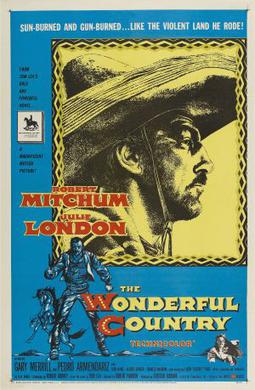
Working for the powerful Castro family in Mexico, gunfighter and hired gun Martin Brady (Robert Mitchum) is crossing the Rio Grande and entering the United States. An incident from his past drastically changed his life, forcing him to retreat into Mexico where he developed a name for himself as quite the dangerous pistolero. Now, he's on a mission from the Castros to pick up an illegal shipment of repeating rifles and ammunition. It isn't soon after crossing the border that his horse throws him, breaking Martin's leg. He can't ride so he's forced to wait and heal in the border town, shipping the guns and ammunition back to Mexico without him. So with nothing to do but wait, Martin sits back and heals but doesn't quite know what awaits him. People from his past, new acquaintances, and those who want to see him dead, they all await in the coming weeks, especially when news reaches town that the gun shipment has been stolen. But by who?
What an interesting, genuinely odd, even offbeat movie. I watched this western from director Robert Parrish years ago and revisited it recently when it popped up on MGM-HD. I liked it a lot then, and a second viewing produced the same result...albeit with the same response. This is an odd movie, no doubt about it. There are touches of an almost art-house film sprinkled throughout. The story is disjointed to say the least, covering months (and maybe more) from beginning to end but with no real sense of the passage of time. But coursing through it all, an odd energy hangs in the air that I found appealing. A bit of a mess but a good mess to watch.
Robert Mitchum was the best. He had no rivals, a rogue in Hollywood before it was cool to be a rogue. He was one of the first anti-heroes too, the tortured hero who transitioned into bigger and better. One of his specialties? As I've mentioned before, Mitchum was drawn to Mexico including this film but also The Wrath of God, Villa Rides, 5 Card Stud, Bandido and probably several more I'm forgetting. Who better then to play an expatriate American who embraced the Mexican lifestyle almost entirely? I can't think of anyone.
Mitchum's Martin Brady is the one constant through all the craziness and winding story. Yeah, his accent is a little rough at times, but when he speaks Spanish, this isn't an actor remembering his lines. He speaks it fluently. But the character as a whole is interesting because it feels so ahead of its time. This is the somber, even doomed gunfighter running from his past but not really knowing what the future holds for him. All he's known is his pistol, but his ability with the gun has him tied down so he can't escape. From the look of the character -- the immense sombrero, the stubble, the vaquero attire -- to the potentially doomed development, it's a more than worthwhile lead performance.
The rest of the cast is more of an ensemble with a few bright spots. Julie London plays Helen Colton, the wife of the local army outpost commander, Major Stark Colton (Gary Merrill), a generally ineffective officer. Helen has a past and is drawn to Mitchum's Brady but she may have other ideas. But then things get weird in almost variety show ensemble territory, including Albert Dekker (a Texas Ranger captain), Jack Oakie (a well-meaning railroad man), scene-stealing Charles McGraw (an amiable doctor), former Negro League/MLB pitcher Satchel Paige (a cavalryman, a Buffalo Soldier), Anthony Caruso (a Mexican farmer), Mike Kellin (a Mexican pistolero), Victor Manuel Mendoza (the army officer) and his brother, the Governor (Pedro Armendariz), John Banner (the German store owner), Jay Novello (a Mexican soldier and Brady's friend) and Max Slaten (his naive visiting nephew). Enough for you? McGraw is especially good, as is Armendariz in a smaller part.
Definitely worth mentioning is the visual appeal of the movie. 'Country' filmed on-location in Mexico, making the movie look almost like a country's tour guide. Some locations are familiar from other like-minded westerns, but for the most part, you're seeing a country as it is, not done up for the sake of a movie. With a Mexican-themed score combined with that beautiful countryside serving as a backdrop, we've got a winner in the technical department. Sure, the story drifts along too much, bouncing from one character and situation to the next almost without warning, but this is a movie that's very enjoyable if you drift along with it. Not a classic, but a pretty darn good western.
The Wonderful Country (1959): ***/****
The Sons of Katie Elder
"First, we reunite, then find Ma and Pa's killer...then read some reviews."
Showing posts with label Pedro Armendariz. Show all posts
Friday, December 18, 2015
Friday, October 9, 2015
The Conqueror (1956)
I love John Wayne so let's get that out of the way. I've seen just about every single one of his feature-length films, and more than a few of his ventures are on the Just Hit Play All-Time Favorite List. I can be honest though when necessary, and the 1950's were far from the Duke's strongest decade. Though there were some gems -- Rio Bravo, The Searchers, Hondo among others -- there were some duds, real tankers. Blood Alley, The Barbarian and the Geisha, Legend of the Lost, all not remembered so fondly but one rises (or sinks?) above the rest. Definitely Wayne's worst film and one remembered as one of the worst of all-time, 1956's The Conqueror.
"Why is it so bad, Tim?" you might ask. Why? Well, John Wayne, the all-American movie star takes a crack at playing the infamous Mongol warrior and leader Genghis Khan. Yeah, you read that right. John Wayne plays Genghis Khan. And away we go!
Ruling his tribe/clan of Mongols on the Asian Steppe, fiery, brutal warrior Temujin (Wayne) has caused himself some issues. Namely, a violent conflict he's started with a rival tribe because he kidnapped said tribe leader's wife-to-be, Bortai (Susan Hayward). The equally fiery woman wants nothing to do with Temujin and making it worse, her father killed Temujin's father years before. Uh-oh, family drama! Even as war looms and his people threaten to leave him entirely, Temujin refuses to give up his kidnapped bride who wants nothing to do with him (or does she?!?). Instead, the Mongol leader looks to form an uneasy alliance with a past enemy to hold his power and hopefully gain much, much more. Can it all hold together long enough for Temujin to do what he needs to do to reach out and grab everything he wants? The answer lies on a trail of bodies and a river of blood across the Steppe.
Well, that was a fun plot synopsis to write! It's not too often I get to write a trail of bodies and a river of blood in a review. It's an easy plot to spell out because it is just so criminally bad. We will address John Wayne as Genghis Khan in a bit -- that's too easy -- but there's so much badness here in all-around fashion. The script offers one stilted scene of dialogue after another and then one betrayal and backstabbing after another. Imagine the Indians in 1950's westerns -- Me Indian. How! -- but transitioned to a war on the Asian steppe. Yeah, it's just as bad and cliched and just plain dumb as you'd expect. Actor-turned-director Dick Powell is at the helm of a real stinker here, basically from beginning to end. It doesn't build to bad. It just IS bad.
Okay, John Wayne as Genghis Khan. Let's process this. Let's rationalize. It can't be as bad as it sounds, right? No, it's exactly how it sounds. In the late 1940's and into the 1950's, Wayne really developed as an actor, piling up some of his best roles -- She Wore a Yellow Ribbon, Red River, Sands of Iwo Jima, The Searchers -- but this is just uncomfortable to watch. As Ben Manckiewicz said during the recent airing of 'Conqueror' on TCM, Wayne has said in interviews he played Khan as an American cowboy, a tough gunfighter and wouldn't you know it? That formula doesn't work. He's trying so give him credit because it would have been easy to phone this one in (real easy). Wayne just has too much working against him from the aforementioned dialogue that sounds especially stiff coming from the Duke down to the ridiculous mustache wardrobe set him up with. Bad. Really bad so be forewarned.
No one in the cast escapes the wrath of the script to be honest. Hayward was one tough actress, but she doesn't have much chemistry with Wayne and that's a problem when the driving force of the movie is their passion-filled, love-hate relationship. Hayward does get a bizarre, forced striptease/sexy dance of sorts so....there's that, I guess? Pedro Armendariz plays Temujin's half-brother, Jamuga, his conscious, a wise sidekick who recommends what to do next. Also look for Agnes Moorehead, Thomas Gomez, William Conrad, John Hoyt and Ted de Corsia in supporting parts. Familiar faces Lee Van Cleef and Leo Gordon get supporting background parts. A whole bunch of very non-Asian actors playing Asian parts and the end results are just as bad as you figured they would be. Not a winner in the bunch!
If there's a positive, it comes as a bit of a loaded statement. The scope and scale of the movie is impressive. The battle scenes of colliding, thundering armies crashing into each other are something to behold. The stuntwork is impressive throughout as hundreds of riders fill the screen in lavish uniforms set against the stunning backdrop of the Utah desert. Then there's the issue...the filming locations were 100-miles south of nuclear testing sites and judging by the amount of cast members that would die from cancer over the coming years, it seems the U.S. government's promise that the nuclear fallout wouldn't head their direction...well, that's garbage. Much of the cast and crew would die over the next 5, 10 and 20-plus years from varying cancers, quite possibly from the arduous filming schedule in the Utah desert. If that's not tragic, I don't know what is.
So here we are. The fact that 'Conqueror' has a 3.3 rating on IMDB is a testament to John Wayne fans who are fighting a heck of a battle to bring that number up at least a little. This movie is just as bad and worse as you've heard. I lost interest pretty quickly but stuck it out, hoping things might improve at some point. That's the worst kind of a bad movie, one that's almost impossible to even enjoy in guilty pleasure fashion. Give this one a wide, big-old berth, and that's coming from one of the biggest John Wayne fans around.
The Conqueror (1956): */****
"Why is it so bad, Tim?" you might ask. Why? Well, John Wayne, the all-American movie star takes a crack at playing the infamous Mongol warrior and leader Genghis Khan. Yeah, you read that right. John Wayne plays Genghis Khan. And away we go!
Ruling his tribe/clan of Mongols on the Asian Steppe, fiery, brutal warrior Temujin (Wayne) has caused himself some issues. Namely, a violent conflict he's started with a rival tribe because he kidnapped said tribe leader's wife-to-be, Bortai (Susan Hayward). The equally fiery woman wants nothing to do with Temujin and making it worse, her father killed Temujin's father years before. Uh-oh, family drama! Even as war looms and his people threaten to leave him entirely, Temujin refuses to give up his kidnapped bride who wants nothing to do with him (or does she?!?). Instead, the Mongol leader looks to form an uneasy alliance with a past enemy to hold his power and hopefully gain much, much more. Can it all hold together long enough for Temujin to do what he needs to do to reach out and grab everything he wants? The answer lies on a trail of bodies and a river of blood across the Steppe.
Well, that was a fun plot synopsis to write! It's not too often I get to write a trail of bodies and a river of blood in a review. It's an easy plot to spell out because it is just so criminally bad. We will address John Wayne as Genghis Khan in a bit -- that's too easy -- but there's so much badness here in all-around fashion. The script offers one stilted scene of dialogue after another and then one betrayal and backstabbing after another. Imagine the Indians in 1950's westerns -- Me Indian. How! -- but transitioned to a war on the Asian steppe. Yeah, it's just as bad and cliched and just plain dumb as you'd expect. Actor-turned-director Dick Powell is at the helm of a real stinker here, basically from beginning to end. It doesn't build to bad. It just IS bad.
Okay, John Wayne as Genghis Khan. Let's process this. Let's rationalize. It can't be as bad as it sounds, right? No, it's exactly how it sounds. In the late 1940's and into the 1950's, Wayne really developed as an actor, piling up some of his best roles -- She Wore a Yellow Ribbon, Red River, Sands of Iwo Jima, The Searchers -- but this is just uncomfortable to watch. As Ben Manckiewicz said during the recent airing of 'Conqueror' on TCM, Wayne has said in interviews he played Khan as an American cowboy, a tough gunfighter and wouldn't you know it? That formula doesn't work. He's trying so give him credit because it would have been easy to phone this one in (real easy). Wayne just has too much working against him from the aforementioned dialogue that sounds especially stiff coming from the Duke down to the ridiculous mustache wardrobe set him up with. Bad. Really bad so be forewarned.
No one in the cast escapes the wrath of the script to be honest. Hayward was one tough actress, but she doesn't have much chemistry with Wayne and that's a problem when the driving force of the movie is their passion-filled, love-hate relationship. Hayward does get a bizarre, forced striptease/sexy dance of sorts so....there's that, I guess? Pedro Armendariz plays Temujin's half-brother, Jamuga, his conscious, a wise sidekick who recommends what to do next. Also look for Agnes Moorehead, Thomas Gomez, William Conrad, John Hoyt and Ted de Corsia in supporting parts. Familiar faces Lee Van Cleef and Leo Gordon get supporting background parts. A whole bunch of very non-Asian actors playing Asian parts and the end results are just as bad as you figured they would be. Not a winner in the bunch!
If there's a positive, it comes as a bit of a loaded statement. The scope and scale of the movie is impressive. The battle scenes of colliding, thundering armies crashing into each other are something to behold. The stuntwork is impressive throughout as hundreds of riders fill the screen in lavish uniforms set against the stunning backdrop of the Utah desert. Then there's the issue...the filming locations were 100-miles south of nuclear testing sites and judging by the amount of cast members that would die from cancer over the coming years, it seems the U.S. government's promise that the nuclear fallout wouldn't head their direction...well, that's garbage. Much of the cast and crew would die over the next 5, 10 and 20-plus years from varying cancers, quite possibly from the arduous filming schedule in the Utah desert. If that's not tragic, I don't know what is.
So here we are. The fact that 'Conqueror' has a 3.3 rating on IMDB is a testament to John Wayne fans who are fighting a heck of a battle to bring that number up at least a little. This movie is just as bad and worse as you've heard. I lost interest pretty quickly but stuck it out, hoping things might improve at some point. That's the worst kind of a bad movie, one that's almost impossible to even enjoy in guilty pleasure fashion. Give this one a wide, big-old berth, and that's coming from one of the biggest John Wayne fans around.
The Conqueror (1956): */****
Monday, December 1, 2014
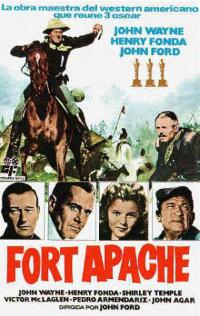
Fort Apache
Director John Ford and star John Wayne went together like peanut butter and jelly. They just clicked, working together 12 times in feature films and many more in uncredited fashion. Right up there with 1952's The Quiet Man, three films stand out as the pair's most memorable films. These are three movies simply known as the Cavalry trilogy, and here's the first, 1948's Fort Apache.
A career officer with a distinguished record, Lt. Colonel Owen Thursday (Henry Fonda) is less than pleased with his new orders. While fellow officers are being sent to fight the Sioux and Cheyenne, Thursday is being sent to a post in Arizona, Fort Apache, where he will take command of a cavalry regiment that's temporarily been under the command of Capt. Kirby York (Wayne). Thursday resents everything about the posting and with no knowledge or respect of the Apaches thinks nothing can happen to advance his career, or at least earn him new orders and a new posting. Not interested in making friends, Thursday's actions cause his regiment, his officers and his men, to resent him for what he's doing. He wants to make the regiment as strong as ever though and continues to push the men. Believing there's nothing he can ultimately do, the new commanding officer sees a chance for glory when Apache warriors leave their reservation. How far will he go?
Later in his career, Ford made darker, more cynical and realistic westerns that almost apologized for his previous genre entries. It's odd then that some 15 to 20 years earlier, it was these westerns that are far better remembered. 'Apache' and the other two Cavalry flicks, She Wore a Yellow Ribbon and Rio Grande, are more how the west should have been and not how it actually was. Ford embraces the romantic concept of the old west. The cavalry were gentlemen and soldiers, family men while the wives were steadfast and loyal, and the government and Indian agents were as corrupt as dirt. The movie is a gem. Ford films on-location in Monument Valley, stunning backdrops from scene to scene, in black and white, producing one of the most visually pleasing westerns ever. The musical score from Richard Hageman is a gem too throughout.
Throughout his career, Ford had his favorite actors to work with, and 'Apache' pairs two of the best in Henry Fonda and John Wayne. This is one of Fonda's most underrated performances, his Thursday a rigid, humorless man and career officer who is equal parts arrogant and condescending. He may be a capable officer but his methods come into question at times. At what point is pride and glory a hindrance, a threat to his command? Wayne's part is less flashy but still quite good. His Capt. York is an experienced Indian fighter with a respect for the Apaches who's trying to help his new commander...except Thursday ain't having it. This is Wayne in fine fashion, natural and quite at home. Their scenes together crackle, two different personalities pushing and testing and feeling each other out. No matter what they discuss though, this is a relationship that seems doomed to failure.
From everything I've read, Ford was a tyrant on his sets, but the man could assemble quite a cast. He brought the best out in his cast (for the most part, some he just pushed mercilessly). Shirley Temple plays Philadelphia, Thursday's daughter who falls for a new lieutenant at the outpost, Lt. Michael O'Rourke (John Agar, Temple's real-life husband). A former silent movie star who worked with Ford regularly before they had a falling out, George O'Brien is excellent as Capt. Collingwood, a former friend who made a decision that halted his career, dooming him to Fort Apache, Anna Lee playing his loyal wife. Ward Bond gets to Irish it up as Sgt. Major O'Rourke, the capable NCO who the rest of the men look up to, a top man at the outpost, with Irene Rich as his wife of many years. From the John Ford Stock Company, look for Pedro Armendariz, Victor McLaglen, Jack Pennick and Dick Foran as four hard-drinking sergeants always getting into trouble.
An Irishman to the core, Ford loved the sense of family and camaraderie and community in his films. This is a prime example. He's interested in the life of the outpost from the officer's dances to the training of the recruits. We see the cavalry moving out in formation, of marching across the desert silhouetted against the rock formations and on the horizon. We see the dynamics of the wives of the fort, of the community that sprouts up in the desert cavalry fort. Ford ate this stuff up in most of his movies and sometimes could lay it on a little thick, but for the most part I felt like he kept those things in check. Yeah, the physical humor with McLaglen is a little thick at times. Yeah, the G-rated love between Temple and Agar is sugary sweet. Yes, Foran even gets to serenade us with an old Irish love song. These moments fit here more, fit with the tone and rhythm where certain other Ford movies are handicapped by moments like this.
Transplanting some characters and tribes, 'Apache' is a pretty thinly veiled take-off on Custer's Last Stand with Fonda's Thursday standing in for Custer. This isn't an action movie -- by a long shot -- with much of the conflict saved for the final 45 minutes as the outnumbered regiment moves out to face Cochise and his warriors. Again, an Irishman can build a sense of doom like no one else, and Ford nails the ending. He builds the tension as we see trouble coming over the horizon and hanging in the air. What Thursday does proves costly in a moving finale both visually and in storytelling. The actual battle is a bit of a disappointment but Ford set out to do what he wanted. The final scene opens up the door especially for some themes that would be discussed 14 years later with Ford's The Man Who Shot Liberty Valance, the movie ending on a far more hopeful note than it could have.
Just an excellent movie. Good story, great-looking film, wonderful score, excellent directing and a very strong ensemble cast, especially Fonda, Wayne, Armendariz and Bond. Not as good as She Wore a Yellow Ribbon but the without a doubt second best movie in the cavalry trilogy. Well worth checking out.
Fort Apache (1948): ****/****
A career officer with a distinguished record, Lt. Colonel Owen Thursday (Henry Fonda) is less than pleased with his new orders. While fellow officers are being sent to fight the Sioux and Cheyenne, Thursday is being sent to a post in Arizona, Fort Apache, where he will take command of a cavalry regiment that's temporarily been under the command of Capt. Kirby York (Wayne). Thursday resents everything about the posting and with no knowledge or respect of the Apaches thinks nothing can happen to advance his career, or at least earn him new orders and a new posting. Not interested in making friends, Thursday's actions cause his regiment, his officers and his men, to resent him for what he's doing. He wants to make the regiment as strong as ever though and continues to push the men. Believing there's nothing he can ultimately do, the new commanding officer sees a chance for glory when Apache warriors leave their reservation. How far will he go?
Later in his career, Ford made darker, more cynical and realistic westerns that almost apologized for his previous genre entries. It's odd then that some 15 to 20 years earlier, it was these westerns that are far better remembered. 'Apache' and the other two Cavalry flicks, She Wore a Yellow Ribbon and Rio Grande, are more how the west should have been and not how it actually was. Ford embraces the romantic concept of the old west. The cavalry were gentlemen and soldiers, family men while the wives were steadfast and loyal, and the government and Indian agents were as corrupt as dirt. The movie is a gem. Ford films on-location in Monument Valley, stunning backdrops from scene to scene, in black and white, producing one of the most visually pleasing westerns ever. The musical score from Richard Hageman is a gem too throughout.
Throughout his career, Ford had his favorite actors to work with, and 'Apache' pairs two of the best in Henry Fonda and John Wayne. This is one of Fonda's most underrated performances, his Thursday a rigid, humorless man and career officer who is equal parts arrogant and condescending. He may be a capable officer but his methods come into question at times. At what point is pride and glory a hindrance, a threat to his command? Wayne's part is less flashy but still quite good. His Capt. York is an experienced Indian fighter with a respect for the Apaches who's trying to help his new commander...except Thursday ain't having it. This is Wayne in fine fashion, natural and quite at home. Their scenes together crackle, two different personalities pushing and testing and feeling each other out. No matter what they discuss though, this is a relationship that seems doomed to failure.
From everything I've read, Ford was a tyrant on his sets, but the man could assemble quite a cast. He brought the best out in his cast (for the most part, some he just pushed mercilessly). Shirley Temple plays Philadelphia, Thursday's daughter who falls for a new lieutenant at the outpost, Lt. Michael O'Rourke (John Agar, Temple's real-life husband). A former silent movie star who worked with Ford regularly before they had a falling out, George O'Brien is excellent as Capt. Collingwood, a former friend who made a decision that halted his career, dooming him to Fort Apache, Anna Lee playing his loyal wife. Ward Bond gets to Irish it up as Sgt. Major O'Rourke, the capable NCO who the rest of the men look up to, a top man at the outpost, with Irene Rich as his wife of many years. From the John Ford Stock Company, look for Pedro Armendariz, Victor McLaglen, Jack Pennick and Dick Foran as four hard-drinking sergeants always getting into trouble.
An Irishman to the core, Ford loved the sense of family and camaraderie and community in his films. This is a prime example. He's interested in the life of the outpost from the officer's dances to the training of the recruits. We see the cavalry moving out in formation, of marching across the desert silhouetted against the rock formations and on the horizon. We see the dynamics of the wives of the fort, of the community that sprouts up in the desert cavalry fort. Ford ate this stuff up in most of his movies and sometimes could lay it on a little thick, but for the most part I felt like he kept those things in check. Yeah, the physical humor with McLaglen is a little thick at times. Yeah, the G-rated love between Temple and Agar is sugary sweet. Yes, Foran even gets to serenade us with an old Irish love song. These moments fit here more, fit with the tone and rhythm where certain other Ford movies are handicapped by moments like this.
Transplanting some characters and tribes, 'Apache' is a pretty thinly veiled take-off on Custer's Last Stand with Fonda's Thursday standing in for Custer. This isn't an action movie -- by a long shot -- with much of the conflict saved for the final 45 minutes as the outnumbered regiment moves out to face Cochise and his warriors. Again, an Irishman can build a sense of doom like no one else, and Ford nails the ending. He builds the tension as we see trouble coming over the horizon and hanging in the air. What Thursday does proves costly in a moving finale both visually and in storytelling. The actual battle is a bit of a disappointment but Ford set out to do what he wanted. The final scene opens up the door especially for some themes that would be discussed 14 years later with Ford's The Man Who Shot Liberty Valance, the movie ending on a far more hopeful note than it could have.
Just an excellent movie. Good story, great-looking film, wonderful score, excellent directing and a very strong ensemble cast, especially Fonda, Wayne, Armendariz and Bond. Not as good as She Wore a Yellow Ribbon but the without a doubt second best movie in the cavalry trilogy. Well worth checking out.
Fort Apache (1948): ****/****
Tuesday, December 22, 2009
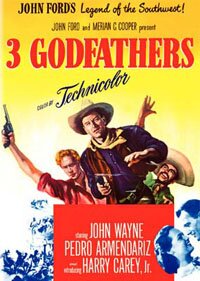
3 Godfathers
By the time John Ford's 3 Godfathers was released in 1948, the basic premise of the story had been used several times before...five times in movie form actually and one was even directed by Ford. But by 1948, Ford had more technology available to him including the obvious one, sound, and Technicolor formatting that was also used a year later in She Wore a Yellow Ribbon. The famous director also played up another aspect of the story, an allegory of Jesus' birth and the three kings who came to see him, but keeping the unique spin of setting the story in the wild west.After successfully robbing a bank in the town of Welcome, Arizona, three men, Bob Hightower (John Wayne), a Texas outlaw who lives on the wrong side of the law, William Kearney (Harry Carey Jr), a youngster known as the Abilene Kid along for his first robbery, and Pedro Rocafuerte (Pedro Armendariz), a Mexican bandit who's ridden with Bob, hightail it into the desert with a posse close behind. Leading that posse is Sheriff Perley 'Buck' Sweet (Ward Bond), a peace officer who tries to avoid violence as much as he can. Trying to outsmart the other one, Bob and Buck try to get to one of the few water holes in the area.
Reaching one of those holes, Bob and Co. stumble across a wagon with a pregnant mother (Mildred Natwick) inside ready to give birth. Struggling to stay alive, she gives birth to a boy, asking these three men to care for her son as godfathers, dying soon after. So these three outlaws give their word and must figure out how to care for the infant in the desert with little water for them, much less a baby. Knowing the posse will figure out where they are, the trio heads off for New Jerusalem, the closest town around, with no horses, a few canteens of water and no food across the desert to deliver the boy to safety.
Over a career that spanned silent and sound movies, the name John Ford became synonymous with westerns, and while this is not one of his most respected or well known westerns, it's still an above average entry into his filmography. He filmed the movie in the Mojave Desert and Death Valley as opposed to Monument Valley, and the results show. It's a stark landscape the three godfathers must trudge across to get to New Jerusalem. Ford takes advantage of the Technicolor imaging, bringing colors to life where many directors would have filmed the desert in black and white. Certain Ford touches are here, especially in the somewhat sappy ending that differs from the tone of the rest of the movie, but that's a given when watching one of this director's movies.
By 1948, John Wayne had become Ford's go-to guy with a lead role as he was just coming off the success of Fort Apache, the first of Ford's so-called Cavalry trilogy. To be fair, I haven't seen all of Wayne's hour-long serials, but this is one of the few movies where the actor played a bad guy...sort of. Sure, he's an outlaw and a bank robber, but a really nice one at that. The same goes for Armendariz and Carey Jr. The trio has chemistry to spare as they care for Robert William Pedro, the name given the boy in honor of his godfathers. There's obvious humor as three bachelor outlaws who have no idea to care for a baby struggle to adjust. Wayne was a fine comedic actor when given the chance, and he provides several good laughs in this one as do Armendariz and Carey Jr.. As the sheriff chasing them, Bond is his usual self, a loud, boisterious fella who is nonetheless a likable guy.
After rival Howard Hawks gave Carey Jr a supporting role in Red River, a somewhat insulted Ford -- who worked with Carey Sr many times -- took it upon himself to add the young actor in the cast listing as 'And introducing Harry Carey Jr.' It seems Ford didn't want to talk about Red River. But that's how Ford was, and over the years he built the Ford Stock Company, actors and actresses you see in almost all his movies. Armendariz, Carey Jr, Natwick and Bond all qualify, but that list also includes Jane Darwell, Hank Worden, Jack Pennick, Mae Marsh, all of whom have supporting parts in 3 Godfathers. Also look for Ben Johnson in his first credited role as one of Sweet's posse.
So as Christmas draws near, if you're looking for an atypical holiday movie give this one a try. It's not a straight-on Christmas story, but it's close and at the heart of the movie is a sweet story about three tough outlaws putting themselves in harm's way to care for a newborn infant. Good casting as usual with a Ford movie, beautiful on-location filming, and a solid story that's been reused time and again since *cough 3 Men and a Baby cough*. It's available on Youtube, starting here with Part 1 of 11, but this is one I'd recommend watching on TV for the scope of the movie.
3 Godfathers <----trailer (1948): *** 1/2 /****
Labels:
1940s,
Ben Johnson,
Christmas,
Harry Carey Jr,
John Ford,
John Wayne,
Pedro Armendariz,
Ward Bond,
westerns
Thursday, November 12, 2009
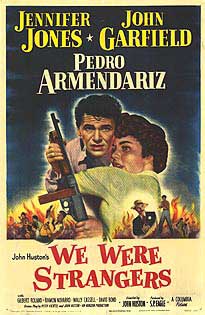
We Were Strangers
Thanks to the local cable provider's high quality product, the three movies I taped off of TCM Monday night turned into one and a half movies. With about 5 minutes to go in 1979's Cuba, the screen freezes so I sit it out for a minute or two. Then onto the fast forward and next thing I know I'm 45 minutes into the next movie. Great, grand, awesome, but in looking for that bright spot the third movie, 1949's We Were Strangers, made it all the way through without any freezes...thankfully.The theme for TCM's Monday schedule was Cuba so the common thread among the three movies I attempted to record was assassination, murder, coups, and generally death and mayhem around every corner. Cuba has never been a real model for stability, especially in the 20th Century beginning with the Spanish American war through several revolutions after that and then Fidel Castro's dictatorship dominating the country from 1959 and on. All this political instability provides some interesting storylines and settings, often told directly and frankly, politically correct feelings be damned.
It's 1933 in Cuba and the senate has ruled that any congregation of more than three people is illegal because those folks must be plotting some evil revolutionary plans. Following her brother's murder at the hands of the Porra (the secret police like the SS or KGB), China Valdez (Jennifer Jones), pronounced Chee-na, seeks out the resistance movement. She hopes to find a way to kill the man, Ariete (Pedro Armendariz), who shot her brother in cold blood. Instead, she is set up with Tony Fenner (John Garfield), a mysterious American, involved with the resistance.
Fenner concocts a detailed plan that could bring about the end of the current dictatorship. Using China's house that stands near a cemetery, Fenner and his small crew of revolutionaries will dig a tunnel under the street into the cemetery until they reach the tomb of Vicente Contreras, a local higher-up and businessman. His plan calls for the group to murder Contreras, and when all of the government powers that be -- including the president -- show up, they will set the bomb off and hopefully knock out the Cuban power structure. But as Fenner's crew works, Ariete stays on their trail, suspicious of what they're up to.
Released just four years after the end of WWII, 'Strangers' is incredibly frank in dealing with its subject matter. China, Fenner and the group believe they are in the right in attempting to assassinate Cuba's president and his cabinet. As presented, it is a rather nasty government that callously murders its citizens believed to be working against them so that makes it easier to side with the revolutionaries. Still, it is about as straightforward as possible. The collateral damage of innocents is mentioned but considered worth the death toll that a bomb will produce. But whether the group is in the right or not is beyond the point. 'Strangers' tells the story of a group of assassins which is a difficult subject to handle. Credit to tough-guy director John Huston for pulling it off so well.
This was the first Jennifer Jones part that I actually thought was pretty good although to be fair I've only seen two others. Jones was not a classical Hollywood beauty with her somewhat exotic look so she was often cast as minorities, Spanish, Asian, Native American, and here, Cuban. Her China is a strong female character looking for revenge. She's believable and completely sympathetic in the part. As the tough guy lead, Garfield is a good choice to play Fenner. Before his sudden death in 1952, Garfield made himself quite a name as a star, and it's easy to see why here. With little in the way of backstory or even in lines, Garfield's Fenner is a tough, no-nonsense leader. Typically playing good guys in a trio of John Ford westerns, Armendariz pulls off the villain perfectly, the secret policeman with little to no scruples. The rest of Fenner's team includes Gilbert Roland as Guillermo, a dock worker, Wally Cassell as Miguel, a bike mechanic, David Bond as Ramon, a law student, and Jose Perez as Toto.
With some rather obvious green screen efforts filling in for outdoor scenes in Havana, some scenes have a fake look to them as Jones and Garfield 'walk' through the downtown area. Other than those studio-manufactured backdrops, 'Strangers' looks like a typically dark, shadowy film noir. Filmed on soundstages for China's house and cellar, the characters are always half in shadow with faces covered and those shadows dancing around the floors and walls. It's a great looking movie -- not a surprise with Huston directing -- and an interesting time capsule of how a movie from the late 1940s handles the touchy subject of assassination. Well worth a watch.
We Were Strangers (1949): ***/****
Subscribe to:
Posts (Atom)

_film_poster.jpg)