I love John Wayne so let's get that out of the way. I've seen just about every single one of his feature-length films, and more than a few of his ventures are on the Just Hit Play All-Time Favorite List. I can be honest though when necessary, and the 1950's were far from the Duke's strongest decade. Though there were some gems -- Rio Bravo, The Searchers, Hondo among others -- there were some duds, real tankers. Blood Alley, The Barbarian and the Geisha, Legend of the Lost, all not remembered so fondly but one rises (or sinks?) above the rest. Definitely Wayne's worst film and one remembered as one of the worst of all-time, 1956's The Conqueror.
"Why is it so bad, Tim?" you might ask. Why? Well, John Wayne, the all-American movie star takes a crack at playing the infamous Mongol warrior and leader Genghis Khan. Yeah, you read that right. John Wayne plays Genghis Khan. And away we go!
Ruling his tribe/clan of Mongols on the Asian Steppe, fiery, brutal warrior Temujin (Wayne) has caused himself some issues. Namely, a violent conflict he's started with a rival tribe because he kidnapped said tribe leader's wife-to-be, Bortai (Susan Hayward). The equally fiery woman wants nothing to do with Temujin and making it worse, her father killed Temujin's father years before. Uh-oh, family drama! Even as war looms and his people threaten to leave him entirely, Temujin refuses to give up his kidnapped bride who wants nothing to do with him (or does she?!?). Instead, the Mongol leader looks to form an uneasy alliance with a past enemy to hold his power and hopefully gain much, much more. Can it all hold together long enough for Temujin to do what he needs to do to reach out and grab everything he wants? The answer lies on a trail of bodies and a river of blood across the Steppe.
Well, that was a fun plot synopsis to write! It's not too often I get to write a trail of bodies and a river of blood in a review. It's an easy plot to spell out because it is just so criminally bad. We will address John Wayne as Genghis Khan in a bit -- that's too easy -- but there's so much badness here in all-around fashion. The script offers one stilted scene of dialogue after another and then one betrayal and backstabbing after another. Imagine the Indians in 1950's westerns -- Me Indian. How! -- but transitioned to a war on the Asian steppe. Yeah, it's just as bad and cliched and just plain dumb as you'd expect. Actor-turned-director Dick Powell is at the helm of a real stinker here, basically from beginning to end. It doesn't build to bad. It just IS bad.
Okay, John Wayne as Genghis Khan. Let's process this. Let's rationalize. It can't be as bad as it sounds, right? No, it's exactly how it sounds. In the late 1940's and into the 1950's, Wayne really developed as an actor, piling up some of his best roles -- She Wore a Yellow Ribbon, Red River, Sands of Iwo Jima, The Searchers -- but this is just uncomfortable to watch. As Ben Manckiewicz said during the recent airing of 'Conqueror' on TCM, Wayne has said in interviews he played Khan as an American cowboy, a tough gunfighter and wouldn't you know it? That formula doesn't work. He's trying so give him credit because it would have been easy to phone this one in (real easy). Wayne just has too much working against him from the aforementioned dialogue that sounds especially stiff coming from the Duke down to the ridiculous mustache wardrobe set him up with. Bad. Really bad so be forewarned.
No one in the cast escapes the wrath of the script to be honest. Hayward was one tough actress, but she doesn't have much chemistry with Wayne and that's a problem when the driving force of the movie is their passion-filled, love-hate relationship. Hayward does get a bizarre, forced striptease/sexy dance of sorts so....there's that, I guess? Pedro Armendariz plays Temujin's half-brother, Jamuga, his conscious, a wise sidekick who recommends what to do next. Also look for Agnes Moorehead, Thomas Gomez, William Conrad, John Hoyt and Ted de Corsia in supporting parts. Familiar faces Lee Van Cleef and Leo Gordon get supporting background parts. A whole bunch of very non-Asian actors playing Asian parts and the end results are just as bad as you figured they would be. Not a winner in the bunch!
If there's a positive, it comes as a bit of a loaded statement. The scope and scale of the movie is impressive. The battle scenes of colliding, thundering armies crashing into each other are something to behold. The stuntwork is impressive throughout as hundreds of riders fill the screen in lavish uniforms set against the stunning backdrop of the Utah desert. Then there's the issue...the filming locations were 100-miles south of nuclear testing sites and judging by the amount of cast members that would die from cancer over the coming years, it seems the U.S. government's promise that the nuclear fallout wouldn't head their direction...well, that's garbage. Much of the cast and crew would die over the next 5, 10 and 20-plus years from varying cancers, quite possibly from the arduous filming schedule in the Utah desert. If that's not tragic, I don't know what is.
So here we are. The fact that 'Conqueror' has a 3.3 rating on IMDB is a testament to John Wayne fans who are fighting a heck of a battle to bring that number up at least a little. This movie is just as bad and worse as you've heard. I lost interest pretty quickly but stuck it out, hoping things might improve at some point. That's the worst kind of a bad movie, one that's almost impossible to even enjoy in guilty pleasure fashion. Give this one a wide, big-old berth, and that's coming from one of the biggest John Wayne fans around.
The Conqueror (1956): */****
The Sons of Katie Elder
"First, we reunite, then find Ma and Pa's killer...then read some reviews."
Showing posts with label Susan Hayward. Show all posts
Friday, October 9, 2015
Friday, February 20, 2015
The Revengers
As I've mentioned before, I've got a list in my head of hard-to-find movies that I've long sought. An interesting cast, a intriguing story, anything and everything, it can be anything that catches my eye. Today's entry? A 1972 western, The Revengers, that I found recently at the local Barnes and Noble. It was a tad pricey for a movie I've never seen, but this is one that's been on the list for too long to risk passing up. Did it pass the test?
A Civil War veteran with a distinguished war record, John Benedict (William Holden) has put the war behind him and is now running a successful ranch in Colorado. His life is thrown into chaos though when he returns from a hunt to find his wife and four children brutally murdered. A posse catches some of those responsible, Comancheros working with raiding Comanche Indians, who identify the leader of the attack, a one-eyed renegade named Tarp. Wanting nothing more than to exact revenge on the renegade, Benedict rides into Texas and then Mexico, ultimately leaving a posse behind. He tracks Tarp down to an isolated trading post but the odds are stacked against him. Needing help to kill Tarp, Benedict takes desperate measures, recruiting six convicts from a prison mine in the hills in Mexico. Will they turn on him the first chance they get? Can Benedict hold them together long enough to get the job done?
Yikes, what a weird movie. The 1970s were a weird time for the western genre in general, but this one was really weird. It's from director Daniel Mann and was a bomb in theaters upon its release. 'Revengers' has the distinct feel of an American western but with touches of a made-for-TV flick with some touches of ultra-violent spaghetti western mixed in. So unfortunately it is all of those and none of those because it never quite picks a tone. The positives though? Filmed in New Mexico, this is quite the good-looking western with some unique locations that I've never seen in a western before. The western-themed score features some rock overtones too, kinda odd but it works in a bizarre fashion. Go figure. There's something entertaining and oddly appealing just the same even if I can't honestly say that it's "just good."
The basic premise for 'Revengers' is a tweak on the 1967 WWII movie, The Dirty Dozen (one of my favorites). One halfway decent guy, a team of convicts turned mercenaries of sorts, unleash them on some impossible, mostly suicidal mission. I loved the DD and really enjoyed knockoffs and quasi-knockoffs using a similar premise. I thought I'd enjoy (maybe love) this one. I didn't. Holden is solid but nothing flashy as John Benedict, the revenge-seeking rancher who wants to kill the man who helped lead the attack on his family and ranch.
His Revengers? There's some recognizable faces and some cool parts, starting with Ernest Borgnine hamming it up as Hoop, a former Comanchero himself who'd turn on his own mother for a profit. There's also Job (Woody Strode), a runaway slave who killed his pursuers and ended up in prison, Quiberon (Roger Hanin), a woman-loving deserter from Maximillian's army and a bandito, Zweig (Reinhard Kolldehoff), the mad German, Chamaco (Jorge Luke), the young Mexican assassin, and Cholo (Jorge Martinez de Hoyos), the philosophizing revolutionary. The international, dynamic feel to the quasi-vigilante group is very cool. Like the movie and story itself, there is a ton of potential that never quite jells. Benedict treats his convict partners as equals, addressing them as 'Mr. ...' and they come to respect the man who handed them their freedom.
That's where things get to be a little disjointed. By a little, I mean a lot. The build-up is entertaining but familiar, seemingly shooting for something action-heavy and dumb and fun. It's a movie that is 108 minutes long and takes a big, surprising departure a little past the halfway point. I didn't see it coming AT ALL. However, it isn't just that the departure happens. It's that the twist throws the rest of the movie for a loop that it never really recovers from. We're shown that most of a year passes, the Revengers develop into friends, becoming almost a bounty hunting gang -- randomly shooting down attackers at one point -- and Benedict has become something else, something he never wanted to be. That device is used several times, jumps in stories moving things forward without warning in a flash.
And in the end, that becomes it's ultimate undoing. 'Revengers' has absolutely no idea what it wants to say or do, much less how to do it. I would have loved to see a story that focused far more on the dynamic between Benedict and the men who become his unlikely allies. That premise could have been at the helm of a really good to maybe great western. Instead, it never clicks as intended. Even the ending disappoints, kinda a limp finish for a story that could have built to something ultra-violent and dark and surprising. In other parts, look for Susan Hayward and Arthur Hunnicutt. Ultimately a disappointment but one that did entertain me overall. Probably more of a two-star review, but with that cast, I'll give it a slight bump. The print on the DVD is a beauty for those wavering over what to do concerning a purchase.
The Revengers (1972): ** 1/2 /****
Tuesday, November 18, 2014
Rawhide
Is there a such thing as a situational western? No, not a large scale story of cavalry vs. Indians or a bandit gang organizing a huge heist. Instead, a story that takes place in a specific amount of time in a semi-confined setting. The big example I can think of is 1952's High Noon. It's a good one but not necessarily my favorite. Well, here's another one, a western I enjoyed a lot, 1951's Rawhide.
At an isolated way station for the Overland Mail and stagecoach line in the Arizona desert, Tom Owens (Tyrone Power) is a week away from moving back east away from his job as the assistant to the grizzled stationmaster, Sam Todd (Edgar Buchanan). News of a stagecoach robbery is making its way up and down the line, forcing one stagecoach passenger, Vinnie Holt (Susan Hayward) and a toddler, to hole up at the station due to company policy. It's only a few hours later when the outlaws behind the robbery arrive, led by escaped convict Rafe Zimmerman (Hugh Marlowe). They put the station in a hostage situation, Zimmerman revealing what his plan is. A stagecoach packed with gold bars is due in the next day, and he intends to get away with all of it. Can the hostages do something in time to stop the robbery and ensure their safety?
Here's a good example of why I love the western so much. From director Henry Hathaway, 'Rawhide' is neither a classic nor it is a dud. To say it's somewhere in between isn't even fair. It's a really good western that I enjoyed throughout and will gladly revisit it in the future. This 1951 small scale western has little to no reputation, but it came along at a different time. The late 1940s and early 1950s were an underrated time for the entire genre before the glossy widescreen (and often white-washed) examples of much of the 1950s. It's just 89 minutes long, was filmed in beautiful black and white and deserves a far more well-known reputation. Western fans will definitely get a kick out of this one.
There is something appealing and charming about the generally confined setting here for this 1951 western. Written by Dudley Nichols, 'Rawhide' has the feel of a stage-based play getting a big screen adaptation. Do you recognize Nichols? I didn't, but I should have. He wrote the screenplay for John Ford's 1939 classic Stagecoach, and 'Rawhide' has a similar feel. The entire story is set at the stagecoach station whether it's in the main building or the barn/corrals out in the middle of the desert. With the Alabama Hills used as a stunning backdrop, the black and white, sparse look of the story is a gem. The entire story takes place over about a 24-hour time period. We spend a lot of time in the expansive main room of the station, the claustrophobic room used as a prison cell or sorts, and then things open up in a big way outside with the mountains in the background. It's a not so flashy but perfectly set little story.
I'm guessing a big reason why 'Rawhide' doesn't have a huge reputation or following is because of the star power, or lack of it. It's a very solid cast (VERY) but there aren't any John Wayne or Henry Fonda waiting in the wings. Power and Hayward are excellent together, strangers forced to pretend they're married for safety reasons. Their kinda Odd Couple dynamic works in a hectic, tense situation. Marlowe is the nasty villain who's cold and calculating with Jack Elam (the psycho), Dean Jagger (the over his head horse thief) and George Tobias (the oafish/loyal enforcer) rounding out his gang. Buchanan is underused as the grizzled stationmaster who could use a bath while Jeff Corey, James Millican, Louis Jean Heydt and Kenneth Tobey make some quick appearances.
'Rawhide' is never slow but does have some relative struggles in getting to the third act. The threat is laid out and really there's only so much you can do before Marlowe's Zimmerman has to either gun somebody down or smack somebody. The ending though, it provides some good twists in dark fashion. The master of the psychotic, possibly unhinged 1950s western bad guy, Jack Elam even outdoes himself when he's in a desperate spot. And what's one of my main complaints about female characters in westerns? The damsel in distress. Not the case here as Hayward's Holt is front and center in the action. Who needs help? Give that woman a gun! An underrated western, one any genre fan should enjoy a lot. Track this one down!
Rawhide (1951): ***/****
Tuesday, October 15, 2013
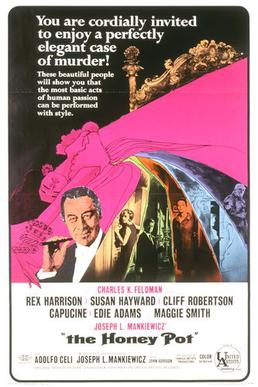
The Honey Pot
I like to think I know at least some background on anything from movies to television, sports to music. And then there's....plays!!! I've never been a huge fan of theater so I can honestly say I know little to nothing about a whole lot of plays, theaters, and writers, like Volpone, a play from the 1600s from playwright Ben Jonson. How about an introduction with 1967's The Honey Pot?
Even with all his millions, his whiskey, his cigars and his huge Venetian mansion, quirky millionaire Cecil Fox (Rex Harrison) is bored to tears. He's always taken pride in living life to the fullest, but in his middle years he's looking for some entertainment. Fox comes up with an idea while watching Jonson's Volpone, bringing the play to life, his life. He hires an on-and-off actor, William McFly (Cliff Robertson), as his assistant in his own personal play, the millionaire putting his diabolically "fun" plan into effect. Fox is going to pretend he's dying following a heart attack and he intends to settle up his vast fortunes, assembling three former loves in his Venetian mansion and letting the hijinks begin. McFly takes the job somewhat suspiciously but he goes along with it. What exactly is Cecil Fox up to? What is his ultimate goal in pulling off this ultra-involved prank?
I had never heard of this 1967 quasi-comedy from director Joseph Mankiewicz until it recently popped up on Turner Classic Movie's schedule. The plot sounded interesting enough, but mostly it was the cast that caught my attention. On top of Harrison and Robertson, we get Susan Hayward as Lone Star Crockett, a quirky American businesswoman with her hand in the oil business, Maggie Smith as Lone Star's nurse, Sarah, Capucine as Princess Dominique, and Edie Adams as a sex kitten American movie star. Oh, and there's also Adolfo Celi as a Venetian police officer who gets pulled into Fox's elaborate practical joke. Not too bad in the casting department, huh? That's what I thought, and I was right. Above all else, if you're going to give this one a try, go in because of the casting.
I especially liked the dynamic between Harrison and Robertson. Neither man knows exactly what the other one is up to, but they both know the other is up to something at least mildly sinister. Who will figure it out first? They have an appealing, easy-going chemistry that gives an energy to each of their scenes together, whether it be putting all the details of their plan together or just sitting across from each other at a poker game. Harrison's Cecil gets a chance to go one-on-one with Hayward's bajillionaire, Capucine's royalty and Adams' actress, each bringing a different dynamic to their scenes and background. I especially liked Hayward as Lone Star with all her quirks and idiosyncrasies. Robertson too gets a possible romance with Smith's Sarah, Lone Star's nurse who begins to smell a rat somewhere in this Venetian mansion.
So where exactly does this one hit a rough spot? Well, to be fair, it's not just one specific scene. It's an entire script from Mankiewicz, based off Thomas Serling's novel which is based off the original Volpone. The movie is a rather leisurely 132 minutes, and that's just the version released in the United States. In the United Kingdom, a 150-minute long version was released in theaters. I'm all for well-written dialogue. I don't know if this is as well-written as it thinks it is. It's smart and clever, witty and quick, but it's not the end all, be all dialogue that it believes it is. 'Pot' is too smarmy for its own good. The dialogue goes on and on seemingly without end. There are no memorably choreographed set pieces, nothing at all really to break up the monotony. It runs over two hours, but this is a story that goes on and on. It feels long. It is long.
'Pot' is listed as a comedy crime thriller which is fine and dandy. When one of the above characters is murdered nearing the hour-mark, things are definitely thrown for a loop. It's dark, but it ceases to be funny from there on in. One character begins to piece things together, but can the mystery be unraveled in time? It's not especially funny, especially the ending with all its forced attempts at humor, and the drama isn't dramatic enough. Pick a tone and stick with it! Funny or drama! It can work in the right situation, but this wasn't it. A very disappointing negative review.
The Honey Pot (1967): **/****
Friday, April 29, 2011
Reap the Wild Wind
As a fan of John Wayne and just about every one of his movies in one way or another, I can appreciate that by a certain point in his career (say 1960 or so) he was basically playing variations on the same character. Some would say he was playing himself, but I won't go quite that far. Early in his career even after the success of 1939's Stagecoach, Wayne had not yet been pigeon-holed into one type of role so in the early 1940s, he played some roles that are different from the norm in generally forgotten movies, like 1942's Reap the Wild Wind.
Still finding his niche as an actor, Wayne gets lost in the shuffle here some with an impressive cast. It's an impressive movie on a lot of different levels, but that doesn't mean it's a particularly good movie though. Directed by the legendary epic moviemaker Cecil B. DeMille, 'Wild Wind' feels like his answer to the classic movie released three years before, 1939's Gone With the Wind. It's lavish and extravagant with a sweeping story full of action, intrigue and romance. It plays too much like a soap opera though ripped right off a stage somewhere. Rarely bored but never truly invested in this movie, it falls short in the end.
After his ship is wrecked on the reefs near Key West, Captain Jack Stuart (Wayne) is nursed back to health by lovely Southern belle, Loxi Claiborne (Paulette Goddard), who instantly falls for him. Stuart has come under fire though, the blame being placed on his shoulders for the wreck. He is set to go on a cruise that will eventually end up in Charleston where he'll face a ruling from the company's board of directors. Looking to help the man she loves, Loxi heads to Charleston by land, looking to woo the lawyer who will look to crucify Jack, Stephen Tolliver (Ray Milland). Stephen falls for her too, and she can't help but have feelings back toward him. The situation will come to a halt though when a salvaging pirate, King Cutler (Raymond Massey), puts them all on a course to meet on the high seas on the company's new steam ship, the Southern Cross, as it heads toward the dangerous Key West reefs.
The story ends up playing out like an average, even at times bad, soap opera. Overacting is around every corner, the love triangle is always tumultuous with all sides swearing they're right, and no one is going to give in easily. It's a big movie, living up to an epic status, with gigantic sets adorned with detail, costuming period accurate, and extras filling the screen. DeMille's film had the biggest budget of any film made since Gone with the Wind, and he spends it well. Visually (even with some bad green screen shots), it is a great movie to watch. The story doesn't keep up though, and you're left waiting for everything to resolve itself. I was willing the movie to move along a little quicker as the 123-minute run time dragged on endlessly.
So even if the story is too ridiculously over the top to take seriously, the cast is nothing to shake your head at. Ray Milland is the real star here, dominating the movie with Goddard. He's painted as the upper class businessman, but that's quickly thrown out the window. It's built up as this great rivalry with Wayne's Capt. Jack, but nothing develops there. Wayne's character is window dressing which is disappointing for me as a fan. Massey is perfectly cast as Massey, I mean King Cutler, the villain who sneers and glares his way through line deliveries. As if those three names weren't enough, Robert Preston is along for the ride (and given little to do) as Dan Cutler, King's little brother and business partner. Lynne Overman gets to ham it up too as Capt. Phil Pillpott, a veteran of the seas always ready with a dig or a barb.
While the male characters aren't developed much and are probably the better for it, the female characters are not so lucky. It's interesting that the two main female roles -- Goddard and Susan Hayward -- were both passed over for the role of Scarlett O'Hara for GwtW. I've never seen Goddard in another role (that I remember at least), but based on this part, I won't be seeking her out too much more. God bless her, she's a pretty girl, but she's an awful actress. She chews the scenery in each and every scene, pulling off both her acting faces, the sly, sweet Southern belle and the screaming terrified woman gone batty. There's little middle ground either, it's one or the other. I felt bad for Hayward who's character has nothing to do but fall for Preston's Dan in a wasted subplot and then serve a purpose late. It's a wasted part for a talented actress.
Trying to save the best for last, 'Wild Wind' surely gets points for effort in the finale. A sizable portion of the budget was used to construct a giant squid that attacks Wayne and Milland as they go diving for the wreck of a ship. The underwater sequences -- giant squid attack included -- are impressive for 1942 considering all those things actually had to be filmed. It is an ending that obviously left an impression as it was almost exactly reused several years later in another John Wayne flick, Wake of the Red Witch. Reap the Wild Wind also belongs to a rare club of John Wayne movies, but I can't give too much away here. I didn't like this movie much, but it does try and almost lives up to its own high expectations.
Reap the Wild Wind (1942): ** 1/2 /****
Labels:
1940s,
John Wayne,
Ray Milland,
Raymond Massey,
Robert Preston,
Susan Hayward
Tuesday, February 15, 2011
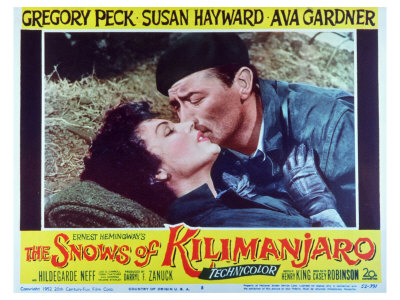
The Snows of Kilimanjaro
My lone venture into author Ernest Hemingway's repertoire is A Farewell to Arms which I had to read for an English class in high school. I don't want to under/over sell my feelings on the book, but I hated it with a passion. It wasn't so much Hemingway's style -- simplistic and understated -- because I appreciated that after reading unnecessarily wordy classics in every class I took. It was the actual story, a lost love story so sugary, so schmaltzy that I wanted both of the main characters to die horrifically. I got through the book thankfully, but it was a trial.
Since then, I've been wary of anything Hemingway-related. I don't avoid him or steer clear of him intentionally, but something he is associated with truly has to catch my eye. Released in 1952, The Snows of Kilimanjaro caught my attention mostly because of the cast while the story sounded suspiciously like A Farewell to Arms. I trudged on though, intent on giving this movie a chance. It was a mixed bag that made me realize Hemingway continued to go back to the same well over and over again. His main character is a variation on himself, a romantic, an idealist and a cynic at the same time who wants to explore and see everything the world has to offer. It sounds interesting at least.
While on safari with girlfriend/lover/fiance, Helen (Susan Hayward), writer/journalist Harry Street (Gregory Peck) scratches his knee on a thorn, the wound quickly becoming infected. Almost certainly staring death in the face if medical attention doesn't arrive soon, Harry lies on his cot in the isolated African savanna waiting for his end. Through the heat and the hallucinations, he looks back on the lost loves of his life, including Cynthia (Ava Gardner) who he meets and falls in love with in Paris following WWI, Countess Liz (Hildegard Knef), a well-to-do member of the upper class he meets on the French Riviera, and then lastly, Helen. But seeing all the mistakes he made in life, Harry tortures himself in what could be his final moments.
During his career, Hemingway went wherever the story was and ended up taking part in the World War I, Spanish Civil War, World War II, African safaris, while also visiting everywhere from Cuba to Paris and all cities in between. He was a storyteller, looking for answers of some sort, why men/women did what they did. That was the biggest appeal of this story. Peck -- apparently channeling a Hemingway-like character -- is always on the move, following the action in his globe-trotting ways. It does become tiresome because we see the toll it takes on Harry's life and those he loves before he ever puts two and two together. Still, a man who will drop anything to follow what he loves to do is an appealing main character.
In my previous Peck reviews, I know I've discussed the mental picture many moviegoers have of the famous Hollywood actor. He's Atticus Finch, the stoic, even wooden main character without much in the way of fire. He did play many roles like that, but through the first 10 years of his career, it was different. He played characters like this. Somewhat eccentric with a fire for life, nothing will stop him. These are the type of roles I typically bring up when someone notes they are not Gregory Peck fans. Even when the movie overall is a disappointment, he rarely is.
Channeling Hemingway though, it's not just the character. It's the lifestyle as well. Director Henry King works off the source novel, but not having read it I can only guess what he was forced to do. Instead of focusing more on Harry and his relationships with Cynthia, Helen and Liz, 'Snow' serves more as a travel guide for the places they visit. Yes, I realize part of the story is Harry's adventures as he explores the world. But long, unedited shots of animals on the African savanna, bullfights in Madrid, and a bizarre ending with a curious hyena do absolutely nothing for the story. Go watch a PBS episode of Nature or The Travel Channel for an idea of what you will get here.
As for the story told in flashback mode, the one with Gardner is given the most attention and for good reason. Frequent on-screen partners, Peck and Gardner had an incredibly natural chemistry that always makes the movie worthwhile to a point. The other two flashbacks are not as successful. Countess Liz is shrill and pretentious while Hayward's Helen feels tacked on to the point we're never given much information about her other than that she falls madly in love with Peck. Hit or miss overall, but that's the movie as a whole. Good and bad with the negative barely outweighing the positive. The movie is available to watch in its entirety on Youtube if you're curious.
The Snows of Kilimanjaro <---trailer (1952): **/****
Thursday, June 17, 2010
The Lusty Men
When it comes to sports, I'll give just about anything a shot, and thanks to ESPN's family of networks I've gotten that shot at seeing all sorts of unique sporting events from the basics to fringe sports like bowling or billiards. Then there's rodeo, a sport I've never really understood and some of that may have to do with where I've lived most of my life, Illinois and Indiana. While not as violent as say bullfighting, rodeo has always rubbed me the wrong way for its treatment of animals.
TCM aired 1952's The Lusty Men last week, a story with the rodeo as the setting. Before I get into this movie, I should say I've seen and enjoyed other rodeo movies like Junior Bonner with Steve McQueen or J.W. Coop with Cliff Robertson. Some sports translate well to a movie form, football, basketball, baseball all come to mind, but I just don't think rodeo is one of them. Up close and personal, I imagine it's a lot better to view, but there's a main flaw I have trouble getting past when it comes to movie versions. That's for later though, let's talk story.
After one too many accidents on the rodeo circuit, past-his-prime cowboy Jeff McCloud (Robert Mitchum) gets a job as a ranch-hand where he meets fellow cowboy Wes Merritt (Arthur Kennedy). Wes instantly recognizes Jeff and begs him to teach him some techniques and strategies for being successful at rodeos. Married for two years to wife Louise (Susan Hayward), Wes is trying to save up $5,000 so they can buy a spread for themselves, but at his pay rate it will take years. With Jeff's help, he sees a way to get the money fast, by joining the rodeo. Louise is adamantly against it, but there's nothing she can do to stop her husband, sending him down a road she's worried he'll never come back down.
I was a little disappointed in the story here because for the first 90 minutes it is as predictable as possible. If you've ever seen a movie with a teacher/mentor and a youngster/student, you basically know where this one is going. McCloud and Merritt start off on the right foot, the younger cowboy idolizing his hero as he teaches him all he knows about the business. But the second Wes gets any taste of success, he begins to resent his teacher who he previously looked up to. He doesn't want to be held back and wants to explore this new world on his own.
If about 15 minutes you haven't figured out where this movie is going, shame on you. Wes does get a taste of the big-time after a lifetime of scraping by from month to month. At first all he wanted was a little place of his own, but now he's living on easy street so why should he go back to busting his hump? My only question in all of this was whether Mitchum's Jeff was going to pounce on Hayward's Louise. That issue is resolved late, and I give props to director Nicholas Ray for not taking the easy way out. The ending as is has one character making a sacrifice -- unintentionally so -- that ends up making the other two very happy.
Watching this predictable storyline, hopefully you'll be saved by the three starring performances. Mitchum plays his typical laid back, uber-cool guy who never gets too rattled by anything. He drifts along, letting Kennedy do the heavy lifting with the meatier role of the cowboy turned rodeo star. Through all their ups and downs though, the two still have a friendship that can't be broken up. A wordless scene late between them -- a smile and a wink here -- show it will take more than one fight to split them up. Hayward is the strongest part of the movie playing a woman who just wants to be happy with her husband, even though it seems he wants nothing to do with settling down. Also, Arthur Hunnicutt plays Booker Davis, a former rodeo star now a near-cripple. For the most part, Hunnicutt doesn't over-do it as his parts so often required him to do. Frank Faylen plays a stock owner traveling along with the rodeo.
Even with the rodeo movies I've enjoyed as mentioned above, my issue is with the actual rodeo scenes. One, studios aren't going to let stars like Mitchum, McQueen, Kennedy, and Robertson actually do any bronc riding or bulldogging. Instead, we get a quick shot of the star on a horse/bull and a quick cut to an actual cowboy in a long shot in the ring. Repeat this over and over to your heart's delight. I don't know now if CGI could help this, but it is always distracting and can be downright dull at times watching cowboys or stunt doubles take over instead of the actors.
While these rodeo scenes can be a little slow moving, the movie as a whole is still worth a watch. Ray has some fun with some interesting looking camerawork, and the actors are all solid -- especially Hayward -- in making these three characters full-fledged, 3-D, believable people and not just cardboard cutouts.
The Lusty Men <----TCM trailer (1952): ** 1/2 /****
Sunday, July 19, 2009
Beau Geste
How gutsy does a director have to be to start a movie by showing the ending? I give any director with the cajones to do that points right off the bat. Opening the movie by showing how the story will end up can drive viewers away in some cases, but if handled well can make viewers even more involved with the story. After all, we now know how everything will end up, but getting there can be half the fun.Director William Wellman pulls this off with his 1939 classic Beau Geste, a story of three brothers who enlist in the French Foreign Legion. The story opens with a relief column nearing Fort Zinderneuf, a far-off post near an oasis that came under siege by Arab tribesmen. But as the relief draws closer, they find the whole garrison massacred to a man, and the commanding officer dead on the parapets with a French bayonet through his heart. With no enemy dead anywhere in sight and no legionnaires to tell the story, the question arises; what happened to these 50 legionnaires?
After the cool opening sequence at the scene of the massacre, the story flashes back to 15 years prior where three brothers, Beau, Digby and John, have been adopted by a rich English woman, Lady Patricia (Heather Thatcher) The three orphans live the life of luxury, playing war games and playing pranks on each other and their 'cousin' Gussie, the heir to quite a family fortune. But the years pass and Lady Patricia receives a note from her long lost husband saying he'll soon return for the Blue Water diamond, the last thing of any value they own. Before he can retrieve it though, the diamond is stolen by someone living in the house. But who was it?
In hopes of removing suspicions from his younger brothers, Beau (Gary Cooper) takes the blame and enlists in the French Foreign Legion to avoid embarrassment for his family. But it's not too soon before brothers Digby (Robert Preston) and John (Ray Milland) join up too with their big brother. It's in the legion they come under the command of sadistic Sergeant Markoff (Brian Donlevy), who was humiliated at his last post and now seeks to redeem himself, no matter the cost even if it is his own men's lives. It is when Markoff finds out the Geste brothers may be diamond thieves that the real conflict arises, the sergeant splitting the trio up, Beau and John to Zinderneuf as replacements and Digby to another fort for mounted infantry training.
The French Foreign Legion is often presented as this glamorous, honorable fighting unit, but in just about every movie I can think of some unlucky company is getting massacred or abandoned at some far out post with no hope of outside help or survival. In Beau Geste, it's no different. The soldiers at Zinderneuf hope to lead a mutiny against Markoff, but that plan gets put on hold when the Arab tribesmen arrive en masse. The battle scenes are exciting from the start even if we know the end result. The desert outside Yuma, Arizona fills in nicely for the Sahara desert, oasis and all, with the set of the fort a perfect setting for the drama to unfold.
As for the cast, it would be hard to ask for a better one. As the title character, Cooper does what he does best, the sort of everyman role who is noble, honorable, and always looking out for those around him, especially his younger brothers. Preston and Milland round out the trio of brothers, Milland getting slightly more screen time and the love interest, and with Cooper provide the heart, the backbone of the movie. Their scenes together ring true whether it be with the comedic introductions or later in the movie when they've enlisted in the Legion. The three actors bring the characters to life, much like the three leads in another 1939 classic with a somewhat similar story, Gunga Din.
In a role he received a Best Supporting Actor nomination for, Donlevy has a great part as Markoff, the sadistic, half crazy sergeant who will drive his men to the breaking point and then keep on pushing. He wants his good name back and all the medals and privileges that come with a promotion, and as he sees it, it's all in grasp if he wins a significant battle, casualties be damned. Unfortunately for Donlevy, 1939 was the year of Gone With the Wind, Stagecoach, Mr. Smith Goes to Washington, so he didn't get the win, but it's still one of his best parts. Also in the cast is a very young Susan Hayward as Isobel, the love interest who grew up with the Gestes but starts to fall for the youngest brother, John. Just some of the other legionnaires include J. Carrol Naish, Albert Dekker, Broderick Crawford, and Charles Barton.
Labeled as Hollywood's strongest overall year just for the sheer number of classics that were released, 1939 was quite a year for the movies. The old reliable 'they don't make 'em like that anymore' applies to any number of movies from that year, especially Beau Geste. It is good old-fashioned entertainment with an exciting story, strong and likable characters and some creativity in telling the story. With a DVD released just weeks ago, don't skip this one by. A true classic from start to finish.
Subscribe to:
Posts (Atom)
_film_poster.jpg)

.jpg)