So there seems to be a go-to move when a comedy wants to delve into that whole marriage thing. What to do? Hen-pecked husbands, evil and manipulative wives. It paints quite a picture for marriage, don't it? Well, I caught one I'd never seen before courtesy of MGM-HD. I'd heard about it but was never able to track it down, 1965's How to Murder Your Wife. Yes, it is a comedy.
Living in an epic townhouse in New York City, Stanley Ford (Jack Lemmon) is a well to-do cartoonist without a care in the world. He tries to enact his own strip, Bash Brannigan, a James Bond-like secret agent, while living the ultimate bachelor's life. At his side is his butler and friend, Charles (Terry-Thomas), who helps him at every step. It's a perfect, unmarried, bachelor life...or at least it was. At a friend's bachelor party gone awry, Stanley drinks far too much and in an absolute state of feeling no pain, marries the dancer/stripper, (Virna Lisi). He of course doesn't remember any of this until the next morning when a hungover Stanley wakes up next to his new bride. His bachelor life is about to be thrown for a loop, especially when his wife absolutely refuses to get a divorce. Okay, so what now? Well, Stanley may only have one option left.
Well, this was an interesting one for both good and bad reasons. From director Richard Quine, it is a polished, funny, stylish comedy with an obviously pretty dark story basis. I think the biggest thing going for 'Murder' is that it is different. It tries to be different, and that's more than you can say for a lot of 1960s screwball comedies. Now that attempt at being unique does provide some uneven moments and some plot holes, but the end result is worth it. Quine films in New York City for some cool backdrop shots with Stanley's man cave of all man caves -- his posh NYC townhouse -- providing the main set. The camera zips in and around the maze-like rooms and floors, giving 'Murder' a unique visual look. This is no one camera set-up. The comedy is there, but that's not all. It's the rare comedy that's fun to actually just look at and watch.
Quine's dark comedy sets the tone early with a great opening sequence that keeps you guessing as to what exactly is going on. Thomas' Charles -- ever the English gentleman -- wakes up Stanley and they whisk off to another "crazy caper." What follows is Stanley enacting all the future adventures of Bash Brannigan with hired actors filling out all the parts from the damsel in distress to the dastardly villains, Stanley playing Bash with Charles taking pictures so Stanley can use them later for inspiration to draw the strips. It's a great opening sequence, one that is equal parts fun and mysterious while also showing off the close friendship Stanley and Charles have. Things are off and running from there with a story that covers a lot of ground, some sequences working better than others but always seemingly getting back on track.
With each passing movie, Jack Lemmon climbs higher and higher on my favorite actors list. Comedy, drama, he does it all. With parts that could easily be overdone, he finds ways to keep it funny without trying too hard. His Stanley (and his quasi-Bash alter-ego) finds himself in quite the predicament but because it's Lemmon you never completely turn on him. He has some great laughs with Thomas' Charles and his chemistry with the very beautiful Virna Lisi is spot-on too, especially as his unnamed wife -- only Mrs. Rogers -- reveals she only speaks Italian. Now that's a morning wake-up call! Also look for Eddie Mayehoff as Stanley's lawyer who's shrill wife, Edna (Claire Trevor), has quite the impact on the new to marriage Mrs. Ford in the manipulation department. Sidney Blackmer and Max Showalter also have key supporting parts.
If there is a weakness in the 1965 dark comedy, it's in the last 30 minutes (a 118-minute total running time). When Stanley finally brings up the idea that maybe murder is his best option, I thought things were heading in the right direction. There are some laughs as his plan is put into play, but we're never quite sure what he's up to. Does he really intend to kill Mrs. Rogers? Is it a plan for something else? It all plays out in a goofy, over the top courtroom sequence that feels forced and too gimmicky. Basically, all the things you'd expect out of lesser screwball comedies.
Still, as a whole, it's definitely worth a watch, especially for Jack Lemmon, Virna Lisi and Terry-Thomas.
How to Murder Your Wife (1965): ***/****
The Sons of Katie Elder
"First, we reunite, then find Ma and Pa's killer...then read some reviews."
Showing posts with label Jack Lemmon. Show all posts
Friday, December 26, 2014
Monday, February 3, 2014
Glengarry Glen Ross
Where do you stand on cursing/swearing in movies? Do you blush if someone drops an F-bomb? Do you laugh when profanity is used as a noun, verb, adjective, even a preposition? Well, let's say this. If you're easily offended by swearing -- and I mean a lot of swearing -- then 1992 Glengarry Glen Ross may not be your type of movie.
At a small real estate agency in Chicago, the four-man salesmen staff is about to get a little shock. They're called in one night for a special meeting, a representative from their big boss arriving with a message. That rep, Blake (Alec Baldwin), delivers a simple ultimatum. The salesmen have exactly one week to prove themselves, selling as many units as humanly possible. At the end of the week, the one in the lead will be awarded a car, the second will receive a set of steak knives, and the other two? They'll be looking for work. Doesn't get any simpler than that, does it? Already working on a day-to-day basis with questionable leads to follow and a tough sell, this group has their work cut out for them. Let the hijinks begin.
This is a movie that sat in my Netflix queue for quite awhile. The cast was ridiculously talented, the story certainly interesting, and the reviews were almost uniformly glowing. Well, I caught up with it, and I can honestly say it wasn't what I thought it was going to be. That's not a negative, just a surprise on my end. I had a picture of high-end real estate, an agency in downtown Chicago dealing with huge deals of millions of dollars and gazillionaires. What is it? A far smaller, low-end agency with a cramped, cluttered office where the salesmen use all sorts of underhanded, duplicitous means to finish off a sale. These four salesmen are truly desperate, knowing their jobs and livelihood depend on one week of being able to do their jobs. Talk about pressure.
From director James Foley, 'Ross' is based off a play from David Mamet (who also wrote the screenplay). It clocks in at 100 minutes and generally has the style and feel of a stage-based play. The story takes place over a span of maybe 12, 18 hours and is based in only two locations, the real estate office and the Chinese restaurant across the street where the salesmen go for a bite to eat and get a drink. The rhythm develops like a play, the cast getting a chance to show their stuff in extended scenes of dialogue, setting things up and then letting it all develop. This is a movie about the dialogue, no doubt about it, Mamet's script a gem. The dialogue is fast and furious, the talented cast delivering it in almost machine gun succession, rapid fire that never slows down. 'Ross' isn't a movie about the effects or the style. It's about the acting, the chemistry, the script and the dialogue. Straightforward in its objectives, it's the better for it.
How about that for a slow burn? I haven't even mentioned the cast beyond Baldwin's one-scene, scene-stealing appearance. Haha take that! Foley is working with quite the cast in terms of pure acting power. The real estate salesmen include Ricky Roma (Al Pacino), the fiery, criminally smooth operator and frontrunner for the award for best salesmen, Shelley Levene (Jack Lemmon), the oldest salesmen in the group and maybe the most desperate because of a recent cold streak in sales, George Aaronow (Alan Arkin), the tag-along of sorts, worried about the challenge but letting everyone else lead the way in opinions, and Dave Moss (Ed Harris), the most heated and the one maybe most willing to do something desperate for the job. As the circus master of this crew, Kevin Spacey bides his time as Williamson, their boss who tries to keep them in check while taking an almost constant barrage of criticism from his employees. Also look for Jonathan Pryce as a possible customer working with Roma who has a serious issue with a sale.
Each character gets his chance to shine, none of them disappointing. I was most impressed with Pacino and Lemmon, but that's like saying which pizza is the best. They're all really good, but some are just slightly better. The dialogue crackles from the get-go and never slows down. It can be uncomfortable at times, this crew just ripping each other apart for any number of reasons, from lack of sales to botching a call. Baldwin's cameo gets things going at a 100 miles per hour, demanding that these salesmen 'Always be closing.' It never really slows down. The dialogue is always going, but the camera just follows the conversational acting, letting the conversations and arguments and fights breathe and develop on their own. The movie is 100 minutes long, but it flies by.
I really liked where this one went about the halfway point. You think you know where it's going, and it pulls the rug out from under you. The ending especially caught me by surprise. Oh, and random pop culture tidbit, Lemmon's excellent performance as aging Shelley Levene was quite the inspiration for Gil Gunderson, the disheveled salesmen on The Simpsons.
Glengarry Glen Ross (1992): ***/****
At a small real estate agency in Chicago, the four-man salesmen staff is about to get a little shock. They're called in one night for a special meeting, a representative from their big boss arriving with a message. That rep, Blake (Alec Baldwin), delivers a simple ultimatum. The salesmen have exactly one week to prove themselves, selling as many units as humanly possible. At the end of the week, the one in the lead will be awarded a car, the second will receive a set of steak knives, and the other two? They'll be looking for work. Doesn't get any simpler than that, does it? Already working on a day-to-day basis with questionable leads to follow and a tough sell, this group has their work cut out for them. Let the hijinks begin.
This is a movie that sat in my Netflix queue for quite awhile. The cast was ridiculously talented, the story certainly interesting, and the reviews were almost uniformly glowing. Well, I caught up with it, and I can honestly say it wasn't what I thought it was going to be. That's not a negative, just a surprise on my end. I had a picture of high-end real estate, an agency in downtown Chicago dealing with huge deals of millions of dollars and gazillionaires. What is it? A far smaller, low-end agency with a cramped, cluttered office where the salesmen use all sorts of underhanded, duplicitous means to finish off a sale. These four salesmen are truly desperate, knowing their jobs and livelihood depend on one week of being able to do their jobs. Talk about pressure.
From director James Foley, 'Ross' is based off a play from David Mamet (who also wrote the screenplay). It clocks in at 100 minutes and generally has the style and feel of a stage-based play. The story takes place over a span of maybe 12, 18 hours and is based in only two locations, the real estate office and the Chinese restaurant across the street where the salesmen go for a bite to eat and get a drink. The rhythm develops like a play, the cast getting a chance to show their stuff in extended scenes of dialogue, setting things up and then letting it all develop. This is a movie about the dialogue, no doubt about it, Mamet's script a gem. The dialogue is fast and furious, the talented cast delivering it in almost machine gun succession, rapid fire that never slows down. 'Ross' isn't a movie about the effects or the style. It's about the acting, the chemistry, the script and the dialogue. Straightforward in its objectives, it's the better for it.
How about that for a slow burn? I haven't even mentioned the cast beyond Baldwin's one-scene, scene-stealing appearance. Haha take that! Foley is working with quite the cast in terms of pure acting power. The real estate salesmen include Ricky Roma (Al Pacino), the fiery, criminally smooth operator and frontrunner for the award for best salesmen, Shelley Levene (Jack Lemmon), the oldest salesmen in the group and maybe the most desperate because of a recent cold streak in sales, George Aaronow (Alan Arkin), the tag-along of sorts, worried about the challenge but letting everyone else lead the way in opinions, and Dave Moss (Ed Harris), the most heated and the one maybe most willing to do something desperate for the job. As the circus master of this crew, Kevin Spacey bides his time as Williamson, their boss who tries to keep them in check while taking an almost constant barrage of criticism from his employees. Also look for Jonathan Pryce as a possible customer working with Roma who has a serious issue with a sale.
Each character gets his chance to shine, none of them disappointing. I was most impressed with Pacino and Lemmon, but that's like saying which pizza is the best. They're all really good, but some are just slightly better. The dialogue crackles from the get-go and never slows down. It can be uncomfortable at times, this crew just ripping each other apart for any number of reasons, from lack of sales to botching a call. Baldwin's cameo gets things going at a 100 miles per hour, demanding that these salesmen 'Always be closing.' It never really slows down. The dialogue is always going, but the camera just follows the conversational acting, letting the conversations and arguments and fights breathe and develop on their own. The movie is 100 minutes long, but it flies by.
I really liked where this one went about the halfway point. You think you know where it's going, and it pulls the rug out from under you. The ending especially caught me by surprise. Oh, and random pop culture tidbit, Lemmon's excellent performance as aging Shelley Levene was quite the inspiration for Gil Gunderson, the disheveled salesmen on The Simpsons.
Glengarry Glen Ross (1992): ***/****
Labels:
1990s,
Al Pacino,
Alan Arkin,
Alec Baldwin,
Ed Harris,
Jack Lemmon,
Jonathan Pryce,
Kevin Spacey
Friday, February 8, 2013
Some Like It Hot
Some movies are just perfect. That's it. They just are. Ridiculously spot-on casting, great direction and writing, and a story and style that have more than withstood the test of time. In 2000, it was even voted the greatest American comedy of all-time. I'm not alone in this stance, but it's one of my favorites, 1959's Some Like It Hot.
Working in 1929 Chicago, down on their luck musicians Joe (Tony Curtis) and Jerry (Jack Lemmon) are looking for any kind of work.....any. Picking up a car to drive to Champaign, they accidentally witness a gangland massacre, gangster Spats Colombo (George Raft) and his crew knocking off seven rival gangsters. The only problem? They were spotted, and now they're desperately on the run. With no money, they resort to the only option available.....posing as female musicians leaving Chicago for Miami with an all-female band. There's no way the ridiculous plan could work, could it? Joe/Geraldine and Jerry/Daphne pass their first test and blend in with the band. Both fall right away for Sugar Kane (Marilyn Monroe), a ukelele-playing singer in the group. Uh-oh, let the hijinks begin, and Spats and his mobsters are still looking for them.
There is chemistry among actors, and then there's chemistry: Some Like It Hot style. I feel comfortable comparing Curtis and Lemmon to Paul Newman in Robert Redford in Butch and Sundance, my high point for on-screen chemistry in a buddy relationship. Other cast pairings were mentioned as director Billy Wilder put his movie together (Curtis and Frank Sinatra as one), but it's hard to imagine any other duo working quite this well. Obviously, you can attribute some to a lot of that success to the script written by Wilder and I.A.L. Diamond, but the actors have to turn that great script into great performances at some point. What I love about their parts is that both men are given their chance to play straight man and comedian in interchangeable parts. That's the beauty of the.....oh, yes.....cross-dressing.
From other films like Tootsie (very good) to White Chicks (end of the world bad) to TV shows like Bosom Buddies, cross-dressing is nothing new in a film/TV medium. What is it that's so funny about men dressing up as women? That's a question left best unanswered. The moral of the story is simple; it is funny, very funny when handled correctly. According to Curtis interviews, both he and Lemmon went through extensive "lady training" to be believable women because to a point, if we don't believe the duo as women, the movie is going to struggle. Yes, they look ridiculous in their wigs, dresses, heels and stockings, but somehow and some way, they make it work. Curtis as saxophone-playing Josephine plays it straight, quite and demure, always pursing "her" lips while Lemmon as lively bull fiddle-wielding Daphne (instead of Geraldine) gets to live it up in a showier, more physical part. It's a match made in heaven, and one that makes the movie the fondly remembered classic it is.
More than just the chemistry between Curtis and Lemmon is the chemistry consistently on display across the entire cast. Monroe could do drama and comedy, but I don't know if she was ever better than she was here as Sugar Kane, the goofy, somewhat ditzy blonde who just wants to find her true love. Shallow side note; she looks stunningly beautiful here, Wilder dressing her up in as risque fashion as possible (her intro especially has become an iconic scene). Her comedic timing is pretty perfect whether it be with Curtis or Lemmon. Both "female musicians" fall for Sugar immediately. Curtis' Joe poses as a young bajillionaire -- coke bottle glasses and all, ridiculous and spot-on Cary Grant voice impression along for the ride -- in hopes of wooing her while Lemmon's Jerry works from the inside of sorts, unfortunately becoming Sugar's fast friend and confidant. The triangle-like relationship (square-like I suppose even) is a gem to watch, just three actors having fun on-screen, and it shows from the start.
In terms of screen-time, those three dominate the movie, but in smaller parts the supporting cast help brings the movie up another notch. Building off his reputation as a long-time tough guy, Raft plays it straight throughout as the tough as nails Spats Colombo -- always up to something -- with Mike Mazurki and Harry Wilson playing his dim-witted, machine-gun wielding associates. Pat O'Brien makes a quick but memorable appearance as Detective Mulligan, the cop tailing Spats. Nehemiah Persoff makes a cameo as Little Bonapart, a mafioso trying to clear up the problem Spats created. Joan Shawlee plays Sweet Sue, the conductor of her all-female band, Sweet Sue and Her Society Syncopators, with Dave Barry as Beinstock, the maligned band manager. The best part goes to Joe E. Brown as Osgood Fielding III, a horndog of a millionaire who's got the hots for Daphne, including one of the most famous closing lines to a movie ever.
As a director, Billy Wilder had his fair share of gems, but this has always been my personal favorite. Whether it be his script with Diamond or his directing, it's a flawless film. It runs 122 minutes, but it never drags, and I can't come up with a wasted or unnecessary scene. Curtis said he and Lemmon had to do little to no improvising because the script didn't need it. The lines are perfect as is. He made a wise choice filming in black and white too, giving it that authentic, throwback feel that gives a sense of 1920s Chicago and Miami. 'Hot' filmed in California (standing in for Miami) at the beautiful Hotel del Coronado, an unreal looking building that feels like it would be on scenic Miami Beach. And last, the score from composer Adolph Deutsch, a jazzy score that will put a smile on your face at its first note. The scenes of Joe and Jerry running from mobsters is given that comedic touch courtesy of Deutsch's score, which you can sample HERE.
The defining factor in a comedy being truly classic is the quotability, that memorable scene or line that lingers long after the movie is over. It's Curtis' running bit doing his Cary Grant impression, "piloting" a motorboat backwards because he can't put it in drive. It's Lemmon -- as Daphne -- trying to move in on Sugar only to have his train car berth taken over by the female band for a drinking and tickling party, doing a tango (with a straight face) with Brown's Osgood and later celebrating their engagement with a maraca dance. That's just a sampling, 'Hot' never goes long without a laugh. It's beyond a classic, and not just one of the best comedies around, but one of Hollywood's all-time great movies.
Some Like It Hot (1959): ****/****
Working in 1929 Chicago, down on their luck musicians Joe (Tony Curtis) and Jerry (Jack Lemmon) are looking for any kind of work.....any. Picking up a car to drive to Champaign, they accidentally witness a gangland massacre, gangster Spats Colombo (George Raft) and his crew knocking off seven rival gangsters. The only problem? They were spotted, and now they're desperately on the run. With no money, they resort to the only option available.....posing as female musicians leaving Chicago for Miami with an all-female band. There's no way the ridiculous plan could work, could it? Joe/Geraldine and Jerry/Daphne pass their first test and blend in with the band. Both fall right away for Sugar Kane (Marilyn Monroe), a ukelele-playing singer in the group. Uh-oh, let the hijinks begin, and Spats and his mobsters are still looking for them.
There is chemistry among actors, and then there's chemistry: Some Like It Hot style. I feel comfortable comparing Curtis and Lemmon to Paul Newman in Robert Redford in Butch and Sundance, my high point for on-screen chemistry in a buddy relationship. Other cast pairings were mentioned as director Billy Wilder put his movie together (Curtis and Frank Sinatra as one), but it's hard to imagine any other duo working quite this well. Obviously, you can attribute some to a lot of that success to the script written by Wilder and I.A.L. Diamond, but the actors have to turn that great script into great performances at some point. What I love about their parts is that both men are given their chance to play straight man and comedian in interchangeable parts. That's the beauty of the.....oh, yes.....cross-dressing.
From other films like Tootsie (very good) to White Chicks (end of the world bad) to TV shows like Bosom Buddies, cross-dressing is nothing new in a film/TV medium. What is it that's so funny about men dressing up as women? That's a question left best unanswered. The moral of the story is simple; it is funny, very funny when handled correctly. According to Curtis interviews, both he and Lemmon went through extensive "lady training" to be believable women because to a point, if we don't believe the duo as women, the movie is going to struggle. Yes, they look ridiculous in their wigs, dresses, heels and stockings, but somehow and some way, they make it work. Curtis as saxophone-playing Josephine plays it straight, quite and demure, always pursing "her" lips while Lemmon as lively bull fiddle-wielding Daphne (instead of Geraldine) gets to live it up in a showier, more physical part. It's a match made in heaven, and one that makes the movie the fondly remembered classic it is.
More than just the chemistry between Curtis and Lemmon is the chemistry consistently on display across the entire cast. Monroe could do drama and comedy, but I don't know if she was ever better than she was here as Sugar Kane, the goofy, somewhat ditzy blonde who just wants to find her true love. Shallow side note; she looks stunningly beautiful here, Wilder dressing her up in as risque fashion as possible (her intro especially has become an iconic scene). Her comedic timing is pretty perfect whether it be with Curtis or Lemmon. Both "female musicians" fall for Sugar immediately. Curtis' Joe poses as a young bajillionaire -- coke bottle glasses and all, ridiculous and spot-on Cary Grant voice impression along for the ride -- in hopes of wooing her while Lemmon's Jerry works from the inside of sorts, unfortunately becoming Sugar's fast friend and confidant. The triangle-like relationship (square-like I suppose even) is a gem to watch, just three actors having fun on-screen, and it shows from the start.
In terms of screen-time, those three dominate the movie, but in smaller parts the supporting cast help brings the movie up another notch. Building off his reputation as a long-time tough guy, Raft plays it straight throughout as the tough as nails Spats Colombo -- always up to something -- with Mike Mazurki and Harry Wilson playing his dim-witted, machine-gun wielding associates. Pat O'Brien makes a quick but memorable appearance as Detective Mulligan, the cop tailing Spats. Nehemiah Persoff makes a cameo as Little Bonapart, a mafioso trying to clear up the problem Spats created. Joan Shawlee plays Sweet Sue, the conductor of her all-female band, Sweet Sue and Her Society Syncopators, with Dave Barry as Beinstock, the maligned band manager. The best part goes to Joe E. Brown as Osgood Fielding III, a horndog of a millionaire who's got the hots for Daphne, including one of the most famous closing lines to a movie ever.
As a director, Billy Wilder had his fair share of gems, but this has always been my personal favorite. Whether it be his script with Diamond or his directing, it's a flawless film. It runs 122 minutes, but it never drags, and I can't come up with a wasted or unnecessary scene. Curtis said he and Lemmon had to do little to no improvising because the script didn't need it. The lines are perfect as is. He made a wise choice filming in black and white too, giving it that authentic, throwback feel that gives a sense of 1920s Chicago and Miami. 'Hot' filmed in California (standing in for Miami) at the beautiful Hotel del Coronado, an unreal looking building that feels like it would be on scenic Miami Beach. And last, the score from composer Adolph Deutsch, a jazzy score that will put a smile on your face at its first note. The scenes of Joe and Jerry running from mobsters is given that comedic touch courtesy of Deutsch's score, which you can sample HERE.
The defining factor in a comedy being truly classic is the quotability, that memorable scene or line that lingers long after the movie is over. It's Curtis' running bit doing his Cary Grant impression, "piloting" a motorboat backwards because he can't put it in drive. It's Lemmon -- as Daphne -- trying to move in on Sugar only to have his train car berth taken over by the female band for a drinking and tickling party, doing a tango (with a straight face) with Brown's Osgood and later celebrating their engagement with a maraca dance. That's just a sampling, 'Hot' never goes long without a laugh. It's beyond a classic, and not just one of the best comedies around, but one of Hollywood's all-time great movies.
Some Like It Hot (1959): ****/****
Labels:
1950s,
Billy Wilder,
Comedy,
Jack Lemmon,
Marilyn Monroe,
Nehemiah Persoff,
Tony Curtis
Tuesday, December 4, 2012
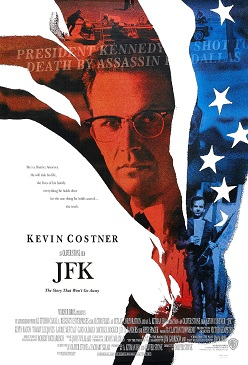
JFK
On November 22, 1963, President John F. Kennedy was traveling by motorcade in Dallas when he was shot and killed by Lee Harvey Oswald. Or so some think at least. One of the most tragic events in U.S. history, Kennedy's assassination has sparked hundreds and thousands of theories. Was Oswald working alone? Was it a government conspiracy to kill Kennedy? Maybe no one will ever know for sure, but the conspiracy theories abound. Enter stage right, 1991's JFK.
The district attorney in New Orleans, Jim Garrison (Kevin Costner) is stunned like so many Americans when news of President Kennedy's death hits the airwaves. He watches with morbid curiosity and a desire for answers as Lee Harvey Oswald (Gary Oldman) is arrested for the murder and summarily shot by Jack Ruby two days later. Several years pass, but by 1966, Garrison is bothered more and more by the details of the assassination. With help from his staff, Garrison begins to do his own investigation, and the results are startling. What exactly happened in the days and months leading up to Nov. 22, 1963? More importantly, what happened after? The more they find out, the more Garrison smells a government cover-up.
From director Oliver Stone, this is quite the ambitious project. For starters, because it involves such a touchy subject as the JFK assassination, everyone has at least somewhat of an opinion on the subject. More than just viewer opinions, the amount of info, theories and evidence involving the assassination is endless. Type in 'JFK Conspiracy' at Google, and see how many results you get. So walking through a virtual filming minefield, Stone takes on a gargantuan task. The end result is a thought-provoking, somewhat meandering (at 206 minutes) story that throws a lot at the viewer, but if you pay attention, it's not a difficult movie to keep up with.
The goal from the beginning is simple; Stone intends to put that bug in your head that the lone shooter theory -- Oswald shooting Kennedy -- just isn't the way it happened. Recent studies show that some 60% of Americans believe there was a conspiracy involving the shooting. Stone has always had an aggressive shooting style, but it's a positive here. The entire movie is basically one interview after another -- quick cuts, fast editing, flashbacks galore -- as one piece of evidence piles up one on top of the other through Garrison and Co.'s investigation. The story is based on the true-to-life efforts of Garrison and his staff (with some tweaks here and there), but it plays like All the President's Men or any number of other films detailing an investigative report.
Ready to be impressed? This is one doozy of a cast, starting with Costner who delivers a likable, human performance as the D.A. driven to obsession to find out the truth. The subplot with his family (including wife Sissy Spacek) is one of the few weak points the movie has. Seeing him only in flashback, Oldman is frighteningly good as Oswald, and a dead ringer physically to boot. Garrison's investigative staff includes Jay O. Sanders, Laurie Metcalf, Wayne Knight, Michael Rooker and Gary Grubbs. Don't go anywhere. I'm not to the halfway point yet. There's also Ed Asner, Jack Lemmon, Brian Doyle-Murray (as Jack Ruby), Walther Matthau, John Candy, Tommy Lee Jones, Donald Sutherland, Kevin Bacon, Joe Pesci, and Tomas Milian. Some are nothing more than a scene or two cameo, but their presence alone legitimizes their scenes. Jones, Sutherland, Bacon and Pesci are the most memorable of the group.
Presenting all sorts of what ifs and could bes, the movie builds to a courtroom scene where Garrison puts someone on trial for conspiring to kill JFK. The scene is a gem, capping off all we've heard, sene and learned through their investigation. Costner is highly effective in this scene, both pointing out the flaws in the lone shooter theory (later referenced famously in Seinfeld with the Magic Loogie, watch HERE) but also addressing the jury for what they should do. It shows one man's frustration at what he believes the government has been up to, doing something for extraordinary amounts of money rather than what's good for the country. The whole movie is enjoyable and extremely polished, but the court scene (about 35 minutes at the end) is the best thing going.
So did Oswald shoot Kennedy? Were there other shooters? We'll probably never know. But I have to give Stone's film credit. Say what you want about your own thoughts on the assassination, but Stone cleanly lays out the potential for at least one possibility. Maybe Oswald was a patsy, one man set up by larger forces at work. It's something you will have to think about yourself, but as a director, Stone does an admirable job at least making us question what really happened.
JFK (1991): ***/****
The district attorney in New Orleans, Jim Garrison (Kevin Costner) is stunned like so many Americans when news of President Kennedy's death hits the airwaves. He watches with morbid curiosity and a desire for answers as Lee Harvey Oswald (Gary Oldman) is arrested for the murder and summarily shot by Jack Ruby two days later. Several years pass, but by 1966, Garrison is bothered more and more by the details of the assassination. With help from his staff, Garrison begins to do his own investigation, and the results are startling. What exactly happened in the days and months leading up to Nov. 22, 1963? More importantly, what happened after? The more they find out, the more Garrison smells a government cover-up.
From director Oliver Stone, this is quite the ambitious project. For starters, because it involves such a touchy subject as the JFK assassination, everyone has at least somewhat of an opinion on the subject. More than just viewer opinions, the amount of info, theories and evidence involving the assassination is endless. Type in 'JFK Conspiracy' at Google, and see how many results you get. So walking through a virtual filming minefield, Stone takes on a gargantuan task. The end result is a thought-provoking, somewhat meandering (at 206 minutes) story that throws a lot at the viewer, but if you pay attention, it's not a difficult movie to keep up with.
The goal from the beginning is simple; Stone intends to put that bug in your head that the lone shooter theory -- Oswald shooting Kennedy -- just isn't the way it happened. Recent studies show that some 60% of Americans believe there was a conspiracy involving the shooting. Stone has always had an aggressive shooting style, but it's a positive here. The entire movie is basically one interview after another -- quick cuts, fast editing, flashbacks galore -- as one piece of evidence piles up one on top of the other through Garrison and Co.'s investigation. The story is based on the true-to-life efforts of Garrison and his staff (with some tweaks here and there), but it plays like All the President's Men or any number of other films detailing an investigative report.
Ready to be impressed? This is one doozy of a cast, starting with Costner who delivers a likable, human performance as the D.A. driven to obsession to find out the truth. The subplot with his family (including wife Sissy Spacek) is one of the few weak points the movie has. Seeing him only in flashback, Oldman is frighteningly good as Oswald, and a dead ringer physically to boot. Garrison's investigative staff includes Jay O. Sanders, Laurie Metcalf, Wayne Knight, Michael Rooker and Gary Grubbs. Don't go anywhere. I'm not to the halfway point yet. There's also Ed Asner, Jack Lemmon, Brian Doyle-Murray (as Jack Ruby), Walther Matthau, John Candy, Tommy Lee Jones, Donald Sutherland, Kevin Bacon, Joe Pesci, and Tomas Milian. Some are nothing more than a scene or two cameo, but their presence alone legitimizes their scenes. Jones, Sutherland, Bacon and Pesci are the most memorable of the group.
Presenting all sorts of what ifs and could bes, the movie builds to a courtroom scene where Garrison puts someone on trial for conspiring to kill JFK. The scene is a gem, capping off all we've heard, sene and learned through their investigation. Costner is highly effective in this scene, both pointing out the flaws in the lone shooter theory (later referenced famously in Seinfeld with the Magic Loogie, watch HERE) but also addressing the jury for what they should do. It shows one man's frustration at what he believes the government has been up to, doing something for extraordinary amounts of money rather than what's good for the country. The whole movie is enjoyable and extremely polished, but the court scene (about 35 minutes at the end) is the best thing going.
So did Oswald shoot Kennedy? Were there other shooters? We'll probably never know. But I have to give Stone's film credit. Say what you want about your own thoughts on the assassination, but Stone cleanly lays out the potential for at least one possibility. Maybe Oswald was a patsy, one man set up by larger forces at work. It's something you will have to think about yourself, but as a director, Stone does an admirable job at least making us question what really happened.
JFK (1991): ***/****
Saturday, November 24, 2012
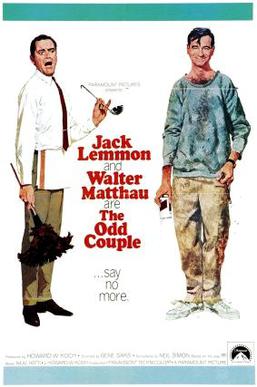
The Odd Couple
If something isn't broken, why fix it? And if something works, keep on using it, right? Starting with 1966's The Fortune Cookie, stars Jack Lemmon and Walther Matthau would work together 10 times over their storied careers, but maybe their most popular film is 1968's The Odd Couple.
Felix Ungar (Lemmon) and Oscar Madison (Matthau) are best friends, both men middle-aged and living in New York City. Felix is a compulsive -- possibly OCD -- neurotic cooking and cleaning machine, apparently unable to sit still for even a minute. Oscar is his polar opposite; sloppy, unreliable and more free-wheeling. But when Felix is kicked out of the family house and his wife wants a divorce, Oscar (a divorcee of 6 months) takes his best friend in. The friends could not be anymore different, and what starts off amiably enough quickly deteriorates. Who's going to budge first? Maybe the one who keeps his sanity the longest.
When I write multiple reviews of films featuring the same acting pairs, I feel like I'm on a broken record at times. Here goes anyways. This is the second pairing of Lemmon and Matthau following 1966's Fortune Cookie, and they pick up right where they left off. Just looking at the two men, from their acting styles to their general appearance, they were born to play the Odd Couple. They look and act like polar opposites, and that's what so perfect about this movie. It's a comedy, but you believe the two actors are really Felix and Oscar. Their back and forth appears effortless. Their dialogue and interactions are basically perfect. Don't try to fix what isn't broken.
From a Broadway play and screenplay by the almost always reliable Neil Simon and directed by Gene Saks, 'Odd' is what smart comedies should aspire to be. Is it the perfect comedy? I can't go that far, but it sure is close. The screenplay from Simon is a gem. The humor and laughs are never obvious either. They are so subtly underplayed to perfection that you just sit back and enjoy it. The focus is more on the verbal, not physical humor, but there of course is both. Matthau's Oscar's march around the apartment to upset Lemmon's Felix was hilarious; Matthau walking on furniture, throwing and dropping trash, wiping his shoe high up on a curtain. There are comedies that just get it. They know how to get a laugh and waste little time getting those laughs.
Setting almost the entire story in Oscar's expansive eight-room apartment (wonder what the rent was?), it's easy to see Simon's Broadway play having an impact on the filmmaking here. The style from Simon's screenplay and Sak's direction is an easy-going one. A 105-minute movie covers three weeks, but you never feel rushed. Several fairly long scenes get all the message and story across that's needed. The intro has the weekly poker game at Oscar's apartment with Murray (Herb Edelman), Roy (David Sheiner), Speed (Larry Haines) and Vinnie (John Fielder) is an ideal scene-setter. A quasi-double date with Felix, Oscar and two British sisters, Cecily (Monica Evans) and Gwendolyn (Carole Shelley), is perfect in its forced nature and awkward moments. These extended scenes -- easily seen in a play setting -- do a great job of showing a quick snippet of the time passed, but telling us everything we need to know.
I liked this movie a lot. The more I think about it -- and review it -- the more I like it. I love the style of these 1960s comedies. I loved the performances, and the laughs are there from beginning to end. From the instantly recognizable theme (listen HERE, I defy you not whistle along) to the effortless pairing of Lemmon and Matthau, this film is a winner. It would inspire a TV show of the same name as well, The Odd Couple, running for five years and starring Tony Randall as Felix and Jack Klugman as Oscar. I feel dumb for having missed this flick all these years, but I'm glad I caught up with it.
The Odd Couple <---trailer (1968): *** 1/2 /****
Felix Ungar (Lemmon) and Oscar Madison (Matthau) are best friends, both men middle-aged and living in New York City. Felix is a compulsive -- possibly OCD -- neurotic cooking and cleaning machine, apparently unable to sit still for even a minute. Oscar is his polar opposite; sloppy, unreliable and more free-wheeling. But when Felix is kicked out of the family house and his wife wants a divorce, Oscar (a divorcee of 6 months) takes his best friend in. The friends could not be anymore different, and what starts off amiably enough quickly deteriorates. Who's going to budge first? Maybe the one who keeps his sanity the longest.
When I write multiple reviews of films featuring the same acting pairs, I feel like I'm on a broken record at times. Here goes anyways. This is the second pairing of Lemmon and Matthau following 1966's Fortune Cookie, and they pick up right where they left off. Just looking at the two men, from their acting styles to their general appearance, they were born to play the Odd Couple. They look and act like polar opposites, and that's what so perfect about this movie. It's a comedy, but you believe the two actors are really Felix and Oscar. Their back and forth appears effortless. Their dialogue and interactions are basically perfect. Don't try to fix what isn't broken.
From a Broadway play and screenplay by the almost always reliable Neil Simon and directed by Gene Saks, 'Odd' is what smart comedies should aspire to be. Is it the perfect comedy? I can't go that far, but it sure is close. The screenplay from Simon is a gem. The humor and laughs are never obvious either. They are so subtly underplayed to perfection that you just sit back and enjoy it. The focus is more on the verbal, not physical humor, but there of course is both. Matthau's Oscar's march around the apartment to upset Lemmon's Felix was hilarious; Matthau walking on furniture, throwing and dropping trash, wiping his shoe high up on a curtain. There are comedies that just get it. They know how to get a laugh and waste little time getting those laughs.
Setting almost the entire story in Oscar's expansive eight-room apartment (wonder what the rent was?), it's easy to see Simon's Broadway play having an impact on the filmmaking here. The style from Simon's screenplay and Sak's direction is an easy-going one. A 105-minute movie covers three weeks, but you never feel rushed. Several fairly long scenes get all the message and story across that's needed. The intro has the weekly poker game at Oscar's apartment with Murray (Herb Edelman), Roy (David Sheiner), Speed (Larry Haines) and Vinnie (John Fielder) is an ideal scene-setter. A quasi-double date with Felix, Oscar and two British sisters, Cecily (Monica Evans) and Gwendolyn (Carole Shelley), is perfect in its forced nature and awkward moments. These extended scenes -- easily seen in a play setting -- do a great job of showing a quick snippet of the time passed, but telling us everything we need to know.
I liked this movie a lot. The more I think about it -- and review it -- the more I like it. I love the style of these 1960s comedies. I loved the performances, and the laughs are there from beginning to end. From the instantly recognizable theme (listen HERE, I defy you not whistle along) to the effortless pairing of Lemmon and Matthau, this film is a winner. It would inspire a TV show of the same name as well, The Odd Couple, running for five years and starring Tony Randall as Felix and Jack Klugman as Oscar. I feel dumb for having missed this flick all these years, but I'm glad I caught up with it.
The Odd Couple <---trailer (1968): *** 1/2 /****
Thursday, November 15, 2012
The Fortune Cookie
Ever been sued? No? Let me tell you. It ain't fun, mostly because you'll no doubt have trouble shaking the suspicion that the sue-es (Not you) are trying to stick it to you. Okay, that was my issue. So how about a 1960s comedy about such a suing scam? Well, if you're going to do it right, then let's do it. Enter 1966's The Fortune Cookie.
Working as an on-field camera man for CBS Sports, Harry Hinkle (Jack Lemmon) is knocked out on the sidelines when Cleveland Browns star Luther 'Boom Boom' Jackson (Ron Rich) crashes into him. Harry is diagnosed with a concussion, but nothing too serious.....until his shyster lawyer of a brother-in-law, Willie Gingrich (Walter Matthau) steps in. Nicknamed Whiplash Willie, he finds out Harry had a childhood injury that resulted in a compressed vertebrae in his back. Who or what's to say the injury wasn't sustained during the on-field accident? Convincing Harry to go along with the scheme (pretending to be paralyzed in one leg, partially in his hands), Willie puts it into action. They're going to sue the Browns, their stadium, and CBS for $1 million bucks. Can they keep up the act?
If that's not a spot-on, ideal description of a really funny movie, I don't know what is. I'm joking of course. Nothing about that even remotely screams 'THIS IS FUNNY! COME WATCH!' So how does it become funny? A director by the name of Billy Wilder, who had a few successful movies during his career. Teaming with I.A.L. Diamond, Wilder's script is pretty perfect, taking an extremely dark situation and breathing some comedic life into it. This isn't obvious physical humor. It's much more subtle although come to think of it, Lemmon does have a great scene late with some physical comedy. It's about the style, the dialogue, the story that knows where it's going and isn't in a huge rush to get there.
Like so many other genres of the 1960s, there is a certain charm to this movie. Wilder's confident style comes through in one criminally simplistic but incredibly unique storytelling device. Scenes are introduced via on-screen title cards/written words like 'Chapter 1: The Accident' and 'Chapter 4: The Legal Eagles.' There are 16 in all, wrapping up with 'Chapter 16: The Final Score.' Scenes fade to black and then fade back, the chapter titles introducing what's next. It's an effective technique for sure. Wilder also shoots in black and white and in Panavision, giving the film more depth with each passing scene. Some Cleveland locations include Municipal Stadium and St. Vincent Hospital, little touches that go a long way.
In the first of 10 pairings between the duo, Lemmon and Matthau show off an easy-going, effortless chemistry that carries the movie. Is it always laugh out loud hilarious? No, but when it's funny, it's because of these two. Lemmon is one of the all-time comedic greats, but this was one of Matthau's first comedies after years of drama and heavies. His line deliveries are hard to describe in their perfection, that deep voice going high-pitched and happy to the point it's even sing-songy. I loved their scenes together, both Lemmon and Matthau (who won the Best Supporting Actor Oscar) arguing like an old married couple. In one of his three career movies, Rich is a bright spot too as Boom Boom, the star NFL player who feels the guilt for "hurting" Harry. Also look for Judi West as Harry's gold-digging ex-wife, Cliff Osmond as Purkey, a private investigator (working with whiny Noam Pitlik), and Harry Holcombe, Les Tremayne, and Lauren Gilbert as O'Brien, Thompson and Kincaid, the powerful lawyers working against Whiplash Willie.
What I like most about so many Wilder films from the 1950s and 1960s is that while they are funny, they don't try to be too funny. It's human drama with touches of humor -- typically smart and/or underplayed -- that brighten up some pretty dark stories. Amidst all the scheming and insurance fraud, a surprising relationship develops between Harry and Luther. The football star feels extreme guilt for what he thinks he did, not realizing it's all a fake on Harry's part. Similarly, the scam starts to weigh on Harry's mind, leading to a satisfying ending for all involved. Yet another solid effort from Billy Wilder, and a good sign of things to come for the partnership of Lemmon and Mattau. Also worth mentioning? This is the earliest movie I can remember that has a woman character called 'a bitch.' So it's got that going for it.
The Fortune Cookie <---trailer (1966): ***/****
Working as an on-field camera man for CBS Sports, Harry Hinkle (Jack Lemmon) is knocked out on the sidelines when Cleveland Browns star Luther 'Boom Boom' Jackson (Ron Rich) crashes into him. Harry is diagnosed with a concussion, but nothing too serious.....until his shyster lawyer of a brother-in-law, Willie Gingrich (Walter Matthau) steps in. Nicknamed Whiplash Willie, he finds out Harry had a childhood injury that resulted in a compressed vertebrae in his back. Who or what's to say the injury wasn't sustained during the on-field accident? Convincing Harry to go along with the scheme (pretending to be paralyzed in one leg, partially in his hands), Willie puts it into action. They're going to sue the Browns, their stadium, and CBS for $1 million bucks. Can they keep up the act?
If that's not a spot-on, ideal description of a really funny movie, I don't know what is. I'm joking of course. Nothing about that even remotely screams 'THIS IS FUNNY! COME WATCH!' So how does it become funny? A director by the name of Billy Wilder, who had a few successful movies during his career. Teaming with I.A.L. Diamond, Wilder's script is pretty perfect, taking an extremely dark situation and breathing some comedic life into it. This isn't obvious physical humor. It's much more subtle although come to think of it, Lemmon does have a great scene late with some physical comedy. It's about the style, the dialogue, the story that knows where it's going and isn't in a huge rush to get there.
Like so many other genres of the 1960s, there is a certain charm to this movie. Wilder's confident style comes through in one criminally simplistic but incredibly unique storytelling device. Scenes are introduced via on-screen title cards/written words like 'Chapter 1: The Accident' and 'Chapter 4: The Legal Eagles.' There are 16 in all, wrapping up with 'Chapter 16: The Final Score.' Scenes fade to black and then fade back, the chapter titles introducing what's next. It's an effective technique for sure. Wilder also shoots in black and white and in Panavision, giving the film more depth with each passing scene. Some Cleveland locations include Municipal Stadium and St. Vincent Hospital, little touches that go a long way.
In the first of 10 pairings between the duo, Lemmon and Matthau show off an easy-going, effortless chemistry that carries the movie. Is it always laugh out loud hilarious? No, but when it's funny, it's because of these two. Lemmon is one of the all-time comedic greats, but this was one of Matthau's first comedies after years of drama and heavies. His line deliveries are hard to describe in their perfection, that deep voice going high-pitched and happy to the point it's even sing-songy. I loved their scenes together, both Lemmon and Matthau (who won the Best Supporting Actor Oscar) arguing like an old married couple. In one of his three career movies, Rich is a bright spot too as Boom Boom, the star NFL player who feels the guilt for "hurting" Harry. Also look for Judi West as Harry's gold-digging ex-wife, Cliff Osmond as Purkey, a private investigator (working with whiny Noam Pitlik), and Harry Holcombe, Les Tremayne, and Lauren Gilbert as O'Brien, Thompson and Kincaid, the powerful lawyers working against Whiplash Willie.
What I like most about so many Wilder films from the 1950s and 1960s is that while they are funny, they don't try to be too funny. It's human drama with touches of humor -- typically smart and/or underplayed -- that brighten up some pretty dark stories. Amidst all the scheming and insurance fraud, a surprising relationship develops between Harry and Luther. The football star feels extreme guilt for what he thinks he did, not realizing it's all a fake on Harry's part. Similarly, the scam starts to weigh on Harry's mind, leading to a satisfying ending for all involved. Yet another solid effort from Billy Wilder, and a good sign of things to come for the partnership of Lemmon and Mattau. Also worth mentioning? This is the earliest movie I can remember that has a woman character called 'a bitch.' So it's got that going for it.
The Fortune Cookie <---trailer (1966): ***/****
Labels:
1960s,
Billy Wilder,
Comedy,
Jack Lemmon,
Walter Matthau
Tuesday, November 6, 2012
Days of Wine and Roses
When I hear the names Blake Edwards and Jack Lemmon, my mind automatically jumps to the madcap, sprawling 1965 comedy The Great Race. It was a favorite of mine growing up, and I still enjoy it a lot. As far as critical acclaim, the duo paired for a film that couldn't be a bigger departure in tone, 1962's Days of Wine and Roses.
A successful public relations man for a firm based in San Francisco, Joe Clay (Lemmon) both likes his job and is equal parts frustrated with it. During a boat party hosted by one of his clients, Joe meets Kirsten (Lee Remick), a beautiful secretary who he likes, but she wants nothing to do with him. Upon actually talking with Joe though, she starts to fall for him, and then it's only a matter of time before they are dating and then married with a kid. As their relationship develops though, Joe's main passion, drinking, begins to affect Kirsten too. What starts off as a drink here and there turns into something much more severe, threatening to tear the relationship apart.
As I watch certain movies, I try to remind myself that the purpose of every single movie is not necessarily to entertain. Some movies you just sit back and watch. Take in the acting, the cinematography, the music, whatever. This is a dramatic movie. I feel safe saying you won't just out and out enjoy it, much less like it. Edwards' film documents in great detail two people's descent into alcoholism, and not surprisingly it isn't a barrel of monkeys to watch. It is intensely uncomfortable to watch and never even eases up just a little.
So looking at the entire film, I just can't give it an overly positive review. Seeing the descent into alcoholism is fascinating to watch in a sick way. Early on, we see Joe bring over two grocery bags of booze to Kirsten's apartment, emptying them and giggling about it. He introduces his future wife to alcohol, the duo just drinking occasionally only to eventually end up as boozehounds. The issue becomes -- on a purely movie basis -- is that it just wasn't interesting to watch (for me at least). How many times can we see people going back to the bottle after achieving some sort of sobriety? Yes, I realize that's the reality of alcoholism, but as a film, that doesn't make it any easier to tolerate. It gets tedious, and with a 117-minute movie, it feels significantly longer thanks to its episodic story techniques.
Where the movie is worth recommending is the performances from Lemmon and Remick as Joe and Kirsten. Their chemistry is without question. They look, act and talk like a couple madly in love, drawn to each other as if the universe wants them to be together. There is a genuine connection of some sorts between them, but eventually their relationship becomes more about the alcohol and bonding over their mutual love of alcohol than anything. Their drunk scenes are pretty bad (literally with some unintentional laughs but also uncomfortable to watch), and their crumbling relationship is difficult to watch. On performance alone though, it's two great acting jobs. Both were nominated for Oscars, Lemmon losing to Gregory Peck (To Kill a Mockingbird) while Remick lost to Anne Bancroft (The Miracle Worker).
The story requires a focus heavily on Joe and Kirsten, but two other performances stand out. One is Charles Bickford as Ellis, Kirsten's widowed father. This is a Dad who just wants the best for her daughter, even seeing that this relationship could be an issue the first time he meets Joe. Also look for Jack Klugman as Jim Hungerford, Joe's eventual Alcoholics Anonymous sponsor. Both are small parts, but both left a very positive impression.
Again, my review is only based on an entertainment level as I try to do with all my reviews. As a film, it is easier to judge. The acting is great, Edwards' direction solid as always, and the shadowy black and white cinematography is ideally suited to the darkness of the story. On the other hand, it simply wasn't a film I enjoyed. It's a tough film to get through in spite of all those more technical positives. Ahead of its time for a 1962 audience, yes, but just not a film I will revisit soon.
Days of Wine and Roses <---trailer (1962): ** 1/2 /****
A successful public relations man for a firm based in San Francisco, Joe Clay (Lemmon) both likes his job and is equal parts frustrated with it. During a boat party hosted by one of his clients, Joe meets Kirsten (Lee Remick), a beautiful secretary who he likes, but she wants nothing to do with him. Upon actually talking with Joe though, she starts to fall for him, and then it's only a matter of time before they are dating and then married with a kid. As their relationship develops though, Joe's main passion, drinking, begins to affect Kirsten too. What starts off as a drink here and there turns into something much more severe, threatening to tear the relationship apart.
As I watch certain movies, I try to remind myself that the purpose of every single movie is not necessarily to entertain. Some movies you just sit back and watch. Take in the acting, the cinematography, the music, whatever. This is a dramatic movie. I feel safe saying you won't just out and out enjoy it, much less like it. Edwards' film documents in great detail two people's descent into alcoholism, and not surprisingly it isn't a barrel of monkeys to watch. It is intensely uncomfortable to watch and never even eases up just a little.
So looking at the entire film, I just can't give it an overly positive review. Seeing the descent into alcoholism is fascinating to watch in a sick way. Early on, we see Joe bring over two grocery bags of booze to Kirsten's apartment, emptying them and giggling about it. He introduces his future wife to alcohol, the duo just drinking occasionally only to eventually end up as boozehounds. The issue becomes -- on a purely movie basis -- is that it just wasn't interesting to watch (for me at least). How many times can we see people going back to the bottle after achieving some sort of sobriety? Yes, I realize that's the reality of alcoholism, but as a film, that doesn't make it any easier to tolerate. It gets tedious, and with a 117-minute movie, it feels significantly longer thanks to its episodic story techniques.
Where the movie is worth recommending is the performances from Lemmon and Remick as Joe and Kirsten. Their chemistry is without question. They look, act and talk like a couple madly in love, drawn to each other as if the universe wants them to be together. There is a genuine connection of some sorts between them, but eventually their relationship becomes more about the alcohol and bonding over their mutual love of alcohol than anything. Their drunk scenes are pretty bad (literally with some unintentional laughs but also uncomfortable to watch), and their crumbling relationship is difficult to watch. On performance alone though, it's two great acting jobs. Both were nominated for Oscars, Lemmon losing to Gregory Peck (To Kill a Mockingbird) while Remick lost to Anne Bancroft (The Miracle Worker).
The story requires a focus heavily on Joe and Kirsten, but two other performances stand out. One is Charles Bickford as Ellis, Kirsten's widowed father. This is a Dad who just wants the best for her daughter, even seeing that this relationship could be an issue the first time he meets Joe. Also look for Jack Klugman as Jim Hungerford, Joe's eventual Alcoholics Anonymous sponsor. Both are small parts, but both left a very positive impression.
Again, my review is only based on an entertainment level as I try to do with all my reviews. As a film, it is easier to judge. The acting is great, Edwards' direction solid as always, and the shadowy black and white cinematography is ideally suited to the darkness of the story. On the other hand, it simply wasn't a film I enjoyed. It's a tough film to get through in spite of all those more technical positives. Ahead of its time for a 1962 audience, yes, but just not a film I will revisit soon.
Days of Wine and Roses <---trailer (1962): ** 1/2 /****
Labels:
1960s,
Blake Edwards,
Jack Klugman,
Jack Lemmon,
Lee Remick
Monday, November 14, 2011
Irma La Douce
Tweaking my intro to Bell Book and Candle, here goes for another pairing. After starring in the highly successful The Apartment, it took Jack Lemmon and Shirley MacLaine three years to star in another movie together, the odd screwball dramedy (drama-comedy) from 1963 Irma La Douce.
Rewarded a new beat for an act of bravery, naive Parisian cop Nestor Patou (Lemmon) goes on patrol, finding a street full of prostitutes looking for customers. He's unaware the girls, their pimps, and a hotel owner have to "look around" the obvious illegalities of the situation, and arrests them all. Among the girls is an affable, pretty hooker named Irma La Douce (MacLaine) who Nestor likes right away. Unfortunately, he gets fired for his actions and finds himself on the streets where he eventually meets, fights, and defeats Irma's "handler" (read: Pimp). Now, Nestor finds himself as Irma's handler. The only problem? He fell for her, and he fell for her hard. She refuses to leave the business so how can Nestor stop the woman he loves from sleeping with other men for money?
Anything strike you as particularly odd about the plot? Yeah, the story about prostitutes played for laughs. Director Billy Wilder pushed the boundaries throughout his career, but this one just didn't work for me in the least. There is just something skeevy with a story about a cop turned pimp trying to get the woman he loves to stop being a hooker with a crazy scheme, and by the way, it is a 1960s screwball comedy. Either ahead of its time by 10 years or so or just lost in the ether somewhere, 'Irma' is an oddity. There are moments of drama, comedy and sex jokes, but none of them work too well. It runs 147 minutes, and it feels it, every minute. Too long, not funny and/or serious enough, and proof that prostitution is not a good basis for a screwball comedy.
Filling out the elements of the screwball aspect is a "clever" scheme developed by Lemmon's Nestor that Lucy and Ethel would have been envious of in an episode of I Love Lucy. He doesn't want Irma sleeping with men for money so he poses as Lord X, an aging and very rich British man who pays Irma for her time and nothing else. He pays so much she doesn't need to "do business" elsewhere. It seems like a perfect plan, and it could be one of the dumbest gimmicks/schemes I've ever seen. Lemmon overplays his scenes as Lord X, the prim and proper stiff upper lip Englishman, and are we really supposed to believe Irma -- seemingly pretty intelligent -- doesn't see through the disguise? The story requires Irma not to notice so that's all the explanation needed I suppose.
During filming, MacLaine was apparently less than pleased with the script -- I don't blame her -- but her performance is nonetheless the best thing going for the movie. She was nominated for Best Actress for her titular part, eventually losing to Patricia Neal for her part in Hud. Playing Irma, MacLaine makes the character a hooker with a heart of gold, albeit with a weird sense of personal pride and ideals. Her introduction that is played over the opening credits is truly funny (watch it HERE), seeing her hustle her customers. As was the case with The Apartment, her chemistry with Lemmon is dead-on which makes it all harder to go along with. Comedy? Drama? Neither? Both? I wish Wilder would have chosen one route and stuck with it. It is surprising to see how much Wilder gets away with showing for a 1964 movie, MacLaine doing a handful of nude (<---discreetly covered in the right places) or partially nude scenes.
One other supporting part really impressed me, that of Lou Jacobi as Moustache, the owner of a bar where the pimps hang out while their girls bring in the cash. He apparently has had 20 or 30 previous lives with all the professions he claim to have done and all the knowledge he has floating around in his head. Standing behind his bar, Jacobi's Moustache dispenses wisdom and advice to anyone who will listen and some who won't. Not quite the straight man, he delivers his lines flawlessly, just that right blend of confidence and cocky, confused and helpful. Also look for James Caan in a wordless appearance as a soldier looking for a good time, his first part in a movie.
I was hoping the movie would end quickly when ta-da, the ending came along! Except it didn't make any sense, delivering a "twist" that defies logic. Wilder was famous for his off-the-wall endings that come out of left field, but this one was almost stupid in its surprise. A disappointing end to a movie that I never really got into despite Shirley MacLaine's Oscar-nominated performance. The link above is the first of 11 parts if you want to watch the whole thing.
Irma La Douce <---TCM trailer/clips (1964): **/****
Rewarded a new beat for an act of bravery, naive Parisian cop Nestor Patou (Lemmon) goes on patrol, finding a street full of prostitutes looking for customers. He's unaware the girls, their pimps, and a hotel owner have to "look around" the obvious illegalities of the situation, and arrests them all. Among the girls is an affable, pretty hooker named Irma La Douce (MacLaine) who Nestor likes right away. Unfortunately, he gets fired for his actions and finds himself on the streets where he eventually meets, fights, and defeats Irma's "handler" (read: Pimp). Now, Nestor finds himself as Irma's handler. The only problem? He fell for her, and he fell for her hard. She refuses to leave the business so how can Nestor stop the woman he loves from sleeping with other men for money?
Anything strike you as particularly odd about the plot? Yeah, the story about prostitutes played for laughs. Director Billy Wilder pushed the boundaries throughout his career, but this one just didn't work for me in the least. There is just something skeevy with a story about a cop turned pimp trying to get the woman he loves to stop being a hooker with a crazy scheme, and by the way, it is a 1960s screwball comedy. Either ahead of its time by 10 years or so or just lost in the ether somewhere, 'Irma' is an oddity. There are moments of drama, comedy and sex jokes, but none of them work too well. It runs 147 minutes, and it feels it, every minute. Too long, not funny and/or serious enough, and proof that prostitution is not a good basis for a screwball comedy.
Filling out the elements of the screwball aspect is a "clever" scheme developed by Lemmon's Nestor that Lucy and Ethel would have been envious of in an episode of I Love Lucy. He doesn't want Irma sleeping with men for money so he poses as Lord X, an aging and very rich British man who pays Irma for her time and nothing else. He pays so much she doesn't need to "do business" elsewhere. It seems like a perfect plan, and it could be one of the dumbest gimmicks/schemes I've ever seen. Lemmon overplays his scenes as Lord X, the prim and proper stiff upper lip Englishman, and are we really supposed to believe Irma -- seemingly pretty intelligent -- doesn't see through the disguise? The story requires Irma not to notice so that's all the explanation needed I suppose.
During filming, MacLaine was apparently less than pleased with the script -- I don't blame her -- but her performance is nonetheless the best thing going for the movie. She was nominated for Best Actress for her titular part, eventually losing to Patricia Neal for her part in Hud. Playing Irma, MacLaine makes the character a hooker with a heart of gold, albeit with a weird sense of personal pride and ideals. Her introduction that is played over the opening credits is truly funny (watch it HERE), seeing her hustle her customers. As was the case with The Apartment, her chemistry with Lemmon is dead-on which makes it all harder to go along with. Comedy? Drama? Neither? Both? I wish Wilder would have chosen one route and stuck with it. It is surprising to see how much Wilder gets away with showing for a 1964 movie, MacLaine doing a handful of nude (<---discreetly covered in the right places) or partially nude scenes.
One other supporting part really impressed me, that of Lou Jacobi as Moustache, the owner of a bar where the pimps hang out while their girls bring in the cash. He apparently has had 20 or 30 previous lives with all the professions he claim to have done and all the knowledge he has floating around in his head. Standing behind his bar, Jacobi's Moustache dispenses wisdom and advice to anyone who will listen and some who won't. Not quite the straight man, he delivers his lines flawlessly, just that right blend of confidence and cocky, confused and helpful. Also look for James Caan in a wordless appearance as a soldier looking for a good time, his first part in a movie.
I was hoping the movie would end quickly when ta-da, the ending came along! Except it didn't make any sense, delivering a "twist" that defies logic. Wilder was famous for his off-the-wall endings that come out of left field, but this one was almost stupid in its surprise. A disappointing end to a movie that I never really got into despite Shirley MacLaine's Oscar-nominated performance. The link above is the first of 11 parts if you want to watch the whole thing.
Irma La Douce <---TCM trailer/clips (1964): **/****
Labels:
1960s,
Billy Wilder,
Comedy,
Jack Lemmon,
James Caan,
Shirley MacLaine
Sunday, November 13, 2011
Bell Book and Candle
Working together in Alfred Hitchcock's 1958 classic thriller Vertigo, co-stars James Stewart and Kim Novak showed off an impressive chemistry that helped make the movie what it was. Stewart was Hitchcock's flawed leading man and Novak the icy blonde. So what's the natural progression as the two worked again later that year? Naturally from a murder thriller to a romantic comedy, 1958's Bell Book and Candle.
A modern-day witch, Gillian Holroyd (Novak) does her best to hide the fact that she is in fact, a witch. With her brother, Nicky (Jack Lemmon), a warlock, and aunt and fellow witch, Queenie (Elsa Lanchester), Gillian is limited by what she can do without revealing herself. Running her little shop of voodoo and primitive art, Gillian has developed a bit of a crush on Shepherd Henderson (Stewart), a big-wig publisher who lives in the building. Well, sort of a crush, it can only go so far with witches. When she sees that he's engaged, she puts a hex on him, one that makes him fall in love with her. As things develop though, can Gillian tell him the truth? Can she develop feelings for just a regular old human being?
Just a couple months after reviewing Sunday in New York, here comes another well-written, well-acted, charming and even sweet romantic comedy from the 1950s and early 1960s. Where have they gone? They're just good movies. Sure, they are based in some sort of alternate universe where stories like this could actually exist, but that's part of the fun. The obvious influence this movie had is on the classic 1960s show Bewitched, a modern-day witch with her family trying to hide her "witch-dom." These aren't mean, cruel or vindictive witches -- for the most part, don't mess with Novak's Gillian -- but instead witches that are hiding who they are and struggling with it, seeing an easy way to easy cash and riches but unable to do anything about it.
The romantic pairing of Stewart and Novak might seem a little odd when you really look at it. This was actually Stewart's final role where he played a romantic interest because apparently he didn't think he was suited anymore for that type of role. He was 50 at the time while Novak was 25. So I'm no mathematician, but that's 25 years difference in age, right? For me, the age discrepancy was not an issue. If an on-screen duo has chemistry, that's great regardless of age. It can carry a movie, and here the age difference makes no impression at all. Stewart and Novak are great together, romantically, dramatically and in terms of the more obvious plays for laughs. The relationship is completely removed from the much darker Vertigo so it's fun to see two talented actors switch it up.
While I've always been familiar with her name, this was only the second movie I've seen Novak in, Vertigo being the other. She was only in 28 movies during her career, not many of them hugely popular or widely well-known. In 'Bell Book' Novak is the best thing going here. She is funny and smart and her voice is so perfectly sexy you can't help but fall for the character. Okay, well, I did. I don't care if you didn't. All I can say? I'll be looking for more movies with her starring roles. Yes, I kinda fell in love.
The rest of the cast looks to be having a lot of fun playing off the witchcraft hijinks. Lemmon and Lanchester are hysterical together, a warlord and witch quite content with their special "talents" and "abilities." Lemmon has some great scenes as the bongo band leader of a house band at the Zodiac Club, a den for witches and warlocks. Ernie Kovacs gets to ham it up as the drunken literary expert on all things mystical, including trying to write a book for Stewart's Henderson about witches in New York, not realizing what he's stepped into. Hermione Gingold is funny in a smaller part as Bianca de Passe, the higher-up of all witches, the woman to go to when some special powers are needed.
Funny, charming romantic comedy that I enjoyed from the start. Stewart is very funny, and it's a bonus seeing him do some physical comedy -- his facial expressions are hilarious -- while Novak plays off him well and is gorgeous so she's got that going for. Director Richard Quine has a real winner here.
Bell Book and Candle <---TCM trailer/clips (1958): ***/****
A modern-day witch, Gillian Holroyd (Novak) does her best to hide the fact that she is in fact, a witch. With her brother, Nicky (Jack Lemmon), a warlock, and aunt and fellow witch, Queenie (Elsa Lanchester), Gillian is limited by what she can do without revealing herself. Running her little shop of voodoo and primitive art, Gillian has developed a bit of a crush on Shepherd Henderson (Stewart), a big-wig publisher who lives in the building. Well, sort of a crush, it can only go so far with witches. When she sees that he's engaged, she puts a hex on him, one that makes him fall in love with her. As things develop though, can Gillian tell him the truth? Can she develop feelings for just a regular old human being?
Just a couple months after reviewing Sunday in New York, here comes another well-written, well-acted, charming and even sweet romantic comedy from the 1950s and early 1960s. Where have they gone? They're just good movies. Sure, they are based in some sort of alternate universe where stories like this could actually exist, but that's part of the fun. The obvious influence this movie had is on the classic 1960s show Bewitched, a modern-day witch with her family trying to hide her "witch-dom." These aren't mean, cruel or vindictive witches -- for the most part, don't mess with Novak's Gillian -- but instead witches that are hiding who they are and struggling with it, seeing an easy way to easy cash and riches but unable to do anything about it.
The romantic pairing of Stewart and Novak might seem a little odd when you really look at it. This was actually Stewart's final role where he played a romantic interest because apparently he didn't think he was suited anymore for that type of role. He was 50 at the time while Novak was 25. So I'm no mathematician, but that's 25 years difference in age, right? For me, the age discrepancy was not an issue. If an on-screen duo has chemistry, that's great regardless of age. It can carry a movie, and here the age difference makes no impression at all. Stewart and Novak are great together, romantically, dramatically and in terms of the more obvious plays for laughs. The relationship is completely removed from the much darker Vertigo so it's fun to see two talented actors switch it up.
While I've always been familiar with her name, this was only the second movie I've seen Novak in, Vertigo being the other. She was only in 28 movies during her career, not many of them hugely popular or widely well-known. In 'Bell Book' Novak is the best thing going here. She is funny and smart and her voice is so perfectly sexy you can't help but fall for the character. Okay, well, I did. I don't care if you didn't. All I can say? I'll be looking for more movies with her starring roles. Yes, I kinda fell in love.
The rest of the cast looks to be having a lot of fun playing off the witchcraft hijinks. Lemmon and Lanchester are hysterical together, a warlord and witch quite content with their special "talents" and "abilities." Lemmon has some great scenes as the bongo band leader of a house band at the Zodiac Club, a den for witches and warlocks. Ernie Kovacs gets to ham it up as the drunken literary expert on all things mystical, including trying to write a book for Stewart's Henderson about witches in New York, not realizing what he's stepped into. Hermione Gingold is funny in a smaller part as Bianca de Passe, the higher-up of all witches, the woman to go to when some special powers are needed.
Funny, charming romantic comedy that I enjoyed from the start. Stewart is very funny, and it's a bonus seeing him do some physical comedy -- his facial expressions are hilarious -- while Novak plays off him well and is gorgeous so she's got that going for. Director Richard Quine has a real winner here.
Bell Book and Candle <---TCM trailer/clips (1958): ***/****
Labels:
1950s,
Comedy,
Jack Lemmon,
James Stewart,
Kim Novak,
Richard Quine
Friday, November 4, 2011
The Apartment
Working for an enormous insurance firm in New York City, Bud 'C.C.' Baxter (Jack Lemmon) is one of thousands of nameless employees who goes about their daily work and takes some pride in it. Baxter however would like nothing more than getting a promotion, getting bumped upstairs to an office with windows. His plan for going about it? He makes a positive impression with four different insurance supervisors by letting them use his apartment with their mistresses. It is obviously a tax and burden on Baxter's somewhat lonely bachelor life, but it takes a turn when the big boss, Shelldrake (Fred MacMurray), finds out about the operation and requests the apartment for himself. With no real out, Baxter agrees, only to find out that Shelldrake is using the apartment with Fran Kubelik (Shirley MacLaine), an elevator girl at the office he's long had a crush on.
This is a classic film that I've always been told I would like. There's just too much talent involved for me not to like it. It was nominated for 10 Academy Awards and won five of them (Best Picture, Director for Wilder, screenplay among them) with Lemmon and MacLaine also receiving nominations. So looking back on it, I can't help but feel I missed something. It is a good story, very professionally done, and in 1960 I'm sure it was ahead of its time in terms of subject matter; marital infidelity on an epic level (the male gender takes a beating here), a bachelor pretending to hook up with a different girl every night, attempted suicide. Something didn't click for me, and I'm struggling to put my finger on it.
What I can explain is my issue between comedy and drama, two genres that can work together when handled correctly. Sometimes the two go hand in hand, drama coming out of a comedic situation or vice versa. For a darker story though -- with all the above mentioned topical issues -- it is handled with too much comedy. Lemmon is one of my favorite actors, but some of his mannerisms and physicality doesn't work. An effort to lighten the proceedings some? Maybe. The premise is there and interesting; a beaten-down, lonely, even depressed middle-aged man loaning his apartment to his bosses for flings with their mistresses. Either make it a madcap, ridiculous comedy or a dark as night drama. I lean toward the drama working better overall because 'Apartment' is at its best in the heavier, dramatic moments.
None of this is intended as a disclaimer or anything of the sort that the movie isn't good. It's just not as good as I had been told. There is too much talent for it not to be enjoyable on some level. Lemmon's Baxter is a pushover of epic proportions -- a little too much at times -- but the veteran actor delivers a great performance, earning him the third of eight Oscar nominations he would receive. He's Joe Everyman, a regular guy who wants success at work and a family at home. His chemistry with MacLaine is what makes this movie special. I like MacLaine more and more with each movie I see her in, and this is her best to date. They would work together again two years later in Wilder's Irma La Douce. As for MacMurray, it's hard to see the Disney star of The Absent Minded Professor and the father in TV's My Three Sons as a cheating husband and all around scumbag, but give the man credit. He's good at what he does.
There is a style from this 1960 that's hard to duplicate nowadays. So many 1960s comedies have that feature, a time capsule of an era long since past that is so much fun to watch. New York City is an ideal setting for a story like this, a personal level with three people looking for some sort of happiness. Baxter's apartment is a cool, little place, an additional character. The supporting parts are strong too, especially Jack Kruschen as Dr. Dreyfuss, Baxter's suspicious neighbor (earned him a Best Supporting Actor nod), and Ray Walston, Willard Waterman, David White and David Lewis are appropriately creepy and/or sceevy as Baxter's supervisors.
I liked the movie but not as much as I thought I would. Performances from Lemmon and MacLaine make it worth recommending.
The Apartment <---TCM trailer/clips (1960): ** 1/2 /****
Labels:
1960s,
Billy Wilder,
Comedy,
Fred MacMurray,
Jack Lemmon,
Shirley MacLaine
Thursday, October 27, 2011
The Wackiest Ship in the Army
One of the great comedic actors to ever star in a movie, there is very little I won't watch Jack Lemmon in. He's funny without having to ham it up, but he is still able to do subtle, smart or physical comedy. Along with the comedy though, Lemmon was a legitimate actor, someone who could handle both comedy and drama -- sometimes at the same time. He even starred in three war comedies (some darker than others), Mister Roberts, Operation Mad Ball, and 1960's The Wackiest Ship in the Army.
Serving in the South Pacific in 1942, Lt. Rip Crandall (Lemmon) wants nothing more than a command of his own, and he gets it...sort of. He's blackmailed, bamboozled and tricked into taking command of the Echo, a schooner relying on its sails as much as its engine. Crandall goes along with the offer when he sees that inexperienced Ensign Tommy Hanson (Ricky Nelson) would take command if he doesn't. Trying to shape up his similarly inexperienced misfit crew, Crandall finds out the mission the Echo has been assigned; deliver an Australian coast watcher to a Japanese-held island before a major Japanese offensive is unleashed. Can he get the crew working together to get the dangerous job done?
The title is clearly misleading here. There's very little "wacky" about this ship other than an experienced boatman trying to teach his inept, inexperienced crew how to be credible sailors. If anything, the movie is better and much more enjoyable when it focuses on the actual mission assigned to the Echo. I watched 'Wackiest' two or three years back, and then revisited it recently. Does it have some comedy? Yeah, but it's not that ridiculous slapstick comedy that dominated 1960s big budget comedies. It's not a dark movie or one with a deep message about the lunacy of war. Think instead of a lighter toned men on a mission movie. It is funny enough with some behind the lines action. Can't go wrong.
Lemmon has something going for him that is few and far between when it comes to stars. Almost completely regardless of his part, he is likable. As a viewer, you just like him. That's all. It sounds almost stupid in its simplicity. He's a natural in front of the camera, able to handle the physical humor while also selling a line with a slow roll of the eyes or a pained drop of his head. Playing the besieged Lt. Randall, this isn't his best work because it doesn't have to be. All Lemmon has to do is keep the story focused and pointed where it needs to get, playing a straight man to the early comedic shenanigans before turning to the more dramatic mission at hand.
Somewhat cliched and fairly predictable, I still found myself enjoying the movie. Part of that enjoyment comes from the characters, most if not all taken from War Movies 101: Stock Characters. In one his few screen roles, Nelson is solid as the inexperienced ensign, a young officer trying to prove himself. He plays the innocent, doe-eyed ensign nicely, playing well off of Lemmon, even getting a chance to sing (watch HERE). Some of the crew include Alvy Moore, Roy Jenson, Warren Berlinger, and Mike Kellin in a funny part as Chief McCarthy, a sailor with no sailing experience. Chips Rafferty brings some world-weary drama to his part as Patterson, the Australian coast watcher assigned a near-suicide mission. Tom Tully and John Lund play two Navy superiors trying to coordinate the mission with Richard Anderson as a possible replacement for Crandall on the mission. Patricia Driscoll makes an odd appearance as Maggie, a possible love interest who disappears for good once the mission arrives.
So as mentioned before, the mission is the best part of the movie, the bumbling crew learning to work together and get the job done. In the process, the Echo sails through all sorts of hellish storms, maneuvers through mined waters, and tangles with a Japanese patrol. There is tension in these scenes, but there is never any real sense of danger. Do you think a movie titled 'Wackiest' anything is going to kill off Jack Lemmon and Ricky Nelson? I think not. The movie was filmed in Hawaii so if desperate for a reason to watch this movie, it's hard to mess up the Hawaiian beauty. George Duning's appropriately Navy-themed score keeps things moving as well without being overbearing.
Not too much to say about this one. It's a good, old-fashioned adventure story with solid characters -- especially the always reliable Jack Lemmon -- and a strong supporting cast that doesn't get bogged down in being anything other than entertaining. A very pleasant, enjoyable way to spend a rainy Sunday afternoon.
The Wackiest Ship in the Army (1960): ***/****
Serving in the South Pacific in 1942, Lt. Rip Crandall (Lemmon) wants nothing more than a command of his own, and he gets it...sort of. He's blackmailed, bamboozled and tricked into taking command of the Echo, a schooner relying on its sails as much as its engine. Crandall goes along with the offer when he sees that inexperienced Ensign Tommy Hanson (Ricky Nelson) would take command if he doesn't. Trying to shape up his similarly inexperienced misfit crew, Crandall finds out the mission the Echo has been assigned; deliver an Australian coast watcher to a Japanese-held island before a major Japanese offensive is unleashed. Can he get the crew working together to get the dangerous job done?
The title is clearly misleading here. There's very little "wacky" about this ship other than an experienced boatman trying to teach his inept, inexperienced crew how to be credible sailors. If anything, the movie is better and much more enjoyable when it focuses on the actual mission assigned to the Echo. I watched 'Wackiest' two or three years back, and then revisited it recently. Does it have some comedy? Yeah, but it's not that ridiculous slapstick comedy that dominated 1960s big budget comedies. It's not a dark movie or one with a deep message about the lunacy of war. Think instead of a lighter toned men on a mission movie. It is funny enough with some behind the lines action. Can't go wrong.
Lemmon has something going for him that is few and far between when it comes to stars. Almost completely regardless of his part, he is likable. As a viewer, you just like him. That's all. It sounds almost stupid in its simplicity. He's a natural in front of the camera, able to handle the physical humor while also selling a line with a slow roll of the eyes or a pained drop of his head. Playing the besieged Lt. Randall, this isn't his best work because it doesn't have to be. All Lemmon has to do is keep the story focused and pointed where it needs to get, playing a straight man to the early comedic shenanigans before turning to the more dramatic mission at hand.
Somewhat cliched and fairly predictable, I still found myself enjoying the movie. Part of that enjoyment comes from the characters, most if not all taken from War Movies 101: Stock Characters. In one his few screen roles, Nelson is solid as the inexperienced ensign, a young officer trying to prove himself. He plays the innocent, doe-eyed ensign nicely, playing well off of Lemmon, even getting a chance to sing (watch HERE). Some of the crew include Alvy Moore, Roy Jenson, Warren Berlinger, and Mike Kellin in a funny part as Chief McCarthy, a sailor with no sailing experience. Chips Rafferty brings some world-weary drama to his part as Patterson, the Australian coast watcher assigned a near-suicide mission. Tom Tully and John Lund play two Navy superiors trying to coordinate the mission with Richard Anderson as a possible replacement for Crandall on the mission. Patricia Driscoll makes an odd appearance as Maggie, a possible love interest who disappears for good once the mission arrives.
So as mentioned before, the mission is the best part of the movie, the bumbling crew learning to work together and get the job done. In the process, the Echo sails through all sorts of hellish storms, maneuvers through mined waters, and tangles with a Japanese patrol. There is tension in these scenes, but there is never any real sense of danger. Do you think a movie titled 'Wackiest' anything is going to kill off Jack Lemmon and Ricky Nelson? I think not. The movie was filmed in Hawaii so if desperate for a reason to watch this movie, it's hard to mess up the Hawaiian beauty. George Duning's appropriately Navy-themed score keeps things moving as well without being overbearing.
Not too much to say about this one. It's a good, old-fashioned adventure story with solid characters -- especially the always reliable Jack Lemmon -- and a strong supporting cast that doesn't get bogged down in being anything other than entertaining. A very pleasant, enjoyable way to spend a rainy Sunday afternoon.
The Wackiest Ship in the Army (1960): ***/****
Monday, August 1, 2011
Grumpy Old Men
So by all accounts getting old sucks, right? As I write this I'm 26 and can say honestly that growing up, having more responsibility and in general, being an adult sucks at times. Wow, that's an uplifting lead to a review if there ever was one, huh? I've got to write about something though, and that's as good as anything. Growing up -- at whatever age; kids, teenagers, adults, senior citizens -- is an easy start-off point for a comedy because life sure is funny at times, like 1993's Grumpy Old Men.
Maybe more than any other genre, comedies are usually niche-driven movies meaning they're intended for a very specific audience. Your typical R-rated movie? Not intended for the majority of the senior citizen crowd. Your average shoot 'em up action flick? Not meant for the faint of heart. That was my thought with this 90s comedy that has developed into a fan favorite over the last 18 years, even producing a sequel a few years later. This is clearly a comedy intended for a different audience than most movies I watch. It is called Grumpy Old Men after all, right? I was only slightly worried I wouldn't get some of the humor, but no worries here. Good comedy is good comedy regardless of how old you are.
In the tiny Minnesota town of Wabasha, next door neighbors Max Goldman (Walter Matthau) and John Gustafson (Jack Lemmon) have been lifelong rivals. Their fighting goes back to the 1930s when they were little kids growing up, and the rivalry has continued all these years since. Now in their late 60s and early 70s, both Max and John have lost their wives, living in their big houses with nothing to do other than bitch and moan at each other, spending their days drinking beer and ice fishing. The childish back and forth is nothing though for these two old professionals. A new neighbor is moving in across the street, Ariel Truax (Ann-Margret), a widower and college professor new to the area. If the back and forth rivalry was heated before, it just got taken up a notch. Who can win the babely Ariel first?
I like smart comedies and stupid ones. I like comedies aimed at kids and those aimed at the more adult audience. Smart, silly, stupid, intellectual, slapstick, I'll watch anything. Then there's this movie which is funny just because it is funny. It never tries too hard, letting this decades old rivalry produce the humor naturally. There is a sweetness to this rivalry though that makes it believable and even endearing to these two crotchety old guys. They fight, they bitch, they rip each other constantly, but somewhere in all that arguing is a friendship. Both Max and John know each others' family and get along with them. They just happen to go back and forth with pranks and jokes that show no sign of stopping anytime soon.
Starring together in 1968's The Odd Couple, Lemmon and Matthau showed what great comedic chemistry they had together as warring roommates Felix and Oscar. Well, apparently chemistry doesn't go away over 20-plus years because the biggest selling point by far from this comedy is the chemistry between these two comedic legends. They play off each other like an old married couple, Max calling John a 'putz' (among other things, his first line is 'Hi, dickhead') with John responding with 'moron.' Throw a beautiful woman into the mix, and all bets are off. It is an easy-going charm between Matthau and Lemmon that carries this movie, making it better than a typical growing old comedy. Definitely stick around for the end credits with a hilarious gag reel showing off all their missteps. If you can't wait, check it out HERE.
Some 15 years younger than Lemmon and almost 20 years younger than Matthau, Margret -- at just 52 years old but seemingly playing an older woman -- is still Ann-Margret. Her character, Ariel, is still trying to move on after losing her husband some five years earlier, finding friendship and maybe more with Max and John. At the young age of 86, Hollywood legend Burgess Meredith plays Pop, John's father and all-around horndog, always trying to convince his son to keep his love life going. The character is hysterical, but his best part comes in the already mentioned gag reel, just great stuff. Also starring are Kevin Pollak and Daryl Hannah as Jake, Max's son running for town mayor, and Melanie, John's daughter who is getting a divorce from her husband (Christopher McDonald). As if Matthau, Lemmon and Meredith weren't enough, there are also small parts for Ossie Davis as Chuck, Max and John's friend who always listens to them complain, and Buck Henry as an inquisitive IRS agent.
This is just one of those movies where you're going to like the humor or you're not. It can be dark at times -- Max and John pining about how sweet it would be to die in your sleep -- but most of the time it's just a good, old-fashioned movie. It is in no rush to get anywhere or deliver a message, instead being quite content to tell the story of two neighbors who like nothing more than making the other one's life miserable. It's a funny, sweet comedy with a great cast and lots of laughs.
Grumpy Old Men <---trailer (1993): ***/****
Maybe more than any other genre, comedies are usually niche-driven movies meaning they're intended for a very specific audience. Your typical R-rated movie? Not intended for the majority of the senior citizen crowd. Your average shoot 'em up action flick? Not meant for the faint of heart. That was my thought with this 90s comedy that has developed into a fan favorite over the last 18 years, even producing a sequel a few years later. This is clearly a comedy intended for a different audience than most movies I watch. It is called Grumpy Old Men after all, right? I was only slightly worried I wouldn't get some of the humor, but no worries here. Good comedy is good comedy regardless of how old you are.
In the tiny Minnesota town of Wabasha, next door neighbors Max Goldman (Walter Matthau) and John Gustafson (Jack Lemmon) have been lifelong rivals. Their fighting goes back to the 1930s when they were little kids growing up, and the rivalry has continued all these years since. Now in their late 60s and early 70s, both Max and John have lost their wives, living in their big houses with nothing to do other than bitch and moan at each other, spending their days drinking beer and ice fishing. The childish back and forth is nothing though for these two old professionals. A new neighbor is moving in across the street, Ariel Truax (Ann-Margret), a widower and college professor new to the area. If the back and forth rivalry was heated before, it just got taken up a notch. Who can win the babely Ariel first?
I like smart comedies and stupid ones. I like comedies aimed at kids and those aimed at the more adult audience. Smart, silly, stupid, intellectual, slapstick, I'll watch anything. Then there's this movie which is funny just because it is funny. It never tries too hard, letting this decades old rivalry produce the humor naturally. There is a sweetness to this rivalry though that makes it believable and even endearing to these two crotchety old guys. They fight, they bitch, they rip each other constantly, but somewhere in all that arguing is a friendship. Both Max and John know each others' family and get along with them. They just happen to go back and forth with pranks and jokes that show no sign of stopping anytime soon.
Starring together in 1968's The Odd Couple, Lemmon and Matthau showed what great comedic chemistry they had together as warring roommates Felix and Oscar. Well, apparently chemistry doesn't go away over 20-plus years because the biggest selling point by far from this comedy is the chemistry between these two comedic legends. They play off each other like an old married couple, Max calling John a 'putz' (among other things, his first line is 'Hi, dickhead') with John responding with 'moron.' Throw a beautiful woman into the mix, and all bets are off. It is an easy-going charm between Matthau and Lemmon that carries this movie, making it better than a typical growing old comedy. Definitely stick around for the end credits with a hilarious gag reel showing off all their missteps. If you can't wait, check it out HERE.
Some 15 years younger than Lemmon and almost 20 years younger than Matthau, Margret -- at just 52 years old but seemingly playing an older woman -- is still Ann-Margret. Her character, Ariel, is still trying to move on after losing her husband some five years earlier, finding friendship and maybe more with Max and John. At the young age of 86, Hollywood legend Burgess Meredith plays Pop, John's father and all-around horndog, always trying to convince his son to keep his love life going. The character is hysterical, but his best part comes in the already mentioned gag reel, just great stuff. Also starring are Kevin Pollak and Daryl Hannah as Jake, Max's son running for town mayor, and Melanie, John's daughter who is getting a divorce from her husband (Christopher McDonald). As if Matthau, Lemmon and Meredith weren't enough, there are also small parts for Ossie Davis as Chuck, Max and John's friend who always listens to them complain, and Buck Henry as an inquisitive IRS agent.
This is just one of those movies where you're going to like the humor or you're not. It can be dark at times -- Max and John pining about how sweet it would be to die in your sleep -- but most of the time it's just a good, old-fashioned movie. It is in no rush to get anywhere or deliver a message, instead being quite content to tell the story of two neighbors who like nothing more than making the other one's life miserable. It's a funny, sweet comedy with a great cast and lots of laughs.
Grumpy Old Men <---trailer (1993): ***/****
Labels:
1990s,
Ann-Margret,
Burgess Meredith,
Comedy,
Jack Lemmon,
Walter Matthau
Thursday, June 30, 2011
Operation Mad Ball
One of Jack Lemmon's most famous roles came in 1955 as the quiet, mousey, anti-confrontational Ensign Pulver in Mister Roberts starring alongside Henry Fonda and James Cagney. By the end of the movie, his character has transformed into his polar opposite; confident, sure of himself, and not worried about rustling some feathers. This was explored some in the all-around bad and unnecessary sequel Ensign Pulver unfortunately. So while in no way related to either 'Roberts' or 'Pulver,' 1957's Operation Mad Ball made me think of the character Pulver as he plays off a variation of that previous character.
As I'm discovering more and more with the comedies I see, I'm never quite sure how to review them. They're meant to be funny of course, but humor is one of the most subjective things about movies. What's funny to me can fall flat with everyone else in the audience. With an action movie, you can talk about the fight sequences or the car chase. With heavy dramatic movies, it's the performances and the actors. What about comedies? Should I just list all the scenes and bits that made me laugh or chuckle? Now that would be an invigorating read, wouldn't it? Basically this is an apology to any readers. I like comedies. I like watching them. Reviewing them? Not so much.
It's September 1945 in France at an Allied hospital near Normandy. World War II has been over for several months now in the European theater, and boredom and tedium have set in for the soldiers. At this hospital is Private Hogan (Lemmon), a highly intelligent wheeler dealer who doesn't actually like work but can get just about anything done if he puts his mind to it. One of his fellow soldiers (Roger Smith) would like nothing more than to meet his girlfriend in a private setting, but only Hogan can arrange it. What starts off as a small romantic evening turns into an extravaganza, a gigantic party with seemingly everyone in camp involved. Can Hogan pull it off though? The company adjutant, gung-ho Captain Lock (Ernie Kovacs), already has Hogan on his radar, and he threatens to bring everything crashing down around the scrounging, wheeling and dealing private.
This war flick was aired recently on Turner Classic Movies as part of a one-night tribute to Ernie Kovacs, the ahead of his time comedian from the 1950s who was tragically killed in a car accident in 1962 at the age of 42. I've seen him in a role here and there but didn't always come away impressed. To be fair, I think this is the first movie of his I've seen where he plays a dominant role. As a character you're not supposed to like, he hits this one out of the park. His Capt. Lock is that guy you're supposed to hate. He's not as bumbling as he could have been, but you know in the end Hogan will get the best of him. Kovacs shows a knack for subtle humor and more obvious humor in the form of physical comedy. Some of his facial expressions are priceless. The best though is his final scene, a look of ultimate despair on his face as to what's happening.
As the story moves along, I was reminded of a MASH episode where Hawkeye needs a new pair of boots and starts to trade things so he can get a pair. One trade turns into another until there's a long line of trades waiting to happen, all of them contingent on the other. That's this movie. A scrounger, a wheeler-dealer, a crafty negotiator, Hogan plays his cards right and almost always gets what he wants. The story isn't the most pointed one around because it needs some detours to show the ridiculous amount of detail the enterprising private goes through to pull off the party. Lots going on overall, including a love interest, Nurse Lt. Bixby (Kathryn Grant), a clueless commanding officer (Arthur O'Connell), a worthy foe for Hogan in a quick-witted French widow, Madame LaFour (Jeanne Manet), and a great bit with a German P.O.W. (Kort Falkenberg) posing as a corpse that Lock thinks is still alive.
One of the all-time greats when it comes to acting -- drama, comedy, it doesn't matter -- Jack Lemmon is the show here. His Private Hogan is the type of soldier who would be a great officer...if he wanted to or even applied himself. Instead, he's pleased with his low responsibility duties that allow him time for his "extracurricular activities." Lemmon is a scene-stealer in the sense that even when he's low-key, you're drawn to him. His crew of fellow low-ranking soldiers include Mickey Rooney, a pre-Bewitched Dick York, James Darren, Smith, an uncredited Paul Picerni, and L.Q. Jones among others. Rooney is memorable especially as a high-strung Southerner, often rhyming all his speech with a 'Fiddle-dee-doo, fiddle-dee-daa' sing-song style of talking, and York too shines as Lock's secretary/assistant who works as a spy and inside source for Hogan's antics and plans. Good performances at the top and strong supporting parts to back it all up.
What else to say, what else to say? I liked this easygoing post-World War II comedy. It is filmed in black and white -- always a bonus in my mind -- and never tries to be anything other than fun and entertaining. It succeeds. At 105 minutes, it's that perfect length for a comedy of its ilk. Good movie, great cast, and a fun movie overall.
Operation Mad Ball <---trailer (1957): ***/****
As I'm discovering more and more with the comedies I see, I'm never quite sure how to review them. They're meant to be funny of course, but humor is one of the most subjective things about movies. What's funny to me can fall flat with everyone else in the audience. With an action movie, you can talk about the fight sequences or the car chase. With heavy dramatic movies, it's the performances and the actors. What about comedies? Should I just list all the scenes and bits that made me laugh or chuckle? Now that would be an invigorating read, wouldn't it? Basically this is an apology to any readers. I like comedies. I like watching them. Reviewing them? Not so much.
It's September 1945 in France at an Allied hospital near Normandy. World War II has been over for several months now in the European theater, and boredom and tedium have set in for the soldiers. At this hospital is Private Hogan (Lemmon), a highly intelligent wheeler dealer who doesn't actually like work but can get just about anything done if he puts his mind to it. One of his fellow soldiers (Roger Smith) would like nothing more than to meet his girlfriend in a private setting, but only Hogan can arrange it. What starts off as a small romantic evening turns into an extravaganza, a gigantic party with seemingly everyone in camp involved. Can Hogan pull it off though? The company adjutant, gung-ho Captain Lock (Ernie Kovacs), already has Hogan on his radar, and he threatens to bring everything crashing down around the scrounging, wheeling and dealing private.
This war flick was aired recently on Turner Classic Movies as part of a one-night tribute to Ernie Kovacs, the ahead of his time comedian from the 1950s who was tragically killed in a car accident in 1962 at the age of 42. I've seen him in a role here and there but didn't always come away impressed. To be fair, I think this is the first movie of his I've seen where he plays a dominant role. As a character you're not supposed to like, he hits this one out of the park. His Capt. Lock is that guy you're supposed to hate. He's not as bumbling as he could have been, but you know in the end Hogan will get the best of him. Kovacs shows a knack for subtle humor and more obvious humor in the form of physical comedy. Some of his facial expressions are priceless. The best though is his final scene, a look of ultimate despair on his face as to what's happening.
As the story moves along, I was reminded of a MASH episode where Hawkeye needs a new pair of boots and starts to trade things so he can get a pair. One trade turns into another until there's a long line of trades waiting to happen, all of them contingent on the other. That's this movie. A scrounger, a wheeler-dealer, a crafty negotiator, Hogan plays his cards right and almost always gets what he wants. The story isn't the most pointed one around because it needs some detours to show the ridiculous amount of detail the enterprising private goes through to pull off the party. Lots going on overall, including a love interest, Nurse Lt. Bixby (Kathryn Grant), a clueless commanding officer (Arthur O'Connell), a worthy foe for Hogan in a quick-witted French widow, Madame LaFour (Jeanne Manet), and a great bit with a German P.O.W. (Kort Falkenberg) posing as a corpse that Lock thinks is still alive.
One of the all-time greats when it comes to acting -- drama, comedy, it doesn't matter -- Jack Lemmon is the show here. His Private Hogan is the type of soldier who would be a great officer...if he wanted to or even applied himself. Instead, he's pleased with his low responsibility duties that allow him time for his "extracurricular activities." Lemmon is a scene-stealer in the sense that even when he's low-key, you're drawn to him. His crew of fellow low-ranking soldiers include Mickey Rooney, a pre-Bewitched Dick York, James Darren, Smith, an uncredited Paul Picerni, and L.Q. Jones among others. Rooney is memorable especially as a high-strung Southerner, often rhyming all his speech with a 'Fiddle-dee-doo, fiddle-dee-daa' sing-song style of talking, and York too shines as Lock's secretary/assistant who works as a spy and inside source for Hogan's antics and plans. Good performances at the top and strong supporting parts to back it all up.
What else to say, what else to say? I liked this easygoing post-World War II comedy. It is filmed in black and white -- always a bonus in my mind -- and never tries to be anything other than fun and entertaining. It succeeds. At 105 minutes, it's that perfect length for a comedy of its ilk. Good movie, great cast, and a fun movie overall.
Operation Mad Ball <---trailer (1957): ***/****
Labels:
1950s,
Arthur O'Connell,
Jack Lemmon,
James Darren,
L.Q. Jones,
Mickey Rooney,
Paul Picerni,
WWII
Sunday, January 2, 2011
The Out-of-Towners
I thought it was appropriate this time of the year with the holidays to throw traveling under the bus. Once you get to your location, traveling is typically okay, but it's the getting there that's the "fun" part...even more so with the recent news about the intense TSA searches. And honestly, everyone has their horrible travel stories, myself included. It's a ritual of growing up almost. But what about the trip where absolutely NOTHING went the way you planned? I've been lucky and never had a trip quite like that. But after seeing 1970's The Out-of-Towners, I feel like I experienced the worst trip imaginable.
One of the first things that jumped into my head when watching the movie was the premise that it was a comedy. A trip where nothing goes right isn't exactly a formula for a hilarious movie. But with a script by Neil Simon and two stars that more than do justice to the story, they make the most out of a story which in the wrong hands would have produced groans more than laughs. Is it a classic? I don't think so. It gets to be almost surreal in the way the story throws one obstacle after another at this poor couple. We should all just hope nothing like this ever happens again in real life.
With a huge job interview that could end up getting him a major promotion, family man George Hellerman (Jack Lemmon) is flying from his home in Ohio to New York for an overnight trip with his wife, Gwen (Sandy Dennis). George has everything planned down to the minute including a romantic dinner and dancing and a night at one of the nicest hotels in New York City, all before going to his interview the next morning at 9 a.m. But almost from the start, George's highly-detailed plans are derailed when the airplane is delayed landing at Kennedy Airport. Things get worse when the plane is re-routed to Boston because of inclement weather, and as the cherry on top...their luggage is nowhere to be found. George and Gwen couldn't imagine what other shenanigans await them.
Without giving everything away, here's just some of what awaits this couple on their short trip to NYC. Start with luggage getting lost, sent to Boston instead of NYC, riding on a crowded train with no food to NYC, starving the whole way because they were looking forward to a classy restaurant, mugged twice, hotel reservation canceled, walking through the city in the rain, unhelpful police, no money, and the most unfriendly, unhelpful people in the history of the world. At a certain point as a viewer, you just want to roll over and take a nap. Sure, it's just a movie, but how could any two sane, normal people survive this much being thrown at them? The laughs come out of their reactions because no one should have to go through even half this stuff.
If you're looking for someone to play a nervous, twitchy, disheveled man, there's nowhere better to start than with Jack Lemmon, one of my all-time favorite actors and not just limited to comedies. Nervous about this upcoming interview and already the owner of an ulcer in his stomach, his Frank Hellerman is basically a ticking time bomb, waiting for that one last thing that will push him over the edge. Of course at a certain point, if he'd just calm down and listen for once maybe some of his problems would be solved, but that would make for a short movie, wouldn't it? As his wife Gwen, Dennis basically the female equivalent of Lemmon here if a little more patient. She's got all the twitching and awkward shrugs down perfectly, and her 'Oh my God' delivery produced laughs each and every time it was delivered. They're a believable married couple, and that definitely helps.
Now at a certain point, it would just have to become too much to handle, right? Where this Arthur Hiller-directed comedy hits new heights is in the last 30-45 minutes. After sleeping the night in Central Park, George and Gwen wake up, wondering what they should do. This is where the movie goes to new heights as the story takes on an almost-surreal feel to it. Both of the Hellermans are near just throwing in the towel and heading for home. Check out IMDB's Memorable Quotes (and there's a lot of them), and at least half come from a quick 15-20 minute window late in the story. I laughed more in that quick turnaround than the rest of the movie combined, including my favorite, Dennis running to Lemmon shouting 'I found breakfast, honey! A box of Cracker Jack on a bench!' That's just good stuff.
It's kind of a one-track movie so there's not much more to praise or criticize here. It's a good movie definitely upgraded because of the performances of Jack Lemmon and Sandy Dennis. Lemmon especially stands out, his ranting and raving on a street corner worth the price of admission on its own. And just when you think nothing else bad can happen, well, I won't spoil it here. Just stick around for the ending. It's well worth, and was repeated years later in an episode of Seinfeld. You can check the whole movie out at Youtube starting with Part 1 of 9.
The Out-of-Towners <---TCM trailer (1970): ***/****
One of the first things that jumped into my head when watching the movie was the premise that it was a comedy. A trip where nothing goes right isn't exactly a formula for a hilarious movie. But with a script by Neil Simon and two stars that more than do justice to the story, they make the most out of a story which in the wrong hands would have produced groans more than laughs. Is it a classic? I don't think so. It gets to be almost surreal in the way the story throws one obstacle after another at this poor couple. We should all just hope nothing like this ever happens again in real life.
With a huge job interview that could end up getting him a major promotion, family man George Hellerman (Jack Lemmon) is flying from his home in Ohio to New York for an overnight trip with his wife, Gwen (Sandy Dennis). George has everything planned down to the minute including a romantic dinner and dancing and a night at one of the nicest hotels in New York City, all before going to his interview the next morning at 9 a.m. But almost from the start, George's highly-detailed plans are derailed when the airplane is delayed landing at Kennedy Airport. Things get worse when the plane is re-routed to Boston because of inclement weather, and as the cherry on top...their luggage is nowhere to be found. George and Gwen couldn't imagine what other shenanigans await them.
Without giving everything away, here's just some of what awaits this couple on their short trip to NYC. Start with luggage getting lost, sent to Boston instead of NYC, riding on a crowded train with no food to NYC, starving the whole way because they were looking forward to a classy restaurant, mugged twice, hotel reservation canceled, walking through the city in the rain, unhelpful police, no money, and the most unfriendly, unhelpful people in the history of the world. At a certain point as a viewer, you just want to roll over and take a nap. Sure, it's just a movie, but how could any two sane, normal people survive this much being thrown at them? The laughs come out of their reactions because no one should have to go through even half this stuff.
If you're looking for someone to play a nervous, twitchy, disheveled man, there's nowhere better to start than with Jack Lemmon, one of my all-time favorite actors and not just limited to comedies. Nervous about this upcoming interview and already the owner of an ulcer in his stomach, his Frank Hellerman is basically a ticking time bomb, waiting for that one last thing that will push him over the edge. Of course at a certain point, if he'd just calm down and listen for once maybe some of his problems would be solved, but that would make for a short movie, wouldn't it? As his wife Gwen, Dennis basically the female equivalent of Lemmon here if a little more patient. She's got all the twitching and awkward shrugs down perfectly, and her 'Oh my God' delivery produced laughs each and every time it was delivered. They're a believable married couple, and that definitely helps.
Now at a certain point, it would just have to become too much to handle, right? Where this Arthur Hiller-directed comedy hits new heights is in the last 30-45 minutes. After sleeping the night in Central Park, George and Gwen wake up, wondering what they should do. This is where the movie goes to new heights as the story takes on an almost-surreal feel to it. Both of the Hellermans are near just throwing in the towel and heading for home. Check out IMDB's Memorable Quotes (and there's a lot of them), and at least half come from a quick 15-20 minute window late in the story. I laughed more in that quick turnaround than the rest of the movie combined, including my favorite, Dennis running to Lemmon shouting 'I found breakfast, honey! A box of Cracker Jack on a bench!' That's just good stuff.
It's kind of a one-track movie so there's not much more to praise or criticize here. It's a good movie definitely upgraded because of the performances of Jack Lemmon and Sandy Dennis. Lemmon especially stands out, his ranting and raving on a street corner worth the price of admission on its own. And just when you think nothing else bad can happen, well, I won't spoil it here. Just stick around for the ending. It's well worth, and was repeated years later in an episode of Seinfeld. You can check the whole movie out at Youtube starting with Part 1 of 9.
The Out-of-Towners <---TCM trailer (1970): ***/****
Wednesday, February 4, 2009
The China Syndrome
Within the disaster movie genre, I've noticed a enjoyable sub-genre where there's not only a disaster but it is being caused by the powers that be. I watched "The China Syndrome" the last couple of days and can include that movie in the list. It could also be included in any list of paranoid thrillers from the 1970s.Released around the time of the Three Mile Island accident in Harrisburg, The China Syndrome begins with a news crew filming a feature at the Ventana Nuclear Power Plant in California. Of course, something goes wrong and the nuclear core is almost uncovered. The cameraman, played by a bearded Michael Douglas, turns his camera on without anyone realizing it, filming the whole accident from the control room's perspective. The problem is solved though without too much damage and soon enough the plant is back on-line.
Typically starring in comedies, Jack Lemmon steps up in a big way in this thriller as a shift supervisor in the control room. He thinks there's something more going on with the pump, and that if too much pressure is placed on the pump everything goes kaboom and nuclear clouds are released all over the state. Lemmon was nominated for his performance, and rightfully so, as a man who has worked for many years at this plant and doesn't want to see something horrific happen because the powers that be are worried about losing money and are willing to sacrifice possibly hundreds of thousands people.

Also earning a nomination is Jane Fonda as Kimberly Miller, a field reporter for a TV station who is given fluff assignments which brings in lots of viewers. Miller aspires to be an investigative reporter but is being held back because she's so successful with her light, happy stories. So when a problem arises with Lemmon's Jack Godell and the power plant, she has two reasons to seek out the story, career-wise and the obvious one of, well, you know, survival.
Labeling The China Syndrome as a disaster movie isn't really fair I guess. It's more so what could happen, the threat of what would happen if a nuclear power plant went through a meltdown. But the tension is there because I wasn't quite sure how far the movie was going to take the storyline. The ending is surprising, but it leaves the big picture to your interpretation. Highly enjoyed this 70s thriller!
Here's the first scene from the movie, sets the stage for what's to come.
Subscribe to:
Posts (Atom)


_poster.jpg)