The Sons of Katie Elder

The Sons of Katie Elder
"First, we reunite, then find Ma and Pa's killer...then read some reviews."
Showing posts with label Strother Martin. Show all posts

Thursday, January 21, 2016

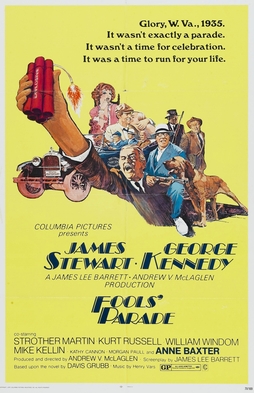
Fools' Parade

So you know what sounded pretty awful? The Great Depression. Man, I'm good at writing introductions to these reviews, aren't I? For every well-known Depression-era movie out there, it seems like there's that many more generally forgotten in a wave of flicks. Here's one I stumbled across on a cable movie channel recently and simply couldn't pass up because of an impressive cast, 1971's Fools' Parade.

It's 1935 and three convicts are being released from a West Virginia penitentiary, including Mattie Appleyard (James Stewart), Lee (Strother Martin) and Johnny (Kurt Russell), all of them having served their sentence for varying crimes. They're driven to the train station by a vicious prison guard, Doc Council (George Kennedy), who ominously states that he'll see them soon. The trio boards the train with plans of opening a general store down the train line, using Mattie's hard-earned savings as a bankroll to get things started. There's a problem though as they get further away from the town and penitentiary. Mattie's check -- earned and saved from 40 years in prison -- can only be cashed back in Glory...where they've been less than pleasantly told to never come back. If they do, Council will be waiting for them. That's not their only problem. Council may not even be waiting that long to hunt them down...

From the older classic like The Grapes of Wrath to the newer entries like O, Brother, Where Art Thou, Depression-era flicks are a cool little genre of flicks that doesn't always get a ton of attention. Maybe it's the whole soul-killing tone of these flicks. Maybe. I don't know. The 1970's especially had some cool entries, including this flick, Emperor of the North Pole, Hard Times, Paper Moon and Dillinger among others. 'Parade' belongs in that group. It's dark(ish), gritty and has the look and feel of one of America's roughest historical stretches.

So why then does this 1971 drama with some light comedy touches have virtually no reputation? Virtually no following? Well, for starters, it most definitely and assuredly is very, very odd. I can't specifically put a finger on said oddness, but it is. It's there. It...is...odd. Maybe as close as I can get is the tone, or lack of. From director Andrew McLaglen and a screenplay by James Lee Barrett, 'Parade' is just a bit of an oddball flick. It's able to build up an impressive sense of doom early on but it never quite takes off. Things slowly derail as the 98-minute running time nears its finish. Still, this is a movie that's never dull or boring. Very watchable, just odd.

Sometimes, an all over the place tone comes in second to something, anything else that's far more appealing. Here, that's easy. It's the cast. That cast. We mostly follow our three recently-freed crooks in Stewart, Martin and Russell. Stewart's Mattie served a 40-year sentence for killing two men, Martin's Lee six years for bank robbery, and Russell's Johnny a shorter sentence for an incident with a girl that's generally left unexplained. The story doesn't linger long on our trio's past criminal transgressions (wisely), instead focusing on them trying to start over again, albeit at different points in their lives. I especially liked Stewart as Mattie, sporting a bizarre-looking glass eye, the oldest of the three who most strongly wants that fresh start. He stashed away all his money during his 40-year sentence (earning a ridiculous-sounding $25,000) and now meets all sorts of roadblocks in getting that cash. Martin's Lee is seemingly a little simple-minded in his obsession with putting together a general store inventory while Russell's Johnny is stubbornly loyal to Mattie. Still, there's something charming about the trio, and there is a solid chemistry among the group.

An interesting cast all-around. When he wanted to, George Kennedy could play one interesting bad guy, and that's on display here. It's just creepy watching him. You're rooting for him to get his due and get it badly. Who else to watch for? An unrecognizable Anne Baxter as a madam who's fallen on hard times, William Windom as an unlucky traveling salesman, Mike Kellin and Morgan Paull as Doc's oddball killers, Robert Donner as a train conductor, Katherine Cannon as Baxter's lone "girl," and David Huddleston as the greedy bank owner. Quite the eclectic bunch!

I can't quite put my finger on it as to 'why' exactly, but I very much enjoyed this movie. Though the subject matter is dark, it is an easy-going, mostly pleasant movie. Yeah, it is a touch slow at times for a movie that runs just 98-minutes, but it is never dull. The West Virginia filming locations are an ideal backdrop for the story as well, giving it an authentic sense of watching where this story would have actually happened. Worth a watch. Apparently, it's somewhat difficult to find so here's my help to the situation. I watched it on Retro, a movie channel coupled with the Encore package on cable. It's a movie I recommend tracking down. Hope you enjoy it!

Fools' Parade (1971): ***/****

Monday, December 28, 2015

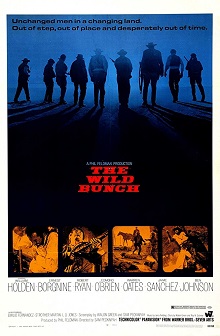
The Wild Bunch

By 1969, director Sam Peckinpah had worked on several TV series and several film productions, including The Deadly Companions, Ride the High Country and Major Dundee. He was an incredibly talented director but one whose fiery personality and personal demons could potentially derail any film he worked on. But in 1969, it all came together, Peckinpah making his classic, his all-time great film, one of the best westerns ever and best films ever in general, 1969's The Wild Bunch.

It's 1913 in a small border town near the Rio Grande, and a gang of outlaws, led by the infamous Pike Bishop (William Holden), disguised as soldiers ride in to rob the bank of a rumored silver shipment. The robbery is an epic disaster as a posse of bounty hunters, led by Deke Thornton (Robert Ryan), a paroled outlaw who used to ride with Pike, is waiting in ambush. Many of Pike's gang is killed in the robbery that nets them NO money. The remaining members of the gang, including Dutch Engstrom (Ernest Borgnine), retreat into Mexico. They need a new job, a new robbery, a new chance to earn some money. Pike especially knows that time is running out, that times are changing, and their chances at surviving as outlaws is becoming ever more unlikely. It doesn't help that Deke and his bounty hunters have followed them into Mexico, looking to collect the bounties on these infamous outlaws. With time running out, what do they do?

What a movie. Every so often, each and EVERY thing involved in the making of a film comes together and forms that perfect symmetry. 'Bunch' is an all-timer, not just a movie I love but a great movie in terms of storytelling and in technical terms. Appropriate for the time it was released (the late 1960's), it is cynical, horrifically violent, brutally honest and generally downbeat. This is a western and film ahead of its time, helping set the tone where films would go in the coming years. This is Peckinpah at the top of his game. He would have other good to great to classic films, but this is his Great film. Just a gem.

There is little to nothing to criticize here. While the filming process sounds incredibly interesting (a film in itself), the choice to film in Mexico pays off huge dividends. Cinematographer Lucien Ballard shoots a beautiful movie with the Mexican countryside and desert as a backdrop. The locations are phenomenal. You feel like you're watching the actual settings of the Mexican Revolution to our story. Composer Jerry Fielding turns in quite the memorable score as well, appropriately epic at times and equally quiet and emotional as necessary in other scenes. Listen to a sample HERE. As for the story itself, Peckinpah and writer Walon Green turn in a screenplay that's just a gem. It isn't a movie in a rush, letting things breathe and allow the viewer to get to know the characters -- for good or bad -- over its 145-minute running time. Sit back and take it in. You shan't be disappointed!

Many westerns have dealt with the death of the old west, the end of an era, but none better than The Wild Bunch. It's 1913 and there's no place for these outlaws, killers and gunfighters anymore. The world is changing, and civilization (of sorts) is moving in to replace them. We follow a gang of those outlaws, robbers, killers/murderers as they try to pull off their one last job and step away, and it's a testament to the acting on display and screenplay that we feel any sympathy at all to these men. Like few movies I've ever seen, there is a doomed quality to these men who are working with limited time on their hands. They know the door is closing on them, more than likely a bloody death awaiting them if they don't figure out something soon.

Where Peckinpah's screenplay is so strong is in its characterization and its depth. There's a whole lot of acting talent on display in 'Bunch,' and for much of the cast, this is their all-time best performance or certainly one of their best. Holden's Pike Bishop is one of the most fascinating characters ever in my book, an aging outlaw who's outlived his time but doesn't know what else to do. Borgnine too is excellent as Dutch, his right-hand man who can also see the writing on the wall. Their scene together after the early botched robbery is essential, two men who potentially know what awaits them but go into things willingly because maybe that ending is what's supposed to happen. On the counter, Ryan's Deke Thornton is equally tragic. He's riding after his old partner, Bishop, and would much rather be riding with them than chasing them. But as the script relies on, your word is your word, and these men live by that coda.

One of the many things Peckinpah loved to touch on in his films was that bond of men under fire who come through while others don't. Holden's Pike is the mouthpiece for that concept, of giving your word and sticking by it even when it'd be far easier to tuck your tail and run. We see that again and again with the bunch, including Pike, Dutch, old, grizzled Sykes (Edmond O'Brien), the crass, unsavory Gorch brothers, Lyle (Warren Oates) and Tector (Ben Johnson), and Angel (Jaime Sanchez), the youngest of the group, a fiery Mexican. What's interesting is that though Pike and the bunch claim to live by this coda, they continue to fall short of actually living up to it. It's when they realize their faults in that department that the story takes a far more tragic turn toward the inevitable ending that you just knew was coming.

Because the already-mentioned star power wasn't enough, here's some more! Along with Ryan, look for scene-chewing Strother Martin and L.Q. Jones as two scummy bounty hunters with Albert Dekker as the railroad magnate "employing" them. Emilio Fernandez is perfectly slimy as Mapache, the Mexican general claiming to be some sort of freedom fighter but it seems it is all for show, for more power, with Jorge Russek and Alfonso Arau (El Guapo in Three Amigos) as his subordinate officers. Also look for Bo Hopkins, Dub Taylor and Chano Urueta in key (if small) supporting parts.

What 'Bunch' has become synonymous with over the years is its groundbreaking, sometimes horrifying portrayal of on-screen violence. It's not that Peckinpah lingers on the violence for the sake of shock value. Far from it, but instead he makes it into an art form. The idea of a 'dance of death' comes to mind in any portrayal of violence with three main set pieces (1. The opening robbery turned into a bloody shootout 2. A prolonged train robbery and 3. The final, bullet-riddled and blood-splattered gun battle). The editing is ridiculously fast and cut in with perfect uses of slow motion. Simply put, there is an art to Peckinpah's use of violence, both in the editing, in the overwhelming use of slow-motion blood squibs, and the impact of that violence we're seeing. If Bonnie and Clyde opened the door some for its own use of on-screen violence, Peckinpah's The Wild Bunch kicked that door wide open. Almost 50 years later, it still resonates, and it's clear the impact it had on hundreds and thousands of movies released since.

It all builds to maybe the most memorable action sequence of all-time. If it's not No. 1, it certainly belongs in the conversation. In a sequence that's been dubbed "The Battle of Bloody Porch," it all comes together in an extended sequence that has lost none of its edge since its release in 1969. This is a transfixing scene that is equal parts horrifying and startling but you just can't look away. There are too many great moments just in this scene alone to mention, including an improvised walk the Bunch takes on their way to a final showdown (maybe the movie's second-strongest sequence). It is followed by a quick, shocking death, and then an eerie moment of silence that hangs in the air. With one gunshot, it is on, bullets flying thick in the air. Obvious SPOILERS but you can watch it HERE. If you haven't seen the movie, I don't recommend watching the sequence out of context. Watch the movie and soak it all in as part of the whole product. Just a remarkable extended sequence with virtually no music. The focus is the characters, violence and death. Nothing more. Nothing less.

A classic in every sense of the word. I pick something new up with every viewing, and it never loses any of its impact. A film without a weakness.

The Wild Bunch (1969): ****/****

Thursday, January 29, 2015

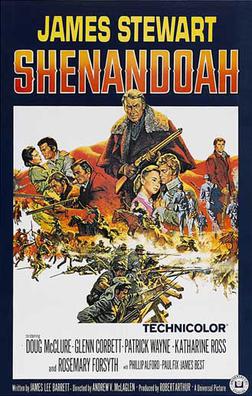
Shenandoah

As far as directing powerhouses of the 1960s, Andrew V. McLaglen will never be remembered as one of the greats. He started off in television before making the jump to feature film, teaming several times with John Wayne while also specializing in audience friendly "guy movies." Good guys versus bad guys, lots of familiar faces and situations, you know the formula. One of his best? An underrated Civil War drama, 1965's Shenandoah.

It's 1864 in Virginia, and the tide of the Civil War has turned as the Union forces are slowly beating down the Confederate armies. Doing his best to remain free of the bloody fighting, farmer and patriarch Charlie Anderson (James Stewart) wants nothing to do with the war. Both for himself and his family -- seven kids, one daughter-in-law -- Anderson simply wants to keep working his 500-acre farm and get through the war unscathed. Fight for Virginia? Fight for slaves he doesn't have? He fights for what he believes in, his family and his farm. Well, that's what he'd like to do. While the fighting rages on, Charlie is stunned when he finds out his youngest son (Phillip Alford) has been confused as a Confederate soldier and captured by nearby Union forces. Now the war and the fighting that Anderson has done so well to steer clear of has landed square on his front porch. Can he find his son amidst the hell of war?

This was a movie I watched often growing up when my sister and I had sleepovers with my Grandma. It made an excellent Civil War double feature with Friendly Persuasion, and let me tell ya, they both hold up! I watched this McLaglen-directed Civil War drama for the first time in years, and it resonated just as much now as an adult as it did when I was a kid, if not more. McLaglen had some excellent movies to his name -- The Wild Geese is a favorite, Hondo, McLintock are also excellent -- but this is his best movie overall. The story is a series of very effective, often moving and often disturbing vignettes, all held together by the Anderson family. Filmed on-location in Oregon and California, 'Shenandoah' is an underrated visual film, and the musical score from composer Frank Skinner is a gem. So what stands out viewing this one as a 29-year old, not a 13-year old kid?

That would be James Stewart, one of my favorites in just about any movie he's in. This doesn't get the attention or notoriety as one of Stewart's best performances, but it certainly belongs in the conversation. I love what he does with the part of Charlie Anderson, a stubborn, feisty Virginia farmer and widower looking out for the best intentions of his family. He doesn't care about the war, about slavery, about Union and Confederate. He will do anything, ANYTHING, to protect his family. Stewart has some great scenes with the younger supporting cast, especially Alford's youngest son, only called 'Boy,' with his daughter, Jenny (Rosemary Forsyth), daughter-in-law, Anne (Katharine Ross), and his sons. There are too many memorable, emotional scenes to mention, but my favorites are the most simple. Minutes before the Andersons go to church each Sunday, Charlie visits his wife's grave and just talks to her. Simple perfection, Stewart absolutely nailing the underplayed but charged scenes. 

Stewart is the unquestioned star of McLaglen's film, but 'Shenandoah' offers quite the ensemble of recognizable faces. Glenn Corbett and Patrick Wayne play Jacob and James, the two oldest brothers. Corbett especially stands out as Jacob who's beginning to question if their choice to stay out of the war is the right decision. Wayne is solid too, especially in his scenes with Ross. In her film debut, Forsyth is excellent, a subtle scene-stealer as innocent, tough and thoughtful Jenny who's also interested in a young Confederate soldier, Sam (Doug McClure). The other Anderson boys include Charles Robinson, Jim McMullan and Tim McIntire. Maybe the best thing you can say about the story is that the family dynamic, it just works. You believe them as one cohesive unit, one that stands together through thick and thin.

But wait, there's more! Also look for George Kennedy as a sympathetic Union officer, Gene Jackson as Gabriel, a friend of Boy's, a slave, Paul Fix as the local doctor, Denver Pyle as the pastor, James Best as Carter, a fellow prisoner who takes Boy under his wing, Harry Carey Jr. as another Confederate prisoner, Tom Simcox as Lt. Johnson, a Confederate officer, with Kevin Hagen, Dabbs Greer and Strother Martin also playing small but memorable parts.

So 29-year old me certainly picked up some new things, or at least was able to process things differently. This is one hell of an anti-war flick. The portrayal of the latter stages of the Civil War is unsettling and often times, disturbing. Death awaits around every corner, hiding behind every tree. The lines are up in the air as the war takes a turn toward its ultimate conclusion. A late battle between a small Confederate camp and a larger Union force with heavy artillery is quick and awful and uncomfortable, one of the more underrated battle sequences I can think of. The last half hour especially features one kick in the gut after another that truly hammers home the anti-war message. And that last scene? Pretty perfect, the possibility of hope lingering in the air amongst all this pain and suffering and death. One of my favorite movies.

Shenandoah (1965): ****/****

Wednesday, October 22, 2014

Nevada Smith

Just a few weeks ago, I watched and reviewed 1964's The Carpetbaggers, the story of a business mogul expanding his empire in the 1920s and 1930s. A minor character in the story? An aging cowboy turned western movie star, Nevada Smith. His backstory is explained but not shown. That's for a prequel made two years later, 1966's Nevada Smith.

Working at his father's played-out mine that has recently produced some gold deposits, a young half-breed Max Sand (Steve McQueen) is away from the house when three outlaws (Karl Malden, Arthur Kennedy, Martin Landau) ride up looking for that gold. Max is too late to help though, arriving at the house to find the tortured, mutilated corpses of his parents. The outlaws are nowhere to be found, but their trail is easy enough to follow. Max's biggest problem though? He's capable of caring for himself on the trail, but he has little money and no real experience with guns, especially when it comes to actually using a pistol or rifle on a human being. Desperate and with no supplies left, Max tries to rob a man on the trail. Instead, the man, Jonas Cord (Brian Keith), an experienced trailsman and capable shot, teaches Max all he can in his quest for revenge. His biggest advice though? Abandon his quest for revenge and move on with his life, but Max isn't hearing it.

It had been years since I watched this 1966 western from director Henry Hathaway (a solid western director, True Grit, Sons of Katie Elder). My biggest takeaway? It isn't as good as I remembered. Still good, still enjoyable, but not as good. There's still positives to take away though. 'Nevada' was filmed on-location in Inyo National Forest and the Owens Valley in the Sierra Mountains. Visually, it is a stunningly good-looking film with the mountains as a backdrop to the revenge story. The score from composer Alfred Newman is solid -- especially the main theme -- but isn't necessarily used enough. The best thing going is the revenge motive, a pretty gruesome story at times. Not graphic, just really violent because we know what's happening. Stabbings, drownings, choking, beating, systematic shooting of an unarmed man. It can be pretty rough at times.

So if you watch this 1966 western and come away a little confused, there's a good reason. The Max Sand character is young, really young. I'm assuming a teenager, maybe approaching 20. When the movie was made in 1965, McQueen was...35. And he's a half-breed with a white father and Kiowa mother. So yeah, he doesn't really look like a teenage half-breed (with his blonde hair too) in a pretty obvious case of miscasting. Still, McQueen makes the most of it. With the revenge motive, it is a fascinating character. Max -- later dubbing himself Nevada Smith -- becomes obsessed with killing his parents' murderers no matter what the cost on those who are helping him. McQueen does a good job in a physically demanding part, doing his own stunts while also adding a dimension of pure physicality to the performance. It's not often spoken words, just a sad look here, a drop of his shoulders there. Not ideal casting, but McQueen makes the most of it.

But the rest of the cast? The rest of the cast?!? It's pretty great. Brian Keith has always been one of my favorites, but I think this is one of his bests. His Jonas Cord is only in the movie for about 20-25 minutes but steals every scene he's in. His chemistry with McQueen is pretty perfect, and their scenes together crackle, an experienced hand with a gun trying to teach the younger Max all he can through good and bad. The Jonas/Max dynamic has always been my favorite, the movie's strongest point. With the episodic story, Malden, Kennedy and Landau make the most of their screentime, three particularly nasty villains you can't wait to see get their due. Raf Vallone is good too as Father Zaacardi, a priest who comes across Max and helps him in a time of need. Also look for familiar western faces Gene Evans, Paul Fix, Pat Hingle, John Doucette, Lyle Bettger, Howard Da Silva and Strother Martin in supporting parts.

Where does 'Nevada' go a little off the tracks then? At 130 minutes, it drifts too much with some extremely slow portions involving the episodic story. There just isn't a ton of energy at times. Two semi-love interests are added, Janet Margolin as an Indian dance hall girl and Suzanne Pleshette as a Cajun girl, are meant to show Max's obsession over a possible future with either, but they become repetitive and tedious. Just not a ton happens. The performances are good, the locations cool, but it's missing that special something. Good but not great.

Also worth mentioning is a western nerd moment. Any western fan who's seen any number of 1960s westerns will recognize Chuck Roberson, Chuck Hayward and Jerry Gatlin as background players and supporting parts. 'Nevada' takes that to new levels. Watch closely and you see them all playing multiple parts. In one scene, Roberson is part of Malden's gang, and the next he's Paul Fix's deputy. It's a little much and a little lazy, something Hathaway also did in Sons of Katie Elder. Thus ends this rant.

Nevada Smith (1966): ** 1/2 /****

Friday, April 18, 2014

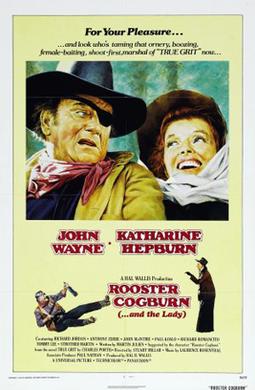
Rooster Cogburn

By the 1970s, there weren't too many bigger and better Hollywood legends than John Wayne and Katharine Hepburn. Both stars had been just that, stars, non-stop since the 1930s and by the mid 1970s were in the later parts of their careers. But even with all those classics films, classic roles and interesting pairings of stars, the duo had never worked together...until 1975's Rooster Cogburn, also known as Rooster Cogburn...and the Lady.

Still working as a U.S. Marshal, Rooster Cogburn (Wayne) is up to his old tricks again. Not too interested in how the law says he should bring suspects in, Cogburn has been suspended for his overzealous ways...for now. He's given his badge and title back if he promises to bring in a dangerous gang of killers led by a maniacal outlaw, Hawk (Richard Jordan). The outlaw's gang murdered an army convoy carrying nitroglycerin, shipments of rifles and a Gatling gun. Their goal? Knock off a federal depository up in the mountains. Cogburn is on their trail quickly, but he's got a problem. In Hawk's wake, the marshal finds an older woman, a missionary of sorts, Eula Goodnight (Hepburn), who saw her father and his mission almost wiped out by the gang. Cogburn hopes to bring her back to safety, but Eula has other plans. She intends to go with, helping bring her father's killers to justice.

I'm usually completely against sequels, especially when the first movie wraps up everything so nicely. That's the case with 1969's True Grit, a western that brought Wayne his only Oscar win for a long, distinguished career. It isn't a great western, but it has stood the test of time because of Wayne's scene-stealing part as Marshal Rooster Cogburn. This 1975 follow-up from director Stuart Millar takes the formula and takes it a step forward, pairing Wayne with Hepburn in a similarly scene-stealing part. Much the same way 'Grit' resonates, so does 'Rooster.' It's typical of many other late Wayne entries, straightforward and entertaining, likable, fun good guys versus dastardly bad guys, and just a lot of fun throughout. Laurence Rosenthal's score is solid, tweaking Elmer Bernstein's score from the original. Listen HERE for the theme. The Oregon locations go a long way too, the backgrounds for the shots providing a stunningly good-looking backdrop to the story.

Who are we kidding though? This is a movie that exists solely to put John Wayne and Katharine Hepburn together. The wait was worth it, the two Hollywood legends stepping to the plate in a big way. They make it look effortless. We learn some more about Rooster (including his first name), but he's still the same fat, one-eyed marshal who likes a good drink and is a tough as nails peace officer. Hepburn is not quite a spinster, but an older woman who looks to religion for answers, nagging Rooster about his drinking, his language, his boasting, a little bit of everything. The chemistry is on display from their first scene until the final scene. They argue, they bond, they talk about their pasts, finding there's plenty of differences between them, but there's also more similarities than they would have originally thought. Along for the trip is Wolf (Richard Romancito), an Indian boy in his teenage years, a capable rider who looks up to Rooster. 

If you're going to have a great hero to lead the way, you need an equally bad villain to put in his way. In steps Richard Jordan, an underrated actor who never became a huge star. His Hawk is beyond intense, his upcoming robbery of a gold depository becoming almost an obsession. In some nice touches with Hawk and his gang, we learn about some past meetings with Cogburn. In his gang, look for Anthony Zerbe as Breed, a tracker/scout who used to ride with Rooster, now on the outlaw trail, and Hawk's maligned right-hand man, Luke, played by 1970s tough guy Paul Koslo. John McIntire makes a quick but memorable appearance as Judge Parker, the court representative who always has to deal with Rooster. Strother Martin hams it up in a one-scene appearance as McCoy, a cantankerous veteran of the sea now renting his raft for river crossings.

Heading into this movie, if you're looking for any sort of groundbreaking western, you're going to be disappointed. The focus is clearly on Wayne and Hepburn, the highpoints their scenes sitting around a campfire, talking while riding on a wagon, moving along the trail. The potential was there for a darker western with more shoot 'em up and gunplay, but for the most part Jordan as Hawk is underused. This is a good, old-fashioned western that plays like comfort food. Just sit back and enjoy this one.

Rooster Cogburn (1975): ***/****

Thursday, February 7, 2013

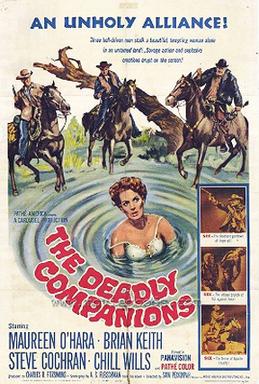
The Deadly Companions

By 1961, Sam Peckinpah had made a name for himself on the TV screen, writing, creating and even directing two different series, the classic The Rifleman and the lesser known The Westerner. The man that would go on to direct classics like The Wild Bunch, Straw Dogs, and Ride the High Country had to start somewhere though in films, and that's 1961's The Deadly Companions.

Drifting along from town to town, a man named Yellowleg (Brian Keith) teams up with two fellow drifters, Turk (Chill Wills) and Billy (Steve Cochran), agreeing to knock off a bank in a tiny, isolated desert town. As they ready to pull the job, the trio instead gets caught up in someone else's robbery, and a young boy is actually killed by Yellowleg in the process. The boy's mother, Kit (Maureen O'Hara), insists the boy be buried with her deceased husband, buried in the far-off and possibly abandoned town of Siringo. Feeling the extreme guilt over the accidental shooting, Yellowleg insists on guiding Kit through Apache territory to Siringo, but the dangerous journey holds secrets and trials that none of them were expecting. 

Everyone has to start somewhere, and for Peckinpah in films, this was it. It is an interesting debut -- both good and bad -- that certainly is a forerunner of his later movies. While limited by a smallish budget, Peckinpah shows a knack that viewers would come to expect with movies like The Wild Bunch and Ride the High Country. According to O'Hara's biography, the filming was a less than pleasant process as first-time feature film director Peckinpah adjusted to shooting on a bigger scale than TV allowed. It's interesting though because with the exception of maybe Junior Bonner or Ballad of Cable Hogue, this is probably his least violent film. There are flaws, but I also think there's a hidden gem among all those flaws.

Let's start with Brian Keith as Yellowleg, a former Union officer traveling the west looking for vengeance on the man who tried to scalp him during the Civil War. That man? Chill Wills' Turk, a former Confederate soldier on the brink of lunacy trying to revive the Confederacy. Keith's Yellowleg (we never learn his real name) wears his hat low on his hat, never taking it off, because of the scar across his forehead from the failed scalping. He's also carrying a bullet in his shoulder and struggles to fire his gun accurately because of the wound. Peckinpah favored wounded, scarred anti-heroes dealing with extreme internal demons struggling to come to terms with those demons. I like Keith more and more with each passing part, and this is a very good one, if not one that's easily remembered as one of his best.

That's what I like about this first Peckinpah feature film. It isn't a classic by any means. But considering it was released in 1961, it's hard not to be impressed. This is far from a typical western released in that year, starting to reflecting the changing times, and that's what surprised me (although I guess it shouldn't have. Peckinpah wasn't exactly a touchy-feely kind of guy). This is one epically dark western. Each and every character is a tortured individual, all struggling to cope with something. Even the bad guys -- perfectly cast Cochran and Wills -- are trying to rape O'Hara's Kit, rob banks, shoot Yellowleg in the back and so on. Not nice guys. The background gives it all more depth; a former Union soldier obsessed with revenge on the Confederate who tried to scalp him? Oh, and a little boy gets gunned down in the first 20 minutes? It's hard to imagine a 1961 getting any more dark. 

As I mentioned, this is far from an action-packed western. At the same time, it isn't exactly story-heavy either. It leans more toward episodic as Yellowleg, Kit, the two gunslingers and the dead boy make their way to Siringo. The focus is on Yellowleg's demons, Kit's mistrust and hatred of the man who killed her boy, and a vengeful Apache trying to kill them. I liked the dynamic between Keith and O'Hara especially. An IMDB reviewer compares it to an artsy Euro-western, and I'm hard pressed to disagree. The music from Marlin Skiles -- heavy on Spanish guitar, accordion and harmonica -- is oddly effective and appropriate. The look (including on-location shooting in Arizona, especially Old Tucson) is dreary and washed-out, reflecting the generally dark demeanor and tone of the story. Oh, and it is a Peckinpah film, watch for Strother Martin as a fire-breathing parson.

Things aren't perfect of course. At 93 minutes, 'Companions' can be a tad disjointed. Scenes transition from one to another without any real transition, scenes ending on odd notes as the screen fades to black. The ending especially is a little crazy as the studio took the finished film away from Peckinpah (a recurring trend later in his career) and reedited it into an indecipherable, completely out of place happy ending. It's still a good movie that doesn't deserve all the flak it takes, and one Peckinpah fans should definitely see. You can watch the entire movie HERE at Youtube, but it is a public domain print and therefore, not a good one. Hold out for another airing on TCM.

The Deadly Companions (1961): ***/****

Thursday, June 21, 2012

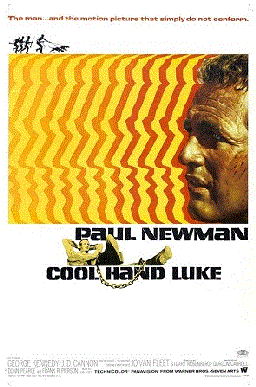
Cool Hand Luke

Heroes are supposed to be noble, loyal, honor-bound and always do what's right. But in the 1960s and its increased cynicism from the audience, was that concept of a hero really going to fly? The idea of an anti-hero started popping up in the 1950s thanks to James Dean and Marlon Brando among others, but for me, the one that kicked the door open in the 1960s was Paul Newman in 1967's Cool Hand Luke.

Having taken the heads off of a long row of parking meters, a drunken Lucas Jackson (Newman) is arrested and sentenced to a two-year sentence on a chain gang in Florida. He meets the Captain (Strother Martin) and his bevy of guards who keep their prison camp roster of 50 prisoners busy on the roads six days a week, but this camp has had nothing like Luke. Easy going enough early on in his sentence, he begins to bristle at being imprisoned, at being told what he's supposed to do. He becomes a hero to his other prisoners, forming a friendship with head honcho, Dragline (George Kennedy), but Luke can only take being held down for so long, and he wants out now.

Paul Newman is one of my all-time favorites, and this is HIS iconic part. Butch Cassidy, The Hustler, The Sting, and many others, all memorable roles, but nothing quite like this one. Want a face for a 1960s audience looking for something different? In steps Lucas Jackson, a man who has little regard for what society says he should do with his life, even less regard for any sort of authority hovering over him. Newman makes Luke -- dubbed 'Cool Hand' for a bluff in poker -- a charming, likable individual, his easy-going, natural smile disarming you in a second. We learn a lot about this character with little background (a veteran, countless jobs, a drifter), finding out that no one and no thing will slow him down. He will do things on his terms, and anyone else can be damned. Newman at his best.

With Newman's Oscar-nominated part at the head, 'Cool' has become one of the seminal movies of the late 1960s, ranking up there with The Wild Bunch, The Graduate, Bonnie and Clyde and several others I'm missing. This is a movie made for a late 1960s audience that isn't content with the status quo. No respect for authority or the so-called 'system'? Check. An anti-hero that wants to do things and live his life his way? Double check. The system are Martin's quiet but intense Captain, Boss Godfrey (Morgan Woodward), the silent guard who wears his ever-present aviator glasses, along with steely-eyed Luke Askew, Richard Donner and John McLiam.  The system is the villain here, imprisoning and breaking the individual down to conform. It's easy to see the appeal in 1967, and just as easy to see now 45 years later in 2012. The thinker, the free spirit, the intelligent rebel, it's an appealing character and premise to root for.

Because Newman's performance is so strong at the top, another part of the film gets lost in the shuffle, and that's the ensemble cast all around him from Martin and Kennedy to the guards to the prisoners. Martin is perfect in his few scenes, including muttering the iconic 'What we have here is failure to communicate.' Kennedy won an Oscar for his part as Dragline, an illiterate but intelligent and fast-talking prisoner who all the other prisoners look up to. Newman and Kennedy play off each other impeccably, the subtle, underplayed Luke with the showier, aggressive and funny Dragline. Other prisoners include J.D. Cannon, Lou Antonio, Robert Drivas, Harry Dean Stanton, Dennis Hopper, Wayne Rogers, Ralph Waite, Joe Don Baker, Dick Davalos and Buck Kartalian among others. Clifton James and Anthony Zerbe are good as prisoners turned associates who help the guards. 

Like any movie that lives on so many years after its release, there's got to be something to make it memorable, and director Stuart Rosenberg doesn't disappoint. The most obvious is Luke stating he can eat 50 eggs in an hour, a classic sequence in its humor, but there's so much more. Luke singing Plastic Jesus -- watch HERE -- after receiving some distressing news is an all-time great. There's Luke earning everyone's respect in a brutal, knock-down boxing match (watch HERE), refusing to go down even when he's beat. There's a teenager washing a car, driving the on-looking prisoners wild (HERE), and up there with Plastic Jesus for the most moving scene, Luke talking with his dying mother, Arletta (Jo Van Fleet). Almost scene-to-scene is aided by composer Lalo Schifrin's amazingly spot-on music, especially the main theme which you can listen to HERE.  

What struck me most in my latest viewing was the darkness of the story. The first hour is generally light-hearted, introducing characters, backgrounds and interactions, setting us up by liking Newman's Luke so much in spite of his bullheaded stubbornness. I'd forgotten then how intensely dark and at times uncomfortable the second half of the movie is. From the start, we know Luke is heading down a bad road, but that unbearable tension and impending sense of doom keeps building. The movie still has its lighter touches -- Luke's escapes provide some unlikely humor -- but there will not be a truly happy ending here. In the end though, one of the final shots shows that free spirits might not always win, but that also doesn't mean the system, authority and power positions will win either. The symbolism can be a little obvious, a little heavy-handed, but the message still strikes a chord.

A classic from beginning to end. End of story.

Cool Hand Luke <---trailer (1967): ****/****

Saturday, February 25, 2012

Drum Beat

History provides all sorts of little tidbits, small, little-known stories that are often enough lost in the history books. The development of the American west had countless examples of this in the 19th Century, small-scale incidents that were major at the time, but were generally forgotten. Made in 1954, Drum Beat is a solid and generally forgotten western telling the story of the Modoc War in 1872 and 1873.

A well-known and respected Indian fighter, Johnny MacKay (Alan Ladd) has been tasked with a mission from President Grant (Hayden Rorke). In the Oregon territory, the Modoc tribe has left the reservation and causing problems for the white settlers. Johnny is hired as a peace commissioner with the hopes of both the white settlers and and Modoc Indians signing a treaty that will bring a halt to all the violence. He is skeptical of the two sides working together, but Johnny travels back west hoping to meet with Captain Jack (Charles Bronson), the chief of this group of Modocs. The Indians are less than cooperative though, and peace won't come easily.

From director Delmer Daves, this is a BIG western. It isn't an epic that runs 3-hours with intermission and a cast of thousands, but it is nonetheless big. It was filmed in Cinerama and takes full advantage of the on-location shooting in Sonora. You can see and feel the immensity of the frontier as the settlers tangle with the warring Indians. The developing story is somewhat familiar in that sense, but it never feels dull. Yes, there are scenes that rely solely on the natural background, long, uninterrupted scenes of riders moving across a horizon. At 111 minutes, it is a tad long in the tooth, but it's not a deal breaker. Victor Young's score is appropriately sweeping without overpowering anything on-screen, and thankfully the Ballad of Drum Beat is only played over the opening credits.

With Daves at the helm, the story is just solid. He's an underrated, underappreciated director who was consistent throughout his career, directing one excellent movie after another. The story is familiar here -- settlers/whites vs. Indians -- but it doesn't feel familiar. Credit to Ladd and Bronson there. I really liked Ladd's performance as Johnny MacKay, an Indian fighter who's good at what he does but doesn't necessarily enjoy it. Bronson as an Indian seems like a bad choice, but that too works. It borders on a caricature but never goes too far. He looks out for the best interest of his tribe...at first...only to get swept up in the glory of fighting. Their scenes together are surprisingly good, especially their final scene in the closing minutes. The fight leading up to that scene ain't too shabby either.

An ensemble cast of familiar faces backs up Ladd and Bronson, Audrey Dalton leading the way as Nancy, an Easterner who's moved west to help the cause and surprise, surprise...falls for Ladd's Johnny! Who saw that coming?!? Oh, everybody? My bad. Marisa Pavan and Anthony Caruso rise above stereotypes as Toby and Mannock, two peaceful Modocs working with Johnny and not against him. Robert Keith plays Bill, an older frontiersman with a grudge while Rodolfo Acosta and Perry Lopez play two of Bronson's warriors. Look for recognizable character actors Willis Bouchey, Elisha Cook Jr., Strother Martin and Denver Pyle in small parts.

As a quasi-western buff, I do have to poke some holes in this story. A title card starts with 'This is true except for the fictional characters and storylines needed to dramatize the truth.' So basically a cop-out. A true story until the truth isn't entertaining enough. Sonora, Arizona does not look like Oregon in the least, and the Modocs look and are portrayed more like Apaches than any other tribe. Just weird observations that ran through my head. Still a good movie, especially a large-scale battle on a Modoc fortress on an impenetrable rock formation, with an interesting cast.

Drum Beat <---credits/opening (1954): ***/****

Thursday, December 1, 2011

Target Zero

Cliched, familiar, flawed, been there and seen that, all things that came to mind while watching 1955's Target Zero, a Korean War story of a lost patrol trying to make it back to their own lines. I've seen this movie before with a different title, and typically I always like them. With a fun couple tweaks here, I liked this one too even if it could have been a B-movie classic.

After a day of heavy fighting, U.N. staffer/nurse Ann Galloway (Peggie Castle) finds herself behind enemy lines with no way to get back to safety. A British tank crew (commanded by Richard Wyler) stumbles upon her and picks her up, the battle-scarred tank running across the remnants of an American patrol, commanded by Lt. Flagler (Richard Conte). Working together, the ragtag group hopes to make it back to American lines, Flagler insisting they head for a strategic hill position. Can they make it through a gauntlet of North Korean soldiers? Will anyone even be at the hill if they make it?

The Lost Patrol, The Steel Helmet, Anzio, this story has been done before and will most likely be done again. The story of a small group of survivors banding together to make it through enemy-infested territory is nothing new to any war movie, Korean or not. But as is the case here, it's just familiar enough to be a fun ride to go along with. Flagler's patrol unknowingly walks into a minefield, hides out as a North Korean patrol walks by, fights among themselves. You name it. You've seen the stereotypes elsewhere if you've even seen a couple war movies. If you can get past the cliches -- or at least go along with them -- you'll most likely enjoy this movie at least a little bit.

Filling out the unit, I had trouble going along with Conte as Lt. Flagler, the idealistic officer who lives for his company and nothing else. Conte's a better villain than a leading man, and I don't see the appeal or respect his men have for him in 'Target.' His patrol includes Charles Bronson as the loyal sergeant, Chuck Connors as Moose, the radioman, L.Q. Jones as O'Hara, the fast-talking Southerner, Strother Martin, Abel Fernandez as Geronimo, an Apache, Don Oreck as Della Nueva, a Latino boxer, and an uncredited and unlisted Richard Park as Pvt. Man Koo, a South Korean soldier. The British tankers include John Alderson and Terence Marney while John Dennis and Aaron Spelling play two American soldiers picked up carrying a mortar tube and little else. Cool little group, Bronson standing out along with Connors and Jones.

Early on, I was more than pleased to see Castle's Ann introduced into the story. A female nurse along for the trip was certainly a unique addition to the story. It takes about 30 minutes before she falls madly in love with Conte's Flagler. She loves him because he's good to his men, because he's driven, because he's a good leader. Yeah, that's awesome. Their scenes together try to explain war, figure it all out, talking about death and moving on, finding a way to cope. Someone picked up War Movie Dialogue Cliches 101 and turned it into a script. Castle's performance is fine -- nothing against her -- but these scenes are painful to watch.

At times playing like an episode of Combat (that's a compliment, I love that show), 'Target' is at its best dealing with the action. It was filmed at Fort Carson, an Army base in Colorado, and it has a great look of a stark land -- in black and white at that -- where anything could happen and anyone could be hiding. Thanks to the filming location, there's also some great aerial footage of fighter jets helping the patrol. The ending certainly influenced 1962's Hell is For Heroes, the patrol stranded on a lonely hilltop ready to face an attack from the North Koreans.

The set-up and intro to that action finale is impressive, but the execution -- or lack of -- is a little disappointing. With a unit picture, usually some men in said unit get picked off, dying in battle. Not here (that page of War Movie Cliches must have fallen out). Everyone makes it. A darker ending is hinted at, including killing Castle's Ann before the North Koreans can get her, but 'Target' doesn't go that far. It's still an entertaining if flawed movie, worth a watch.

Target Zero (1955): ** 1/2 /****

Sunday, October 2, 2011

Hard Times

In one of the first reviews I did a couple years ago, I said Charles Bronson is cooler than you. He was....that's all.  There's no argument or counter. Charles Bronson was cool as hell.  Later in his career, he got into a rut of Death Wish and Family of Cops movies, but in his heyday in the 1960s and 1970s there were few actors who were as popular as the coal-miner turned action star. He wasn't a great actor in the traditional sense, usually playing quiet anti-heroes who rose to the occasion as needed. But at his best, he was a brewing, intense presence of an actor, especially in 1975's Hard Times.

Whenever you read a list of 'Guy's Movies,' this should be at or near the top. This is a prototypical, definition of a guy's movie.  Tough guy actors, brutal story about street fighting, and without much in the way of romance or wasted subplots that go nowhere. If you're going to stop reading this review, here you go. 'Times' is 93 minutes of Charles Bronson whaling on people in knock-down, vicious street fights. Okay, it's more than that...but not by much. Who better to direct this guy's flick than Walter Hill? He was an underrated master at straightforward, hard-edged movies heavy on action and violence. In his directorial debut, Hill definitely comes out swinging -- pun intended.

A drifter and a loner traveling through 1933 Great Depression-riddled America, a man named Chaney (Bronson) jumps off a train and walks into a small Southern town. Looking to make some traveling money, he gets into a street fight, winning with one brutal, efficient knockout punch. There he meets Speed (James Coburn), a gambler, businessman and all-around con man, forming a partnership with the potential for lots of money to be made quickly. With opium-addicted trainer and cut man, Poe (Strother Martin), along, Chaney goes to work, and no one can stop him in a fight. He's just looking for some money though, and nothing else. No fame, no notoriety. Speed on the other hand has a different plan, including a fight worth thousands of dollars against high-stakes gambler and kingpin Chick Gandil (Michael McGuire). Will Chaney go along with it, even when a supposed ringer is brought in?

There is absolutely nothing flashy about this movie. Let's just get that out of the way. Hill isn't interested in it. His movie obviously isn't a documentary, but it definitely has the feel of one. It's a slice of life story, albeit one about a bare-knuckle street fighter. It has a folksy 1970s feel to it, a slice of American history as the country struggles through the Great Depression. Hill films his story entirely in New Orleans and never has a city looked so dirt-poor and grim and still manages to be appealing as New Orleans does here. The look of the movie feels real, not stagey or hokey or done-up like so many movies. The musical score leaves little impression, only making its presence known at the beginning and end. No frills film-making at its best, and no one knows how to do it better than Hill. His focus is on his characters and the harsh world they live in.

A poster at the IMDB actually listed every word Charles Bronson says in the entire movie. I'll say this...it isn't much. Chaney (no first name provided, or needed for that matter) is a man of few words, appropriately enough letting his fists do most of the talking.  Above all else in this movie, I loved this character. He's not showing off his ability or looking for fame. As he explains 'He knocks people down' and he's damn good at it. With little said in the way of words, Bronson makes Chaney sympathetic. We know absolutely nothing about his background or where he came from, and we don't need to know. Like so many Americans, he's had a rough time of it and is trying to keep on living. When asked if he's had a rough time, he answers 'Who hasn't?' We see a glimpse of his humanity with Jill Ireland's Lucy, but only briefly. It's in the end we see his true colors.

So I don't care if it was a movie, and the fights were staged. I want nothing to do with Bronson in a street fight. My uncle first recommended this movie to me, stating 'It's Charles Bronson beating the crap out of people." That's a pretty spot-on description. These fights are vicious, bone-rattling affairs that hurt just watching them. There is a distinct sound, a THWACK! as Bronson's punches land, especially when he throws three punches in quick succession (right! left! right!). A fight with Gandil's top fighter (Robert Tessier) is the most vicious, and an incredible scene to watch. In a grain mill or something of the sort in a fenced-off square ringed by bloodthirsty fans, they go to town. No finesse, no dancing around, just two men throwing hay-makers at each other. The final fight against the ringer, a Chicago fighter named Street (Nick Dimitri), couldn't live up to that prior fight, but still holds its own in terms of emotion and the bigger meaning, what Chaney risks to fight.

More than Bronson and the street fighting though, 'Times' has a lot going for it. Bronson and Coburn had worked together several times before, and here again they show a solid chemistry. Two of the all-time coolest actors working together is never a bad thing. Coburn's Speed is a hustler, almost always ending exactly where he started, with nothing. It's Chaney who has to save him. Martin is typically slick and oily as Poe.  Also watch for Felice Orlandi and Bruce Glover as two loan sharks on Speed's tail. An underrated movie overall, and a great example of how a simple and straightforward storytelling technique can work so well.

Hard Times <---trailer (1975): ***/****

Saturday, July 9, 2011

Pocket Money

My high school and college Spanish only takes me so far when it comes to actually understanding the language. That can be a problem when trying to understand and keep up with a Spanish movie, or at least an American-made movie dubbed into Spanish.  That's where I was first introduced to 1972's Pocket Money, a late night showing of this modern western. When I saw stars Paul Newman and Lee Marvin, I sat down and trudged through it, trying to keep up with the language the best I could.

Long story short? My Spanish isn't that good if I have to rush to keep up. I had no real concept of what was going on but went along for the ride. The problem arose that this was not a movie available in any formats, and TCM wasn't showing it as part of their rotation.  Well, finally it was released on DVD as part of a Newman film collection, and how many years later I was able to catch up with it. I knew going in that it wasn't either actor's best work, but as a fan of both, I wanted to give it a try...in English this time around.

A down on his luck Arizona cowboy, Jim Kane (Newman) has been dealt some bad news when he finds out the horses he's brought to market have to be quarantined with the horse equivalent of an STD. He needed the money he would get for the sale to pay off a bank loan, but now he's up the creek. Looking for work -- any sort of work -- Kane makes a deal with a somewhat shady businessman, Bill Garrett (Strother Martin), to herd cattle up from Mexico into the U.S. for an upcoming rodeo. Something about the deal doesn't strike Kane quite right, but desperate for the cash he takes the job. With help from an old friend and "cattle broker," Leonard (Marvin), he heads south to round up the animals, but nothing is going to go as planned for this perpetually down on his luck cowboy.

The ingredients for a really solid modern western were all here.  Marvin and Newman working together for the only time was the only selling point I needed to hear.  The plot reminded me some of Cormac McCarthy's All the Pretty Horses, and when I saw Terrence Malick had written the script I was psyched.  Throw in supporting parts for Martin, Wayne Rogers, Matt Clark, Hector Elizondo, Gregory Sierra, and Fred Graham too. Something doesn't make the transition though because the end result is a story that meanders along too much with an already short 99 minute run-time and never really gets anywhere, finishing where it started. It isn't a bad movie, just one that fails to make much of an impression.  I watched it last night and early this morning, and I'm already struggling to remember much about it. That's never a good thing.

If you're going to watch this movie though, I'm guessing it will be because of Newman and Marvin in the two lead roles.  What makes it worthwhile seeing these two legends work together is that they both play against type.  Newman's Jim is a nice enough guy, a hard worker, and a decent cowboy, but he just isn't the sharpest crayon in the box.  Stupid is too harsh, and dim-witted sounds too comical, but there's a naivete to the character that you rarely see in a Paul Newman movie. The same for Lee Marvin as Leonard, a businessman and cowboy who always wears a suit and tie while working. He's not as intense or intimidating as so many other roles, but Marvin easily slides into the part.

The chemistry between the two is not in question here.  With a story bouncing around between some dramatic scenes and some comedic exchanges, the duo makes it look effortless.  It's more impressive when you consider the script just doesn't give them much to do.  Maybe it was just early in his career as he was finding his voice, but Malick's script is not a strong one. It relies far too heavily on the star power without developing any sense of pacing or character development. As a topper, it's never quite clear what's going on.  There are moments of great quality, especially Marvin's speech to their Mexican cowhands and Newman's confrontation with Martin over their deal, but the long stretches of nothingness handicap the movie too much overall.

I can't put my finger on what went wrong with this movie.  Is it drama or comedy? Is it neither? Maybe I'm judging it too harshly, but I came away empty from it as if the movie had left no impression on me at all.  I don't know what else to say. The Mexican locations are authentic -- appropriately enough -- and Carole King's song (listen HERE) is pretty standard fare for a folk song theme played over the opening and closing credits. I wish the movie was better, but it never amounts to anything.

Pocket Money <---Youtube clip (1972): **/****

Wednesday, July 6, 2011

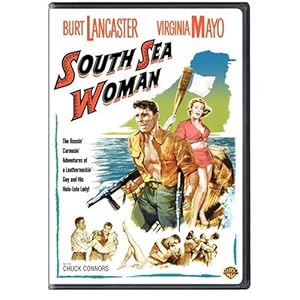
South Sea Woman

Working with stars like James Cagney, Gregory Peck and Burt Lancaster among others, it would have been easy for Virginia Mayo to get lost in the shuffle of the casts in her movies. She could have been a pretty background piece that didn't distract from the movie, letting her male co-stars do the heavy lifting.  Mayo started her career as a dancer and singer but transitioned into film. Not in many classic movies, she never achieved huge stardom but through the 1940s and 1950s, Mayo was almost always a good choice to play a strong female character without getting overwhelmed by her co-stars.

Released in 1953, South Sea Woman is a good indication of Mayo's talent.  Working alongside Lancaster for a second time after their pairing in The Flame and the Arrow with Chuck Connors playing the other lead role, she always remains at the forefront of this oddity of a movie.  The TCM description read 'A Marine sergeant battles Nazi agents to help a showgirl escape war torn China.' Having watched the movie now, I can say that is one of the most inaccurate plot descriptions I've ever read. Did the person who write that even see the movie? Regardless of its inaccuracy, the premise -- however wrong -- seems fairly serious, but this is a WWII comedy. Confused much? I certainly was in the first 15 minutes or so.

Brought up on a variety of charges at a court martial trail, Marine Corps. Sergeant James O'Hearn (Lancaster) faces over 100 years in jail and even possible execution if he is found guilty.  The veteran sergeant though remains completely quiet at his trial, prepared to face any and all charges which include everything from destruction of countless robberies, theft, and the most severe, desertion from his post.  Nothing rattles O'Hearn even as the trial begins, the story revealing itself how he got into this spot. One of his Marines, Pfc. Davey White (Connors) was trying to marry a camera girl in a bar in Shanghai, Ginger (Mayo), who O'Hearn thinks is into the young Marine for all the wrong reasons.  In hopes of helping White, O'Hearn ends up getting left behind when his unit sails, setting off a chain of events that no court is seemingly going to believe.

So for starters we've got a courtroom drama done in flashback mode with more comedic moments than you could ever count on concerning a story about two Marines and one beautiful woman all set around December 7th, 1941 when Japan attacked Pearl Harbor. It all seems like a natural fit for a story, doesn't it? I was skeptical when TCM host Robert Osborne explained that this seemingly WWII drama was in fact a comedy, but I went along for the ride. It is an uneven movie, and the humor isn't physical or slapstick thankfully. It's the natural humor that can arise out of perilous situations that ends up working the best. It never gets too heavy-handed, and when the time comes there's a sharp turn back to the dramatic.  Fun while it lasted though.

Throw all these different elements together, and you're certainly going to get your money's worth.  The movie is only 99 minutes, but director Arthur Lubin certainly packs a lot into that running time. The courtroom testimony -- including witnesses Mayo, Leon Askin, and Veola Vonn among others -- serve as a set-up for the flashbacks which tend to be episodic in nature. Lancaster, Mayo, and Connors certainly cover a lot of ground, running from gangsters, stowing away on a Chinese sailboat, getting shipwrecked on a remote island paradise, and then getting back into the war effort around Guadalacanal.  As crazy as it sounds though, 'Woman' never feels disjointed. The story just keeps flowing along with that nice balance of drama and comedy.

If you're going to make a dramatic comedy or a funny drama, you can do a whole lot worse than Burt Lancaster, one of those few actors who can handle both genres within the same movie. He's a genuinely funny performer, whether it's a subtle line delivery (like wooing Vonn's Madame's three non-English speaking nieces) or physical movement like masquerading as a hula dancer while still wearing his Marine-issued boots and a grass skirt. Mayo is similarly able to handle being really sexy while still being funny. So often, it's one or the other.  She has a great chemistry with both of her male co-stars.  This was Connors' first major role, and he more than handles his own with Lancaster. They play off each other well, rivals always willing to fight who are also close friends.

The courtroom drama and its flashbacks (which dominate the movie, the trial is only a jumping off point) develop and head toward that drama in the finale which surprised me.  The ending though -- and a key revelation about one character -- did provide a twist I didn't see coming as O'Hearn and White get back into the war effort in a big way.  Other performances include Barry Kelley, Paul Burke, and Raymond Greenleaf  as officers of the court, Bob Sweeney as the defense and Hayden Rorke as the prosecuting lawyer, and Arthur Shields, William O'Leary and John Alderson as members of O'Hearn's makeshift crew he assembles when stealing a yacht. Even a young Strother Martin has an uncredited part as a Marine at the trial.  

Odd little movie, but one that works surprisingly well when considering all the different elements assembled here.  Through drama or comedy though, the reason to see it is the cast, especially Burt Lancaster, Virginia Mayo and a very young Chuck Connors.

South Sea Woman <---TCM trailer (1953): ***/****

Tuesday, May 31, 2011

Slap Shot

Growing up, I watched and played just about any sport on God's green Earth. Baseball, basketball, football, soccer, and everything in between.  Still do. But one sport I never embraced to this day is hockey. Part of that has to do with the Chicago Blackhawks being a black hole for hockey until recently.  More than that though, I was just never interested. That's the big reason I'd never seen 1977's Slap Shot before this weekend. Hockey just doesn't get me like so many other sports.

This was a sports movie that is often at the top of the list of the best sports movies ever made.  After seeing none of it for years, I was excited to see this one.  Star Paul Newman teams with director George Roy Hill for the third time (joining Butch Cassidy and the Sundance Kid and The Sting), and the Netflix recommended rating said I would love the movie. It's a foul-mouthed, filthy, raucous, at times hilarious comedy. So what happened? By the end, I was bored to tears. What's going on?

A grizzled, long-time veteran of hockey's minor leagues, Reggie Dunlop (Newman) is a player/coach for the Charlestown Chiefs. He's on the last legs of his career, sticking with hockey mostly because he knows little else to do.  The local mill is closing soon though, and Dunlop fears the team will feel the repercussions, finding out that team General Manager Joe McGrath (Strother Martin) knows the team will fold at the end of the season. With nothing to lose, Reggie starts to work his magic in trying to save the franchise. For one, he floats a rumor that an investor in Florida is interested in buying the team. Second, he turns the team's style into good, old-fashioned goon style hockey, letting the Hanson brothers wreak havoc on opponents. Fans eat up the new brutal style, filling arenas wherever the Chiefs go. Could the team somehow be saved?

I am a sucker for sports movies....any sports movie.  Underdog sports story? Yeah, count me in. Then throw in a story not of the highest level of sports, but the dingy, ratty minor leagues, and you've got a winner. That's what produces the biggest laughs here, the cheap goings on in the day-to-day running of a barely successful minor league hockey franchise. There's Martin's GM McGrath selling off equipment his team needs during the season. There is the clueless radio play-by-play man (Andrew Duncan), asking ridiculous questions and generally not knowing anything about the team. There is the newspaper beat writer (M. Emmet Walsh) who eats up everything Reggie feeds him. Throw in the always cheesy 1970s sense of style, and it all works together nicely, bringing this never glamorous life to the big screen in a generally funny way.

It's the rare movie where Paul Newman gets overshadowed, but it happens here. Meet the Hanson Brothers, the thugs of the Chiefs and the fan favorites in Charlestown and the most hated players in every road team's arena. There is Jeff, Steve and Jack -- ages 18, 19, and 20 -- hockey players with no real skill, but they're goons on the ice...and they're great at it. These three brothers are hysterical. They scream like lunatics at Reggie's pre-game speeches. They drive remote control cars in their hotel rooms. Their looks (including low, shoulder-length hair and wearing their thick, bottle rim glasses) just provide the capper. The brother trio produces the movie's best laughs, especially their on-ice antics.  

So the Hanson brothers steal the movie, but Newman in the lead is no slouch. It's just not his best work either although it is remembered as one of his best parts/movies.  For a movie known as a foul-mouthed comedy, it spends too much time on Reggie's love life, especially with his separated wife, Francine (Jennifer Warren). The Chiefs' best player, Ned Braken (Michael Ontkean), is also annoying as hell, a player who wants to play the right way and objects to Reggie's new thuggish plan. One of the most unlikable characters I can think of.  The Chiefs' roster is where the movie has some fun, including "Killer" Carlson (Jerry Houser), a player who embraces his inner goon, Yvon Barrette as the smallish goalie, Denis, the French Canadian making an attempt at speaking English, and Brad Sullivan as ladies man Morris, among several other laugh-worthy teammates.  

I liked this movie for awhile. The opener is very strong, Carr "interviewing" French-speaking Denis, watch it HERE. The humor is pretty low-brow at times, the type of stuff you would hear in locker rooms of any sports team.  It's funny because it is real. This is how things go, but soon after the Chiefs turn to thuggery on the ice, the movie's humor goes away and never resurfaces.  There's so much spent on the forced drama angle -- Braden and his long-suffering wife (Lindsay Crouse) -- instead of the hockey and the interesting characters. I found myself bored with the last 45 minutes, fast forwarding through whole scenes. The humor gets left behind and Capt. Buzzkill arrives in the form of some dramatic moments.

Then there is the ending, one of the most bizarre finales I can think of (and not in an especially good way). It's just ridiculous, and even stupid (which is saying something considering the low-brow humor there to begin with) as the Chiefs battle for the league's championship. It borders on the surreal, and doesn't make much sense anyways, no matter how you look at it. The actual ending -- the last shot -- has a heavy dose of drama again, a message that feels out of place here.  I certainly wanted to like this movie, and I did like parts of it a lot, but mostly I came away disappointed.

Slap Shot <---trailer (1977): **/****

Sunday, May 22, 2011

Kiss Me Deadly

In the late 1940s and into the 1950s when film noir ruled theaters with its uniquely dark storytelling and innovative filming techniques, no one was more popular writing crime novels than author Mickey Spillane.  He started off writing comic books before turning to novels in 1947 with his debut story, I, Jury, eventually writing over 20 novels in all.  His stories were incredibly dark and hard-edged, not looking to pull any punches.  They seem like the perfect springboard for film noir flicks.

Nowhere was Spillane's writing more appropriate for film noir than his most famous character, private detective/investigator Mike Hammer. For lack of a better or more eloquent description, all I can think of to describe this individual is that he's one gnarly dude.  Male leads in film noir -- film or literature -- are never particularly likable characters, but there's almost always some glimmer of goodness in them. Hammer? Not so much. He is brutally violent, hates women basically across the board, and also seems genuinely pissed at the world. All of that is on display in 1955's Kiss Me Deadly.

Driving through the desert outside Los Angeles in the dead of night, Mike Hammer (Ralph Meeker) almost crashes into a young woman, Christina (Cloris Leachman), trying to wave him down. He picks her up, quickly finding out she's escaped from an insane asylum. It's only a few miles later where they're driven off the road. Mike wakes up hours later, beaten severely to find that Christina has been tortured to death. She told him if anything happens, 'Remember her.' Now, Mike wants to know what's going on. What was this woman involved with? With help from his assistant, Velda (Maxine Cooper), he starts to look into it. Already as jaded as possible, even Mike can't prepare for what he finds.

I really don't know what to make of this movie. Released in 1955, it's basically different from any other movie you will have seen from that year or even that decade. Director Robert Aldrich puts his own darker, more cynical take on the film noir genre. It is a black and white world where there really isn't any "white," as in anything good. The characters -- with an exception here and there -- are out for themselves. It's a seedy world where nothing is on the level. Visually, Aldrich uses some cool, ahead of their time camera techniques, and films on location in and around 1950s Los Angeles. The time portal argument again, yes, 1950s LA looks cool.

Starting with Meeker in the lead role as Hammer, there aren't any big names associated with this cast. It helps here because as is so often the case, as an audience we don't have much in the way of preconceived notions or backgrounds on these people. Whether he was playing a good guy or a bad guy (typically bad or at least morally questionable good), Meeker has an intensity on-screen like few other actors in Hollywood.  In that way, he's an ideal choice to play Hammer, one of the more despicable lead characters ever. He's just oozing anger, intensity and pure rage as he investigates the weirdness of the girl's death. More importantly, you feel he's capable of just about anything. His "business" as a detective involves blackmailing clients by sleeping with the women or having Velda sleep with the men. White-washed 1950s movie this is not, but Meeker is at his best.

No big names at all after Meeker, but the cast is great nonetheless, mostly because of Spillane's writing. He has all these great characters, all with their own motivations and incentives.  Albert Dekker remains in the shadows most of the movie playing the baddie, Dr. Soberin, putting everything in motion. Cooper as Velda is a good match to Meeker, equally cynical but still somehow with feelings for Hammer. She's the scarred female lead that these noirs so often used/needed. Also worth mentioning are Wesley Addy as Pat Murphy, a cop associate if not friend of Hammer's, Paul Stewart as one of Soberin's men (with thugs Jack Lambert and Jack Elam), Gaby Rodgers as Gabrielle, Christina's long-suffering roommate, and Nick Dennis as Nick, one of Meeker's few friends, a mechanic. Even look for a young Strother Martin as someone Hammer interviews.

This movie has gained quite a cult reputation over the years, largely due to the fact that it's basically an anti-1950s movie.  You just won't see many movies like this one from that decade.  But somewhere in between Spillane's novel and the Aldrich film version, any sort of coherence gets lost in the shuffle.  It opens with a bang, the opening sequence is one of the coolest I can think of. But as Hammer starts his investigation, the story weaves this way and that way without any sense of direction. It is a talky movie, and not necessarily a good one. Hammer slaps countless people to get the information he wants, and then moves on. It took me several sittings to get through this 106-minute movie just because I struggled to get involved with anything that was happening.

That builds to the ending, the reason Christina (Leachman in her screen debut) was brutally murdered. The story goes timely, tying things up with a reference to the Manhattan Project in the Nuclear Age.  SPOILERS STOP READING SPOILERS How we don't know, but she has in her possession a box that contains some sort of nuclear/radioactive item that when released actually blows up a house. We've got this hard-edged detective story, and then WHAM!, we're going symbolic science fiction about evil and the end of the world. There is an alternate ending (read about it HERE) which actually sounds better considering the studio interference.

Kiss Me Deadly <---trailer (1955): **/****

Wednesday, January 5, 2011

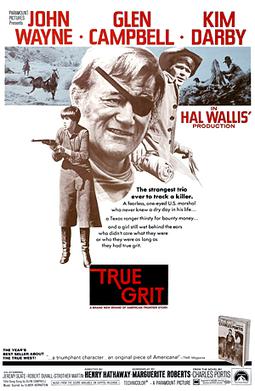
True Grit (1969)

Through a career that spanned four decades by the time 1969 had rolled around, John Wayne had somehow only been nominated for one Oscar in his entire career.  His part in 1949's Sands of Iwo Jima earned him a Best Actor nod which he would lose to Broderick Crawford in All the King's Men.  My complaint isn't that Wayne lost, but he had some excellent parts during his career that included The Searchers, The Quiet Man, Red River, and She Wore a Yellow Ribbon among others.  Well, in 1969 Wayne won his first and only Oscar for his performance in True Grit, an award that obviously came about because of that movie but was almost a symbolic Lifetime achievement award.

Recently this flick has been in the news because the Coen brothers remade it with their movie hitting theaters in the last few weeks.  My worry was that it was a movie that didn't need to be remade so why touch it?  Honestly, the 1969 version isn't a great western, but it is remembered so fondly because of what it meant for John Wayne, his career and his fans.  It's a pretty standard oater and a good example of the type of movies Wayne made at this later point in his career.  Familiar story, good vs. bad, lots of recognizable faces, and nothing really groundbreaking.  But in the end, it's entertaining and a pleasant enough way to pass a couple of hours.

For those not familiar with the story, here's a basic description. The 1969 and 2010 versions are pretty identical story-wise, but here goes. Teenager Mattie Ross (Kim Darby) travels to Fort Smith, Arkansas in 1880 looking for help in tracking down the man, Tom Chaney (Jeff Corey), who gunned down her father in cold blood. She finds no takers other than U.S. Marshal Rooster Cogburn (Wayne), a one-eyed, drunk who is a few years past his prime.  With a Texas Ranger, La Beouf (country singer Glen Campbell), Mattie and Rooster head into the Indian territory to hunt down Chaney and bring him back, hearing rumors he has joined up with outlaw Lucky Ned Pepper (Robert Duvall) and his gang.

Call it his best performance if you want (I don't think it's even close, he had much better) but this may be the one Wayne is most remembered for.  Criticisms aside, and I don't have many, but he had better parts that showed off his ability, Wayne does deliver a great performance and one that he fully deserved his Oscar for.  To a certain point, he is playing a caricature of himself.  He later joked that if he knew all it would take to win an Oscar was put on an eye patch he would have done it years before.  Wayne was an underrated comedic actor, and his Rueben 'Rooster' J. Cogburn shows that off.  He's rough and ready but has a softer side to when it comes to Mattie who can both drive him nuts and have him develop a fatherly bond with her at the same time.  Watch his Oscar acceptance speech HERE for a simple, effective and very moving look at Wayne and this part which finally earned him some Academy Award consideration.

So Wayne is obviously the biggest selling point here, but the problem is what else is there to sell?  As good as Wayne is as Rooster, his two main supporting parts are about as awful as they can be. The Mattie character is key, and as was the case with the remake, annoying but endearing in an odd way.  You're supposed to root for in spite of how ridiculously annoying, how brutally honest she is.  Darby just can't manage it in one of the most grating performances I've ever come across.  You just can't get behind this character.  A similar problem exists for Campbell as Texas Ranger La Beouf.  First, this country singer can't act a lick.  His character is supposed to be the polar opposite of Rooster, but just like Darby's Mattie it's hard to find a reason to like him.  If nothing else, his character redeems himself in the end...twice actually.  Still, it's not enough to save the part.  Check out the remake for how these characters should and could have been played.

Having watched both versions in little less than a week, I had to laugh at the idea that the Coen brothers did something vastly different with their version. Working off the Charles Portis novel, whole scenes, whole exchanges of dialogue are exactly the same between the two movies.  The tone is obviously different -- more light-hearted here -- and the only huge difference is the period authentic dress, dialogue, and accuracy in general.  Director Henry Hathaway films this story in Mexico, California and Colorado and ends up with a beautifully photographed film that looks absolutely nothing like the setting it takes place in, but that's just a minor detail, right? Elmer Bernstein's score sounds like a mix of a lot of his movies, but not necessarily in a bad way.  You'll notice a lot of familiar notes if you're familiar with his work at all, but the main theme is a good one.

You can't help but compare the two, and all I could come up with involving both was that the story itself is lacking something.  Portis was known for straightforward stories that didn't pull punches.  If anything, True Grit is too simplistic, too straightforward.  At times, it's even a little dull.  This is a movie about characters, and for the most part they're interesting even if we don't like them.  Story gets lost in the shuffle at times, but sit back and enjoy getting to know the main characters.  Of the rest of the cast, Duvall makes basically a small cameo, Jeremy Slate and Dennis Hopper are two of his gang, and Strother Martin is a haggling horse trader who incurs Mattie's wrath.

True Grit <---trailer (1969): ***/****