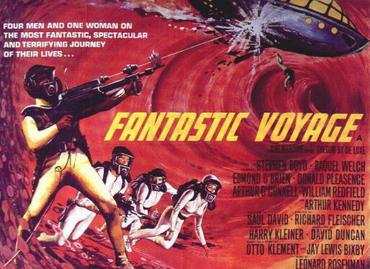
Groundbreaking doesn't mean groundbreaking for all-time. It qualifies only in the moment, maybe a few months, or even a year in the luckiest of situations. If a movie is considered groundbreaking, it kicks the door open and hundreds of rip-offs and wanna be follow-ups storm through the opening. That kept cycling through my head as I watched 1966's Fantastic Voyage.
A scientist (Jean Del Val) working for the Soviets has defected with American intelligence agencies desperate to help him and bring him to the United States. In the transport though, enemy agents attack, severely wounding him. He's in a coma with an unreachable blood clot on his brain, but he has info that the American government desperately wants. To relieve the pressure of the clot, a new technology will be utilized. A team of surgeons (including Arthur Kennedy and Donald Pleasence), a security officer (Stephen Boyd), and two others will travel via a submarine, be shrunk down to a microscopic size and injected into the scientist's body, traveling through his body and ultimately break up the clot and save his life. There's problems though. The body will most likely do everything it can to slow down the intruders, and they only have 60 minutes to get the job done before they begin to grow back to their normal size, whether they're in the body or not.
From director Richard Fleischer, this science fiction story won two Oscars, one for Best Art Direction and one for Best Special Effects. So while I didn't really care for the movie, I can appreciate the crazy visual on display. A tiny submarine the size of a period with five people inside traveling through a human body? How couldn't that be a great visual experience as a movie? Much of it comes from a green screen visual -- sets of the human body would be rather immense I'm supposing -- and just in terms of color alone, it's a beautiful movie. The little prototype submarine travels through the veins, arteries, lungs, heart, ears and ultimately, the brain.
So what do you think? A trip through the body and all its inner workings is unique, no doubt about that. Why then is this story so dull? I was bored to tears almost the second the submarine went to work. There's plenty of detours that provide some excitement. A miscalculation forces the crew to travel through the heart, but the problem is that the heart beating should tear the submarine apart. The medical staff monitoring the body basically shuts down the heart, giving the crew 60 seconds to travel through it. The premise presents all kinds of impressive, should-be cool situations like that. The crew is told that the body is going to do its best to protect itself, assuming that the submarine is a disease or virus of sorts. Those provide some cool visuals as well, antibodies swarming to the sub and the crew, but it's the weirdest thing. If that wasn't enough, someone involved with the mission is an enemy agent, but even that reveal is disappointing. It's a dull story of a very cool idea.
In a variation on one of my favorite sub-genres, 'Voyage' is a men-on-a-mission movie. Check that; a men-on-a-mission movie with Raquel Welch in a tight white bodysuit. So there it is, a group of specialists working to accomplish a mission. Along with Boyd's security and government agent, Kennedy's extremely talented lead surgeon, and Pleasence's reliable medical officer, there is Welch as Cora, Kennedy's assistant, and William Redfield as Capt. Owens, the Navy officer piloting the prototype submarine. Back at normal size, Edmond O'Brien and Arthur O'Connell play the bickering officers forced to make the difficult command decisions. Also look for a young James Brolin as one of the technicians working in the lab. None are given much in the way of background so instead of characters working to accomplish a dangerous mission, we're watching Stephen Boyd, Arthur Kennedy and Raquel Welch accomplish the mission. In other words, there's little personal investment in accomplishing the mission.
I thought I would enjoy this movie a lot in the early goings. The virtually silent, unexplained opening is a great scene-setter, eerie and unsettling because we don't know what's going on. It reminded me a lot of 1965's The Satan Bug in its simple style. I can't explain it though, but the second the miniaturized mission was presented I lost almost all interest in the story. There are some cool moments, but they didn't add up to a finished product that I enjoyed that much. Sorry to say it because I've long wanted to see it, but I came away disappointed with this 1960s sci-fi classic.
Fantastic Voyage (1966): **/****
The Sons of Katie Elder
"First, we reunite, then find Ma and Pa's killer...then read some reviews."
Showing posts with label Donald Pleasence. Show all posts
Wednesday, February 13, 2013
Saturday, March 10, 2012
You Only Live Twice
While in orbit around Earth, an American space shuttle suddenly disappears, swallowed up by another large spacecraft. Just weeks after, a Russian space shuttle suffers the same fate, and both world powers seem on the brink of a nuclear war. In hopes of investigating the disappearances without being hunted down, MI6 agent James Bond (Connery) fakes his own death and goes to work. The last reports of the "abducting" spacecraft were somewhere near Japan so Bond heads there to investigate. The only problem? The spacecraft genuinely seem to have disappeared. There is little to no trace of them, but everything manages to find points to Spectre's involvement. With another American spacecraft launch fast approaching, time is running out for 007.
As a huge fan of movies, James Bond films are like westerns for me. I'm going to find something to like even in the bad ones. A bad Bond movie is still a Bond movie, and therefore better than many spy/espionage flicks. From director Lewis Gilbert, this is one of those middle of the road entries, not a classic and not a complete bomb, just somewhere in between. The franchise visits Japan for the first time, and the locations don't disappoint. Nancy Sinatra's theme -- listen HERE to 'You Only Live Twice' -- is one of the better Bond songs, and was sampled years later by Robbie Williams in Millenium. John Barry's score is as spot-on perfect as always. Even that impossible to duplicate 1960s style is there so what's missing? A franchise for the first time leaning toward a caricature of itself.
Of his six official Bond films and one unofficial (Never Say Never Again), I've always thought this was Connery's weakest effort. He had already stated he wouldn't be back for another film, and the same energy isn't there, both in his performance and the movie on a whole. It's not entirely his fault to be fair. The story has Bond "becoming" Japanese, going through several plastic surgery-like procedures and learning how to be a ninja in two or three days. It's one of the bigger stretches the Bond franchise has taken, and that's saying something. He isn't aided by some of the weaker Bond girls in any of the movies including Aki (Akiko Wakabayashi), a Japanese agent working at his side, Kissy (Mie Hama), his fake wife turned fellow agent, and Helga (Karin Dor), a Spectre assassin.
Filling out the cast are some oppositely pretty cool performances that help balance out the weaknesses. Japanese actor Tetsuro Tamba plays Tiger Tanaka, Bond's Japanese counterpart who works with him in the investigation. Where some fans had an objection to a black Felix Leiter in Casino Royale, think of this one; an Asian Felix Leiter equivalent. Cool performance, an agent with ninja skills. Donald Pleasence makes a short but effective performance as Ernst Blofeld, the head of Spectre dead-set on taking over the world after the U.S. and Russia destroy themselves. Teru Shimada plays Mr. Osato, a business owner who's a front for Spectre's activities. Before playing Blofeld two films later in Diamonds Are Forever, Charles Gray makes a quick appearance as Henderson, a source Bond uses. And what would a 007 movie be without M (Bernard Lee), Miss Moneypenny (Lois Maxwell) and Q (Desmond Llewelyn)?
What does make 'Twice' memorable is the action, shot on a grand scale that few other Bond films can rival. The most obvious is the finale, Bond, Tiger, Kissy and a small army of ninja agents descending into a Spectre fortress hidden away in a dead volcano. Production designer Ken Adams designed and built a gigantic set that is a sight to behold. The finale is appropriately epic -- making up for some of the lower parts earlier -- as ninjas battle Spectre henchmen. How could that not be cool? An earlier aerial sequence is just as impressive, Bond in a mini-helicopter dueling with four full-size and heavily armed helicopters with some amazing aerial footage. Watch it HERE. There's also a car chase with a memorable payoff featuring the disposal of the nameless baddies, and in the originality department, Gilbert shoots an action chase on foot by helicopter, Bond running and fighting from Spectre henchmen on the top of a wharf warehouse.
Through it all, the problem is that is becomes a caricature of it all. 'Twice' provided much of the ammo for all the Austin Powers spoofs, and produced one of the great Simpsons episodes of all-time in You Only Move Twice featuring super-villain Hank Scorpio. Over the top is a valid description. It's still good, just not as good as the other more classic Connery-Bond pairings.
You Only Live Twice <---trailer (1967): ** 1/2 /****
Labels:
1960s,
Bernard Lee,
Donald Pleasence,
Espionage,
James Bond,
Sean Connery,
Tetsuro Tanba
Friday, November 25, 2011
The Man Inside
Having planned the robbery for 15 years, Englishman Sam Carter (Nigel Patrick) walks into a diamond exchange in New York City and steals a diamond worth over $700,000. The success comes from the simplicity of the job, and now no one -- including the police -- know where to start looking for Carter or the diamond. Milo March (Jack Palance), a private detective, is called in to see what he can find trying to pick up the crook's trail. March finds himself globe-trotting, following Carter to Lisbon, Madrid, Paris and London, always one step behind him. He keeps running into a mysterious Austrian woman (Anita Ekberg) who similarly has an interest in acquiring the diamond, and that's not all. Some very bad, very hard men don't care who gets hurt as they search for the rare diamond.
As I found out afterward, 'Inside' is not available on VHS or DVD so I was glad to stumble across it on TCM's schedule. It's nothing special and drifts along with its story more than a pointed, driven effort. Still, director John Gilling keeps it interesting if not always hugely entertaining. There are villains, but the type you assume will never successfully hurt a good guy. Said good guys betray each other, but you know they'll end up working together in the end. Part film noir, heist, and European tour guide, 'Inside' never really decides what it is. Drama? Comedy? Never great and never awful, decent enough way to spend 97 minutes.
Newley didn't get a mention in the plot review because like a lot of sidekicks, his part isn't essential to the story. The very British Newley plays the very Italian Ernesto, a taxi driver and guide in Madrid who meets Palance's March and ends up helping him around the city. He plays surprisingly well off the always intense Palance, providing some lighter moments with some running comedic bits that just shouldn't work, but well, they end up working. It's a good supporting part for Mr. Newley who always seems to be having fun no matter the role he plays.
It always feels like a cop-out when I write about this in a review, devoting an entire paragraph to this particular aspect, but as was the case here in 'Inside' it is really good. Yes, here I go again with on-location shooting, Gilling filming much of his movie in Lisbon, Madrid and Paris. Filmed in a very stylish black and white, this very visual movie helped me as a viewer slog through some of the slower portions. And while it sounds obvious, a movie is just better when you see the actors actually in the locations, not a poorly done green screen effect. It's always pretty clear when the actor isn't actually in those glamorous European cities. To some, maybe it's a little thing, but it's a major selling point for me, and 'Inside' doesn't disappoint on that level.
The good and bad here is that the cast assembled is a good one, but they're not always given anything to do. Lots of travel scenes, lots of pointless talking that waste an otherwise talented cast. Palance's March is a step back from his usual psychotic character he perfected over his career. Still intense, but pulled back a notch or two. Human Barbie doll Ekberg is the femme fatale, playing all sides for her own gain. Patrick is the shifty Carter, the diamond thief who we know little about. Some more background would have been nice about the character, his motivations, his reasoning, something. Also look for Donald Pleasance as a Spanish organ grinder, Sid James as March's friend and supervisor Franklin, and Bonar Colleano and Sean Kelly as two hired guns after the diamond.
All things considered, a pretty forgettable movie. The cast is above average though, and it's a great movie to look at so there's just enough to recommend here. Barely, but still recommending it.
The Man Inside (1958): **/****
Labels:
1950s,
Anita Ekberg,
Anthony Newley,
Donald Pleasence,
Jack Palance,
Nigel Patrick
Monday, November 21, 2011
Hearts of the West
Who among us at some point hasn't wanted to be a movie star? Even if it was just for a second, the glamour of the big screen looks awfully inviting. So how about a young country bumpkin getting started in the movies and finding out it isn't quite as glamorous as it looks? In steps 1975's Hearts of the West.
Hoping to become a western novel writer, young Lewis Tater (Jeff Bridges) heads west to what he believes is a writing school only to find it is a correspondence school and a con job at that. Still wanting to pursue his dream, Lewis runs afoul of the con men (Anthony James and Richard B. Shull) and ends up with some of their money. On the run, Lewis stumbles onto the set of a western being filmed in the desert and quickly finds work. He wants to be a writer above all else but starts off as a background player and stuntman, meeting Howard Pike (Andy Griffith) and a handful of other vets of the business. Somewhat naive and a little idealistic though, Lewis finds out everything isn't quite what it's made out to be.
Following your dreams and coming of age stories are pretty familiar story-lines, but that's not a bad thing. Bridges at 26 years old is probably a little old for the Lewis character, but he makes it work. A tad pretentious at times because he's so assured of his writing abilities, Bridges gives Lewis that solid mix of naive youngster and over the top, energetic where you can't help but like him. He meets people both good and bad, finding out that trusting others isn't always the easiest or best thing to do to advance yourself. Bridges is one of my favorites, and his performance here -- while not one of his most well known -- is a very strong role to lead the movie.
What works so well with director Howard Zieff's movie is the portrayal of an ever-growing business, movies. Set in the early 1930s, 'Hearts' is right in that time when studios were still trying to figure out how to make the transition from silent films to sound films, the focus here on the cheap western serials made with a quick turnaround. The good guys were very good, the bad guys very bad, and the stunt guys? Well, they just want to get paid. It is the little scenes and moments that made me laugh. Alan Arkin plays Kessler, a director who can manipulate like nobody's business, "motivating" Lewis by telling him the money they'll lose if a scene doesn't work. Bridges' ridiculously theatrical "death scene" has him twisting and turning, moaning and groaning before finally falling to the ground with a thud. A little window into one of Hollywood's most interesting eras, and a good window at that.
In an impressive supporting cast, Arkin and Griffith both stand out for all the right reasons. Arkin's Kessler is a supporting player to the story and not a necessarily important one, but Arkin makes the best of it. He isn't chewing the scenery, but it's close. He gets to ham it up a bit working with his cast, stunt men, script supervisors and film crew. Kessler goes from zero to 60 like nothing, providing some truly funny outbursts. In between The Andy Griffith Show but before Matlock, Griffith gets to show off his range, a fun character who's had years of experience in the business who also has a darker side. Bridges' Lewis clearly looks up to him, something that could come back to bite him. It's a great performance, both of them are, the strong parts that can bring a movie up a notch or two overall.
That's not all though with a very deep cast assembled for this movie-making film. Blythe Danner plays Miss Trout, a script supervisor who Lewis meets on-set. She similarly feels sympathy for him while also liking him and his genuine willingness to make something of himself. Donald Pleasence makes a quick appearance as A.J. Neitz, a movie producer with lots of pull all around Hollywood. Alex Rocco is underused as Earl, one of Arkin's assistants. Matt Clark and Burton Gilliam are two of the stunt crew who work with Lewis and Howard, putting themselves in harm's way for a small payday. Good cast from top to bottom.
Not much else to say here. Just a good movie, funny, sweet and a great look into the movies from behind the camera.
Hearts of the West <---TCM clips (1975): ***/****
Hoping to become a western novel writer, young Lewis Tater (Jeff Bridges) heads west to what he believes is a writing school only to find it is a correspondence school and a con job at that. Still wanting to pursue his dream, Lewis runs afoul of the con men (Anthony James and Richard B. Shull) and ends up with some of their money. On the run, Lewis stumbles onto the set of a western being filmed in the desert and quickly finds work. He wants to be a writer above all else but starts off as a background player and stuntman, meeting Howard Pike (Andy Griffith) and a handful of other vets of the business. Somewhat naive and a little idealistic though, Lewis finds out everything isn't quite what it's made out to be.
Following your dreams and coming of age stories are pretty familiar story-lines, but that's not a bad thing. Bridges at 26 years old is probably a little old for the Lewis character, but he makes it work. A tad pretentious at times because he's so assured of his writing abilities, Bridges gives Lewis that solid mix of naive youngster and over the top, energetic where you can't help but like him. He meets people both good and bad, finding out that trusting others isn't always the easiest or best thing to do to advance yourself. Bridges is one of my favorites, and his performance here -- while not one of his most well known -- is a very strong role to lead the movie.
What works so well with director Howard Zieff's movie is the portrayal of an ever-growing business, movies. Set in the early 1930s, 'Hearts' is right in that time when studios were still trying to figure out how to make the transition from silent films to sound films, the focus here on the cheap western serials made with a quick turnaround. The good guys were very good, the bad guys very bad, and the stunt guys? Well, they just want to get paid. It is the little scenes and moments that made me laugh. Alan Arkin plays Kessler, a director who can manipulate like nobody's business, "motivating" Lewis by telling him the money they'll lose if a scene doesn't work. Bridges' ridiculously theatrical "death scene" has him twisting and turning, moaning and groaning before finally falling to the ground with a thud. A little window into one of Hollywood's most interesting eras, and a good window at that.
In an impressive supporting cast, Arkin and Griffith both stand out for all the right reasons. Arkin's Kessler is a supporting player to the story and not a necessarily important one, but Arkin makes the best of it. He isn't chewing the scenery, but it's close. He gets to ham it up a bit working with his cast, stunt men, script supervisors and film crew. Kessler goes from zero to 60 like nothing, providing some truly funny outbursts. In between The Andy Griffith Show but before Matlock, Griffith gets to show off his range, a fun character who's had years of experience in the business who also has a darker side. Bridges' Lewis clearly looks up to him, something that could come back to bite him. It's a great performance, both of them are, the strong parts that can bring a movie up a notch or two overall.
That's not all though with a very deep cast assembled for this movie-making film. Blythe Danner plays Miss Trout, a script supervisor who Lewis meets on-set. She similarly feels sympathy for him while also liking him and his genuine willingness to make something of himself. Donald Pleasence makes a quick appearance as A.J. Neitz, a movie producer with lots of pull all around Hollywood. Alex Rocco is underused as Earl, one of Arkin's assistants. Matt Clark and Burton Gilliam are two of the stunt crew who work with Lewis and Howard, putting themselves in harm's way for a small payday. Good cast from top to bottom.
Not much else to say here. Just a good movie, funny, sweet and a great look into the movies from behind the camera.
Hearts of the West <---TCM clips (1975): ***/****
Labels:
1970s,
Alan Arkin,
Alex Rocco,
Andy Griffith,
Donald Pleasence,
Jeff Bridges
Wednesday, June 1, 2011
The Great Escape
In World War II, both the Allies and Axis forces had to deal with how to handle prisoners of wars. In Germany, the Luftwaffe, the German Air Force, was placed in charge of these Allied prisoners, placing them in P.O.W. camps all over their occupied territory. These prisoners -- as was their sworn duty -- tried countless escapes over the length of the war in typically small groups, sometimes getting as many as a dozen out. But one true story set the bar for heroism and courage among the prisoners, the true story of 76 prisoners escaping Stalag Luft III in March 1944. Literally hundreds of prisoners were involved in the effort as the escape even had an impact on D-Day some three months later.
It's 1943, and a new prison camp has been built. The German Luftwaffe has taken the worst prisoners from all their camps and thrown them in this new camp that features all the security aspects they've learned from previous camps. In this "perfect" camp, the Germans (Hannes Messemer is the commandant) intend to watch these men very carefully. Leading the prisoners is Roger Bartlett (Richard Attenborough), dubbed 'Big X' for his leadership at the top of the 'X Organization,' a team of prisoners working together to bust out as many captured soldiers as they can. Bartlett has bigger plans though this time around. Instead of just getting two or three prisoners out, he intends to get 250 out of the camp with a large-scale plan that includes three extremely long tunnels under the barbed-wire fence. The plan seems impossible, but the prisoners go to work, slowly working their way toward escape.
Do you know the line 'They don't make them like they used to?' This movie applies. Director John Sturges (one of my favorites and an underrated filmmaker overall) turns in his all-time best film, one that stands at or near the top in the lexicon of World War II movies. It is based in fact, sticking to the details and truths in the story, without getting bogged down. There is action, humor (never overplayed, just natural humor arising from the situation), and characters you love and are generally rooting for. Composer Elmer Bernstein turns in a score that is one of the greats, especially the main theme, listen HERE. Bernstein's score both drives the story as needed and keeps it grounded in the quieter, emotional scenes (including one where a tunnel is discovered and its tragic consequences). Sturges filmed in Germany -- as his assistant said, 'Germany looks like Germany.' An entire camp was built, an exact duplicate of the actual camp, bringing this 1963 epic up another notch in terms of realism and authenticity.
Sturges' movies were famous for their male-dominated ensemble casts, but this may be his most impressive. Start with Steve McQueen as Hilts, the motorcycle-riding 'Cooler King,' the role that shot him to international stardom. Then there's James Garner as Hendley, the scrounger, and Attenborough as Bartlett, the prisoner's top man, a brilliant mind who comes up with this improbable plan. Not bad, huh? Oh yeah, there's also James Donald as Ramsey, the senior British officer, Charles Bronson and John Leyton as Danny and Willie, the tunnel kings, James Coburn as Sedgwick, the manufacturer, Donald Pleasence as Blythe, the forger, David McCallum as Ashley-Pitt, "dispersal," and Gordon Jackson as MacDonald, the intelligence officer. Other prisoners include Nigel Stock, Jud Taylor and Angus Lennie in a small but essential part as Ives, Hilt's progressively wire-happy partner. A more impressive cast could be impossible to assemble.
What is amazing is that even with all those stars -- some on the rise, some already established -- is that they all register, they all make a lasting impression in a positive way. More on McQueen later, but Attenborough delivers a career-best as Big X, the driven even obsessed leader who wants to take the war back to the Germans, not sitting out the war comfortably as his captors intend. Garner's Hendley bonds with Pleasence's Blythe in some of the movie's most touching scenes, two very different people forming a friendship. Bronson and Leyton as the tunnel kings certainly make an impression, carving three tunnels out of the Earth 30 feet below the surface. Bronson is at his best, a Polish flyer with claustrophobia who hides his fear of small, enclosed spaces and digs. Coburn doesn't get a ton to do compared to the others, but is his usual, laconic self. There is not a weakness in the cast from top to bottom.
When movie fans think of The Great Escape, they usually go right to Steve McQueen, a rising star who got his crack at the big time here and didn't disappoint. His Capt. Virgil Hilts is one of his most iconic roles, the loner, trouble-making American prisoner who attempts escape attempt after attempt. What's funny is that his character basically disappears for vast stretches of the movie, only to reappear after a stint in the cooler and steal every scene he is in. This is McQueen at his laid back, scene-stealing best. With all the notable actor's actors around him, he is the unquestioned star thanks in great part to the finale, a motorcycle chase across Germany with his captors in hot pursuit. It is one of the greatest chases sequences ever, caped with one of the most impressive stunts ever, a 7-foot jump by stunt man Bud Ekins over a high-strung barbed-wire fence. McQueen is my favorite, but this is always his best to me.
With a final run-time of 2 hours and 53 minutes, Sturges' true story doesn't have to rush along at a lightning pace...but does anyway. The first 105 minutes or so focus exclusively on the escape attempt, putting all the little details together that need to happen. The first and biggest of course is the digging of the tunnels, 30 feet down and over 300 feet straight out. A track is built to transport prisoners/diggers, and wooden boards are needed to shore up the entire length of the tunnel. Up above, forgers create documents, tailors make clothes, Intelligence gathers information, all part of an elaborate system of security and watchmen to make sure nothing is discovered by their ever-vigilant German guards. It would have been easy for this movie to get bogged down in these details, but The Great Escape revels in them, making the mundane and possibly boring, exciting at a breakneck pace.
It is a movie called 'The Great Escape' though, and it is at its most exciting once the prisoners do escape, 76 of them in the dead of night spread out all over the German countryside. The escape attempt covers the last hour of the movie, an incredible extended sequence that is hard to top. It is almost entirely dialogue free, Bernstein's score playing over the action the whole way. Finally free of their camp, the prisoners make their efforts to hopefully reach freedom, some by train, some by bikes, others by planes, and in Hilts' case, a stolen German motorcycle. Sturges was an action master, and this may be his tour de force sequence.
I could go on and on with this movie, and I've already sort of done so. My head is full of little tidbits of information that I've picked up over the course of repeated viewings. Above all else through the drama, the facts, and the action is that Sturges gets the tone right from Paul Brickhill's source novel, and most importantly, the true story it is based on. These men did the impossible in an impossible situation. Knowing their chances of escape back to freedom were slim, they plodded on when they could have just as easily quit. If you didn't know and just read the details -- check out the Wikipedia entry HERE for more details -- you would say there's no way this happened, but somehow, some way, it did. The ending hits you square in the stomach as it should, but the movie ends on a positive note; McQueen's Hilts once again in the cooler, bouncing his baseball off the wall. You may capture him again, but you'll never stop him from trying.
A perfect movie, one of the best around, and one of my two favorite movies.
The Great Escape <---trailer (1963): ****/****
Monday, May 30, 2011
Eye of the Devil
I'll get into the specifics more later about the pre-credit sequence that opens the movie. As someone who typically steers clear of horror movies, I couldn't pass this one up stumbling across it on TCM's schedule recently. The cast is mostly what caught my eye because the story description certainly didn't sound too interesting. This isn't a horror movie of 2011 with shock value and gore, instead building up suspense and tension with its gothic feel. What to make of it? I have no idea. It was weird, but I think...think...I liked it.
A well to-do businessman in Paris, Phillipe de Montfaucon (David Niven) must return home when news of his estate's vineyards dying reaches him. A few days later, his wife, Catherine (Deborah Kerr), joins him at the estate -- called Bellenac -- with their two children. Catherine begins to see strange, unexplainable things one night but can't find anyone to answer her questions. She even sees members of something that looks like a cult gathering in the expansive estate home, but just can't figure it out. Her mother-in-law, Countess Estelle (Flora Robson), seems to know what's going on but won't tell her a thing. She begins to worry for her safety, her children's, and also of her husband. Could he possibly be involved with these strange happenings? More importantly, if he is involved, can Catherine save him?
For starters, let's start at the start...words are fun. Before a credits sequence or a title cards, we get a lightning quick montage, edited within an inch of its life that immediately sets the tone for the rest of the movie. Now as I look for it, I of course cannot find a clip of this sequence. It is an odd assortment of quick images -- a dove pierced with an arrow, a woman's eye, a man's head, a train speeding down the tracks, among many others -- that is edited together so quickly it can be hard to make anything out of it. The sequence feels like something A Clockwork Orange would have used 5 years later. Regardless of the background though, it pulls you into the movie. You want to, you need to know what those disparate images mean and how they're related.
Cheap thrills are one thing, and genuine fear and uneasiness are another. Gory, shocking, 'Gotcha!' moments are part of the reason I dislike horror movies so much. There is a subtlety to older horror movies that more recent ones are just missing. Some complaints are that director J. Lee Thompson does go to the old horror cliche book a few too many times, but for the most part the scares are genuine. The off-center camera angles telegraph everything that's going to happen, and the dark, spooky shadows always reveal something hidden away. But still, the scares are there. 'Devil' is filmed in black and white, and it definitely has a gothic feel, especially in this immense, extravagant, lavish French manor that looks like it's out of the 1700s. Throw in composer Gary McFarland's eerie, Church choir-like score, and you've got all the makings.
I'll admit it. I'm a sucker for big names when I see a cast listing. Why else would I watch a basically unknown British horror movie from the 1960s? David Niven and Deborah Kerr in the starring roles sounded perfect for me so surprisingly enough, I thought they were the weakest parts of the cast. Niven sleepwalks through his role, disappearing for long stretches of the movie. Kerr basically looks nervous the whole movie, screaming occasionally. The rest of the cast makes up for it. Master of understated creepiness Donald Pleasence plays a creepy priest, Pere Dominic, Robson is the tortured woman who knows the whole truth, and Edward Mulhare is a longtime friend of Kerr's Catherine. The best thing going for 'Devil' is David Hemmings and Sharon Tate as Christian (an albino archer?) and Odile, brother and sister who always know more than they let on.
You know that feeling on Christmas Eve when you see your presents wrapped up nicely under the tree? Now, I loved my presents -- always have -- but the anticipation and mystery is part of the appeal. More and more, I find that's the case with movies that hold out on you until the finale with a huge, major revelation. The build-up here is all the fun because the reveal disappoints. Think mix between The Wicker Man and The Omen, but that's all I'll say. The ending never quite explains everything either, hinting at and beating around the bush, but never laying everything out. I definitely was creeped out by this movie, but the ending left me disappointed unfortunately.
Eye of the Devil <---TCM trailer (1966): ** 1/2 /****
Thursday, January 14, 2010
Escape from New York
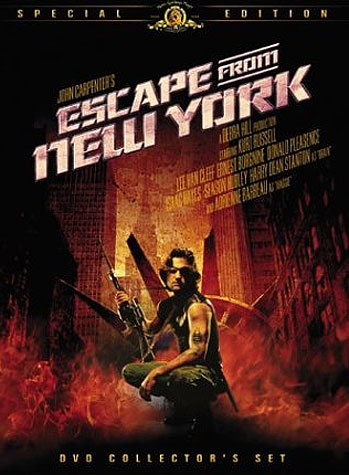
Not having been around in the 60s and 70s when Kurt Russell was making a name for himself on TV and in Disney movies like 'The Computer Wore Tennis Shoes,' I don't know how popular the young actor was at the time. He was obviously popular enough though as he springboarded his early Disney career into feature films as an adult that typically had him playing some variation of a tough guy.Part of that transition is thanks in great part to action/horror director John Carpenter who cast Russell in two early 80s movies, Escape from New York and The Thing (a remake of a 1950s sci-fi movie). The Thing is one of my favorite horror/sci-fi combos with Russell headlining as MacReady, a booze-swilling, tough talking helicopter pilot of a remote science station in the Arctic. Seeing the cast and reading the plot of 'Escape,' I thought I'd enjoy that one as much but came away disappointed.
In 1988, crime in the U.S. escalates over 400% and the island of Manhattan is turned into a maximum security prison. A huge wall is built all around the island, and all the bridges and exits off the island are mined so prisoners can't escape. It's a self-governed prison where there are no guards, and the prisoners rule themselves with no interference from above. The idea is simple, as a prisoner you go onto the island and never leave. But after years of success, a revolutionary group hijacks Air Force One with the President (Donald Pleasence) on board and crashes the plane onto the island.
The prison commissioner, Hauk (Lee Van Cleef) is forced to come up with a plan to get the President out of the island prison safely and is facing a deadline in doing it. The President needs to speak at a world summit -- the U.S., Russia, and China seem to be at war but it's never clearly spelled out -- and is carrying vital information. Hauk turns to his only option, a prisoner about to be sent to Manhattan, Snake Plisken (Russell), promising him a full pardon if he can get the President out in only 22 hours. Snake agrees, and gets onto the island via a glider that lands on top of the World Trade Center (a very eerie scene) only to find that the President is a prisoner of the Duke (Isaac Hayes), the self-appointed ruler of Manhattan Prison.
Carpenter's films have a reputation as cult classics, movies that aren't necessarily high quality but are nonetheless extremely entertaining. 'Escape' certainly has that popularity with its fans, but I struggled getting into the movie. It was filmed on a small budget, but that tends to work here more often than not. Carpenter uses parts of downtown St. Louis as a stand-in for a ruined, beaten down Manhattan, and the setting works beautifully. Almost all the movie takes place at night in the shadowy, vacant streets where prisoners with nothing to lose hide just out of sight ready to attack if the opportunity presents itself. Atmosphere and cinematography are the least of the movie's worries.
Clocking in at a brisk 99 minutes, the movie feels stagnant at times but could also use some fleshing out of the characters, especially Plissken. Russell growls and grimaces his way through lines, making Plissken a modern-day gunfighter you could see Clint Eastwood playing in a spaghetti western. His background is hinted at -- war hero turned criminal -- but it's never dealt with in full force. Maybe it was intended that way to keep the already very stylish, very cool character a mystery, which I understand, but even a little more background would have been good. Also, Carpenter had to cut the original beginning of the movie explaining how Plissken got caught, acts the way he does and ends up being sent to Manhattan. Check it out HERE if curious. Extremely stylish sequence which could have really helped the movie out.
But in addition to little development for Plissken, the supporting cast is given even less, a real shame when considering the talent involved. Hayes is more of a presence than an actor and pulls off the part of the Duke adequately, but how did he come to power in Manhattan? Van Cleef as always is a badass, and Pleasence is really just an idea of a president. There's also Ernest Borgnine as Cabbie, a longtime prisoner who still operates his cab, and Harry Dean Stanton as Brain, a prisoner living in the library who supplies the Duke with gasoline for his entourage, seen here. Cabbie gets some backstory but not much, and Brain has a history with Snake but that's never really revealed. Adrienne Barbeau's chest also makes an appearance as Maggie, Brain's girl. She says virtually nothing and wears a low-cut dress. That's the character, no frills attached.
The generally cheap feeling of the movie works in most cases, but basically nothing happens. Snake walks around a lot -- at a slow pace too considering time is of the essence -- meets people, runs around, snatches the President rather easily and tries to get out of the island prison fortress. Even Russell's cool presence couldn't save this one as an interesting story never rises to its potential and wastes a strong supporting cast.
Escape from New York <----trailer (1981): **/****
Subscribe to:
Posts (Atom)