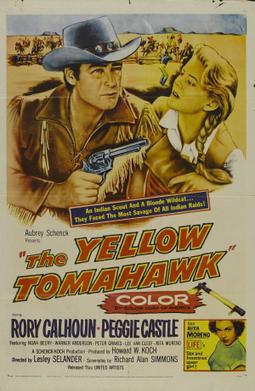
Every so often, I just need a good, old-fashioned B-western. It doesn't have to be great or even particularly good, but I need that dose of WESTERN. So while 1954's The Yellow Tomahawk is pretty run-of-the-mill, I liked it. Entertaining, surprisingly violent and with a cool cast, it's a solid western that's worth a watch.
Riding out of the wilderness, frontiersman Adam Reed (Rory Calhoun) finds himself being chased by Cheyenne warriors. He's cornered and looks to be in trouble until his blood brother, Cheyenne warrior Fire Knife (Lee Van Cleef), steps in, all of it a show to arrange a meeting. Fire Knife has a warning and a message he would like delivered. The U.S. cavalry is building a new fort nearby with a commander, Major Ives (Warner Anderson), who lead a bloody massacre months prior against a peaceful Indian camp. His reputation has preceded him with Fire Knife passing his message along to Reed. What is it? Tell Ives to stop building the fort and risk an attack that will wipe out the partially-assembled fort. Reed rides down to the fort and passes it along but Ives isn't having it, doubting the truth of the threat. What awaits for the small garrison and the soldiers' families who have traveled west? Reed sees the writing on the wall but no one else seems to believe what's coming.
Nothing flashy here, nothing too crazy. From director Lesley Selander, 'Tomahawk' is nonetheless an entertaining, pretty solid western that isn't limited by its budget or limitations. A longtime director in film and television, Selander is a pro at spinning a movie like this. So often, westerns are town-bound. limited by a fake-looking set that never allows the story to breathe. This particular entry does not have that problem with virtually no sets! The cavalry building a fort allows for no sets other than a couple half-assembled walls. It was shot on-location at the Kanab Movie Ranch and Fort, giving the story a cool, intimidating, scary sense of the openness of the desert and wilderness. You're all alone out there, and with the threat of an imminent Indian attack, there's no place to hide.
A star of B-westerns who often played supporting roles in bigger budget pictures, Calhoun is a favorite of mine. He plays a memorable, roguish good guy, a solid anti-hero with an edge who is quite comfortable in the western and in the saddle. His Adam Reed character, a frontiersman and scout of sorts, is interesting because of his hinted-at backstory. It's never told in detail, but it appears he lived with the Cheyenne at some point, his brotherhood and family connection with a young Lee Van Cleef as warrior Fire Knife. If there was a little more time to breathe ('Tomahawk' is a very pleasant 82 minutes), maybe we could have learned some more about out hero. Still, what's there is pretty cool.
No A-listers on-hand here, but that doesn't detract from an overall good cast. Peggie Castle (Lily Merrill on TV's Lawman) is the necessary love interest, a beautiful woman visiting her fiance, a cavalry officer, at the budding fort. She's no damsel in distress either, a welcome addition to the genre. Noah Beery Jr. has some stereotypical fun as Tonio, an ay-ay-ay Mexican horse wrangler with a beautiful Indian girl, Honey Bear (Rita Moreno), who follows him around. As the stupidly blind officer, Major Ives, Warner Anderson is frighteningly uncomfortable, portraying an officer that was probably all too familiar in the wild west. Also look for Peter Graves (gold prospector) and Adam Williams and James Best (cavalry troopers) in key supporting parts.
One good western after another followed a simple formula. Introduce a disparate group of survivors and individuals, throw them into a survival situation with an ever-present Indian war party, and see who makes it out. After an intense, tension-building first 30 minutes or so, that's what 'Tomahawk' uses as a base. We follow a small group of survivors of an Indian attack trying to get across the desert to safety. The action itself is pretty intense in itself, especially the Cheyenne attack on the hastily-built and poorly-defended fort. It's not hugely graphic -- it is still 1954 after all -- but the violence is incredibly rough and if it had been shown on-screen, whoo, we're talking one nasty picture. The ending too is pretty honest for a mid-1950's western, something that surprised me, caught me off-guard a little bit.
A solid western overall. Worth checking out.
The Yellow Tomahawk (1954): ** 1/2 /****
The Sons of Katie Elder
"First, we reunite, then find Ma and Pa's killer...then read some reviews."
Showing posts with label Lee Van Cleef. Show all posts
Tuesday, January 12, 2016
Sunday, December 6, 2015
The Lawless Breed
The Wild West in the post-Civil War years was synonymous with a lot of things, but maybe none more than the infamous gunslingers, gunfighters and pistoleros that roamed the country. Some are instantly recognizable like Billy the Kid, Jesse James, Wild Bill Hickok, while others don't have that notoriety. Take John Wesley Hardin for instance, reputed to have killed more than 40 people depending on what you read. Stick with Wikipedia though for any facts because 1953's The Lawless Breed...well, it's a steaming pile of you know what.
It's the years following the Civil War in Texas and young John Wesley Hardin (Rock Hudson) has grown up under a strict, God-fearing father who's tried to instill his own strict beliefs in his son. Wes as he's called, he's not interested. He's worked long and hard to be fast with a six-shooter and wants nothing more than to marry his longtime crush, Jane (Mary Castle), and start working at building up a farm where he can care for and sell horses. That's his plan at least. His father's actions push him away to the point young Wes finds himself in a saloon in a card game that goes poorly quickly. A man across the table draws first, but Wes outdraws him, killing him. Witnesses say otherwise though, forcing Hardin on the run as he tries to prove his innocence. The rewards and bounties grow larger and so does the body count as Wes tries to put the killing behind him (sort of). Can he though or will his name and reputation be too much?
My timing here is interesting. I'm currently reading Larry McMurtry's Streets of Laredo, his sequel to one of my favorite books, Lonesome Dove. John Wesley Hardin is a supporting character in the western novel, portrayed as an unhinged killer with no qualms about shooting anyone for any reason. Then, I saw this pop up on a movie channel and thought I'd give it a try. I shouldn't have...
From director Raoul Walsh, 'Breed' is based off the autobiography Hardin wrote about his life while serving a prison sentence in the 1880s/1890s. To say it stretches the truth a little is a massive understatement. It portrays Hardin as a kid who ends up in the wrong place time and time again and has to kill people over and over again because there's just no alternative. Yuck. Gag me. It's like an anti-revisionist western, hell-bent on portraying one of the west's more dastardly killers as...well, a decent guy! The script is a mess, drifting along far too much even at just 83 minutes, and though the casting is interesting (at times), most of it falls short because that source material is just so weak. Both in character portrayal and visual look, 'Breed' is too clean, too polished and too manicured as it tries to make a killer into the unlikeliest of heroes.
A rising star by 1953, Hudson gives it a go, but this isn't great casting for John Wesley Hardin. It tries to portray him as misunderstood but the next second it shows him as a bit of a scamp, a liar and a gambler who doesn't intend to keep his promises. If we're supposed to feel sympathy for this fella, there's an epic misfire. No matter what happens, the character just keeps digging deeper and deeper, never realizing it's all his fault and that he's to blame. If you're not on our "hero's" side, then things are going to get rough before they get better.
The rest of the cast has some name recognition, but again, the script does them no favors. Julie Adams is Rosie, the saloon girl turned potentially more with Wes, representing herself fairly well with a script that has her wearing very little and leaning forward a lot seductively. I'm sure her back was bothering her, nothing sinister about being able to see down her shirt/dress/blouse. In the oddity department, John McIntire plays dual roles, one as Wes' Bible-thumping Dad and the other as his more fun-loving but hard-working uncle. The Uncle is better than the Dad, but still, it's odd to just go along with. Also look for Dennis Weaver, Lee Van Cleef, Michael Ansara, Forrest Lewis, and Hugh O'Brian in supporting parts.
I kept waiting for something enjoyable, entertaining or interesting to come along but to no avail. By the time the framing device of Wes and his autobiography wraps up...well, it's not good. The newspaper editor looks longingly off-camera and when asked how the story ends says "I'm not sure. It's a story that hasn't ended yet." The ending itself is laughable compared to Hardin's real-life death, read about that HERE with SPOILERS obviously, to the point I actually groaned when "The End" popped up on the screen. It's a B-western, but it's a bad one with very little other than the lovely Julie Adams to recommend giving it a watch. Give it a big, old wide berth!
The Lawless Breed (1953): */****
It's the years following the Civil War in Texas and young John Wesley Hardin (Rock Hudson) has grown up under a strict, God-fearing father who's tried to instill his own strict beliefs in his son. Wes as he's called, he's not interested. He's worked long and hard to be fast with a six-shooter and wants nothing more than to marry his longtime crush, Jane (Mary Castle), and start working at building up a farm where he can care for and sell horses. That's his plan at least. His father's actions push him away to the point young Wes finds himself in a saloon in a card game that goes poorly quickly. A man across the table draws first, but Wes outdraws him, killing him. Witnesses say otherwise though, forcing Hardin on the run as he tries to prove his innocence. The rewards and bounties grow larger and so does the body count as Wes tries to put the killing behind him (sort of). Can he though or will his name and reputation be too much?
My timing here is interesting. I'm currently reading Larry McMurtry's Streets of Laredo, his sequel to one of my favorite books, Lonesome Dove. John Wesley Hardin is a supporting character in the western novel, portrayed as an unhinged killer with no qualms about shooting anyone for any reason. Then, I saw this pop up on a movie channel and thought I'd give it a try. I shouldn't have...
From director Raoul Walsh, 'Breed' is based off the autobiography Hardin wrote about his life while serving a prison sentence in the 1880s/1890s. To say it stretches the truth a little is a massive understatement. It portrays Hardin as a kid who ends up in the wrong place time and time again and has to kill people over and over again because there's just no alternative. Yuck. Gag me. It's like an anti-revisionist western, hell-bent on portraying one of the west's more dastardly killers as...well, a decent guy! The script is a mess, drifting along far too much even at just 83 minutes, and though the casting is interesting (at times), most of it falls short because that source material is just so weak. Both in character portrayal and visual look, 'Breed' is too clean, too polished and too manicured as it tries to make a killer into the unlikeliest of heroes.
A rising star by 1953, Hudson gives it a go, but this isn't great casting for John Wesley Hardin. It tries to portray him as misunderstood but the next second it shows him as a bit of a scamp, a liar and a gambler who doesn't intend to keep his promises. If we're supposed to feel sympathy for this fella, there's an epic misfire. No matter what happens, the character just keeps digging deeper and deeper, never realizing it's all his fault and that he's to blame. If you're not on our "hero's" side, then things are going to get rough before they get better.
The rest of the cast has some name recognition, but again, the script does them no favors. Julie Adams is Rosie, the saloon girl turned potentially more with Wes, representing herself fairly well with a script that has her wearing very little and leaning forward a lot seductively. I'm sure her back was bothering her, nothing sinister about being able to see down her shirt/dress/blouse. In the oddity department, John McIntire plays dual roles, one as Wes' Bible-thumping Dad and the other as his more fun-loving but hard-working uncle. The Uncle is better than the Dad, but still, it's odd to just go along with. Also look for Dennis Weaver, Lee Van Cleef, Michael Ansara, Forrest Lewis, and Hugh O'Brian in supporting parts.
I kept waiting for something enjoyable, entertaining or interesting to come along but to no avail. By the time the framing device of Wes and his autobiography wraps up...well, it's not good. The newspaper editor looks longingly off-camera and when asked how the story ends says "I'm not sure. It's a story that hasn't ended yet." The ending itself is laughable compared to Hardin's real-life death, read about that HERE with SPOILERS obviously, to the point I actually groaned when "The End" popped up on the screen. It's a B-western, but it's a bad one with very little other than the lovely Julie Adams to recommend giving it a watch. Give it a big, old wide berth!
The Lawless Breed (1953): */****
Friday, October 9, 2015
The Conqueror (1956)
I love John Wayne so let's get that out of the way. I've seen just about every single one of his feature-length films, and more than a few of his ventures are on the Just Hit Play All-Time Favorite List. I can be honest though when necessary, and the 1950's were far from the Duke's strongest decade. Though there were some gems -- Rio Bravo, The Searchers, Hondo among others -- there were some duds, real tankers. Blood Alley, The Barbarian and the Geisha, Legend of the Lost, all not remembered so fondly but one rises (or sinks?) above the rest. Definitely Wayne's worst film and one remembered as one of the worst of all-time, 1956's The Conqueror.
"Why is it so bad, Tim?" you might ask. Why? Well, John Wayne, the all-American movie star takes a crack at playing the infamous Mongol warrior and leader Genghis Khan. Yeah, you read that right. John Wayne plays Genghis Khan. And away we go!
Ruling his tribe/clan of Mongols on the Asian Steppe, fiery, brutal warrior Temujin (Wayne) has caused himself some issues. Namely, a violent conflict he's started with a rival tribe because he kidnapped said tribe leader's wife-to-be, Bortai (Susan Hayward). The equally fiery woman wants nothing to do with Temujin and making it worse, her father killed Temujin's father years before. Uh-oh, family drama! Even as war looms and his people threaten to leave him entirely, Temujin refuses to give up his kidnapped bride who wants nothing to do with him (or does she?!?). Instead, the Mongol leader looks to form an uneasy alliance with a past enemy to hold his power and hopefully gain much, much more. Can it all hold together long enough for Temujin to do what he needs to do to reach out and grab everything he wants? The answer lies on a trail of bodies and a river of blood across the Steppe.
Well, that was a fun plot synopsis to write! It's not too often I get to write a trail of bodies and a river of blood in a review. It's an easy plot to spell out because it is just so criminally bad. We will address John Wayne as Genghis Khan in a bit -- that's too easy -- but there's so much badness here in all-around fashion. The script offers one stilted scene of dialogue after another and then one betrayal and backstabbing after another. Imagine the Indians in 1950's westerns -- Me Indian. How! -- but transitioned to a war on the Asian steppe. Yeah, it's just as bad and cliched and just plain dumb as you'd expect. Actor-turned-director Dick Powell is at the helm of a real stinker here, basically from beginning to end. It doesn't build to bad. It just IS bad.
Okay, John Wayne as Genghis Khan. Let's process this. Let's rationalize. It can't be as bad as it sounds, right? No, it's exactly how it sounds. In the late 1940's and into the 1950's, Wayne really developed as an actor, piling up some of his best roles -- She Wore a Yellow Ribbon, Red River, Sands of Iwo Jima, The Searchers -- but this is just uncomfortable to watch. As Ben Manckiewicz said during the recent airing of 'Conqueror' on TCM, Wayne has said in interviews he played Khan as an American cowboy, a tough gunfighter and wouldn't you know it? That formula doesn't work. He's trying so give him credit because it would have been easy to phone this one in (real easy). Wayne just has too much working against him from the aforementioned dialogue that sounds especially stiff coming from the Duke down to the ridiculous mustache wardrobe set him up with. Bad. Really bad so be forewarned.
No one in the cast escapes the wrath of the script to be honest. Hayward was one tough actress, but she doesn't have much chemistry with Wayne and that's a problem when the driving force of the movie is their passion-filled, love-hate relationship. Hayward does get a bizarre, forced striptease/sexy dance of sorts so....there's that, I guess? Pedro Armendariz plays Temujin's half-brother, Jamuga, his conscious, a wise sidekick who recommends what to do next. Also look for Agnes Moorehead, Thomas Gomez, William Conrad, John Hoyt and Ted de Corsia in supporting parts. Familiar faces Lee Van Cleef and Leo Gordon get supporting background parts. A whole bunch of very non-Asian actors playing Asian parts and the end results are just as bad as you figured they would be. Not a winner in the bunch!
If there's a positive, it comes as a bit of a loaded statement. The scope and scale of the movie is impressive. The battle scenes of colliding, thundering armies crashing into each other are something to behold. The stuntwork is impressive throughout as hundreds of riders fill the screen in lavish uniforms set against the stunning backdrop of the Utah desert. Then there's the issue...the filming locations were 100-miles south of nuclear testing sites and judging by the amount of cast members that would die from cancer over the coming years, it seems the U.S. government's promise that the nuclear fallout wouldn't head their direction...well, that's garbage. Much of the cast and crew would die over the next 5, 10 and 20-plus years from varying cancers, quite possibly from the arduous filming schedule in the Utah desert. If that's not tragic, I don't know what is.
So here we are. The fact that 'Conqueror' has a 3.3 rating on IMDB is a testament to John Wayne fans who are fighting a heck of a battle to bring that number up at least a little. This movie is just as bad and worse as you've heard. I lost interest pretty quickly but stuck it out, hoping things might improve at some point. That's the worst kind of a bad movie, one that's almost impossible to even enjoy in guilty pleasure fashion. Give this one a wide, big-old berth, and that's coming from one of the biggest John Wayne fans around.
The Conqueror (1956): */****
"Why is it so bad, Tim?" you might ask. Why? Well, John Wayne, the all-American movie star takes a crack at playing the infamous Mongol warrior and leader Genghis Khan. Yeah, you read that right. John Wayne plays Genghis Khan. And away we go!
Ruling his tribe/clan of Mongols on the Asian Steppe, fiery, brutal warrior Temujin (Wayne) has caused himself some issues. Namely, a violent conflict he's started with a rival tribe because he kidnapped said tribe leader's wife-to-be, Bortai (Susan Hayward). The equally fiery woman wants nothing to do with Temujin and making it worse, her father killed Temujin's father years before. Uh-oh, family drama! Even as war looms and his people threaten to leave him entirely, Temujin refuses to give up his kidnapped bride who wants nothing to do with him (or does she?!?). Instead, the Mongol leader looks to form an uneasy alliance with a past enemy to hold his power and hopefully gain much, much more. Can it all hold together long enough for Temujin to do what he needs to do to reach out and grab everything he wants? The answer lies on a trail of bodies and a river of blood across the Steppe.
Well, that was a fun plot synopsis to write! It's not too often I get to write a trail of bodies and a river of blood in a review. It's an easy plot to spell out because it is just so criminally bad. We will address John Wayne as Genghis Khan in a bit -- that's too easy -- but there's so much badness here in all-around fashion. The script offers one stilted scene of dialogue after another and then one betrayal and backstabbing after another. Imagine the Indians in 1950's westerns -- Me Indian. How! -- but transitioned to a war on the Asian steppe. Yeah, it's just as bad and cliched and just plain dumb as you'd expect. Actor-turned-director Dick Powell is at the helm of a real stinker here, basically from beginning to end. It doesn't build to bad. It just IS bad.
Okay, John Wayne as Genghis Khan. Let's process this. Let's rationalize. It can't be as bad as it sounds, right? No, it's exactly how it sounds. In the late 1940's and into the 1950's, Wayne really developed as an actor, piling up some of his best roles -- She Wore a Yellow Ribbon, Red River, Sands of Iwo Jima, The Searchers -- but this is just uncomfortable to watch. As Ben Manckiewicz said during the recent airing of 'Conqueror' on TCM, Wayne has said in interviews he played Khan as an American cowboy, a tough gunfighter and wouldn't you know it? That formula doesn't work. He's trying so give him credit because it would have been easy to phone this one in (real easy). Wayne just has too much working against him from the aforementioned dialogue that sounds especially stiff coming from the Duke down to the ridiculous mustache wardrobe set him up with. Bad. Really bad so be forewarned.
No one in the cast escapes the wrath of the script to be honest. Hayward was one tough actress, but she doesn't have much chemistry with Wayne and that's a problem when the driving force of the movie is their passion-filled, love-hate relationship. Hayward does get a bizarre, forced striptease/sexy dance of sorts so....there's that, I guess? Pedro Armendariz plays Temujin's half-brother, Jamuga, his conscious, a wise sidekick who recommends what to do next. Also look for Agnes Moorehead, Thomas Gomez, William Conrad, John Hoyt and Ted de Corsia in supporting parts. Familiar faces Lee Van Cleef and Leo Gordon get supporting background parts. A whole bunch of very non-Asian actors playing Asian parts and the end results are just as bad as you figured they would be. Not a winner in the bunch!
If there's a positive, it comes as a bit of a loaded statement. The scope and scale of the movie is impressive. The battle scenes of colliding, thundering armies crashing into each other are something to behold. The stuntwork is impressive throughout as hundreds of riders fill the screen in lavish uniforms set against the stunning backdrop of the Utah desert. Then there's the issue...the filming locations were 100-miles south of nuclear testing sites and judging by the amount of cast members that would die from cancer over the coming years, it seems the U.S. government's promise that the nuclear fallout wouldn't head their direction...well, that's garbage. Much of the cast and crew would die over the next 5, 10 and 20-plus years from varying cancers, quite possibly from the arduous filming schedule in the Utah desert. If that's not tragic, I don't know what is.
So here we are. The fact that 'Conqueror' has a 3.3 rating on IMDB is a testament to John Wayne fans who are fighting a heck of a battle to bring that number up at least a little. This movie is just as bad and worse as you've heard. I lost interest pretty quickly but stuck it out, hoping things might improve at some point. That's the worst kind of a bad movie, one that's almost impossible to even enjoy in guilty pleasure fashion. Give this one a wide, big-old berth, and that's coming from one of the biggest John Wayne fans around.
The Conqueror (1956): */****
Wednesday, December 31, 2014
Take a Hard Ride
Time for a little genre crossover today, one I love, one I'm fascinated by if I don't really like. The love genre? The spaghetti western. The disappointing fascination? Blaxploitation. Both genres were fan friendly flicks that weren't going to rewrite film, but dammit, they were going to be entertaining in a low budget fashion. Today's combo flick? That's 1975's Take a Hard Ride.
Having helped deliver a herd of cattle to market, a cowboy named Pike (Jim Brown) finds himself in a sticky spot. The rancher in charge of the herd dies soon after selling his cattle, begging Pike to return the money to his wife back at their ranch in northern Mexico. It's a hefty sum -- some $86,000 -- but Pike is a man of his word and intends to deliver the money. He begins to ride south toward Mexico, picking up some help in the form of shifty gambler, Tyree (Fred Williamson), and a mute tracker raised by Indians, Kashtok (Jim Kelly). The news of Pike's mission has spread like wildfire though, and anyone who can heft a gun is on their trail, all of them hoping to get their hands on that lucrative pile of money. One seems more dangerous than the others, a renegade bounty hunter named Kiefer (Lee Van Cleef), and he's not going to make this easy for Pike. Can the cowboy keep his word and get to Mexico safely?
What an interesting premise. This 1975 western had American and Italian backing so it's not a straight spaghetti western, but the down and dirty feel is still there. Director Antonio Margheriti shot his movie in the Canary Islands, giving 'Ride' a very distinct, unique look. No familiar locations here from countless other spaghetti westerns! The score leans more toward the American side and feels out of place at times. As a whole, the idea is pretty cool. You don't see a lot of African American actors starring in a western, much less three of them with some solid star power and name recognition. Throw three black actors into a spaghetti western formula and let things fall where they may. Now all that said....the idea is pretty good. What about the execution?
It falls short, but I'm gonna cover some positives first. The biggest positive is pretty easy to spot, and that's the cast, especially the leads. In Brown, Williamson and martial artist turned star Kelly, 'Ride' offers three of the biggest stars of the blaxploitation, three stars who had worked together a year before in 1974's Three the Hard Way. The cowboy, the gambler and the tracker are three archetypal characters in the western genre, and the trio has some fun with the roles. Brown is solid and not flashy, the quiet cowboy who believes in doing the right thing, even if that decision could prove deadly. Williamson gets the showiest part as Tyree, the gambler, a well-dressed, back-stabbing dandy who has no qualms about killing to get his hands on some money. In the coolest part, Kelly is mostly presence, his mute tracker killing quickly, efficiently and in brutal fashion at times.
Some cool characters for sure, and they look to be having a lot of fun throughout. I especially liked the dynamic between Brown's Pike and Williamson's Tyree, the duo reminding me some of Gary Cooper and Burt Lancaster in the very important 1954 western, Vera Cruz. These are two polar opposites, and that idea plays well. Pike wants to return the money no matter what, agreeing to let Tyree to tag along because an extra gun on the trail is never a bad thing. Oh, by the way, Tyree tells Pike he intends to kill him once they reach the end of the trail. Fun, huh? They have an excellent chemistry as two guys who aren't hiding anything. They're just waiting for their showdown somewhere down the trail. Also, that Lee Van Cleef guy is around too. He's awesome as always if underused. His presence is intimidating whether he's on-screen or not, a menacing gunman ready to dispatch whoever stands in his way.
Now, about that whole execution thing. I loved the premise of the movie, combining two hugely popular genres. The execution is a different story. It struggles to find a tone, juggling squib-heavy violence with buddy humor, and the blaxploitation's love of everything....well, how do I say this? Hatred of white people? The supporting characters are pretty cut and dry whether it's evil or stupid or both. Catherine Spaak plays Catherine, a widow on the trail with our heroes, prompting Tyree to say "Two black men, an Indian and a white woman." Laughs ensue! Barry Sullivan plays a law officer who puts away his badge to go after the money while Harry Carey Jr. and Robert Donner play two ignorant, bumbling cowboys doing the same. There's also some Johnny Rebs wanting to continue the Civil War, a greedy Mexican bandit, a cute Mexican boy, and two black guys on the trail who bitch and moan like a married couple. Talk about broad strokes.
With a 103-minute running time, things drifted too much for my liking. We get riding/talking scenes, brief shootout, campfire scene and then repeat. As well, the ending seems like one big old cop-out on numerous levels. Things build and build to a showdown, a proper shootout...and we don't get it. Now it may seem like I'm being overly critical, but I did enjoy this movie, just not as much as I would have liked. Still worth watching though, especially for western and blaxploitation fans alike. Even Dana Andrews makes a quick appearance early on!
Take a Hard Ride (1975): ** 1/2 /****
Having helped deliver a herd of cattle to market, a cowboy named Pike (Jim Brown) finds himself in a sticky spot. The rancher in charge of the herd dies soon after selling his cattle, begging Pike to return the money to his wife back at their ranch in northern Mexico. It's a hefty sum -- some $86,000 -- but Pike is a man of his word and intends to deliver the money. He begins to ride south toward Mexico, picking up some help in the form of shifty gambler, Tyree (Fred Williamson), and a mute tracker raised by Indians, Kashtok (Jim Kelly). The news of Pike's mission has spread like wildfire though, and anyone who can heft a gun is on their trail, all of them hoping to get their hands on that lucrative pile of money. One seems more dangerous than the others, a renegade bounty hunter named Kiefer (Lee Van Cleef), and he's not going to make this easy for Pike. Can the cowboy keep his word and get to Mexico safely?
What an interesting premise. This 1975 western had American and Italian backing so it's not a straight spaghetti western, but the down and dirty feel is still there. Director Antonio Margheriti shot his movie in the Canary Islands, giving 'Ride' a very distinct, unique look. No familiar locations here from countless other spaghetti westerns! The score leans more toward the American side and feels out of place at times. As a whole, the idea is pretty cool. You don't see a lot of African American actors starring in a western, much less three of them with some solid star power and name recognition. Throw three black actors into a spaghetti western formula and let things fall where they may. Now all that said....the idea is pretty good. What about the execution?
It falls short, but I'm gonna cover some positives first. The biggest positive is pretty easy to spot, and that's the cast, especially the leads. In Brown, Williamson and martial artist turned star Kelly, 'Ride' offers three of the biggest stars of the blaxploitation, three stars who had worked together a year before in 1974's Three the Hard Way. The cowboy, the gambler and the tracker are three archetypal characters in the western genre, and the trio has some fun with the roles. Brown is solid and not flashy, the quiet cowboy who believes in doing the right thing, even if that decision could prove deadly. Williamson gets the showiest part as Tyree, the gambler, a well-dressed, back-stabbing dandy who has no qualms about killing to get his hands on some money. In the coolest part, Kelly is mostly presence, his mute tracker killing quickly, efficiently and in brutal fashion at times.
Some cool characters for sure, and they look to be having a lot of fun throughout. I especially liked the dynamic between Brown's Pike and Williamson's Tyree, the duo reminding me some of Gary Cooper and Burt Lancaster in the very important 1954 western, Vera Cruz. These are two polar opposites, and that idea plays well. Pike wants to return the money no matter what, agreeing to let Tyree to tag along because an extra gun on the trail is never a bad thing. Oh, by the way, Tyree tells Pike he intends to kill him once they reach the end of the trail. Fun, huh? They have an excellent chemistry as two guys who aren't hiding anything. They're just waiting for their showdown somewhere down the trail. Also, that Lee Van Cleef guy is around too. He's awesome as always if underused. His presence is intimidating whether he's on-screen or not, a menacing gunman ready to dispatch whoever stands in his way.
Now, about that whole execution thing. I loved the premise of the movie, combining two hugely popular genres. The execution is a different story. It struggles to find a tone, juggling squib-heavy violence with buddy humor, and the blaxploitation's love of everything....well, how do I say this? Hatred of white people? The supporting characters are pretty cut and dry whether it's evil or stupid or both. Catherine Spaak plays Catherine, a widow on the trail with our heroes, prompting Tyree to say "Two black men, an Indian and a white woman." Laughs ensue! Barry Sullivan plays a law officer who puts away his badge to go after the money while Harry Carey Jr. and Robert Donner play two ignorant, bumbling cowboys doing the same. There's also some Johnny Rebs wanting to continue the Civil War, a greedy Mexican bandit, a cute Mexican boy, and two black guys on the trail who bitch and moan like a married couple. Talk about broad strokes.
With a 103-minute running time, things drifted too much for my liking. We get riding/talking scenes, brief shootout, campfire scene and then repeat. As well, the ending seems like one big old cop-out on numerous levels. Things build and build to a showdown, a proper shootout...and we don't get it. Now it may seem like I'm being overly critical, but I did enjoy this movie, just not as much as I would have liked. Still worth watching though, especially for western and blaxploitation fans alike. Even Dana Andrews makes a quick appearance early on!
Take a Hard Ride (1975): ** 1/2 /****
Sunday, July 13, 2014
The Lonely Man
One of those great Hollywood tough guys, Jack Palance was without a doubt, one of the best heavies around in film. He was great in those tough, can't keep down parts that ranged from heroes to dastardly villains, especially in 1953's Shane where he played one of the western genre's all-time great villains. So in the 1950s as he played a lot of anti-heroes, a lot of out-and-out bad guys, it's cool to see him in a well-told, somber western from 1957, The Lonely Man.
In a quiet, dusty western town, a man with quite the reputation, Jacob Wade (Palance), rides up the street looking to find someone. His reputation leans heavily toward the wrong side of the law, Wade gaining notoriety as a gunfighter, a killer, a bandit, and wherever he goes, that name precedes him. He finds the man he's looking for, Riley (Anthony Perkins), a young man, a bit of a loafer around town who goes about his own business quietly. Who is he? He's Wade's son, the son he hasn't seen in over 15 years since leaving him and the boy's mother, hitting the outlaw trail of sorts. After all those years apart though, Wade wants to do right by his son, setting him up with a ranch, some cattle. It will be small at first, but with some hard work, it can flourish....if Riley wants anything to do with his long-lost father's help. It's more than that though. Men from Wade's past are on his trail, men looking to exact revenge on the infamous gunslinger.
Well, here we sit. It is movies like this that make me such a huge fan of the western. There's nothing particularly out of this world unique, nothing you probably haven't seen in other, more well-known westerns over the years. And you know what? There's nothing wrong with that. From director Henry Levin, 'Lonely' is a well-told, old-fashioned story that I liked from the beginning. It gets to the core of what can be so right about westerns. Ultimately, it's about doing what's right, even if it'd be easier to turn and ride out. It's about living up to your word, standing by a friend when he's in trouble, and doing your damnedest to live up to what you should be whether it's loyal, honest or hard-working. As Davy Crockett said, 'Know you're right and go ahead.' In story terms, it doesn't get more straightforward than that.
We get that perspective that would be dealt with years later in movies like Ride the High Country, The Magnificent Seven and The Wild Bunch through the eyes of Palance's Jacob Wade (apparently not related to THIS Jake Wade). His outlaw is trying to put that outlaw past behind him, but that past may not allow it. He regrets the things he's done, the men he's killed, those he's put at risk. It may be too late to save himself, but in his son, there remains some sort of hope for a better future. Palance could be a gem at chewing the scenery, but he was at his best here when he underplays everything. He keeps it inside, the emotions brewing and waiting for an outburst. It is a part that brims with intensity, but it never comes over the top. The chemistry between Palance and Perkins is excellent, a father who wants to help the son he abandoned (supposedly), a son who wants nothing to do with the offer of help. The father-son dynamic works across most genres, and that's no different in the western.
Now that supporting cast. Yikes, just yikes. Some of those familiar faces would go onto bigger and better in the coming years, but that's our benefit. There's a very deep cast that western fans will definitely appreciate from top to bottom. Neville Brand gets the lead villain part as King Fisher, a former saloon owner who has a bullet he carries with Wade's name on it, some of the lead still in his leg. His gang includes Lee Van Cleef, Elisha Cook Jr., and Adam Williams. Robert Middleton has a strong, key supporting part as Ben Ryerson, a former member of Wade's gang, now riding with him trying to put the boy on the right track. There's also a quick part for Claude Akins, a former gang member looking for some "help" with John Doucette riding by his side. Even look for Denver Pyle in an early appearance as a sheriff who knows Wade's reputation.
There's some issues here, but nothing huge. The story is a tad slow, even at 88 minutes dragging in bits and pieces. The subplot with Elaine Aiken's Ada, a saloon girl who rode with Wade and wanted to settle down with him, doesn't develop as much as it could have. When Perkins' Riley shows some interest, I'd had about enough with that part of the story. For the most part though, things work and they work well. A somber, soft score permeates the emotionally-charged family story, and the locations in the Alabama Hills in California are a gorgeous backdrop to the developments across the board. It isn't a perfect western, but it is a really good one that genre fans will definitely enjoy. You pretty much know where it's building early on, but getting to the finale was part of the fun. An easy western to recommend.
The Lonely Man (1957): ***/****
In a quiet, dusty western town, a man with quite the reputation, Jacob Wade (Palance), rides up the street looking to find someone. His reputation leans heavily toward the wrong side of the law, Wade gaining notoriety as a gunfighter, a killer, a bandit, and wherever he goes, that name precedes him. He finds the man he's looking for, Riley (Anthony Perkins), a young man, a bit of a loafer around town who goes about his own business quietly. Who is he? He's Wade's son, the son he hasn't seen in over 15 years since leaving him and the boy's mother, hitting the outlaw trail of sorts. After all those years apart though, Wade wants to do right by his son, setting him up with a ranch, some cattle. It will be small at first, but with some hard work, it can flourish....if Riley wants anything to do with his long-lost father's help. It's more than that though. Men from Wade's past are on his trail, men looking to exact revenge on the infamous gunslinger.
Well, here we sit. It is movies like this that make me such a huge fan of the western. There's nothing particularly out of this world unique, nothing you probably haven't seen in other, more well-known westerns over the years. And you know what? There's nothing wrong with that. From director Henry Levin, 'Lonely' is a well-told, old-fashioned story that I liked from the beginning. It gets to the core of what can be so right about westerns. Ultimately, it's about doing what's right, even if it'd be easier to turn and ride out. It's about living up to your word, standing by a friend when he's in trouble, and doing your damnedest to live up to what you should be whether it's loyal, honest or hard-working. As Davy Crockett said, 'Know you're right and go ahead.' In story terms, it doesn't get more straightforward than that.
We get that perspective that would be dealt with years later in movies like Ride the High Country, The Magnificent Seven and The Wild Bunch through the eyes of Palance's Jacob Wade (apparently not related to THIS Jake Wade). His outlaw is trying to put that outlaw past behind him, but that past may not allow it. He regrets the things he's done, the men he's killed, those he's put at risk. It may be too late to save himself, but in his son, there remains some sort of hope for a better future. Palance could be a gem at chewing the scenery, but he was at his best here when he underplays everything. He keeps it inside, the emotions brewing and waiting for an outburst. It is a part that brims with intensity, but it never comes over the top. The chemistry between Palance and Perkins is excellent, a father who wants to help the son he abandoned (supposedly), a son who wants nothing to do with the offer of help. The father-son dynamic works across most genres, and that's no different in the western.
Now that supporting cast. Yikes, just yikes. Some of those familiar faces would go onto bigger and better in the coming years, but that's our benefit. There's a very deep cast that western fans will definitely appreciate from top to bottom. Neville Brand gets the lead villain part as King Fisher, a former saloon owner who has a bullet he carries with Wade's name on it, some of the lead still in his leg. His gang includes Lee Van Cleef, Elisha Cook Jr., and Adam Williams. Robert Middleton has a strong, key supporting part as Ben Ryerson, a former member of Wade's gang, now riding with him trying to put the boy on the right track. There's also a quick part for Claude Akins, a former gang member looking for some "help" with John Doucette riding by his side. Even look for Denver Pyle in an early appearance as a sheriff who knows Wade's reputation.
There's some issues here, but nothing huge. The story is a tad slow, even at 88 minutes dragging in bits and pieces. The subplot with Elaine Aiken's Ada, a saloon girl who rode with Wade and wanted to settle down with him, doesn't develop as much as it could have. When Perkins' Riley shows some interest, I'd had about enough with that part of the story. For the most part though, things work and they work well. A somber, soft score permeates the emotionally-charged family story, and the locations in the Alabama Hills in California are a gorgeous backdrop to the developments across the board. It isn't a perfect western, but it is a really good one that genre fans will definitely enjoy. You pretty much know where it's building early on, but getting to the finale was part of the fun. An easy western to recommend.
The Lonely Man (1957): ***/****
Monday, April 21, 2014
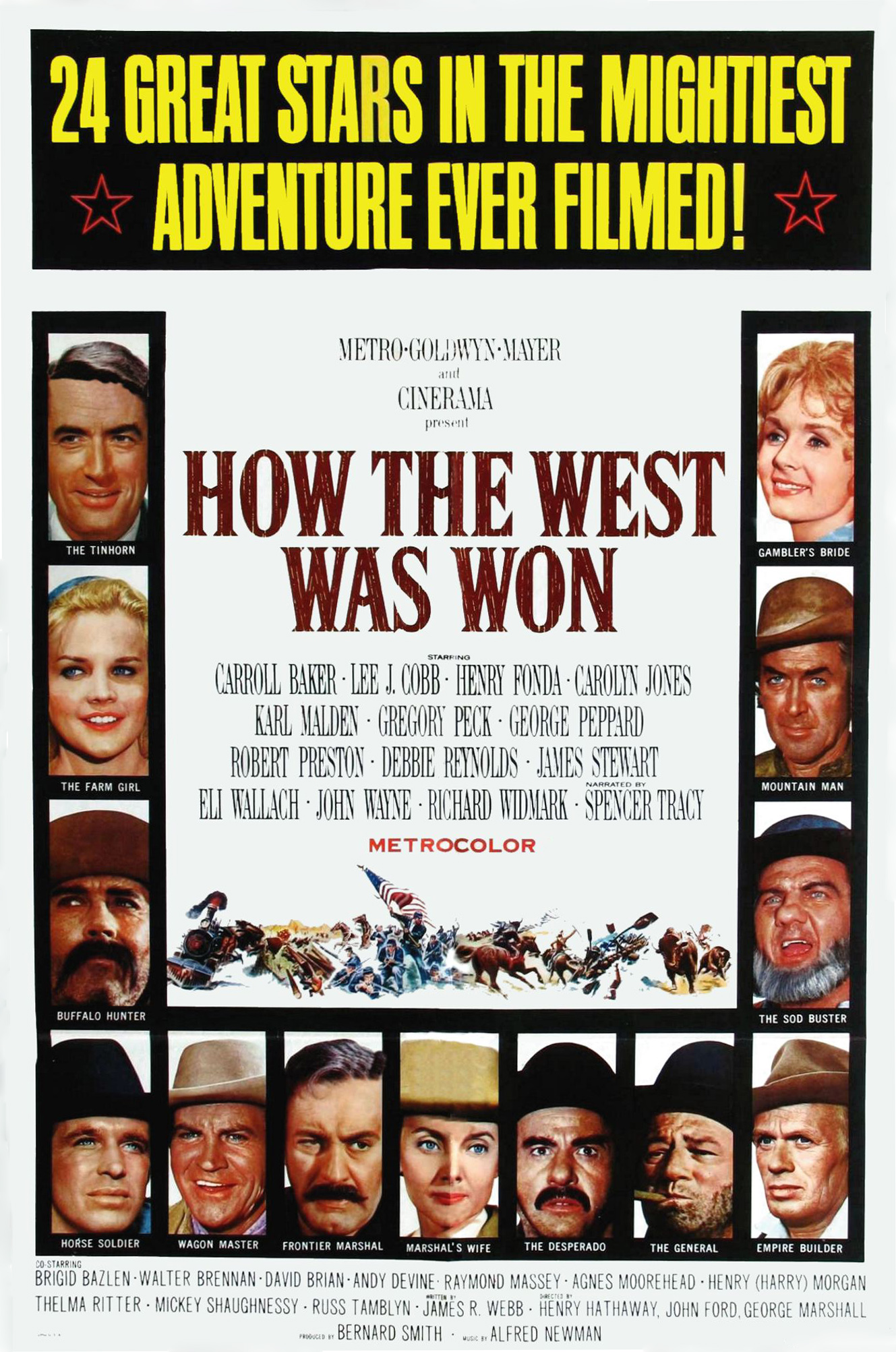
How the West Was Won
In the age of the epics -- the 1950s and 1960s -- some just stand above the rest. It's the stories, the cast, the scope. I don't love 1962's How the West Was Won but as far as epics go, there are very few in its neighborhood. There are obvious flaws, but when it works, it works in a big way. An impressive all-star cast, a story about the development of the American west and a shooting technique that is must-see. That's a winning formula.
A 162-minute film is broken up into five separate segments, the story following the Prescott-Rawlings family as it moves west and settles between the 1840s and the 1880s. It was directed by three different directors and covers a ton of ground. And away we go!
1. The Rivers (directed by Henry Hathaway): It's the 1840s, and the Prescott family, led by patriarch Zebulon (Karl Malden), is moving west and looking for a new life. In Zebulon's family is two daughters, Eve (Carroll Baker), looking for a new life in the west, and Lillith (Debbie Reynolds), wanting to stay in the far-more civilized East. In their dangerous travels on the rivers, they also meet Linus Rawlings (James Stewart), a mountain man with a canoe full of pelts.
Also starring: Lee Van Cleef, Walter Brennan, Agnes Moorehead, Brigid Bazlen.
2. The Plains (directed by Hathaway): Having worked for years on her own as a singer and dancer, Lillith Prescott (Reynolds) has just inherited a gold mine in the wake of the California gold rush. She heads west on a wagon train led by trail driver Richard Morgan (Robert Preston) with a gold-seeking gambler, Cleve Van Valen (Gregory Peck), also along too.
Also starring: Thelma Ritter.
3. The Civil War (directed by John Ford): The war between the states in its early months, young Zeb Rawlings (George Peppard) leaves home with the blessing of his mother, Eve, to join the Ohio volunteers in the fighting. Like so many others, he thinks the war will be full of glory and be over quickly. Zeb finds out how very wrong he is at the bloody battle of Shiloh.
Also starring: John Wayne (as General Sherman), Russ Tamblyn (as a Confederate deserter), Harry Morgan (as General Grant), Andy Devine, Ken Curtis, Raymond Massey (as Abraham Lincoln).
4. The Railroad (directed by George Marshall): In the years following the Civil War, railroad companies race across the U.S. to link the two coasts. Now in the cavalry, Zeb Rawlings (Peppard) finds himself balancing out what his duty requires of him with what he knows is right, the railroad, including brutal supervisor Mike King (Richard Widmark), pushing the Arapahoes to their limit.
Also starring: Henry Fonda as Jethro Stuart, a former mountain man.
5. The Outlaws (directed by Hathaway): Having left the cavalry behind, Zeb Rawlings is now a family man with two kids, now trying to leave his profession as a lawman behind. He receives a letter from his aunt, Lillith (Reynolds), and readies the family to move. As they travel though, Zeb runs into Charlie Gant (Eli Wallach), a notorious outlaw gunning for Zeb.
Also starring: Lee J. Cobb, Carolyn Jones.
This is a movie that's simply put, BIG. It was filmed in Cinerama, three cameras filming each scene and then splicing the action together. The result? An immense look at the expansion of the west. Shots look like panoramic paintings, putting a whole new scope on the growth and development of the American west. It is a beautiful movie. Certain sequences especially stand out -- the camera on a raft trying to survive river rapids, an Indian attack on a wagon train, a stampeding buffalo herd trampling a railroad camp, a runaway train during an attempted robbery -- over the course of the movie, but visually there just isn't a weak spot. I love composer Alfred Newman's score -- listen to an extended sample HERE -- as it gives a moving background to the story. Countless gorgeous filming locations, providing a great backdrop while also transitioning from segment to segment.
It had been years since I watched this movie straight through in one sitting before my recent revisit of this 1962 epic. As you compare the five separate segments, I don't think it's really in question which one is the strongest. It's John Ford's Civil War segment, doing in 20 minutes what entire movies couldn't do in bringing the Civil War to life. Quick, dark, visually striking and unsettling, it is a gem of a sequence, especially Peppard meeting Tamblyn's Confederate deserter after the battle. The second strongest segment for me is the opening 'Rivers' with Stewart, Baker, Reynolds and Malden all leaving a positive impression. All five segments could be stretched out to a feature length film on their own, but these two especially stand out. They get their message across in a quick window and in both cases left me wanting more. Kudos to Ford and Hathaway for their work here.
What struck me more on the rewatch was the other three segments. They are by no means bad segments, but they're just not as good as the other two. I've always thought the weakest was the Plains segment, things feeling too rushed in general. The same qualifies for the Railroad and Outlaws portions. By the time you take away the Entr'Acte, intermission, and Finale music, we're looking at a movie with five segments covered in about 150 minutes (give or take). None of these three are given a chance to breathe to the point they feel downright rushed. As for some other positives? I loved the transitional scenes -- narrated by Spencer Tracy, directed in uncredited fashion by Richard Thorpe -- that set things up, explaining how America has changed, how its people change. These quick montages provide the heart of the movie, almost like a documentary in some ways. Like any movie that tries to accomplish so much, there's good and bad. The positives -- especially the Civil War middle -- is enough to outweigh the negatives thankfully.
One of my biggest worries in reviewing this 1962 epic was that the cast is too big. There's no way I was gonna be able to get all those names tagged with a 200-character limit. Who stands out? Stewart i excellent as Linus Rawlings, Fonda is good in a quick part as Jethro Stuart, and Baker is very strong too. The best parts though are Debbie Reynolds as Lillith and George Peppard as Zeb, the two hearts of the family. One or both is in every segment, the audience seeing them age, learn and adapt as America grows with them. Their scenes together in the Outlaws portion ring especially true. However you cut it though, just an impressive cast from top to bottom, one of the best ever assembled for a Hollywood film.
A doozy of a movie for what it's trying to accomplish. It falls short at times, but this is a movie worth watching for what it represents alone. This is a throwback film, a true epic that strives to be something great. If it doesn't live up those high hopes, so be it. The effort is admirable, a fascinating story of America growing up over an extremely turbulent portion of its history. Oh, and Debbie Reynolds singing A Home in the Meadow (listen HERE) is a truly beautiful song, a fitting one for the movie.
How the West Was Won (1962): ***/****
A 162-minute film is broken up into five separate segments, the story following the Prescott-Rawlings family as it moves west and settles between the 1840s and the 1880s. It was directed by three different directors and covers a ton of ground. And away we go!
1. The Rivers (directed by Henry Hathaway): It's the 1840s, and the Prescott family, led by patriarch Zebulon (Karl Malden), is moving west and looking for a new life. In Zebulon's family is two daughters, Eve (Carroll Baker), looking for a new life in the west, and Lillith (Debbie Reynolds), wanting to stay in the far-more civilized East. In their dangerous travels on the rivers, they also meet Linus Rawlings (James Stewart), a mountain man with a canoe full of pelts.
Also starring: Lee Van Cleef, Walter Brennan, Agnes Moorehead, Brigid Bazlen.
2. The Plains (directed by Hathaway): Having worked for years on her own as a singer and dancer, Lillith Prescott (Reynolds) has just inherited a gold mine in the wake of the California gold rush. She heads west on a wagon train led by trail driver Richard Morgan (Robert Preston) with a gold-seeking gambler, Cleve Van Valen (Gregory Peck), also along too.
Also starring: Thelma Ritter.
3. The Civil War (directed by John Ford): The war between the states in its early months, young Zeb Rawlings (George Peppard) leaves home with the blessing of his mother, Eve, to join the Ohio volunteers in the fighting. Like so many others, he thinks the war will be full of glory and be over quickly. Zeb finds out how very wrong he is at the bloody battle of Shiloh.
Also starring: John Wayne (as General Sherman), Russ Tamblyn (as a Confederate deserter), Harry Morgan (as General Grant), Andy Devine, Ken Curtis, Raymond Massey (as Abraham Lincoln).
4. The Railroad (directed by George Marshall): In the years following the Civil War, railroad companies race across the U.S. to link the two coasts. Now in the cavalry, Zeb Rawlings (Peppard) finds himself balancing out what his duty requires of him with what he knows is right, the railroad, including brutal supervisor Mike King (Richard Widmark), pushing the Arapahoes to their limit.
Also starring: Henry Fonda as Jethro Stuart, a former mountain man.
5. The Outlaws (directed by Hathaway): Having left the cavalry behind, Zeb Rawlings is now a family man with two kids, now trying to leave his profession as a lawman behind. He receives a letter from his aunt, Lillith (Reynolds), and readies the family to move. As they travel though, Zeb runs into Charlie Gant (Eli Wallach), a notorious outlaw gunning for Zeb.
Also starring: Lee J. Cobb, Carolyn Jones.
This is a movie that's simply put, BIG. It was filmed in Cinerama, three cameras filming each scene and then splicing the action together. The result? An immense look at the expansion of the west. Shots look like panoramic paintings, putting a whole new scope on the growth and development of the American west. It is a beautiful movie. Certain sequences especially stand out -- the camera on a raft trying to survive river rapids, an Indian attack on a wagon train, a stampeding buffalo herd trampling a railroad camp, a runaway train during an attempted robbery -- over the course of the movie, but visually there just isn't a weak spot. I love composer Alfred Newman's score -- listen to an extended sample HERE -- as it gives a moving background to the story. Countless gorgeous filming locations, providing a great backdrop while also transitioning from segment to segment.
It had been years since I watched this movie straight through in one sitting before my recent revisit of this 1962 epic. As you compare the five separate segments, I don't think it's really in question which one is the strongest. It's John Ford's Civil War segment, doing in 20 minutes what entire movies couldn't do in bringing the Civil War to life. Quick, dark, visually striking and unsettling, it is a gem of a sequence, especially Peppard meeting Tamblyn's Confederate deserter after the battle. The second strongest segment for me is the opening 'Rivers' with Stewart, Baker, Reynolds and Malden all leaving a positive impression. All five segments could be stretched out to a feature length film on their own, but these two especially stand out. They get their message across in a quick window and in both cases left me wanting more. Kudos to Ford and Hathaway for their work here.
What struck me more on the rewatch was the other three segments. They are by no means bad segments, but they're just not as good as the other two. I've always thought the weakest was the Plains segment, things feeling too rushed in general. The same qualifies for the Railroad and Outlaws portions. By the time you take away the Entr'Acte, intermission, and Finale music, we're looking at a movie with five segments covered in about 150 minutes (give or take). None of these three are given a chance to breathe to the point they feel downright rushed. As for some other positives? I loved the transitional scenes -- narrated by Spencer Tracy, directed in uncredited fashion by Richard Thorpe -- that set things up, explaining how America has changed, how its people change. These quick montages provide the heart of the movie, almost like a documentary in some ways. Like any movie that tries to accomplish so much, there's good and bad. The positives -- especially the Civil War middle -- is enough to outweigh the negatives thankfully.
One of my biggest worries in reviewing this 1962 epic was that the cast is too big. There's no way I was gonna be able to get all those names tagged with a 200-character limit. Who stands out? Stewart i excellent as Linus Rawlings, Fonda is good in a quick part as Jethro Stuart, and Baker is very strong too. The best parts though are Debbie Reynolds as Lillith and George Peppard as Zeb, the two hearts of the family. One or both is in every segment, the audience seeing them age, learn and adapt as America grows with them. Their scenes together in the Outlaws portion ring especially true. However you cut it though, just an impressive cast from top to bottom, one of the best ever assembled for a Hollywood film.
A doozy of a movie for what it's trying to accomplish. It falls short at times, but this is a movie worth watching for what it represents alone. This is a throwback film, a true epic that strives to be something great. If it doesn't live up those high hopes, so be it. The effort is admirable, a fascinating story of America growing up over an extremely turbulent portion of its history. Oh, and Debbie Reynolds singing A Home in the Meadow (listen HERE) is a truly beautiful song, a fitting one for the movie.
How the West Was Won (1962): ***/****
Monday, September 23, 2013
Sabata
Mostly a supporting player in countless film and TV westerns, Lee Van Cleef
had a solid if unspectacular career as an on-screen tough guy through
the 1950s and early 1960s. He was given rebirth though with the
ever-increasing popularity of the spaghetti western genre, especially
working with Italian director Sergio Leone in For a Few Dollars More and
The Good, the Bad and the Ugly. It was a rejuvenation of sorts with a
long line of some classic and near-classic spagettis to the point he was
given his own genre iconic character, 1969's Sabata.
A $100,000 Army payroll has been robbed from the bank in Daugherty City, but in the getaway outside of town, a mysterious gunman, Sabata (Van Cleef), guns down seven of the bandits, returning the money to the town and earning himself a $5,000 reward. There's a problem though. Three of the town's most prominent citizens, including local ranch and land owner, Stengel (Franco Ressel), was behind the robbery and are now worried if they can be implicated for the job. Sabata is able to put the pieces together of how the robbery is pulled off and quickly figures out who was behind it, seeing a chance for a huge payday. Stengel and his cohorts are less than convinced paying him off will accomplish anything, sending a litany of hired guns and killers after Sabata. With an unlikely duo backing him, Sabata readies for each and every attack, worrying all the time about a similarly talented hired gun, Banjo (William Berger), who hasn't made his allegiance known just yet.
This would be the first of three Sabata movies, followed by Adios, Sabata and The Return of Sabata and both released in 1971, all of them directed by Gianfranco Parolini. Where the Sergio Leone westerns are classics above the genre and others are message-oriented with an action shell, the Sabata movies are about as good as they get in terms of pure entertainment. They even border on campy at times. We've got great characters -- good and bad -- with a fun story, a non-stop line of quickly-paced and choreographed gunfights and enough cool guns, gadgets and contraptions to keep everyone interested. It's not so much a story as a series of showdowns and gunfights followed by some negotiations that never amount to much and another series of showdowns and gunfights. If it sounds simple, it is, and it's a lot of fun for all 111 minutes.
Right up there on par with Colonel Douglas Mortimer as his coolest character, Van Cleef nails the part as the mysterious gunman, Sabata. It starts with the style, the gunman in black, his flat-brimmed hat, the impeccable suit, the flowing coat. It continues with his weaponry, Sabata a deadshot with just about anything that shoots. He doesn't wear a gunbelt, favoring an odd four-barrelled derringer and a rifle with an extended barrel. He's ready for anything thrown at him, almost like an other-worldly specter hovering over the town. As far as cool factor goes, Van Cleef has it in spades. It's that ever-present smirk, that quick mocking laugh. He speaks almost solely in one-liners, but it works without being too goofy. Van Cleef found a home in the genre and by 1969 he was a star (the Leone flicks, Day of Anger, Death Rides a Horse, The Big Gundown), but this is one of my favorites for him, and he's cooler than ever.
That's part of the beauty of the weirdness and eccentricity of the spaghetti westerns. We get these bizarre quirky characters that are so goofy it works. Start with Berger's Banjo, a gunman who's seemingly worked with Sabata in the past (in some capacity) and always totes a banjo...with a surprise inside. His long red hair hangs to his shoulder, he wears bells on his pants and around his neck, and he's always ready with a one-liner of his own. His scenes with Van Cleef are pretty perfect, two badass gunfighters going toe to toe. Sabata's crew are gems themselves including Carrincha (Ignazio Spalla), a drunken, knife-throwing Mexican veteran of the Civil War and Alley Cat (Aldo Canti), an athletic, acrobatic Indian. It's the weirdest crew of western characters, but it just works.
Also look for Ressel as the manipulatively evil and combover wearing Stenger, wielding a knife-shooting cane, with Antonio Gradoli and Gianni Rizzo as Ferguson and Judge O'Hara, his two partners in crime. Spaghetti western babe Linda Veras plays Jane, Banjo's dancehall girl with familiar faces Spartaco Conversi, Marco Zuanelli and Claudio Undari as Oswald, a Stengel henchman, rounding out the cast.
With a character that's seemingly indestructible at the forefront, you'd think it might not be that interesting a flick to watch. You'd be wrong. It becomes a test of how he'll defeat his enemies, not a test of if. As my buddy Steve said as we watched Sabata at the Music Box Theatre, Sabata becomes the MacGyver of westerns. He shoots with a variety of trick shots, well-placed shots, and gimmicks galore. The shootouts are fun throughout, with the finale including Sabata, Carrincha and Alley Cat attacking Stengel's heavily fortified ranch with gunfire, gatling guns, dynamite, acrobatics and explosions galore. I loved the ending too, holding back on the meanness or cynical qualities of the other darker westerns, but still has some great twists.
Also worth mentioning is the score from Marcello Giombini. The main theme especially is a gem -- listen HERE -- but it works well throughout. Listen to more of the score HERE with some clips in the video. It incorporates everything from Banjo playing his banjo to some lighter touches, like recurring sound effects leading up to gunfights and even some uses of church organ. It all combines to give the movie that lighter touch, that fun touch. That's the movie. It's got can't miss gunmen, a banjo-wielding gunman, an acrobatic Indian who bounces through the movie and never slows down. A real gem of the spaghetti western genre.
Sabata (1969): *** 1/2 /****
Rewrite of October 2009 review
A $100,000 Army payroll has been robbed from the bank in Daugherty City, but in the getaway outside of town, a mysterious gunman, Sabata (Van Cleef), guns down seven of the bandits, returning the money to the town and earning himself a $5,000 reward. There's a problem though. Three of the town's most prominent citizens, including local ranch and land owner, Stengel (Franco Ressel), was behind the robbery and are now worried if they can be implicated for the job. Sabata is able to put the pieces together of how the robbery is pulled off and quickly figures out who was behind it, seeing a chance for a huge payday. Stengel and his cohorts are less than convinced paying him off will accomplish anything, sending a litany of hired guns and killers after Sabata. With an unlikely duo backing him, Sabata readies for each and every attack, worrying all the time about a similarly talented hired gun, Banjo (William Berger), who hasn't made his allegiance known just yet.
This would be the first of three Sabata movies, followed by Adios, Sabata and The Return of Sabata and both released in 1971, all of them directed by Gianfranco Parolini. Where the Sergio Leone westerns are classics above the genre and others are message-oriented with an action shell, the Sabata movies are about as good as they get in terms of pure entertainment. They even border on campy at times. We've got great characters -- good and bad -- with a fun story, a non-stop line of quickly-paced and choreographed gunfights and enough cool guns, gadgets and contraptions to keep everyone interested. It's not so much a story as a series of showdowns and gunfights followed by some negotiations that never amount to much and another series of showdowns and gunfights. If it sounds simple, it is, and it's a lot of fun for all 111 minutes.
Right up there on par with Colonel Douglas Mortimer as his coolest character, Van Cleef nails the part as the mysterious gunman, Sabata. It starts with the style, the gunman in black, his flat-brimmed hat, the impeccable suit, the flowing coat. It continues with his weaponry, Sabata a deadshot with just about anything that shoots. He doesn't wear a gunbelt, favoring an odd four-barrelled derringer and a rifle with an extended barrel. He's ready for anything thrown at him, almost like an other-worldly specter hovering over the town. As far as cool factor goes, Van Cleef has it in spades. It's that ever-present smirk, that quick mocking laugh. He speaks almost solely in one-liners, but it works without being too goofy. Van Cleef found a home in the genre and by 1969 he was a star (the Leone flicks, Day of Anger, Death Rides a Horse, The Big Gundown), but this is one of my favorites for him, and he's cooler than ever.
That's part of the beauty of the weirdness and eccentricity of the spaghetti westerns. We get these bizarre quirky characters that are so goofy it works. Start with Berger's Banjo, a gunman who's seemingly worked with Sabata in the past (in some capacity) and always totes a banjo...with a surprise inside. His long red hair hangs to his shoulder, he wears bells on his pants and around his neck, and he's always ready with a one-liner of his own. His scenes with Van Cleef are pretty perfect, two badass gunfighters going toe to toe. Sabata's crew are gems themselves including Carrincha (Ignazio Spalla), a drunken, knife-throwing Mexican veteran of the Civil War and Alley Cat (Aldo Canti), an athletic, acrobatic Indian. It's the weirdest crew of western characters, but it just works.
Also look for Ressel as the manipulatively evil and combover wearing Stenger, wielding a knife-shooting cane, with Antonio Gradoli and Gianni Rizzo as Ferguson and Judge O'Hara, his two partners in crime. Spaghetti western babe Linda Veras plays Jane, Banjo's dancehall girl with familiar faces Spartaco Conversi, Marco Zuanelli and Claudio Undari as Oswald, a Stengel henchman, rounding out the cast.
With a character that's seemingly indestructible at the forefront, you'd think it might not be that interesting a flick to watch. You'd be wrong. It becomes a test of how he'll defeat his enemies, not a test of if. As my buddy Steve said as we watched Sabata at the Music Box Theatre, Sabata becomes the MacGyver of westerns. He shoots with a variety of trick shots, well-placed shots, and gimmicks galore. The shootouts are fun throughout, with the finale including Sabata, Carrincha and Alley Cat attacking Stengel's heavily fortified ranch with gunfire, gatling guns, dynamite, acrobatics and explosions galore. I loved the ending too, holding back on the meanness or cynical qualities of the other darker westerns, but still has some great twists.
Also worth mentioning is the score from Marcello Giombini. The main theme especially is a gem -- listen HERE -- but it works well throughout. Listen to more of the score HERE with some clips in the video. It incorporates everything from Banjo playing his banjo to some lighter touches, like recurring sound effects leading up to gunfights and even some uses of church organ. It all combines to give the movie that lighter touch, that fun touch. That's the movie. It's got can't miss gunmen, a banjo-wielding gunman, an acrobatic Indian who bounces through the movie and never slows down. A real gem of the spaghetti western genre.
Sabata (1969): *** 1/2 /****
Rewrite of October 2009 review
Monday, August 12, 2013
Guns, Girls and Gangsters
The 1950s were the age of the sex kitten blondes, especially Marilyn Monroe and later Jayne Mansfield. Where one succeeds, others follow and beyond Monroe and Mansfield was another bleach blonde movie star, Mamie Van Doren. She never reached the stardom of either Monroe or Mansfield, but became a bit of a cult favorite in the late 1950s and 1960s in some really odd, entertaining and bizarre flicks. Case in point, 1959's Guns, Girls and Gangsters.
Released from prison, Chuck Wheeler (Gerald Mohr) has a plan in mind that will net him some $2 million, a plan he developed with another prisoner in jail. He enlists the unwilling help of the prisoner's wife, Vi Victor (Van Doren), to do a key part of the job while also assembling a small team of crooks to help him pull it off. The objective? Knock off an armored car traveling from Las Vegas to Los Angeles packed to the guts with casino winnings from the New Year's holiday. His plan depends on precision detail, and he's confident he can pull it off, even planning ahead for a smooth getaway. There's a problem though. He wants Vi too and not just the money, quite the issue when his prisoner friend and Vi's husband, Mike Bennett (Lee Van Cleef), escapes from prison following Vi's letter asking for a divorce. Can the plan hold together before Mike comes after them?
My first introduction to Mamie Van Doren is a good one. While she's not a great actor, she fits in well with this hard-edged B-movie. Too often in 1950s B-movies, pretty actresses (often models turned actresses) were able to single-handedly ruin films with their bad acting. So, Van Doren doesn't have a ton of range, and the script doesn't call for any huge action scenes, but she more than holds her own with an almost entirely male cast. She has a good chemistry with Mohr especially, and if there was a question....yes, the sex kitten angle is on display. Van Doren is always in a variety of ridiculously tight dresses, night gowns and/or lingerie, and swimsuits. Yes, her looks don't hurt the appeal here. There, it had to be said. Oh, and she gets two chances to sing and perform so there's that too. Watch them HERE.
As a B-movie film noir though, 'Guns' typically succeeds. As a B-movie, it can get away with following the bad guys and leaving the good guys by the wayside for the most part. Everyone is a bad guy, it just depends on what shade of bad you are. Van Doren's Vi? Bad but almost by default. Mohr's Weaver? Pretty bad dude, but maybe...just maybe...he'll have a redemptive moment. Van Cleef's Mike? Oh, he's doomed. Bet on it. I liked the generally dark take on everything, an uncredited narrator keeping things moving with a brisk pace for a 70-minute flick. It has the feel of an episode of Dragnet, any number of 1950/1960s police procedurals. Mostly filmed on studio sets, 'Guns' does have a couple ventures outside, providing some solid location shooting.
Even starting with Van Doren as the top-billed star, there isn't exactly any star power here. Van Doren is solid, a quasi-femme fatale caught in a sticky heist situation. A tough guy star of countless B-movies and a guest star on TV shows, Mohr is a very good anti-hero in the lead, although I suppose I'm using the 'hero' part lightly. Van Cleef is a scene-stealer, still a relative unknown relegated to supporting parts in westerns and crime stories, his Mike like an exposed wire just waiting to spark. Grant Richards plays Darren, the mobster with money problems (with Carlo Fiore as his main henchman) while the always reliable Paul Fix is Largo, an ex-con working with Weaver to pull off the job. Elaine Edwards and John Baer play Ann and Steve Thomas, owners of a highway motel and fix-it shop who unknowingly become part of Weaver's plan.
The early going can be a little slow as Weaver and Vi meet, fight, talk, fight and then decide to work together. Once the heist is actually brought along, the pace quickens for the better. The heist angle is ahead of its time and most definitely has a hard-edge to it, our main characters ready to dispatch anyone standing in their way. Like any heist movie, part of the fun is seeing an impossible plan come together (and ultimately how it will fail), and 'Guns' does it right. So while not a classic, it is an enjoyable enough B-movie film noir. Worth giving a watch if nothing else.
Guns, Girls and Gangsters (1959): ** 1/2 /****
Released from prison, Chuck Wheeler (Gerald Mohr) has a plan in mind that will net him some $2 million, a plan he developed with another prisoner in jail. He enlists the unwilling help of the prisoner's wife, Vi Victor (Van Doren), to do a key part of the job while also assembling a small team of crooks to help him pull it off. The objective? Knock off an armored car traveling from Las Vegas to Los Angeles packed to the guts with casino winnings from the New Year's holiday. His plan depends on precision detail, and he's confident he can pull it off, even planning ahead for a smooth getaway. There's a problem though. He wants Vi too and not just the money, quite the issue when his prisoner friend and Vi's husband, Mike Bennett (Lee Van Cleef), escapes from prison following Vi's letter asking for a divorce. Can the plan hold together before Mike comes after them?
My first introduction to Mamie Van Doren is a good one. While she's not a great actor, she fits in well with this hard-edged B-movie. Too often in 1950s B-movies, pretty actresses (often models turned actresses) were able to single-handedly ruin films with their bad acting. So, Van Doren doesn't have a ton of range, and the script doesn't call for any huge action scenes, but she more than holds her own with an almost entirely male cast. She has a good chemistry with Mohr especially, and if there was a question....yes, the sex kitten angle is on display. Van Doren is always in a variety of ridiculously tight dresses, night gowns and/or lingerie, and swimsuits. Yes, her looks don't hurt the appeal here. There, it had to be said. Oh, and she gets two chances to sing and perform so there's that too. Watch them HERE.
As a B-movie film noir though, 'Guns' typically succeeds. As a B-movie, it can get away with following the bad guys and leaving the good guys by the wayside for the most part. Everyone is a bad guy, it just depends on what shade of bad you are. Van Doren's Vi? Bad but almost by default. Mohr's Weaver? Pretty bad dude, but maybe...just maybe...he'll have a redemptive moment. Van Cleef's Mike? Oh, he's doomed. Bet on it. I liked the generally dark take on everything, an uncredited narrator keeping things moving with a brisk pace for a 70-minute flick. It has the feel of an episode of Dragnet, any number of 1950/1960s police procedurals. Mostly filmed on studio sets, 'Guns' does have a couple ventures outside, providing some solid location shooting.
Even starting with Van Doren as the top-billed star, there isn't exactly any star power here. Van Doren is solid, a quasi-femme fatale caught in a sticky heist situation. A tough guy star of countless B-movies and a guest star on TV shows, Mohr is a very good anti-hero in the lead, although I suppose I'm using the 'hero' part lightly. Van Cleef is a scene-stealer, still a relative unknown relegated to supporting parts in westerns and crime stories, his Mike like an exposed wire just waiting to spark. Grant Richards plays Darren, the mobster with money problems (with Carlo Fiore as his main henchman) while the always reliable Paul Fix is Largo, an ex-con working with Weaver to pull off the job. Elaine Edwards and John Baer play Ann and Steve Thomas, owners of a highway motel and fix-it shop who unknowingly become part of Weaver's plan.
The early going can be a little slow as Weaver and Vi meet, fight, talk, fight and then decide to work together. Once the heist is actually brought along, the pace quickens for the better. The heist angle is ahead of its time and most definitely has a hard-edge to it, our main characters ready to dispatch anyone standing in their way. Like any heist movie, part of the fun is seeing an impossible plan come together (and ultimately how it will fail), and 'Guns' does it right. So while not a classic, it is an enjoyable enough B-movie film noir. Worth giving a watch if nothing else.
Guns, Girls and Gangsters (1959): ** 1/2 /****
Labels:
1950s,
Heist movies,
Ida Lupino,
Lee Van Cleef,
Paul Fix
Monday, March 25, 2013
Posse from Hell
Ah, the posse, where men can be men and.....do manly stuff? Ride horses, shoot guns, track bad guys, eat jerky and drink bad coffee around a fire out in the desert under the stars. Pretty cool, huh? Eh, probably not, but for a western nut like myself, I could get on board with that. Obviously it wasn't a pleasant experience -- tracking down the bad guys to bring them to justice -- but there's been countless westerns following the posse, but few have been better than 1961's Posse from Hell.
Four very dangerous, murdering convicts led by an outlaw named Crip (Vic Morrow) descend on a small, peaceful western town, wreaking havoc and leaving a handful of dead in their wake, including the town marshal. The gang steals $11,000 from the bank and also kidnaps young Helen Caldwell (Zohra Lampert) and takes her with them. As a posse forms the following day, a new deputy arrives in town. His name is Banner Cole (Audie Murphy), and he immediately assumes the marshal's duties, starting with forming the posse. His honesty about the coming hunt scares many people away, leaving Banner with just six men riding with him to take down a four-man gang. The trail awaits with ambushes, double crosses, personal grudges and cowards waiting around every corner. Can Banner hold the group together long enough to get the gang?
From director Herbert Coleman, here is an example of a solid western that's flown under the radar in the 50-plus years since its release. It doesn't hit the 90-minute mark -- wrapping up in 89 instead -- and is most definitely a B-western. 'Hell' was filmed on the backlots with a few excursions to the California desert. The music is pretty standard stuff to the point the full cast and crew listing don't even list a composer. So why does it work then? Western novelist Clair Huffaker (wrote the novel and the screenplay) knows what he's doing. He knows the western and more importantly the characters. His good guy is resolute, his bad guys extremely nasty, and the rest are cannon fodder. Familiar? Maybe, but it's fun and entertaining throughout.
Maybe because it was a B-western and not a huge studio release, 'Hell' can get away with some stuff. That stuff ranks pretty high on the nasty, dark meter. There are things you would expect out of a spaghetti western or revisionist American western from the late 1960s or early 1970s, not a 1961 western. Morrow's Crip is a cold-blooded killer (channeling a similar character he played on an episode of The Rifleman) who favors a double-barreled shotgun and kills with no discretion. His gang kills because they can, not because it actually accomplishes anything. After leaving the town behind, Crip's gang even rapes Helen and leaves her for dead. Banner's posse is equally treacherous with insane, cowardly, big-talking individuals who can't back themselves up. It's a refreshing change of pace from some straightforward white hat good guys and black hat bad guys.
The king of the American B-western, Audie Murphy is an ideal lead. At times, his acting could be a tad wooden, but his stone-faced, almost monotone delivery plays well here. He's less than interested in the feelings or reactions of his posse. He's out there to do a job, not worry about the personalities of these people he's just met. The best dynamic is between Murphy's Banner and John Saxon's Seymour Kern, an Easterner working with the bank in town who's told to go with the posse to watch over the recovered money. The veteran cowboy and the inexperienced Easterner is a familiar convention, but it works. The rest of the posse includes Robert Keith as a power-happy former Union officer, Rodolfo Acosta as a Mexican cowboy known for his tracking ability, Royal Dano as Helen's drunken uncle, Frank Overton as the revenge-seeking townsperson trying to avenge his brother, and Paul Carr as the fast-draw with a pistol who's got little real life experience with his pistols. Also look for Lee Van Cleef as one of Crip's gang. It's a cool group with a variety of personalities, some around to be targets for Crip's gang.
The story is fairly episodic once the posse gets out on the trail. With seven members of the posse, it's clear some aren't going to make it so it becomes a guessing game as to who will survive. There are some surprising twists there so stay tuned through the end. Overall, the story doesn't really know how to end so it does drag a little in the final 15-20 minutes, but the build-up is so worthwhile I barely noticed. It's not enough to detract from a western I very much enjoyed. Highly recommended. Give it a shot at Youtube, link included below.
Posse from Hell (1961): *** 1/2 /****
Four very dangerous, murdering convicts led by an outlaw named Crip (Vic Morrow) descend on a small, peaceful western town, wreaking havoc and leaving a handful of dead in their wake, including the town marshal. The gang steals $11,000 from the bank and also kidnaps young Helen Caldwell (Zohra Lampert) and takes her with them. As a posse forms the following day, a new deputy arrives in town. His name is Banner Cole (Audie Murphy), and he immediately assumes the marshal's duties, starting with forming the posse. His honesty about the coming hunt scares many people away, leaving Banner with just six men riding with him to take down a four-man gang. The trail awaits with ambushes, double crosses, personal grudges and cowards waiting around every corner. Can Banner hold the group together long enough to get the gang?
From director Herbert Coleman, here is an example of a solid western that's flown under the radar in the 50-plus years since its release. It doesn't hit the 90-minute mark -- wrapping up in 89 instead -- and is most definitely a B-western. 'Hell' was filmed on the backlots with a few excursions to the California desert. The music is pretty standard stuff to the point the full cast and crew listing don't even list a composer. So why does it work then? Western novelist Clair Huffaker (wrote the novel and the screenplay) knows what he's doing. He knows the western and more importantly the characters. His good guy is resolute, his bad guys extremely nasty, and the rest are cannon fodder. Familiar? Maybe, but it's fun and entertaining throughout.
Maybe because it was a B-western and not a huge studio release, 'Hell' can get away with some stuff. That stuff ranks pretty high on the nasty, dark meter. There are things you would expect out of a spaghetti western or revisionist American western from the late 1960s or early 1970s, not a 1961 western. Morrow's Crip is a cold-blooded killer (channeling a similar character he played on an episode of The Rifleman) who favors a double-barreled shotgun and kills with no discretion. His gang kills because they can, not because it actually accomplishes anything. After leaving the town behind, Crip's gang even rapes Helen and leaves her for dead. Banner's posse is equally treacherous with insane, cowardly, big-talking individuals who can't back themselves up. It's a refreshing change of pace from some straightforward white hat good guys and black hat bad guys.
The king of the American B-western, Audie Murphy is an ideal lead. At times, his acting could be a tad wooden, but his stone-faced, almost monotone delivery plays well here. He's less than interested in the feelings or reactions of his posse. He's out there to do a job, not worry about the personalities of these people he's just met. The best dynamic is between Murphy's Banner and John Saxon's Seymour Kern, an Easterner working with the bank in town who's told to go with the posse to watch over the recovered money. The veteran cowboy and the inexperienced Easterner is a familiar convention, but it works. The rest of the posse includes Robert Keith as a power-happy former Union officer, Rodolfo Acosta as a Mexican cowboy known for his tracking ability, Royal Dano as Helen's drunken uncle, Frank Overton as the revenge-seeking townsperson trying to avenge his brother, and Paul Carr as the fast-draw with a pistol who's got little real life experience with his pistols. Also look for Lee Van Cleef as one of Crip's gang. It's a cool group with a variety of personalities, some around to be targets for Crip's gang.
The story is fairly episodic once the posse gets out on the trail. With seven members of the posse, it's clear some aren't going to make it so it becomes a guessing game as to who will survive. There are some surprising twists there so stay tuned through the end. Overall, the story doesn't really know how to end so it does drag a little in the final 15-20 minutes, but the build-up is so worthwhile I barely noticed. It's not enough to detract from a western I very much enjoyed. Highly recommended. Give it a shot at Youtube, link included below.
Posse from Hell (1961): *** 1/2 /****
Labels:
1960s,
Audie Murphy,
John Saxon,
Lee Van Cleef,
Robert Keith,
Rodolfo Acosta,
Royal Dano,
Vic Morrow,
westerns
Sunday, December 30, 2012
Barquero
With the distinct feel of a spaghetti western, 1970s Barquero relies on a simple formula; pair two very successful western stars and let them do their thing. Not particularly flashy by any means, it's a meat and potatoes kind of western, just barely worth getting an above average rating.
At an isolated river crossing along the border, Travis (Lee Van Cleef) is thriving as the owner of a river barge. The crossing is the only spot for miles in either direction, and a little town has popped up around Travis' barge. Miles away, infamous outlaw Jake Remy (Warren Oates) and his gang have led a bloody raid on a cavalry convoy transporting silver and repeating rifles, wiping out a town in the process. Remy's gang heads for the river crossing, knowing time will become a factor with the Army in hot pursuit to get back their silver and rifles. Travis and the river town catch wind though, getting to the far side of the river. Now Travis and Co. are on one side while Remy's gang is on the other, plotting their next move as the Army closes in behind them. Who will cave first?
From director Gordon Douglas, this is a western from a sub-genre that popped up in the late 1960s in the U.S. In Europe, the spaghetti westerns had emerged as a factor to be reckoned with, and western fans responded. They wanted darker, more cynical and more violent westerns. Good guys weren't just good guys. They became anti-heroes. So studios gave them what they want, and the result is a sticky middle ground that isn't pigeon-holed clearly. I have always thought of them as quasi-spaghetti westerns, movies like 100 Rifles, Villa Rides, Charro!, Shalako and so many more. 'Barquero' wasn't filmed in Europe -- Colorado is the backdrop, and a good one at that -- but it still feels like a spaghetti western. Composer Dominic Frontiere's score is okay, but it's not memorable like some of his better scores.
The best thing going for this American-ish spaghetti western is the casting of Lee Van Cleef and Warren Oates as rivals. Both actors were at the height of their popularity. Van Cleef became an international star because of the spaghetti westerns, and Oates had risen from a career of supporting parts to become a leading man/star in his own right. They look to be having a lot of fun in the process, two tough guys sneering and yelling at each other from across a river. As Travis -- dubbed 'the Barquero' (Spanish for boatman) -- Van Cleef is not playing his typical gunfighter, but instead a tough as nails working man who won't turn his back on something he has created. Playing Remy, Oates hams it up (as usual, but it's always interesting) as the unhinged outlaw. We learn some about his past, and how he got here -- most definitely crazy -- but he plays one nasty dude like few others can.
Beyond that tough guy duo, 'Barquero' lacks the star power, but the supporting cast doesn't disappoint. I thought the best part was for Kerwin Matthews as Marquette, Remy's right hand man in leading a brutal gang. He is a former French officer who survived when French emperor Maximilian was killed by Mexican revolutionaries, now working as Remy's reasonable thinking ally. Also providing a scene-stealing supporting part is Forrest Tucker as Mountain Phil, a mountain man drifter who teams with Travis to protect the crossing. Both fighting over Van Cleef's Travis, Marie Gomez and Mariette Hartley play the love interests. Rounding out Remy's gang of cutthroats are Armando Silvestre, John Davis Chandler, Ed Bakey, Richard Lapp and Brad Weston. Craig Littler plays Pitney, the town store owner doubling as a con man preacher.
While I did like this western, I can't say I loved it. The premise is cool; two rivals across a river from each other. Time is running out for one of them, and they need to get across the river. Sounds like a pretty decent cat and mouse game, doesn't it? It should be, but it isn't. Remy's plan is....well, he doesn't have one. He brews and stews on his side of the river for much of the middle portion of the movie without actually doing anything. It's Matthews' Marquette who finally comes up with a plan. Clocking in at 109 minutes, it's a tad long with not enough going on. Still, it's a worthwhile popcorn western. Enjoy it for what it is, and watch Van Cleef and Oates be cool together. You can watch the entire movie HERE at Youtube.
Barquero (1970): ** 1/2 /****
At an isolated river crossing along the border, Travis (Lee Van Cleef) is thriving as the owner of a river barge. The crossing is the only spot for miles in either direction, and a little town has popped up around Travis' barge. Miles away, infamous outlaw Jake Remy (Warren Oates) and his gang have led a bloody raid on a cavalry convoy transporting silver and repeating rifles, wiping out a town in the process. Remy's gang heads for the river crossing, knowing time will become a factor with the Army in hot pursuit to get back their silver and rifles. Travis and the river town catch wind though, getting to the far side of the river. Now Travis and Co. are on one side while Remy's gang is on the other, plotting their next move as the Army closes in behind them. Who will cave first?
From director Gordon Douglas, this is a western from a sub-genre that popped up in the late 1960s in the U.S. In Europe, the spaghetti westerns had emerged as a factor to be reckoned with, and western fans responded. They wanted darker, more cynical and more violent westerns. Good guys weren't just good guys. They became anti-heroes. So studios gave them what they want, and the result is a sticky middle ground that isn't pigeon-holed clearly. I have always thought of them as quasi-spaghetti westerns, movies like 100 Rifles, Villa Rides, Charro!, Shalako and so many more. 'Barquero' wasn't filmed in Europe -- Colorado is the backdrop, and a good one at that -- but it still feels like a spaghetti western. Composer Dominic Frontiere's score is okay, but it's not memorable like some of his better scores.
The best thing going for this American-ish spaghetti western is the casting of Lee Van Cleef and Warren Oates as rivals. Both actors were at the height of their popularity. Van Cleef became an international star because of the spaghetti westerns, and Oates had risen from a career of supporting parts to become a leading man/star in his own right. They look to be having a lot of fun in the process, two tough guys sneering and yelling at each other from across a river. As Travis -- dubbed 'the Barquero' (Spanish for boatman) -- Van Cleef is not playing his typical gunfighter, but instead a tough as nails working man who won't turn his back on something he has created. Playing Remy, Oates hams it up (as usual, but it's always interesting) as the unhinged outlaw. We learn some about his past, and how he got here -- most definitely crazy -- but he plays one nasty dude like few others can.
Beyond that tough guy duo, 'Barquero' lacks the star power, but the supporting cast doesn't disappoint. I thought the best part was for Kerwin Matthews as Marquette, Remy's right hand man in leading a brutal gang. He is a former French officer who survived when French emperor Maximilian was killed by Mexican revolutionaries, now working as Remy's reasonable thinking ally. Also providing a scene-stealing supporting part is Forrest Tucker as Mountain Phil, a mountain man drifter who teams with Travis to protect the crossing. Both fighting over Van Cleef's Travis, Marie Gomez and Mariette Hartley play the love interests. Rounding out Remy's gang of cutthroats are Armando Silvestre, John Davis Chandler, Ed Bakey, Richard Lapp and Brad Weston. Craig Littler plays Pitney, the town store owner doubling as a con man preacher.
While I did like this western, I can't say I loved it. The premise is cool; two rivals across a river from each other. Time is running out for one of them, and they need to get across the river. Sounds like a pretty decent cat and mouse game, doesn't it? It should be, but it isn't. Remy's plan is....well, he doesn't have one. He brews and stews on his side of the river for much of the middle portion of the movie without actually doing anything. It's Matthews' Marquette who finally comes up with a plan. Clocking in at 109 minutes, it's a tad long with not enough going on. Still, it's a worthwhile popcorn western. Enjoy it for what it is, and watch Van Cleef and Oates be cool together. You can watch the entire movie HERE at Youtube.
Barquero (1970): ** 1/2 /****
Labels:
1970s,
Gordon Douglas,
Kerwin Matthews,
Lee Van Cleef,
Warren Oates,
westerns
Saturday, April 7, 2012
Death Rides a Horse
The middle film in Sergio Leone's famous Dollars trilogy, 1965's For a Few Dollars More, is considered one of the best spaghetti westerns ever made and is also my personal favorite of the genre. Two years later, 1967's Death Rides a Horse hit theaters, and hhmm, something sure seems familiar. Borrowing liberally from Leone's earlier western, it uses the same basic storyline with some almost identical scenes. Thankfully it does enough to stand on its own.
At an isolated ranch where $100,000 is being guarded one rainy night, a gang of bandits and killers descend on the ranch, taking the money as they kill the guards and family. All except one that is...a young boy. Some 15 years later, the boy has grown up, and Bill (John Phillip Law), is looking for the men responsible for his family's murder. A dead-shot with pistol or rifle, Bill is still inexperienced, but he has specific memories that will help him identify the killers without having seen their faces. As he travels though, he meets up with Ryan (Lee Van Cleef), an older gunman fresh out of prison. Their plans seem the same as both men are gunning for the same bandits. Will they work together or as foes?
Sounds like For a Few Dollars More, doesn't it? The young gunslinger teaming with the older, more experienced gun-hand isn't unique to just FAFDM, but it is an example of a movie that handles it really well. But in the wave of movies that were released after the Leone westerns, some similar stories popped up, and director Giulio Petroni uses that story as a jumping off point. Similar elements are there -- the dynamic between characters, the blood-tinted flashbacks -- but this is a movie that stands on its own. There's a reason it is remembered as one of the best spaghetti westerns around. And wouldn't you know it? This Lee Van Cleef guy is a big reason why.
By 1967, Van Cleef was a star thanks to the spaghetti western. He'd already starred in FAFDM, The Good, the Bad and the Ugly, and The Big Gundown, and with 'Death' adds another classic to his name. His Ryan is a slightly different version of Col. Mortimer, albeit a little more down on his luck. Even when his characters are in the right though, Van Cleef gave them a mean streak right up their back. He's an anti-hero, but one you're never sure of his intentions. Cool as gunfire starts, he knows what he wants and plans on getting it. Playing Colonel Mortimer for Leone is probably his most iconic role, but this is one of my favorites of his. Unfortunately John Phillip Law just can't match Clint Eastwood's part, but he does a respectable job as the revenge-seeking Bill. It's hard to tell if it's his acting or a bad dubbing, but wooden aptly describes the character. There is a chemistry with Van Cleef's Ryan though and that goes a long way in saving the story.
So who should our revenge-seeking gunmen go after? 'Death' fills out a cast will plenty of recognizable faces, all just waiting to be picked off. Law's Bill as a child saw little things he could remember about the killers; a tattoo, an earring, a scar, and now he's looking for those clues. The killers include Luigi Pistilli as Walcott, now a respectable banker (saw him clearly), American actor Anthony Dawson as Cavanaugh (chest tattoo of four aces), a saloon owner and town boss, with two bandit brothers, including Jose Torres as Pedro (scar over his left eye) and Angelo Susani as Paco (an earring from his right ear that dangles). Also look for Mario Brega as one of Walcott's henchmen, an actor continuing his trend of dying horrifically in spaghetti westerns, and Bruno Corazzari as another hapless henchmen. Don't forget about him in the finale. Where is he hiding?
All the touches of a successful spaghetti western are here from the anti-heroes and the despicable villains to the dusty border towns and extreme close-ups. For a movie that's 114 minutes though, it is not action-packed. The story builds up the tension as Bill and Ryan hunt down their revenge, but it's rarely dull. Just don't think you're seeing two hours of shootouts and gunfights. The ending though is one of the more memorable finales of the genre; Bill and Ryan in an isolated Mexican mountain village shooting it out with Walcott's men. A wind storm whips across the mountains, enveloping the town as sand, dirt and wind swirl around. If you were looking for action, this is the best place to find. Also worth mentioning, a twist that probably shouldn't come as a surprise, but it works nonetheless in terms of the two characters involved. Great finale, great ending.
Now in a spaghetti western, you'd be safe guessing that composer Ennio Morricone did the musical score, and here, you would be 100% correct. It never ceases to amaze me this man's talents. Some scores had touches of familiarity, but his 'Death' score is unlike any other he did and in general, one of his most underrated scores from a long and distinguished career. Listen to the main theme HERE for an idea. Another sample comes late in the movie -- dubbed Mystic and Severe -- which you can listen to HERE and watch in context HERE. Quentin Tarantino is a huge fan of the score, using both those music cues in his movies Kill Bill Vol. 1 and Inglourious Basterds. A great score though to keep things moving in a great spaghetti western. Van Cleef was rarely better in bad-ass mode, and you'll be hard-pressed to come up with too many that are better than this movie. You can watch the entire movie HERE at Youtube, but the quality isn't great.
Death Rides a Horse <---trailer (1967): *** 1/2 /****
At an isolated ranch where $100,000 is being guarded one rainy night, a gang of bandits and killers descend on the ranch, taking the money as they kill the guards and family. All except one that is...a young boy. Some 15 years later, the boy has grown up, and Bill (John Phillip Law), is looking for the men responsible for his family's murder. A dead-shot with pistol or rifle, Bill is still inexperienced, but he has specific memories that will help him identify the killers without having seen their faces. As he travels though, he meets up with Ryan (Lee Van Cleef), an older gunman fresh out of prison. Their plans seem the same as both men are gunning for the same bandits. Will they work together or as foes?
Sounds like For a Few Dollars More, doesn't it? The young gunslinger teaming with the older, more experienced gun-hand isn't unique to just FAFDM, but it is an example of a movie that handles it really well. But in the wave of movies that were released after the Leone westerns, some similar stories popped up, and director Giulio Petroni uses that story as a jumping off point. Similar elements are there -- the dynamic between characters, the blood-tinted flashbacks -- but this is a movie that stands on its own. There's a reason it is remembered as one of the best spaghetti westerns around. And wouldn't you know it? This Lee Van Cleef guy is a big reason why.
By 1967, Van Cleef was a star thanks to the spaghetti western. He'd already starred in FAFDM, The Good, the Bad and the Ugly, and The Big Gundown, and with 'Death' adds another classic to his name. His Ryan is a slightly different version of Col. Mortimer, albeit a little more down on his luck. Even when his characters are in the right though, Van Cleef gave them a mean streak right up their back. He's an anti-hero, but one you're never sure of his intentions. Cool as gunfire starts, he knows what he wants and plans on getting it. Playing Colonel Mortimer for Leone is probably his most iconic role, but this is one of my favorites of his. Unfortunately John Phillip Law just can't match Clint Eastwood's part, but he does a respectable job as the revenge-seeking Bill. It's hard to tell if it's his acting or a bad dubbing, but wooden aptly describes the character. There is a chemistry with Van Cleef's Ryan though and that goes a long way in saving the story.
So who should our revenge-seeking gunmen go after? 'Death' fills out a cast will plenty of recognizable faces, all just waiting to be picked off. Law's Bill as a child saw little things he could remember about the killers; a tattoo, an earring, a scar, and now he's looking for those clues. The killers include Luigi Pistilli as Walcott, now a respectable banker (saw him clearly), American actor Anthony Dawson as Cavanaugh (chest tattoo of four aces), a saloon owner and town boss, with two bandit brothers, including Jose Torres as Pedro (scar over his left eye) and Angelo Susani as Paco (an earring from his right ear that dangles). Also look for Mario Brega as one of Walcott's henchmen, an actor continuing his trend of dying horrifically in spaghetti westerns, and Bruno Corazzari as another hapless henchmen. Don't forget about him in the finale. Where is he hiding?
All the touches of a successful spaghetti western are here from the anti-heroes and the despicable villains to the dusty border towns and extreme close-ups. For a movie that's 114 minutes though, it is not action-packed. The story builds up the tension as Bill and Ryan hunt down their revenge, but it's rarely dull. Just don't think you're seeing two hours of shootouts and gunfights. The ending though is one of the more memorable finales of the genre; Bill and Ryan in an isolated Mexican mountain village shooting it out with Walcott's men. A wind storm whips across the mountains, enveloping the town as sand, dirt and wind swirl around. If you were looking for action, this is the best place to find. Also worth mentioning, a twist that probably shouldn't come as a surprise, but it works nonetheless in terms of the two characters involved. Great finale, great ending.
Now in a spaghetti western, you'd be safe guessing that composer Ennio Morricone did the musical score, and here, you would be 100% correct. It never ceases to amaze me this man's talents. Some scores had touches of familiarity, but his 'Death' score is unlike any other he did and in general, one of his most underrated scores from a long and distinguished career. Listen to the main theme HERE for an idea. Another sample comes late in the movie -- dubbed Mystic and Severe -- which you can listen to HERE and watch in context HERE. Quentin Tarantino is a huge fan of the score, using both those music cues in his movies Kill Bill Vol. 1 and Inglourious Basterds. A great score though to keep things moving in a great spaghetti western. Van Cleef was rarely better in bad-ass mode, and you'll be hard-pressed to come up with too many that are better than this movie. You can watch the entire movie HERE at Youtube, but the quality isn't great.
Death Rides a Horse <---trailer (1967): *** 1/2 /****
Labels:
1960s,
Lee Van Cleef,
Luigi Pistilli,
Mario Brega,
spaghetti westerns
Monday, February 27, 2012
Arrow in the Dust
When I recorded four westerns off of Turner Classic Movies in January, I figured I'd lucked into something. I'd seen none of them, much less heard much about any of them, so I went in with measured expectations, hoping for at least one or two winners among the bunch. I was surprised as any when I really liked the first three (Gold of the Seven Saints, Fort Dobbs, Drum Beat), and then there was the fourth, 1954's Arrow in the Dust. No perfect 4-for-4 day at the plate this time.
Having deserted his post, U.S. cavalry trooper Bart Laish (Sterling Hayden) is on the run with a patrol not far behind. As he runs, he comes across the wreckage of an ambushed wagon train, his dying friend, Major Andy Pepperes (Carleton Young), among the bodies. Andy implores his friend to complete the mission he couldn't, take command of a wagon train that must get through to Fort Laramie. The Pawnee tribe is on the warpath, and the wagon train is guarded by a small, undermanned company waiting for a commander. Knowing that taking the job could be certain death, Bart poses as the Major and joins up with the train, hoping to bring it in safely while possibly also clearing his name.
As a fan of the western genre, I can give a movie a pass if it still manages to entertain me in all its badness. This 1954 oater is testing even my limits. It is bad, truly bad. A B-movie that runs just 79 minutes but feels like an eternity has little to nothing going for it. From Allied Artists Pictures, 'Arrow' is one of the weakest westerns I've ever come across. At least 30 minutes of the already glacial-like story is long shots of the train and the cavalry troop riding around to a generic western score. The script is predictable (if there was a script), the characters taken from the Western Stock Characters 101 list, the action laughable, and in general, a feeling of laziness. Bad, just bad.
I go back and forth with Sterling Hayden as an actor. In movies like The Asphalt Jungle, he's very good, but I think it's because he's working with an ensemble and not asked to carry the picture. In Dr. Strangelove, his wooden delivery works through the ridiculous nature of the story. In a bad B-movie like 'Arrow,' he stands out like a sore thumb. He looks physically uncomfortable in the part, and his stilted, awkward deliveries are as monotone as ever. His "command" comes to respect him, and I'm thinking "What did I miss?" When a movie depends on Hayden to carry an already sub-par story, you're in for a long movies. He also could be the most unrealistic cowboy/trooper I've ever seen. Watch him riding his horse. He always pulls back on the reins, his horse rearing its head with every stride like it's in pain.
Playing the deserter-turned-savoir with no real explanation provided for his desertion, Hayden's Bart makes decision after decision that gets stupider with each one. More and more of his men are killed, but because the story requires it, they love him and respect him. The "action" has a shot of cavalry firing at charging Indians, said Indians falling from their horses, cavalry shooting again. Any hand-to-hand combat is ridiculous, some of the worst choreographed fights ever, including one clumsy fight toward the end with two past their prime old men duking it out. The Pawnees also team up with the Apaches to become the dumbest tribe of warriors ever, charging into a wall of gunfire rather than shooting back. In the end, the cavalry makes it, apparently because the Indians got bored and went home. Who knows for sure.
While Hayden's bad performance is the most prominent, it is just one of many in this flick. Coleen Gray plays Christella (cool name), a single woman driving her own wagon as part of the train. She just hates Bart for how hard he drives the men, but gosh darnit! Wouldn't you know she kinda falls for him too? Hayden certainly gives her a lot to fall in love with. Keith Larsen is Lt. King, Bart's second-in-command, with Tom Tully playing the chubby scout, Crowshaw, who quickly finds out Bart's secret but doesn't say anything. The only other name even worth mentioning is Lee Van Cleef in a supporting role as a trouble-making gunslinger. Watch quick though before he makes a gruesome exit.
If you've made it this far, I appreciate it. I can't recommend this even to western fans, but if you can come up with a good drinking game to go with it, lots of alcohol/booze could make it more enjoyable. Well, maybe, it's a shot in the dark. Feeling like torturing yourself? Watch the entire movie below.
Arrow in the Dust <---entire movie (1954): */****
Having deserted his post, U.S. cavalry trooper Bart Laish (Sterling Hayden) is on the run with a patrol not far behind. As he runs, he comes across the wreckage of an ambushed wagon train, his dying friend, Major Andy Pepperes (Carleton Young), among the bodies. Andy implores his friend to complete the mission he couldn't, take command of a wagon train that must get through to Fort Laramie. The Pawnee tribe is on the warpath, and the wagon train is guarded by a small, undermanned company waiting for a commander. Knowing that taking the job could be certain death, Bart poses as the Major and joins up with the train, hoping to bring it in safely while possibly also clearing his name.
As a fan of the western genre, I can give a movie a pass if it still manages to entertain me in all its badness. This 1954 oater is testing even my limits. It is bad, truly bad. A B-movie that runs just 79 minutes but feels like an eternity has little to nothing going for it. From Allied Artists Pictures, 'Arrow' is one of the weakest westerns I've ever come across. At least 30 minutes of the already glacial-like story is long shots of the train and the cavalry troop riding around to a generic western score. The script is predictable (if there was a script), the characters taken from the Western Stock Characters 101 list, the action laughable, and in general, a feeling of laziness. Bad, just bad.
I go back and forth with Sterling Hayden as an actor. In movies like The Asphalt Jungle, he's very good, but I think it's because he's working with an ensemble and not asked to carry the picture. In Dr. Strangelove, his wooden delivery works through the ridiculous nature of the story. In a bad B-movie like 'Arrow,' he stands out like a sore thumb. He looks physically uncomfortable in the part, and his stilted, awkward deliveries are as monotone as ever. His "command" comes to respect him, and I'm thinking "What did I miss?" When a movie depends on Hayden to carry an already sub-par story, you're in for a long movies. He also could be the most unrealistic cowboy/trooper I've ever seen. Watch him riding his horse. He always pulls back on the reins, his horse rearing its head with every stride like it's in pain.
Playing the deserter-turned-savoir with no real explanation provided for his desertion, Hayden's Bart makes decision after decision that gets stupider with each one. More and more of his men are killed, but because the story requires it, they love him and respect him. The "action" has a shot of cavalry firing at charging Indians, said Indians falling from their horses, cavalry shooting again. Any hand-to-hand combat is ridiculous, some of the worst choreographed fights ever, including one clumsy fight toward the end with two past their prime old men duking it out. The Pawnees also team up with the Apaches to become the dumbest tribe of warriors ever, charging into a wall of gunfire rather than shooting back. In the end, the cavalry makes it, apparently because the Indians got bored and went home. Who knows for sure.
While Hayden's bad performance is the most prominent, it is just one of many in this flick. Coleen Gray plays Christella (cool name), a single woman driving her own wagon as part of the train. She just hates Bart for how hard he drives the men, but gosh darnit! Wouldn't you know she kinda falls for him too? Hayden certainly gives her a lot to fall in love with. Keith Larsen is Lt. King, Bart's second-in-command, with Tom Tully playing the chubby scout, Crowshaw, who quickly finds out Bart's secret but doesn't say anything. The only other name even worth mentioning is Lee Van Cleef in a supporting role as a trouble-making gunslinger. Watch quick though before he makes a gruesome exit.
If you've made it this far, I appreciate it. I can't recommend this even to western fans, but if you can come up with a good drinking game to go with it, lots of alcohol/booze could make it more enjoyable. Well, maybe, it's a shot in the dark. Feeling like torturing yourself? Watch the entire movie below.
Arrow in the Dust <---entire movie (1954): */****
Thursday, January 26, 2012
The Good, the Bad and the Ugly
With 1964's A Fistful of Dollars, director Sergio Leone put the spaghetti western on an international stage and in the process made star Clint Eastwood a hugely popular actor worldwide. Leone followed it up the next year with For a Few Dollars More, what some (including this guy) consider to be the best spaghetti western ever. It was all practice though for 1966's The Good, the Bad and the Ugly, a movie that is bigger than just a spaghetti western or even a western in general. It's one of the best movies ever made.
It's 1863/1864 in the American southwest, and the Civil War is raging as Union forces battle with fleeing Confederate troops. Amidst all the fighting, a Confederate payroll has been stolen and ultimately hidden, buried away in a grave in a cemetery with thousands of near identical graves. The payroll of $200,000 in gold coins seems destined to waste away for all time, but three men know about it and are dead-set on acquiring it. Running a bounty scam, a drifting gunfighter, Blondie (Eastwood) and a Mexican bandit, Tuco (Eli Wallach) stumble across the information, one knowing the cemetery, the other knowing the name on the grave. A third man, a hired killer, Angel Eyes (Lee Van Cleef), is also on the prowl and never far behind. Who can get there first? Can they even make it alive?
I try not to throw this term around loosely, but The Good, the Bad and the Ugly is one of those rare perfect movies. Everything fits together like a jigsaw puzzle, all the little things working together seamlessly, impressive considering the scale of this movie. With the Civil War as its backdrop, it is a big, big western, the epitome of an epic. The scale Leone shoots his movie would be jaw-dropping in itself, but it's handled well. The Almerian locations in Spain become an additional character, using the land like so many other spaghetti westerns attempted but failed to do. It is an incredible visual experience. If not beautiful, it is powerful in its image. More details on all of this later, but Ennio Morricone's score is among the most instantly recognizable scores ever, the acting is perfect, the set pieces leaving a lasting impression, and a movie overall that won't easily be forgotten.
Like so many of the best directors, Leone had a knack for casting, and with Eastwood, Wallach and Van Cleef, the Italian director hits three home runs. Eastwood reprises his role from the first two Dollars movies, the man of few words gunslinger, Blondie (instead of Joe and/or Manco), who usually lets his gun do his talking. There's even an introduction of his infamous poncho. He is the prototypical anti-hero, the silent gunfighter looking for treasure. Van Cleef as Angel Eyes (Sentenza -- means Death Sentence -- in the Italian dubbing) is an all-time sinister villain, the hired killer who always seems to show up when least desired. Sinister, brutal, maniacal, all apply to this gunhand. The scene-stealer though is Wallach as Tuco, a well-traveled Mexican bandit. He's going 100 mph at all times, the fast-talking, quick-draw who is always crossing himself over his victims. These are all characters capable of carrying a movie on their own, but instead they work together to form one of the great lead ensembles ever assembled for a movie.
A couple smaller performances also deliver, regardless of how little screentime they have. Aldo Giuffre plays a Union captain who Blondie and Tuco come across in the midst of a battle. An alcoholic, he questions the lunacy of his orders but continues on because an officer must do his duty. Spaghetti regular Luigi Pistilli plays Father Ramirez, Tuco's brother who looks down upon what his brother has become, a lowly bandit. Spaghetti baddie Mario Brega plays Cpl. Wallace, a sadistic Union soldier looking over Tuco. Al Mulock plays a gunfighter gunning for Tuco after a past encounter. Fans of the genre should also look out for Benito Stefanelli, Aldo Sambrell, and Lorenzo Robledo as members of Angel Eyes' gang.
What ends up being another character is Morricone's score, as key an ingredient to the movie's success as any score/movie relationship I can think of. The main theme -- listen HERE -- is instantly recognizable, and basically everyone around the world has heard at it some point whether they knew it or not. The unique sound, the whistling, the tune, it all sets the stage for a score that goes from epic and huge to personal and moving with the snap of a finger. Used several times in the movie, Carriage of the Spirits is an ethereal, other-worldly beautiful sample of music that still sends chills up and down my back upon hearing it. That's what Morricone does, he makes his music effective and powerful no matter what the scene or setting. The best though of all -- even better than the GBU main theme -- is a track entitled Ecstasy of Gold, a hauntingly beautiful piece of music. Why's it so good? More on that later (sorry, I will get to it). All in all, an incredible score that serves an integral role in making this movie a classic. One of the all-time great film scores.
A handful of set pieces dominate the film -- several abandoned western towns, a shootout in a bombed out town, a huge, bloody battle between Union and Confederate forces -- but it all pales to the ending, the film's last 30 minutes or so as Blondie, Tuco and Angel Eyes all near the gold. The extended sequence starts with Tuco finding the cemetery, racing through rows and rows of graves trying to find the name Blondie has told him. Set to Morricone's Ecstasy of Gold, the sequence defies words. It's dizzying and unsettling, Leone's camera breathlessly following Wallach as he runs, finally finding the wanted grave. Watch it HERE. Then it's the showdown, one of the most respected, iconic (drinking game? How many times have I used that?) gunfights ever. Leone's trick though is the build-up. It's almost 5 minutes of positioning and mind games, the camera bouncing back and forth in close-ups and extreme close-ups, a blur of eyes, hands, and guns, all three men daring the other to draw. Watch it HERE, the single, greatest standoff in the history of movies.
Watching this recently on a big screen -- thank you, Doc Films -- I realized something odd and unique about the movie. It took an Italian director in Leone to make the best Civil War movie around. I think that gets lost sometimes with the scale and epicness of the movie. Wrapped up in it all is an anti-war message, and an effective one. All the soldiers we meet are cripples, drunks, corrupt, and dying. We see bodies littered on trails and in streets like discarded garbage. A thief is callously shot down by a firing squad. A Confederate spy's body is lashed to a cow-catcher on a train as a warning to others. Without beating us over the head with his message, Leone effectively shows the horror of war but also the lunacy and stupidity of it all. As Eastwood's Blondie states while overlooking a battle, "I've never seen so many men wasted so badly."
There it is, an epically long and rambling review for an epically great movie. Dark and cynical, it is oddly funny -- Tuco's 'When you have to shoot, shoot, don't talk' and the running 'There are 2 types of people in this world' line providing some good laughs -- and shows off an underrated script with a story that spans months and hundreds of miles. It is that perfect movie. A buddy-journey story set in the American Civil War with perfect performances, an immensely giant scale, a great musical score, and choreographed action which has been attempted over and over ever since. The definition of what a movie should be. It doesn't get better than this.
The Good, the Bad and the Ugly <---trailer (1966): ****/****
It's 1863/1864 in the American southwest, and the Civil War is raging as Union forces battle with fleeing Confederate troops. Amidst all the fighting, a Confederate payroll has been stolen and ultimately hidden, buried away in a grave in a cemetery with thousands of near identical graves. The payroll of $200,000 in gold coins seems destined to waste away for all time, but three men know about it and are dead-set on acquiring it. Running a bounty scam, a drifting gunfighter, Blondie (Eastwood) and a Mexican bandit, Tuco (Eli Wallach) stumble across the information, one knowing the cemetery, the other knowing the name on the grave. A third man, a hired killer, Angel Eyes (Lee Van Cleef), is also on the prowl and never far behind. Who can get there first? Can they even make it alive?
I try not to throw this term around loosely, but The Good, the Bad and the Ugly is one of those rare perfect movies. Everything fits together like a jigsaw puzzle, all the little things working together seamlessly, impressive considering the scale of this movie. With the Civil War as its backdrop, it is a big, big western, the epitome of an epic. The scale Leone shoots his movie would be jaw-dropping in itself, but it's handled well. The Almerian locations in Spain become an additional character, using the land like so many other spaghetti westerns attempted but failed to do. It is an incredible visual experience. If not beautiful, it is powerful in its image. More details on all of this later, but Ennio Morricone's score is among the most instantly recognizable scores ever, the acting is perfect, the set pieces leaving a lasting impression, and a movie overall that won't easily be forgotten.
Like so many of the best directors, Leone had a knack for casting, and with Eastwood, Wallach and Van Cleef, the Italian director hits three home runs. Eastwood reprises his role from the first two Dollars movies, the man of few words gunslinger, Blondie (instead of Joe and/or Manco), who usually lets his gun do his talking. There's even an introduction of his infamous poncho. He is the prototypical anti-hero, the silent gunfighter looking for treasure. Van Cleef as Angel Eyes (Sentenza -- means Death Sentence -- in the Italian dubbing) is an all-time sinister villain, the hired killer who always seems to show up when least desired. Sinister, brutal, maniacal, all apply to this gunhand. The scene-stealer though is Wallach as Tuco, a well-traveled Mexican bandit. He's going 100 mph at all times, the fast-talking, quick-draw who is always crossing himself over his victims. These are all characters capable of carrying a movie on their own, but instead they work together to form one of the great lead ensembles ever assembled for a movie.
A couple smaller performances also deliver, regardless of how little screentime they have. Aldo Giuffre plays a Union captain who Blondie and Tuco come across in the midst of a battle. An alcoholic, he questions the lunacy of his orders but continues on because an officer must do his duty. Spaghetti regular Luigi Pistilli plays Father Ramirez, Tuco's brother who looks down upon what his brother has become, a lowly bandit. Spaghetti baddie Mario Brega plays Cpl. Wallace, a sadistic Union soldier looking over Tuco. Al Mulock plays a gunfighter gunning for Tuco after a past encounter. Fans of the genre should also look out for Benito Stefanelli, Aldo Sambrell, and Lorenzo Robledo as members of Angel Eyes' gang.
What ends up being another character is Morricone's score, as key an ingredient to the movie's success as any score/movie relationship I can think of. The main theme -- listen HERE -- is instantly recognizable, and basically everyone around the world has heard at it some point whether they knew it or not. The unique sound, the whistling, the tune, it all sets the stage for a score that goes from epic and huge to personal and moving with the snap of a finger. Used several times in the movie, Carriage of the Spirits is an ethereal, other-worldly beautiful sample of music that still sends chills up and down my back upon hearing it. That's what Morricone does, he makes his music effective and powerful no matter what the scene or setting. The best though of all -- even better than the GBU main theme -- is a track entitled Ecstasy of Gold, a hauntingly beautiful piece of music. Why's it so good? More on that later (sorry, I will get to it). All in all, an incredible score that serves an integral role in making this movie a classic. One of the all-time great film scores.
A handful of set pieces dominate the film -- several abandoned western towns, a shootout in a bombed out town, a huge, bloody battle between Union and Confederate forces -- but it all pales to the ending, the film's last 30 minutes or so as Blondie, Tuco and Angel Eyes all near the gold. The extended sequence starts with Tuco finding the cemetery, racing through rows and rows of graves trying to find the name Blondie has told him. Set to Morricone's Ecstasy of Gold, the sequence defies words. It's dizzying and unsettling, Leone's camera breathlessly following Wallach as he runs, finally finding the wanted grave. Watch it HERE. Then it's the showdown, one of the most respected, iconic (drinking game? How many times have I used that?) gunfights ever. Leone's trick though is the build-up. It's almost 5 minutes of positioning and mind games, the camera bouncing back and forth in close-ups and extreme close-ups, a blur of eyes, hands, and guns, all three men daring the other to draw. Watch it HERE, the single, greatest standoff in the history of movies.
Watching this recently on a big screen -- thank you, Doc Films -- I realized something odd and unique about the movie. It took an Italian director in Leone to make the best Civil War movie around. I think that gets lost sometimes with the scale and epicness of the movie. Wrapped up in it all is an anti-war message, and an effective one. All the soldiers we meet are cripples, drunks, corrupt, and dying. We see bodies littered on trails and in streets like discarded garbage. A thief is callously shot down by a firing squad. A Confederate spy's body is lashed to a cow-catcher on a train as a warning to others. Without beating us over the head with his message, Leone effectively shows the horror of war but also the lunacy and stupidity of it all. As Eastwood's Blondie states while overlooking a battle, "I've never seen so many men wasted so badly."
There it is, an epically long and rambling review for an epically great movie. Dark and cynical, it is oddly funny -- Tuco's 'When you have to shoot, shoot, don't talk' and the running 'There are 2 types of people in this world' line providing some good laughs -- and shows off an underrated script with a story that spans months and hundreds of miles. It is that perfect movie. A buddy-journey story set in the American Civil War with perfect performances, an immensely giant scale, a great musical score, and choreographed action which has been attempted over and over ever since. The definition of what a movie should be. It doesn't get better than this.
The Good, the Bad and the Ugly <---trailer (1966): ****/****
Thursday, October 13, 2011
El Condor
Released in 1970, El Condor is one of those westerns. It is pretty typical of how these movies tried to capitalize on the success of the spaghetti westerns. They were often filmed in Italy and Spain so you're seeing familiar and well-worn locations popping up. Casts needed to be filled so stars of spaghetti westerns made the seamless transition. The stories were similar, stories of gunfighters and saddle tramps, hired guns and killers, all looking to make a buck. Of course, these movies weren't spaghetti westerns no matter how hard they tried, and it shows. Still, thanks to some interesting casting and at least an attempt, most of these westerns are very watchable.
Working on a chain gang at a mine in the desert, a prisoner named Luke (Jim Brown) continues to hear rumors about a fortune in gold in the Mexican desert. Only knowing part of the story, Luke escapes with plans of getting his hands on the gold. The fortune is in El Condor, an immense mountain fortress guarded by a heavily armed garrison commanded by General Chavez (Patrick O'Neal). Inside the fortress awaits the treasure, all the gold that makes up the Mexican national treasury as Mexico fights back against French invader Maximilian. Luke seeks help, finding it in Jaroo (Lee Van Cleef), a down on his luck gold prospector who used to live with the Apaches. Recruiting over 80 Apache warriors (headed by Iron Eyes Cody), Jaroo and Luke go about preparing their plan to get the millions of dollars worth of gold.
The best thing going for this pseudo-spaghetti is the casting of Brown and Van Cleef who have a good Odd Couple, uneasy alliance buddy relationship. Still trying to prove himself as an actor/movie star after retiring from the NFL in 1966, Brown brings his usual bigger than life presence to his part as Luke. He was always more a star than an actor, but let's face it. Running back or movie star? Jim Brown was cool. Van Cleef gets to ham it up a bit, playing a part vastly different from his typical cold, steely-eyed anti-heroes that he played in so many spaghetti westerns. Individually, both men would have been capable of carrying an action movie, but together? Pie in the sky. They have a good chemistry together as they try to figure each other out, figuring who and what the other is up to.
One of the coolest things to come out of this movie though is the actual El Condor fortress, built specifically for this movie. You can see its introduction HERE via a Youtube clip. The sheer size of it makes it like an additional character, this heavily armed and guarded fortress, as impregnable as possible, taunting anyone who cares to take it on. Some pictures of what it looks like more recently can be seen HERE at a cool spaghetti western locations website, just scroll down a bit. The fortress looks like something you'd see out of a French Foreign Legion movie with its high walls and baroque lookout towers. It's been used in several movies since, and in an age of computer-generated....well, everything, it's very cool to see such a well-built and highly functioning location.
Not quite an American or spaghetti western, El Condor falls somewhere in between. It certainly tries to offer something new in terms of violence and sex that you couldn't see on television, producing some rather odd moments. Luke and Jaroo lead a surprise attack on a Mexican patrol taking a "siesta" by kidnapping a bunch of women and having their way with them. The ambush waits until everyone's nude so we get some full frontal nudity -- not just female nudity either, awkwardly enough -- and some pretty low-brow humor. What the movie is most known for is Marianna Hill and her infamous striptease. Distracting the guards, Hill's Claudine -- O'Neal's live-in girlfriend I guess -- strips down where everyone can see her. She's completely nude for at least a couple minutes, the camera not shying away from her the way most movies would do. No complaints, Hill's gorgeous, but it feels oddly placed and kind of creepy, even voyeuristic. Basically something you wouldn't expect out of a 1970 western.
Director John Guillermin saves much of his best action for last, the final sneak attack and assault on El Condor led by Luke, Jaroo and their army of Apache warriors. The violence and action is amped up on an impressive scale. This fortress gets torn apart as the casualties mount and the gold gets ever closer. The finale saves some surprising twists -- along with Hill's distracting striptease -- that caught me off guard. I don't necessarily like the ending, but I don't hate it either. A specific choice is made that seems forced, making me question why Guillermin and the script didn't call for a darker ending because the potential is there. It is still a good example of these pseudo-spaghetti westerns even if it is a bit of a guilty pleasure.
El Condor <---trailer (1970): ***/****
Labels:
1970s,
Jim Brown,
Lee Van Cleef,
Patrick O'Neal,
westerns
Subscribe to:
Posts (Atom)


_film_poster.jpg)