Ah, the posse, where men can be men and.....do manly stuff? Ride horses, shoot guns, track bad guys, eat jerky and drink bad coffee around a fire out in the desert under the stars. Pretty cool, huh? Eh, probably not, but for a western nut like myself, I could get on board with that. Obviously it wasn't a pleasant experience -- tracking down the bad guys to bring them to justice -- but there's been countless westerns following the posse, but few have been better than 1961's Posse from Hell.
Four very dangerous, murdering convicts led by an outlaw named Crip (Vic Morrow) descend on a small, peaceful western town, wreaking havoc and leaving a handful of dead in their wake, including the town marshal. The gang steals $11,000 from the bank and also kidnaps young Helen Caldwell (Zohra Lampert) and takes her with them. As a posse forms the following day, a new deputy arrives in town. His name is Banner Cole (Audie Murphy), and he immediately assumes the marshal's duties, starting with forming the posse. His honesty about the coming hunt scares many people away, leaving Banner with just six men riding with him to take down a four-man gang. The trail awaits with ambushes, double crosses, personal grudges and cowards waiting around every corner. Can Banner hold the group together long enough to get the gang?
From director Herbert Coleman, here is an example of a solid western that's flown under the radar in the 50-plus years since its release. It doesn't hit the 90-minute mark -- wrapping up in 89 instead -- and is most definitely a B-western. 'Hell' was filmed on the backlots with a few excursions to the California desert. The music is pretty standard stuff to the point the full cast and crew listing don't even list a composer. So why does it work then? Western novelist Clair Huffaker (wrote the novel and the screenplay) knows what he's doing. He knows the western and more importantly the characters. His good guy is resolute, his bad guys extremely nasty, and the rest are cannon fodder. Familiar? Maybe, but it's fun and entertaining throughout.
Maybe because it was a B-western and not a huge studio release, 'Hell' can get away with some stuff. That stuff ranks pretty high on the nasty, dark meter. There are things you would expect out of a spaghetti western or revisionist American western from the late 1960s or early 1970s, not a 1961 western. Morrow's Crip is a cold-blooded killer (channeling a similar character he played on an episode of The Rifleman) who favors a double-barreled shotgun and kills with no discretion. His gang kills because they can, not because it actually accomplishes anything. After leaving the town behind, Crip's gang even rapes Helen and leaves her for dead. Banner's posse is equally treacherous with insane, cowardly, big-talking individuals who can't back themselves up. It's a refreshing change of pace from some straightforward white hat good guys and black hat bad guys.
The king of the American B-western, Audie Murphy is an ideal lead. At times, his acting could be a tad wooden, but his stone-faced, almost monotone delivery plays well here. He's less than interested in the feelings or reactions of his posse. He's out there to do a job, not worry about the personalities of these people he's just met. The best dynamic is between Murphy's Banner and John Saxon's Seymour Kern, an Easterner working with the bank in town who's told to go with the posse to watch over the recovered money. The veteran cowboy and the inexperienced Easterner is a familiar convention, but it works. The rest of the posse includes Robert Keith as a power-happy former Union officer, Rodolfo Acosta as a Mexican cowboy known for his tracking ability, Royal Dano as Helen's drunken uncle, Frank Overton as the revenge-seeking townsperson trying to avenge his brother, and Paul Carr as the fast-draw with a pistol who's got little real life experience with his pistols. Also look for Lee Van Cleef as one of Crip's gang. It's a cool group with a variety of personalities, some around to be targets for Crip's gang.
The story is fairly episodic once the posse gets out on the trail. With seven members of the posse, it's clear some aren't going to make it so it becomes a guessing game as to who will survive. There are some surprising twists there so stay tuned through the end. Overall, the story doesn't really know how to end so it does drag a little in the final 15-20 minutes, but the build-up is so worthwhile I barely noticed. It's not enough to detract from a western I very much enjoyed. Highly recommended. Give it a shot at Youtube, link included below.
Posse from Hell (1961): *** 1/2 /****
The Sons of Katie Elder
"First, we reunite, then find Ma and Pa's killer...then read some reviews."
Showing posts with label John Saxon. Show all posts
Monday, March 25, 2013
Sunday, August 16, 2009
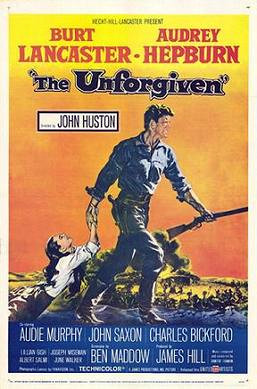
The Unforgiven
Some westerns are content to go for the lowest common denominator, an entertaining story with ridiculous amounts of action. I don't mean that as negatively as it sounds, I own a lot of movies like that. But some westerns strive for something else whether it be getting a message across or trying to make a statement about the times. These can be hit or miss because sometimes they strive to do too much, but every so often they find that balance, like John Huston's 1960 adult western The Unforgiven.
Based on a novel by author Alan Le May, who also wrote The Searchers, you have to figure you're not getting a typical shoot 'em up western. And in general, westerns were getting away from the old stereotypes, especially in the 1950s with some adult, psychological westerns like Anthony Mann's movies teaming up with Jimmy Stewart (all highly recommended). The Unforgiven doesn't settle for anything easy in it's story about a western family dealing with the revelation that their adopted daughter may be a Kiowa.
The Zacharys are a frontier family working their spread in the Texas panhandle and looking to put together a cattle herd to drive north to Wichita. The patriarch of the family since his father died years before, Ben (Burt Lancaster) is the leader, the oldest brother who keeps everyone else in check. His mother, Mattilde (Lillian Gish), runs the house and makes sure the family stays together. Helping Ben around the spread are his two younger brothers, Cash (Audie Murphy), a fiery, hot-tempered cowboy, and Andy (Doug McClure), the youngest brother who's still growing up. Then, there's Rachel (Audrey Hepburn), their adopted sister who their father supposedly found after her parents were massacred by Kiowas.
One day, a mysterious rider (Joseph Wiseman) rides into town with some revealing news. He says that Rachel has Indian blood in her, and that the story her father told was a lie. Everyone around turns on the Zacharys, and the news even tears the family itself apart with Cash refusing to live in the same house as a 'red-skinned' Indian. Even Ben's longtime partner and neighbor Zed Rawlings (Charles Bickford) refuses to deal with the family. All the while, Ben must hold the family together, even when the Kiowas come to take Rachel back.
Any movie, including a western, that deals with racism as straight forward and honest as this one is going to be polarizing. The Unforgiven can be brutally honest in that sense. We're introduced to all these characters, get to know them, and across the board they seem like good people. But the moment the possibility arises that one among them could be an Indian, they turn on each other. That could have been what the times were like, but it's a story that could be set in any decade or time in American history. It works because it doesn't try to whitewash the story.
Credit for that goes to Huston and his cast, an impressive listing of actors. It's not Lancaster's best part, but he's solid in the lead role. Hepburn is a bit of an odd choice as Rachel, but she pulls it off even if she looks little to nothing like a young Kiowa woman. This movie is known as much for the behind the scenes issues with Hepburn, but her role as Rachel works because she makes the character easy to identify with and very sympathetic.
Surprisingly enough with Lancaster and Hepburn in the leads, it's Audie Murphy that has the best part. His Cash Zachary is a deeply flawed character, a racist at the most basic who wants nothing to do with Indians of any sort, even his own adopted sister. Always known for playing the good guy in a white hat, the WWII hero plays completely against part here as the racist cowboy and comes across the best because he puts it all into the part. Of the rest of the cast, Gish and McClure round out the family, a believable representation of a frontier family, and John Saxon has a cool if small part as Johnny Portugal, an Indian horse wrangler/breaker, including this well choreographed chase scene.
Judging the movie apart from its story is a lot easier because Huston presents such a well-package western. Visually, he gets the spectacle down, the epic feel of what living in the west was like. The movie was shot in Durango, Mexico where many westerns were filmed, and it looks beautiful. The west was full of big, wide open spaces and Huston utilizes that feeling with some memorable long shots, some seemingly from miles away on a rock butte or hill. Composer Dimitri Tiomkin's score isn't as consistently strong as some of his others, but his music in those scenes fits perfectly.
A western that's dark and gloomy and doesn't pull any punches with its story dealing with racism and prejudices in the wild west. The movie benefits from some great performances, including a career-best part from Audie Murphy, and location shooting in Durango. This isn't as well known as Alan Le May's other highly respected western The Searchers, but it deserves more recognition than it's gotten in the years since.
The Unforgiven (1960): *** 1/2 /****
Based on a novel by author Alan Le May, who also wrote The Searchers, you have to figure you're not getting a typical shoot 'em up western. And in general, westerns were getting away from the old stereotypes, especially in the 1950s with some adult, psychological westerns like Anthony Mann's movies teaming up with Jimmy Stewart (all highly recommended). The Unforgiven doesn't settle for anything easy in it's story about a western family dealing with the revelation that their adopted daughter may be a Kiowa.
The Zacharys are a frontier family working their spread in the Texas panhandle and looking to put together a cattle herd to drive north to Wichita. The patriarch of the family since his father died years before, Ben (Burt Lancaster) is the leader, the oldest brother who keeps everyone else in check. His mother, Mattilde (Lillian Gish), runs the house and makes sure the family stays together. Helping Ben around the spread are his two younger brothers, Cash (Audie Murphy), a fiery, hot-tempered cowboy, and Andy (Doug McClure), the youngest brother who's still growing up. Then, there's Rachel (Audrey Hepburn), their adopted sister who their father supposedly found after her parents were massacred by Kiowas.
One day, a mysterious rider (Joseph Wiseman) rides into town with some revealing news. He says that Rachel has Indian blood in her, and that the story her father told was a lie. Everyone around turns on the Zacharys, and the news even tears the family itself apart with Cash refusing to live in the same house as a 'red-skinned' Indian. Even Ben's longtime partner and neighbor Zed Rawlings (Charles Bickford) refuses to deal with the family. All the while, Ben must hold the family together, even when the Kiowas come to take Rachel back.
Any movie, including a western, that deals with racism as straight forward and honest as this one is going to be polarizing. The Unforgiven can be brutally honest in that sense. We're introduced to all these characters, get to know them, and across the board they seem like good people. But the moment the possibility arises that one among them could be an Indian, they turn on each other. That could have been what the times were like, but it's a story that could be set in any decade or time in American history. It works because it doesn't try to whitewash the story.
Credit for that goes to Huston and his cast, an impressive listing of actors. It's not Lancaster's best part, but he's solid in the lead role. Hepburn is a bit of an odd choice as Rachel, but she pulls it off even if she looks little to nothing like a young Kiowa woman. This movie is known as much for the behind the scenes issues with Hepburn, but her role as Rachel works because she makes the character easy to identify with and very sympathetic.
Surprisingly enough with Lancaster and Hepburn in the leads, it's Audie Murphy that has the best part. His Cash Zachary is a deeply flawed character, a racist at the most basic who wants nothing to do with Indians of any sort, even his own adopted sister. Always known for playing the good guy in a white hat, the WWII hero plays completely against part here as the racist cowboy and comes across the best because he puts it all into the part. Of the rest of the cast, Gish and McClure round out the family, a believable representation of a frontier family, and John Saxon has a cool if small part as Johnny Portugal, an Indian horse wrangler/breaker, including this well choreographed chase scene.
Judging the movie apart from its story is a lot easier because Huston presents such a well-package western. Visually, he gets the spectacle down, the epic feel of what living in the west was like. The movie was shot in Durango, Mexico where many westerns were filmed, and it looks beautiful. The west was full of big, wide open spaces and Huston utilizes that feeling with some memorable long shots, some seemingly from miles away on a rock butte or hill. Composer Dimitri Tiomkin's score isn't as consistently strong as some of his others, but his music in those scenes fits perfectly.
A western that's dark and gloomy and doesn't pull any punches with its story dealing with racism and prejudices in the wild west. The movie benefits from some great performances, including a career-best part from Audie Murphy, and location shooting in Durango. This isn't as well known as Alan Le May's other highly respected western The Searchers, but it deserves more recognition than it's gotten in the years since.
The Unforgiven (1960): *** 1/2 /****
Labels:
1960s,
Audie Murphy,
Audrey Hepburn,
Burt Lancaster,
John Huston,
John Saxon,
Joseph Wiseman,
westerns
Thursday, February 12, 2009
Netflix Review #6: Joe Kidd

After the huge success of Dirty Harry the year before, Clint Eastwood returned to the genre that made him a star, the western, in 1972's Joe Kidd, the story of a range war in turn of the century New Mexico. It's another Eastwood western I've always avoided some because I enjoyed the Leone spaghettis so much, but I enjoyed it even with all its flaws of which there are many.
Eastwood is Joe Kidd, a small-time rancher who's just received a 10-day jail sentence for a number of offences. He's let out when a rich land owner, Frank Harlan, wants to hire Joe to lead a hunting expedition of sorts, a hunt for a Mexican stirring up trouble when it comes to land rights by the name of Luis Chama. Kidd turns down the offer but changes his mind when he returns home to find that Chama and his gang have stolen his horses and beaten one of his hired hands. Kidd joins up with Harlan and his posse, finding out how brutal their methods can be on the trail.
For one, it's a short movie at 88 minutes. I was disappointed to read the DVD has missing scenes from previous releases or TV showings. I can't verify having never seen it, but a DVD always gets lower points for something like that. With the short running time, you lose a ton of character and plot development. John Saxon plays Chama, appearing for the first five minutes and then disappearing until the last 20 minutes. Robert Duvall has always been a good villain, and lives up to reputation here, but his character is as one-dimensional as they come. Must kill Chama!
Some of these issues most likely were caused by the lack of a finished script. Director John Sturges improvised on the fly, especially in the finale. There's a cool stunt with a train going off the rails, but a few minutes later, the movie just sort of ends. It's not one of those open-ended conclusions where you're left to interpret what happened, the movie is over and credits roll.In spite of these flaws, it's a western I enjoyed. Eastwood is a more laid back gunslinger, and even if he is underwritten, Duvall provides a good counter to him. Composer Lalo Schifrin does his own version of a spaghetti western score that's memorable, and the California and Old Tucson locations are shot beautifully. Harlan's posse of hired guns, Lamarr Simms (Don Stroud), a hothead who would like nothing more than kill Kidd, Olin Mingo (James Wainwright), a sniper who can hit anything, and Roy Gannon (Paul Koslo), the calm, cool fast draw specialist, are also good villains, if underused. The showdown the movie builds to with Kidd and Simms has no pay-off, too bad, it would have been a goodie.
The DVD, missing scenes and all, is an average disc. Widescreen presentation is noticeably scratchy in certain scenes, but otherwise appears okay. Special features include the always boring production notes with cast and crew info, and a trailer that plays up the action in the movie. A western with flaws, sure, but still check it out.
Joe Kidd (1972): ***/****
Labels:
1970s,
Clint Eastwood,
John Saxon,
John Sturges,
Paul Koslo,
Robert Duvall,
westerns
Subscribe to:
Posts (Atom)