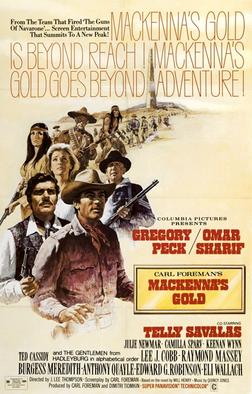
Oh, cable, how I love you. I basically have two channels on if I'm watching TV, either MLB Network or Encore Westerns. A whole channel devoted to western TV shows and movies?!? Aaahhh my head just exploded! It gives me a chance to revisit a whole bunch of movies I haven't seen in years, like 1969's Mackenna's Gold, a big-budget, all-star extravaganza that I remember liking (I think) on my first viewing. Does it hold up?
A marshal for the western town of Hadleyburg, Mackenna (Gregory Peck) is out on the trail when he's ambushed by an old Apache man who dies after a quick shootout. Before he dies, the Apache gives Mackenna a map to a famous, supposedly lost, canyon of gold ('Canon del Oro') that treasure hunters have long sought. Mackenna throws the map in the fire but not before noticing a couple landmarks on it. He's soon cornered by a Mexican bandit, Colorado (Omar Sharif), and his gang who similarly are looking for the canyon of gold. They're not alone. The desert seems full of treasure hunters and gold-hopefuls desperately searching for the gold. Discovering that Mackenna may hold the key to finding the canyon, he's taken along as Colorado's unwilling prisoner. The supposed location is days away across the vast desert with Mackenna, Colorado and his men forced to deal with a do-good posse out of Hadleyburg, an intervening cavalry troop and an Apache war party. How far will the prospect of gold drive all these folks?
I'm a sucker for westerns -- good and bad -- but this one is bad and just not that enjoyable. Talk about a movie where the ingredients don't come together (at all), and you've got this movie. The talent on-hand is unquestionable from director J. Lee Thompson, stars Gregory Peck and Omar Sharif leading a ridiculously deep cast, a cool, potential-filled story and a drop-dead look to it all...it should have been so much better. Or I guess I'd settle for just 'good' too. The formula seems to go after a western Guns of Navarone meets Treasure of the Sierra Madre combination, but it never jells into anything remotely coherent or especially enjoyable. That's tough to say because a cast this good should make a movie pretty decent on its own but alas, it wasn't meant to be this time! If you're looking for a Peck-Thompson-Carl Foreman pairing, stick with 'Navarone.'
Kudos to Encore Westerns. Watching the movie for the second time but first time since 2009, I watched it in widescreen, as it was meant to be. Thompson filmed in Super Panavision 70, a filming technique that fills the screen to epic proportions, almost like a panoramic picture. Shooting on-location in Monument Valley, Glen Canyon and Canyon de Chelly in Arizona adds a great visual appeal to the movie. Shots of riders galloping across these expanses are excellent to watch, a sight to behold, and unfortunately, one of the few genuine positives to take away from a western that's too long at 128 minutes. When a movie's looks are the best thing going...that's never a good thing.
Poor Gregory Peck, he looks like he's as bored as all get-out and doesn't quite know what to do. One of my all-time favorite actors, he's undone by all the shenanigans going on around him. Getting to play straight man to a murdering bandit, a gold-for-eyes posse, a bloodthirsty Apache war party, a murdering cavalry sergeant (an underused Telly Savalas), and all sorts of ancient legends coming to life is never a good thing. As reliable as anyone who's ever graced the screen, Peck is given little more to do than look out for Camilla Sparv's damsel in distress while navigating a love triangle with Julie Newmar's Apache warrior and Sparv. Yeah, you read that right. Catwoman plays an Apache warrior and looks great doing it! She even gets an odd nude swimming scene where she tries to kill both Peck and Sparv. So there's that!
So much of the rest of the cast is simply miscast. I like Sharif in just about any film he's ever done, but he's an odd choice to play our Mexican bandit, Colorado. His gang includes Keenan Wynn as a Mexican bandit named Sanchez, with Ted Cassidy (Lurch from The Addams Family), Rudy Diaz and Robert Phillips as Apache warriors. All spot-on casting! Brace for this list of appearances that amount to little more than cameos, members of a "posse" out of Hadleyburg that's looking for gold. The group includes Eli Wallach, Anthony Quayle, Lee J. Cobb, Burgess Meredith, Raymond Massey and Edward G. Robinson!!! Look at that Hollywood royalty! Unfortunately, they're introduced, given nothing to do and there basically because of their name recognition. So....yeah....there's that! Quite the cast, huh? I just wish they were given more to do. Maybe that character development was cut from the rumored 3-hour version of the film. Yeah, that's it I'm sure.
Just too many moving pieces that never get going in the same direction. There's virtually no story, just some character introductions and then they're off into the desert. The only detour are various ways to kill off characters in waves. Then, there's the beautiful location shooting, with a slight problem. Countless times, one after another, we see the location shots and then a quick cut to our actors in front of a rear projection shot. Nothing takes you out of the story's momentum like Peck, Sharif and Co. riding a "horse" as they tear across the desert. Throw in some odd, out of place narration (it's not Victor Jory's fault!), some painful theme ballads, and generally odd cutting and editing that is more and more jarring with each passing scene.
There's a meanness to the story that's hard to account for. Characters are introduced for the sake of dispatching them in unceremonious fashion, but the general tone of the movie itself isn't that dark. It feels like they're going for that "Greed will make you do horrible things" tone, but it's too light, fluffy and goofy to pull it off. There's some potential obviously with the all-star cast, some equally impressive camera angles and shots, and the location shooting, but there's just too much negative going on to ignore it. A stinker.
Mackenna's Gold (1969): **/****
The Sons of Katie Elder
"First, we reunite, then find Ma and Pa's killer...then read some reviews."
Showing posts with label Burgess Meredith. Show all posts
Wednesday, December 30, 2015
Friday, February 13, 2015
The Story of G.I. Joe
I went to Indiana University in Bloomington for college, getting my journalism degree from the IU School of Journalism. The building was named Ernie Pyle Hall or shortened to 'the Pyle.' The school was named after famed journalist and war correspondent Ernie Pyle who rose to fame during World War II for his columns about the fighting in Europe and the Pacific. His exploits were given a feature film adaptation in a criminally forgotten war film, 1945's The Story of G.I. Joe.
It's 1942 in North Africa and inexperienced American troops are being pushed back on all fronts against the veteran German troops. A journalist and columnist from Indiana, 42-year old Ernie Pyle (Burgess Meredith) joins the American infantry on the front lines looking to tell their stories for the American people back in the states. The tide begins to turn though as the green Americans learn how to fight, pushing the Germans back and winning North Africa. As the war jumps to Italy, Pyle is right there with the troops, documenting everything he sees. Pyle keeps moving around but always seems to find himself with one infantry company with its commander, Captain Bill Walker (Robert Mitchum), and troops not only getting to know him but welcoming him in, the journalist becoming one of them. What does the war hold though? What awaits both Pyle and the American troops?
What an excellent movie. I think the biggest compliment I can give is that 'Joe' is one of the most authentic war movies ever made. It's not just authentic though. It's real, emotional and resonates long after viewing. Director William Wellman wants to tell the story of the grunts, the men on the front lines and does so without any huge displays of patriotism or heroism. These are just 20-somethings who just want to get home. The quickest way to accomplish that? Win the next battle and the next until they get to Berlin. We don't meet any staff officers or get a wider, bigger picture of the war. We get to know the troops, see them on the march, in combat, waiting and waiting. In ways that movies with a much bigger reputation/following didn't do, you really get the sense of what it was like being in the infantry in WWII.
That authenticity comes from Pyle's writings, two of his compilation books serving as inspiration for the screenplay (writers Leopold Atlas, Guy Endore, Philip Stevenson) that was nominated for an Academy Award. Pyle's columns were simple and straightforward, effective because he got a message across that left quite the impression. A relative unknown at the time, Meredith was cast as Pyle, bringing the man to life with a quiet, understated performance. He steals the movie in subtle fashion. Like Pyle's columns, Meredith isn't overbearing or trying too hard. Like good journalists, he listens and looks and waits for the story. He doesn't force it.
It's a feeling that reflects the entire movie. Nothing feels forced. A lot of ground is covered, but you don't feel rushed. There's a natural flow to the story. Overall, 'Joe' is ahead of its time. It was released the summer of 1945 as the war was winding down, but there's not an ounce of propaganda involved. It's just war. We see the effects of battle on the troops, some eventually cracking. We see the looks in the soldiers' faces as they look back on a fallen comrade. They don't talk about the power or glory of war. It's a dirty, nasty business and people die. It is a little touch, but the soldiers have beards and mustaches, the product of days and weeks up at the front without a rest. 'Joe' was filmed in a stark, minimalist black and white that leaves all the focus on the story. There are some beautiful shots throughout mixed in with all the dreary waiting and waiting for something to happen.
In 1945, Mitchum had been working for several years in Hollywood, usually with supporting roles. This is a supporting role, but my goodness, what a part. He was nominated for a Best Supporting Actor for his performance as Lt. (later Captain) Walker, the commander of C Company, 18th Infantry. With Meredith as Pyle, Mitchum's Walker provides the heart of the movie. A genuine friendship develops between the two men, one a 43-year old writer, the other a young officer trying to get his men through the war unscathed. Like his best parts, Mitchum is the picture of realism. There aren't BIG, LOUD moments but real, emotional ones. His scene with Pyle during the battle for Monte Cassino shows the wear and tear on him, the war stripping him down as he sees the casualties mount. It is a subtle, perfect scene, Mitchum showing all the talent we'd come to expect to see in the coming years.
One other performance is really worth mentioning, and that's Freddie Steele as Sgt. Warnicki, a hard-edged, tough NCO who all the men look up to, including Walker and Pyle. A former boxer who had a short-lived career in Hollywood, Steele is excellent. It's just a fascinating character. His main storyline is that he receives a record from his wife who's recorded his young son's voice, a voice he's never heard. Problem? He needs a record player, the payoff a heartbreaking conclusion. The other infantry include Wally Cassell as fun-loving Dendaro, John R. Reilly as Murphy, a washed-out pilot, and William Murphy as Mew, just trying to fill out his life insurance form.
There are too many moments to mention. There's combat -- Walker and Warnicki working up a bombed-out street to take out 2 German snipers -- and then the more personal, the company resting on Christmas in a brief respite from battle. I loved Mew trying to figure out what name to write on his insurance form. I loved Arab, the little mutt dog the company adopts. It all builds to a very real, very moving, heartbreaking ending. This is war seen through the eyes of one of the best war correspondents to ever write. An excellent movie, one of the best war movies ever made.
The Story of G.I. Joe (1945): ****/****
Rewrite of March 2009 review
Labels:
1940s,
Biography,
Burgess Meredith,
Robert Mitchum,
William Wellman,
WWII
Thursday, July 11, 2013
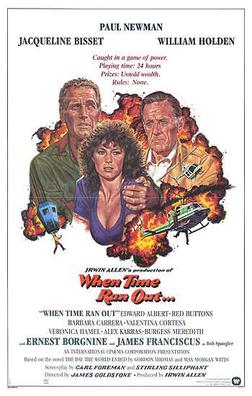
When Time Ran Out
With The Poseidon Adventure and The Towering Inferno to his name, producer Irwin Allen had quite the track record when it came to disaster flicks. In this case, he went back to the well once too often, and the end result is a less than quality final product, 1980's When Time Ran Out.
On a remote island in the Pacific, extremely successful businessman Shelby Gilmore (William Holden) is putting the final touches on his newly constructed hotel resort with his partner, Bob Spangler (James Franciscus), a longtime native of the island. Miles away from the oceanside resort is a volcano that's been dormant for over 60 years, but it is starting to show signs of another eruption but on a far greater scale than it's ever shown. Drilling an oil well on the island with his crew, Hank Anderson (Paul Newman) sees all the telltale signs of what's to come, but he can't convince Spangler to prep for what promises to be an epic disaster (money is a powerful motivator, isn't it?). As he makes a last ditch effort to convince others, the volcano explodes in grand fashion. Can all the island inhabitants and guests find a way to survive?
Like any successful genre, 'Time' follows the formula laid out by countless other disaster flicks. Assemble an all-star cast of actors and actresses, put them in some ridiculously perilous situation, and see who survives. The only problem? Well, other than the script that is. By 1980, the genre had outlasted its welcome a bit. Audiences had seen just about every calamity a disaster film could throw at them. How many times can you see the same movie over and over again, just replacing the man-made disasters, natural disasters or various diseases? 'Time' bombed in theaters and received some very poor reviews. Star power aside, it's got nothing going for it. Other than that? It's a real winner.
What sucked me in was the casting. To be fair, these are all cardboard cutouts of real characters, but the star power is legitimate. Newman is sleepwalking as Hank, the quiet oil driller who steps up as a hero because all disaster movies need a hero. He's also in trouble when he meets his ex, Kay (Jacqueline Bisset, around to wear a low-cut, tight T-shirt), who's now dating Holden's Shelby. Uh-oh, relationship drama! Sit back though, we're just getting started. Franciscus is the big villain -- $ $ for eyes -- who's cheating on his wife, Nikki (Veronica Hamel), with a hotel employee, Iolani (Barbara Carrera), who's engaged to islander Brian (Edward Albert). And just because, there's also Ernest Borgnine's NYC cop tracking a possible crook (Red Buttons) while Burgess Meredith and Valentina Cortese play an old married couple. There's also Alex Karras as Newman's right hand man, Pat Morita as a saloon owner and Sheila Allen as Mona, his wife.
Now more than just the all star cast is how the all star cast is treated. You could do a drinking game with these movies, or you could keep a scorecard. Every time a celebrity dies, take a shot. Throw $20 in and whoever guesses which celebrities survive and which ones don't gets all the money. The volcano explodes about halfway through director James Goldstone's flick, giving plenty of time for all the celebrity carnage. There's some surprises here, but nothing gigantic. Still, you've got to stick with it. Who makes it?!? Who doesn't?!?
Mostly though, the issue here is that it's just too dumb for it's own good. The volcano explodes so Newman's Hank leads a small group of individuals away from the fast-moving lava. Seems like sound thinking, right? Oh, no, they're all celebrities! Something bad might happen to them! It's beyond cliched here. The group must actually walk along a mountain ledge that's about to fall apart. Then, they've got to navigate a rickety wooden bridge that stands over a deep, flowing river of lava! That extended sequence goes on for about 20 minutes and actually ends with Meredith saving two kids by walking a tight rope (read = thin wooden rail) with a balancing act. The scene goes on and on, lacking any real tension.
For a movie budgeted at $20 million, it's hard to see where all that cash went. The special effects are laughable, especially the projectiles thrown from the volcano, usually landing directly on the hotel and/or people. The two sequences above were clearly shot on a poorly lit indoor stage, adding a nice touch of realism to the proceedings. That's a joke by the way. Then, at different points, the volcano is either right on top of the hotel or miles away as needed. Whatever is most appropriate for that given shot. This one's a dud. Even the all star cast couldn't save this one.
When Time Ran Out (1980): */****
On a remote island in the Pacific, extremely successful businessman Shelby Gilmore (William Holden) is putting the final touches on his newly constructed hotel resort with his partner, Bob Spangler (James Franciscus), a longtime native of the island. Miles away from the oceanside resort is a volcano that's been dormant for over 60 years, but it is starting to show signs of another eruption but on a far greater scale than it's ever shown. Drilling an oil well on the island with his crew, Hank Anderson (Paul Newman) sees all the telltale signs of what's to come, but he can't convince Spangler to prep for what promises to be an epic disaster (money is a powerful motivator, isn't it?). As he makes a last ditch effort to convince others, the volcano explodes in grand fashion. Can all the island inhabitants and guests find a way to survive?
Like any successful genre, 'Time' follows the formula laid out by countless other disaster flicks. Assemble an all-star cast of actors and actresses, put them in some ridiculously perilous situation, and see who survives. The only problem? Well, other than the script that is. By 1980, the genre had outlasted its welcome a bit. Audiences had seen just about every calamity a disaster film could throw at them. How many times can you see the same movie over and over again, just replacing the man-made disasters, natural disasters or various diseases? 'Time' bombed in theaters and received some very poor reviews. Star power aside, it's got nothing going for it. Other than that? It's a real winner.
What sucked me in was the casting. To be fair, these are all cardboard cutouts of real characters, but the star power is legitimate. Newman is sleepwalking as Hank, the quiet oil driller who steps up as a hero because all disaster movies need a hero. He's also in trouble when he meets his ex, Kay (Jacqueline Bisset, around to wear a low-cut, tight T-shirt), who's now dating Holden's Shelby. Uh-oh, relationship drama! Sit back though, we're just getting started. Franciscus is the big villain -- $ $ for eyes -- who's cheating on his wife, Nikki (Veronica Hamel), with a hotel employee, Iolani (Barbara Carrera), who's engaged to islander Brian (Edward Albert). And just because, there's also Ernest Borgnine's NYC cop tracking a possible crook (Red Buttons) while Burgess Meredith and Valentina Cortese play an old married couple. There's also Alex Karras as Newman's right hand man, Pat Morita as a saloon owner and Sheila Allen as Mona, his wife.
Now more than just the all star cast is how the all star cast is treated. You could do a drinking game with these movies, or you could keep a scorecard. Every time a celebrity dies, take a shot. Throw $20 in and whoever guesses which celebrities survive and which ones don't gets all the money. The volcano explodes about halfway through director James Goldstone's flick, giving plenty of time for all the celebrity carnage. There's some surprises here, but nothing gigantic. Still, you've got to stick with it. Who makes it?!? Who doesn't?!?
Mostly though, the issue here is that it's just too dumb for it's own good. The volcano explodes so Newman's Hank leads a small group of individuals away from the fast-moving lava. Seems like sound thinking, right? Oh, no, they're all celebrities! Something bad might happen to them! It's beyond cliched here. The group must actually walk along a mountain ledge that's about to fall apart. Then, they've got to navigate a rickety wooden bridge that stands over a deep, flowing river of lava! That extended sequence goes on for about 20 minutes and actually ends with Meredith saving two kids by walking a tight rope (read = thin wooden rail) with a balancing act. The scene goes on and on, lacking any real tension.
For a movie budgeted at $20 million, it's hard to see where all that cash went. The special effects are laughable, especially the projectiles thrown from the volcano, usually landing directly on the hotel and/or people. The two sequences above were clearly shot on a poorly lit indoor stage, adding a nice touch of realism to the proceedings. That's a joke by the way. Then, at different points, the volcano is either right on top of the hotel or miles away as needed. Whatever is most appropriate for that given shot. This one's a dud. Even the all star cast couldn't save this one.
When Time Ran Out (1980): */****
Monday, August 1, 2011
Grumpy Old Men
So by all accounts getting old sucks, right? As I write this I'm 26 and can say honestly that growing up, having more responsibility and in general, being an adult sucks at times. Wow, that's an uplifting lead to a review if there ever was one, huh? I've got to write about something though, and that's as good as anything. Growing up -- at whatever age; kids, teenagers, adults, senior citizens -- is an easy start-off point for a comedy because life sure is funny at times, like 1993's Grumpy Old Men.
Maybe more than any other genre, comedies are usually niche-driven movies meaning they're intended for a very specific audience. Your typical R-rated movie? Not intended for the majority of the senior citizen crowd. Your average shoot 'em up action flick? Not meant for the faint of heart. That was my thought with this 90s comedy that has developed into a fan favorite over the last 18 years, even producing a sequel a few years later. This is clearly a comedy intended for a different audience than most movies I watch. It is called Grumpy Old Men after all, right? I was only slightly worried I wouldn't get some of the humor, but no worries here. Good comedy is good comedy regardless of how old you are.
In the tiny Minnesota town of Wabasha, next door neighbors Max Goldman (Walter Matthau) and John Gustafson (Jack Lemmon) have been lifelong rivals. Their fighting goes back to the 1930s when they were little kids growing up, and the rivalry has continued all these years since. Now in their late 60s and early 70s, both Max and John have lost their wives, living in their big houses with nothing to do other than bitch and moan at each other, spending their days drinking beer and ice fishing. The childish back and forth is nothing though for these two old professionals. A new neighbor is moving in across the street, Ariel Truax (Ann-Margret), a widower and college professor new to the area. If the back and forth rivalry was heated before, it just got taken up a notch. Who can win the babely Ariel first?
I like smart comedies and stupid ones. I like comedies aimed at kids and those aimed at the more adult audience. Smart, silly, stupid, intellectual, slapstick, I'll watch anything. Then there's this movie which is funny just because it is funny. It never tries too hard, letting this decades old rivalry produce the humor naturally. There is a sweetness to this rivalry though that makes it believable and even endearing to these two crotchety old guys. They fight, they bitch, they rip each other constantly, but somewhere in all that arguing is a friendship. Both Max and John know each others' family and get along with them. They just happen to go back and forth with pranks and jokes that show no sign of stopping anytime soon.
Starring together in 1968's The Odd Couple, Lemmon and Matthau showed what great comedic chemistry they had together as warring roommates Felix and Oscar. Well, apparently chemistry doesn't go away over 20-plus years because the biggest selling point by far from this comedy is the chemistry between these two comedic legends. They play off each other like an old married couple, Max calling John a 'putz' (among other things, his first line is 'Hi, dickhead') with John responding with 'moron.' Throw a beautiful woman into the mix, and all bets are off. It is an easy-going charm between Matthau and Lemmon that carries this movie, making it better than a typical growing old comedy. Definitely stick around for the end credits with a hilarious gag reel showing off all their missteps. If you can't wait, check it out HERE.
Some 15 years younger than Lemmon and almost 20 years younger than Matthau, Margret -- at just 52 years old but seemingly playing an older woman -- is still Ann-Margret. Her character, Ariel, is still trying to move on after losing her husband some five years earlier, finding friendship and maybe more with Max and John. At the young age of 86, Hollywood legend Burgess Meredith plays Pop, John's father and all-around horndog, always trying to convince his son to keep his love life going. The character is hysterical, but his best part comes in the already mentioned gag reel, just great stuff. Also starring are Kevin Pollak and Daryl Hannah as Jake, Max's son running for town mayor, and Melanie, John's daughter who is getting a divorce from her husband (Christopher McDonald). As if Matthau, Lemmon and Meredith weren't enough, there are also small parts for Ossie Davis as Chuck, Max and John's friend who always listens to them complain, and Buck Henry as an inquisitive IRS agent.
This is just one of those movies where you're going to like the humor or you're not. It can be dark at times -- Max and John pining about how sweet it would be to die in your sleep -- but most of the time it's just a good, old-fashioned movie. It is in no rush to get anywhere or deliver a message, instead being quite content to tell the story of two neighbors who like nothing more than making the other one's life miserable. It's a funny, sweet comedy with a great cast and lots of laughs.
Grumpy Old Men <---trailer (1993): ***/****
Maybe more than any other genre, comedies are usually niche-driven movies meaning they're intended for a very specific audience. Your typical R-rated movie? Not intended for the majority of the senior citizen crowd. Your average shoot 'em up action flick? Not meant for the faint of heart. That was my thought with this 90s comedy that has developed into a fan favorite over the last 18 years, even producing a sequel a few years later. This is clearly a comedy intended for a different audience than most movies I watch. It is called Grumpy Old Men after all, right? I was only slightly worried I wouldn't get some of the humor, but no worries here. Good comedy is good comedy regardless of how old you are.
In the tiny Minnesota town of Wabasha, next door neighbors Max Goldman (Walter Matthau) and John Gustafson (Jack Lemmon) have been lifelong rivals. Their fighting goes back to the 1930s when they were little kids growing up, and the rivalry has continued all these years since. Now in their late 60s and early 70s, both Max and John have lost their wives, living in their big houses with nothing to do other than bitch and moan at each other, spending their days drinking beer and ice fishing. The childish back and forth is nothing though for these two old professionals. A new neighbor is moving in across the street, Ariel Truax (Ann-Margret), a widower and college professor new to the area. If the back and forth rivalry was heated before, it just got taken up a notch. Who can win the babely Ariel first?
I like smart comedies and stupid ones. I like comedies aimed at kids and those aimed at the more adult audience. Smart, silly, stupid, intellectual, slapstick, I'll watch anything. Then there's this movie which is funny just because it is funny. It never tries too hard, letting this decades old rivalry produce the humor naturally. There is a sweetness to this rivalry though that makes it believable and even endearing to these two crotchety old guys. They fight, they bitch, they rip each other constantly, but somewhere in all that arguing is a friendship. Both Max and John know each others' family and get along with them. They just happen to go back and forth with pranks and jokes that show no sign of stopping anytime soon.
Starring together in 1968's The Odd Couple, Lemmon and Matthau showed what great comedic chemistry they had together as warring roommates Felix and Oscar. Well, apparently chemistry doesn't go away over 20-plus years because the biggest selling point by far from this comedy is the chemistry between these two comedic legends. They play off each other like an old married couple, Max calling John a 'putz' (among other things, his first line is 'Hi, dickhead') with John responding with 'moron.' Throw a beautiful woman into the mix, and all bets are off. It is an easy-going charm between Matthau and Lemmon that carries this movie, making it better than a typical growing old comedy. Definitely stick around for the end credits with a hilarious gag reel showing off all their missteps. If you can't wait, check it out HERE.
Some 15 years younger than Lemmon and almost 20 years younger than Matthau, Margret -- at just 52 years old but seemingly playing an older woman -- is still Ann-Margret. Her character, Ariel, is still trying to move on after losing her husband some five years earlier, finding friendship and maybe more with Max and John. At the young age of 86, Hollywood legend Burgess Meredith plays Pop, John's father and all-around horndog, always trying to convince his son to keep his love life going. The character is hysterical, but his best part comes in the already mentioned gag reel, just great stuff. Also starring are Kevin Pollak and Daryl Hannah as Jake, Max's son running for town mayor, and Melanie, John's daughter who is getting a divorce from her husband (Christopher McDonald). As if Matthau, Lemmon and Meredith weren't enough, there are also small parts for Ossie Davis as Chuck, Max and John's friend who always listens to them complain, and Buck Henry as an inquisitive IRS agent.
This is just one of those movies where you're going to like the humor or you're not. It can be dark at times -- Max and John pining about how sweet it would be to die in your sleep -- but most of the time it's just a good, old-fashioned movie. It is in no rush to get anywhere or deliver a message, instead being quite content to tell the story of two neighbors who like nothing more than making the other one's life miserable. It's a funny, sweet comedy with a great cast and lots of laughs.
Grumpy Old Men <---trailer (1993): ***/****
Labels:
1990s,
Ann-Margret,
Burgess Meredith,
Comedy,
Jack Lemmon,
Walter Matthau
Monday, April 4, 2011
Rocky III
At some point when a single successful movie becomes a successful movie franchise, there's a point where studios should just call it quits. More sequels become unnecessary, and in a lot of ways painful to watch. Even The Godfather movies hit a major road block by the third movie. The Rocky series is one of the weirder ones to look at in that way. Rocky and Rocky II are classics, but after that the series went more in favor of entertainment as opposed to the drama of the first two. None of that is to say the other four movies aren't good (okay, Rocky V sucks), but they're just not as good. Still quality but not on par with its predecessors, 1982's Rocky III.
What carries the franchise through its less-impressive efforts is basically the will-power of star, director and writer Sylvester Stallone. In the early 1980s, he wasn't quite the cliched action star, the punch line yet that he became in later years. I'm a fan so cliched action star isn't necessarily a bad thing, but through his ups and downs, Stallone knew what audiences liked and wanted. High up on that list is underdog stories, the little guy getting a crack at the big time. Rocky Balboa has to be one of the most beloved characters ever in movies so even when the story is a quasi-rehash of what we've seen before, we're still rooting for him when the chips are down.
After beating Apollo Creed (Carl Weathers) for the heavyweight title, Rocky Balboa (Stallone) defends the title for three years, beating any opponent put in front of him. His trainer, Mick (Burgess Meredith), breaks down and tells him he's been beating fighters just not on his level, making Rocky want to take on the top contender for the heavyweight crown, an up and coming, viciously brutal fighter, Clubber Lang (Mr. T). The fire, the passion just aren't there though so Rocky trains but ends up getting knocked out. After someone close to him dies following the fight, Rocky is left to question, what next? With some help from Apollo, Balboa goes for the rematch with Lang. If he stands any chance of winning though, he's going to have to relearn everything he knows about fighting, reinventing himself as a boxer.
The first two Rocky movies are both on their own classics in my mind, and the end of the second one with Rocky narrowly defeating Apollo in a brutal fight was an ideal ending for the series. Any more sequels were just unneeded. It's like Michael Jordan coming back after hitting the game-winning shot in the 1998 NBA Finals. Don't come back, close on the highest note possible. Thankfully where Jordan's comeback with the Washington Wizards was a disaster, Rocky III is still an above average, very entertaining movie. It follows an almost identical formula as all the Rocky movies do, and all the familiar faces are back with a few new, interesting ones thrown in to liven things up. Not on par with I or II, but still quality.
The key to everything of course is who else? Mr. Stallone as America's favorite underdog turned champion Rocky Balboa. There's still something endearing about this character who has finally hit it big and wants to enjoy himself. With wife Adrian (a less shrill Talia Shire than usual) and son, Rocky has carved out quite a name and a life for himself. Trying to keep the drama going, Stallone's script adds a darker feel to Balboa here. SPOILERS STOP READING SPOILERS When Mick dies after the first Lang fight, Rocky questions everything he's done, everything he's made for himself. Even when he starts training with Apollo, he doesn't give his full effort until a heated conversation/discussion with Adrian re-lights his fire. It's a great scene that works well because one, Stallone is a better actor than he's given credit for, and two, he has great chemistry with Shire.
On to the old and new stuff, starting with Meredith as Mick, Burt Young as the always obnoxious Pauly, and Tony Burton as Apollo turned Rocky trainer Duke. Meredith is as perfect as ever as crotchety, tightly-wound trainer, Mick, pushing Rocky wherever and whenever he can. For the big positives though, I'll start with Weathers as Apollo Creed. He was a great foe, a great enemy in the first two, but there was still something likable about Apollo. Team him up with Rocky as opposed to against him, and you've got a great fighting duo. Plus, Apollo becomes more than just a cardboard cutout of a character as we get to see more of him. Hulk Hogan also makes an appearance in a charity match, playing wrestler Thunderlips (Everything that is MAN!) who throws Rocky around like a rag doll -- briefly that is. And then there's the best addition to Rocky III, Eye of the Tiger by Survivor, a song meant to be played over a training montage if there ever was one. As for Clubber, Mr. T is perfect, the ideal overexaggerated opponent for Rocky to fight.
If you've made it this far into the review, it's safe to say you're a Rocky fan. There's just something basic about these movies that you either love or hate with no middle ground. If hearing the Rocky theme (listen HERE), doesn't get your blood flowing, these aren't the movies for you. If you don't smile at the ridiculously cool -- and slightly homoerotic -- training montage (watch HERE), steer clear. As a sports fan, you love to see the underdog story. As a movie fan, you love the characters and the drama. The final fight is a whopper, an epic fight that should and will have you cheering. That's the whole point of these movies. As sports flicks, they're hard to beat.
Rocky III <---trailer (1982): ***/****
What carries the franchise through its less-impressive efforts is basically the will-power of star, director and writer Sylvester Stallone. In the early 1980s, he wasn't quite the cliched action star, the punch line yet that he became in later years. I'm a fan so cliched action star isn't necessarily a bad thing, but through his ups and downs, Stallone knew what audiences liked and wanted. High up on that list is underdog stories, the little guy getting a crack at the big time. Rocky Balboa has to be one of the most beloved characters ever in movies so even when the story is a quasi-rehash of what we've seen before, we're still rooting for him when the chips are down.
After beating Apollo Creed (Carl Weathers) for the heavyweight title, Rocky Balboa (Stallone) defends the title for three years, beating any opponent put in front of him. His trainer, Mick (Burgess Meredith), breaks down and tells him he's been beating fighters just not on his level, making Rocky want to take on the top contender for the heavyweight crown, an up and coming, viciously brutal fighter, Clubber Lang (Mr. T). The fire, the passion just aren't there though so Rocky trains but ends up getting knocked out. After someone close to him dies following the fight, Rocky is left to question, what next? With some help from Apollo, Balboa goes for the rematch with Lang. If he stands any chance of winning though, he's going to have to relearn everything he knows about fighting, reinventing himself as a boxer.
The first two Rocky movies are both on their own classics in my mind, and the end of the second one with Rocky narrowly defeating Apollo in a brutal fight was an ideal ending for the series. Any more sequels were just unneeded. It's like Michael Jordan coming back after hitting the game-winning shot in the 1998 NBA Finals. Don't come back, close on the highest note possible. Thankfully where Jordan's comeback with the Washington Wizards was a disaster, Rocky III is still an above average, very entertaining movie. It follows an almost identical formula as all the Rocky movies do, and all the familiar faces are back with a few new, interesting ones thrown in to liven things up. Not on par with I or II, but still quality.
The key to everything of course is who else? Mr. Stallone as America's favorite underdog turned champion Rocky Balboa. There's still something endearing about this character who has finally hit it big and wants to enjoy himself. With wife Adrian (a less shrill Talia Shire than usual) and son, Rocky has carved out quite a name and a life for himself. Trying to keep the drama going, Stallone's script adds a darker feel to Balboa here. SPOILERS STOP READING SPOILERS When Mick dies after the first Lang fight, Rocky questions everything he's done, everything he's made for himself. Even when he starts training with Apollo, he doesn't give his full effort until a heated conversation/discussion with Adrian re-lights his fire. It's a great scene that works well because one, Stallone is a better actor than he's given credit for, and two, he has great chemistry with Shire.
On to the old and new stuff, starting with Meredith as Mick, Burt Young as the always obnoxious Pauly, and Tony Burton as Apollo turned Rocky trainer Duke. Meredith is as perfect as ever as crotchety, tightly-wound trainer, Mick, pushing Rocky wherever and whenever he can. For the big positives though, I'll start with Weathers as Apollo Creed. He was a great foe, a great enemy in the first two, but there was still something likable about Apollo. Team him up with Rocky as opposed to against him, and you've got a great fighting duo. Plus, Apollo becomes more than just a cardboard cutout of a character as we get to see more of him. Hulk Hogan also makes an appearance in a charity match, playing wrestler Thunderlips (Everything that is MAN!) who throws Rocky around like a rag doll -- briefly that is. And then there's the best addition to Rocky III, Eye of the Tiger by Survivor, a song meant to be played over a training montage if there ever was one. As for Clubber, Mr. T is perfect, the ideal overexaggerated opponent for Rocky to fight.
If you've made it this far into the review, it's safe to say you're a Rocky fan. There's just something basic about these movies that you either love or hate with no middle ground. If hearing the Rocky theme (listen HERE), doesn't get your blood flowing, these aren't the movies for you. If you don't smile at the ridiculously cool -- and slightly homoerotic -- training montage (watch HERE), steer clear. As a sports fan, you love to see the underdog story. As a movie fan, you love the characters and the drama. The final fight is a whopper, an epic fight that should and will have you cheering. That's the whole point of these movies. As sports flicks, they're hard to beat.
Rocky III <---trailer (1982): ***/****
Labels:
1980s,
Burgess Meredith,
Burt Young,
Carl Weathers,
Rocky,
Sports,
Sylvester Stallone,
Talia Shire
Tuesday, March 22, 2011
A Walk in the Sun
Somewhat out of necessity and somewhat because of audience demand, Hollywood studios during World War II often turned to patriotic, flag-waving war stories for their movies as opposed to more realistic, balanced looks at the war. Some examples like John Ford’s They Were Expendable peg the Americans as courageous, infallible heroes while the Japanese are the vicious, murdering enemy, but the movie still manages to be an above average entry into the WWII movie genre.
Now of course, all of them weren’t propaganda pictures meant to influence public thought and sentiment about the direction the war was taking or how despicably evil the enemy was. Released in 1945 at the tail end of the war, A Walk in the Sun could easily be pegged as one of those movies, but it rises above that stigma. It doesn’t try to portray the American soldiers in Europe as supermen who can’t be taken down by a whole army of German infantry. On the other side, the Germans are a faceless enemy, but never a demonic one. This is war, and everyone is affected. Just like my previous few of All Quiet on the Western Front, these are soldiers interested in survival, not some higher meaning or purpose in war.
Huddled in a landing craft headed for an Italian beach in the dead of night, an American infantry platoon prepares for the mission ahead of them. Problems start immediately though when the platoon commander and the second-ranking officer are both killed in the landing. Taking over, Sergeant Porter (Herbert Rudley, looking like a dead ringer for Frank Lovejoy) and Sergeant Tyne (Dana Andrews) must now figure out what to do. Their mission was described only vaguely to them; march six miles inland and knock out a key farmhouse along the main road. Little is known what awaits them along the road or the enemy strength at the farmhouse, but they head out into the unknown hoping to accomplish their mission, and hopefully make it back alive.
Any similarities or comparisons to ‘Western Front’ are fair for two reasons. One, director Lewis Milestone directed both movies. Two, they are both based on strong source novels that provide a great blueprint for the story. The reasons ‘Walk’ works is because of similar reasons. This is not an action-heavy story, instead portraying the life of a soldier as it more likely is; long stretches of boredom balanced with extreme fear/terror broken up by seconds of violent chaos. What do the soldiers do in between engagements? They talk. They talk about their worries, their lives back home, their thoughts on the patrol. You name it, it gets covered. A story that puts you right there on the dusty road with the soldiers and gives you an authentic feel for what they’re going through always gets points in my book.
This has to be one of the earlier examples of a ‘unit picture,’ a story that focuses on a specific group of soldiers, sometimes as large as a division or a brigade on down the ladder to a group like a squad or a platoon. Dana Andrews is the star here, the sergeant thrust into a position of power, leading his men on a mission where he knows little to nothing about what they’re supposed to accomplish. Along with Rudley as Porter, the NCO about to crack, the platoon includes Lloyd Bridges as Ward, a sergeant and a farmer back home with a craving for an apple, John Ireland as Windy, an intelligent soldier who is constantly writing letters back home in a unique way, Richard Conte as Rivera, the motor-mouth machine gunner, George Tyne as Friedman, Rivera’s ammunition carrier and sounding board, and Norman Lloyd as Archimbeau, a private convinced the war is destined to go on for years, among many others who make a quick appearance, but never really rise above being a sea of infantry faces. Burgess Meredith narrates.
Every so often at the IMDB, you run across a description so perfect it makes it worthwhile to continue to peruse all the other garbage people post there. One very accurate poster said this 1945 WWII story could easily have been renamed ‘A Talk in the Sun.’ It’s a fair assessment. Of a story that clocks in at 117 minutes, this is a dialogue heavy movie so if you’re looking for action packed excitement, keep looking. I’m all for dialogue in a movie (good, well-written dialogue that is), and for the most part, the conversation is good here. Eventually though, it gets tedious. How many times can we hear Rivera and Friedman argue like an old married couple? How many times will Archimbeau talk about the coming battle in 1955 for Tibet? Some scenes drag more than others, but late in the movie, I started to feel like I was watching the same scenes over and over again. Is that what a soldier’s life is like? Probably, but realism only takes a movie so far.
Balancing the long stretches of boredom here are those chaotic, brief moments of terror where your life can be snatched away from you in the blink of an eye. The patrol is constantly under bombardment while also dealing with patrolling German fighters overhead and tank and armored car patrols. The farmhouse (Semi SPOILERS I guess, yes, they make it to the farmhouse) is heavily guarded, and a suicidal charge across an open field feels like the only solution. Like the best parts of the movie, the battle scenes are well-executed (similar to Milestone’s action in Western Front with some great camerawork) and always keeping you on edge as to what will happen. It’s not a perfect war story, but for a movie released in 1945, the realism and honest look at the life of a soldier help make up for any shortcomings the movie might have. A public domain movie, it is available to watch at Youtube HERE in a somewhat washed out but tolerable print.
A Walk in the Sun <---TCM clips (1945): ***/****
Now of course, all of them weren’t propaganda pictures meant to influence public thought and sentiment about the direction the war was taking or how despicably evil the enemy was. Released in 1945 at the tail end of the war, A Walk in the Sun could easily be pegged as one of those movies, but it rises above that stigma. It doesn’t try to portray the American soldiers in Europe as supermen who can’t be taken down by a whole army of German infantry. On the other side, the Germans are a faceless enemy, but never a demonic one. This is war, and everyone is affected. Just like my previous few of All Quiet on the Western Front, these are soldiers interested in survival, not some higher meaning or purpose in war.
Huddled in a landing craft headed for an Italian beach in the dead of night, an American infantry platoon prepares for the mission ahead of them. Problems start immediately though when the platoon commander and the second-ranking officer are both killed in the landing. Taking over, Sergeant Porter (Herbert Rudley, looking like a dead ringer for Frank Lovejoy) and Sergeant Tyne (Dana Andrews) must now figure out what to do. Their mission was described only vaguely to them; march six miles inland and knock out a key farmhouse along the main road. Little is known what awaits them along the road or the enemy strength at the farmhouse, but they head out into the unknown hoping to accomplish their mission, and hopefully make it back alive.
Any similarities or comparisons to ‘Western Front’ are fair for two reasons. One, director Lewis Milestone directed both movies. Two, they are both based on strong source novels that provide a great blueprint for the story. The reasons ‘Walk’ works is because of similar reasons. This is not an action-heavy story, instead portraying the life of a soldier as it more likely is; long stretches of boredom balanced with extreme fear/terror broken up by seconds of violent chaos. What do the soldiers do in between engagements? They talk. They talk about their worries, their lives back home, their thoughts on the patrol. You name it, it gets covered. A story that puts you right there on the dusty road with the soldiers and gives you an authentic feel for what they’re going through always gets points in my book.
This has to be one of the earlier examples of a ‘unit picture,’ a story that focuses on a specific group of soldiers, sometimes as large as a division or a brigade on down the ladder to a group like a squad or a platoon. Dana Andrews is the star here, the sergeant thrust into a position of power, leading his men on a mission where he knows little to nothing about what they’re supposed to accomplish. Along with Rudley as Porter, the NCO about to crack, the platoon includes Lloyd Bridges as Ward, a sergeant and a farmer back home with a craving for an apple, John Ireland as Windy, an intelligent soldier who is constantly writing letters back home in a unique way, Richard Conte as Rivera, the motor-mouth machine gunner, George Tyne as Friedman, Rivera’s ammunition carrier and sounding board, and Norman Lloyd as Archimbeau, a private convinced the war is destined to go on for years, among many others who make a quick appearance, but never really rise above being a sea of infantry faces. Burgess Meredith narrates.
Every so often at the IMDB, you run across a description so perfect it makes it worthwhile to continue to peruse all the other garbage people post there. One very accurate poster said this 1945 WWII story could easily have been renamed ‘A Talk in the Sun.’ It’s a fair assessment. Of a story that clocks in at 117 minutes, this is a dialogue heavy movie so if you’re looking for action packed excitement, keep looking. I’m all for dialogue in a movie (good, well-written dialogue that is), and for the most part, the conversation is good here. Eventually though, it gets tedious. How many times can we hear Rivera and Friedman argue like an old married couple? How many times will Archimbeau talk about the coming battle in 1955 for Tibet? Some scenes drag more than others, but late in the movie, I started to feel like I was watching the same scenes over and over again. Is that what a soldier’s life is like? Probably, but realism only takes a movie so far.
Balancing the long stretches of boredom here are those chaotic, brief moments of terror where your life can be snatched away from you in the blink of an eye. The patrol is constantly under bombardment while also dealing with patrolling German fighters overhead and tank and armored car patrols. The farmhouse (Semi SPOILERS I guess, yes, they make it to the farmhouse) is heavily guarded, and a suicidal charge across an open field feels like the only solution. Like the best parts of the movie, the battle scenes are well-executed (similar to Milestone’s action in Western Front with some great camerawork) and always keeping you on edge as to what will happen. It’s not a perfect war story, but for a movie released in 1945, the realism and honest look at the life of a soldier help make up for any shortcomings the movie might have. A public domain movie, it is available to watch at Youtube HERE in a somewhat washed out but tolerable print.
A Walk in the Sun <---TCM clips (1945): ***/****
Labels:
1940s,
Burgess Meredith,
Dana Andrews,
John Ireland,
Lewis Milestone,
Richard Conte,
WWII
Tuesday, September 7, 2010
Advise and Consent
Recently in the news, former Illinois governor Rod Blagojevich was found guilty on one count of 24 levied against him. A mistrial is in the works, but the news was nothing new. Controversies and scandals in politics are as old as well, politics itself. Are we surprised anymore when a politician, whether it be the President or down through the ranks to Senators, Representatives, Governors, and on and on, does something stupid in the news? Sex, past indiscretions, corruption, all over the above, nothing seems to faze the American public anymore.
Let's go back almost half a century in more innocent times, I guess, the 1960s weren't exactly innocent. But the times were certainly different without that 24-hour news cycle that keeps viewers up to date on everything going on. Politicians could have secrets and that's just what they were, secrets. The master of adult-themed movies, Otto Preminger explored this concept with 1962's Advise and Consent. When you accept a position in the public eye, you lose your privacy to a certain point. You open yourself up for criticism on many fronts, but if this Preminger movie teaches us anything, we all have secrets. It's only a matter of time before they're found out.
The President of the United States (Franchot Tone) has chosen a nominee for the vacant position of the Secretary of State. The man is Robert Leffingwell (Henry Fonda) and from the get-go, the nomination divides the Senate who will have to approve or disapprove him. The Senate majority leader (Walter Pidgeon) is all for the choice and knows he can get the necessary number of votes for Leffingwell. Opposing him is a long-time senator from South Carolina (Charles Laughton), who was burned by Leffingwell in the past and still holds a grudge. But before a vote can be counted, the nomination must go through a Senate sub-committee headed by an idealistic young senator (Don Murray) who will decide if Leffingwell is capable of doing the job. But as the committee starts, the dirt comes out and the fight begins.
As he did so often with his movies, Preminger puts together a very impressive ensemble cast to work with. It's so good from top to bottom that Fonda -- yes, Henry Fonda -- is almost an afterthought as a supporting character. He doesn't even make an appearance in the last 30 minutes. Preminger was a perfectionist as a filmmaker, but actors must have liked working with him. Along with the names mentioned above, there is also Gene Tierney, Peter Lawford, Will Geer, Burgess Meredith, Lew Ayres, and Paul Ford among others. Like any large ensemble, some in the cast get more of a chance to shine than others, but none disappoint however long they're on screen. Murray, Pidgeon and Laughton are the ones that shine brightest though, including Ayres as a vanilla vice president.
This isn't a movie about camera techniques or in your face effects. Preminger lets takes and scenes go on uninterrupted without the slightest editing. Characters hold conversations like they would in real life. He lets his cast show off their ability, letting the dialogue do all the talking the story needs. At times, the pace can be infuriatingly slow (it is 140 minutes long) because of that, especially toward the end when the pace should be picking up, but it's all part of the story the movie revels in. Preminger filmed in countless locations in Washington DC -- shooting in black and white -- giving a real feel for all the backroom deals and shady motives that really go on in the capital. It doesn't intentionally call attention to itself, but the movie is a treat to watch on a purely visual level.
What was somewhat disappointing as the story develops is that by 2010, nothing really surprised me in terms of government scandals and controversies. In the last 10 or 20 years, there has been murder, extramarital affairs, corruption, prostitution, kidnappings, and any number of other things I'm probably forgetting. So when the scandals do pop up, including Fonda's Leffingwell and his past involvement in a different government and Murray's Senator's past coming back to haunt him, they don't have a huge affect on the viewer. Shocking in 1962, maybe, but not in 2010. Through no fault of Preminger's then (you can't blame him for making a move when he did), the emotional impact is lessened then just by time and how the world has changed in the almost 50 years since.
As everything does unravel in the end and the twists and secrets come out, the story thankfully picks up some steam. One twist at the very end was a little too coincidental for me personally, the timing just too perfect, but that's movies for you. It is a movie that is as professionally done as just about any other movie you'll come across, and the cast is hard to top. If there was a way to watch this in 1962, maybe the impact would have been greater, but in 2010, it's still pretty good.
Advise and Consent <---IMDB trailer (1962): ***/****
Let's go back almost half a century in more innocent times, I guess, the 1960s weren't exactly innocent. But the times were certainly different without that 24-hour news cycle that keeps viewers up to date on everything going on. Politicians could have secrets and that's just what they were, secrets. The master of adult-themed movies, Otto Preminger explored this concept with 1962's Advise and Consent. When you accept a position in the public eye, you lose your privacy to a certain point. You open yourself up for criticism on many fronts, but if this Preminger movie teaches us anything, we all have secrets. It's only a matter of time before they're found out.
The President of the United States (Franchot Tone) has chosen a nominee for the vacant position of the Secretary of State. The man is Robert Leffingwell (Henry Fonda) and from the get-go, the nomination divides the Senate who will have to approve or disapprove him. The Senate majority leader (Walter Pidgeon) is all for the choice and knows he can get the necessary number of votes for Leffingwell. Opposing him is a long-time senator from South Carolina (Charles Laughton), who was burned by Leffingwell in the past and still holds a grudge. But before a vote can be counted, the nomination must go through a Senate sub-committee headed by an idealistic young senator (Don Murray) who will decide if Leffingwell is capable of doing the job. But as the committee starts, the dirt comes out and the fight begins.
As he did so often with his movies, Preminger puts together a very impressive ensemble cast to work with. It's so good from top to bottom that Fonda -- yes, Henry Fonda -- is almost an afterthought as a supporting character. He doesn't even make an appearance in the last 30 minutes. Preminger was a perfectionist as a filmmaker, but actors must have liked working with him. Along with the names mentioned above, there is also Gene Tierney, Peter Lawford, Will Geer, Burgess Meredith, Lew Ayres, and Paul Ford among others. Like any large ensemble, some in the cast get more of a chance to shine than others, but none disappoint however long they're on screen. Murray, Pidgeon and Laughton are the ones that shine brightest though, including Ayres as a vanilla vice president.
This isn't a movie about camera techniques or in your face effects. Preminger lets takes and scenes go on uninterrupted without the slightest editing. Characters hold conversations like they would in real life. He lets his cast show off their ability, letting the dialogue do all the talking the story needs. At times, the pace can be infuriatingly slow (it is 140 minutes long) because of that, especially toward the end when the pace should be picking up, but it's all part of the story the movie revels in. Preminger filmed in countless locations in Washington DC -- shooting in black and white -- giving a real feel for all the backroom deals and shady motives that really go on in the capital. It doesn't intentionally call attention to itself, but the movie is a treat to watch on a purely visual level.
What was somewhat disappointing as the story develops is that by 2010, nothing really surprised me in terms of government scandals and controversies. In the last 10 or 20 years, there has been murder, extramarital affairs, corruption, prostitution, kidnappings, and any number of other things I'm probably forgetting. So when the scandals do pop up, including Fonda's Leffingwell and his past involvement in a different government and Murray's Senator's past coming back to haunt him, they don't have a huge affect on the viewer. Shocking in 1962, maybe, but not in 2010. Through no fault of Preminger's then (you can't blame him for making a move when he did), the emotional impact is lessened then just by time and how the world has changed in the almost 50 years since.
As everything does unravel in the end and the twists and secrets come out, the story thankfully picks up some steam. One twist at the very end was a little too coincidental for me personally, the timing just too perfect, but that's movies for you. It is a movie that is as professionally done as just about any other movie you'll come across, and the cast is hard to top. If there was a way to watch this in 1962, maybe the impact would have been greater, but in 2010, it's still pretty good.
Advise and Consent <---IMDB trailer (1962): ***/****
Tuesday, July 27, 2010
Rocky II
As long as there have been movies, there have been sequels. Of course, the familiar formula is usually that after the original, the sequel proceed to go down the drain rather quickly. Sure, there's exceptions where the sequel might actually be better, like Godfather II and Empire Strikes Back, but a majority usually go the other way. The first sequel to 1976's Rocky isn't on the same ground as the original, but all things considered, 1979's Rocky II is a worthwhile sequel and a strong follow-up in a series that would produce three more sequels.
What some people seem to forget is that in the original, Rocky doesn't win, he loses by the slimmest of margins. But in the sense of being an underdog, he did what he wanted to accomplish, going the distance against the heavyweight champion of the world. It's such a good story that a sequel isn't necessary. Rocky went the distance, got the girl, and proved everyone wrong. Thankfully, the sequel doesn't mess anything up, instead continuing with an equally as strong story.
After going the distance against heavyweight champ Apollo Creed (Carl Weathers), Philly boxer and tough guy Rocky Balboa (Sylvester Stallone) adapts to life as a semi-celebrity. With his payday from the fight, he ends up marrying girlfriend Adrian (Talia Shire), buys a new house for them to live in, goes on a huge shopping spree, and begins to start a family with Adrian expecting a baby soon. But at a certain point, Rocky hits a wall with nowhere to go. He can't get a job with no real skills to offer, but he has to care for his wife and family. All he can think of is getting back into the ring, especially when Apollo comes calling for a rematch to prove that the first fight between them was nothing more than a fluke. With trainer Mickey (Burgess Meredith) in his corner, Rocky prepares again for the fight of his life on an even bigger stage with bigger expectations.
Made three years after the original, II picks up immediately where the first one leaves off following the championship bout. In general, the story follows the same basic formula as would the later sequels. Home life, relationship with Adrian, personal problems, training montage, and fight. Rinse and repeat if necessary. But just like Rocky, the characters are so engaging that it's an enjoyable ride even if you know where it's going from the start. The whole cast is back as is the ever important Rocky theme, and like I mentioned in the other review, the story of an underdog everyone is betting against is hard to turn down. One thing I'll complain about, the necessary montage sequence -- watch it HERE -- is a little too over the top with the crowd running sequence, even for a Rocky movie.
Seeing the second movie in the series just confirms Stallone's ability as an actor in my head. Building on the character, we see that a little success doesn't change him or who he is. He spends little of his winnings on himself, buying things for those closest to him. At heart, Rocky is still the same lovable galoot he was before he become a celebrity. His corny jokes, his aw shucks way of communicating, how much he loves Adrian, it all adds up perfectly to create this character. In Part II, he's not worried about not being able to hang with the champ, he's worried about the life he has built for himself and how it will impact Adrian and the baby. Stallone didn't get a nomination this time around, but the character is as solid as ever.
What appealed to me about this Rocky entry was the emergence of the supporting cast. Meredith and Weathers were both key figures to the first movie, but they weren't always there with most of the story understandably devoted to Rocky and Adrian. As Mickey, Meredith steals each and every scene he is in as fast-talking, gravelly-voiced trainer who will push Balboa to his limit and then some. He has too many quotable lines to even mention, but my favorite has always been "I think we oughta knock his block off" or the always reliable "You're gonna eat lightning and crap thunder!" Playing Apollo again, Weathers gets more screentime to develop a character that is seriously pissed off the Italian Stallion stuck with him for 15 rounds. Also returning is Burt Young as Rocky's cantankerous friend, Paulie.
One thing I thought was improved on was the actual fight, another brutal, knock down affair between Rocky and Apollo. Instead of just long shots from behind of these two whaling on each other, we get some close-ups like we're there in the ring with the two fighters. Just like the first one, you definitely get the feel and sense of what getting hit in the head repeatedly must feel like. The ending of the first one would be hard to improve on, but this sure comes close on pure emotion and excitement. That's the whole movie summed up. Not as good as the original, but it's awfully close.
Rocky II <----trailer (1979): *** 1/2 /****
What some people seem to forget is that in the original, Rocky doesn't win, he loses by the slimmest of margins. But in the sense of being an underdog, he did what he wanted to accomplish, going the distance against the heavyweight champion of the world. It's such a good story that a sequel isn't necessary. Rocky went the distance, got the girl, and proved everyone wrong. Thankfully, the sequel doesn't mess anything up, instead continuing with an equally as strong story.
After going the distance against heavyweight champ Apollo Creed (Carl Weathers), Philly boxer and tough guy Rocky Balboa (Sylvester Stallone) adapts to life as a semi-celebrity. With his payday from the fight, he ends up marrying girlfriend Adrian (Talia Shire), buys a new house for them to live in, goes on a huge shopping spree, and begins to start a family with Adrian expecting a baby soon. But at a certain point, Rocky hits a wall with nowhere to go. He can't get a job with no real skills to offer, but he has to care for his wife and family. All he can think of is getting back into the ring, especially when Apollo comes calling for a rematch to prove that the first fight between them was nothing more than a fluke. With trainer Mickey (Burgess Meredith) in his corner, Rocky prepares again for the fight of his life on an even bigger stage with bigger expectations.
Made three years after the original, II picks up immediately where the first one leaves off following the championship bout. In general, the story follows the same basic formula as would the later sequels. Home life, relationship with Adrian, personal problems, training montage, and fight. Rinse and repeat if necessary. But just like Rocky, the characters are so engaging that it's an enjoyable ride even if you know where it's going from the start. The whole cast is back as is the ever important Rocky theme, and like I mentioned in the other review, the story of an underdog everyone is betting against is hard to turn down. One thing I'll complain about, the necessary montage sequence -- watch it HERE -- is a little too over the top with the crowd running sequence, even for a Rocky movie.
Seeing the second movie in the series just confirms Stallone's ability as an actor in my head. Building on the character, we see that a little success doesn't change him or who he is. He spends little of his winnings on himself, buying things for those closest to him. At heart, Rocky is still the same lovable galoot he was before he become a celebrity. His corny jokes, his aw shucks way of communicating, how much he loves Adrian, it all adds up perfectly to create this character. In Part II, he's not worried about not being able to hang with the champ, he's worried about the life he has built for himself and how it will impact Adrian and the baby. Stallone didn't get a nomination this time around, but the character is as solid as ever.
What appealed to me about this Rocky entry was the emergence of the supporting cast. Meredith and Weathers were both key figures to the first movie, but they weren't always there with most of the story understandably devoted to Rocky and Adrian. As Mickey, Meredith steals each and every scene he is in as fast-talking, gravelly-voiced trainer who will push Balboa to his limit and then some. He has too many quotable lines to even mention, but my favorite has always been "I think we oughta knock his block off" or the always reliable "You're gonna eat lightning and crap thunder!" Playing Apollo again, Weathers gets more screentime to develop a character that is seriously pissed off the Italian Stallion stuck with him for 15 rounds. Also returning is Burt Young as Rocky's cantankerous friend, Paulie.
One thing I thought was improved on was the actual fight, another brutal, knock down affair between Rocky and Apollo. Instead of just long shots from behind of these two whaling on each other, we get some close-ups like we're there in the ring with the two fighters. Just like the first one, you definitely get the feel and sense of what getting hit in the head repeatedly must feel like. The ending of the first one would be hard to improve on, but this sure comes close on pure emotion and excitement. That's the whole movie summed up. Not as good as the original, but it's awfully close.
Rocky II <----trailer (1979): *** 1/2 /****
Labels:
1970s,
Burgess Meredith,
Burt Young,
Carl Weathers,
Rocky,
Sports,
Sylvester Stallone,
Talia Shire
Sunday, July 18, 2010
Rocky
In a sports dominated world, there's the New York Yankees, the Notre Dame Fighting Irish, the Dallas Cowboys, the Los Angeles Lakers, those major teams that have a polarizing effect on fans all over the country; love them or hate them. But something just about every sports fan can get behind is the idea of the underdog. There's no way they can win, no way they can keep up with the champs, but even as they keep on advancing people fall in love with them. In movie form, nowhere is that more evident than one of the best sports movies of all time, 1976's Rocky.
A movie that came out of nowhere thanks to the work of star/producer/writer Sylvester Stallone, Rocky is that quintessential American underdog story, one that more than ever probably resonates with sports fans today 30 years after it was in theaters for the first time. Watching it now in 2010 after five sequels, I had to remind myself that this movie was like a breath of fresh air in 1976 as it won the Best Picture and Best Directing Oscar along with nominations for stars Stallone and three co-stars. It most definitely still has an impact today watching it, but not so much as a large scale, epic sports story, but as a character driven drama.
Living in Philadelphia, 30-year old Rocky Balboa (Stallone) works as an enforcer for a second-rate loan shark while training and boxing when he gets the chance to make some money on the side. He drifts along in his life to a certain point, meeting up and drinking with his childhood friend Paulie (Burt Young), trying to convince Paulie's sister Adrian (Talia Shire) to go out with him. On a bigger level, the world's undisputed heavyweight champion Apollo Creed (Carl Weathers) has a fight commitment drop out so he needs a replacement for a fight just five weeks away in Philly. Looking for the ultimate underdog, the best story possible, Apollo asks unknown Rocky if he'd be interested. But as a journeyman boxer, does Rocky even stand a chance against the best boxer in the world?
Even with the somewhat weaker sequels to follow, the original still packs a wallop. It's easy to forget thanks to his roles since Rocky, but Stallone can be a great actor with the right part. Balboa is basically that lovable galoot that everyone knows. He's awkward in his interactions, a little dim-witted, but basically a good guy who looks out for the people he likes, and you love him for it. He lives in a little apartment with his turtles Cuff and Link, his fish Moby Dick. Rocky trains when he feels like it and works for the loan shark collecting cash from deadbeats. Then he's given this opportunity to rise up, to be great, and he takes it. As his trainer Mick (Burgess Meredith) says, he always had the talent but never the resolve to put the time in to be great.
After a handful of low-budget movies that didn't do much for his career, Stallone fully steps into the spotlight here to play journeyman boxer Rocky Balboa. By far, this is his best acting performance, and as I write that I'm trying to decide if that's a good thing or a bad thing. He was nominated for his part, but lost to Peter Finch in Network. Personally I would have given it to Stallone, De Niro for Taxi Driver, or William Holden in Network over Finch, but that's just me. As good as the fight is in the finale, the sport is secondary for much of the movie. This is a story about one man with self-doubt and concern living his life given a chance to do something great. What does he do with it? He worries because really, who wouldn't?
Stallone is obviously the key to the movie, but just as importantly the rest of the cast doesn't disappoint. In the Godfather movies, Shire drives me nuts as whiny Connie Corleone, but her Adrian is a great character and a perfect counter to Stallone's Rocky. She's shy and quiet, but opens up when actually given a chance. Young's Paulie is that friend everyone has who you fight with constantly, but typically it's forgotten even before the fight is over. Meredith is a scene-stealer as tough-talking trainer Mick, frustrated by Rocky's refusal to work in the past but willing to work with him if he'll commit. All three were nominated for their performances, and unfortunately all of them came up empty. In terms of pure acting power, 1976 was a crazy year, here's the Oscar winners and nominations.
SPOILERS from here on in SPOILERS I feel stupid warning about the ending because I think just about everyone knows how Rocky ends, but for those that don't, stop reading. The night before the fight Rocky tells Adrian he knows he can't hope to win, but if he goes the distance, all 15 rounds, against the heavyweight champion he'll have accomplished something. And what's he do? Goes all 15 rounds in a brutal fight that has both fighters battered and bloody by the end. The whole fight is an incredible sequence and one of the best presentations of a sporting event ever. Great end to a great movie.
The biggest test for a sports movie and its ability to stay relevant are the moments, the ones you talk about for months and even years to become. Rocky has too many iconic moments to even count, but here goes. There's Bill Conti's amazing Rocky theme over maybe the most iconic moment of all, the training montage. There's the actual montage, Rocky running up the stairs at the Museum of Art. There's the fight, 'Cut me, Mick!' and so much more. One of the best sports movies ever, enough said.
Rocky <---trailer (1976): ****/****
A movie that came out of nowhere thanks to the work of star/producer/writer Sylvester Stallone, Rocky is that quintessential American underdog story, one that more than ever probably resonates with sports fans today 30 years after it was in theaters for the first time. Watching it now in 2010 after five sequels, I had to remind myself that this movie was like a breath of fresh air in 1976 as it won the Best Picture and Best Directing Oscar along with nominations for stars Stallone and three co-stars. It most definitely still has an impact today watching it, but not so much as a large scale, epic sports story, but as a character driven drama.
Living in Philadelphia, 30-year old Rocky Balboa (Stallone) works as an enforcer for a second-rate loan shark while training and boxing when he gets the chance to make some money on the side. He drifts along in his life to a certain point, meeting up and drinking with his childhood friend Paulie (Burt Young), trying to convince Paulie's sister Adrian (Talia Shire) to go out with him. On a bigger level, the world's undisputed heavyweight champion Apollo Creed (Carl Weathers) has a fight commitment drop out so he needs a replacement for a fight just five weeks away in Philly. Looking for the ultimate underdog, the best story possible, Apollo asks unknown Rocky if he'd be interested. But as a journeyman boxer, does Rocky even stand a chance against the best boxer in the world?
Even with the somewhat weaker sequels to follow, the original still packs a wallop. It's easy to forget thanks to his roles since Rocky, but Stallone can be a great actor with the right part. Balboa is basically that lovable galoot that everyone knows. He's awkward in his interactions, a little dim-witted, but basically a good guy who looks out for the people he likes, and you love him for it. He lives in a little apartment with his turtles Cuff and Link, his fish Moby Dick. Rocky trains when he feels like it and works for the loan shark collecting cash from deadbeats. Then he's given this opportunity to rise up, to be great, and he takes it. As his trainer Mick (Burgess Meredith) says, he always had the talent but never the resolve to put the time in to be great.
After a handful of low-budget movies that didn't do much for his career, Stallone fully steps into the spotlight here to play journeyman boxer Rocky Balboa. By far, this is his best acting performance, and as I write that I'm trying to decide if that's a good thing or a bad thing. He was nominated for his part, but lost to Peter Finch in Network. Personally I would have given it to Stallone, De Niro for Taxi Driver, or William Holden in Network over Finch, but that's just me. As good as the fight is in the finale, the sport is secondary for much of the movie. This is a story about one man with self-doubt and concern living his life given a chance to do something great. What does he do with it? He worries because really, who wouldn't?
Stallone is obviously the key to the movie, but just as importantly the rest of the cast doesn't disappoint. In the Godfather movies, Shire drives me nuts as whiny Connie Corleone, but her Adrian is a great character and a perfect counter to Stallone's Rocky. She's shy and quiet, but opens up when actually given a chance. Young's Paulie is that friend everyone has who you fight with constantly, but typically it's forgotten even before the fight is over. Meredith is a scene-stealer as tough-talking trainer Mick, frustrated by Rocky's refusal to work in the past but willing to work with him if he'll commit. All three were nominated for their performances, and unfortunately all of them came up empty. In terms of pure acting power, 1976 was a crazy year, here's the Oscar winners and nominations.
SPOILERS from here on in SPOILERS I feel stupid warning about the ending because I think just about everyone knows how Rocky ends, but for those that don't, stop reading. The night before the fight Rocky tells Adrian he knows he can't hope to win, but if he goes the distance, all 15 rounds, against the heavyweight champion he'll have accomplished something. And what's he do? Goes all 15 rounds in a brutal fight that has both fighters battered and bloody by the end. The whole fight is an incredible sequence and one of the best presentations of a sporting event ever. Great end to a great movie.
The biggest test for a sports movie and its ability to stay relevant are the moments, the ones you talk about for months and even years to become. Rocky has too many iconic moments to even count, but here goes. There's Bill Conti's amazing Rocky theme over maybe the most iconic moment of all, the training montage. There's the actual montage, Rocky running up the stairs at the Museum of Art. There's the fight, 'Cut me, Mick!' and so much more. One of the best sports movies ever, enough said.
Rocky <---trailer (1976): ****/****
Labels:
1970s,
Burgess Meredith,
Burt Young,
Carl Weathers,
Rocky,
Sports,
Sylvester Stallone,
Talia Shire
Wednesday, March 31, 2010
A Big Hand for the Little Lady
I looked this up to be sure -- thanks, Wikipedia -- but the game of poker has been around since the 15th Century in different forms. It's always been there, but since online gambling became so popular and ESPN's World Series of Poker has been put on TV seemingly around the clock, poker (especially Texas Hold 'Em) has experienced a rebirth, a rejuvenation over the last 10 years or so. Watching a card game wouldn't appear to be the most exciting thing, but 1966's A Big Hand for the Little Lady proves otherwise, among other movies like The Sting, The Cincinnati Kid, and Rounders.
This is a comedy western -- typically not my favorite thing -- that keeps the humor pretty low-key with almost all of the focus on one specific card game and its development. The story is almost exclusively in one location, the back room of a saloon, with a few quick detours outside for more money or booze. I'm not comparing it to 12 Angry Men as a whole, but in terms of storytelling it is very similar with the jury room changed to a saloon's back room. I was really enjoying the movie for the first 80 minutes, and then it happened. The movie phenomena known as....THE UNNECESSARY TWIST! More on that later.
Riding into Laredo, a husband and wife, Meredith (Henry Fonda) and Mary (Joanne Woodward) with their son must stop for repairs on their wagon. They're bound for San Antonio and the 40 acres they've purchased to live on. Stopping at the saloon, Meredith hears about a high-stakes poker game going on in the back room. Each year, five local businessmen lock themselves away and play until someone takes all the winnings. Meredith asks if he can sit in and quickly changes his mind, thinking he could win the game judging by the players' abilities. But his luck is not so good, and he has to use all the money the family's saved. Then, his luck turns. He gets the hand of a lifetime, but in the excitement of the hand, a heart attack incapacitates him. Who can finish out the hand for him, even with a lack of funds? Why his wife of course.
This western has the look and feel of a TV western that's entirely set on a western town set, like Gunsmoke or Bonanza. The visual look of 'Big Hand' isn't very important though because the focus is on this poorly lit, smoky backroom where the annual card game is played out. The five players are all recognizable faces if not huge stars and are clearly the highlight of the movie. They include Henry Drummond (Jason Robards), a cantankerous land owner, Benson Trop (Charles Bickford), the woman-hating undertaker, Otto Habershaw (Kevin McCarthy), the educated lawyer, Dennis Wilcox (Robert Middleton), the ranch owner, and Jesse Buford (John Qualen), the cheapskate cattle baron. The quintet has a history and a background that comes from 16 years of playing that comes across perfectly. Robards' Drummond walked out on his daughter's slow-moving wedding to play, and McCarthy's Otto bailed on a court case where his defendant could hang. Little touches make these characters work.
Later in his career, Fonda veered into playing darker characters, straight villains like Once Upon a Time in the West, or even deeply flawed people, like here or in The Rounders. His Meredith has a gambling background -- an addiction to poker is hinted at -- and he can't ignore the allure of this high-stakes game. Woodward is the angelic wife who trusts her husband implicitly even when he's made such a backslide into the life he promised he would avoid. As he fights through a heart attack, he tells her to play out the hand. Mary has never played poker in her life, but when Meredith tells her it is the hand of a lifetime, she trusts him. The only problem? They're out of money so she turns to the town banker C.P. Ballinger (Paul Ford) while the town doctor (Burgess Meredith) tends to her husband.
And then there was the twist, revealed about 80 minutes into the movie but not about to be revealed here. Looking back, I can't remember any hints of what's to come so I guess that's a testament to the twist working so well. Maybe unlike so many other twist/revelation storylines, we're not supposed to have any inkling. But it is such a departure from the humor of the story up to that point, it feels completely unnecessary and for me, wasted any goodwill the majority of the movie had racked up. If that wasn't bad enough, there's about 15 minutes more after the twist is revealed that drags on and on. Not only was I disappointed in the direction the story took, I've got to endure scenes that serve no real purpose. Pass on that.
It's all too bad because with the cast and their impressive talents -- especially Robards and McCarthy -- this comedic western had a chance to do something great. I was actually angry at the twist reveal. Not because it didn't work, the story has no plot holes and looking back everything worked. It is because the twist is stupid and unnecessary for a movie with a good story. I would have ended the movie at the end of the poker game and been done with it instead of sitting through almost 20 more minutes of movie. I couldn't find a trailer so the link below is a TCM-provided clip.
A Big Hand for the Little Lady <----clips (1966): **/****
This is a comedy western -- typically not my favorite thing -- that keeps the humor pretty low-key with almost all of the focus on one specific card game and its development. The story is almost exclusively in one location, the back room of a saloon, with a few quick detours outside for more money or booze. I'm not comparing it to 12 Angry Men as a whole, but in terms of storytelling it is very similar with the jury room changed to a saloon's back room. I was really enjoying the movie for the first 80 minutes, and then it happened. The movie phenomena known as....THE UNNECESSARY TWIST! More on that later.
Riding into Laredo, a husband and wife, Meredith (Henry Fonda) and Mary (Joanne Woodward) with their son must stop for repairs on their wagon. They're bound for San Antonio and the 40 acres they've purchased to live on. Stopping at the saloon, Meredith hears about a high-stakes poker game going on in the back room. Each year, five local businessmen lock themselves away and play until someone takes all the winnings. Meredith asks if he can sit in and quickly changes his mind, thinking he could win the game judging by the players' abilities. But his luck is not so good, and he has to use all the money the family's saved. Then, his luck turns. He gets the hand of a lifetime, but in the excitement of the hand, a heart attack incapacitates him. Who can finish out the hand for him, even with a lack of funds? Why his wife of course.
This western has the look and feel of a TV western that's entirely set on a western town set, like Gunsmoke or Bonanza. The visual look of 'Big Hand' isn't very important though because the focus is on this poorly lit, smoky backroom where the annual card game is played out. The five players are all recognizable faces if not huge stars and are clearly the highlight of the movie. They include Henry Drummond (Jason Robards), a cantankerous land owner, Benson Trop (Charles Bickford), the woman-hating undertaker, Otto Habershaw (Kevin McCarthy), the educated lawyer, Dennis Wilcox (Robert Middleton), the ranch owner, and Jesse Buford (John Qualen), the cheapskate cattle baron. The quintet has a history and a background that comes from 16 years of playing that comes across perfectly. Robards' Drummond walked out on his daughter's slow-moving wedding to play, and McCarthy's Otto bailed on a court case where his defendant could hang. Little touches make these characters work.
Later in his career, Fonda veered into playing darker characters, straight villains like Once Upon a Time in the West, or even deeply flawed people, like here or in The Rounders. His Meredith has a gambling background -- an addiction to poker is hinted at -- and he can't ignore the allure of this high-stakes game. Woodward is the angelic wife who trusts her husband implicitly even when he's made such a backslide into the life he promised he would avoid. As he fights through a heart attack, he tells her to play out the hand. Mary has never played poker in her life, but when Meredith tells her it is the hand of a lifetime, she trusts him. The only problem? They're out of money so she turns to the town banker C.P. Ballinger (Paul Ford) while the town doctor (Burgess Meredith) tends to her husband.
And then there was the twist, revealed about 80 minutes into the movie but not about to be revealed here. Looking back, I can't remember any hints of what's to come so I guess that's a testament to the twist working so well. Maybe unlike so many other twist/revelation storylines, we're not supposed to have any inkling. But it is such a departure from the humor of the story up to that point, it feels completely unnecessary and for me, wasted any goodwill the majority of the movie had racked up. If that wasn't bad enough, there's about 15 minutes more after the twist is revealed that drags on and on. Not only was I disappointed in the direction the story took, I've got to endure scenes that serve no real purpose. Pass on that.
It's all too bad because with the cast and their impressive talents -- especially Robards and McCarthy -- this comedic western had a chance to do something great. I was actually angry at the twist reveal. Not because it didn't work, the story has no plot holes and looking back everything worked. It is because the twist is stupid and unnecessary for a movie with a good story. I would have ended the movie at the end of the poker game and been done with it instead of sitting through almost 20 more minutes of movie. I couldn't find a trailer so the link below is a TCM-provided clip.
A Big Hand for the Little Lady <----clips (1966): **/****
Subscribe to:
Posts (Atom)