The Sons of Katie Elder

The Sons of Katie Elder
"First, we reunite, then find Ma and Pa's killer...then read some reviews."
Showing posts with label Lew Ayres. Show all posts

Wednesday, October 29, 2014

Damien: Omen II

So I love the original The Omen. Everybody cool with that? Yeah, I'm not a horror fan, but there's a sick, disturbing appeal -- for me at least -- for movies dealing with Satan, pure evil, and in this case, the Antichrist. A big success in 1976, The Omen spawned two sequels, a TV movie, and a remake that I just reviewed recently. I've seen the sequels, but it's been years so thanks to an AMC mini-marathon, here we are with 1978's Damien: Omen II.

It's been seven years since young Damien Thorn barely survived an attack from his father who was trying to murder the five-year old boy. Now, Damien (Jonathan Scott-Taylor) is 12 years old and living in the Chicago suburbs with his uncle, Richard (William Holden), and aunt, Ann (Lee Grant). Richard is the C.E.O. of Thorn Industries, a company on the verge of some major, lucrative developments. Damien is heading to military school with his cousin, Mark (Lucas Donat), as he heads into his teenage years. His past is his past though, and he's moved on, but now he's starting to have odd feelings, weird sensations (and it ain't puberty!). What is going on? What's behind it all? Certain people keep telling Damien that big changes are coming and that he should fully embrace it. Others are willing to risk their lives to stop him from embracing his future.

Yeah, yeah, yeah, I can be wishy-washy when it comes to sequels. I typically think sequels are pretty dumb...until I like them. That's the beauty of it all here. If you look at the original The Omen, it's a perfect self-contained movie. The ending is slightly open-ended, but there is a creepy resolution including that great creepy final shot. But what happens to Damien? Where does he go from there? And that's where the sequels enter, letting Damien grow up. Director Don Taylor does a solid job developing the story of Damien and letting it breathe. The jump in time forward seven years was a cool choice -- the Antichrist as a teenager, gasp!?! -- and it keeps that incredibly creepy, underplayed vibe. Even composer Jerry Goldsmith tweaks his musical score, not the same score as the original but still perfectly sinister.

This isn't necessarily a smart horror movie, but it is a really good one. Creepy kids are a fixture in the genre, and Damien (here and in the original) is near or at the top of that list. But what about a creepy kid coming of age story? As cheesy and after-school special as that sounds, that's what this movie is. What Damien did in the original flick was never purely evil. Here....yeah, he's starting to realize who he is, what he's capable of, and what he can aspire to. When that aspiration is potentially ruling the world through evil? Sorta terrifying. Scott-Taylor does an excellent job playing Damien, a charming, smart young man. He's got that icy, steely look in his eyes and it is a terrifying premise as we see what is capable in this young man, especially when certain people around him are doing their best to protect him. A solid performance, a solid and interesting character.

As for the rest of the cast, there isn't a ton of star power. William Holden is obviously the biggest name here, and he does a solid, workmanlike job as Richard Thorn, a businessman who knows at least part of his family's past but maybe not the whole thing. His chemistry with Grant is believable, and just by being here, he legitimizes the whole proceedings. Also look for Lew Ayres (in his last role), Robert Foxworth and Nicholas Pryor as Thorn co-workers, all around for different reasons. Lance Henriksen is nicely cast as Sergeant Neff, Damien's platoon leader at military school while Sylvia Sidney and Elizabeth Shepherd play two women who may know the truth about Damien's background and possible future. In a cool connection to the original Omen, Leo McKern returns in a startling open scene as Bugenhagen, an exorcist and archeologist who knows the truth, with Ian Hendry as a friend and possible believer.

I read a topic at the IMDB message board for 'Damien' that cracked me up. It complained about a lack of plot with a reliance of "Hey, Damien is evil!....Ah, I'm dead" scenes. It's actually pretty spot-on. This isn't a plot-driven movie with more of a focus on the character. Now that said, the deaths are pretty gruesome -- if not graphic -- as some sort of evil power seemingly protects Damien wherever and whenever needed. There's some memorable deaths, the scenes full of impending doom and danger with Goldsmith's score doing its thing. Also worth mentioning, 'Damien' was partially filmed on-location in Chicago with some shots on LaSalle Street and some key scenes at the Field Museum including a great surprise ending.

A very solid sequel, one I was glad I could catch up with, especially during the Halloween season. Worth checking out for sure, especially for original Omen fans and horror fans in general.

Damien: Omen II (1978): ***/****

Tuesday, October 7, 2014

The Carpetbaggers

One of my favorite movies growing up -- and still is -- is the 1966 western Nevada Smith starring Steve McQueen. Wouldn't you know it? It's a prequel to a novel by Harold Robbins called The Carpetbaggers. How's that work? Well, it does and it doesn't. I'm still looking for the book, but I can check the film adaptation off the list. That's 1964's The Carpetbaggers.

It's the early 1920s and Jonas Cord Jr. (George Peppard) is a young man without a care in the world. Any problems he has, his rich father will solve or give him money or turn a blind eye to his antics. When Jonas' father suddenly dies from an aneurysm, a whole business empire is thrust upon Jonas. Will it crumble with the irresponsible Jonas at its helm? Far from it if he has anything to do with it. Young Cord wants to expand and grow and dominate the world. He starts the steady climb up, parlaying one factory into another and there's no market anywhere that Jonas doesn't want his hand in. He wants the power, the money, the prestige and nothing is going to stop him. But in the 1920s and 1930s, can anything actually slow Jonas down? Maybe only himself.

This was a movie I've long been aware of, one that I was vaguely familiar with because of 1966's Nevada Smith. For quite awhile it lingered on my Netflix Saved queue and lingered and lingered. Seriously....do people just hold onto the movies for months at a time?!? 'Carpetbaggers' finally popped up on the Retro Movie Channel, and I had to jump. I'm glad I did. From director Edward Dmytryk, it is a well-told story about business, ego, power, corruption and all that good, dark, sexy stuff that audiences can't turn away from. It clocks in at 150 minutes which might seem long, but the story moves at a lightning pace throughout. The timeline covers around 20 years but never feels rushed. We see the important moments from the good to the mostly bad to the really bad and often painful.

There's something simple and appealing about rise to power stories. How do they climb up? How do they stay there? What, if anything, will ultimately prove to be their downfall? This is a dark movie. There aren't good guys, just less bad guys. Everyone is out for themselves and willing to screw anyone over to get what they want with Peppard's Jonas leading the way. 'Carpetbaggers' takes place in posh hotel suites, busy movie sets, on new-model airplanes, in factories and follows Jonas with every decision he makes. It's nothing crazy original -- sure seems like a Howard Hughes-esque main character -- but there's something enjoyable, entertaining and appealing about this flick. I especially liked composer Elmer Bernstein's musical score with some familiar touches from other scores but forming its own identity. Listen HERE to the main theme.

Look at George Peppard's 1960s filmography, and you only see a couple classic movies, Breakfast at Tiffany's and How the West Was Won. But there's more there to appreciate, but he's got a handful or two of really solid movies worth seeking out. This film definitely counts. Peppard specialized in playing the anti-hero, that a-hole lead you just hate but can't look away from.This is a character who's icy, calculating, brutally efficient and with some deep-seeded personal issues. Obviously this isn't a character you're rooting for, but he's perfectly fascinating. We want to see what makes him tick. We want to see his next brutal takeover, whether it's on a personal basis or putting together a corporate buyout. An excellent performance from one of my favorites, Mr. Peppard. Nice work all around.

Peppard's Cord is the lightning rod for the story, but we meet a whole lot of other folks, most of them just as egotistical, greedy and downright lousy. Some good performances in a deep cast, starting with Alan Ladd in one of his all-time best parts as aging cowboy Nevada Smith. A checkered past to his name, Nevada tries to help Jonas knowing it can never really work. There's also Carroll Baker as Rina, Jonas' stepmother who's the same age as him and looking to make a name for herself. Slinking it up and quite sexy, Baker delivers an excellent part. There's also key supporting parts for Elizabeth Ashley (Jonas' wife), Robert Cummings (an agent turned producer), Martha Hyer (another femme fatale), Lew Ayres (Jonas' much-maligned yet capable accountant), Martin Balsam (a rival movie studio owner), Ralph Taeger (a pilot and business part of Jonas'), Archie Moore (the house servant who knows all) and Leif Erickson (Jonas' tough-love father).

If there's a weak point, it comes in the ending. I was looking for something better, something more appropriate and something DARKER. This is a tidy ending. An easy ending. The build-up makes up for it though to the point the last five minutes can't and won't ruin things. As for the connection to 1966's prequel, Nevada Smith, I think it is best to consider it two unrelated movies. Things don't jive just right, especially Brian Keith's Jonas turning into manipulative, evil Leif Erickson. One produced the other so that's cool, but that's about it. Both excellent movies, and let's leave it at that.

The Carpetbaggers (1964): ***/****

Monday, March 3, 2014

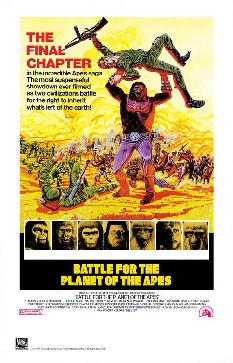
Battle for the Planet of the Apes

Here we sit. It's been a long ride full of ups and downs, but we made it through, and I'd like to thank all of those who supported me along the way. Yes, it is officially time to wrap up the Planet of the Apes series. It is time for 1973's Battle for the Planet of the Apes. Pretty dramatic, huh?!? I should totally do voiceover work.

It has been 12 years since the highly intelligent, thoughtful talking chimp, Caesar (Roddy McDowall) led the bloody revolt that gained apes -- the chimps, orangutans, and gorillas -- their freedom from their cruel human masters. It was a revolt that set off a chain reaction, countries and cities turning on each other, nuclear weapons wiping whole cities off the face of the Earth. Caesar and a small community of apes and humans manage to escape the destruction, building a city in the wilderness and starting their own civilization of sorts. It is a tenuous situation though, Caesar dealing with the apes' control over the humans, an ape general, Aldo (Claude Akins), eager to gain power, and the possibility of another group of human survivors -- mutated beings -- invading his territory. Can he hold it all together?

I've long been a fan of the Planet of the Apes series so it's been fun catching up with the series, especially watching all five movies straight through for the first time ever. It's cool to see the continuity among the five flicks, see recurring characters, recurring stories and plotlines. This fifth entry, from director J. Lee Thompson (who also directed Conquest), was released as part of the collection as an 'Extended Version,' running 93 minutes with about 10 minutes of additional footage reinserted. Not going to lie here, I was kinda disappointed with this final entry. There are positives -- more in that department later -- but there are also far too many negatives. The story seems like a jumbled collection of the previous storylines -- especially Beneath and Conquest -- and doesn't create enough of its own identity. Fans of the series will definitely enjoy it, but as far as series finales go, this one could have been better.

What are the biggest issues? Well, the script for starters. Reading about the Extended Cut (with spoilers), it's cool to see what footage was added back into the movie. Some scenes work better than others, some lack any rhythm or pacing. The exploration of the bombed-out city should be adrenaline-pumping, but the build-up is slow that it loses any momentum. It also seems thrown together for the sake of a sequel, an unnecessary one at that. It's only 12 years since the end of 'Conquest,' but the apes speak clearly and perfectly understandable. A whole species learns to speak in a little over a decade? Why did the humans go with the apes? Was it for survival? A whole sub-culture comes together so quickly, rushed backstory like the entire movie. There are portions that work as it tries to connect and wrap up with the rest of the series, especially the connection to Beneath, the villain, Governor Kolp (Severn Dearden), having an assistant, Mendez (Paul Stevens), the same name as the leader of the mutants in Beneath, the Alpha bomb there too. Little touches like that are pretty cool, especially for nerds like me

The biggest positive is the face of the franchise right there with Charlton Heston, Roddy McDowall, who starred in four of the five movies playing two different roles. His Caesar is the intelligent, thoughtful leader of the ape civilization, juggling countless roles. He's a leader, a father, a friend, and he's got to keep all the plates spinning at once. McDowall is the heart of it all, and not surprisingly, he kills the part. He is the link through it all, the best aspect of the character being his interest, his curiosity about his past. What were his parents like? How did they end up on a human-ruled Earth? What led to their tragic deaths? As a family man, we meet his wife, Lisa (Natalie Trundy, who also starred in four Ape movies), and his teenage son, Cornelius (Bobby Porter), who just wants to be a kid, Caesar doing his best to make his son's life smooth and easy. Any issues the movie may have, McDowall is above it. A fitting lead performance to wrap things up.

The rest of the cast is okay, some solid names, some recognizable faces, but nothing really eye-popping. Akins hams it up like a crazy person, his General Aldo really just a child in a position of power. He's the polar opposite of Caesar, fiery and emotional, but an action he takes certainly takes drives the story forward. For some of the other key ape performances, Lew Ayres is a scene-stealer as Mandemus, the senior citizen ape placed in charge of the armory, his logical thinking tripping everyone up, and Paul Williams as Virgil, the intellectual, the thinker who plays Devil's Advocate to just about everything Caesar does, but in a helpful fashion. Austin Stoker plays MacDonald, the face of the human group living with the apes. He has a good chemistry with McDowall's Caesar in their scenes together in an underused part.

I don't know. I came away disappointed. Maybe it tries to do too much, maybe it's just not very good. If you're a fan of the series, you've got to see it to wrap things up. There, plain and simple. It lacks that special something to hold it all together. A framing device with John Huston making a quick appearance as the Lawgiver tries to show that the Apes timeline can and should be adjusted, but everything else in the series seems to suggest otherwise. If it didn't, everything would collapse in on itself in the space time continuum. Yeah, time travel analysis. Didn't see that coming, did you?!? Watch it for the series, for the sci-fi aspect, just enough positives in a movie that lacked some energy. Still, it's been a hugely entertaining series, a fun ride over five movies. Thanks to the girlfriend for the Christmas present. Now, I've just gotta get her to watch them...

Battle for the Planet of the Apes (1973): ** 1/2 /****

Friday, March 18, 2011

All Quiet on the Western Front

In one of the most succinct, powerfully effective lines in history, Union general William Tecumseh Sherman said 'War is hell.' Nothing else really needs to be said. There is nothing glamorous about armed conflict in any setting where one man takes the life of another, no matter what movies, TV shows, and books may try and convince you otherwise.  Anti-war movies really came to the forefront during the Vietnam War as public sentiment soured on the conflict in Asia.  But one of the most moving anti-war stories came long before that, 1930's All Quiet on the Western Front.

Based on the classic novel of the same name by Erich Maria Remarque, this is a remarkable movie for any number of reasons, starting with the year it was released. I would have never pegged this movie as being released in 1930, just a few years into the sound era of movies.  There is also a sense with early Hollywood of white-washing stories, of censoring the movies of anything that is even remotely offensive. But that's the point of a war movie like this. It is supposed to offend you, to show the real horrors of war.  Considering its 1930 release, it is one of the most violent movies of the era, but it so much more than just violence.  This is war at its dirtiest, most base fighting, the effect it has on the men doing the fighting. No glory, no glamor, just survival.

With Germany preparing for war in 1914, teenager Paul Baumer (Lew Ayres) enlists with almost 20 other teenage boys from his school, dreaming of the glory that awaits them on the battlefield as Germany battles England and France. They leave with the notion that nothing would being them greater glory than to die for their country, quickly realizing how ridiculous the notion is.  After a quick training period, Paul's company is sent to the front lines as replacements for a veteran unit already worn down and torn apart from the fighting. They find a war unlike anything told to them prior, the idea of heroism and glory quickly going out the window. They settle in to the trench warfare, charging across bomb-marked fields into walls of machine gun fire. A heroic fight for one's country? Maybe, but these soldiers could care less. They just want to survive the hell that surrounds them.

Two characters rise above the story here, starting with Ayres as young, impressionable Paul. His acting can be a little too stage-oriented, but it is through his eyes we see the horror of war.  It is a remarkable performance from the 22-year old actor as we see his transformation from a naive newbie on the front lines to a tattered veteran in the matter of days. Somehow, he survives the days, weeks and months as so many of his comrades drop around him. Playing a part that would become synonymous with war movies, Louis Wolheim plays Corporal 'Kat' Katczinsky, the wily veteran who ends up being a leader based almost solely on his ability to teach and survive where so few others can. It's these two performances that anchor the movie. Other than that, most of the cast is pretty interchangeable, faces that don't leave much of an impression before being quickly dispatched.

Working on an impressively large scale for a 1930 release, director Lewis Milestone turns in an all-time classic here. He pulls no punches with his story, staying true to Remarque's source novel and its brutal honesty in portraying the horrors of war. Hundreds of extras fill the screen, and the battle scenes are immense.  Milestone shows a knack with his camera in an ahead of its time use of tracking shots that put you in the trenches with the hand-to-hand combat, following the men across acres of open ground under bombardment and heavy fire.  Exciting or entertaining? No, not really. This is war where there were no super-soldiers. Men died by the hundreds and thousands in futile efforts to gain a few feet of dirt.  The battles are surprisingly graphic, just adding to the affect of what you're actually seeing.

When I think of an above average anti-war movie, I think of the moments that stick with you long after watching the movie.  'Western Front' has too many to even mention, but here are just a few that left the deepest impression. Visiting a wounded soldier, Paul watches him die a slow, painful death, the staff and patients around him not so much as blinking at his cries. Hiding in a trench, Paul tries to save a French soldier's life moments after stabbing him to save his own. After a sustained bombardment, a German soldier finally cracks, running out of the damp, crowded dugout screaming bloody murder. Later, a wounded soldier rises from his hospital bed and trudges across the room to the window where he feels a ray of sunlight on his face, promptly dropping dead. The best though may be Paul's return home, seeing the perception that the people left behind have of this glorious war.  He tries to tell them the truth, but to no avail. After all, what does he know having served on the front lines for years?

This is a story where a happy ending just wouldn't work, wouldn't fit with the tone or style of this anti-war message.  But even being aware of that doesn't take away from the raw power of the ending, simple in its execution but speaking volumes about the idiocy of war. SPOILERS STOP READING SPOILERS Returning from leave, Paul finds Katczinsky who is wounded scrounging for food. Paul carries him back to the aid station several miles back, unaware his friend has died. He leaves quietly, not sure or not believing what just happened. Days later sitting in a trench, he reaches out for a butterfly resting just inches away and is picked off by a French sniper. The movie ends with the haunting image of Paul's outstretched hand reaching for that one beautiful thing in nature, coming up just short. I can't think of a more appropriately down ending for a movie that had to end that way.

If interested in watching the movie, it is available to watch at Youtube in an above average print thanks to a great restoration job, especially when considering the movie was made over 80 years ago.  You can watch it HERE starting with Part 1 of  13. 

All Quiet on the Western Front <---trailer (1930): *** 1/2 /****

Tuesday, September 7, 2010

Advise and Consent

Recently in the news, former Illinois governor Rod Blagojevich was found guilty on one count of 24 levied against him.  A mistrial is in the works, but the news was nothing new.  Controversies and scandals in politics are as old as well, politics itself.  Are we surprised anymore when a politician, whether it be the President or down through the ranks to Senators, Representatives, Governors, and on and on, does something stupid in the news?  Sex, past indiscretions, corruption, all over the above, nothing seems to faze the American public anymore.

Let's go back almost half a century in more innocent times, I guess, the 1960s weren't exactly innocent.  But the times were certainly different without that 24-hour news cycle that keeps viewers up to date on everything going on.  Politicians could have secrets and that's just what they were, secrets.  The master of adult-themed movies, Otto Preminger explored this concept with 1962's Advise and Consent. When you accept a position in the public eye, you lose your privacy to a certain point.  You open yourself up for criticism on many fronts, but if this Preminger movie teaches us anything, we all have secrets. It's only a matter of time before they're found out.

The President of the United States (Franchot Tone) has chosen a nominee for the vacant position of the Secretary of State. The man is Robert Leffingwell (Henry Fonda) and from the get-go, the nomination divides the Senate who will have to approve or disapprove him. The Senate majority leader (Walter Pidgeon) is all for the choice and knows he can get the necessary number of votes for Leffingwell. Opposing him is a long-time senator from South Carolina (Charles Laughton), who was burned by Leffingwell in the past and still holds a grudge. But before a vote can be counted, the nomination must go through a Senate sub-committee headed by an idealistic young senator (Don Murray) who will decide if Leffingwell is capable of doing the job. But as the committee starts, the dirt comes out and the fight begins.

As he did so often with his movies, Preminger puts together a very impressive ensemble cast to work with.  It's so good from top to bottom that Fonda -- yes, Henry Fonda -- is almost an afterthought as a supporting character.  He doesn't even make an appearance in the last 30 minutes.  Preminger was a perfectionist as a filmmaker, but actors must have liked working with him.  Along with the names mentioned above, there is also Gene Tierney, Peter Lawford, Will Geer, Burgess Meredith, Lew Ayres, and Paul Ford among others. Like any large ensemble, some in the cast get more of a chance to shine than others, but none disappoint however long they're on screen.  Murray, Pidgeon and Laughton are the ones that shine brightest though, including Ayres as a vanilla vice president.

This isn't a movie about camera techniques or in your face effects.  Preminger lets takes and scenes go on uninterrupted without the slightest editing.  Characters hold conversations like they would in real life.  He lets his cast show off their ability, letting the dialogue do all the talking the story needs.  At times, the pace can be infuriatingly slow (it is 140 minutes long) because of that, especially toward the end when the pace should be picking up, but it's all part of the story the movie revels in.  Preminger filmed in countless locations in Washington DC -- shooting in black and white -- giving a real feel for all the backroom deals and shady motives that really go on in the capital.  It doesn't intentionally call attention to itself, but the movie is a treat to watch on a purely visual level.

What was somewhat disappointing as the story develops is that by 2010, nothing really surprised me in terms of government scandals and controversies.  In the last 10 or 20 years, there has been murder, extramarital affairs, corruption, prostitution, kidnappings, and any number of other things I'm probably forgetting.  So when the scandals do pop up, including Fonda's Leffingwell and his past involvement in a different government and Murray's Senator's past coming back to haunt him, they don't have a huge affect on the viewer.  Shocking in 1962, maybe, but not in 2010.  Through no fault of Preminger's then (you can't blame him for making a move when he did), the emotional impact is lessened then just by time and how the world has changed in the almost 50 years since.

As everything does unravel in the end and the twists and secrets come out, the story thankfully picks up some steam.  One twist at the very end was a little too coincidental for me personally, the timing just too perfect, but that's movies for you. It is a movie that is as professionally done as just about any other movie you'll come across, and the cast is hard to top.  If there was a way to watch this in 1962, maybe the impact would have been greater, but in 2010, it's still pretty good.

Advise and Consent <---IMDB trailer (1962): ***/****