The Sons of Katie Elder

The Sons of Katie Elder
"First, we reunite, then find Ma and Pa's killer...then read some reviews."
Showing posts with label Henry Silva. Show all posts

Monday, April 28, 2014

Johnny Cool

Some faces just stick with you as you watch more and more movies. A glare, a stare, a smile, a laugh, a maniacal laugh at that, just something easily remembered. Henry Silva qualifies on basically all of those things, a character actor who made a career out of playing supporting parts, usually crazy, psychopathic villains. He was GOOD at it, beyond good, a great bad guy. Then there's 1963's Johnny Cool where Silva got a starring role as the definition of an anti-hero bordering on out-and-out bad guy.

As a young teenager in 1940s Sicily with World War II raging, young Salvatore Giordano sees his mother killed by a German soldier. He joins the Italian partisans, becoming a hero across the countryside both during the war and after. Years pass and now Salvatore (Silva) is infamously known around the country and even internationally. Some know him simply as a bandit chieftain, others as a modern day Robin Hood. An exiled American gangster, Johnny Colini (Marc Lawrence), arranges a faked death for Salvatore as he has far bigger plans for him. Colini teaches Salvatore how to act and look like a gentleman, but more importantly he turns him into an unstoppable killer. His intended targets? The men who helped orchestrate Colini's exile. If Salvatore -- taking the gangster's name -- can pull it off, Colini's empire will be his.

Yikes. What a vicious, brutal movie. From director William Asher, it's even darker when you consider it was released in 1963. Playing like a hard-boiled, brutal, in your face film noir, 'Cool' is the definition of a B-movie. It's gritty and doesn't feel faked from beginning to end. While there are indoor/studio shots, there is also plenty of on-location scenes from New York City to Los Angeles to Las Vegas. The gloomy, impending doom, jazz-heavy score from Billy May and Johnny Worth permeates Asher's gangster/underworld story. This is a story based in smoky nightclubs, in backroom gambling halls, in gangsters' offices in high rises. Filmed in black and white, there's a great, throwback style throughout. I didn't love the movie -- little slow-moving at times -- but it does have a lot going for it.

From possibly unhinged supporting player to...partially unhinged leading player....Yeah, okay, maybe this part isn't a huge departure for Silva, but it's a chance he doesn't disappoint with. While there's a strong ensemble working with him, this is Silva's movie, plain and simple. It's cool to see the transformation his character goes through, from revenge-seeking teenager to infamous bandit to killing machine. It would have been cool to see some more background, more motivation -- is he solely interested in riches and fame? Is it something else, something more? -- but we see a man who becomes obsessed with achieving his goal. It's pretty apparent from the second we meet Salvatore/Johnny that this is one doomed dude, but the route he takes is certainly fascinating. Silva brings that intensity we've come to expect from the veteran character actor. A very interesting part.

The rest of the cast has its positives and negatives. Ever seen 1960s TV sitcom Bewitched? Yeah, Samantha herself, Elizabeth Montgomery plays Darien, a divorced woman looking for some excitement and getting more than she figured when she joins up with Silva's Johnny. How about some of Johnny's hopeful victims? There's Telly Savalas (sporting some hair), Jim Backus, John McGiver Brad Dexter and Mort Sahl. If that wasn't enough, also look for Joey Bishop, Sammy Davis Jr., Richard Anderson, Elisha Cook Jr. Beyond Montgomery and Savalas, no one on this list is around for more than a couple minutes, the story almost becoming a revolving door of quick cameos. Still, cool to see some big names like this all in one cast.

Mostly though, this is a dark movie to sit back and watch without much in the way of a sympathetic character. Silva's Salvatore/Johnny becomes a killing machine who's beyond saving. Fascinating to watch, far from an even remotely sympathetic anti-hero. Much of the violence is off-screen, but it's pretty hardcore just the same. You don't have to see it to know that a man getting bashed in the head with a shotgun is gonna be rather graphic. People are dispatched with no build-up, no tension. Just BOOM! You're dead. And that ending....wow, just wow. We don't see what's going on, but the foreshadowing is rough. An interesting movie, but beware of what you're getting into.

Johnny Cool (1963): **/****

Tuesday, October 22, 2013

The Jayhawkers!

Sometimes sports rivalries can be pretty legit. As my friend pointed out, Missouri vs. Kansas isn't just two schools who hate each other. This is two states that brutally went back and forth against each other prior to the Civil War in hopes of bringing Kansas into the U.S. as a free, Northern state. So when you hear "border warfare" between the two schools, remember, it's not so bad. The conflict was even dubbed Bleeding Kansas. It's naturally a touchy subject, especially one for a feature film, but that doesn't seem to stop 1959's The Jayhawkers!

It's shortly before the Civil War in 1860, and Cam Bleeker (Fess Parker) has escaped from the territorial prison in Kansas. Wounded with a bullet in his shoulder, he returns home to find a very pretty French widow, Jeanne (Nicole Maurey), living in his home and on his land with her two kids. He finds out the truth, his wife died months earlier from unknown reasons. It's not long then before he's caught by the army and offered a choice. Bleeker will earn himself a full pardon for his past actions if he can somehow bring Luke Darcy (Jeff Chandler) to justice. With a small army of fighters and gunmen, Darcy intends to turn Kansas into his own country, seemingly without a preference to free or slave state. The only problem is that Darcy has forted up somewhere in the foothills, and no one knows where his hideout is. Making Bleeker's decision easier, he finds out Darcy may have somehow been involved with his wife's death. He takes the offer having to first find Darcy and his gang of Jayhawkers, but he doesn't know the full truth.

From director Melvin Frank, I remembered this one vaguely from watching it as a kid. A huge Davy Crockett fan then (and now to be fair), I watched it for Fess Parker, the mountain fortress sticking with me all these years. It popped up recently on a movie channel I didn't realize I had so I thought it was as good a time as any to catch up with it. Let's start with the positives. A quasi-western about Bleeding Kansas gets points just for having some balls. That is one particularly nasty period in American history so quite a challenge for a modestly budgeted western. So there, No. 1, an attempt at originality. On top of that, it's a very pretty western, shot with some impressive vistas and horizon shots that John Ford would have been proud of. Also, composer Jerome Moross turns in a score that's all around solid, big and booming (a little too "epic-y" at times) to keep up with the action and developing story. 

Never quite the huge film stars they could have been -- Parker more of a television star thanks to Davy Crockett and Daniel Boone, Chandler with a career tragically cut short by his sudden death in 1962 at the young age of 42 --both Chandler (getting top billing) and Parker are well cast. I liked the darkness of either character. Chanlder's Jeff Darcy is an egomaniacal maniac....but a really smooth, charming one. He wants Kansas, ALL of it for himself. His methods are brutally harsh, innocent people caught up in his wake, but for many, there's a method to his madness as his followers increase. Parker too gets a good shot at a significantly darker role than he'd previously had and doesn't disappoint. His Cam Bleeker (also a nomination for Coolest Name Ever) is hell bent on revenge and his target is Darcy. The relationship between the two men is maybe the most surprising thing about the movie, mostly good, some questionable.

Because every western needs a female character -- read = Sarcasm -- we get Maurey as Jeanne, a French widow who ends up with Bleeker through an odd set of circumstances, one after another. Her children are very badly dubbed it seems to the point it can be distracting listening to them talk. It's not that this is a bad or uninteresting character, it's just that she seems out of place and forced into the story. Henry Silva is a slimy scene-stealer as Lordan, Darcy's right hand man and brutal enforcer while Don Megowan and Leo Gordon play two of his Jayhawkers. Herbert Rudley plays the Governor of Kansas, cutting a deal with Bleeker. Also look quickly for uncredited Jack Kruschen and Harry Dean Stanton as a sheriff and deputy in pursuit of a fleeing Bleeker.

Unfortunately, it ain't all positive. A potentially really dark story with a revenge-seeking convict cutting a deal to capture a maniacal, power hungry man just should have been better. It just should have. Parker's Bleeker seems to fall awfully easy for Chandler's Darcy and all his motivations. Even when something goes horribly wrong late in the movie, Bleeker is pissed.........but really only to a point. For the sake of the movie he keeps on going to get his revenge, but even then, the brakes get tapped. All I ask is commit to the darkness or don't go there at all. There's even a bizarre scene in tone early as Bleeker "teaches" Jeanne's two French-speaking children English, or at least a Parker-like English. Bleeker instructs them "I'm a-going, she's a-going, he's a-going" and keeps on going. It's a painful scene in execution and completely out of place.

That's the biggest deal breaker. It's a lot of potential here that is never tapped. For a movie that runs 100 minutes, just not enough happens. Lots and lots of talking with no real payoff, including an ending that I felt cheated a bit. A decent watch thanks to some interesting casting, but mostly this was just a disappointment.

The Jayhawkers! (1959): **/****

Saturday, April 13, 2013

Ocean's Eleven (1960)

One of my favorite movies from the 2000s, I love 2001's Ocean's Eleven. I'm no dummy though, and I remember stating that the 2001 remake was better than the original. Well, it took me a little while -- okay, well over a year, but who's counting? -- but I'm revisiting that statement. Was I right or wrong? Maybe somewhere in between? Let's get started with the Rat Pack original, 1960's Ocean's Eleven.

A former paratrooper with countless daring, behind the lines missions under his belt during World War II, Danny Ocean (Frank Sinatra) has moved on with his life, but some 15 years since the end of the war, he's got a plan. The catch? He needs help from his old army buddies to pull off a daring heist. Ocean gets the group together, including Sam Harmon (Dean Martin), Jimmy Foster (Peter Lawford), and Josh Howard (Sammy Davis Jr.) among others, and lays out the plan for them. Just a few days away, Ocean and Co. plan on hitting five of Las Vegas's biggest casinos on New Year's Eve when the vaults are packed to the gills with money. Could it work? The plan depends on to-the-second timing, teamwork and countless little details, maybe even a little luck. It sounds like an impossible plan, but Ocean's crew might be crazy enough to pull it off.

Starting in the mid 1950s, Sinatra, Martin, Davis Jr., Lawford and Joey Bishop teamed up to star in movies that are simply known as....Rat Pack movies. Classic cinema they are not, but they are basically the definition of a good popcorn flick. Just sit back and enjoy them. Of all the Rat Pack movies though, this one is the best by far. Lewis Milestone directs, but his job is basically to get Sinatra and the boys on the right track and let them go. In that sense, he hits it out of the park. It is a vastly different movie than the 2001 remake which is really a remake in name and basic premise alone. The script, the heist, and the Vegas setting are all a means to an end. If you like Sinatra, Martin or any of the Rat Pack, you will enjoy this movie.

Singing or performing on stage, starring in movies, the Rat Pack had an innate chemistry that most entertainers dream of having. So cutting away a lot of other things, this movie is about the Packers hanging out, drinking some liquor, smoking a lot of cigarettes and wearing impeccably cool suits. Is it self-indulgent? Yes, basically the definition of self-indulgent. If you're a fan of Sinatra, Martin or any of the guys, this is the movie for you. It's genuinely funny with plenty of quick, snappy dialogue, lots of one-liners that don't feel like a script. It feels like it is a bunch of friends hanging out busting each other. Oh, and they happen to be planning an epic casino robbery too so they've got that going for them.

One of the biggest differences between the 1960 original and the 2001 remake is the background. Made 15 years after the end of WWII, the paratroopers angle is pretty cool. Sinatra's Danny is the sergeant, Lawford the entitled officer, Martin's Sam the soldier who saved Danny's life and best friend, and so on. Along with Davis. Jr as Josh and Bishop as Mushy, Danny's crew includes Richard Conte as Tony, just out of prison and looking to provide for his son, Henry Silva as smooth, quick-talking Roger, Buddy Lester as Vince, the former club bouncer with an in, Richard Benedict as Curly, Norman Fell as Peter, the explosives specialist, and Clem Harvey as Jackson, the drawling cowboy. Like the best men-on-a-mission movies, there's something inherently cool about a group of specialists working together to pull of an impossible job. When you actually like some of the group? That's even better, like a fastball down the middle.

Not surprisingly, the focus here is on Danny's crew, but the rest of the cast is pretty solid. Angie Dickinson plays Beatrice, Danny's wife who's working through some issues with her always moving husband. Cesar Romero is Duke Santos, a well-connected former gangster who stumbles into Ocean's plan and who happens to be engaged to Jimmy's mother (Ilka Chase). Akim Tamiroff gets a lot of laughs as Spyros, the ex-con who concocted the casino heist but can't come up with the details, turning to Danny for that part. Also look for Red Skelton playing himself in a casino scene, frustrated and wanting more money, and George Raft as a casino head in a strategy session. Even look for an uncredited Shirley MacLaine as a drunken New Year's Eve partygoer who meets Martin's Sam during the heist. And lastly, listen for Richard Boone providing his voice talents in a key scene late, even if he never appears on-screen.

I loved the style from this 1960 heist movie, and that doesn't come as a surprise considering the talent involved. The credits sequence from Saul Bass gets things going nicely. Watch it HERE, composer Nelson Riddle's score playing as accompaniment. Much of the film was shot on location in Las Vegas, and who would have thought? 1960 Vegas looks amazingly fun, like a time capsule into a smooth, cool era. Even the indoor sets look cheesy, but they're cool cheesy. The heist itself is pretty cool if a little more simplistic than the 2001 remake (Damn technology!). As most heist films will tell you though, it's the post-robbery stuff that's the issue. It's Vegas in the middle of the desert. How do you escape or hide the money? The ending delivers a couple great twists, especially the final one that sets up a very cool, very stylish final scene as Ocean's Eleven walk along the Vegas strip.

There is a simple, stylish elegance to this movie. Is it a classic film, an example of great cinema? No, but in terms of pure entertainment value, it's hard to beat. The scene where the crew discuss the upcoming heist in Spyros' well-decorated man cave is epically cool, Ocean's Eleven huddled around the pool table discussing the ins and outs of the heist. It's a fun, cool and entertaining movie that's a prime example of the style of a past era in Hollywood. The Rat Pack is cool. If you agree, you'll like this movie.

Ocean's Eleven (1960): ****/****         

Thursday, July 12, 2012

The Boss

And now for those readers who have made it through two reviews of sleazy B-movie Italian crime thrillers, here's a third! Wrapping up director Fernando Di Leo's loosely linked Italian crime trilogy comes 1973's The Boss, the weakest of the three but with enough positive to mildly recommend. Fans of both The Godfather and Scarface should get some enjoyment/entertainment out of it for sure.

Having worked as a trusted enforcer for Don Giuseppe (Claudio Nicastro), a powerful mob boss, stoic Nick Lanzetta (Henry Silva) has been put in a spot with no easy out. With a mob war brewing because of successful hit he pulled off, Lanzetta is caught in the middle. He's loyal to Don Giuseppe, but he also sees more of a chance for advancement if he listens to the big boss in town, Don Corrasco (Richard Conte), Giuseppe's superior. As the bodies continue to pile up, Lanzetta must make a decision. Does he stick with what he knows or try to rise up in the aftermath of the bloody mob war?

Having watched all three of Di Leo's crime trilogy in less than a week, I came away impressed with a couple things. Through all three movies, I was entertained even if there were some sluggish parts (more on that). Mostly though is the downright brutality and cynicism of these worlds. Maybe it's the European audience and market wanting a more reality-based crime story, but everyone....everyone...is a bad guy. It's just shades of bad. When someone gets beaten, it looks, sounds and feels like they're actually getting beaten. Kids, women, pets? Not exempt from some rather graphic deaths. Like I mentioned in The Italian Connection review, Di Leo just don't give a damn. He doesn't care if he offends some. He just wants to entertain a lot of folks and for the most part, accomplishes that.

'Boss' does differ from the previous two movies in the Di Leo trilogy in that it isn't exclusively on the small-scale, low-level hoods. There's a bigger picture here, crime families duking it out for supremacy in the underworld. We hear a lot about 'The Family needs...' and 'The Family must...' when talking about a lot of people making a difficult decision. The Godfather was an obvious influence here -- down to the Conte casting, a role similar to his Barzini -- with 'Boss' hitting theaters just a year after the 1972 American classic. Everyone is betraying everyone, and no one is safe.

A definite bright spot in 1972's The Italian Connection, Silva one-ups himself here. He's the best thing going for 'Boss' by a long shot as Lanzetta, the steely-eyed, ice water in his veins hit man. Silva was a huge presence with a truly intimidating glare when he stared someone down. The hit man is business-like about his job and brutally efficient. To me, it seems like an obvious influence on the Skull, Tony Montana's killer in Scarface. He wears almost exclusively black clothes and rarely shows an ounce of human emotion. He's cold-blooded but highly intelligent and calculating, able to see two or three steps ahead, knowing when trouble will arise. Conte is all right, Gianni Garko is wasted in a supporting part as a police officer on the hunt, Pier Paolo Capponi hams it up as Cocchi, the mob rival, and Marino Mase plays Pignatoro, a former partner of Lanzetta's.

What's disappointing is that for lack of a better description, 'Boss' is boring. If Silva isn't on-screen, the story grinds to a halt. Garko's scenes with his condescending superior (Vittorio Caprioli) serve no purpose and drag on endlessly. Whole scenes are just characters talking back and forth, the camera stationary as if its trying to make us fall asleep. Other times, 'Boss' is just trying too hard, like Giuseppe's daughter (Antonia Santilli) being kidnapped and joining in orgies with her captors just for the movie to have an excuse to have her naked. A nympho hippie? Yeah, right, especially when she jumps into bed for a week with Lanzetta. I liked the movie, but the parts that didn't work truly flopped. Mostly worthwhile for Silva's lead performance.

The Boss <---Opening scene (1973): **/**** 

Tuesday, July 10, 2012

The Italian Connection

Yes, I'm pretty cool when it comes to watching movies. Because I've got an odd memory for movies I'd like to see, I have an ever-growing list of films (literally, I've written down a list) I stumble across at Netflix, Amazon, IMDB, Turner Classic Movies and on and on. Usually I limit it to harder to find movies that aren't readily available, movies you're glad you find and usually by accident. I stumbled across 1972's The Italian Connection years ago and was finally able to find a halfway decent, watchable copy.

A low-level pimp, Luca Canali (Mario Adorf) has gotten on the bad side of the wrong people. An American mob boss has put a hit contract on the pimp, claiming that he helped steal millions of dollars worth of heroin as it was being shipped. The boss has hired two American hired guns, Dave Catania (Henry Silva) and Frank Webster (Woody Strode), to kill Luca and to do so slowly, painfully and graphically as a message to anyone else doing the same thing. The hired guns head to Italy to hunt Luca, but the pimp isn't even aware he's in trouble. Has someone been setting him up?

This was a movie that was worth the wait in an odd way. Part of director Fernando Di Leo's unofficial Italian crime trilogy, it's gritty, low-brow in most instances and entertaining in almost all instances. There's just something oddly appealing about the forthright nature of these Euro crime movies. They don't seem to care that at some point in the film, they will almost certainly insult or offend someone. Gratuitious violence, random bits of nudity, the definition of politically incorrect, and the best part is that Di Leo and Co. just don't give a damn. Either you like it or you don't. Simple as that. If you do, sit back and enjoy. If not? No skin off the Italian director's back.

One of the same appeals here for me in these Italian/European crime flicks is a similar feeling I have watching spaghetti westerns. When things weren't always going well in the U.S., many American actors -- some past their prime, others rising stars -- headed to Europe for these audience friendly cult favorites. A German-Italian actor, Adorf really seems to relish the part here as Luca, a pimp but gosh darn it! Just an all-around nice guy! All he wants to do is hang out with his daughter and be civil with his ex-wife (Sylva Koscina). Now that wouldn't be an interesting movie to watch, would it? No, not at all, so we've got to piss off Luca and give him a reason to go on a murderous rampage. With a part that could have been too exaggerated (like his part in Caliber 9), Adorf does a good job of keeping the character grounded in some sort of reality. I only knew him through Peckinpah's Major Dundee, but another solid intro to Adorf.

Years ago when I found this movie via IMDB, it was because of the rest of the cast -- no disrespect to Mr. Adorf. Silva and Strode as American hit men taking it to the road? How can you go wrong? Not surprisingly, Silva is the more showy of the duo, a hard-drinking, hard-living, womanizing killer. Strode is just the opposite, all business with no distractions. Moral of the story though, they work well together as a killing duo. In fact, the story suffers when they're not around, and unfortunately through the middle portions, there is a lot of those situations. A whole movie could have been devoted to them, and I'd be cool with that. Also look for Thunderball co-stars Adolfo Celi and Luciana Paluzzi as an Italian mob boss and the hit men's tour guide of sorts.

Building the story, Di Leo seems to revel in lulling you to sleep...to a point at least. The first 45 minutes are painfully slow at times as characters, setting and background fall into place. The last 45 minutes are an adrenaline rush, one crazy action sequence after another piled on top of each other. Watch one of the truly adrenaline-pumping chases HERE, via car and on foot. The finale too lives up to expectations, Luca playing cat and mouse with Dave and Frank in a junkyard. A flawed crime flick, but a good flawed crime flick and highly entertaining.

The Italian Connection <---trailer (1972): ***/****

Sunday, November 6, 2011

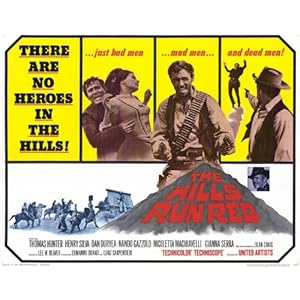
The Hills Run Red (1967)

Discovering the spaghetti western genre through the Clint Eastwood/Sergio Leone Dollars trilogy, I quickly figured out the problem if I was going to see more of the spaghettis. Most of them just weren't available in a watchable form, at least the ones that were somewhat affordable. So to find them I was scouring TV listings, looking through bargain bins, even trading a couple movies here and there. Thankfully DVD distributors finally started releasing some of the lesser-known entries, including one I'd always wanted to see, 1967's The Hills Run Red.

As the Civil War comes to a close, Confederate soldiers Jerry Brewster (Thomas Hunter) and Ken Seagull (Nando Gazzolo) have robbed a Union payroll. About to be caught by a Union patrol, they flip to see who will buy the other one some time, Jerry losing out but demanding that Ken care for his family until he can get back to them. Ken escapes with the money -- some $600,000 -- and Jerry is captured and sent to prison, serving a brutal five-year sentence. He is finally released only to find that Ken refused to help his family, Jerry's wife dying years before and his son is missing. His former partner even used the money to set himself up as a powerful rancher, holding rein over hundreds of miles of land. A man possessed, Jerry is looking for revenge. He gets himself hired by Ken's top hand, Mendez (Henry Silva), and goes about taking down the empire from the inside.

This is pretty typical of a majority of spaghetti westerns in that it is neither a classic nor an awful movie. It's entertaining on a pretty basic level but never rises or falls to any heights or depths.  Former film critic Carlo Lizzani takes his crack at a genre that was at the height of its popularity in 1967, turning out a western that has some strands of an American western but has a decidedly Italian flavor, most of them for the good. Composer Ennio Morricone's score is not one of his best or most memorable, but it's catchy like most of his scores were. It certainly has a different sound compared to his more well-known scores, even featuring a song, 'Home to My Love,' that feels out of place.

Spaghetti westerns have a reputation for being particularly nasty in their brutal portrayal of the west, and 'Hills' has to be one of the most brutal. One review called it misanthropic, and after a quick detour to the dictionary, I can confirm.  It has little regard for people at all, mowing down countless gunmen in various fashions, one nastier than the rest. Hunter's Brewster has to be one of the genre's most punished leads, and that's saying something. Within the first 30 minutes, he's been beaten half to death twice, tortured in prison, cuts off his own tattoo, gets tangled up in a handful of gunfights and also stabs a rival gunman in the hand. Don't worry though, nothing's stopping this guy. It's a little more graphic than even most spaghetti westerns so if you're a fan of graphic, brutal violence, this is a movie for you.

One of hundreds of spaghettis generally forgotten, much of that can be chalked up to Thomas Hunter in the lead. An American actor who only starred in nine movies (most of them European), Hunter just isn't the greatest actor or charismatic enough to have a starring role, one where the movie depends on him. The dubbing across the board is pretty awful, but it hurts Hunter a ton. A gunman looking for revenge is an ideal lead, a man obsessed with avenging his family, but in Hunter's hands that means overacting in a BIG way. His scenes that call for any emotion are almost hysterical. He screams so much, his eyes bulging that I couldn't help but laugh. You're rooting for him because he's the good guy, not any real reason.

Now where overacting can be a good thing is the villain, and in steps Henry Silva, one of the all-time great movie bad guys. Just like Hunter's Brewster, Silva's Mendez is ridiculously and completely over the top, but he's the villain so you buy it, and it's fun. He laughs hysterically in almost every scene, is always ready to pull a gun and blast away, and speaks in this basic Spanish that is comical in its badness. Va-ma-nos mu-cha-chos! Mendez is also decked out in black leather jacket and pants, black shirt and black sombrero. Bad Guys 101, Silva is a good bad guy, and he does most of the heavy lifting. Gazzolo makes no impression at all as Ken Seagull turned Ken Milton.

In the bizarre, kinda weird casting department, American actor Dan Duryea plays Winny Getz, a mysterious gunman working with Brewster to take down Milton and Mendez and their empire. Why so mysterious? Gotta stick around to the end to find out his "secret." It feels thrown together and unnecessary, but Duryea feels out of place here anyways, like he accidentally got on a plane to Italy and walked onto the set. Italian beauty Nicoletta Machiavelli is the obligatory love interest, Milton's sister, Mary Ann, who likes Brewster but is pursued by Mendez.

What else to recommend or rip? Little of both in the finale, Brewster and Getz running on a wild goose chase through an abandoned town as Mendez's small army of gunmen pursue them. It's some good action with some exciting gunplay, but also mind-blowingly stupid. If these gunmen thought it through at all, they'd stop chasing these two vastly outnumbered guys into dark rooms. Still, it's a fun sequence like the rest of the movie. Fun and pretty forgettable, but you could do much worse.

The Hills Run Red <---trailer (1967): ** 1/2 /****

Friday, October 21, 2011

Viva Zapata!

Fought through the 1910s, the Mexican Revolution produced several heroic, notable, and even infamous historical figures. The name most people know – or at least have heard of – is Pancho Villa, a revolutionary leader who fought the Mexican Army in Northern Mexico. A name that may not be as well known, Emiliano Zapata, did as much if not more than Villa but hasn’t been as easily remembered. In 1952, Zapata’s exploits were turned into an award-winning film, Viva Zapata!

Who better to play an infamous revolutionary leader than….Marlon Brando?  One of the all-time greats in Hollywood as an actor, Brando played an eclectic, off-the-wall variety of characters in his career. He played Southern hotheads, a German soldier, a rogue American general, a Mafia head of a family, and so many more. So does a Mexican revolutionary sound so far off base? He’s an interesting choice to play Zapata, the only negative coming from an odd make-up choice to make Brando’s eyes appear…Asian? Eh, minor detail.

A poor Mexican farmer in southern Mexico, farmer Emiliano Zapata (Brando) is one of thousands of poor peasants upset with how the government takes advantage of them whenever possible. When their land is scooped up by the government, Emiliano and his brother, Eufemo (Anthony Quinn), join the fighting that has swept the country. Zapata doesn’t fight for glory or fame or riches, just for the people’s rights so they can be treated like human beings. But with so much power on the line, Zapata finds that anyone and everyone must question their own beliefs, choosing between their wants and their needs.

You know what’s a good sign that a movie has a lasting impact? A whole subgenre is named after one person, and in the case here, one movie. After ‘Viva’ was released in 1952, revolutionary westerns started popping up in theaters more and more over the next 20 or so years. Think The Wild Bunch, The Professionals, Villa Rides! and many more. This was one of the first, and it’s a good one, setting the groundwork for the many that would follow, all the characters, story twists, and plotlines there for the taking.

Now 100 years removed from the actual incidents these movies portray, historians now question how revolutionaries like Villa and Zapata have been remembered. Were they heroes or murderers? Directed by Elia Kazan, ‘Viva’ leans toward the hero angle, going as far as building Brando’s Zapata up to almost God-like proportions. It’s never obnoxious or goes too far, but you certainly notice. Brando does a phenomenal job portraying Zapata in a way that doesn’t make the revolutionary tedious or one-note. He’s an illiterate, poor farmer who wants something else for the people and himself. He’s willing to sacrifice it all to accomplish that mission. Brando was nominated for an Academy Award for his part, losing to Gary Cooper in High Noon, but that doesn’t take away from an impressive performance.

Like any historical epic, this movie must deal with a delicate issue. How do you condense 15-20 years of history into a 2-hour movie? ‘Viva’ does a fair job of hitting all the key points of Zapata’s involvement in the revolution, his rise and fall more or less. The first half of the movie struggles some to build any momentum, the rhetoric of the revolution bogging the story down some. The subplot with Zapata marrying Josefa (Jean Peters) doesn’t serve much of a purpose either as it tries to humanize the revolutionary. The pacing picks up in the far superior second half as the revolution takes its toll on Zapata and his army, the conflict becoming fiercer, the battles bloodier, the betrayals and backstabbing more familiar with no end in sight.

Originally expected to play Zapata, Anthony Quinn had to “settle” playing the revolutionary’s brother. Call it fate, but Quinn won the Academy Award for Best Supporting Actor while Brando was only nominated. It’s not a great performance – Quinn had much better – but it reflects the times and who won at the Oscars. It is a big, loud part where Quinn is allowed to chew the scenery and ham it up, a passionate, driven revolutionary who starts to see that everything isn’t as it is made out to be. Another very solid supporting part comes from Joseph Wiseman as Hernando, a somewhat mysterious revolutionary who seems obsessed with winning this fight, seeing what Zapata means to the revolution, not as a person but for what he represents. Also look for an uncredited Henry Silva as Hernando, a peasant and fighter who joins Zapata late in the revolution and Frank Silvera as Victoriano Huerta.

Naturally because this is a positively reviewed movie and generally well respected by critics and fans alike, it is available in absolutely NO formats, no VHS, DVD, or Blu-Ray. It’s been a ‘Save’ option on Netflix for over a year in my queue. So if you can track a copy down, it’s well worth it. Beautiful black and white photography, strong performances from the three leads, and an interesting story about a revolution with no easy answers. Check out four clips HERE at TCM's website.

Viva Zapata ß-trailer (1953): ***/****

Saturday, June 12, 2010

The Secret Invasion

Released in 1967, Robert Aldrich's The Dirty Dozen came along at just the right terms for movie audiences with its cynical tone and generally pessimistic look at society and any sort of hierarchy and power.  The story of 12 convicts chosen to take part in a suicide mission just before D-Day was unlike anything audiences had seen.  To Aldrich's credit, he made the premise unique and damn entertaining.  Really though, the idea of convicts turned commandos had been used countless times before.

Take 1964's The Secret Invasion from the master of schlock, low-budget B-movies, director Roger Corman. The cult director made a career of doing a lot with very little in terms of money in the budget as well as producing some 300-plus movies.  But when given the chance, Corman showed what he was able to do with even a mid-sized budget like in 1964's The Secret Invasion, a WWII story that uses the same basic premise as Dirty Dozen.  Don't be confused though, 'Invasion' is still a B-movie without any notion of being anything else.  On the highly positive side, it's a prime example of how good a B-movie can be when everything goes right.

Stationed in Cairo in 1943, British Major Richard Mace (Stewart Granger) has assembled a dubious crew to help him on a dangerous mission in the Balkans.  From prisons and penitentiaries all around the world, Mace has assembled a crew of criminals -- all experts in one way or another -- to join him.  Just days away from the Allied invasion of Italy, Mace and his team will sneak into the Balkans and help an Italian general (Enzo Fiermonte) escape from a heavily guarded German prison.  With the general's help, Mace hopes to turn the Italian forces against the Germans, making the Allied invasion even a little bit smoother.  First though, the major has to worry about keeping his team of crooks in line, many of them willing to shoot him and escape the first chance they get.

Now with a B-movie -- even a really good one like this -- you can't expect a bunch of A-listers starring.  Instead, you get something better.  Actors you know and have seen countless times but usually in supporting roles.  Some were past their prime and others still on the rise.  Corman hits a home run with the casting of his dirty half-dozen including Raf Vallone as Rocca, a mafioso and expert planner of strategy, Mickey Rooney as Scanlon, an IRA explosives expert, Edd Byrnes as Fell, the master forger, Henry Silva as Durell, the hired assassin, and William Campbell as Saval, a master of disguise and deception.  These were all solid character actors given a shot at starring roles, and the ensemble doesn't disappoint.

With any 'men on a mission' movie, there's a certain dark element that makes them intriguing.  By the end, you know most if not all won't make it so early on make your choices.  'Invasion' certainly has some fun with this notion as to who survives and how.  The cast is clearly having some fun with these cardboard cutouts for roles.  Vallone as the reliable second in command speaks in that heavily accented English and certainly makes a positive impression, as does Silva as the dead-eyed killer.  But by far, the most surprising and enjoyable part is for Rooney as the half-mad Irishman and explosives expert.  Playing completely against type -- as he would do again two years later in B-movie Ambush Bay -- Rooney absolutely steals the movie.

As much as I like a good, old-fashioned long movie (even The Dirty Dozen was 150 minutes long), a quick-paced B-movie can be just as enjoyable.  With his 95-minute movie here, Corman keeps the story going at all times with some snappy dialogue or a quick action set-piece.  The story flies by and never really slows down.  It's never long before the half-dozen find themselves in some sticky new situation they have to get out of.  Along the way, they dodge either, work with some partisans, and then finally must fight their way out of the German fortress.  Sounds easy, don't it?

Taking advantage of a bigger budget, Corman filmed in Yugoslavia and Croatia, giving the whole movie a unique, realistic feel to the proceedings.  The on-location shooting is great, but Corman saves the best for last.  Chased by hundreds of German soldiers, Mace's crew must escape up a seaside hill with the Germans close on their heels.  He clearly spent some money on this battle sequence with an epic feel.  Lots of extras working as German soldiers, explosions and shootouts galore, and some surprises as to who survives and who doesn't.  It's a great action sequence, and Corman almost lulls you to sleep early with so little action.  He certainly makes up for it in his finale.

I stumbled across this war flick at IMDB a few years back and am I ever glad I did.  It's exciting right from the start -- opening scenes included below -- and never really slows down.  Cool choices in casting, gorgeous locations, and a wham bang action finish.  Maybe it doesn't have the high hopes a movie like The Dirty Dozen did, but from master director/producer Corman, this is about as good as a B-movie can be!

The Secret Invasion <---opening (1964): *** 1/2 /****

Monday, May 17, 2010

The Law and Jake Wade

Rising to fame in the late 1940s and early 1950s, Richard Widmark made a name for himself for one big reason. Anybody can play the angelic good guy, but what about the devilish, laughing at death bad guy? From his screen debut in Kiss of Death as a psychotic killer, Widmark was typecast to a certain point early in his career as the villain. Why not really? He was the perfect bad guy. In the late 1950s though, he started to get more offers for leading roles, the good guys instead.

One of the last true villains Widmark played -- he took on some characters that lived in that gray area between good and bad -- was in 1958's The Law and Jake Wade. In this John Sturges western, Widmark isn't required to go crazy villain on the viewer, but just enough to be both charming and intimidating at the same time. Okay, maybe a little crazy, but not too much. Sturges is right in his comfort zone with this western and makes the most of a small-scale and most likely small budget in this above average western. With Widmark and a strong cast around him, 'Jake Wade' is better than it should have been.

After years of living on the outlaw trail, Jake Wade (Robert Taylor) has become a respectable marshal in a small New Mexico town -- apparently he formed a new identity. But before he can marry his sweetheart, Peggy (Patricia Owens), Wade feels he has one thing he has to do. He rides to a town several days ride away and busts out Clint Hollister (Widmark), his old partner, who's rotting away in a jail cell awaiting sentencing. Wade gets him out and sets him free, claiming they're even now. A few days pass though and Hollister shows up with his gang. He's not done with his old partner yet, wanting Wade to lead them to the $20,000 he hid years before after a robbery. Hollister kidnaps Peggy to force Wade to go along so they set off into the wilderness to get the money back.

As far as westerns go, this is pretty typical of many 1950s entries, but it handles everything so well it's elevated above so many others. Sturges keeps the story tight at under 90 minutes and the cast comes in at just eight key characters with little else to distract from the story at hand. As a director, he specialized in 'guy movies' where large casts of tough guy actors worked together and dealt with ideas of loyalty, honor, and betrayal. Some of those ideas were used to an even better point a year later in The Magnificent Seven. It's to the point, entertaining, and improves all the way to an exciting finale.

The only part that lags a bit is the midsection as Hollinger's gang -- with kidnappees -- head out into the desert to the spot where Wade buried $20,000 in cash years before. What makes this part tolerable is Widmark's part here in several campfire dialogue scenes as he explains the history he has with Wade. It's scenes like that brimming with tension and testosterone that make the middle portions anything but boring. Of course, there are too many long shots of riders on the horizon with the California locations in the background.

Widmark is the main reason I'd recommend this western, but the rest of the cast is nothing to sneeze at. Taylor is solid if not spectacular as Jake Wade, a outlaw turned peace officer trying to put his violent past behind him. Midway through the movie it looks like Taylor realizes he's being overshadowed by Widmark's villain and saves his energy for the finale. Wise choice, Rob, wise choice. Owens looks worried and screams when needed as her character requires little else. Hollister's gang includes Rennie (Henry Silva), Wexler (DeForest Kelley), Ortero (Robert Middleton) and Burke (Eddie Firestone), Silva as the nutty gunfighter and Middleton as the wavering bandit standing out from the rest in strong parts.

Sturges saves his best for last here as the gang reaches the sand-swept, windy ghost town where the money is buried. Arriving about the same time as the gang? A Comanche war party looking for scalps. Sturges and cinematographer Robert Surtees do an incredible job of filming this ghost town as if it was in the middle of a vast empty. This feeling of being trapped in a wide open space makes the shootout a great sequence as the Comanches close in. This ending would have been good on its own, but then we've got the inevitable Wade vs. Hollister showdown which doesn't disappoint either. An empty town and two men looking for revenge is always a good combination in a western. Solid ending to an overall above average western.

The Law and Jake Wade <----TCM trailer (1959): ***/****

Thursday, January 7, 2010

Almost Human

Every so often a character in a movie, a book, a TV show, anything really, comes along that is just so despicable, so downright low that it is beyond easy to hate them. They tend to have no redeemable qualities at all, often performing acts so unspeakable it can be difficult to watch. For me at least, this is often balanced out because that character is the villain, an individual matched in screentime by some sort of hero. What about if there isn't a hero, and that villain dominates almost every scene? Put that all together, and you've got 1974's Almost Human.

By 1974, Cuban actor Tomas Milian had made quite a name for himself working in Europe, tending to stay within the western and crime genres for his parts. He was a perfect choice for a roguish individual who usually lived in that fine line between good and bad but often enough ended up making the right choice and saving the day. Often enough, but not every time. Working with director Umberto Lenzi for the first time, Milian delivers a performance in Almost Human that pulls out all the stops with a character so ridiculously evil that it borders on going too far over the top. But of all his roles, Milian picks 'Almost Human' as his best.

Working as a low-level hood for the mafia in Italy, Giulio Sacchi (Milan) panics during a bank robbery and kills a police officer trying to ticket his car. The mafia capo, Majone (Luciano Catenacci), does not appreciate any undue attention being called to him and his organization and lets Giulio go. Fed up with these small-time jobs, Giulio turns to bigger fish and finds what seems the perfect crime when he visits his girlfriend (Anita Strindberg) at work. Her boss has a young daughter in her early 20s, and Giulio decides there's millions of lire in it if he was to kidnap her and demand ransom. Working with two similarly low-level thugs, Carmine (Ray Lovelock) and Vittorio (Gino Santercole), Giulio goes about figuring out his plan for the kidnapping.

The story starts with Giulio panicking and killing a patrolling police officer and never stops from there. The body count begins to build -- I counted 15 people Giulio kills by himself -- as the crimes escalate and the kidnapping plan is put into execution. The transformation Milian's main character goes through is alarming, starting off as a thug who panics in a chaotic situation but degenerating into a sadistic killer who has little whim about killing anyone if it will benefit him. At one point, he even guns down a little girl with a machine gun. If that's not a character to root against, I don't know if there's one out there. Giulio is a brutal, bi-sexual, drug addicted murderer who you can't wait to see get his comeuppance. I put bi-sexual not as a judgement, just to add to the overall eccentricity of the character.

What makes this all more uneasy to watch is that the 'good guy' is nothing more than a crime thriller stereotype. Usually playing the role Milian takes here, Henry Silva is police commissioner Walter Gribaldi, a veteran officer trying to piece together all these crimes popping up. For one thing, it's nice to see Silva playing a good guy after a long line of psychotic lunatics, but the character has no development other than being a near-obsessed police officer. Even then, Silva isn't given much to work with in his scenes although he does come around in the end...the end you can see coming miles away. More was needed though to give the viewer someone to root for.

Where many other Italian crime thrillers added other elements to the main story, 'Almost Human' rises and falls on Milian's performance alone. And character dislike aside, this is a great performance for the actor although I disagree that this is his best overall. But other than Milian, there's not much to recommend. I can't place it, but I swear Ennio Morricone's score was used in another movie, and the action overall isn't meant to be exciting, but unsettling instead. It's a pulpy B-movie with plenty of blood and guts, gratuitious nudity, and an in your face style. Take away Milian in the lead, and it's a bad movie. With the performance, it's at least worth giving a mild recommendation.

Almost Human <----trailer (1974): **/****