I love westerns. I love heist movies. They're two of my favorite genres. So what happens when you combine the two? And throw in two of my all-time favorite actors? Oh, no.....it's a movie nerd alert!!! With just an air of fun hanging over the whole story and production, it's hard not to get on-board and truly enjoy the 1967 western The War Wagon.
Fresh out of jail after serving a three-year sentence for a crime he didn't commit, former rancher Taw Jackson (John Wayne) heads home with revenge on his mind. Framed by a local businessman and landowner, Pierce (Bruce Cabot), Jackson wants to exact revenge where it hurts most...Pierce's gold mine. The attempt would seem suicidal though, Pierce paying for an armor-plated wagon outfitted with a Gatling gun and guarded by 33 outriders that transports the gold from the mine to the train station that would prove to be a major deterrent to any would-be robbers. Jackson isn't about to give up though, but he does need some help, including an unlikely partnership with a hired gun named Lomax (Kirk Douglas) with whom he's had a deadly rivalry in the past and has the bullet wounds to prove it. With a small team of fellow crooks, Taw puts his plan into action to rob the armor-plated wagon, the War Wagon. But just how in hell is he going to pull this off successfully without getting shot full of holes?
This is a movie that's just hard not to like. It was a staple on AMC and TNT growing up so I saw it many times, and it's one I always look forward to revisiting every so often. This last time, well, it had been quite awhile. From tough guy director (and a Wayne favorite) Burt Kennedy, 'War' is one of those perfectly straightforward westerns with no pretensions about the changing times or a revisionist view. It's F-U-N, plain and simple, mixing so effortlessly that western setting with a heist story. Put a crew together, give them a crazy, no way in hell this works mission, and let things fall where they may. Not the best, but one of the most purely entertaining westerns to come out of the decade.
So John Wayne and...Kirk Douglas. Please and THANK YOU. The duo had worked previously together in 1965's In Harm's Way and 1966's Cast a Giant Shadow, but this is the best pairing because it just lets these two pros go to work. Yeah, the heist is fun throughout, but you watch this movie for any and all scenes between Wayne and Douglas. The dialogue crackles between them, a rivalry that treads that fine line between joking and deadly serious. There's some genuine menace in the chemistry, but you just sit back and watch things develop. The best part? They're clearly having a blast. An underrated comedic actor to begin with, Wayne gets to show off his funny chops with some great line deliveries, and Douglas is the perfect foil as Lomax, a hired gun who's a bit of a dandy but takes his job supremely seriously, especially with so much potential money on the line. You couldn't ask for a better star duo to lead the adventure film.
Any good heist needs a good heist team so who to look out for? Certainly a motley crew of crooks, including the very white Howard Keel as Levi Walking Bear, Keenan Wynn as Wes, an employee of Pierce's, and Robert Walker Jr. as Billy, an explosives expert with a drinking problem. A Wayne friend and favorite, Cabot looks to be having a ball as Pierce, the sneering, menacing crook with a whole bunch of power. Also cool to see background player Don Collier get a more visible part as Pierce's right-hand man. Also look for Joanna Barnes, Valora Noland, Bruce Dern, Chuck Roberson (Wayne's stunt double), Emilio Fernandez, and Gene Evans rounding out the cast.
'Wagon' has a lot of little things going for it that combined make for a significantly better flick. Durango, Mexico was one of Wayne's favorite filming locations including Sons of Katie Elder, The Train Robbers, Chisum and here with 'Wagon.' The Mexican mountains and wilderness provide an intimidating, authentic backdrop to the story. Dimitri Tiomkin's score is a gem, big and booming, perfect for an adventure story and one that instantly screams 'Oh, yeah, that's Tiomkin music.' Lastly, an oh so perfectly bad theme song that you can listen to HERE. It's awful, but my goodness, is it ever catchy. I defy you to watch the movie and not to be humming along to the theme days later.
But, ah yes, the heist. There's hints along the way of what Taw, Lomax and Co. are up to, but nothing too specific. So like the best heist movies, as the caper develops, we're in the dark to the exact details, all of that adding a sense of mystery to the proceedings. Nothing too crazy here other than a matter of split-second timing, some dumb luck, and one rather prominent plot hole if you ask me. But there's no point in ripping it to pieces too hard. This is a movie that's meant to be a hell of a lot of fun, and it succeeds throughout on that premise. Wayne and Douglas are pitch perfect together and look to be having a ball.
Sit back, enjoy and let that fun take over from there.
The War Wagon (1967): ***/****
Rewrite of February 2009 review
The Sons of Katie Elder
"First, we reunite, then find Ma and Pa's killer...then read some reviews."
Showing posts with label Bruce Dern. Show all posts
Sunday, November 29, 2015
Thursday, November 6, 2014
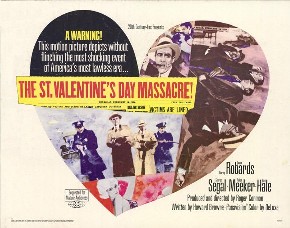
The St. Valentine's Day Massacre
I grew up in Chicago so I love just about everything in the Windy City, all the sports teams, the downtown area, all that great food from Chicago style hot dogs to Chicago style pizza. But that Chicago history? My goodness, there are some dark moments from the Black Sox scandal to the Chicago Fire, the riots at the 1968 Democratic convention and generally all sorts of political corruption and deception. One of the most violent incidents in the city's history? That's told in a 1967 B-movie, The St. Valentine's Day Massacre.
It's early 1929 and the streets of Chicago are filled with warring gangsters from two rival gangs. On one side is Al Capone (Jason Robards), a brutal, possibly maniacal Italian gangster with Mafia ties, who rules Chicago's South Side with an iron fist. Running the city's North side is George 'Bugs' Moran (Ralph Meeker), his Irish gang trying to hold onto their territory. Things across the city are building to an unavoidable confrontation as both sides fight for control of thousands of speakeasies, Prohibition still raging. Capone has grown tired of Moran's gang trying to build up their power and has put into work a plan to execute his rival gang leader. Can one gang win out over the other? Can anyone win with the city's streets riddled with bullets and blood?
Everyone's heard of producer/director extraordinaire Roger Corman? He's one of Hollywood's all-time greats at getting movies made on the cheap so basically the King of B-Movies. That's not a bad thing, and I say it as a compliment. This generally forgotten 1967 gangster flick is one of his best, telling the true story of one of Chicago's darkest moments. It was filmed on studio streets -- cheaper than Chicago's downtown area -- but it works, giving the city a closed in, wintery and claustrophobic effect. This is a flick that works almost like a quasi-documentary, like something you'd see on The History Channel...but darker, much darker. With narrator Paul Frees and his perfectly gravelly voice laying things out, introducing dates, people and times, it all fits together like puzzle pieces.
Where 'Massacre' separates itself from the quasi-documentary feel is that darkness, that gangster world we're thrust into. Low budget though it may be, the movie looks great with countless gangsters wearing impeccably cool suits with fedoras, rocking vicious tommy guns and 1920s boats of cars that look as cool as ever now in 2014 as they would have in 1929. As for the real life gangsters, this isn't The Godfather where you kinda sorta maybe sympathize with the Corleones, however vicious and murdery they are. There ain't a single sympathetic character anywhere in sight. These are nasty, brutal, violent folks interested in making money and killing some rival gangsters in the process. You're not rooting for anybody. You're not hoping these guys come out unscathed. You just wanna see how it all shakes out and who's gonna make it. Let me tell you...not many do.
One of the coolest aspects of 'Massacre' is its ridiculously deep cast. We're not talking a disaster flick type of cast full of aging A-list stars. We're talking a couple very solid movie stars/actors at the top and a cast backing them up absolutely packed to the guts with familiar, recognizable character actors. As for the leads, Robards is terrifyingly hammy as everyone's favorite Chicago gangster, Al Capone. He's got that look in his eye, you just never know what he's going to do next. Meeker is excellent too in a more understated but just as sinister part, Bugs Moran, an Irish gangster and Capone's main rival for power. Also look for a young George Segal in one of his best early roles, playing Peter Gusenberg, one of Moran's enforcers/lieutenants working closely with his brother, another enforcer, Frank (David Canary) while constantly fighting with live-in girlfriend (Jean Hale).
Okay, brace yourself because you're about to get hit with a whole lot of links to actor's IMDB pages. These are all the real-life people involved in the 1920s world of Chicago gang wars, an extremely interesting historical time if you're interested in the subject matter. On the Capone side keep an eye out for Clint Ritchie as the massacre's mastermind, Frank Silvera, Harold J. Stone, Paul Richards, Joe Turkel, Alex Rocco, Leo Gordon, John Agar, and Richard Bakalyan and Jack Nicholson (Yes, that Jack Nicholson) as two hired mafia killers. On the Moran side of things, watch for Bruce Dern, Kurt Kreuger, Tom Reese. Some appearances are quicker than others, but it's cool to see so many people in one movie, even if it is only for a scene or two.
Just an entertaining dark and dirty movie. If you're a fan of history whether it be Chicago or gangsters or anything in between, this gritty, cynical, particularly vicious flick is for you. I loved it.
The St. Valentine's Day Massacre (1967): *** 1/2 /****
It's early 1929 and the streets of Chicago are filled with warring gangsters from two rival gangs. On one side is Al Capone (Jason Robards), a brutal, possibly maniacal Italian gangster with Mafia ties, who rules Chicago's South Side with an iron fist. Running the city's North side is George 'Bugs' Moran (Ralph Meeker), his Irish gang trying to hold onto their territory. Things across the city are building to an unavoidable confrontation as both sides fight for control of thousands of speakeasies, Prohibition still raging. Capone has grown tired of Moran's gang trying to build up their power and has put into work a plan to execute his rival gang leader. Can one gang win out over the other? Can anyone win with the city's streets riddled with bullets and blood?
Everyone's heard of producer/director extraordinaire Roger Corman? He's one of Hollywood's all-time greats at getting movies made on the cheap so basically the King of B-Movies. That's not a bad thing, and I say it as a compliment. This generally forgotten 1967 gangster flick is one of his best, telling the true story of one of Chicago's darkest moments. It was filmed on studio streets -- cheaper than Chicago's downtown area -- but it works, giving the city a closed in, wintery and claustrophobic effect. This is a flick that works almost like a quasi-documentary, like something you'd see on The History Channel...but darker, much darker. With narrator Paul Frees and his perfectly gravelly voice laying things out, introducing dates, people and times, it all fits together like puzzle pieces.
Where 'Massacre' separates itself from the quasi-documentary feel is that darkness, that gangster world we're thrust into. Low budget though it may be, the movie looks great with countless gangsters wearing impeccably cool suits with fedoras, rocking vicious tommy guns and 1920s boats of cars that look as cool as ever now in 2014 as they would have in 1929. As for the real life gangsters, this isn't The Godfather where you kinda sorta maybe sympathize with the Corleones, however vicious and murdery they are. There ain't a single sympathetic character anywhere in sight. These are nasty, brutal, violent folks interested in making money and killing some rival gangsters in the process. You're not rooting for anybody. You're not hoping these guys come out unscathed. You just wanna see how it all shakes out and who's gonna make it. Let me tell you...not many do.
One of the coolest aspects of 'Massacre' is its ridiculously deep cast. We're not talking a disaster flick type of cast full of aging A-list stars. We're talking a couple very solid movie stars/actors at the top and a cast backing them up absolutely packed to the guts with familiar, recognizable character actors. As for the leads, Robards is terrifyingly hammy as everyone's favorite Chicago gangster, Al Capone. He's got that look in his eye, you just never know what he's going to do next. Meeker is excellent too in a more understated but just as sinister part, Bugs Moran, an Irish gangster and Capone's main rival for power. Also look for a young George Segal in one of his best early roles, playing Peter Gusenberg, one of Moran's enforcers/lieutenants working closely with his brother, another enforcer, Frank (David Canary) while constantly fighting with live-in girlfriend (Jean Hale).
Okay, brace yourself because you're about to get hit with a whole lot of links to actor's IMDB pages. These are all the real-life people involved in the 1920s world of Chicago gang wars, an extremely interesting historical time if you're interested in the subject matter. On the Capone side keep an eye out for Clint Ritchie as the massacre's mastermind, Frank Silvera, Harold J. Stone, Paul Richards, Joe Turkel, Alex Rocco, Leo Gordon, John Agar, and Richard Bakalyan and Jack Nicholson (Yes, that Jack Nicholson) as two hired mafia killers. On the Moran side of things, watch for Bruce Dern, Kurt Kreuger, Tom Reese. Some appearances are quicker than others, but it's cool to see so many people in one movie, even if it is only for a scene or two.
Just an entertaining dark and dirty movie. If you're a fan of history whether it be Chicago or gangsters or anything in between, this gritty, cynical, particularly vicious flick is for you. I loved it.
The St. Valentine's Day Massacre (1967): *** 1/2 /****
Thursday, January 30, 2014
Nebraska
There are certain movies out there that are just hard not to appreciate. You don't have to like it, don't have to come away with a new appreciation for film. You just have to appreciate it. Appreciate a style, a story, a character, a storytelling technique, just something. I'd like to put 2013's Nebraska in that category, but with an exception. I very much liked it, even if I'm still processing and/or digesting it.
An old man in Billings, Montana who's health problems are starting to wear on him, his health, his mind and his family, Woody Grant (Bruce Dern) is on a mission. He's received notice in the mail that he's won $1 million dollars, and he intends to go pick it up....in Lincoln, Nebraska. Woody keeps leaving the house, beginning to walk to Lincoln, picked up every time and brought back home. His son, David (Will Forte), is going through his own personal struggles, at home and at work, a 30-something midlife crisis of sorts. With his mother, Kate (June Squibb), nagging him to do something, David agrees to take Woody on a road trip to Lincoln to "pick up his winnings," basically calling his mother's bluff. He isn't quite sure what to expect, only knowing that his aging father has become quite the handful to take care of. What does he hope to achieve, knowing there is no million dollar treasure at the end of the road?
From director Alexander Payne (The Descendants, Sideways, About Schmidt) and screenplay writer Bob Nelson, 'Nebraska' piled up the Oscar nominations, the Academy Awards about a month away, including Best Picture, Best Director, Best Screenplay, Best Actor and Best Supporting Actor. I'll be curious to see if this film picks up any wins because it definitely deserves the wins. This is a movie about story above all else. There are no distractions, no special effects, no sex/explosions/violence, just a story about family. The score from composer Mark Orton is a soft, folksy, even soothing score that is underplayed, never overpowering the story and characters. It's so straightforward that it plays almost like a documentary, a look into the Grant family after years of alcoholism, arguments, disagreements and all the trappings that come with being a family, for good and bad.
Where to start with the whole acting thing? With a part that De Niro, Hackman, Duvall and Nicholson were all considered for, Bruce Dern nails the part as Woody Grant, a Korean War vet, an alcoholic who doesn't think drinking beer makes him an alcoholic, a quiet man of few words, and as we learn, he has a past full of generosity with a desire to help and so much more. He's also struggling with some health issues. Woody can't hear too well, seems to drift at times and wants nothing more than to go get his million dollars. Why? He wants a new truck (he can't drive) and an air compressor (he doesn't paint anymore). Like all the performances here, nothing feels forced. It's very natural. His hair disheveled, his beard needing a trim, his clothes hanging on him a bit. Dern nails the part from the word 'go.' I don't know if he'll win the Best Actor Oscar, his second nomination including a Supporting nod for Coming Home, but it is a perfectly played part. It's human, flawed, authentic, like being a....person...really...is.
There isn't a weak performance in the whole movie. As my buddy Steve said, the straight man never gets the accolades, but I think Will Forte deserves more buzz for his performance here. He is the straight man, the regular guy among all the kookiness. He's struggling a bit in his mid 30s, dealing with all the drama from his own relationship/break-up, his low-paying retail job, and a less than close relationship with his father, still holding some resentment for his childhood. When his father continues to bring up the sweepstakes winnings in Lincoln, David agrees to go with, hoping to spend some time with his father, but also help him feel like he's got a reason to live. The father-son dynamic is an essential ingredient here, Dern and Forte making it look easy. And then there's June Squibb as Kate, Woody's wife who feels ignored over the years as everyone worries about Woody. This was such a crazy, off the wall character, absolutely no filter as she talks about friends, family, acquaintances, anything and everything, usually knowing the dirt on anyone and everything. Quite the family for sure.
That ain't enough, is it?!? No! There's so much more. Stacy Keach makes quite an impression as Ed Pegram, an old friend of Woody's who is glad to see his old buddy but with his own motivation. Mary Louise Wilson and Rance Howard play David's aunt and uncle still living in the town Woody grew up in, Tim Driscoll and Devin Ratray (Buzz from Home Alone) their sons (David's cousins) who are a tad suspicious of Uncle Woody's winnings. Also look for Bob Odenkirk as Ross, David's older brother who's a bit more successful in his career, but is still close with David. There are too many other bit parts to mention. We meet a person here, a couple here, an old friend there, some congratulating Woody, others just glad to see him. These are appearances no longer than a minute or two for the most part, but like everything else, they feel natural, giving 'Nebraska' that additional sense of realism.
In bringing Nelson's script to life, director Payne made an interesting stylistic choice. He filmed his movie (clocking in at 110 minutes, leisurely played in an episodic story but never dull) in black and white, not color. It reminded me of 1971's The Last Picture Show and 1973's Paper Moon, also filmed in black and white even though color shooting is readily available. The black and white shooting gives it a retro, throwback look, like we're watching a movie from the early 1960s, maybe even a John Ford-esque movie from the 1940s. Even the opening credits are brutally straightforward, white letters on a black screen. It's hard to describe why the black and white works. It just does. Like so many other aspects of the movie, it helps strip away anything extra or unnecessary. And just on the visual level, it makes the story more appealing, like individual shots are Ansel Adams pictures. Don't make me explain it, but it works. Credit to Payne for trying it because if the style choice didn't work out, his movie was in trouble.
A couple hours after watching the movie, I'm sitting here thinking if Payne's movie had a specific message, something it wanted to tell us as an audience. What did I come up with? Nothing. I don't think there is one message to take away, and that is intended as a compliment. As cheesy as this may sound, I think it's a movie about small-town America, about tough times with the economy, about growing old, about appreciating family even when it's damn near impossible to do so. Payne shoots his movie with a respect for those country roads, those small, isolated towns dotting the map, the rolling farm land, all providing a great backdrop for the family-oriented story. An incredibly easy movie to recommend. Go out and see this one, dramatic, uncomfortable, funny, and most importantly authentic.
Nebraska (2013): *** 1/2 /****
An old man in Billings, Montana who's health problems are starting to wear on him, his health, his mind and his family, Woody Grant (Bruce Dern) is on a mission. He's received notice in the mail that he's won $1 million dollars, and he intends to go pick it up....in Lincoln, Nebraska. Woody keeps leaving the house, beginning to walk to Lincoln, picked up every time and brought back home. His son, David (Will Forte), is going through his own personal struggles, at home and at work, a 30-something midlife crisis of sorts. With his mother, Kate (June Squibb), nagging him to do something, David agrees to take Woody on a road trip to Lincoln to "pick up his winnings," basically calling his mother's bluff. He isn't quite sure what to expect, only knowing that his aging father has become quite the handful to take care of. What does he hope to achieve, knowing there is no million dollar treasure at the end of the road?
From director Alexander Payne (The Descendants, Sideways, About Schmidt) and screenplay writer Bob Nelson, 'Nebraska' piled up the Oscar nominations, the Academy Awards about a month away, including Best Picture, Best Director, Best Screenplay, Best Actor and Best Supporting Actor. I'll be curious to see if this film picks up any wins because it definitely deserves the wins. This is a movie about story above all else. There are no distractions, no special effects, no sex/explosions/violence, just a story about family. The score from composer Mark Orton is a soft, folksy, even soothing score that is underplayed, never overpowering the story and characters. It's so straightforward that it plays almost like a documentary, a look into the Grant family after years of alcoholism, arguments, disagreements and all the trappings that come with being a family, for good and bad.
Where to start with the whole acting thing? With a part that De Niro, Hackman, Duvall and Nicholson were all considered for, Bruce Dern nails the part as Woody Grant, a Korean War vet, an alcoholic who doesn't think drinking beer makes him an alcoholic, a quiet man of few words, and as we learn, he has a past full of generosity with a desire to help and so much more. He's also struggling with some health issues. Woody can't hear too well, seems to drift at times and wants nothing more than to go get his million dollars. Why? He wants a new truck (he can't drive) and an air compressor (he doesn't paint anymore). Like all the performances here, nothing feels forced. It's very natural. His hair disheveled, his beard needing a trim, his clothes hanging on him a bit. Dern nails the part from the word 'go.' I don't know if he'll win the Best Actor Oscar, his second nomination including a Supporting nod for Coming Home, but it is a perfectly played part. It's human, flawed, authentic, like being a....person...really...is.
There isn't a weak performance in the whole movie. As my buddy Steve said, the straight man never gets the accolades, but I think Will Forte deserves more buzz for his performance here. He is the straight man, the regular guy among all the kookiness. He's struggling a bit in his mid 30s, dealing with all the drama from his own relationship/break-up, his low-paying retail job, and a less than close relationship with his father, still holding some resentment for his childhood. When his father continues to bring up the sweepstakes winnings in Lincoln, David agrees to go with, hoping to spend some time with his father, but also help him feel like he's got a reason to live. The father-son dynamic is an essential ingredient here, Dern and Forte making it look easy. And then there's June Squibb as Kate, Woody's wife who feels ignored over the years as everyone worries about Woody. This was such a crazy, off the wall character, absolutely no filter as she talks about friends, family, acquaintances, anything and everything, usually knowing the dirt on anyone and everything. Quite the family for sure.
That ain't enough, is it?!? No! There's so much more. Stacy Keach makes quite an impression as Ed Pegram, an old friend of Woody's who is glad to see his old buddy but with his own motivation. Mary Louise Wilson and Rance Howard play David's aunt and uncle still living in the town Woody grew up in, Tim Driscoll and Devin Ratray (Buzz from Home Alone) their sons (David's cousins) who are a tad suspicious of Uncle Woody's winnings. Also look for Bob Odenkirk as Ross, David's older brother who's a bit more successful in his career, but is still close with David. There are too many other bit parts to mention. We meet a person here, a couple here, an old friend there, some congratulating Woody, others just glad to see him. These are appearances no longer than a minute or two for the most part, but like everything else, they feel natural, giving 'Nebraska' that additional sense of realism.
In bringing Nelson's script to life, director Payne made an interesting stylistic choice. He filmed his movie (clocking in at 110 minutes, leisurely played in an episodic story but never dull) in black and white, not color. It reminded me of 1971's The Last Picture Show and 1973's Paper Moon, also filmed in black and white even though color shooting is readily available. The black and white shooting gives it a retro, throwback look, like we're watching a movie from the early 1960s, maybe even a John Ford-esque movie from the 1940s. Even the opening credits are brutally straightforward, white letters on a black screen. It's hard to describe why the black and white works. It just does. Like so many other aspects of the movie, it helps strip away anything extra or unnecessary. And just on the visual level, it makes the story more appealing, like individual shots are Ansel Adams pictures. Don't make me explain it, but it works. Credit to Payne for trying it because if the style choice didn't work out, his movie was in trouble.
A couple hours after watching the movie, I'm sitting here thinking if Payne's movie had a specific message, something it wanted to tell us as an audience. What did I come up with? Nothing. I don't think there is one message to take away, and that is intended as a compliment. As cheesy as this may sound, I think it's a movie about small-town America, about tough times with the economy, about growing old, about appreciating family even when it's damn near impossible to do so. Payne shoots his movie with a respect for those country roads, those small, isolated towns dotting the map, the rolling farm land, all providing a great backdrop for the family-oriented story. An incredibly easy movie to recommend. Go out and see this one, dramatic, uncomfortable, funny, and most importantly authentic.
Nebraska (2013): *** 1/2 /****
Labels:
2010s,
Alexander Payne,
Bruce Dern,
Stacy Keach,
Will Forte
Friday, September 20, 2013
Small Soldiers
With 1995's Toy Story, the idea of toys coming to life....well...came to life. While there was some really dark moments in that Pixar classic -- Sid comes to mind torturing his toys -- it was mostly a really sweet, really funny story about the lives of toys when their masters/kids aren't around. At its very basic, ground level, that's an incredibly unique idea, one all kids have thought of at some point. But what if Toy Story didn't tap the brakes? I think it would be a movie a little closer to 1998's Small Soldiers.
Helping his father run his struggling toy store, teenager Alan Abernathy (Gregory Smith) accepts (read = bribes) a shipment of new action figures during the latest delivery. From GloboTech Industries comes the Commando Elite, a specialist group of commandos headed by Major Chip Hazard (voiced by Tommy Lee Jones), whose sole goal is to eliminate their enemies, creatures called the Gorgonites, headed by Archer (voiced by Frank Langella). The toys are a new design, able to speak and respond to voice commands. Alan is stunned though when Archer doesn't just talk to him, but respond with unique answers to questions he asks. These aren't just any action figures, but that's only the start. Alan takes Archer home with him overnight, but meanwhile at the store, the Commando Elite have come to life too. Their aim? Kill Archer and his fellow Gorgonites.
While I love Toy Story, I can also appreciate how cool the premise here sounds. I'd seen bits and pieces of this quasi-family oriented science fiction story from director Joe Dante, but I finally sat down and watched it straight through recently. I liked it but didn't love it. Complaints to come, but 'Soldiers' gets a lot of points for originality if nothing else. What if G.I. Joe and Cobra toys came to life? Teenage Mutant Ninja Turtles vs. Shredder and the Foot Clan? Stands to reason they might try and kill each other, right? Yeah, as a kid who grew up with action figures, that's pretty cool. The graphics here are spot-on as the toys come to life. It's not CGI -- always a good thing -- and while it looks realistic, the toys are still toys. They can break (damn plastic!) and their movements are pretty stilted. It goes a long way in making it seem even remotely believable.
The focus is not exclusively on the toys. Our main character, Alan, has quite the checkered past and has been kicked out of two schools, forcing his family, including Dad (Kevin Dunn) and Mom (Ann Magnuson) to move. He meets Christy (Kirsten Dunst), his neighbor, and quickly hits it off with her...even though she only "dates" older guys. So, yes, at times the story focuses too much on that after school special drama, how tough it is to be a teenager and all that garbage. Come on, parents, trust me...even though I've given you no reason to trust me! This is the movie at its slowest and most dull, but thankfully, the story moves along too fast to stay in one place for too long. And back to the killer toys!
One of the coolest things about 'Soldiers' as a movie fan is its knowledge of past movies. Case in point? The Commando Elite are voiced by four members of the cast of 1967's The Dirty Dozen, and it would have been five, but Richard Jaeckel died before filming. The Gorgonites are voiced by the cast of This Is Spinal Tap. Getting in line behind the perfect voice casting of Tommy Lee Jones is Ernest Borgnine as Kip Kallagin, Jim Brown as Butch Meathook, George Kennedy as Brick Bazooka, Clint Walker as Nick Nitro, and replacing Jaeckel, Bruce Dern as Link Static. Along with the calmly voiced Langella as Archer, the Gorgonites include Christopher Guest as Slamfist and Scratch-It, Michael McKean as Insaniac and Freakenstein, and Harry Shearer as Punch-It. It's just fun to hear that many talented actors working together, even if it's only their voices. Also listen for Sarah Michelle Gellar and Christina Ricci as two Gwendy (knockoff Barbie) dolls.
The funnest and also darkest part of 'Soldiers' comes when the Commandos get loose and go gunning for the Gorgonites. It sounds goofy enough, even a little innocent in the fun department. How could toys kill toys? Well, it gets pretty extreme at times. The Commandos have been built with government chips in them -- thanks Department of Defense -- that turn seemingly innocent toys into brutal killing machines. Yeah, seriously, killing machines. They want to kill their rival Gorgonites, but also the people protecting them, like Alan, Christy and their families, including Christy's goofy Dad (the always fun Phil Hartman). They build assault vehicles out of bikes and skateboards, make weapons out of chainsaws and toasters. There's a cool factor involved in seeing these toys go on the offensive, but it gets pretty dark too, many moviegoers complaining the movie was mismarketed upon its initial release.
Also joining the cast are GloboTech's money-minded, condescending CEO (Denis Leary) and the developers of the Commandos and Gorgonites, Jay Mohr and David Cross. It's a fun movie with some pretty big flaws, but it is entertaining with some nice touches in the cast.
Small Soldiers (1998): ** 1/2 /****
Helping his father run his struggling toy store, teenager Alan Abernathy (Gregory Smith) accepts (read = bribes) a shipment of new action figures during the latest delivery. From GloboTech Industries comes the Commando Elite, a specialist group of commandos headed by Major Chip Hazard (voiced by Tommy Lee Jones), whose sole goal is to eliminate their enemies, creatures called the Gorgonites, headed by Archer (voiced by Frank Langella). The toys are a new design, able to speak and respond to voice commands. Alan is stunned though when Archer doesn't just talk to him, but respond with unique answers to questions he asks. These aren't just any action figures, but that's only the start. Alan takes Archer home with him overnight, but meanwhile at the store, the Commando Elite have come to life too. Their aim? Kill Archer and his fellow Gorgonites.
While I love Toy Story, I can also appreciate how cool the premise here sounds. I'd seen bits and pieces of this quasi-family oriented science fiction story from director Joe Dante, but I finally sat down and watched it straight through recently. I liked it but didn't love it. Complaints to come, but 'Soldiers' gets a lot of points for originality if nothing else. What if G.I. Joe and Cobra toys came to life? Teenage Mutant Ninja Turtles vs. Shredder and the Foot Clan? Stands to reason they might try and kill each other, right? Yeah, as a kid who grew up with action figures, that's pretty cool. The graphics here are spot-on as the toys come to life. It's not CGI -- always a good thing -- and while it looks realistic, the toys are still toys. They can break (damn plastic!) and their movements are pretty stilted. It goes a long way in making it seem even remotely believable.
The focus is not exclusively on the toys. Our main character, Alan, has quite the checkered past and has been kicked out of two schools, forcing his family, including Dad (Kevin Dunn) and Mom (Ann Magnuson) to move. He meets Christy (Kirsten Dunst), his neighbor, and quickly hits it off with her...even though she only "dates" older guys. So, yes, at times the story focuses too much on that after school special drama, how tough it is to be a teenager and all that garbage. Come on, parents, trust me...even though I've given you no reason to trust me! This is the movie at its slowest and most dull, but thankfully, the story moves along too fast to stay in one place for too long. And back to the killer toys!
One of the coolest things about 'Soldiers' as a movie fan is its knowledge of past movies. Case in point? The Commando Elite are voiced by four members of the cast of 1967's The Dirty Dozen, and it would have been five, but Richard Jaeckel died before filming. The Gorgonites are voiced by the cast of This Is Spinal Tap. Getting in line behind the perfect voice casting of Tommy Lee Jones is Ernest Borgnine as Kip Kallagin, Jim Brown as Butch Meathook, George Kennedy as Brick Bazooka, Clint Walker as Nick Nitro, and replacing Jaeckel, Bruce Dern as Link Static. Along with the calmly voiced Langella as Archer, the Gorgonites include Christopher Guest as Slamfist and Scratch-It, Michael McKean as Insaniac and Freakenstein, and Harry Shearer as Punch-It. It's just fun to hear that many talented actors working together, even if it's only their voices. Also listen for Sarah Michelle Gellar and Christina Ricci as two Gwendy (knockoff Barbie) dolls.
The funnest and also darkest part of 'Soldiers' comes when the Commandos get loose and go gunning for the Gorgonites. It sounds goofy enough, even a little innocent in the fun department. How could toys kill toys? Well, it gets pretty extreme at times. The Commandos have been built with government chips in them -- thanks Department of Defense -- that turn seemingly innocent toys into brutal killing machines. Yeah, seriously, killing machines. They want to kill their rival Gorgonites, but also the people protecting them, like Alan, Christy and their families, including Christy's goofy Dad (the always fun Phil Hartman). They build assault vehicles out of bikes and skateboards, make weapons out of chainsaws and toasters. There's a cool factor involved in seeing these toys go on the offensive, but it gets pretty dark too, many moviegoers complaining the movie was mismarketed upon its initial release.
Also joining the cast are GloboTech's money-minded, condescending CEO (Denis Leary) and the developers of the Commandos and Gorgonites, Jay Mohr and David Cross. It's a fun movie with some pretty big flaws, but it is entertaining with some nice touches in the cast.
Small Soldiers (1998): ** 1/2 /****
Monday, January 7, 2013
Django Unchained
Not everyone is a fan of director Quentin Tarantino. I understand that. He tends to rub people the wrong way at times in his verbosity and lack of filter. Within each of his movies, there are even moments I want to slap him, tell him to tone things down. But the best part? When he gets something right, he does it so ridiculously well it makes you appreciate how good a feature film can be. Enter 2012's Django Unchained.
Being transported following a slave auction in 1858 Texas, slave Django (Jamie Foxx) is rescued by a dentist turned bounty hunter, Dr. King Schultz (Christoph Waltz). The good doctor has a proposal; Django knows what the Brittle brothers, three notorious outlaws, look like while Schultz cannot identify them. If Django travels with him and identifies him, Schultz will give him his freedom. Django agrees but with a caveat, he wants Schultz's help getting his wife, Broomhilda (Kerry Washington), also sold at an auction, back. The duo forms an unlikely partnership, the bounty hunter teaching the slave the ways of the business. The Brittle brothers await somewhere at a southern plantation, but Django and Schultz also find out that Broomhilda was purchased by Monsieur Calvin Candie (Leonardo DiCaprio), owner of one of the biggest plantations in the South. What awaits the bounty hunter dentist and his slave apprentice?
Above all else, Quentin Tarantino (directing and writing the script here) loves movies. He truly loves them. His movies always reflect that. He grew up watching all sorts of movies -- spaghetti westerns, blaxploitation flicks, countless others -- and his movies typically work as a quasi-tribute to those movies he loves. When things are going well, it is going really well. As a viewer, I watch certain scenes and just inherently know 'This is what movies should be.' His movies are done on an epic scope, blending an incredible visual with drama and humor, performances that can shock and surprise whether they be workmanlike or highly memorable, a style in story and camerawork that sets it apart from the rest. Because Tarantino can get far too indulgent at times, it's easy to look past his freakish talent, but it's there just the same. If only there was a way to calm him down....just a little.
For a director with less than 10 feature films to his name, Tarantino has created an impressive, eclectic variety of movies. Not surprisingly, 'Django' defies any specific description. Is it a western? Yeah, sort of, but that's limiting. It takes place almost entirely in the deep South in 1858, long before our concept of the wild west ever began. This is a movie that in its rather verbose 165 minutes covers a whole lot of ground. It is at times incredibly difficult to watch, especially considering its rather blunt portrayal of slavery and violence. Whippings, dog attacks, the ever-present and constant use of the 'N-word,' it's all there, including a brutal fighting style called Mandingo, slaves fighting to the death with their bare hands for the enjoyment and entertainment of their masters. But ultimately, a movie that defies description is not a bad thing, not by a long shot. While it refers and pays tribute to countless other movies, it is most definitely its own movie.
The best thing going for 'Django' is the casting of Foxx and Waltz and the relationship that develops between the two men. The casting of the Django character was tricky, attracting names from Will Smith to Tyrese Gibson to Terrence Howard, but Foxx is a great choice. His character is likable and sympathetic while also giving a hard edge that shows how driven he is. Playing a part not dissimilar to his part in Tarantino's Inglourious Basterds, Waltz is again a scene-stealer. Foxx is the anti-hero, Waltz the showier part as Dr. King Schultz. Tarantino's script does a fine job developing both men, especially Dr. Schultz as the movie delves deeper and deeper into their mission. It is the unlikeliest of pairings, but it is beyond perfect. Schultz takes him along purely for financial reasons (the badder the man, the bigger the bounty) but ends up looking to Django as an equal he insists on sticking with. I loved the two performances and hope both actors are rewarded with some award nominations in the coming weeks.
Actors and actresses want to work with Tarantino, and the biggest surprise in casting was Leonard DiCaprio as Southern plantation owner Calvin Candie. It is a gem of a performance. Like Waltz, it is big and showy and aggressive, but it never feels forced. DiCaprio takes the chance to work with a Tarantino script and runs with it. Seeing him in such an obvious but racially-charged role as a bad guy isn't a bad thing either. The real villain though? In my estimation, Samuel L. Jackson in a scene-stealing part as Stephen, Candie's head slave who looks out for himself, screw black, white and any other skin color. Washington too does a fine job in a not so great part as Broomhilda, the damsel in distress waiting for her true love to rescue her.
That should be enough for any movie, but it is a Tarantino movie so....yeah, it isn't enough. In varying roles look for Walt Goggins, Dennis Christopher, Don Johnson, Jonah Hill, James Remar, James Russo, Bruce Dern, Russ Tamblyn, Amber Tamblyn, Don Stroud, Michael Parks, Tom Savini, and M.C. Gainey. The coolest appearance goes to the original Django himself, Franco Nero, appearing in a quick scene with Foxx that any fan of the 1966 spaghetti western should appreciate. They have a quick exchange and share a knowing look in a very cool scene.
Another fixture in a Tarantino movie is the musical score, and he doesn't disappoint here. The actual Django theme from 1966 (Listen HERE) plays over the opening credits with composer Luis Bacalov's scores from several other movies used throughout the story. Other samples include Ennio Morricone's scores from Two Mules for Sister Sara, Violent City, Hornets' Nest, Hellbenders and others mixed in with Bacalov scores, and several rap songs (out of place to me). For the most part, the soundtrack fits well without being as aggressively blaring as certain Tarantino soundtracks.
How about another Tarantino fixture? Yep, it took me awhile, but here we are talking about on-screen violence, a staple in Tarantino films. For the most part, the director uses violence to shock and surprise, disgust and enthrall at the same time. It's quick and shocking and graphic. That's fine, the violence even played for some incredibly dark humor at times. For me though, even Tarantino goes too far in a late shootout that pushes the bounds I have for violence. Graphic and gratuitous is one thing, but it's such a ridiculously over the top sequence -- slow motion galore, blood squibs and clouds of bloody mist on steroids -- that it becomes disgusting. The violence is at its best in quick bursts, but when it lingers, it starts to become too much.
For a movie I liked a lot (maybe even loved, give me a couple days to think about it), it may sound like I'm too negative. 'Django' certainly has some negatives. It has some pacing problems just past the halfway point of the movie that it struggles to overcome. The first 110 minutes or so are nearly perfect while the second half of the story is still impressive but just not on the same level. The ending -- not surprisingly -- does not disappoint. It is a funny, impressive, moving, incredibly dark, smart, vicious, honest and highly entertaining movie. I could do whole reviews about single scenes, performances and countless other little things from this movie. It has flaws (don't be confused there), but when it works, I loved this movie, even enough to give it a four-star rating. Say what you want about Quentin Tarantino, but the man knows how to make a film that can bring together and/or divide an audience like nobody's business. Definitely check this one out.
Django Unchained (2012): ****/****
Being transported following a slave auction in 1858 Texas, slave Django (Jamie Foxx) is rescued by a dentist turned bounty hunter, Dr. King Schultz (Christoph Waltz). The good doctor has a proposal; Django knows what the Brittle brothers, three notorious outlaws, look like while Schultz cannot identify them. If Django travels with him and identifies him, Schultz will give him his freedom. Django agrees but with a caveat, he wants Schultz's help getting his wife, Broomhilda (Kerry Washington), also sold at an auction, back. The duo forms an unlikely partnership, the bounty hunter teaching the slave the ways of the business. The Brittle brothers await somewhere at a southern plantation, but Django and Schultz also find out that Broomhilda was purchased by Monsieur Calvin Candie (Leonardo DiCaprio), owner of one of the biggest plantations in the South. What awaits the bounty hunter dentist and his slave apprentice?
Above all else, Quentin Tarantino (directing and writing the script here) loves movies. He truly loves them. His movies always reflect that. He grew up watching all sorts of movies -- spaghetti westerns, blaxploitation flicks, countless others -- and his movies typically work as a quasi-tribute to those movies he loves. When things are going well, it is going really well. As a viewer, I watch certain scenes and just inherently know 'This is what movies should be.' His movies are done on an epic scope, blending an incredible visual with drama and humor, performances that can shock and surprise whether they be workmanlike or highly memorable, a style in story and camerawork that sets it apart from the rest. Because Tarantino can get far too indulgent at times, it's easy to look past his freakish talent, but it's there just the same. If only there was a way to calm him down....just a little.
For a director with less than 10 feature films to his name, Tarantino has created an impressive, eclectic variety of movies. Not surprisingly, 'Django' defies any specific description. Is it a western? Yeah, sort of, but that's limiting. It takes place almost entirely in the deep South in 1858, long before our concept of the wild west ever began. This is a movie that in its rather verbose 165 minutes covers a whole lot of ground. It is at times incredibly difficult to watch, especially considering its rather blunt portrayal of slavery and violence. Whippings, dog attacks, the ever-present and constant use of the 'N-word,' it's all there, including a brutal fighting style called Mandingo, slaves fighting to the death with their bare hands for the enjoyment and entertainment of their masters. But ultimately, a movie that defies description is not a bad thing, not by a long shot. While it refers and pays tribute to countless other movies, it is most definitely its own movie.
The best thing going for 'Django' is the casting of Foxx and Waltz and the relationship that develops between the two men. The casting of the Django character was tricky, attracting names from Will Smith to Tyrese Gibson to Terrence Howard, but Foxx is a great choice. His character is likable and sympathetic while also giving a hard edge that shows how driven he is. Playing a part not dissimilar to his part in Tarantino's Inglourious Basterds, Waltz is again a scene-stealer. Foxx is the anti-hero, Waltz the showier part as Dr. King Schultz. Tarantino's script does a fine job developing both men, especially Dr. Schultz as the movie delves deeper and deeper into their mission. It is the unlikeliest of pairings, but it is beyond perfect. Schultz takes him along purely for financial reasons (the badder the man, the bigger the bounty) but ends up looking to Django as an equal he insists on sticking with. I loved the two performances and hope both actors are rewarded with some award nominations in the coming weeks.
Actors and actresses want to work with Tarantino, and the biggest surprise in casting was Leonard DiCaprio as Southern plantation owner Calvin Candie. It is a gem of a performance. Like Waltz, it is big and showy and aggressive, but it never feels forced. DiCaprio takes the chance to work with a Tarantino script and runs with it. Seeing him in such an obvious but racially-charged role as a bad guy isn't a bad thing either. The real villain though? In my estimation, Samuel L. Jackson in a scene-stealing part as Stephen, Candie's head slave who looks out for himself, screw black, white and any other skin color. Washington too does a fine job in a not so great part as Broomhilda, the damsel in distress waiting for her true love to rescue her.
That should be enough for any movie, but it is a Tarantino movie so....yeah, it isn't enough. In varying roles look for Walt Goggins, Dennis Christopher, Don Johnson, Jonah Hill, James Remar, James Russo, Bruce Dern, Russ Tamblyn, Amber Tamblyn, Don Stroud, Michael Parks, Tom Savini, and M.C. Gainey. The coolest appearance goes to the original Django himself, Franco Nero, appearing in a quick scene with Foxx that any fan of the 1966 spaghetti western should appreciate. They have a quick exchange and share a knowing look in a very cool scene.
Another fixture in a Tarantino movie is the musical score, and he doesn't disappoint here. The actual Django theme from 1966 (Listen HERE) plays over the opening credits with composer Luis Bacalov's scores from several other movies used throughout the story. Other samples include Ennio Morricone's scores from Two Mules for Sister Sara, Violent City, Hornets' Nest, Hellbenders and others mixed in with Bacalov scores, and several rap songs (out of place to me). For the most part, the soundtrack fits well without being as aggressively blaring as certain Tarantino soundtracks.
How about another Tarantino fixture? Yep, it took me awhile, but here we are talking about on-screen violence, a staple in Tarantino films. For the most part, the director uses violence to shock and surprise, disgust and enthrall at the same time. It's quick and shocking and graphic. That's fine, the violence even played for some incredibly dark humor at times. For me though, even Tarantino goes too far in a late shootout that pushes the bounds I have for violence. Graphic and gratuitous is one thing, but it's such a ridiculously over the top sequence -- slow motion galore, blood squibs and clouds of bloody mist on steroids -- that it becomes disgusting. The violence is at its best in quick bursts, but when it lingers, it starts to become too much.
For a movie I liked a lot (maybe even loved, give me a couple days to think about it), it may sound like I'm too negative. 'Django' certainly has some negatives. It has some pacing problems just past the halfway point of the movie that it struggles to overcome. The first 110 minutes or so are nearly perfect while the second half of the story is still impressive but just not on the same level. The ending -- not surprisingly -- does not disappoint. It is a funny, impressive, moving, incredibly dark, smart, vicious, honest and highly entertaining movie. I could do whole reviews about single scenes, performances and countless other little things from this movie. It has flaws (don't be confused there), but when it works, I loved this movie, even enough to give it a four-star rating. Say what you want about Quentin Tarantino, but the man knows how to make a film that can bring together and/or divide an audience like nobody's business. Definitely check this one out.
Django Unchained (2012): ****/****
Wednesday, April 25, 2012
Waterhole #3
Throw together elements of It's a Mad, Mad World, Mackenna's Gold, and The Great Race and more or less you get 1967's Waterhole # 3. It comes from my not so favorite sub-genre, the comedic western, but that isn't what bothered me the most. Two major flaws trip up this otherwise pretty decent western.
A U.S. Army gold shipment of four gold bars valued at $100,000 is stolen by a gang and buried near a waterhole by their leader, Doc Quinlen (Roy Jenson). Through a run-in that gets violent quickly, gambler Lewton Cole (James Coburn) discovers a map that will lead him to the buried gold, but he's obviously not the only one looking for it. He steals a horse from Sheriff John Copperud (Carroll O'Connor) and heads off into the desert for the gold. Copperud and his daughter, Billee (Margaret Blye), are not far behind, both with their own motivations. Not far behind them? The double-crossed members of the gang and a cavalry troop looking to get its gold shipment back.
As a fan of westerns, I'll give them all a try; epic or small scale, heavy on action or more artsy, deathly serious or straight comedy. Mostly I was intrigued by this one because of the cast despite all the mixed to negative reviews I was reading. Even Netflix didn't think I'd love it, much less like it too much. For a comedic western, it isn't grating like so many other efforts. It is genuinely funny at times. The cast is too talented for it not to be at least funny by accident, even unintentionally. So where does it go wrong? Pick your poison. There's two guesses, one annoying and one somewhat ethically questionable.
Using the term 'ethically questionable' in any review sounds a little off to me, but it's all I can come up. As Coburn's Lewton heads for the gold in the desert, he's caught in the process of stealing O'Connor's horse, meeting Blye's Billee in the process. He forces himself on her, and even though she kisses back because his kiss must be just so magical....it's a rape scene. Lewton rapes Billee. So how to follow it up? Make it a funny rape scene. In a comedic western, I object to a main character raping a woman. Check that, I object to any character doing that, but you get my point. Is that worth being funny over? I don't care if it's a goofy, stupid movie. I felt funny rooting for Coburn's character after that scene. Oh, and he basically does the same thing toward the end of the movie. It hit a sour note with me, her father more interested in the gold, Billee discovering she loves him after being raped, Lewton playing it off like it was nothing. Ah, rape, one of the lighter topics to deal with.
Now in comparison to a comedic rape, my next objection is going to sound stupid and particularly tame. Making this comedic western more folksy and goofy is country singer Roger Miller's song Waterhole #3 (Code of the West) that basically plays over all the action in the 96-minute movie. Nothing like a folk country western song to rev things up! It talks about killing and raping not being so bad, and does a fantastic job of describing everything going on on-screen, what we've seen and what we're about to see. It's like closed captioning on steroids and set to a tune. Trying to show everyone how awful the song is, I of course cannot find a link to it anywhere on the plains of the Internet. Maybe that's a good thing.
The thing preventing me from completely trashing this movie was the cast. That whole rape thing aside, Coburn brings a certain charm to Lewton, a no-account gambler who's able to manipulate and twist anyone around him. O'Connor too gets to ham it up as the not-so-honest Honest John, Sheriff of Integrity, Arizona. The more obvious physical humor aside, I enjoyed Coburn and O'Connor's back and forth more than anything. In a horrifically written character, Blye is nice eye candy as Billee. Claude Akins plays Sgt. Fugger, the inside man on the robbery, with Jenson and Timothy Carey as the imposing but slow Hilb rounding out the gang. Bruce Dern is funny in his one scene as Tippen, the deputy who disappears on a never-seen posse. James Whitmore appears for two scenes as cavalry captain Shipley, while Joan Blondell is funny as Lavinia, the owner of a whorehouse where everything comes crashing down.
Too bad overall, two bad choices crippling this movie's chances. Take the incredibly unfunny rape/revenge storyline out, replace Miller's mind-numbing score, and you've got a pretty decent comedic western. That pains me a little to say. I'm not typically a fan of comedy being thrown in with a western, but Coburn and O'Connor make this at least partially worth watching. They're very good together, very funny, but it's still a mess of a movie.
Waterhole #3 <---Youtube clip (1967): **/****
A U.S. Army gold shipment of four gold bars valued at $100,000 is stolen by a gang and buried near a waterhole by their leader, Doc Quinlen (Roy Jenson). Through a run-in that gets violent quickly, gambler Lewton Cole (James Coburn) discovers a map that will lead him to the buried gold, but he's obviously not the only one looking for it. He steals a horse from Sheriff John Copperud (Carroll O'Connor) and heads off into the desert for the gold. Copperud and his daughter, Billee (Margaret Blye), are not far behind, both with their own motivations. Not far behind them? The double-crossed members of the gang and a cavalry troop looking to get its gold shipment back.
As a fan of westerns, I'll give them all a try; epic or small scale, heavy on action or more artsy, deathly serious or straight comedy. Mostly I was intrigued by this one because of the cast despite all the mixed to negative reviews I was reading. Even Netflix didn't think I'd love it, much less like it too much. For a comedic western, it isn't grating like so many other efforts. It is genuinely funny at times. The cast is too talented for it not to be at least funny by accident, even unintentionally. So where does it go wrong? Pick your poison. There's two guesses, one annoying and one somewhat ethically questionable.
Using the term 'ethically questionable' in any review sounds a little off to me, but it's all I can come up. As Coburn's Lewton heads for the gold in the desert, he's caught in the process of stealing O'Connor's horse, meeting Blye's Billee in the process. He forces himself on her, and even though she kisses back because his kiss must be just so magical....it's a rape scene. Lewton rapes Billee. So how to follow it up? Make it a funny rape scene. In a comedic western, I object to a main character raping a woman. Check that, I object to any character doing that, but you get my point. Is that worth being funny over? I don't care if it's a goofy, stupid movie. I felt funny rooting for Coburn's character after that scene. Oh, and he basically does the same thing toward the end of the movie. It hit a sour note with me, her father more interested in the gold, Billee discovering she loves him after being raped, Lewton playing it off like it was nothing. Ah, rape, one of the lighter topics to deal with.
Now in comparison to a comedic rape, my next objection is going to sound stupid and particularly tame. Making this comedic western more folksy and goofy is country singer Roger Miller's song Waterhole #3 (Code of the West) that basically plays over all the action in the 96-minute movie. Nothing like a folk country western song to rev things up! It talks about killing and raping not being so bad, and does a fantastic job of describing everything going on on-screen, what we've seen and what we're about to see. It's like closed captioning on steroids and set to a tune. Trying to show everyone how awful the song is, I of course cannot find a link to it anywhere on the plains of the Internet. Maybe that's a good thing.
The thing preventing me from completely trashing this movie was the cast. That whole rape thing aside, Coburn brings a certain charm to Lewton, a no-account gambler who's able to manipulate and twist anyone around him. O'Connor too gets to ham it up as the not-so-honest Honest John, Sheriff of Integrity, Arizona. The more obvious physical humor aside, I enjoyed Coburn and O'Connor's back and forth more than anything. In a horrifically written character, Blye is nice eye candy as Billee. Claude Akins plays Sgt. Fugger, the inside man on the robbery, with Jenson and Timothy Carey as the imposing but slow Hilb rounding out the gang. Bruce Dern is funny in his one scene as Tippen, the deputy who disappears on a never-seen posse. James Whitmore appears for two scenes as cavalry captain Shipley, while Joan Blondell is funny as Lavinia, the owner of a whorehouse where everything comes crashing down.
Too bad overall, two bad choices crippling this movie's chances. Take the incredibly unfunny rape/revenge storyline out, replace Miller's mind-numbing score, and you've got a pretty decent comedic western. That pains me a little to say. I'm not typically a fan of comedy being thrown in with a western, but Coburn and O'Connor make this at least partially worth watching. They're very good together, very funny, but it's still a mess of a movie.
Waterhole #3 <---Youtube clip (1967): **/****
Monday, July 26, 2010
The Cowboys
At a certain point in his career, John Wayne started taking flak for playing himself in all of his movies instead of playing a different character each time around. This criticism typically applies to Wayne's movies from the late 1960s and early 1970s, and in a lot of cases the criticisms were valid. But lost in the shuffle sometimes is that the huge star turned in three of his all-time best performances during this span, including his Oscar-winning turn in True Grit, his last performance in The Shootist, and in 1972's The Cowboys.
It is a western that has taken its fair share of abuse over the years, especially for the message given late in the movie. But where so many American westerns had become so blah in the 1960s, 'Cowboys' tries for something different instead of the same old worn down story. By now Wayne had been a star in movies for over 30 years and many moviegoers had grown up watching him on-screen. So playing the starring roles in this Mark Rydell-directed western, why not take that notion on a bigger level? The Duke steps into a starring role that has him as a surrogate father for a dozen cowboys, make that 'half-cowboys,' for now that is.
Looking to drive his 1,200 cattle to market, rancher Wil Andersen (Wayne) is in trouble. A recent gold strike has brought every man in the territory and left the rancher with no cowboys to drive the cattle. Andersen turns to the only people available, 11 boys ranging from 9 to 15 from the local schoolhouse, who get a crash course in being a cowboy. With only one other man, black cook Jebediah Nightlinger (Roscoe Lee Browne), along for help, Andersen sets off with his herd. The cowboys learn driving a herd of cattle isn't as glamorous as it sounds with long hours in the saddle and little chance for rest. But slowly but surely, the cattle moves along as Andersen's crew begin to figure the job out. When it seems nothing can stop them though, Andersen realizes a gang led by a rustler (Bruce Dern) is tracking them with eyes set on stealing the herd.
SPOILERS STOP READING SPOILERS In a career that spanned five decades, John Wayne is legendary for any number of things, but one thing more than most makes for that sort of trivia movie buffs (myself included) love. The question is how many movies did he die in on-screen? The answer is 8 -- if you can name more than two, kudos to you -- and The Cowboys is one of them. Making it more shocking is not the fact that he does die, but how he dies. Wayne's Wil Anderson beats the bejesus out of Dern's character and walks away from him like he couldn't be bothered with this excuse for a man. Dern proceeds to shoot him in the back/arm/legs/stomach four times. This all leads to an ending many have an objection to. END OF SPOILERS
Along the trail, Andersen teaches these young cowboys how to do their job, for their benefit and for his. That's the part that sets this role apart from the average Wayne movie. He teaches these boys how to act like men, how to grow up, and how to handle yourself in situations where it would be easier to turn tail and run than stand your ground. As the special features on the DVD discuss, Wayne both on-screen and off took a fatherly role to these kids. It's a great performance as he acts with several young actors with experience and others with none who had a rodeo background. They range from Robert Carradine (in his film debut) and A. Martinez as the oldest cowboys at the ripe old age of 15 all the way down to the youngest like 11-year old Clay O'Brien. All of the cowboys have a natural, easy way about them when acting, and it's a shame many of them didn't continue in the acting department because there's some talent there.
To film the movie, Rydell teams with cinematographer Robert Surtees, filming all over California, New Mexico and Colorado, the end result being a gorgeous-looking western with a wide variety of locations that help give the impression of the cattle drive actually moving south. Also worth mentioning is John Williams' score that you will be whistling along, humming in your head for days afterward. Listen HERE if curious. There's two main tracks, the cowboys theme and Dern's theme, sounding like a rattlesnake about to strike.
Two supporting parts help anchor the movie, those being Lee Browne as Nightlinger and Dern as Asa Watts, dubbed 'Long Hair' in the credits. Both were classically trained actors, but they fit in as smoothly as possible here (also look for Slim Pickens in a small part). Wayne famously told Dern before they shot his death scene "Oh, people are going to hate you" and he was right. Who shoots John Wayne in the back? His villain is perfect because in other movies Wayne dies in, it's a nameless soldier doing it, but here we get a pure evil bad guy. It all produces an ending many objected to; the cowboys getting revenge on Watts and his rustlers -- watch it HERE -- and in a sense becoming men. I think it's a ridiculous notion because the ending makes sense. They're not killing Watts because they have a bloodlust, they're doing it because there's right and wrong. But still, some audiences objected, but I'll leave it up to you to decide. The movie's a good one, and that's all that matters to me.
The Cowboys <----trailer (1972): *** 1/2 /****
It is a western that has taken its fair share of abuse over the years, especially for the message given late in the movie. But where so many American westerns had become so blah in the 1960s, 'Cowboys' tries for something different instead of the same old worn down story. By now Wayne had been a star in movies for over 30 years and many moviegoers had grown up watching him on-screen. So playing the starring roles in this Mark Rydell-directed western, why not take that notion on a bigger level? The Duke steps into a starring role that has him as a surrogate father for a dozen cowboys, make that 'half-cowboys,' for now that is.
Looking to drive his 1,200 cattle to market, rancher Wil Andersen (Wayne) is in trouble. A recent gold strike has brought every man in the territory and left the rancher with no cowboys to drive the cattle. Andersen turns to the only people available, 11 boys ranging from 9 to 15 from the local schoolhouse, who get a crash course in being a cowboy. With only one other man, black cook Jebediah Nightlinger (Roscoe Lee Browne), along for help, Andersen sets off with his herd. The cowboys learn driving a herd of cattle isn't as glamorous as it sounds with long hours in the saddle and little chance for rest. But slowly but surely, the cattle moves along as Andersen's crew begin to figure the job out. When it seems nothing can stop them though, Andersen realizes a gang led by a rustler (Bruce Dern) is tracking them with eyes set on stealing the herd.
SPOILERS STOP READING SPOILERS In a career that spanned five decades, John Wayne is legendary for any number of things, but one thing more than most makes for that sort of trivia movie buffs (myself included) love. The question is how many movies did he die in on-screen? The answer is 8 -- if you can name more than two, kudos to you -- and The Cowboys is one of them. Making it more shocking is not the fact that he does die, but how he dies. Wayne's Wil Anderson beats the bejesus out of Dern's character and walks away from him like he couldn't be bothered with this excuse for a man. Dern proceeds to shoot him in the back/arm/legs/stomach four times. This all leads to an ending many have an objection to. END OF SPOILERS
Along the trail, Andersen teaches these young cowboys how to do their job, for their benefit and for his. That's the part that sets this role apart from the average Wayne movie. He teaches these boys how to act like men, how to grow up, and how to handle yourself in situations where it would be easier to turn tail and run than stand your ground. As the special features on the DVD discuss, Wayne both on-screen and off took a fatherly role to these kids. It's a great performance as he acts with several young actors with experience and others with none who had a rodeo background. They range from Robert Carradine (in his film debut) and A. Martinez as the oldest cowboys at the ripe old age of 15 all the way down to the youngest like 11-year old Clay O'Brien. All of the cowboys have a natural, easy way about them when acting, and it's a shame many of them didn't continue in the acting department because there's some talent there.
To film the movie, Rydell teams with cinematographer Robert Surtees, filming all over California, New Mexico and Colorado, the end result being a gorgeous-looking western with a wide variety of locations that help give the impression of the cattle drive actually moving south. Also worth mentioning is John Williams' score that you will be whistling along, humming in your head for days afterward. Listen HERE if curious. There's two main tracks, the cowboys theme and Dern's theme, sounding like a rattlesnake about to strike.
Two supporting parts help anchor the movie, those being Lee Browne as Nightlinger and Dern as Asa Watts, dubbed 'Long Hair' in the credits. Both were classically trained actors, but they fit in as smoothly as possible here (also look for Slim Pickens in a small part). Wayne famously told Dern before they shot his death scene "Oh, people are going to hate you" and he was right. Who shoots John Wayne in the back? His villain is perfect because in other movies Wayne dies in, it's a nameless soldier doing it, but here we get a pure evil bad guy. It all produces an ending many objected to; the cowboys getting revenge on Watts and his rustlers -- watch it HERE -- and in a sense becoming men. I think it's a ridiculous notion because the ending makes sense. They're not killing Watts because they have a bloodlust, they're doing it because there's right and wrong. But still, some audiences objected, but I'll leave it up to you to decide. The movie's a good one, and that's all that matters to me.
The Cowboys <----trailer (1972): *** 1/2 /****
Labels:
1970s,
Bruce Dern,
John Wayne,
Slim Pickens,
westerns
Tuesday, June 15, 2010
All the Pretty Horses
If I had to sit down and make a list of my top 10 or 20 favorite movies, it's a safe bet that about half of them would be westerns in one form or another. Most of those are typical westerns, stories set between the end of the Civil War and through the first 10 or 15 years of the 20th century. A smaller class of westerns is the modern western, movies like Lonely Are the Brave, Hud, Three Burials of Melquiades Estrada and Brokeback Mountain -- among many others. Maybe because these aren't based in the romantic old west there aren't as many, but an example of a good one is 2000's All the Pretty Horses.
Based on a Cormac McCarthy novel, it is a story of what the west used to be and longing to be a part of it. It is an interesting movie because it tries to be a western of the 1960s and at the same time is an anti-western, playing against many of the genre's tendencies. McCarthy's novel is an interesting read, but one that I questioned how it would be translated to the screen in the same way I wondered about The Road. Dialogue is sparse, imagery is heavy, and parts of the storyline demand audiences to make conclusions on their own. If that's not a recipe for success at the box office, I don't know what is. Making it worse, director Billy Bob Thornton turned in a finish cut somewhere between 3-4 hours only to have it cut down to 2 hours. A good jumping off point if there ever was one.
It's 1949 in San Angelo, Texas not far from the Rio Grande and the U.S./Mexico border. Young John Grady Cole (Matt Damon) and childhood friend Lacey Rawlins (Henry Thomas) decide to mount up one day and ride south into Mexico. They don't have a goal or destination in mind, they just want to see what life offers. Along the way, they meet a 12 or 13 year old kid, Jimmy Blevins (Lucas Black) riding a horse he claims is his, but John and Lacey remain suspicious, especially Rawlins who says they should leave him behind. Both with some experience as cowboys, Cole and Rawlins find work at a Mexican ranch owned by Hector de la Rocha (Ruben Blades), a very rich, very powerful man. Cole immediately falls for Rocha's daughter Alejandra (Penelope Cruz), but that's just the start of their problems as Blevins pops up one more time.
First off, any movie that is cut by an hour-plus is almost doomed to struggle in its storytelling. A 3-hour version seems appropriate having read the book to really dive into the characters, the setting, and the story. McCarthy's novel itself is episodic, never staying in one place too long before moving on. The movie is the same way, but each of these smaller episodes isn't given enough time to breath and develop -- something I'd most likely attribute to those studio-forced cuts. It's a road picture and a buddy movie (without the laughs) that is also a mystery, a romance, and a prison movie. Try fitting all that into two hours and you get a somewhat disjointed story that understandably can be a little confusing.
Where the movie does succeed is in the visuals and the casting. Working with cinematographer Barry Markowitz, Thornton makes the Texas border country and Northern Mexico (Texas and New Mexico locations) a treat to look at. Anyone who thinks Texas is one big desert should watch this movie and then reevaluate their opinion. The camerawork is full of color and shots that drift just long enough to let you take all the scenery in. There was also apparently a dust-up about the musical score, but the one that made it to the final cut is a perfect fit, full of Mexican-themed guitar and a softness and intimacy to it that is about as soothing as a score can be. Some critics complained that the cinematography and music was too self-indulgent, but I loved both aspects in giving the movie a deeper level.
Even though he was 30 years old making the movie, Damon still looks to be about 15, maybe 20 here, which is appropriate because his character is about to turn 20 years old. I've always been a fan of Damon, and this part is a good example of his on-screen persona. He does a good job inhabiting these characters without taking over the movie. His Cole is likable, honest, loyal, and a good friend even when it'd be easier to turn tail and run. With Thomas, he has a good, easy-going chemistry that two longtime friends would have. Black is a scene-stealer as Blevins, I just wish he was in the movie more (I had the same request in the book). Cruz -- besides being drop dead gorgeous -- makes the most of an underwritten part that requires her to look good. Too bad because her Alejandra in the book is much more developed.
The supporting cast is beyond solid, especially Blades as ranch owner Rocha, a man who bonds with Damon's Cole through their love of horses. Miriam Colon delivers in a quick two or three scenes as Alejandra's aunt looking out for her best interest. Julio Oscar Mechoso is perfectly evil as a Mexican captain of police, so subtle in his ways he doesn't come across as evil until you really listen to him. Also making one or two scene appearances are Robert Patrick as Cole's father, Sam Shepard as J.C. Franklin, his lawyer, and Bruce Dern as a judge looking for the truth in Cole's adventures and misadventures.
This is a movie that certainly isn't for everyone, but I would recommend reading McCarthy's novel before checking it out. It tends to explain things a little more smoothly and fills in some of the pieces that the movie was missing. Of course, it's hard to fault Thornton in his directing. Maybe his original version showed and explained these things I've brought up. Hopefully so and there's a director's cut floating around out there somewhere. Until then, at least check the novel out and give this maligned modern western a try.
All the Pretty Horses <----fan-made trailer (2000): ***/****
Labels:
2000s,
Billy Bob Thornton,
Bruce Dern,
Lucas Black,
Matt Damon,
Penelope Cruz,
Sam Shepard,
westerns
Wednesday, December 16, 2009
Family Plot
Pick a favorite director and look at his/her last movie. In some cases, they tried to go out with a bang, a big message movie, a huge epic, or sometimes just a middle of the road story that is neither great or awful, just somewhere in between. Making his last movie in an illustrious career, Alfred Hitchcock went down that last road with his 1976 comedy/thriller Family Plot. It is not highly regarded as many of his other movies still has that charm we've come to expect from the director.It's odd because watching the movie I didn't chuckle once, didn't think I was watching a comedy at all. I'll have to chalk that up to previous Hitchcock movies which never even touched comedy. Sure, there were moments that you chuckled here and there, but that was usually a result of the script providing some odd, funny moment. So I finish Family Plot and read up on it some and the IMDB genre listing has it as 'comedy/crime/thriller.' I was okay on the last two, but comedy? Really? Maybe I missed something.
Working a scam as a spiritualist/psychic, Blanche Tyler (Barbara Harris) stumbles into a job that will pay her $10,000. One of her customers (Cathleen Nesbitt) wants Blanche to find out the whereabouts of the rightful heir to her family's fortunes. The man -- then a 17-year old kid -- was supposedly killed in a tragic house fire that claimed his mother and father, but his body was never found. Blanche takes the offer and with some help from her cab driver/private detective boyfriend, George Lumley (Bruce Dern) begins to investigate the suspicious circumstances surrounding the boy's death from 25 years earlier.
George quickly figures out the boy didn't die and starts to follow the clues. The boy is now a man, Arthur Adamson (William Devane), who is leading a double life, one as a diamond distributor, and two, as a kidnapper who ransoms people off with his girlfriend, Fran (Karen Black). Blanche and George somewhat innocently pursue him with no idea of what's really going on, thinking they will be helping Adamson out. Arthur on the other hand wants nothing to do with them and must figure out what to do with a rather high-up official locked in his basement as his next kidnapping victim with these junior detectives tailing him.
Looking back on the movie, there were parts that I can see now were going for laughs, but they ended up just pissing me off. At one point, the brakes on Blanche and George's car have been cut (check it out here) as they maneuver down a mountain road. Blanche's hysterics aren't funny, they're just annoying. What to do as the car veers out of control? Grab the driver and the wheel while screaming hysterically! As for other Hitchcock updates, much of the humor (I guess) comes from sex jokes and swearing which comes across as lazy. Dealing with all sorts of Hollywood censorship codes earlier in his career, Hitchcock dealt with sex subtly -- think Notorious or North by Northwest. But here, it's just awkward.
The story itself is a good one although Blanche and George never seem to figure out that if this person disappeared years ago there's a good chance he doesn't want to be found. The coincidence that Arthur and Fran are kidnapping masters is a little much, but because Devane is such a strong, reliable villain with his gigantic smile and shifty eyes, you hardly notice it. Black is given little to do as Fran but make the couple more sympathetic...if that's possible with kidnappers. Dern is at his best and does get a few laughs because his character is so off the wall, but then again, when wasn't a Bruce Dern character a little crazy? Juggling his cab driving duties while helping his girlfriend does provide some lighter moments. Harris gets to overact as she dupes customers, and the twist at the end isn't really a twist at all. Just listen closely in the last scene, and you'll know what I mean.
With all that said, I still enjoyed the movie. An average Alfred Hitchcock movie is still better than many of the movies out there. The comedic elements didn't work for me, but it is not enough to say this isn't a flick worth watching, especially because it was Hitchcock's last in a long, distinguished career. If you'd like to see this movie, it's available on Youtube broken up into parts, starting here with Part 1 of 13. A good but not great Hitchcock movie that tries too hard.
Family Plot <----trailer (1976): ** 1/2 /****
Labels:
1970s,
Alfred Hitchcock,
Bruce Dern,
Karen Black,
William Devane
Thursday, November 19, 2009
The Driver
As far back as the silent Keystone Cops series, movies have had car chases. In the late 60s, Bullitt and The French Connection opened the door for a slew of car-chase related movies that continues to this day. Name a halfway decent action movie from the last 30-40 years, and there's a good chance there is a car chase. Who knows what attracts audiences to them? Ridiculously cool cars gunning it across country and through crowded cities just sounds fun.
But with car chases, and I'm not talking racing movies, there are few movies directed to the most important thing in the chase -- the guy behind the wheel. Released in 1978, The Driver just does that, focusing almost completely on the man driving the badass car(s). Director Walter Hill handles a movie that could have been a color film noir movie with the typically cool anti-hero, the femme fatale, and the dedicated, driven cop trying to catch the rebellious main character. It's the type of movie that almost borders on the pretentious with characters addressed as their occupation -- the Driver, the Detective, the Connection -- but pulls back just enough not to be obnoxious.
When a crook/robber/underworld thug is trying to pull off a job, there's one person that can significantly help his chances get away. Everyone knows him simply as the Driver (Ryan O'Neal), the best getaway driver and wheelman around. The police are fully aware of who and what he is, especially the Detective (Bruce Dern), but they're never able to pin any of the crimes on him, and he always gets away to pull off another getaway. But the Detective has been pushed too far so he goes about setting up a trap that even the Driver can't escape from.
The plot is straightforward with little diversions to take away from the heated and on-going battle between the getaway driver and the police officer trying to bring him in. There's a rivalry between the men that O'Neal and Dern pull off perfectly. O'Neal's Driver is quickly aware that he's being set up and still take the job if for nothing else than to prove he can do it, and more importantly he's smarter than a cop. O'Neal isn't a great actor, but playing the strong, silent type works nicely for him. Dern is a scene-stealer (as he usually was) as the slightly crazy detective who will risk anything to catch his rival.
Director Hill clearly knows what he's doing with an often minimalist story that focuses so closely on style over substance, especially with the chase scenes that bookend the movie. The opening as the Driver attempts to escape from the police (watch it HERE) is a great intro as to what type of movie you're about to watch. It also features one of the best endings to a car chase I can remember. The finale -- check it out here with SPOILERS of course -- is even better, combining some great stunt driving with a sometimes unbearable tension as O'Neal drives a souped-up pickup truck chasing down a Firebird.
Watching the chase scenes is easier to appreciate because O'Neal did just enough driving to make it seem believable. Sure, a stunt driver probably did most of it, but the viewer actually sees O'Neal behind the wheel. It sounds simple, but it helps a lot. And one of the reasons I'll always love older movies, no fake-looking CGI could ever replace good old fashioned stunts. In these chase scenes, Hill doesn't mess around with a loud blaring soundtrack that tells you how to feel. Just like Bullitt, The Driver's chase scenes are almost silent other than the sounds of the engines chugging along trying to outdo each other. Definitely some of the best car chases around because they don't mess with the formula. Simple, straightforward and exciting.
With the rest of the cast, a few names jump out but it's O'Neal and Dern's movie to win or lose. Isabelle Adjani is the Player, a young woman in desperate need of money who provides an alibi for the Driver after the opening getaway. If there was a love interest, Adjani would be it, but the story doesn't have time to waste with a love story. Ronee Blakley is the Connection, the woman who sets the Driver up with jobs and seems to have some sort of past with him but that could be me overanalyzing. Felice Orlandi and Matt Clark are two of Dern's fellow detectives working the case and Joseph Walsh and Rudy Ramos are Glasses and Teeth, two crooks who need the Driver's services.
A quasi-existential chase movie that's a lot of fun to watch, especially for any fans of car chases in the vein of Bullitt, The French Connection, and Two-Lane Blacktop. Stars Ryan O'Neal and Bruce Dern look to be having a good time making it, and director Walter Hill turns in a taut, exciting story dominated by car chases at either end of the movie. Car junkies shouldn't miss this one.
The Driver <----trailer (1978): ***/****
But with car chases, and I'm not talking racing movies, there are few movies directed to the most important thing in the chase -- the guy behind the wheel. Released in 1978, The Driver just does that, focusing almost completely on the man driving the badass car(s). Director Walter Hill handles a movie that could have been a color film noir movie with the typically cool anti-hero, the femme fatale, and the dedicated, driven cop trying to catch the rebellious main character. It's the type of movie that almost borders on the pretentious with characters addressed as their occupation -- the Driver, the Detective, the Connection -- but pulls back just enough not to be obnoxious.
When a crook/robber/underworld thug is trying to pull off a job, there's one person that can significantly help his chances get away. Everyone knows him simply as the Driver (Ryan O'Neal), the best getaway driver and wheelman around. The police are fully aware of who and what he is, especially the Detective (Bruce Dern), but they're never able to pin any of the crimes on him, and he always gets away to pull off another getaway. But the Detective has been pushed too far so he goes about setting up a trap that even the Driver can't escape from.
The plot is straightforward with little diversions to take away from the heated and on-going battle between the getaway driver and the police officer trying to bring him in. There's a rivalry between the men that O'Neal and Dern pull off perfectly. O'Neal's Driver is quickly aware that he's being set up and still take the job if for nothing else than to prove he can do it, and more importantly he's smarter than a cop. O'Neal isn't a great actor, but playing the strong, silent type works nicely for him. Dern is a scene-stealer (as he usually was) as the slightly crazy detective who will risk anything to catch his rival.
Director Hill clearly knows what he's doing with an often minimalist story that focuses so closely on style over substance, especially with the chase scenes that bookend the movie. The opening as the Driver attempts to escape from the police (watch it HERE) is a great intro as to what type of movie you're about to watch. It also features one of the best endings to a car chase I can remember. The finale -- check it out here with SPOILERS of course -- is even better, combining some great stunt driving with a sometimes unbearable tension as O'Neal drives a souped-up pickup truck chasing down a Firebird.
Watching the chase scenes is easier to appreciate because O'Neal did just enough driving to make it seem believable. Sure, a stunt driver probably did most of it, but the viewer actually sees O'Neal behind the wheel. It sounds simple, but it helps a lot. And one of the reasons I'll always love older movies, no fake-looking CGI could ever replace good old fashioned stunts. In these chase scenes, Hill doesn't mess around with a loud blaring soundtrack that tells you how to feel. Just like Bullitt, The Driver's chase scenes are almost silent other than the sounds of the engines chugging along trying to outdo each other. Definitely some of the best car chases around because they don't mess with the formula. Simple, straightforward and exciting.
With the rest of the cast, a few names jump out but it's O'Neal and Dern's movie to win or lose. Isabelle Adjani is the Player, a young woman in desperate need of money who provides an alibi for the Driver after the opening getaway. If there was a love interest, Adjani would be it, but the story doesn't have time to waste with a love story. Ronee Blakley is the Connection, the woman who sets the Driver up with jobs and seems to have some sort of past with him but that could be me overanalyzing. Felice Orlandi and Matt Clark are two of Dern's fellow detectives working the case and Joseph Walsh and Rudy Ramos are Glasses and Teeth, two crooks who need the Driver's services.
A quasi-existential chase movie that's a lot of fun to watch, especially for any fans of car chases in the vein of Bullitt, The French Connection, and Two-Lane Blacktop. Stars Ryan O'Neal and Bruce Dern look to be having a good time making it, and director Walter Hill turns in a taut, exciting story dominated by car chases at either end of the movie. Car junkies shouldn't miss this one.
The Driver <----trailer (1978): ***/****
Labels:
1970s,
Bruce Dern,
Car Movies,
Matt Clark,
Ryan O'Neal,
Walter Hill
Monday, September 28, 2009
Marnie
Alfred Hitchcock's fascination with ice princess blondes is well-documented over the course of his career from Grace Kelly to Eve Marie Saint to Kim Novak. The director said blondes showed up better on the screen, and that if he used brunettes, the audience would be instantly suspicious of them. Of the three mentioned above, I enjoyed the movie or movies they were in, but with one Hitchcock blonde, Tippi Hedren, I just don't understand her appeal.Early in her career, Hedren didn't make that many movies, but two she made with Hitchcock rise above everything else she did, The Birds and Marnie. Her character was annoying in The Birds, but the movie as a whole made up for it so I was able to look past my initial dislike for the character. Not so easy with Marnie which rests almost solely on her performance.
Hedren plays Margaret 'Marnie' Edgar, a woman in her late 20s who moves around to the bigger cities on the east coast, gets a job in an office, and after a few weeks on the job proceeds to rob the office safe. Getting away with several thousands dollars, she sends some to her mother (Louise Latham) and then moves on to another job. But after a handful of successful jobs, Marnie pushes her luck to far and is caught by her boss, Mark Rutland (Sean Connery).
Completely under his power as to what Mark can do, Marnie has no way to escape. Mark presents two options, one, go to the police and turn her in, or two, marry her because (GASP!) he's fallen in love with her and try to figure out why she's a compulsive thief. That's not all that's bothering Marnie though, she freaks out when she sees anything red, and she won't let any man touch her, not to mention all she wants is a hug from her mother.
The movie builds and builds to this big revelation but doesn't really offer anything to keep the audience excited or even interested in the meantime. At over 2 hours -- runtime of 131 minutes -- this is a dialogue-heavy movie as Connery's Mark tries to unravel the mystery that is his frigid wife Marnie. It just feels like a lazy effort from Hitchcock with Marnie's tendencies and phobias introduced early and just repeated over and over again until it's time to reveal the twist.
When the twist does come, it's not much of a surprise at all. SPOILERS It's basically a rehash of Psycho, and it's been hinted at the whole movie. If you haven't figured out that something traumatic happened to Marnie during her childhood about halfway through, you're probably not paying attention. Maybe it was shocking at the time, but watching it over 40 years later, it comes across as ho-hum. If nothing else, the flashback reveal does give a young Bruce Dern one of his first movie appearances.
On to my feelings on Hedren. Kelly, Saint, and Novak, among others, all had something that made them likable onscreen. Kelly is probably the most similar to Hedren with her prim and proper attitude, but there was something personable about the future Princess of Monaco. With Hedren, you just get this high and mighty holier than thou feeling. And because she's in basically every scene in the movie, it can be a bit of a drag with her overacting and wooden deliveries combining into one behemoth.
Looking at Hitchcock's career as a director, he made over 50 feature films and most of them are considered classics or at the least high-quality thriller and suspense movies. But with Marnie, I just didn't understand its appeal. It is slow-moving from the beginning, and the performances come across as too stagey. I'll stick with Psycho or North By Northwest until someone convinces me otherwise about this clunker.
Marnie <---trailer (1964): * 1/2 /****
Friday, August 7, 2009
The 'burbs
More of a dark comedy with a fair share of silly touches, The 'burbs explores the basic idea that no one knows their neighbors too well. Who knows what's going on in their basement in the middle of the night? Then add to the setting the normal weirdness of living in the suburbs, and you've got something going there. Movies like Rear Window and Disturbia used similar storylines, but both of those movies were played seriously. 'burbs puts your average suburbanite in an odd situation and lets the story play out with sometimes hysterical results.
Taking a week off from work, Ray Peterson (Hanks) plans to sit around the house and be lazy with his wife Carol (Carrie Fisher) and 'get back to normal.' But next door, the neighbors, the Klopeks, seem to be up to something crazy, with blinding lights and odd sounds coming from their basement. Ray's neighbor Art (Rick Ducommun) is convinced that the Klopeks are part of some sort of satanic cult, killing people and burning their bodies in the basement and then burying the bones in the backyard. Ray is more than a little skeptical, but the clues continue to come up. Even then, it's only when one elderly neighbor disappears that Ray starts to believe something fishy is going on.
With some help from across the street neighbor, Mark Rumsfield (Bruce Dern), a Vietnam vet, Ray and Art plan to investigate the Klopeks house and see exactly what's going on. The fun and mystery of it all is that you're never quite sure what's going on at the Klopek's house. Sure, there are clues that there's something funny transpiring, but Art and Rumsfield are more than ready to jump to conclusions. The movie is set entirely on this one cul-de-sac and never leaves this stretch of houses. It's self-contained in the suburbs, and overall gives a good sense of the general weirdness of a suburban neighborhood.
What works so well when it comes to the laughs is that no one tries too hard. Most of the laugh out loud humor comes from the dialogue, little throwaway lines here and there that you almost miss. Here's IMDB's memorable quotes with some semi-SPOILERS. The story waits until the last 30 minutes to really ratchet up the craziness as Ray and Art jump over the fence to investigate while the Klopeks are away on a day trip. The comedy goes from dialogue to physical, including one bit with Art trying to knock out the Klopeks' alarm system among several other winners.
With Hanks playing straight man to all these suburban shenanigans, it's the rest of the ensemble cast that makes the movie memorable. Hanks is good as the everyman trying to lead his life, but he leaves most of the laughs to Ducommun and especially Dern. Playing a Vietnam vet, Dern is hysterical, not afraid to ask questions or do things the rest of his neighbors are not. With his trophy wife Bonnie (Wendy Schaal), Rumsfield is my favorite of the Mayfield Place neighbors. A vet of '18 months in the bush,' he still wears the uniform and is outfitted with all sorts of weapons. Setting up an observation post late in the movie, Rumsfield quietly sits on his roof, drinking some coffee and eating animal crackers. He doesn't say a word, but it's priceless regardless. Here's another of my favorites, Dern 'directing the operation' with some pitch-perfect delivery.
While Ducommun and Dern steal the show, the rest of the cast doesn't disappoint. Fisher plays the worrying wife who along with Schaal's Bonnie is convinced nothing is going on. Corey Feldman provides some good laughs as Ricky Butler, the street's resident stoner who loves nothing more than watching his neighbors' crazy antics. Then, there's the Klopeks, who I've debated revealing. So if you don't want to know who they are, skip ahead to the next paragraph. Henry Gibson is Dr. Werner Klopeck with a great entrance about halfway through the movie with Brother Theodore as his brother Reuben and Courtney Gains as Hans, the red-headed youngster with the gnarly-looking sideburns.
So is this the movie for everyone? Probably not. The humor can be kind of off the wall, but if you have a dark sense of humor The 'burbs is probably right up your alley. Great cast especially Hanks, Ducommun and Dern with some truly laugh out loud moments.
The 'burbs <----trailer (1989): *** 1/2 /****
Wednesday, January 28, 2009
Netflix Review 2: Hang 'Em High

After the huge success of Sergio Leone's Dollars trilogy, Clint Eastwood returned to the US and quickly made an American western, Hang 'Em High, that bears quite a resemblance to the basic style of the spaghetti westerns. I've avoided watching Hang 'Em High for years for a couple reasons, I always figured it could never live up to the Dollars movies, and reviews were always mixed. While I enjoyed the movie, my worries were pretty dead on. It was an average western that would not be remembered if Eastwood wasn't starring.
Eastwood is Jed Cooper, a small rancher who has recently bought 100 head of cattle. As he's driving the herd home, Cooper is stopped by a nine-man posse who say he stole the cattle and murdered the rancher even though he's got a bill of sale. They string Cooper up and leave without making sure he's dead. A marshal happens to be riding by and cuts the man down before he dies. After his innocence is proved, Cooper takes a job as a marshal in the Oklahoma territory and starts to hunt the men down one-by-one.
Very much influenced by spaghetti westerns, this movie just doesn't live up to what it could have been. Looking at the cast, I was blown away by all the names, but I guess I should have learned by now. Big cast full of big names: characters aren't developed much at all. Ed Begley plays Capt. Wilson, the leader of the posse who is terrified of Cooper's revenge, but he basically disappears for huge chunks of the movie. Inger Stevens is the obligatory love interest, a woman with a past who's also looking for revenge. Stevens is gorgeous, but her part is as bland as they come.
The rest of the posse is similarly underwhelming despite some big names including L.Q. Jones, Bruce Dern, Alan Hale JR, and Bob Steele. These parts could have been great, add Strother Martin, Dub Taylor, and Warren Oates and you've got a perfect posse.

Three parts, along with Eastwood, stand out. Pat Hingle, always a good slimy villain, is an ideal counterpart to Cooper as Judge Fenton, a power-hungry official who wants statehood for the territory no matter what he has to do. He becomes so obsessed with justice you're not sure if his mind is all there. Ben Johnson, a real-life cowboy, makes a brief appearace as Dave Bliss, the marshal that rescues Cooper. Just by being in the movie, Johnson gives it credibility. Gravelly-voiced Charles McGraw plays Sheriff Ray Calhoun, a peace officer who may be working both sides.
But that's just three supporting roles, Dennis Hopper makes a bizarre one-scene cameo as the Prophet, a crazed, bearded prisoner, and James MacArthur shows up to lead a crowd in prayer at a hanging as the Preacher. It's just all too weird. The movie tries too hard to be a great western. The music is overdone and loud, although some good parts sound like Morricone's soundtracks, but it takes away from the movie overall.
The DVD is cheap with a somewhat grainy widescreen presentation and a trailer I've included the link for that's pretty revealing. Don't watch it if you haven't seen the movie. Overall, I was disappointed with this 1968 western, but there's enough to recommend, especially Eastwood, Hingle, and Ben Johnson.
Hang 'Em High (1968): **/****
Subscribe to:
Posts (Atom)