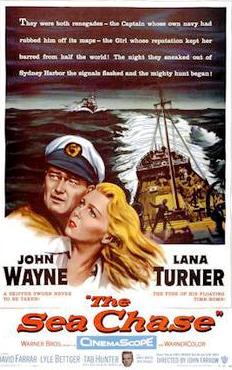
First and foremost, John Wayne was one of the screen's most iconic cowboys. Sure, he took some detours along the way as soldiers, cops and on occasion, as sailors and captains. It can be kinda odd seeing him at see instead of in the saddle, but some of the ventures are pretty good, especially 1955's The Sea Chase. And it's not just the Duke that's interesting, but some generally unique choices in storytelling and tone. And away we go on the high seas!
It's the late 1930's and the German steam freighter Ergenstrasse, commanded by German captain Karl Ehrlich (Wayne), is in port in Sydney, Australia. Ehrlich has fallen from some impressive heights in the German navy because he refuses to support the Nazi party, but he's a supremely capable officer with a solid reputation among fellow sailors. Then the whole world is turned upside down when World War II breaks out, leaving the Ergenstrasse far from home and badly under-supplied. Before they slip out from Sydney though, Ehrlich is visited by the German consul who thrusts a German spy on-board, Elsa Keller (Lana Turner), who has important information and needs to get back to German soil. The British Navy doesn't want to let Ehrlich's ship get through though, setting off a cat-and-mouse across the Pacific and Atlantic of who can out-maneuver the other.
This isn't a movie remembered as one of John Wayne's best, but from the star's weakest decade overall, it's a pretty good entry. It isn't a classic, but I found it damn entertaining, director John Farrow at the helm (shipping/sailing pun intended) of a war thriller that's been generally forgotten. John Wayne as a German captain during WWII? Even if he despises the Nazi party, that's a risky play for a star associated with America and patriotism. 'Chase' was filmed in Australia and Hawaii, its sun-drenched locations giving the thriller one purty look. It isn't flashy, but it certainly gets the job done.
So Wayne as a German captain works surprisingly well. He commits himself to the part in the same way he would a cowboy or a soldier. His Karl Ehrlich is a career man, someone who lives by his word and expects others around him to do the same. Nothing is aggressive or heavy-handed about the background, just that Wayne's Ehrlich has little use for Hitler and the Nazis and is paying for those feelings by being sent to captain the far-off German steamer with no value and no hope of promotion. He knows getting back to Germany will end in trouble for his own future, but it is his duty and he feels compelled to do it, troubling results be damned. He looks comfortable to in the role and compared to some of those 1950's duds -- like The Conqueror or Blood Alley -- it's a classic!
In a long, distinguished career, Wayne wasn't always given too many roles with love interests. Okay, that's not true. Love interests other than Maureen O'Hara. Some reviews seem to disagree with me, but I thought the Duke and the lovely Lana Turner were pretty good together. They've both got somewhat checkered pasts and neither has a future that seems too pleasant, but those two stubborn kids, wouldn't you know that they end up falling for each other a tiny bit? Oh, sorry, SPOILER. A good pairing, the only time these two Hollywood legends worked together. It's a very solid pairing.
If a John Wayne at sea love story isn't your thing, the supporting cast here should pull you in. They're not always given a lot to do in a 117-minute running time, but the character actor star power is ON-POINT here. It's cool just seeing all these fellas together, starting with David Farrar as Napier, Ehrlich's friend and a British officer leading the chase, and Lyle Bettger as Chief Officer Kirchner, a die-hard, loyal follower of the Nazi party who's gonna cause all sorts of problems. As for the Ergenstrasse crew -- and I take a deep breath -- look for Tab Hunter, James Arness, Richard Davalos, Luis Van Rooten, John Qualen, Paul Fix, Alan Hale Jr., Peter Whitney, Claude Akins, John Doucette, and Adam Williams. Not bad, huh? Movie nerds will definitely appreciate that character actor-studded cast.
There are some slower portions during the midsection as Ehrlich and the Ergenstrasse improvises and picks up some supplies at a remote Pacific island. It's necessary though as we get to know the persistently stubborn captain and his beautiful German spy on-board. The international intrigue though picks up, especially when Bettger's Kirchner goes on his own and makes a dangerous command decision that puts the whole crew at risk. There's nothing too flashy from beginning to end, but this is a pretty solid sea thriller, meant to be watched on a rainy Sunday afternoon or late at night with some popcorn. A cool change of pace for the Duke with the beautiful Lana Turner and a fun supporting cast. Definitely worth a watch.
The Sea Chase (1955): ***/****
The Sons of Katie Elder
"First, we reunite, then find Ma and Pa's killer...then read some reviews."
Showing posts with label Alan Hale Jr.. Show all posts
Saturday, January 9, 2016
Friday, June 14, 2013
Kill the Umpire
Across preferred sports, favorite teams and athletes, classic games and series, most sports fans can agree on one thing.....officials are brutal. Referees, umpires, call them whatever you want, but fans can always find solace that an official will mess up a call here and there. They're easy targets, aren't they? For the most part and on a percentage basis, they get it right. But what's the fun in that? There aren't many movies out there about umpires, but here we go with 1950's Kill the Umpire.
A former baseball player with a family, Bill Johnson (William Bendix) loves one thing above all else, and it keeps getting him into trouble. Bill loves baseball. He can't get enough of it to the point he keeps losing his job because he bails far too often to go to afternoon ballgames. His wife (Una Merkel) has finally had enough and threatens to leave him unless he really buckles down and commits to keeping a job. Bill's father-in-law, Jonah (Ray Collins), is a former baseball umpire and recommends Bill -- with all his fandom and knowledge of baseball -- trains to become an umpire himself. As a sports fan who hates each and every umpire, Bill bristles at the very thought, but in hopes of keeping his family together, a less than enthused Bill half-heartedly goes along with it.
That is one misleading plot synopsis if there ever was one. Brace yourself, but this 1951 movie from director Lloyd Bacon is a slapstick farce comedy. That in itself isn't a deal-breaker. I love The Three Stooges, Laurel and Hardy and all sorts of physical comedies from the 1930s through the 1950s. What is a deal-breaker is how over the top and ridiculous the slapstick is here. I figured a story titled 'Kill the Umpire' wasn't going to be heavy, dark drama, but the humor here was painful to watch. At one point, Bendix over-inflates his chest protector, gets his cleats stuck in the floor and bounces back and forth like a bouncy ball between the floor and the lockers. Everyone has a good guffaw at that craziness. The best physical humor is just funny, the actors/actresses don't have to try too hard.
Of course, that's not what's going on here. Late in the movie, Bendix's Bill falls out of an ambulance -- it's a long, meandering story -- but manages to catch on to part of a fence the ambulance crashed through and is now dragging behind it. He is able to stand up on the broken fence and basically surfs behind the fleeing ambulance. Seriously, there's no good, rational way to explain how he gets into that troublesome predicament. Just go with me, he's there. Funny is funny when it works, but the on-screen theatrics here were brutal to watch. Too bad because in the more subtle moments, Bendix shows off a low-key comedic timing that still shows how physical comedy can work. I like Bendix a lot, always have, and in small doses here, he's very good. The script is all over the place though, kneecapping him whenever he gets into a rhythm.
In the supporting cast, Collins is pretty good as a straight man to Bendix's Bill. His friendly father-in-law just wants to help out his son-in-law, even if it's something the guy hates to do. Merkel is pretty shrill -- understandably so to be fair -- as Mrs. Johnson with Gloria Henry and Connie Marshall playing the Johnson daughters. Better known as Fred Mertz in I Love Lucy, William Frawley is solid as Jimmy O'Brien, the owner of the umpire school, Tom D'Andrea is Roscoe Snooker, Bill's friend at school, and an uncredited Alan Hale Jr. as a baseball player who comes across Bill's wrath (sort of). Also uncredited are Jeff York and Robert J. Wilke as big-time gamblers trying to bribe Bill.
There are moments that do work here. Bill at Umpire school provides some really funny laughs, especially when he's trying to get kicked out of the school. His final test at graduation -- with an unfortunate mix-up with eye drops -- is the sort of physical humor that works so well, dubbing him a nickname Bill 'Two-Call' Johnson. Earlier ventures showing Bill absolutely losing his mind at umpires' calls is perfect, the fired-up fan even charging onto the field to argue. I did like it, but it's too goofy for its own good. A disappointing mild review.
Kill the Umpire (1951): **/****
A former baseball player with a family, Bill Johnson (William Bendix) loves one thing above all else, and it keeps getting him into trouble. Bill loves baseball. He can't get enough of it to the point he keeps losing his job because he bails far too often to go to afternoon ballgames. His wife (Una Merkel) has finally had enough and threatens to leave him unless he really buckles down and commits to keeping a job. Bill's father-in-law, Jonah (Ray Collins), is a former baseball umpire and recommends Bill -- with all his fandom and knowledge of baseball -- trains to become an umpire himself. As a sports fan who hates each and every umpire, Bill bristles at the very thought, but in hopes of keeping his family together, a less than enthused Bill half-heartedly goes along with it.
That is one misleading plot synopsis if there ever was one. Brace yourself, but this 1951 movie from director Lloyd Bacon is a slapstick farce comedy. That in itself isn't a deal-breaker. I love The Three Stooges, Laurel and Hardy and all sorts of physical comedies from the 1930s through the 1950s. What is a deal-breaker is how over the top and ridiculous the slapstick is here. I figured a story titled 'Kill the Umpire' wasn't going to be heavy, dark drama, but the humor here was painful to watch. At one point, Bendix over-inflates his chest protector, gets his cleats stuck in the floor and bounces back and forth like a bouncy ball between the floor and the lockers. Everyone has a good guffaw at that craziness. The best physical humor is just funny, the actors/actresses don't have to try too hard.
Of course, that's not what's going on here. Late in the movie, Bendix's Bill falls out of an ambulance -- it's a long, meandering story -- but manages to catch on to part of a fence the ambulance crashed through and is now dragging behind it. He is able to stand up on the broken fence and basically surfs behind the fleeing ambulance. Seriously, there's no good, rational way to explain how he gets into that troublesome predicament. Just go with me, he's there. Funny is funny when it works, but the on-screen theatrics here were brutal to watch. Too bad because in the more subtle moments, Bendix shows off a low-key comedic timing that still shows how physical comedy can work. I like Bendix a lot, always have, and in small doses here, he's very good. The script is all over the place though, kneecapping him whenever he gets into a rhythm.
In the supporting cast, Collins is pretty good as a straight man to Bendix's Bill. His friendly father-in-law just wants to help out his son-in-law, even if it's something the guy hates to do. Merkel is pretty shrill -- understandably so to be fair -- as Mrs. Johnson with Gloria Henry and Connie Marshall playing the Johnson daughters. Better known as Fred Mertz in I Love Lucy, William Frawley is solid as Jimmy O'Brien, the owner of the umpire school, Tom D'Andrea is Roscoe Snooker, Bill's friend at school, and an uncredited Alan Hale Jr. as a baseball player who comes across Bill's wrath (sort of). Also uncredited are Jeff York and Robert J. Wilke as big-time gamblers trying to bribe Bill.
There are moments that do work here. Bill at Umpire school provides some really funny laughs, especially when he's trying to get kicked out of the school. His final test at graduation -- with an unfortunate mix-up with eye drops -- is the sort of physical humor that works so well, dubbing him a nickname Bill 'Two-Call' Johnson. Earlier ventures showing Bill absolutely losing his mind at umpires' calls is perfect, the fired-up fan even charging onto the field to argue. I did like it, but it's too goofy for its own good. A disappointing mild review.
Kill the Umpire (1951): **/****
Labels:
1950s,
Alan Hale Jr.,
Robert J. Wilke,
Sports,
William Bendix
Thursday, June 6, 2013
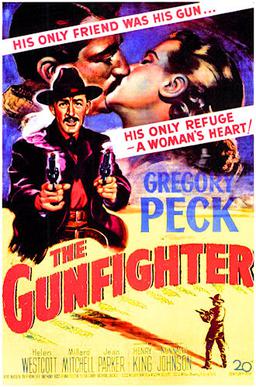
The Gunfighter
One of the enduring myths of the wild west was the idea of the fast draw gunslinger. The story as legend would have it was two men standing on a windy, empty street about 20 feet from each other, the duo finally squaring off to see who was quicker with the gun and ultimately, who would survive. Who was the fastest gun? Who was the best? It's a concept that has become a myth thanks to movie westerns, including one of the most under-appreciated westerns around, 1950's The Gunfighter.
A long, lean Texan, Jimmy Ringo (Gregory Peck) has created quite a name for himself over the last few years. Throughout Texas and the southwest, he's known as the quickest, deadliest gunfighter around with anywhere from 10 to 15 men killed under his gun. Now with his infamous reputation established, Ringo rides from town to town dealing with young guns and eager rivals who want to be the one who killed the famous Jimmy Ringo. Having killed one trigger happy gunslinger (Richard Jaeckel), Ringo finds himself again on the run with some pursuers, the gunslinger's three brothers. He heads for the town of Cayenne with a purpose; he wants to see a woman, Peggy (Helen Wescott), from his past, but it may take some convincing. Ringo is looking for a change in his life, but he may be running out of time.
I have long sought this western from director Henry King out with no luck. I could never find a VHS tape, never find a DVD, never find it airing in the dead of night on a movie channel. Until now that is. I found a video store (GASP!) that actually has old VHS tapes (double GASP!) and wouldn't you know it, this was available. It is a western that is ahead of its time. It takes the concept of the romantic western and twists it around to a more realistic, darker world. The west wasn't white hats vs. black hats. It was a truly nasty, brutal place. So a western that portrays a trail-weary gunslinger who's sick of what he's become....and in 1950?!? We're talking about a movie released two years before the overrated High Noon and with a vastly different, significantly darker message. Moral of the story; I loved this western for a lot of reasons.
More than the story or the characters, 'Gunfighter' has a lot going for it. Filmed in black and white, it has an almost stage-based film noir feel to it. With a few, quick detours, the entire 85-minute running time is spent in the Cayenne saloon as Ringo waits to meet Peggy. We see the story from inside the saloon, from the street in through the windows, and the most bizarre thing...it works ridiculously well. If you've got two working brain cells, you know where the story is heading with King doing an incredible job building up the tension. We know the three revenge-seeking brothers (including Alan Hale Jr., David Clarke and John Pickard) are close behind, some quick cutaways showing them riding with a purpose across the desert. As Ringo waits in the saloon, we see quick shots of a clock on the wall. It's an underplayed, low key tension, but it works in a big way in building up that sense of doom right up until the finale.
Gregory Peck continues to impress me. As far as acting goes, he hit the ground running and never really looked back. Already with a handful of gems to his name, he follows his Best Actor nomination from Twelve O'Clock High with a role that should have at least earned him a nomination. With a few quick scenes, a few dialogue exchanges, we learn a ton about him. Years ago, he wanted to be the fastest gun in the west, and he earned the tag but now he has to deal with it and all it ensues. We learn some tidbits from his past, including his past with Wescott's Peggy and also with Cayenne's sheriff, Mark Strett (Millard Mitchell). A great scene with a youngster in town gives Ringo an added layer of depth that makes him more than just an infamous gunhand. King's film does a wise thing; Ringo is neither a prototypical good guy or bad guy. He's one of the first sympathetic anti-heroes I can think of. Another big winner for Peck.
In the supporting cast, Wescott and Mitchell are gems as Peggy and Mark, maybe the only two people in Cayenne on Ringo's side. The history among the three is a worthy, necessary addition to the story. Also look for Karl Malden as Mac, the saloon owner/bartender who buddies up to Ringo, Jean Parker as Molly, a saloon girl who knows Ringo well, Skip Homeier as Hunt Bromly, a young, inexperienced gunfighter who wants his chance at Ringo, and Anthony Ross as Charlie, Mark's capable if cautious deputy.
Some critical reviews point to the ending being a little heavy-handed in its execution. It's a fair criticism I suppose, but I think it's necessary to consider something. In 1950, a story shooting holes in the myth of the gunfighter is unique. It's new. It hasn't been seen. Yes, it spells everything out a little too much, but it was a necessary ending for a 1950 audience. What isn't in question is that the build-up and a surprising ending are pretty perfect. This is a western that deserves more notoriety (in a good way). It's a gem of the genre.
The Gunfighter (1950): ****/****
A long, lean Texan, Jimmy Ringo (Gregory Peck) has created quite a name for himself over the last few years. Throughout Texas and the southwest, he's known as the quickest, deadliest gunfighter around with anywhere from 10 to 15 men killed under his gun. Now with his infamous reputation established, Ringo rides from town to town dealing with young guns and eager rivals who want to be the one who killed the famous Jimmy Ringo. Having killed one trigger happy gunslinger (Richard Jaeckel), Ringo finds himself again on the run with some pursuers, the gunslinger's three brothers. He heads for the town of Cayenne with a purpose; he wants to see a woman, Peggy (Helen Wescott), from his past, but it may take some convincing. Ringo is looking for a change in his life, but he may be running out of time.
I have long sought this western from director Henry King out with no luck. I could never find a VHS tape, never find a DVD, never find it airing in the dead of night on a movie channel. Until now that is. I found a video store (GASP!) that actually has old VHS tapes (double GASP!) and wouldn't you know it, this was available. It is a western that is ahead of its time. It takes the concept of the romantic western and twists it around to a more realistic, darker world. The west wasn't white hats vs. black hats. It was a truly nasty, brutal place. So a western that portrays a trail-weary gunslinger who's sick of what he's become....and in 1950?!? We're talking about a movie released two years before the overrated High Noon and with a vastly different, significantly darker message. Moral of the story; I loved this western for a lot of reasons.
More than the story or the characters, 'Gunfighter' has a lot going for it. Filmed in black and white, it has an almost stage-based film noir feel to it. With a few, quick detours, the entire 85-minute running time is spent in the Cayenne saloon as Ringo waits to meet Peggy. We see the story from inside the saloon, from the street in through the windows, and the most bizarre thing...it works ridiculously well. If you've got two working brain cells, you know where the story is heading with King doing an incredible job building up the tension. We know the three revenge-seeking brothers (including Alan Hale Jr., David Clarke and John Pickard) are close behind, some quick cutaways showing them riding with a purpose across the desert. As Ringo waits in the saloon, we see quick shots of a clock on the wall. It's an underplayed, low key tension, but it works in a big way in building up that sense of doom right up until the finale.
Gregory Peck continues to impress me. As far as acting goes, he hit the ground running and never really looked back. Already with a handful of gems to his name, he follows his Best Actor nomination from Twelve O'Clock High with a role that should have at least earned him a nomination. With a few quick scenes, a few dialogue exchanges, we learn a ton about him. Years ago, he wanted to be the fastest gun in the west, and he earned the tag but now he has to deal with it and all it ensues. We learn some tidbits from his past, including his past with Wescott's Peggy and also with Cayenne's sheriff, Mark Strett (Millard Mitchell). A great scene with a youngster in town gives Ringo an added layer of depth that makes him more than just an infamous gunhand. King's film does a wise thing; Ringo is neither a prototypical good guy or bad guy. He's one of the first sympathetic anti-heroes I can think of. Another big winner for Peck.
In the supporting cast, Wescott and Mitchell are gems as Peggy and Mark, maybe the only two people in Cayenne on Ringo's side. The history among the three is a worthy, necessary addition to the story. Also look for Karl Malden as Mac, the saloon owner/bartender who buddies up to Ringo, Jean Parker as Molly, a saloon girl who knows Ringo well, Skip Homeier as Hunt Bromly, a young, inexperienced gunfighter who wants his chance at Ringo, and Anthony Ross as Charlie, Mark's capable if cautious deputy.
Some critical reviews point to the ending being a little heavy-handed in its execution. It's a fair criticism I suppose, but I think it's necessary to consider something. In 1950, a story shooting holes in the myth of the gunfighter is unique. It's new. It hasn't been seen. Yes, it spells everything out a little too much, but it was a necessary ending for a 1950 audience. What isn't in question is that the build-up and a surprising ending are pretty perfect. This is a western that deserves more notoriety (in a good way). It's a gem of the genre.
The Gunfighter (1950): ****/****
Labels:
1950s,
Alan Hale Jr.,
Gregory Peck,
Henry King,
Karl Malden,
Richard Jaeckel,
westerns
Wednesday, January 28, 2009
Netflix Review 2: Hang 'Em High

After the huge success of Sergio Leone's Dollars trilogy, Clint Eastwood returned to the US and quickly made an American western, Hang 'Em High, that bears quite a resemblance to the basic style of the spaghetti westerns. I've avoided watching Hang 'Em High for years for a couple reasons, I always figured it could never live up to the Dollars movies, and reviews were always mixed. While I enjoyed the movie, my worries were pretty dead on. It was an average western that would not be remembered if Eastwood wasn't starring.
Eastwood is Jed Cooper, a small rancher who has recently bought 100 head of cattle. As he's driving the herd home, Cooper is stopped by a nine-man posse who say he stole the cattle and murdered the rancher even though he's got a bill of sale. They string Cooper up and leave without making sure he's dead. A marshal happens to be riding by and cuts the man down before he dies. After his innocence is proved, Cooper takes a job as a marshal in the Oklahoma territory and starts to hunt the men down one-by-one.
Very much influenced by spaghetti westerns, this movie just doesn't live up to what it could have been. Looking at the cast, I was blown away by all the names, but I guess I should have learned by now. Big cast full of big names: characters aren't developed much at all. Ed Begley plays Capt. Wilson, the leader of the posse who is terrified of Cooper's revenge, but he basically disappears for huge chunks of the movie. Inger Stevens is the obligatory love interest, a woman with a past who's also looking for revenge. Stevens is gorgeous, but her part is as bland as they come.
The rest of the posse is similarly underwhelming despite some big names including L.Q. Jones, Bruce Dern, Alan Hale JR, and Bob Steele. These parts could have been great, add Strother Martin, Dub Taylor, and Warren Oates and you've got a perfect posse.

Three parts, along with Eastwood, stand out. Pat Hingle, always a good slimy villain, is an ideal counterpart to Cooper as Judge Fenton, a power-hungry official who wants statehood for the territory no matter what he has to do. He becomes so obsessed with justice you're not sure if his mind is all there. Ben Johnson, a real-life cowboy, makes a brief appearace as Dave Bliss, the marshal that rescues Cooper. Just by being in the movie, Johnson gives it credibility. Gravelly-voiced Charles McGraw plays Sheriff Ray Calhoun, a peace officer who may be working both sides.
But that's just three supporting roles, Dennis Hopper makes a bizarre one-scene cameo as the Prophet, a crazed, bearded prisoner, and James MacArthur shows up to lead a crowd in prayer at a hanging as the Preacher. It's just all too weird. The movie tries too hard to be a great western. The music is overdone and loud, although some good parts sound like Morricone's soundtracks, but it takes away from the movie overall.
The DVD is cheap with a somewhat grainy widescreen presentation and a trailer I've included the link for that's pretty revealing. Don't watch it if you haven't seen the movie. Overall, I was disappointed with this 1968 western, but there's enough to recommend, especially Eastwood, Hingle, and Ben Johnson.
Hang 'Em High (1968): **/****
Subscribe to:
Posts (Atom)