The Sons of Katie Elder

The Sons of Katie Elder
"First, we reunite, then find Ma and Pa's killer...then read some reviews."
Showing posts with label Carroll O'Connor. Show all posts

Friday, August 15, 2014

Marlowe

One of the most underrated actors from both film and television going back to the late 1950s, James Garner passed away in mid-July at the age of 86. The star of TV's Maverick and The Rockford Files, he's also a scene-stealing member of a great ensemble in one of my two favorite movies, The Great Escape. In a tribute to Garner's impressive career, Turner Classic Movies aired a 24-hour marathon of some of Garner's best -- but NOT The Great Escape -- allowing me to catch up with 1969's Marlowe, a flick I'd never even heard of.

A private detective working in Los Angeles, Phillip Marlowe (Garner) will take just about any case that presents itself in his office. His most recent case though is providing some problems, but not the one he would think. A small-town Oklahoma girl, Orfamay Quest (Sharon Farrell), is worried that something happened to her brother who's gone missing for first a few days and then more than a week. Marlowe looks into the case but doesn't think there's too much to look into, telling Orfamay to go back to Oklahoma and things will figure themselves out. They don't though. Looking into one last lead, Marlowe finds a man he interviewed with an ice pick buried deep in his neck. The next day, another source turns up dead via the exact same fashion. What exactly has Marlowe gotten himself into? Has he gone too far?

From famed noir author Raymond Chandler, the character Phillip Marlowe is synonymous with tough, hard-edged film noirs, both written and on the big screen. The name became even more recognizable when Humphrey Bogart played Marlowe in 1946's The Big Sleep. It is a great, lasting character that's been played by several famous actors. Made 15 years after the heyday of the film noir genre, 'Marlowe' then is an interesting development for the character. Movies by the late 1960s could get away with more and in far more aggressive fashion. But all that said, is this 1969 neo-noir from director Paul Bogart and based off a Chandler novel any good? Well, I'm not a huge fan.

When you look at James Garner's career filmography, I can't really identify one singular role. Yes, he's excellent in The Great Escape. He was good to very good to great in more than a few movies, but he didn't have that one AMAZING performance in a classic film. None of that is a negative. This was a reliable, steady actor who was almost always incredibly likable on screen, and I'm always glad to see him pop up in credits. That's what type of performance this is. His Marlowe is a little worn-out, but still stubborn to a fault and always looking for answers. He's not below some under-handed shenanigans to get the job done and let it be known, he's very good at being a private detective. As the story develops, Garner's Marlowe becomes almost the straight man to all the craziness that he discovers. It's a part that sure seems like a big influence on The Rockford Files, Garner always ready with a quick, disarming and charming smile that can quickly turn into a disgusted shrug.

Beyond Garner though, the movie is a bit of a mess. The supporting players are recognizable but not necessarily interesting unfortunately. One of the first suspects Marlowe starts to look into is a rising TV sitcom star and all-around sex symbol Gayle Hunnicutt who looks worried all the time and refuses to cooperate. There's also Farrell as the shrill, whiny country girl who keeps after Marlowe. In the more interesting department, Rita Moreno plays Dolores, a high-class dancer/stripper, friend of Hunnicutt's and possibly interested in Marlowe. Her striptease at the end is pretty scandalous for the times and ends up being a somewhat reasonable reason to stick with this one.  Because we need someone stupid to make Marlowe look good, Carroll O'Connor and Kenneth Tobey play detectives always one step behind the case. Also look for future Mr. Feeney, William Daniels, in a small part and Bruce Lee even gets a chance to show off his athleticism and karate ability as a henchman sent to intimidate Marlowe.

For all the good things that could have been though, they just don't add up. I liked the locations, but there wasn't enough of them. The tone of the story is all over the place from a phone routine that seems more appropriate for a James Garner/Doris Day flick than a hard-boiled 1969 film noir. The same for a fight scene when Marlowe dispatches a villainous killer after him. The payoff is almost laughable, playing like a comedy spoof as opposed to what it is. As the story develops, one layer of the onion is revealed one after another to the point I wasn't sure who did what and to whom by the end of the movie. There's a twist, a reveal, a payoff, and I felt like I missed it entirely. Who killed who for goodness sake?!?

So, Mr. Garner, I'm sorry to see you go. You were one of my favorites. Onto The Great Escape!

Marlowe (1969): **/****

Thursday, June 12, 2014

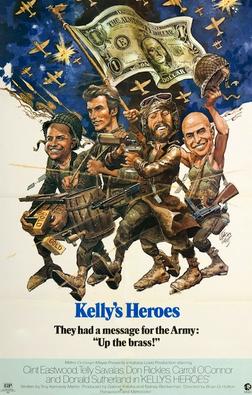
Kelly's Heroes

Growing up, I always associated Memorial Day Weekend with the war movie marathons on TV that dotted TNT, AMC and Turner Classic Movies. I ate them up -- still do -- as I watched as many as I could. They're still some of my favorite movies, everything from The Dirty Dozen to The Devil's Brigade and one of my favorites, 1970's Kelly's Heroes.

It's fall 1944 and Allied forces are fighting their way across France, the German army slowly being beaten back. At the forefront of the Allied advance, a recon platoon, including Sgt. Big Joe (Telly Savalas), are worn down after months of fighting. One member of the platoon, Pvt. Kelly (Clint Eastwood), stumbles across an interesting tidbit of information while interrogating a German colonel. There is 14,000 bars of gold -- worth $16 million -- in a bank just waiting to be plucked. The catch? The bank is 30 miles behind German lines. Joe manages to convince both Big Joe and the platoon to navigate through the lines and get their hands on the gold. With a scrounger/supply sergeant, Crapgame (Don Rickles) and three Sherman tanks commanded by a hippie, Oddball (Donald Sutherland), along for the ride, Kelly and his motley crew of soldiers head out with a chance to net quite the payday.

What an appropriately timed World War II movie. By the late 1960s, the tone of war movies had changed from the big epics to the more cynical/comedic variety, movies like MASH and Catch 22 among others. Enter Kelly's Heroes, directed by Brian G. Hutton (who also directed Where Eagles Dare), one of the most entertaining war movies I've ever seen. Cynical with a dark sense of humor but also some lighter moments -- courtesy of Sutherland's hippie tank commander -- with some great action, memorable score, and one of those perfect tough guy casts. There's a reason it remains a fan favorite 40-plus years later, and much of it because it blends all those things together so effortlessly. Even an odd-sounding theme, Burning Bridges, fits perfectly in an odd way. It is one of my favorite movies and always will be, a classic war flick that I can sit down and watch whenever it pops up on TV.

Can you ask for a better lead quartet than Clint Eastwood, Telly Savalas, Don Rickles and Donald Sutherland? Yeah, there has been casts with bigger star power, bigger name recognition, but it's more than that here. This is four tough guys having fun, on-screen chemistry that's just hard to describe. They all get their chance in the spotlight. Eastwood is Eastwood, the impeccably cool and man of few words hero. Savalas is a subtle scene-stealer as Big Joe, the unofficial commander of the recon platoon (Hal Buckley playing the clueless real commander Capt. Maitland), just trying to get his men through the fighting unscathed and a somewhat unwilling participant in the gold heist. Rickles is an out of left field choice to join the cast, but it works, his Crapgame a smart-ass New Yorker always with an eye for a profit. And then there's Sutherland as Oddball, the tank commander always talking about positive waves (No Negative Waves, man!), his Zen-like qualities, heading into battle with music blaring and shells filled with paint waiting to be unleashed on the Germans.

As a fan of guy's guys movies, it's simply hard to beat those four stars. They make it look downright easy. Much of that chemistry and success comes from the script written by Troy Kennedy-Martin, a script with too many great one-liners to even mention. We see familiar character archetypes, familiar war movie situations -- stumbling into a minefield, prepping for battle -- but there's a different energy to the whole thing. It's that tone that blends the drama, comedy and action so easily that makes it work. Carroll O'Connor too is excellent in a part that lets him ham it up as General Colt, the fiery division commander who's frustrated with the stagnant front lines, getting a jolt of energy when Kelly's screwball force unintentionally opens things up all along the front. There's something to be said for a movie that is non-stop fun. It never gets heavy-handed or obvious like some more message-oriented war movies.

When the platoon looks back on a field where some of their fallen comrades lay dead in the dirt, there's no words that need to be said. The looks on the surviving men's faces says it all. Showing he's putting on appearances for his men, Big Joe turns and raises his binoculars to check one last time. The dynamic is there from the lead quartet right down to the platoon, a group of recognizable character actors clearly having some fun. The platoon includes Little Joe (Stuart Margolin), Big Joe's radioman, Cowboy (Jeff Morris) and Willard (Harry Dean Stanton), two drawling best buds, Gutowski (Dick Davalos), the sniper, Petuko (Perry Lopez), the smooth, goofy ladies man, Cpl. Job (Tom Troupe), Joe's second-in-command close friend, Fisher (Dick Balduzzi), the platoon genius, and Babra not Barbara (Gene Collins). Also, you can't forget Gavin MacLeod as Moriarty, Oddball's mechanical genius and constant provide of negative waves.

Also look for Seinfeld's Uncle Leo, Len Lesser, as Bellamy, an engineer Oddball ropes into helping the cause and Karl-Otto Alberty as a German tank commander who goes up against Kelly's forces and Oddball's tank trio.

With a 146-minute running time, we've got plenty of chances for guys being guys and plenty of action scenes. We get lots of action -- escaping a minefield, a tank attack on a railway station, the platoon racing through a German crossroad under mortar attack -- but the best is saved for last as the platoon descends on Clermont, the town where the bank and the gold are waiting. It's an extended sequence that runs about 35 minutes that doesn't rush into it. We get almost 10 minutes of the men and the tanks sneaking into town while the German garrison slowly wakes up, composer Lalo Schifrin's score driving the action. The entire movie was filmed in Czechoslovakia, the action finale filmed in the village of Vizinada. It's an extended sequence that is hard to beat.

Just a great movie overall. Great cast, incredibly quotable, lots of action, memorable soundtrack (Quentin Tarantino is a big fan of the score, especially Tiger Tank), and even a nod to Eastwood's spaghetti western background with a three-way showdown with said tank. One of my all-time favorites and hopefully you'll enjoy it just as much as I do.

Kelly's Heroes (1970): ****/****
Rewrite of August 2009 review

Monday, May 27, 2013

The Devil's Brigade

In tribute to all our veterans, here's a Memorial Day review. As a movie fan, Memorial Day was a huge weekend for me growing up. I looked forward to watching old war movies on TNT in round-the-clock marathons, WWII flicks that are some of my favorites like The Dirty Dozen, Kelly's Heroes and an underrated classic and one of my all-time favorites, 1968's The Devil's Brigade.

It's 1942 and with World War II very much yet to be decided, Lt. Colonel Robert Frederick (William Holden) has been summoned to a staff meeting in England. Even though he has no combat experience, Frederick is being given command of a new unit, the First Special Service Force. Their ultimate mission is still to be decided but the Colonel prepares for the training that awaits his brigade that consists of a crack unit of well-trained Canadian troops commanded by Dunkirk veteran Maj. Alan Crown (Cliff Robertson) and an unruly, misfit group of American troops headed by the similarly unruly Maj. Cliff Bricker (Vince Edwards). The two sides bristle immediately, but training continues. If Frederick can manage to keep his men together, their services are very much needed, including a dangerous mission on the Italian front.

From veteran director Andrew McLaglen, 'Brigade' is based on a real-life military unit, the First Special Service Force. Released just a year after The Dirty Dozen, it bears some striking similarities, but it more than capably carves out its own niche in war movie department. It is one of the great men-on-a-mission movies, and that's saying something considering the late 1960s were rampant with them. McLaglen filmed on location in Italy for much of the second half of the movie, giving an authentic look and feel to the proceedings as the Brigade goes into battle. Composer Alex North turns in a gem of a soundtrack, his theme for the Brigade (listen HERE) one that you'll be whistling for days. The main theme is a highlight, but North specializes in the quieter, darker and more sinister moments leading up to the battle in the finale.

More of a workmanlike director than an auteur, McLaglen specialized in movies like this with impressive casts of male stars. This 1968 WWII flick is loaded with star power. As Colonel Frederick, Holden doesn't get a flashy part, but he leads the way just the same. His officer wants to prove himself while also proving how capable his men are too. The best part in the film goes to Robertson as Maj. Crown, an intelligent, well-spoken and brutally capable officer who survived the Dunkirk disaster. It is a smart, underplayed role, and he steals every scene he's in. As his American counterpart, Edwards too is very solid. His Maj. Bricker is blunt and without a filter, a scrounger and hustler with the best of them. Also look for Dana Andrews, Michael Rennie and Carroll O'Connor as American generals, all making cameo appearances.

Ah, yes, and then there's the rest of the cast. If the star power above wasn't enough, McLaglen assembles a deep, talented cast of tough guys to fill out the ranks of the brigade. Leading the American contingent, look for Claude Akins, Andrew Prine, Richard Jaeckel, Luke Askew, Tom Troupe, Bill Fletcher and Tom Stern. For the Canadian half of the Brigade, watch out for Jack Watson, Harry Carey Jr., Jeremy Slate, Richard Dawson and Jean-Paul Vignon. It's cool just seeing all these recognizable faces here together, some leaving more of an impression than others. Jaeckel as Omar Greco, an acrobat trying to escape but finding a home instead, especially stands out as does Akins as Rocky, the American bully, Prine as Ransom, a smart misfit, Watson as Peacock, the tough but gentlemanly Canadian and Slate as O'Neill, the hand-to-hand combat instructor.

I think it's the cast that separates the movie from so many other solid WWII movies. It's a familiar formula here; introduce everyone, train them, have them put their differences aside following some male bonding and then unleash them on the enemy. The male bonding comes courtesy of a barroom brawl (watch HERE) with some rowdy lumberjacks, a great scene. The script is ideal in its ability to let these tough guys be tough guys. It's fun, natural with chemistry and features some great one-liners. Other highlights include Slate's introduction in a showdown with Akins (watch HERE), a 30-mile hike where the rivalry develops further, and many others. Moral of the story is this, we need these parts to be effective for the second half of the movie to truly work. And you bet it does.

The last hour follows the Brigade as it enters combat. Required to prove themselves and their ability, Frederick leads a patrol behind the lines to a heavily guarded Italian town crawling with Germans. It's a lighter action scene, but memorable just the same. The best part though is in the finale, the Brigade ordered to attack the apparently impenetrable Mount la Difensa (where the Service Force really made a name for themselves), a mountain garrisoned by German infantry and heavy armor. First, they must scale a sheer cliff-face to mount a surprise attack on the garrison. It is a great action sequence, McLaglen filming in the trenches and dugouts as the Brigade begins their assault. We always know where the battle is, where it's going, and the sheer scale of it. When the casualties do come (and they do, quickly and with some surprises), it makes this extended battle sequence that much more effective emotionally.

This has always been one of my favorites, and I seem to pick something new up with each passing viewing (I'm guessing I'm somewhere between 20 and 30). This time? The darkness late, Frederick greeting his men as they prepare for battle. North's score goes dark, Dawson explaining "Haven't you ever heard a man say goodbye?" It's an eerie, uncomfortable moment. Spot-on too, considering the Brigade sustained 77% casualties in the coming battle. 'Brigade' doesn't have the reputation of so many other WWII movies of the time, but it deserves some attention. A hidden gem.

The Devil's Brigade (1968): ****/****
* Rewrite of June 2010 review

Wednesday, April 25, 2012

Waterhole #3

Throw together elements of It's a Mad, Mad World, Mackenna's Gold, and The Great Race and more or less you get 1967's Waterhole # 3. It comes from my not so favorite sub-genre, the comedic western, but that isn't what bothered me the most. Two major flaws trip up this otherwise pretty decent western.

A U.S. Army gold shipment of four gold bars valued at $100,000 is stolen by a gang and buried near a waterhole by their leader, Doc Quinlen (Roy Jenson). Through a run-in that gets violent quickly, gambler Lewton Cole (James Coburn) discovers a map that will lead him to the buried gold, but he's obviously not the only one looking for it. He steals a horse from Sheriff John Copperud (Carroll O'Connor) and heads off into the desert for the gold. Copperud and his daughter, Billee (Margaret Blye), are not far behind, both with their own motivations. Not far behind them? The double-crossed members of the gang and a cavalry troop looking to get its gold shipment back.

As a fan of westerns, I'll give them all a try; epic or small scale, heavy on action or more artsy, deathly serious or straight comedy. Mostly I was intrigued by this one because of the cast despite all the mixed to negative reviews I was reading. Even Netflix didn't think I'd love it, much less like it too much. For a comedic western, it isn't grating like so many other efforts. It is genuinely funny at times. The cast is too talented for it not to be at least funny by accident, even unintentionally. So where does it go wrong? Pick your poison. There's two guesses, one annoying and one somewhat ethically questionable.

Using the term 'ethically questionable' in any review sounds a little off to me, but it's all I can come up. As Coburn's Lewton heads for the gold in the desert, he's caught in the process of stealing O'Connor's horse, meeting Blye's Billee in the process. He forces himself on her, and even though she kisses back because his kiss must be just so magical....it's a rape scene. Lewton rapes Billee. So how to follow it up? Make it a funny rape scene. In a comedic western, I object to a main character raping a woman. Check that, I object to any character doing that, but you get my point. Is that worth being funny over? I don't care if it's a goofy, stupid movie. I felt funny rooting for Coburn's character after that scene. Oh, and he basically does the same thing toward the end of the movie. It hit a sour note with me, her father more interested in the gold, Billee discovering she loves him after being raped, Lewton playing it off like it was nothing. Ah, rape, one of the lighter topics to deal with.

Now in comparison to a comedic rape, my next objection is going to sound stupid and particularly tame. Making this comedic western more folksy and goofy is country singer Roger Miller's song Waterhole #3 (Code of the West) that basically plays over all the action in the 96-minute movie. Nothing like a folk country western song to rev things up! It talks about killing and raping not being so bad, and does a fantastic job of describing everything going on on-screen, what we've seen and what we're about to see. It's like closed captioning on steroids and set to a tune. Trying to show everyone how awful the song is, I of course cannot find a link to it anywhere on the plains of the Internet. Maybe that's a good thing.

The thing preventing me from completely trashing this movie was the cast. That whole rape thing aside, Coburn brings a certain charm to Lewton, a no-account gambler who's able to manipulate and twist anyone around him. O'Connor too gets to ham it up as the not-so-honest Honest John, Sheriff of Integrity, Arizona. The more obvious physical humor aside, I enjoyed Coburn and O'Connor's back and forth more than anything. In a horrifically written character, Blye is nice eye candy as Billee. Claude Akins plays Sgt. Fugger, the inside man on the robbery, with Jenson and Timothy Carey as the imposing but slow Hilb rounding out the gang. Bruce Dern is funny in his one scene as Tippen, the deputy who disappears on a never-seen posse. James Whitmore appears for two scenes as cavalry captain Shipley, while Joan Blondell is funny as Lavinia, the owner of a whorehouse where everything comes crashing down.

Too bad overall, two bad choices crippling this movie's chances. Take the incredibly unfunny rape/revenge storyline out, replace Miller's mind-numbing score, and you've got a pretty decent comedic western. That pains me a little to say. I'm not typically a fan of comedy being thrown in with a western, but Coburn and O'Connor make this at least partially worth watching. They're very good together, very funny, but it's still a mess of a movie.

Waterhole #3 <---Youtube clip (1967): **/****