The Sons of Katie Elder

The Sons of Katie Elder
"First, we reunite, then find Ma and Pa's killer...then read some reviews."
Showing posts with label William Berger. Show all posts

Monday, August 11, 2014

Von Ryan's Express

Introduced as a kid to 1963's The Great Escape, I fell hook, line and sinker for the entire prisoner of war genre. Some like 'Escape' and Bridge on the River Kwai are instantly recognizable among movie fans while many others have taken some digging on my part to track them down. How about one of the best? One of my all-time favorites? Oh, yes, one I always enjoy revisiting, 1965's Von Ryan's Express.

As the Germans try to hold off advancing Allied forces in Italy in August 1943, an American Army Air Corp pilot, Colonel Joseph Ryan (Frank Sinatra) is shot down and sent to a prisoner of war camp where he becomes the ranking officer. There he clashes quickly with his second-in-command, a fiery, stubborn British officer, Major Eric Fincham (Trevor Howard). When the camp's Italian guards abandon the camp, Ryan makes a difficult decision, one that ends up backfiring as almost 400 prisoners are rounded up and boarded on a German train heading north. Heading the wrong way away from the advancing Allied forces, it seems hope has run out for Ryan, Fincham and their fellow prisoners. When all seems lost though, Colonel Ryan has one more trick up his sleeve, a daring plan that has the prisoners attempting to take over the train. The closely packed train is headed to Germany, but not if Ryan has his say. Instead? They look to Switzerland, but can their plan hold together?

If there is one major difference between 'Von Ryan's' and other prisoner of war movies, it is this. While all entertaining, movies like The Great Escape, River Kwai, Stalag 17 and others are high drama, often delivering a message. That's not to say Von Ryan's Express isn't high drama, director Mark Robson doing a fine job in this WWII actioner. It's more than that. It's more than just describing it as a prisoner of war movie. I've long thought this is one of the most perfect popcorn flicks ever made, the most entertaining, the most adrenaline-pumping action/dramas I can think of. It clocks in at 116 minutes but with each viewing, it goes by quicker and quicker. There isn't a weak moment. There are no slow portions, no parts where the momentum lets up. It's the rare movie that can accomplish that. From beginning to surprising finale, I love it all, one of my all-time favorites, one film I can watch over and over again.

What's the best thing going here for this 1965 war movie? There's a ton to mention! Just a few weeks ago in my review for 100 Rifles I mentioned how much I loved composer Jerry Goldsmith's score. Well, as good as that score was, I think his score here is one of his bests (and that's saying something considering the breadth of his career). Listen to the main theme HERE. This is the perfect score to back up the action, the heart-pumping moments, the quieter, more inward scenes and everything in between. An underrated score that deserves more of a reputation. Right up there with the musical score as an additional character is the choice to film on location in Italy. The filming locations give an air of authenticity that Hollywood backlots just wouldn't have accomplished. From the hills and streams to the ancient ruins to the weathered towns and train stations, wouldn't you know it? The film actually looks like it takes place in Italy. Go figure, right?!?  These are things that if mishandled wouldn't be a deal-breaker, but when handled correctly.....well, they can lift the movie up a notch or two or 10.     

You know who's cool? Totally caught me off guard, but it's that guy -- maybe you've heard of him -- named Frank Sinatra. By the mid 1960s, Sinatra played variations on tough guy parts that allowed him to more or less, be himself. In other movies, it might seem too familiar, but there's an energy here as Sinatra brings this intriguing character to life. Dubbed 'Von Ryan' by his fellow prisoners for helping the Germans, he's forced to make difficult decisions left and right, often putting lives at risk with each passing decision. There's an easy-going confidence to Sinatra's Ryan, a 90-day wonder as he calls it, a capable leader making some impossible decisions. The best supporting part not surprisingly comes from Trevor Howard as the stubborn, action-driven Fincham. Their Odd Couple-like relationship works, the quiet, cool American and the fiery Brit officer providing some good energy, some good sparks throughout. Their chemistry is evident any time and every time they're on screen together. Two excellent leads.

Lost in the shuffle can be a damn good supporting cast beyond Sinatra and Howard. In the eye candy department, Raffaella Carra plays Gabriella, a beautiful Italian girl who becomes a part of the escape. As for the villains, there's Adolfo Celi as a Fascist Italian officer and commandant of the camp and the very German Wolfgang Preiss as a very German officer in command of the prison train. My favorite supporting parts are Ryan's fellow prisoners, a cool group, an almost oddball crew that includes Bostick (Brad Dexter), one of the few American prisoners, Capt. Oriana (Sergio Fantoni), a well-meaning Italian officer thrust in with the P.O.W.s, Orde (John Leyton, also in Great Escape), Fincham's right-hand man, Father Costanzo (Edward Mulhare), the naive at times but very brave priest, and Stein (Michael Goodliffe), the camp medic. Also look for James Brolin, Michael St. Clair, Richard Bakalyan and James Sikking as other prisoners with smaller parts.  

Based off a novel by David Westheimer, 'Von Ryan' certainly has plenty to offer, including a handful of memorable set pieces. The opening 40 minutes are spent in the camp, the next 15 or so on the road and the last hour is when the prisoners are boarded on the prison train. I loved Ryan's scene with an inquisitive Gestapo agent (supposedly William Berger, I'm not positive) asking about Ryan's American watch. I loved Mulhare's masquerade as a German officer hoping to dupe an inspection. There are all these great moments that embrace this ludicrous possibility of this happening and run with it. We go along because it's so damn fun. This is a thrill a minute flick that's meant to entertain scene in and scene out. Nowhere is that more evident than....

The finale. As strong as the movie is, 'Von Ryan' is at its absolute best over the last 25 minutes, the prison train making a desperate run to the Alps and Switzerland, a German troop train (commanded by John Van Dreelen) hot on their trail. Throw in a trio of Messerschmitt fighters, a bombed out bridge (Spain standing in for Italy), and a stunning backdrop on a mountainside railway trestle....well, you've got a winner. It is in the ending that the film deviates most from Westheimer's novel, but it is a doozy of a finale. In terms of pure excitement, of really getting your blood pumping, I can think of few movies that can the ending here. A race against time, Germans edging ever closer, it has it all. Just a great movie, one I can rewatch over and over and always pick up something new.

Highly recommended. One of my all-time favorites.

Von Ryan's Express (1965): ****/****
Rewrite of October 2009 review

Monday, September 23, 2013

Sabata

Mostly a supporting player in countless film and TV westerns, Lee Van Cleef had a solid if unspectacular career as an on-screen tough guy through the 1950s and early 1960s. He was given rebirth though with the ever-increasing popularity of the spaghetti western genre, especially working with Italian director Sergio Leone in For a Few Dollars More and The Good, the Bad and the Ugly. It was a rejuvenation of sorts with a long line of some classic and near-classic spagettis to the point he was given his own genre iconic character, 1969's Sabata.

A $100,000 Army payroll has been robbed from the bank in Daugherty City, but in the getaway outside of town, a mysterious gunman, Sabata (Van Cleef), guns down seven of the bandits, returning the money to the town and earning himself a $5,000 reward. There's a problem though. Three of the town's most prominent citizens, including local ranch and land owner, Stengel (Franco Ressel), was behind the robbery and are now worried if they can be implicated for the job. Sabata is able to put the pieces together of how the robbery is pulled off and quickly figures out who was behind it, seeing a chance for a huge payday. Stengel and his cohorts are less than convinced paying him off will accomplish anything, sending a litany of hired guns and killers after Sabata. With an unlikely duo backing him, Sabata readies for each and every attack, worrying all the time about a similarly talented hired gun, Banjo (William Berger), who hasn't made his allegiance known just yet.  

This would be the first of three Sabata movies, followed by Adios, Sabata and The Return of Sabata and both released in 1971, all of them directed by Gianfranco Parolini. Where the Sergio Leone westerns are classics above the genre and others are message-oriented with an action shell, the Sabata movies are about as good as they get in terms of pure entertainment. They even border on campy at times. We've got great characters -- good and bad -- with a fun story, a non-stop line of quickly-paced and choreographed gunfights and enough cool guns, gadgets and contraptions to keep everyone interested. It's not so much a story as a series of showdowns and gunfights followed by some negotiations that never amount to much and another series of showdowns and gunfights. If it sounds simple, it is, and it's a lot of fun for all 111 minutes.

Right up there on par with Colonel Douglas Mortimer as his coolest character, Van Cleef nails the part as the mysterious gunman, Sabata. It starts with the style, the gunman in black, his flat-brimmed hat, the impeccable suit, the flowing coat. It continues with his weaponry, Sabata a deadshot with just about anything that shoots. He doesn't wear a gunbelt, favoring an odd four-barrelled derringer and a rifle with an extended barrel. He's ready for anything thrown at him, almost like an other-worldly specter hovering over the town. As far as cool factor goes, Van Cleef has it in spades. It's that ever-present smirk, that quick mocking laugh. He speaks almost solely in one-liners, but it works without being too goofy. Van Cleef found a home in the genre and by 1969 he was a star (the Leone flicks, Day of Anger, Death Rides a Horse, The Big Gundown), but this is one of my favorites for him, and he's cooler than ever.

That's part of the beauty of the weirdness and eccentricity of the spaghetti westerns. We get these bizarre quirky characters that are so goofy it works. Start with Berger's Banjo, a gunman who's seemingly worked with Sabata in the past (in some capacity) and always totes a banjo...with a surprise inside. His long red hair hangs to his shoulder, he wears bells on his pants and around his neck, and he's always ready with a one-liner of his own. His scenes with Van Cleef are pretty perfect, two badass gunfighters going toe to toe. Sabata's crew are gems themselves including Carrincha (Ignazio Spalla), a drunken, knife-throwing Mexican veteran of the Civil War and Alley Cat (Aldo Canti), an athletic, acrobatic Indian. It's the weirdest crew of western characters, but it just works.

Also look for Ressel as the manipulatively evil and combover wearing Stenger, wielding a knife-shooting cane, with Antonio Gradoli and Gianni Rizzo as Ferguson and Judge O'Hara, his two partners in crime. Spaghetti western babe Linda Veras plays Jane, Banjo's dancehall girl with familiar faces Spartaco Conversi, Marco Zuanelli and Claudio Undari as Oswald, a Stengel henchman, rounding out the cast.  

With a character that's seemingly indestructible at the forefront, you'd think it might not be that interesting a flick to watch. You'd be wrong. It becomes a test of how he'll defeat his enemies, not a test of if. As my buddy Steve said as we watched Sabata at the Music Box Theatre, Sabata becomes the MacGyver of westerns. He shoots with a variety of trick shots, well-placed shots, and gimmicks galore. The shootouts are fun throughout, with the finale including Sabata, Carrincha and Alley Cat attacking Stengel's heavily fortified ranch with gunfire, gatling guns, dynamite, acrobatics and explosions galore. I loved the ending too, holding back on the meanness or cynical qualities of the other darker westerns, but still has some great twists.

Also worth mentioning is the score from Marcello Giombini. The main theme especially is a gem -- listen HERE -- but it works well throughout. Listen to more of the score HERE with some clips in the video. It incorporates everything from Banjo playing his banjo to some lighter touches, like recurring sound effects leading up to gunfights and even some uses of church organ. It all combines to give the movie that lighter touch, that fun touch. That's the movie. It's got can't miss gunmen, a banjo-wielding gunman, an acrobatic Indian who bounces through the movie and never slows down. A real gem of the spaghetti western genre.

Sabata (1969): *** 1/2 /****
Rewrite of October 2009 review

Monday, April 8, 2013

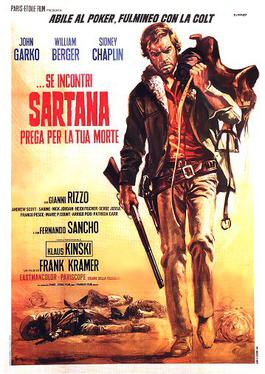
If You Meet Sartana, Pray For Your Death

The Man with No Name Dollars trilogy, Trinity, Django, Sabata, all characters that have their own series in the spaghetti western genre. I've seen at least parts of all those character series, and recently jumped into another, the Sartana series, starting with 1968's If You Meet Sartana, Pray for Your Death

A stagecoach has been robbed, and all its passengers lay dead. As the robbers loot the bodies, a mysterious gunman, Sartana (Gianni Garko), steps in front of them and guns them down. Not long after, a second stagecoach is attacked, this time carrying a huge gold shipment for a town up the trail. The only issue? The strongbox doesn't contain any gold at all....it's just heavily loaded with rocks. Who's up to something? Sartana seems to know, pitting all sides against each other. Another gunman, Lasky (William Berger), has been well-involved with all the robbery, murder and betrayal and is suspicious of what Sartana is up to. Sartana has too many enemies though as he investigates the disappearance of the gold. His only option is simple; pit all sides against each other and swoop in at the opportune time.

This spaghetti western is everything that's both good and bad about the genre. When it's entertaining, it's very entertaining (movie specific: this one's bad but entertaining). When it's bad.....it's very bad. For director Gianfranco Parolini, 'Pray' plays more like a test run for his infinitely better 1969 spaghetti classic, Sabata. The basic premise is almost entirely the same story. Garko's Sartana is a younger Sabata (played to perfection by Lee Van Cleef). The tone is light with some acrobatic gunmen and generally goofy atmosphere. The music from composer Piero Piccioni is pretty forgettable, a disappointment considering how good some of his other scores (The Deserter) were. There are some cool locations although the movie hamstrings itself by using the same locations repeatedly. I swear Sartana rides through the same hilly sand dune at least four different times.

Belonging in the short list of coolest spaghetti western title characters, Sartana is a pretty cool anti-hero gunfighter. He's a gentleman and dresses the part, favoring a suit, vest, cravat and overcoat that resembles a cape. He uses a long-range Winchester rifle and a multi-barreled derringer pistol. Sartana is a gambler as well as an accomplished gun, an ability that plays well in an early card game. Mostly I like the character because it hints -- in not so subtle fashion -- that Sartana is some sort of angelic killer, an angel of death. He seemingly can't be shot (check out the opening scene HERE) or hurt by enemies while appearing at will out of thin air. I like Garko a lot in the role, one he would play three more times, bringing a lighter touch to the anti-hero gunslinger. He's smooth with a gun and a bit of a smartass with whoever he meets. It's different, and I liked it a lot.

Spaghetti western diehards will eat this one up in the casting department with some really odd and really cool casting. Berger is over the top and goofy as Lansky, a brutally efficient hired gun with murder and blackmail on his mind. He's also completely undone whenever Sartana plays the tune from the watch of a man Lansky has killed. Klaus Kinski shows up in a bizarre cameo as Morgan, a knife-throwing killer with little bells for spurs. He's around for about 3 minutes, but it's Kinski so it's cool. Fernando Sancho does what he does best, playing a slimy, greasy, cackling Mexican bandit/general -- here General Tampico Mendoza -- who gets caught up in the killing. Sydney Chaplin and Gianni Rizzo play the two conniving businessmen in town who are up to something, Heidi Fischer playing Rizzo's equally conniving wife. Spaghetti western regular Salvatore Borghese makes a too quick appearance as Moreno, one of Sancho's main henchman.

There is a part of almost all spaghetti westerns that are inherently stupid, but you just go along (well, if you're a fan at least). Unfortunately, 'Pray' has so many of these moments it's hard to take even remotely serious. I liked the movie, but I can appreciate it and all its badness. If you did a drinking game after every time someone maniacally laughs, you'd be drunk in minutes thanks to maniacal laughing coffin maker Dusty (Franco Pesce). Sancho cackles and laughs, eating the same greasy piece of chicken in countless scenes. Berger's Lansky literally crumbles at just the sound of a musical watch. The script is pretty bad in itself -- Sartana's bedroom kinkiness a highlight -- and doesn't offer much of a story. The "story" requires people to connive and worry, Sartana shows up, plans are thrown out and started over. An impressive body count here with some fun action scenes too. It's bad. No doubt about it, but I was entertained throughout.     

If You Meet Sartana, Pray for Your Death (1968): ** 1/2 /****

Monday, March 21, 2011

They Call Him Cemetery

Names like Clint Eastwood, Lee Van Cleef, Franco Nero, and Tomas Milian are always closely associated with the spaghetti western craze of the 1960s and 1970s.  There were countless other stars -- American, Italian, international -- that left their mark on the Italian westerns, some lucky enough to be a part of their own successful franchise.  A star of the Sartana series, Gianni Garko was one of those secondary stars without the name recognition to the average fan, partially because his movies are harder to track down. He wasn't exclusive to the Sartana series (making four official franchise entries), and I'm glad I was introduced to him starting with 1971's They Call Him Cemetery...although it's known by several other names.

The Sartana series made Garko a star, and his main character here sounds like an off-shoot of his infamous gunslinger.  It is similar to the Sabata series and even had me thinking that possibly this character was intended as a younger Lee Van Cleef. Right down to the same clothes and similar arsenal of guns and trick shots, Sartana (or here Ace) and Sabata could be son and father.  But that's just an observation and nothing more. This isn't a hard-hitting, cynical spaghetti western. It's all about the cool factor, the smooth gunfighters, the evil, backhanded villains, the goofy sidekicks, and just a touch of comedy.  This is not on the level of the classic Leone westerns -- few are really -- but it's an underrated spaghetti that deserves more of a following.

Having grown up in the east, the McIntire brothers, John (Chris Chittell) and George (John Fordyce) move west to help their crippled father run the family ranch. They are immediately struck by the violent culture that rules the west, everyone carrying guns and ready to shoot it out at the drop of a hat.  All the local ranchers are even being forced into paying protection to a gang of local bandits.  The McIntire brothers don't see the need, and immediately put themselves in danger by humiliating one of the lead bandits.  Now they must fend for themselves, or seemingly so, when a mysterious gunman, Ace (Garko), arrives in the territory and teaches them how to use a gun effectively.  No matter their ability though, the odds are stacked against them with an army of hired guns waiting to pick them off, including an infamous hired killer, Duke (William Berger), brought in to finish the job.    

One of the best things to come out of the spaghetti western success was the crazy, off the wall, eccentric gunmen in lead roles. We're talking blind, mute, crippled, you name it. There's a western with it.  Named the Ace of Hearts, Garko's gunfighter is relatively simple. He's decked out in black clothes, including a wide, flat-brimmed hat, wears his gunbelt low on his hip, and sports an epic, awesome Fu Manchu mustache.  A cool backstory about Ace is explained early on, giving the character the feeling of a guardian angel hovering over those he's trying to protect. Where many spaghetti leads are amoral, Ace is a hired gun for a reason, looking out for those who need it. It's my first introduction to Garko, and I was very impressed. I'm definitely looking forward to seeing more of his movies.

My one complaint from a movie I really enjoyed was that Garko and co-star William Berger are underused, neither making an appearance until almost 15 minutes into the movie that only runs 87 minutes (or at least the version I saw). Much of the story focuses on the McIntire brothers which isn't an awful thing because eventually they become interesting characters after a rocky start. Garko's Ace is the means to their characters becoming interesting, but I would have liked less of the brothers and more of the supremely cool Ace. A comedic element is added with the inclusion of two Mexican peons working with the McIntires, Sancho (Ugo Fangareggi) and Pedro (Raimondo Penne), who are also expert knife throwers. With Ace, it's a cool, little motley army of gunmen. They're not boring or annoying, I just liked Garko more than these four.

Balancing Garko and matching him step for step is Berger as similarly talented hired gun, Duke.  Berger was one of many American actors who made a name for themselves heading to Europe as part of the spaghetti craze.  He was rarely the star and more often the secondary character, someone you're never sure if he is a good or bad guy.  Playing the well-dressed gunfighter, Duke, he's a slightly older gunman to Garko's character.  Like Van Cleef and Eastwood in For a Few Dollars More, there's the younger vs. older element which is never boring to watch. Friendly rivals who respect each other despite being on opposite sides, you know a showdown between the two equally matched gunmen is looming.  The ending even hints at a sequel with the two men, but unfortunately it never came along. Still, it's a ton of fun to watch Garko and Berger go at it.

This is another example of being surprised with what I bought when I purchased 44 spaghetti westerns for $14.99.  Three movies in, and all three have been very watchable widescreen presentations.  The sound wasn't great, and the image is a little blurry, but that's nothing compared to some of the horrible prints I've seen with hard to find movies.  The locations are great -- especially the finale in a church's ruins on a very green hillside -- and Bruno Nicolai's score is a notch above the rest, especially the main theme which you can listen to over at Shobary's website HERE, just scroll down to the MP3 link.  A very pleasant surprise overall, and a great spaghetti western.

They Call Him Cemetery <---trailer (1971): *** 1/2 /****

Saturday, October 10, 2009

Face to Face

God bless, Youtube, where users can post movies broken up into 10-minute segments for fans to watch for free. I stumbled across a Youtube poster who's put up a wide variety of spaghetti westerns and kung fu movies so before somebody catches on and forces him to take them down, I thought I'd give one a shot. Face to Face is considered one of the best non-Leone spaghetti westerns, but it's only available on DVD from other countries, and I'm not plopping down a couple hundred bucks for a region free DVD player.

Directed by the other Sergio, no, not Leone or Corbucci, yes to Sergio Sollima, Face to Face was the director's follow-up to The Big Gundown which is also considered one of the best in the genre. While many spaghettis went for the lowest common denominator, lots of mindless killing, cool musical score, badass anti-hero, Sollima's westerns, like all his movies, try to deliver a message. It's nothing deep or profound, but there's always something there that adds a deeper layer to the story. Of course, it helps to have the killing, music and antihero to help things along.

A history professor at an eastern university, Brad Fletcher (Gian Maria Volonte) is told to head west by his doctors for the better climate to fight off the disease that is quickly killing him. He improves immediately, but one day a stagecoach occupied by three marshals transporting a prisoner pulls into his village. Brad offers to help the prisoner, but ends up in a hostage situation as the bandit kills his escort. Out in the desert, easterner Brad must care for the wounded bandit, Solomon 'Beau' Bennett (Tomas Milian), the leader of a decimated gang known as Bennett's Raiders.

With nothing tying him down to his home, Brad joins Beau as the bandit reassembles his gang who've been scattered all over thinking their leader is dead. He finds them one by one (spaghetti regulars Frank Brana, Jose Torres, Angel del Pozo, and Nello Pazzafini) and they go back to work. At first timid about handling and shooting a gun, Brad develops into a right hand man to Beau and possibly a threat to his leadership. That's not all that Beau must deal with as Pinkerton agent Charlie Siringo (William Berger) is on his trail, looking to bring him to justice.

Unlike a lot of spaghetti westerns where the bad guys are supremely evil and the antiheroes are really only in it for themselves and the money, Sollima's westerns play on the audience's preconceptions about the characters they're watching. From the start, it's figured that Volonte's Brad is the good guy, the one to root for, while Milian's Beau is the prototypical bad guy, a bandit who will get his due in the end. That changes by the halfway mark as both characters transform into someone different. It's great to see a spaghetti really flesh the characters out.

In doing that, it helps to have actors the caliber of Volonte and Milian. Starring in two of Leone's Dollars trilogy, Volonte is becoming one of my favorite actors. He has an intense look about him, and he wastes no time getting into character. Brad is the early favorite for the good guy role, but he undergoes a change over the course of the movie that is believable and never seems forced. The same can be said for Milian who made his fair share of high-quality spaghettis. He had a penchant for over-the-top Mexican bandit characters in the vein of Eli Wallach's Tuco, and even when his character is a little crazy, he's still appealing, likable to the viewer, or at least me for sure.

As for the checklist of must-haves in the Italian western genre, the leads are a given with Berger rounding out the top trio. His Siringo is based on a real historical figure, and Berger makes the most of a part that has him in and out of the story a lot. In the easy on the eyes department, Jolanda Modio, Carole Andre, and Linda Veras play love interests who are given little to do and have very few lines but look great doing it. So much for well-rounded strong female characters here. 'Face' was filmed in Almeria so you'll see a lot of familiar locations, and Ennio Morricone provides a typically reliable if not hugely memorable score. A botched bank robbery highlights the action late in the movie.

As is the case with Sollima's other westerns, Face to Face doesn't settle for the staus quo. It's a whole lot better than the typical spaghetti western and benefits from strong performances of stars Gian Maria Volonte and Tomas Milian. If like me you're not willing to drop a pretty penny on a region-free DVD player, cruise on over to Youtube and give this one a try. If you're new to the spaghetti western, it's also a good place to start right up there with the Leone and Corbucci entries.

Face to Face <----trailer (1967): *** 1/2 /**** Part 1 of 11 on Youtube