The Sons of Katie Elder

The Sons of Katie Elder
"First, we reunite, then find Ma and Pa's killer...then read some reviews."
Showing posts with label Sal Mineo. Show all posts

Wednesday, December 10, 2014

Giant

So there's the United States, but if you ask some people from Texas, there's a different way of looking at it. There's 49 states that make up the U.S., and then there's TEXAS!!! A giant state with some giant personality, it needs a movie just as big as the idea of the state to really get the message across. Here's an epic that certainly tries, 1956's Giant.

It's the early 1910s and young, powerful Texas rancher Jordan 'Bick' Benedict (Rock Hudson) travels to a farm in Maryland to buy a strong, beautiful young horse. There, he finds what he's looking for and much, much more. Instantly struck, Bick marries the seller's daughter, Leslie (Elizabeth Taylor), who's as equally moved by the big, strong Texan. Leslie travels back to Texas with Bick where she's stunned by the immensity of the Benedict ranch, hundreds of thousands of acres with cattle numbering in the thousands. The life is hard but worthwhile...for those accustomed to it. Leslie is used to a certain openness about living and prejudices and beliefs, none of which she finds in Texas. The marriage is just weeks old, but Bick and Leslie begin to butt heads almost immediately. The young couple with everything at their disposal, right at their fingertips, is heading into a turbulent time, both for themselves but also for Texas.

Some movies just scream EPIC, and in the age of the monster budget, historical epics, this 1956 Texas family drama from director George Stevens certainly qualifies. Based off a novel from author Edna Ferber, this is a big old movie. At the time, it was the most expensive film ever made. The scope and scale is gigantic. Stevens took advantage of the widescreen filming techniques, filling the screen with the wide expanses of the Texas plains in all its sunny and sandy glory. Visually, 'Giant' is a stunner. Dimitri Tiomkin's score is solid but more subdued than most of his more well-known scores and with an obvious reliance on some patriotic Texas songs. A must in an epic -- seemingly -- is to get a message across though, to say something. That's where 'Giant' seems to stumble in a big way. I don't know if it's trying to say much of anything. That's for a little later. For now, here's some positives to take away.

So big story, big setting....yeah, we need a big cast. Two rising stars who were definitely on the way to bigger and better things in Rock Hudson and Elizabeth Taylor. I was interested in these characters which is a credit to Hudson and Taylor because let's be honest. These aren't especially likable characters. They bicker, fight and argue about anything and everything. Love at first sight....until real life settles in. So they're not especially likable, but they do a fine job bringing these characters to life. It feels like real life, two madly in love individuals figuring out marriage and love isn't so easy. Neither is a truly great performance, but they're very solid performances just the same. 

Unfortunately, 'Giant' was remembered both then and now for the sudden, tragic death of one of its cast members. That actor? The iconic James Dean, star of just three movies before his sudden passing in 1955 before the film was completely finished, just 24 years old when he died. Here, he plays Jett Rink, a lower class cowboy working on the Benedict Ranch, a thorn in Bick's side but liked by everyone else. Jett was my favorite character, a remotely sympathetic anti-hero just trying to make his way, to carve out a niche for himself. A late monologue had to be re-recorded because the dubbing hadn't been completed before his surprising death during post-production. It's a quiet, understated part with some great moments (early on at least), especially when Jett's land proves to be far more valuable than originally thought. An obvious influence on many actors who would rise to stardom in the coming years, Dean is a gem.

Okay, enough with the relative positives. I love epics, especially those from the 1950s and early 1960s. This one pushed even me to the limits to the point I struggled to get through the last hour-plus in a movie that already runs 201 minutes. The first 90-120 minutes are pretty good if nothing classic in my mind. Then from there on in, the story jumps to when Bick and Leslie are far older, their empire grown, their family established and all grown up. At this point, all the issues introduced early are basically brushed aside. The story -- not exactly fast-moving up to this point -- grinds to a complete halt. Characters are introduced and dispatched with little fanfare. It drifts aimlessly until an ending that to put it lightly is disappointing. Was there an ending in mind that actually accomplished something? 'Giant' limps to the finish line after a painfully slow 3-hour road trip.

That's the biggest issue. What -- if anything -- is it trying to say? It's obviously a story focused on family and Texas and all their drama. Let's say this though. There is A LOT of drama. It's everything from marital strife to racism, sexism to political corruption, old school versus new school, parenting methods to manipulation of all sorts and on countless different levels, cattle ranching to becoming an oil baron. Pick one, or even two or three, and run with it. Instead, Giant just barrels ahead with all of the above and lets things fall where they may.

Now back to the casting. The characters may not always be very good, but the star power is impressive. Mercedes McCambridge does what she does best as Luz, Bick's sister who's a tomboy, a bit of a spinster, and if this movie was in 2014...a tough as nails lesbian. Chill Wills is solid in a more subdued part as Bick's very Texas uncle. As for the younger generation that pops up in the last third of the movie, look for Carroll Baker, Sal Mineo, Earl Holliman, and Dennis Hopper. Oh, and for good measure, Paul Fix and Rod Taylor have underused supporting parts so there's that. A big disappointment for me though, one I really, REALLY wanted to love. I came away barely tolerating it. A major disappointment.

Giant (1956): **/**** 

Thursday, February 13, 2014

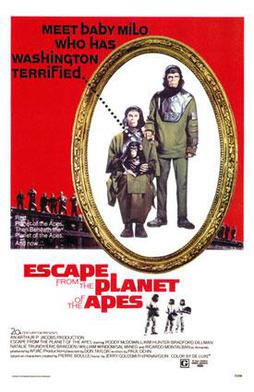
Escape from the Planet of the Apes

Sometimes a series is too successful to just let it end naturally. Following the success of Planet of the Apes and Beneath the Planet of the Apes, Fox Studios wanted another sequel, but there was a problem. Without giving too much away, the ending for 'Beneath' well....didn't really leave any opening for a follow-up. That's what screenwriters are for and ta-da! The series continued! A third movie in the series, 1971's Escape from the Planet of the Apes.

On a warm sunny day off the coast in southern California, a spaceship is discovered floating in the Pacific. The ship is brought ashore, the Army waiting to welcome the astronauts on-board but no one is sure where the spaceship came from or who is in fact on-board. Those waiting are stunned when the three astronauts remove their helmets, revealing themselves as apes. The three astronauts? Dr. Cornelius (Roddy McDowall), his wife, Dr. Zira (Kim Hunter) and Dr. Milo (Sal Mineo). The arrival of talking, intelligent apes stuns the world, forcing the government to decide what to do with the ape trio. Some are welcoming, Cornelius and Zira especially becoming instantly famous in pop culture. Others though aren't so welcoming, questioning where these apes came from and what is their intention in coming to Earth? Both sides need to find a happy medium, but some are sure the presence alone of these futuristic astronauts is a threat to the future of mankind.

So as we talked about, Beneath the Planet of the Apes didn't leave much of an opening for the series to continue, Charlton Heston insisting that be it for the series. Money is a powerful motivator though, isn't it? The series continues, but back on Earth in modern times. Director Don Taylor begins the second half of the series, catapulting the franchise in a different route for its final three films, composer Jerry Goldsmith returning as well with a great score. The premise linking 'Beneath' and 'Escape' is a tad contrived, a tad forced when you think about how 'Beneath' ended but for the sake of where the series is going, it's not so bad. Why does it stand out from the rest?

Two reasons. McDowall and Hunter. Playing Cornelius, McDowall returns to the series after being unable to to star in 'Beneath' because of a scheduling conflict. Less than pleased with her characterization in 'Beneath' (or maybe lack of), Hunter returned because she liked the script. The story is a departure from the first two movies, but this returning duo is perfect. Where we saw Heston's Taylor and James Franciscus' Brent struggling to adjust in a simian world, we now see Cornelius and Zira going through the same struggles in a human world. Where everything else has changed around them, having a spouse is a constant. Their chemistry is perfect, two intelligent individuals deciding what should be their next step, how best to survive in this human world. They have these perfect little moments, Cornelius trying on suits, Zira trying on stylish dresses, Cornelius standing up for his wife, Zira fighting for respect that carries the story surprisingly well on an emotional level.

It's cool to see Cornelius and Zira -- key supporting parts in the first two movies, still supporting parts -- step into the lead roles. That added dimension carries the movie. Who else to look for? Bradford Dillman and Natalie Trundy as Lewis Dixon and Stephanie Branton, two doctors and animal psychiatrists who become almost public relations representatives for Cornelius and Zira, but more importantly, they become trusted friends. Eric Braeden is Dr. Otto Hasslein, the scientific adviser to the President (William Windom), who questions that if these apes come from Earth's future...why did they leave?  It's Eric Braeden so yes, he's a villain. Mineo makes the most of his smallish part as Dr. Milo, the third ape to travel through time with Cornelius and Zira, while Ricardo Montalban is a scene-stealer as Armando, the charming, friendly owner of a circus who works with Lewis and Stephanie. Also look for Jason Evers and Albert Salmi as Braeden's two henchmen, while John Randolph is the head of the commission investigating what to do with the visiting simians.  

There are portions of this movie that are really sweet, great emotional moments that work because of the chemistry between McDowall and Hunter. Following the trend of the first two movies though, things take a turn for the dark though near the halfway point of the 98-minute movie. The time travel aspect comes up, if someone from the future knows what's going to happen, can we change it by wiping them out? We discuss issues of nuclear war, experimentation on animals, prejudices against races and cultures, but it is all handled in subtle enough fashion that it works. The ending is pretty heartbreaking in itself, but as the series has set us up for, there's a great twist in the final scene. Definitely stick with it to the final credits.

Another worthy Planet of the Apes movie, throwing us for a loop but all for the interesting. Coming up next, the final two films in the series, Conquest of Planet of the Apes and Battle for the Planet of the Apes, neither of which I've seen in one sitting. Stay tuned!

Escape from the Planet of the Apes (1971): ***/****

Friday, March 15, 2013

The Dangerous Days of Kiowa Jones

The 1950s and early 1960s were the era of the TV westerns. Countless shows from Bonanza to Gunsmoke, The Rifleman to Rawhide and many more dotted the TV landscape. Audiences wanted to see them, and the studios and channels obliged them. By 1966 though, their popularity was waning a bit. A TV movie that was never picked up as a show, The Dangerous Days of Kiowa Jones, was unfortunately a tad bit too late.

A drifting cowboy on the trail to a job, Kiowa Jones (Robert Horton) stumbles across two prisoners at an isolated cabin guarded by Marshal Duncan (Gary Merrill), a peace officer slowly dying from fever and smallpox. Duncan enlists Jones' help, swearing him in as a deputy to help him transport the duo. The cowboy wants nothing to do with it, but goes along with Duncan's plan just the same. It's less than a day later though when the Marshal dies from the fever, leaving Jones to bring the two prisoners to justice in Fort Smith. There's a problem though. One of the prisoners, Bobby Jack Wilkes (Sal Mineo), has made a standing offer. Anyone who rescues him from the hangman's noose will be rewarded with $2,000. As if his impromptu job wasn't tough enough, now Jones has to defend his prisoners from every man in the territory who can carry a gun.

First shown on TV in 1966, 'Kiowa' wasn't picked up by a network. It's unfortunate because it certainly has some potential. I think the biggest positive is Horton as the titular Kiowa Jones. He had already starred in Wagon Train and A Man Called Shenandoah so he was familiar with audiences and the genre. In other words, he knew what worked. Horton was never a huge star on film or on television, and besides the oh so awful but oh so good The Green Slime, I'd never seen him in anything in either format. The best TV westerns had memorable lead characters, and I feel like Horton's Kiowa Jones certainly had the potential to be a pretty memorable lead.

Why is that you ask? Simple. Like I reviewed recently in A Man Called Gannon, there's something iconic and even a little romantic about the concept of a drifting cowboy. Everything he owns is on his horse with him. He rides from town to town and job to job, living on his own and by his own code of ethics and morals. Horton is able to put a fresh spin on it. His Kiowa Jones is a likable, easy-going cowboy who carries a rifle but doesn't wear a pistol. Thrust into the unlikely position as a deputy, he commits to it because he gave his word. Nothing else. It would be easy to ride out, leave the Marshal behind. He could even hand over his prisoners to any of the gunmen trying to free Bobby Jack. The best part? Kiowa wants nothing to do with the $1,000 reward he would earn by delivering the prisoners. His reasoning? He'd just get in trouble with it. He likes his easy-going lifestyle. That money would just be a hassle. I really, really liked what Horton did with the Kiowa Jones character.

Getting the prisoners to Fort Smith provides about as difficult as you would assume, but 'Kiowa' introduces a solid list of supporting characters along the trail. Doing what seems like a rift on Billy the Kid, Mineo is a scene-stealer as Bobby Jack. He cackles and laughs hysterically, defying Kiowa to just let him go. The dynamic between the two reminded me a little of Anthony Mann's The Naked Spur, albeit on a smaller, less dark level. Nehemiah Persoff is similarly a scene-stealer as Skoda, Kiowa's second prisoner and a gypsy who's accepted his fate with the hangman, predicting what comes with his tarot cards. In an interesting addition, Diane Baker plays Amilia Rathmore, a middle-aged, single, even a little plain woman traveling by wagon to her new teaching post. I especially liked the give and take between her and the trail-wise Kiowa.

On the trail, also look for Royal Dano as Otto, an aging family patriarch out for revenge against Bobby Jack, with his two sons (Lonny Chapman and Zalman King) along for the ride. Harry Dean Stanton and Val Avery make a quick appearance as two greedy bounty hunters tailing Kiowa, Bobby Jack and Skoda with dollar signs for eyes. Robert H. Harris plays Dobie, the hangman.  

Clocking in at 98 minutes, the story in 'Kiowa' is episodic, dealing with one issue at a time before moving on. It is a TV movie so the budget wasn't gigantic. The entire movie is spent on the trail so there's no need for extras or towns. Nighttime scenes are clearly indoor sets, but with my penchant for anything 1960s and/or westerns, there's a certain cheeseball charm to the lack of budget. The music is a little goofy at times, little too light-hearted, but it works. Mostly though, I liked this movie a lot for the casting. I loved Horton as Kiowa. It's a fun part, but there's a darkness to it as evident when the peaceful Kiowa is forced to kill a man. It's a surprisingly dramatic moment in a surprisingly good western. Too bad it was never picked up as a show, but this is a pretty good stand-alone flick on its own.

The Dangerous Days of Kiowa Jones (1966): ***/****

Friday, May 21, 2010

Cheyenne Autumn

A solid director early in his career, John Ford shot to stardom behind the camera thanks to success in one particular genre, the western.  Starting with Stagecoach in 1939 and continuing into the 1940s with his 'cavalry trilogy,' Ford became a go-to director westerns that he was able to put his own personal -- often romantic -- look at the American west in the latter half of the 19th century.  And in almost every one of these westerns, Native Americans were portrayed in a negative light, whether as a fearful presence or as murdering on-screen savages.

With his last western, 1964's Cheyenne Autumn, Ford did an about face in terms of the depiction with something that has since been dubbed 'white man's guilt.' Based on a true story, the movie attempts to put Native Americans in a positive light instead of the stereotypical savage so often associated with westerns.  It's a noble concept and feels like a bit of an apology on Ford's part, but too many things work against this movie from the start, ranging from the casting to the dull, slow-paced storyline.

It's 1878 and 300 members of a Cheyenne tribe on a reservation in the southwestern desert have had enough.  They don't receive supplies promised to them -- food, clothes, medicine -- and are basically being ignored by the U.S. government.  Led by two proud warriors (Ricardo Montalban and Gilbert Roland), the Cheyenne leave the reservation in the dead of night with hopes of marching almost 1,500 miles north to their ancestral hunting grounds in South Dakota and Montana.  Pursuing them is a cavalry outfit led by the sympathetic Capt. Archer (Richard Widmark) who tries his best to bring the Cheyenne in peacefully.  Nothing comes easy though and the terror sets in of 300 Cheyenne roaming the west in towns all along their trail.

To tell this story, Ford assembles a remarkable cast but as is so often the case with huge casts of big name stars, many are lost in the shuffle.  Along with those mentioned already, there's also Karl Malden, Edward G. Robinson, Dolores Del Rio, Carroll Baker, Jimmy Stewart, Arthur Kennedy, Sal Mineo, George O'Brien, and Sean McClory, along with several others I'll mention later.  Needless to say, that's a ton of talent involved, but the odd thing is almost NOTHING happens the entire movie.  It's downright dull at many points and never really gets the viewer invested in what's going on.

First off, the story does represent the Cheyennes in a positive light as a tribe just trying to survive now that their heyday has passed.  But then Ford spends a majority of the time with the white characters as the Cheyenne tribe disappears here and there for long stretches.  There's also the issue of casting Hispanic actors as Indians which just doesn't make much sense to me.  I figure there weren't many Native American actors working in Hollywood in the 1960s, but for a story trying to be authentic and fair, it would have been worthwhile to cast one or two.  Montalban and Roland represent themselves well as the warriors leading the tribe while Mineo says two or three words and enthusiastically takes his shirt off at one point.

One criticism of Ford over his career is his bawdy, broad humor that populates his movies, and Cheyenne Autumn doesn't disappoint.  About 90 minutes in, a 20-plus minute segment takes a complete detour from the story for some incredibly out of place humor in Dodge City with Stewart playing Wyatt Earp and Kennedy playing Doc Holliday.  Besides being incredibly miscast as the famous gunfighters, the tone of this extended segment is comical and over the top.  The tone to this point has been downbeat if not entirely interesting, and we get a segment here that is ripped right from any of the cavalry trilogy.  This comedic segment is so out of place that it can be difficult to watch in its badness.

What I enjoyed most about this movie were the scenes on the trail with the Indians or with the cavalry pursuing them.  Widmark makes the most of a part that just doesn't give him much to do, but Ford seems incredibly comfortable in the cavalry scenes.  Patrick Wayne (the Duke's son) plays Lt. Scott, a young officer out for blood, Mike Mazurki plays the veteran sergeant, and in a nod to Rio Grande and She Wore a Yellow Ribbon, Ben Johnson and Harry Carey Jr play troopers Plumtree and Smith. A running bit between the two has Archer consistently forgetting Carey's name.  Both parts were uncredited ones for the veteran character actors. Maybe because it feels like a throwback to better westerns, but the cavalry portions of the story are infinitely more watchable than much of the rest of the movie.

For all its flaws, 'Autumn' is still worth watching just to see that huge cast work together and as is typical with a Ford western, the Monument Valley scenery.  Through all the movies ever shot there, I don't know if its ever looked better serving as a backdrop for the story.  Overall though, this is an average movie from a great director like Ford.  It's too inconsistent to call a good western, but one that fans should still see.  A disappointing but intriguing last western from one of the genre's best.

Cheyenne Autumn <----trailer (1964) **/****