Almost but not quite. At the peak of their popularity in the late 1960s, the spaghetti westerns found their footing in theaters all over the world. Studios from a long list of different countries did their best to release their own imitations. They were filmed in spaghetti western locations, used spaghetti-sounding scores, and often featured familiar faces from the genre. One of the better examples of those imitations? That's 1969's 100 Rifles.
It's 1912 somewhere south of the Rio Grande in Mexico, and an Arizona lawman, Lyedecker (Jim Brown), has no idea what he's ridden into. Looking to keep his sheriff position on a permanent basis, Lyedecker has been tasked with arresting and bringing back an outlaw who stole some $6,000 from an Arizona bank. He actually finds the outlaw, a Mexican-half breed, Yaqui Joe (Burt Reynolds), in a small town but quickly finds out that Joe is wanted by the Mexican army as well. Now, Lyedecker finds himself working with the man he's supposed to arrest, but desperate times call for desperate measures. With an ethnic-cleansing minded general, Verdugo (Fernando Lamas), on their trail, Lyedecker and Joe race across the frontier. The key to them getting away? It may be a fiery Mexican girl, Sarita (Raquel Welch), fighting with the revolutionaries against Verdugo's forces.
Okay, let's get this out of the way. This is an entertaining, always interesting quasi-spaghetti western, but that doesn't necessarily mean it's good. The story drifts along with a series of episodic showdowns and some cool characters over a 110-minute running time. Any criticisms aside though, this is an excellent, action-packed shoot 'em up that western and action fans will certainly enjoy. Filming on location in Almeria, spaghetti western fans will no doubt recognize some of the on-location shooting. Maybe the best thing you can take away from '100' is the score from composer Jerry Goldsmith. Listen to an extended sample HERE, the best part of the theme kicking in about 40 seconds in and then again at 1:55. It's an underrated score, one of my favorites, a great whistle-worthy theme. The score was recycled seven years later in the 1976 western The Last Hard Men.
Nothing flashy but always enjoyable, '100' is a good example of a Zapata western, westerns with similar themes and stories involving the Mexican Revolution. We get all the familiar faces, genre archetypes you get used to seeing with enough viewing. The Mexican bandit/fighter is Yaqui Joe, the outsider, usually an American thrust into the fighting, Lyedecker, the fiery revolutionary, Sarita, the evil general, Verdugo, the German military adviser, Lt. Franz Von Klemme (Eric Braeden), and the American businessman working with the developing railroad, Grimes (Dan O'Herlihy). Like the better Zapata westerns, '100' covers a lot of ground with plenty of interesting characters. They're drawn in broad strokes, the good if flawed (Lyedecker, Joe, Sarita), the bad (Verdugo) and the messy gray middle ground (Von Klemme, Grimes). It is all familiar, but it is fun.
What ends up being the best part of '100' is the buddy dynamic between Jim Brown's stubborn sheriff and Burt Reynolds' fun-loving, live on the edge bandito. They don't like each other in the least, but their constant arguing, the never-ending bitching and moaning is pitch perfect, especially when they're thrown right in the mix of all the fighting. Yaqui Joe (half-American, half-Indian) actually used his stolen $6,000 to buy 100 rifles for the revolution, but Lydecker still intends to bring him back for trial. The only way to do it? Help Joe escape from the Mexican army. The rest of the cast is okay to bad. The worst? Welch, sporting a stereotypically heavy Mexican accent as Sarita. She's given any number of chances to undress or wear little -- including one shower scene while wearing clothes -- but this wasn't her best work. Lamas evils it up in impeccable fashion, thick mustache, constant sneer and pearl-handled pistols completing the look.
Who else to look for? Braeden is underused as Lt. Von Klemme, a military adviser who sees the mistakes Verdugo is making with each passing day. O'Herlihy is solid too as the greedy American businessman, interested in making the railroad money and keeping his locomotive intact. Also look for Michael Forest as Humara, Sarita's muscle-bound enforcer who doesn't speak a word, and spaghetti western regular Aldo Sambrell as Sgt. Paletes, Verdugo's trustworthy non-commissioned officer.
Onto the action! And let me tell you, there's plenty of it. The story drifts along at times, a series of quick dialogue scenes broken up by said action scenes. Lots of gunplay, some good chases, all of it handled well with only an occasional slow-motion death here and there. We get the small-scale like Brown and Reynolds having a good knock-down fight about halfway through. On the far bigger scale, we see an ambush of a heavily guarded train in a seemingly empty desert, all of it leading to the epic final showdown in another well-guarded town. Is this a great movie? Far from it, but I'm always entertained, and Reynolds especially makes it worthwhile. He commits himself to the fun, and it always looks like he's actually having fun. A good, solid almost spaghetti western.
100 Rifles (1969): ***/****
The Sons of Katie Elder
"First, we reunite, then find Ma and Pa's killer...then read some reviews."
Showing posts with label Eric Braeden. Show all posts
Wednesday, July 23, 2014
Thursday, February 13, 2014
Escape from the Planet of the Apes
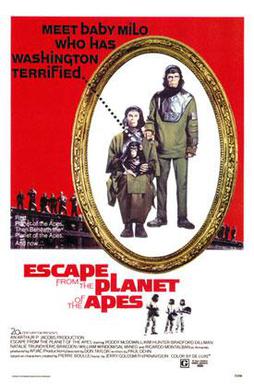
Sometimes a series is too successful to just let it end naturally. Following the success of Planet of the Apes and Beneath the Planet of the Apes, Fox Studios wanted another sequel, but there was a problem. Without giving too much away, the ending for 'Beneath' well....didn't really leave any opening for a follow-up. That's what screenwriters are for and ta-da! The series continued! A third movie in the series, 1971's Escape from the Planet of the Apes.
On a warm sunny day off the coast in southern California, a spaceship is discovered floating in the Pacific. The ship is brought ashore, the Army waiting to welcome the astronauts on-board but no one is sure where the spaceship came from or who is in fact on-board. Those waiting are stunned when the three astronauts remove their helmets, revealing themselves as apes. The three astronauts? Dr. Cornelius (Roddy McDowall), his wife, Dr. Zira (Kim Hunter) and Dr. Milo (Sal Mineo). The arrival of talking, intelligent apes stuns the world, forcing the government to decide what to do with the ape trio. Some are welcoming, Cornelius and Zira especially becoming instantly famous in pop culture. Others though aren't so welcoming, questioning where these apes came from and what is their intention in coming to Earth? Both sides need to find a happy medium, but some are sure the presence alone of these futuristic astronauts is a threat to the future of mankind.
So as we talked about, Beneath the Planet of the Apes didn't leave much of an opening for the series to continue, Charlton Heston insisting that be it for the series. Money is a powerful motivator though, isn't it? The series continues, but back on Earth in modern times. Director Don Taylor begins the second half of the series, catapulting the franchise in a different route for its final three films, composer Jerry Goldsmith returning as well with a great score. The premise linking 'Beneath' and 'Escape' is a tad contrived, a tad forced when you think about how 'Beneath' ended but for the sake of where the series is going, it's not so bad. Why does it stand out from the rest?
Two reasons. McDowall and Hunter. Playing Cornelius, McDowall returns to the series after being unable to to star in 'Beneath' because of a scheduling conflict. Less than pleased with her characterization in 'Beneath' (or maybe lack of), Hunter returned because she liked the script. The story is a departure from the first two movies, but this returning duo is perfect. Where we saw Heston's Taylor and James Franciscus' Brent struggling to adjust in a simian world, we now see Cornelius and Zira going through the same struggles in a human world. Where everything else has changed around them, having a spouse is a constant. Their chemistry is perfect, two intelligent individuals deciding what should be their next step, how best to survive in this human world. They have these perfect little moments, Cornelius trying on suits, Zira trying on stylish dresses, Cornelius standing up for his wife, Zira fighting for respect that carries the story surprisingly well on an emotional level.
It's cool to see Cornelius and Zira -- key supporting parts in the first two movies, still supporting parts -- step into the lead roles. That added dimension carries the movie. Who else to look for? Bradford Dillman and Natalie Trundy as Lewis Dixon and Stephanie Branton, two doctors and animal psychiatrists who become almost public relations representatives for Cornelius and Zira, but more importantly, they become trusted friends. Eric Braeden is Dr. Otto Hasslein, the scientific adviser to the President (William Windom), who questions that if these apes come from Earth's future...why did they leave? It's Eric Braeden so yes, he's a villain. Mineo makes the most of his smallish part as Dr. Milo, the third ape to travel through time with Cornelius and Zira, while Ricardo Montalban is a scene-stealer as Armando, the charming, friendly owner of a circus who works with Lewis and Stephanie. Also look for Jason Evers and Albert Salmi as Braeden's two henchmen, while John Randolph is the head of the commission investigating what to do with the visiting simians.
There are portions of this movie that are really sweet, great emotional moments that work because of the chemistry between McDowall and Hunter. Following the trend of the first two movies though, things take a turn for the dark though near the halfway point of the 98-minute movie. The time travel aspect comes up, if someone from the future knows what's going to happen, can we change it by wiping them out? We discuss issues of nuclear war, experimentation on animals, prejudices against races and cultures, but it is all handled in subtle enough fashion that it works. The ending is pretty heartbreaking in itself, but as the series has set us up for, there's a great twist in the final scene. Definitely stick with it to the final credits.
Another worthy Planet of the Apes movie, throwing us for a loop but all for the interesting. Coming up next, the final two films in the series, Conquest of Planet of the Apes and Battle for the Planet of the Apes, neither of which I've seen in one sitting. Stay tuned!
Escape from the Planet of the Apes (1971): ***/****
On a warm sunny day off the coast in southern California, a spaceship is discovered floating in the Pacific. The ship is brought ashore, the Army waiting to welcome the astronauts on-board but no one is sure where the spaceship came from or who is in fact on-board. Those waiting are stunned when the three astronauts remove their helmets, revealing themselves as apes. The three astronauts? Dr. Cornelius (Roddy McDowall), his wife, Dr. Zira (Kim Hunter) and Dr. Milo (Sal Mineo). The arrival of talking, intelligent apes stuns the world, forcing the government to decide what to do with the ape trio. Some are welcoming, Cornelius and Zira especially becoming instantly famous in pop culture. Others though aren't so welcoming, questioning where these apes came from and what is their intention in coming to Earth? Both sides need to find a happy medium, but some are sure the presence alone of these futuristic astronauts is a threat to the future of mankind.
So as we talked about, Beneath the Planet of the Apes didn't leave much of an opening for the series to continue, Charlton Heston insisting that be it for the series. Money is a powerful motivator though, isn't it? The series continues, but back on Earth in modern times. Director Don Taylor begins the second half of the series, catapulting the franchise in a different route for its final three films, composer Jerry Goldsmith returning as well with a great score. The premise linking 'Beneath' and 'Escape' is a tad contrived, a tad forced when you think about how 'Beneath' ended but for the sake of where the series is going, it's not so bad. Why does it stand out from the rest?
Two reasons. McDowall and Hunter. Playing Cornelius, McDowall returns to the series after being unable to to star in 'Beneath' because of a scheduling conflict. Less than pleased with her characterization in 'Beneath' (or maybe lack of), Hunter returned because she liked the script. The story is a departure from the first two movies, but this returning duo is perfect. Where we saw Heston's Taylor and James Franciscus' Brent struggling to adjust in a simian world, we now see Cornelius and Zira going through the same struggles in a human world. Where everything else has changed around them, having a spouse is a constant. Their chemistry is perfect, two intelligent individuals deciding what should be their next step, how best to survive in this human world. They have these perfect little moments, Cornelius trying on suits, Zira trying on stylish dresses, Cornelius standing up for his wife, Zira fighting for respect that carries the story surprisingly well on an emotional level.
It's cool to see Cornelius and Zira -- key supporting parts in the first two movies, still supporting parts -- step into the lead roles. That added dimension carries the movie. Who else to look for? Bradford Dillman and Natalie Trundy as Lewis Dixon and Stephanie Branton, two doctors and animal psychiatrists who become almost public relations representatives for Cornelius and Zira, but more importantly, they become trusted friends. Eric Braeden is Dr. Otto Hasslein, the scientific adviser to the President (William Windom), who questions that if these apes come from Earth's future...why did they leave? It's Eric Braeden so yes, he's a villain. Mineo makes the most of his smallish part as Dr. Milo, the third ape to travel through time with Cornelius and Zira, while Ricardo Montalban is a scene-stealer as Armando, the charming, friendly owner of a circus who works with Lewis and Stephanie. Also look for Jason Evers and Albert Salmi as Braeden's two henchmen, while John Randolph is the head of the commission investigating what to do with the visiting simians.
There are portions of this movie that are really sweet, great emotional moments that work because of the chemistry between McDowall and Hunter. Following the trend of the first two movies though, things take a turn for the dark though near the halfway point of the 98-minute movie. The time travel aspect comes up, if someone from the future knows what's going to happen, can we change it by wiping them out? We discuss issues of nuclear war, experimentation on animals, prejudices against races and cultures, but it is all handled in subtle enough fashion that it works. The ending is pretty heartbreaking in itself, but as the series has set us up for, there's a great twist in the final scene. Definitely stick with it to the final credits.
Another worthy Planet of the Apes movie, throwing us for a loop but all for the interesting. Coming up next, the final two films in the series, Conquest of Planet of the Apes and Battle for the Planet of the Apes, neither of which I've seen in one sitting. Stay tuned!
Escape from the Planet of the Apes (1971): ***/****
Subscribe to:
Posts (Atom)
.jpg)