My timing really couldn't have been more impeccable. I just turned the big 3-0 a few weeks ago in mid-June. Through dumb luck, Turner Classic Movie's always solid schedule, and my inability to catch up with this movie over the years, I watched 1976's Logan's Run for the first time. The premise? A futuristic society where everyone is killed once they turn 30 to help control the population. Well, if that isn't downright bad timing, I don't know what is.
It's late in the 23rd Century and what remains of mankind lives in a domed city protected from all outer dangers. This is life at its hedonistic, fun-loving, screw the consequences best...with a catch. You get to live life to the fullest, but at the age of 30, you must undergo Carousel, a renewal process to let you start life over again. Among the population is a man in his late 20s, Logan 5 (Michael York), a 'Sandman' who helps track down 'Runners,' those not interested in the Carousel process. As he watches on renewal ceremony though, Logan begins to question more and more about the whole layout. Something just doesn't make sense. Something doesn't add up. The problem is though, he's good at what he does -- very good -- and doesn't want to risk anything by investigating. Some things though...they're just too perfect to pass up.
Well, here we sit. I do love me a good science fiction flick. I especially love those ventures from the 1960's and 1970's, movies like Planet of the Apes, Fahrenheit 451, Westworld, Soylent Green (more on that later), and The Omega Man. This flick from director Michael Anderson is one I've always wanted to see but never actively sought out. It is based off a novel by authors William F. Nolan and George Clayton Johnson, but it sounds like the film and novel have very little in common other than the name and the basic premise. My biggest issue though? I liked it, but as has been the case with a lot of so-called twist movies, the twist works...but not afterward in using that all-important twist as a jumping off point.
It's my Christmas Eve theory all over again. Do you want the mystery of your presents or do you want to know what's under all that wrapping paper?!? I like the mystery so naturally, I love the build-up in mysterious, twist-based movies. The other issue is pretty obvious. Of course everything isn't hunky-dory in this futuristic world!!! It doesn't come as a surprise that the whole 30-year old Carousel renewal process is garbage. The build-up is solid as Logan 5 begins to piece things together. All humans have a crystal implant in their left hand inserted at birth and once they reach 30, it begins to flash. Your turn for renewal! I felt like something was missing. The "twist" seemed far too obvious to me, especially actually seeing the renewal process. Still, though there are flaws through the first hour of the 119-minute movie, it is still an above average, tension-filled sci-fi story. I just wish the second half could have followed suit with it.
The cast definitely has some fun along the way, whether it be starring roles or just key supporting parts. I thought York was okay as Logan, but it's missing something in that lead role department. His female companion is Jenny Agutter's Jessica, a 20-something young woman drawn to Logan who may know more than she's letting on. They spend much of the movie running for safety and whining when they have some free time. They just aren't the most compelling characters and that takes away from the drama and mystery. Richard Jordan is excellent as Francis, Logan's best friend and fellow Sandman who wants his friend to simply get in line, stop questioning and enjoy life but when it comes right down to it, he's got his own job to do. In other supporting parts look for Michael Anderson Jr., Roscoe Lee Browne, Farrah Fawcett (feathered hair and all), and Peter Ustinov.
Just last year, a movie was released that I don't remember seeing in any theaters, and I only noticed it on Redbox. It's called Space Station 76, and is a futuristic sci-fi movie, 1970's style. Just check out that poster! 'Logan' is a prime inspiration for that spoof. This futuristic world, a domed city, looks like it was shot in a mall. A nice mall at that, but you get the idea. Everyone wears pastel colors because God bless, everyone is happy. The women refuse to wear bras (so there's that), instead opting for loose, almost sheer quasi-dresses. The effects too are horrifically dated, both obvious miniatures and more obvious green screen shots. Considering all these things, there is a certain charm in small doses, but combine them all together and you've got quite a lot of 1970's science fiction cheese. At times, it reminded me of the classic Soylent Green, but the payoff there was far better than it was here.
And that's what my disappointment comes down to. 'Logan' has a ton of potential and delivers on it at certain points but ultimately comes up short. It's played straight but too often comes through like a spoof. Roscoe Lee Browne providing his voice for a ridiculous-looking killer robot? Peter Ustinov as the oldest man alive, a crazy cat man at that? Shouldn't someone be controlling the questioning? Just a computer is in charge of this last beacon of hope for mankind? There are simply too many unanswered questions and predicaments that ultimately did the movie in for me. A disappointing rating because I definitely wanted to like this one more.
Logan's Run (1976): **/****
The Sons of Katie Elder
"First, we reunite, then find Ma and Pa's killer...then read some reviews."
Showing posts with label Peter Ustinov. Show all posts
Thursday, July 16, 2015
Sunday, September 21, 2014
Viva Max
From the time I watched Disney's Davy Crockett episodes, I was hooked to the story of the battle of the Alamo. I read all I could about one of Texas history's most infamous events. I watched every movie I could from John Wayne's The Alamo to 1955's The Last Command and everything in between. But 20-some years, one movie managed to steer clear of my grasp...until now that is. It took me years, but I finally tracked down 1969's Viva Max.
Along the U.S./Mexico border, a company of Mexican infantry from the Rio Nuevo garrison crosses the Rio Grande river, throwing the border patrol for a loop. Their commander, Lt. General Maximilian Rodrigues de Santos (Peter Ustinov), has told his men very little about what they're actually doing, instead keeping his plans close to his vest. What exactly is he up to? In 1960s Texas over 130 years since the actual battle, General Max intends to retake the Alamo mission, now an instantly recognizable landmark sought out by millions of tourists each year. What are his motives? Well, that's for Max to reveal at his choosing. Before Max and his small army are done, the San Antonio police (including Sheriff Harry Morgan), the National Guard (including General Jonathan Winters) and the Army (including General Keenan Wynn) are all going to get involved. How can they solve this ridiculous situation peaceably?
I visited San Antonio for the first time with my Dad when I was 10 years old where I bought one of my favorite books, Frank Thompson's Alamo Movies. I've done my best to track down and catch up with all of the listed movies, but this 1969 flick managed to avoid me. The catch? This movie from director Jerry Paris is a comedy, a screwball, physical comedy at that. Yes, you read it right. A movie about a horrific, bloody massacre is a comedy. A comedy!!! That was my biggest worry heading into a flick I've long wanted to see. It wasn't that it was going to be in poor taste. I assumed on that much. But how badly in poor taste was it going to be? I hold the Alamo story above almost all else and even have a distant relative/ancestor who fought and died there in 1836. Heroic efforts on both sides ending in costly casualties. Should you even remotely touch that in the comedy department?
Just know going in that you probably will be offended at some point during this film because of that subject matter. Now all that said, I enjoyed this 1969 comedy a whole lot. Yeah, it is dumb, even stupid at times. Some efforts at physical, goofy humor fall short but as a whole? It's funny as the more subtle gags and lines work because of a talented cast stepping to the plate. This ain't rocket science but 'Max' is funny. As an Alamo buff, one thing stands out above all else. San Antonio and the Alamo allowed 'Max' to film on the mission grounds in downtown San Antonio. To film A LOT. All the footage works as a behind the scenes look at the Alamo a lot. What's left of the mission is almost miniscule compared to what the Alamo looked like in 1836 (check it out HERE), but it works as a backdrop where a Hollywood backlot wouldn't have. Issues with the humor/story aside, the visual works in effortless fashion.
Playing our title character, Ustinov throws himself into the part as Max, a Mexican general who inspires....well, no faith in his men, and that becomes his motivation. I won't give it away completely, but his motives for retaking the Alamo are far from historical reasons, revenge reasons or basically anything you'd think. His motives? Far more personal. Ustinov -- heavily tanned -- has a lot of fun with the part with his Max, a generally quiet guy who's a bit of a dandy, a bit of a doof and pretty oblivious to just about everything around him. He gets some especially funny scenes with a beautiful young woman (Pamela Tiffin) who has an odd request of the Mexican general as she's captured inside the Alamo. His right-hand man, Sergeant Valdez (scene-stealing John Astin), tries to keep his men in line and his general at the front...something that proves harder than you'd think. A very funny performance for Ustinov.
The whole cast doesn't disappoint. We're not talking subtle, smart laughs, but usually big goofy laughs and moments. Morgan, Winters and Wynn split time in the clueless command spots, Winters especially getting some laughs as the politically correct, generally inept National Guard general. I loved Astin's part, the underplayed performance as Valdez, Max's loyal, capable sergeant. Also look for Alice Ghostley as a paranoid prisoner convinced Max and his men are Chinese Communists, Kenneth Mars as her ultra-patriotic nephew with a para-military group, and Ann Morgan Guilbert (Paris' co-star and on-screen wife in The Dick Van Dyke Show) and Bill McCutcheon as a married couple who Max's infantry comes across. Also look for Gino Conforti and Larry Hankin as two of the more visible/vocal troops in Max's makeshift army.
I probably shouldn't have liked this movie, but I did. It cracked me up in all its badness. An early on-screen message says 'No one mentioned in this movie is real except for Davy Crockett, Jim Bowie, William Travis, John Wayne and Richard Widmark.' John Wayne's Alamo becomes a running gag at times, him and Widmark's name becoming passwords and countersigns as the "battle" develops. It's those smaller, quieter and smarter moments that work, especially Max's version of Travis' line in the sand moment. Still, I liked it throughout, a mindless but very entertaining way to spend 90-plus minutes. Worth tracking down if you can.
Viva Max (1969): ***/****
Along the U.S./Mexico border, a company of Mexican infantry from the Rio Nuevo garrison crosses the Rio Grande river, throwing the border patrol for a loop. Their commander, Lt. General Maximilian Rodrigues de Santos (Peter Ustinov), has told his men very little about what they're actually doing, instead keeping his plans close to his vest. What exactly is he up to? In 1960s Texas over 130 years since the actual battle, General Max intends to retake the Alamo mission, now an instantly recognizable landmark sought out by millions of tourists each year. What are his motives? Well, that's for Max to reveal at his choosing. Before Max and his small army are done, the San Antonio police (including Sheriff Harry Morgan), the National Guard (including General Jonathan Winters) and the Army (including General Keenan Wynn) are all going to get involved. How can they solve this ridiculous situation peaceably?
I visited San Antonio for the first time with my Dad when I was 10 years old where I bought one of my favorite books, Frank Thompson's Alamo Movies. I've done my best to track down and catch up with all of the listed movies, but this 1969 flick managed to avoid me. The catch? This movie from director Jerry Paris is a comedy, a screwball, physical comedy at that. Yes, you read it right. A movie about a horrific, bloody massacre is a comedy. A comedy!!! That was my biggest worry heading into a flick I've long wanted to see. It wasn't that it was going to be in poor taste. I assumed on that much. But how badly in poor taste was it going to be? I hold the Alamo story above almost all else and even have a distant relative/ancestor who fought and died there in 1836. Heroic efforts on both sides ending in costly casualties. Should you even remotely touch that in the comedy department?
Just know going in that you probably will be offended at some point during this film because of that subject matter. Now all that said, I enjoyed this 1969 comedy a whole lot. Yeah, it is dumb, even stupid at times. Some efforts at physical, goofy humor fall short but as a whole? It's funny as the more subtle gags and lines work because of a talented cast stepping to the plate. This ain't rocket science but 'Max' is funny. As an Alamo buff, one thing stands out above all else. San Antonio and the Alamo allowed 'Max' to film on the mission grounds in downtown San Antonio. To film A LOT. All the footage works as a behind the scenes look at the Alamo a lot. What's left of the mission is almost miniscule compared to what the Alamo looked like in 1836 (check it out HERE), but it works as a backdrop where a Hollywood backlot wouldn't have. Issues with the humor/story aside, the visual works in effortless fashion.
Playing our title character, Ustinov throws himself into the part as Max, a Mexican general who inspires....well, no faith in his men, and that becomes his motivation. I won't give it away completely, but his motives for retaking the Alamo are far from historical reasons, revenge reasons or basically anything you'd think. His motives? Far more personal. Ustinov -- heavily tanned -- has a lot of fun with the part with his Max, a generally quiet guy who's a bit of a dandy, a bit of a doof and pretty oblivious to just about everything around him. He gets some especially funny scenes with a beautiful young woman (Pamela Tiffin) who has an odd request of the Mexican general as she's captured inside the Alamo. His right-hand man, Sergeant Valdez (scene-stealing John Astin), tries to keep his men in line and his general at the front...something that proves harder than you'd think. A very funny performance for Ustinov.
The whole cast doesn't disappoint. We're not talking subtle, smart laughs, but usually big goofy laughs and moments. Morgan, Winters and Wynn split time in the clueless command spots, Winters especially getting some laughs as the politically correct, generally inept National Guard general. I loved Astin's part, the underplayed performance as Valdez, Max's loyal, capable sergeant. Also look for Alice Ghostley as a paranoid prisoner convinced Max and his men are Chinese Communists, Kenneth Mars as her ultra-patriotic nephew with a para-military group, and Ann Morgan Guilbert (Paris' co-star and on-screen wife in The Dick Van Dyke Show) and Bill McCutcheon as a married couple who Max's infantry comes across. Also look for Gino Conforti and Larry Hankin as two of the more visible/vocal troops in Max's makeshift army.
I probably shouldn't have liked this movie, but I did. It cracked me up in all its badness. An early on-screen message says 'No one mentioned in this movie is real except for Davy Crockett, Jim Bowie, William Travis, John Wayne and Richard Widmark.' John Wayne's Alamo becomes a running gag at times, him and Widmark's name becoming passwords and countersigns as the "battle" develops. It's those smaller, quieter and smarter moments that work, especially Max's version of Travis' line in the sand moment. Still, I liked it throughout, a mindless but very entertaining way to spend 90-plus minutes. Worth tracking down if you can.
Viva Max (1969): ***/****
Labels:
1960s,
Comedy,
Harry Morgan,
Jerry Paris,
Jonathan Winters,
Keenan Wynn,
Peter Ustinov,
The Alamo
Wednesday, July 30, 2014
Spartacus
I've been in Spartacus mode for about six months now. This spring I watched the entire run of Starz's Spartacus, I caught up with Howard Fast's novel Spartacus, found a couple non-fiction books about the famous slave turned gladiator at the library and then bought the TV miniseries that aired about 10 years ago. So what is there left? Naturally I tried to save the best for last, catching up recently with one of Hollywood's great historical epics, 1960's Spartacus.
It's the 70s B.C. in Rome when a Thracian slave named Spartacus (Kirk Douglas) is bought from a Libyan mine and sold to a gladiator school in Capua, Italy, several days ride from the city of Rome. The popularity of gladiators is growing ever stronger, Spartacus thrust into training to become hopefully one of the best. He shows promise but also resents the life, the hatred beginning to grow at Rome's brutal, cruel insistence on slaves and slavery itself. Months into his training, Spartacus incites a brutal takeover, his fellow gladiators joining him in a bloody attack that gives them power and allows them to escape. At first content to be a roving band of marauding bandits, Spartacus organizes his fellow escaped gladiators into an army. They can be more than bandits. They can be an army. An army that with growth and training could challenge Rome itself. His name grows, his army increases with each passing day. In Rome, a powerful Senator and businessman, Marcus Crassus (Laurence Olivier), watches the effect the gladiator slave general has and braces for a reply...if it's not too late.
Wowza, what a good movie, the definition of a historical epic that dominated Hollywood through the 1950s and into the early 1960s. A somewhat checkered production had some issues, a 30-year old Stanley Kubrick replacing Anthony Mann just a week or so into filming. Oddly enough, it is a movie that Kubrick doesn't consider one of his own, not including it in the canon of his films. It is an epic, a smart, well-written, beautifully shot movie with an impressive cast. Composer Alex North turns in a perfect score, large in scale but also very emotional in the quieter moments. I was always a fan of the score, but it really resonated with me on the most recent viewing. There isn't a weakness here, author Howard Fast's novel come to life in truly epic form.
One of the biggest stars working in Hollywood at the time, Kirk Douglas was firmly behind this movie, helping ramrod it right into production and is listed as executive producer. I've always thought this is one of his strongest, if underappreciated, performances. As slave turned gladiator turned general, Douglas is Spartacus. He has several effective so-called "bigger scenes" but the more effective moments are the quiet ones. When he touches the hand of the woman he loves, the rage in his eyes as he's addressed by his superiors, the pride when his army stands up for him, this is an actor doing his absolute best. He brings a real-life character to life, and it's easy to see why so many followed him against Rome. Douglas is charismatic and welcoming from beginning to end. He's furious and full of hate at the Roman system that enlists hundreds of thousands of slaves. Ultimately, he's pushed too far, and his response is something that shakes the world. Just a great performance from a Hollywood legend.
What this flick is able to do so well is to blend so many different moving pieces together. It is an epic with a true ensemble cast, all of the assembled talent given a chance to shine. In one of the best love stories I can think of, Douglas has a great chemistry with Jean Simmons, playing Varinia, a slave from Brittania who becomes Spartacus' wife, friend and confidant. They just work. They're perfect together. There's one of the great actors of all-time, Laurence Olivier, relishing the part of Crassus, a criminally smooth, brilliant manipulator who yearns for power in all forms. There's Tony Curtis in one of his best roles, here as Antoninus, an educated slave who escapes from Olivier's Crassus and joins Spartacus' army. Opposites in most ways, the uneducated leader and the younger, educated fighter become very close, a father-son, brotherly relationship. There's Charles Laughton as Gracchus, the Roman senator with a long, distinguished career behind him, now opposing Crassus, and John Gavin as Caesar, the young and upcoming senator, both giving Rome's perspective as Spartacus' revolt grows and grows. Oh, and there's a scene-stealing Peter Ustinov as Batiatus, the owner of the gladiatoral school that Spartacus escapes from, an Oscar-winning part for Ustinov.
Oh, but there's more. Herbert Lom plays Tigranes, an oily pirate negotiating with Spartacus to get his army out of Italy. As for the gladiators turned army command, look for an underused John Ireland as Crixus with Harold J. Stone and Nick Dennis also standing out from the crowd with smaller supporting parts. One of three performances in 1960 that helped make him more than a physical presence, Woody Strode plays Draba, an experienced gladiator worn down by the constant killing in the arena. A small part but a key one to propel the story forward. And last but not least, gravelly-voiced Charles McGraw as Marcellus, the brutal gladiator instructor, a man tasked with turning slaves into killing machines intended for the gladiator ring. Strength from top to bottom, not a weak link in one of the great casts ever put together.
This is a thinking man's epic, not a true sword and sandal epic. The script from blacklisted author/writer Dalton Trumbo is a gem, giving a window into the politics of the time. The story moves amongst the ensemble from the gladiator school in Capua, to the streets and halls of the Roman Senate, to Spartacus' base at Mount Vesuvius to his camps moving across Italy. Trumbo's script is an idea-script, one about freedom and corruption, living life to its fullest even if the means seem impossible. We see the inner-workings of the Roman senate, of Spartacus' inner circle. You get a feeling of what the times were like in ancient Rome. Just a beautifully written script, Douglas saying "Screw it" to the blacklist that prevented Trumbo from writing for years.
'Spartacus' has moments both big and small here, both working seamlessly. The arena fight between Spartacus and Draba is a gem. Not drawn out but incredibly intense, including a great twist near its conclusion. The revolt in the school is quick and hard-hitting, the tension finally boiling to an unbearable point. As the rebellion grows -- the real-life history was called the Third Servile War -- Spartacus realizes the fight can be as big as his army wants it to be. The entire movie is a treat to watch, but I've always found the second half the film's strongest, especially when the tide turns against the slave army. Maybe the most iconic scene, "I'm Spartacus!," has become a punchline in pop culture, but in context, it is one of the most beautifully constructed, emotionally perfect scenes ever, the camera lingering on Douglas as an ideal conclusion. Watch it HERE with obvious spoilers. The same for a late scene between Spartacus and Antoninus discussing the impact of what they've done, Spartacus willing to Crassus "He'll come back and he'll be millions." Too many great moments to mention.
This isn't an action-heavy movie so beware going in if you're expecting 3 hours of battle scenes. Supposedly more battle scenes were filmed but never used, all in hopes of making the one major battle late in the film far more effective. It is, but this is not a movie interested in the scope and scale of battle. This is a story about the people. We see scenes with literally thousands of extras, but the camera zooms in on the faces, people we see popping up throughout the second half of the movie. Old and young, mothers and fathers, teenagers, kids, thin and fat. The moment where Spartacus walks through his camp on the eve of battle is perfect, the former slave truly realizing the scope of what his army has accomplished. The post-battle scene is that much more gut-wrenching as is the finale itself.
Just a classic. Enjoy it.
Spartacus (1960): ****/****
It's the 70s B.C. in Rome when a Thracian slave named Spartacus (Kirk Douglas) is bought from a Libyan mine and sold to a gladiator school in Capua, Italy, several days ride from the city of Rome. The popularity of gladiators is growing ever stronger, Spartacus thrust into training to become hopefully one of the best. He shows promise but also resents the life, the hatred beginning to grow at Rome's brutal, cruel insistence on slaves and slavery itself. Months into his training, Spartacus incites a brutal takeover, his fellow gladiators joining him in a bloody attack that gives them power and allows them to escape. At first content to be a roving band of marauding bandits, Spartacus organizes his fellow escaped gladiators into an army. They can be more than bandits. They can be an army. An army that with growth and training could challenge Rome itself. His name grows, his army increases with each passing day. In Rome, a powerful Senator and businessman, Marcus Crassus (Laurence Olivier), watches the effect the gladiator slave general has and braces for a reply...if it's not too late.
Wowza, what a good movie, the definition of a historical epic that dominated Hollywood through the 1950s and into the early 1960s. A somewhat checkered production had some issues, a 30-year old Stanley Kubrick replacing Anthony Mann just a week or so into filming. Oddly enough, it is a movie that Kubrick doesn't consider one of his own, not including it in the canon of his films. It is an epic, a smart, well-written, beautifully shot movie with an impressive cast. Composer Alex North turns in a perfect score, large in scale but also very emotional in the quieter moments. I was always a fan of the score, but it really resonated with me on the most recent viewing. There isn't a weakness here, author Howard Fast's novel come to life in truly epic form.
One of the biggest stars working in Hollywood at the time, Kirk Douglas was firmly behind this movie, helping ramrod it right into production and is listed as executive producer. I've always thought this is one of his strongest, if underappreciated, performances. As slave turned gladiator turned general, Douglas is Spartacus. He has several effective so-called "bigger scenes" but the more effective moments are the quiet ones. When he touches the hand of the woman he loves, the rage in his eyes as he's addressed by his superiors, the pride when his army stands up for him, this is an actor doing his absolute best. He brings a real-life character to life, and it's easy to see why so many followed him against Rome. Douglas is charismatic and welcoming from beginning to end. He's furious and full of hate at the Roman system that enlists hundreds of thousands of slaves. Ultimately, he's pushed too far, and his response is something that shakes the world. Just a great performance from a Hollywood legend.
What this flick is able to do so well is to blend so many different moving pieces together. It is an epic with a true ensemble cast, all of the assembled talent given a chance to shine. In one of the best love stories I can think of, Douglas has a great chemistry with Jean Simmons, playing Varinia, a slave from Brittania who becomes Spartacus' wife, friend and confidant. They just work. They're perfect together. There's one of the great actors of all-time, Laurence Olivier, relishing the part of Crassus, a criminally smooth, brilliant manipulator who yearns for power in all forms. There's Tony Curtis in one of his best roles, here as Antoninus, an educated slave who escapes from Olivier's Crassus and joins Spartacus' army. Opposites in most ways, the uneducated leader and the younger, educated fighter become very close, a father-son, brotherly relationship. There's Charles Laughton as Gracchus, the Roman senator with a long, distinguished career behind him, now opposing Crassus, and John Gavin as Caesar, the young and upcoming senator, both giving Rome's perspective as Spartacus' revolt grows and grows. Oh, and there's a scene-stealing Peter Ustinov as Batiatus, the owner of the gladiatoral school that Spartacus escapes from, an Oscar-winning part for Ustinov.
Oh, but there's more. Herbert Lom plays Tigranes, an oily pirate negotiating with Spartacus to get his army out of Italy. As for the gladiators turned army command, look for an underused John Ireland as Crixus with Harold J. Stone and Nick Dennis also standing out from the crowd with smaller supporting parts. One of three performances in 1960 that helped make him more than a physical presence, Woody Strode plays Draba, an experienced gladiator worn down by the constant killing in the arena. A small part but a key one to propel the story forward. And last but not least, gravelly-voiced Charles McGraw as Marcellus, the brutal gladiator instructor, a man tasked with turning slaves into killing machines intended for the gladiator ring. Strength from top to bottom, not a weak link in one of the great casts ever put together.
This is a thinking man's epic, not a true sword and sandal epic. The script from blacklisted author/writer Dalton Trumbo is a gem, giving a window into the politics of the time. The story moves amongst the ensemble from the gladiator school in Capua, to the streets and halls of the Roman Senate, to Spartacus' base at Mount Vesuvius to his camps moving across Italy. Trumbo's script is an idea-script, one about freedom and corruption, living life to its fullest even if the means seem impossible. We see the inner-workings of the Roman senate, of Spartacus' inner circle. You get a feeling of what the times were like in ancient Rome. Just a beautifully written script, Douglas saying "Screw it" to the blacklist that prevented Trumbo from writing for years.
'Spartacus' has moments both big and small here, both working seamlessly. The arena fight between Spartacus and Draba is a gem. Not drawn out but incredibly intense, including a great twist near its conclusion. The revolt in the school is quick and hard-hitting, the tension finally boiling to an unbearable point. As the rebellion grows -- the real-life history was called the Third Servile War -- Spartacus realizes the fight can be as big as his army wants it to be. The entire movie is a treat to watch, but I've always found the second half the film's strongest, especially when the tide turns against the slave army. Maybe the most iconic scene, "I'm Spartacus!," has become a punchline in pop culture, but in context, it is one of the most beautifully constructed, emotionally perfect scenes ever, the camera lingering on Douglas as an ideal conclusion. Watch it HERE with obvious spoilers. The same for a late scene between Spartacus and Antoninus discussing the impact of what they've done, Spartacus willing to Crassus "He'll come back and he'll be millions." Too many great moments to mention.
This isn't an action-heavy movie so beware going in if you're expecting 3 hours of battle scenes. Supposedly more battle scenes were filmed but never used, all in hopes of making the one major battle late in the film far more effective. It is, but this is not a movie interested in the scope and scale of battle. This is a story about the people. We see scenes with literally thousands of extras, but the camera zooms in on the faces, people we see popping up throughout the second half of the movie. Old and young, mothers and fathers, teenagers, kids, thin and fat. The moment where Spartacus walks through his camp on the eve of battle is perfect, the former slave truly realizing the scope of what his army has accomplished. The post-battle scene is that much more gut-wrenching as is the finale itself.
Just a classic. Enjoy it.
Spartacus (1960): ****/****
Thursday, January 3, 2013
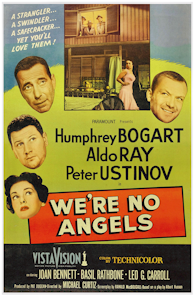
We're No Angels
By 1955, Humphrey Bogart had done everything possible to be a true Hollywood legend. What do you think of when you hear his name though? I typically think of heavy roles, dramatic, intimidating tough guys. Sure, they're not all like that, The African Queen comes to mind, but a majority were. Well, we can add another film to that small list, 1955's We're No Angels.
It's Christmas Eve on Devil's Island in 1895, and three convicts, Joseph (Bogart), Albert (Aldo Ray) and Jules (Peter Ustinov), have managed to escape. The only problem? They've got no money, no papers, and no way of getting off the island. Instead, they meet Felix Ducotel (Leo G. Carroll), a quiet, worrisome and soft-spoken shopkeeper who offers them a job fixing his roof. The trio sees a chance for some easy money, pretending to work on the roof and waiting for nightfall for a chance to rob the shopkeeper blind, giving them everything they need to pull off the successful escape. Pretty simple, right? From their rooftop perch, the convicts start to listen to the goings on in Felix's worrisome life. Uh-oh, now the convicts are interested and even going to help. That escape plan is on hold....for now.
This was a movie on my Netflix queue as a 'Save' option for months after I accidentally read about it at IMDB. I couldn't find it anywhere, and it didn't seem to be on TV...ever. So when TCM aired it in early December, I jumped at the chance. It was well worth the wait. That plot description doesn't exactly scream out buddy comedy, does it? That's what it is though at its most basic. It just happens to be a buddy comedy on steroids that blends a great script, perfect casting and a unique setting that takes advantage of the early stages of widescreen format in films. Long story short, I liked this movie from director Michael Curtiz a whole lot.
The casting works so well because it plays against convention and typecasting. My first thought at hearing Bogie, Aldo Ray and Peter Ustinov in a movie about convicts escaping Devil's Island? Not going to be a comedy. While all three actually are criminals, their crimes are played for laughs (Bogie is a forger, Ray and Ustinov murderers) and end up producing some of the biggest laughs in the movie. I probably use this too much, but the chemistry among these three actors -- all very talented in their own right -- is spot-on. It's effortless. They do it with ease. And because it's a comedy, it's that much better. Dramatic actors doing comedy can be hit or miss, but when handled correctly as it is here, it can carry a movie.
So as is usually the case, this movie goes both ways. Is it the cast lifting up a script or a solid script giving the cast something to do for a change? Oh, no, the Chicken or Egg: Movie Edition! It's both here. Bogie, Ray and Ustinov doing comedy is a welcome change. As good as they are dramatically, they're even better doing comedy. Read some of the more memorable quotes from 'Angels' over at IMDB HERE. It's never obvious humor, most of it underplayed to the point some lines are probably too subtle to even register. That is the beauty though of smart humor though. And throw into the shenanigans, Adolph, a very little, very poisonous snake as the fourth member of the troop with a knack for "solving problems," and we've got some laughs.
Playing the straight man to the convicts' subtle shenanigans, Carroll does a fine job as constantly worried Felix whether it be his family or his business. Joan Bennett and Gloria Talbott round out Felix's family, his loving wife, Amelie, and his daughter, Isabel, madly in love. Basil Rathbone and John Baer play visiting family members, both with their own secrets and looking to take advantage of Felix, his family and his general store. Rathbone is particularly nasty, rounding out a supporting cast that does a solid job without taking away the spotlight from the three main stars.
On top of the acting though the little things come through in 'Angels.' It was one of the first films to use Vistavision, a unique, very colorful widescreen format. The main setting -- Felix's shop, house and roof -- plays like an on-stage play, but the screen is constantly full of bright colors and vivid backgrounds. It hits the ground running in an opening scene that shows the trio of angels escaping from quite a distance. The story itself is pretty interesting and never dull, but it never hurts when a movie is fun to watch in a visual-sense alone. As I seem to do so often, I feel like I'm not explaining why I liked this movie real well (damn comedies!), but I did. A lot, I liked this movie a ton. If you can find a copy or stumble across it on TV, sit down, plant it somewhere comfy and enjoy it.
We're No Angels (1955): *** 1/2 /****
It's Christmas Eve on Devil's Island in 1895, and three convicts, Joseph (Bogart), Albert (Aldo Ray) and Jules (Peter Ustinov), have managed to escape. The only problem? They've got no money, no papers, and no way of getting off the island. Instead, they meet Felix Ducotel (Leo G. Carroll), a quiet, worrisome and soft-spoken shopkeeper who offers them a job fixing his roof. The trio sees a chance for some easy money, pretending to work on the roof and waiting for nightfall for a chance to rob the shopkeeper blind, giving them everything they need to pull off the successful escape. Pretty simple, right? From their rooftop perch, the convicts start to listen to the goings on in Felix's worrisome life. Uh-oh, now the convicts are interested and even going to help. That escape plan is on hold....for now.
This was a movie on my Netflix queue as a 'Save' option for months after I accidentally read about it at IMDB. I couldn't find it anywhere, and it didn't seem to be on TV...ever. So when TCM aired it in early December, I jumped at the chance. It was well worth the wait. That plot description doesn't exactly scream out buddy comedy, does it? That's what it is though at its most basic. It just happens to be a buddy comedy on steroids that blends a great script, perfect casting and a unique setting that takes advantage of the early stages of widescreen format in films. Long story short, I liked this movie from director Michael Curtiz a whole lot.
The casting works so well because it plays against convention and typecasting. My first thought at hearing Bogie, Aldo Ray and Peter Ustinov in a movie about convicts escaping Devil's Island? Not going to be a comedy. While all three actually are criminals, their crimes are played for laughs (Bogie is a forger, Ray and Ustinov murderers) and end up producing some of the biggest laughs in the movie. I probably use this too much, but the chemistry among these three actors -- all very talented in their own right -- is spot-on. It's effortless. They do it with ease. And because it's a comedy, it's that much better. Dramatic actors doing comedy can be hit or miss, but when handled correctly as it is here, it can carry a movie.
So as is usually the case, this movie goes both ways. Is it the cast lifting up a script or a solid script giving the cast something to do for a change? Oh, no, the Chicken or Egg: Movie Edition! It's both here. Bogie, Ray and Ustinov doing comedy is a welcome change. As good as they are dramatically, they're even better doing comedy. Read some of the more memorable quotes from 'Angels' over at IMDB HERE. It's never obvious humor, most of it underplayed to the point some lines are probably too subtle to even register. That is the beauty though of smart humor though. And throw into the shenanigans, Adolph, a very little, very poisonous snake as the fourth member of the troop with a knack for "solving problems," and we've got some laughs.
Playing the straight man to the convicts' subtle shenanigans, Carroll does a fine job as constantly worried Felix whether it be his family or his business. Joan Bennett and Gloria Talbott round out Felix's family, his loving wife, Amelie, and his daughter, Isabel, madly in love. Basil Rathbone and John Baer play visiting family members, both with their own secrets and looking to take advantage of Felix, his family and his general store. Rathbone is particularly nasty, rounding out a supporting cast that does a solid job without taking away the spotlight from the three main stars.
On top of the acting though the little things come through in 'Angels.' It was one of the first films to use Vistavision, a unique, very colorful widescreen format. The main setting -- Felix's shop, house and roof -- plays like an on-stage play, but the screen is constantly full of bright colors and vivid backgrounds. It hits the ground running in an opening scene that shows the trio of angels escaping from quite a distance. The story itself is pretty interesting and never dull, but it never hurts when a movie is fun to watch in a visual-sense alone. As I seem to do so often, I feel like I'm not explaining why I liked this movie real well (damn comedies!), but I did. A lot, I liked this movie a ton. If you can find a copy or stumble across it on TV, sit down, plant it somewhere comfy and enjoy it.
We're No Angels (1955): *** 1/2 /****
Labels:
1950s,
Aldo Ray,
Christmas,
Comedy,
Humphrey Bogart,
Michael Curtiz,
Peter Ustinov
Saturday, September 1, 2012
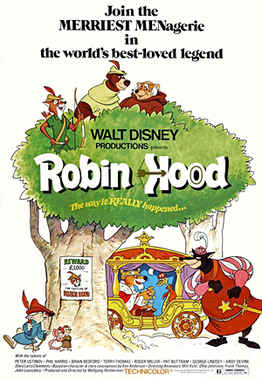
Robin Hood (1973)
Errol Flynn, Kevin Costner, Russell Crowe, Sean Connery, Cary Elwes and an athletic, wise-cracking fox. What do they all have in common? They have all played the iconic literary character and legendary Middle Ages outlaw Robin Hood. Does that last one seem out of place? If it does, shame on you. You must not have had an entertaining childhood. Change of pace review today, a favorite from growing up, the 1973 animated Disney classic, Robin Hood.
Outlaws on the run, Robin Hood (voice of Brian Bedford) and his portly sidekick Little John (voice of Phil Harris) are living it up in Sherwood Forest. In the nearby town of Nottingham, the weakly Prince John (voice of Peter Ustinov) and his enforcer, the Sheriff (Pat Buttram), are taxing the population heavily to the point where there is no money left in town. Always one from steal from the rich and give to the poor, Robin and Little John do their best to cause all the problems they can for Prince John to deal with, but that roguish outlaw has other plans. Robin also wants to win back his longtime love, Maid Marian (Monica Evans). Wouldn't you know it? All these problems might end up crashing head-on.
Is there a more pointless plot description than the one I just wrote? Everyone and their Mother knows at least part of the Robin Hood story, right? Eh, maybe I'm wrong, but I weep for those people. The names are iconic and instantly recognizable, everyone from Robin Hood to Little John to Friar Tuck (voice of Andy Devine, a perfect, spot-on choice, Tuck as a badger) to the evil Sheriff of Nottingham. It's that familiar image of the iconic outlaw in his Lincoln green clothing, appearing out of Sherwood Forest to wreak havoc on the rich. This Disney classic is a classic for a reason, putting a spin on the story for a younger audience. I grew up watching this one, loved it then, loved it now. Yeah, I sound like an old fogy, but they just don't make them like this anymore.
Ready for the part that will blow your mind? Well, that is if you've already forgotten the first paragraph a few clicks up. All these characters are played by anamorphic animals. Flynn, Costner, Crowe, Connery, all fine actors, but they just don't hold a candle to Robin Hood as a....fox. Between the 1950s and the middle of the 1970s, the Disney animated movies were cranking on all levels, many of them using animals as main characters in this way. Maybe it's the little kid that grew up watching these movies, but there's something cool about seeing Robin Hood (a fox) and Little John (a bear) fighting the Sheriff (a wolf) and Prince John (a lion). It sounds criminally simple that it should work so well, but it does. So there. Deal with it. I love this movie and won't be swayed from my opinion.
All these old animated Disney movies are a gem in my head. Yes, some are better than others, but in the age before computer generated images, these movies were actually drawn. They look great, a portal into a time that we may never see again in movies aimed at families with young children. The screen is always full of color and action, and the animation -- dated though it may be -- is a gem to watch. Pixar Studios is immensely talented, and I'll always enjoy their ventures into animated movies, but there is an undeniable charm to these old school Disney flicks.
Oh, right, the voice talents involved. There's not a bad choice in the bunch as the Robin Hood story turns into a story performed by animals. British actor Bedford has some fun as Robin (called 'Rob' by Little John), giving an animated character some personality, as does the whole cast. Harris (Baloo in another classic, The Jungle Book) brings his big, booming voice to the table, providing a great sidekick for Robin. Ustinov is an inspired choice for the weakly, sniveling Prince John, Terry-Thomas playing his maligned "assistant" of sorts, Sir Hiss (a snake). Carole Shelley is very funny as Lady Kluck, always at Maid Marian's side (Evans doing a fine job as Robin's lost love). George Lindsey and Ken Curtis supply their voices as Trigger and Nutsy, two of the Sheriff's dimwitted vulture guards. Yes, vultures. I told you this movie was awesome. Watch the intro HERE to get a look at all the main characters.
A childhood favorite. I love it and always will. Also worthwhile for the voice talents of singer Roger Miller who plays Allan-a-Dale, the talented singing and colorful rooster of Sherwood. The main theme -- Oo-de-lally -- is a classic, listen to it HERE. There's a handful of other songs too, all of them memorable, especially Harris' song as Little John mocking Prince John. The soundtrack in general from frequent Disney composer George Bruns is a classic in itself, just one in a sea of positives about this movie.
Robin Hood <---trailer (1973): ****/****
Outlaws on the run, Robin Hood (voice of Brian Bedford) and his portly sidekick Little John (voice of Phil Harris) are living it up in Sherwood Forest. In the nearby town of Nottingham, the weakly Prince John (voice of Peter Ustinov) and his enforcer, the Sheriff (Pat Buttram), are taxing the population heavily to the point where there is no money left in town. Always one from steal from the rich and give to the poor, Robin and Little John do their best to cause all the problems they can for Prince John to deal with, but that roguish outlaw has other plans. Robin also wants to win back his longtime love, Maid Marian (Monica Evans). Wouldn't you know it? All these problems might end up crashing head-on.
Is there a more pointless plot description than the one I just wrote? Everyone and their Mother knows at least part of the Robin Hood story, right? Eh, maybe I'm wrong, but I weep for those people. The names are iconic and instantly recognizable, everyone from Robin Hood to Little John to Friar Tuck (voice of Andy Devine, a perfect, spot-on choice, Tuck as a badger) to the evil Sheriff of Nottingham. It's that familiar image of the iconic outlaw in his Lincoln green clothing, appearing out of Sherwood Forest to wreak havoc on the rich. This Disney classic is a classic for a reason, putting a spin on the story for a younger audience. I grew up watching this one, loved it then, loved it now. Yeah, I sound like an old fogy, but they just don't make them like this anymore.
Ready for the part that will blow your mind? Well, that is if you've already forgotten the first paragraph a few clicks up. All these characters are played by anamorphic animals. Flynn, Costner, Crowe, Connery, all fine actors, but they just don't hold a candle to Robin Hood as a....fox. Between the 1950s and the middle of the 1970s, the Disney animated movies were cranking on all levels, many of them using animals as main characters in this way. Maybe it's the little kid that grew up watching these movies, but there's something cool about seeing Robin Hood (a fox) and Little John (a bear) fighting the Sheriff (a wolf) and Prince John (a lion). It sounds criminally simple that it should work so well, but it does. So there. Deal with it. I love this movie and won't be swayed from my opinion.
All these old animated Disney movies are a gem in my head. Yes, some are better than others, but in the age before computer generated images, these movies were actually drawn. They look great, a portal into a time that we may never see again in movies aimed at families with young children. The screen is always full of color and action, and the animation -- dated though it may be -- is a gem to watch. Pixar Studios is immensely talented, and I'll always enjoy their ventures into animated movies, but there is an undeniable charm to these old school Disney flicks.
Oh, right, the voice talents involved. There's not a bad choice in the bunch as the Robin Hood story turns into a story performed by animals. British actor Bedford has some fun as Robin (called 'Rob' by Little John), giving an animated character some personality, as does the whole cast. Harris (Baloo in another classic, The Jungle Book) brings his big, booming voice to the table, providing a great sidekick for Robin. Ustinov is an inspired choice for the weakly, sniveling Prince John, Terry-Thomas playing his maligned "assistant" of sorts, Sir Hiss (a snake). Carole Shelley is very funny as Lady Kluck, always at Maid Marian's side (Evans doing a fine job as Robin's lost love). George Lindsey and Ken Curtis supply their voices as Trigger and Nutsy, two of the Sheriff's dimwitted vulture guards. Yes, vultures. I told you this movie was awesome. Watch the intro HERE to get a look at all the main characters.
A childhood favorite. I love it and always will. Also worthwhile for the voice talents of singer Roger Miller who plays Allan-a-Dale, the talented singing and colorful rooster of Sherwood. The main theme -- Oo-de-lally -- is a classic, listen to it HERE. There's a handful of other songs too, all of them memorable, especially Harris' song as Little John mocking Prince John. The soundtrack in general from frequent Disney composer George Bruns is a classic in itself, just one in a sea of positives about this movie.
Robin Hood <---trailer (1973): ****/****
Labels:
1970s,
Andy Devine,
Animated,
Ken Curtis,
Peter Ustinov,
Terry-Thomas,
Walt Disney
Wednesday, August 22, 2012
The Sundowners
Teaming up for John Huston's Heaven Knows, Mr. Allison in 1957, stars Deborah Kerr and Robert Mitchum made up a perfect pair in an underrated movie. Don't fix what isn't broken, right? Just three years later, the duo teamed up again with equally positive results, this time in 1960's The Sundowners.
Working and living in the Australian Outback, Irish-Australian Paddy Carmody (Mitchum) is constantly on the go, taking odd jobs wherever he can to support his family. Along for the ride with him is his wife, Ida (Kerr), and his teenage son, Sean (Michael Anderson Jr.). While Paddy loves the roving, even nomadic lifestyle, Ida and Sean want to settle down somewhere, especially one farm along a river they find in Bulinga. Paddy can't quite bring himself to do it, refusing to be tied down anywhere, but for the sake of his family, he takes a job shearing sheep at a ranch with hopes of saving enough money to purchase the farm. Paddy's old ways may prove to be harder to fix than anything as Ida and Sean dream of their farm.
Thanks to my own forgetfulness and stubbornness, this 1960 movie from director Fred Zinnemann has long avoided me. I was finally able to catch up with it, and it was well worth the wait. This is a big movie, clocking in at 133 minutes, with a scale that's meant to impress you. According to the always-reliable Wikipedia page, Zinnemann spent 12 weeks in Australia shooting everything from the land itself to shots of sheep herding. The actual movie -- filmed on location with the cast in Australia -- looks great, from the vast horizons in the Outback to the towns that pop up along the way. Some money was clearly spent on establishing that sense of reality, and it pays dividends immediately.
For all its impressive scale though, 'Sundowners' is most successful because it works in terms of story on a personal level. It is a big, expansive story, but the focus is on the Carmody family and their journey (through good and bad) as they search for some sort of normal. Paddy? He loves his roving life. Ida and Sean? They want a home to call their own. In terms of its portrayal of a family, the story reminded me at times of a John Ford story where family (immediate and extended) is the most important thing in life. Thankfully, it avoids all the schmaltzy, sugary sweet portrayals of family that Ford often fell back on. No slapstick humor here, just the authentic feel of a family striving to be together and to be something together.
Some actors and actresses just have chemistry, and that's certainly the case with Kerr and Mitchum working together. Showing off that same chemistry they had in 'Mr. Allison,' the duo gets the ball rolling immediately. Some on-screen couples just had that back and forth that doesn't feel like acting. Like here, it has the very real feel of a couple that has spent years and years married through the trials and tribulations, the good and the bad. Who better to play an amiable but sometimes hard-drinking middle-aged man who refuses to be tied down to one single place? I can't come up with anyone better than Mitchum for that part. As for Kerr, she is quickly climbing my list of favorite actresses. She has this easy-going charm that is hard not to fall for. Her Ida obviously loves Paddy, but she admits he also can drive her batty at times too. Their relationship doesn't feel forced. It feels genuine.
What will set this apart from a lot of aspiring epics is the cast. We're not talking Ben-Hur or Lawrence of Arabia here. Instead, it's an epic-looking movie that focuses on a handful of key characters on a smaller scale so in other words? Not a big cast. Peter Ustinov is a scene-stealer as Rupe Venneker, a former ship's captain (possibly) who headed back to land and in general loves everything about life. He signs on with the Carmodys as they undertake driving a sheep herd to market, working as a drover alongside Paddy, and becomes almost an adopted member of the family. In just his second credited role, Anderson Jr. holds his own on-screen with Kerr, Mitchum and Ustinov. His wide-eyed innocence at the world is a good fit alongside his roving Dad, weary Mom, and always mischievous (in a good way) Rupe. In an Oscar nominated part for Best Supporting Actress, Glynnis Johns plays Mrs. Firth, a hotel/saloon owner who takes a shine to Ustinov's Rupe. Also, look for John Meillon, Ronald Fraser and Chips Rafferty as some of Paddy's fellow sheep-shearers.
Struggling in theaters in 1960, 'Sundowners' apparently didn't catch on with audiences. Zinnemann thought it was because it was advertised as a From Here to Eternity knock-off of sorts. Again, Wikipedia is never wrong, right? Whatever the reason for its struggles, I liked it. It's nothing profound or different, but just a good story about family. The road-weary Kerr looking at a done-up woman on a train and wanting to be her, even just for a second. The roving Mitchum, genuinely distraught after a mistake he made cost the family dearly. It's the little things in this quasi-epic that never aspires to EPIC status, but it just don't need to. Enjoy.
The Sundowners <---TCM trailer/clips (1960): ***/****
Working and living in the Australian Outback, Irish-Australian Paddy Carmody (Mitchum) is constantly on the go, taking odd jobs wherever he can to support his family. Along for the ride with him is his wife, Ida (Kerr), and his teenage son, Sean (Michael Anderson Jr.). While Paddy loves the roving, even nomadic lifestyle, Ida and Sean want to settle down somewhere, especially one farm along a river they find in Bulinga. Paddy can't quite bring himself to do it, refusing to be tied down anywhere, but for the sake of his family, he takes a job shearing sheep at a ranch with hopes of saving enough money to purchase the farm. Paddy's old ways may prove to be harder to fix than anything as Ida and Sean dream of their farm.
Thanks to my own forgetfulness and stubbornness, this 1960 movie from director Fred Zinnemann has long avoided me. I was finally able to catch up with it, and it was well worth the wait. This is a big movie, clocking in at 133 minutes, with a scale that's meant to impress you. According to the always-reliable Wikipedia page, Zinnemann spent 12 weeks in Australia shooting everything from the land itself to shots of sheep herding. The actual movie -- filmed on location with the cast in Australia -- looks great, from the vast horizons in the Outback to the towns that pop up along the way. Some money was clearly spent on establishing that sense of reality, and it pays dividends immediately.
For all its impressive scale though, 'Sundowners' is most successful because it works in terms of story on a personal level. It is a big, expansive story, but the focus is on the Carmody family and their journey (through good and bad) as they search for some sort of normal. Paddy? He loves his roving life. Ida and Sean? They want a home to call their own. In terms of its portrayal of a family, the story reminded me at times of a John Ford story where family (immediate and extended) is the most important thing in life. Thankfully, it avoids all the schmaltzy, sugary sweet portrayals of family that Ford often fell back on. No slapstick humor here, just the authentic feel of a family striving to be together and to be something together.
Some actors and actresses just have chemistry, and that's certainly the case with Kerr and Mitchum working together. Showing off that same chemistry they had in 'Mr. Allison,' the duo gets the ball rolling immediately. Some on-screen couples just had that back and forth that doesn't feel like acting. Like here, it has the very real feel of a couple that has spent years and years married through the trials and tribulations, the good and the bad. Who better to play an amiable but sometimes hard-drinking middle-aged man who refuses to be tied down to one single place? I can't come up with anyone better than Mitchum for that part. As for Kerr, she is quickly climbing my list of favorite actresses. She has this easy-going charm that is hard not to fall for. Her Ida obviously loves Paddy, but she admits he also can drive her batty at times too. Their relationship doesn't feel forced. It feels genuine.
What will set this apart from a lot of aspiring epics is the cast. We're not talking Ben-Hur or Lawrence of Arabia here. Instead, it's an epic-looking movie that focuses on a handful of key characters on a smaller scale so in other words? Not a big cast. Peter Ustinov is a scene-stealer as Rupe Venneker, a former ship's captain (possibly) who headed back to land and in general loves everything about life. He signs on with the Carmodys as they undertake driving a sheep herd to market, working as a drover alongside Paddy, and becomes almost an adopted member of the family. In just his second credited role, Anderson Jr. holds his own on-screen with Kerr, Mitchum and Ustinov. His wide-eyed innocence at the world is a good fit alongside his roving Dad, weary Mom, and always mischievous (in a good way) Rupe. In an Oscar nominated part for Best Supporting Actress, Glynnis Johns plays Mrs. Firth, a hotel/saloon owner who takes a shine to Ustinov's Rupe. Also, look for John Meillon, Ronald Fraser and Chips Rafferty as some of Paddy's fellow sheep-shearers.
Struggling in theaters in 1960, 'Sundowners' apparently didn't catch on with audiences. Zinnemann thought it was because it was advertised as a From Here to Eternity knock-off of sorts. Again, Wikipedia is never wrong, right? Whatever the reason for its struggles, I liked it. It's nothing profound or different, but just a good story about family. The road-weary Kerr looking at a done-up woman on a train and wanting to be her, even just for a second. The roving Mitchum, genuinely distraught after a mistake he made cost the family dearly. It's the little things in this quasi-epic that never aspires to EPIC status, but it just don't need to. Enjoy.
The Sundowners <---TCM trailer/clips (1960): ***/****
Friday, October 14, 2011
Lady L
The more I see of Paul Newman, the more I come to respect him as an actor. I don't always enjoy his choice of movies or parts, but I can give credit where credit is due. He branched out, playing an eclectic list of characters and individuals over a 50-plus year career. Some efforts fall far short -- playing a Mexican bandit in The Outrage comes to mind -- but when it would have been easy to be typecast, Newman tried something else. In a hit or miss historic romantic comedy, 1965's Lady L, Newman adds another oddity to his listing, a French thief who joins a revolutionary group.
This is a movie that is also known for its director, taking a trip from around the camera where he was usually in front of it acting, Peter Ustinov. The actor from movies like Spartacus and Quo Vadis takes a crack at directing, one of just six films he did over his career. It is an odd movie overall with a story that doesn't sound like a comedy but ends up being just that, a love story with some weirdly funny (and others not so funny) moments.
An old woman nearing her 80th birthday, Lady Louise (Sophia Loren) sits down with a writer and old friend, Percy (Cecil Parker), to tell him the story of her life growing up. As a young woman, Louise worked in a Paris bordello as a laundry girl where she meets Armand (Newman), an anarchist bank robber who the French police would like nothing more than to arrest him. She joins him in his adventures and misadventures, quickly falling in love with him. Adventurous Armand eventually ends up with an extremist group looking to assassinate a Bavarian prince, causing Louise to question if she can put up with him. She meets Lord Lendale (David Niven), questioning even more now who she belongs with. Could it work somehow to be with both men?
Like most flawed movies, I'm going to slightly recommend this movie mostly because of the casting. How often are you going to see a grouping of Sophia Loren, Paul Newman and David Niven? Even when the script and the story is too cutesy for its own good, these three keep it grounded at least a little bit. Loren -- wearing heavy make-up as an old woman -- gets to show her comedic and dramatic sides, Newman plays the straight man in the ever-growing ridiculous story, and Niven gets to play a variation of himself, a prim and proper Englishman looking for a wife, possibly finding it in Loren's Louise. None of the parts are among any of the three's best, but it's still fun to see actors of their caliber working together.
Writing the plot description made me realize how off the wall this story is. Reading some background on it, 'Lady' sounded like a romantic period piece. Well, partially. The choices made are odd, especially Newman's Armand as an anarchist thief, eventually joining a revolutionary group trying to assassinate anyone and everyone. The assassination attempt is played for laughs -- Ustinov making a cameo as Prince Otto of Bavaria -- so it's hard to criticize too much, but it comes off in poor taste (to me at least). Niven's Lendale later welcomes the members of the group to stay at his villa, preparing their next attack in peace and quiet. It sounds so ridiculous that it almost works, but the story itself is too weird, too different to fully work.
Now in that craziness there are some funny moments, many coming from Claude Dauphin's part as Inspector Mercier, head of the French police trying to arrest Armand. His team of inspectors isn't quite the Keystone Cops, but their efforts to arrest Armand are surprisingly funny, alerting each other the presence of the thief through a series of gruffer and louder throat clearings. Newman's introduction is funny as well, a bank robbery where nothing is at it seems. I did laugh a few times throughout the movie, but the chuckles were lost in a sea of otherwise boring scenes.
Not a long review for this movie because I neither hated it or loved it. The movie has a great look to it, large sets and lavish costumes that reflect the setting of pre-World War I Europe in the first decades of the 1900s. It's funny, but too much and too little at different times. The cast is good but not overly impressive. Average movie that could have been better.
Lady L <---TCM trailer/clips (1965): **/****
This is a movie that is also known for its director, taking a trip from around the camera where he was usually in front of it acting, Peter Ustinov. The actor from movies like Spartacus and Quo Vadis takes a crack at directing, one of just six films he did over his career. It is an odd movie overall with a story that doesn't sound like a comedy but ends up being just that, a love story with some weirdly funny (and others not so funny) moments.
An old woman nearing her 80th birthday, Lady Louise (Sophia Loren) sits down with a writer and old friend, Percy (Cecil Parker), to tell him the story of her life growing up. As a young woman, Louise worked in a Paris bordello as a laundry girl where she meets Armand (Newman), an anarchist bank robber who the French police would like nothing more than to arrest him. She joins him in his adventures and misadventures, quickly falling in love with him. Adventurous Armand eventually ends up with an extremist group looking to assassinate a Bavarian prince, causing Louise to question if she can put up with him. She meets Lord Lendale (David Niven), questioning even more now who she belongs with. Could it work somehow to be with both men?
Like most flawed movies, I'm going to slightly recommend this movie mostly because of the casting. How often are you going to see a grouping of Sophia Loren, Paul Newman and David Niven? Even when the script and the story is too cutesy for its own good, these three keep it grounded at least a little bit. Loren -- wearing heavy make-up as an old woman -- gets to show her comedic and dramatic sides, Newman plays the straight man in the ever-growing ridiculous story, and Niven gets to play a variation of himself, a prim and proper Englishman looking for a wife, possibly finding it in Loren's Louise. None of the parts are among any of the three's best, but it's still fun to see actors of their caliber working together.
Writing the plot description made me realize how off the wall this story is. Reading some background on it, 'Lady' sounded like a romantic period piece. Well, partially. The choices made are odd, especially Newman's Armand as an anarchist thief, eventually joining a revolutionary group trying to assassinate anyone and everyone. The assassination attempt is played for laughs -- Ustinov making a cameo as Prince Otto of Bavaria -- so it's hard to criticize too much, but it comes off in poor taste (to me at least). Niven's Lendale later welcomes the members of the group to stay at his villa, preparing their next attack in peace and quiet. It sounds so ridiculous that it almost works, but the story itself is too weird, too different to fully work.
Now in that craziness there are some funny moments, many coming from Claude Dauphin's part as Inspector Mercier, head of the French police trying to arrest Armand. His team of inspectors isn't quite the Keystone Cops, but their efforts to arrest Armand are surprisingly funny, alerting each other the presence of the thief through a series of gruffer and louder throat clearings. Newman's introduction is funny as well, a bank robbery where nothing is at it seems. I did laugh a few times throughout the movie, but the chuckles were lost in a sea of otherwise boring scenes.
Not a long review for this movie because I neither hated it or loved it. The movie has a great look to it, large sets and lavish costumes that reflect the setting of pre-World War I Europe in the first decades of the 1900s. It's funny, but too much and too little at different times. The cast is good but not overly impressive. Average movie that could have been better.
Lady L <---TCM trailer/clips (1965): **/****
Labels:
1960s,
Cecil Parker,
David Niven,
Paul Newman,
Peter Ustinov,
Sophia Loren
Wednesday, March 10, 2010
Quo Vadis
Everyone has their favorite movie stars, but what about stars you dislike? For me, I've never been able to understand Robert Taylor's appeal. He is as wooden as can be and never seems to actually act. His lines whether he's content, pissed or in love always come out the same...monotone in his already deep, flat voice. Unfortunately for me, Taylor was in many westerns, war and adventure movies that appeal to me. He isn't always bad -- Bataan is a classic -- but I've rarely come away from one of these movies thinking highly of his performance.
One of his more wooden parts comes in the 1951's Quo Vadis, one of the first Technicolor historical epics that include Ben-Hur, Spartacus, Cleopatra, Fall of the Roman Empire and many more. This is a BIG movie with a cast of thousands, gigantic sets, and an appropriately large story involving the growth of Christianity in the years following Jesus' death and resurrection. But with all those positives going for the movie, Taylor is cast as the lead. I don't believe he was the right actor to carry such a big production. His stiff performance is the movie's weakest element in an otherwise enjoyable epic.
After a 3-year campaign, Roman legion commander Marcus Vinicius (Taylor) returns home to Rome triumphantly at the head of his army. Staying at the home of a former general, Marcus is struck by the beauty of the general's adopted daughter, Lygia (Deborah Kerr). He does everything he can to win her over but ends up driving her further away with his boorish, violent ways. Somehow, Lygia does fall for Marcus but her Christian beliefs confuse him. As he tries to win her back, Roman emperor Nero (Peter Ustinov) goes about ruling his empire, always teetering on the brink of insanity. Looking for inspiration, he orders Rome to be burned down, forcing Marcus to find Lygia and her family before the city is destroyed.
Stories set in ancient times have a romantic feel to them that is nearly impossible to ruin in movie-form. Almost three-hours long, 'Quo Vadis' was a big-budget success that audiences flocked to. Made in Italy, it is a beautifully shot movie whether the scenes are on the elaborate sets built for the movie or the quiet scenes set in the Italian countryside. It's a very professional movie without a ton of heart, but so often these epics were about the spectacle. No CGI in the 1950s so all those scenes of enormous crowds were actually filmed. I've said it before, but there's always something appealing about a director actually filming something as opposed to creating it on a computer.
Other than Taylor's struggles in the lead, the cast is top notch if not instantly recognizable. Kerr as the object of Marcus' affections is very good as Lygia. Her character is a Christian and basically is given no flaws, making her feelings for Taylor's Marcus all that much harder to comprehend. He basically forces himself on her, and when that doesn't work buys her. All the while, he doesn't understand why she won't have him. Other cast members making a strong impression include Leo Genn as Petronius, Marcus' uncle and one of Nero's closest adviser, Patricia Laffan as Poppea, Nero's slutty wife, and Buddy Baer as Ursus, a giant of a man devoted to keeping Lygia safe from trouble in whatever form it comes.
The romance storyline has its awkward moments but is decent enough when looked at as a whole. The highlight of the movie though is Peter Ustinov as Emperor Nero, a role which earned him an Oscar nomination for a supporting role (Genn was nominated too but neither won). Ustinov's Nero is often petty and childlike with a vindictive streak that has no bounds. He is almost cartoonish in his performance of an emperor who fancies himself a demi-god and a portal through which the Roman gods speak to the people. His performance is mesmerizing, both funny and frightening all at once, and the main reason to watch this movie. You almost want to feel bad for him at times because he's so easily manipulated, but this is one crazy dude.
Another interesting sub-plot revolves around the growth of Christianity with the story beginning some 30 years after Jesus' death. His apostle Peter (Finlay Currie) plays a key part in the story when being a Christian was forbidden and punishable by death. Keeping their faith under wraps, the Christians meet secretly at night in some of the movie's best sequences. In the finale Nero realizes his burning of Rome did not go over as planned -- who would have thought that? -- and blames this new fledgling religion. They are burned alive and eaten by lions in the Colisseum in a remarkable sequence late. It all makes for an interesting subplot when the love angle gets a little dull.
Not the best of the historical studio epics, but one still worth watching, especially for Peter Ustinov's performance as Nero. I'd recommend watching this one on the TV, but it is available to watch on Youtube, starting with Part 1 of 22. Get a comfortable chair before you sit down for three hours at the computer.
Quo Vadis <-----trailer (1951): ** 1/2 /****
One of his more wooden parts comes in the 1951's Quo Vadis, one of the first Technicolor historical epics that include Ben-Hur, Spartacus, Cleopatra, Fall of the Roman Empire and many more. This is a BIG movie with a cast of thousands, gigantic sets, and an appropriately large story involving the growth of Christianity in the years following Jesus' death and resurrection. But with all those positives going for the movie, Taylor is cast as the lead. I don't believe he was the right actor to carry such a big production. His stiff performance is the movie's weakest element in an otherwise enjoyable epic.
After a 3-year campaign, Roman legion commander Marcus Vinicius (Taylor) returns home to Rome triumphantly at the head of his army. Staying at the home of a former general, Marcus is struck by the beauty of the general's adopted daughter, Lygia (Deborah Kerr). He does everything he can to win her over but ends up driving her further away with his boorish, violent ways. Somehow, Lygia does fall for Marcus but her Christian beliefs confuse him. As he tries to win her back, Roman emperor Nero (Peter Ustinov) goes about ruling his empire, always teetering on the brink of insanity. Looking for inspiration, he orders Rome to be burned down, forcing Marcus to find Lygia and her family before the city is destroyed.
Stories set in ancient times have a romantic feel to them that is nearly impossible to ruin in movie-form. Almost three-hours long, 'Quo Vadis' was a big-budget success that audiences flocked to. Made in Italy, it is a beautifully shot movie whether the scenes are on the elaborate sets built for the movie or the quiet scenes set in the Italian countryside. It's a very professional movie without a ton of heart, but so often these epics were about the spectacle. No CGI in the 1950s so all those scenes of enormous crowds were actually filmed. I've said it before, but there's always something appealing about a director actually filming something as opposed to creating it on a computer.
Other than Taylor's struggles in the lead, the cast is top notch if not instantly recognizable. Kerr as the object of Marcus' affections is very good as Lygia. Her character is a Christian and basically is given no flaws, making her feelings for Taylor's Marcus all that much harder to comprehend. He basically forces himself on her, and when that doesn't work buys her. All the while, he doesn't understand why she won't have him. Other cast members making a strong impression include Leo Genn as Petronius, Marcus' uncle and one of Nero's closest adviser, Patricia Laffan as Poppea, Nero's slutty wife, and Buddy Baer as Ursus, a giant of a man devoted to keeping Lygia safe from trouble in whatever form it comes.
The romance storyline has its awkward moments but is decent enough when looked at as a whole. The highlight of the movie though is Peter Ustinov as Emperor Nero, a role which earned him an Oscar nomination for a supporting role (Genn was nominated too but neither won). Ustinov's Nero is often petty and childlike with a vindictive streak that has no bounds. He is almost cartoonish in his performance of an emperor who fancies himself a demi-god and a portal through which the Roman gods speak to the people. His performance is mesmerizing, both funny and frightening all at once, and the main reason to watch this movie. You almost want to feel bad for him at times because he's so easily manipulated, but this is one crazy dude.
Another interesting sub-plot revolves around the growth of Christianity with the story beginning some 30 years after Jesus' death. His apostle Peter (Finlay Currie) plays a key part in the story when being a Christian was forbidden and punishable by death. Keeping their faith under wraps, the Christians meet secretly at night in some of the movie's best sequences. In the finale Nero realizes his burning of Rome did not go over as planned -- who would have thought that? -- and blames this new fledgling religion. They are burned alive and eaten by lions in the Colisseum in a remarkable sequence late. It all makes for an interesting subplot when the love angle gets a little dull.
Not the best of the historical studio epics, but one still worth watching, especially for Peter Ustinov's performance as Nero. I'd recommend watching this one on the TV, but it is available to watch on Youtube, starting with Part 1 of 22. Get a comfortable chair before you sit down for three hours at the computer.
Quo Vadis <-----trailer (1951): ** 1/2 /****
Labels:
1950s,
Deborah Kerr,
Historical epics,
Leo Genn,
Peter Ustinov,
Robert Taylor
Subscribe to:
Posts (Atom)