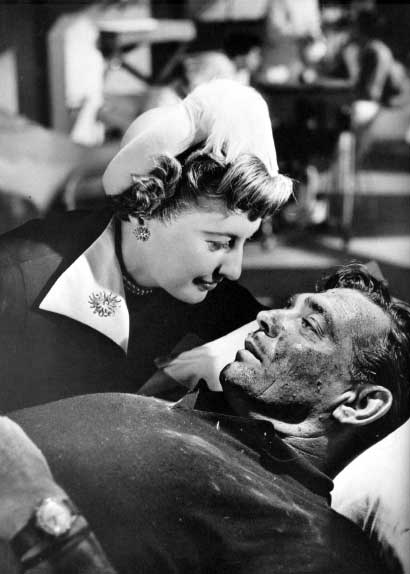
When I stumble across auto racing -- Nascar, IRL, you name it -- on TV, I can't change the channel quick enough. The idea of watching other people drive (however skilled, however talented) around tracks doesn't appeal to me in the least. So how does it make sense that I love racing movies like Le Mans, Grand Prix, the Love Bug movies? Go figure, but we can add 1950's To Please a Lady to the list, other than the whole tame 1950s porno name.
Writing a nationwide syndicated column and hosting a radio show, Regina Forbes (Barbara Stanwyck) is one powerful person, able to build someone up as quickly as she can take them down. Her latest target is Mike Brannan (Clark Gable), a midget car racer and former WWII hero in the Marines. Brannan has earned himself villain status on the racing circus, and Regina takes him down when he's involved in an on-course accident that kills a driver. Brannan is blacklisted and not allowed to race...at first. He climbs back up, joining the big racing circuits and hopefully getting back to the top. But if he thought he was rid of Regina and her efforts, he would be wrong. The high-powered writer isn't done with him yet.
The user reviews at the IMDB are decidedly mixed, but I liked this movie nonetheless. Some of that can be chalked up to a nostalgic factor ranging from the footage of late 1940s and early 1950 racing to the portrayal of the newspaper business (think of Stanwyck as a female Burt Lancaster from Sweet Smell of Success). Not surprisingly, a mutual interest arises between Gable and Stanwyck. I know, I didn't see it coming either. The story isn't the deepest of stories, and there are some odd moments (a quasi-phone sex scene between the two stars is kinda weird) but the end result is still entertaining.
Why is it entertaining? I don't care how simplistic the story is, when you put together actors the caliber of Gable and Stanwyck, it's going to be worthwhile to watch. There is chemistry, and then there's the chemistry these two have. It looks to be effortless. They're fighting after first meeting, and you believe it. They have little to nothing in common other than being dominant, Type-A personalities, but they're drawn to each other. Their scenes together are perfect, Gable as cool, smooth and suave as ever, Stanwyck as equally strong-willed and sexy in her confidence. Adolphe Menjou plays Gregg, Stanwyck's partner/adviser/secretary who's always needling her with Will Geer playing Jack Mackay, Brannan's team owner and pit crew leader.
Now chemistry is one thing, but I do have to mention one thing. It's never really in doubt that Stanwyck's Regina and Gable's Mike will end up together. It's just a matter of when more than if. How does it come about though? Regina basically blackballs Mike's career, and then goes and sees him about it as he tries to build his career. In arguing about the situation, Mike slaps Regina pretty forcefully (it looks like a real slap dealt by Gable). Only then does the relationship start to develop, like Regina needed a wake-up call. Call it over-analyzing, maybe I'm reading too much into it, but it didn't sit right with me.
I'm figuring if you've made it this far you're looking for some sort of race analysis. This 1950 movie is a gem for racing fans, motorheads, and anyone who appreciates a good car. The footage here is insanely good, including three sequences that don't montage a race to death but show much of it in its entirety. The finale at the Indianapolis 500 is a great ending too. From midget cars to stunt shows to the stronger, more powerful cars at the Indy 500, racing fans will be more than appeased. It's a time capsule, and a good one in a surprisingly good movie overall.
To Please a Lady <---TCM trailer (1950): ***/****
The Sons of Katie Elder
"First, we reunite, then find Ma and Pa's killer...then read some reviews."
Showing posts with label Clark Gable. Show all posts
Tuesday, January 24, 2012
Sunday, November 20, 2011
The King and Four Queens
Riding into a lonely western town, Dan Kehoe (Clark Gable) has possibly stumbled onto riches more than he ever imagined. A bartender tells him of $100,000 worth of gold but with an interesting backstory. The four McDade brothers pulled off a robbery of the gold, but three were killed and one escaped and has been hiding ever since. The gold is believed to be guarded at Saddle Mound, the McDade ranch run by Ma McDade (Jo Van Fleet), and the four possible widows of the brothers. Dan has $ in his eyes, and he intends to get that gold, even with the protective Ma around, guarding her daughter-in-laws and the gold with her rifle. Let the charming and seduction begin.
This movie has 1950s American western syndrome. It has all the elements of a potentially entertaining, successful western but never finds a way to gel all those elements together. Even late in his career, Gable is a worthy leading man, and director Raoul Walsh was a more than capable hand with a story like this. Shot on location in Utah, the locations are stunningly beautiful, providing a great backdrop for a lackluster story that never goes anywhere. Composer Alex North's score doesn't leave much of an impression, positive or negative.
Like so many 1950s American westerns, 'King' goes more for the psychological edge which sounds weird considering it is a comedic western. At least, it's listed as that. It isn't funny in the slightest, and the story of a saddle tramp -- even one as charming as Clark Gable -- wooing four lonely, attractive and man-happy widows and their controlling, intimidating mother-in-law just isn't funny at its most basic. If you're going to make this a comedy, just commit. Make it ridiculous. Make it stupid, but you have to try and provide some sort of laughs.
This is going to sound ridiculous after I ripped the movie the last two paragraphs, but there were times watching this western where I couldn't help but think of a well-written play, if not Shakespeare along those lines certainly. If Walsh didn't want to commit to a slapstick comedy, then go the other way. Make this western the darkest thing you've ever seen. A saddle tramp charming, seducing and manipulating four attractive young widows to gain the gold they're hiding sounds like a naturally pretty dark scenario, but that's not the case here. Disappointing end result. Maybe there's potential for a Skin-a-max movie with this story. Who knows, it couldn't be much duller than this movie.
Working with what they've got in terms of a script, the cast does their best with what's in front of them. Gable is okay as Kehoe, but it isn't the most energetic part or most interesting. Jo Van Fleet has the strongest part as Ma McDade, family matriarch who's seen her family torn apart and is desperately trying to hold on to what's left. The widows include Eleanor Parker as Sabina, smart and crafty and up to something, Jean Willes as the fiery and hot-tempered Ruby, Barbara Nichols as Birdie, the dance hall girl, and Sara Shane as Oralie, the quiet, even meek widow. Look for Jay C. Flippen as a helpful bartender, Arthur Shields as a priest, and Roy Roberts as a curious sheriff.
Never a good sign when the best thing a movie has going for it is the location shooting. Dull western that wastes a decent cast. Thankfully it's only 84 minutes long. Still.....pass.
The King and Four Queens <---early scene (1956): */****
Wednesday, February 17, 2010
Mutiny on the Bounty (1935)
The story of Fletcher Christian's mutiny aboard the H.M.S Bounty against Captain William Bligh is one of the most famous historical stories that just about everyone knows in some form or another. It is a story that translates well to film, including three well known flicks and a few other less highly regarded ones, with versions made in 1935, 1962, and 1984. The 1935 version, appropriately titled Mutiny on the Bounty, is the one held in highest regard, even earning the Best Picture Oscar and a long list of nominations.
While I'm not doubting the movie for its entertainment value, it does suffer from a problem many movies from the 1930s have. The movie studios were still making the transitition from silent to sound with many actors making the jump right from the stage to the big screen. But before method acting developed in the 1950s, many roles came across as too theatrical, too over the top, as if the actors were playing to audiences who would have been sitting right in front of them. Because of that, it can be hard to get a read on characters and what they're going through, especially in the case of 1935's Bounty.
Making his first sea voyage with an objective of writing a Tahitian dictionary, Roger Byam (Franchot Tone) boards the H.M.S. Bounty with romantic ideas of what the sea is like. He bonds quickly with Fletcher Christian (Clark Gable), the master's mate, and the two become fast friends. The Bounty is sailing to Tahiti where they will pick up 1,000 breadfruits and deliver them to the West Indies. The captain of the ship, William Bligh (Charles Laughton), rules his ship with an iron fist and quickly turns the crew against him with his gung-ho mentality. Christian especially bristles at how Bligh runs the ship, and after successly acquiring the breadfruits, leads a mutiny, putting Bligh and some of the crew on a longboat on the open seas.
Having seen the other two versions, the Marlon Brando and Mel Gibson takes, there was nothing that came as much of a surprise with the 1935 version. The enjoyment of watching movies that deal with similar subjects is how they handle the stories differently. History is built around facts, but it's funny how different those facts can be interpreted in the eyes of the beholder. The actual mutiny is typically handled in the same way, but the build-up and repercussions tend to differ.
The Academy must really have loved the acting in 'Bounty' because Laughton, Gable, and Tone were all nominated for Best Actor...with none of them actually winning. Laughton is a fine actor with a long list of impressive roles to his name, but his Bligh comes across as too cartoonishly evil. Granted, the historical Bligh was not a pleasant character, but some human emotions would have been nice for the character. Gable's Christian is a little better, the voice of the crew who can't understand the madness of their captain. Tone's Byam is a smattering of many different members of the Bounty and is the wavering voter, the individual in the middle. As an officer in the British navy, he should be loyal to his captain but what about his friendship with Fletcher?
Trying to figure out how to review 'Bounty,' the acting was a sticking point. It isn't bad, far from it. I've seen much worse in the way of 1930s over the top theatrical acting. But at the same time, it's hard to say we actually get to know these characters. They're more like cardboard cutouts spouting their lines. Bligh is evil, Christian is good, and Byam is trying to find himself. The hatred and friendship that develops is genuine, but it's easy to side with Christian's decision -- for me at least. Bligh is a blatant liar who treats his men horrifically when it doesn't always call for it. Of course, in all three versions I've sided with Christian's decision. Guess I would have been a mutineer on Pitcairn Island.
As a historical movie, 'Bounty' is all about the spectacle of a high seas voyage. While most of the acting on-board the Bounty was clearly done on a soundstage with an oceanic backdrop, there are actual shots of an 18th century ship sailing across the ocean, and not always in calm seas. There are great shots of the crew preparing the ship for sailing high above in the masts as the expansive sails come flowing down. And not really a surprise, but Tahiti sure looks nice. Maybe not as nice as it did in Technicolor in the 1962 version, but it's hard to make paradise look bad.
So good and bad, I'm still recommending this movie. For all its faults, 'Bounty' is still an entertaining adventure, especially if you're a fan of the history it is based in. Maybe the acting is too much at times, but Gable is and always will be pretty cool onscreen. There are flaws, and the ending does leave a fair share of subplots and storylines waving in the breeze, but worth a rent if nothing else.
Mutiny on the Bounty <----trailer (1935): ** 1/2 /****
While I'm not doubting the movie for its entertainment value, it does suffer from a problem many movies from the 1930s have. The movie studios were still making the transitition from silent to sound with many actors making the jump right from the stage to the big screen. But before method acting developed in the 1950s, many roles came across as too theatrical, too over the top, as if the actors were playing to audiences who would have been sitting right in front of them. Because of that, it can be hard to get a read on characters and what they're going through, especially in the case of 1935's Bounty.
Making his first sea voyage with an objective of writing a Tahitian dictionary, Roger Byam (Franchot Tone) boards the H.M.S. Bounty with romantic ideas of what the sea is like. He bonds quickly with Fletcher Christian (Clark Gable), the master's mate, and the two become fast friends. The Bounty is sailing to Tahiti where they will pick up 1,000 breadfruits and deliver them to the West Indies. The captain of the ship, William Bligh (Charles Laughton), rules his ship with an iron fist and quickly turns the crew against him with his gung-ho mentality. Christian especially bristles at how Bligh runs the ship, and after successly acquiring the breadfruits, leads a mutiny, putting Bligh and some of the crew on a longboat on the open seas.
Having seen the other two versions, the Marlon Brando and Mel Gibson takes, there was nothing that came as much of a surprise with the 1935 version. The enjoyment of watching movies that deal with similar subjects is how they handle the stories differently. History is built around facts, but it's funny how different those facts can be interpreted in the eyes of the beholder. The actual mutiny is typically handled in the same way, but the build-up and repercussions tend to differ.
The Academy must really have loved the acting in 'Bounty' because Laughton, Gable, and Tone were all nominated for Best Actor...with none of them actually winning. Laughton is a fine actor with a long list of impressive roles to his name, but his Bligh comes across as too cartoonishly evil. Granted, the historical Bligh was not a pleasant character, but some human emotions would have been nice for the character. Gable's Christian is a little better, the voice of the crew who can't understand the madness of their captain. Tone's Byam is a smattering of many different members of the Bounty and is the wavering voter, the individual in the middle. As an officer in the British navy, he should be loyal to his captain but what about his friendship with Fletcher?
Trying to figure out how to review 'Bounty,' the acting was a sticking point. It isn't bad, far from it. I've seen much worse in the way of 1930s over the top theatrical acting. But at the same time, it's hard to say we actually get to know these characters. They're more like cardboard cutouts spouting their lines. Bligh is evil, Christian is good, and Byam is trying to find himself. The hatred and friendship that develops is genuine, but it's easy to side with Christian's decision -- for me at least. Bligh is a blatant liar who treats his men horrifically when it doesn't always call for it. Of course, in all three versions I've sided with Christian's decision. Guess I would have been a mutineer on Pitcairn Island.
As a historical movie, 'Bounty' is all about the spectacle of a high seas voyage. While most of the acting on-board the Bounty was clearly done on a soundstage with an oceanic backdrop, there are actual shots of an 18th century ship sailing across the ocean, and not always in calm seas. There are great shots of the crew preparing the ship for sailing high above in the masts as the expansive sails come flowing down. And not really a surprise, but Tahiti sure looks nice. Maybe not as nice as it did in Technicolor in the 1962 version, but it's hard to make paradise look bad.
So good and bad, I'm still recommending this movie. For all its faults, 'Bounty' is still an entertaining adventure, especially if you're a fan of the history it is based in. Maybe the acting is too much at times, but Gable is and always will be pretty cool onscreen. There are flaws, and the ending does leave a fair share of subplots and storylines waving in the breeze, but worth a rent if nothing else.
Mutiny on the Bounty <----trailer (1935): ** 1/2 /****
Labels:
1930s,
Charles Laughton,
Clark Gable,
Franchot Tone,
Historical epics
Subscribe to:
Posts (Atom)


