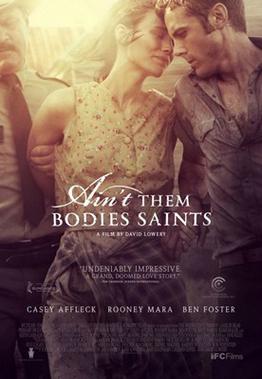
I'll make a bet with you. I swear I'll pay up too if I lose. I would wager that David Lowery is a fan of two things. One, he's a fan of the films of Terrence Malick, few though they are. Two, he grew up watching 1970s crime thrillers set in the South, including Texas. How do I know this you ask? I watched Lowery's film that he directed and wrote, 2013's Ain't Them Bodies Saints, a film with obvious influences from both of the above.
After a botched robbery that resulted in a police officer getting shot, outlaw Bob Muldoon (Casey Affleck) is sent to prison with a 25-to-life jail sentence. He took all of the guilt and blame for the robbery and the shooting, his pregnant wife, Ruth (Rooney Mara), a willing participant and the one who actually shot the officer. Years pass, Ruth has a baby daughter, and life moves on of sorts, Bob writing her almost every day from prison as his sentence wears on. After three-plus years go by, Ruth is shocked when the police arrive to tell her something....Bob has escaped from prison. Does she know anything about the escape, his intentions or where he's heading? Ruth maintains that Bob wants nothing to do with her, holding back the truth, but she knows her husband is coming back to bring them with on a new life. Does Ruth want to go?
When I saw this trailer last spring/summer for this movie, I was immediately intrigued. The visual, the lyrical story, the small-time crooks, all those different stylistic choices, I was convinced this was a film from director Terrence Malick. Convinced of it. I was wrong, Lowery both writing and directing this 2013 film. The influences though are obvious from Affleck's ethereal, dream-like narration, the long shots of open fields and grass blowing in the wind, the music from composer Daniel Hart that's almost trance-like, soothing and calming with an ever-growing sense of doom and dread. It reminded me of Malick's Badlands, of the more recent Cold Mountain, and of countless movies set in the South and in Texas, different worlds when it comes to movie portrayals, especially with crime stories. It's a different sort of crime here, more personal and on a smaller scale.
So what doesn't add up? I....don't....know. Okay, that's not fair, I know, but I'm struggling to explain it. All I can I come up with is this, 'Bodies' doesn't create its own identity. It feels familiar, like we've seen this countless times before. It's too familiar. More than that though, 'Bodies' depends on that familiarity. Lowery's script isn't interested in explaining or in some cases, even addressing how the story develops. It drifts from scene to scene without transitions, scenes of nature and sunsets and grassy hills serving as those transitions. The story is equal parts too fast and too slow because of those seemingly missing scenes that just ain't there. I'm going down a slippery slope here in my criticism. Stories like this force critics' hands. Is it smart because it doesn't spell everything out for us? Or is pretentious, using that as an excuse to gloss over flaws in a story? Lyrical, dream-like only goes so far when those missing gaps are key to....well, everything.
The biggest fatality is the characters. At no point did I feel like I was really invested in any of these characters. Affleck is hit the hardest, his Bob Muldoon going from possibly a tragic anti-hero to a rambling, angry husband and father who may not be all there. Affleck's Bob has two rambling monologues that other characters interrupt to correct/question, painting Bob as something else than we're seeing. Getting out of this unscathed, even representing herself very well, is Mara (a rising star in Hollywood) as Ruth, an almost single mother who's tortured by a decision that tore the family apart. Her scenes with her daughter, Sylvie (played by twins), are effective and moving, especially as she sees this new life she's got isn't so bad. Also coming away looking good is Ben Foster as Patrick Wheeler, the police officer who Ruth shot but Bob took the wrap for. Years later, he's drawn to Ruth, not knowing the truth. Mara and Foster are very good together, the high point in the acting department.
With a small cast, there's really only two other parts worth mentioning. Keith Carradine is misused as Skerritt, an obvious influence on Bob and Ruth growing up....but, yeah, that's all. This is another huge hit because of the script. It's hinted that Skerritt ran some sort of gang in the past -- Bob, Ruth, even his own son included -- and was almost a surrogate father. That's all though. Hinted at isn't enough, too much mystery out there when even a little detail would have gone a long way. Another solid part is from Nate Parker as Sweetie, a bar owner who has a past with Bob, possibly working with him in some criminal undertakings.
No doubt about it, some moments do work. Without anything said or spelled out, it seems the story is set in the 1970s. The folksy musical score underplays the story and what little action there is. A nighttime ambush by three bounty hunters/hired guns with Bob is chaotic and crazy, a chase ensuing with fast-paced, backroads Cajun music playing with it. It isn't enough though, the moments not adding up to a worthwhile package. When things truly fall apart in the finale, we're supposed to feel something, but it's just not there. I was never invested in the characters or their goals or concerns so when the inevitable downbeat ending comes along, it falls short. A disappointing negative review because there was potential for an interesting movie.
Ain't Them Bodies Saints (2013): **/****
The Sons of Katie Elder
"First, we reunite, then find Ma and Pa's killer...then read some reviews."
Showing posts with label Keith Carradine. Show all posts
Tuesday, March 11, 2014
Friday, August 19, 2011
Cowboys & Aliens
When I first read that the movie was going to be made, my first thought was that it could possibly be the stupidest idea for a movie I'd ever heard. When I heard that James Bond and Indiana Jones/Han Solo were then going to star in said movie, I was slightly curious. Then, I saw the trailers this past spring and thought once again "Dear Lord, that looks like the biggest pile of drivel I've ever seen....should I go to the midnight show?" You hear the title and right away you've made up your mind. Are you going to go see it? That's 2011's Cowboys & Aliens.
As I write this review, I've written over 100-plus reviews in a little less than three years of westerns. When I first started doing this blog, I debated doing an exclusive western movie review blog. If you haven't figure it out by now, I L-O-V-E westerns. Even the worst ones I watch -- usually with an open mind -- so that's what ultimately pulled me into this science-fiction western. Not surprisingly the western aspects of the story appealed to me more, and it's got a lot of them; the quiet, lone drifter, the tough as nails old man, stock characters galore, big, wide open locations, the dusty one-street western town, and a showdown in the end that will settle everything once and for all. There just happen to be aliens around who want to wipe out mankind so yeah...that's the movie.
In the Arizona desert in 1873, a man (Daniel Craig) wakes up miles from civilization with no idea where he is or more importantly, who he is. All he knows is that he's got a weird contraption on his wrist that he can't remove. He makes it to the nearest town where he figures out who he is, an infamous bandit named Jake Lonergan. As he's about to be put on an armored stage to Santa Fe, something weird appears in the sky. Fast-moving, powerful spaceships swarm all over, blasting the town to pieces and in the process, kidnapping countless townspeople. A posse is formed to pursue this new species by the local cattle baron, a Civil War veteran named Colonel Dolarhyde (Harrison Ford), with Lonergan and his wrist cannon along for the ride. What do these alien creatures want, and more strangely, why are they kidnapping people left and right?
I don't know what to say or where to start here. You head into this movie knowing that you will in fact be watching a movie where cowboys fight aliens, but then manage to still be surprised when you see it. How often -- if ever -- do you see a genre-bending movie with such two different genres, science fiction and western? What works best (and remember, this is coming from a die-hard western fan) is the western elements of the story. The movie looks great, the California and New Mexico locations being a great scene-setter. Harry Gregson-William's musical score works without being overbearing or obnoxious -- it is at its best in the quieter moments -- but isn't particularly memorable. There's something unexplainable why I did like this movie, mostly because it is a western, and they are becoming few and far between, especially major studio productions.
So how can you go wrong with James Bond and Indiana Jones? Long story short...you can't. Craig is at the point in his stardom where if he's in a movie, I'm in line to see it. The British actor looks extremely comfortable in the western setting, an easy fit for the silent anti-hero, a drifting gunman with little ties to hold him down. He belongs in westerns, and I'd be curious to see what the result would be if just made a straight western, hold the aliens. Ford plays against type to a point, not quite a bad guy but not exactly a good guy either. His Dolarhyde is the tough as dirt cattle baron who growls and grimaces and glares as forms of communicating. It's hard to believe Ford is almost 70 years old, but whatever his age, he's still cool as hell. That qualifies for both men; two badass leading men kicking some alien ass. If that doesn't appeal to you, steer clear.
Watch a western, and you're going to see stock characters appear repeatedly. Director Jon Favreau assembles a crazy (in a good way) supporting cast, making these familiar characters interesting and worth watching because of the talent involved. Olivia Wilde is Ella, a beautiful woman who seems to know more than what she's letting on, a lady with a secret. The mystery comes out late, but who am I kidding? Wilde is drop dead gorgeous so it doesn't matter. Then there's Sam Rockwell as Doc, the saloon owner, Clancy Brown as Meachem, the town preacher, Paul Dano as Percy, Dolarhyde's entitled son, Adam Beach as Nat Colorado, Dolarhyde's Indian tracker, Ana de la Reguera as Maria, Doc's Mexican wife, young Noah Ringer as Emmett, the wide-eyed kid, Keith Carradine as Sheriff Taggart, and Walton Goggins, David O'Hara and Julio Cedillo as members of Jake's former gang. Familiar characters but fun characters too.
There is something primal comparing two genres that are so loved as the western and science fiction. There is something cool about seeing cowboys with Winchesters and six-shooters going toe to toe with aliens wanting nothing more than to wipe us out. The action scenes are that perfect mix of CGI and actual stunts, blending nicely together. The action is on a large-scale but without overdoing it. The ending goes on for a little too long, dragging in parts, but the final shot is an appropriate one, an ending any western fan should be able to appreciate. The movie has its flaws -- the violence is pretty grisly, there isn't much dark humor when there was the potential to have it -- and I'm probably overrating it a bit, but I did like this weird little oddity of a movie.
Cowboys & Aliens <---trailer (2011): ***/****
As I write this review, I've written over 100-plus reviews in a little less than three years of westerns. When I first started doing this blog, I debated doing an exclusive western movie review blog. If you haven't figure it out by now, I L-O-V-E westerns. Even the worst ones I watch -- usually with an open mind -- so that's what ultimately pulled me into this science-fiction western. Not surprisingly the western aspects of the story appealed to me more, and it's got a lot of them; the quiet, lone drifter, the tough as nails old man, stock characters galore, big, wide open locations, the dusty one-street western town, and a showdown in the end that will settle everything once and for all. There just happen to be aliens around who want to wipe out mankind so yeah...that's the movie.
In the Arizona desert in 1873, a man (Daniel Craig) wakes up miles from civilization with no idea where he is or more importantly, who he is. All he knows is that he's got a weird contraption on his wrist that he can't remove. He makes it to the nearest town where he figures out who he is, an infamous bandit named Jake Lonergan. As he's about to be put on an armored stage to Santa Fe, something weird appears in the sky. Fast-moving, powerful spaceships swarm all over, blasting the town to pieces and in the process, kidnapping countless townspeople. A posse is formed to pursue this new species by the local cattle baron, a Civil War veteran named Colonel Dolarhyde (Harrison Ford), with Lonergan and his wrist cannon along for the ride. What do these alien creatures want, and more strangely, why are they kidnapping people left and right?
I don't know what to say or where to start here. You head into this movie knowing that you will in fact be watching a movie where cowboys fight aliens, but then manage to still be surprised when you see it. How often -- if ever -- do you see a genre-bending movie with such two different genres, science fiction and western? What works best (and remember, this is coming from a die-hard western fan) is the western elements of the story. The movie looks great, the California and New Mexico locations being a great scene-setter. Harry Gregson-William's musical score works without being overbearing or obnoxious -- it is at its best in the quieter moments -- but isn't particularly memorable. There's something unexplainable why I did like this movie, mostly because it is a western, and they are becoming few and far between, especially major studio productions.
So how can you go wrong with James Bond and Indiana Jones? Long story short...you can't. Craig is at the point in his stardom where if he's in a movie, I'm in line to see it. The British actor looks extremely comfortable in the western setting, an easy fit for the silent anti-hero, a drifting gunman with little ties to hold him down. He belongs in westerns, and I'd be curious to see what the result would be if just made a straight western, hold the aliens. Ford plays against type to a point, not quite a bad guy but not exactly a good guy either. His Dolarhyde is the tough as dirt cattle baron who growls and grimaces and glares as forms of communicating. It's hard to believe Ford is almost 70 years old, but whatever his age, he's still cool as hell. That qualifies for both men; two badass leading men kicking some alien ass. If that doesn't appeal to you, steer clear.
Watch a western, and you're going to see stock characters appear repeatedly. Director Jon Favreau assembles a crazy (in a good way) supporting cast, making these familiar characters interesting and worth watching because of the talent involved. Olivia Wilde is Ella, a beautiful woman who seems to know more than what she's letting on, a lady with a secret. The mystery comes out late, but who am I kidding? Wilde is drop dead gorgeous so it doesn't matter. Then there's Sam Rockwell as Doc, the saloon owner, Clancy Brown as Meachem, the town preacher, Paul Dano as Percy, Dolarhyde's entitled son, Adam Beach as Nat Colorado, Dolarhyde's Indian tracker, Ana de la Reguera as Maria, Doc's Mexican wife, young Noah Ringer as Emmett, the wide-eyed kid, Keith Carradine as Sheriff Taggart, and Walton Goggins, David O'Hara and Julio Cedillo as members of Jake's former gang. Familiar characters but fun characters too.
There is something primal comparing two genres that are so loved as the western and science fiction. There is something cool about seeing cowboys with Winchesters and six-shooters going toe to toe with aliens wanting nothing more than to wipe us out. The action scenes are that perfect mix of CGI and actual stunts, blending nicely together. The action is on a large-scale but without overdoing it. The ending goes on for a little too long, dragging in parts, but the final shot is an appropriate one, an ending any western fan should be able to appreciate. The movie has its flaws -- the violence is pretty grisly, there isn't much dark humor when there was the potential to have it -- and I'm probably overrating it a bit, but I did like this weird little oddity of a movie.
Cowboys & Aliens <---trailer (2011): ***/****
Thursday, February 3, 2011
McCabe and Mrs. Miller
Revisionist westerns are completely hit or miss with me. Made mostly in the 1960s and early 1970s as Americans and people around the world undoubtedly became a little more skeptical, a little more cynical, these westerns tried to show what the wild west was really like. I go back and forth because I can appreciate the west was not the one so often portrayed in John Wayne movies. It just wasn't a romantic place where everything ended with the good guys winning out. Some revisionist westerns just go too far though. There's a middle ground between the romantic and just ripping apart a myth or a legend for the sake of doing it. One of the best I've come across though, proof that a revisionist look at the old west can be a classic, 1971's McCabe and Mrs. Miller.
Sometimes these westerns are prime examples of the period they were made in. Director Robert Altman is certainly guilty of that here with his folk music soundtrack coming across as too lyrical and just trying too hard overall. But other than the poor choice in music, I feel safe saying Altman makes a nearly perfect western...if you can call this a western. It is one of the most realistic looks a movie has ever given about what frontier life was really like. It was a lawless place where one must fend for themselves. Death lurked around any corner waiting to strike. Maybe it's an anti-western, I really don't know. But just on pure emotion with an ability to tell the simplest, darkest of stories, Altman delivers a winner.
Its the Pacific Northwest in the 1890s, and a man named John McCabe (Warren Beatty) rides into a small, muddy one-road mining town high up in the mountains. He has his sights set on building a successful business for himself and letting the money roll in. The plan goes perfectly as he brings three prostitutes in and goes about building a saloon for all the miners living nearby. McCabe is quickly approached by a madam, Mrs. Constance Miller (Julie Christie), who wants to help him improve his business. Not quite sure if he wants to go into business with a woman as a partner, McCabe wavers before ultimately deciding to do it. It's the right choice, and his business thrives. If anything, it thrives too much though. The company that owns the nearby mines is very aware of his success and wants their fair share of the profits.
At the heart of this movie is Beatty and Christie as these two very similar flawed characters who find a common link between them through their arguments and disagreements. This is the type of relationship that so many westerns attempt to show between a man and woman. It's just natural, never forced. The duo was actually dating in real life apart from the movie, and their chemistry certainly shows. They have an easy-going back and forth in their conversations, whether it be an argument or a quiet discussion as they discuss what to do next. It's also a plus that in two actors like Beatty and Christie, neither made a long list of movies during their careers. They clearly chose quality projects to do, and this is a perfect example.
Altman has that rare knack that few directors have, an artsy reputation who still appeals to a mainstream audience. I like his directing style because it's never in your face. He places his camera there for a scene and lets things develop. He filmed in West Vancouver in the mountains, giving a palatable feel of being separated from humanity in this mountaintop town. It is a gorgeous movie, one that earned cinematographer Vilmos Zsigmond a British Oscar nomination for his camerawork. It is a movie that feels authentic down to its very roots and the muddy streets these characters walk through. The dialogue, the period dress, the sets, the guns, all authentic as possible.
Now I've made no qualms about my preference for darker, cynical movies that shy away from generic happy endings, but this one bugged me to the point where I felt sick as the ending neared. The whole tone of the movie led me to figure out how the story was going to end up, but even seeing it feels like a train just rolled over you. This was 1971, and Altman pulls out all the stops. No one is immune from his wrath, including big and small businesses, lawyers (William Devane in a great one-scene cameo), the church and organized religion, and just about anything else you care to think of in between. Altman comes out firing with both barrels and isn't afraid who gets caught in the crossfire. That said, the ending (as much as I hated it) is the perfect, appropriate finale for this movie. Anything else would have felt inauthentic. The American dream, my ass, Altman is beyond pessimistic here.
Depending on the viewer, certain scenes in a given movie are going to have a different impact or leave an impression. This had several -- the ending obviously -- but one just minutes before that shows how fragile life on the frontier really was. Keith Carradine plays a young man known simply as the Cowboy who stops by McCabe and Miller's whorehouse, enjoys himself, and then prepares to ride out. He's confronted by one of three killers sent to dispatch McCabe and callously gunned down by the man. It is an uncomfortable scene to watch because it's clear where it's building to, and when the gunshot roars to life, you wince at the noise. With the snap of a finger, one unlucky young man is dead as quick as that. Without any pandering to the audience or a big speech explaining what just happened, Altman gets his message across.
More on the ending so SPOILERS from here on in. Three hired guns are sent to this mountain town to force McCabe into a deal or kill him in the process. All three actors are virtual unknowns, making their appearance more ominous. Who are they, and what are they capable of? McCabe has a reputation as a gunfighter, but he really isn't so when push comes to shove he loads his pistol and confronts them, not unlike the showdown at the end of High Noon. He kills them all, but at a price. He's mortally wounded and dies in the snow as a storm rages all around him. Altman films this almost 30-minute sequence with no music and little dialogue to distract from what's happening on screen. Heartbreaking, incredibly moving, however you want to describe it. It's an upsetting but perfect ending for the story.
McCabe and Mrs. Miller <---trailer (1971): ****/****
Sometimes these westerns are prime examples of the period they were made in. Director Robert Altman is certainly guilty of that here with his folk music soundtrack coming across as too lyrical and just trying too hard overall. But other than the poor choice in music, I feel safe saying Altman makes a nearly perfect western...if you can call this a western. It is one of the most realistic looks a movie has ever given about what frontier life was really like. It was a lawless place where one must fend for themselves. Death lurked around any corner waiting to strike. Maybe it's an anti-western, I really don't know. But just on pure emotion with an ability to tell the simplest, darkest of stories, Altman delivers a winner.
Its the Pacific Northwest in the 1890s, and a man named John McCabe (Warren Beatty) rides into a small, muddy one-road mining town high up in the mountains. He has his sights set on building a successful business for himself and letting the money roll in. The plan goes perfectly as he brings three prostitutes in and goes about building a saloon for all the miners living nearby. McCabe is quickly approached by a madam, Mrs. Constance Miller (Julie Christie), who wants to help him improve his business. Not quite sure if he wants to go into business with a woman as a partner, McCabe wavers before ultimately deciding to do it. It's the right choice, and his business thrives. If anything, it thrives too much though. The company that owns the nearby mines is very aware of his success and wants their fair share of the profits.
At the heart of this movie is Beatty and Christie as these two very similar flawed characters who find a common link between them through their arguments and disagreements. This is the type of relationship that so many westerns attempt to show between a man and woman. It's just natural, never forced. The duo was actually dating in real life apart from the movie, and their chemistry certainly shows. They have an easy-going back and forth in their conversations, whether it be an argument or a quiet discussion as they discuss what to do next. It's also a plus that in two actors like Beatty and Christie, neither made a long list of movies during their careers. They clearly chose quality projects to do, and this is a perfect example.
Altman has that rare knack that few directors have, an artsy reputation who still appeals to a mainstream audience. I like his directing style because it's never in your face. He places his camera there for a scene and lets things develop. He filmed in West Vancouver in the mountains, giving a palatable feel of being separated from humanity in this mountaintop town. It is a gorgeous movie, one that earned cinematographer Vilmos Zsigmond a British Oscar nomination for his camerawork. It is a movie that feels authentic down to its very roots and the muddy streets these characters walk through. The dialogue, the period dress, the sets, the guns, all authentic as possible.
Now I've made no qualms about my preference for darker, cynical movies that shy away from generic happy endings, but this one bugged me to the point where I felt sick as the ending neared. The whole tone of the movie led me to figure out how the story was going to end up, but even seeing it feels like a train just rolled over you. This was 1971, and Altman pulls out all the stops. No one is immune from his wrath, including big and small businesses, lawyers (William Devane in a great one-scene cameo), the church and organized religion, and just about anything else you care to think of in between. Altman comes out firing with both barrels and isn't afraid who gets caught in the crossfire. That said, the ending (as much as I hated it) is the perfect, appropriate finale for this movie. Anything else would have felt inauthentic. The American dream, my ass, Altman is beyond pessimistic here.
Depending on the viewer, certain scenes in a given movie are going to have a different impact or leave an impression. This had several -- the ending obviously -- but one just minutes before that shows how fragile life on the frontier really was. Keith Carradine plays a young man known simply as the Cowboy who stops by McCabe and Miller's whorehouse, enjoys himself, and then prepares to ride out. He's confronted by one of three killers sent to dispatch McCabe and callously gunned down by the man. It is an uncomfortable scene to watch because it's clear where it's building to, and when the gunshot roars to life, you wince at the noise. With the snap of a finger, one unlucky young man is dead as quick as that. Without any pandering to the audience or a big speech explaining what just happened, Altman gets his message across.
More on the ending so SPOILERS from here on in. Three hired guns are sent to this mountain town to force McCabe into a deal or kill him in the process. All three actors are virtual unknowns, making their appearance more ominous. Who are they, and what are they capable of? McCabe has a reputation as a gunfighter, but he really isn't so when push comes to shove he loads his pistol and confronts them, not unlike the showdown at the end of High Noon. He kills them all, but at a price. He's mortally wounded and dies in the snow as a storm rages all around him. Altman films this almost 30-minute sequence with no music and little dialogue to distract from what's happening on screen. Heartbreaking, incredibly moving, however you want to describe it. It's an upsetting but perfect ending for the story.
McCabe and Mrs. Miller <---trailer (1971): ****/****
Saturday, April 17, 2010
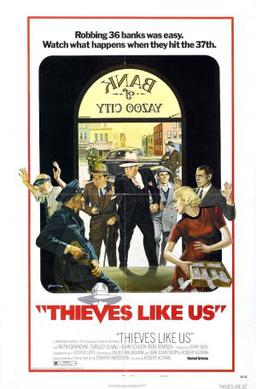
Thieves Like Us
Directed by the master of the period drama, Robert Altman, 'Thieves' is an incredibly realistic, very truthful retelling of the 1930s and the life of crime that was often a direct result of the tough times. From the clothes to the sets to the almost-constant radio programming in the background, this movie feels like the 1930s. That decade had a certain look that translates well to movies. And instead of focusing on John Dillinger or some of the other high-profile crooks of the era, Altman focuses on three low-level bank robbers making their way across the south with eyes on acquiring as much money as possible.
Escaping from a prison work farm in the deep south, Bowie (Keith Carradine) and Chicamaw (John Schuck) team up with a third escaped convict, T-Dub (Bert Remsen), and hit the road. Bowie's two new partners both have some experience as bank robbers so the trio decides to hit a couple banks to help them live a better life. And at first, things go smoothly, but soon enough, their names and pictures are plastered across several states with a reward posted for information on them. In between jobs, the trio splits up with Bowie moving in with a girl in Mississippi, Keechie (Shelley Duvall), who wants him to leave his gang. But Bowie feels pulled both ways because he loves Keechie, but Chicamaw and T-Dub are his only friends in the world. With the noose tightening around their necks, the young, naive criminal is forced to make a decision.
In 1974, Carradine was one of many rising stars in the movies, but he never became a huge mega-star. Maybe it was for the best, he was always so strong in smaller movies like this one that were focused on story and character above all else. His Bowie is the main character in 'Thieves' and a likable one at that. He gets involved with two veteran crooks, and it's usually those two where the violence comes from. Bowie sticks with them because it's all he knows. Most of the time, he serves as the getaway driver. The other plotline is the relationship that develops between him and Keechie which is surprisingly sweet and effective. They're both naive to just about everything, and end up being a perfect match together.
It's a good thing that Carradine and Duvall are likable because with a gangster story, it's not always easy to get behind the main characters. Don't expect a whole lot of action here, instead it is more of a budding love story with a few bank robberies thrown into the mix. As for Bowie's partners, the two performances are equally strong if not equally likable. Schuck's Chicamaw is a drunk and an angry one at that, while Remsen's T-Dub provides some funny moments with his boasting of all the robberies he's lead, but he ends up coming off as a horny old guy. Other worthwhile supporting parts include Louise Fletcher as Mattie, T-Dub's sister-in-law, and Ann Latham as Lula, T-Dub's main squeeze who I think is also a relative. Tom Skerritt is wasted as Dee Mobley, Keechie's uncle who helps Bowie and Co. following their robberies.
All the positives aside, I had some issues with the movie. Altman is in no rush to move his story along with a leisurely 123-minute run time. That's all right with many stories because the end result is always in site down the road somewhere. SPOILERS Stories with 30s crooks typically don't end well for the crooks because eventually the cops/FBI/authorities close in and finish the job. By the end, T-Dub and Bowie are dead with Chicamaw's fate left undecided. We don't see any of this though. T-Dub is killed off-screen, and we hear about it via a radio report, and Bowie is ambushed in a small cabin, but we only see the shooting from the outside. I'm not calling for a gory, viciously bloody ending, but by this point, I've come to like the characters flaws and all. Just hearing about their deaths or knowing what's happening isn't enough. And in a way, I feel cheated. END OF SPOILERS
Good and bad, I did like this movie, but I didn't love it. Watching a story about 1930s era gangsters, it's hard not to compare Thieves Like Us to movies like Bonnie and Clyde, Dillinger, and even more recently with Public Enemies. It's an enjoyable enough movie, but it's not on the level of those three movies. A sometimes too leisurely pacing does slow the movie down too much, and some creative choices Altman made ended up bugging me a lot in terms of character. I wanted to like it more, but it is a quality movie and quite a window into the 1930s.
Thieves Like Us <----trailer (1974): ** 1/2 /****
Labels:
1970s,
Gangsters,
Keith Carradine,
Robert Altman,
Tom Skerritt
Subscribe to:
Posts (Atom)