The Sons of Katie Elder

The Sons of Katie Elder
"First, we reunite, then find Ma and Pa's killer...then read some reviews."
Showing posts with label Gert Frobe. Show all posts

Monday, June 2, 2014

Those Daring Young Men in Their Jaunty Jalopies

When I think of the big roadshow epics of the late 1950s and into the 1960s, I typically think of historical epics, big period pieces with casts of thousands. There were the comedies out there too though, like the classic 1963 road epic It's a Mad, Mad, Mad, Mad World, 1965's The Great Race and on a slightly smaller scale, 1965's Those Magnificent Men in Their Flying Machines. By 1969, the big road epic comedy had played out its course....almost. A quasi-sequel to 'Machine,' here's 1969's Those Daring Young Men in Their Jaunty Jalopies.

It's the 1920s and the Monte Carlo Rally, a race across Europe ending in Monte Carlo, is fast approaching. Racers from all over the world are heading to several different starting points around Europe hoping to win the prestigious race. Among them? Sir Cuthbert Ware-Armitage (Terry-Thomas), an Englishman with a mean, devious streak up his back, looking to save his father's car company. His opposition and co-owner courtesy of a shrewd poker move? Fun-loving, kooky American, Chester Schofield (Tony Curtis), who has some big ideas about what to do with the far-more traditional English cars. The two men agree to race for it all, whoever beats the other in the Rally takes complete control of the company. But with racers from all over the world coming to compete, this will be one crazy race.

Dubbed Monte Carlo or Bust! for international audiences, 'Jalopies' is a sequel to 1965's air adventure, director Ken Annakin returning while also writing the screenplay with Jack Davies. It features an animated credit sequence, a title song sung by Jimmy Durante, and goes for that same stylish effect that previous road comedy epics went for. At 122 minutes, it's relatively short compared to its predecessors, Annakin forced to cut anywhere from 10 to 30 minutes depending on the market (and the source). What's left? A movie that's unfortunately a little lackluster in just about all accounts. It's not as funny as it wants to be, not as stylish and entertaining as it should have been. It's not bad, but it's not good either.

While it isn't my most original critique, all I can say here is that 'Jalopies' simply tries too hard for its laughs. The sped-up physical comedy sequences -- cars, drivers and spectators moving at ridiculously fast speeds -- are goofy for their own sake. Funny here and there, tedious when used time after time. The same for the BIG sequences, like two drivers navigating an iced-over lake full of hockey players. How many times can we see a car sliding/drifting and people jumping out of the way before you just want to turn it off? Well, I don't know the answer there because I lost track, and for the sake of the review, I finished the movie out, hoping at some point it would get better. It didn't really, a big disappoint because I enjoyed the other three previously mentioned road epics so much. They can't all be winners I guess. 

The cast is good and bad, some undone by uninteresting characters, others by the over-reliance on the physical humor, and some by a script that gives them little to do. A star of The Great Race, I liked Curtis as American racer Schofield (favoring 'Zowee!' as one of his go-to phrases) who commits to the goofiness but never really overdoes it. He's given a driving partner of sorts, Susan Hampshire's Betty, who may or may not be trying to slow him down. As his English counterpart, Thomas is good as Cuthbert (Thomas played Cuthbert's father in 'Machines'), the definition of an Englishman, this one so desperately trying to stop Schofield -- and all the other racers for that matter. Also returning is Eric Sykes as Perkins, Cuthbert's much-maligned and blackmailed assistant. This rivalry is the only one that was really appealing to me, the rest falling short here and there.

One of the other positives is Peter Cook (Major Dawlish) and Dudley Moore (Lt. Barrington), two British army officers driving together, Dawlish unleashing all his new-fangled inventions with every opportunity. Their very British demeanor provides some good laughs. Who else to look out for? Another star from 'Machines' but in a different part, Gert Frobe plays a convict look-a-like recruited to race as a famous racer (with Peer Schmidt as his partner)...and smuggle some diamonds for an underused Jack Hawkins (playing a sinister Count). There's also two Italian police officers (Lando Buzzanca and Walter Chiari), one looking for glory, one looking not to get married to an ugly woman, and a female racing team that includes Mireille Darc, Marie Dubois and Nicoletta Machiavelli who I don't believe are ever identified by name. They look pretty. That's their requirement for being there. Also, Bourvil plays the champagne-guzzling race organizer.

When 'Jalopies' gets down to it, there are some entertaining racing sequences. We see 1920s-era cars -- not exactly sleek racing cars -- bombing across Europe (with some great on-location shooting across the continent), especially the finale as the remaining racers gun it into Monte Carlo. There's just too little of it, and far too much use of miniatures and green screen work for a whole lot of sequences. In the end, a disappointment. If you want to be funny, just tap the brakes some and let it happen.

Those Daring Young Men in Their Jaunty Jalopies (1969): **/****

Wednesday, April 10, 2013

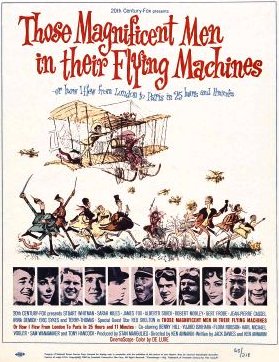
Those Magnificent Men in Their Flying Machines

The roadshow epic is unfortunately a thing of the past, a symbol of a Hollywood era that ruled through the 1950s and early 1960s. Even the lousy ones have something worthwhile. For me, I love the huge scale, the intro music, the intermission, the casts of thousands. By the mid 1960s though, things, they were 'a changing, and the epics were becoming a thing of the past. One of the last films hitting theaters before the era completely died out was a good one, 1965's Those Magnificent Men in Their Flying Machines.

It's 1910, and British army officer Richard Mays (James Fox) is among a small group of pilots worldwide who are helping advance aviation just seven years since the Wright Brothers flew at Kitty Hawk in 1903. He's sorta-engaged to Patricia Rawnsley (Sarah Miles), the daughter of Lord Rawnsley (Robert Morley), a newspaper owner disgusted at the thought of other countries' pilots advancing quicker in aviation than England. Using all his pull, Lord Rawnsley organizes an international air race from England to Paris that will show once and for all who is the best pilot around. Pilots from around the world travel to England with their flying machines with the hopes of winning the race and its lucrative prize. Among them, Orvil Newton (Stuart Whitman), an American cowboy, with his eyes set on the race, the prize, and maybe Patricia too. Uh-oh, America vs. Britain!

Working with Jack Davies to write the script and direct the film as well, Ken Annakin was a huge fan of aviation, and it shows with this 1965 epic. Setting the story in 1910 is a great touch as aviation and flying were still in its infancy. There weren't airlines or commercial jets. Individuals -- not businesses -- were trying to figure out what worked and didn't work in flying. Flying machines (yes, planes) flew much closer to the ground, couldn't stay in the air that long, and had a variety of mechanical and structural issues. Sounds fun, huh? And a little dangerous? Yeah, just a little. Check out the Wikipedia link HERE for an idea of the variety of planes featured here. There's some doozies in the group, definitely making you appreciate the modern jet airliner.

In the vein of The Great Race and It's a Mad, Mad World, 'Flying' is big and flashy but never gets too big or unwieldy. An opening montage with Red Skelton starring as individuals through history learning how hard flying can be (Neanderthal, Ancient Greek, Middle Ages, Victorian), leading right into the cartoon credits played under the Flying Machines theme song (listen HERE). I liked Ron Goodwin's score a lot too, similar to his score four years later in The Battle of Britain. Much of the story was filmed at the Brookley Motor Racing Track, helping give a real sense of 1910s aviation with its lush green fields serving as landing strips, immense wooden hangars housing the new wave of planes, and an outfitted windmill serving as a lookout point for Fire Chief Perkins (Benny Hill). The aerial sequences are impressive, even on the pre-takeoff as we see hundreds and thousands of extras lining the airfields.

The one thing lacking here from most other roadshow epics is huge star power. There are some really solid actors/actresses here, but there's no gigantic star(s). Whitman and Fox get the leads as the American and British pilots, fighting to win the race but also to win the lady. Thankfully, this storyline isn't too painful to watch, bouncing among a handful of different pilots. Some of the other international pilots include Count Emilio (Alberto Sordi), the Italian family man with a penchant for crashing, Pierre Dubois (Jean-Pierre Cassel), the loving life Frenchman, Sir Percy (Terry-Thomas), the sabotaging Englishman with his maligned assistant, Courtney (Eric Sykes), Yamamoto (Yujiro Ishihara), the experienced Japanese pilot and the race favorite, Capt. Rumplestoss (Karl Michael Vogler), the inexperienced but proud German army officer, and MacDougal (Gordon Jackson), the fun-loving Scotsman. Not much star power, but we get a lot of memorable characters with some truly funny recurring bits.

While the scale on a large scale is always impressive, it's the recurring bits that help bring the movie up a notch. It's fun seeing Orvil and Richard go toe-to-toe, the American always looking good in heroic fashion. There's also Dubois swearing he's seeing the same girl over and over again, Irina Dernick playing all of the women. In a pre-World War I time, there's also national rivalries, the English believing they're better than anyone, the Germans doing the same, and the Italians and Frenchmen having fun at their expense. Dubois and his French crew constantly mess with the Germans, especially their commander, Colonel Manfred (scene-stealing Gert Frobe) and Rumplestoss. There's also James Robertson Justice making a quick appearance as the narrator, deadpanning his way through the Skelton bit, Flora Robson as Mother Superior, a nun with an incentive to help the race, Sam Wanamaker as Orvil's partner and friend, and an uncredited Ronnie Stevens as the race's public address announcer.   

'Flying Machines' isn't as long as many epics, wrapping up in just 138 minutes as opposed to so many other three-hour monstrosities. Much of the first 90 minutes is spent on the ground getting to know our pilots, including a whole lot of hijinks and shenanigans as our international lineup tries to outdo each other. The last 50 minutes focus on the race with some impressive aerial sequences, our antiquated looking planes flying across England, the English Channel, and finally Paris. I loved this movie, and more so as it went along. No star power? No problem. It's a gem, and one of the last true roadshow epics. Enjoy it.

Those Magnificent Men in Their Flying Machines (1965): ****/****

Friday, August 28, 2009

Triple Cross

The mid 1960s were a ripe time for historical movies with international casts, huge stories, and big budgets, from Roman times epics like Spartacus and The Fall of the Roman Empire to more modern stories like The Longest Day and Battle of Britain. The problem is that many relied too much on the stars to make something of the movie with nothing to back them up. One that comes through and doesn't just rest on its laurels is 1966's Triple Cross.

Behind the lines spy stories from WWII can be hard to mess up when translating stories to the big screen. There's typically going to be a strong villain, Germans or Japanese depending on the perspective, and a natural tension that livens up any story. Based on the true story of British criminal/spy Eddie Chapman, Triple Cross drags at times but ultimately comes through with a quality WWII spy story.

In the months leading up to WWII, British safecracker extraordinaire Eddie Chapman (Christopher Plummer) is stealing his way across the country, taking anything and everything he can from personal safes in houses and apartments. But vacationing on the Channel Islands, Chapman is captured and thrown into jail where months later he still resides when the Germans invade and take over. Fed up with his lot, Chapman offers his services to the German army as a spy. His English background and speaking abilities would clearly serve the Third Reich.

After some initial debates and tests, Chapman is sent to work a specialized German intelligence unit led by Baron Von Grunen (Yul Brynner), a career soldier and German colonel who doesn't necessarily agree with the Fuhrer and the Nazi party but nonetheless does his job. With the Baron's team are the Countess (Romy Schneider) who starts a relationship with Chapman, partially for herself but also for the job, and Colonel Steinhager (Gert Frobe), a former police officer suspicious of Chapman's intentions. The British turncoat goes through training and ends up as a trusted agent to Von Grunen, but what are his motivations?

Credit goes to Plummer for doing so well with this part because up until the 1:00-1:15 mark, you're not sure of his intentions. Is he a loyal Brit taking advantage of the situation to get back to England or does he intend to help the German war effort? Or is Chapman just looking out for himself and a chance at a big payday courtesy of the British and German intelligence outfits? Plummer plays the part so smoothly it's hard to figure out the character. He typically played a character like that, extremely smug, often overconfident that makes it hard to like him, and even when the intentions are revealed, you're not quite sure if you can believe them.

Directed by Terence Young and with Frobe as a supporting cast, the James Bond trio is completed with the casting of Claudine Auger (Domino in Thunderball). Kinda pointless trivia, but I thought worth pointing out. Trevor Howard also makes an appearance as the 'Distinguished Civilian,' no joke, a British higher-up working with Chapman on his possible collaboration with the British and Germans. It's the typical staunch, sophisticated British upper class role that Howard played so often and so well. Brynner too stands out in the cast as the intelligence colonel who sees the direction the war is going.

What I liked about Triple Cross was that the story doesn't settle for the spy adventure status-quo. One scene really jumped out for me when the Germans supposedly send Chapman out on his first mission, parachuting him into England. Thinking everything is legit, Chapman abandons his orders upon landing only to discover he's been dropped in Nazi-occupied France as a test. Scrambling to send the radio signal he was supposed to transmit an hour earlier, Eddie finds himself in a race for his life. And that's what is so nerve-wracking about spy movies. One slip up, even just a throwaway comment, can bring on your doom and when that dooms comes from the Nazis, you know you're in for it.

At times a little slow-moving and hard to follow, Triple Cross isn't the perfect spy thriller or even a very good one, but it is entertaining. Christopher Plummer and Yul Brynner provide memorable leads, and the based on a true story (loosely from what I've read) provide a nice backdrop for this WWII thriller. It seems the US version has been cut some so that might explain some flaws, but it's still worth checking out in its current form.

Triple Cross (1966): ***/****