Ever heard of a carpetbagger? It is a particularly nasty piece of American history. Following the Civil War, they were northerners who moved into the south looking to make a profit off the Reconstruction Era. You see them briefly in Gone With the Wind, even a John Wayne western like The Undefeated, but because it was such a despicable profession of sorts...well, we're not going to see a whole lot of movies about them. When we do, like 1953's Thunder Over the Plains, they're the easiest of villains to root against.
It's 1869, some four years removed from the end of the Civil War, and the wounds are still fresh from the war. Texas has not yet been readmitted to the Union as a state with tensions high as carpetbaggers ravage the Texans trying to get back on their feet with corruption and high taxes. A Robin Hood-like bandit, Ben Westman (Charles McGraw), has stepped forward and with a small, loyal gang wreaks havoc on the carpetbaggers' efforts to earn their ill-got profits. A Texan who fought on the Union side and remains in the cavalry, Capt. David Porter (Randolph Scott) finds himself in a sticky situation. He tends to agree with Westman's actions, but he's honor-bound by duty to try and bring Westman to justice. All sides are pulling at the captain, both inward and outward, as he deals with pressure from his own commander, his wife, his fellow officers and the $-for-eyes carpetbaggers.
By the 1950s, star Randolph Scott was doing westerns exclusively. From 1945 on, Scott only made two non-western films. Think about that. This was a man who knew what he wanted, what he liked doing at work, and what audiences wanted to see him do. John Wayne would take a similar approach in the latter stages of his legendary career. The issue becomes that other than Scott's pairings with director Budd Boetticher (7 different films) and later Sam Peckinpah (Ride the High Country), his 1950s westerns are typically okay at best and dull and far too familiar at worst. Unfortunately, 'Thunder' falls into that category. While it has some potential and Scott is reliable as ever, it's just missing that special something and ends up going off the rails near the halfway point.
That ends up being the most frustrating part in this western from director Andre de Toth. 'Thunder' has a ton of potential. For a 1953 western, it's surprisingly dark. The post-Civil War setting in Texas during Reconstruction isn't exactly commonplace in the genre. There is a variety of characters with some great heroes and equally awful villains. But in a movie that runs just 82 minutes, it can't sustain that energy. The story begins to meander near the 45-minute mark and limps to the finish. One pretty major subplot isn't even addressed or given a worthwhile resolution....so yeah, that kinda sucks. Everything gets all jumbled together with too many characters and twists and secondary plots, and the ship never rights itself. A western that could have been pretty good ends up being disappointing and below average.
So while I'm not a huge fan of Randolph Scott's western, I am a big fan of Scott himself. This is a part he specialized in, the resolute, loyal and tough as nails western hero who's going to do what's right no matter what it takes. A sheriff, a cavalry officer, a drifter, he played tweak versions on this throughout the last 17 years of his career and did it well. He's undone by a script that has his Capt. Porter simply trying to keep too many plates spinning. At home, his wife (Phyllis Kirk) incessantly talks about leaving for a different post. At the fort, his friend and commander (Henry Hull) nags and nags without actually offering any help. As well, a new officer arrives in the form of Capt. Bill Hodges (Lex Barker), who resents the posting, isn't too partial about using his new silver pistol and has his eyes set on Mrs. Porter. It's not Scott's fault. All the way, he's going for it. A true pro even in one of his lesser efforts.
Who else to look for? Buried deep in the credits are Hugh Sanders and Elisha Cook Jr. as the corrupt carpetbagger and the the equally corrupt tax commissioner sticking it to recovering Texas. In the familiar face department, look for Lane Chandler, James Brown and a very young Fess Parker in supporting roles.
I wish I liked this one more. Scott is excellent, and McGraw's Ben Westman is a very cool character that is underutilized. I would have loved to see a movie that focused far more on those two characters and their very interesting dynamic. As is, 'Thunder' disappoints. It has potential, but it never delivers unfortunately.
Thunder Over the Plains (1953): **/****
The Sons of Katie Elder
"First, we reunite, then find Ma and Pa's killer...then read some reviews."
Showing posts with label Henry Hull. Show all posts
Tuesday, March 17, 2015
Wednesday, January 14, 2015
The Sheriff of Fractured Jaw
Here's an odd formula for you. A very British actor, a busty bombshell, a British western (British?!?) and filming locations that would go onto bigger and better things within five years. What does all that add up to? A mostly entertaining, often fascinating 1960 western, The Sheriff of Fractured Jaw.
The son of the owner of a firearms company based in England, Jonathan Tibbs (Kenneth More) is looking for something to do. He doesn't feel quite at home in his father's company and is more comfortable building all sorts of crazy gadgets and contraptions. It doesn't take Tibbs too long to figure out a solution. Reading the newspaper one day, he reads a story about the violent wilds of the American west...where guns are quite prevalent. His rationalization? Where there's violence...there's guns so Tibbs packs up and heads to the American west in hopes of expanding his father's business. After plenty of travel, he ends up in the lawless town of Fractured Jaw where sheriffs can't seem to stick around too long. Well, they've got a new one. Through a series of misunderstandings and miscommunications, Tibbs becomes the new sheriff and the key to getting through it? A tough saloon owner, Kate (Jayne Mansfield), who takes a liking to the semi-clueless Brit.
Go figure. This oddball, schizophrenic formula....it kinda works. In one of his last films, director Raoul Walsh helms this goofy, off the wall western. He was past his heyday back in Hollywood's Golden Age, working often with swashbuckling star Errol Flynn, but it's just one more choice you'd think wouldn't work but ends up working quite well. I'll watch anything western but a British western? It wouldn't/shouldn't seem to fit. Look, this isn't a classic. Far from it, things falling apart nicely in the last 30 minutes. When it does work, it's a pleasant change of pace, an entertaining mess. Oh, and those filming locations? 'Fractured' films on-location in Almeria, Spain where in about four years hundreds of spaghetti westerns were filmed. Makes sense, don't it?
Okay, let's cast a male and female lead, two actors who you'd never think would star in a British comedy western together. Hmm, and they're going to have to show off some lovey-dovey chemistry? How about Kenneth More and Jayne Mansfield? DONE! But once again, 'Fractured' gets the last laugh. More is by far the best thing the movie has to offer. A character development that depends on misunderstandings sounds tenuous at best, but More just commits. He plays it all straight and never seems to be going really hard at getting the laughs. He just gets them. The fish out of water routine -- the gentlemanly Brit in the rough and tumble west -- works over and over again. More's Tibbs is a gentleman, polite and trying to make friends and in the process never seems to realize he's doing everything in about the exact wrong way you're supposed to do it. An example? Indians attack the stagecoach he's on so naturally he tries to approach them peaceably to tell them to stop. Oh, by the way. His plan works.
Because More is so good, the chemistry with Mansfield works. One of the biggest sex symbols of the 1950s and into the 1960s, Mansfield isn't a great actress but she makes a go of it. She's here to look sexy, wear very tight dresses and let her natural endowments do the rest. She also sings three different songs, but she's dubbed so that's not her real singing voice. Instead, we're left to consider how anyone could actually be built like that. She's a real-life Barbie doll!
Who else to look for? Some familiar western faces to help ease viewers into...GASP...a British western!!! Henry Hull gets the most screentime as Masters, the Mayor of Fractured Jaw who likes Tibbs immediately, even if he has no idea that his new sheriff can barely handle a gun, much less live up to a reputation of a hardened fast draw. Also look for Bruce Cabot as a rancher who wants to test Tibbs, William Campbell as the real deal, a real fast draw and gunfighter, and Robert Morley as Tibbs' uncle.
So 'Fractured' runs about 103 minutes and for 60 minutes or so, it's really good. Then it takes a detour it never really recovers from. More's Tibbs gets caught up in a sticky situation with two warring ranches and their armies of gunslingers as well as an Indian tribe looking to stir up some trouble. The fish out of water bit wears a little thin as things are stretched out to fill that running time. Still, the first hour is really fun, and I enjoyed it a lot. So in the end, it's an enjoyable mess with some surprisingly good performances. Yep, a British comedy western actually works. I would have bet big money against that thought!
The Sheriff of Fractured Jaw (1960): ** 1/2 /****
Tuesday, January 6, 2015
Inferno
Your leg is broken. You have limited supplies, some water and nothing really but your wits about you. Miles from help and with no way to contact help, you are alone and isolated in the middle of the desert. What do you do? That's 1953's Inferno, an early survival flick, one of the earliest I can even think of.
Leaving a small camp and tracks all around them, a man (William Lundigan) and a woman (Rhonda Fleming) ride out of the desert back to the family ranch miles away. The ranch belongs to the woman's husband, but where is he? The man, Donald Carson (Robert Ryan), is alive if not well, alone in the desert. While riding together out in the desert with his wife, Geraldine, and friend, Duncan, Carson sustained a broken leg and because it was too risky to move him, both Geraldine and Duncan promised to ride for help. Will they? Nope, that's not the full plan. The duo are just days into an illicit affair and took advantage of the situation when Carson hurt himself. They intend to mislead search parties and any rescue effort so that Carson -- crippled and running out of food and water -- dies in the process. They planned just about everything they could except for one thing, Carson's will to live once he figures out he's been double-crossed.
Add this 1953 survival drama to a long list of movies I so politely call 'Wait...What? I've never even heard of that. Why?' From director Roy Ward Baker, 'Inferno' has the feel if a film noir was set in the desolate desert. It's got all the fixings. An anti-hero of sorts who lives fast and hard (Ryan), the sizzling femme fatale (Fleming) and the conniving scoundrel (Lundigan), all mixed up in a sordid affair. Instead of a mob betrayal or backstabbing over money, it's about a marriage with problems and the wife's way to seemingly get out of it clean. It was filmed on location the Mojave Desert, providing quite the visual backdrop for the survival story and clocks in at just 83 minutes. Why has it generally been forgotten since the 1950s? Your guess is as good as mine.
It's a good but far from great movie. The biggest positive is pretty easy to peg, and that's Robert Ryan, leg broken, beard/stubble growing quickly, and his grasp of sanity quickly fading away. What's his motivator? It doesn't take long for him to figure out his wife and business partner have left him out in the desert to die. Ryan is one of the best actors in Hollywood history thanks in great part to his ability to bounce back and forth between good guy and bad guy roles and do it well. This is the flawed anti-hero. We're rooting for him, but as we learn more about him we start to see it's not like this is one immaculate fella. He's flawed, but whatever he's done, he's been wrong. Abandoned and left to die, he's on his own.
That's the movie at its strongest. The movie is never long, but it struggles when we're away from Ryan's Carson out in the desert. It is an incredibly physical part, a man with a broken leg and no way to get out of the desert other than to start crawling his way toward safety. On his own, he's got no one to talk to so we interact with him via his voiceover. This is a man on the brink of losing it, of giving up and dying so we hear his thoughts, his plans, his rationalizations as everything comes together about his betrayal at the hands of his wife and business partner. The camera is on Ryan and Ryan alone, and this Hollywood legend doesn't disappoint. It isn't mentioned as one of his stronger performances, but it certainly belongs in the conversation.
Unfortunately, the wheels sort of come off when Ryan isn't around. Having left him to die, Fleming and Lundigan talk about their plan, about how to make sure how it could go wrong, about how things could go wrong and do so quickly. It just ain't that interesting. Things really get out of hand late in an action-packed finale that really comes out of left field. To that point, it's been all about survival and making it through so the shift in tone didn't necessarily work for me. For the rest of the cast, look for Larry Keating as Carson's lawyer who knows all the good and bad, Henry Hull as a local rancher working to track Carson, and Carl Betz and Robert Burton as two officers involved in the search. A good survival story but some big issues.
Inferno (1953): ** 1/2 /****
Monday, August 18, 2014
The Buccaneer
Ever heard the name Jean Lafitte? If you're a history buff, you should have. A French pirate and privateer, Lafitte operated out of New Orleans and the surrounding bayous through the early 1830s. His name though remains in American history for a big reason, Lafitte helping then-General and future President Andrew Jackson to victory at the Battle of New Orleans in 1815. It's a story told in a generally forgotten film from 1958, The Buccaneer.
War has broken out between the young United States of America and Great Britain, the power up for grabs after British forces capture Washington D.C., the American government barely escaping. Down in Louisiana, New Orleans is bracing for an attack, a small American army commanded by General Andy Jackson (Charlton Heston) ready to hold off a far superior British army. New Orleans will be the key as whoever holds the river will control the Mississippi River. The key to it all? A powerful, rich pirate named Jean Lafitte (Yul Brynner) who helps control the mouth of the Mississippi with his fortified pirate colony. Whichever side he sides with will have all the power and both the British and Americans are desperately trying to convince him. They're both very convincing, but what will Lafitte decide in the end?
Of all the wars America has fought in since the American Revolution in the 1770s and 1780s, the War of 1812 has to be one of those most easily forgotten. I can't even think of another film about the war. 'Buccaneer' is also noteworthy for its director, an actor making his only appearance behind the camera. Who you ask? That would be Anthony Quinn, Zorba himself taking a shot at directing. It is rumored that famed director Cecil B. DeMille did direct some of the movie while also appearing on-screen early for the prologue that sets up the history of what we're about to see in the film. What it tries to accomplish is admirable, bringing a part of American history to light that hasn't gotten the amount of attention that other wars, conflicts and incidents have. What it accomplishes in the end? That's more up in the air.
The biggest positive is Yul Brynner as infamous French pirate Jean Lafitte. As portrayed here, he's probably a little idealistic (but that's more the tone of the movie) as to the historical figure, but Brynner does a solid job. This is a man caught in the middle and trying to figure out what's his best play, whether it be with the British or the Americans. He thinks selfishly, knowing whichever way he chooses will affect his vast fleet of pirates but also thousands of other people. Dressed up as a bit of a dandy -- in one of the few roles I can think of where Brynner sports hair, even if it is a wig -- Brynner commits to the part. He has some fun with it, the best thing going in a story that tries to accomplish a lot in terms of scale and characters and history. His struggles are interesting throughout, a bit of a doomed character, and his scenes in the second half of the movie with Heston's Jackson provide the movie's strongest points.
The rest of 'Buccaneer' is more of a mixed bag. One of my biggest questions involves the sets. The entire movie is filmed on indoor sets, giving the story an odd, even cheap look. In some scenes, like the battle of New Orleans, it adds a cool claustrophobic effect to the proceedings, but for the most part it limits the potential. It's going for an epic scale, full of a long list of characters and big history, but never quite gets there. In other words, the DeMille touch...sorta. Everything is polished and colorful and too clean for an 1810s world. A pirate world at that! It's more than that though, a story that bounces around too much and simply takes too long to get where it needs to be. The last 45 minutes are 'Buccaneer' at its strongest, but the first hour and the last 15 minutes drag a bit too much. Elmer Bernstein's score is okay but not up there with his best.
So DeMille loved his epics, right? Nowhere else is that more evident in the casting. Check out the full cast and crew listing HERE. There's 200-plus names, a whole lot credited, a whole lot more uncredited. Just too much going on all over the place. There's Claire Bloom as the fiery daughter of a rival pirate captain, Charles Boyer as Lafitte's very French second-in-command, Inger Stevens as the beautiful daughter of the Louisiana governor (E.G. Marshall), Heston as Andrew Jackson, Henry Hull as his backwoods, buckskin wearing assistant, Lorne Greene as a rich resident of New Orleans, and George Matthews as Lafitte's loyal henchman of sorts. That's only part of the cast. There's too many familiar faces and recognizable names to mention. Among Lafitte's pirates we see Woody Strode to John Dierkes and many more. If you ask me, it speaks to a movie that was edited some heavily in post-production.
If you stick around, the second half is significantly better than the first half. The battle of New Orleans isn't a long, drawn-out battle but what's there is enjoyable. Parts of the movie are really good but as a whole it wastes much of its potential. Too bad.
The Buccaneer (1958): **/****
Monday, June 16, 2014
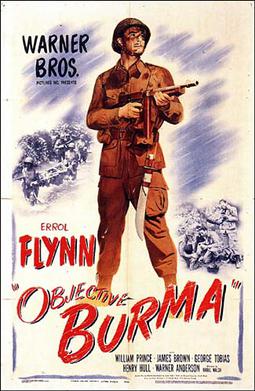
Objective, Burma!
With any actor or actress with a devoted fan following, that following is going to have differing opinions. What is your favorite film? This one or that one? All of them? When we're talking about an actor who worked over multiple decades, it gets that much tougher. Take Errol Flynn who started working in the 1930s and stayed in films through the 1950s. He's got more than a few gems to his name, but my favorite is and always will be 1945's Objective, Burma!
It's 1944 in Burma and Allied forces are preparing to invade the country they were kicked out of by Japanese forces two years earlier. The men across the branches are just waiting for their orders. Among the forces waiting to unleash the attack is Capt. Nelson (Flynn), an officer in command of a platoon of paratroopers. With his friend and second-in-command, Lt. Sid Jacobs (William Prince), Nelson will lead a behind the lines mission into Burma, his men tasked with finding and destroying a key radar station used by the Japanese forces. A 2,000 man garrison isn't too far away from the radar station, meaning Nelson's paratroopers must drop in miles away and find the hidden radar station, all the while avoiding thick Japanese patrols. With a newspaper reporter, Mark Williams (Henry Hull), along to report on the mission, the paratroopers take off from their base with a dangerous mission ahead of them. As prepared as they are though, nothing can really prepare them for what awaits.
What a great movie, one that qualifies in the overused at times but appropriate 'They don't make them like that anymore' category. As far as pure action/adventure movies go, this 1945 WWII flick from director Raoul Walsh is simply hard to beat. It was released in theaters in early 1945, the war winding down but the fighting still very much going on both in the Pacific and Europe. It was a movie ahead of its time, patriotic but not flag-waving and propaganda thankfully. With an Oscar-nominated score from composer Franz Waxman (one that would be used again in the similarly-themed Merrill's Marauders), the action in the 142-minute movie is always on the go, never really slowing down. You feel like you're there with the soldiers, seeing their exhaustion, beards and facial hair appearing as the mission goes awry. It's the perfect popcorn movie, but there are other layers and levels to appreciate. A war movie that still resonates almost 70 years later.
At the tail end of his heyday in terms of popularity, Flynn is the without a doubt, no question star here. I love his performance, especially because he switches things up a bit. Flynn was Robin Hood, a pirate, a swashbuckler, a ladies man, but here, he is just a very capable, very tough and well-liked officer. His Captain Charlie Nelson has been tasked with a dangerous mission that will prove essential to the Allied war effort. Is he rattled, even nervous? Yes, every minute, but he embraces it, hides the feeling away and shows that confidence and even a little bit of a swagger so his men need to see. Flynn was an underrated actor -- for me at least -- but that's one of his biggest attributes. He was confident. He was cool, smooth, and he looked like he belonged on-screen. If it looks like he's not acting, that's the work of an actor who could make it look effortless. At one point with the mission in doubt, one of Nelson's men encourages the other men with "I'd follow him down the barrel of a cannon." Little schmaltzy? Sure, but it works in context, and you see why. I'd follow Errol Flynn into battle too!
Take a look at the cast and you see some names and faces you recognize, but this is Flynn's movie. The rest of the cast becomes part of the unit picture, men brought together from disparate backgrounds forced to work together to get the job done. I liked Hull's journalist, a crotchety old writer trying to tell the story of the soldiers. Nelson's friendship with Prince's Jacobs certainly adds another layer to the story as well. As for Nelson's paratroopers, look for James Brown, George Tobias, John Alvin, Richard Erdman, Joel Allen, and uncredited parts for Anthony Caruso and George Tyne in uncredited parts. Warner Anderson and Hugh Beaumont (Beaver Cleaver's Dad) play higher-ranking officers while Mark Stevens gives a solid supporting part as Lt. Barker, a pilot with the closest ties to Nelson's paratroopers. I liked Tobias, and there's another paratrooper I can't identify by name who has a great bit with a Japanese soldier.
There's so much good going on here, things I picked up on during a recent viewing. It is that perfect war action movie, but it's more. There are a handful of scenes that really resonate, giving an eye into the eyes and thoughts of the paratroopers. Prior to jumping into Burma, the camera moves along a row of faces, the men reacting differently to their upcoming jump and mission. When the mission goes awry, we see the looks on their faces when they have to adjust on the fly. I thought the highlight though was when Nelson and his men come across the mutilated bodies of the paratroopers who didn't make it, the result of a Japanese ambush. One soldier remains, Walsh filming only the man in a door frame so we can't see what's been done to him. We only know he's been cut up, shot up, and he's bleeding out. Over the course of the movie, we see the exhaustion set in, the frustration weighing on all their shoulders. An epically exciting action movie? Yes, and much more.
That is one of the huge appeals for 'Burma.' The action is everywhere, and it doesn't disappoint. The attack on the radar station is the biggest set piece, the rest of the shooting all about the tension and the chase. We don't see the Japanese in frame a lot, but their off-screen presence is a menacing, intimidating cloud hanging over the paratroopers just waiting to strike. The final sequence is especially effective, the pursuing Japanese trying to infiltrate the paratroopers' position on a lonely isolated hill marked by trenches and foxholes. Filmed in the dark with little music, it is a doozy of a success. The whole movie is, one of the great war movies around.
Objective, Burma! (1945): ****/****
Labels:
1940s,
Anthony Caruso,
Errol Flynn,
George Tobias,
Henry Hull,
Men on a Mission,
Raoul Walsh,
WWII
Friday, March 1, 2013
The Return of Frank James
Late last June, I reviewed 1939's Jesse James, a generally inaccurate, sometimes dull western detailing the life of the infamous outlaw. It played fast and loose with the facts, turning James into a hero more than he probably really was. A bright spot though was Henry Fonda in a small, underused part as Jesse's brother, Frank. Just a year later, Fonda returned with his own movie, 1940's The Return of Frank James.
After the botched Northfield, Minnesota raid, outlaw Frank James (Fonda) leaves the remnant of his brother's gang behind, setting up an alias as a poor farmer. With some help from a youngster, Clem (Jackie Cooper), and a freed slave, Pinky (Ernest Whitman), Frank has managed to hide his identity, leaving his outlaw past behind him. One day though on the farm, he hears that his brother, Jesse, has been murdered, and that his killers, Bob (John Carradine) and Charlie (Charles Tannen) Ford (former members of the James gang), have been found guilty but released from any sentence. Balancing out his desire to leave his violent past behind while still looking to avenge his brother's murder, Frank straps his gunbelt back on and hits the trail in search of the Ford brothers.
There just wasn't much going for the 1939 western that set this sequel up. Tyrone Powers was acceptable as Jesse, but the movie itself lacked any sort of excitement or punch. The sequel is slightly more entertaining for one simple reason, and that's Henry Fonda. He played Frank in the 1939 western, but it is such a small, almost insignificant part that it was a wasted effort. If for nothing else, this sequel is worthwhile to see Fonda -- always the pro -- get an expanded, meatier part. He would later go on to star in westerns like Fort Apache, Once Upon a Time in the West, The Ox-Bow Incident, My Darling Clementine, but this was his first major role in a western. In a movie slightly better than its predecessor, Fonda is the best thing here by far.
In his mid 30s when he made 'Return,' Fonda reflects a lot of what a western hero (in this case anti-hero) should be. Yes, Frank James was an outlaw who's made to look like an immaculate saint here, but he has an ease on-screen that few actors do. He does it so well it doesn't even look like he's trying too hard, but it's there. Like the gentlemanly, serious Wyatt Earp in 'Clementine,' there is a quiet confidence about Fonda's Frank James. He seeks revenge, but he isn't obsessed by it. He has some morals, some ethics, and it is those things that help make it a more interesting character. I especially liked his relationship with young Clem (Cooper does a fine job), almost a big brother-little brother dynamic as they head out on the trail for those murdering Ford boys. It is a 1940 western so it's not real dark, but we at least get to see some of the turmoil brewing in Frank during his hunt.
Beyond Mr. Fonda, there is little star power here. Gene Tierney makes her screen debut as Eleanor Stone, a young woman trying to make it as a newspaper reporter who meets Frank under some odd circumstances....and gets a story in the process (sort of). Henry Hull returns from the original as bombastic, loud, and obnoxious newspaper man Major Rufus Cobb, defender of the downtrodden....and outlaws. Other than that? Not much. Some unintentionally hilarious bad guys, some angelic good guys, and that's it. Carradine is wasted as Jesse James' murderer, Bob Ford, appearing a couple times but mostly spending his screentime on the run.
Clocking in at just 92 minutes, 'Return' isn't around long enough to overstay its welcome. It's inoffensive and doesn't really add anything new to the western genre, but for the first 60 minutes, I was liking it a lot. The look of the movie in odd tinted color is oddly appropriate, and the scale is pretty impressive considering its quickish run-time. It's good, old-fashioned western storytelling at its best. Then, in the final 32 minutes, the story bogs down in Frank's trial as he tries to clear his name. Odd bits of humor, far too much talking, and a complete halt to the story in this disappointing finale for director Fritz Lang's film. The showdown between Frank and Carradine's Bob is a decent last fight, but like the rest of the movie, it's missing that special something. Historical accuracy aside, it's not a bad western, but it's not anything more than good either.
The Return of Frank James (1940): ** 1/2 /****
Labels:
1940s,
Fritz Lang,
Gene Tierney,
Henry Fonda,
Henry Hull,
John Carradine,
westerns
Thursday, September 20, 2012
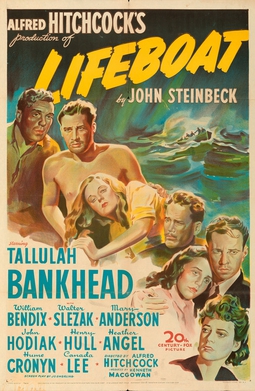
Lifeboat
The timing here was interesting, two completely different types of movies, and I couldn't help but be slightly amused by it. I just recently reviewed Around the World in 80 Days, a huge scale epic that had locations around the world. Then there's this review, an entire movie set on an adrift boat at sea. I love a good epic, but an entire movie contained on one set? That's impressive. The movie is 1944's Lifeboat.
On its way to England during WWII, an Allied supply ship crewed by merchant marines is attacked by a German U-boat and sinks. Aboard a sturdy lifeboat, respected writer Connie Porter (Tallulah Bankhead) rescues Kovac (John Hodiak), a member of the crew from the engine room. Connie tells him that the German U-boat sunk as well in all the chaos. Minutes pass and they begin to pick up other survivors until there is nine of them all told. Among them is a German sailor, Willi (Walter Slezak), who no one is sure what to make of. Should they throw him overboard or keep him as a prisoner? With food and water limited, their decision could directly affect their survival.
Do you need proof that director Alfred Hitchcock was a director far ahead of his time? First off, if you said 'yes,' shame on you. Second, this film should serve as proof....if it was some how needed. Some four years before his 1948 film Rope and 13 years before 12 Angry Men used the formula, Hitchcock films the entire movie on one set, in this case the lifeboat adrift at sea. The entire movie. There are no asides or flashbacks or anything that distracts from the very singular location. This well-made, sturdy boat ends up being a weirdly compelling additional character. By the end of the movie, you feel claustrophobic and alone. Not a lot of directors could pull this premise off successfully, but Hitchcock seems to do it with ease.
Working with an ensemble cast, Hitchcock brings together a group of actors/actresses from all walks of life with more than a few differences in background. Bankhead as Connie gets top billing and delivers a solid performance but is far from sympathetic. Hodiak brings a tough guy edge to his part as Kovac, the former slaughterhouse worker turned sailor and maybe the one thinking the clearest. Slezak ends up being Evil Incarnate as Willi, the German sailor who knows more than he is letting on. Also look for William Bendix as Gus, the lovable sailor wanting to get back to his dancing girlfriend, Mary Anderson as Alice, a young nurse nervous about reaching London, Henry Hull as Rittenhouse, a proud, self-made businessman, Hume Cronyn as Sparks, the radioman who bonds with Alice, Canada Lee as Joe, the black steward, and Heather Angel as Mrs. Higgins, a mother traveling with infant to visit her husband.
What is impressive about the film can also be a weakness depending on your point of view. Hitchcock chooses not to use any gimmicks or tricks in developing a story that clocks in at 97 minutes. There are no marauding sharks circling the boat or patrolling plane overhead. This is an ultra-personal story that is entirely contained within the confines of the boat. Because there is nothing to distract from the task at hand, this is a dialogue-heavy movie. At times, it gets to be a little much. You can only hear so many monologues about the past and how people got here, their beliefs and relationships before things get a little on the slow. When it does work though, it's great. The story gives a window into mob mentality, especially when survival is on the line. Not surprisingly, you react differently to a situation at hand when life and death hangs in the balance.
Setting the survivor story (yeah, alliteration!) during WWII was no doubt a timely one. I can't help but wonder though what the story would have been like in a more existential setting; just survivors on the open sea hoping to make it to land or rescue of some sorts. Yes, the Willi character and his sinister motives are necessary, but that could have been tweaked too. The WWII dynamic is one thing, but a solid, interesting story detours and degenerates some in the finale as a propaganda message is not to subtly blared at us as a viewing audience. Oh, Germans are bad! There was potential for a twisted, darker ending in the closing minute, but the propaganda shuts the door on that possibility. Still, it's an impressive movie, and one that's easily recommended.
Lifeboat (1944): ***/****
Labels:
1940s,
Alfred Hitchcock,
Henry Hull,
Hume Cronyn,
John Hodiak,
Walter Slezak,
William Bendix,
WWII
Subscribe to:
Posts (Atom)


_poster.jpg)