Ever heard of a carpetbagger? It is a particularly nasty piece of American history. Following the Civil War, they were northerners who moved into the south looking to make a profit off the Reconstruction Era. You see them briefly in Gone With the Wind, even a John Wayne western like The Undefeated, but because it was such a despicable profession of sorts...well, we're not going to see a whole lot of movies about them. When we do, like 1953's Thunder Over the Plains, they're the easiest of villains to root against.
It's 1869, some four years removed from the end of the Civil War, and the wounds are still fresh from the war. Texas has not yet been readmitted to the Union as a state with tensions high as carpetbaggers ravage the Texans trying to get back on their feet with corruption and high taxes. A Robin Hood-like bandit, Ben Westman (Charles McGraw), has stepped forward and with a small, loyal gang wreaks havoc on the carpetbaggers' efforts to earn their ill-got profits. A Texan who fought on the Union side and remains in the cavalry, Capt. David Porter (Randolph Scott) finds himself in a sticky situation. He tends to agree with Westman's actions, but he's honor-bound by duty to try and bring Westman to justice. All sides are pulling at the captain, both inward and outward, as he deals with pressure from his own commander, his wife, his fellow officers and the $-for-eyes carpetbaggers.
By the 1950s, star Randolph Scott was doing westerns exclusively. From 1945 on, Scott only made two non-western films. Think about that. This was a man who knew what he wanted, what he liked doing at work, and what audiences wanted to see him do. John Wayne would take a similar approach in the latter stages of his legendary career. The issue becomes that other than Scott's pairings with director Budd Boetticher (7 different films) and later Sam Peckinpah (Ride the High Country), his 1950s westerns are typically okay at best and dull and far too familiar at worst. Unfortunately, 'Thunder' falls into that category. While it has some potential and Scott is reliable as ever, it's just missing that special something and ends up going off the rails near the halfway point.
That ends up being the most frustrating part in this western from director Andre de Toth. 'Thunder' has a ton of potential. For a 1953 western, it's surprisingly dark. The post-Civil War setting in Texas during Reconstruction isn't exactly commonplace in the genre. There is a variety of characters with some great heroes and equally awful villains. But in a movie that runs just 82 minutes, it can't sustain that energy. The story begins to meander near the 45-minute mark and limps to the finish. One pretty major subplot isn't even addressed or given a worthwhile resolution....so yeah, that kinda sucks. Everything gets all jumbled together with too many characters and twists and secondary plots, and the ship never rights itself. A western that could have been pretty good ends up being disappointing and below average.
So while I'm not a huge fan of Randolph Scott's western, I am a big fan of Scott himself. This is a part he specialized in, the resolute, loyal and tough as nails western hero who's going to do what's right no matter what it takes. A sheriff, a cavalry officer, a drifter, he played tweak versions on this throughout the last 17 years of his career and did it well. He's undone by a script that has his Capt. Porter simply trying to keep too many plates spinning. At home, his wife (Phyllis Kirk) incessantly talks about leaving for a different post. At the fort, his friend and commander (Henry Hull) nags and nags without actually offering any help. As well, a new officer arrives in the form of Capt. Bill Hodges (Lex Barker), who resents the posting, isn't too partial about using his new silver pistol and has his eyes set on Mrs. Porter. It's not Scott's fault. All the way, he's going for it. A true pro even in one of his lesser efforts.
Who else to look for? Buried deep in the credits are Hugh Sanders and Elisha Cook Jr. as the corrupt carpetbagger and the the equally corrupt tax commissioner sticking it to recovering Texas. In the familiar face department, look for Lane Chandler, James Brown and a very young Fess Parker in supporting roles.
I wish I liked this one more. Scott is excellent, and McGraw's Ben Westman is a very cool character that is underutilized. I would have loved to see a movie that focused far more on those two characters and their very interesting dynamic. As is, 'Thunder' disappoints. It has potential, but it never delivers unfortunately.
Thunder Over the Plains (1953): **/****
The Sons of Katie Elder
"First, we reunite, then find Ma and Pa's killer...then read some reviews."
Showing posts with label Andre De Toth. Show all posts
Tuesday, March 17, 2015
Sunday, May 12, 2013
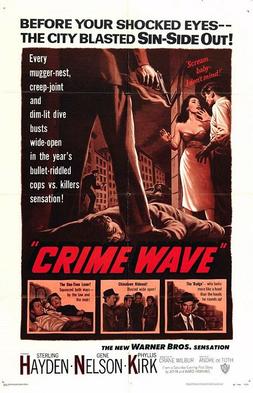
Crime Wave
I've been thinking about this for three days now since I watched 1954's Crime Wave, and I've got nothing. I really do try to come up with interesting intros to the reviews, even taking some pride in it. I'm stumped here though so let's cut to the chase. A film noir with a solid cast and director, I liked this movie a lot. Good enough? Yeah, let's get going.
In the dead of night in Los Angeles, three escaped convicts led by Doc Penny (Ted de Corsia) rob a gas station, grabbing $130, but as they make their getaway, an investigating police officer on patrol gets in their way and is callously gunned down. The news spreads through police departments/offices throughout the city, and in minutes, a huge manhunt led by Lt. Sims (Sterling Hayden) is under way. The city is all but shut down in hopes of capturing the trio, but they seem to have disappeared. Sims and the police start to investigate where they could be hiding with Sims thinking they've holed up somewhere with an ex-con. Suspect No. 1? An ex-con named Steve Lacey (Gene Lacey) who Sims put away years ago and has supposedly gone clean. Time is running out though, and there's a chance that maybe the crooks slipped away, the murder going unresolved.
I come away more and more impressed with the entire genre of film noir flicks the more I'm introduced to them. I was always aware of the more well-known, well respected noirs, but as I try to review more and more reviews, I'm finding more and more worthwhile entries to the genre. This one from director Andre de Toth is one that doesn't get much in the way of recognition, but it's everything that's right about the genre. It was filmed on location in Los Angeles, Burbank and Glendale, its shadowy streets, alleys and neighborhoods providing a backdrop to the story. It looks great, and it doesn't waste any time with its 75-minute running time. Cops, crooks, and those caught in the middle. Hard to mess up that formula, but de Toth does a great, workmanlike job here.
Early on in 'Crime,' I thought I was watching a quasi-remake of Jules Dassin's 1948 noir The Naked City. That film plays almost like a documentary of how the cops handle the investigation following a crime. Seeing both the police perspective and that of the crooks on the run, 'Crime' is similar in its portrayal. We see suspects brought in for questioning, the police searching for clues, following any leads that might lead to bringing the cop killers to justice. The story takes an interesting, even surprising turn in the second half, focusing more on Nelson's Steve and his troubles. He's moved on from his criminal past, marrying Ellen (Phyllis Kirk), a woman who accepts what he was but loves him for what he is now. This goes down the more traditional route in its noir roots, Steve, Sims and the police, and Doc and the crooks all converging on a collision course.
As far as casting goes, 'Crime' lacks the star power of more well-known film noirs, but I liked the cast. Hayden especially stands out as Lt. Sims, a veteran police officer who's seen just about everything the streets have to offer. Early on, he's so driven -- even obsessed -- I thought the story might have him develop into the bad guy. As the villain, de Corsia is appropriately greasy/slimy with a young Charles Bronson (listed as Buchinsky) and Nedrick Young as his convict cohorts. Jay Novello plays a doctor and ex-con who accidentally killed a patient, now working as a vet who gets caught up in the manhunt while the uncredited duo of Timothy Carey and Jim Hayward as two other ex-cons brought into Doc's plan. Dub Taylor makes a quick appearance as the gas station attendant while Hank Worden plays Steve's trusting boss.
Not too much analysis required here. It's a good film noir with a solid story, good casting and quick-moving pacing. Not a hugely well known film noir, but one I enjoyed a lot. Oh, and 1950s Los Angeles looks pretty cool. It almost feels like Joe Friday should come in to assist on the investigation.
Crime Wave (1954): ***/****
In the dead of night in Los Angeles, three escaped convicts led by Doc Penny (Ted de Corsia) rob a gas station, grabbing $130, but as they make their getaway, an investigating police officer on patrol gets in their way and is callously gunned down. The news spreads through police departments/offices throughout the city, and in minutes, a huge manhunt led by Lt. Sims (Sterling Hayden) is under way. The city is all but shut down in hopes of capturing the trio, but they seem to have disappeared. Sims and the police start to investigate where they could be hiding with Sims thinking they've holed up somewhere with an ex-con. Suspect No. 1? An ex-con named Steve Lacey (Gene Lacey) who Sims put away years ago and has supposedly gone clean. Time is running out though, and there's a chance that maybe the crooks slipped away, the murder going unresolved.
I come away more and more impressed with the entire genre of film noir flicks the more I'm introduced to them. I was always aware of the more well-known, well respected noirs, but as I try to review more and more reviews, I'm finding more and more worthwhile entries to the genre. This one from director Andre de Toth is one that doesn't get much in the way of recognition, but it's everything that's right about the genre. It was filmed on location in Los Angeles, Burbank and Glendale, its shadowy streets, alleys and neighborhoods providing a backdrop to the story. It looks great, and it doesn't waste any time with its 75-minute running time. Cops, crooks, and those caught in the middle. Hard to mess up that formula, but de Toth does a great, workmanlike job here.
Early on in 'Crime,' I thought I was watching a quasi-remake of Jules Dassin's 1948 noir The Naked City. That film plays almost like a documentary of how the cops handle the investigation following a crime. Seeing both the police perspective and that of the crooks on the run, 'Crime' is similar in its portrayal. We see suspects brought in for questioning, the police searching for clues, following any leads that might lead to bringing the cop killers to justice. The story takes an interesting, even surprising turn in the second half, focusing more on Nelson's Steve and his troubles. He's moved on from his criminal past, marrying Ellen (Phyllis Kirk), a woman who accepts what he was but loves him for what he is now. This goes down the more traditional route in its noir roots, Steve, Sims and the police, and Doc and the crooks all converging on a collision course.
As far as casting goes, 'Crime' lacks the star power of more well-known film noirs, but I liked the cast. Hayden especially stands out as Lt. Sims, a veteran police officer who's seen just about everything the streets have to offer. Early on, he's so driven -- even obsessed -- I thought the story might have him develop into the bad guy. As the villain, de Corsia is appropriately greasy/slimy with a young Charles Bronson (listed as Buchinsky) and Nedrick Young as his convict cohorts. Jay Novello plays a doctor and ex-con who accidentally killed a patient, now working as a vet who gets caught up in the manhunt while the uncredited duo of Timothy Carey and Jim Hayward as two other ex-cons brought into Doc's plan. Dub Taylor makes a quick appearance as the gas station attendant while Hank Worden plays Steve's trusting boss.
Not too much analysis required here. It's a good film noir with a solid story, good casting and quick-moving pacing. Not a hugely well known film noir, but one I enjoyed a lot. Oh, and 1950s Los Angeles looks pretty cool. It almost feels like Joe Friday should come in to assist on the investigation.
Crime Wave (1954): ***/****
Labels:
1950s,
Andre De Toth,
Charles Bronson,
Dub Taylor,
Film Noir,
Sterling Hayden
Sunday, March 18, 2012
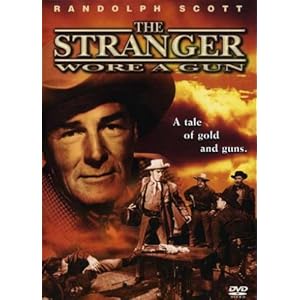
The Stranger Wore a Gun
While many movies in the 1950s tried to offer something that television simply couldn't match, many westerns dug their heels in and refused to change/adjust. The result? A lot of straightforward, traditional efforts that were like most westerns released over the previous 20-plus years. If you haven't figured it out, none of this is particularly positive, like 1953's The Stranger Wore a Gun, a B-western in every regard.
After the bloody raid on Lawrence, Kansas by William Quantrill, Confederate rider Jeff Travis (Randolph Scott) leaves Quantrill's raiders and heads west. But even after the end of the Civil War, the memory persists in his head, and more importantly, so does the stigma of being one of Quantrill's guerrilla riders. Wanted for a murder he didn't commit, Travis heads to Prescott, Arizona on the advice of long-time friend, Josie (Claire Trevor). He finds a job with a former Confederate soldier who wants the Confederacy to live on, Jules Mourret (George Macready), but finds out quickly that Jules is willing to go to some dark places to accomplish his goal. For Travis though, it could be too late to make a change.
With so many 1950s westerns, I feel like my reviews lean toward cookie-cutter. They're the same thing over and over again, just changing the names and places. Like so many 1950s westerns, 'Stranger' has its good and bad, but the biggest thing is that nothing at all is particularly memorable. Director Andre De Toth goes about his job with workmanlike precision, telling a familiar story that doesn't throw anything new at the viewer. The stories are forgettable, the characters interchangeable, and if you've got more than two or three functioning brain cells, you know how it's going to end before it started. Some of the California locations look very nice here, but it does absolutely nothing to distinguish it from the thousands of other westerns you could watch. Not bad, not good, and not memorable in the least.
Starring in many of these westerns was Randolph Scott, a stout, resolute western hero in that second rung of western stars. His biggest problem? Unless he was working with directors like Budd Boetticher and Sam Peckinpah, his typically solid lead parts were lost in a sea of bad B-movies. Playing Jeff Travis, he's one of the better things going for 'Stranger.' His motivations aren't always explained -- he's running from his Confederate past by working for a Confederate trying to revive the Confederacy?....right -- but in a sea of mediocrity, his performance stands out. Trevor does what she does best, playing the damaged society woman, Macready is an average at best villain, and Joan Weldon plays a wooden requisite pretty girl (another trademark of a low budget 1950s western) that Scott's Travis must decide if he really loves, with Pierre Watkin playing her father.
Enough beating around the bush, let's get to some negatives! Anyone who's seen Treasure of the Sierra Madre is familiar with the infamous 'We don't need no stinking badges!' line delivered by bandit chief Rodolfo Bedoya. Instead of one well-handled scene, he gets a much bigger role here with a similar character, the stereotypes amped up....a lot. His "portrayal" of Degas, a Mexican bandit and gang leader, is laughable and painful to watch. He laughs hysterically for no apparent reason at least three different times, and speaks in an odd variation of Spanglish. His sidekick, Shorty (Joseph Vitale), is just as bad, speaking in halted, quasi-threatening tones. Way, way too much of a good thing here. Also worth mentioning -- I suppose -- is the 3-D filming technique. We get guns "fired at" the camera, not to mention torches, punches, vases, you name it, thrown at us. Oooohhhh, startling! There's also a bizarre technique where rocks/brush are placed in front of stock footage, apparently to make it look more realistic? I guess. I can't come up with anything else. It's bad. That's what I'm going for.
One positive -- however small -- with many of these 1950s westerns is that future stars who shot to fame in the 1960s got their start with supporting roles. Here in 'Stranger' there's Lee Marvin and Ernest Borgnine as Kurth and Slager, two of Jules' henchmen. Hindsight is 20-20, but it's clear the talent they're working with even in supporting roles. Not a ton to recommend overall, and maybe I'm reaching for straws, but something's got to get you through these B-movies.
The Stranger Wore a Gun <---TCM trailer (1958): **/****
After the bloody raid on Lawrence, Kansas by William Quantrill, Confederate rider Jeff Travis (Randolph Scott) leaves Quantrill's raiders and heads west. But even after the end of the Civil War, the memory persists in his head, and more importantly, so does the stigma of being one of Quantrill's guerrilla riders. Wanted for a murder he didn't commit, Travis heads to Prescott, Arizona on the advice of long-time friend, Josie (Claire Trevor). He finds a job with a former Confederate soldier who wants the Confederacy to live on, Jules Mourret (George Macready), but finds out quickly that Jules is willing to go to some dark places to accomplish his goal. For Travis though, it could be too late to make a change.
With so many 1950s westerns, I feel like my reviews lean toward cookie-cutter. They're the same thing over and over again, just changing the names and places. Like so many 1950s westerns, 'Stranger' has its good and bad, but the biggest thing is that nothing at all is particularly memorable. Director Andre De Toth goes about his job with workmanlike precision, telling a familiar story that doesn't throw anything new at the viewer. The stories are forgettable, the characters interchangeable, and if you've got more than two or three functioning brain cells, you know how it's going to end before it started. Some of the California locations look very nice here, but it does absolutely nothing to distinguish it from the thousands of other westerns you could watch. Not bad, not good, and not memorable in the least.
Starring in many of these westerns was Randolph Scott, a stout, resolute western hero in that second rung of western stars. His biggest problem? Unless he was working with directors like Budd Boetticher and Sam Peckinpah, his typically solid lead parts were lost in a sea of bad B-movies. Playing Jeff Travis, he's one of the better things going for 'Stranger.' His motivations aren't always explained -- he's running from his Confederate past by working for a Confederate trying to revive the Confederacy?....right -- but in a sea of mediocrity, his performance stands out. Trevor does what she does best, playing the damaged society woman, Macready is an average at best villain, and Joan Weldon plays a wooden requisite pretty girl (another trademark of a low budget 1950s western) that Scott's Travis must decide if he really loves, with Pierre Watkin playing her father.
Enough beating around the bush, let's get to some negatives! Anyone who's seen Treasure of the Sierra Madre is familiar with the infamous 'We don't need no stinking badges!' line delivered by bandit chief Rodolfo Bedoya. Instead of one well-handled scene, he gets a much bigger role here with a similar character, the stereotypes amped up....a lot. His "portrayal" of Degas, a Mexican bandit and gang leader, is laughable and painful to watch. He laughs hysterically for no apparent reason at least three different times, and speaks in an odd variation of Spanglish. His sidekick, Shorty (Joseph Vitale), is just as bad, speaking in halted, quasi-threatening tones. Way, way too much of a good thing here. Also worth mentioning -- I suppose -- is the 3-D filming technique. We get guns "fired at" the camera, not to mention torches, punches, vases, you name it, thrown at us. Oooohhhh, startling! There's also a bizarre technique where rocks/brush are placed in front of stock footage, apparently to make it look more realistic? I guess. I can't come up with anything else. It's bad. That's what I'm going for.
One positive -- however small -- with many of these 1950s westerns is that future stars who shot to fame in the 1960s got their start with supporting roles. Here in 'Stranger' there's Lee Marvin and Ernest Borgnine as Kurth and Slager, two of Jules' henchmen. Hindsight is 20-20, but it's clear the talent they're working with even in supporting roles. Not a ton to recommend overall, and maybe I'm reaching for straws, but something's got to get you through these B-movies.
The Stranger Wore a Gun <---TCM trailer (1958): **/****
Labels:
1950s,
Andre De Toth,
Claire Trevor,
Ernest Borgnine,
Lee Marvin,
Randolph Scott,
westerns
Saturday, April 2, 2011
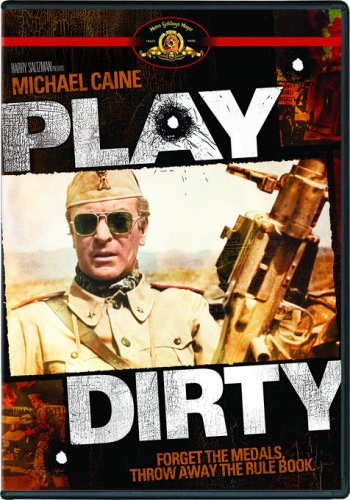
Play Dirty
An actor in the lead almost always worth watching. Michael Caine, check. A setting that rarely disappoints. Check, North Africa in WWII as the Germans battle the Allies for control. An ending that delivers one of the best sucker punch surprises ever. You bet. So why has no one heard of 1968's Play Dirty? It's one of those hidden gems I was very pleased I stumbled upon. Now if only more fans could find it, it might get some of the credit it deserves.
After a year of failed missions that produced no results, British commando leader Colonel Masters (Nigel Green) has been given one last chance to do something positive. He has reports of a German fuel dump that is key to Rommel's success. The high command's only demand is that Masters send a British officer along with to lead the mission. In steps Capt. Douglas (Caine), a British petroleum official, who instantly clashes with his second-in-command and Masters' officer, Capt. Leech (Nigel Davenport). That might be the least of his problems. Trekking across 400 miles of desert, Douglas leads a small team of convict commandos, battling German patrols, murdering Arab tribesmen, and everything the desert can throw at them. Something else might be waiting for them too, something none of them could plan for.
Director Andre De Toth has a hidden gem here in this WWII story. It borrows liberally from other North Africa WWII movies like Tobruk or TV shows like The Rat Patrol. But something just clicks here that's hard to explain. It is a minimalist war movie if there ever was one. It is cynical beyond all belief, the headquarters officers (including Harry Andrews in a small part) clueless but brimming with pride and ego. The commandos are murderers, rapists, drug dealers and arms smugglers, only joining Masters' force because it got them out of prison. The effect is a winner. It's an honest, downright filthy look at WWII. As the tagline said, 'Throw out the medals, forget the rule book, if you want to survive...play dirty.'
Playing a cat and mouse game on the mission is Caine as Douglas and Davenport as Leech. Michael Caine plays the stiff upper-lip officer perfectly, prim and proper trying to do things by the book. He doesn't realize he's basically a sacrificial lamb, trying to pull off this suicidal mission. He receives little help from Capt. Leech, a man interested only in which side will pay more for his services. The problem is, he's damn good at his job and is working with a pay-off in mind. Seeing these two men go toe to toe is fun, like a heavyweight bout where both sides land punch after punch. It's not great performances on their own, but together they carry the movie. Douglas just wants to accomplish the mission placed in front of him, even with the men behind him possibly gunning for him. Leech is going to do what it takes to ensure his own survival, and hopefully Douglas' life too.
Like Tobruk, the basic mission is simple. In the desert, gasoline and water are key if you want to keep your vehicles moving. The men on a mission angle isn't played up much after an early introduction scene of the convict commandos. More focus is placed on Douglas and Leech, but the commandos include Sadok (Aly Ben Ayed), explosives expert, Kostas Manou (Takis Emmanuel), black market arms dealer, Kafkarides (Enrique Avila), the drug dealer and driver, Boudesh (Scott Miller), a brawler, and Hassan (Mohsen Ben Abdallah) and Assine (Mohamed Kouka), the two gay Arab trail guides. Among the group, there's maybe 15 or 20 lines combined. It's more what they are that's important. They're the lowest of the low and no one much cares what happens to them. None of these actors were anything more than background players, and for some, they were only in three or four movies at all. They still do a solid job giving Douglas' team an eclectic mix of sordid individuals though.
The minimalist aspect helps make this movie better than other similar WWII stories. The mission is painfully simple. Travel across the desert and blow up the fuel dump. Done, no detours. A long sequence has them navigating a steep cliff face trying to get their vehicles to the top. They change countless tires. They run into patrols, Arab tribesmen, avoiding mine fields and booby traps. Michel Legrand's musical score never provides any clues as to what's about to happen, the story surprising you instead. The pacing may seem a little slow, but this is what faces them. Survival at its most base in the desert. You do what you need to do to keep moving. For these men, it's always moving forward because what awaits them is better than what they're leaving behind.
Above all else though, the final 30-45 minutes makes Play Dirty a near classic. I'm going to give away the ending so stop reading if you don't want to know. SPOILERS STOP READING SPOILERS Making it all the way to the dump, Douglas' team doesn't realize their mission has become compromised. The fuel dump is in reach of Allied forces and can be saved, not destroyed. British headquarters contacts double agents and tells them a team of commandos is gunning for the fuel. All but Douglas and Leech are killed in the attempt, the two officers making it out. Not bad, right? Late 1960s cynicism at its best. There's more. The next morning, the duo (in German uniforms) attempts to surrender to advancing Allied forces. Hands up, white flag in sight, they're accidentally gunned down by British troops. A soldier apologizes to his officer, claiming he didn't see the flag, credits roll. END OF SPOILERS
Just in terms of sheer guts to actually use that ending, Play Dirty gets a ridiculous amount of credit from me. I can think of maybe three or four other movies that surprised me, just completely caught me off-guard in a shocking way. First, that many main characters getting killed off is an oddity. But that's what works. People get killed during war, often in situations where mistakes are made and soldiers have to be sacrificed. One of the best shocker endings I've ever seen in one of the most underrated WWII movies around.
Play Dirty <--- opening credits (1968): *** 1/2 /****
After a year of failed missions that produced no results, British commando leader Colonel Masters (Nigel Green) has been given one last chance to do something positive. He has reports of a German fuel dump that is key to Rommel's success. The high command's only demand is that Masters send a British officer along with to lead the mission. In steps Capt. Douglas (Caine), a British petroleum official, who instantly clashes with his second-in-command and Masters' officer, Capt. Leech (Nigel Davenport). That might be the least of his problems. Trekking across 400 miles of desert, Douglas leads a small team of convict commandos, battling German patrols, murdering Arab tribesmen, and everything the desert can throw at them. Something else might be waiting for them too, something none of them could plan for.
Director Andre De Toth has a hidden gem here in this WWII story. It borrows liberally from other North Africa WWII movies like Tobruk or TV shows like The Rat Patrol. But something just clicks here that's hard to explain. It is a minimalist war movie if there ever was one. It is cynical beyond all belief, the headquarters officers (including Harry Andrews in a small part) clueless but brimming with pride and ego. The commandos are murderers, rapists, drug dealers and arms smugglers, only joining Masters' force because it got them out of prison. The effect is a winner. It's an honest, downright filthy look at WWII. As the tagline said, 'Throw out the medals, forget the rule book, if you want to survive...play dirty.'
Playing a cat and mouse game on the mission is Caine as Douglas and Davenport as Leech. Michael Caine plays the stiff upper-lip officer perfectly, prim and proper trying to do things by the book. He doesn't realize he's basically a sacrificial lamb, trying to pull off this suicidal mission. He receives little help from Capt. Leech, a man interested only in which side will pay more for his services. The problem is, he's damn good at his job and is working with a pay-off in mind. Seeing these two men go toe to toe is fun, like a heavyweight bout where both sides land punch after punch. It's not great performances on their own, but together they carry the movie. Douglas just wants to accomplish the mission placed in front of him, even with the men behind him possibly gunning for him. Leech is going to do what it takes to ensure his own survival, and hopefully Douglas' life too.
Like Tobruk, the basic mission is simple. In the desert, gasoline and water are key if you want to keep your vehicles moving. The men on a mission angle isn't played up much after an early introduction scene of the convict commandos. More focus is placed on Douglas and Leech, but the commandos include Sadok (Aly Ben Ayed), explosives expert, Kostas Manou (Takis Emmanuel), black market arms dealer, Kafkarides (Enrique Avila), the drug dealer and driver, Boudesh (Scott Miller), a brawler, and Hassan (Mohsen Ben Abdallah) and Assine (Mohamed Kouka), the two gay Arab trail guides. Among the group, there's maybe 15 or 20 lines combined. It's more what they are that's important. They're the lowest of the low and no one much cares what happens to them. None of these actors were anything more than background players, and for some, they were only in three or four movies at all. They still do a solid job giving Douglas' team an eclectic mix of sordid individuals though.
The minimalist aspect helps make this movie better than other similar WWII stories. The mission is painfully simple. Travel across the desert and blow up the fuel dump. Done, no detours. A long sequence has them navigating a steep cliff face trying to get their vehicles to the top. They change countless tires. They run into patrols, Arab tribesmen, avoiding mine fields and booby traps. Michel Legrand's musical score never provides any clues as to what's about to happen, the story surprising you instead. The pacing may seem a little slow, but this is what faces them. Survival at its most base in the desert. You do what you need to do to keep moving. For these men, it's always moving forward because what awaits them is better than what they're leaving behind.
Above all else though, the final 30-45 minutes makes Play Dirty a near classic. I'm going to give away the ending so stop reading if you don't want to know. SPOILERS STOP READING SPOILERS Making it all the way to the dump, Douglas' team doesn't realize their mission has become compromised. The fuel dump is in reach of Allied forces and can be saved, not destroyed. British headquarters contacts double agents and tells them a team of commandos is gunning for the fuel. All but Douglas and Leech are killed in the attempt, the two officers making it out. Not bad, right? Late 1960s cynicism at its best. There's more. The next morning, the duo (in German uniforms) attempts to surrender to advancing Allied forces. Hands up, white flag in sight, they're accidentally gunned down by British troops. A soldier apologizes to his officer, claiming he didn't see the flag, credits roll. END OF SPOILERS
Just in terms of sheer guts to actually use that ending, Play Dirty gets a ridiculous amount of credit from me. I can think of maybe three or four other movies that surprised me, just completely caught me off-guard in a shocking way. First, that many main characters getting killed off is an oddity. But that's what works. People get killed during war, often in situations where mistakes are made and soldiers have to be sacrificed. One of the best shocker endings I've ever seen in one of the most underrated WWII movies around.
Play Dirty <--- opening credits (1968): *** 1/2 /****
Labels:
1960s,
Andre De Toth,
Harry Andrews,
Michael Caine,
Nigel Davenport,
Nigel Green,
WWII
Monday, August 30, 2010
The Indian Fighter
During the heyday of the movie western in the 1940s and 1950s, directors like John Ford, Anthony Mann, and Budd Boetticher dominated the box office. Some were bigger scale, others made on a smaller budget with less scope. But while these directors are generally easily remembered for their work, others went about their work as a director producing quality movies that weren't classics at one end or awful bombs at the other. They were typically solid if unspectacular movies that audiences ate up but never left a huge impression.
Hungarian director Andre De Toth made a career out of these movies, hard-hitting westerns that were usually light on the corniness factor and heavy on action and blood and guts that were often ahead of its time. He specialized in westerns and action movies and also ended up doing his fair share of television directing in the 1960s when the offers weren't there to direct movies. I'd seen a couple De Toth movies, and liked them, especially his last movie, Play Dirty, a WWII men on a mission movie starring Michael Caine. But a majority of his movies were westerns, including 1955's The Indian Fighter.
In the years following the Civil War, Sioux chief Red Cloud (Eduard Franz) is dealing with the increased flow of white settlers into his tribe's land. A scout for the cavalry, Johnny Hawks (Kirk Douglas), is doing his best to keep the peace between the Indians and the white settlers heading west. Hawks is leading a wagon train to Oregon and hoping to get through without any incidents, but two saddle tramps (Walter Matthau and Lon Chaney Jr) traveling with the wagon train are looking for gold. The delicate balance for peace is hanging in the balance, and no matter how much Hawks does to keep it together, these two gunmen are looking for trouble and no one's going to stop them.
Wagon train stories are nothing new to the western and go back about as far as the genre goes. Growing up I played my fair share of Oregon Trail on the PC so I'm a fan, but this western was missing something. A simple straightforward story is nothing to shake your head at because I've watched too many movies that go on and on with no real purpose. But this is one leisurely story, seemingly more content to let Douglas romance an Indian girl (Elsa Martinelli) and let the Oregon filming locations fill in any gaps in the story. The locations are gorgeous to look at, but beautiful filming locations always work better for me when they're a key part of the story, not filling in for the story.
I don't have a lot of pet peeves when it comes to movies, but one major issue I've always had is when one actor plays two different roles. I'm not talking twin characters either, just two different people. 'Indian' has two such parts, Harry Landers and Hank Worden playing both an Indian warrior and a cavalry soldier. How hard is it to get another actor to play a bit part that any goon off the street could play? If the budget is that tight, I feel bad for the director. Worse than that, Worden is dubbed with a ridiculously deep voice as a warrior almost like the moviemakers knew they were trying to get away with something with the dual roles. It is just a pet peeve and doesn't usually ruin a movie for me, but it is certainly on my mind as I keep seeing the same actor pop up over and over again.
Besides that complaint, the cast is pretty good, starting with Douglas in the lead. An incredibly gifted physical actor, Douglas was always at home in the westerns where he was allowed to show off, whether it was in a man-to-man fight or his ability to leap onto horses with a jump. His Hawks character is torn between his respect for the Indians and an "obligation" to his white brethren. The love angle is a little weird because Hawks forces himself on Martinelli's Indian girl, she pulls a knife, he backs off, and the next time around when he jumps her again, she's all for it. Seeing Matthau in a villainous turn was cool and former Mrs. Kirk Douglas, Diana Douglas, plays a single mother. There's also supporting roles from Walter Abel, Alan Hale Jr., Ray Teal, and Elisha Cook Jr. as a cavalry photographer.
Now what some earlier westerns often forget is that the west was a pretty nasty place. De Toth embraces that nastiness in terms of betrayals, murders and double crosses while also showing some fairly graphic violence for a movie released in 1955. Stabbings, shootings, scalpings and explosions are never gory and the camera doesn't linger, but it's presented and that's better than a lot of westerns. Some great stuntwork is on display here, and the action scenes are enjoyable in an otherwise average western.
The Indian Fighter <---TCM trailer (1955): **/****
Hungarian director Andre De Toth made a career out of these movies, hard-hitting westerns that were usually light on the corniness factor and heavy on action and blood and guts that were often ahead of its time. He specialized in westerns and action movies and also ended up doing his fair share of television directing in the 1960s when the offers weren't there to direct movies. I'd seen a couple De Toth movies, and liked them, especially his last movie, Play Dirty, a WWII men on a mission movie starring Michael Caine. But a majority of his movies were westerns, including 1955's The Indian Fighter.
In the years following the Civil War, Sioux chief Red Cloud (Eduard Franz) is dealing with the increased flow of white settlers into his tribe's land. A scout for the cavalry, Johnny Hawks (Kirk Douglas), is doing his best to keep the peace between the Indians and the white settlers heading west. Hawks is leading a wagon train to Oregon and hoping to get through without any incidents, but two saddle tramps (Walter Matthau and Lon Chaney Jr) traveling with the wagon train are looking for gold. The delicate balance for peace is hanging in the balance, and no matter how much Hawks does to keep it together, these two gunmen are looking for trouble and no one's going to stop them.
Wagon train stories are nothing new to the western and go back about as far as the genre goes. Growing up I played my fair share of Oregon Trail on the PC so I'm a fan, but this western was missing something. A simple straightforward story is nothing to shake your head at because I've watched too many movies that go on and on with no real purpose. But this is one leisurely story, seemingly more content to let Douglas romance an Indian girl (Elsa Martinelli) and let the Oregon filming locations fill in any gaps in the story. The locations are gorgeous to look at, but beautiful filming locations always work better for me when they're a key part of the story, not filling in for the story.
I don't have a lot of pet peeves when it comes to movies, but one major issue I've always had is when one actor plays two different roles. I'm not talking twin characters either, just two different people. 'Indian' has two such parts, Harry Landers and Hank Worden playing both an Indian warrior and a cavalry soldier. How hard is it to get another actor to play a bit part that any goon off the street could play? If the budget is that tight, I feel bad for the director. Worse than that, Worden is dubbed with a ridiculously deep voice as a warrior almost like the moviemakers knew they were trying to get away with something with the dual roles. It is just a pet peeve and doesn't usually ruin a movie for me, but it is certainly on my mind as I keep seeing the same actor pop up over and over again.
Besides that complaint, the cast is pretty good, starting with Douglas in the lead. An incredibly gifted physical actor, Douglas was always at home in the westerns where he was allowed to show off, whether it was in a man-to-man fight or his ability to leap onto horses with a jump. His Hawks character is torn between his respect for the Indians and an "obligation" to his white brethren. The love angle is a little weird because Hawks forces himself on Martinelli's Indian girl, she pulls a knife, he backs off, and the next time around when he jumps her again, she's all for it. Seeing Matthau in a villainous turn was cool and former Mrs. Kirk Douglas, Diana Douglas, plays a single mother. There's also supporting roles from Walter Abel, Alan Hale Jr., Ray Teal, and Elisha Cook Jr. as a cavalry photographer.
Now what some earlier westerns often forget is that the west was a pretty nasty place. De Toth embraces that nastiness in terms of betrayals, murders and double crosses while also showing some fairly graphic violence for a movie released in 1955. Stabbings, shootings, scalpings and explosions are never gory and the camera doesn't linger, but it's presented and that's better than a lot of westerns. Some great stuntwork is on display here, and the action scenes are enjoyable in an otherwise average western.
The Indian Fighter <---TCM trailer (1955): **/****
Labels:
1950s,
Andre De Toth,
Elisha Cook Jr.,
Kirk Douglas,
Walter Matthau,
westerns
Subscribe to:
Posts (Atom)