The Sons of Katie Elder

The Sons of Katie Elder
"First, we reunite, then find Ma and Pa's killer...then read some reviews."
Showing posts with label John Anderson. Show all posts

Wednesday, November 20, 2013

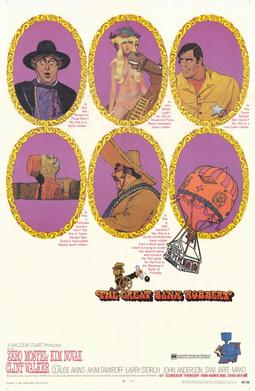
The Great Bank Robbery (1969)

From banks to trains, stagecoaches to payrolls and everything in between, wild west bandits, robbers and thieves had plenty of choices as to who and where to rob. But how about an impenetrable bank built specifically to hold back any would-be robbers? That's the basis for 1969's The Great Bank Robbery, a western spoof.

Having just pulled off a successful robbery of a government gold shipment, notorious outlaw Slade (Claude Akins) heads to the town of Friendly, Texas to stash his takings in a bank built by outlaws for outlaws. No one....no one can rob it. Well, that perfect bank is about to be tested. A con man and robber posing as a priest, Rev. Pious Blue (Zero Mostel), with his assistants, including "Sister" Lyda (Kim Novak), to tunnel into the bank. At the same time, a Mexican bandit (Akim Tamiroff), and his gang are prepping for an attack on the town and bank. Also, a Texas Ranger, Ben Quick (Clint Walker), has been sent to Friendly to investigate and to see if he can get into the bank too. His plan? Hire a group of Chinese laundry workers to tunnel into the bank as well. Well, this should be interesting as all these different groups unknowingly working toward the same goal.

Western comedies usually aren't my thing....like at all. This one worried me some with its low IMDB rating and generally across the board negative reviews. Still, the cast sounded pretty appealing, and who am I kidding? I'll give any western -- even a spoof-life comedy -- a shot when it comes right down to it. Well, I'm really glad I did. Is it dumb, even too stupid for its own good? Oh, yes, very much. Director Hy Averback works on a straightforward, broad comedic strokes level. This is not any subtle English humor. This is stereotyped Mexican bandits and Chinamen, one goofier situation on top of each other, and a madcap finale that includes colliding horses and wagons, a getaway via a hot air balloon and a cannon cutting loose on a church steeple. Nothing academic, smart or subtle here. We're talking LAUGH! moments. That said, I cracked up and liked it a lot.

Committing to the goofiness is a very solid cast that embraces the stupid. Walker plays the straight man, Texas Ranger Ben Quicky who is a good trailsman, a fast draw with his pistol and a gentleman to the end. Mostel is a scene-stealer as Reverend Pious Blue, a con man with an eye on a pot of gold. He even gets a goofy musical number with a boys choir that comes out of nowhere. Novak gets to sex kitten it up as Sister Lyda, always with a couple strategic buttons undone here and there. Lyda ends up being a diversion for the questioning Ranger Quick. Their scene together when Lyda gives Ben some peyote candy is priceless (watch it HERE), the Ranger no idea he's hallucinating. As for Pious' "assistants," look for John Fiedler as Br. Dismas (explosives), Peter Whitney as Br. Jordan (tunneling/engineering), and Sam Jaffe as Br. Lilac (art forger). In addition to the stereotypical (if fun) Mexican bandit, Papa, played by Tamiroff, is Larry Storch as his dim-witted but well-meaning son, Juan.

My favorite part goes to western veteran/regular and character actor Claude Akins as the outlaw and man in black, Slade. His part is underplayed to perfection in putting a new spin on that familiar character of the western baddie. Akins as Slade is a philosophical wondering man, calling all those around him "Scum" and "Scum of the Earth." When he shoots people -- kinda a must in the business he's chosen -- he questions "Why do they always make me do that?" He's a brooding, almost depressed man, always keeping his right hand man, Jeb (Elisha Cook Jr.), down with a series of threats and putdowns. A great, scene-stealing part for the always reliable Claude Akins. Also look for John Anderson as Kincaid, the crooked mayor and bank owner, Mako as Secret Agent Fong, working with Quick to find out what's going on, and Ruth Warrick as Mrs. Applebee, a curvy townswoman who takes an interest in Reverend Pious.

I can appreciate this comedy isn't rewriting the genre, and maybe it isn't even that good. But I keep coming back to one of my old standbys. Was I entertained? Throughout, even if that madcap finale is a little much and the movie just sort of ends. The always reliable Clint Walker, sex kitten Novak with a quasi-nude scene, Akins in a memorable part, there's a lot going for this comedic western that isn't trying to rewrite the genre. It's supposed to be fun and goofy and stupid. I liked it throughout.

The Great Bank Robbery (1969): ***/****

Monday, February 4, 2013

A Man Called Gannon

There is a certain charm I associate with westerns. The idea of a man riding across the country, all his possessions he's either wearing or they're on his horse with him, and answering to no one is an incredibly cool premise for me. Countless westerns have used that iconic character, the loner-drifter-cowboy, including 1969's A Man Called Gannon, a remake of 1955's Man Without a Star.

Riding a train west after a failed cattle ranch in Texas, cowboy drifter Gannon (Tony Franciosa) meets Jess Washburn (Michael Sarrazin), an inexperienced Easterner from Philadelphia. Jess wants nothing more than to be a cowboy, but he's got no idea where to start. In a jam when they witness a murder, Gannon saves Jess, and the youngster feels obligated to him. Booted off the train, they get jobs working at a local cattle ranch through Matty (Susan Oliver), a prostitute and "friend" of Gannon's. As the experienced cowboy teaches Jess everything he can, they find themselves in the midst of a budding range war. As the sides separate though, Gannon and Jess find they may be on opposite sides.

It's been awhile since I saw the 1955 version/original so I didn't associate this 1969 remake right away with it. The 1955 version starred Kirk Douglas and was pretty good in a simple, straightforward kind of way. There's no reason to remake it to begin with, but here we go just the same. 'Gannon' is one of a wave of movies released in the late 1960s and early 1970s about the changing of the west on the personal level; the cowboy. It reminds me a lot of Monte Walsh, released a year later. It tries to be a little too lyrical and schmaltzy, especially its main theme, a folk song called 'A Smile, A Memory and an Extra Shirt.' 'Gannon' struggles to find the right tone from the get-go, bouncing back and forth between physical comedy, goofiness and the natural darkness that comes from the changing times in the west. Pick a route and take it.

What makes it worthwhile is the casting of Franciosa and Sarrazin in the two lead roles. Neither actor had a ton of star power, but they were both solid actors capable of delivering above average performances. It doesn't hurt that the two parts -- the weathered, veteran cowboy and the inexperienced, wet behind the ears youngster -- are basically the definition of two archetypal western characters. You've seen them before, and you will see them again. I typically think of Franciosa as more of a heavy, a bad guy, so it's cool to see him in a more straight, good guy role. He at first wants nothing to do with Sarrazin's Jess, but can't really shake the persistent youngster. Sarrazin too does a fine job with the part, a young man who so desperately wants to be something, anything, that he puts himself in a bad situation to get to that point.

The relationship that develops between the two is the best part of the movie. Gannon keeps on teaching everything he can, and to his credit, Jess does a good job of picking things up whether it be shooting, roping, or handling a horse. Gannon has a checkered past and still holds some tremendous guilt from a past incident that went horribly wrong. In young Jess, he sees potential to right a wrong. The problem is simple, he can only show him how to do things, but at some point, Jess will have to decide things for himself. As the hooker with a heart of gold, Oliver does a very good job as Matty, a woman trying to fix Gannon for lack of a better description. Judi West plays Beth, the ranch owner trying to keep the place afloat by any means necessary (and with anyone who will help....in the bedroom), John Anderson plays Capper, the ranch top hand, David Sheiner is the maligned but tough sheriff, with James Westerfield, Gavin MacLeod and Eddie Firestone playing some of the cowhands at Beth's ranch. 

Unfortunately as things develop in this 105-minute flick from director James Goldstone, the pace lets up and the story loses steam. The opener, with Gannon meeting an old acquaintance (Jason Evers) as a telegraph line is set up, is nearly perfect, setting up how out of place this veteran cowboy is in a changing world. But as things progress, the story goes in too many directions and never quite gets back on the right track. It's never bad, but I started to lose interest (a lot) at about the hour-mark. Harmless enough western, probably worthwhile for a watch.

A Man Called Gannon (1969): ** 1/2 /****

Monday, May 16, 2011

The Satan Bug

Because guns, grenades and bombs weren't good enough at killing people, a new type of weapon started to be developed in the 20th century. It started as early as WWI with mustard and poison gas being used during trench warfare. It escalated and became more sophisticated, more efficient over the years. As part of the Cold War mutual destruction strategy, world powers turned to scientists to give them an edge in fighting...a different sort of fighting. Germ and chemical warfare became a topic of conversation, little strands of diseases that could destroy the world in minutes, days, and weeks without a weapon fired. That's the background for 1965's The Satan Bug.

This is one of those hidden gems that you're glad you stumbled upon, in this case, because of the director of the film, John Sturges. I knew his other movies like The Magnificent Seven and The Great Escape so reading through his list of films, I happened upon this one, a well-made and exciting if at times confusing espionage thriller centered around germ and chemical warfare. It is based on a novel by Alistair MacLean of Guns of Navarone and Where Eagles Dare fame, originally published under his pseudonym Ian Stuart. In a different setting from his usual WWII adventures, some changes were made to MacLean's book for the movie version, transplanting the story from dreary old England to the arid, dry American southwest. It is the rare novel that makes it to film completely the same as it was written, but as far as novel-to-film transformations go, this is a good one.

At remote, isolated and heavily guarded Station 3 somewhere in the Southwestern desert, two men are killed and several flasks of a recently developed germ/disease strand have been stolen. The robbery and murder seem too perfect considering the heavy security at the facility, but former security head and all-around rebel Lee Barrett (George Maharis) is called in to investigate. He's given some sobering news early on in his investigation. One strand of botulinus that's been stolen has the potential to wipe out hundreds and thousands of lives but has a short life once its oxidizes. The other strand is far more dangerous, a world killer that if unleashed will destroy every living thing on Earth. What mastermind orchestrated the job, and more importantly, what do they intend to do with the new formula, dubbed simply the Satan Bug. Up against the clock, Barrett has to figure out who did it, why, and where exactly the flasks are. Can he do it in time though?

If I had to pick a decade as my favorite in terms of movies, it would be the 1960s, and the decision isn't a tough one. I love the epic quality, the stars, the character actors, and especially the style. In one of the great descriptions I've ever read of an era, one reviewer pointed out that The Satan Bug is one of the last hurrahs of the suit and hat. This movie has style. All the characters wear a suit and tie and stylish hats as they race all over the Southwest looking for these disease-filled flasks. These aren't rogue agents who look like bums off the street. These are the good guys, and they're going to look good catching the bad guys. The sets scream 1960s leisurely style, and composer Jerry Goldsmith turns in an eerie, unsettling score that keeps things moving at a brisk pace. It  will also ring in your head for a couple days so beware of that too. Sometimes all a movie needs to work is that style, and The Satan Bug is a very cool movie to watch.

As a director over four decades with more than 40 movies to his name, Sturges made a career out of tough guy movies with typically male-dominated casts (Great Escape, Mag7, Bad Day at Black Rock), and while the big star name recognition doesn't qualify here, the cast is still impressive. Maharis is a good lead, the super intelligent investigator who pieces things together quicker than any man should be able to do. He's also worried about ex-wife Mary (Anne Francis), but that's understandable. Dana Andrews is General Andrews, a former military man who still holds a mysterious position in the government who also happens to be Barrett's father-in-law. Richard Basehart is Dr. Hoffman, one of Station 3's top doctors who include John Larkin and Simon Oakland. John Anderson plays Reagan, the security officer in charge of Station 3, albeit briefly. Richard Bull is Cavanaugh, a police investigator working with Barrett to catch Ed Asner and Frank Sutton, two of the murdering thieves. Yes, Lou Grant and Sgt Carter as bad guys. It takes some getting used to. The star quality might not be there, but the cast makes up for it, working smoothly together from the start.

Now I like this movie, but I can admit I have no idea what's going on half the time. My first viewing? I must have watched it in a daze, only to review it a couple days later. I understood more if not everything.  MacLean's novel The Satan Bug is a mystery thriller, throwing lots of characters and suspects at you. It's just hard to keep up. In the movie, characters are introduced, killed off, and then we find out they were important much later. Nothing is spelled out at all, forcing the viewer to jump to or make their own conclusions. Not always the best idea when it comes to movies.  Maharis' Barrett makes some ridiculous jumps in logic too, piecing together pieces of evidence so effortlessly that it is almost laughable. By the end, I feel I've got some sort of grip on what was happening, but it is all relative. Explanations, reasoning, development, not really present at any point.

Just like MacLean's novel, the movie takes some liberties with these mankind-killing diseases, but I won't spoil them here. They're supposedly able to wipe out men everywhere...except...well, it doesn't matter. But if Barrett needs to survive, he comes up with some off-the-wall plan to postpone death, mostly because the story requires his presence. These characters are also surprisingly lax with an easily breakable flask carrying the disease that will literally wipe out the Earth. This isn't a great movie, and it might not even be a good movie, but the 1960s style and ensemble cast make up for the lack of logic in the rest of the movie. It is available to watch at Youtube, starting HERE with Part 1 of 11.

The Satan Bug <---trailer (1965): ***/****

Tuesday, September 29, 2009

Young Billy Young

Starting his movie directing career in the mid 1960s, Burt Kennedy found a home in the western genre and rarely left it in a 20-year span. None of the Kennedy westerns are classic, far from it, but they are about the equivalent of the hour-long serials from the 1930s. Nothing groundbreaking with good guys tangling with some ornery bad guys, but they are always entertaining if nothing else.

Kennedy worked with a wide variety of tough guy actors in these westerns, including John Wayne, Glenn Ford, Henry Fonda, Ben Johnson, Yul Brynner, Frank Sinatra, Kirk Douglas and Robert Mitchum. Just like director Kennedy, many of these actors are remembered for their parts in westerns over the years. Mitchum especially never really left the western behind, joining with Kennedy for the 1969 oater Young Billy Young just two years removed from minor classic El Dorado.

Based loosely on a novel about Wyatt Earp's involvement with the Cowboy gang following the shootout at the O.K. Corral, Young Billy Young feels like a mash-up of several different stories all rolled into one. A great opening sequence has two young gunfighters, Billy Young (Robert Walker JR) and Jess Boone (David Carradine) sneaking onto a Mexican troop train and completing a hit on a Mexican general. In their escape, Jess abandons Billy when his horse throws up, and it's only by pure luck Billy escapes.

Billy makes it to the next town on the back of a burro, but it's not long before he guns down the town's sheriff for cheating in a card game. With some help from a gunfighter, Ben Kane (Mitchum), passing through town, Billy escapes a posse on his trail. He tags along with Ben who's on his way to a new job, working as a deputy in a roughshod town with no law and order run by slimy John Behan (Jack Kelly). The odds are against Ben, but he's got revenge on the mind as he looks for the man (John Anderson) who killed his son years ago in a jailbreak.

As if that wasn't enough, a saloon/dance hall girl, Lilly (Angie Dickinson), takes a shine to Kane, but Lilly is Behan's girl and doesn't take too nicely to Ben stepping in. There's more that is revealed in terms of plot twists that won't be spoiled here, but it's nothing too new that you won't have seen before. The only problem is that with all these different storylines about revenge and friendships and shootouts, the 89-minute running time is all sorts of convoluted. Maybe another 30 minutes could have served the movie better, but it's not a deal breaker.

Some characters get short-shrift, like Anderson's gunfighter who shows up in town, disappears for awhile, and then reappears with little warning for a final showdown with Mitchum (a disappointing end for that story). It would have been interesting to see two storylines, Billy and Jesse and then Ben's revenge dealt with exclusively, but what's there is entertaining nonetheless. It doesn't hurt that the movie was filmed in Old Tucson and looks great.

With the cast, Mitchum provides credibility just by being there. It's the type of part for the veteran star that he could do with no heavy lifting. He shows up, acts cool, shoots some baddies and gets the girl. Made the same year as he made Easy Rider, Walker JR gets a more mainstream role here as Billy who with Mitchum's older, more experienced gunfighter make a good old vs. young buddy pairing. Carradine's a good villain (when wasn't he?) while Kelly sneers as Behan, I guess loosely based on the real-life John Behan. In a role similar to her part 10 years earlier in Rio Bravo, Dickinson again plays a strong female character with a checkered past and even as little as she was height-wise is a good match with Mitchum.

So what's not to like with a western with a more than capable cast, some nice location shooting, plenty of gunfights, and Robert Mitchum singing the theme song? Maybe Burt Kennedy wasn't the best director around and one without much of a personal style, but he put together some exciting westerns during his career. Young Billy Young is certainly one of them, an oater that will keep you interested from start to finish.

Young Billy Young (1969): ** 1/2 / ****

Friday, August 14, 2009

A Glenn Ford double feature

Glenn Ford doesn't get a lot of credit as a major western star like a John Wayne, Clint Eastwood, or Randolph Scott. Maybe it's because he was only in one western that is considered a classic, the original 3:10 To Yuma, but Ford turned out a strong list of quality westerns especially later in his career in the 1950s and 1960s. TCM did a Glenn Ford Day as part of their Summer Under the Stars recently, and I was able to catch two westerns I'd missed in the past both from the second half of his career.

1967's A Time for Killing is a good example of how American westerns tried to respond to the cynical, darker spaghetti westerns from Italy. It's the closing days of the Civil War when a group of Confederate prisoners led by Captain Dorrit Bentley (George Hamilton) escape from a Union stockade near the U.S./Mexico border. Heading south, they ambush a supply train and take a prisoner, Emily Biddle (Inger Stevens), the fiance of the Union major, Wolcott (Ford), tracking them.

Bentley's Confederate escapees are a pretty slimy bunch, not too say that Wolcott's Union patrol is any better. It's the end of a long, bloody war, and these men on both sides are exhausted and just want to go home. I was caught off guard by how far the movie went to show those depths. Even when Bentley finds out the war is over, he keeps the news from the men, and Walcott disobeys orders and follows the fugitives into Mexico. The movie was filmed in Old Tucson and Utah and looks great, appropriately gritty and dusty.

While Ford is good as Major Tom Wolcott, the officer trying to rescue his fiance, it's Hamilton who leaves the deepest impression. His Bentley is an ultra-patriot who refuses to believe the war is over and will continue to take that war to the Yankees. Before her tragic death that was ruled a suicide, Stevens made a string of quality westerns late in the 60s, and she's very good here, holding her own with both Ford and Hamilton. The background players include Kenneth Tobey, Max Baer in a role slightly different from Jethro on Beverly Hillbillies, Timothy Carey, Harry Dean Stanton, Todd Armstrong, and for all you trivia buffs out there, Harrison Ford in just his third movie.

Made two years later, Heaven With a Gun is a more traditional western, but it does make efforts to change with the times when dealing with sex and violence. How many westerns have started with a stranger riding into a town and no one knows who he is or what his motives are? It'd probably take quite a few posts just to list all those movies, but that's how 'Heaven' begins with Jim Killian (Ford) riding into Vinegaroon, a town divided between cattle ranchers and sheepherders. Looking to make up for his violent past, Killian sets up a church in town with hopes of uniting both sides.

His main opposition is Asa Beck (John Anderson), a cattle rancher who with his son, Coke (David Carradine) will have nothing to do with sheepherders and refuses to even listen to Killian's ideas. On the other hand, Killian gets help from everyone else in town including Madge (Carolyn Jones), the saloon/brothel owner, Leloopa (Barbara Hershey), a young Indian girl Jim cares for after her father is killed, and Bart Patterson (William Bryant), a local ranch owner. Also worth mentioning are two supporting parts for J.D. Cannon as a hired gun, Mace, and Noah Beery Jr as Garvey, one of Beck's most trusted hands.

The script calls for some random nudity that feels just thrown into the script for the sake of some topless saloon girls, and the violence is pretty vicious even if it's not shown. Much of it is off-screen, but it's pretty grim whether you see the results or not. The sex and violence then makes the ending seem a little off for me. Killian is trying to stop Beck and his gunhands from massacring the sheepherders and cattle ranchers who are now working together. It doesn't work overall and comes across as too forced, like the money just wasn't there to set up a shootout.

The constant through both movies is Ford's steadying influence on the story. He was usually cast as the good guy, but later in his career they added a wrinkle to that old standby, the good guy who used to be a bad guy and is looking to repent. It's hard to judge Ford as an actor because in roles like this he didn't have to show a lot of range. But like John Wayne did in his later years, Ford nails these parts. He's likable on-screen with a very natural presence. I liked both movies, Time for Killing a lot and Heaven With A Gun despite the ending.

A Time for Killing <---fan-made trailer (1967): ***/****
Heaven With a Gun (1969): ** 1/2 /****