Haha people are so dumb. Did you read THIS story? It says that Netflix has stated that 2015's The Ridiculous 6 got the most-ever views for a movie in its first 30-days upon its release. Hahaha why would you watch that crap? Ah, so, yeah, I watched that crap. Call it morbid curiosity, but I watched it. If this doesn't prove that I'll watch just about any western, I don't know what does. And away we go!
An orphan who has lived with the Apaches most of his life, Tommy (Adam Sandler), a.k.a. White Knife, has grown into a respected warrior who's a specialist with knives. One day, a famous bandit named Frank Stockburn (Nick Nolte) rides into the village claiming to be Tommy's father, and that his long-lost treasure is not too far away. Before they can go get it though, a vicious gang of killers swoops in and kidnaps Frank. Stunned at the revelation his father is alive, Tommy is in hot pursuit behind the bandits, but he's in for another surprise. Out on the trail, he keeps meeting the seeds of Frank's past. That's right, he meets five half-brothers, including Ramon (Rob Schneider), Little Pete (Taylor Lautner), Herm (Jorge Garcia), Chico (Terry Crews) and Danny (Luke Wilson). Working together, can the six brothers save their long-lost father from certain death?
To say this flick had a checkered production would be an understatement. Originally supposed to be released by Warner Bros., it was dropped. Netflix scooped it up and on things went! During production, 'Ridiculous' caused a stir when some of the Native Americans working on-set walked off, upset with the movie's portrayal of Indians. My thought there is 'Really? What did you think this was gonna be?' It all led to that point where I saw the trailer for the movie and thought "Oh, come on, that can't be good if Netflix had to showcase it rather than a theatrical run.' So what's to say of director Frank Coraci's straight-to-Netflix western? Well...
It's pretty awful. There are some laughs along the way -- genuine laughs -- but they're generally lost in a sea of recurring jokes that go nowhere, awful characters, and a story at 119 minutes that is a touch on the long side. I've mentioned my worries about comedic westerns early and often as I've written these reviews over the years, and the same issues are here. If you don't handle it right, it's just goofy to downright dumb. Coraci (a frequent Sandler director), Sandler and co-writer Tim Herlihy clearly know the western genre. They pick and choose some stereotypes here and some cliches there and mix it all together into one jumbled-up mess. Some of the end results pay off with laughs while others flop.
Two things ultimately got me through this flick. Okay, maybe 3. 1. I wanted to write a review. Look at all those movie stars! 2. I love westerns. 3. Okay, it was just 2. Adam Sandler's movies aren't meant to be classics. They're supposed to be fun. So what I did like here was the often very stupid dynamic among the actual Ridiculous 6. White Knife is the stoic anti-hero, Schneider's Ramon, the Mexican bandit, Little Pete, the mentally challenged idiot (a truly painful performance to watch), Garcia's Herm, the mute, mammoth mountain man, Crews' Chico the saloon piano player, Wilson's Danny the gunfighter looking for redemption. The group even...sings (so there's that) about finding their Dad. There are some good gags here, including Chico "revealing" to his brothers that he's actually black (gasp!). Same for a scene where they discuss their ridiculous skills and talents, The payoff is worth it.
Who else to watch out for? I liked Will Forte as the leader of the Left-Eye gang, bandits who have shown the commitment to the gang by tearing out their right eyes, including Clem (Steve Zahn), already down to one eye when he joins the gang. I won't give away all the surprises -- you can do that by looking at the full cast listing -- but it was cool to see guys like Harvey Keitel (a gunslinging saloon owner), Danny Trejo (bandit leader), Steve Buscemi (barber/doctor in a truly disgusting scene), and John Turturro (Abner Doubleday introducing baseball to Indians) pop up here and there. Plenty more familiar faces pop up here and there so keep your eyes peeled throughout for some good, some bad and some just plain dumb.
What's unfortunate I thought was that there actually was a fair share of potential for a western spoof/satire here. I did laugh here and there throughout. Unfortunately, most of that potential gets swept away in a sea of donkey diarrhea scenes (twice), one scene of bathroom humor after another, jokes about third nipples, odd special effects overdone sight gags and generally that feel that a 13-year old giggled his way through writing the screenplay. I'm not giving it a positive rating, but it isn't so awful that it's not worth a watch, at least to experience the mostly badness mixed with the at-times goodness.
Now what about a sequel...
The Ridiculous 6 (2015): * 1/2 /****
The Sons of Katie Elder
"First, we reunite, then find Ma and Pa's killer...then read some reviews."
Showing posts with label Steve Buscemi. Show all posts
Friday, January 8, 2016
Thursday, December 3, 2015
Lonesome Dove
Sometimes you just need to sit back and take it all in. Just appreciate a movie for being pretty much perfect on all levels. Case in point? The 1989 CBS miniseries Lonesome Dove, based off the Pulitzer Prize-winning novel -- also an all-timer and one of my favorites -- from author Larry McMurtry. Aired over four nights, the miniseries pulled in crazy ratings, better reviews, and rave reviews for its cast. It deserves every positive thing it got. It is a true classic, and regardless of its TV roots, one of the best westerns of all-time.
Along the Rio Grande River in the town of Lonesome Dove in south Texas, former Texas Rangers Capt. Augustus McCrae (Robert Duvall) and Capt. Woodrow F. Call (Tommy Lee Jones) own the Hat Creek Company, working as cattle buyers and sellers, selling an occasional horse but nothing too lucrative. After creating quite a name for themselves as Rangers when all of Texas was still a wilderness, the duo has drifted into obscurity some. They're pleasantly surprised when a good friend from their past and a former ranger himself, Jake Spoon (Robert Urich), rides into Lonesome Dove telling them how beautiful and untouched the Montana territory far to the north is. Call gets the idea in his head to put together a herd of cattle and drive them all the way to the territory, starting up the first cattle ranch in Montana. Gus and several of their men are wary but go along with it. The veteran Rangers have their reasons for going -- both very different -- but no one involved has any real idea what awaits them on the trail.
It's impossible to condense a 900-plus page novel and a four-part miniseries running 384 minutes into one concise paragraph explaining the plot. Expanding a little, the two Rangers drive a cattle herd from south Texas to Montana, experiencing all the good, bad, dangerous and terrifying that the trail has to offer. Without getting too cheesy/flowery, it's about friendship, love, betrayal, pride, loyalty and on the biggest level, the changing times in the west, seen through the eyes of old and young men alike. There is a subplot I've lost interest in over the years and repeated viewings/readings, but Lonesome Dove is as perfect a movie as I've ever seen. I highly recommend the novel too if you're a reader looking for a good book.
Director Simon Wincer does an admirable job bringing McMurtry's novel to life. Decisions that are made to streamline the story excise non-essential characters, scenes and explanation to make a four-part miniseries into a miniseries running longer than six hours that flies by. The filming locations are perfect, helping set up the passage of time with cinematographer Dean Semler turning in a beautiful-looking story. A TV miniseries might seem limiting, but the visual scope and beauty here is a huge selling point. Throw in a sweeping, emotionally perfect score (listen HERE) from composer Basil Poledouris, and you've got all the makings of a halfway decent story!
What sets 'Lonesome' apart I've always felt is its ability to mix the romance of the wild west with the realism of the wild west. There's something straightforward and iconic about the visual of a cowboy on horseback trailing along with a cattle herd against the horizon. There's something simple about it that is able to permeate itself through a ton of westerns, good and bad. A man on his horse, doing a job that isn't easy and ready to fight off whatever comes at the herd because it's his job. The counter? There was nothing romantic about it no matter what you may want to think. It was back-breaking work, and death comes cheap (as it's said several times) to those who aren't careful and even to those who are. It doesn't take much for the winds to shift from good to bad. Straddling that line, 'Lonesome' is a somber, moving story that has the ability to tear your guts up through good and bad. It's the rare western with that ability.
Robert Duvall and Tommy Lee Jones. That's it. That's all. I could leave it at that and be good, but that'd make for a short review, wouldn't it? Both men have had remarkable careers, but I don't believe either has ever (EVER!!!) been better than they were here. Duvall's Gus is fast-talking, loves some whiskey and good biscuits, a ladies man, and an all-timer at avoiding work. Jones' Call is a man of few words, ridiculously stubborn, hard-working to a fault, and lives by a code. A true Odd Couple-esque dynamic, these are phenomenal performances. They play off each other with ease. Their dialogue crackles with energy whether it be two friends busting each other, two partners figuring out how to solve a problem, or two longtime friends having a rare heart-to-heart in a trying moment. Both are amazingly excellent, but Duvall is on another level here as Gus. His energy, his non-stop talking, his physical mannerisms from a quick smirk to sucking his lips to his unique walk...my goodness, Gus McCrae is one of the all-time best western characters. Robert Duvall is the freaking man.
Though there are many characters in the miniseries, the heart of the story is Gus and Call's Hat Creek outfit and their motley crew of cowboys. Danny Glover is a quiet scene-stealer as Josh Deets, the outfit's tracker and scout, a fiercely capable worker and fighter who never complains, just putting his head down and getting the job done. Rick Schroder is excellent as Newt, a young, inexperienced 17-year old cowboy orphaned years before and picked up and cared for by the Hat Creek outfit. Tim Scott plays Pea Eye, a well-meaning but not so intelligent former Ranger. And last, there's unofficial member Dish Boggett, played by D.B. Sweeney, a more than capable cowboy who finds a niche with the group. There's a bond, a camaraderie amongst the crew that feels natural and real, not actors, but real people and their relationships. It is the rare western where you can say that.
You could write a thesis paper about individual characters here, making my job reviewing the miniseries a tough one! Diane Lane doesn't deserved to get buried so far down in a review, but here we sit. Her Lorena Wood, a beautiful young prostitute who finds herself on the trail with the herd, is a fascinating character to watch grow and develop. Her chemistry with Duvall is impeccable too. Anjelica Houston plays Clara, a past love (and maybe currently) of Gus', married and with children on a horse ranch in Nebraska. Frederic Forrest is frightening as Blue Duck, a half-breed bandit who's rampaged all over Texas for years, all the while out of the reach of our Rangers. I also especially liked Jorge Martinez de Hoyos as Po Campo, the cook traveling with the herd.
If there is a weak point in 'Lonesome,' it is a subplot involving an Arkansas sheriff, July Johnson (Chris Cooper), trailing Jake Spoon only to find out his wife (Glenne Headly) has left him. This subplot also features Barry Corbin, Steve Buscemi, and Frederick Coffin. I just don't find myself drawn to the characters here and as a result, their portions of the story tend to drag.
This is a movie that deserves a big old, long review full of in-depth analysis, more than I've got the space for here. I easily could write a college paper about this McMurtry novel! I also don't want to give away too much here with my review, recommending you go into the miniseries with a clean slate. I'll say this instead. There are moments that are absolutely heartbreaking, truly gut-wrenching, whether it be a surprising/shocking death to a face-to-face where you're begging something to happen. Both watching the miniseries and reading McMurtry's novel, I've cried and we're talking real, big crocodile tears. It's a classic movie -- screw the miniseries moniker -- and required viewing for anyone who loves good characters, story and scope regardless of your feelings on the western genre.
Interesting tidbit? McMurtry originally wrote the basic idea as a movie with John Wayne (Call), Jimmy Stewart (Gus) and Henry Fonda (Jake) leading the cast only to see it fall apart because of scheduling conflicts. Can you imagine that? If you're looking to kill a couple hours, see if you can fill out the rest of the cast with actors working in the late 1960's and early 1970's. I have, and let me tell you, it's tough. In the meantime, check Lonesome Dove out.
Lonesome Dove (1989): ****/****
Along the Rio Grande River in the town of Lonesome Dove in south Texas, former Texas Rangers Capt. Augustus McCrae (Robert Duvall) and Capt. Woodrow F. Call (Tommy Lee Jones) own the Hat Creek Company, working as cattle buyers and sellers, selling an occasional horse but nothing too lucrative. After creating quite a name for themselves as Rangers when all of Texas was still a wilderness, the duo has drifted into obscurity some. They're pleasantly surprised when a good friend from their past and a former ranger himself, Jake Spoon (Robert Urich), rides into Lonesome Dove telling them how beautiful and untouched the Montana territory far to the north is. Call gets the idea in his head to put together a herd of cattle and drive them all the way to the territory, starting up the first cattle ranch in Montana. Gus and several of their men are wary but go along with it. The veteran Rangers have their reasons for going -- both very different -- but no one involved has any real idea what awaits them on the trail.
It's impossible to condense a 900-plus page novel and a four-part miniseries running 384 minutes into one concise paragraph explaining the plot. Expanding a little, the two Rangers drive a cattle herd from south Texas to Montana, experiencing all the good, bad, dangerous and terrifying that the trail has to offer. Without getting too cheesy/flowery, it's about friendship, love, betrayal, pride, loyalty and on the biggest level, the changing times in the west, seen through the eyes of old and young men alike. There is a subplot I've lost interest in over the years and repeated viewings/readings, but Lonesome Dove is as perfect a movie as I've ever seen. I highly recommend the novel too if you're a reader looking for a good book.
Director Simon Wincer does an admirable job bringing McMurtry's novel to life. Decisions that are made to streamline the story excise non-essential characters, scenes and explanation to make a four-part miniseries into a miniseries running longer than six hours that flies by. The filming locations are perfect, helping set up the passage of time with cinematographer Dean Semler turning in a beautiful-looking story. A TV miniseries might seem limiting, but the visual scope and beauty here is a huge selling point. Throw in a sweeping, emotionally perfect score (listen HERE) from composer Basil Poledouris, and you've got all the makings of a halfway decent story!
What sets 'Lonesome' apart I've always felt is its ability to mix the romance of the wild west with the realism of the wild west. There's something straightforward and iconic about the visual of a cowboy on horseback trailing along with a cattle herd against the horizon. There's something simple about it that is able to permeate itself through a ton of westerns, good and bad. A man on his horse, doing a job that isn't easy and ready to fight off whatever comes at the herd because it's his job. The counter? There was nothing romantic about it no matter what you may want to think. It was back-breaking work, and death comes cheap (as it's said several times) to those who aren't careful and even to those who are. It doesn't take much for the winds to shift from good to bad. Straddling that line, 'Lonesome' is a somber, moving story that has the ability to tear your guts up through good and bad. It's the rare western with that ability.
Robert Duvall and Tommy Lee Jones. That's it. That's all. I could leave it at that and be good, but that'd make for a short review, wouldn't it? Both men have had remarkable careers, but I don't believe either has ever (EVER!!!) been better than they were here. Duvall's Gus is fast-talking, loves some whiskey and good biscuits, a ladies man, and an all-timer at avoiding work. Jones' Call is a man of few words, ridiculously stubborn, hard-working to a fault, and lives by a code. A true Odd Couple-esque dynamic, these are phenomenal performances. They play off each other with ease. Their dialogue crackles with energy whether it be two friends busting each other, two partners figuring out how to solve a problem, or two longtime friends having a rare heart-to-heart in a trying moment. Both are amazingly excellent, but Duvall is on another level here as Gus. His energy, his non-stop talking, his physical mannerisms from a quick smirk to sucking his lips to his unique walk...my goodness, Gus McCrae is one of the all-time best western characters. Robert Duvall is the freaking man.
Though there are many characters in the miniseries, the heart of the story is Gus and Call's Hat Creek outfit and their motley crew of cowboys. Danny Glover is a quiet scene-stealer as Josh Deets, the outfit's tracker and scout, a fiercely capable worker and fighter who never complains, just putting his head down and getting the job done. Rick Schroder is excellent as Newt, a young, inexperienced 17-year old cowboy orphaned years before and picked up and cared for by the Hat Creek outfit. Tim Scott plays Pea Eye, a well-meaning but not so intelligent former Ranger. And last, there's unofficial member Dish Boggett, played by D.B. Sweeney, a more than capable cowboy who finds a niche with the group. There's a bond, a camaraderie amongst the crew that feels natural and real, not actors, but real people and their relationships. It is the rare western where you can say that.
You could write a thesis paper about individual characters here, making my job reviewing the miniseries a tough one! Diane Lane doesn't deserved to get buried so far down in a review, but here we sit. Her Lorena Wood, a beautiful young prostitute who finds herself on the trail with the herd, is a fascinating character to watch grow and develop. Her chemistry with Duvall is impeccable too. Anjelica Houston plays Clara, a past love (and maybe currently) of Gus', married and with children on a horse ranch in Nebraska. Frederic Forrest is frightening as Blue Duck, a half-breed bandit who's rampaged all over Texas for years, all the while out of the reach of our Rangers. I also especially liked Jorge Martinez de Hoyos as Po Campo, the cook traveling with the herd.
If there is a weak point in 'Lonesome,' it is a subplot involving an Arkansas sheriff, July Johnson (Chris Cooper), trailing Jake Spoon only to find out his wife (Glenne Headly) has left him. This subplot also features Barry Corbin, Steve Buscemi, and Frederick Coffin. I just don't find myself drawn to the characters here and as a result, their portions of the story tend to drag.
This is a movie that deserves a big old, long review full of in-depth analysis, more than I've got the space for here. I easily could write a college paper about this McMurtry novel! I also don't want to give away too much here with my review, recommending you go into the miniseries with a clean slate. I'll say this instead. There are moments that are absolutely heartbreaking, truly gut-wrenching, whether it be a surprising/shocking death to a face-to-face where you're begging something to happen. Both watching the miniseries and reading McMurtry's novel, I've cried and we're talking real, big crocodile tears. It's a classic movie -- screw the miniseries moniker -- and required viewing for anyone who loves good characters, story and scope regardless of your feelings on the western genre.
Interesting tidbit? McMurtry originally wrote the basic idea as a movie with John Wayne (Call), Jimmy Stewart (Gus) and Henry Fonda (Jake) leading the cast only to see it fall apart because of scheduling conflicts. Can you imagine that? If you're looking to kill a couple hours, see if you can fill out the rest of the cast with actors working in the late 1960's and early 1970's. I have, and let me tell you, it's tough. In the meantime, check Lonesome Dove out.
Lonesome Dove (1989): ****/****
Tuesday, July 23, 2013
Monsters University
Since Toy Story was first released in 1995, Pixar has become a cash cow among audiences. Children and families alike love the animated films, many of them becoming instant classics. That said, just about anyone who has seen a few of these movies no doubt has a favorite movie among the bunch. It's like picking pizza...even the bad ones are still good, but for me, one of my personal favorites has always been 2001's Monsters, Inc. How then can you go wrong with a prequel, 2013's Monsters University?
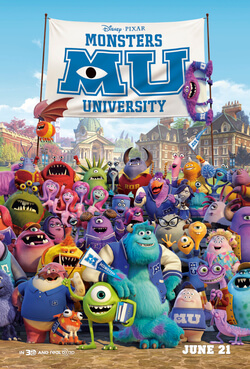
Ever since he was a young, little monster, Mike Wazowski (voice of Billy Crystal) has wanted one thing more than anything else. He wants to go to Monsters University and get his degree in Scaring, hoping to ultimately become one of the all-time great scarers. Mike eventually does get into MU, devoting himself to learning the ins and outs, every little thing he can about becoming the best monster he can be. He meets another freshman, James "Sully" Sullivan (voice of John Goodman) who seems to get by on his family name and a natural ability to scare. The two freshmen become fierce rivals, but when they get on the wrong side of some of the school administration, they have to team up. Can Mike, Sully and a handful of members of a nerdy fraternity on campus work together to win the famous Scare Games?
Made 12 years after the original, 'University' gets at least a partial pass just because it's fun to see these characters we love back again for more. It's great to see Mike and Sully, see how they met and eventually end up at Monsters, Inc. where we saw them in the first movie. It's cool to see the introduction of some other characters we've met prior, not to mention a solid list of other characters we're meeting for the first time. Thankfully though, director Dan Scanlon doesn't go for the status quo. Is another Monsters movie even necessary? Over a decade later....no, not particularly so Scanlon comes up with a gimmick that ends up working really well; the prequel. Instead of some retread sequel, we get an enjoyable, worthwhile prequel. It sounds obvious to give credit where it's due, but it felt refreshing to see an original prequel rather than a well-worn, comfortable (if dull) sequel. Point to you, Mr. Scanlon.
As is the case with all the Pixar movies I've seen, the voice casting is impeccable again. The pairing of Billy Crystal and John Goodman as Mike and Sully is pretty perfect. Crystal's higher-pitched, almost nasally voice at times is a natural fit with Goodman's deeper, almost baritone voice. Also, seeing them as enemies rather than friends is a cool, surprising twist. The visual doesn't hurt either; Mike a small, gangly green monster with one enormous eye while Sully looks like a teddy bear on steroids, immense and tall with blue fur and pink polka dots to go with his horns. Forcing the duo to work together was a nice touch as well, giving the story a bit of a lesson for its younger members of audiences without being really obvious or overly heavy-handed. LISTEN to the MESSAGE! It never feels like that. Mike with his stubborn edge and thirst for more, Sully with his natural ability and self-confidence, it's a monster match made in Heaven.
The rest of the cast in the voice department doesn't disappoint either. Returning (pre-returning?) from 'Inc.' is Steve Buscemi as Randall, Mike's roommate who can turn himself invisible and hasn't quite created that mean, evil streak we see years later. Helen Mirren is a welcome addition to the cast as Dean Hardscrabble, the legendary dean of Monsters University who comes to work against both Mike and Sully with Alfred Molina as Professor Knight, the teacher in Scaring 101. Nathan Fillion is a solid choice to play Johnny Worthington, the All-American college guy and head of the fraternity that's always the coolest on campus. Also look and listen for the voice talents of John Krasinski, Tyler Labine, Aubrey Plaza, Bonnie Hunt, Bill Hader, Bobby Moynihan and John Ratzenberger as the Abominable Snowman in supporting parts.
The best thing to come out of this 2013 prequel though is the handful of characters we meet at Oozma Kappa, the nerdy, disrespected fraternity Mike and Sully are forced to join to be eligible for the Scare Games. The group includes Don (Joel Murray), a 40-something salesman who went back to school for a new job, Squishy (Peter Sohn), a nerdy, quiet youngster looking for friends, Terry (Dave Foley) and Terri (Sean Hayes), a two-head monster, one who wants to dance and the other to study, and Art (scene-stealing Charlie Day), the goofy, off-the-wall monster with an odd past who also looks like a Muppet. Obviously, part of the appeal from the OK Fraternity comes from their physical appearance which proves difficult to describe, but check out the visual HERE. The genuine friendship, the bonding, this key introduction of the OK characters goes a long way and for the better, great additions to the story.
So we've made it this far, and I haven't really mentioned the visual here other than the appearance of the many different monsters. Pixar did it again, producing and making an incredibly visual film, full of color and excitement, deep and rich to the point some shots look like paintings. Mostly though, reviews for Pixar films could be done quickly and capably. It's good -- sometimes really good -- and you will no doubt get some really solid laughs and enjoyment out of it. 'University' isn't on par with the original, but it's a worthy addition to the Pixar archives for sure. A very solid prequel to a classic. The Pixar short before the movie, The Blue Umbrella, is okay but nothing special.
Monsters University (2013): ***/****
Ever since he was a young, little monster, Mike Wazowski (voice of Billy Crystal) has wanted one thing more than anything else. He wants to go to Monsters University and get his degree in Scaring, hoping to ultimately become one of the all-time great scarers. Mike eventually does get into MU, devoting himself to learning the ins and outs, every little thing he can about becoming the best monster he can be. He meets another freshman, James "Sully" Sullivan (voice of John Goodman) who seems to get by on his family name and a natural ability to scare. The two freshmen become fierce rivals, but when they get on the wrong side of some of the school administration, they have to team up. Can Mike, Sully and a handful of members of a nerdy fraternity on campus work together to win the famous Scare Games?
Made 12 years after the original, 'University' gets at least a partial pass just because it's fun to see these characters we love back again for more. It's great to see Mike and Sully, see how they met and eventually end up at Monsters, Inc. where we saw them in the first movie. It's cool to see the introduction of some other characters we've met prior, not to mention a solid list of other characters we're meeting for the first time. Thankfully though, director Dan Scanlon doesn't go for the status quo. Is another Monsters movie even necessary? Over a decade later....no, not particularly so Scanlon comes up with a gimmick that ends up working really well; the prequel. Instead of some retread sequel, we get an enjoyable, worthwhile prequel. It sounds obvious to give credit where it's due, but it felt refreshing to see an original prequel rather than a well-worn, comfortable (if dull) sequel. Point to you, Mr. Scanlon.
As is the case with all the Pixar movies I've seen, the voice casting is impeccable again. The pairing of Billy Crystal and John Goodman as Mike and Sully is pretty perfect. Crystal's higher-pitched, almost nasally voice at times is a natural fit with Goodman's deeper, almost baritone voice. Also, seeing them as enemies rather than friends is a cool, surprising twist. The visual doesn't hurt either; Mike a small, gangly green monster with one enormous eye while Sully looks like a teddy bear on steroids, immense and tall with blue fur and pink polka dots to go with his horns. Forcing the duo to work together was a nice touch as well, giving the story a bit of a lesson for its younger members of audiences without being really obvious or overly heavy-handed. LISTEN to the MESSAGE! It never feels like that. Mike with his stubborn edge and thirst for more, Sully with his natural ability and self-confidence, it's a monster match made in Heaven.
The rest of the cast in the voice department doesn't disappoint either. Returning (pre-returning?) from 'Inc.' is Steve Buscemi as Randall, Mike's roommate who can turn himself invisible and hasn't quite created that mean, evil streak we see years later. Helen Mirren is a welcome addition to the cast as Dean Hardscrabble, the legendary dean of Monsters University who comes to work against both Mike and Sully with Alfred Molina as Professor Knight, the teacher in Scaring 101. Nathan Fillion is a solid choice to play Johnny Worthington, the All-American college guy and head of the fraternity that's always the coolest on campus. Also look and listen for the voice talents of John Krasinski, Tyler Labine, Aubrey Plaza, Bonnie Hunt, Bill Hader, Bobby Moynihan and John Ratzenberger as the Abominable Snowman in supporting parts.
The best thing to come out of this 2013 prequel though is the handful of characters we meet at Oozma Kappa, the nerdy, disrespected fraternity Mike and Sully are forced to join to be eligible for the Scare Games. The group includes Don (Joel Murray), a 40-something salesman who went back to school for a new job, Squishy (Peter Sohn), a nerdy, quiet youngster looking for friends, Terry (Dave Foley) and Terri (Sean Hayes), a two-head monster, one who wants to dance and the other to study, and Art (scene-stealing Charlie Day), the goofy, off-the-wall monster with an odd past who also looks like a Muppet. Obviously, part of the appeal from the OK Fraternity comes from their physical appearance which proves difficult to describe, but check out the visual HERE. The genuine friendship, the bonding, this key introduction of the OK characters goes a long way and for the better, great additions to the story.
So we've made it this far, and I haven't really mentioned the visual here other than the appearance of the many different monsters. Pixar did it again, producing and making an incredibly visual film, full of color and excitement, deep and rich to the point some shots look like paintings. Mostly though, reviews for Pixar films could be done quickly and capably. It's good -- sometimes really good -- and you will no doubt get some really solid laughs and enjoyment out of it. 'University' isn't on par with the original, but it's a worthy addition to the Pixar archives for sure. A very solid prequel to a classic. The Pixar short before the movie, The Blue Umbrella, is okay but nothing special.
Monsters University (2013): ***/****
Labels:
2010s,
Alfred Molina,
Animated,
Bill Hader,
Billy Crystal,
Helen Mirren,
John Goodman,
Steve Buscemi
Monday, May 14, 2012
Miller's Crossing
Quirky, darkly funny, extremely violent, all trademarks of the films of the Coen brothers, Joel and Ethan. You basically know what you're getting yourself into when you head into a Coen brothers film. While I've liked all their movies -- some more than others -- I've noticed a recurring trend. The movies? They're entertaining and technically? Pretty much perfect. But they often keep you at arm's length, forcing you to watch a story develop without having a huge interest or personal investment in the characters. Win-lose? That was my first thought on 1990's Miller's Crossing.
It's the Prohibition and in an unnamed city, Irish gangster Leo (Albert Finney) rules with an iron fist, his right-hand man, Tom Reagan (Gabriel Byrne), at his side. Leo's power is hanging in the balance though, Tom seeing that things can change with the snap of a finger. The hard-drinking, gambling Tom is caught in the middle and not helping matters by sleeping with Verna (Marcia Gay Harden), Leo's girl. While Leo tries to hold onto his power, an Italian gangster, Johnny Caspar (Jon Polito), is moving quickly to step into what he hopes will be a power void. Able to think things through easily, Tom concocts a plan to get out cleanly, but with so much on the line, nothing is going to be easy, and it's going to come at a bloody price.
In his 1990 review, Roger Ebert pointed out that 'Crossing' is the best of two worlds; a gangster pic with a film noir setting. At its best, it succeeds because of that. Made on a relatively small budget, it wreaks of authenticity (I mean that in the positive sense by the way) from the 1920s period authentic suits and hats to the classic cars to the weaponry. It feels like we've been dropped into a 1920s city about to be torn apart by a mob war. The look of the movie is incredible, dark colors and backgrounds, shadows everywhere hiding things as needed only to reveal secrets suddenly and shockingly. The heavily Irish-themed score (listen HERE) from Carter Burwell is hit or miss, but when it works, it really works. I get it. 'Crossing' is a great movie to watch and revel in, enjoying it for all the elements that help make a movie a classic.
Yeah, that's right. Here comes the curveball. Why then do I feel so apathetic to the movie? It was a good movie, but it is missing that special something. The cast -- more on that later -- is immensely talented, the script full of witty banter, surprising, startling violence, and a twisting, turning story that only comes together late. But many reviews I read simply said "You should like this movie if not love it." Not many actually say why so in my head? I'm thinking people like this movie simply because they're told to. Yes, I know there's more to it than that. It's a cold movie, one that I enjoyed but didn't jump into head first. I wasn't particularly interested in any of the characters so as the story threw twists and turns at me, I wasn't surprised, shocked or even that interested. I hear reviewers say "It gets better on repeated viewings." To me, that sounds like a huge cop-out.
Now just because the characters aren't likable doesn't mean the performances aren't worth mentioning. A self-identified 'son of a bitch,' Byrne's Tom is the perfect anti-hero. He's a lead character who is nearly impossible to read, much less completely figure him out. I especially liked the brotherly, even father-son relationship, between Byrne and Finney's Leo. It's the longtime partner and the veteran crime boss, both very talented in their unique fields. Polito is a surprising scene-stealer as Caspar, the Italian (eye-talian according to the Irish) gangster caught up in a developing mob war, and Harden is an out of left field but dead-on pick for Verna, the femme fatale. John Turturro is appropriately slimy as Bernie, Verna's conniving brother, J.E. Freeman as Dane, Caspar's enforcer of sorts, Steve Buscemi as the weaselly Mink, and Mike Starr and Al Mancini as Caspar's on-the-street enforcers. Frances McDormand (the Mrs. Joel Coen) also has a small part as the Mayor's secretary.
Many of the usual Coen brothers touches are there. The violence isn't graphic, but it certainly jumps off the screen. A hit attempt gone wrong on Finney's Leo is a gem, the experienced Irish gangster blazing away with a stolen tommy gun, seemingly never reloading despite firing hundreds of rounds. The sound and visual is indescribable in this extended scene. For the most part, the touches are a little off though. Attempts at that very dark, even sinister, humor felt incredibly out of place and even forced at other times. Other scenes are just plain weird, like Caspar slapping his son for telling him what he had for lunch or a schlub boxer screaming like a little girl while someone else gets beaten. The story is pointed and knows where it wants to go so these outlandish attempts at the dark humor fell short for me.
I'll give credit where it's due though. Emotionally investing? Maybe not, but 'Crossing' is definitely an interesting movie. Many parts felt like the script was trying to tell us something, deliver a profound message. Symbolism is everywhere, leading many fans/viewers to make all sorts of crazy conclusions, many of them oddly related to whether all the male characters were gay. Tom's hat comes to take on a deeper meaning, but what exactly? I can't say I even have the vaguest notion. Maybe this is a movie that would drastically improve with repeat viewings, but while I moderately enjoyed it the first time, I don't see myself revisiting it very soon. I feel like I've been writing this a lot lately, but here it is again. Lots of potential, didn't quite live up to it for me.
Miller's Crossing <---trailer (1990): ** 1/2 /****
It's the Prohibition and in an unnamed city, Irish gangster Leo (Albert Finney) rules with an iron fist, his right-hand man, Tom Reagan (Gabriel Byrne), at his side. Leo's power is hanging in the balance though, Tom seeing that things can change with the snap of a finger. The hard-drinking, gambling Tom is caught in the middle and not helping matters by sleeping with Verna (Marcia Gay Harden), Leo's girl. While Leo tries to hold onto his power, an Italian gangster, Johnny Caspar (Jon Polito), is moving quickly to step into what he hopes will be a power void. Able to think things through easily, Tom concocts a plan to get out cleanly, but with so much on the line, nothing is going to be easy, and it's going to come at a bloody price.
In his 1990 review, Roger Ebert pointed out that 'Crossing' is the best of two worlds; a gangster pic with a film noir setting. At its best, it succeeds because of that. Made on a relatively small budget, it wreaks of authenticity (I mean that in the positive sense by the way) from the 1920s period authentic suits and hats to the classic cars to the weaponry. It feels like we've been dropped into a 1920s city about to be torn apart by a mob war. The look of the movie is incredible, dark colors and backgrounds, shadows everywhere hiding things as needed only to reveal secrets suddenly and shockingly. The heavily Irish-themed score (listen HERE) from Carter Burwell is hit or miss, but when it works, it really works. I get it. 'Crossing' is a great movie to watch and revel in, enjoying it for all the elements that help make a movie a classic.
Yeah, that's right. Here comes the curveball. Why then do I feel so apathetic to the movie? It was a good movie, but it is missing that special something. The cast -- more on that later -- is immensely talented, the script full of witty banter, surprising, startling violence, and a twisting, turning story that only comes together late. But many reviews I read simply said "You should like this movie if not love it." Not many actually say why so in my head? I'm thinking people like this movie simply because they're told to. Yes, I know there's more to it than that. It's a cold movie, one that I enjoyed but didn't jump into head first. I wasn't particularly interested in any of the characters so as the story threw twists and turns at me, I wasn't surprised, shocked or even that interested. I hear reviewers say "It gets better on repeated viewings." To me, that sounds like a huge cop-out.
Now just because the characters aren't likable doesn't mean the performances aren't worth mentioning. A self-identified 'son of a bitch,' Byrne's Tom is the perfect anti-hero. He's a lead character who is nearly impossible to read, much less completely figure him out. I especially liked the brotherly, even father-son relationship, between Byrne and Finney's Leo. It's the longtime partner and the veteran crime boss, both very talented in their unique fields. Polito is a surprising scene-stealer as Caspar, the Italian (eye-talian according to the Irish) gangster caught up in a developing mob war, and Harden is an out of left field but dead-on pick for Verna, the femme fatale. John Turturro is appropriately slimy as Bernie, Verna's conniving brother, J.E. Freeman as Dane, Caspar's enforcer of sorts, Steve Buscemi as the weaselly Mink, and Mike Starr and Al Mancini as Caspar's on-the-street enforcers. Frances McDormand (the Mrs. Joel Coen) also has a small part as the Mayor's secretary.
Many of the usual Coen brothers touches are there. The violence isn't graphic, but it certainly jumps off the screen. A hit attempt gone wrong on Finney's Leo is a gem, the experienced Irish gangster blazing away with a stolen tommy gun, seemingly never reloading despite firing hundreds of rounds. The sound and visual is indescribable in this extended scene. For the most part, the touches are a little off though. Attempts at that very dark, even sinister, humor felt incredibly out of place and even forced at other times. Other scenes are just plain weird, like Caspar slapping his son for telling him what he had for lunch or a schlub boxer screaming like a little girl while someone else gets beaten. The story is pointed and knows where it wants to go so these outlandish attempts at the dark humor fell short for me.
I'll give credit where it's due though. Emotionally investing? Maybe not, but 'Crossing' is definitely an interesting movie. Many parts felt like the script was trying to tell us something, deliver a profound message. Symbolism is everywhere, leading many fans/viewers to make all sorts of crazy conclusions, many of them oddly related to whether all the male characters were gay. Tom's hat comes to take on a deeper meaning, but what exactly? I can't say I even have the vaguest notion. Maybe this is a movie that would drastically improve with repeat viewings, but while I moderately enjoyed it the first time, I don't see myself revisiting it very soon. I feel like I've been writing this a lot lately, but here it is again. Lots of potential, didn't quite live up to it for me.
Miller's Crossing <---trailer (1990): ** 1/2 /****
Sunday, January 8, 2012
Escape from L.A.
If you're going to do a sequel, you might as well commit and do it right, right? You'd think so, or at least that's usually my hope when I stumble across a sequel -- especially an unnecessary one. That is partially why I avoided John Carpenter's 1996 sequel Escape from L.A.. The 1981 original doesn't need a sequel so somewhat skeptical, I dove in.
It's 2013 and the United States is very much a dystopian country still, even 16 years since Special Forces soldier turned criminal Snake Plissken (Kurt Russell) rescued the President in New York. Now though, an immensely powerful earthquake has ripped Los Angeles apart, the city now an island destination for any "undesirables." Now a new religious fanatic (Cliff Robertson) has become the President, and his extremist daughter (A.J. Langer) has hijacked an item that could destroy the world, retreating to L.A. to work with fellow extremist Cuervo Jones (Georges Corraface). Snake's services are called on once more. Blackmailed and working against a deadline of death, Snake must sneak into L.A., retrieve the item, kill the daughter, and only then will he be safe. Can he pull off the impossible again?
I didn't love the original Escape from New York, but I certainly liked it. Made on a small budget, there was a certain B-movie charm to Carpenter's film. It was cheesy and ridiculous and over the top and most importantly of all, fun to watch. The dystopian setting of an America that is nothing like the country we know now is ideal, opening the door for all kinds of outlets to take a story. Carpenter and Russell worked together a handful of times over their careers, clearly enjoying making movies together. Russell liked it so much -- and playing Snake too -- that he worked with Carpenter on writing a sequel. It was held up for years, finally coming to fruition in the mid 1990s. With that long of a wait and this much talent involved, why then is the sequel so bad?
The obvious answer is that it is basically the same movie. Sequels are fine when they add another step, a new layer to a pre-existing world and characters. But making the same movie -- quite literally -- with all the same features, characters and settings? Replacing New York with Los Angeles isn't unique or new. It's a road trip. I guess I just expected more. If you've got 15-plus years to write a sequel, couldn't you manage something better than this? It bombed in theaters, not making a profit, so I'm not the only one with complaints. The repeat of New York's success is one thing, but this 'Escape' has too much really awful CGI, too many similar characters, and did I mention the almost identical story?
What carries both movies on different levels is Kurt Russell. 'New York' is just a genuinely good B-movie that's aided and boosted by Russell. 'L.A.' is basically watchable only because of Russell. Snake Plissken is Russell's most iconic character from a successful career, and there's nothing about him that isn't cool. Okay, check that, the odd, fetishisized leather outfit is a little much. But other than that, Snake is the perfect anti-hero. A high profile crook with a reputation, he has no regard for any authority and only goes along with the plan because his life depends on it. Yes, he growls everything he says. Yes, he makes some awfully stupid decisions. But is he cool doing it? Yes, Kurt Russell is awesome, and he's cooler than you.
While the rest of the cast and characters are pretty ridiculous, Carpenter nonetheless assembles quite a cast. Start with Robertson, having some fun taking some jabs at the religious nuts. His U.S. President is one big stereotype, hamming it up like nobody's business. Stacy Keach plays Malloy, Snake's "handler" of sorts, with Michelle Forbes as his assistant. Steve Buscemi, Bruce Campbell, Valeria Golino and Peter Fonda play just some of the eccentric nuts trying to survive in Los Angeles who Snake runs across, Buscemi and Fonda making the best impressions. Look also for Pam Grier as Hershe Las Palmas, a drag queen who Snake used to work with on other jobs. I've gotta admit though, it's a little unsettling hearing a man's voice coming from Grier's mouth.
So watching a rehash of the more enjoyable Escape from New York, there are some saving graces in this most unnecessary of sequels. The ending features a couple very cool twists, some you can see coming if you're paying attention, but enjoyable nonetheless. Was there ever any doubt Snake was going to get duped repeatedly by these morons? I think not. Cool character, cool ending, but that doesn't save the movie.
Escape from L.A. <---trailer (1996): * 1/2 /****
It's 2013 and the United States is very much a dystopian country still, even 16 years since Special Forces soldier turned criminal Snake Plissken (Kurt Russell) rescued the President in New York. Now though, an immensely powerful earthquake has ripped Los Angeles apart, the city now an island destination for any "undesirables." Now a new religious fanatic (Cliff Robertson) has become the President, and his extremist daughter (A.J. Langer) has hijacked an item that could destroy the world, retreating to L.A. to work with fellow extremist Cuervo Jones (Georges Corraface). Snake's services are called on once more. Blackmailed and working against a deadline of death, Snake must sneak into L.A., retrieve the item, kill the daughter, and only then will he be safe. Can he pull off the impossible again?
I didn't love the original Escape from New York, but I certainly liked it. Made on a small budget, there was a certain B-movie charm to Carpenter's film. It was cheesy and ridiculous and over the top and most importantly of all, fun to watch. The dystopian setting of an America that is nothing like the country we know now is ideal, opening the door for all kinds of outlets to take a story. Carpenter and Russell worked together a handful of times over their careers, clearly enjoying making movies together. Russell liked it so much -- and playing Snake too -- that he worked with Carpenter on writing a sequel. It was held up for years, finally coming to fruition in the mid 1990s. With that long of a wait and this much talent involved, why then is the sequel so bad?
The obvious answer is that it is basically the same movie. Sequels are fine when they add another step, a new layer to a pre-existing world and characters. But making the same movie -- quite literally -- with all the same features, characters and settings? Replacing New York with Los Angeles isn't unique or new. It's a road trip. I guess I just expected more. If you've got 15-plus years to write a sequel, couldn't you manage something better than this? It bombed in theaters, not making a profit, so I'm not the only one with complaints. The repeat of New York's success is one thing, but this 'Escape' has too much really awful CGI, too many similar characters, and did I mention the almost identical story?
What carries both movies on different levels is Kurt Russell. 'New York' is just a genuinely good B-movie that's aided and boosted by Russell. 'L.A.' is basically watchable only because of Russell. Snake Plissken is Russell's most iconic character from a successful career, and there's nothing about him that isn't cool. Okay, check that, the odd, fetishisized leather outfit is a little much. But other than that, Snake is the perfect anti-hero. A high profile crook with a reputation, he has no regard for any authority and only goes along with the plan because his life depends on it. Yes, he growls everything he says. Yes, he makes some awfully stupid decisions. But is he cool doing it? Yes, Kurt Russell is awesome, and he's cooler than you.
While the rest of the cast and characters are pretty ridiculous, Carpenter nonetheless assembles quite a cast. Start with Robertson, having some fun taking some jabs at the religious nuts. His U.S. President is one big stereotype, hamming it up like nobody's business. Stacy Keach plays Malloy, Snake's "handler" of sorts, with Michelle Forbes as his assistant. Steve Buscemi, Bruce Campbell, Valeria Golino and Peter Fonda play just some of the eccentric nuts trying to survive in Los Angeles who Snake runs across, Buscemi and Fonda making the best impressions. Look also for Pam Grier as Hershe Las Palmas, a drag queen who Snake used to work with on other jobs. I've gotta admit though, it's a little unsettling hearing a man's voice coming from Grier's mouth.
So watching a rehash of the more enjoyable Escape from New York, there are some saving graces in this most unnecessary of sequels. The ending features a couple very cool twists, some you can see coming if you're paying attention, but enjoyable nonetheless. Was there ever any doubt Snake was going to get duped repeatedly by these morons? I think not. Cool character, cool ending, but that doesn't save the movie.
Escape from L.A. <---trailer (1996): * 1/2 /****
Labels:
1990s,
Cliff Robertson,
John Carpenter,
Kurt Russell,
Pam Grier,
Peter Fonda,
Sci-Fi,
Stacy Keach,
Steve Buscemi
Monday, February 7, 2011
Pulp Fiction
When I reviewed Inglorious Basterds over a year ago, I said that there isn't as divisive a director as Quentin Tarantino currently working in Hollywood. I stand by that statement still. Is he immensely talented, an eccentric movie lover? Or is he a hack, taking here and there from previously successful movies and making them his own? Is it a bad thing that it seems he falls somewhere in between? I think he's both. Of course, if you're not a fan of his, it's going to take more than that to appreciate the man's films. To each his own. Like anything with movies, it comes down to personal preference.
What's impressive about Tarantino and the love-hate relationship moviegoers have with him is that the man just doesn't have a lot of films to his name. He picks projects that appeal to him, not just taking anything that comes down the road. Of the 15 directorial claims IMDB makes, only eight are feature length projects. In their own right, each can be called in a classic (okay, a minor classic in some cases), and fans have their own individual favorites. For many, it's an easy decision, and the movie that always seems to come up is 1994's Pulp Fiction, Tarantino's first movie after the surprising success of 1992's Reservoir Dogs.
I don't put much stock in the IMDB's fan rating system which allows fan voting to show how good/bad a movie is. Pulp Fiction currently sits at No. 5 all-time. I don't think it's close to being one of the top five greatest movies of all-time, but then again, IMDB voters have The Shawshank Redemption as No. 1 so take that for what's it worth. This is a good intro to Tarantino for fans not familiar with him. Long scenes of uninterrupted dialogue broken up by brief but extreme moments of graphic violence, style to spare, and a cast that any movie fan should be able to appreciate. Here goes an attempt to give some sort of plot synopsis, however muddled it may be. Interweaving storylines, characters in and out of the story, and a non-linear plot certainly keep you on your toes.
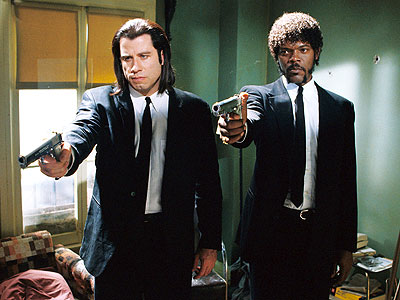
Two low-level enforcer/hit men, Vincent Vega (John Travolta) and Jules Winnfield (Samuel L. Jackson), have been dispatched on a mission from their boss, Marsellus Graham (Ving Rhames). Someone owes him money, and Vincent and Jules intend to get it back. Vincent's also been assigned an unusual task, go on a date with Marsellus' wife, Mia (Uma Thurman) while the boss is out of town. Also going on, Marsellus has arranged for aging boxer, Butch Coolidge (Bruce Willis), to throw a fight for big money, but Butch has other plans that only he knows about. On top of that, two bottom-tier thieves (Tim Roth and Amanda Plummer) are planning their next job, and everyone is involved whether they know it or not.
Where to start, where to start? Tarantino uses his usual chapters storytelling device, breaking up the 153-minute movie into smaller segments that aren't told in chronological order. For example, we see someone get killed in one chapter, but they're alive in the next. Gimmicky, yes, but when handled right, it's a home run, and Tarantino brings it full circle, ending the movie exactly where it started. The soundtrack is full of classic rock songs, and really runs the gamut across genres. Style-wise, Tarantino tells a story with his camera, blending long unedited takes with quick in your face editing at other times. Question if you will what the director is showing, but just in terms of pure movie-making skill, it's hard to beat this guy.
By 1994, John Travolta's career was all but mainlining when he accepted this part to play hitman Vincent Vega. It was the part that put him back in the limelight and earned him an Oscar nomination in the process. For me personally, Travolta (and his interactions with Jackson) are what makes this movie special. It's the little things that make it work. I couldn't place Vince's accent if I tried, but it adds something to the character. He's a little off, maybe a little crazy, but at the same time perfectly sane. His dance scene with Uma Thurman (watch it HERE) is about as iconic, as memorable as anything to hit theaters in the last 20 years and is so sublimely perfect it's not even worth trying to explain. I loved this character and wish there was more of him.
With a story that bounces around as much as Pulp Fiction does, some characters/storylines get more in-depth than others. On top of all those names mentioned above, there's also parts for Eric Stoltz, Rosanna Arquette, Steve Buscemi as a smarmy waiter, Tarantino stepping in front of the camera for a quick appearance, and two perfect parts for Christopher Walken and Harvey Keitel. Walken is on-screen for no more than two minutes but delivers one of the most movingly effective and equally funny monologues I've ever seen (watch it HERE). Keitel nails his part as 'the Wolf,' a cleaner who fixes other people's messes. Check out Keitel's entrance HERE. These are two small parts that Tarantino clearly loved writing, stylish and unnecessary but nonetheless giving a movie those little touches that can bring it up a notch.
As much as I loved certain parts of the movie, others just fell flat. The Bruce Willis boxer subplot didn't work as well for me as the rest of the movie -- with the exception of the Walken scene -- and I found myself fast-forwarding through it. Tarantino can be too self-indulgent at times, and the dialogue goes on too long at times. That said, the positives make the negatives a minor problem. Travolta, Jackson, Rhames, Walken, Keitel, Thurman, deliver amazingly memorable performances. For all the dialogue that never stops, there's monologues (like Jackson's in the finale SPOILERS, HERE) that make you appreciate what good writing really is. Flawed as a movie overall, yes, but one of the best flawed movies I've seen in awhile.
Pulp Fiction <---trailer (1994): *** 1/2 /****
What's impressive about Tarantino and the love-hate relationship moviegoers have with him is that the man just doesn't have a lot of films to his name. He picks projects that appeal to him, not just taking anything that comes down the road. Of the 15 directorial claims IMDB makes, only eight are feature length projects. In their own right, each can be called in a classic (okay, a minor classic in some cases), and fans have their own individual favorites. For many, it's an easy decision, and the movie that always seems to come up is 1994's Pulp Fiction, Tarantino's first movie after the surprising success of 1992's Reservoir Dogs.
I don't put much stock in the IMDB's fan rating system which allows fan voting to show how good/bad a movie is. Pulp Fiction currently sits at No. 5 all-time. I don't think it's close to being one of the top five greatest movies of all-time, but then again, IMDB voters have The Shawshank Redemption as No. 1 so take that for what's it worth. This is a good intro to Tarantino for fans not familiar with him. Long scenes of uninterrupted dialogue broken up by brief but extreme moments of graphic violence, style to spare, and a cast that any movie fan should be able to appreciate. Here goes an attempt to give some sort of plot synopsis, however muddled it may be. Interweaving storylines, characters in and out of the story, and a non-linear plot certainly keep you on your toes.
Two low-level enforcer/hit men, Vincent Vega (John Travolta) and Jules Winnfield (Samuel L. Jackson), have been dispatched on a mission from their boss, Marsellus Graham (Ving Rhames). Someone owes him money, and Vincent and Jules intend to get it back. Vincent's also been assigned an unusual task, go on a date with Marsellus' wife, Mia (Uma Thurman) while the boss is out of town. Also going on, Marsellus has arranged for aging boxer, Butch Coolidge (Bruce Willis), to throw a fight for big money, but Butch has other plans that only he knows about. On top of that, two bottom-tier thieves (Tim Roth and Amanda Plummer) are planning their next job, and everyone is involved whether they know it or not.
Where to start, where to start? Tarantino uses his usual chapters storytelling device, breaking up the 153-minute movie into smaller segments that aren't told in chronological order. For example, we see someone get killed in one chapter, but they're alive in the next. Gimmicky, yes, but when handled right, it's a home run, and Tarantino brings it full circle, ending the movie exactly where it started. The soundtrack is full of classic rock songs, and really runs the gamut across genres. Style-wise, Tarantino tells a story with his camera, blending long unedited takes with quick in your face editing at other times. Question if you will what the director is showing, but just in terms of pure movie-making skill, it's hard to beat this guy.
By 1994, John Travolta's career was all but mainlining when he accepted this part to play hitman Vincent Vega. It was the part that put him back in the limelight and earned him an Oscar nomination in the process. For me personally, Travolta (and his interactions with Jackson) are what makes this movie special. It's the little things that make it work. I couldn't place Vince's accent if I tried, but it adds something to the character. He's a little off, maybe a little crazy, but at the same time perfectly sane. His dance scene with Uma Thurman (watch it HERE) is about as iconic, as memorable as anything to hit theaters in the last 20 years and is so sublimely perfect it's not even worth trying to explain. I loved this character and wish there was more of him.
With a story that bounces around as much as Pulp Fiction does, some characters/storylines get more in-depth than others. On top of all those names mentioned above, there's also parts for Eric Stoltz, Rosanna Arquette, Steve Buscemi as a smarmy waiter, Tarantino stepping in front of the camera for a quick appearance, and two perfect parts for Christopher Walken and Harvey Keitel. Walken is on-screen for no more than two minutes but delivers one of the most movingly effective and equally funny monologues I've ever seen (watch it HERE). Keitel nails his part as 'the Wolf,' a cleaner who fixes other people's messes. Check out Keitel's entrance HERE. These are two small parts that Tarantino clearly loved writing, stylish and unnecessary but nonetheless giving a movie those little touches that can bring it up a notch.
As much as I loved certain parts of the movie, others just fell flat. The Bruce Willis boxer subplot didn't work as well for me as the rest of the movie -- with the exception of the Walken scene -- and I found myself fast-forwarding through it. Tarantino can be too self-indulgent at times, and the dialogue goes on too long at times. That said, the positives make the negatives a minor problem. Travolta, Jackson, Rhames, Walken, Keitel, Thurman, deliver amazingly memorable performances. For all the dialogue that never stops, there's monologues (like Jackson's in the finale SPOILERS, HERE) that make you appreciate what good writing really is. Flawed as a movie overall, yes, but one of the best flawed movies I've seen in awhile.
Pulp Fiction <---trailer (1994): *** 1/2 /****
Tuesday, May 4, 2010
The Island
When I reviewed Transformers 2 last summer, I wasn’t too shy about letting director Michael Bay have it with both barrels. It is never a good sign when you become a punch line for your profession. Oh, a movie with stupid amounts of action, in your face style, and all at the expense of those old stand-bys like story, character and any sort of plot development...that must be a Michael Bay movie! As was the case with Transformers, the movie wasn’t trying to be anything but a stupid action movie so it’s easier to judge that because it is what is, a bad movie. But what about when Bay ruins a perfectly good movie with his abrasive filmmaking style? So goes 2005’s The Island.
One genre that has definitely benefited from the advances in computer generated imagery is science fiction. Previous sci-fi movies had to use the very limited capabilities at their disposal or find some way to create what they needed to shoot. The end result may have been groundbreaking at the time but now ends up looking very dated. Advances in CGI – while expensive – made directors’ jobs that much easier. The first hour of The Island is an example of what good CGI can do before Bay gets his over-the-top hands on that story and goes to town.
In a futuristic society following an Armageddon-like event known only as ‘the contamination,’ humans live in a totalitarian society where their day-to-day decisions are made for them by an unknown and unseen power. The humans are given jobs and live in posh apartments where everything is provided for them. In charge is a Dr. Merrick (Sean Bean) who monitors these surviving humans through their actions and emotions. All the humans have some free will and an ability to question their existence, but it a naïve questioning that is reminiscent of a child’s mind. Everyone lives from day to day with the hopes of winning the Lottery where the winners get to go to the Island, an experience of living even greater than the lives they knew before.
Generally, these humans are content to wait for their chance and hopefully win the Lottery and get their long awaited trip to the Island. But one human keeps bringing up questions as to what is going on. His name is Lincoln Six Echo (Ewan McGregor), and he is confused about everything that surrounds him with his existence. He begins to investigate the strange goings-on and when he figures out what’s happening escapes with a fellow human, Jordan Two Delta (Scarlett Johansson). Merrick needs these two humans back and brings in an ex-Special Forces soldier, (Djimon Hounsou), to track them down and bring them back.
Stop reading if you don’t want to know what’s actually going on at the Island. SPOILERS from here on in SPOILERS This futuristic world isn’t so futuristic, it’s only a decade or so into the 2020s or so. These humans are clones purchased by rich individuals to help prolong their lives. In case of an organ transplant or horrific accident to their sponsor, these clones are told they’ve been chosen to go to the Island when really they’re just cut up and hacked to pieces for the necessary parts. This isn’t much of a spoiler like I’m ruining the end of the movie. This is all revealed about 60 minutes into the story. It’s a unique twist though and really keeps the first hour moving as Lincoln pieces things together.
I absolutely loved the first hour of the movie because it is a prime example of how good sci-fi can be when things are handled right. It’s a picture of ‘what if?’ that asks what our world could become. Those first 60 minutes are stylish and a sight to behold at this futuristic, gigantic apartment building, a nice, little microcosm of what society can be. It is a different lifestyle entirely where anything and everything is controlled in everyday life. Like many sci-fi/dystopian stories, some troublemaker has to start asking questions.
This first hour is effective thanks to the casting with MacGregor and Johansson as the two humans. Lincoln questions more than Jordan does because he just isn’t satisfied with life as he knows it. Jordan is more content to live each day and have fun, only to change her mind when Lincoln starts bringing up all his questions. In a sci-fi action movie, the casting as a whole is very impressive. Bean’s Dr. Merrick is perfectly creepy who’s doing something morally wrong, but he believes he’s helping the world (and making a pretty penny in the process). Bean is at his best when playing the villainous parts like here. Character actor extraordinaire Steve Buscemi is perfectly cast as McCord, a janitor who may know more than he’s letting on and is a good friend of Lincoln. Michael Clarke Duncan is wasted in a small part that clues Lincoln as to what’s happening. Hounsou is an incredible presence on-screen, but his character is given so little to do and with so little background, he’s hardly more than a cardboard cutout.
All these characters – interesting in their own rights – are introduced through the first hour, but over the next 76 minutes any more development is left by the wayside. Bay’s action tendencies kick in, and we get an extended chase full of action and explosions and CGI. Does it look great? You bet it does, but like any Bay movie, it could have been toned down. It wouldn’t be an issue, but the first hour is so good that it raises expectations for the second half which it just can’t live up to. It’s all great to watch, but it comes at the expense of these cool characters and highly interesting story.
Comparing the two halves of the movie, the first half is clearly better than the second. As a whole though, the movie is still pretty decent and kept me entertained, but I wasn’t blown away in the end. The finale is a bit disappointing. It’s easier though to look at The Island as two halves, a science fiction side and a heavy-duty action side. Know what you’re getting when watching this Michael Bay extravaganza, and you should be safe.
The Island <----trailer (2005): ** ½ /****
Subscribe to:
Posts (Atom)