The Sons of Katie Elder

The Sons of Katie Elder
"First, we reunite, then find Ma and Pa's killer...then read some reviews."
Showing posts with label Frederic Forrest. Show all posts

Thursday, December 3, 2015

Lonesome Dove

Sometimes you just need to sit back and take it all in. Just appreciate a movie for being pretty much perfect on all levels. Case in point? The 1989 CBS miniseries Lonesome Dove, based off the Pulitzer Prize-winning novel -- also an all-timer and one of my favorites -- from author Larry McMurtry. Aired over four nights, the miniseries pulled in crazy ratings, better reviews, and rave reviews for its cast. It deserves every positive thing it got. It is a true classic, and regardless of its TV roots, one of the best westerns of all-time.

Along the Rio Grande River in the town of Lonesome Dove in south Texas, former Texas Rangers Capt. Augustus McCrae (Robert Duvall) and Capt. Woodrow F. Call (Tommy Lee Jones) own the Hat Creek Company, working as cattle buyers and sellers, selling an occasional horse but nothing too lucrative. After creating quite a name for themselves as Rangers when all of Texas was still a wilderness, the duo has drifted into obscurity some. They're pleasantly surprised when a good friend from their past and a former ranger himself, Jake Spoon (Robert Urich), rides into Lonesome Dove telling them how beautiful and untouched the Montana territory far to the north is. Call gets the idea in his head to put together a herd of cattle and drive them all the way to the territory, starting up the first cattle ranch in Montana. Gus and several of their men are wary but go along with it. The veteran Rangers have their reasons for going -- both very different -- but no one involved has any real idea what awaits them on the trail.

It's impossible to condense a 900-plus page novel and a four-part miniseries running 384 minutes into one concise paragraph explaining the plot. Expanding a little, the two Rangers drive a cattle herd from south Texas to Montana, experiencing all the good, bad, dangerous and terrifying that the trail has to offer. Without getting too cheesy/flowery, it's about friendship, love, betrayal, pride, loyalty and on the biggest level, the changing times in the west, seen through the eyes of old and young men alike. There is a subplot I've lost interest in over the years and repeated viewings/readings, but Lonesome Dove is as perfect a movie as I've ever seen. I highly recommend the novel too if you're a reader looking for a good book.

Director Simon Wincer does an admirable job bringing McMurtry's novel to life. Decisions that are made to streamline the story excise non-essential characters, scenes and explanation to make a four-part miniseries into a miniseries running longer than six hours that flies by. The filming locations are perfect, helping set up the passage of time with cinematographer Dean Semler turning in a beautiful-looking story. A TV miniseries might seem limiting, but the visual scope and beauty here is a huge selling point. Throw in a sweeping, emotionally perfect score (listen HERE) from composer Basil Poledouris, and you've got all the makings of a halfway decent story!

What sets 'Lonesome' apart I've always felt is its ability to mix the romance of the wild west with the realism of the wild west. There's something straightforward and iconic about the visual of a cowboy on horseback trailing along with a cattle herd against the horizon. There's something simple about it that is able to permeate itself through a ton of westerns, good and bad. A man on his horse, doing a job that isn't easy and ready to fight off whatever comes at the herd because it's his job. The counter? There was nothing romantic about it no matter what you may want to think. It was back-breaking work, and death comes cheap (as it's said several times) to those who aren't careful and even to those who are. It doesn't take much for the winds to shift from good to bad. Straddling that line, 'Lonesome' is a somber, moving story that has the ability to tear your guts up through good and bad. It's the rare western with that ability.

Robert Duvall and Tommy Lee Jones. That's it. That's all. I could leave it at that and be good, but that'd make for a short review, wouldn't it? Both men have had remarkable careers, but I don't believe either has ever (EVER!!!) been better than they were here. Duvall's Gus is fast-talking, loves some whiskey and good biscuits, a ladies man, and an all-timer at avoiding work. Jones' Call is a man of few words, ridiculously stubborn, hard-working to a fault, and lives by a code. A true Odd Couple-esque dynamic, these are phenomenal performances. They play off each other with ease. Their dialogue crackles with energy whether it be two friends busting each other, two partners figuring out how to solve a problem, or two longtime friends having a rare heart-to-heart in a trying moment. Both are amazingly excellent, but Duvall is on another level here as Gus. His energy, his non-stop talking, his physical mannerisms from a quick smirk to sucking his lips to his unique walk...my goodness, Gus McCrae is one of the all-time best western characters. Robert Duvall is the freaking man.


Though there are many characters in the miniseries, the heart of the story is Gus and Call's Hat Creek outfit and their motley crew of cowboys. Danny Glover is a quiet scene-stealer as Josh Deets, the outfit's tracker and scout, a fiercely capable worker and fighter who never complains, just putting his head down and getting the job done. Rick Schroder is excellent as Newt, a young, inexperienced 17-year old cowboy orphaned years before and picked up and cared for by the Hat Creek outfit. Tim Scott plays Pea Eye, a well-meaning but not so intelligent former Ranger. And last, there's unofficial member Dish Boggett, played by D.B. Sweeney, a more than capable cowboy who finds a niche with the group. There's a bond, a camaraderie amongst the crew that feels natural and real, not actors, but real people and their relationships. It is the rare western where you can say that.

You could write a thesis paper about individual characters here, making my job reviewing the miniseries a tough one! Diane Lane doesn't deserved to get buried so far down in a review, but here we sit. Her Lorena Wood, a beautiful young prostitute who finds herself on the trail with the herd, is a fascinating character to watch grow and develop. Her chemistry with Duvall is impeccable too. Anjelica Houston plays Clara, a past love (and maybe currently) of Gus', married and with children on a horse ranch in Nebraska. Frederic Forrest is frightening as Blue Duck, a half-breed bandit who's rampaged all over Texas for years, all the while out of the reach of our Rangers. I also especially liked Jorge Martinez de Hoyos as Po Campo, the cook traveling with the herd.

If there is a weak point in 'Lonesome,' it is a subplot involving an Arkansas sheriff, July Johnson (Chris Cooper), trailing Jake Spoon only to find out his wife (Glenne Headly) has left him. This subplot also features Barry Corbin, Steve Buscemi, and Frederick Coffin. I just don't find myself drawn to the characters here and as a result, their portions of the story tend to drag.

This is a movie that deserves a big old, long review full of in-depth analysis, more than I've got the space for here. I easily could write a college paper about this McMurtry novel! I also don't want to give away too much here with my review, recommending you go into the miniseries with a clean slate. I'll say this instead. There are moments that are absolutely heartbreaking, truly gut-wrenching, whether it be a surprising/shocking death to a face-to-face where you're begging something to happen. Both watching the miniseries and reading McMurtry's novel, I've cried and we're talking real, big crocodile tears. It's a classic movie -- screw the miniseries moniker -- and required viewing for anyone who loves good characters, story and scope regardless of your feelings on the western genre.

Interesting tidbit? McMurtry originally wrote the basic idea as a movie with John Wayne (Call), Jimmy Stewart (Gus) and Henry Fonda (Jake) leading the cast only to see it fall apart because of scheduling conflicts. Can you imagine that? If you're looking to kill a couple hours, see if you can fill out the rest of the cast with actors working in the late 1960's and early 1970's. I have, and let me tell you, it's tough. In the meantime, check Lonesome Dove out.

Lonesome Dove (1989): ****/****

Saturday, February 28, 2015

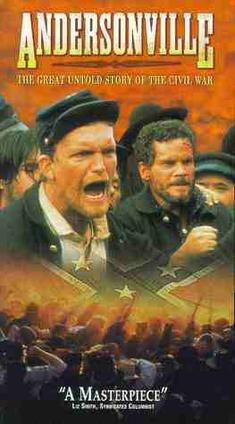
Andersonville

When you think of prisoner of war movies, World War II-era flicks dominate the landscape with movies like The Great Escape and Bridge on the River Kwai. There are others of course, some from the Korean and Vietnam Wars. But as if there wasn't already a scarcity of Civil War movies, there definitely aren't many Civil War P.O.W. movies. How about a gem, a made-for-TV flick from the mid-1990s? That's 1996's Andersonville.

During the battle of Cold Harbor in early June 1864, a group of Union troops from a Massachusetts regiment, including Corporal Josiah Day (Jarrod Emick) and Sergeant McSpadden (Frederic Forrest), are captured by Confederate forces. Packed into cattle cars, the Union infantry is shipped south to a prison camp that is quickly gaining a reputation for all the wrong reasons. It's called Andersonville, and thousands and thousands of prisoners are confined in a stockade meant for less than 8,000. Food, water and rations are limited, and the maniacal camp commandant, Capt. Henry Wirtz (Jan Triska), rules the camp with an iron fist. Josiah, McSpadden and their fellow Massachusetts men have no idea what awaits them in a prison camp where men drop like flies each day from disease, starvation and even a murdering group of prisoners called Raiders. Can they survive? As Andersonville wears on them, do they even want to survive?

Have you heard of Ted Turner? Well, he's quirky, rich and a Civil War enthusiast. Having already backed the 1993 Civil War epic Gettysburg, Turner turned his sights on this made-for-TV venture, bringing to the small screen a generally forgotten, truly dark part of American history. Once fighting began in 1861, both the Union and Confederate sides now had to deal with the ever-increasing number of prisoners of war. Clocking in at 167 minutes, 'Andersonville' is a horrifying, moving and realistic portrayal of the worst Civil War prison camp. Built in 1864, over 45,000 prisoners were held there, and over 13,000 died in just over a year-plus. The truth is horrifying just reading about it, but seeing it? Quite the moving experience.

With Turner backing the production, no expenses were cut short. An entire set was built almost to the exact measurements of the actual prison camp (it's a little bit smaller) to provide just a stunning visual for all the wrong reasons. Acres and acres of makeshift tents and shelters -- usually just holes in the ground covered with tarps -- stretch as far as the eye can see, prisoners packed into the camp like sardines. With no sanitation, you can only imagine how absolutely filthy and disease-ridden the camp was. Director John Frankenheimer brings this god-forsaken place to life, using long tracking shots that have the camera navigating through this claustrophobic, filthy, death lingering in the air, horrific location to life. By the end of the movie, you're exhausted, beaten up and truly get a sense of what living in the camp was like.

'Andersonville' utilizes an ensemble cast with some familiar faces, even some stage actors, but no huge stars. Playing the everyman hero, Emick -- a stage actor -- is our window into the camp as Josiah, an educated, well-spoken soldier who vows to survive no matter what it takes. Forrest too is excellent as the tough Sgt. McSpadden who wants nothing more than to get his Massachusetts men through this living hell. The prisoners we meet are a combination of those new Massachusetts infantry who arrive and the Pennsylvania miners who welcome them in, even letting them in their desperate escape attempt. Ted Marcoux plays Martin, one of the miners and simply a good man in who we see a horrific physical transformation over his time in the camp.

Also worth mentioning in a very solid supporting part is Cliff De Young (Glory, Centennial) as Sgt. Gleason, the leader of the Pennsylvania men who welcomes in the Massachusetts contingent. Experienced miners in the coal mines, Gleason's men are digging a tunnel under the wall. Their odds? Slim, but anything is better than staying in the camp. Also look for Jayce Bartok, Justin Henry, Andrew Kavovit, Olek Krupa, Thomas Wilson, Peter Murnik, and Gregory Sporleder as other key Union prisoners we meet. Frederick Coffin and William Sanderson play the leaders of the Raiders, more intent on survival than anything, even if it means attacking and killing fellow prisoners. Also look for William H. Macy as a Confederate officer tasked with examining what goes on within Andersonville's walls.

Originally broadcast over two separate nights, the story tries to accomplish a ton. The first half introduces our characters, the camp and the desperate escape attempt via tunnel while the second half shows the effort to rid the camp of raiders while also showing the horrific physical wear and tear the prisoners go through. It all builds to quite the ending, one that packs quite the emotional punch. It's heartbreaking with a last twist and ends on a quiet, somber note that shows the real horror of the camp. Highly recommended, an incredibly difficult movie to watch but one that is incredibly worthwhile.

Andersonville (1996): ****/****

Thursday, July 24, 2014

The Missouri Breaks

By the late 1960s, the idea of the good guys vs. bad guys westerns were a definite thing of the past. Spaghetti westerns helped blow the genre up, but back in the states, the concept of a revisionist western started to pop up more and more. Some are excellent -- Ulzana's Raid, The Hired Hand, The Culpepper Cattle Co. among others -- but for the most part, I've always felt they tried too hard to tear down the myths and legends, kneecapping themselves in the process. Somewhere in between is 1976's The Missouri Breaks, a truly odd film with some great moments canceled out by a fair share of bizarre moments.

On the wild frontiers of Montana, a horse rustler, Tom Logan (Jack Nicholson), and his gang have run into some trouble. One of their own has been captured and hung by a local land and cattle baron, Braxton (John McLiam), who took the law into his own hands. With his options somewhat limited, Logan puts a risky plan into action. He buys a small ranch near Braxton's home and poses as a farmer and horse trader, basically stealing from him from right under his nose. The plan seems just crazy enough to work, Logan's "farm" posing as a stop along the trail for stolen horses being transported. Sick of seeing his stock continually stolen, Braxton goes one step further to stop the unknown rustlers. He hires a regulator, a hired gun and killer, Robert E. Lee Clayton (Marlon Brando), to finish off the rustlers. The rancher might not know the extent of what he's gotten himself into, Logan and his gang in an identical spot. What does Clayton's arrival hold for all of them?

I like the idea behind most of the revisionist westerns. The American west in the 19th Century was a horrifically violent, tough place to start a life. In other words, the west wasn't the ideal, idyllic world many westerns show. From director Arthur Penn (Bonnie and Clyde), 'Missouri' is dark, gritty, violent, brutal and truly, truly bizarre. It is a little too long at 125 minutes -- aimlessly drifting a little much for my liking -- and definitely tries too accomplish a lot, maybe too much. The production was more than a touch checkered with difficulties, both Brando and Nicholson demanding massive rewrites for their characters. Somewhere in this movie is a genuinely good movie, but it gets lost in a maze of misguided attempts at humor, some physical and raunchy, and moments of heavy drama. It all tries to be too quirky and off-the-wall. If you're going to be different with story and characters, so be it. Just do it. Don't aggressively call attention to it at all times.

Massive rewrites aside, I did like Jack Nicholson as the leader of a gang of horse rustlers, Tom Logan. One of the biggest stars of the 1970s, Nicholson embraces the character, the anti-hero who as presented, isn't such a bad guy. It isn't exactly a sympathetic character, but it is certainly an interesting one. We're not given much background -- just a blink and you'll miss it description about his past -- but then again, a tough as nails anti-hero doesn't need a whole lot of background. There's that Nicholson energy in patches, those outbursts, that nasty grin where you just know he's up to something. He's aided by his gang, especially Cal (Harry Dean Stanton), his right-hand man and an underplayed psycho of sorts. Nicholson and Stanton have a couple very strong scenes together, quiet scenes as the duo talks. The gang also includes Little Tod (Randy Quaid), Cary (Frederic Forrest), and Si (John P. Ryan).

As good as Nicholson is though, what most viewers will take away from 'Missouri' is Marlon Brando. The definition of a method actor, Brando takes this part to places I've never seen before in a western. There have been psychos, there have been unhinged killers, even deranged lunatics, but nothing like this. Brando's Clayton favors flowery perfumes, rocks an Irish brogue that drifts in and out, uses a high-powered sniper rifle, a dainty Mexican pistol with flowers on the handle and a knife-like throwing object that looks like a crucifix. He also quotes literature, is profoundly uncomfortable in his interactions, poses as a priest and a woman and becomes obsessed with completing the job. He's going up against someone in Nicholson who could similarly chew some scenery, but this performance from Brando is both profoundly good and profoundly bad. It's just unreal. It is a part that has to be seen to be believed.

An interesting movie if not a particularly good one. It's all over the place in the end. Too much time is spent with Nicholson's Logan and Braxton's daughter, Jane (Kathleen Lloyd), and their budding relationship. At different points, Clayton and Braxton both from a distance watch Logan and Jane engage in some sex on the prairie. Who could pass that up? The last 30/40 minutes are the movie at its best -- Clayton officially going rogue -- but even then, the ending taps the brakes some when it could have gone for a great finale. The big picture is this, I think 'Missouri' simply tackles too much. At different points, it is equal parts weird, funny, dramatic, comedy falling short, oddly sexual, and quirky for the sake of being quirky.

A missed opportunity with just enough -- just -- to give it a very mild recommendation. Definitely know what you're getting into though, especially with the Godfather himself, Marlon Brando.

The Missouri Breaks (1976): ** 1/2 /****