The Sons of Katie Elder

The Sons of Katie Elder
"First, we reunite, then find Ma and Pa's killer...then read some reviews."
Showing posts with label Nick Adams. Show all posts

Sunday, January 3, 2016

Hell is For Heroes

In a career shortened by his tragic death at the age of 50, Steve McQueen turned in one memorable performance after another. Films like The Sand Pebbles and The Great Escape and Bullitt come to mind as frequent mentions as the King of Cool's most iconic roles (and rightfully so. They're gems). But how about an underrated performance that doesn't get its due? I've always thought 1962's Hell is For Heroes belonged in McQueen's best performance list. What do you think?

It's 1944 in France along the Siegfried Line and rumors are spreading that troops will be heading home soon. As the infantry waits, Private John Reese (McQueen) arrives as a replacement for an already undermanned squad commanded by Sgt. Larkin (Harry Guardino) with the platoon led by Sgt. Pike (Fess Parker). The troops aren't going home though. They're being sent back on the line. Larkin's squad is in for a surprise though. The entire company was moved in during the night, but many of the men were pulled back during the night and relocated up the line to serve as a reserve for an expected German counterattack. What's that mean for Larkin's squad? The sergeant and his five men, including Reese, must hold an extended portion of the line until reinforcements can arrive. Can they? What if the Germans catch on to who they're actually facing off against?

I think this is one of the best, most underrated war films ever made. It is rarely mentioned in conversations of great war films, but it certainly belongs in the conversation. Director Don Siegel -- one of the all-timers at tough guy flicks -- helms a low-budget (but never in a bad way) war story that genuinely tries to show the horrors of war on a more personal level. This isn't armies clashing over territory. This is a half-dozen tired American soldiers simply trying to survive against overwhelming odds and in spite of idiotic orders. There's no picture of the war or fighting on a grand scale. We're in the trenches and foxholes with the soldiers who are interested in getting some sleep, eating some good food and not being shot at for a change.

What's always appealed to me about Siegel's film is the stark, bleak look. 'Heroes' is filmed in black and white, an excellent decision that helps focus the story more on the soldiers and their bleak situation with little in the way of distraction. Much of the story is focused then on a stretch of line marked with trenches, dugouts, bombed-out pillboxes, dragon's teeth, foxholes and all the remnants of previous fighting littering the ground. Across the line a few hundred yards, the German infantry -- mostly unseen -- waits like a presence just waiting to strike. An obvious impact on TV's Combat!, 'Heroes' has a memorable look, Siegel not undone by his relatively small budget. Throw in a wartime score from Leonard Rosenman -- not used often, highly effective when used -- that's moody and dark and scene-setting and you've got all the ingredients! Watch the opening/closing credits HERE for a sample.

The thing holding it all together though is McQueen's performance as Private John Reese, a brutally efficient soldier and fighter who's most effective in combat. Once removed from the fighting, he starts to get in trouble. This is a performance built on such an intimidating presence that McQueen was supposedly incredibly difficult to work with on-set, rarely getting out of character. His physical appearance is gaunt with several day-old stubble on his face. For lack of a better description, Reese is a psychopath, albeit an incredibly capable soldier. One of the earliest method actors, McQueen radiates intensity and rage here like few performances I've ever seen. He barely speaks and when he does, he's short, quick and to the point. But my goodness, it is a highly memorable performance, one tortured individual who is most at home when the bullets are flying through the air and death is ever-present. One of my first thoughts when watching The Hurt Locker was that Jeremy Renner's character could have been Reese's son! What a performance from McQueen.

The entire ensemble is a strong one with McQueen leading the way. Fess Parker is solid as Pike, the tough sergeant trying to hold his men together even considering the hellish fighting they've been through. Larkin too is a capable soldier, Guardino doing a fine job of showing his unease at what he likely should do and what he's been ordered to do. His squad includes James Coburn as Henshaw, a mechanical genius, Bobby Darin as Corby, a scrounger always ready with a joke/quip, Mike Kellin as Kolinsky, the worrier, and Bill Mullikin as Cumberly, the cheery soldier with a positive outlook. The squad gets unlikely reinforcements in the form of Bob Newhart's Pvt. Driscoll, a typist who finds himself at the front line, and Nick Adams as Homer, a young Polish man who tags along with the squad. Also look for Joseph Hoover as Capt. Loomis, the company commander, and L.Q. Jones appearing very briefly as a supply sergeant.

This is one of the earliest examples of a real look at war I can think of. Sure, Darin has some jokes and Newhart briefly gets to do a telephone bit, but the message of the story is the absolute horror of war. There's nothing glamorous or glorifying about it. It's men killing men in horrific fashion. 'Heroes' is interested in small unit pictures, squad vs. squad, as we see some of the ruses Larkin's men use to trick the Germans into thinking there's far more of them than there really is. When the violence and gunfire erupts, it's quick, unsettling and vicious. Characters die in truly uncomfortable ways that isn't just "Bang...You're Dead." One characters screams "My guts! My guts! Don't tell my wife it was like this!" as he bleeds out before a medic arrives. Generally forgotten, 'Heroes' was one of the first to show war as it really was, laying the groundwork for many future war films.

Take this next part with a grain of salt (I'm not sure how true it is), but I've read Siegel simply ran out of money late in filming and the studio didn't give him anymore. What's next? An improvised ending that is actually one of the most memorable, startling endings I've ever seen. It stays in tune with the movie's general downbeat tone with no happy endings in sight. What I've always wondered then is this...what was the original ending if there was more of a budget? I'm still searching for that answer! In the meantime, it's an excellent movie, one that deserves far more of a reputation among war movie fans. It's a gem.

Hell is For Heroes (1962): ****/****
Rewrite of December 2010 review

Monday, August 10, 2015

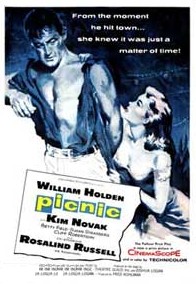
Picnic

I tend to think of the 1950's as a pleasant mix of Leave it to Beaver and Happy Days. Naturally, that's not what the entire decade in the U.S. was like, but isn't it fun to think of it that way? They were more innocent times before the hair on fire 1960's rolled around, huh? Some of those 1950's movies though, you could see an indication of what was to come. One sexually charged or sexually repressed movie after another hit theaters, many of them based off scandalous novels or stage plays. One I've always been curious to watch and was finally able to track down? That's 1955's Picnic.

A freight train rolls into a quiet Kansas town on a hot summer day, and a man named Hal Carter (William Holden) jumps off. A drifter without a home or too much money in his pocket, Hal hopes to reunite with a friend from college and maybe get a job out of it...if possible. It doesn't take too long for Hal to find the friend, Alan Benson (Cliff Robertson), the well-to-do son of one of the richest men in town. Even after years apart and with both men having gone down such different paths, the two fraternity buddies pick things up like they were never apart. It's Labor Day, and Hal's timing is pretty good as the whole town is heading off to an immense picnic, a farewell of sorts to the summer. Hal is a little wary of the gathering as the outsider in town but ends up going. Problem? You bet, especially when Hal sets his sights on Madge (Kim Novak), Alan's beautiful girlfriend who comes from a poor(ish) family. Let the drama begin.

In the button-down, gentlemanly, poodle-skirt era of the 1950's, people simply did not have sex. It was simply...FORBIDDEN. Or so the movies would have you think. This was a huge time of change in Hollywood as studios got away from all sorts of production codes that limited what could and couldn't be shown. So as a result, audiences got a lot of sexually charged, forbidden love movies, often set in little towns where sexual frustrations apparently ran rampant. We got movies like this, Peyton Place, God's Little Acre, A Streetcar Named Desire, Baby Doll and plenty more I'm probably forgetting. All that repression and frustration always explodes in dramatic fashion! Ah, emotions and feelings! Yeah, at times, things can go a little overboard. That's Picnic. Some good moments, some good performances, with some really heavy, overdone moments.

'Picnic' is based off a Pulitzer Prize winning play that took Broadway by storm in 1953. Director Joshua Logan helmed both the play and the feature film, picking up an Oscar nomination in the process. In its filming techniques, 'Picnic' never feels like a stage-based play turned feature film. You can't say that for a lot of like-minded films. Logan filmed on-location in Hutchinson, Kansas and explores the town. You get a feel for the town, its people and its energy. The movie itself clocks in at 115 minutes and can clearly be divided in two parts. That first hour sets the stage, introducing all this hidden drama, rivalries, personal problems and lets the tension build into the high-drama of the second half as all those issues come to center stage. As for me? I loved the first hour and tolerated the second. More on that to come.

The cast doesn't feature a ton of big names, but that's not a bad thing. Holden took some heat because at 37 he was probably a little too old for the Hal part, but probably doesn't mean much. He brings the right energy to the part, hiding some personal demons while presenting an outgoing, fun-loving, likable persona. Really? He's a man in his mid-20s trying to find his lot in life, and so far, he's come up empty wherever he's turned. This isn't always a likable character, but Holden's Hal is a sympathetic one. His chemistry with Novak's Madge is perceptible in the air, just two people drawn to each other and they can't explain it. Novak would develop into a solid actress over the years, but here, her performance is a little rough. As a presence, she's unquestioned, stunningly beautiful, her Madge sick of everyone judging her by looks and looks alone.

Who else to look for? 'Picnic' was actually Cliff Robertson's first credited feature film, his Alan being an interesting mix, a spoiled kid who doesn't want to be the spoiled kid. We do get to see a mean streak in him though so stay tuned. Betty Field plays Flo, Madge's single mother, badgering and worrying and overbearing, while Susan Strasberg is Millie, Madge's tomboy little sister, smart, a reader and sick of Madge.  Rosalind Russell hams it up as Rosemary, a 40-something schoolteacher in town, with a suitor/boyfriend of sorts in shop owner, Howard (Arthur O'Connell in an Oscar-nominated turn). Also look for Verna Felton as Helen Potts, the adorable next door neighbor, a bit of a conscience for the film/town, and Nick Adams as a horny teenager.

When Picnic is good, it's really good. But when it goes? Man, it goes. Everything comes to crazy fruition at the tail end of the picnic, and all hell breaks loose. The key, momentum-changing shift is started when a shirt gets torn, and literally everyone FREAKS THE EF OUT. A movie based on a stage play becomes very stagey and overdone and hammy. EMOTIONS and FEELINGS are everywhere. It's not that the drama isn't effective. It's that it lacks all subtlety at all. It becomes painful to watch at times. The ending itself is built up as a happy ending (of sorts), but man, when you think about it, this is NO happy ending at all. Still...it's a very cool final shot, so that counts for something right?

An interesting mix in the end. I really liked parts of it, especially Holden's performance, but the whole thing gets to be a little much in the end. The positives serve as a time capsule of sports. The entire story takes place in a 24-hour time period, and my goodness, it was quite the sunny, beautiful Labor Day. This is a beautiful movie to sit back and watch and appreciate it. We get a picture of 1950's life, especially in the extended picnic sequence as the whole town comes together to celebrate. Before all hell breaks loose in the emotions department in the second half, you get a sense of a more innocent time, and then Holden's shirt gets ripped and all bets are off. Still, there's enough to recommend but be forewarned that things turn into a sappy, tawdry soap opera in the second half.

Picnic (1955): ** 1/2 /****

Saturday, December 15, 2012

The FBI Story

Released in 1959, The FBI Story is an interesting flick, but not always for the right reasons. Made with the support of J. Edgar Hoover and the FBI, the final product has that whitewashed, diluted feel to it. Hoover apparently ran roughshod over the making of the movie, and it shows. Some things stand out, but for the most part, it's one big dull pat on the back.

Working as a field agent in the infancy of the Federal Bureau of Investigations, Chip Hardesty (James Stewart) proposes to his long-time girlfriend, Lucy (Vera Miles), and agrees to resign his post. His timing could not be worse as the FBI is making drastic changes to become a more effective, more efficient government office. Chip maintains his status as an agent right as the U.S. is heading into some of its most tumultuous times in its young history. Chip sees all the good that he is able to accomplish through his work -- even with the danger -- while Lucy worries away at home with their growing family.

The biggest fault this movie has is that J. Edgar Hoover had any involvement at all with it. The FBI director apparently ordered film director Mervyn LeRoy to re-shoot certain scenes, insisting they show the FBI in a more positive light. So while Hoover attempted to make a movie that showed his agency for all its heroism and righteousness, the end result is a disgustingly positive "look" into the inner workings. These are Superheroes! G-Men! Infallible and can't be touched. The potential is there -- seeing the 1950s crime scene techniques, the depths an investigation will go to -- with some cool scenes, but it has an incredibly fake, forced feel. I can just see Hoover smiling like a nut thinking 'Oh, audiences will love this," almost like he's holding a door open to let us see. Nice try, Mr. Hoover.

In terms of the story, think of this movie as The FBI Story: The Forrest Gump Version. From when he joins the FBI in the mid 1920s, Stewart's Chip takes part in just about every important, watershed moment in FBI history. The Ku Klux Klan, murdered Native Americans for oil rights, shifty Communists, the gangsters of the 1930s, Axis agents in WWII, this guy does everything. The problem? In a 149-minute movie (a very long 149 minutes), none of these events are given their due. 'Story' covers 30-plus years in history, glazing over the most important -- and usually entertaining -- portions with broad strokes. All of those things are worthy of a movie on their own, but here we're treated to little windows, just snippets, of what was going on. Again, maybe chalk it up to Hoover trying to show everything the FBI has ever done? Who knows for sure. 

Unfortunately, the solution to the above-problem is simple. Yes, it's a 149-minute long movie. I would guess anywhere from 90-100 minutes is actually about the FBI. The rest? As one IMDB reviewer so eloquently put it...."Father Knows Best: With Guns." Mindlessly tedious scenes with Chip, Lucy and their family are painful to watch. It even makes the FBI snippets insanely exciting (and they're really not). Chip goes on assignment. Lucy complains, buckles and lets him go. Chip goes on assignment..........and repeat eight or nine times. It's not interesting the first time so time No. 8 isn't any better. To top it off, Stewart and Miles (one of my least favorite actresses) don't have a ton of chemistry. She comes across as shrill, and Stewart to quirky-goofy at times in their home scenes.

Any more problems? Sure, why not! Other than Stewart and Miles, 'Story' has little in the way of star power. The movie doesn't call for a cast of thousands, all big name celebrities, but on the other hand, some more recognizable faces couldn't hurt. Murray Hamilton is good if underused as Chip's partner, Sam Crandall, who climbs the FBI ladder with him. Larry Pennell plays George Crandall, Sam's son who grows up wanting to be an FBI agent like his father. Also look for Nick Adams in a small part early as a mentally unhinged individual who plants on a bomb on a commercial airliner. Unfortunately, no one else truly stands out. Disappointed here overall. You know it's bad when even Jimmy Stewart can't save a movie, but this FBI-backed story just has too many holes and flaws.

The FBI Story (1959): **/****

Friday, October 7, 2011

The Hook

A title card for 1963's The Hook makes an interesting distinction about war. Paraphrased a bit, it says that for war and all its major campaigns, violent battles, and conflict on such an epic scale, the actual art of war is a very personal thing that is based at the individual level. It is the individual doing the fighting. That's something that sounds incredibly obvious, but in terms of a successful anti-war movie, that idea is almost always present.

This little known Korean War movie has more or less been lost to the decades since 1963. Before it showed up on Turner Classic Movie's schedule in September, I had never even heard of it.  Because of its subject matter, it is pretty clear why it has been forgotten over the last six decades.  The story revolves around orders for three American GI's to murder their North Korean prisoner soon after capturing him. In other words, a story with the most obvious of anti-war messages. It doesn't always work with some holes in the plot, but the message comes through clearly without being overbearing.  Definitely a movie that deserves a better fate since its 1963 release.

Working to load barrels of fuel onto a ship as part of an American withdrawal, Sgt. Briscoe (Kirk Douglas) and two privates, Dennison (Robert Walker Jr.) and Hatchett (Nick Adams) are strafed by a North Korean plane, their commanding officer killed in the raid. The plane crashes near the ship they're loading, and Dennison swims out to save the wounded North Korean (Pancho Magalona). Moving out on the Finnish ship run by Captain Van Ryn (Nehemiah Persoff), the trio bring the wounded prisoner with, planning to turn him over to the authorities when they reach their base. Just hours into the voyage though, they receive a startling radio message. The base has been badly hit in a bombing raid, and all the North Korean prisoners were overrun and killed by the locals. The order is simple; execute the prisoner before they reach the base. The enemy is the enemy, but can these three do it?

As far as subject matter, 'Hook' is years ahead of its time, coming two years before the United States was even involved officially in Vietnam. Even the most naive among us can appreciate that brutal and horrific things are done in war, atrocities that are crimes against man. Often times, there are incidents that happen far from the battle as opposing sides meet as is the case here. That's what the story boils down to. All hatred and prejudices aside, the act is a war crime, out and out murder, no matter that they're doing what they're ordered to.  It is a talky movie, the three soldiers all battling with their inner struggles and personal morality about what they've been told to do. Acts like this have almost certainly been committed in war since the dawn of time, but does that make it any easier to handle? Not really. Death is death no matter how you cut it.

The individual face of the war comes across in the roles of the three soldiers, Douglas, Walker Jr., and Adams.  Looking for some sort of existential symbolism or meaning, Persoff's captain is even a bit of a God-like figure, watching from above as the situation deteriorates. Okay, enough with that mumbo-jumbo and deeper meanings. The performances keep the movie based, especially Douglas as Sgt. Briscoe, a 19-year Army vet a year away from retirement and his pension. As the highest ranking soldier, he is handed the unenviable task of carrying out the order, bullying his two men into the act. It's Douglas at his best, a brother/father-like figure looking out for their well-being balanced out with a manipulative, conniving way of getting things done. His monologue about a patrol gone bad on Guadalcanal in WWII is an actor showing how good he is at what he does. Both hero and villain, he makes Briscoe an interesting character, no doubt about it.

Some of my concern about 'Hook' was the casting of Walker Jr. and Adams alongside Douglas, fearing they would be overshadowed. That wasn't the case thankfully. Walker's Dennison is the smart, thinking soldier, questioning aloud what they're supposed to do. North Korean or not, their prisoner is a man, a father and a husband. He intends to fight Briscoe about the execution every step of the way. I think it would have been more interesting for Dennison's character if he wavered even a little about the orders, just for that added dimension, but he's resolute in his stance. Adams too does not disappoint, his Hatchett a diminutive soldier who Briscoe has a hold on. He starts to see the folly in his ways as he is pushed and pushed to do what he doesn't want to do. A Filipino actor who only starred in a handful of American movies, Magalona does much with a character that has no speaking lines, communicating his fear and terror with his eyes. It's a good part, one that could have been a throwaway piece, an idea more than a human being.

What prevents 'Hook' from being an anti-war classic is the ending, which I won't spoil here. As is, the ending works in George Seaton's film. It is effective with a touch of irony and hope for the future still there. The finale delivers a twist in that irony, going down a path I didn't see coming. Once the twist is revealed though, more -- much more -- could have been done to really slam home the anti-war ideas. There was potential for a shocking, startling, surprising ending that would have made this an even more memorable conclusion. As is so often the case, my issue is what could have been done. This ending does work, but it is a safer ending. Still, I very much enjoyed this movie. It has been wrongly forgotten and deserves more of a following or audience.

The Hook <---TCM trailer (1963): ***/****