The Sons of Katie Elder

The Sons of Katie Elder
"First, we reunite, then find Ma and Pa's killer...then read some reviews."
Showing posts with label Carey Mulligan. Show all posts

Wednesday, May 7, 2014

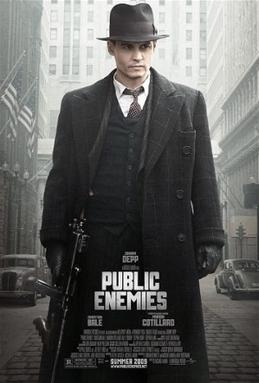
Public Enemies

In the age of the gangsters, the 1930s in Depression-era America, one name stands out above the rest. Sure, there's Pretty Boy Floyd, the Barkers, Baby Face Nelson, Machine Gun Kelly, Alvin Karpis, even Bonnie and Clyde. But the name John Dillinger stands out, Public Enemy No. 1, a gangster, bank robber and possible killer who rose to notoriety in the early 1930s. I reviewed this movie from 2009 that works as a quasi-biography, but rewatched it recently and updated the review. Here were go with 2009's Public Enemies.

It's 1933 in Crown Point, Indiana and John Dillinger (Johnny Depp) has been caught and is just being brought to prison, or so his guards think. Instead, the notorious bank robber has arranged a breakout, a group from his gang busting out with him. With his gang back together again, Dillinger goes on a spree, robbing banks all over Chicago and into Indiana and Wisconsin. The gangster feels the noose tighten around his neck, his notoriety forcing the government's hand in bringing him to justice. The Bureau of Investigation (the FBI) is in its infancy, J. Edgar Hoover (Billy Crudup) placing a young but capable agent, Melvin Purvis (Christian Bale), in charge of bringing Dillinger to justice. Using all the technology available to them, Purvis and his agents do everything they can to capture Dillinger, but can the notorious bank robber continue his crime spree?

This 2009 crime thriller is based off a book of the same name, Public Enemies, by author Bryan Burrough. It's a great read, non-fiction at its best. Burrough's book covers a ton of ground about one of the more violent, turbulent times in American history. The 1930s were the time of the gangster, killers, bank robbers and thieves working on a grand scale with a trail of fast cars, money and riches and dead bodies. Almost every single one of them died bloody and violent. It was a bloody, violent, fascinating time in American history. Originally thought of as a miniseries, Burroughs turned his research into a book. With so many people, places and incidents, the film version was condensed to John Dillinger vs. Melvin Purvis. It's a wise choice because Burroughs' novel as is would have been overwhelming.  

We meet other people, but this is Johnny Depp's movie as he brings John Dillinger to life. A sympathetic character? No, not quite. It is on the other hand a fascinating character to watch. The people who met him during his crime reign of terror, a lot of witnesses said he was charming, likable and friendly. One of the biggest movie stars around, Depp is the best thing going in this movie, making Dillinger a human being, not just a historical name. Depp's Dillinger seems to know the life he's chosen necessitates a live-fast, live-hard mentality. Knowledge of the historical facts or not, you just know Dillinger is leading a doomed life. Sooner or later, his luck will run out. It's really the only character here given any sort of development or characterization too, John given a love interest in Billie Frechette (Marion Cotillard), a coat check girl from a poor background who falls hard for the gangster, as does he for her. Depp and Cotillard have a believable, real chemistry, giving the story that necessary human element.

Who best to direct a high-arcing crime thriller? How about a director with movies like Heat, Thief, Last of the Mohicans and The Inside to his name? Michael Mann takes the helm here for this style-heavy period piece.  'Enemies' was filmed on location in Chicago and around the Midwest where much of the story actually took place. Chicago serving as a backdrop for a story is never a bad thing, giving an air of authenticity here. The suits, the hats, the gentleman gangsters, the cars, it all adds up a to a more than worthy time capsule to 1930s Depression-era America. If there's a fault, Mann is too interested in the style, not the substance. He shot with a digital format, giving those scenes an odd, fuzzy look. The editing is fast and hard -- almost schizophrenic -- to the point the movement is hard to follow. Replace some of that aggressive style which doesn't necessarily work with some more story and characterization, and then we're talking.

Depp's movie, no doubt, but in star power, Christian Bale isn't far behind. It's just star power though. Bale is a really good actor, but he's given little to do here. The real-life Melvin Purvis was a bit of a dunce, the movie choosing not to delve too much into that angle. Bale is okay, but it's a necessary, workmanlike part, nothing more. Crudup does a good job with his quick scenes as Hoover, a glorified cameo. As for Dillinger's gang, look for Jason Clarke, Stephen Dorff, David Wenham and another violent gangster, Stephen Graham as maniacal Baby Face Nelson. Stephen Lang is memorable as a Texas lawman, Charles Winstead, brought in to help Purvis, Rory Cochrane playing one of his fellow Chicago FBI agents. There's also quick parts for Channing Tatum, Carey Mulligan and Giovanni Ribisi, and in the case of Tatum and Mulligan, don't blink or you'll miss them. There's plenty of other appearances that probably deserve some attention, but they're not around long enough to mention.

That's one of the weaknesses in Mann's film. Condensing Burroughs' book and doing so with just one focus -- Dillinger -- is still a daunting task. I think it tries to accomplish too much. A year-plus of story, countless speaking roles, and a whole lot of history. Depp is excellent, that's not in question. The action is very exciting, especially the infamous Little Bohemia shootout. Mann does action and does it well. The heavy, automatic machine guns, the B.A.R.s, the heavy pistols, these are guns that pack a punch so there's something visceral and adrenaline-pumping in the action scenes. Something is missing though. It's cool, but the movie doesn't have a ton of heart. The last 30 minutes are the movie at its best, Purvis and the FBI closing in on Dillinger. One what-if scene has Dillinger walking into the Dillinger Squad office, surreal and cool. The same for Dillinger's death, a stylish, cool scene aided by Elliot Goldenthal's musical score.

A good movie but with some serious flaws. It could have been a classic, and maybe with a miniseries it would have been. Still, Johnny Depp is cooler than you.

Public Enemies (2009): ** 1/2 /****
Rewrite of July 2009 review

Friday, April 11, 2014

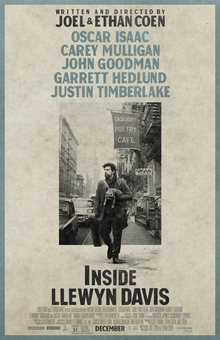
Inside Llewyn Davis

Maybe more than any other film that was considered for some Academy Award nominations, 2013's Inside Llewyn Davis landed with a thud when the nominations were actually released in February. It picked up just two nominations -- for Best Cinematography and Best Sound Mixing -- but won neither. Should it have picked up some other nominations? That's for others to decide. What isn't up for discussion is that awards season success aside, this is a good movie.

It's 1961 in New York City's Greenwich Village and Llewyn Davis (Oscar Isaac) is looking for work and more importantly, some money. A folk musician with a bit of a following, Llewyn released an album with a partner in recent years, but he's on his own now and struggling a bit to get by. His name has a reputation -- somewhat -- as a talented musician who's also a bit flighty. Mostly though, Llewyn wants to sing, to perform, to get his name out there and really to take his career to the next level. He's nearing rock bottom though, his money running out almost completely. It's the dead of winter and he's overextended all his relationships, his friendships, his business connections. He feels he's close, but he just needs that one break...if he can find it.

Another movie that proved difficult to write a one-paragraph plot synopsis. From the Coen brothers, Joel and Ethan, 'Inside' is a stylish, well-told, throwback-type story that follows about a week in the life of a struggling musician. It's easy to see why there was some outrage when it didn't pick up any prominent Oscar nominations. I'll get into some real analysis later, but the gist is this; it's a really good movie. Not quite a comedy, not a straight drama, it's just good.

The most obvious place to start is with directors/writers/producers Joel and Ethan Coen. There is a certain style in each and every one of their movies from Blood Simple to Fargo, True Grit to No Country for Old Men, O Brother, Where Art Thou to The Big Lebowski. The stylistic choice here is picking the location, 1960s New York City (with some out of state departures). From the look of the movie with the hairstyles, the wardrobe, the cars, the mindset, all these little things add up to one great puzzle. From beginning to end, you feel like you're in 1960s NYC. The visual is almost bland, washed out colors permeating almost every scene. As for the folk background, 'Inside' has an extreme love and appreciation for the folk music scene of the 1960s. It feels authentic down to the smallest detail, and that authenticity goes a long way. The story drifts at times, it's both dark and funny and dramatic, but it just feels real.

A young actor with a ton of potential, Oscar Isaac nails the lead part here as folk singer Llewyn Davis. He's had key supporting parts in Drive, The Bourne Legacy, 10 Years (where he also sang), and Robin Hood, but this is quite the breakout leading part. For starters, Llewyn is far from a likable character. He has moments where you feel sympathy for him, but mostly, his issues are self-made. We learn why he's on his own now and not working as a duo anymore. We learn how he's got to this spot, and most importantly, we see that desperation and frustration of an artist/musician who just wants his shot at the big time. Unlikable qualities aside, with a general lack of sympathy, I still found myself rooting for Llewyn....only to see him rip that away quickly with some jackass move. Like the story though, this has the distinct feel of an authentic character, a person with hopes and dreams, aspirations that just haven't been there so far. Likable? Nope. Interesting, fascinating to watch? Yes, you bet. Interesting to see where Isaac goes next, especially because many thought he should have picked up a Best Actor nomination for his part.

Those Cohens, they specialize in ensemble casts like nobody's business. I guess talented actors and actresses want to work with them for some reason. I especially liked Carey Mulligan as Jean, a fellow folk singer who has a checkered past with Llewyn including one major current issue. Justin Timberlake is excellent too as Jim, Jean's fiance, a singer who's carved a name out for himself already.  The pairing of John Goodman as existential-thinking jazz musician Roland Turner is a scene-stealer, Garrett Hedlund providing some 1960s beatnik background as beat poet Johnny Five, Llewyn carpooling to Chicago with the odd duo. F. Murray Abraham has a good part as a Chicago club owner who's got some pull with record labels, giving Llewyn an impromptu audition. Also look for Ethan Phillips and Robin Bartlett as the Gorfeins, a middle-aged married couple who love Llewyn and allow him to crash on their couch from time to time. Max Casella also has a fun part as Papi, a club owner who likes Llewyn and keeps offering him different gigs.

An interesting movie for a whole lot of different reasons, most of them positive. The only one I didn't like was a stylistic choice with a framing device at the beginning and end, but it's not a huge deal. In general, there's plenty of things that can/will draw you in. There's a handful of musical numbers performed -- Isaac especially impressing -- with a nice nod to Bob Dylan late if you're paying attention. But across the board, whether it's the music, the story, the style, the acting, it's just good stuff. Enjoy it, appreciate it.

Inside Llewyn Davis (2013): ***/****

Monday, November 11, 2013

The Great Gatsby (2013)

One of the few books/novels I had to read for AP/Honors English in high school and college and actually enjoyed was F. Scott Fitzgerald's The Great Gatsby, a condemnation of the Jazz Age, rich folks, all sorts of waste, and all that good stuff. It's had several reincarnations since, including one film starring Robert Redford, and more than a few other film and stage productions. In the age of the remake/reboot, here we sit with 2013's big-budget The Great Gatsby, as lavish and over the top as the story condemns.

It's 1922 and Nick Carraway (Tobey Maguire) has moved east to pursue a job in business on the stock market, leaving his Midwestern roots and his dream of being a writer behind him. He rents a small cottage on Long Island and can't help but notice the lavish, ridiculously over the top parties on almost a nightly basis at his next door neighbor's mansion. His neighbor? The mysteriously rich Jay Gatsby (Leonardo DiCaprio), a man in his early 30s who no one knows much about. Specifically invited to one of Gatsby's parties, Nick shows up and is amazed at what he finds and sees, a party unlike any he's ever seen. He meets Gatsby, taking an instant like to this amiable, quirky man with all sorts of unanswered questions hanging over his head. Who is he really? How did he come to this spot? Nick will most certainly be surprised when he finds out, but will he care or will he just be worried about his new friend?

When I hear the name Baz Luhrmann, I think of one thing; one, big old extravagant director. With movies like Romeo and Juliet, Moulin Rouge and Australia to his name, Luhrmann has a track record for hugely visual, highly stylized films that reek (in a good way) of extravagant sets, goofy style, color, movement and more color. He continues the tradition/trend here with one crazy visual movie. It's style, style and style. We're transported to 1920s NYC courtesy of some pretty obvious but pretty cool CGI. The modern soundtrack is a little much -- songs from Jay Z, Beyonce, Andre 3000, Jack White among others -- and calls too much attention to itself at times. It's not just that the movie is stylish. Luhrmann and his crew commit to bringing it to life. Even if the story sucked or wasn't interesting, you could just sit back and revel in the visual. Thankfully, it's not just style and no substance.

Early on though, I'll admit to being rather worried about what I'd gotten into. As the movie finds its tone and pace, the first 20-25 minutes were rough for me. Things are righted the minute DiCaprio as Jay Gatsby appears on-screen for the first time. Talk about ideal casting, DiCaprio is perfectly cast as the mysterious, charismatic, engaging Gatsby. Let's face it. DiCaprio is a good-looking guy and that certainly helps here. He brings a certain charming energy to the part. Reading the book in high school, I really liked the Gatsby character. He's rich beyond anyone's dreams, but he isn't some smarmy, condescending millionaire. His past is slowly filtered out as we learn about his love for Daisy Buchanan (Carey Mulligan), Nick's cousin who also happens to be married to an equally rich man, Tom Buchanan (Joel Edgerton). We learn that Gatsby is like most people. He looks for happiness, for love, for someone to share his riches with. It's an excellent part for DiCaprio, again showing what a good actor he is.

The rest of the cast is uniformly solid behind him. I'm not a fan of Maguire going back to his Spiderman days, but he's pretty decent here. His Nick is our window into the story, Nick seeing and exploring as we do into this very rich world. His narration gets to be too much at times -- simply trying too hard -- but it's cool to see his friendship develop with Gatsby. Mulligan and Edgerton provide some interesting characters as Daisy and her husband, Tom, Daisy and Gatsby's love providing the spark for the second half of the story. We also get to meet Jordan Baker (Elizabeth Debicki), a young, up and coming golfer who Nick meets soon after moving to NYC. Isla Fisher plays Myrtle, Tom's mistress, with Jason Clarke playing her husband, the owner of a gas station.

Having read the book (even if it was years ago), I had a certain worry heading into this flick. How close would the script stay to the novel? I worry about it with most books I've read that are turned into films. Thankfully, this adaptation sticks pretty close. While I liked the style and the visual appeal is obvious, I got more enjoyment out of the second half when Jay and Daisy's love steps to the forefront. The style is still there, but it's here we see more substance and get to know the characters far better. The sense of doom arises because we know everything can't end well for all those involved. Where will it head? Will it keep driving toward Fitzgerald's inevitable end? It's in the second half of the movie where 'Gatsby' finds that groove, that right mix of style, story, substance and characters. A pleasant surprise for sure.

The Great Gatsby (2013): ***/****

Thursday, February 28, 2013

Wall Street: Money Never Sleeps

One of the more iconic movies to come out of the 1980s, 1987's Wall Street is memorable because of star Michael Douglas and his infamous line, "Greed is good." The movie itself is pretty good, and 23 years after its release, director Oliver Stone decided to return to his iconic character and continue the story with 2010's Wall Street: Money Never Sleeps.

After spending 13 years in jail for insider training and securities fraud, Gordon Gekko (Douglas) is finally given his parole. Some seven years pass, and now he's promoting his new book 'Is Greed Good?' when he meets a young stock broker, Jake Moore (Shia LaBeouf), who is engaged to Gordon's estranged daughter, Winnie (Carey Mulligan). Gordon wants to form a relationship with a daughter who might as well consider him dead. At the same time, Gordon begins to help Jake, a talented, intelligent broker in his own right, as he starts a new job with a high-level firm broker, Bretton James (Josh Brolin), who has rubbed plenty of people the wrong way in his rise to power. With millions and billions of dollars on the line and the massive egos to boot, an epic confrontation looms, but the struggling economy may have the last laugh over everyone involved.

For starters, let's get this somewhat obvious statement out of the way. Like just about any sequel ever, this is basically the definition of unnecessary. Why go back to a movie from 23 years ago and revisit a character -- however iconic -- and story that didn't need revisiting? Oh...the sequel made $130 million in theaters? I suppose that's as good a reason as any. Well, in business at least. Other than the epic economic issues of the last 10 years, there's no real reason to make this sequel. That said, it's not bad. The biggest thing working in positive fashion is the acting. The story lacks a bit of punch -- it's missing something in the energy department -- but I liked it just the same. Unnecessary? Oh, you betcha, but you could do worse.

I like movies, sports, reading. I can B.S. my way through a fair share of conversations. The financial crisis of 2008 is most definitely not one of those things. I have a very basic knowledge of the economic collapse that this sequel goes into in depth, but I'm far from an expert. In other words, some background and/or understanding in big money, Wall Street, stocks, and everything financial will no doubt help your enjoyment of this flick. Because my knowledge of the subject material is limited, I wasn't always crystal clear on what was going on. I still liked it, but it's an issue just the same. End of sidenote.

Without question, the best thing going for Stone's sequel is the return of Michael Douglas as Gordon Gekko. His introduction is perfect, Gekko getting his parole and being released from prison after serving 13 total years in jail. We see him get his possessions back from a suit to a watch to a rather massive cell phone. The message is clear; times have changed, and Gordon is a dinosaur who has to adjust with the times. I think Stone makes an incredibly wise choice. For much of the movie, Gekko is a secondary -- if incredibly important secondary -- character that fleets in and out of the story as needed. Any scene with Douglas in it is worth watching, his appearances bringing the entire movie up a notch just by being there. He makes the others around him better. The new movie itself is unnecessary, but Douglas's appearance makes it worthwhile.

The rest of the cast is solid if unspectacular. It seems no matter the movie, LaBeouf takes grief for any number of things -- wooden acting, bad acting, off-screen antics -- but as long as he's not in loud, obnoxious, and obvious Transformers mode, I like him. It isn't a flashy part (that is left to Douglas, nailing it in subtle fashion), but LaBeouf's Jake is the main character, and for me, an interesting one. Mulligan too is pretty good as Winnie, Gordon's estranged daughter who wants nothing to do with her father. Behind Douglas, I thought the best part was from Brolin as the Wall Street rival with some ulterior motives. Frank Langella is a scene-stealer as well as Louis Zabel, Jake's aging mentor who hates what Wall Street is becoming, Susan Sarandon plays Jake's mom who's heavily invested in real estate, Eli Wallach as a Wall Street dinosaur, and Jason Clarke as the NYC Fed chief. Not necessarily great performances, but it's fun to see all those names assembled.

This 2010 sequel is missing that special something from making it an above-average, truly enjoyable flick. It's good enough, but it's never more than that. Clocking in at 138 minutes, it feels incredibly long in certain stretches. Lots of dialogue isn't a bad thing, but at times, it gets a little tedious, a little slow. Douglas certainly helps the momentum pick up a bit, especially late when we see the Gekko we all love to hate. Charlie Sheen even makes a cameo as Bud Fox, the protagonist in the original Wall Street. I liked this one, didn't love it. Not bad stuff.

Wall Street: Money Never Sleeps (2010): ** 1/2 /****

Monday, December 10, 2012

Drive

Some movies defy descriptions. Is that good thing or a bad thing? It could go either way, but 2011's Drive most definitely leans in the positive direction. A throwback to the film noirs of the 1940s, a throwback to the crime thrillers of the 1970s, a love story, and one of the most graphically violent films I've ever seen. However I describe it though, I can say I definitely loved it.

Working for his friend, Shannon (Bryan Cranston), at his mildly successful garage, Driver (Ryan Gosling) lives in Los Angeles and leads an almost monk-like life. He works for Shannon, doubles as a stunt driver for Hollywood productions, but that's just the start. He also provides a unique service to any would-be criminals, working as a getaway driver with a very strict set of rules and demands. Driver more or less drifts along from day to day, that is until he meets Irene (Carey Mulligan) and her son, Benicio (Kaden Leos), his next door neighbors. His brief reverie is broken up though as Irene's husband is paroled from jail, and Shannon cuts a deal with a mobster, Bernie (Albert Brooks), to buy a used stock car so Driver can utilize his driving skills on a race track.

From Danish director Nicolas Winding Refn, 'Drive' makes a risky choice that ends up paying huge dividends. This may sound odd, but this is a film that tries to be cool. It wants to be cool. It wants you as a viewer to think it's cool, and it tries really hard to get to that point. I usually resent movies that try so ridiculously hard to be so stylish, but for Refn, he succeeds on just about every level. It is cool. It is stylish. It's a freaking ridiculously cool movie. Drive is a film noir, a crime thriller, a love story, and an ultra-violent film that rips you out of your seats. I debated for months whether to check it out -- having heard some lukewarm reviews -- and I'm glad I finally sought it out.

Let's delve into that style some. Originally intended as a big-budget, blockbuster film, Drive was eventually released as a lower budget, far artsier film. Refn filmed on location in Los Angeles, and the visual look of the film is a stunner. This is where the art house tag applies to 'Drive.' It's colorful but takes advantage of shadows and light like a noir from the 1940s. Slow motion is utilized to startle and upset, to build tension in an insanely simple way. The opening title card is in hot pink, and oddly enough, it works. The soundtrack from composer Cliff Martinez has a New Age, ethereal feel to it (a la so many 1980s soundtracks). Listen to a sample HERE. 'Drive' also features a theme song of sorts, an odd but perfectly appropriate indie rock song called A Real Hero. It shouldn't work in the context of the story, but it does. The whole soundtrack has an odd appeal to it, a techno-electronica sound that feels like a throwback to the 1980s (yes, again), but it works. I loved the look, loved the music.

As for star Ryan Gosling, I'm not a huge fan of him as an actor, but this is a great performance from him. I think it's more than just the acting because in terms of words actually spoken, Gosling says about 121 words the entire movie. It's all reactions and expressions, physical movements and saying as much as humanly impossible with his eyes instead of speaking. I loved this character. We know basically nothing about him other than that he's a freaky talented driver and he utilizes in weird ways; as a getaway driver. His rules are simple; you get 5 minutes to pull the job -- no more, no less -- and he'll make sure you get away. He bonds instantly with Irene and her son, seeing potential for something there. What? Who knows. Other reviews point to Gosling's performance reflecting similar performances from actors like Steve McQueen and Clint Eastwood. I'm hard pressed to disagree. You can act without giving huge, grandiose speeches (McQueen and Eastwood certainly proved that), and Gosling's acting is understated and simple. When he sees Irene and Benicio threatened, he comes to life. Does he see a release, an out, a happiness in them? Yeah, probably, but it's also easy to see himself. Maybe he was that little boy years ago.

Gosling's nearly silent, monk-like lead performance is clearly the role that makes this film special, but I loved all of the performances. Mulligan is a great counter to Gosling, a similarly understated, emotionally torn apart performance with young Leos representing himself well. Mulligan's Irene loves her husband, Standard (Oscar Isaac), recently paroled and owing some nasty people a lot of money. Enter Driver.  Brooks isn't a typical choice to play a villainous mobster, but his unlikely casting is a gem. His Bernie is typically an unwilling killer, but he'll do it just the same. Cranston's Shannon is probably the most human of all the characters, maybe Driver's only true friend. Ron Perlman is not surprisingly very intimidating as Nino, Bernie's partner in all sorts of nasty mob stuff. James Biberi is Cook, a gangster who gets set up with Driver and Standard with Christina Hendricks as Blanche, his moll. Also look briefly for Russ Tamblyn as Doc, helping Driver out of a jam. 

One of the more impressive things about this movie is the job Refn (and Hossein Amini's script off James Sallis' novel) does in completely throwing the viewer for a loop. The first 45 minutes almost lull you to sleep with long, quiet scenes that feature little dialogue. And then here comes the VIOLENCE! As fellow reviewer David J. Fowlie says, this movie is Michael Mann meets Walter Hill meets Sam Peckinpah. We're talking gory, over the top violence that is both startling and uncomfortable to watch while also hard to look away from. Heads exploding courtesy of a shotgun blasts, impalings on all sorts of brutal, blunt and sharp instruments, and several other deaths I don't want to spoil. I think this violence lands in heavier fashion than some ridiculously over the screen violence is that it's personal. I was stunned by how much I came to like these characters. The violence may be incredibly graphic (even cartoonish), but it is visceral in the same way. Go figure, but it ain't for the squeamish.

This is a film that could be analyzed scene-for-scene, but I don't want to get into the gory details from one scene to another. It reminds me of so many other movies, but it manages to create its own identity in the process. The story reflects a film noir, the style reflects so many crime thrillers, the music the 1980s, and Gosling's main character is straight out of a French crime story from Melville (specifically Le Samourai). I loved everything about it, and I like it more two days later having thought about it some more. The only thing I had an issue with is the final scene -- open-ended for your consideration! -- that is rather ambiguous. It's up to you for your decision so it's not a deal-breaker by any means. It all comes back to the Driver though, an anti-hero with no past, no real ties to the world, doing something because he thinks it's right.

A late scene spells it out, a bloodied Driver standing on the top level of a parking garage on the phone to set up a meeting to wrap up all the loose ends. It's filmed in the dead of night, the lights from Los Angeles lighting up the background as the two characters (no spoilers about who's at the other end of the phone) hash it out in a meeting that will no go smoothly. His Driver is a doomed character if there ever was in a great movie that flies out of the gate, settles in nicely and then sets you up time and time again before that ending. I loved it. Glad I caught up with it.

Drive (2011): ****/****