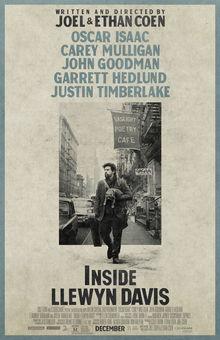
Maybe more than any other film that was considered for some Academy Award nominations, 2013's Inside Llewyn Davis landed with a thud when the nominations were actually released in February. It picked up just two nominations -- for Best Cinematography and Best Sound Mixing -- but won neither. Should it have picked up some other nominations? That's for others to decide. What isn't up for discussion is that awards season success aside, this is a good movie.
It's 1961 in New York City's Greenwich Village and Llewyn Davis (Oscar Isaac) is looking for work and more importantly, some money. A folk musician with a bit of a following, Llewyn released an album with a partner in recent years, but he's on his own now and struggling a bit to get by. His name has a reputation -- somewhat -- as a talented musician who's also a bit flighty. Mostly though, Llewyn wants to sing, to perform, to get his name out there and really to take his career to the next level. He's nearing rock bottom though, his money running out almost completely. It's the dead of winter and he's overextended all his relationships, his friendships, his business connections. He feels he's close, but he just needs that one break...if he can find it.
Another movie that proved difficult to write a one-paragraph plot synopsis. From the Coen brothers, Joel and Ethan, 'Inside' is a stylish, well-told, throwback-type story that follows about a week in the life of a struggling musician. It's easy to see why there was some outrage when it didn't pick up any prominent Oscar nominations. I'll get into some real analysis later, but the gist is this; it's a really good movie. Not quite a comedy, not a straight drama, it's just good.
The most obvious place to start is with directors/writers/producers Joel and Ethan Coen. There is a certain style in each and every one of their movies from Blood Simple to Fargo, True Grit to No Country for Old Men, O Brother, Where Art Thou to The Big Lebowski. The stylistic choice here is picking the location, 1960s New York City (with some out of state departures). From the look of the movie with the hairstyles, the wardrobe, the cars, the mindset, all these little things add up to one great puzzle. From beginning to end, you feel like you're in 1960s NYC. The visual is almost bland, washed out colors permeating almost every scene. As for the folk background, 'Inside' has an extreme love and appreciation for the folk music scene of the 1960s. It feels authentic down to the smallest detail, and that authenticity goes a long way. The story drifts at times, it's both dark and funny and dramatic, but it just feels real.
A young actor with a ton of potential, Oscar Isaac nails the lead part here as folk singer Llewyn Davis. He's had key supporting parts in Drive, The Bourne Legacy, 10 Years (where he also sang), and Robin Hood, but this is quite the breakout leading part. For starters, Llewyn is far from a likable character. He has moments where you feel sympathy for him, but mostly, his issues are self-made. We learn why he's on his own now and not working as a duo anymore. We learn how he's got to this spot, and most importantly, we see that desperation and frustration of an artist/musician who just wants his shot at the big time. Unlikable qualities aside, with a general lack of sympathy, I still found myself rooting for Llewyn....only to see him rip that away quickly with some jackass move. Like the story though, this has the distinct feel of an authentic character, a person with hopes and dreams, aspirations that just haven't been there so far. Likable? Nope. Interesting, fascinating to watch? Yes, you bet. Interesting to see where Isaac goes next, especially because many thought he should have picked up a Best Actor nomination for his part.
Those Cohens, they specialize in ensemble casts like nobody's business. I guess talented actors and actresses want to work with them for some reason. I especially liked Carey Mulligan as Jean, a fellow folk singer who has a checkered past with Llewyn including one major current issue. Justin Timberlake is excellent too as Jim, Jean's fiance, a singer who's carved a name out for himself already. The pairing of John Goodman as existential-thinking jazz musician Roland Turner is a scene-stealer, Garrett Hedlund providing some 1960s beatnik background as beat poet Johnny Five, Llewyn carpooling to Chicago with the odd duo. F. Murray Abraham has a good part as a Chicago club owner who's got some pull with record labels, giving Llewyn an impromptu audition. Also look for Ethan Phillips and Robin Bartlett as the Gorfeins, a middle-aged married couple who love Llewyn and allow him to crash on their couch from time to time. Max Casella also has a fun part as Papi, a club owner who likes Llewyn and keeps offering him different gigs.
An interesting movie for a whole lot of different reasons, most of them positive. The only one I didn't like was a stylistic choice with a framing device at the beginning and end, but it's not a huge deal. In general, there's plenty of things that can/will draw you in. There's a handful of musical numbers performed -- Isaac especially impressing -- with a nice nod to Bob Dylan late if you're paying attention. But across the board, whether it's the music, the story, the style, the acting, it's just good stuff. Enjoy it, appreciate it.
Inside Llewyn Davis (2013): ***/****
The Sons of Katie Elder
"First, we reunite, then find Ma and Pa's killer...then read some reviews."
Showing posts with label F. Murray Abraham. Show all posts
Friday, April 11, 2014
Thursday, March 27, 2014
The Grand Budapest Hotel
Wes Anderson is one goofy, talented, eccentric director with a legion of devoted fans who love just about everything he does. I'm a fan of Anderson's films, but I don't love them. His humor can be too off the wall, his humor too subtle at times. Well, then there's 2014's The Grand Budapest Hotel, a hysterically dark, truly off the wall flick that Anderson fans will no doubt appreciate.
It's 1932 in the Republic of Zubrowka, and the concierge of the Grand Budapest Hotel, M. Gustave (Ralph Fiennes), has taken a protege under his wing, Zero Moustafa (Tony Revolori), a talented refugee working as one of the hotel's Lobby Boys. Zero is fascinated by everything about Gustave from his gentlemanly ways to his knowledge of anything and everything, especially his "relationships" with rich, older women who visit the hotel to specifically see him. When one of his favorite guests, Madame D. (Tilda Swinton), dies mysteriously, Gustave and Zero rush to her countryside villa to be there for the funeral. They're both stunned when they find out that Madame left almost everything in her will to Gustave, including one lucrative painting. The rest of the family is less than pleased and just a day later, Gustave is arrested for the murder of Madame D. With help from loyal Zero, can he escape jail and prove his innocence?
If there was ever a movie where a story/plot description could be misleading, this is it. Yes, the story is key with its twisting and turning reveals, its countless characters, its flashbacks within flashbacks. But as anyone who's seen a Wes Anderson movie, it is also far more than that. His movies are never just stories, using the screenplays as a huge jumping off point into a stylishly visual movie that basically defies description. With an Anderson flick -- when it works -- you can just sit back and let it wash over you. Very much qualifying in that department, 'Budapest' succeeds on a stylistic level on its own. The visual is stunning at times. Anderson uses his familiar shooting technique, the camera shooting much of the action as if it was a stage play. It's more than that though. The camera and all its movements become a secondary character.
Some of these shots make the movie feel like a throwback to the days of pre-computer special effects. I imagine Anderson used some CGI at different points, but he never really relies on it. The pure variety of shots 'Budapest' uses is impressive in itself. Our first introduction to the hotel and its surrounding areas is done via miniatures, a little set built up that looks like a dollhouse. From there, the tone is set. Just about every scene looks like a painting painstakingly crafted by an artist full of bright, vivid, Earthy colors. Anderson films with his cast, close-ups as they ride a motorcycle, as they race down a mountain on a sled. It's clearly an effect but it appears almost effortless in execution. The closest, best description I can come up -- and I intend it as a compliment -- is that 'Budapest' looks and plays like a children's picture book, the story bouncing from page to page with almost reckless abandon. Style to burn, an essential element to Anderson's formula for success.
The extreme depth of the cast here shows what a director Anderson must be, one who actors and actresses desperately desire to work with. He has his fair of regulars who show up here, but this is a movie that belongs to Ralph Fiennes. Working with Anderson for the first time, Fiennes is an epically successful scene-stealer. It's a part that's hard to qualify because it works on so many levels. There's a rhythm to the dialogue that Fiennes takes to easily, his delivery rarely varying no matter who he's addressing. It's more than that too, Fiennes committing physically with some great visuals, a pitter-patter to the on-screen movements. His running style especially cracked me up, including one scene where he's confronted about the murder of Madame D. Gustave runs away, but he runs as a gentleman under control, not a man running for his life. There's too many funny scenes to mention, but almost all of them work. This is most definitely a character though, a gentleman who is vain, loves older women because they've gained life experience (among other things), full of pride, a strong boss, a loyal friend. We pick up all these little things that just work so well.
This performance comes through best in the scenes between Gustave and young Revolori as Zero, the Lobby Boy refugee who's lived on his own for years. Not quite father-son, not quite a brotherly relationship, it's somewhere in between, the protege and his mentor. The duo brings the screenplay to life from the drama to the laughs, the physical, almost screwball comedy to the international chases. I loved both characters, even the quasi-rivalry that develops when Zero meets a beautiful young baker, Agatha (Saoirse Ronan), who Gustave is enchanted with as well. Just a great chemistry, a great one-two punch that carries the movie throughout.
Brace yourself for the rest of the cast. It is a doozy. In a framing device, Tom Wilkinson plays the author of a book about the hotel, Jude Law playing his younger representation, interviewing an older Zero, played by F. Murray Abraham. Because part of the fun is stumbling across the stars on-hand here, I won't go into a ton of detail as to their background or who they are. But just to list them is pretty crazy in itself so pull up a chair and get comfy. Some appearances are no more than a scene or two, but they're there just the same. There's Adrien Brody, Mathieu Amalric, Willem Dafoe, Jeff Goldblum, Harvey Keitel, Bill Murray, Edward Norton, Jason Schwartzman, Owen Wilson, and Bob Balaban, among others who will no doubt catch your eye. If that cast doesn't do something for you, maybe movies aren't your thing.
As I've learned with other Anderson movies, these simply aren't for everyone. The humor is either something you go along with or just don't. 'Budapest' covers a ton of ground in its 100-minute running time, scenes transitioning with a stylish title card, Alexandre Desplat's effortless score pushing the story along, sight gags galore dotting the road. If you like it, I think you'll love it. Just a goofy kind of perfect, vastly different and a step above just about everything else hitting theaters. Highly recommended.
The Grand Budapest Hotel (2014): *** 1/2 /****
It's 1932 in the Republic of Zubrowka, and the concierge of the Grand Budapest Hotel, M. Gustave (Ralph Fiennes), has taken a protege under his wing, Zero Moustafa (Tony Revolori), a talented refugee working as one of the hotel's Lobby Boys. Zero is fascinated by everything about Gustave from his gentlemanly ways to his knowledge of anything and everything, especially his "relationships" with rich, older women who visit the hotel to specifically see him. When one of his favorite guests, Madame D. (Tilda Swinton), dies mysteriously, Gustave and Zero rush to her countryside villa to be there for the funeral. They're both stunned when they find out that Madame left almost everything in her will to Gustave, including one lucrative painting. The rest of the family is less than pleased and just a day later, Gustave is arrested for the murder of Madame D. With help from loyal Zero, can he escape jail and prove his innocence?
If there was ever a movie where a story/plot description could be misleading, this is it. Yes, the story is key with its twisting and turning reveals, its countless characters, its flashbacks within flashbacks. But as anyone who's seen a Wes Anderson movie, it is also far more than that. His movies are never just stories, using the screenplays as a huge jumping off point into a stylishly visual movie that basically defies description. With an Anderson flick -- when it works -- you can just sit back and let it wash over you. Very much qualifying in that department, 'Budapest' succeeds on a stylistic level on its own. The visual is stunning at times. Anderson uses his familiar shooting technique, the camera shooting much of the action as if it was a stage play. It's more than that though. The camera and all its movements become a secondary character.
Some of these shots make the movie feel like a throwback to the days of pre-computer special effects. I imagine Anderson used some CGI at different points, but he never really relies on it. The pure variety of shots 'Budapest' uses is impressive in itself. Our first introduction to the hotel and its surrounding areas is done via miniatures, a little set built up that looks like a dollhouse. From there, the tone is set. Just about every scene looks like a painting painstakingly crafted by an artist full of bright, vivid, Earthy colors. Anderson films with his cast, close-ups as they ride a motorcycle, as they race down a mountain on a sled. It's clearly an effect but it appears almost effortless in execution. The closest, best description I can come up -- and I intend it as a compliment -- is that 'Budapest' looks and plays like a children's picture book, the story bouncing from page to page with almost reckless abandon. Style to burn, an essential element to Anderson's formula for success.
The extreme depth of the cast here shows what a director Anderson must be, one who actors and actresses desperately desire to work with. He has his fair of regulars who show up here, but this is a movie that belongs to Ralph Fiennes. Working with Anderson for the first time, Fiennes is an epically successful scene-stealer. It's a part that's hard to qualify because it works on so many levels. There's a rhythm to the dialogue that Fiennes takes to easily, his delivery rarely varying no matter who he's addressing. It's more than that too, Fiennes committing physically with some great visuals, a pitter-patter to the on-screen movements. His running style especially cracked me up, including one scene where he's confronted about the murder of Madame D. Gustave runs away, but he runs as a gentleman under control, not a man running for his life. There's too many funny scenes to mention, but almost all of them work. This is most definitely a character though, a gentleman who is vain, loves older women because they've gained life experience (among other things), full of pride, a strong boss, a loyal friend. We pick up all these little things that just work so well.
This performance comes through best in the scenes between Gustave and young Revolori as Zero, the Lobby Boy refugee who's lived on his own for years. Not quite father-son, not quite a brotherly relationship, it's somewhere in between, the protege and his mentor. The duo brings the screenplay to life from the drama to the laughs, the physical, almost screwball comedy to the international chases. I loved both characters, even the quasi-rivalry that develops when Zero meets a beautiful young baker, Agatha (Saoirse Ronan), who Gustave is enchanted with as well. Just a great chemistry, a great one-two punch that carries the movie throughout.
Brace yourself for the rest of the cast. It is a doozy. In a framing device, Tom Wilkinson plays the author of a book about the hotel, Jude Law playing his younger representation, interviewing an older Zero, played by F. Murray Abraham. Because part of the fun is stumbling across the stars on-hand here, I won't go into a ton of detail as to their background or who they are. But just to list them is pretty crazy in itself so pull up a chair and get comfy. Some appearances are no more than a scene or two, but they're there just the same. There's Adrien Brody, Mathieu Amalric, Willem Dafoe, Jeff Goldblum, Harvey Keitel, Bill Murray, Edward Norton, Jason Schwartzman, Owen Wilson, and Bob Balaban, among others who will no doubt catch your eye. If that cast doesn't do something for you, maybe movies aren't your thing.
As I've learned with other Anderson movies, these simply aren't for everyone. The humor is either something you go along with or just don't. 'Budapest' covers a ton of ground in its 100-minute running time, scenes transitioning with a stylish title card, Alexandre Desplat's effortless score pushing the story along, sight gags galore dotting the road. If you like it, I think you'll love it. Just a goofy kind of perfect, vastly different and a step above just about everything else hitting theaters. Highly recommended.
The Grand Budapest Hotel (2014): *** 1/2 /****
Thursday, September 5, 2013
Dead Man Down
Having directed the huge 2009 hit The Girl With the Dragon Tattoo, Niels Arden Oplev made an interesting decision. He stepped away. The film broke box office records, but Oplev was in no rush to get behind a film camera again, instead working some in television. He's finally returned to movies, coming back in strong fashion with 2013's Dead Man Down.
Having infiltrated a small-time but growing criminal empire, Victor (Colin Farrell) is a trusted member of a crew run by Alphonse Boyd (Terrence Howard). Alphonse's crew is in trouble though, one of his most trusted men having turned up. Clues are sent in the mail to Boyd, someone clearly intent on torturing him before unleashing their final attack. Living in the apartment building adjacent from his, Victor meets Beatrice (Noomi Rapace), a young woman still recovering from a horrific car accident -- at the hands of a drunk driver -- that left her with a heavily scarred face, even with plastic surgery. What seems like a potential friendship is something else though. Beatrice saw Victor murder a man in his apartment and now intends to blackmail him with that information. In this case though, Beatrice may have stumbled into something far bigger than she intended.
From director Oplev, 'Dead' was a real winner for me. Not surprisingly, it received pretty mixed to negative reviews and didn't do much damage at the box office, earning about $18 million. I'm a big Colin Farrell fan though, and the trailer caught my eye in a big way. Add in my general gullible qualities when it comes to even remotely decent crime thrillers, and I must have been a fish waiting for a line in the water with this one. I liked it a lot, and for all the reasons a lot of critics/reviews didn't. The story is convoluted and does depend on some rather crazy plot twists. As a positive though, much of the script from writer J.H. Wyman is a gem, filtering out little bits of information with each passing scene. In other words, pay attention to those first 45 minutes because very little is spelled out. It all comes together nicely, the momentum picking up at the 45-minute mark or so.
What appealed to me most -- along with the casting -- was a reliance on style. The story is there (a must) and doesn't disappoint, but it's that brutally dark style incorporated by Oplev and cinematographer Paul Cameron. This is apparently a world without sunshine. The movie is filmed almost entirely at night and indoors in poorly lit rooms and apartments. When it does go out into the day, it's always cloudy and gloomy, reflecting the general gloominess of the story and its characters. Add in Jacob Groth's gloomy, trance-like score too for a nice touch. It's a nasty world they're living in, a dog eat dog world where everyone looks out for themselves first. Rapace's Beatrice is constantly yelled at and insulted by a group of kids because of her scars. There's gangsters, gangsters and more gangsters, all ready to dispatch each other with the slightest provocation. That general darkness in crime thrillers (in any movies really) has always appealed to me, and it's handled nicely here.
It seems there are diehard fans of Colin Farrell and those that can't stand him. Well, I come down in the diehard camp then. With just about every new part, I like him more and more. Even in average flicks like Total Recall, he's a bright spot. How about a film with a good script and a good part for him? He isn't going to disappoint too much. His character here as Victor reminded me in some ways of his part from London Boulevard (another film I thought didn't get a fair shake), a tragic character who's been down quite the path and is trying to right a wrong no matter how he can. Farrell is excellent at that tragic antihero, Victor's backstory certainly putting him into that category. He does a lot without much in the way of dialogue, expressing a lot with a look here, a worried glance there, an intense outburst breaking the silence. In a very good movie all around, I thought Farrell was the best thing going here.
Adding some depth to the character is Rapace's similarly layered performance as Beatrice. The original Girl With the Dragon Tattoo, Rapace's Beatrice enlists Victor to exact her own form of revenge but instead finds herself dealing with a similarly flawed, troubled individual. The dynamic between them is spot-on, underplayed nicely without going for any obvious genre conventions. Howard too is very good as Alphonse, a criminally smooth bad guy, Howard's silky voice putting his victims at ease before he strikes. Dominic Cooper is a scene-stealer as Darcy, Victor's friend and a member of Alphonse's crew trying to climb his way up. Also look for Isabelle Huppert as Beatrice's worrying mother, an excellent F. Murray Abraham as a man from Victor's past helping him out, James Biberi as Ibir, an Albanian gangster working with Alphonse, Armand Assante as a higher-up gangster disappointed in Alphonse, and Luis Da Silva Jr. as Terry, Alphonse's right hand man.
Because I do my best not to spoil new movies I really like, I'm trying not to reveal too many twists and turns here. If there's flaws, they aren't big enough to derail the movie. That's part of the fun, going along with a story that slowly parcels out information with each passing scene. There is action, quick and hard-hitting but not overtly graphic, with the finale packing in an impressive, artsy shootout in a mansion packed with gangsters. I was worried about where the movie was leading, what kind of ending we were in store for, but it worked on just about every level I could think of. I liked the whole movie a whole lot. Well worth seeking it out.
Dead Man Down (2013): *** 1/2 /****
Having infiltrated a small-time but growing criminal empire, Victor (Colin Farrell) is a trusted member of a crew run by Alphonse Boyd (Terrence Howard). Alphonse's crew is in trouble though, one of his most trusted men having turned up. Clues are sent in the mail to Boyd, someone clearly intent on torturing him before unleashing their final attack. Living in the apartment building adjacent from his, Victor meets Beatrice (Noomi Rapace), a young woman still recovering from a horrific car accident -- at the hands of a drunk driver -- that left her with a heavily scarred face, even with plastic surgery. What seems like a potential friendship is something else though. Beatrice saw Victor murder a man in his apartment and now intends to blackmail him with that information. In this case though, Beatrice may have stumbled into something far bigger than she intended.
From director Oplev, 'Dead' was a real winner for me. Not surprisingly, it received pretty mixed to negative reviews and didn't do much damage at the box office, earning about $18 million. I'm a big Colin Farrell fan though, and the trailer caught my eye in a big way. Add in my general gullible qualities when it comes to even remotely decent crime thrillers, and I must have been a fish waiting for a line in the water with this one. I liked it a lot, and for all the reasons a lot of critics/reviews didn't. The story is convoluted and does depend on some rather crazy plot twists. As a positive though, much of the script from writer J.H. Wyman is a gem, filtering out little bits of information with each passing scene. In other words, pay attention to those first 45 minutes because very little is spelled out. It all comes together nicely, the momentum picking up at the 45-minute mark or so.
What appealed to me most -- along with the casting -- was a reliance on style. The story is there (a must) and doesn't disappoint, but it's that brutally dark style incorporated by Oplev and cinematographer Paul Cameron. This is apparently a world without sunshine. The movie is filmed almost entirely at night and indoors in poorly lit rooms and apartments. When it does go out into the day, it's always cloudy and gloomy, reflecting the general gloominess of the story and its characters. Add in Jacob Groth's gloomy, trance-like score too for a nice touch. It's a nasty world they're living in, a dog eat dog world where everyone looks out for themselves first. Rapace's Beatrice is constantly yelled at and insulted by a group of kids because of her scars. There's gangsters, gangsters and more gangsters, all ready to dispatch each other with the slightest provocation. That general darkness in crime thrillers (in any movies really) has always appealed to me, and it's handled nicely here.
It seems there are diehard fans of Colin Farrell and those that can't stand him. Well, I come down in the diehard camp then. With just about every new part, I like him more and more. Even in average flicks like Total Recall, he's a bright spot. How about a film with a good script and a good part for him? He isn't going to disappoint too much. His character here as Victor reminded me in some ways of his part from London Boulevard (another film I thought didn't get a fair shake), a tragic character who's been down quite the path and is trying to right a wrong no matter how he can. Farrell is excellent at that tragic antihero, Victor's backstory certainly putting him into that category. He does a lot without much in the way of dialogue, expressing a lot with a look here, a worried glance there, an intense outburst breaking the silence. In a very good movie all around, I thought Farrell was the best thing going here.
Adding some depth to the character is Rapace's similarly layered performance as Beatrice. The original Girl With the Dragon Tattoo, Rapace's Beatrice enlists Victor to exact her own form of revenge but instead finds herself dealing with a similarly flawed, troubled individual. The dynamic between them is spot-on, underplayed nicely without going for any obvious genre conventions. Howard too is very good as Alphonse, a criminally smooth bad guy, Howard's silky voice putting his victims at ease before he strikes. Dominic Cooper is a scene-stealer as Darcy, Victor's friend and a member of Alphonse's crew trying to climb his way up. Also look for Isabelle Huppert as Beatrice's worrying mother, an excellent F. Murray Abraham as a man from Victor's past helping him out, James Biberi as Ibir, an Albanian gangster working with Alphonse, Armand Assante as a higher-up gangster disappointed in Alphonse, and Luis Da Silva Jr. as Terry, Alphonse's right hand man.
Because I do my best not to spoil new movies I really like, I'm trying not to reveal too many twists and turns here. If there's flaws, they aren't big enough to derail the movie. That's part of the fun, going along with a story that slowly parcels out information with each passing scene. There is action, quick and hard-hitting but not overtly graphic, with the finale packing in an impressive, artsy shootout in a mansion packed with gangsters. I was worried about where the movie was leading, what kind of ending we were in store for, but it worked on just about every level I could think of. I liked the whole movie a whole lot. Well worth seeking it out.
Dead Man Down (2013): *** 1/2 /****
Subscribe to:
Posts (Atom)


