The Sons of Katie Elder

The Sons of Katie Elder
"First, we reunite, then find Ma and Pa's killer...then read some reviews."
Showing posts with label Jason Schwartzman. Show all posts

Thursday, March 27, 2014

The Grand Budapest Hotel

Wes Anderson is one goofy, talented, eccentric director with a legion of devoted fans who love just about everything he does. I'm a fan of Anderson's films, but I don't love them. His humor can be too off the wall, his humor too subtle at times. Well, then there's 2014's The Grand Budapest Hotel, a hysterically dark, truly off the wall flick that Anderson fans will no doubt appreciate.

It's 1932 in the Republic of Zubrowka, and the concierge of the Grand Budapest Hotel, M. Gustave (Ralph Fiennes), has taken a protege under his wing, Zero Moustafa (Tony Revolori), a talented refugee working as one of the hotel's Lobby Boys. Zero is fascinated by everything about Gustave from his gentlemanly ways to his knowledge of anything and everything, especially his "relationships" with rich, older women who visit the hotel to specifically see him. When one of his favorite guests, Madame D. (Tilda Swinton), dies mysteriously, Gustave and Zero rush to her countryside villa to be there for the funeral. They're both stunned when they find out that Madame left almost everything in her will to Gustave, including one lucrative painting. The rest of the family is less than pleased and just a day later, Gustave is arrested for the murder of Madame D. With help from loyal Zero, can he escape jail and prove his innocence?

If there was ever a movie where a story/plot description could be misleading, this is it. Yes, the story is key with its twisting and turning reveals, its countless characters, its flashbacks within flashbacks. But as anyone who's seen a Wes Anderson movie, it is also far more than that. His movies are never just stories, using the screenplays as a huge jumping off point into a stylishly visual movie that basically defies description. With an Anderson flick -- when it works -- you can just sit back and let it wash over you. Very much qualifying in that department, 'Budapest' succeeds on a stylistic level on its own. The visual is stunning at times. Anderson uses his familiar shooting technique, the camera shooting much of the action as if it was a stage play. It's more than that though. The camera and all its movements become a secondary character.

Some of these shots make the movie feel like a throwback to the days of pre-computer special effects. I imagine Anderson used some CGI at different points, but he never really relies on it. The pure variety of shots 'Budapest' uses is impressive in itself. Our first introduction to the hotel and its surrounding areas is done via miniatures, a little set built up that looks like a dollhouse. From there, the tone is set. Just about every scene looks like a painting painstakingly crafted by an artist full of bright, vivid, Earthy colors. Anderson films with his cast, close-ups as they ride a motorcycle, as they race down a mountain on a sled. It's clearly an effect but it appears almost effortless in execution. The closest, best description I can come up -- and I intend it as a compliment -- is that 'Budapest' looks and plays like a children's picture book, the story bouncing from page to page with almost reckless abandon. Style to burn, an essential element to Anderson's formula for success.

The extreme depth of the cast here shows what a director Anderson must be, one who actors and actresses desperately desire to work with. He has his fair of regulars who show up here, but this is a movie that belongs to Ralph Fiennes. Working with Anderson for the first time, Fiennes is an epically successful scene-stealer. It's a part that's hard to qualify because it works on so many levels. There's a rhythm to the dialogue that Fiennes takes to easily, his delivery rarely varying no matter who he's addressing. It's more than that too, Fiennes committing physically with some great visuals, a pitter-patter to the on-screen movements. His running style especially cracked me up, including one scene where he's confronted about the murder of Madame D. Gustave runs away, but he runs as a gentleman under control, not a man running for his life. There's too many funny scenes to mention, but almost all of them work. This is most definitely a character though, a gentleman who is vain, loves older women because they've gained life experience (among other things), full of pride, a strong boss, a loyal friend. We pick up all these little things that just work so well.

This performance comes through best in the scenes between Gustave and young Revolori as Zero, the Lobby Boy refugee who's lived on his own for years. Not quite father-son, not quite a brotherly relationship, it's somewhere in between, the protege and his mentor. The duo brings the screenplay to life from the drama to the laughs, the physical, almost screwball comedy to the international chases. I loved both characters, even the quasi-rivalry that develops when Zero meets a beautiful young baker, Agatha (Saoirse Ronan), who Gustave is enchanted with as well. Just a great chemistry, a great one-two punch that carries the movie throughout.

Brace yourself for the rest of the cast. It is a doozy. In a framing device, Tom Wilkinson plays the author of a book about the hotel, Jude Law playing his younger representation, interviewing an older Zero, played by F. Murray Abraham. Because part of the fun is stumbling across the stars on-hand here, I won't go into a ton of detail as to their background or who they are. But just to list them is pretty crazy in itself so pull up a chair and get comfy. Some appearances are no more than a scene or two, but they're there just the same. There's Adrien Brody, Mathieu Amalric, Willem Dafoe, Jeff Goldblum, Harvey Keitel, Bill Murray, Edward Norton, Jason Schwartzman, Owen Wilson, and Bob Balaban, among others who will no doubt catch your eye. If that cast doesn't do something for you, maybe movies aren't your thing.

As I've learned with other Anderson movies, these simply aren't for everyone. The humor is either something you go along with or just don't. 'Budapest' covers a ton of ground in its 100-minute running time, scenes transitioning with a stylish title card, Alexandre Desplat's effortless score pushing the story along, sight gags galore dotting the road. If you like it, I think you'll love it. Just a goofy kind of perfect, vastly different and a step above just about everything else hitting theaters. Highly recommended.

The Grand Budapest Hotel (2014): *** 1/2 /****

Monday, January 13, 2014

Saving Mr. Banks

There are few names as instantly recognizable, as iconic as Walt Disney, the hugely successful businessman who helped create the immense Disney empire. I grew up watching animated Disney movies with my sister, family and friends having been introduced to the older Disney genres at the same time so for me the 1950s and 1960s were the empire at its ultimate best. Think of all the backstories, all the explanations, all the little tidbits explaining how all those movies and TV shows came to be, like the classic 1964 film Mary Poppins, which we see in 2013's Saving Mr. Banks.

Struggling financially to make ends meet in her London home, Pamela 'P.L.' Travers (Emma Thompson) has agreed to do something she's avoided for 20 years. She agrees to meet Walt Disney (Tom Hanks) in Los Angeles to discuss selling the rights to her hugely successful children's book, Mary Poppins. While she could clearly use the money, Travers also is less than psyched to sell the rights to her most famous book, the one that put her on the literary map. The book, the story and the characters, they all mean too much to her, and she worries Walt Disney will "Disney-fy" it, adding animation and songs and a far-more lighthearted tone than her original book intends. Having long wanted to turn Travers' book into a feature film (having promised his daughters he would do so), Disney is going to put the full-court press on the author to get the job done. Who's going to buckle first?

There's something to be said for movies like this. Blend a well-written, entertaining story with some fun, memorable characters, throw some style in there for good measure, and let things fall where they may. It isn't trying to rewrite Film, instead it is content to tell that story and hopefully resonate that way. Director John Lee Hancock is a specialist at that type of film, and I mean that in the most positive sense. In terms of what it is trying to accomplish, it reminded me of two other Hancock films, The Rookie and The Blind Side. It certainly helps if you're a fan of the original Mary Poppins to get some of the jokes, the lines, the background, but it's not essential. The story is a good blend of drama and comedy, and don't be fooled. Hancock's film is most definitely trying to pull at your heart strings. Oh, and it does, and does it well.

The movie's success rides on the shoulders of stars Emma Thompson and Tom Hanks. I don't know if either will get any Academy Award nominations, but these are two very human, very layered performances. Over the last couple weeks, 'Banks' has taken some public grief because of its portrayal of Disney -- not too many flaws in view, read more HERE -- as that flawless, pretty perfect hero, but at no point was this a huge, digging character study of a movie. This is about two very stubborn folks who are willing to stick to their guns, Thompson's Travers and Hanks' Disney. Their scenes together crackle, Thompson perfectly cast as the icy, brutally honest author who wants to protect her own story, Hanks breathing life into a likable, charming and even then iconic Walt Disney. Thompson makes it hard at times, but you like both these characters. You're rooting for both of them.

So while I point out this isn't a movie too interested in the characters' real-life flaws, it also doesn't gloss over too much. While much of the story is spent in Los Angeles in the 1960s, a fairly large amount of time is spent in a flashback in the early 1900s in Australia, watching a young Travers grow up, seeing what becomes her inspiration for Mary Poppins and its characters. We see young Ginty (Annie Rose Buckley), her well-meaning father (Colin Farrell) with a drinking problem, her mother (Ruth Wilson), overwhelmed by her husband's drinking problems that affect all aspects of their life, and ultimately, Aunt Ellie (Rachel Griffiths), Travers' inspiration for Mary Poppins. Of the two halves of the story, I enjoyed the 1960s Disney portion more, but both hold their merits. It's never overdone even if its obvious where the 1900s Australia part is going. I was just more interested in how Mary Poppins came together, a battle of wills between Travers and Disney.

There isn't a weak performance in the movie. The supporting parts are filled out with some big names too, parts that are meant to flesh out the lead roles. My favorite part went to Paul Giamatti as Ralph, Pamela's appointed driver to chauffeur her around L.A. as she decides whether to sell the rights to her book. An eternal optimist with a bright outlook on life, even Travers' almost non-stop negativity can't weight on him. Bradley Whitford, B.J. Novak and Jason Schwartzman as Don DeGradi, the screenplay writer, and Robert and Richard Sherman, Mary Poppins' writers of the music and lyrics. The trio's scenes with Thompson are pretty perfect, three talented individuals seemingly working against a brick wall. It's also fun to see these rehearsal scenes coming together, seeing a handful of iconic scenes from Mary Poppins coming together, including some of its best and most memorable musical numbers. Also worth mentioning are Kathy Baker and Melanie Paxson as two secretaries working with Disney and Travers, almost as middlemen.

An underrated aspect of 'Banks' is the style. Immediately I felt transported back to Los Angeles in the 1960s. The look of the film is perfect from seeing Disneyland in the 1960s to the big boats that were once called cars to everyone wearing immaculate suits to work. The early 1960s were the Disney empire at a high point -- Swiss Family Robinson, 101 Dalmatians, The Sword and the Stone among many others -- and on a simple level, it's just fun to get an inside look at the making of one of Disney's most iconic films. Another positive is Thomas Newman's score, good without being overbearing. Mostly though, it's the moments that work. Through all the laughs, the emotional, dramatic moments work the best, especially as Thompson's Travers opens up a little, 'Let's Go Fly a Kite' providing a great moment.

It's a really good movie. That's it. Go see for yourself.

Saving Mr. Banks (2013): *** 1/2 /****

Saturday, February 23, 2013

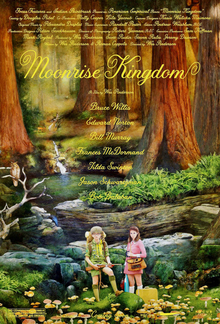
Moonrise Kingdom

One thing comes to mind when I hear director Wes Anderson's name. He is one quirky dude. With movies like Rushmore, The Royal Tenenbaums, and The Life Aquatic, he's created a niche for himself in the smart (usually), quirky comedy department. That generally off-the-wall, unique humor can be dividing among viewers so head into 2012's Moonrise Kingdom knowing what you're getting into.

It's 1965 on a small New England island called New Penzance and a major storm is rolling in, and in more ways than one. A Khaki scout camping with his troop, 12-year old Sam Shakusky (Jared Gilman) is a bit of an odd duck, and now he's up to something. One night, he escapes from the troop at Camp Ivanhoe, forcing Scout Master Randy Ward (Edward Norton), to start searching for him. Sam isn't alone though. He's running away with 12-year old Suzy (Kara Hayward), the oldest daughter in a family with three younger brothers and two lawyer parents. The whole island scrambles to find them, but what are the two pre-teens up to, and where do they hope to get?

Watching an Anderson film, you really, really need to know what you're watching. The comedy is so ridiculously underplayed and understated that you've really got to pay attention to every line, every delivery and facial reaction or you're going to miss something. It's quirky humor with style though. Anderson's camera is pretty stationary, rarely moving into the action, shooting the film almost like a stage play, occasionally moving in for a close-up. Setting the story here in 1965 adds to a quirky, retro style from the throwback clothes and cars to the general awesomeness of the 1960s (a documented scientific fact). It's a beautiful movie, full of colors that could make up paintings if need be. Get in rhythm with the style and generally kooky humor early, and things should fall into place for you.

Actors and actresses certainly like working with Anderson as a director because he continues to attract big names to his films. Along with Norton as Scout Master Randy, Frances McDormand, Bruce Willis, Tilda Swinton, Bob Balaban, and Harvey Keitel (buried far down in the credits) and Anderson regulars Bill Murray and Jason Schwartzman round out the cast. There isn't a bad performance in the bunch. Willis especially stands out as Captain Sharp, Penzance's police officer, Schwartzman is a crazy scream as Cousin Ben, an older scout, and McDormand and Murray as Suzy's parents working through some personal things. I won't list all the names, but Scout Master Randy's troop features some solid performances from some young actors while Suzy's brothers also have some funny moments.

The most quirky part of the story is definitely the teenage crush turned love that develops between Sam and Suzy, two pre-teens that find a common bond that brings them together. They're both loners, what most would consider weird to other kids their age (probably because they're wise beyond their ages), and they don't like what their lives are. Solution-oriented? Run away with plenty of supplies...on an island. While the duo is both obsessively quirky and appropriately odd, there's also a real charm to their relationship. Because neither is the accepted 'norm,' they must automatically be vastly different. Their runaway has some really funny moments, some truly odd and even unsettling moments, but it ends up being a good mix. Sam wears a coonskin cap, smokes a pipe, and is quite the Khaki scout in terms of skills. Suzy loves a French record given to her by her godmother, loves fantasy books, and always wears binoculars. How is that not a match made in heaven?

I think Anderson is a talented director who treads that fine line. He's really close to being too quirky, too cute, too disgustingly quirky even. There are times it tries too hard to be different in its humor. To his credit, Anderson seems to know when to tap the brakes as he approaches that fine line. There are moments he seems like he's losing it, but he regains control quickly. I don't mean it as a huge criticism -- he's very talented and a very good director -- but each of his movies have those moments that are just too odd for their own sake.

It's still a funny movie, worthwhile to check out for sure. When it works, it is clicking on all cylinders. Phone calls with a split screen are simple but effective. Norton's Scout Master exploring the camp with all its eccentricities is pretty perfect, as is the surreal scenes when Schwartzman arrives to help Sam and Suzy. Weird? Yes. Enjoyable? Oh, yes, that too.

Moonrise Kingdom (2012): ***/****

Wednesday, February 9, 2011

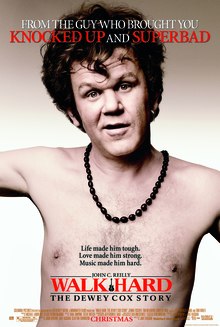
Walk Hard: The Dewey Cox Story

Rags to riches stories, the American dream at its best.  Musicians, athletes, movie stars, so many seem to follow a similar career arc. Whole shows like VH1's Behind the Music followed an almost identical show about rock stars.  Meteoric rise to fame, brief period at the top, and landslide to the bottom.  Movies like Ray and Walk the Line told the true stories of Ray Charles and Johnny Cash, and as was the case with all of the above mentioned things, they were just begging to be spoofed.  It's just too easy not to.  That's where 2007's Walk Hard: The Dewey Cox Story steps in.

In this not so thinly veiled dig at Johnny Cash and Walk the Line (and on a bigger level anything concerning music), every one and every thing in the music business is fair game.  Starring as Dewey Cox is one of the most underrated actors in Hollywood -- drama or comedy -- John C. Reilly. Starting with Reilly, the talent involved here is downright impressive including writer Judd Apatow and a huge cast that make spot-on cameos and fill out the supporting roles.  Both equally stupid and smart, this is just a funny movie, pure and simple.

At the young age of 6, Dewey Cox accidentally slices his brother in two at the waist when a machete fight (yes, a machete fight) goes horrifically wrong.  With that trauma hanging over his head, Dewey grows up, turning to music as an outlet.  He takes to it right away, and when he's kicked out of the house at 14 by his resentful father, Dewey (O'Reilly) tries to get into the music business. He skyrockets to the top with his hit song, Walk Hard <---music video, and is on the way to the top.  But his climb to the top comes at a price, and it's only a matter of time before you reach the summit, and there's no way to go but down.  For Dewey, it's a big drop.

Playing Dewey, Reilly gives him this sort of bumpkin charm where he's beyond stupid one second but genuinely funny the next.  He borders that fine line between over the top, idiotic stereotype and a character you actually like.  Reilly is one of the funniest actors in Hollywood right now, combining really broad physical/slapstick humor (Dewey's go-to move when angry is ripping sinks out of the wall) with subtle line deliveries ("I think I'm doing okay for a 15-year old with a wife and a baby").  Helping the character and his rise and fall is that the music is genuinely good.  Sure, the lyrics are usually a joke, but they sound good, especially Walk Hard.  

Following Dewey's career, it's not just Johnny Cash that is in line for some digs.  Dewey goes through phases of country, folk, punk rock, psychedelic rock, disco, and a couple others I'm probably forgetting.  These are some of the movie's most inspired moments.  Dewey becomes a Bob Dylan knock-off (watch/listen HERE) in trying to stay relevant, doing a spot-on impression of Dylan.  We meet Elvis (The White Stripes' Jack White), Buddy Holly (Frankie Muniz), and in the movie's far and away best scene, Dewey visiting the Beatles in India in 1968 during their psychedelic phase.  The Beatles are going through some internal struggles (a rift as Dewey calls it) which produce some of the movie's best laughs.  Watch it HERE. Jack Black plays Paul, Paul Rudd is John, Justin Long is George, and Jason Schwartzman plays Ringo. 

With a story that covers over 50 years, there's a fair share of characters that Dewey comes across during his up and down career.  Just about every comedic actor around gets a scene or two in this flick.  Playing Dewey's long-suffering band are Tim Meadows (his running bit about introducing Dewey to new drugs is priceless), Chris Parnell and Matt Besser. SNL star Kristen Wiig plays Dewey's wife who he marries (at 14) when she's 12 while Jenna Fischer is the true love of his life and fellow singer/performer Darlene. David Krumholtz is his one-note manager, Raymond J. Barry his resentful father, Harold Ramis and Martin Starr as Jewish record execs, Craig Robinson as a rival club singer, and many, many more recognizable faces. Even look for musicians like Eddie Vedder, Lyle Lovett and Jewel making appearances as themselves.

Parts of the movie don't work as well as others, but that's to be expected with a comedy.  It can be hard sustaining that frenetically funny pace over 90-plus minutes. Overall, Walk Hard avoids that pretty well for about an hour.  But when the story hits 1976 and the disco era, the pacing hits a major roadblock.  It knows where it wants to end up but not quite how to get there.  That last half hour is a tad on the slow side without the laughs.  Balancing it out though, that first hour is about as funny as a comedy can be.  It works out in the end, and there's just too much talent here to pass on this movie.

Walk Hard: The Dewey Cox Story <---trailer (2007): ***/****