The Sons of Katie Elder

The Sons of Katie Elder
"First, we reunite, then find Ma and Pa's killer...then read some reviews."

Friday, April 25, 2014

Wreck-It Ralph

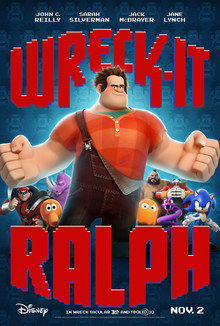
With 1995's Toy Story, animated movies were rewritten on several different levels. The computer animation revolutionized the genre, Pixar becoming a huge studio in the years since. On a simpler level, it took something we've all thought of growing up -- your toys coming to life when you're not there -- and ran with it. Almost 20 years later, another cool premise with a twist, video games, is brought to life with 2012's Wreck-It Ralph.

For 30 years at Litwik's Arcade, the game Fix-It Felix, Jr. has been a mainstay, a popular game for countless fans. At night though when the arcade is closed, the games and their characters are left on their own, all of them allowed to travel from one game to another through the power cables. The villain in Fix-It, Wreck-It Ralph (John C. Reilly), has had enough though, deciding 30 years is enough of being a villain while Fix-It Felix (Jack McBrayer) is honored as a hero on a nightly basis. One night, Ralph leaves the game through the power lines, hoping to become a hero (and earn a medal in the process) so he can prove everyone wrong. Ralph doesn't know what he's getting into, traveling from first-person shooter games to kart-racing games, but the old stand-by, Fix-It Felix Jr., could be in trouble if Ralph doesn't return in time.

In the same way Toy Story appeals to me, so does this Disney animated film from director Rich Moore (who also lends his voice talent to a couple characters). While the execution is there from beginning to end in the 108-minute movie, above all else, it's the idea, the premise that works so well. The thought of beloved video game characters, of dastardly villains, having this separate life apart from their video game is a thing of brilliance. As we play their games, this is their job, their day-to-day, 9-to-5 gig. When the arcade is closed, that's closing time. The power lines and outlets serve as a video game subway, the good guys and bad guys traveling wherever they so choose at night. The visual appeal is there -- from the sugar-coated kart-racing game to the dark, apocalyptic first-person shooter -- but it is that brilliantly innovative story that is most effective.

I'll also say that this is a movie that has a genuine appreciation and love for its subject matter. Wreck-It Ralph is clearly patterned after the original Donkey Kong, an early 1980s platform game that's since morphed and transitioned countless times, Ralph molded like Donkey Kong. It's cool to see all the video games living in one world, from the old platform games to the shoot 'em up action games, the racing games to the new wave of dance platforms (the end credits are especially cool in that department, Ralph working his way across countless video game worlds). There's some great moments early, including Ralph showing up to a Villains Support Meeting, the whole group working to get through their years of getting beaten down as villains. Their best line? "Just because you're a bad guy doesn't mean you're a bad guy." We meet all sorts of iconic video game characters -- check them out HERE -- with some other nice little touches, from glitches to how characters move in almost robotic fashion as their characters would. Clearly fans of video games were behind this flick, and it doesn't hurt if you're a fan too.

One of my favorite comedic actors, John C. Reilly nails the part of Wreck-It Ralph. He's made a career out of smashing a high-rise building only to have McBrayer's Fix-It Felix swoop in and save the day, and he's had about enough. All he wants to do is save the day, be the good guy, be the hero. Reilly's voice translates well to the part, and the visual doesn't hurt, an immense physical stature with his red overalls, his wild hair, and his rather large wrecking hands. It's quite the character, a great lead. The best development for Ralph comes when he meets Vanellope von Schweetz, a young girl and racer in the kart-racing game Sugar Rush. Sarah Silverman lends her voice talents to Vanellope, putting her usually pretty harsh sense of humor on hold. Vanellope is an outcast in her game, a glitch who threatens to shut the game down if fans want nothing to do with her. The duo forms an unlikely friendship/partnership, Reilly and Silverman doing an excellent job.

I liked the rest of the cast, but there aren't a ton of recognizable voices here. McBrayer is excellent as Fix-It Felix Jr. -- a gentle takeoff on Mario I think -- who's naive and clueless but in a sweet way. At one point as he tries to help a situation, "Why can I only fix things?!?" Playing Calhoun, the hard-edged female squad commander in Heroes Duty (first person shooter vs. aliens), Jane Lynch does a good job as a hero with the darkest backstory ever. Alan Tudyk plays King Candy, the ruler of Sugar Rush. Also listen for Mindy Kaling, Dennis Haysbert, Joe Lo Truglio and Ed O'Neill as Mr. Litwak, the longtime owner of his expansive arcade.

A fun movie with a very cool premise. The message for the kids never gets to be too heavy or too obvious. I look forward to where Wreck-It Ralph might go in a sequel. Moore has said it might aim at online and console gaming but that's for later. For now, just enjoy the original!

Wreck-It Ralph (2012): ***/****

Wednesday, April 23, 2014

The Frisco Kid

Some movies have a formula that should just work. They just should. A great director, a really cool premise/plot, and two actors in the lead roles that I'm a big, big fan of. And sometimes, the formula doesn't add up to something that's as good as it could have been. That's 1979's The Frisco Kid. I liked it, but it has its flaws/struggles and doesn't quite live up to its potential.

It's 1850 in Poland and young rabbi Avram Belinski (Gene Wilder) is 87th in his graduating class of 88 potential rabbis (because rabbis have graduation/class rankings?), but he's about to be on the move. He has been named the rabbi of a congregation/church in San Francisco so Avram packs his things, a Torah included, and sails across the Atlantic on his way to his new life and destination. Likable and naive, Avram is taken in by three con men who steal his money, clothes and all his possessions, leaving him on his own on the trail westward. His hopes of surviving on his own seem slim at best, much less actually making it to San Francisco to get to his church. Just when it seems his chances are completely shot, he is saved on the trail by young Tommy Lillard (Harrison Ford), who looks like a cowboy but is in fact, a bank robber. Maybe the duo can get by together.

From director Robert Aldrich (of The Dirty Dozen fame, among many others), this 1979 western is good but not great. It just should have been better. I've made no bones about my general dislike for comedic westerns, but this one could have been a pretty good one. As it is, it is way too long at 119 minutes, utilizing an episodic story that is funny at times and drags in a big way in others. There's no real unifying link in the story that simply drifts too much. Never bad, but never as good as it could have been in the end unfortunately.

Come on now, it doesn't take a nuclear scientist to figure out the best thing going here in Aldrich's western comedy. That would be Gene Wilder and Harrison Ford as one of the odder buddy pairings I've ever seen, a naive, likable rabbi and a wild west bank robber. Above all else, this pairing works because both actors commit to their parts. Things get a little goofy at times, a little over the top, as both actors are required to ham it up as their trail trials get a little weirder. It is a pairing that wouldn't seem to work, but it does. They have a great chemistry together whether it be arguments or bonding back and forth. With Young Frankenstein, The Producers, Blazing Saddles and many other movies, Wilder was the established star by 1979. Ford was riding high as Han Solo off the success of 1977's Star Wars ('Empire' to come). Two very different stars, but it works throughout.

Not many others resonate from the rest of the cast unfortunately. Most of the episodic portions of the story don't stick around long enough to do so. Ramon Bieri, William Smith and George DiCenzo play the three con men who rob Avram and leave him for dead on the trail. Val Bisoglio has some fun as Chief Gray Cloud, an Indian chief who's fascinated by Avram's Jewish background. Penny Peyser has a good part as Rosalie, the sister of the somewhat slutty young woman who's been promised to Avram upon his arrival in San Franisco.

With a talent like Wilder, you've got to figure some comedic moments are going to stand out from a story that drags at times. Some of it is as simple as a physical mannerism, like the inexperienced Avram riding a horse, holding the reins out wide of his body like he's conducting an orchestra. The Jewish jokes can be hit or miss at times, but when they work, they're really funny. In a life or death situation, Avram refuses to ride a horse on a Saturday (the Shabbat) but encourages his horse to walk faster, Tommy screaming at him all the while, as the sun ever so slowly sets behind a rock formation, a posse in hot pursuit behind them. A trip to a monastery run by monks who have taken a vow of silence has some good laughs, as does a detour to an Indian camp where Avram sees their cultures aren't so different, the Indians and the Jews.

There are a handful of moments like these, really strong moments that hold the story together, whether they be dramatic or funny. The same for Wilder as Avram and Ford as Tommy, a genuine if unlikely friendship developing between the two men. If only the movie had been a little tighter, a little more pointed in its story, we'd have a pretty good movie. As is, it is a mild recommendation with some worthwhile moments.

The Frisco Kid (1979): ** 1/2 /****

Tuesday, April 22, 2014

The Big Chill

It's one of those things. Good movie (some would say great to classic), impressive cast, a loyal following and positively reviewed almost across the board. Then.....then, you watch it, and it just isn't very good. All in the eye of the beholder, huh? Maybe I missed something, maybe I just didn't think it was very good, but here's 1983's The Big Chill.

A group of friends who attended the University of Michigan in the late 1960s have drifted apart over the years, some starting families, others pursuing careers, some doing both. They're about to be brought back together under far from ideal conditions. One of the friends, Alex, has committed suicide, the rest of the group all returning to Alex's hometown in Michigan for the funeral and service. For some, they see friends they haven't seen or talked to in years, but the relationships are still there, the bonds, the friendships, rivalries, all coming back in a flash. Staying together in one house over the weekend, the group of friends starts to see that everything isn't so rosy. Sex, drugs, music and some good old-fashioned bonding among longtime friends. Let the craziness and kookiness commence.

This was the first time I saw director Lawrence Kasdan's film that's earned a reputation over the years as one of the seminal movies of the 1980s. This is a story about a generation that grew up with Vietnam, hippies, Watergate, the drug culture, one of the most turbulent times in American history. Now in the early 1980s, they're all grown-up, their past craziness just that, a thing of the past. They have jobs, careers, family (for the most part). It is a story ripe with potential, one house serving as the setting for almost the entire movie. The soundtrack is pretty epic featuring everyone from The Rolling Stones to Marvin Gaye, The Temptations to Procol Harum and a whole lot in between. Style, interesting premise, lots of talent in the cast....and, yeah, I didn't really like it much at all.

For starters, let's talk about the very talented cast. There's Kevin Kline and Glenn Close as a married couple with a checkered past that has been left in the past, Tom Berenger as the big celebrity, the TV star with a hugely successful Magnum P.I.-esque show, JoBeth Williams his married crush who's having some marital struggles, Jeff Goldblum as a goofy journalist, William Hurt as the drug-addled Vietnam vet who struggles with...well, everything, Mary Kay Place as the single 30-something who has her biological clock ticking loudly, and then Meg Tilly as Alex's girlfriend who he'd been seeing for about three months. Some impressive names, but my goodness, I just didn't like these characters. We're thrown into the story without much in the way of introduction or background so I struggled immediately to keep up with what was going on. Yes, we learn some things with each passing dialogue scene (and there's plenty), but the early struggles proved to be the movie's doom.

Watching this movie in 2014, it's easy to see the influence 'Chill' has had on countless films and television shows in the 30 years since its release. Any movie about old friends reuniting has to at least tip its cap to this 1983 film in one way or another. As for my next statement, I say this as someone who grew up in a generation that complains about just about everything. But really, has there ever been a movie with so many whiny individuals? Is life just so awful? As they reunite, catch up after years apart, this group of friends proceeds to bitch and moan about how tough life is, how life didn't turn out how they thought it would, how things didn't develop as they thought they would. Boo-freaking-hoo. The entire second half of the movie plays like one big sob story. It helps to have some initial sympathy for these characters, but it's just never there. Wait, life is tough?!? Who knew? Get over yourself.

What was original in 1983 plays like cliched now. So through no fault of its own, 'Chill' was working against it immediately. At one point, the crew dances together as they clean up and do the dishes after dinner. Woo-hoo! Bonding! If it was meant to show them bonding again, we get it, but it feels forced and goofy. The story up until this point is based in some sort of reality, but the last 30 minutes or so derails with some just odd decisions. We're talking painfully awkward decisions that I just don't see a lot of real-life friends making. By the end though, I was beyond worrying too much. I went in with modest expectations but came away very, very disappointed. Maybe in five or six years when I'm in my mid-30s, I'll appreciate it more. For now, I just don't get the appeal.

The Big Chill (1983): * 1/2 /****

Monday, April 21, 2014

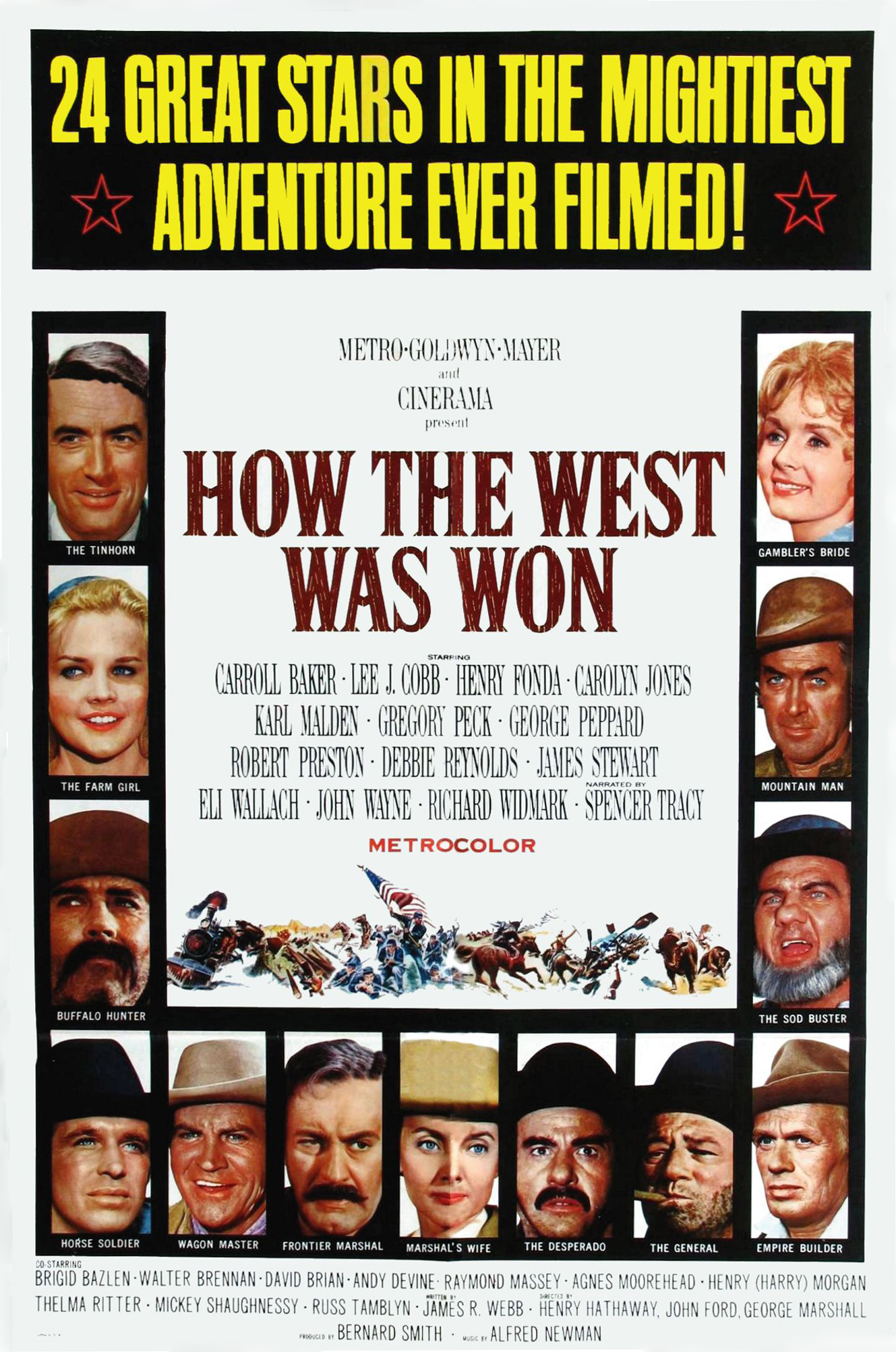
How the West Was Won

In the age of the epics -- the 1950s and 1960s -- some just stand above the rest. It's the stories, the cast, the scope. I don't love 1962's How the West Was Won but as far as epics go, there are very few in its neighborhood. There are obvious flaws, but when it works, it works in a big way. An impressive all-star cast, a story about the development of the American west and a shooting technique that is must-see. That's a winning formula.

A 162-minute film is broken up into five separate segments, the story following the Prescott-Rawlings family as it moves west and settles between the 1840s and the 1880s. It was directed by three different directors and covers a ton of ground. And away we go!

1. The Rivers (directed by Henry Hathaway): It's the 1840s, and the Prescott family, led by patriarch Zebulon (Karl Malden), is moving west and looking for a new life. In Zebulon's family is two daughters, Eve (Carroll Baker), looking for a new life in the west, and Lillith (Debbie Reynolds), wanting to stay in the far-more civilized East. In their dangerous travels on the rivers, they also meet Linus Rawlings (James Stewart), a mountain man with a canoe full of pelts.
Also starring: Lee Van Cleef, Walter Brennan, Agnes Moorehead, Brigid Bazlen.

2. The Plains (directed by Hathaway): Having worked for years on her own as a singer and dancer, Lillith Prescott (Reynolds) has just inherited a gold mine in the wake of the California gold rush. She heads west on a wagon train led by trail driver Richard Morgan (Robert Preston) with a gold-seeking gambler, Cleve Van Valen (Gregory Peck), also along too. 
Also starring: Thelma Ritter.

3. The Civil War (directed by John Ford): The war between the states in its early months, young Zeb Rawlings (George Peppard) leaves home with the blessing of his mother, Eve, to join the Ohio volunteers in the fighting. Like so many others, he thinks the war will be full of glory and be over quickly. Zeb finds out how very wrong he is at the bloody battle of Shiloh.
Also starring: John Wayne (as General Sherman), Russ Tamblyn (as a Confederate deserter), Harry Morgan (as General Grant), Andy Devine, Ken Curtis, Raymond Massey (as Abraham Lincoln).

4. The Railroad (directed by George Marshall): In the years following the Civil War, railroad companies race across the U.S. to link the two coasts. Now in the cavalry, Zeb Rawlings (Peppard) finds himself balancing out what his duty requires of him with what he knows is right, the railroad, including brutal supervisor Mike King (Richard Widmark), pushing the Arapahoes to their limit.
Also starring: Henry Fonda as Jethro Stuart, a former mountain man.

5. The Outlaws (directed by Hathaway): Having left the cavalry behind, Zeb Rawlings is now a family man with two kids, now trying to leave his profession as a lawman behind. He receives a letter from his aunt, Lillith (Reynolds), and readies the family to move. As they travel though, Zeb runs into Charlie Gant (Eli Wallach), a notorious outlaw gunning for Zeb.
Also starring: Lee J. Cobb, Carolyn Jones.

This is a movie that's simply put, BIG. It was filmed in Cinerama, three cameras filming each scene and then splicing the action together. The result? An immense look at the expansion of the west. Shots look like panoramic paintings, putting a whole new scope on the growth and development of the American west. It is a beautiful movie. Certain sequences especially stand out -- the camera on a raft trying to survive river rapids, an Indian attack on a wagon train, a stampeding buffalo herd trampling a railroad camp, a runaway train during an attempted robbery -- over the course of the movie, but visually there just isn't a weak spot. I love composer Alfred Newman's score -- listen to an extended sample HERE -- as it gives a moving background to the story. Countless gorgeous filming locations, providing a great backdrop while also transitioning from segment to segment.

It had been years since I watched this movie straight through in one sitting before my recent revisit of this 1962 epic. As you compare the five separate segments, I don't think it's really in question which one is the strongest. It's John Ford's Civil War segment, doing in 20 minutes what entire movies couldn't do in bringing the Civil War to life. Quick, dark, visually striking and unsettling, it is a gem of a sequence, especially Peppard meeting Tamblyn's Confederate deserter after the battle. The second strongest segment for me is the opening 'Rivers' with Stewart, Baker, Reynolds and Malden all leaving a positive impression. All five segments could be stretched out to a feature length film on their own, but these two especially stand out. They get their message across in a quick window and in both cases left me wanting more. Kudos to Ford and Hathaway for their work here.

What struck me more on the rewatch was the other three segments. They are by no means bad segments, but they're just not as good as the other two. I've always thought the weakest was the Plains segment, things feeling too rushed in general. The same qualifies for the Railroad and Outlaws portions. By the time you take away the Entr'Acte, intermission, and Finale music, we're looking at a movie with five segments covered in about 150 minutes (give or take). None of these three are given a chance to breathe to the point they feel downright rushed. As for some other positives? I loved the transitional scenes -- narrated by Spencer Tracy, directed in uncredited fashion by Richard Thorpe --  that set things up, explaining how America has changed, how its people change. These quick montages provide the heart of the movie, almost like a documentary in some ways. Like any movie that tries to accomplish so much, there's good and bad. The positives -- especially the Civil War middle -- is enough to outweigh the negatives thankfully.

One of my biggest worries in reviewing this 1962 epic was that the cast is too big. There's no way I was gonna be able to get all those names tagged with a 200-character limit. Who stands out? Stewart i excellent as Linus Rawlings, Fonda is good in a quick part as Jethro Stuart, and Baker is very strong too. The best parts though are Debbie Reynolds as Lillith and George Peppard as Zeb, the two hearts of the family. One or both is in every segment, the audience seeing them age, learn and adapt as America grows with them. Their scenes together in the Outlaws portion ring especially true. However you cut it though, just an impressive cast from top to bottom, one of the best ever assembled for a Hollywood film.

A doozy of a movie for what it's trying to accomplish. It falls short at times, but this is a movie worth watching for what it represents alone. This is a throwback film, a true epic that strives to be something great. If it doesn't live up those high hopes, so be it. The effort is admirable, a fascinating story of America growing up over an extremely turbulent portion of its history. Oh, and Debbie Reynolds singing A Home in the Meadow (listen HERE) is a truly beautiful song, a fitting one for the movie.

How the West Was Won (1962): ***/****

Friday, April 18, 2014

Rooster Cogburn

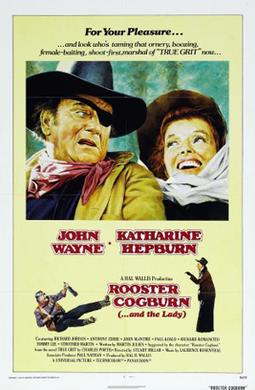
By the 1970s, there weren't too many bigger and better Hollywood legends than John Wayne and Katharine Hepburn. Both stars had been just that, stars, non-stop since the 1930s and by the mid 1970s were in the later parts of their careers. But even with all those classics films, classic roles and interesting pairings of stars, the duo had never worked together...until 1975's Rooster Cogburn, also known as Rooster Cogburn...and the Lady.

Still working as a U.S. Marshal, Rooster Cogburn (Wayne) is up to his old tricks again. Not too interested in how the law says he should bring suspects in, Cogburn has been suspended for his overzealous ways...for now. He's given his badge and title back if he promises to bring in a dangerous gang of killers led by a maniacal outlaw, Hawk (Richard Jordan). The outlaw's gang murdered an army convoy carrying nitroglycerin, shipments of rifles and a Gatling gun. Their goal? Knock off a federal depository up in the mountains. Cogburn is on their trail quickly, but he's got a problem. In Hawk's wake, the marshal finds an older woman, a missionary of sorts, Eula Goodnight (Hepburn), who saw her father and his mission almost wiped out by the gang. Cogburn hopes to bring her back to safety, but Eula has other plans. She intends to go with, helping bring her father's killers to justice.

I'm usually completely against sequels, especially when the first movie wraps up everything so nicely. That's the case with 1969's True Grit, a western that brought Wayne his only Oscar win for a long, distinguished career. It isn't a great western, but it has stood the test of time because of Wayne's scene-stealing part as Marshal Rooster Cogburn. This 1975 follow-up from director Stuart Millar takes the formula and takes it a step forward, pairing Wayne with Hepburn in a similarly scene-stealing part. Much the same way 'Grit' resonates, so does 'Rooster.' It's typical of many other late Wayne entries, straightforward and entertaining, likable, fun good guys versus dastardly bad guys, and just a lot of fun throughout. Laurence Rosenthal's score is solid, tweaking Elmer Bernstein's score from the original. Listen HERE for the theme. The Oregon locations go a long way too, the backgrounds for the shots providing a stunningly good-looking backdrop to the story.

Who are we kidding though? This is a movie that exists solely to put John Wayne and Katharine Hepburn together. The wait was worth it, the two Hollywood legends stepping to the plate in a big way. They make it look effortless. We learn some more about Rooster (including his first name), but he's still the same fat, one-eyed marshal who likes a good drink and is a tough as nails peace officer. Hepburn is not quite a spinster, but an older woman who looks to religion for answers, nagging Rooster about his drinking, his language, his boasting, a little bit of everything. The chemistry is on display from their first scene until the final scene. They argue, they bond, they talk about their pasts, finding there's plenty of differences between them, but there's also more similarities than they would have originally thought. Along for the trip is Wolf (Richard Romancito), an Indian boy in his teenage years, a capable rider who looks up to Rooster. 

If you're going to have a great hero to lead the way, you need an equally bad villain to put in his way. In steps Richard Jordan, an underrated actor who never became a huge star. His Hawk is beyond intense, his upcoming robbery of a gold depository becoming almost an obsession. In some nice touches with Hawk and his gang, we learn about some past meetings with Cogburn. In his gang, look for Anthony Zerbe as Breed, a tracker/scout who used to ride with Rooster, now on the outlaw trail, and Hawk's maligned right-hand man, Luke, played by 1970s tough guy Paul Koslo. John McIntire makes a quick but memorable appearance as Judge Parker, the court representative who always has to deal with Rooster. Strother Martin hams it up in a one-scene appearance as McCoy, a cantankerous veteran of the sea now renting his raft for river crossings.

Heading into this movie, if you're looking for any sort of groundbreaking western, you're going to be disappointed. The focus is clearly on Wayne and Hepburn, the highpoints their scenes sitting around a campfire, talking while riding on a wagon, moving along the trail. The potential was there for a darker western with more shoot 'em up and gunplay, but for the most part Jordan as Hawk is underused. This is a good, old-fashioned western that plays like comfort food. Just sit back and enjoy this one.

Rooster Cogburn (1975): ***/****

Thursday, April 17, 2014

Outbreak

Released way back in 2011, Steven Soderbergh's Contagion was one of the best movies I saw in 2012. A seemingly unstoppable virus is tearing its way across the world. Can it be stopped? Smart, well-written, well-acted and stylish, it was a great movie. Released 16 years earlier, 1995's Outbreak deals with a very similar story and formula. Where does it stand in comparison?

A longtime disease specialist/virologist working for the U.S. Army Medical Research Institute of Infectious Diseases (USARMIID), Sam Daniels (Dustin Hoffman) and his team have been sent to Zaire to deal with a new disease that wiped out an entire village. What they find is terrifying, a virus that replicates quickly, claiming victims within a 24-hour period. Daniels' crew manages to contain the disease within the village, taking samples and clearing out before the disease can spread. Just days later though, a patient in a hospital in Boston has the symptoms similar to the disease. Then there's another in California, and then a whole town. How did the disease spread so quickly? Can it be stopped before it wipes out thousands and maybe millions? Daniels and his team go to work, but there may be more at work within the government than they know trying to stop them.

From director Wolfgang Petersen, 'Outbreak' is a good example of a modern disaster film that doesn't have to resort to gimmicks to be good. When disaster films were at their most popular in the late 1970s and early 1980s, they became cliched quickly, trying to one-up each other one after another. That's not really an issue here, a pretty smart script laying out a situation that could really happen. Viruses and diseases are constantly evolving. Can the medical field and the government stay ahead of those evolutions? 'Outbreak' blends that intelligent premise with an all-star cast and lets things take off. For the most part, I liked it....for awhile. That's for a little later though. For now, here's some positives.

In much the same way I enjoyed Contagion, 'Outbreak' is at its best in dealing with the social implications involved here. We see how the USARMIID and the CDC respond, trying to react as quickly as possible. We see the government planning ahead for all possible contingency plans, however dark they may be. Petersen's got an eye for it, covering a ton of ideas and scenarios in relatively quick fashion. While there's a lot of characters and situations, it doesn't feel rushed. The disease spreads quickly, the virus jumping and developing quickly. It's all cut together at a lightning-pace, bouncing among all the different affected parties. Things take a turn for the dark when a California town is a breakout point, patients piling up at an alarming rate. The USARMIID, CDC, military and government descend on the town, other advances being made to track down the source. How did this disease spread? Those are the coolest moments, a frightening premise to think about in our current world.

Now for that all-star cast!!! It's interesting watching Dustin Hoffman do just about anything on-screen, and he's a great lead here. Unfortunately some of his character background is dealing with his recently divorced wife, Robby (Rene Russo), who's taken a job at the CDC. Oh, divorce drama! Still, Hoffman and Russo have a good chemistry. Rounding out Daniels' team are Kevin Spacey as Casey, the smart-ass, highly intelligent assistant who's worked for years with Daniels, and Cuba Gooding Jr. as Salt, a new recruit with an army and medical background but no field experience. Representing the government/military higher-ups, Morgan Freeman and Donald Sutherland play highly-ranked officers who know more than they're letting on (courtesy of a 1967 flashback to open the film we see). Also look for Patrick Dempsey as an unknowing spreader of the disease, a cool, quick and essential subplot to the story.

And there it is. A good, creepy, entertaining story that could have been based in some sort of reality. And then there's the last 45 minutes. Hoffman's Daniels becomes a superhero, Gooding Jr. his intrepid sidekick, the duo traveling all over California, Sutherland's evil general in hot pursuit, and all against the clock. There's helicopter chases, a trap for a cute, disease-ridden monkey, an evil general obsessed with something, taking over a TV news broadcast, a helicopter with an endless supply of fuel, and a big old shift in tone that goes from serious and dramatic to goofy and campy. The movie is still good, but the last third is pretty rough. We're not sure who makes it, and it all is resolved rather quickly in a flash. Could have been great in the end, but it's okay instead.

Outbreak (1995): ** 1/2 /****

Wednesday, April 16, 2014

Minnesota Clay

For right or wrong, movie fans think Sergio Leone created the spaghetti western genre. They would be wrong. With his Dollars trilogy, especially Fistful of Dollars, he didn't create the genre but instead put it squarely on the map, put it in the spotlight. Spaghetti westerns had been around for several years but in an earlier, nicer form. Leone would flip that formula. One pre-Leone spaghetti is pretty decent, a mix of an American and Italian western, 1964's Minnesota Clay.

Wasting away for years at a labor camp in the desert, Minnesota Clay (Cameron Mitchell) has had enough, vowing to prove his innocence. Years before, Clay was sent to prison in a frame-up job, found guilty for gunning down two men. In reality, it was self-defense, but a bribed court didn't see it that way.  He manages to escape, heading for home but in his hometown of Mesa Encantada, Clay finds the town being run by two rival gangs, one a gang of Mexican bandits led by General Ortiz (Fernando Sancho), the other run by a man called Fox (Georges Riviere), an old friend originally hired to protect the town. Looking to clear his name, Clay finds himself pitted against both gangs, working to save his own skin before they turn on him. His reputation as one of the fastest guns around is about to be tested in a big way.

Part of the 50 Spaghetti Western collection I bought several years ago, I was pleasantly surprised by this one. I knew this next tidbit but didn't remember it going in, but 'Minnesota' is from director Sergio Corbucci, later of Django, The Great Silence, The Mercenary and Companeros fame, among others. Corbucci's big hit, Django, would hit theaters internationally two years later, but here in 1964 with the genre still in its infancy, Corbucci shows his potential with a middling movie. It still has touches of American westerns (forced love interest, forced comedic moments), but there's also some clear, early examples of where the genre is/was heading. There's some familiar locations, decent if not memorable music from Piero Piccioni (he did much better) and a story eerily similar to Fistful of Dollars which was based off Akira Kurosawa's Yojimbo. Not great, but better in general than some early spaghetti entries.

Over the last year, I've been watching The High Chaparral, a TV western that aired for four seasons and is now on syndication, letting me catch up two episodes at a time. One of the stars? Cameron Mitchell who I like a lot as Buck Cannon, a loving life cowboy. I've seen plenty of movies with him, but nothing quite like this. A recognizable face in American westerns, it's cool to see him head to Italy and star in this early spaghetti. It isn't a flashy part but a good one just the same. Gravelly-voiced, steely-eyed and looking for redemption, Mitchell's Minnesota Clay is a good example of where the spaghetti western anti-hero would go in the coming years. Some time is wasted with his daughter (Diana Martin) who doesn't know her father and her bumbling suitor (Alberto Cevenini), not enough focus on his possibly doomed attempt to clear his name. Not the biggest name to lead the way in a western but Mitchell more than holds his own.

The supporting cast is a good example of how the spaghetti western genre helped change the western in general. We've got some very good characters and very evil characters with little in between. Riviere is the slimy, smooth Fox, a manipulative businessman with a gang of killers to back him up, Gino Pernice as his main enforcer, Scratchy (quite an imposing name, huh?). Sancho does what he did best, the crazy, overacting, cliched, stereotypical Mexican bandit right down to the crossed bandoliers, the greasy mustache, the maniacal laughing, all a lot of fun. Ethel Rojo gets to femme fatale it up as Estella, a saloon girl who attaches herself to anyone who can help her out. Rounding out 'the good' department, Antonio Casas plays Jonathan Mulligan, Clay's old friend who took his daughter in as his own.

Maybe the biggest thing that audiences ate up with spaghetti westerns was the brutality, just the out and out violent, vicious qualities. No one was safe. NO ONE. Everyone was a possible target. Corbucci especially took those qualities to heart in his movies (Django, Silence, The Hellbenders), and this 1964 western is a good preview. Corbucci loved torturing his anti-heroes, gunslingers who were crippled, maimed, wounded and handicapped, forced to overcome these things to save the day in the end...and sometimes fail. There isn't a ton of gunplay here, most of it saved for two shootouts late. The finale especially is pretty cool, a partially blinded Clay forced to take on a small gang of gunmen. The American and Italian versions had different endings, and for a change, the American ending was better.

A solid spaghetti western all-around.

Minnesota Clay (1964): ** 1/2 /****

Tuesday, April 15, 2014

Bengazi

Some movies should just have been better. That's all. Good cast, cool story, lots of potential....and then they're not very good. That's what I thought with 1955's Bengazi. It starts off strong and then it just fizzles....quickly.

A World War II veteran who served in Africa, John Gillmore (Richard Conte) owns half of a bar in Bengazi co-owned by an aging Irishman, Robert Donovan (Victor McLaglen). Gillmore is involved in all sorts of black market deals, especially running guns, and consistently stays ahead of the local police detective, Inspector Levering (Richard Carlson). His most recent crime? He stole a jeep mounted with a machine gun from the British motor pool. He has a plan in place, working with a recently released convict, Selby (Richard Erdman), who knows the location of a hidden gold treasure at an abandoned mosque in the desert. Gillmore enlists Donovan's help with the promise of a huge payday in the end -- dangerous road aside -- but their plan has a wrench thrown in it when Donovan's daughter (Mala Powers) arrives in Bengazi to visit her father she hasn't seen in over 15 years.

A B-movie from director John Brahm, 'Bengazi' clocks in at 79 minutes, seemingly a perfect length for a relatively cheap flick. Well, that's what I figured at least. After some early potential, this movie derailed quickly and never recovers. As I've said, cheap/low budget doesn't mean bad....but, yeah, the cheap ends up impacting this one in the end. The disparate quasi-refugees and crooks working together in a crime-ridden foreign city, a suicidal mission with touches of countless westerns and war movies -- including The Lost Patrol, which McLaglen starred in -- are all archetypal stories and situations that never amount to much in the end. By the end, things are just thrown at the wall hoping some of them stick. Most don't.

If there's the remotest semblance of a positive here it comes from the cast. That doesn't mean it's good, but there's certainly some interesting casting. I like Conte, a solid character actor who never became a star so it's cool to see him in a leading role. The script does him no favors in a painfully forced subplot with Powers as Donovan's daughter, Aileen, falls madly in love with him and vice versa. They have no chemistry but are instantly in love in a dangerous situation. Gag. Late in his career, McLaglen hams it up like his life depends on it, but it's Victor McLaglen so that can be fun even when it's bad. Carlson inexplicably has a brutal Scottish accent, his Levering just an odd character in the end. Erdman is underused as the slithery Selby while Pedro Gonzalez Gonzalez, Jay Novello and Maurice Hill have small supporting parts.

I wanted to like this one. The cast is pretty cool and that premise was interesting if somewhat familiar. After traveling across the desert, Gillmore, Donovan and Selby find the abandoned mosque near a desert oasis, but they're not alone, Bedouin tribesmen hovering just beyond the horizon in an effort to protect their hidden gold. Gillmore reveals a machine gun as protection and the trio wait for help. Wouldn't you know it? Levering shows up with his assistant and Aileen...because, well, we need some love tension, not because that move makes any sense in the real world. From there, it's a matter of who will survive, if anyone. We never see the Bedouin tribesmen other than a late reveal -- budget restrictions I'm assuming -- but that sense of danger never permeates the story. Yeah, they're there in the dunes, but when there's no interest in the characters, who cares who makes it?

By the end, the bodies pile up -- Conte calling his machine gun "Baby" -- but things degenerate into painfully slow, downright dull dialogue scenes and the always unbearable love triangle. Who will Aileen pick?!? The roguish Gillmore or the reliable Levering?!? Bleck. Just steer clear of this dud, solid cast and premise aside.

Bengazi (1955): */****

Monday, April 14, 2014

The Last Days on Mars

The unknown is almost always scarier than the known. What's behind that door? What creatures and secrets do the depths of the ocean hold? What about the far reaches of space? For me, especially watching movies, the mystery proves far more interesting than the actual reveal. The revelation can be forced, contrived, far too familiar or just not very good, like 2013's The Last Days on Mars, a potential-filled science fiction film that never creates its own identity.

Having served a tour at the Tantalus Base on Mars, an eight-man astronaut and scientific crew is just hours away from being relieved so they can begin the six-month trip back to Earth. One of the crew, a scientist named Marko (Goran Kostic), has made a startling discovery but with time running out he convinces the base captain, Brunel (Elias Koteas), to let him go out and explore one of their dig sites. Listening back at base over a transmission, the crew hears some sort of explosion and screaming but don't know exactly what happened. Racing out to the site, Brunel and one of his lead technicians, Vince (Liev Schreiber), are stunned at what they find. A huge hole has appeared in the ground, Marko's body seemingly down at the bottom. When Vince goes down to investigate, Marko's body isn't there. What exactly is going on?

I love a good science fiction movie. I don't necessarily like being scared when I watch a movie, but if I'm going to go along with it, this is the type of movie in terms of style. The unknown, the mysterious, the possibility of something unstoppable and terrifying, now that's scary. This sci-fi flick from director Ruairi Robinson is based off a short story called The Animators from author Sydney J. Bound. It doesn't overstay its welcome at just 98 minutes. Released last fall, it received a very limited theatrical release, received uniformly negative reviews and in the end is just sorta there. It isn't good, and it isn't bad. 'Mars' has its moments, but for the most part, it never does enough to distinguish itself from several other like-minded science fiction films.

Ah, that mystery. The build-up, that unknown, that possibility of anything, it's a powerful motivator in a story like this, and it doesn't have to be science fiction. Thrillers, dramas, it just works. I don't want to give too much away in terms of spoilers, but I'll give 'Mars' credit. The twist and the reveal works. What Marko finds somewhere in Mars' soil is genuinely creepy because....let's face it. It could happen. There's so much going on in space and its reaches that we can never really know what to expect. The twist is all well and good. It works, but in taking it forward, the execution just isn't there. The rest of the story plays like a knockoff of countless other better science fiction films from John Carpenter's The Thing to Invasion of the Body Snatchers. What this science/astronaut expedition finds on Mars threatens mankind, our existence itself if it escapes. It should work better in that sense. A small group of people fighting for their own survival, but also fighting for something bigger. That formula never quite gels.

With an ensemble cast, there's some recognizable names, some recognizable faces and a couple folks you just know are fodder waiting to be knocked off. Schreiber is the biggest name and the star, his Vincent Campbell a talented engineer who's struggling with some inner demons. Like the rest of the cast though, the script does him no favors. We get mentions of family, of wives and kids, of lives left behind on Earth, but it never translates to form any personal interest in these people. You're rooting for them because they're in a hellish situation, but that's all with no emotional investment. Koteas represents himself well as the base captain, trying to hold his crew together. Also standing out from the group is Olivia Williams is Kim, the hard-edged scientist who doesn't hold back her opinions, tough though they may be. In addition to Kostic as the selfish Marko, look for Romola Garai (Lane), Johnny Harris (the worrisome, selfish Irwin), Tom Cullen (Harrington), and Yusra Warsama (Dalby).

 Disappointing end result here, and maybe because it was just too familiar. When the twist is revealed, the momentum should pick up, but it doesn't. It limps to the finish line. The only real mystery is who will survive but even that can be pretty predictable. Too familiar, too cliched, and not willing to take any real risks. A good-looking, creepy, eerie movie at times that never comes together.

The Last Days on Mars (2013): **/****