Turner Classic Movies devoted Tuesdays in January to one of my favorite sub-genres; the heist film. For the most part, I had seen most of the flicks that popped up on the schedule, and the ones I hadn't seen, I at least recognized them. Well, most of them. I'd never seen or heard of 1967's Jack of Diamonds, and away we go!
An infamous thief with police and law enforcement agencies around the world searching for him, Jeff Hill (George Hamilton), dubbed the Jack of Diamonds, has pulled off countless jobs, usually stealing rare jewels and diamonds. After one particularly successful job, Jeff heads on a skiing vacation with his friend and mentor, Ace (Joseph Cotten), but instead he stumbles into another job. They meet an old friend of Ace's, Nicolai (Maurice Evans), who presents a job that will net them the rarest of blood-red diamonds. There's a catch though. Always working on his own no matter the job, Jeff must conspire with Nicolai's daughter, Olga (Marie Laforet), to pull off the job. The heist itself -- robbing a well-guarded vault -- seems impossible, and that's if the quartet can actually work together to pull it off.
The 1960s were the decade of spy flicks, espionage thrillers, and heist capers. For all the serious entries in those three films though, there were probably just as many spoof and/or comedic takes on the genre. In a lot of ways, this 1967 caper reminded me most of the Matt Helm series starring Dean Martin. Goofy, tongue-in-cheek and very stylish, 'Diamonds' succeeds because it doesn't take itself too seriously....at all. At the same time, director (and former actor) Don Taylor knows not to make it outright stupid. As far as capers go, it sticks to the basics; likable, roguish thief pursued by cops. What shenanigans will he get into this time around? Pretty meat and potatoes, although there is a good twist in the final 10 minutes that breathes some new life into a familiar formula.
'Diamonds' has a very distinctive 1960s style from its cheesy-looking indoor sets to its odd musical score from composers Bob Harris and Peter Thomas. The music is good and bad, some reviews comparing it to a psuedo-Ennio Morricone score. When it works, that's a fair comparison. Much of the time though, it's just odd vocals that are annoying more than appropriate. Other reviews pointed out the style here in 'Diamond' is similar to the generally odd Danger: Diabolik which I think is fair too, if in a measured way. How best to describe it? A mix falling somewhere in between American, European and low-budget B-movie style that works because it is so random and eclectic. It's hard to describe this 1960s style in detail or pin-point fashion, but throw all that weirdness together, and it just works. And in the random department, stars Carroll Baker, Zsa Zsa Gabor and Lilli Palmer all make cameos as themselves, all victims of the Jack of Diamonds.
My first thought at hearing George Hamilton's name is not 'dramatic actor' so with that said, this is the perfect part for him! He gets to be charming, suave and cool, delivering basically all his lines with a kind of cheesy charm....and a whole lot of guy-liner. From the word 'go,' he's clearly having a lot of fun. I especially liked the dynamic between Hamilton's Jack and Cotten's Ace, the mentor-student relationship producing some pretty funny, cool scenes. Cotten does a solid job with a smaller part. Evans too is a scene-stealer as Nicolai, possibly suspicious partner in crime to Jack and Ace. Playing his daughter who's got a love-hate rivalry with Jack, Laforet is okay as Olga, but she doesn't have a ton of chemistry with Hamilton. In another solid supporting part, WWII movie vet Wolfgang Preiss plays Von Shenk, the Interpol agent on Jeff's trail.
For a movie with a pretty jokey, spoofish tone, I was surprised then when the actual heist comes along. I'm figuring it would be something ridiculous and completely out of left field that would make no sense. Well, I was wrong. It's the complete opposite in a sequence that runs about 15 minutes as Jack and Olga make their way into a heavily-guarded building via some Paris rooftops. The extended sequence is basically wordless, letting the silence mess with our heads as the tension gets ratcheted up. It's a great sequence with a surprising conclusion, but still an exciting one. The reviews are almost uniformly down to below average for this flick, but I liked it a lot. Watch Hamilton and Co. traipse across Paris, New York City, and Munich and have fun with them.
Jack of Diamonds (1967): ***/****
The Sons of Katie Elder
"First, we reunite, then find Ma and Pa's killer...then read some reviews."
Friday, March 8, 2013
Thursday, March 7, 2013
Big Deal on Madonna Street
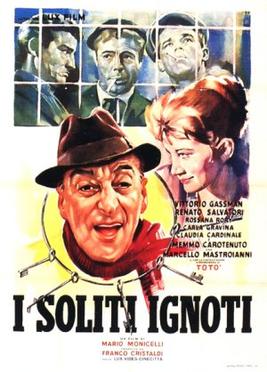
From director Jules Dassin, 1955's Rififi is maybe the perfect heist movie. It succeeds on countless levels, one better than the other, and maybe most importantly/impressively, it has impacted just about every heist flick made in the 50-plus years since it's release in one way or another. The biggest compliment a movie can make is to imitate a predecessor, and 1958's Big Deal on Madonna Street takes the basic premise of Rififi and turns it into....a spoof? Color me surprised, but it works in a big way.
A small-time crook, Cosimo (Memmo Carotenuto) is arrested while trying to steal a car, found guilty and sentenced to jail. His timing is lousy though because he quickly hears about a foolproof plan, an intricate heist that will net quite a payday. What to do though? He needs a fall guy to take the blame for his actual crime, but his partner, Capannelle (Carlo Pisacane), can't find anyone. Instead, all his candidates team to find someone else, settling on struggling boxer Peppe (Vittorio Gassman), but even that plan doesn't go according to plan, Peppe ending up in jail with Cosimo. The boxer pulls a double cross though and finds out Cossimo's plan, and now with his motley team of amateur and small-time crooks, he intends to do the job himself.
It isn't quite fair to say that this Italian film from director Mario Monicelli is a straight remake of Dassin's 1955 film, but it does bear some striking resemblances. The most obvious connection is the actual heist scene, but even that is tweaked enough to set it apart. I loved this one. It is a spoof, but not in the modern sense of a spoof like the bizarrely stupid Scary Movie series. It's a smart humor mixed in with some rather dry laughs, proving spoof doesn't equal stupid.
Maybe it's the Italian charm, but 'Madonna' has style to burn that mixes the natural drama of an involved, complicated heist with that light sense of humor. For one, I love the look of the film, shot on location in and around Rome. No matter the era, Rome has a historic, beautiful look that translates ridiculously well to film. No sets here, just real-life Rome. Composer Piero Umiliani's score is perfect, a mix of fast-moving, light-hearted jazz and quieter moments as the heist comes together. Listen to a sample HERE.And then there's the style of the story. Title cards reminiscent of a 1920s silent movie keep the story moving along, filling in holes with the story so the 106-minute run-time is never lagging. They're genuinely funny messages on the title cards, but I also like the fact that it's subtle humor. Monicelli didn't feel the need to spell out everything little thing for us. Because of the title cards, the story does take some jumps and transitions but never in a bad way. It works, trusting the audience to figure things out to a point.
The biggest spoof aspect comes from the crew of amateur crooks and low-level thieves who team up to pull off a heist. Gassman is a strong lead, the tough boxer who ends up leading his motley crew through one ridiculous trial after another. His team includes Mario (Renato Salvatori), a thief who will buy and sell anything, Norma (Rossana Rory), Cossimo's former girlfriend, Capannelle (Pisacane), the aging, bumbling thief, Ferribotte (Tiberio Murgia), the gentlemanly thief trying to protect his single sister, Carmelita (Claudia Cardinale), Tiberio (Marcello Mastroianni), a down on his luck thief caring for his son since his wife was sent to jail, and Dante (Toto), the expert and veteran safecracker. Of the group, Gassman, Salvatori, Pisacane, Murgia and Mastroianni become the stars, the little group coming together nicely as the heist comes together. Great casting, good variety, and a perfect chemistry.
While the main focus is on the heist, there are certain departures that are handled really well. They're the type of departures that normally would drive me up a wall, but for whatever reason, they work here. Most come as off-shoots of the heist, like Gassman's Peppe trying to woo Nicoletta (Carla Gravina), a maid in an apartment the crew will have to use to get at a safe. The young maid doesn't go willingly, messing with Peppe as much as he does with her. The same goes for Mario and Carmelita. Ferribotte hides his beautiful sister away so only her fiance will ever see her, but Mario falls for her at first sight. It all works together nicely, the different storylines blending well.
In the end though, this is a heist movie, spoof/comedy or not. It has influenced plenty of other films itself and has been remade twice, 1984's Crackers and 2002's Welcome to Collinwood. Up until this point, the amateur masterminds have managed to overcome any number of shortcomings, but when the actual heist comes along, one thing leads to another. Moral of the story? Nothing -- nothing at all -- goes smoothly. One issue snowballs into another. One sight gag especially stood out, catching me by surprise in the movie's biggest laugh. The whole movie is funny, but the best and biggest laughs are saved for the heist. A nearly perfect movie. I loved it. Can't recommend it enough.
Big Deal on Madonna Street (1958): *** 1/2 /****
A small-time crook, Cosimo (Memmo Carotenuto) is arrested while trying to steal a car, found guilty and sentenced to jail. His timing is lousy though because he quickly hears about a foolproof plan, an intricate heist that will net quite a payday. What to do though? He needs a fall guy to take the blame for his actual crime, but his partner, Capannelle (Carlo Pisacane), can't find anyone. Instead, all his candidates team to find someone else, settling on struggling boxer Peppe (Vittorio Gassman), but even that plan doesn't go according to plan, Peppe ending up in jail with Cosimo. The boxer pulls a double cross though and finds out Cossimo's plan, and now with his motley team of amateur and small-time crooks, he intends to do the job himself.
It isn't quite fair to say that this Italian film from director Mario Monicelli is a straight remake of Dassin's 1955 film, but it does bear some striking resemblances. The most obvious connection is the actual heist scene, but even that is tweaked enough to set it apart. I loved this one. It is a spoof, but not in the modern sense of a spoof like the bizarrely stupid Scary Movie series. It's a smart humor mixed in with some rather dry laughs, proving spoof doesn't equal stupid.
Maybe it's the Italian charm, but 'Madonna' has style to burn that mixes the natural drama of an involved, complicated heist with that light sense of humor. For one, I love the look of the film, shot on location in and around Rome. No matter the era, Rome has a historic, beautiful look that translates ridiculously well to film. No sets here, just real-life Rome. Composer Piero Umiliani's score is perfect, a mix of fast-moving, light-hearted jazz and quieter moments as the heist comes together. Listen to a sample HERE.And then there's the style of the story. Title cards reminiscent of a 1920s silent movie keep the story moving along, filling in holes with the story so the 106-minute run-time is never lagging. They're genuinely funny messages on the title cards, but I also like the fact that it's subtle humor. Monicelli didn't feel the need to spell out everything little thing for us. Because of the title cards, the story does take some jumps and transitions but never in a bad way. It works, trusting the audience to figure things out to a point.
The biggest spoof aspect comes from the crew of amateur crooks and low-level thieves who team up to pull off a heist. Gassman is a strong lead, the tough boxer who ends up leading his motley crew through one ridiculous trial after another. His team includes Mario (Renato Salvatori), a thief who will buy and sell anything, Norma (Rossana Rory), Cossimo's former girlfriend, Capannelle (Pisacane), the aging, bumbling thief, Ferribotte (Tiberio Murgia), the gentlemanly thief trying to protect his single sister, Carmelita (Claudia Cardinale), Tiberio (Marcello Mastroianni), a down on his luck thief caring for his son since his wife was sent to jail, and Dante (Toto), the expert and veteran safecracker. Of the group, Gassman, Salvatori, Pisacane, Murgia and Mastroianni become the stars, the little group coming together nicely as the heist comes together. Great casting, good variety, and a perfect chemistry.
While the main focus is on the heist, there are certain departures that are handled really well. They're the type of departures that normally would drive me up a wall, but for whatever reason, they work here. Most come as off-shoots of the heist, like Gassman's Peppe trying to woo Nicoletta (Carla Gravina), a maid in an apartment the crew will have to use to get at a safe. The young maid doesn't go willingly, messing with Peppe as much as he does with her. The same goes for Mario and Carmelita. Ferribotte hides his beautiful sister away so only her fiance will ever see her, but Mario falls for her at first sight. It all works together nicely, the different storylines blending well.
In the end though, this is a heist movie, spoof/comedy or not. It has influenced plenty of other films itself and has been remade twice, 1984's Crackers and 2002's Welcome to Collinwood. Up until this point, the amateur masterminds have managed to overcome any number of shortcomings, but when the actual heist comes along, one thing leads to another. Moral of the story? Nothing -- nothing at all -- goes smoothly. One issue snowballs into another. One sight gag especially stood out, catching me by surprise in the movie's biggest laugh. The whole movie is funny, but the best and biggest laughs are saved for the heist. A nearly perfect movie. I loved it. Can't recommend it enough.
Big Deal on Madonna Street (1958): *** 1/2 /****
Wednesday, March 6, 2013
The Last Command (1955)
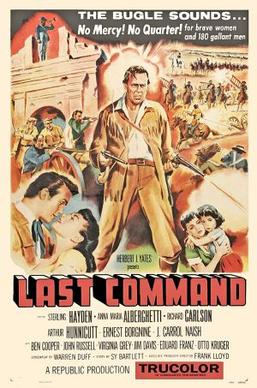
Of the three most well-known heroes of the battle of the Alamo, David Crockett, James Bowie and William Travis, there's no doubt who is the most well-known of the three. Oh, that'd be Crockett for those unfamiliar with history. In second place, the infamous knife fighter Jim Bowie who's had several films based on his exploits including 1952's The Iron Mistress (meh) and for today's review, 1955's The Last Command.
It's 1834, and knife fighter, adventurer and land owner Jim Bowie (Sterling Hayden) is riding south through Texas to Mexico to see his home and his family. As he rides through the territory though, he finds that many Texan colonists have had enough with Mexican president, Santa Anna (J. Carrol Naish), who's become more of a dictator with each passing day. Old friends with the president, Bowie isn't sure who to side with at first, but when his wife and children die, he's forced to come up with answers about what he believes and what he should ultimately do with the coming revolution. He joins the fighting, leading a group of volunteers. Santa Anna has started to march an army north from Mexico City to deal with the revolutionaries, and all roads lead to the town of San Antonio and a ruined old mission, the Alamo.
Anyone familiar with John Wayne's The Alamo from 1960 will no doubt notice some similarities between that film and this 1955 flick from Republic Studios. The reason? This was originally made with Wayne -- still working at Republic -- attached as an actor. He wanted to make an Alamo film, but disagreements with the studio drove the two sides apart. The end result was simple; Wayne left Republic, Republic made the film without Wayne, apparently out of spite. There are some similarities, from Davy Crockett's death to the Alamo defenders raiding the surrounding Mexican army for artillery and many others. The biggest difference though is obvious, a focus on Jim Bowie.
It's funny that in the casting of the infamous knife fighter, one of America's truly unique historical personalities, two of Hollywood's most wooden, vanilla actors were chosen. In 'Iron,' Alan Ladd starred, and here, Hayden takes the reins as Bowie. I'll say this. I don't think Hayden has a "showy" side, but he at least commits here and shows some energy in the lead. Just like Wayne's film would do, there is an unnecessary -- even painful -- love story as Bowie falls for Consuelo (Anna Maria Alberghetti), a young Mexican woman from a rich family (Eduard Franz plays her well-to-do uncle). Above all else, it's cool to see Bowie get a movie devoted to him and his involvement in the months leading up to and in the Texas Revolution. He was a fiery, passionate fighter who fought for what he believed in. His friendship with Santa Anna is a little much (the Mexican dictator affectionately calls him 'Jimmy'), but seeing a familiar story from an unfamiliar angle is refreshing.
Overall, the story focuses on a two-year period starting in 1834 and running through March 1836 and the battle and fall of the Alamo. The movie runs just 110-minutes and is a little slow-moving at times -- rather talky -- so non-history fans may lose some interest. Alamo buffs will get a kick out of the story though that focuses on Texas history that most Alamo movies simply ignore. We do meet some familiar faces, including Colonel Travis (Richard Carlson), Davy Crockett (Arthur Hunnicutt) and Lt. Dickinson (John Russell). Carlson is solid as the similarly fiery Travis, and Hunnicutt is a scene-stealer as the backwoods, storytelling Crockett that's based more in myth than the real-life Crockett. The story doesn't just jump right to the Alamo, but lays some ground work and background leading up to the famous battle. Also look for Ernest Borgnine as Mike Radin a rival-turned-friend of Bowie's and Ben Cooper as Jeb Lacey, a young Texan who looks up to Bowie. Other Alamo defenders include Slim Pickens, Jim Davis, Roy Roberts and Russell Simpson as the Parson.
The actual battle for the Alamo takes up about the last 40 minutes of 'Command.' The set is somewhat limited -- we basically see one corner of the mission along with the wooden palisade -- but there's something oddly cool about the set built near Bracketville, Texas (where Wayne's film was made). For a movie released in 1955, the final assault on the Alamo is surprisingly vicious and violent. Nothing graphic, but still pretty hardcore stuff for a 1950s audience. Each character gets their moment, their on-screen death with Bowie saved for last.
There's nothing hugely memorable about this 1955 Republic picture, but I like it just the same. Composer Max Steiner's score is a highlight -- give it a sample HERE -- and the Jim Bowie theme song (listen HERE) is pretty awful, but in an amazingly bad and memorable way. Lots of good actors, familiar faces and an enjoyable if unspectacular story in director Frank Lloyd's historical bio-pic. One IMDB reviewer points it out accurately. It's neither a big budget A-movie or a low-budget B-movie, but it's somewhere in between. TCM has three clips available so give them a watch at the link below.
The Last Command (1955): ***/****
It's 1834, and knife fighter, adventurer and land owner Jim Bowie (Sterling Hayden) is riding south through Texas to Mexico to see his home and his family. As he rides through the territory though, he finds that many Texan colonists have had enough with Mexican president, Santa Anna (J. Carrol Naish), who's become more of a dictator with each passing day. Old friends with the president, Bowie isn't sure who to side with at first, but when his wife and children die, he's forced to come up with answers about what he believes and what he should ultimately do with the coming revolution. He joins the fighting, leading a group of volunteers. Santa Anna has started to march an army north from Mexico City to deal with the revolutionaries, and all roads lead to the town of San Antonio and a ruined old mission, the Alamo.
Anyone familiar with John Wayne's The Alamo from 1960 will no doubt notice some similarities between that film and this 1955 flick from Republic Studios. The reason? This was originally made with Wayne -- still working at Republic -- attached as an actor. He wanted to make an Alamo film, but disagreements with the studio drove the two sides apart. The end result was simple; Wayne left Republic, Republic made the film without Wayne, apparently out of spite. There are some similarities, from Davy Crockett's death to the Alamo defenders raiding the surrounding Mexican army for artillery and many others. The biggest difference though is obvious, a focus on Jim Bowie.
It's funny that in the casting of the infamous knife fighter, one of America's truly unique historical personalities, two of Hollywood's most wooden, vanilla actors were chosen. In 'Iron,' Alan Ladd starred, and here, Hayden takes the reins as Bowie. I'll say this. I don't think Hayden has a "showy" side, but he at least commits here and shows some energy in the lead. Just like Wayne's film would do, there is an unnecessary -- even painful -- love story as Bowie falls for Consuelo (Anna Maria Alberghetti), a young Mexican woman from a rich family (Eduard Franz plays her well-to-do uncle). Above all else, it's cool to see Bowie get a movie devoted to him and his involvement in the months leading up to and in the Texas Revolution. He was a fiery, passionate fighter who fought for what he believed in. His friendship with Santa Anna is a little much (the Mexican dictator affectionately calls him 'Jimmy'), but seeing a familiar story from an unfamiliar angle is refreshing.
Overall, the story focuses on a two-year period starting in 1834 and running through March 1836 and the battle and fall of the Alamo. The movie runs just 110-minutes and is a little slow-moving at times -- rather talky -- so non-history fans may lose some interest. Alamo buffs will get a kick out of the story though that focuses on Texas history that most Alamo movies simply ignore. We do meet some familiar faces, including Colonel Travis (Richard Carlson), Davy Crockett (Arthur Hunnicutt) and Lt. Dickinson (John Russell). Carlson is solid as the similarly fiery Travis, and Hunnicutt is a scene-stealer as the backwoods, storytelling Crockett that's based more in myth than the real-life Crockett. The story doesn't just jump right to the Alamo, but lays some ground work and background leading up to the famous battle. Also look for Ernest Borgnine as Mike Radin a rival-turned-friend of Bowie's and Ben Cooper as Jeb Lacey, a young Texan who looks up to Bowie. Other Alamo defenders include Slim Pickens, Jim Davis, Roy Roberts and Russell Simpson as the Parson.
The actual battle for the Alamo takes up about the last 40 minutes of 'Command.' The set is somewhat limited -- we basically see one corner of the mission along with the wooden palisade -- but there's something oddly cool about the set built near Bracketville, Texas (where Wayne's film was made). For a movie released in 1955, the final assault on the Alamo is surprisingly vicious and violent. Nothing graphic, but still pretty hardcore stuff for a 1950s audience. Each character gets their moment, their on-screen death with Bowie saved for last.
There's nothing hugely memorable about this 1955 Republic picture, but I like it just the same. Composer Max Steiner's score is a highlight -- give it a sample HERE -- and the Jim Bowie theme song (listen HERE) is pretty awful, but in an amazingly bad and memorable way. Lots of good actors, familiar faces and an enjoyable if unspectacular story in director Frank Lloyd's historical bio-pic. One IMDB reviewer points it out accurately. It's neither a big budget A-movie or a low-budget B-movie, but it's somewhere in between. TCM has three clips available so give them a watch at the link below.
The Last Command (1955): ***/****
Tuesday, March 5, 2013
Can't Hardly Wait
With movies like Ferris Bueller, 16 Candles, Pretty in Pink, and The Breakfast Club, director John Hughes opened the door for a new wave of comedies in the 1980s, a new sub-genre that is still alive and kicking 30 years later; the teenage comedy (now adjusted to the teen sex comedy). New variations and developments keep on changing the teen comedy, but one of the best is 1998's Can't Hardly Wait, almost a tribute to Hughes' films.
It's graduation day at Huntington High School. With summer and college ahead of all the graduates, the senior class has one more party together, an epic house party with ample amounts of booze. With one last shot to accomplish what they want, many grads go into the party with an objective. Smart everyman Preston (Ethan Embry) wants to profess his love for Amanda Beckett (Jennifer Love Hewitt), the school's hottest girl and recently dumped by star athlete Mike Dexter (Peter Facinelli). A class nerd, William (Charlie Korsmo) hopes to humiliate Mike for years of torture and abuse while Kenny (Seth Green) simply wants to get some action. All sorts of hijinks and shenanigans are on the docket, and no one is immune from some trouble.
A formula for a successful teen-high school-epic party movie is simple; is it real? Is it even remotely similar to what high school is actually like? 'Wait' passes with flying colors. Sure, some things are exaggerated a titch here and there (gotta get those laughs), but directors/screenwriters Harry Elfont and Deborah Kaplan get it right. For most of us, high school was an extremely awkward, uncomfortable time. So when I say a successful teen comedy is 'real,' that's what I mean. Much of the laughs come from the natural awkwardness resulting from 17 and 18-year old teenagers trying to figure out who they are. Throw in a late 1990s soundtrack -- hello Smash Mouth!!!! -- with an interesting camera technique, and you've got a winner!
Stereotypes and cliches are based in the truth, right? Right??? The answer is 'Yes' if you were confused. 'Wait' runs with that thought, following a handful of characters that every high school has. Embry does a good job as Preston, the normal kid who is shooting for the stars with his crush, the hottest girl in school, Love Hewitt an ideal choice for the part. Facinelli is perfectly cast as Mike, the jock and coolest guy in school who can't wait to get to college and keep on partying. Wise choice in the script, Mike is humanized late -- however briefly -- before resorting back to his usual jock antics in the finale. Another key character is Lauren Ambrose's Denise, Preston's friend who is the necessary cute but antisocial girl who resents just about everything and everyone at school.
As good as all those parts/characters are, two parts stand out from the rest, Green as Kenny and Korsmo as William. Their characters? Green as the white guy trying for all he's worth to be a black guy, and Korsmo as the nerd who becomes a class hero at the party. Both parts are movie-stealers, both memorable in their own way. A rising star, Green hams it up like nobody's business as Kenny, a normal kid growing up who decides he wants to be a black guy. He treads that fine line between funny and offensive, but because he's so epically over the top in his mannerisms, it works perfectly. In his last role before leaving acting, Korsmo is a scream. His William so desperately wants revenge, but then he starts drinking.....and becomes popular, the life of the party. His two fellow nerds -- Joel Michaely and Jay Paulson -- have some very funny moments too as they wait too unleash William's plan.
Beyond those main characters, 'Wait' is noteworthy for its supporting cast from key parts to bit parts that only make an appearance or two. Jenna Elfman plays the Angel, a dancer, not a stripper, who Preston meets during his night travels. Jerry O'Connell is Trip, the former high school star returned in all his "glory." Melissa Joan Hart plays Yearbook Girl, the senior who wants every senior in school to sign her yearbook. Breckin Meyer and Donald Faison play bickering members of the party band. Not enough? Look out for Freddy Rodriguez, Erik Palladino, Jaime Pressly, Chris Owen (Sherminator from American Pie), Jason Segel, Selma Blair, Clea DuVall, Eric Balfour and even Hollywood veteran Reni Santoni.
So with all those characters, how does the movie do them all justice in a movie that's just 101 minutes? With a few quick departures, the entire story is contained at the house party. Episodic doesn't begin to describe the storytelling technique. Some dissenters complain about the frenetic pacing that jumps around like a story on steroids. For me, it worked really well. It never focuses on one character for too long, keeping tabs on all the characters and storylines as the party develops. They criss-cross and interact, one character and story affecting each other.
It's a gem of a movie. It's got a style that never tries too hard but does enough to set itself apart from the pack. Character title cards introduce all the main players, giving us an idea in an instant who these people are. The cards are black and white, like a mug shot, and it works well. It's the type of comedic movie where all the characters get a wrap-up comment, a couple sentences appearing on-screen telling us where everyone ends up. Almost a tribute to the 1980s John Hughes comedies, 'Wait' is a gem on its own. Definitely check it out.
Can't Hardly Wait (1998): ***/****
It's graduation day at Huntington High School. With summer and college ahead of all the graduates, the senior class has one more party together, an epic house party with ample amounts of booze. With one last shot to accomplish what they want, many grads go into the party with an objective. Smart everyman Preston (Ethan Embry) wants to profess his love for Amanda Beckett (Jennifer Love Hewitt), the school's hottest girl and recently dumped by star athlete Mike Dexter (Peter Facinelli). A class nerd, William (Charlie Korsmo) hopes to humiliate Mike for years of torture and abuse while Kenny (Seth Green) simply wants to get some action. All sorts of hijinks and shenanigans are on the docket, and no one is immune from some trouble.
A formula for a successful teen-high school-epic party movie is simple; is it real? Is it even remotely similar to what high school is actually like? 'Wait' passes with flying colors. Sure, some things are exaggerated a titch here and there (gotta get those laughs), but directors/screenwriters Harry Elfont and Deborah Kaplan get it right. For most of us, high school was an extremely awkward, uncomfortable time. So when I say a successful teen comedy is 'real,' that's what I mean. Much of the laughs come from the natural awkwardness resulting from 17 and 18-year old teenagers trying to figure out who they are. Throw in a late 1990s soundtrack -- hello Smash Mouth!!!! -- with an interesting camera technique, and you've got a winner!
Stereotypes and cliches are based in the truth, right? Right??? The answer is 'Yes' if you were confused. 'Wait' runs with that thought, following a handful of characters that every high school has. Embry does a good job as Preston, the normal kid who is shooting for the stars with his crush, the hottest girl in school, Love Hewitt an ideal choice for the part. Facinelli is perfectly cast as Mike, the jock and coolest guy in school who can't wait to get to college and keep on partying. Wise choice in the script, Mike is humanized late -- however briefly -- before resorting back to his usual jock antics in the finale. Another key character is Lauren Ambrose's Denise, Preston's friend who is the necessary cute but antisocial girl who resents just about everything and everyone at school.
As good as all those parts/characters are, two parts stand out from the rest, Green as Kenny and Korsmo as William. Their characters? Green as the white guy trying for all he's worth to be a black guy, and Korsmo as the nerd who becomes a class hero at the party. Both parts are movie-stealers, both memorable in their own way. A rising star, Green hams it up like nobody's business as Kenny, a normal kid growing up who decides he wants to be a black guy. He treads that fine line between funny and offensive, but because he's so epically over the top in his mannerisms, it works perfectly. In his last role before leaving acting, Korsmo is a scream. His William so desperately wants revenge, but then he starts drinking.....and becomes popular, the life of the party. His two fellow nerds -- Joel Michaely and Jay Paulson -- have some very funny moments too as they wait too unleash William's plan.
Beyond those main characters, 'Wait' is noteworthy for its supporting cast from key parts to bit parts that only make an appearance or two. Jenna Elfman plays the Angel, a dancer, not a stripper, who Preston meets during his night travels. Jerry O'Connell is Trip, the former high school star returned in all his "glory." Melissa Joan Hart plays Yearbook Girl, the senior who wants every senior in school to sign her yearbook. Breckin Meyer and Donald Faison play bickering members of the party band. Not enough? Look out for Freddy Rodriguez, Erik Palladino, Jaime Pressly, Chris Owen (Sherminator from American Pie), Jason Segel, Selma Blair, Clea DuVall, Eric Balfour and even Hollywood veteran Reni Santoni.
So with all those characters, how does the movie do them all justice in a movie that's just 101 minutes? With a few quick departures, the entire story is contained at the house party. Episodic doesn't begin to describe the storytelling technique. Some dissenters complain about the frenetic pacing that jumps around like a story on steroids. For me, it worked really well. It never focuses on one character for too long, keeping tabs on all the characters and storylines as the party develops. They criss-cross and interact, one character and story affecting each other.
It's a gem of a movie. It's got a style that never tries too hard but does enough to set itself apart from the pack. Character title cards introduce all the main players, giving us an idea in an instant who these people are. The cards are black and white, like a mug shot, and it works well. It's the type of comedic movie where all the characters get a wrap-up comment, a couple sentences appearing on-screen telling us where everyone ends up. Almost a tribute to the 1980s John Hughes comedies, 'Wait' is a gem on its own. Definitely check it out.
Can't Hardly Wait (1998): ***/****
Sunday, March 3, 2013
Lost in America
Albert Brooks is a smart, funny guy. He's a writer, director, actor, comedian and producer, but there's one thing he ain't, and that's Hollywood. He goes years without acting, without making a movie, and he makes films and projects that he is interested in and wants to do. Take 1985's Lost in America, a comedy that grossed $10 million upon its release but has become a cult classic in the 20-plus years since.
Living in Los Angeles with his wife, Linda (Julie Hagerty), 30-something David Howard (Brooks) is living a pretty decent life. He's got a good job at an advertising company, is ready to buy a new house with Linda, and is confident he's about to get a well-deserved promotion and raise. Well, sort of. He is being reassigned to the New York office, and to be honest, David wants nothing to do with it, especially when he finds out a less-qualified co-worker received the promotion. He freaks out and is fired, but it's not all bad. With a nice little nest egg to their name, David convinces Linda to quit her job as they undertake a new adventure; RVing across the country at their own speed, the American dream. Well, that's David's plan at least. Almost immediately, things start to go poorly. Is the couple's dream going up in smoke?
This is an odd comedy to review, and I think 'odd' in a good way. It reminded me of some other classic comedies -- think combination of The Out-of-Towners and National Lampoon's Vacation -- but it's also very much it's own movie. For lack of a better, more specific description, it is a different road movie. At various points in the story, 'Lost' takes some almost bizarre turns. The tone is darkly funny, but there's also that part that is just....well, dark. If anything, I thought it was a little short at just 91 minutes. A whole lot of ground is covered in that somewhat short run-time, but there was a lot of potential for more. Maybe it's just because I liked the movie a lot and wanted to see more, but it felt like the movie was over far too quickly.
Much -- if not all I suppose -- of that intensely dark humor is from star-director-writer Albert Brooks at the helm of just about everything. His humor is different, no doubt about that. It is far from obvious and usually hinges on an audience appreciating his line deliveries or his facial reactions. His humor and laughs are both subtle and underplayed and big and aggressive, but they work both ways. How is that? A really subtle delivery, like his epically perfect scene with casino boss Garry Marshall, could not have been done any better. At the other end of the spectrum is the scene where David is reassigned and flips out. It's not a quiet, subtle response, but instead an explosion. It works though because it isn't aggressively loud. It's a smart explosion. Not Vince Vaughn ranting, but a controlled burn instead.
Playing longtime spouses, Brooks and Hagerty play off each other well. There is a believable, and more importantly, likable charm between the two actors. At different points, you want to slap both of them for their interactions and actions, but through all the craziness, they come across as a believable couple. Hagerty is nice incarnate, her Linda making one crucial mistake as the couple heads out on the road, Brooks' David responding in volcano-like, fireworks diatribes. Marshall's quick appearance is a highlight while Art Frankel has a small but memorable part as an Employment agent who sits down with David late in the movie.
Sometimes the best comedy is the worst comedy. In other words, when the worst possible thing happens...it's damn funny. So picture this...a successful married couple leaves their stable lives behind to pursue an American dream of sorts. Surprising when it doesn't go according to plan (at all)? Nope, and that's where this Brooks-directed comedy rises above the rest. One thing after another gets thrown at the Howards to the point it becomes surreal. Brooks has a knack for making movies -- not just in the humor department -- and uses his camera in interesting ways that include long tracking shots and some perfectly edited cuts, including one that has the movie's funniest reveal late. The ending comes together quickly, but it works. The whole movie does. I just wish it had been a little longer.
Lost in America (1985): ***/****
Living in Los Angeles with his wife, Linda (Julie Hagerty), 30-something David Howard (Brooks) is living a pretty decent life. He's got a good job at an advertising company, is ready to buy a new house with Linda, and is confident he's about to get a well-deserved promotion and raise. Well, sort of. He is being reassigned to the New York office, and to be honest, David wants nothing to do with it, especially when he finds out a less-qualified co-worker received the promotion. He freaks out and is fired, but it's not all bad. With a nice little nest egg to their name, David convinces Linda to quit her job as they undertake a new adventure; RVing across the country at their own speed, the American dream. Well, that's David's plan at least. Almost immediately, things start to go poorly. Is the couple's dream going up in smoke?
This is an odd comedy to review, and I think 'odd' in a good way. It reminded me of some other classic comedies -- think combination of The Out-of-Towners and National Lampoon's Vacation -- but it's also very much it's own movie. For lack of a better, more specific description, it is a different road movie. At various points in the story, 'Lost' takes some almost bizarre turns. The tone is darkly funny, but there's also that part that is just....well, dark. If anything, I thought it was a little short at just 91 minutes. A whole lot of ground is covered in that somewhat short run-time, but there was a lot of potential for more. Maybe it's just because I liked the movie a lot and wanted to see more, but it felt like the movie was over far too quickly.
Much -- if not all I suppose -- of that intensely dark humor is from star-director-writer Albert Brooks at the helm of just about everything. His humor is different, no doubt about that. It is far from obvious and usually hinges on an audience appreciating his line deliveries or his facial reactions. His humor and laughs are both subtle and underplayed and big and aggressive, but they work both ways. How is that? A really subtle delivery, like his epically perfect scene with casino boss Garry Marshall, could not have been done any better. At the other end of the spectrum is the scene where David is reassigned and flips out. It's not a quiet, subtle response, but instead an explosion. It works though because it isn't aggressively loud. It's a smart explosion. Not Vince Vaughn ranting, but a controlled burn instead.
Playing longtime spouses, Brooks and Hagerty play off each other well. There is a believable, and more importantly, likable charm between the two actors. At different points, you want to slap both of them for their interactions and actions, but through all the craziness, they come across as a believable couple. Hagerty is nice incarnate, her Linda making one crucial mistake as the couple heads out on the road, Brooks' David responding in volcano-like, fireworks diatribes. Marshall's quick appearance is a highlight while Art Frankel has a small but memorable part as an Employment agent who sits down with David late in the movie.
Sometimes the best comedy is the worst comedy. In other words, when the worst possible thing happens...it's damn funny. So picture this...a successful married couple leaves their stable lives behind to pursue an American dream of sorts. Surprising when it doesn't go according to plan (at all)? Nope, and that's where this Brooks-directed comedy rises above the rest. One thing after another gets thrown at the Howards to the point it becomes surreal. Brooks has a knack for making movies -- not just in the humor department -- and uses his camera in interesting ways that include long tracking shots and some perfectly edited cuts, including one that has the movie's funniest reveal late. The ending comes together quickly, but it works. The whole movie does. I just wish it had been a little longer.
Lost in America (1985): ***/****
Saturday, March 2, 2013
The Stand at Apache River
One of the perks of a B-movie is the scale, or more importantly the lack of scale. A smaller budget and a smaller cast keep things on the personal level. Take 1953's The Stand at Apache River, set in the midst of an Apache uprising. We never get a sense of a bigger picture, the murder, mayhem and rampaging, just how a small group of people are affected by it. Simple, right?
Riding far into the desert, Sheriff Lane Dakota (Stephen McNally) is in pursuit of a believed killer, Greiner (Russell Johnson). Greiner stumbles into an Apache ambush and is wounded, but ultimately rescued by Dakota who gets his wounded fugitive to safety at a river crossing outpost at Apache River. They arrive at the same time as a stagecoach arrives full of passengers, but the timing couldn't have been worse. An Apache chief, Cara Blanca (Edgar Barrier), has led over 90 warriors off the reservation, and before Dakota can lead everyone away, the war party is across the river. Now what to do? Dakota must look out for how to get out with his prisoner, but he's also got to keep an eye on a beautiful young woman (Julie Adams) who's also trapped. Can he figure out a plan in time?
This is a prime example of what a B-western is at its most basic makeup. For the most part, that's a good thing. From director Lee Sholem, 'Stand' doesn't even break the 80-minute mark, clocking in at just 77 minutes. It only has nine speaking parts, and after the early intro at the desert ambush, the entire movie is based at the two-story adobe river outpost. In that sense, it reminds me a lot of what a western could be if it was based off a stage play. The outpost becomes its own character, long, windy halls, poorly lit, giving a good backdrop to the developing Apache uprising.
The not-so-good part of the B-movie angle is that the cast isn't eye-popping or especially noteworthy in any sense. McNally is okay as the necessary heroic sheriff, but I've never been a huge fan. He yells and glares more than anything, leaving something to be desired as Dakota. Julie Adams is Julie Adams, very pretty, decent actress. Her and co-star Jaclynne Greene always manage to have immaculate hair and dresses in the desert too, go figure. Greene is pretty good as a married woman seeking survival with whoever will offer it, including outpost employee, Hatcher (Jack Kelly). Hugh Marlowe is given a good part too as Colonel Morsby, a veteran cavalry officer who doesn't trust anything about the Apaches, Hugh O'Brian is Greene's late-arriving husband, Johnson (later the Professor on Gilligan's Island) has a surprising dark turn, and Forrest Lewis is Deadhorse, the grizzled stagecoach driver.
So while it lacks any real star power, 'Stand' does a good job giving us a variety of characters and as a jumping-off point from there, how that variety of characters reacts in such a hellish, basically suicidal situation. I'm slowly changing my stance on this thought, but I've always figured 1950s westerns had a whitewashed sense to them. This is a surprisingly dark western, especially for one released in 1953. In this isolated desert outpost, we see growing conflicts, disagreements and hatred among our group of survivors. It feels real, not forced. If 90 Apache warriors were surrounding you and ready to attack at any moment, you'd be a little upset, wouldn't you?
Even at just 77 minutes, 'Stand' struggles to keep up its momentum. The Apaches have a few attacks on the outpost, but they never seem in any real rush to full-out attack. Not surprisingly, the attacks are the best part of the flick, quick and hard-hitting, there's just not enough of them. The ever-constant talking gets to be a little too much, and as dark as the ending is, the story taps the brakes in the final scene, providing an oh-so-sweet ending that is unnecessary and forced. Decent B-western with some positives and negatives, just enough more positives to recommend this one.
The Stand at Apache River (1953): ** 1/2 /****
Riding far into the desert, Sheriff Lane Dakota (Stephen McNally) is in pursuit of a believed killer, Greiner (Russell Johnson). Greiner stumbles into an Apache ambush and is wounded, but ultimately rescued by Dakota who gets his wounded fugitive to safety at a river crossing outpost at Apache River. They arrive at the same time as a stagecoach arrives full of passengers, but the timing couldn't have been worse. An Apache chief, Cara Blanca (Edgar Barrier), has led over 90 warriors off the reservation, and before Dakota can lead everyone away, the war party is across the river. Now what to do? Dakota must look out for how to get out with his prisoner, but he's also got to keep an eye on a beautiful young woman (Julie Adams) who's also trapped. Can he figure out a plan in time?
This is a prime example of what a B-western is at its most basic makeup. For the most part, that's a good thing. From director Lee Sholem, 'Stand' doesn't even break the 80-minute mark, clocking in at just 77 minutes. It only has nine speaking parts, and after the early intro at the desert ambush, the entire movie is based at the two-story adobe river outpost. In that sense, it reminds me a lot of what a western could be if it was based off a stage play. The outpost becomes its own character, long, windy halls, poorly lit, giving a good backdrop to the developing Apache uprising.
The not-so-good part of the B-movie angle is that the cast isn't eye-popping or especially noteworthy in any sense. McNally is okay as the necessary heroic sheriff, but I've never been a huge fan. He yells and glares more than anything, leaving something to be desired as Dakota. Julie Adams is Julie Adams, very pretty, decent actress. Her and co-star Jaclynne Greene always manage to have immaculate hair and dresses in the desert too, go figure. Greene is pretty good as a married woman seeking survival with whoever will offer it, including outpost employee, Hatcher (Jack Kelly). Hugh Marlowe is given a good part too as Colonel Morsby, a veteran cavalry officer who doesn't trust anything about the Apaches, Hugh O'Brian is Greene's late-arriving husband, Johnson (later the Professor on Gilligan's Island) has a surprising dark turn, and Forrest Lewis is Deadhorse, the grizzled stagecoach driver.
So while it lacks any real star power, 'Stand' does a good job giving us a variety of characters and as a jumping-off point from there, how that variety of characters reacts in such a hellish, basically suicidal situation. I'm slowly changing my stance on this thought, but I've always figured 1950s westerns had a whitewashed sense to them. This is a surprisingly dark western, especially for one released in 1953. In this isolated desert outpost, we see growing conflicts, disagreements and hatred among our group of survivors. It feels real, not forced. If 90 Apache warriors were surrounding you and ready to attack at any moment, you'd be a little upset, wouldn't you?
Even at just 77 minutes, 'Stand' struggles to keep up its momentum. The Apaches have a few attacks on the outpost, but they never seem in any real rush to full-out attack. Not surprisingly, the attacks are the best part of the flick, quick and hard-hitting, there's just not enough of them. The ever-constant talking gets to be a little too much, and as dark as the ending is, the story taps the brakes in the final scene, providing an oh-so-sweet ending that is unnecessary and forced. Decent B-western with some positives and negatives, just enough more positives to recommend this one.
The Stand at Apache River (1953): ** 1/2 /****
Labels:
1950s,
Hugh Marlowe,
Hugh O'Brian,
Jack Kelly,
Julie Adams,
Stephen McNally,
westerns
Friday, March 1, 2013
The Return of Frank James
Late last June, I reviewed 1939's Jesse James, a generally inaccurate, sometimes dull western detailing the life of the infamous outlaw. It played fast and loose with the facts, turning James into a hero more than he probably really was. A bright spot though was Henry Fonda in a small, underused part as Jesse's brother, Frank. Just a year later, Fonda returned with his own movie, 1940's The Return of Frank James.
After the botched Northfield, Minnesota raid, outlaw Frank James (Fonda) leaves the remnant of his brother's gang behind, setting up an alias as a poor farmer. With some help from a youngster, Clem (Jackie Cooper), and a freed slave, Pinky (Ernest Whitman), Frank has managed to hide his identity, leaving his outlaw past behind him. One day though on the farm, he hears that his brother, Jesse, has been murdered, and that his killers, Bob (John Carradine) and Charlie (Charles Tannen) Ford (former members of the James gang), have been found guilty but released from any sentence. Balancing out his desire to leave his violent past behind while still looking to avenge his brother's murder, Frank straps his gunbelt back on and hits the trail in search of the Ford brothers.
There just wasn't much going for the 1939 western that set this sequel up. Tyrone Powers was acceptable as Jesse, but the movie itself lacked any sort of excitement or punch. The sequel is slightly more entertaining for one simple reason, and that's Henry Fonda. He played Frank in the 1939 western, but it is such a small, almost insignificant part that it was a wasted effort. If for nothing else, this sequel is worthwhile to see Fonda -- always the pro -- get an expanded, meatier part. He would later go on to star in westerns like Fort Apache, Once Upon a Time in the West, The Ox-Bow Incident, My Darling Clementine, but this was his first major role in a western. In a movie slightly better than its predecessor, Fonda is the best thing here by far.
In his mid 30s when he made 'Return,' Fonda reflects a lot of what a western hero (in this case anti-hero) should be. Yes, Frank James was an outlaw who's made to look like an immaculate saint here, but he has an ease on-screen that few actors do. He does it so well it doesn't even look like he's trying too hard, but it's there. Like the gentlemanly, serious Wyatt Earp in 'Clementine,' there is a quiet confidence about Fonda's Frank James. He seeks revenge, but he isn't obsessed by it. He has some morals, some ethics, and it is those things that help make it a more interesting character. I especially liked his relationship with young Clem (Cooper does a fine job), almost a big brother-little brother dynamic as they head out on the trail for those murdering Ford boys. It is a 1940 western so it's not real dark, but we at least get to see some of the turmoil brewing in Frank during his hunt.
Beyond Mr. Fonda, there is little star power here. Gene Tierney makes her screen debut as Eleanor Stone, a young woman trying to make it as a newspaper reporter who meets Frank under some odd circumstances....and gets a story in the process (sort of). Henry Hull returns from the original as bombastic, loud, and obnoxious newspaper man Major Rufus Cobb, defender of the downtrodden....and outlaws. Other than that? Not much. Some unintentionally hilarious bad guys, some angelic good guys, and that's it. Carradine is wasted as Jesse James' murderer, Bob Ford, appearing a couple times but mostly spending his screentime on the run.
Clocking in at just 92 minutes, 'Return' isn't around long enough to overstay its welcome. It's inoffensive and doesn't really add anything new to the western genre, but for the first 60 minutes, I was liking it a lot. The look of the movie in odd tinted color is oddly appropriate, and the scale is pretty impressive considering its quickish run-time. It's good, old-fashioned western storytelling at its best. Then, in the final 32 minutes, the story bogs down in Frank's trial as he tries to clear his name. Odd bits of humor, far too much talking, and a complete halt to the story in this disappointing finale for director Fritz Lang's film. The showdown between Frank and Carradine's Bob is a decent last fight, but like the rest of the movie, it's missing that special something. Historical accuracy aside, it's not a bad western, but it's not anything more than good either.
The Return of Frank James (1940): ** 1/2 /****
After the botched Northfield, Minnesota raid, outlaw Frank James (Fonda) leaves the remnant of his brother's gang behind, setting up an alias as a poor farmer. With some help from a youngster, Clem (Jackie Cooper), and a freed slave, Pinky (Ernest Whitman), Frank has managed to hide his identity, leaving his outlaw past behind him. One day though on the farm, he hears that his brother, Jesse, has been murdered, and that his killers, Bob (John Carradine) and Charlie (Charles Tannen) Ford (former members of the James gang), have been found guilty but released from any sentence. Balancing out his desire to leave his violent past behind while still looking to avenge his brother's murder, Frank straps his gunbelt back on and hits the trail in search of the Ford brothers.
There just wasn't much going for the 1939 western that set this sequel up. Tyrone Powers was acceptable as Jesse, but the movie itself lacked any sort of excitement or punch. The sequel is slightly more entertaining for one simple reason, and that's Henry Fonda. He played Frank in the 1939 western, but it is such a small, almost insignificant part that it was a wasted effort. If for nothing else, this sequel is worthwhile to see Fonda -- always the pro -- get an expanded, meatier part. He would later go on to star in westerns like Fort Apache, Once Upon a Time in the West, The Ox-Bow Incident, My Darling Clementine, but this was his first major role in a western. In a movie slightly better than its predecessor, Fonda is the best thing here by far.
In his mid 30s when he made 'Return,' Fonda reflects a lot of what a western hero (in this case anti-hero) should be. Yes, Frank James was an outlaw who's made to look like an immaculate saint here, but he has an ease on-screen that few actors do. He does it so well it doesn't even look like he's trying too hard, but it's there. Like the gentlemanly, serious Wyatt Earp in 'Clementine,' there is a quiet confidence about Fonda's Frank James. He seeks revenge, but he isn't obsessed by it. He has some morals, some ethics, and it is those things that help make it a more interesting character. I especially liked his relationship with young Clem (Cooper does a fine job), almost a big brother-little brother dynamic as they head out on the trail for those murdering Ford boys. It is a 1940 western so it's not real dark, but we at least get to see some of the turmoil brewing in Frank during his hunt.
Beyond Mr. Fonda, there is little star power here. Gene Tierney makes her screen debut as Eleanor Stone, a young woman trying to make it as a newspaper reporter who meets Frank under some odd circumstances....and gets a story in the process (sort of). Henry Hull returns from the original as bombastic, loud, and obnoxious newspaper man Major Rufus Cobb, defender of the downtrodden....and outlaws. Other than that? Not much. Some unintentionally hilarious bad guys, some angelic good guys, and that's it. Carradine is wasted as Jesse James' murderer, Bob Ford, appearing a couple times but mostly spending his screentime on the run.
Clocking in at just 92 minutes, 'Return' isn't around long enough to overstay its welcome. It's inoffensive and doesn't really add anything new to the western genre, but for the first 60 minutes, I was liking it a lot. The look of the movie in odd tinted color is oddly appropriate, and the scale is pretty impressive considering its quickish run-time. It's good, old-fashioned western storytelling at its best. Then, in the final 32 minutes, the story bogs down in Frank's trial as he tries to clear his name. Odd bits of humor, far too much talking, and a complete halt to the story in this disappointing finale for director Fritz Lang's film. The showdown between Frank and Carradine's Bob is a decent last fight, but like the rest of the movie, it's missing that special something. Historical accuracy aside, it's not a bad western, but it's not anything more than good either.
The Return of Frank James (1940): ** 1/2 /****
Labels:
1940s,
Fritz Lang,
Gene Tierney,
Henry Fonda,
Henry Hull,
John Carradine,
westerns
Thursday, February 28, 2013
Wall Street: Money Never Sleeps
One of the more iconic movies to come out of the 1980s, 1987's Wall Street is memorable because of star Michael Douglas and his infamous line, "Greed is good." The movie itself is pretty good, and 23 years after its release, director Oliver Stone decided to return to his iconic character and continue the story with 2010's Wall Street: Money Never Sleeps.
After spending 13 years in jail for insider training and securities fraud, Gordon Gekko (Douglas) is finally given his parole. Some seven years pass, and now he's promoting his new book 'Is Greed Good?' when he meets a young stock broker, Jake Moore (Shia LaBeouf), who is engaged to Gordon's estranged daughter, Winnie (Carey Mulligan). Gordon wants to form a relationship with a daughter who might as well consider him dead. At the same time, Gordon begins to help Jake, a talented, intelligent broker in his own right, as he starts a new job with a high-level firm broker, Bretton James (Josh Brolin), who has rubbed plenty of people the wrong way in his rise to power. With millions and billions of dollars on the line and the massive egos to boot, an epic confrontation looms, but the struggling economy may have the last laugh over everyone involved.
For starters, let's get this somewhat obvious statement out of the way. Like just about any sequel ever, this is basically the definition of unnecessary. Why go back to a movie from 23 years ago and revisit a character -- however iconic -- and story that didn't need revisiting? Oh...the sequel made $130 million in theaters? I suppose that's as good a reason as any. Well, in business at least. Other than the epic economic issues of the last 10 years, there's no real reason to make this sequel. That said, it's not bad. The biggest thing working in positive fashion is the acting. The story lacks a bit of punch -- it's missing something in the energy department -- but I liked it just the same. Unnecessary? Oh, you betcha, but you could do worse.
I like movies, sports, reading. I can B.S. my way through a fair share of conversations. The financial crisis of 2008 is most definitely not one of those things. I have a very basic knowledge of the economic collapse that this sequel goes into in depth, but I'm far from an expert. In other words, some background and/or understanding in big money, Wall Street, stocks, and everything financial will no doubt help your enjoyment of this flick. Because my knowledge of the subject material is limited, I wasn't always crystal clear on what was going on. I still liked it, but it's an issue just the same. End of sidenote.
Without question, the best thing going for Stone's sequel is the return of Michael Douglas as Gordon Gekko. His introduction is perfect, Gekko getting his parole and being released from prison after serving 13 total years in jail. We see him get his possessions back from a suit to a watch to a rather massive cell phone. The message is clear; times have changed, and Gordon is a dinosaur who has to adjust with the times. I think Stone makes an incredibly wise choice. For much of the movie, Gekko is a secondary -- if incredibly important secondary -- character that fleets in and out of the story as needed. Any scene with Douglas in it is worth watching, his appearances bringing the entire movie up a notch just by being there. He makes the others around him better. The new movie itself is unnecessary, but Douglas's appearance makes it worthwhile.
The rest of the cast is solid if unspectacular. It seems no matter the movie, LaBeouf takes grief for any number of things -- wooden acting, bad acting, off-screen antics -- but as long as he's not in loud, obnoxious, and obvious Transformers mode, I like him. It isn't a flashy part (that is left to Douglas, nailing it in subtle fashion), but LaBeouf's Jake is the main character, and for me, an interesting one. Mulligan too is pretty good as Winnie, Gordon's estranged daughter who wants nothing to do with her father. Behind Douglas, I thought the best part was from Brolin as the Wall Street rival with some ulterior motives. Frank Langella is a scene-stealer as well as Louis Zabel, Jake's aging mentor who hates what Wall Street is becoming, Susan Sarandon plays Jake's mom who's heavily invested in real estate, Eli Wallach as a Wall Street dinosaur, and Jason Clarke as the NYC Fed chief. Not necessarily great performances, but it's fun to see all those names assembled.
This 2010 sequel is missing that special something from making it an above-average, truly enjoyable flick. It's good enough, but it's never more than that. Clocking in at 138 minutes, it feels incredibly long in certain stretches. Lots of dialogue isn't a bad thing, but at times, it gets a little tedious, a little slow. Douglas certainly helps the momentum pick up a bit, especially late when we see the Gekko we all love to hate. Charlie Sheen even makes a cameo as Bud Fox, the protagonist in the original Wall Street. I liked this one, didn't love it. Not bad stuff.
Wall Street: Money Never Sleeps (2010): ** 1/2 /****
After spending 13 years in jail for insider training and securities fraud, Gordon Gekko (Douglas) is finally given his parole. Some seven years pass, and now he's promoting his new book 'Is Greed Good?' when he meets a young stock broker, Jake Moore (Shia LaBeouf), who is engaged to Gordon's estranged daughter, Winnie (Carey Mulligan). Gordon wants to form a relationship with a daughter who might as well consider him dead. At the same time, Gordon begins to help Jake, a talented, intelligent broker in his own right, as he starts a new job with a high-level firm broker, Bretton James (Josh Brolin), who has rubbed plenty of people the wrong way in his rise to power. With millions and billions of dollars on the line and the massive egos to boot, an epic confrontation looms, but the struggling economy may have the last laugh over everyone involved.
For starters, let's get this somewhat obvious statement out of the way. Like just about any sequel ever, this is basically the definition of unnecessary. Why go back to a movie from 23 years ago and revisit a character -- however iconic -- and story that didn't need revisiting? Oh...the sequel made $130 million in theaters? I suppose that's as good a reason as any. Well, in business at least. Other than the epic economic issues of the last 10 years, there's no real reason to make this sequel. That said, it's not bad. The biggest thing working in positive fashion is the acting. The story lacks a bit of punch -- it's missing something in the energy department -- but I liked it just the same. Unnecessary? Oh, you betcha, but you could do worse.
I like movies, sports, reading. I can B.S. my way through a fair share of conversations. The financial crisis of 2008 is most definitely not one of those things. I have a very basic knowledge of the economic collapse that this sequel goes into in depth, but I'm far from an expert. In other words, some background and/or understanding in big money, Wall Street, stocks, and everything financial will no doubt help your enjoyment of this flick. Because my knowledge of the subject material is limited, I wasn't always crystal clear on what was going on. I still liked it, but it's an issue just the same. End of sidenote.
Without question, the best thing going for Stone's sequel is the return of Michael Douglas as Gordon Gekko. His introduction is perfect, Gekko getting his parole and being released from prison after serving 13 total years in jail. We see him get his possessions back from a suit to a watch to a rather massive cell phone. The message is clear; times have changed, and Gordon is a dinosaur who has to adjust with the times. I think Stone makes an incredibly wise choice. For much of the movie, Gekko is a secondary -- if incredibly important secondary -- character that fleets in and out of the story as needed. Any scene with Douglas in it is worth watching, his appearances bringing the entire movie up a notch just by being there. He makes the others around him better. The new movie itself is unnecessary, but Douglas's appearance makes it worthwhile.
The rest of the cast is solid if unspectacular. It seems no matter the movie, LaBeouf takes grief for any number of things -- wooden acting, bad acting, off-screen antics -- but as long as he's not in loud, obnoxious, and obvious Transformers mode, I like him. It isn't a flashy part (that is left to Douglas, nailing it in subtle fashion), but LaBeouf's Jake is the main character, and for me, an interesting one. Mulligan too is pretty good as Winnie, Gordon's estranged daughter who wants nothing to do with her father. Behind Douglas, I thought the best part was from Brolin as the Wall Street rival with some ulterior motives. Frank Langella is a scene-stealer as well as Louis Zabel, Jake's aging mentor who hates what Wall Street is becoming, Susan Sarandon plays Jake's mom who's heavily invested in real estate, Eli Wallach as a Wall Street dinosaur, and Jason Clarke as the NYC Fed chief. Not necessarily great performances, but it's fun to see all those names assembled.
This 2010 sequel is missing that special something from making it an above-average, truly enjoyable flick. It's good enough, but it's never more than that. Clocking in at 138 minutes, it feels incredibly long in certain stretches. Lots of dialogue isn't a bad thing, but at times, it gets a little tedious, a little slow. Douglas certainly helps the momentum pick up a bit, especially late when we see the Gekko we all love to hate. Charlie Sheen even makes a cameo as Bud Fox, the protagonist in the original Wall Street. I liked this one, didn't love it. Not bad stuff.
Wall Street: Money Never Sleeps (2010): ** 1/2 /****
Tuesday, February 26, 2013
Premium Rush
Having worked in TV and film since the early 1990s, Joseph Gordon-Levitt has hit his stride in recent years. With very solid acting parts in The Lookout, 50/50, Inception, The Dark Knight Rises and several other major films, Gordon-Levitt seems destined for bigger and better things with each passing role. They're not all winners though, and case in point, 2012's Premium Rush.
A former law student who didn't want to be tied down, 20-something Wilee (Gordon-Levitt) has created a daredevil reputation for himself as a bike messenger in New York City. There isn't a job that this possibly suicidal rider won't take, but he's in a bit of a spot. As he deals with his girlfriend, Vanessa (Dania Ramirez), breaking up with him, Wilee is given a delivery job with an extremely strict deadline, delivering a small envelope from Manhattan to Chinatown. Before he can on his bike though, Wilee is confronted by a mysterious, possibly unhinged man (Michael Shannon) who demands the bike messenger give him what the envelope contains. Wilee manages to escape, but now the man is trailing him. What has he gotten himself into?
I remember seeing the trailer for this last summer and thinking two things. One, it looked different and at least a little interesting in a unique kind of way. Two, it looked different....and stupid, really stupid. Let's review. It is different, and the premise is also interesting. Unfortunately, it is stupid. We're talking truly stupid to the point I was laughing out loud at the developing story. An action-packed, adrenaline pumping story about bike messengers sounded promising. The window into that world certainly had some potential, but it completely falls apart basically the second Michael Shannon arrives on the scene. I don't get it at all. I was stunned by how bad this movie was from the acting to the....yeah, just the acting. It's truly bad.
Michael Shannon is a very talented actor with the ability to play a laundry list of different roles. This is not one of those roles. It is an amazingly bad acting job, and it comes completely out of left field. I read some reviews, some message boards and couldn't believe that a surprising amount of people not only liked his performance, they loved it. I couldn't believe what I was watching. Shannon has a....unique?....face to begin with, but with his big old bug eyes and bizarre line deliveries that unique face is taken to a whole new level. There is a difference between hamming it up and/or chewing the scenery, and whatever the hell Shannon is doing here. It is so amazingly bad watching his shenanigans -- SPOILER He's an unhinged NYC detective with a gambling problem END OF SPOILER -- that it had me wondering if I was watching a spoof. Unfortunately, it is dead serious, and it single-handedly ruins the movie.
Director David Koepp (working with John Kamps on the screenplay) tries to do some different techniques to keep things interesting, but for the most part, it feels familiar and forced. Gordon-Levitt's Wilee rides a bike with no brakes and no gears, riding for the ultimate thrill of the job. He's good at what he does, analyzing in an instant which route to take in NYC rush hour. Picture the technique Robert Downey Jr. uses as Sherlock Holmes to analyze and defeat an opponent in a fight and transplant it to the chaotic, dangerous world of a NYC bike messenger. Cool to a point, but by the second or third time we see Wilee analyze an intersection in slow motion, it's beyond repetitive. We also get some "tech angles," seeing the messengers' routes through NYC and Manhattan from above like a Google Map, a colored line outlining the upcoming route.
Doing the best he can with a lousy script, Gordon-Levitt is okay as Wilee. His narration at the beginning and end of the film comes off as cliched and far too familiar, limiting the character to little more than a stereotype. Some of that is the script which is a recurring cycle of people shouting 1. Look out! 2. Move! and 3. Dammit! If nothing else (and I'm truly searching for something here), he looks the part of a bike messenger who gets off on the thrill of the job. Because a bike messenger being pursued by a hellbent individual wasn't enough though, we meet Vanessa, his fiery and recently broken up girlfriend. There's also Manny (Wole Parks), a rival messenger who doesn't like Wilee but likes Vanessa, Aasif Mandvi as Raj, the messenger dispatcher, and Jamie Chung as the young woman who sends Wilee on his hellish messenger job.
Because I feel like I'm devoting far too much time to a movie I truly disliked, let's wrap things up. Clocking in at just 91 minutes, this movie is far too long. We get several odd, disjointed flashbacks that show how everyone ended up in the story, but they take too long getting there. The actual objective of the messenger job is beyond stupid, force-feeding a ridiculous, sappy and out of place message into the story. I didn't have high expectations for this one, but I wanted to at least like it a little bit. It didn't happen. I hated the movie. I can recommend it more as a comedy, one you can watch while doing shots and drinking games. Steer clear otherwise.
Premium Rush (2012): */****
A former law student who didn't want to be tied down, 20-something Wilee (Gordon-Levitt) has created a daredevil reputation for himself as a bike messenger in New York City. There isn't a job that this possibly suicidal rider won't take, but he's in a bit of a spot. As he deals with his girlfriend, Vanessa (Dania Ramirez), breaking up with him, Wilee is given a delivery job with an extremely strict deadline, delivering a small envelope from Manhattan to Chinatown. Before he can on his bike though, Wilee is confronted by a mysterious, possibly unhinged man (Michael Shannon) who demands the bike messenger give him what the envelope contains. Wilee manages to escape, but now the man is trailing him. What has he gotten himself into?
I remember seeing the trailer for this last summer and thinking two things. One, it looked different and at least a little interesting in a unique kind of way. Two, it looked different....and stupid, really stupid. Let's review. It is different, and the premise is also interesting. Unfortunately, it is stupid. We're talking truly stupid to the point I was laughing out loud at the developing story. An action-packed, adrenaline pumping story about bike messengers sounded promising. The window into that world certainly had some potential, but it completely falls apart basically the second Michael Shannon arrives on the scene. I don't get it at all. I was stunned by how bad this movie was from the acting to the....yeah, just the acting. It's truly bad.
Michael Shannon is a very talented actor with the ability to play a laundry list of different roles. This is not one of those roles. It is an amazingly bad acting job, and it comes completely out of left field. I read some reviews, some message boards and couldn't believe that a surprising amount of people not only liked his performance, they loved it. I couldn't believe what I was watching. Shannon has a....unique?....face to begin with, but with his big old bug eyes and bizarre line deliveries that unique face is taken to a whole new level. There is a difference between hamming it up and/or chewing the scenery, and whatever the hell Shannon is doing here. It is so amazingly bad watching his shenanigans -- SPOILER He's an unhinged NYC detective with a gambling problem END OF SPOILER -- that it had me wondering if I was watching a spoof. Unfortunately, it is dead serious, and it single-handedly ruins the movie.
Director David Koepp (working with John Kamps on the screenplay) tries to do some different techniques to keep things interesting, but for the most part, it feels familiar and forced. Gordon-Levitt's Wilee rides a bike with no brakes and no gears, riding for the ultimate thrill of the job. He's good at what he does, analyzing in an instant which route to take in NYC rush hour. Picture the technique Robert Downey Jr. uses as Sherlock Holmes to analyze and defeat an opponent in a fight and transplant it to the chaotic, dangerous world of a NYC bike messenger. Cool to a point, but by the second or third time we see Wilee analyze an intersection in slow motion, it's beyond repetitive. We also get some "tech angles," seeing the messengers' routes through NYC and Manhattan from above like a Google Map, a colored line outlining the upcoming route.
Doing the best he can with a lousy script, Gordon-Levitt is okay as Wilee. His narration at the beginning and end of the film comes off as cliched and far too familiar, limiting the character to little more than a stereotype. Some of that is the script which is a recurring cycle of people shouting 1. Look out! 2. Move! and 3. Dammit! If nothing else (and I'm truly searching for something here), he looks the part of a bike messenger who gets off on the thrill of the job. Because a bike messenger being pursued by a hellbent individual wasn't enough though, we meet Vanessa, his fiery and recently broken up girlfriend. There's also Manny (Wole Parks), a rival messenger who doesn't like Wilee but likes Vanessa, Aasif Mandvi as Raj, the messenger dispatcher, and Jamie Chung as the young woman who sends Wilee on his hellish messenger job.
Because I feel like I'm devoting far too much time to a movie I truly disliked, let's wrap things up. Clocking in at just 91 minutes, this movie is far too long. We get several odd, disjointed flashbacks that show how everyone ended up in the story, but they take too long getting there. The actual objective of the messenger job is beyond stupid, force-feeding a ridiculous, sappy and out of place message into the story. I didn't have high expectations for this one, but I wanted to at least like it a little bit. It didn't happen. I hated the movie. I can recommend it more as a comedy, one you can watch while doing shots and drinking games. Steer clear otherwise.
Premium Rush (2012): */****
Subscribe to:
Posts (Atom)