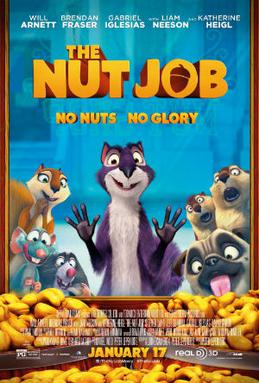
I remember very clearly seeing the trailer for 2014's The Nut Job. I remember laughing out loud -- in a good way -- at the premise, so ridiculous sounding it had to be a spoof trailer, right? Right?!? But no, it wasn't. This was an animated heist movie....with animals. How could that not work? It just has to work on basically all levels. It just has to!!!
In the small city of Oakton, a beautiful little park with plenty of trees and creeks and rolling hills sits in the middle of the downtown area. All the animals that live there are prepping for a fast-approaching winter, the group led by Raccoon (voice of Liam Neeson) who's doing his best to help organize all the available food. A rebellious squirrel, Surly (voice of Will Arnett), is working on his own though to store up for winter, even finding a nut store near the park that will keep him fat and full all winter. Now, he's just got to find a way in without being caught. Raccoon catches wind of his plan and sends two brave squirrels, Grayson (Brendan Fraser) and Andie (Katherine Heigl), after Surly to see what he's up to. There's more to it though. A lot more. Something is going on inside the nut store that none of them had planned on.
Here we sit again. I feel absolutely ridiculous writing a plot description for an animated movie. At that, an animated movie about squirrels, mice, rats, groundhogs, a mole, and a power-hungry raccoon joining forces to rob a nut store. At the same time, that premise alone gets some points. This 2014 animated flick was backed by South Korean studios and did pretty well in theaters, earning over $76 million this winter, director Peter Lepeniotis' movie more than earning back its budget. I mildly liked it, but I wanted to love it. There are some laughs but not enough, and the story is lacking something. Maybe Pixar has just ruined things for everyone with all their unique, original, innovative ideas.
What does work? I loved the visual. Though it's never dealt with directly, 'Job' has the look of the 1950s as if the story took place in a little American town. It reminded me of so many classic Looney Tunes cartoons that I grew up watching. What exactly do Surly and Co. stumble into while trying to rob the nut store? They find themselves working around a gangster, King (voice of Stephen Lang), and his cronies trying to rob a nearby bank by tunneling in. That premise reminded me of several Looney Tunes adventures, Bugs Bunny working against some dimwitted gangsters doing their best James Cagney impersonations. While the animation has that crisp, clear look we've come to expect out of modern animated movies -- thanks again, Pixar -- there is also that throwback feel to the animation. It's colorful and detailed right down to the background and characters. It all adds up to a nice animated package.
What doesn't work? I came away disappointed with the voice work here. Will Arnett does his best as Surly the squirrel, but there aren't too many animated movies out there where the main character is so unsympathetic. He's mean, kinda a bully, and generally not very likable. Surly has his moments -- most with his mute sidekick, a mouse -- but I didn't like the character. Heigl is okay as Andie, the squirrel love interest. Fraser hams it up as the overly heroic and slightly nuts Grayson, but I didn't even realize it was Fraser, requiring a look-up. Neeson is cool because it's freaking Liam Neeson voicing an evil raccoon. The rest of the nut job heist crew include Precious (Maya Rudolph), a pug who teams up with Surly, Mole (comedian Jeff Dunham), the blind, dimwitted mole, Jimmy (Gabriel Iglesias), Johnny (Joe Pingue) and Jamie (Annick Obonsawin), a trio of groundhogs. It sounds cute, but in the end, it's just sorta meh.
So in the end, I think the idea is far better than the execution here. I really, really liked the premise, but as the story developed, it never really grabbed me and pulled me in. The potential was certainly there, but 'Job' doesn't pay off unfortunately. And let me tell you, I wanted it to pay off. It's a heist movie with animals for goodness sake!!! That has to be awesome, right?!?
That said, there is a quasi-saving grace in the finale. I wonder if the studio behind 'Job' has a hand in the studio behind musical artist Psy, known for his unbelievably catchy dance song Gagnam Style. Listen HERE. One of my favorite early scenes has Surly and his sidekick, Mouse, dancing in celebration to Psy's song. It's not the Gagnam Style dance, but it's funny. Very funny. The highlight for me was in the end credits, an animated Psy dancing as the credits roll, all the characters -- both humans and animals -- dancing along with him. It's gimmicky, a tad forced, pretty ridiculous, and it is FUNNY. It works, simple as that. Watch it HERE. Yeah, I'm a cheap date. It doesn't take much to entertain me.
The Nut Job (2014): **/****
The Sons of Katie Elder
"First, we reunite, then find Ma and Pa's killer...then read some reviews."
Tuesday, June 10, 2014
Monday, June 9, 2014
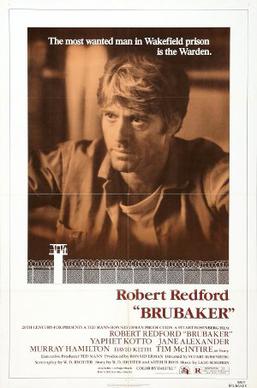
Brubaker
Well, it may be time to add a new label and genre for the right-hand column. I've written double-digit reviews about prisoners-of-war stories but what about good, old-fashioned prison stories? Movies like The Shawshank Redemption, Cool Hand Luke, Papillon, and plenty others ranging from classics to good to just bad. It's official. I'll add the Prison movie to the list, and here's a new one, 1980's Brubaker.
A new shipment of prisoners is arriving at the Wakefield State Prison, among them a quiet, mysterious prisoner who puts his head down and minds his own business. The prisoner quickly sees how horrific prison life is from abusive guards -- both physical, mental and sexual abuse -- to cramped living quarters, insect-ridden food to corruption on all levels of how the prison is run. After several days though, the prisoner reveals himself as Henry Brubaker (Robert Redford), the prison's new warden who's been tasked with cleaning up the prison, both for the prisoners and as a government-funded location. His appearance scares countless people to death, their corrupt, nasty world about to get thrown for a loop. His methods are demanding and fast-acting, making many people incredibly nervous. With pressure from inside and out, can Brubaker clean up the prison? Or has he pushed too far and endangered his own life?
From director Stuart Rosenberg, 'Brubaker' asks some interesting questions. Prison reform is meant to make sure that prisoners are treated like decent human beings. They don't deserve to be beaten, abused, violated and treated like dirt. Or do they? As the movie points out in snippets, these men are criminals, found guilty of a variety of crimes from rape to murder, robbery to manslaughter and all sorts of pleasant stuff in between. How well do they deserve to be treated considering the crimes they've been found guilty of committing? Should we rehabilitate prisoners so they can reenter the world as better individuals or simply let them waste away in under-funded prisons? The answer is probably somewhere in between. And enough of the social commentary, on with the movie!
'Brubaker' is a good movie, a story featuring some social commentary that for the most part avoids getting too obvious with its message. It is based on the book Accomplices to the Crime: The Arkansas Prison Scandal, the warden posing as a prisoner made up for the sake of the film. This is dark stuff from the get-go, Brubaker's undercover mission incredibly uncomfortable to watch. Things only get worse as he undertakes his new job, so many people around him -- inside and outside the prison -- trying to stop him, or at least slow him down. 'Brubaker' was filmed at Junction City Prison (recently closed) in Ohio, giving the story a filthy, seedy look that adds to the tension and the reality Rosenberg was aiming for. It doesn't feel like some Hollywood studio posing as a prison. It is a prison, and that goes a long ways toward authenticity. Also worth mentioning is composer Lalo Schifrin's score, equal parts underplayed and quiet with fast-moving, adrenaline-pumping sequences.
Who best to lead the way as a progressive prison warden who's not interested in whips, abuses, punishments and beatings? Why Robert Redford of course, at the height of his popularity. In his personal life, Redford has gotten behind and backed causes he believed to be worthwhile so this doesn't feel forced as an acting role. I would have liked some more background about the Brubaker character -- how did he end up here? What drives him? What's his motivation -- but an intelligent, thoughtful warden who becomes almost obsessed with accomplishing his mission is a great hero to lead the way. Redford was, is and will be a likable star to lead the way in a movie, and he's the best thing going here. Also look for Jane Alexander as Lillian Gray, his government connection, their background and relationship hinted at but never specified.
There's plenty of solid supporting parts to back Redford, starting with Yaphet Kotto as Coombes, a trusty who Brubaker counts on to help his reform get rolling while also questioning what's going on, and David Keith as Larry Lee Bullen, a lifer, a prisoner who's piled up three felonies and earned himself a life sentence. The scenes among Redford, Kotto and Keith are some of the strongest throughout the 132-minute movie. As for other trustees, look for Matt Clark, Tim McIntire, Everett McGill, Val Avery, and Joe Spinell. Murray Hamilton plays the evil Governor with Albert Salmi, M. Emmet Walsh, and Wilford Brimley also representing the evil System.
Just a good movie with a strong cast and an interesting story that takes some surprising twists as the it develops. The ending gets a little heavy-handed with a slow clap and all, but the movie as a whole is easy to recommend.
Brubaker (1980): ***/****
A new shipment of prisoners is arriving at the Wakefield State Prison, among them a quiet, mysterious prisoner who puts his head down and minds his own business. The prisoner quickly sees how horrific prison life is from abusive guards -- both physical, mental and sexual abuse -- to cramped living quarters, insect-ridden food to corruption on all levels of how the prison is run. After several days though, the prisoner reveals himself as Henry Brubaker (Robert Redford), the prison's new warden who's been tasked with cleaning up the prison, both for the prisoners and as a government-funded location. His appearance scares countless people to death, their corrupt, nasty world about to get thrown for a loop. His methods are demanding and fast-acting, making many people incredibly nervous. With pressure from inside and out, can Brubaker clean up the prison? Or has he pushed too far and endangered his own life?
From director Stuart Rosenberg, 'Brubaker' asks some interesting questions. Prison reform is meant to make sure that prisoners are treated like decent human beings. They don't deserve to be beaten, abused, violated and treated like dirt. Or do they? As the movie points out in snippets, these men are criminals, found guilty of a variety of crimes from rape to murder, robbery to manslaughter and all sorts of pleasant stuff in between. How well do they deserve to be treated considering the crimes they've been found guilty of committing? Should we rehabilitate prisoners so they can reenter the world as better individuals or simply let them waste away in under-funded prisons? The answer is probably somewhere in between. And enough of the social commentary, on with the movie!
'Brubaker' is a good movie, a story featuring some social commentary that for the most part avoids getting too obvious with its message. It is based on the book Accomplices to the Crime: The Arkansas Prison Scandal, the warden posing as a prisoner made up for the sake of the film. This is dark stuff from the get-go, Brubaker's undercover mission incredibly uncomfortable to watch. Things only get worse as he undertakes his new job, so many people around him -- inside and outside the prison -- trying to stop him, or at least slow him down. 'Brubaker' was filmed at Junction City Prison (recently closed) in Ohio, giving the story a filthy, seedy look that adds to the tension and the reality Rosenberg was aiming for. It doesn't feel like some Hollywood studio posing as a prison. It is a prison, and that goes a long ways toward authenticity. Also worth mentioning is composer Lalo Schifrin's score, equal parts underplayed and quiet with fast-moving, adrenaline-pumping sequences.
Who best to lead the way as a progressive prison warden who's not interested in whips, abuses, punishments and beatings? Why Robert Redford of course, at the height of his popularity. In his personal life, Redford has gotten behind and backed causes he believed to be worthwhile so this doesn't feel forced as an acting role. I would have liked some more background about the Brubaker character -- how did he end up here? What drives him? What's his motivation -- but an intelligent, thoughtful warden who becomes almost obsessed with accomplishing his mission is a great hero to lead the way. Redford was, is and will be a likable star to lead the way in a movie, and he's the best thing going here. Also look for Jane Alexander as Lillian Gray, his government connection, their background and relationship hinted at but never specified.
There's plenty of solid supporting parts to back Redford, starting with Yaphet Kotto as Coombes, a trusty who Brubaker counts on to help his reform get rolling while also questioning what's going on, and David Keith as Larry Lee Bullen, a lifer, a prisoner who's piled up three felonies and earned himself a life sentence. The scenes among Redford, Kotto and Keith are some of the strongest throughout the 132-minute movie. As for other trustees, look for Matt Clark, Tim McIntire, Everett McGill, Val Avery, and Joe Spinell. Murray Hamilton plays the evil Governor with Albert Salmi, M. Emmet Walsh, and Wilford Brimley also representing the evil System.
Just a good movie with a strong cast and an interesting story that takes some surprising twists as the it develops. The ending gets a little heavy-handed with a slow clap and all, but the movie as a whole is easy to recommend.
Brubaker (1980): ***/****
Labels:
1980s,
David Keith,
Matt Clark,
Murray Hamilton,
Prisons,
Robert Redford,
Yaphet Kotto
Friday, June 6, 2014
See No Evil, Hear No Evil
Ah, the gimmick. When it works, it can be great. When it doesn't, that blasted thing can ruin an entire movie single-handed. I was skeptical of the gimmick/premise from 1989's See No Evil, Hear No Evil, but the talent involved was too much to pass up. And throwing in that I've never heard of the movie and never heard anyone talk about it, I went in with a clean slate.
Running his newstand in a downtown NYC skyscraper, Dave Lyons (Gene Wilder) goes about his day-to-day work like nothing's going on. Well, there is. He's deaf, but Dave is pretty smooth as long as he can read the person's lips he's talking to. One day, he hires Wally Karew (Richard Pryor), the two having some struggle communicating almost immediately. Why exactly? Wally is blind. How can they make it work? They do, finding a way and a rhythm, but it is relatively short-lived. One morning, a man walks in demanding to see Karew but before anything can be resolved....the man is shot. Dave never gets a good look at the killer -- only seeing her legs as she walks away -- while Wally only smells her perfume as she walks away scot-free. That's one problem but just the start. The police walk in to find Dave and Wally perched over the body. They're suspects No. 1 and No. 2.
Okay, about that gimmick thing. There's more than one. A couple actually in this Arthur Hiller-directed comedy. In the third of four pairings between Pryor and Wilder, the laughs are there from beginning to end in a 103-minute movie. Critics ripped it apart pretty good for those gimmicks. One works better than the other. The one that doesn't? A blind guy who's good friends with a deaf guy sounds almost sophomoric, but nope, that works. What doesn't work is the pretty forced, overdone way to get the duo into some kooky situations. The murder isn't even the dumb part, but what comes after it. None of it is a deal-breaker, but you can't help but shake your head at it at times, especially the MacGuffin that ties it all together.
It isn't something that kills the movie because, well, because Richard Pryor and Gene Wilder are a comedy match made in heaven. Having already worked together on Silver Streak and Stir Crazy, they team up again here with similarly successful results. Say what you want about the movie itself, but their on-screen chemistry and banter are above any criticism. Like the best comedy teams from Laurel and Hardy to The Three Stooges, the Marx Brothers, Abbott and Costello to Dean Martin and Jerry Lewis, chemistry is key above it all. They make it look easy scene-in and scene-out, raising the sometimes forced story above its average roots. No matter how goofy or downright stupid the story is, it's fun to watch this duo do their thing.
Simply put, Pryor and Wilder commit to the gimmick, a blind man and a deaf man forced to work together. It works because it is simple. Pryor's Wally can't see, liking to pretend he can. Wilder's Dave can't hear, but he's an expert at lip-reading (except for some tough sound-alikes). There are too many great little set pieces and running jokes to even mention, but here's a few. Drinking at a bar, they get into a fistfight, the blind man punching while the deaf man calls out where to punch as if it was a clock. My favorite has the duo arrested and taking mug shots. Dave can't see the photographer's face (so he can't hear her), requiring Wally to tell him what to do, but he can't see that Dave isn't in the right position. Watch it HERE. Just more proof you don't need something big and obvious and over the top to be funny. Sometimes it's the littlest things that produce the biggest laughs. I don't want to spoil too many of the best bits, but know this. It's genuinely funny. I laughed out loud throughout, and hopefully you will too.
You don't really need too much else in the cast department, but there's some other parts worth mentioning. The beautiful Joan Severance plays Eve, the real killer who's working with her partner, Kirgo, played by Kevin Spacey sporting a well-manicured pencil mustache and a British accent. Both of them are working for a mysterious man, Sutherland (Anthony Zerbe), who has a twist/surprise of his own in the final act. Alan North and Louis Giambalvo play two NYC detectives forced to deal with our blind/deaf duo and progressively losing it while Kirsten Childs plays Wally's sister, Adele, brought into the craziness.
Downright dumb at times with plenty of laughs. You wouldn't expect anything else from a comedy starring Richard Pryor and Gene Wilder. Turn off your brain for a couple hours and sit back and enjoy the laughs.
See No Evil, Hear No Evil (1989): ***/****
Running his newstand in a downtown NYC skyscraper, Dave Lyons (Gene Wilder) goes about his day-to-day work like nothing's going on. Well, there is. He's deaf, but Dave is pretty smooth as long as he can read the person's lips he's talking to. One day, he hires Wally Karew (Richard Pryor), the two having some struggle communicating almost immediately. Why exactly? Wally is blind. How can they make it work? They do, finding a way and a rhythm, but it is relatively short-lived. One morning, a man walks in demanding to see Karew but before anything can be resolved....the man is shot. Dave never gets a good look at the killer -- only seeing her legs as she walks away -- while Wally only smells her perfume as she walks away scot-free. That's one problem but just the start. The police walk in to find Dave and Wally perched over the body. They're suspects No. 1 and No. 2.
Okay, about that gimmick thing. There's more than one. A couple actually in this Arthur Hiller-directed comedy. In the third of four pairings between Pryor and Wilder, the laughs are there from beginning to end in a 103-minute movie. Critics ripped it apart pretty good for those gimmicks. One works better than the other. The one that doesn't? A blind guy who's good friends with a deaf guy sounds almost sophomoric, but nope, that works. What doesn't work is the pretty forced, overdone way to get the duo into some kooky situations. The murder isn't even the dumb part, but what comes after it. None of it is a deal-breaker, but you can't help but shake your head at it at times, especially the MacGuffin that ties it all together.
It isn't something that kills the movie because, well, because Richard Pryor and Gene Wilder are a comedy match made in heaven. Having already worked together on Silver Streak and Stir Crazy, they team up again here with similarly successful results. Say what you want about the movie itself, but their on-screen chemistry and banter are above any criticism. Like the best comedy teams from Laurel and Hardy to The Three Stooges, the Marx Brothers, Abbott and Costello to Dean Martin and Jerry Lewis, chemistry is key above it all. They make it look easy scene-in and scene-out, raising the sometimes forced story above its average roots. No matter how goofy or downright stupid the story is, it's fun to watch this duo do their thing.
Simply put, Pryor and Wilder commit to the gimmick, a blind man and a deaf man forced to work together. It works because it is simple. Pryor's Wally can't see, liking to pretend he can. Wilder's Dave can't hear, but he's an expert at lip-reading (except for some tough sound-alikes). There are too many great little set pieces and running jokes to even mention, but here's a few. Drinking at a bar, they get into a fistfight, the blind man punching while the deaf man calls out where to punch as if it was a clock. My favorite has the duo arrested and taking mug shots. Dave can't see the photographer's face (so he can't hear her), requiring Wally to tell him what to do, but he can't see that Dave isn't in the right position. Watch it HERE. Just more proof you don't need something big and obvious and over the top to be funny. Sometimes it's the littlest things that produce the biggest laughs. I don't want to spoil too many of the best bits, but know this. It's genuinely funny. I laughed out loud throughout, and hopefully you will too.
You don't really need too much else in the cast department, but there's some other parts worth mentioning. The beautiful Joan Severance plays Eve, the real killer who's working with her partner, Kirgo, played by Kevin Spacey sporting a well-manicured pencil mustache and a British accent. Both of them are working for a mysterious man, Sutherland (Anthony Zerbe), who has a twist/surprise of his own in the final act. Alan North and Louis Giambalvo play two NYC detectives forced to deal with our blind/deaf duo and progressively losing it while Kirsten Childs plays Wally's sister, Adele, brought into the craziness.
Downright dumb at times with plenty of laughs. You wouldn't expect anything else from a comedy starring Richard Pryor and Gene Wilder. Turn off your brain for a couple hours and sit back and enjoy the laughs.
See No Evil, Hear No Evil (1989): ***/****
Labels:
1980s,
Anthony Zerbe,
Arthur Hiller,
Comedy,
Gene Wilder,
Kevin Spacey,
Richard Pryor
Thursday, June 5, 2014
Chaos
I've got 30-plus movies on my Netflix queue, and I'm....in....a....rut. Last weekend, not one of them burst off the page. I didn't really want to see any of them so I did a sorta-random search and picked a movie. The end result....2005's Chaos, a movie that got an extremely limited theatrical release. Good cast, cool premise? Maybe we've got a rut-buster.
After a hostage standoff goes horribly wrong, Seattle detective Quentin Conners (Jason Statham) is suspended indefinitely from the force while his partner is fired. Just a few months later, Conners is brought back to the force when his supervisor has no other option. A bank is being robbed by five heavily armed gunmen with over 40 hostages taken. The leader of the bank robbers, Lorenz (Wesley Snipes), has demanded to negotiate only with Conners and no one else. Given a young, new partner -- really more of a watchdog -- Shane Dekker (Ryan Phillippe), Conners heads to the bank looking to get the robbers and save the hostages. Nothing goes right though, several hostages injured in an explosion that allows the bank robbers to escape as well. Inside the bank, no money seems to have been taken. What exactly was the purpose of the "robbery"? What did they hope to achieve? Can Conners and Dekker figure it all out?
Yeah, about this one......wow, what a stinker. This is not the rut-buster I was counting on for my Netflix queue. From director Tony Giglio (who also wrote the screenplay), 'Chaos' borrows liberally from a fair amount of like-minded movies about bank robberies and hostages, anything from Swordfish to Inside Man (heavily borrowed), Dog Day Afternoon to Heat and plenty other movies that are far better than this one. It was clearly made on a smaller budget, Canadian locations filling in for Seattle, and generally has the feel of a straight-to-DVD dud. It tries to be something better, something else, but it never creates enough of its own identity and is dead on arrival. 'Chaos' is only 106 minutes long but it drags badly almost immediately and never picks up any momentum.
The formula for cheap action flicks like this is usually cast two or three pretty recognizable actors/stars, get another actor who never quite became a star but is a recognizable face, and then fill in the rest of the cast with no-name actors and actresses. Here we get Statham (rising action star at the time), Snipes (past his prime star with some legal issues) and Phillippe (young star who never quite rose to stardom). The three lead performances range from decent to pointless to wasted and then just some plain old bad. Statham's cool on-screen persona is there, but his American accent drifts in and out at will. Mostly, he looks frustrated or has a smart-ass grin on his face. Snipes' part amounts to little more than a cameo, but he goes for it in the over-the-top villain department. Phillippe just struggles. He gets the big, explanatory dialogue scenes and it's just bad. Uncomfortably bad.
The only other recognizable face is Henry Czerny as Capt. Martin Jenkins, the higher-ranking police officer who speaks in cliches, questioning everything and demanding things be done his way. Or the highway!!! It's the same part he played in Mission: Impossible and Clear and Present Danger.
Bad is bad, but then there's just awful bad. 'Chaos' has more of those awful moments than any guilty pleasure should have. My favorite right out of the Jerry Bruckheimer/Michael Bay school of Action Movies goes like this. Phillippe is chasing a suspect down an alley in a foot chase and smashes right into a row of parked motorcycles. Shane yells "I'm a police officer! I need your motorcycle!" at which point he puts on a ridiculous helmet and chases after him, a ridiculously long action sequence starting up. The other goes down the Overtly Uncomfortable Sexual Tension Department. Investigating a crime scene, Conners and Dekker talk to a CSI investigator (Keegan Connor Tracy) who tells Dekker she'd like to ride him and she has a list of approved things he can put in her mouth. Oh, all the while she's sucking on a sucker. Subtle, this ain't. You'll think you've stumbled across a Skinamax movie late at night.
Then there's the twist and then another and then another. The movie's title is based on chaos theory which suggests that seemingly random occurrences are actually related in some fashion or another. Random eventually leads to patterns so in fact, nothing is in fact, chaotic. There are so many good movies out there like The Usual Suspects and Fight Club and The Sixth Sense with excellent twists, really well thought out revelations that seem ridiculous, but nope, when you really start to think about them it all comes together. This is not one of those movies. The twists are both obvious and stupid, and the ending goes for a "clever" finale that plays against genre conventions, but even that falls short. Just nothing to recommend here unfortunately. Avoid at all costs.
Chaos (2005): */****
After a hostage standoff goes horribly wrong, Seattle detective Quentin Conners (Jason Statham) is suspended indefinitely from the force while his partner is fired. Just a few months later, Conners is brought back to the force when his supervisor has no other option. A bank is being robbed by five heavily armed gunmen with over 40 hostages taken. The leader of the bank robbers, Lorenz (Wesley Snipes), has demanded to negotiate only with Conners and no one else. Given a young, new partner -- really more of a watchdog -- Shane Dekker (Ryan Phillippe), Conners heads to the bank looking to get the robbers and save the hostages. Nothing goes right though, several hostages injured in an explosion that allows the bank robbers to escape as well. Inside the bank, no money seems to have been taken. What exactly was the purpose of the "robbery"? What did they hope to achieve? Can Conners and Dekker figure it all out?
Yeah, about this one......wow, what a stinker. This is not the rut-buster I was counting on for my Netflix queue. From director Tony Giglio (who also wrote the screenplay), 'Chaos' borrows liberally from a fair amount of like-minded movies about bank robberies and hostages, anything from Swordfish to Inside Man (heavily borrowed), Dog Day Afternoon to Heat and plenty other movies that are far better than this one. It was clearly made on a smaller budget, Canadian locations filling in for Seattle, and generally has the feel of a straight-to-DVD dud. It tries to be something better, something else, but it never creates enough of its own identity and is dead on arrival. 'Chaos' is only 106 minutes long but it drags badly almost immediately and never picks up any momentum.
The formula for cheap action flicks like this is usually cast two or three pretty recognizable actors/stars, get another actor who never quite became a star but is a recognizable face, and then fill in the rest of the cast with no-name actors and actresses. Here we get Statham (rising action star at the time), Snipes (past his prime star with some legal issues) and Phillippe (young star who never quite rose to stardom). The three lead performances range from decent to pointless to wasted and then just some plain old bad. Statham's cool on-screen persona is there, but his American accent drifts in and out at will. Mostly, he looks frustrated or has a smart-ass grin on his face. Snipes' part amounts to little more than a cameo, but he goes for it in the over-the-top villain department. Phillippe just struggles. He gets the big, explanatory dialogue scenes and it's just bad. Uncomfortably bad.
The only other recognizable face is Henry Czerny as Capt. Martin Jenkins, the higher-ranking police officer who speaks in cliches, questioning everything and demanding things be done his way. Or the highway!!! It's the same part he played in Mission: Impossible and Clear and Present Danger.
Bad is bad, but then there's just awful bad. 'Chaos' has more of those awful moments than any guilty pleasure should have. My favorite right out of the Jerry Bruckheimer/Michael Bay school of Action Movies goes like this. Phillippe is chasing a suspect down an alley in a foot chase and smashes right into a row of parked motorcycles. Shane yells "I'm a police officer! I need your motorcycle!" at which point he puts on a ridiculous helmet and chases after him, a ridiculously long action sequence starting up. The other goes down the Overtly Uncomfortable Sexual Tension Department. Investigating a crime scene, Conners and Dekker talk to a CSI investigator (Keegan Connor Tracy) who tells Dekker she'd like to ride him and she has a list of approved things he can put in her mouth. Oh, all the while she's sucking on a sucker. Subtle, this ain't. You'll think you've stumbled across a Skinamax movie late at night.
Then there's the twist and then another and then another. The movie's title is based on chaos theory which suggests that seemingly random occurrences are actually related in some fashion or another. Random eventually leads to patterns so in fact, nothing is in fact, chaotic. There are so many good movies out there like The Usual Suspects and Fight Club and The Sixth Sense with excellent twists, really well thought out revelations that seem ridiculous, but nope, when you really start to think about them it all comes together. This is not one of those movies. The twists are both obvious and stupid, and the ending goes for a "clever" finale that plays against genre conventions, but even that falls short. Just nothing to recommend here unfortunately. Avoid at all costs.
Chaos (2005): */****
Wednesday, June 4, 2014
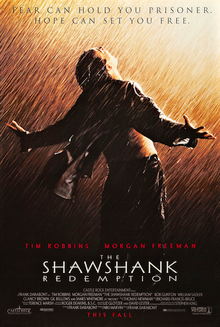
The Shawshank Redemption
Sometimes you just have to shake your head at audiences and moviegoers. Some movies just aren't meant to make some money in theaters no matter how good reviews are, no matter how good the cast and crew is. It just isn't meant to be. Take 1994's The Shawshank Redemption, a movie that barely recovered its budget in theaters but has become a ridiculously popular movie in the 20 years since its release. How good is it? On the IMDB Top 250 (of all-time), it's currently rocking the No. 1 ranking...of All-Time. Not the most scientific voting, but still...
It's 1947 when banker Andy Dufresne (Tim Robbins) is convicted of murdering his wife and the man she was having an affair with. Andy maintains his innocence but the evidence is overwhelmingly against him, and he receives consecutive life sentences as a verdict. He is sent to Shawshank Prison near Portland, Maine and settles into prison life as best he can. More than that, he just wants to survive. Days to weeks, weeks to months, months to years, Andy becomes close friends with a fellow prisoner, Red (Morgan Freeman), who is similarly serving a sentence for murder. Prison life is one step above hell itself, Andy carving out a niche for himself as best he can. Will it ultimately prove to be too much? Will it wear Andy down over the years? Can he somehow prove his innocence when on one else believes him and the evidence against him seems like a sure thing? In prison with life sentences on the line, only time will tell.
What a difficult movie to review in a somewhat concise plot synopsis. I tried to build this movie up to someone recently who had never seen it, and without giving too much away....well, let's just say it proved difficult. It's difficult, but it's for good reason. In the 20 years since 'Redemption' was released, it has gained quite the positive reputation, director Frank Darabont also adapting a screenplay from a short story by acclaimed author Stephen King. For about three years in the early 2000s, AMC and TNT and TBS seemed to show this movie EVERY SINGLE WEEKEND, and I probably watched it every other weekend or so. It had been years since I'd seen the movie straight through in one sitting, and not surprisingly, it holds up one basically all levels. Who knows how it will be remembered in years to come. Will it be a classic? A highly-regarded film? Maybe both, but for me, it's a personal favorite.
As I prepare to write some reviews, I try to identify some flaws, if I haven't already from during the viewing. So those flaws here....yeah, there aren't any. This is one of those perfect movies you can sit back and appreciate on any number of levels. The biggest strength is the story, a dark, unsettling story that is able to blend drama and comedy and even elements of horror effortlessly. The look of the movie reflects the story, colors washed out to pale shades of blue and grey, the Ohio State Reformatory serving as the backdrop for Shawshank. The immense prison walls tower over the prisoners, its hallways holding all kinds of hellish horrors. Another of the movie's strongest features is the soundtrack from Thomas Newman, my personal favorite score from an excellent composer. Listen to the entire soundtrack HERE, music equal parts emotional and moving with unsettling and uncomfortable.
Above all else, this movie rides on the shoulders of its stars, Tim Robbins and Morgan Freeman. Talk about an effortless chemistry. These two pros make it look downright easy. This isn't acting, just two very talented actors doing their thing. Natural doesn't begin to describe the power of their performances, the relationship between Andy and Red developing into a genuine friendship as the years pass. Their conversations crackle, two men talking because, well, because there's plenty of time to talk in prison. They talk about life, about their pasts, their likes and dislikes, but bigger things too. Andy and Red talk about hope -- check that, Hope -- and dreams, about something bigger, about finding your spot and persevering no matter what's thrown in front of you. I can't think of other films where Robbins and Freeman were better than this. Two great actors bringing two flawed, fascinating characters to life.
Who else to look for? How about evil personified as Shawshank's warden (Bob Gunton) and his lead guard and enforcer Byron Hadley (Clancy Brown), two of the most evil, despicable villains ever. James Whitmore, 73 years old at the time and having worked in Hollywood since the late 1940s, is a scene-stealer as Brooks, an aging prisoner who's become institutionalized as his sentence runs into its fifth decade. Other prisoners include William Salder as Haywood, an overbearing at times but generally likable inmate, with Larry Brandenburg, Neil Giuntoli, Brian Libby, Joseph Ragno and David Proval rounding out Red's clique of prisoners. Also look for Gil Bellows as Tommy, a young prisoner who comes to Shawshank in the mid 1960s with knowledge that could change Andy's life.
Maybe the biggest effect this movie has had on audiences is Morgan Freeman Narration Syndrome. Featuring one of the all-time great voiceover narrations, 'Shawshank' propelled Freeman into another stratosphere. It would be fun to listen to Freeman read a phone book. He's that good. The narration is what holds the movie together, almost 20 years of story packed into 142 minutes. There is a simple elegance to the narration, conversations about hope and fate, destiny and love, all of it giving a deeper sense of what's going on. It also features one of my all-time favorite movie lines, Red taking one of Andy's thoughts to heart. 'Get busy living or get busy dying....Damn right.' Just good stuff. Narration can be overdone, condescending, pretentious, but here? It's damn perfect.
There really isn't a weakness in this movie. Not a one. Now that said, the last 40 minutes or so is one of the strongest extended sequences in film history. This is a story that builds and builds, but you're not necessarily sure where. It doesn't drop hints so when a twist comes along, it genuinely shocks and surprises. One twist and surprise on top of each other -- all of them working effortlessly -- that don't feel forced. Thankfully, no 'Gotcha!' moments here. It leads to an ending that is beyond perfect. Moving, emotional and dramatic, including a beautiful final shot set to Newman's music. One of those great movies, a classic that gets better with repeated viewings. Sit back and enjoy it beginning to end.
The Shawshank Redemption (1994): ****/****
It's 1947 when banker Andy Dufresne (Tim Robbins) is convicted of murdering his wife and the man she was having an affair with. Andy maintains his innocence but the evidence is overwhelmingly against him, and he receives consecutive life sentences as a verdict. He is sent to Shawshank Prison near Portland, Maine and settles into prison life as best he can. More than that, he just wants to survive. Days to weeks, weeks to months, months to years, Andy becomes close friends with a fellow prisoner, Red (Morgan Freeman), who is similarly serving a sentence for murder. Prison life is one step above hell itself, Andy carving out a niche for himself as best he can. Will it ultimately prove to be too much? Will it wear Andy down over the years? Can he somehow prove his innocence when on one else believes him and the evidence against him seems like a sure thing? In prison with life sentences on the line, only time will tell.
What a difficult movie to review in a somewhat concise plot synopsis. I tried to build this movie up to someone recently who had never seen it, and without giving too much away....well, let's just say it proved difficult. It's difficult, but it's for good reason. In the 20 years since 'Redemption' was released, it has gained quite the positive reputation, director Frank Darabont also adapting a screenplay from a short story by acclaimed author Stephen King. For about three years in the early 2000s, AMC and TNT and TBS seemed to show this movie EVERY SINGLE WEEKEND, and I probably watched it every other weekend or so. It had been years since I'd seen the movie straight through in one sitting, and not surprisingly, it holds up one basically all levels. Who knows how it will be remembered in years to come. Will it be a classic? A highly-regarded film? Maybe both, but for me, it's a personal favorite.
As I prepare to write some reviews, I try to identify some flaws, if I haven't already from during the viewing. So those flaws here....yeah, there aren't any. This is one of those perfect movies you can sit back and appreciate on any number of levels. The biggest strength is the story, a dark, unsettling story that is able to blend drama and comedy and even elements of horror effortlessly. The look of the movie reflects the story, colors washed out to pale shades of blue and grey, the Ohio State Reformatory serving as the backdrop for Shawshank. The immense prison walls tower over the prisoners, its hallways holding all kinds of hellish horrors. Another of the movie's strongest features is the soundtrack from Thomas Newman, my personal favorite score from an excellent composer. Listen to the entire soundtrack HERE, music equal parts emotional and moving with unsettling and uncomfortable.
Above all else, this movie rides on the shoulders of its stars, Tim Robbins and Morgan Freeman. Talk about an effortless chemistry. These two pros make it look downright easy. This isn't acting, just two very talented actors doing their thing. Natural doesn't begin to describe the power of their performances, the relationship between Andy and Red developing into a genuine friendship as the years pass. Their conversations crackle, two men talking because, well, because there's plenty of time to talk in prison. They talk about life, about their pasts, their likes and dislikes, but bigger things too. Andy and Red talk about hope -- check that, Hope -- and dreams, about something bigger, about finding your spot and persevering no matter what's thrown in front of you. I can't think of other films where Robbins and Freeman were better than this. Two great actors bringing two flawed, fascinating characters to life.
Who else to look for? How about evil personified as Shawshank's warden (Bob Gunton) and his lead guard and enforcer Byron Hadley (Clancy Brown), two of the most evil, despicable villains ever. James Whitmore, 73 years old at the time and having worked in Hollywood since the late 1940s, is a scene-stealer as Brooks, an aging prisoner who's become institutionalized as his sentence runs into its fifth decade. Other prisoners include William Salder as Haywood, an overbearing at times but generally likable inmate, with Larry Brandenburg, Neil Giuntoli, Brian Libby, Joseph Ragno and David Proval rounding out Red's clique of prisoners. Also look for Gil Bellows as Tommy, a young prisoner who comes to Shawshank in the mid 1960s with knowledge that could change Andy's life.
Maybe the biggest effect this movie has had on audiences is Morgan Freeman Narration Syndrome. Featuring one of the all-time great voiceover narrations, 'Shawshank' propelled Freeman into another stratosphere. It would be fun to listen to Freeman read a phone book. He's that good. The narration is what holds the movie together, almost 20 years of story packed into 142 minutes. There is a simple elegance to the narration, conversations about hope and fate, destiny and love, all of it giving a deeper sense of what's going on. It also features one of my all-time favorite movie lines, Red taking one of Andy's thoughts to heart. 'Get busy living or get busy dying....Damn right.' Just good stuff. Narration can be overdone, condescending, pretentious, but here? It's damn perfect.
There really isn't a weakness in this movie. Not a one. Now that said, the last 40 minutes or so is one of the strongest extended sequences in film history. This is a story that builds and builds, but you're not necessarily sure where. It doesn't drop hints so when a twist comes along, it genuinely shocks and surprises. One twist and surprise on top of each other -- all of them working effortlessly -- that don't feel forced. Thankfully, no 'Gotcha!' moments here. It leads to an ending that is beyond perfect. Moving, emotional and dramatic, including a beautiful final shot set to Newman's music. One of those great movies, a classic that gets better with repeated viewings. Sit back and enjoy it beginning to end.
The Shawshank Redemption (1994): ****/****
Labels:
1990s,
James Whitmore,
Morgan Freeman,
Prisons,
Stephen King,
Tim Robbins
Tuesday, June 3, 2014
A Million Ways to Die in the West
Seth MacFarlane is one of the more polarizing personalities currently working in Hollywood. The creator of TV's Family Guy and man behind 2012's very funny and very wrong Ted, MacFarlane typically inspires a 'love him or hate him' reaction from audiences. I typically come down on the love him side, loving Ted and for the most part liking Family Guy. So when I read MacFarlane was working on a comedy film western....well, color me curious. Here's 2014's A Million Ways to Die in the West.
It's 1882 in Arizona and cowardly rancher Albert Stark (MacFarlane) is trying to make the most of his small sheep ranch in the desert. He's dating the pretty, young teacher, Louise (Amanda Seyfried), and even though the wild west life is pretty rough, Albert is pleased....and then he isn't. After he negotiates his way out of a gunfight rather than shoot it out, Albert gets dumped by Louise. He just sort of drifts along afterwards, eventually meeting a new woman in town, Anna (Charlize Theron), who he clicks with very quickly. It isn't long before Albert gets roped into another gunfight with Louise's new man, but that's the least of his problems. Anna isn't telling him everything about who she is and more importantly, who she's married to. Her husband? Clinch Leatherwood (Liam Neeson), a bandit and one of the most notorious gunfighters around. Now, Albert is really in for some trouble.
Released in theaters just this past weekend, 'Million' earned over $17 but was still dubbed a disappointment. Reviews were decidedly mixed to negative, and what little word of mouth I heard was....I'll say, less than positive. Nonetheless, I plunged on! It's a comedy western -- which I'm not a huge fan of to begin with -- but it certainly looked like the talent involved had put together a winning product. Andddddddddddddd, yeah, unfortunately that's not the case. This is not a good movie to the point I will even say it is really, really bad. Making it worse, it does have some potential but never amounts to anything other than a winning joke or bit here and there. It is painfully long at 116 minutes (it feels much, much longer) and simply tries too hard. Simply swearing in the wild west with vulgar sex jokes, pretty raunchy physical humor, some drug jokes, it isn't enough. There's got to be something more.
The parts that do work? It all goes back to the title. The wild west was a particularly nasty place, and as MacFarlane's movie/script points out in its strongest moments, there were a countless myriad of ways to die and to die graphically. The bits that work come from that simple premise, the west was almost trying to kill you. MacFarlane's Albert has a funny monologue pointing out all those ways people can and do die from. The payoff is priceless, Albert literally pointing out the town mayor's dead body that's been lying in the street untouched for three days. The bit comes back later with a great sight gag. The same for the county fair where people always seem to die gruesome, grisly deaths. Gags like that work and do it well, an intelligence to the humor. There isn't enough of those sorts of gags and bits. Instead, we get jokes about a retarded sheep, a gunfighter who can't join the gunfight because he has two (TWO) bouts of extreme and very public diarrhea, and a sheep peeing on Albert while he's hiding from Clinch's gunmen. Now, that's funny!
Some reviews criticized MacFarlane for casting himself in his movie. That's the least of my concerns. You may not like his humor, but he knows how to get laughs. His quick, random asides work well, and a cowardly sheep rancher is an interesting chance of pace for a lead in a western. The script does him no favors though, his Albert getting too many ranting and raving monologues that feel forced. His scenes are okay with Theron, but they tend to slow things down even more. Neeson looks to be having some fun as the dastardly Clinch, a bandit who's reputation precedes him, but even he is underused. SPOILERS STOP READING SPOILERS There are a couple surprise appearances along the way but blink and you'll miss them. They include Christopher Lloyd, Ewan MacGregor, Ryan Reynolds, Gilbert Gottfried, Jamie Foxx (stay for the credits), and then Patrick Stewart providing his recognizable voice for a quick voiceover. END OF SPOILERS YOU MAY CONTINUE READING NOW.
Who else to look for? Wes Studi is a quick scene-stealer in his appearance as Cochise, the wise Apache chief who guides Albert through his struggles. Giovanni Ribisi and Sarah Silverman don't fare so well as an engaged couple. Oh, and Silverman is a prostitute, but the couple is "saving themselves" for marriage. So yeah, we get lots of raunchy sex jokes that fell short one and all. You could have heard a pin drop in the theater with each passing joke. Repeated jokes about anal and oral sex and ejaculation can only take you so far. Neil Patrick Harris plays Foy, Louise's new beau, impressive mustache to boot. Screen veteran Matt Clark gets a quick part too as a gold prospector.
What I found disappointing was that MacFarlane was genuinely trying to do something different here. In one way, he's trying to make a comedic spoof western in the vein of Blazing Saddles. He's not making a generic, studio-forced sequel. At no point does it click though, a series of bits and one-liners that work at times on their own, but ultimately fall short. MacFarlane looks to be a western fan, even shooting on-location in Monument Valley, made famous by famed western director John Ford. Everything from the look to the throwback-sounding score to the credits scream 'WESTERN!' but it never gels as one cohesive picture. Struggles to find the right tone, the right comedy, the right rhythm, you can point to any and all of these problems as handicapping the final product.
Your call in the end. I love westerns and when a comedy western is handled correctly, I'll go along for the ride. This western most definitely tried, but it just doesn't happen. A few good bits don't amount to something worthwhile in the end. I didn't like this movie at all, and there were more than a few extended scenes that were painful to watch. Truly painful, made all that much worse by the fact that somewhere in all that mess is a potentially very good movie. As is though, steer clear. If you do go see it, definitely don't watch the trailer.
A Million Ways to Die in the West (2014): */****
It's 1882 in Arizona and cowardly rancher Albert Stark (MacFarlane) is trying to make the most of his small sheep ranch in the desert. He's dating the pretty, young teacher, Louise (Amanda Seyfried), and even though the wild west life is pretty rough, Albert is pleased....and then he isn't. After he negotiates his way out of a gunfight rather than shoot it out, Albert gets dumped by Louise. He just sort of drifts along afterwards, eventually meeting a new woman in town, Anna (Charlize Theron), who he clicks with very quickly. It isn't long before Albert gets roped into another gunfight with Louise's new man, but that's the least of his problems. Anna isn't telling him everything about who she is and more importantly, who she's married to. Her husband? Clinch Leatherwood (Liam Neeson), a bandit and one of the most notorious gunfighters around. Now, Albert is really in for some trouble.
Released in theaters just this past weekend, 'Million' earned over $17 but was still dubbed a disappointment. Reviews were decidedly mixed to negative, and what little word of mouth I heard was....I'll say, less than positive. Nonetheless, I plunged on! It's a comedy western -- which I'm not a huge fan of to begin with -- but it certainly looked like the talent involved had put together a winning product. Andddddddddddddd, yeah, unfortunately that's not the case. This is not a good movie to the point I will even say it is really, really bad. Making it worse, it does have some potential but never amounts to anything other than a winning joke or bit here and there. It is painfully long at 116 minutes (it feels much, much longer) and simply tries too hard. Simply swearing in the wild west with vulgar sex jokes, pretty raunchy physical humor, some drug jokes, it isn't enough. There's got to be something more.
The parts that do work? It all goes back to the title. The wild west was a particularly nasty place, and as MacFarlane's movie/script points out in its strongest moments, there were a countless myriad of ways to die and to die graphically. The bits that work come from that simple premise, the west was almost trying to kill you. MacFarlane's Albert has a funny monologue pointing out all those ways people can and do die from. The payoff is priceless, Albert literally pointing out the town mayor's dead body that's been lying in the street untouched for three days. The bit comes back later with a great sight gag. The same for the county fair where people always seem to die gruesome, grisly deaths. Gags like that work and do it well, an intelligence to the humor. There isn't enough of those sorts of gags and bits. Instead, we get jokes about a retarded sheep, a gunfighter who can't join the gunfight because he has two (TWO) bouts of extreme and very public diarrhea, and a sheep peeing on Albert while he's hiding from Clinch's gunmen. Now, that's funny!
Some reviews criticized MacFarlane for casting himself in his movie. That's the least of my concerns. You may not like his humor, but he knows how to get laughs. His quick, random asides work well, and a cowardly sheep rancher is an interesting chance of pace for a lead in a western. The script does him no favors though, his Albert getting too many ranting and raving monologues that feel forced. His scenes are okay with Theron, but they tend to slow things down even more. Neeson looks to be having some fun as the dastardly Clinch, a bandit who's reputation precedes him, but even he is underused. SPOILERS STOP READING SPOILERS There are a couple surprise appearances along the way but blink and you'll miss them. They include Christopher Lloyd, Ewan MacGregor, Ryan Reynolds, Gilbert Gottfried, Jamie Foxx (stay for the credits), and then Patrick Stewart providing his recognizable voice for a quick voiceover. END OF SPOILERS YOU MAY CONTINUE READING NOW.
Who else to look for? Wes Studi is a quick scene-stealer in his appearance as Cochise, the wise Apache chief who guides Albert through his struggles. Giovanni Ribisi and Sarah Silverman don't fare so well as an engaged couple. Oh, and Silverman is a prostitute, but the couple is "saving themselves" for marriage. So yeah, we get lots of raunchy sex jokes that fell short one and all. You could have heard a pin drop in the theater with each passing joke. Repeated jokes about anal and oral sex and ejaculation can only take you so far. Neil Patrick Harris plays Foy, Louise's new beau, impressive mustache to boot. Screen veteran Matt Clark gets a quick part too as a gold prospector.
What I found disappointing was that MacFarlane was genuinely trying to do something different here. In one way, he's trying to make a comedic spoof western in the vein of Blazing Saddles. He's not making a generic, studio-forced sequel. At no point does it click though, a series of bits and one-liners that work at times on their own, but ultimately fall short. MacFarlane looks to be a western fan, even shooting on-location in Monument Valley, made famous by famed western director John Ford. Everything from the look to the throwback-sounding score to the credits scream 'WESTERN!' but it never gels as one cohesive picture. Struggles to find the right tone, the right comedy, the right rhythm, you can point to any and all of these problems as handicapping the final product.
Your call in the end. I love westerns and when a comedy western is handled correctly, I'll go along for the ride. This western most definitely tried, but it just doesn't happen. A few good bits don't amount to something worthwhile in the end. I didn't like this movie at all, and there were more than a few extended scenes that were painful to watch. Truly painful, made all that much worse by the fact that somewhere in all that mess is a potentially very good movie. As is though, steer clear. If you do go see it, definitely don't watch the trailer.
A Million Ways to Die in the West (2014): */****
Monday, June 2, 2014
Those Daring Young Men in Their Jaunty Jalopies
When I think of the big roadshow epics of the late 1950s and into the 1960s, I typically think of historical epics, big period pieces with casts of thousands. There were the comedies out there too though, like the classic 1963 road epic It's a Mad, Mad, Mad, Mad World, 1965's The Great Race and on a slightly smaller scale, 1965's Those Magnificent Men in Their Flying Machines. By 1969, the big road epic comedy had played out its course....almost. A quasi-sequel to 'Machine,' here's 1969's Those Daring Young Men in Their Jaunty Jalopies.
It's the 1920s and the Monte Carlo Rally, a race across Europe ending in Monte Carlo, is fast approaching. Racers from all over the world are heading to several different starting points around Europe hoping to win the prestigious race. Among them? Sir Cuthbert Ware-Armitage (Terry-Thomas), an Englishman with a mean, devious streak up his back, looking to save his father's car company. His opposition and co-owner courtesy of a shrewd poker move? Fun-loving, kooky American, Chester Schofield (Tony Curtis), who has some big ideas about what to do with the far-more traditional English cars. The two men agree to race for it all, whoever beats the other in the Rally takes complete control of the company. But with racers from all over the world coming to compete, this will be one crazy race.
Dubbed Monte Carlo or Bust! for international audiences, 'Jalopies' is a sequel to 1965's air adventure, director Ken Annakin returning while also writing the screenplay with Jack Davies. It features an animated credit sequence, a title song sung by Jimmy Durante, and goes for that same stylish effect that previous road comedy epics went for. At 122 minutes, it's relatively short compared to its predecessors, Annakin forced to cut anywhere from 10 to 30 minutes depending on the market (and the source). What's left? A movie that's unfortunately a little lackluster in just about all accounts. It's not as funny as it wants to be, not as stylish and entertaining as it should have been. It's not bad, but it's not good either.
While it isn't my most original critique, all I can say here is that 'Jalopies' simply tries too hard for its laughs. The sped-up physical comedy sequences -- cars, drivers and spectators moving at ridiculously fast speeds -- are goofy for their own sake. Funny here and there, tedious when used time after time. The same for the BIG sequences, like two drivers navigating an iced-over lake full of hockey players. How many times can we see a car sliding/drifting and people jumping out of the way before you just want to turn it off? Well, I don't know the answer there because I lost track, and for the sake of the review, I finished the movie out, hoping at some point it would get better. It didn't really, a big disappoint because I enjoyed the other three previously mentioned road epics so much. They can't all be winners I guess.
The cast is good and bad, some undone by uninteresting characters, others by the over-reliance on the physical humor, and some by a script that gives them little to do. A star of The Great Race, I liked Curtis as American racer Schofield (favoring 'Zowee!' as one of his go-to phrases) who commits to the goofiness but never really overdoes it. He's given a driving partner of sorts, Susan Hampshire's Betty, who may or may not be trying to slow him down. As his English counterpart, Thomas is good as Cuthbert (Thomas played Cuthbert's father in 'Machines'), the definition of an Englishman, this one so desperately trying to stop Schofield -- and all the other racers for that matter. Also returning is Eric Sykes as Perkins, Cuthbert's much-maligned and blackmailed assistant. This rivalry is the only one that was really appealing to me, the rest falling short here and there.
One of the other positives is Peter Cook (Major Dawlish) and Dudley Moore (Lt. Barrington), two British army officers driving together, Dawlish unleashing all his new-fangled inventions with every opportunity. Their very British demeanor provides some good laughs. Who else to look out for? Another star from 'Machines' but in a different part, Gert Frobe plays a convict look-a-like recruited to race as a famous racer (with Peer Schmidt as his partner)...and smuggle some diamonds for an underused Jack Hawkins (playing a sinister Count). There's also two Italian police officers (Lando Buzzanca and Walter Chiari), one looking for glory, one looking not to get married to an ugly woman, and a female racing team that includes Mireille Darc, Marie Dubois and Nicoletta Machiavelli who I don't believe are ever identified by name. They look pretty. That's their requirement for being there. Also, Bourvil plays the champagne-guzzling race organizer.
When 'Jalopies' gets down to it, there are some entertaining racing sequences. We see 1920s-era cars -- not exactly sleek racing cars -- bombing across Europe (with some great on-location shooting across the continent), especially the finale as the remaining racers gun it into Monte Carlo. There's just too little of it, and far too much use of miniatures and green screen work for a whole lot of sequences. In the end, a disappointment. If you want to be funny, just tap the brakes some and let it happen.
Those Daring Young Men in Their Jaunty Jalopies (1969): **/****
It's the 1920s and the Monte Carlo Rally, a race across Europe ending in Monte Carlo, is fast approaching. Racers from all over the world are heading to several different starting points around Europe hoping to win the prestigious race. Among them? Sir Cuthbert Ware-Armitage (Terry-Thomas), an Englishman with a mean, devious streak up his back, looking to save his father's car company. His opposition and co-owner courtesy of a shrewd poker move? Fun-loving, kooky American, Chester Schofield (Tony Curtis), who has some big ideas about what to do with the far-more traditional English cars. The two men agree to race for it all, whoever beats the other in the Rally takes complete control of the company. But with racers from all over the world coming to compete, this will be one crazy race.
Dubbed Monte Carlo or Bust! for international audiences, 'Jalopies' is a sequel to 1965's air adventure, director Ken Annakin returning while also writing the screenplay with Jack Davies. It features an animated credit sequence, a title song sung by Jimmy Durante, and goes for that same stylish effect that previous road comedy epics went for. At 122 minutes, it's relatively short compared to its predecessors, Annakin forced to cut anywhere from 10 to 30 minutes depending on the market (and the source). What's left? A movie that's unfortunately a little lackluster in just about all accounts. It's not as funny as it wants to be, not as stylish and entertaining as it should have been. It's not bad, but it's not good either.
While it isn't my most original critique, all I can say here is that 'Jalopies' simply tries too hard for its laughs. The sped-up physical comedy sequences -- cars, drivers and spectators moving at ridiculously fast speeds -- are goofy for their own sake. Funny here and there, tedious when used time after time. The same for the BIG sequences, like two drivers navigating an iced-over lake full of hockey players. How many times can we see a car sliding/drifting and people jumping out of the way before you just want to turn it off? Well, I don't know the answer there because I lost track, and for the sake of the review, I finished the movie out, hoping at some point it would get better. It didn't really, a big disappoint because I enjoyed the other three previously mentioned road epics so much. They can't all be winners I guess.
The cast is good and bad, some undone by uninteresting characters, others by the over-reliance on the physical humor, and some by a script that gives them little to do. A star of The Great Race, I liked Curtis as American racer Schofield (favoring 'Zowee!' as one of his go-to phrases) who commits to the goofiness but never really overdoes it. He's given a driving partner of sorts, Susan Hampshire's Betty, who may or may not be trying to slow him down. As his English counterpart, Thomas is good as Cuthbert (Thomas played Cuthbert's father in 'Machines'), the definition of an Englishman, this one so desperately trying to stop Schofield -- and all the other racers for that matter. Also returning is Eric Sykes as Perkins, Cuthbert's much-maligned and blackmailed assistant. This rivalry is the only one that was really appealing to me, the rest falling short here and there.
One of the other positives is Peter Cook (Major Dawlish) and Dudley Moore (Lt. Barrington), two British army officers driving together, Dawlish unleashing all his new-fangled inventions with every opportunity. Their very British demeanor provides some good laughs. Who else to look out for? Another star from 'Machines' but in a different part, Gert Frobe plays a convict look-a-like recruited to race as a famous racer (with Peer Schmidt as his partner)...and smuggle some diamonds for an underused Jack Hawkins (playing a sinister Count). There's also two Italian police officers (Lando Buzzanca and Walter Chiari), one looking for glory, one looking not to get married to an ugly woman, and a female racing team that includes Mireille Darc, Marie Dubois and Nicoletta Machiavelli who I don't believe are ever identified by name. They look pretty. That's their requirement for being there. Also, Bourvil plays the champagne-guzzling race organizer.
When 'Jalopies' gets down to it, there are some entertaining racing sequences. We see 1920s-era cars -- not exactly sleek racing cars -- bombing across Europe (with some great on-location shooting across the continent), especially the finale as the remaining racers gun it into Monte Carlo. There's just too little of it, and far too much use of miniatures and green screen work for a whole lot of sequences. In the end, a disappointment. If you want to be funny, just tap the brakes some and let it happen.
Those Daring Young Men in Their Jaunty Jalopies (1969): **/****
Labels:
1960s,
Cars,
Gert Frobe,
Jack Hawkins,
Ken Annakin,
Terry-Thomas,
Tony Curtis
Friday, May 30, 2014
Sands of the Kalahari
Ah, the survival film, the type of movie that makes you think how you would react in a life and death, do or die situation. Me? I'd probably wet myself and die of fright in most situations. Adrift at sea, stranded anywhere from a snow-covered mountain to a barren, savage desert wasteland, it all sounds pretty hellish to me. A straightforward story of survival with a hugely dark message, enter 1965's Sands of the Kalahari.
Traveling across Africa, Grace Munkton (Susannah York) is at the airport waiting for her flight when over the loudspeaker she hears her flight has been indefinitely postponed. She heads to a nearby hotel and is woken up hours later by a knock at the door. Several passengers have agreed to pay a pilot, Sturdevan (Nigel Davenport) with his own plane to fly them to their destination. With five passengers, Sturdevan takes off but hours out from the airfield they fly directly into an immense swarm of locusts. The engines give out, the plane crash-landing in the middle of the African desert. Now with limited supplies, Grace, Sturdevan and four other individuals must survive. They're trapped in the middle of the desert with no indication of where they are, where they should head. Making it worse? Sturdevan was unable to report his position before crashing. Can the group survive? Can they survive each other?
'Kalahari' comes from director Cy Endfield (who also wrote the screenplay) and star Stanley Baker who had worked together a year earlier on the very successful Zulu. It keeps the African location, but from there the similarities end. This flick was filmed on-location in South-West Africa and Spain, an expansive, sun-drenched look to the desert survival story. The music is kept to a minimum, the focus almost entirely on the survival aspect. It is based off a novel by author William Mulvihill and gets points for some wise choices. It's unglamorous, gritty, cynical and dark. It explores the possibilities when a situation is quite literally life and death. How would you respond? Would you freak out? Would you do your best to remain calm, hold out for hope and rescue? It's hard not to at least think of this story on a personal level in that sense.
The survivors certainly cover the gamut in terms of variety. We get a female character, an old man, strapping young man, the educated, the physical, the bullying. A little society pops up among the survivors who find a relative life when they stumble across a cave carved into an immense black rock mountain, a water hole nearby with a limited food supply. Baker plays Bain, an alcoholic engineer who's injured in the crash. Davenport has a character that's odd across the board in terms of personal choices, the pilot Sturdevan an interesting, flawed character. York adds the interesting element as the woman, drawn to Stuart Whitman's O'Brien, a big-game hunter who's traveling with two high-powered rifles in tow. Whitman is the star here, his O'Brien realizing how tenuous their grasp on survival is, and he's willing to make some harsh decisions. There's also Harry Andrews as Grimmelman, an aging German man with desert experience, and Theodore Bikel as Dr. Bondrachai, a professor with tons of knowledge but not necessarily life experience.
I liked this movie enough to seek out the novel from Mulvihill. I read it over a couple days, an entertaining, interesting read that I enjoyed. Endfield's adaptation is odd in a sense, trying to add some more profound outlooks on life. He doesn't just show the desperation for survival. He has to tell us about it. Everything is spelled out for us. Campfire scenes try to explain what's happening, about their situation, about how they're changing. I think they're trying to be profound in their analysis of humans, survival and that desperation that sets in with death on the line. Just show it though. These long, expository scenes of dialogue become tedious and worse than that, condescending.
If there's a weakness, it's that the story isn't as interested in spelling things out. 'Kalahari' leaves a couple loose ends in the finale about what happens to certain characters. The ending itself is perfect in its execution. There's some good twists along the way, some good performances, but it's also a tad slow-moving and drifts along at parts. I wanted to really like this one, but I came away with mixed feelings. I'll recommend it, but this is a decent movie that could have been significantly better.
Sands of the Kalahari (1965): ** 1/2 /****
Traveling across Africa, Grace Munkton (Susannah York) is at the airport waiting for her flight when over the loudspeaker she hears her flight has been indefinitely postponed. She heads to a nearby hotel and is woken up hours later by a knock at the door. Several passengers have agreed to pay a pilot, Sturdevan (Nigel Davenport) with his own plane to fly them to their destination. With five passengers, Sturdevan takes off but hours out from the airfield they fly directly into an immense swarm of locusts. The engines give out, the plane crash-landing in the middle of the African desert. Now with limited supplies, Grace, Sturdevan and four other individuals must survive. They're trapped in the middle of the desert with no indication of where they are, where they should head. Making it worse? Sturdevan was unable to report his position before crashing. Can the group survive? Can they survive each other?
'Kalahari' comes from director Cy Endfield (who also wrote the screenplay) and star Stanley Baker who had worked together a year earlier on the very successful Zulu. It keeps the African location, but from there the similarities end. This flick was filmed on-location in South-West Africa and Spain, an expansive, sun-drenched look to the desert survival story. The music is kept to a minimum, the focus almost entirely on the survival aspect. It is based off a novel by author William Mulvihill and gets points for some wise choices. It's unglamorous, gritty, cynical and dark. It explores the possibilities when a situation is quite literally life and death. How would you respond? Would you freak out? Would you do your best to remain calm, hold out for hope and rescue? It's hard not to at least think of this story on a personal level in that sense.
The survivors certainly cover the gamut in terms of variety. We get a female character, an old man, strapping young man, the educated, the physical, the bullying. A little society pops up among the survivors who find a relative life when they stumble across a cave carved into an immense black rock mountain, a water hole nearby with a limited food supply. Baker plays Bain, an alcoholic engineer who's injured in the crash. Davenport has a character that's odd across the board in terms of personal choices, the pilot Sturdevan an interesting, flawed character. York adds the interesting element as the woman, drawn to Stuart Whitman's O'Brien, a big-game hunter who's traveling with two high-powered rifles in tow. Whitman is the star here, his O'Brien realizing how tenuous their grasp on survival is, and he's willing to make some harsh decisions. There's also Harry Andrews as Grimmelman, an aging German man with desert experience, and Theodore Bikel as Dr. Bondrachai, a professor with tons of knowledge but not necessarily life experience.
I liked this movie enough to seek out the novel from Mulvihill. I read it over a couple days, an entertaining, interesting read that I enjoyed. Endfield's adaptation is odd in a sense, trying to add some more profound outlooks on life. He doesn't just show the desperation for survival. He has to tell us about it. Everything is spelled out for us. Campfire scenes try to explain what's happening, about their situation, about how they're changing. I think they're trying to be profound in their analysis of humans, survival and that desperation that sets in with death on the line. Just show it though. These long, expository scenes of dialogue become tedious and worse than that, condescending.
If there's a weakness, it's that the story isn't as interested in spelling things out. 'Kalahari' leaves a couple loose ends in the finale about what happens to certain characters. The ending itself is perfect in its execution. There's some good twists along the way, some good performances, but it's also a tad slow-moving and drifts along at parts. I wanted to really like this one, but I came away with mixed feelings. I'll recommend it, but this is a decent movie that could have been significantly better.
Sands of the Kalahari (1965): ** 1/2 /****
Thursday, May 29, 2014
24 Hours to Kill
When it comes to movies, sometimes you should just listen to your gut. I recorded 1965's 24 Hours to Kill off of Turner Classic Movies back in early February, and there it sat on the DVR for two-plus months. I watched five or 10 minutes and was intrigued, but something seemed a little odd. Maybe my gut was ahead of my brain in this case. It's got a couple redeeming features, but mostly....yeah, just bad.
Flying his commercial flight with a full crew and packed airliner, pilot Jamie Faulkner (Lex Barker) is forced to land in Beirut when the plane has engine troubles. He thinks it'll be a quick fix, but mechanics say otherwise. The plane is going to be grounded for 24 hours while the engines are worked on. One of the members of his crew, Norman 'Jonesy' Jones (Mickey Rooney), seems especially distressed at the news, hanging close to the crew as they head into Beirut. What's wrong? What isn't he telling them? He tells Faulkner over drinks that a friend of his robbed a crime syndicate in Beirut of a gold shipment, the syndicate blaming Jonesy for the theft. Is there more to his story? Maybe, but now Faulkner is forced to be on guard for one of the members of his crew while also seeing if he can find out the truth. The clock is ticking.
I typically like 1960s crime thrillers made in Europe and the Middle East. There's a certain low budget hidden away charm that comes from movies like this, movies that aren't readily available or even readily known in the U.S. When 'Kill' popped up on TCM's schedule, I was intrigued. From director Peter Bezencenet, 'Kill' has some potential but it goes nowhere. International intrigue with smuggling and a crime syndicate and all sorts of ulterior motives, nothing wrong there, but the execution just isn't there. The best thing going is the on-location shooting in Beirut, a bit of a time capsule to a city that would be torn apart by war in 1970s with the Lebanese Civil War. The Beirut backdrop provides some gorgeous, very cool locations to a story that unfortunately does not hold its own.
A Hollywood legend who started his career all the way back in the 1920s, Mickey Rooney passed away this April at the age of 93. There isn't much he didn't do over a career that spanned 10 decades. In the second half of his career, Rooney did his best to reinvent himself, taking darker, more sinister roles than the ones audiences had come to expect from him. This performance certainly qualifies, an airplane engineer who clearly isn't letting on to everything he knows. A bad guy is one thing, but a lousy character is another. Rooney does his best, but this is not a well-written character. It's basically a series of bluffs as Jonesey sees what he can get away with in dealing with both his friends among the crew and the syndicate trying to track him down. All he does is whine and moan, getting into one stupid situation after another. I'm a big Rooney fan, but this isn't his best moment.
So as mentioned, a lot of that has to do with the script. The on-location shooting in Beirut is a definite positive, but I'm also beginning to suspect maybe Lebanon had some financial backing to advertise their city. A script that should have been a more modern film noir simply falls short. It becomes light comedy as we hang out with Jamie's crew, including babely Louise (Helga Sommerfeld), who Jamie has some sort of relationship with (I'm thinking work mistress). There's also Tommy (Michael Medwin), a ladies man with a little black book who's ignoring the advances of similarly babely Franzi (France Anglade), another stewardess. Oh, and there's co-pilot Kurt (Wolfgang Lukschy) who's struggling with a gambling addiction of sorts. Who cares?!? Focus on the crime syndicate and all the underhanded, dastardly doings from the criminal underworld, not a travel guide for Beirut!
It's a 94-minute movie without much in the way of energy, just a series of scenes joined by tourist detours around the city. The ending doesn't pull any punches, but by then it's too late. I had checked out long before. If there's a minor positive, it's Walter Slezak in Bond-villain mode as Malouf, the mysterious bad guy in the syndicate who wears a Fez, has an imbecile enforcer who's a doctor, and a hot blonde limo driver. Other than that? Steer clear.
24 Hours to Kill (1965): */****
Flying his commercial flight with a full crew and packed airliner, pilot Jamie Faulkner (Lex Barker) is forced to land in Beirut when the plane has engine troubles. He thinks it'll be a quick fix, but mechanics say otherwise. The plane is going to be grounded for 24 hours while the engines are worked on. One of the members of his crew, Norman 'Jonesy' Jones (Mickey Rooney), seems especially distressed at the news, hanging close to the crew as they head into Beirut. What's wrong? What isn't he telling them? He tells Faulkner over drinks that a friend of his robbed a crime syndicate in Beirut of a gold shipment, the syndicate blaming Jonesy for the theft. Is there more to his story? Maybe, but now Faulkner is forced to be on guard for one of the members of his crew while also seeing if he can find out the truth. The clock is ticking.
I typically like 1960s crime thrillers made in Europe and the Middle East. There's a certain low budget hidden away charm that comes from movies like this, movies that aren't readily available or even readily known in the U.S. When 'Kill' popped up on TCM's schedule, I was intrigued. From director Peter Bezencenet, 'Kill' has some potential but it goes nowhere. International intrigue with smuggling and a crime syndicate and all sorts of ulterior motives, nothing wrong there, but the execution just isn't there. The best thing going is the on-location shooting in Beirut, a bit of a time capsule to a city that would be torn apart by war in 1970s with the Lebanese Civil War. The Beirut backdrop provides some gorgeous, very cool locations to a story that unfortunately does not hold its own.
A Hollywood legend who started his career all the way back in the 1920s, Mickey Rooney passed away this April at the age of 93. There isn't much he didn't do over a career that spanned 10 decades. In the second half of his career, Rooney did his best to reinvent himself, taking darker, more sinister roles than the ones audiences had come to expect from him. This performance certainly qualifies, an airplane engineer who clearly isn't letting on to everything he knows. A bad guy is one thing, but a lousy character is another. Rooney does his best, but this is not a well-written character. It's basically a series of bluffs as Jonesey sees what he can get away with in dealing with both his friends among the crew and the syndicate trying to track him down. All he does is whine and moan, getting into one stupid situation after another. I'm a big Rooney fan, but this isn't his best moment.
So as mentioned, a lot of that has to do with the script. The on-location shooting in Beirut is a definite positive, but I'm also beginning to suspect maybe Lebanon had some financial backing to advertise their city. A script that should have been a more modern film noir simply falls short. It becomes light comedy as we hang out with Jamie's crew, including babely Louise (Helga Sommerfeld), who Jamie has some sort of relationship with (I'm thinking work mistress). There's also Tommy (Michael Medwin), a ladies man with a little black book who's ignoring the advances of similarly babely Franzi (France Anglade), another stewardess. Oh, and there's co-pilot Kurt (Wolfgang Lukschy) who's struggling with a gambling addiction of sorts. Who cares?!? Focus on the crime syndicate and all the underhanded, dastardly doings from the criminal underworld, not a travel guide for Beirut!
It's a 94-minute movie without much in the way of energy, just a series of scenes joined by tourist detours around the city. The ending doesn't pull any punches, but by then it's too late. I had checked out long before. If there's a minor positive, it's Walter Slezak in Bond-villain mode as Malouf, the mysterious bad guy in the syndicate who wears a Fez, has an imbecile enforcer who's a doctor, and a hot blonde limo driver. Other than that? Steer clear.
24 Hours to Kill (1965): */****
Subscribe to:
Posts (Atom)


.jpg)
_poster.jpg)