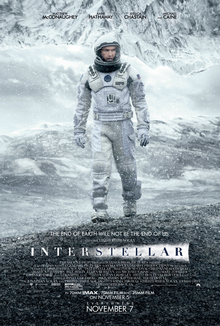
There aren't a lot of huge, big name directors making movies in Hollywood right now. You know, those directors that if they're behind a film makes it a must-watch film. I put Christopher Nolan high up on that list. The director of the most recent Batman trilogy, Nolan is a big old talent so I was more than curious when I first saw the trailer for his Batman follow-up, 2014's Interstellar. Where does it come down?
It's sometime in the not too distant future and Earth is in trouble as a crop blight is causing the planet to slowly but surely run out of food. Society has changed in countless ways with those people still alive forced to become farmers in hopes of continuing to provide food, among them a former NASA pilot, Cooper (Matthew McConaughey) and his family. Something needs to be done if humanity has any hope of surviving long-term, and Cooper and his daughter may unknowingly hold the key to it all. The former pilot begins to work with NASA on quite the alternate solution. A wormhole has been discovered around Saturn that can transport a spaceship and its crew into far-off galaxies that otherwise would have been impossible to reach. Could there be an alternate galaxy that offers a planet that can sustain human life? Can it be reached? Knowing that the trip will take years to complete, will Cooper go along? The depths and mysteries of the universe await through the wormhole.
In the same way I loved the Batman movies, Inception, The Prestige, I loved Interstellar. This most recent Nolan film has flaws -- no doubt about it -- but there's a sense of what movies could and should be. Even those who are critical of Nolan should be able to admit that this talented director tries something different. He aspires to direct something more, something bigger and something you can't look away from. The story is obviously pretty big (can't do much bigger than the end of Earth) with stunning visuals, solid casting, a memorable score from composer Hans Zimmer, and overall, just something different that I thought worked so smoothly and ridiculously well together. It's a long movie at 169 minutes and could have been trimmed here and there but this is an excellent movie. Highly recommend this one.
Say what you want about Nolan as a storyteller, but I think he's at his best as a big picture sort of guy. Unique ideas, scope and scale, the bigger the better. Where better to bring that to life than the science fiction genre? Nolan tweaks the world we know, adding a few years but a world that seems pretty inevitable for our planet. The plight that ravaged crops worldwide is never addressed head-on. It happened. Let's try and fix it. Humanity's time on Earth is running out with the end fast approaching. With a few quick scenes, some dialogue here and there, we're introduced to this world. What does our future hold? That's the beauty of Nolan's vision. We see future technologies, including robot assistants (voiced by Bill Irwin and Josh Stewart) with unique movements. We see a world far less populated where the accepted ways of living have changed. That's what Nolan does so well. He creates a world with broad strokes laying out the groundwork. He aspires to do something different, something better.
Before I delve into some technical "analysis" (or at least as much as I can imagine), let's deal with some casting. McConaughey makes the most of his first film with Nolan, his Cooper a kind of wild-eyed dreamer with an inventive streak and intellect that makes him seemed destined for bigger and better. I wish McConaughey didn't mumble so much, but the performance itself is very strong, especially his relationship with his 10-year old daughter, Murph (Mackenzie Foy). There's a human side that works really well here, a single father who makes an impossibly difficult decision that could take years away from his time with his daughter and son (Timothee Chamalet) but could potentially preserve mankind's existence. That question pervades much of the second half of Nolan's film. With so much on the line, do you think selfishly or do you think for the bigger good?
There's plenty more in the old casting department. Anne Hathaway plays Brand, a scientist who travels with Cooper into the Saturn wormhole, another intellectual trying to wrap her head around their situation, about making decisions that could cost years and millions of lives. Michael Caine plays her brilliant scientist father with Wes Bentley and David Gyasi playing the other two members of the Saturn wormhole. Now who else to look for? Here's some semi-SPOILERS for you. SPOILERS I don't want to explain much about the rest of the cast in terms of characterization, as in who and what the roles are. That's the fun of where this story goes with some unexpected appearances and characters twists. Those names include Ellen Burstyn, John Lithgow, David Oyelowo, William Devane, Topher Grace, and with some big old-fashioned star power, Jessica Chastain, Matt Damon and Casey Affleck. Chastain and Damon especially leave the best lasting impressions. END OF semi-SPOILERS.
It's hard not to watch Interstellar and not see influences from previous sci-fi movies, most notably Stanley Kubrick's 2001: A Space Odyssey but also including Contact (also starring McConaughey), Planet of the Apes and Armageddon among many others I'm probably forgetting. With the openness of our galaxy and beyond, Nolan is like a kid in the candy store. Much like last year's Gravity, the spacial visual is a stunning backdrop as we see the spaceship Endurance heading into deep space, unexplored space to find something, anything. We're introduced to two quasi-Earth like planets -- one as frightening as the other -- in a galaxy centered around an immense black hole dubbed Gargantua. You get a sense of the immensity of space, of the vastness of what surrounds us and the time it would and does take to get there and back. The screenplay has some fun in the department, time in one dimension moving far slower than someone close by. What's an hour for one character in real-time is several years for another. It's a unique, thought-provoking technique that's used well throughout Nolan's film.
I'm writing this review almost a week after seeing it in theaters. I definitely needed some time to process it, to really think things out. What was my conclusion? There are some plotholes, some issues in storytelling that I thought could have been tightened. As many other far better writers than me have written -- check out Chris' review HERE over at Nothing is Written -- Nolan has a knack for long scenes of exposition that explain everything that's going on. For me, I appreciated these scenes because I wasn't always sure what was actually going on. So yeah, there are issues but none of them did me in to the point where I couldn't take anymore. I loved the idea and thought behind the film, I loved the execution from the spectacle to the visual to the musical score to the cast to a mind-bending story and a moving ending.
Highly recommended. Definitely worth seeing in theaters if you get a chance. It feels like a movie where it will lose some of its impact on a TV.
Interstellar (2014): ****/****
The Sons of Katie Elder
"First, we reunite, then find Ma and Pa's killer...then read some reviews."
Showing posts with label John Lithgow. Show all posts
Tuesday, January 13, 2015
Saturday, June 8, 2013
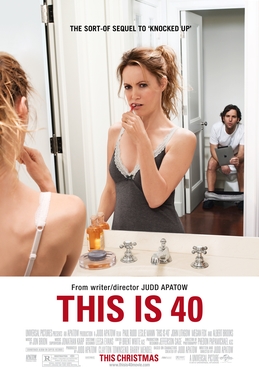
This Is 40
Released in 2007, Knocked Up was a more than worthy follow-up to director Judd Apatow's surprise success with The 40-Year Old Virgin. It was an uneven if funny flick with a whole lot of talent assembled and a decent amount of laughs. Apatow takes a few key characters from 'Knocked' and hits us with a quasi-sequel, 2012's This Is 40.
Married for 16 years, Pete (Paul Rudd) and Debbie (Leslie Mann) are about to hit a big milestone....they're both turning 40. Well, Pete's turning 40, but Debbie refuses to admit she could possibly be 40 years old. Their marriage and home life have hit a bit of a rough patch as Pete's record label is struggling to find a niche while Debbie's boutique losing money by the barrel. Back at home, teenager Sadie (Maude Apatow) is mad at everything while younger daughter Charlotte (Iris Apatow) is just trying to grow up and not get killed by her sister. Both Pete and Debbie are struggling to find any sort of norm and with a whole bunch of problems from marriage to family to finances to work, nothing comes easy, and their marriage is paying the price.
Do you notice anything about the plot description? Well, my first thought upon finishing the movie and then starting the review that nothing about it screams funny. I get it. Life's inherent goofiness, craziness and uniqueness can produce some laughs from a natural place. '40' does have its moments. The cast is far too talented not to get some laughs, even if it was by accident. Those laughs come mostly in the meandering first half of the movie that introduces a whole lot of characters and a whole lot of subplots. It is funny. Apatow does know how to write characters and a solid script, but it also goes down a very dark route in the second half. The laughs are left by the wayside, and '40' turns into one depressing, not so enjoyable movie in the second half.
Key supporting players in Knocked Up, Rudd's Pete and Mann's Debbie get their shots at the lead roles here. While it isn't always funny (far from it), the comedic duo does have a very believable chemistry together. That's not always a good thing though for this longtime married couple who has seen their marriage lose some of its luster. Both are talented actors/comedians, whatever you want to call it, but at a certain point this movie becomes Pete and Debbie screaming at each other over and over again. Oh, and again. I haven't been married for 16 years -- I'm 27 as I write this -- so I don't know about all the good and bad of a 16-year marriage. It feels authentic because obviously marriage isn't a walk in the park. As this marriage though hits a rough patch, it ceases to be an enjoyable film. '40' is too downbeat for its own good, and even talents like Rudd and Mann can't save it from its own darkness.
As a director, writer, producer, Apatow is a very talented guy, and people clearly want to work with him. The supporting cast in basically all his movies illustrate that point. Jason Segel returns as Jason, Deb's trainer who's got a way with the ladies. Albert Brooks is a welcome addition to the cast as Larry, Pete's father who keeps borrowing money, while John Lithgow plays Deb's estranged father. Megan Fox shows she's got some comedic chops as Desi, one of Deb's employees while Chris O'Dowd and Lena Dunham (of HBO's Girls) play two of Pete's record label employees. Robert Smigel is memorable as Barry, Pete's friend.
So obviously a lot of talent is on hand here. At a certain point I got the feeling Apatow just ran with the premise that 'Hey, I'm working with (Insert Star's Name here)!' and didn't know what to do with himself. Oh, and there's more names so keep on reading. It's almost schizophrenic in its entirety. Brooks and Lithgow are somewhat necessary to the story. Other than that? Not so much. Segel is a trainer who wants to hook up with Fox who may or may not be stealing from Deb's store. O'Dowd is a goofy quasi-stoner who wants to hook up with Fox. Dunham makes a couple snarky comments. Smigel is perfect in deadpan fashion. There are too many storylines going on here from Deb and Pete's financial troubles, to a subplot with British rocker Graham Parker, to a drug-laced weekend getaway, to problems with the kids at school. Is this life? Yeah, in some fashion, but that doesn't make it a good movie.
The word that came to mind a lot as this movie wore on was 'self-indulgent.' '40' clocks in at a robust, far too long 134 minutes. With an episodic, drifting story, it goes on endlessly and could have been cut by about 40 minutes. The very funny Melissa McCarthy makes an appearance as a foul-mouthed mother, her improvised scene never ending (and uncomfortable to boot). Returning from Knocked Up, Charlyne Yi is ridiculously unfunny as the pill-popping Jodi, delivering a painfully awkward scene under the drug influence. Did Segel or O'Dowd even need to be in the movie? I wanted to like this movie, but I just couldn't get on board with it. A huge disappointment.
This Is 40 (2012): **/****
Labels:
2010s,
Albert Brooks,
Chris O'Dowd,
Comedy,
Jason Segel,
John Lithgow,
Judd Apatow,
Megan Fox,
Melissa McCarthy,
Paul Rudd
Thursday, March 14, 2013
Twilight Zone: The Movie
Airing for five seasons on CBS between 1959 and 1964, The Twilight Zone is one of the all-time great television shows. A mix of horror, science fiction, paranormal and all sorts of wackiness, almost all the episodes were able to deliver some shocker/twist in the end. It's been revived several times in TV reboots, and even received a big screen adaptation, the much-maligned 1983 Twilight Zone: The Movie, a film shrouded in controversy even before its release.
The story is broken down into four separate segments, including a prologue. The first segment follows Bill Connor (Vic Morrow), a despicably racist middle-aged man who finds himself in a variety of different situations where he's the one being prejudiced against. The second takes place at a retirement home where one of the residents, Mr. Bloom (Scatman Crothers) offers his fellow residents a chance at a new life of sorts. In the third, a young woman, a teacher, Helen (Kathleen Quinlan), is on a road trip west when she meets Anthony (Jeremy Licht) with a strange hold and ability to control his family. And last, John Valentine (John Lithgow), a man who hates flying, is on a cross-country flight and struggling mightily as the plane flies through a storm. Looking out the window, Valentine is absolutely convinced that something is out on the wing, tearing up the engine. No one else on board sees it though. Is he nuts?
I loved the original Twilight Zone episodes from creator/writer Rod Serling so I went into this movie with some at least modest expectations. As a result, I was more than a little worried as I watched the prologue, two men (Albert Brooks and Dan Aykroyd) driving at night on a road trip out in the desert. The tone was okay -- feeling like a set-up -- if a little odd, but a really stupid twist (supposedly a shocker?) comes completely out of left field. If it was supposed to be a shocker, it came across as laughable. Thankfully, it wasn't a complete harbinger of what was to come. For the most part, the movie does what it's supposed to do. It's creepy, unsettling and plays like a tribute to the original show. Is it perfect? No, not at all. Of the four segments, one is really good, two only good, and one really bad.
Beyond the actual movie, 'Zone' is known for a horrific accident that claimed the lives of three cast members on-set, including star Vic Morrow. Filming the movie's opening segment, Morrow and two child actors were killed when a helicopter crashed onto them after several explosions sent the helicopter out of control. There is actually some horrifically brutal footage of the accident via Youtube if you're curious. It's sickening stuff. The accident put the film in limbo, producers and the studio debating whether to continue with the film. The first segment's director, John Landis, took a ton of heat for the accident (understandably so), even getting through a lawsuit that ruled no one was at fault for the accident. With absolutely no disrespect meant to Morrow or the two child actors, a cloud hung over the film's production and eventual release. The opening segment with Morrow is one of the "only good" segments, but it's difficult to watch it without thinking about what actually happened in bringing this portion of the film to life.
Almost as a novelty, the four segments were divided by four different directors, Landis, Steven Spielberg, Joe Dante and George Miller. The odd part? Spielberg -- the most accomplished of the four by far -- delivers the weakest segment of the film by far. Apparently Spielberg was greatly affected by Morrow's death and debated even continuing the film. He did stick with it, but biographies claim the director just mailed in the effort, and it shows. While Crothers does a good job in his part, the segment plays like a happy go-lucky after school special. In other words? Nothing like the best Twilight Zone episodes, not even the average ones. Directing the prologue and the opening portion, Landis' parts are hit or miss. The Morrow story is good, but it had to be edited on the fly following Morrow's death. The end result is a rather abrupt ending.
Thankfully, the final two portions make up for the somewhat slow start. The Joe Dante portion is based off a Zone episode titled 'It's a Good Life' with the original star, Bill Mumy, making a quick appearance. Quinlan does a fine job as Helen, the young teacher thrust into something she can't even comprehend at first. 12-year old Licht is incredibly creepy as young Anthony, a boy with special powers. Also look for Kevin McCarthy and William Schallert in key parts. The highlight though is George Miller's segment, based off maybe the most well known and classic Twilight Zone episode ever, 'Nightmare at 20,000 Feet' starring William Shatner. Lithgow's performance as an obsessed, possibly paranoid airline passenger is the best performance in the entire movie. It is a truly unsettling segment, also delivering the biggest and best twist of all the four stories.
In the end, the TV show turned movie is a mixed bag. More than a movie that stands on its own, it plays like a tribute without a whole lot originality. Wrapping up at just 101 minutes, it covers a whole lot of ground. Could 15-20 more minutes have aided the cause? Maybe not, but it couldn't have hurt. Also listen for Burgess Meredith as the narrator, transitioning from story to story and keeping us mildly informed....as much as the Twilight Zone will allow!!! Imagine a dun-dun-duh!!! at the end of that statement.
Twilight Zone: The Movie (1983): ** 1/2 /****
Labels:
1980s,
Albert Brooks,
Dan Aykroyd,
Horror,
John Landis,
John Lithgow,
Kevin McCarthy,
Sci-Fi,
Steven Spielberg,
Vic Morrow
Monday, January 28, 2013
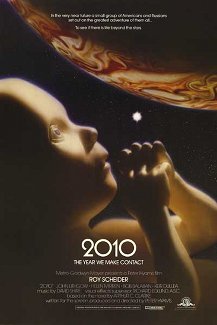
2010
I admitted it. I didn't "get" 1968's 2001: A Space Odyssey, not by a long shot. Crazy visuals, light on story, and it didn't live up to the high expectations I went in with. But ah, there's a bright spot! A sequel! Go figure, I'm usually not a fan of sequels, but I had to give it a chance so here goes with 1984's 2010.
It's been nine years since the sudden and mysterious disappearance of the U.S. spaceship Discovery, and Dr. Heywood Floyd (Roy Scheider) still struggles with what happened. In charge of the mission that went deadly awry, Floyd was blamed for the debacle, but he may have a chance to redeem himself. American efforts are being made to investigate, sending a second ship to Jupiter and its moons (where Discovery disappeared), but he is approached by Russian agencies who are ahead of schedule and will get to Jupiter first. Undertaking a risky, even suicidal mission, Floyd and two other Americans (John Lithgow and Bob Balaban) join the Russian space expedition. What secrets do the moons, Jupiter, the Discovery and maybe space itself hold for the astronauts?
Highly respected and regarded as an all-time classic, Stanley Kubrick's 2001: A Space Odyssey is far from a traditional movie. In fact, it's everything non-traditional about modern films. From director and writer Peter Hyams, '2010' is similar in its story matter and characters, but other than that, it is the complete polar opposite. It is a far-more traditional science fiction thriller, and a smart one at that. For lack of a better description, it is an easy movie to "like." Compare the two; 2001 is a movie to sit back and watch, to appreciate, but not necessarily enjoy. On the other hand, 2010 is far more easily digested. It's smart, but not condescending. Sure, it's not perfect. That's the risk that happens when a sequel is made for a movie that didn't need a sequel in the first place. It's worth it though, and a film I enjoyed significantly more than its predecessor.
So I wasn't much of a fan, but I can appreciate that 2001 does not require a sequel. Its unanswered questions are oddly perfect in that decision to remain unanswered. It allows viewers to wrap their head around the story as they so choose, not as the movie dictates. That's why I both liked and disliked this sequel. In the more traditional sense, 2010 builds a story in a far more linear fashion. We learn more about the HAL-9000, its background, and why it malfunctioned the way it did. Did we need those answers? No, but it's nice to see. We learn a little more about the mysterious monoliths popping up around the world. Did we need those answers? Nope once again. But necessary or not, they come around as worthwhile. It's nice to see the effort made as goofy as it sounds. I came away eternally frustrated with 2001, but I didn't have that same sentiment here in the least. Maybe that's a pity positive vote, but so be it, I'm sticking by my guns.
With a focus more on the space, science and mystery, the characters and their background can be a secondary thing here. The actors do their best to humanize their parts, but it's more a means to an end. We see how these highly trained, highly intelligent individuals respond in a hellish, life or die situation. Scheider does a fine job (as usual) as Dr. Heywood, a man looking for answers and to right a wrong. His recorded letters to his wife (Madolyn Smith Osborne) become a little tedious in an effort to humanize him, but that's a minor complaint. Lithgow plays Dr. Curnrow, the builder/designer of the original Discovery, with Balaban playing Dr. Chandra, HAL's creator, desperately trying to prove his creation did nothing wrong, the two other Americans on-board the Russian ship. Helen Mirren -- rocking an awesome Russian accent -- plays Capt. Kirbuk, the commander of the Russian ship, with Elya Baskin very good as one of the crew who bonds with Curnrow.
The moments that do work here are home runs knocked out of the park. With 16 years of improved technology, the special effects are very cool, if a little more understated than the original. Approaching Jupiter and its moons, Europa and Io, are some stunning sequences. The mid-space transfer from the Russian ship to the Discovery is similarly impressive, especially when you think about what's actually going on. '2010' has its moments of scares too, truly frightening. I've long said this in deep space reviews. You don't know what the universe truly contains. All sorts of things -- both good and bad -- are out there. Deep space could hide anything. Is it out there to help us or hurt us? The development of the monoliths certainly opens up that door. What is their ultimate purpose?
Maybe the biggest fear comes in a chilling, highly effective reappearance by Keir Dullea who played Dr. Dave Bowman in the original 2001, mysteriously disappearing in the end. His appearance halfway through the movie is genuinely startling, and the more we see, the creepier and more chilling it gets. His final line in 2001, "My God, it's full of stars!' provides much of the jumping off point here, and the impending changes his "being" implies set the tone for a genuinely creepy final hour. What awaits the rescue crew, and on a bigger level, Earth and mankind itself? I didn't love the ending, but I liked it a lot, especially the final scene. It's easier to judge these movies on a separate level. For me though, I liked the sequel significantly more than the original, even if it was vastly different movies.
2010 (1984): ***/****
Labels:
1980s,
Bob Balaban,
Helen Mirren,
John Lithgow,
Roy Scheider,
Sci-Fi
Monday, February 6, 2012
Memphis Belle
My favorite book, Joseph Heller's Catch 22, is a fictional account of American bombers in World War II flying over Italy, trying to survive the lunacy and craziness of war. It is an intensely funny story in its dark humor. At its base though, the story of the pilots and crews of the bombers and fighters is an incredibly heroic story, like it is documented in 1990's Memphis Belle.
It's May 1943 and World War II is very much still up for grabs. On a daily basis, hundreds of Allied planes fly over Europe -- especially France and Germany -- bombing key targets, but the daytime raids have produced heavy casualties. Among the crews of the Eighth Air Force is the Memphis Belle, a B-17 bomber commanded by Capt. Dearborn (Matthew Modine) with co-pilot Luke Sinclair (Tate Donovan), navigator Phil Lowenthal (D.B. Sweeney) and bombardier Val Kozlowski (Billy Zane). The Belle has made it through 24 missions virtually unscathed and now sits one mission away from being rotated home. Army public relations (including smarmy John Lithgow) has caught wind of the remarkable story and plans to make national heroes out of the crew. The 25th mission awaits though, a heavily guarded factory deep in Germany in the city of Bremen. Can the Belle's luck hold out once more?
The reviews from critics and fans are fairly positive, but not quite as positive as I thought they'd be. I loved this movie. It is cliched at times and relies on some well-worn story points, but the cliches have to come from somewhere, right? Like so many of the best war movies, director Michael Caton-Jones doesn't glorify war and all its brutality. Instead, he glorifies the men who fought the war. What they did regardless of personal beliefs and convictions was heroic, putting their lives on the line. Add in the element of being so close to going home, and that heroism and fear is ratcheted up. Even in the mission, there are moments where Modine's Captain could basically save them all, but they continue on with the objective. They fight through their worries, concerns and fears, working together to accomplish something bigger than them.
I was somewhat surprised that the movie focuses exclusively on that last mission, the 25th, because I was expecting more of a tour of duty story. Glad I was wrong though because having the story take place over 24 hours is a stroke of genius. The tension, the impending doom, the possibility of failure keep 'Belle' moving at a lightning pace. Much of the last 2/3 of the movie is set entirely in the Belle, giving a claustrophobic, closed in feel. You feel like you're flying over Germany with the crew, almost willing the plane and crew to make it. Not surprisingly, the mission doesn't go off without a hitch. The tension is unbearable as the mission continues, right up until the ending. Is it ever really in doubt? Not really, but Caton-Jones does a great job of at least keeping you guessing. Credit to him for keeping the viewers on their toes.
The ensemble cast here assembled is interesting because in 1990, these were a lot of rising stars. The catch? None of them ever became truly huge stars. The story at 106 minutes manages to give each member of the crew some much-needed characterization. It's not in-depth by any means, but we at least get a sense of who these men are. Modine, Donovan, Sweeney and Zane are nicely cast as the officers of the Belle. No one truly stands out because they're all just solid. That's a positive if it didn't come out that way. The crew includes Eric Stoltz (radioman), Sean Astin (ball turret), Harry Connick Jr. (tail gunner), Reed Diamond (nose gunner), and Courtney Gains and Neil Giuntoli as the waist gunners. Stoltz as the intellectual and Connick Jr. (even getting a chance to sing) stand out from the group. Also worth mentioning is David Strathairn as the group commander, making the most of a small part.
As far as war movies go, 'Belle' has a handful of truly powerful, moving sequences that make it memorable, rising above so many others. Connick Jr. sings Danny Boy quietly the night before the final mission to a silent hangar packed with people (watch it HERE). Riding out to the plane, the crew softly sings Amazing Grace to themselves. It could have been too artsy or pretentious, but it works. Arguing with Lithgow's PR officer, Strathairn reads letters he's received from the families of his pilots and crew members killed in action. The mission itself has too many moments like that, the feeling like you've been punched in your throat. It's the type of moments that make a good movie a great one. You can watch the entire movie HERE at Youtube.
Memphis Belle <---trailer (1990): ****/****
Labels:
1990s,
Billy Zane,
D.B. Sweeney,
David Strathairn,
John Lithgow,
WWII
Saturday, December 3, 2011
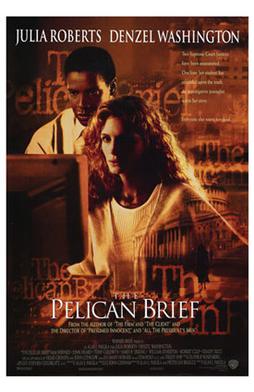
The Pelican Brief
Two U.S. Supreme Court judges have been assassinated, and no one knows where to start. A Tulane law student, Darby Shaw (Julia Roberts), starts her own investigation and gives her findings to boyfriend/law professor, Thomas Callahan (Sam Shepard). The brief she's written seems a little far-fetched, but in the intelligence community it has hit a nerve. Anyone associated with the brief starts turning up dead, leaving Darby to assume she's next. She turns to an investigative reporter, Gray Grantham (Denzel Washington), working in Washington D.C. for help. Darby and Gray begin to look into her findings, realizing they've stumbled into something bigger than them. Can they prove the brief as accurate before they too are taken care of?
Any movie based off a John Grisham novel is off to a flying start so 'Pelican' earns points before the movie has even started. Directed by Alan J. Pakula, this government thriller is polished and professional, well-told and well-executed. It keeps you guessing, giving you that uncomfortable feel of a shady, sinister government up to no good. Would you expect anything less from the director of All the President's Men? The movie is maybe a little long at 141 minutes, but it doesn't drag, staying true to Grisham's novel. James Horner's score is a good one, using samples from Glory and Braveheart among a few other recognizable stings.
Starring together in 1993, Roberts and Washington were two of the rising stars in Hollywood. As so many reviews point out, no one does distressed and terrified quite like Julia Roberts. Playing Darby Shaw, Roberts does a good job of making her character frazzled without being obnoxious. Seeing what she sees? I don't blame her being frazzled. She composes herself and turns it outward, intending to prove her theory right. As the bloodhound-like investigative reporter, Washington has the best part as Gray. He can sniff out a story and get it to print like few others can. Once they meet about halfway through the movie, 'Pelican' picks up some, Roberts and Washington showing off an easy-going, likable chemistry. Good performances to lead the way.
Like any good thrillers, this is a movie that unsettles you in an incredibly smart way. They aren't 'Gotcha!' moments. Instead, they're quiet moments that build up the tension. Is someone waiting around a corner to kill you? More importantly, who's behind all this killing? The idea/premise of a government agency with all its resources trying to kill one person is what so many government thrillers are based in. What's one little murder to people like that? You never know when they'll strike or where, and that's where 'Pelican' works so well.
The performances in support of Roberts and Washington are something else. With a long list of speaking roles, most are only around for two or three scenes so enjoy them, and don't blink! Robert Culp is particularly memorable as the President of the United States, Tony Goldwyn playing his shifty Chief of Staff. Stanley Tucci is startling as Khamel, an assassin with seemingly no rival. John Lithgow plays Smith, Gray's beaten-down but trusting newspaper editor. Playing the head of the FBI, James Sikking is just the right amount of ability and paranoia, balancing out someone turning on him at any time. Even Hume Cronyn makes a quick appearance as an aging Supreme Court Justice. That is by no means all of the names worth mentioning, but the list could go on for several more reviews. Lots of talent assembled here, lots of recognizable faces.
I was surprised to find a relatively modest 6.3 rating out of 10 at IMDB for this movie. It isn't anything that new, and the ending is a little too tidy, but I enjoyed it nonetheless. Well-written and with good performances from top to bottom. You can't ask for too much more in a movie.
The Pelican Brief <---trailer (1993): ***/****
Wednesday, September 7, 2011
Rise of the Planet of the Apes
If you're going to try and re-energize a franchise though, this summer's surprise hit, Rise of the Planet of the Apes, is a cookie cutter example of how to pull it off successfully. For fans of the original movies, this newest venture is a mix between Escape, Conquest and Battle with some tweaks here and there to keep us interested. Thankfully director Rupert Wyatt doesn't go for the status quo. It is new. It is interesting from the get-go, and he makes a wise choice. Midway through the movie, the attention is turned from the man and chimp relationship to almost exclusively a story that focuses on the apes. What was surprising is how well the technique works in a movie that genuinely caught me off guard in terms of quality and entertainment value.
Working for a pharmaceutical company in San Francisco, doctor Will Rodman (James Franco) has worked for years on a cure for alzheimer's disease through case studies on chimps. Over five years he has little luck until he starts to work with Caesar, the orphaned infant baby of the one chimp who showed signs of progress. Will is amazed at what he sees over the coming months and years, Caesar growing physically obviously but also taking leaps and bounds forward in terms of intelligence, comprehension and understanding. No matter what happens though or how much he grows and learns though, Caesar is still a monkey and no one quite knows what to do with him. One day, the ever-intelligent chimp defends Will's father (John Lithgow) from a berating neighbor, sending both him and Will down a path where nothing good can come from it.
I watched the movie, and a lot of things rolled around in my head. First, I came away very impressed. It is an impressive, well-told story in terms of scale, but there is a genuine emotion in the proceedings, Will and Caesar and their father/son or brotherly relationship developing. That's probably the best place to start, British actor Andy Serkis who stands in via computer-generated images as Caesar, bringing this highly intelligent chimpanzee to life, making him a full-fledged, red-blooded, 3-D character that you end up rooting for. The serum he takes boosts him to almost a man-like state. Serkis has done work like this before, like Peter Jackson's King Kong and Gollum in Lord of the Rings, but this movie sinks or swims on his performance. All the chimps, apes, and gorillas we meet are CGI so either you buy it or you don't.
The original Apes movies had a certain cheese-ball charm because it was humans dressed as apes. Not the case here. Credit to Serkis and all the techs and engineers for making us believe in and root for these mistreated animals pushed far beyond any normal limits. The Caesar character -- and his relationship with Franco's Will -- is the heart of the movie, especially as we see the chimp develop, taking a power position among the other imprisoned apes at a "sanctuary" run by Brian Cox and Tom Felton. There's the potential for this to go badly and to go badly quickly, but Serkis and Co. commit to the material. I believed what I was watching and was rooting for them. The Caesar character is a perfect lead, better than I could have ever hoped.
That is important when you consider most of the human roles go one of two ways. There are the good humans -- Franco, girlfriend and veterinarian in a pointless role Freida Pinto, scene-stealing Lithgow, monkey handler Tyler Labine -- and the epically bad, like Cox, Felton (Draco Malfoy from the Harry Potter movies), David Oyelowo's evil pharmaceutical CEO interested in the $, and berating neighbor David Hewlett. Franco is good in a thankless role that has him overshadowed by his CGI-monkey counterpart, and it's always good to see John Lithgow, even in a supporting role. The bad guys? Well, they're the type of bad guys you just know are going to die horrifically basically from the minute they're introduced. The parts for the human roles are necessary but not essential to the story. They're there to help move things along, and that's all. Don't be bad is all the script requires of them.
So this is Rise of the Planet of the Apes, right? At some point the apes have to take over, right? You won't be disappointed. Caesar develops in front of our eyes from a intelligent, thoughtful young chimp into an ultra-intelligent, clear-thinking grown chimp able to plan and think ahead. Beaten and abused at the sanctuary, he leads an escape as a small herd (right word? Eh, beyond the point) of monkeys, also given the serum that makes them smarter. They go on a rampage through San Francisco, trying to get across the Golden Gate Bridge to the Redwood Forest outside the city. The escape and rampage sequence is like a release for the audience. For one, it's an adrenaline-pumping action scene, highly intelligent apes on the attack, especially the showdown at the Golden Gate. This all sounds ridiculous as I re-read this, but somehow and some way it works. It just does in a way I never thought it would.
Who thought that would happen? I really liked this movie. Did my skepticism and lowered expectations have something to do with it? I honestly don't think so. The story is engaging, the characters -- especially Caesar -- are very interesting, and it's even cool to see the interactions among the chimps, apes and gorillas as they organize. San Francisco is an ideal setting, and composer Patrick Doyle has a score that is solid without being overpowering, working with what's happening on the screen as opposed to against it. There was the potential with a movie about smart apes for an over the top, cartoonish story that could have been truly awful, just a bad movie. 'Rise' avoids all those pitfalls. I hopefully look forward to any sequels coming down the road in the future because this was a great reboot of a franchise.
Rise of the Planet of the Apes <---trailer (2011): *** 1/2 /****
Labels:
2010s,
Andy Serkis,
Brian Cox,
James Franco,
John Lithgow,
Planet of the Apes,
Sci-Fi
Subscribe to:
Posts (Atom)