The Sons of Katie Elder

The Sons of Katie Elder
"First, we reunite, then find Ma and Pa's killer...then read some reviews."
Showing posts with label Robert Culp. Show all posts

Wednesday, January 29, 2014

PT 109

John F. Kennedy  is known for any number of things from a tragically shortened life. His beautiful wife, Jackie, his supposed affairs with Marilyn Monroe among others, his charm and popularity, his turbulent presidency that included the Cuban Missile Crisis, and most tragically, his assassination under the rifle of Lee Harvey Oswald. One of the most fascinating parts of his adventure-filled life? His World War II exploits as told in 1963's PT 109.

While the fighting rages in the Solomon Islands in the Pacific in 1943, Lt. John F. Kennedy (Cliff Robertson) arrives at a small naval base specializing in patrol torpedo boats (PT) meant to keep Japanese forces at bay. Kennedy is given command of PT 109, a beat-up old boat that has seen far better days. He's given just a week to get the 109 ready for action, assembling a crew, including Ensign Leonard Thom (Ty Hardin), cleaning the boat, and rehabbing the engines. They manage to come in under deadline, Kennedy, his crew and the 109 thrust immediately into action. The day-to-day life of a PT boat is a dangerous one though, the boats meant to be used to buy time while the U.S. Navy still tries to recover from Pearl Harbor. Patrols, routine or not, rescues, deliveries, Kennedy and his crew take it all on, but the mission that will put them all in the history books awaits one pitch-black night in the Blackett Strait in the Solomon Islands.

One of my favorite movies growing up, I can still go back and visit this 1963 WWII movie from director Leslie H. Martinson and enjoy it from beginning to end. This isn't the most hard-hitting of movies, but like some other WWII movies from Warner Bros., there is a distinct visual look, a professionalism and a straightforward style that plays well. Could things be tightened up a bit with a 140-minute movie? Sure, here and there, but it's an excellent story and film just the same. It was filmed in the Florida Keys, and it's sunny and sandy with plenty of palm trees to help stand in for the Solomon Islands in the Pacific. The musical score from composers David Buttolph and William Lava knows when to lighten the mood and when to show the developing drama, a score that sounds similar to another Warner Bros. WWII movie, 1962's Merrill's Marauders.

Released in theaters less than six months before his death in Dallas, PT 109 was made with the help of Kennedy right in the midst of his term as President. He even had final say on the actor who would play him, Robertson being his ultimate choice. It ends up being a great pick, one that makes the movie far more memorable in my eyes. Besides the striking physical resemblance -- look at Robertson in an iconic JFK picture HERE -- Robertson nails the heroic, likable, charming part of a future American president. That's the movie's goal, to show Kennedy as a hero. More on the details in the next paragraph, but Kennedy's actions were more than enough so Martinson didn't have to stretch things too much. Robertson's Kennedy is smart, quick with a comeback and a plan, a leader who's respected by his men and fellow officers, and a capable commander with a knack for doing the right thing. It's not the most in-depth characterization, but it never set out to be. Kudos to Robertson, already one of my favorites.

Semi-SPOILERS from here on in. The truth of the story behind PT 109 is remarkable in itself. Patrolling in the Blackett Strait a dark August night, the 109 was struck by a Japanese destroyer similarly on patrol. Kennedy's boat was ripped in two pieces, two crewmen killed in the collision. Banding the men together, Kennedy got the survivors to swim to a far-off island and hopefully wait for survival. What followed is and was an inspiring story in itself, Kennedy ultimately winning the the Congressional Medal of Honor for his heroic actions. The movie itself is divided into two halves, the first introducing Kennedy, the crew, the boat and their exploits, the second half following its chapter in history as a Japanese destroyer tears the little boat apart. Both halves are excellent, but it's hard to beat the second half as the survivors desperately wait for help in one form or another, Kennedy swimming out into the Strait at night to flag down an American ship.

While the focus is obviously on Robertson as Kennedy, the supporting cast is very solid without stealing the spotlight. Hardin as 2nd-in-command Ensign Thom has a good chemistry with Robertson, Robert Blake, Norman Fell, and Biff Elliot starring as the most visible of the 109's crew. James Gregory is a scene-stealer as Commander Ritchie, the leader of a squadron of PT boats, a veteran officer who's never seen combat but is always searching for the best out of his men. Even Robert Culp shows up at the halfway point as Ensign Barney Ross, an old friend of Kennedy's who ends up on the 109 for its fateful mission, Michael Pate making a memorable appearance as Evans, an Australian coastwatcher who plays an integral part in the eventual rescue of Kennedy and the remaining survivors. Also lending his voice talents in an uncredited narrator role is Andrew Duggan

This isn't a WWII movie that rewrites the genre. It is a movie meant to honor the heroics of future president John F. Kennedy, and it does it well. Exciting with some good action, some genuine laughs and some lighter moments, and Robertson in a great leading part as Kennedy himself.

PT 109 (1963): *** 1/2 /****
Rewrite of August 2010 review

Saturday, December 3, 2011

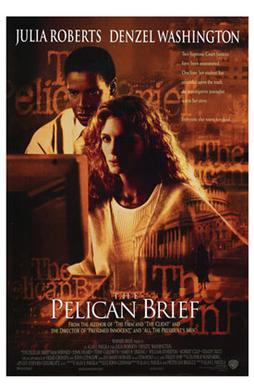
The Pelican Brief

Serial killers, lunatic murderers, freaky alien attacks, deranged animal assaults; all creepy and scary in their own way, all played up in all sorts of movies. What could be the creepiest thing? How about a government meant to protect and look out for its people up to all sorts of shady activities? Conspiracies left and right with millions and even billions of dollars on the line to the point where a few lives don't matter. Nothing flashy, just good entertainment, 1993's The Pelican Brief.

Two U.S. Supreme Court judges have been assassinated, and no one knows where to start. A Tulane law student, Darby Shaw (Julia Roberts), starts her own investigation and gives her findings to boyfriend/law professor, Thomas Callahan (Sam Shepard). The brief she's written seems a little far-fetched, but in the intelligence community it has hit a nerve. Anyone associated with the brief starts turning up dead, leaving Darby to assume she's next. She turns to an investigative reporter, Gray Grantham (Denzel Washington), working in Washington D.C. for help. Darby and Gray begin to look into her findings, realizing they've stumbled into something bigger than them. Can they prove the brief as accurate before they too are taken care of?

Any movie based off a John Grisham novel is off to a flying start so 'Pelican' earns points before the movie has even started. Directed by Alan J. Pakula, this government thriller is polished and professional, well-told and well-executed. It keeps you guessing, giving you that uncomfortable feel of a shady, sinister government up to no good. Would you expect anything less from the director of All the President's Men?  The movie is maybe a little long at 141 minutes, but it doesn't drag, staying true to Grisham's novel. James Horner's score is a good one, using samples from Glory and Braveheart among a few other recognizable stings.

Starring together in 1993, Roberts and Washington were two of the rising stars in Hollywood.  As so many reviews point out, no one does distressed and terrified quite like Julia Roberts.  Playing Darby Shaw, Roberts does a good job of making her character frazzled without being obnoxious. Seeing what she sees? I don't blame her being frazzled. She composes herself and turns it outward, intending to prove her theory right. As the bloodhound-like investigative reporter, Washington has the best part as Gray. He can sniff out a story and get it to print like few others can.  Once they meet about halfway through the movie, 'Pelican' picks up some, Roberts and Washington showing off an easy-going, likable chemistry. Good performances to lead the way. 

Like any good thrillers, this is a movie that unsettles you in an incredibly smart way. They aren't 'Gotcha!' moments. Instead, they're quiet moments that build up the tension. Is someone waiting around a corner to kill you? More importantly, who's behind all this killing? The idea/premise of a government agency with all its resources trying to kill one person is what so many government thrillers are based in. What's one little murder to people like that? You never know when they'll strike or where, and that's where 'Pelican' works so well.

The performances in support of Roberts and Washington are something else. With a long list of speaking roles, most are only around for two or three scenes so enjoy them, and don't blink! Robert Culp is particularly memorable as the President of the United States, Tony Goldwyn playing his shifty Chief of Staff. Stanley Tucci is startling as Khamel, an assassin with seemingly no rival. John Lithgow plays Smith, Gray's beaten-down but trusting newspaper editor. Playing the head of the FBI, James Sikking is just the right amount of ability and paranoia, balancing out someone turning on him at any time. Even Hume Cronyn makes a quick appearance as an aging Supreme Court Justice. That is by no means all of the names worth mentioning, but the list could go on for several more reviews. Lots of talent assembled here, lots of recognizable faces.

I was surprised to find a relatively modest 6.3 rating out of 10 at IMDB for this movie. It isn't anything that new, and the ending is a little too tidy, but I enjoyed it nonetheless. Well-written and with good performances from top to bottom. You can't ask for too much more in a movie.

The Pelican Brief <---trailer (1993): ***/****

Monday, October 10, 2011

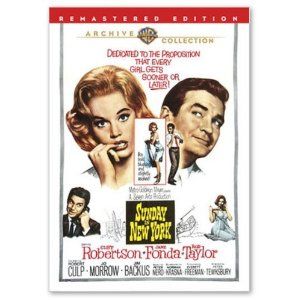
Sunday in New York

A member of one of Hollywood's royal families, Jane Fonda can be remembered for a lot of things. Her controversial visit to North Vietnam, earning her the nickname Hanoi Jane, is certainly at the top of that list. In the 1980s, she "reinvented" herself in a way, releasing a series of exercise tapes. None of this even mentions her film roles, including campy space sex romp Barbarella or her five Academy Award nominations or two Oscar wins. Before all that though? A handful of light 1960s romantic comedies, including 1963's Sunday in New York.

Now as I write this in an age of inept, annoying and downright awful romantic comedies, it's safe to say that the concept of romantic comedies has taken a bit of a hit, a public relations debacle. At some point, romantic comedies stopped being romantic, smart and enjoyable, resorting to moronically stupid stories that put stereotypes to shame and characters doing things no sane or rational person would ever do. Just because it was released in the 1960s doesn't mean these are perfect movies. But there is a charm, a style, and a sense of enjoyment that has been lost in so many movies since.

After a bad breakup with her fiance, 22-year old Eileen (Fonda) visits her older brother, Adam (Cliff Robertson), in New York City, planning to spend a week or so with him and just get away from her problems. She corners him, asking if men are only interested in sex in relationships. A globe-trotting airline pilot and all-around ladies man, Adam does the only thing he can do for his sister's benefit...he lies. Eileen isn't so sure, meeting Mike (Rod Taylor) later that day and hitting it off immediately with him. She intends to put Mike to the test to see if he'll be interested if she throws herself at him.  Her plan doesn't go quite as planned though, putting her in an awkward situation when her ex-fiance, Russ (Robert Culp), bursts into the apartment with Eileen and Mike only wearing bath robes. Uh-oh, Eileen's got some explaining to do.

More than the well-written, semi-intelligent script or the interesting and still believable characters, there is that style and charm in 'Sunday' that you just can't duplicate.  Director Peter Tewksbury shot the movie on location in NYC, and let's face it, it is hard to mess up that city in a movie, especially downtown Manhattan.  It could serve as a companion piece to Breakfast at Tiffany's, (released two years earlier), serving as a time portal into a very cool city some 50 years back. All the guys wear suits (at all times too), the ladies get dolled up to go out. Adam's apartment -- where much of the shenanigans take place -- is immense and ends up being an additional character. Imagine the Friends' apartment in 1963, and you've got your set. The whole story takes place in under 24 hours -- that one rainy Sunday afternoon -- but never feels rushed. Charm and style, 'Sunday' has it to spare.

As for the semi-intelligent part involving the script, this movie was probably a little shocking to audiences in 1963. Now, it seems tame although there are some instances that caught me off guard watching it for the first time. Fonda's Eileen is a virgin, wondering if she's the last one on the planet. Culp's Russ dumped her because their relationship wasn't developing physically quick enough for his liking. Fonda even makes a reference to Russ having to play "handball" several times a week (that line and Fonda's delivery really cracked me up).  The point is though, it's never dirty or filthy, just adults talking about sex and relationships.  It will seem tame to modern audiences, but you enjoy the story and its developments and the characters. Smart? Maybe not, but it feels real.

A well-written script is one thing, but having the actors/actresses to pull it off is another thing. 'Sunday' goes 4-for-4 in that department. Fonda is the all-American girl here, so perfectly cute that you can't help but like her.  Her chemistry with Taylor is as natural as they come, their friendship/relationship serving as an easy blue print for what romantic comedies should aspire for. As for Taylor and Robertson, neither would seem like an obvious choice for their parts, both men more at home in a "guy's movie." They're too talented not to leave a positive impression though, both getting a chance to show off their lighter, comedic sides. Culp is the unknowing dupe, the somewhat sympathetic but mostly clueless boyfriend. Also look for Jim Backus as Drysdale, Robertson's flight controller boss, and Jo Morrow as Mona, Adam's girlfriend who just can't seem to buy a break.

For all my writing about an intelligent romantic comedy, the last third of the movie does resort to a needlessly ridiculous plot twist about a case of mistaken identity. Culp thinks Taylor is Fonda's brother, not a stranger she just met, and Robertson is Taylor's pilot friend. Yep, I Love Lucy syndrome, a "dilemma" that could be solved with one simple explanation. It never panders or tries too hard to be funny though, just going along with the developments. A high point is Robertson and Taylor dancing together, showing Fonda how to explain the situation. Physical comedy that isn't overdone. It's just right. Now if only some more recent romantic comedies could be even halfway as good as this one....then we'd have something.

Sunday in New York <---TCM trailer (1963): ***/****