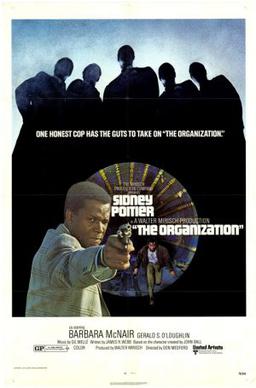
For so many reasons, 1967's In the Heat of the Night was a key movie that helped mark the change of the portrayal of race on-screen. It was a groundbreaking movie, one that's noteworthy for the working relationship between two cops, one black, Sidney Poitier, and one white, Rod Steiger. While that film is fondly remembered though, Poitier returned with the same character in two sequels, 1970s's They Call Me Mister Tibbs and 1971's The Organization.
At a heavily guarded business, a murder has taken place, but there is little in the way of evidence pointing to the culprits, leaving the police and investigating officer Virgil Tibbs (Poitier) grasping at straws. As the investigation develops though, Tibbs is contacted by an urban revolutionary group with some revealing information. They take credit for robbing the business -- a front for a criminal organization -- of $4 million worth of heroin, but nothing about the murder. Tibbs is left to make a difficult decision. Help this group that broke the law (multiple times) even though their intentions were pure, or turn them in to face the law.
My first reaction when I found this movie on TCM's schedule was that Poitier was slumming with these two sequels. I've never seen 'Mister Tibbs' so take that into account here too. These two movies in no way affect the power or effectiveness of 'Night,' but what's the point? Why make two sequels? The original got the message across, and even though Poitier's Virgil Tibbs is one badass character, was there a need for more stories back in his hometown instead of the deep South? Nope, not really. Even more unfortunately, the sequel's script and story just isn't up to par. I'm not a huge fan of sequels to begin with, but if the effort is there I'll at least go along with it for the ride. Moral of the story is simple; cool character does not equal cool movie.
Thanks to Poitier and the San Francisco backdrop for the story, the movie isn't a complete waste of time. The script simply doesn't give Poitier much to do as the lead character. He gets deeper and deeper into this case with no easy way out, but there's nowhere to go other than straight down. We get some background with his wife, Valerie (Barbara McNair), and son (George Spell), even some oddly toned scenes where they talk about the birds and the bees. It's far from Poitier's best work, but even a mediocre performance from him is still worthwhile. There's not much else worthwhile in the character department though, leaving Poitier to do all the heavy lifting.
The sinister aspect of "THE ORGANIZATION" is wasted here because the story never picks a route to take. Instead, it bounces all over the place. The urban revolutionaries (including Raul Julia, Ron O'Neal, Billy Green Bush, Lani Miyazaki among others) could have been given their own movie, but instead they are background players here -- a means to an end -- and they never amount to anything more than that. The Organization and all their henchmen are nameless faces (intimidating if nothing else), and the bosses (Fred Beir and John Lasell) have little personality. This criminal organization is given no background, no history, no truly sinister nature other than what we see, but there's no reasoning or motive. So Poitier's Tibbs wants to take them down, but what's the point?
On the positive, look for 1970s eye candy Sheree North as a woman with a possible link to the case and Gerald S. O'Loughlin as a fellow police officer, Lt. Pecora, working with Tibbs on the investigation. Mostly though, the movie on the whole never connects. The story drifts along without much of an end-game in sight so the chases and shootouts don't amount too much. They're there in the story, but when you're not interested in the story to begin with, those sequences lack any energy or much of an interest level. As Bullitt and the Dirty Harry movies proved, San Francisco is a great backdrop for a cop story so the locations stand out, and Poitier is solid, but there's little else.
The Organization <---trailer (1971): **/****
The Sons of Katie Elder
"First, we reunite, then find Ma and Pa's killer...then read some reviews."
Tuesday, October 2, 2012
Monday, October 1, 2012
Deathwatch
It's difficult to imagine the horror that was trench warfare in World War I. Wasting away in the mud with filth, rats and disease all around, soldiers were rewarded with what amounted to suicidal charges into enemy machine guns. In other words, basically the worst environment available. Maybe because of that situation -- and its general uncomfortable quality for viewing -- WWI movies aren't as prevalent as WWII. So how do we tweak that plan? A horror WWI movie, 2002's Deathwatch.
It's 1917 along the Western Front in France, and Pvt. Charlie Shakespeare (Jamie Bell) and the rest of his infantry company take part in a nighttime charge on a heavily guarded German position. The casualties are horrific, and in the morning Shakespeare and a small group of fellow survivors are lost and separated from any other British units in the fog. They stumble upon a maze-like set of trenches held by just a trio of German soldiers so their commander, Capt. Jennings (Laurence Fox), orders them to hold the position, believing they've taken a forward German position. The group settles in, but something isn't right. Something else is in the trenches with them...some sort of evil.
Poorly reviewed/rated since its 2002 release, Deathwatch is still an interesting -- if heavily flawed -- movie. A lot of it appealed to me, and I'm not usually one for horror movies. That might be its biggest positive though, and that would be the ability to combine genres. A war movie meets a horror movie? You don't see many of those around. A WWI trench is an ideal setting for a movie for the look and feel alone. It rains basically the entire movie, turning the trench into one vast mud pit. The walkways are cluttered with debris, dead bodies and who knows what other horrors. Setting the story in an intricate set of maze-like trenches sounds simple, but it is original and gives a great backdrop to an interesting cross-genre plot.
I've made no secret of my typical dislike for horror movies. I don't like being scared watching movies. I want to enjoy them. That said, 'Deathwatch' is an incredibly uncomfortable, unsettling movie that had me on the edge of my seat. What is it that awaits these British soldiers in the trench? No spoilers here, but it is an unseen -- mostly at least -- evil that seems to pit the soldiers against one another. The trench is literally littered with corpses, German soldiers too. Serial killers, slasher movies, yeah, they're scary. But what about an enemy that is evil incarnate? How do you defeat something that is at its base...evil and in theory, can't be defeated? That sense of doom and foreboding is disgustingly effective here because until late, we don't see what these soldiers are actually up against. A twisting, turning maze can hold all sorts of horrors, and no one knows what to do to combat it.
Combining a war story with a horror movie allows director Michael J. Bassett to use the 'unit picture' idea in his casting; a small group of men from one unit working together to survive some sort of hellish war situation. In one of his first roles, 18-year old Jamie Bell is decent but nothing spectacular as Pvt. Shakespeare, the young soldier trying to overcome a fear that cripples him in battle. Fox as Jennings is the new officer who no one quite trusts. The other noteworthy performances include Hugo Speer as Sgt. Tate, the experienced non-com, Andy Serkis as Wilson, the unhinged killer, Matthew Rhys as Fairweather, the medic, Dean Lennox Kelly as McNess, the clear-thinking, worrying Scotsman, and Hugh O'Conor as Bradford, the religious radioman. The other soldiers include Ruaidhri Conroy, Kris Marshall and Hans Matheson. Torben Liebrecht has a creepy part as Friedrich, a German soldier captured in the trenches.
What splits a lot of people -- myself included -- about this movie is the ending. Spoiling it here with no doubt ruin your whole viewing of the movie, but I will say I liked it....to a point. It feels familiar, like other films I've seen with a similar twist. The last scene leaves the story open to interpretations a little, and the final shot is a startling one that sent a shiver up my back. In general, the story is good, but at times it tries to do too much. It explores religion amidst war, the brutality, goodness in a horrific situation, and a will to survive when everything around you is trying to kill you. The story/script could have been a little more pointed, but I still liked this one a lot. Well worth checking out for a creepy change of pace movie.
Deathwatch <---trailer (2002): ***/****
It's 1917 along the Western Front in France, and Pvt. Charlie Shakespeare (Jamie Bell) and the rest of his infantry company take part in a nighttime charge on a heavily guarded German position. The casualties are horrific, and in the morning Shakespeare and a small group of fellow survivors are lost and separated from any other British units in the fog. They stumble upon a maze-like set of trenches held by just a trio of German soldiers so their commander, Capt. Jennings (Laurence Fox), orders them to hold the position, believing they've taken a forward German position. The group settles in, but something isn't right. Something else is in the trenches with them...some sort of evil.
Poorly reviewed/rated since its 2002 release, Deathwatch is still an interesting -- if heavily flawed -- movie. A lot of it appealed to me, and I'm not usually one for horror movies. That might be its biggest positive though, and that would be the ability to combine genres. A war movie meets a horror movie? You don't see many of those around. A WWI trench is an ideal setting for a movie for the look and feel alone. It rains basically the entire movie, turning the trench into one vast mud pit. The walkways are cluttered with debris, dead bodies and who knows what other horrors. Setting the story in an intricate set of maze-like trenches sounds simple, but it is original and gives a great backdrop to an interesting cross-genre plot.
I've made no secret of my typical dislike for horror movies. I don't like being scared watching movies. I want to enjoy them. That said, 'Deathwatch' is an incredibly uncomfortable, unsettling movie that had me on the edge of my seat. What is it that awaits these British soldiers in the trench? No spoilers here, but it is an unseen -- mostly at least -- evil that seems to pit the soldiers against one another. The trench is literally littered with corpses, German soldiers too. Serial killers, slasher movies, yeah, they're scary. But what about an enemy that is evil incarnate? How do you defeat something that is at its base...evil and in theory, can't be defeated? That sense of doom and foreboding is disgustingly effective here because until late, we don't see what these soldiers are actually up against. A twisting, turning maze can hold all sorts of horrors, and no one knows what to do to combat it.
Combining a war story with a horror movie allows director Michael J. Bassett to use the 'unit picture' idea in his casting; a small group of men from one unit working together to survive some sort of hellish war situation. In one of his first roles, 18-year old Jamie Bell is decent but nothing spectacular as Pvt. Shakespeare, the young soldier trying to overcome a fear that cripples him in battle. Fox as Jennings is the new officer who no one quite trusts. The other noteworthy performances include Hugo Speer as Sgt. Tate, the experienced non-com, Andy Serkis as Wilson, the unhinged killer, Matthew Rhys as Fairweather, the medic, Dean Lennox Kelly as McNess, the clear-thinking, worrying Scotsman, and Hugh O'Conor as Bradford, the religious radioman. The other soldiers include Ruaidhri Conroy, Kris Marshall and Hans Matheson. Torben Liebrecht has a creepy part as Friedrich, a German soldier captured in the trenches.
What splits a lot of people -- myself included -- about this movie is the ending. Spoiling it here with no doubt ruin your whole viewing of the movie, but I will say I liked it....to a point. It feels familiar, like other films I've seen with a similar twist. The last scene leaves the story open to interpretations a little, and the final shot is a startling one that sent a shiver up my back. In general, the story is good, but at times it tries to do too much. It explores religion amidst war, the brutality, goodness in a horrific situation, and a will to survive when everything around you is trying to kill you. The story/script could have been a little more pointed, but I still liked this one a lot. Well worth checking out for a creepy change of pace movie.
Deathwatch <---trailer (2002): ***/****
Friday, September 28, 2012
Sherlock Holmes: A Game of Shadows
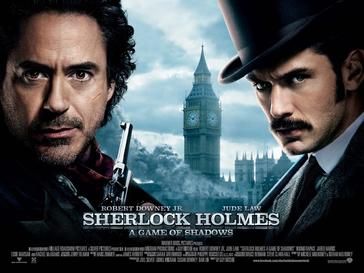
Even re-reading my review for 2009's Sherlock Holmes, I still can't quite put my finger on it. I liked the movie, but there were parts of it that just didn't work for me. It's a little schizophrenic, a lot nutty, and was missing that special element that turns a good movie into a very good one. So what's the difference then with its recent sequel, 2011's Sherlock Holmes: A Game of Shadows? Heck if I know, but I liked it a lot.
It's 1891, and a series of bombings across France and Germany have Europe on edge with countries teetering on the brink of war. Everyone has their theories about the reasoning for the bombings. Terrorists? Anarchists? Assassins? Quirky and eccentric London detective Sherlock Holmes (Robert Downey Jr.) has been feverishly investigating the bombings and has come up with his own theory. A brilliant professor, Moriarty (Jared Harris), is Holmes' main suspect, but Holmes has no proof other than his own wild theories. With the help of his soon to be married loyal sidekick, Watson (Jude Law), Holmes goes about getting that evidence in a case that will have them traveling all over Europe and in all sorts of hijinks.
What's throwing me off here is a criminally simplistic issue. There is little difference overall between the 2009 film and this 2011 sequel. Director Guy Ritchie did a very capable job with the original as he does here. The two movies are almost identical lengths (129 to 128 minutes) and have the same look, feel and tone. All I can come up with is a somewhat more pointed feel to the proceedings. The action isn't so ridiculous. It isn't trying to be hysterically funny, just funny. The scope isn't IMMENSE. Even when a war among European countries looms, the point of view is on a personal level (i.e. Sherlock and Watson) and for me at least, more effective.
It is Guy Ritchie though, and it's got a certain charm and style unto itself. The look of the movie is great, 1890s Europe with its own unique look. It has a cluttered, busy look, but it works with the semi-schizo nature here. One of the best things going is Hans Zimmer's score. As needed, it's big and booming like a historical epic/period piece should be. The most memorable sample though is the main theme, or as I always think of it...Sherlock's theme which you can listen to HERE. It is the perfect quirky, eccentric theme for a quirky, eccentric hero. Yes, overall the script and story is too smart/clever for its own good at times with countless reveals of things we didn't know need to be revealed. Much more than the first movie though, I just had more fun watching this one.
That is no doubt easily chalked up to the continued success in casting. Robert Downey Jr. is one of my favorite actors, and he does a great job bringing Holmes to life. Again, this isn't the prim and proper Englishman. Downey's Holmes is quirky, eccentric, offbeat, brilliant, obsessively observant, and always one step ahead of his rivals. Law's Watson is the perfect sidekick; intelligent, smart and wise but in a way completely different from Holmes. The duo is basically the original Odd Couple. Holmes is upset that Watson is getting married (to Kelly Reilly from the original) and doesn't hide his feelings. Their friendship is basically a perfect match, the two longtime friends arguing like an old married couple. Noomi Rapace is wasted as Sim, a gypsy along for the ride with the duo. Harris is okay as the villain with Paul Anderson as his sharpshooting henchman. Rachel McAdams and Eddie Marsan briefly reprise their roles from the original with Stephen Fry playing Holmes' classier brother.
With a story that's all over the place and never really slows down, some set pieces stand out from the rest. The running gag of Holmes seeing and analyzing what's about to happen...and then doing exactly what he saw is used just the right amount. Not too little, not too much. A running chase/fight in a London casino with a Cossack assassin is impressive as is a chase and gunfight through a Moriarty-owned factory in France with some explosive results. The finale doesn't disappoint either as Holmes and Moriarty finally confront each other. End result? 'Shadows' knows when to tap the brakes where the original was more aggressively in your face. It makes all the difference.
Sherlock Holmes: A Game of Shadows <---trailer (2011): ***/****
It's 1891, and a series of bombings across France and Germany have Europe on edge with countries teetering on the brink of war. Everyone has their theories about the reasoning for the bombings. Terrorists? Anarchists? Assassins? Quirky and eccentric London detective Sherlock Holmes (Robert Downey Jr.) has been feverishly investigating the bombings and has come up with his own theory. A brilliant professor, Moriarty (Jared Harris), is Holmes' main suspect, but Holmes has no proof other than his own wild theories. With the help of his soon to be married loyal sidekick, Watson (Jude Law), Holmes goes about getting that evidence in a case that will have them traveling all over Europe and in all sorts of hijinks.
What's throwing me off here is a criminally simplistic issue. There is little difference overall between the 2009 film and this 2011 sequel. Director Guy Ritchie did a very capable job with the original as he does here. The two movies are almost identical lengths (129 to 128 minutes) and have the same look, feel and tone. All I can come up with is a somewhat more pointed feel to the proceedings. The action isn't so ridiculous. It isn't trying to be hysterically funny, just funny. The scope isn't IMMENSE. Even when a war among European countries looms, the point of view is on a personal level (i.e. Sherlock and Watson) and for me at least, more effective.
It is Guy Ritchie though, and it's got a certain charm and style unto itself. The look of the movie is great, 1890s Europe with its own unique look. It has a cluttered, busy look, but it works with the semi-schizo nature here. One of the best things going is Hans Zimmer's score. As needed, it's big and booming like a historical epic/period piece should be. The most memorable sample though is the main theme, or as I always think of it...Sherlock's theme which you can listen to HERE. It is the perfect quirky, eccentric theme for a quirky, eccentric hero. Yes, overall the script and story is too smart/clever for its own good at times with countless reveals of things we didn't know need to be revealed. Much more than the first movie though, I just had more fun watching this one.
That is no doubt easily chalked up to the continued success in casting. Robert Downey Jr. is one of my favorite actors, and he does a great job bringing Holmes to life. Again, this isn't the prim and proper Englishman. Downey's Holmes is quirky, eccentric, offbeat, brilliant, obsessively observant, and always one step ahead of his rivals. Law's Watson is the perfect sidekick; intelligent, smart and wise but in a way completely different from Holmes. The duo is basically the original Odd Couple. Holmes is upset that Watson is getting married (to Kelly Reilly from the original) and doesn't hide his feelings. Their friendship is basically a perfect match, the two longtime friends arguing like an old married couple. Noomi Rapace is wasted as Sim, a gypsy along for the ride with the duo. Harris is okay as the villain with Paul Anderson as his sharpshooting henchman. Rachel McAdams and Eddie Marsan briefly reprise their roles from the original with Stephen Fry playing Holmes' classier brother.
With a story that's all over the place and never really slows down, some set pieces stand out from the rest. The running gag of Holmes seeing and analyzing what's about to happen...and then doing exactly what he saw is used just the right amount. Not too little, not too much. A running chase/fight in a London casino with a Cossack assassin is impressive as is a chase and gunfight through a Moriarty-owned factory in France with some explosive results. The finale doesn't disappoint either as Holmes and Moriarty finally confront each other. End result? 'Shadows' knows when to tap the brakes where the original was more aggressively in your face. It makes all the difference.
Sherlock Holmes: A Game of Shadows <---trailer (2011): ***/****
Labels:
2010s,
Guy Ritchie,
Jude Law,
Noomi Rapace,
Rachel McAdams,
Robert Downey Jr
Wednesday, September 26, 2012
Shallow Grave
With Slumdog Millionaire and 127 Hours, British director Danny Boyle has put himself on a mainstream map where his name has some pull with audiences. In 1994 though, he was making his directorial debut with none of that recognition. His 1994 film Shallow Grave is a doozy, one that changed his career and sent the British film industry down a detoured path.
Three friends, Alex (Ewan McGregor), David (Christopher Eccleston) and Juliet (Kerry Fox), share an apartment in Edinburgh, Scotland and are looking to take in a fourth roommate. They finally decide on Hugo (Keith Allen), a somewhat mysterious but interesting man about their age, and he moves in quickly. Just a few days later, the trio finds Hugo dead in his room of a drug overdose. More interesting? Alex finds a suitcase packed to the gills with cash. What to do now? The three flatmates decide to dispose of the body -- removing his hands and feet, smashing his skull to pieces -- in a grave in the woods and keep the money for themselves. What seems simple though is far from it as these three soon discover.
Setting the stage for his hit two years later in Trainspotting, Boyle's 'Shallow' is certainly different from just about any movie I've ever seen. The amateur crime aspect is nothing new, but Boyle handles it in ways you wouldn't normally think. He doesn't shy away from the brutality of what they're doing and their repercussions. Some reviews list it as a dark/black comedy, and even though I didn't laugh much, it reminded me somewhat in tone of the dark humor the Coen brothers so often use in dealing with nasty subjects.
As Fox explained it in the special features, this is a movie different from most people's perceptions of a "British movie." It isn't dark, dreary and bleak....well, in visuals at least. Boyle is a very visual conscious director. The apartment is full of bright colors, and that distinct 1990s style is prevalent all around. Alex is a hipster, David a suit-wearing accountant, Juliet a doctor and professional. The style and pacing is kinetic, all over the place, and when things hit the fan, Boyle shoots in the darkness with shadows and a minimal use of lights (flashlights, car headlights illuminating the action). The music threw me off too, from the techno-sounding opening (watch HERE) to the darker, moodier score as the "grave situation" develops. Style-wise, it's easy to see how this film changed the mood and tone of British films for years to come.
Now all that said, I didn't really care for the film much at all. I don't need to love characters -- or even like them really -- to appreciate a movie. Watching awful, despicable characters can be a selling point in a movie. Literally from the first scene here though, I hated...HATED these three main characters. We're introduced to them as they interview applicants for their fourth roommate. McGregor rips the first applicant (Colin McCredie) to pieces, and the gloves come off. They look down on applicants, ripping them to pieces with this type of yuppie-hipster pretentious attitude and within seconds I was rooting against them. To be fair, in the acting department, all three deliver solid performances. Their descent into paranoia and greed affects each of them differently, and it is cool to see that degeneration into something rather ugly.
As the story developed though, that's where I was holding out with some sort of sick hope. The second the trio decide to keep the money for themselves, you know the story won't end well for any of them. The whole tone of the movie speaks to that. But even in that regard, I was disappointed. When things come to a head late, the result is almost comical in its exaggerated depiction. There is a twist in there that works pretty well, but I was so far removed from the movie by that point it probably didn't make the expected impact. Check it out for yourself though at Youtube -- watch it HERE -- and make your own decision.
Shallow Grave <---trailer (1994): * 1/2 /****
Three friends, Alex (Ewan McGregor), David (Christopher Eccleston) and Juliet (Kerry Fox), share an apartment in Edinburgh, Scotland and are looking to take in a fourth roommate. They finally decide on Hugo (Keith Allen), a somewhat mysterious but interesting man about their age, and he moves in quickly. Just a few days later, the trio finds Hugo dead in his room of a drug overdose. More interesting? Alex finds a suitcase packed to the gills with cash. What to do now? The three flatmates decide to dispose of the body -- removing his hands and feet, smashing his skull to pieces -- in a grave in the woods and keep the money for themselves. What seems simple though is far from it as these three soon discover.
Setting the stage for his hit two years later in Trainspotting, Boyle's 'Shallow' is certainly different from just about any movie I've ever seen. The amateur crime aspect is nothing new, but Boyle handles it in ways you wouldn't normally think. He doesn't shy away from the brutality of what they're doing and their repercussions. Some reviews list it as a dark/black comedy, and even though I didn't laugh much, it reminded me somewhat in tone of the dark humor the Coen brothers so often use in dealing with nasty subjects.
As Fox explained it in the special features, this is a movie different from most people's perceptions of a "British movie." It isn't dark, dreary and bleak....well, in visuals at least. Boyle is a very visual conscious director. The apartment is full of bright colors, and that distinct 1990s style is prevalent all around. Alex is a hipster, David a suit-wearing accountant, Juliet a doctor and professional. The style and pacing is kinetic, all over the place, and when things hit the fan, Boyle shoots in the darkness with shadows and a minimal use of lights (flashlights, car headlights illuminating the action). The music threw me off too, from the techno-sounding opening (watch HERE) to the darker, moodier score as the "grave situation" develops. Style-wise, it's easy to see how this film changed the mood and tone of British films for years to come.
Now all that said, I didn't really care for the film much at all. I don't need to love characters -- or even like them really -- to appreciate a movie. Watching awful, despicable characters can be a selling point in a movie. Literally from the first scene here though, I hated...HATED these three main characters. We're introduced to them as they interview applicants for their fourth roommate. McGregor rips the first applicant (Colin McCredie) to pieces, and the gloves come off. They look down on applicants, ripping them to pieces with this type of yuppie-hipster pretentious attitude and within seconds I was rooting against them. To be fair, in the acting department, all three deliver solid performances. Their descent into paranoia and greed affects each of them differently, and it is cool to see that degeneration into something rather ugly.
As the story developed though, that's where I was holding out with some sort of sick hope. The second the trio decide to keep the money for themselves, you know the story won't end well for any of them. The whole tone of the movie speaks to that. But even in that regard, I was disappointed. When things come to a head late, the result is almost comical in its exaggerated depiction. There is a twist in there that works pretty well, but I was so far removed from the movie by that point it probably didn't make the expected impact. Check it out for yourself though at Youtube -- watch it HERE -- and make your own decision.
Shallow Grave <---trailer (1994): * 1/2 /****
Labels:
1990s,
Christopher Eccleston,
Danny Boyle,
Ewan McGregor
Tuesday, September 25, 2012
Cry of Battle
Made on a shoestring budget with a rogue, even amateurish feel to it, 1963's Cry of Battle is everything that a low-budget war movie should be. Unfortunately, it's also got a weird tie to history as it was the movie showing at the drive-in theater the night Lee Harvey Oswald was arrested. That minor blip on the radar aside, it's well worth a watch if you can track a copy down.
In the days following the Japanese attack on Pearl Harbor, Dave McVey (James MacArthur) finds himself on his own and on the run in the Philippines. The son of a prominent American businessman who got out of the country, Dave is helped by a Filipino guerilla fighter, Careo (Leopoldo Salcedo), and goes into hiding. It is there he meets Joe Trent (Van Heflin), a land-bound sailor also on the run. Joe makes a choice that forces them to join a different Filipino guerrilla group, thrusting the duo to take an active part in the fighting as Japanese forces sweep over the island. Joe has seen the worst the world can offer, but Dave has led a shielded life, until now at least.
Shot on location in the Philippines and almost always on a small, personal scale, 'Cry' has that distinct look and feel of renegade filmmaking styles. This is not a polished, manicured Hollywood war film. It is down and dirty, right in the mud with the guerrilla fighters. All those things can be a detriment to a lot of movies when handled poorly/incorrectly, but here it serves as a bonus. Director Irving Lerner used a mostly Filipino cast and crew, and the jungle locations give an authentic feel to the jungle fighting the islands saw during WWII. The music is kept in the background and to a minimum, the focus staying on the rather nasty elements of war.
It is in those rather nasty elements that 'Cry' amounts to a surprisingly dark, surprisingly effective war story. Two years before the U.S. was officially involved in Vietnam, it takes a low-budget, small scale WWII movie to show the outright brutality of war. More than that, it's a take on survival in war. Heflin's Joe at different points rapes a Filipino girl, uses his poker winnings to buy Dave a night with a prostitute, and sets up his own men in an ambush. Rita Moreno's character, Sisa, is a young Filipino woman who attaches herself to whoever can care for her. A rather blunt conversation about her being a whore is highly effective and far ahead of its time. Mostly though, this isn't a war story interested in the glory or heroism of war. It's war, and horrific things happen. Wounded soldiers kill themselves rather than be captured, and in general, death hovers over the hell of the situation. For a 1963 war film, 'Cry' has a lot of guts to be this honest.
There isn't a weakness among the three lead performances. Heflin gets top billing as Joe Trent, the veteran sailor who is light on morals and ethics but high on survival and enjoying life (women, fighting, drinking, gambling). In Dave, he sees potential for a big reward if he can bring the young man through the war safely. A credit to Heflin's ability as an actor, Joe is a despicable human being, and through it all, there is still that tiniest sliver of likability. A Disney star growing up, MacArthur breaks free from that clean, pure, cookie-cutter role in his part as Dave, a young man forced to grow up and be a man on the fly. An odd but believable buddy relationship (father-son, brothers) develops between the two as the movie develops. Moreno too is very effective as Sisa, a young woman who saw her family and village slaughtered by Japanese troops.
In looking at the action scenes in 'Cry,' it is another case of a small budget and very few extras being a bonus. The opening scene has Dave desperately trying to escape from machete-wielding bandits. A later ambush of a Japanese supply truck is similarly effective because it is a handful of guerrilla fighters against a handful of Japanese soldiers. There is no bigger picture, just a few men on either side trying to kill each other. The last 30 minutes get away from the war story some as Joe and Dave begin to drift apart as they fight over Sisa, but it's still interesting enough and builds to a solid ending. An underrated WWII movie that deserves more of a reputation.
Cry of Battle (1963): ***/****
In the days following the Japanese attack on Pearl Harbor, Dave McVey (James MacArthur) finds himself on his own and on the run in the Philippines. The son of a prominent American businessman who got out of the country, Dave is helped by a Filipino guerilla fighter, Careo (Leopoldo Salcedo), and goes into hiding. It is there he meets Joe Trent (Van Heflin), a land-bound sailor also on the run. Joe makes a choice that forces them to join a different Filipino guerrilla group, thrusting the duo to take an active part in the fighting as Japanese forces sweep over the island. Joe has seen the worst the world can offer, but Dave has led a shielded life, until now at least.
Shot on location in the Philippines and almost always on a small, personal scale, 'Cry' has that distinct look and feel of renegade filmmaking styles. This is not a polished, manicured Hollywood war film. It is down and dirty, right in the mud with the guerrilla fighters. All those things can be a detriment to a lot of movies when handled poorly/incorrectly, but here it serves as a bonus. Director Irving Lerner used a mostly Filipino cast and crew, and the jungle locations give an authentic feel to the jungle fighting the islands saw during WWII. The music is kept in the background and to a minimum, the focus staying on the rather nasty elements of war.
It is in those rather nasty elements that 'Cry' amounts to a surprisingly dark, surprisingly effective war story. Two years before the U.S. was officially involved in Vietnam, it takes a low-budget, small scale WWII movie to show the outright brutality of war. More than that, it's a take on survival in war. Heflin's Joe at different points rapes a Filipino girl, uses his poker winnings to buy Dave a night with a prostitute, and sets up his own men in an ambush. Rita Moreno's character, Sisa, is a young Filipino woman who attaches herself to whoever can care for her. A rather blunt conversation about her being a whore is highly effective and far ahead of its time. Mostly though, this isn't a war story interested in the glory or heroism of war. It's war, and horrific things happen. Wounded soldiers kill themselves rather than be captured, and in general, death hovers over the hell of the situation. For a 1963 war film, 'Cry' has a lot of guts to be this honest.
There isn't a weakness among the three lead performances. Heflin gets top billing as Joe Trent, the veteran sailor who is light on morals and ethics but high on survival and enjoying life (women, fighting, drinking, gambling). In Dave, he sees potential for a big reward if he can bring the young man through the war safely. A credit to Heflin's ability as an actor, Joe is a despicable human being, and through it all, there is still that tiniest sliver of likability. A Disney star growing up, MacArthur breaks free from that clean, pure, cookie-cutter role in his part as Dave, a young man forced to grow up and be a man on the fly. An odd but believable buddy relationship (father-son, brothers) develops between the two as the movie develops. Moreno too is very effective as Sisa, a young woman who saw her family and village slaughtered by Japanese troops.
In looking at the action scenes in 'Cry,' it is another case of a small budget and very few extras being a bonus. The opening scene has Dave desperately trying to escape from machete-wielding bandits. A later ambush of a Japanese supply truck is similarly effective because it is a handful of guerrilla fighters against a handful of Japanese soldiers. There is no bigger picture, just a few men on either side trying to kill each other. The last 30 minutes get away from the war story some as Joe and Dave begin to drift apart as they fight over Sisa, but it's still interesting enough and builds to a solid ending. An underrated WWII movie that deserves more of a reputation.
Cry of Battle (1963): ***/****
Labels:
1960s,
James MacArthur,
Rita Moreno,
Van Heflin,
WWII
Monday, September 24, 2012
Doctor Zhivago
By 1965, director David Lean had already completed two of his most highly regarded and well-respected movies of his prestigious career. With 1957's The Bridge on the River Kwai and 1962's Lawrence of Arabia, Lean basically defined how a director should make a gigantic film epic. So some three years later, he followed up with 1965's Doctor Zhivago, a film I'm still digesting -- for good and bad -- some three days later.
A doctoral student who grew up with an adopted family of sorts, Yuri Zhivago (Omar Sharif) is an aspiring poet in the early 1910s in Russia. He marries childhood friend and longtime love, Tonya (Geraldine Chaplin), and starts a family. Growing up with a single mother, Lara (Julie Christie) goes through some harsh teenage years as she deals with a troubled single mother. As Russia is thrust into World War I -- the fighting eventually turning into the Russian Revolution -- Yuri (working as a doctor) and Lara (as a nurse) meet amongst the aftermath of a battle. They are instantly drawn to each other as they work side-by-side, but as the conflict escalates, this is a relationship that seems doomed to failure.
Wow, I'm not proud of that plot synopsis. It sounds like I'm reading a cheesy romance novel. Anyways, onto bigger, better and more on-point things. This is a GIGANTIC movie as one would come to expect from a David Lean epic. With locations in Spain, Canada and Finland, the scale is a pleasure to watch. Lean and cinematographer Freddie Young shoot each scene -- the snow-capped mountains, the desolate wastelands, the flower-covered plains -- like a Renaissance painting. It is a stunningly gorgeous film, one you can just sit back and experience. Composer Maurice Jarre's score won the Oscar -- rightfully so -- with Lara's Theme (listen HERE) an instantly recognizable, beautiful tune, one that you'll be humming for days. The sets are expansive, the cast numbering in the thousands with extras, and the story covers a time in history (Russia in the 1910s/1920s) that is rich with depth.
So what happens then? Why do I feel conflicted about this Lean-directed epic? In a 200-minute movie, there exists little to no story. It moves from location to location and time to time with transitions that can be jarring at times. My lack of knowledge about Russian history certainly did NOT help my enjoyment and/or appreciation of what was going on. I don't think lyrical is the right description, but it's all I'm coming up with. Story is also a word I use lightly. It isn't really a story so much as a budding relationship that develops over many years and all the people caught up and effected by it. We see snippets of a time/conflict/place, and then zip to another spot. Because of that, I never felt in tune with what was going on, feeling at times very disconnected from the plot.
And onto the cast, much easier to decipher. For one of the all-time great love stories, I didn't think much of the chemistry (or lack of) between Sharif and Christie. Omar Sharif is a very talented actor, and he does a fine job as Yuri Zhivago showing a man's flaws, imperfections and talents. Christie too as Lara is an interesting character, neither individual perfect by any means. I appreciated that. We're watching human beings, not immaculate individuals, but in terms of on-screen chemistry I was not buying Sharif and Christie as a couple that is drawn to each other in an unexplained way, not letting time or circumstances tear them apart. Christie is stunningly beautiful as Lara with Lean electing to photograph her like an angel, especially her blue, blue, BLUE eyes.
The name recognition from the supporting cast will draw in many film fans and understandably so. You don't put a cast together with the likes of Rod Steiger, Alec Guinness, Tom Courtenay, Chaplin, Klaus Kinski and Ralph Richardson together without causing a stir in the acting department. Among that group, there isn't a weak link in the bunch. Some are more impressive than others -- Steiger, Guinness, Chaplin and Kinski -- but the lack of a true, developing story hurts all of the performances. Steiger and Courtenay disappear for long stretches, only to reappear as the story requires. I just don't know how to describe this. I enjoyed the actors, enjoyed seeing their performances, but something just didn't click.
There are moments of near perfection amidst some of the rather leisurely 200-minute running time. After a sluggish first 45-60 minutes, things get flowing at a quicker, more enjoyable pace. Not surprisingly, the high points are several chaotic, impressively staged action sequences. One especially, Bolshevik cavalry charging across an ice-covered lake, stands out. An encounter between Russian replacements and Russian deserters on a wayward, desolate plain is simple in its brutality. Much of the success in these moments come from the visual that Lean and Young created. A framing device at the beginning and end with Guinness (a veteran Communist officer) interviewing a young woman (Rita Tushingham) who could be Yuri and Lara's daughter too is especially effective. The ending too goes right for the jugular, a heart-breaking ending for Yuri and Lara.
I'm torn on what to do here. I can appreciate why so many film fans adore this movie. I can also easily appreciate why some struggle to go along for the ride. Not to use a cop out, but I fall somewhere in between. I loved parts of it, liked others and struggled to go along for other portions. I love both 'River Kwai' and 'Lawrence' so Zhivago had some big shoes to fill in the expectations department, but it never quite lived up to them. Still a must-see film just for the scale and talent involved, but not the classic I was hoping it to be.
Doctor Zhivago <---trailer (1965): ** 1/2 /****
A doctoral student who grew up with an adopted family of sorts, Yuri Zhivago (Omar Sharif) is an aspiring poet in the early 1910s in Russia. He marries childhood friend and longtime love, Tonya (Geraldine Chaplin), and starts a family. Growing up with a single mother, Lara (Julie Christie) goes through some harsh teenage years as she deals with a troubled single mother. As Russia is thrust into World War I -- the fighting eventually turning into the Russian Revolution -- Yuri (working as a doctor) and Lara (as a nurse) meet amongst the aftermath of a battle. They are instantly drawn to each other as they work side-by-side, but as the conflict escalates, this is a relationship that seems doomed to failure.
Wow, I'm not proud of that plot synopsis. It sounds like I'm reading a cheesy romance novel. Anyways, onto bigger, better and more on-point things. This is a GIGANTIC movie as one would come to expect from a David Lean epic. With locations in Spain, Canada and Finland, the scale is a pleasure to watch. Lean and cinematographer Freddie Young shoot each scene -- the snow-capped mountains, the desolate wastelands, the flower-covered plains -- like a Renaissance painting. It is a stunningly gorgeous film, one you can just sit back and experience. Composer Maurice Jarre's score won the Oscar -- rightfully so -- with Lara's Theme (listen HERE) an instantly recognizable, beautiful tune, one that you'll be humming for days. The sets are expansive, the cast numbering in the thousands with extras, and the story covers a time in history (Russia in the 1910s/1920s) that is rich with depth.
So what happens then? Why do I feel conflicted about this Lean-directed epic? In a 200-minute movie, there exists little to no story. It moves from location to location and time to time with transitions that can be jarring at times. My lack of knowledge about Russian history certainly did NOT help my enjoyment and/or appreciation of what was going on. I don't think lyrical is the right description, but it's all I'm coming up with. Story is also a word I use lightly. It isn't really a story so much as a budding relationship that develops over many years and all the people caught up and effected by it. We see snippets of a time/conflict/place, and then zip to another spot. Because of that, I never felt in tune with what was going on, feeling at times very disconnected from the plot.
And onto the cast, much easier to decipher. For one of the all-time great love stories, I didn't think much of the chemistry (or lack of) between Sharif and Christie. Omar Sharif is a very talented actor, and he does a fine job as Yuri Zhivago showing a man's flaws, imperfections and talents. Christie too as Lara is an interesting character, neither individual perfect by any means. I appreciated that. We're watching human beings, not immaculate individuals, but in terms of on-screen chemistry I was not buying Sharif and Christie as a couple that is drawn to each other in an unexplained way, not letting time or circumstances tear them apart. Christie is stunningly beautiful as Lara with Lean electing to photograph her like an angel, especially her blue, blue, BLUE eyes.
The name recognition from the supporting cast will draw in many film fans and understandably so. You don't put a cast together with the likes of Rod Steiger, Alec Guinness, Tom Courtenay, Chaplin, Klaus Kinski and Ralph Richardson together without causing a stir in the acting department. Among that group, there isn't a weak link in the bunch. Some are more impressive than others -- Steiger, Guinness, Chaplin and Kinski -- but the lack of a true, developing story hurts all of the performances. Steiger and Courtenay disappear for long stretches, only to reappear as the story requires. I just don't know how to describe this. I enjoyed the actors, enjoyed seeing their performances, but something just didn't click.
There are moments of near perfection amidst some of the rather leisurely 200-minute running time. After a sluggish first 45-60 minutes, things get flowing at a quicker, more enjoyable pace. Not surprisingly, the high points are several chaotic, impressively staged action sequences. One especially, Bolshevik cavalry charging across an ice-covered lake, stands out. An encounter between Russian replacements and Russian deserters on a wayward, desolate plain is simple in its brutality. Much of the success in these moments come from the visual that Lean and Young created. A framing device at the beginning and end with Guinness (a veteran Communist officer) interviewing a young woman (Rita Tushingham) who could be Yuri and Lara's daughter too is especially effective. The ending too goes right for the jugular, a heart-breaking ending for Yuri and Lara.
I'm torn on what to do here. I can appreciate why so many film fans adore this movie. I can also easily appreciate why some struggle to go along for the ride. Not to use a cop out, but I fall somewhere in between. I loved parts of it, liked others and struggled to go along for other portions. I love both 'River Kwai' and 'Lawrence' so Zhivago had some big shoes to fill in the expectations department, but it never quite lived up to them. Still a must-see film just for the scale and talent involved, but not the classic I was hoping it to be.
Doctor Zhivago <---trailer (1965): ** 1/2 /****
Saturday, September 22, 2012
Let's Make Love
Oh, no, here I go again doing another musical review. Okay, that's not entirely true. A comedy with musical numbers, but I'm definitely leaning more toward the musical department with this one. Drawn in by a talented cast, I nonetheless came away unimpressed with 1960's Let's Make Love. Scandalous title? I suppose people had sex in the 1950s/1960s, but do they have to rub it in our face like this?
A billionaire who has everything in the world he could ever want, Jean-Marc Clement (Yves Montand) is internationally known as quite the ladies man. He's approached by one of his PR men, Alexander Coffman (Tony Randall), with news of an off-Broadway play that's going to poke some serious fun at him. Jean-Marc wants to go check out a rehearsal, see what it's all about, but there's a hiccup. Arriving at rehearsal, two things happen. First, he is immediately struck by Amanda (Marilyn Monroe), one of the actresses, and second, he's mistaken for an impressionist of....himself. He's hired and in hopes of getting the girl, goes along with the plan to play himself. And let the hijinks and shenanigans begin!
Far more for the cast aspect than the musical, I dove headfirst into this George Cukor-directed quasi-musical. The potential early-on was certainly there, but over the course of a 119-minute movie that potential never actually left the landing pad. It has a somewhat checkered past as everyone from Gregory Peck to Yul Bynner turned down the part (find the full list HERE at Wikipedia), an uncredited Arthur Miller revised the script to give more screentime to Mrs. Arthur Miller -- Marilyn for those keeping track at home -- and oh, by the way, Monroe and Montand had on-set affair. Awkward much?
My revised stance on musicals is that if there is a worthwhile cast I should at least give it a try. Of the three names listed above though, Monroe is the only one who ends up being even remotely memorable. She sings, she dances, and once again shows that she is not just eye candy. Side note: She looks beautiful. End of side note. Monroe could act too, and not just a ditzy blonde. Montand is a little stiff for the part, and while I've liked him in everything else I've seen him in, he just isn't very likable here. Chemistry off-screen with Monroe maybe, but on-screen, I never bought their possibly budding relationship. As for Randall, it's just not his fault. He provides some laughs early on, but the script basically has his character written out in the second half. He sits and watches other people act/dance/sing. Literally. He sits there off stage and has to smile. What a waste of a very funny comedic actor.
So that potential I was talking about, huh? I thought I'd stumbled upon a hidden gem early on. The opening montage, a history of the rich but always ill-fated Clement family, is hysterical in its dark humor. Montand's face is super-imposed on images throughout the Clement history, a succession of his ancestors earning their millions and dying in some tragically funny way. The laughs sort of dry up after that opening three minutes. That's a good sign of a movie if there ever was. Also look for three cameos that make the draggy middle portions almost watchable. As Jean-Marc tries to impress Monroe's Amanda, he hires coaches in the form of Milton Berle (comedy), Bing Crosby (singing) and Gene Kelly (dancing). Playing themselves, the trio provides some much needed laughs.
Mostly though, things never click. Clocking in at just under two hours, this is a painfully slow movie. There are eight different musical numbers that aren't that bad in themselves, but when they slow up an already slow-moving story, we're in for a long ride. I'll recommend it for Monroe, Randall and the cameos -- too short though they are -- but I was bored almost from the start with this one, and it never gets better.
Let's Make Love <---trailer (1960): **/****
A billionaire who has everything in the world he could ever want, Jean-Marc Clement (Yves Montand) is internationally known as quite the ladies man. He's approached by one of his PR men, Alexander Coffman (Tony Randall), with news of an off-Broadway play that's going to poke some serious fun at him. Jean-Marc wants to go check out a rehearsal, see what it's all about, but there's a hiccup. Arriving at rehearsal, two things happen. First, he is immediately struck by Amanda (Marilyn Monroe), one of the actresses, and second, he's mistaken for an impressionist of....himself. He's hired and in hopes of getting the girl, goes along with the plan to play himself. And let the hijinks and shenanigans begin!
Far more for the cast aspect than the musical, I dove headfirst into this George Cukor-directed quasi-musical. The potential early-on was certainly there, but over the course of a 119-minute movie that potential never actually left the landing pad. It has a somewhat checkered past as everyone from Gregory Peck to Yul Bynner turned down the part (find the full list HERE at Wikipedia), an uncredited Arthur Miller revised the script to give more screentime to Mrs. Arthur Miller -- Marilyn for those keeping track at home -- and oh, by the way, Monroe and Montand had on-set affair. Awkward much?
My revised stance on musicals is that if there is a worthwhile cast I should at least give it a try. Of the three names listed above though, Monroe is the only one who ends up being even remotely memorable. She sings, she dances, and once again shows that she is not just eye candy. Side note: She looks beautiful. End of side note. Monroe could act too, and not just a ditzy blonde. Montand is a little stiff for the part, and while I've liked him in everything else I've seen him in, he just isn't very likable here. Chemistry off-screen with Monroe maybe, but on-screen, I never bought their possibly budding relationship. As for Randall, it's just not his fault. He provides some laughs early on, but the script basically has his character written out in the second half. He sits and watches other people act/dance/sing. Literally. He sits there off stage and has to smile. What a waste of a very funny comedic actor.
So that potential I was talking about, huh? I thought I'd stumbled upon a hidden gem early on. The opening montage, a history of the rich but always ill-fated Clement family, is hysterical in its dark humor. Montand's face is super-imposed on images throughout the Clement history, a succession of his ancestors earning their millions and dying in some tragically funny way. The laughs sort of dry up after that opening three minutes. That's a good sign of a movie if there ever was. Also look for three cameos that make the draggy middle portions almost watchable. As Jean-Marc tries to impress Monroe's Amanda, he hires coaches in the form of Milton Berle (comedy), Bing Crosby (singing) and Gene Kelly (dancing). Playing themselves, the trio provides some much needed laughs.
Mostly though, things never click. Clocking in at just under two hours, this is a painfully slow movie. There are eight different musical numbers that aren't that bad in themselves, but when they slow up an already slow-moving story, we're in for a long ride. I'll recommend it for Monroe, Randall and the cameos -- too short though they are -- but I was bored almost from the start with this one, and it never gets better.
Let's Make Love <---trailer (1960): **/****
Labels:
1960s,
Bing Crosby,
Gene Kelly,
Marilyn Monroe,
Musicals,
Tony Randall,
Yves Montand
Friday, September 21, 2012
Charro!
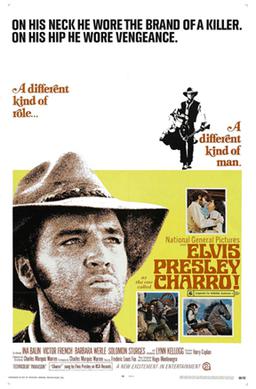
A singer and a performer, Elvis Presley has few rivals in terms of entertainers. He has sold millions of records and made over 30 films during his career. Of all his films though, one stands out from the rest as an oddity, and that's 1969's Charro! For starters, it's a western, Presley doesn't sing, and he even sports a beard. Oh, the horror! Not a classic, but a guilty pleasure of mine just the same.
Having separated from his gang for well over a year, Jess Wade (Presley) has struggled trying to go straight but does not want to return to his outlaw ways. His old gang, led by Vince Hackett (Victor French), isn't too pleased with his departure either and has framed Wade. Vince and the gang stole a gold-plated, silver-lined cannon from Mexico City that fired the 'victory shot' against Maximillian, but they set it up to look like Jess organized and led the robbery. Framed to look like someone else with a nasty neck wound -- courtesy of a brand in Vince's hand -- Jess must now look to clear his name and exact some revenge on Vince and the boys.
Doesn't sound much like an Elvis movie full of songs and huge dance numbers, does it? Not in the least, and that's probably why Charro! isn't remembered as one of Presley's best. For just its novelty alone in terms of the vast departure it takes from his musicals, this is a movie worth watching. Elvis does sing, but only over the opening credits, and not actually in the story. Listen to it HERE. Catchy, ain't it? By 1969, Presley was trying to mount a comeback of sorts, and this western tries to reflect the changing times. The effort was hamstrung to a point because apparently a fair share of violence and nudity were cut before it was released. Still, though it is nothing groundbreaking, I've always enjoyed this one.
According to Wikipedia (so take this for what it's worth), the role Presley took was originally offered to Clint Eastwood. With the Man with No Name playing the main character, this would have been one more late 1960s western. With Presley here, there's something oddly charming. As a dramatic actor, he will never be considered a great thespian, but as the revenge-seeking gunslinger? He's not that bad. A tad on the wooden side at times, Presley does a pretty good job with the part and handles much of his own stunts in this Charles Marquis Warren-directed western. In the tough luck department, he also has the love interest, Tracey, a well-to-do saloon and dance hall owner, played by the gorgeous Ina Balin. That must have been pretty tough.
On the whole, the movie has a lot going for it despite the average reviews and generally forgotten status. It was 1969 when it was released, and the effect of the spaghetti western was in full swing. It wasn't enough to have good guys vs. bad guys anymore. We needed anti-heroes and despicable villains who weren't concerned about innocents being killed. Composer Hugo Montenegro's score is a gem, part spaghetti western, some borrowed from his The Undefeated score the same year, and other tunes using a heavy Mexican theme. The combination covers a lot of ground, but it works well. The violence -- even if it was cut and/or edited -- is not graphic, but it's harsh, nasty stuff anyways. The look of the movie helps too from the sweat, scruff, stubble and dust on all the characters. It doesn't take much to make a western fan like me happy, and Charro! doesn't disappoint.
Other than Mr. Presley himself, the cast does not exactly jump off the screen in terms of star power. The future Mr. Edwards in Little House on the Prairie, Victor French is a particularly nasty villain. He's subtle in his evil qualities, letting the emotions fly in quick outbursts as the leader of a gang that would turn on him in a second. Balin isn't given much to do but show cleavage and look pretty unfortunately, but wouldn't you know it? She nails the part. Solomon Sturges hams it up as Billy Roy, Vince's possibly unhinged, sometimes maniacal brother while James Sikking has some fun as Gunner, a former Confederate artillery officer in Vince's gang. Tony Young has a small part as Lt. Rivera, a Mexican federale on the trail of the stolen cannon. There's some potential with Vince's gang, but they're left in the background with little to do, background players without much name recognition.
So there it is, Elvis with a beard, no guitar, and little singing in a part different from basically any other part he had. Nothing flashy, but in 1969 when westerns were all over the place, Charro! tries to keep up with the change and ends up being a fast-paced, entertaining final product. If no one else agrees, so be it. I like it. If you're a Spanish speaker, the movie is available at Youtube HERE.
Charro! <---trailer (1969): ***/****
Having separated from his gang for well over a year, Jess Wade (Presley) has struggled trying to go straight but does not want to return to his outlaw ways. His old gang, led by Vince Hackett (Victor French), isn't too pleased with his departure either and has framed Wade. Vince and the gang stole a gold-plated, silver-lined cannon from Mexico City that fired the 'victory shot' against Maximillian, but they set it up to look like Jess organized and led the robbery. Framed to look like someone else with a nasty neck wound -- courtesy of a brand in Vince's hand -- Jess must now look to clear his name and exact some revenge on Vince and the boys.
Doesn't sound much like an Elvis movie full of songs and huge dance numbers, does it? Not in the least, and that's probably why Charro! isn't remembered as one of Presley's best. For just its novelty alone in terms of the vast departure it takes from his musicals, this is a movie worth watching. Elvis does sing, but only over the opening credits, and not actually in the story. Listen to it HERE. Catchy, ain't it? By 1969, Presley was trying to mount a comeback of sorts, and this western tries to reflect the changing times. The effort was hamstrung to a point because apparently a fair share of violence and nudity were cut before it was released. Still, though it is nothing groundbreaking, I've always enjoyed this one.
According to Wikipedia (so take this for what it's worth), the role Presley took was originally offered to Clint Eastwood. With the Man with No Name playing the main character, this would have been one more late 1960s western. With Presley here, there's something oddly charming. As a dramatic actor, he will never be considered a great thespian, but as the revenge-seeking gunslinger? He's not that bad. A tad on the wooden side at times, Presley does a pretty good job with the part and handles much of his own stunts in this Charles Marquis Warren-directed western. In the tough luck department, he also has the love interest, Tracey, a well-to-do saloon and dance hall owner, played by the gorgeous Ina Balin. That must have been pretty tough.
On the whole, the movie has a lot going for it despite the average reviews and generally forgotten status. It was 1969 when it was released, and the effect of the spaghetti western was in full swing. It wasn't enough to have good guys vs. bad guys anymore. We needed anti-heroes and despicable villains who weren't concerned about innocents being killed. Composer Hugo Montenegro's score is a gem, part spaghetti western, some borrowed from his The Undefeated score the same year, and other tunes using a heavy Mexican theme. The combination covers a lot of ground, but it works well. The violence -- even if it was cut and/or edited -- is not graphic, but it's harsh, nasty stuff anyways. The look of the movie helps too from the sweat, scruff, stubble and dust on all the characters. It doesn't take much to make a western fan like me happy, and Charro! doesn't disappoint.
Other than Mr. Presley himself, the cast does not exactly jump off the screen in terms of star power. The future Mr. Edwards in Little House on the Prairie, Victor French is a particularly nasty villain. He's subtle in his evil qualities, letting the emotions fly in quick outbursts as the leader of a gang that would turn on him in a second. Balin isn't given much to do but show cleavage and look pretty unfortunately, but wouldn't you know it? She nails the part. Solomon Sturges hams it up as Billy Roy, Vince's possibly unhinged, sometimes maniacal brother while James Sikking has some fun as Gunner, a former Confederate artillery officer in Vince's gang. Tony Young has a small part as Lt. Rivera, a Mexican federale on the trail of the stolen cannon. There's some potential with Vince's gang, but they're left in the background with little to do, background players without much name recognition.
So there it is, Elvis with a beard, no guitar, and little singing in a part different from basically any other part he had. Nothing flashy, but in 1969 when westerns were all over the place, Charro! tries to keep up with the change and ends up being a fast-paced, entertaining final product. If no one else agrees, so be it. I like it. If you're a Spanish speaker, the movie is available at Youtube HERE.
Charro! <---trailer (1969): ***/****
Labels:
1960s,
Elvis Presley,
Ina Balin,
Victor French,
westerns
Thursday, September 20, 2012
Lifeboat
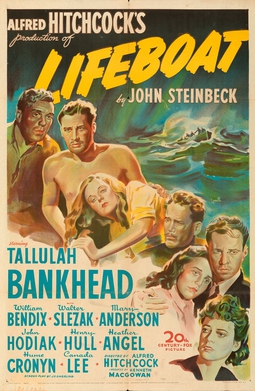
The timing here was interesting, two completely different types of movies, and I couldn't help but be slightly amused by it. I just recently reviewed Around the World in 80 Days, a huge scale epic that had locations around the world. Then there's this review, an entire movie set on an adrift boat at sea. I love a good epic, but an entire movie contained on one set? That's impressive. The movie is 1944's Lifeboat.
On its way to England during WWII, an Allied supply ship crewed by merchant marines is attacked by a German U-boat and sinks. Aboard a sturdy lifeboat, respected writer Connie Porter (Tallulah Bankhead) rescues Kovac (John Hodiak), a member of the crew from the engine room. Connie tells him that the German U-boat sunk as well in all the chaos. Minutes pass and they begin to pick up other survivors until there is nine of them all told. Among them is a German sailor, Willi (Walter Slezak), who no one is sure what to make of. Should they throw him overboard or keep him as a prisoner? With food and water limited, their decision could directly affect their survival.
Do you need proof that director Alfred Hitchcock was a director far ahead of his time? First off, if you said 'yes,' shame on you. Second, this film should serve as proof....if it was some how needed. Some four years before his 1948 film Rope and 13 years before 12 Angry Men used the formula, Hitchcock films the entire movie on one set, in this case the lifeboat adrift at sea. The entire movie. There are no asides or flashbacks or anything that distracts from the very singular location. This well-made, sturdy boat ends up being a weirdly compelling additional character. By the end of the movie, you feel claustrophobic and alone. Not a lot of directors could pull this premise off successfully, but Hitchcock seems to do it with ease.
Working with an ensemble cast, Hitchcock brings together a group of actors/actresses from all walks of life with more than a few differences in background. Bankhead as Connie gets top billing and delivers a solid performance but is far from sympathetic. Hodiak brings a tough guy edge to his part as Kovac, the former slaughterhouse worker turned sailor and maybe the one thinking the clearest. Slezak ends up being Evil Incarnate as Willi, the German sailor who knows more than he is letting on. Also look for William Bendix as Gus, the lovable sailor wanting to get back to his dancing girlfriend, Mary Anderson as Alice, a young nurse nervous about reaching London, Henry Hull as Rittenhouse, a proud, self-made businessman, Hume Cronyn as Sparks, the radioman who bonds with Alice, Canada Lee as Joe, the black steward, and Heather Angel as Mrs. Higgins, a mother traveling with infant to visit her husband.
What is impressive about the film can also be a weakness depending on your point of view. Hitchcock chooses not to use any gimmicks or tricks in developing a story that clocks in at 97 minutes. There are no marauding sharks circling the boat or patrolling plane overhead. This is an ultra-personal story that is entirely contained within the confines of the boat. Because there is nothing to distract from the task at hand, this is a dialogue-heavy movie. At times, it gets to be a little much. You can only hear so many monologues about the past and how people got here, their beliefs and relationships before things get a little on the slow. When it does work though, it's great. The story gives a window into mob mentality, especially when survival is on the line. Not surprisingly, you react differently to a situation at hand when life and death hangs in the balance.
Setting the survivor story (yeah, alliteration!) during WWII was no doubt a timely one. I can't help but wonder though what the story would have been like in a more existential setting; just survivors on the open sea hoping to make it to land or rescue of some sorts. Yes, the Willi character and his sinister motives are necessary, but that could have been tweaked too. The WWII dynamic is one thing, but a solid, interesting story detours and degenerates some in the finale as a propaganda message is not to subtly blared at us as a viewing audience. Oh, Germans are bad! There was potential for a twisted, darker ending in the closing minute, but the propaganda shuts the door on that possibility. Still, it's an impressive movie, and one that's easily recommended.
Lifeboat (1944): ***/****
On its way to England during WWII, an Allied supply ship crewed by merchant marines is attacked by a German U-boat and sinks. Aboard a sturdy lifeboat, respected writer Connie Porter (Tallulah Bankhead) rescues Kovac (John Hodiak), a member of the crew from the engine room. Connie tells him that the German U-boat sunk as well in all the chaos. Minutes pass and they begin to pick up other survivors until there is nine of them all told. Among them is a German sailor, Willi (Walter Slezak), who no one is sure what to make of. Should they throw him overboard or keep him as a prisoner? With food and water limited, their decision could directly affect their survival.
Do you need proof that director Alfred Hitchcock was a director far ahead of his time? First off, if you said 'yes,' shame on you. Second, this film should serve as proof....if it was some how needed. Some four years before his 1948 film Rope and 13 years before 12 Angry Men used the formula, Hitchcock films the entire movie on one set, in this case the lifeboat adrift at sea. The entire movie. There are no asides or flashbacks or anything that distracts from the very singular location. This well-made, sturdy boat ends up being a weirdly compelling additional character. By the end of the movie, you feel claustrophobic and alone. Not a lot of directors could pull this premise off successfully, but Hitchcock seems to do it with ease.
Working with an ensemble cast, Hitchcock brings together a group of actors/actresses from all walks of life with more than a few differences in background. Bankhead as Connie gets top billing and delivers a solid performance but is far from sympathetic. Hodiak brings a tough guy edge to his part as Kovac, the former slaughterhouse worker turned sailor and maybe the one thinking the clearest. Slezak ends up being Evil Incarnate as Willi, the German sailor who knows more than he is letting on. Also look for William Bendix as Gus, the lovable sailor wanting to get back to his dancing girlfriend, Mary Anderson as Alice, a young nurse nervous about reaching London, Henry Hull as Rittenhouse, a proud, self-made businessman, Hume Cronyn as Sparks, the radioman who bonds with Alice, Canada Lee as Joe, the black steward, and Heather Angel as Mrs. Higgins, a mother traveling with infant to visit her husband.
What is impressive about the film can also be a weakness depending on your point of view. Hitchcock chooses not to use any gimmicks or tricks in developing a story that clocks in at 97 minutes. There are no marauding sharks circling the boat or patrolling plane overhead. This is an ultra-personal story that is entirely contained within the confines of the boat. Because there is nothing to distract from the task at hand, this is a dialogue-heavy movie. At times, it gets to be a little much. You can only hear so many monologues about the past and how people got here, their beliefs and relationships before things get a little on the slow. When it does work though, it's great. The story gives a window into mob mentality, especially when survival is on the line. Not surprisingly, you react differently to a situation at hand when life and death hangs in the balance.
Setting the survivor story (yeah, alliteration!) during WWII was no doubt a timely one. I can't help but wonder though what the story would have been like in a more existential setting; just survivors on the open sea hoping to make it to land or rescue of some sorts. Yes, the Willi character and his sinister motives are necessary, but that could have been tweaked too. The WWII dynamic is one thing, but a solid, interesting story detours and degenerates some in the finale as a propaganda message is not to subtly blared at us as a viewing audience. Oh, Germans are bad! There was potential for a twisted, darker ending in the closing minute, but the propaganda shuts the door on that possibility. Still, it's an impressive movie, and one that's easily recommended.
Lifeboat (1944): ***/****
Labels:
1940s,
Alfred Hitchcock,
Henry Hull,
Hume Cronyn,
John Hodiak,
Walter Slezak,
William Bendix,
WWII
Subscribe to:
Posts (Atom)