The Sons of Katie Elder

The Sons of Katie Elder
"First, we reunite, then find Ma and Pa's killer...then read some reviews."
Showing posts with label Danny Boyle. Show all posts

Friday, January 10, 2014

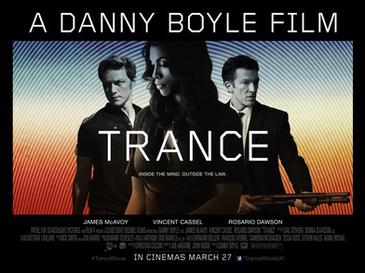
Trance

Not many directors have the guts to do what Danny Boyle does. Check out the British director's list of films. There's a ridiculous variety of films there, and the scary part? With one exception I'm seeing, there isn't a weak flick in the bunch. Even his less highly regarded movies are still pretty decent. How about hypnosis and amnesia though? Can Boyle even pull that one off? Let's see with 2013's Trance.

An art auctioneer working for a high-end auction house, Simon Newton (James McAvoy) has become involved with a gang of crooks led by Franck (Vincent Cassel). Their target? A rare Francisco Goya painting, Witches in the Air, that will soon go up for auction. The job goes relatively smooth until Simon inexplicably trying to stop Franck who punches him in the face, knocking him out. Franck discovers later that Simon switched out the paintings, just leaving the frame in the case. In the meantime, Simon has become a hero for trying to stop the robbery, but there's a problem. Simon can't remember what happened after Franck's punch, can't remember what happened to the painting. Even after some torture, Simon still can't remember so Franck knows he genuinely can't remember. He comes up with an out of left field solution, sending Simon to a hypnotist, Dr. Elizabeth Lamb (Rosario Dawson), who will help him remember and net him a lucrative payday in the end.

Another movie to add to the list of "I was bored so I explored Netflix" finds, 'Trance' was given a limited theatrical release in the U.S., seeing the light of day in a sprinkling of theaters. Let's say this...it's a doozy of a flick, one Boyle had wanted to bring to the big screen for years having read Joe Ahearne's script in the mid-1990s. Is it a good or bad doozy though? I'm still deciding there. The problem is simple, Ahearne's script is interesting but its goal is to deceive. It is a movie meant to confuse and baffle as it develops, and then when the finale comes along, it comes as a complete surprise. That's fine, right? Yeah, surprises are good, but this one feels very forced, very contrived and completely lucky. So many things (sssssssso many) need to happen for it to work that it passes any sort of reality -- even movie reality -- and leaves it in the rear view mirror.

The catch to it all is that because Boyle is a very talented director, he still makes it work even in spite of its flaws. As a visual director, Boyle has few rivals currently working. His movies are polished, stylish and quite the visual treat. The cinematography from Anthony Dod Mantle is a gem, scenes full of color from the white, clean look of Elizabeth's office, to Franck's dark, poorly lit and sparsely decorated house to Simon's cluttered house. Even when the story may be a tad confusing -- and it is -- watching the movie is still a treat. There's little to no action, instead scenes of dialogue and hypnosis replacing them, so Boyle and Mantle work to make those scenes visually interesting. We're watching the hypnosis as it happens through the individual's head, seeing what they see, those listening "appearing" in the hypnosis as if they were really there. The score from composer Rick Smith is solid as well (listen HERE), driving the story forward with a mix of electronic/trance-like music that fits well.

The cast is limited basically to the three stars, McAvoy, Cassel and Dawson. Obviously, the focus is on this trio of characters in just about every scene. What works well is that the three of them all have a development over the course of the movie, and all in surprising fashion. McAvoy does a very solid job as Simon, the art auctioneer who becomes a participant in a heist after taking a serious punch to the head. He does a good job as the tortured individual trying to figure it all out (and with a twist). Dawson is excellent too, her soothing voice providing the good backdrop for the hypnotist who also has ulterior motives. Cassel does what he does best, a scheming, sneering intimidating villain who just looks like a bad guy. I don't want to give too much away about where/what these characters become, but all three performances are certainly interesting. As Franck's gang, look for Danny Sapani, Matt Cross and Wahab Sheikh in supporting parts.

Most of the last 30 minutes are spent on the twist, the reveal, and then the explanation. Again, no real spoilers here to speak of. Even clues could take away your enjoyment, or at least the surprise, when things are revealed. Because Boyle knows what he's doing, the big reveal is something else to watch. It's meant to catch you by surprise, even shock you in some instances (and it does), but the more I thought about it, the less I liked it. So so many things have to happen for this all to happen that it becomes ridiculous to fathom. The same for one particular twist that seems to defy explanation involving something stashed away in a car trunk. As for the final scene, there's a nod/rip-off (depending on your interpretation) to Christopher Nolan's Inception.

Quite the mixed bag in the end. A lot of talent working with a very skilled director, but it never quite gels. Tries too hard at some times, very stylish and entertaining in others.

Trance (2013): ** 1/2 /****

Wednesday, September 26, 2012

Shallow Grave

With Slumdog Millionaire and 127 Hours, British director Danny Boyle has put himself on a mainstream map where his name has some pull with audiences. In 1994 though, he was making his directorial debut with none of that recognition. His 1994 film Shallow Grave is a doozy, one that changed his career and sent the British film industry down a detoured path.

Three friends, Alex (Ewan McGregor), David (Christopher Eccleston) and Juliet (Kerry Fox), share an apartment in Edinburgh, Scotland and are looking to take in a fourth roommate. They finally decide on Hugo (Keith Allen), a somewhat mysterious but interesting man about their age, and he moves in quickly. Just a few days later, the trio finds Hugo dead in his room of a drug overdose. More interesting? Alex finds a suitcase packed to the gills with cash. What to do now? The three flatmates decide to dispose of the body -- removing his hands and feet, smashing his skull to pieces -- in a grave in the woods and keep the money for themselves. What seems simple though is far from it as these three soon discover.

Setting the stage for his hit two years later in Trainspotting, Boyle's 'Shallow' is certainly different from just about any movie I've ever seen. The amateur crime aspect is nothing new, but Boyle handles it in ways you wouldn't normally think. He doesn't shy away from the brutality of what they're doing and their repercussions. Some reviews list it as a dark/black comedy, and even though I didn't laugh much, it reminded me somewhat in tone of the dark humor the Coen brothers so often use in dealing with nasty subjects.

As Fox explained it in the special features, this is a movie different from most people's perceptions of a "British movie." It isn't dark, dreary and bleak....well, in visuals at least. Boyle is a very visual conscious director. The apartment is full of bright colors, and that distinct 1990s style is prevalent all around. Alex is a hipster, David a suit-wearing accountant, Juliet a doctor and professional. The style and pacing is kinetic, all over the place, and when things hit the fan, Boyle shoots in the darkness with shadows and a minimal use of lights (flashlights, car headlights illuminating the action). The music threw me off too, from the techno-sounding opening (watch HERE) to the darker, moodier score as the "grave situation" develops. Style-wise, it's easy to see how this film changed the mood and tone of British films for years to come.

Now all that said, I didn't really care for the film much at all. I don't need to love characters -- or even like them really -- to appreciate a movie. Watching awful, despicable characters can be a selling point in a movie. Literally from the first scene here though, I hated...HATED these three main characters. We're introduced to them as they interview applicants for their fourth roommate. McGregor rips the first applicant (Colin McCredie) to pieces, and the gloves come off. They look down on applicants, ripping them to pieces with this type of yuppie-hipster pretentious attitude and within seconds I was rooting against them. To be fair, in the acting department, all three deliver solid performances. Their descent into paranoia and greed affects each of them differently, and it is cool to see that degeneration into something rather ugly.

As the story developed though, that's where I was holding out with some sort of sick hope. The second the trio decide to keep the money for themselves, you know the story won't end well for any of them. The whole tone of the movie speaks to that. But even in that regard, I was disappointed. When things come to a head late, the result is almost comical in its exaggerated depiction. There is a twist in there that works pretty well, but I was so far removed from the movie by that point it probably didn't make the expected impact. Check it out for yourself though at Youtube -- watch it HERE -- and make your own decision.

Shallow Grave <---trailer (1994): * 1/2 /****

Wednesday, February 1, 2012

28 Days Later

Not quite a zombie movie, not quite an end of the world apocalypse story, 2002's 28 Days Later falls somewhere in between. What it is? An oddity among horror movies with a bit of science fiction thrown in. I'm not sure what to make of it though, and even now I'm not positive how much I liked and/or disliked about it.

A virus has gotten loose in England, turning normal everyday people into raving, murdering psychotic lunatics that seemingly cannot be stopped. Some 28 days after the outbreak, a man named Jim (Cillian Murphy) wakes up in a hospital bed to find a world unlike anything he's ever seen. The streets of London are completely empty like the people have been swept away. He's attacked by several infected people and barely survives thanks to Selena (Naomie Harris). They also meet Frank (Brendan Gleeson) and his teenage daughter, Hannah (Megan Burns). On the radio, they hear a looped message about an army unit to the north holding out and surviving. Could there be more survivors? It may be a pipe dream, but they can only hold out for so long in London and decide to make the dangerous journey.

For coherent purposes, let's say this. Fans/haters debate whether this is a zombie movie because it's a virus and not a product of some bizarre quasi-apocalypse. I will be calling it a zombie movie because....well....I can't think of a better description. Is it possible for a zombie movie to be an art-house zombie movie? If so, director Danny Boyle accomplished it here. This is most assuredly not a run-and-gun, kill hundreds of zombie type movie, far from it. It instead focuses on a small group of survivors in a ravaged world occasionally running into zombies. The musical score is great, featuring some indie rock (including THIS epically appropriate song), the camera angles are different and aggressive, and there is a message to the story in a bizarre way. Don't expect Dawn of the Dead is all I'm saying.

Through this quasi-art house film comes all these different elements. In some truly remarkable set pieces, Boyle creates a whole new, unique world. It's believable watching this movie that there are few people left behind. The opening 15-20 minutes has Murphy's Jim walking through a completely vacant London in some of the coolest, most unsettling shots I've ever watched. To Boyle's credit, as a viewer I felt isolated. Can you imagine that setting, exploring a world you know well but it isn't quite that world? There is an emotional depth, an emotional quality to this movie that surprised me. Extreme fear and terror, complete isolation, looking for a reason to survive, it's all there. One scene has the small group trying to fix a flat tire as a dozen or so infected people sprint at them. Creepy much? A perfect chase scene that will assuredly get the blood pumping and the adrenaline flowing.

So why then with all these positives do I feel like I'm missing something? Reviews were almost uniformly positive, Netflix thought I would 'Really Like' it, and I typically go for movies like this. The little things I can put my finger on? Boyle films with video, producing a grainy, amateurish look that I didn't go for. He also uses the ultra-fast editing technique where any scene with movement is just a blur. But more than those things -- which I can go along with if I'm enjoying a movie -- is that I was disappointed with where the story went. There are moments where you're glued to your seat wanting and needing to know what comes next, and then whole scenes that lack any energy, killing the momentum that was just built up moments before. The ending too disappoints, a different tone from the whole rest of the movie. The DVD offers several better, darker finales.

With this low budget movie featuring a small cast, there are only 15 or 20 speaking roles in the entirety of the 113 minute long movie. Murphy is all right as Jim, supposed to be an everyman of sorts but lacking any real personality. Harris and Gleeson are the best things going here. Harris' Selena is a survivor who learned quick how to preserve her own life no matter how drastic or gruesome the measures are. Gleeson is a single father looking out for his daughter above all else. Christopher Eccleston plays Major West, the leader of a small group of soldiers holding out for the present and hopefully much longer into the future.

So all in all, some major positives and a few glaring negatives. The movie is good, no doubt about that, but I still came away disappointed. I did like it, but there was the potential to love it. Interested enough to see the sequel though, 2007's 28 Weeks Later.

28 Days Later <---trailer (2002): ** 1/2 /**** 

Friday, June 17, 2011

127 Hours

It was the type of story you just couldn't believe the first time you heard it.  Too gruesome, too brutal, too far-fetched, but it happened.  In 2003, adventurer/climber/guide Aron Ralston went canyoneering in Utah who was forced to amputate his own arm when he fell in a canyon and had his right hand pinned by a large boulder. With no food and no water after several days of being trapped, Ralston actually amputated his own right arm below the elbow and survived. I was curious when I heard the story was being made into a feature-length movie, but I came away very impressed with 2010's 127 Hours.

Throw everything else away here; acting, story, direction, soundtrack, camerawork.  This is a movie about one of the most basic elements of living...surviving.  I guarantee when people read this story back in 2003 a majority wondered what they would have done in that situation?  Would you have had the will to live so much that you would cut off your own arm with a dull pocket knife to survive?  How far would you go to keep on living?  I think that's maybe the biggest appeal of this movie. It's a person to person thing, and no one really knows how they would respond in such a hellish situation.

Leaving in the dead of night one April 2003 weekend, canyoneer Aron Ralston (James Franco) has several days of biking, hiking and exploring ahead of him.  He leaves with a backpack full of supplies and drives out into Canyonlands National Park, a beautiful but basically desolate and vacant part of the American west.  Aron loves everything about it, the beauty, the history, the solitude. That's what he quickly realizes. In all the vast stretches of land, Aron is very alone. Descending into a canyon, he trips and falls down to the bottom, a large boulder pinning his right arm to the canyon wall.  He has a little water, a little food, and the supplies and equipment he was carrying. The hours turn into days though, and Aron begins to realize he will have to make a drastic choice if he hopes to live.

Director Danny Boyle has a personal style to his movies, and usually that's a good thing. This is a true story though that I never thought called for too much in the way of stylization.  The story of Aron's struggles to survive stands on its own, and that's basically my only complaint with the movie.  Split screens, ironic soundtrack choices, ultra-fast montages, none of them were needed.  None of these issues overpower the movie or detract from it in a major way, but like anything, it is the little details that bug you.  His eye behind the camera (with 2 cinematographers) is never in question.  Filming in Utah, the movie is stunning in its portrayals of the American west. Even when the story is tied to Aron's struggle in the canyon, there is an eerie beauty to his surroundings, both the land and rock formations to go with the nature that surrounds him.

It speaks to the strength of this year's Oscar nominees for Best Actor that James Franco didn't win (I'm gonna get around to The King's Speech one of these days) his first Academy Award.  This is that type of performance that actors must dream about. The camera's focus is on him and him alone, and Franco makes the most of it.  The emotion, the physicality, the mental strain, he brings them all to life. There's that momentary panic followed by the realization of the predicament he's in. Trying to maintain some sense of reality, Aron talks into his digital camera, telling the people he's left behind what's happened and the thoughts racing through his head. It is a sink or swim performance because if you don't believe in Franco or like the actual performance, you're going to dislike this movie.  I loved it, and hopefully it's another sign of a long, successful career to come.

What worked so well (and kind of negated the overly stylized moments) is the reflection Aron does on his life, some through just thinking, some through hallucinations and dreams.  One of my first thoughts when I heard about this movie was how would a director make it an even somewhat interesting feature film?  It's a guy trapped under a rock.  My concern or worries were unfounded. Some of the movie's most powerful moments come from those reflections. Aron's messages to his family taped on his digital camera are heartbreaking. He thinks he's going to die, and believes this will be his final hours of life. A darkly comic scene has Aron posing as a talk shot guest, talking about his faults and the stupidity of his self-confidence that he told no one where he was going and therefore no one knows where to look for him. The best though for me was one late dream/hallucination of Aron's as he draws closer to giving up. In front of him sitting on a couch and standing around it are all his friends and family. They say nothing, just sitting there, almost willing him to do what he has to do.  That of course leads to....

Yeah, the cutting of his own arm is an incredibly uncomfortable sequence to watch. It's not gratuitous, but it is graphic (how could it not be I guess). Actually thinking about what he's doing is the most amazing thing of the story right up there with the will to live and the limits we'll go to in hopes of continuing to live.  Some of the mystery is taken away because we know what Aron will do, and that he will ultimately survive. In no way though does that take away the power and the beauty of the aftermath. With Sigur Ros' Festival playing, the rescue is one of the most beautiful, moving scenes I've ever watched. The ending is beyond moving. You feel like you've been through Aron's trials with him, and seeing him rescued is a release.  The epilogue is eloquent in its simplicity, the title cards popping up telling us what became of Aron.  It's a great, simple, beyond beautiful ending.

Franco is the unquestioned star here of course, but the hallucinations/flashbacks allow for some interesting casting. Treat Williams plays his father, a key scene early explaining Aron's love of nature as father and son watch the sunrise over the desert horizon. That is a scene straight out of poetry, pure Americana there.  Kate Mara and Amber Tamblyn play Kristi and Megan, two hikers Aron meets on the trail before his accident. Lizzy Caplan makes a quick appearance as Aron's sister, providing motivation for Aron because he wants to be at her wedding. Clemence Poesy plays Rana, a past girlfriend he regrets the way their relationship ended.

As I write this review, I find myself liking the movie more than I did while watching it. I enjoyed watching it, don't let me confuse you.  But thinking of the moments that work so well, I loved parts of the movie. It is a story of survival, of one individual absolutely wanting and needing to keep on living. Power of the human spirit, a will to live, call it what you want. The story is great, Franco's performance amazing, and overall one of those truly inspiring stories you come across.

127 Hours <---trailer (2010): ****/****

Saturday, August 21, 2010

Sunshine

A bit in "The Hitchhiker's Guide to the Galaxy" has a character exposed to the immensity of outer space, our galaxy and much further on.  The kicker is that everyone who sees how big the universe is thus feels as small as an ant and kills themselves.  It's funnier than it sounds, trust me.  But the size of space is hard to comprehend, one of many things that flashed through my head while watching 2007's Sunshine.  A sci-fi story that is a lot more at times -- and a lot less at others -- asks a lot of questions, some harder to answer than others.

The science portion of the science fiction angle has this ability to drive a lot of viewers off as they claim "Oh, that's ridiculous.  That could never happen."  Well thankfully, I've never been a science whiz and when I see something that doesn't quite make sense, it usually drifts over me and is gone as quick as it appeared.  Sunshine has its fair share of those moments, but the build-up and the tension and the character dynamics are so interesting to watch, the science of it all can be superfluous at times.  I was loving this movie, absolutely loving it, for about an hour, and then director Danny Boyle adds a twist so unnecessary and out of place that it almost ruins the whole movie.  Stew on that for a little while.

Some 50 years into the future, the sun is dying much faster than ever predicted, leaving the Earth in a state of winter at all times, the planet basically freezing to death.  Aboard an immense space ship, the Icarus II, eight astronauts navigate from Earth to the Sun carrying a bomb, a massive payload the size of Manhattan Island, that it is believed will create a star within a star by exploding the bomb within the sun.  The voyage is millions of miles away, and the Icarus II has been moving toward its goal for some 16 months.  But as the ship passes Mercury, an odd distress signal is heard, that of Icarus I, the first ship sent to accomplish the mission before mysteriously disappearing.  What happened to the first ship, and could it happen to the second before the mission  is accomplished, dooming Earth to its fate?

A great ensemble fills out Icarus II's crew, starting with Kaneda (Hiroyuki Sanada), the ship's captain, Harvey (Troy Garity), 2nd in command and communications officer, Searle (Cliff Curtis), ship's doctor and psych officer, Capa (Cillian Murphy), the physicist in charge of the bomb, Corazon (Michelle Yeoh), the biologist, Cassie (Rose Byrne), the pilot, Trey (Benedict Wong), the navigator, and Mace (Chris Evans), the no-nonsense engineer. On a journey with no outside world to escape to that will take years, the crew develops tendencies and routines, fighting amongst themselves while balancing out the scale of their mission. The first hour of the movie as we see these characters and get to know them is by far the best part, seeing this dynamic among eight people as they risk their lives to save millions.

Deep space provides all sorts of open doors for a movie to walk into.  It's unexplored, and anything could exist out there.  It takes years to travel the millions of miles between Earth and the Sun so rescue isn't just around the corner.  These astronauts are on their own.  That premise is what drives the story.  The future of the Earth depends on this crew and their ability.  Add in an absolutely beautiful visual movie, a very moving if underused score by John Murphy (listen HERE) and you've got all these great elements to work with. About halfway through, I thought I was watching one of the best sci-fi movies ever, only to have a curveball thrown my way.  It helped following the movie reading scathing posts on the message boards that I wasn't the only one who hated an unnecessary late twist.

SPOILERS for this paragraph SPOILERS  The disappearance and then reappearance of Icarus I is a perfect addition to the story, in theory.  It's like Christmas Eve, you're curious what those presents are, but it's almost more fun not knowing what's inside.  How did the Icarus disappear? Did they kill each other? Did the Sun destroy them? Was it an alien? It's better not knowing here.  It is that sense of mystery of what space could contain.  ANYTHING.  Then in need of repairs, the Icarus II docks with I, and over the last 30-45 minutes we see that it was the deranged captain (Mark Strong) who took out his crew and now plans to take out II, hoping to be the man who last talks to "God," or in reality the sun and all its power. What was one of the best science-fiction movies ever now devolves into a teen slasher film.  Really? That's where you wanted to go with this?  The ending still remains incredibly moving in its execution, but it's almost an afterthought. END OF SPOILERS

There are good twist, great twist, stupid twists and unnecessary ones.  This one was stupid and unnecessary in so many ways. It almost completely ruins what otherwise could have been a classic movie about space, space travel, and all the emotions and feelings that race through the human mind when faced with an impossible, nearly suicidal task.  Almost completely ruins. The first hour and the last five minutes are so good I'm still recommending this one.

Sunshine <----trailer (2007): ***/****