Think of a movie star from the 1950s or 1960s. There's a long list of possibilities, but chances are you picked a white actor or actress. Now think of a black movie star from the same period. A handful come to mind, but only one was a huge star and for good reason, Sidney Poitier. For most of 20 years, black characters in movies were there for punchlines or for comic relief, but when Poitier burst onto the scene he opened the door for serious roles, including becoming the first African-American to win an Academy Award.
One reason Poitier is held in such high regard is the caliber of the movie he typically starred in. He rarely went slumming, taking a paycheck for any old role. Look up and down at his filmography and there just aren't many duds in the bunch. Some are clearly better than others, but even the ones that don't reach classic status at least tried something new and different. Movies like The Defiant Ones and In the Heat of the Night are probably his most famous roles, both dealing with racism in one form or another. One that's been generally forgotten and past by dealing with similar topics, 1957's Something of Value.
Having grown up together in Africa, Peter (Rock Hudson) and Kimani (Poitier) are somewhat oblivious to their differences in skin color. They've grown up as friends and even more than that, as brothers. But it's 1945 in Kenya, and the differences start to stare them dead in the face. Kimani's father is sentenced to prison for doing something his culture -- not the British law -- observes. Fed up with the system, Kimani joins a violent revolutionary group called 'Mau Mau' that hopes to take Africa back from the British. As the revolution grows and the body count increases daily, Peter tries to find Kimani, hoping to convince him that the way he has chosen is not the correct one, and that peace is possible. It's been years though, and it may be too late to save either man.
I'm a victim of this as much as anyone, but sometimes I look at movies from the 1950s and think of everything as whitewashed and censored to the point where everything is bland -- a la Leave it to Beaver of Happy Days. Those blanket statements can be helpful at times, but they're almost never true. 'Value' certainly pokes holes in my whitewashed theory in showing a particularly bloody, surprisingly gory depiction of an African uprising. It is filmed in black and white, but that doesn't take away the very visceral feeling you get during the battle scenes. Director Richard Brooks would have been hard-pressed to tell this story in any sense of a whitewashed fashion, but he doesn't take the easy way out telling this story, and the movie is better for that decision.
Based on a novel by Robert Ruark, Brooks' movie is clearly divided into two stories after an opening segment introducing us to Peter and Kimani. Once the story divides itself, it's either one or the other character. Long segments focus exclusively on Peter or Kimani through their lives amidst the chaos of the Mau Mau rebellion. Peter marries his longtime sweetheart (Dana Wynter) and has to deal with the massacre of some of his close family. He tries to move on with sister Elizabeth (Wendy Hiller) and father Henry (Walter Fitzgerald), but the fighting might not let them. Kimani too starts a family as he tries to convince fellow revolutionaries that there is a peaceful way to protest but quickly gets nowhere.
Their stories are obviously on a collision course when the two will meet again, vastly different men than they were in their early 20s. The white settlers (including a bloodthirsty Michael Pate) do their best to wipe out the revolution while the Mau Mau fighters plan on fighting to the last man, except for Kimani who sees how futile continuing the fight would be. The ending caught me off guard in some of the decisions made, but not in a negative 'I hated that decision' way. I haven't read the novel to compare, but Brooks goes for a realistic, depressing ending that still somehow offers a glimpse of hope, of survival in the end.
Some complaints spoke to the casting of Hudson as a British settler, and to be fair, he doesn't even attempt an accent of any sort. Is that really a bad thing though? For me, the casting was one of the strongest parts of the movie, especially Hudson and Poitier who play so well off each other in their few scenes together. Wynter and Hiller play strong female characters trying to survive this hellish life they have, and Fitzgerald is the stout father figure that can't be shaken. Pate plays the straight evil villain to perfection while Juano Hernandez plays Njogu, a sympathetic figure of the revolution who keeps his faith through it all. Also look for Ivan Dixon (Sgt. Kinch in Hogan's Heroes) as Lathela, Peter's right-hand man. Generally forgotten, but definitely worth looking for.
Something of Value <---trailer (1957): ***/****
The Sons of Katie Elder
"First, we reunite, then find Ma and Pa's killer...then read some reviews."
Thursday, June 24, 2010
Wednesday, June 23, 2010
The Internecine Project
If a movie has a gimmick, is that a bad thing? 3-D filming comes to mind, an actor/actress playing against type in a major way, a twist that no one sees coming, and many more I'm probably missing. Sometimes that gimmick can hold an otherwise dull or average movie together and make it worth watching. These gimmicks tend to gravitate toward thrillers, horror and action movies, but that's a general blanket statement. They can be in any type of movie. Generally forgotten since its release, 1974's The Internecine Project has a gimmick, and a good one at that.
This British production is interesting in that it presents a unique idea and executes it in one of the most ridiculously boring sounding sequences. I won't spoil what it is yet, but does a man sitting in his office waiting for a phone to ring at a preordained time over the course of several hours sound interesting at all? You wouldn't think so, but that's part of why 'Project' works so surprisingly well. It's not groundbreaking or anything that new, but the murder mystery thriller keeps you guessing until the end when an appropriate twist ending is delivered.
About to receive a government advisor position after years of working in economic theory as a Harvard professor, Dr. Robert Elliott (James Coburn) is approached by a highly powerful and high ranking government official who also seems to have some ties in big business, E.J. Farnsworth (Keenan Wynn). Elliott has a bit of a shadowy past during his years as an operative for the government, and these people would stand to take him down if he gains this position of power. The only solution? Kill them. But how can he do it without arising suspicion that he did it? Elliott comes up with an ingenious plan that has these four people unknowingly killing each other. The deadline is approaching though, and Elliott has little time to accomplish his task when an ex-girlfriend, a respected journalist (Lee Grant) shows up on his doorstep.
This is the type of story that keeps you guessing as to where exactly it is going through the first 30 minutes. You know something's coming down the highway right at you, but what exactly? When it is revealed, the simplicity of it is what makes it work. Elliott needs these four dead and in a great handful of scenes goes to each of them (including Harry Andrews, Ian Hendry, Michael Jayston, and Christiane Kruger) explaining what they have to do to remain safe. All of the murders will take place in one night in a 3-4 hour window with Elliott telling each of his dupes/victims to call him at a certain time and let the phone ring a specified amount of times.
And that's where the gimmicky scene of Coburn sitting in his office waiting for his private line to ring begins. It's a scene that goes on almost 30 minutes as the four go about their business, sneaking into an apartment or office while another person is doing the same in their apartment. All the while, Coburn's Elliott sits in his office with a checklist, crossing them off as the quartet calls him with updates. The plan is simple but depends almost completely on timing so when the phone rings more or less than expected, Coburn of course gets nervous. The scene is incredibly high on tension in a way I would have never thought possible.
This is the type of thriller though where you're fulling expecting a twist. Sometimes the best twist can be not seeing it coming at all, but others just beg to reveal something or surprise the audience at the end. 'Project' from the get-go feels like a movie that is going to pull the carpet out from under you at the last possible second, and in the last five minutes it certainly does not disappoint. I debated even making this comparison, but it reminded me a lot of 1972's The Mechanic. Both endings caught me by surprise in their execution, but that last twist, that last surprise works beautifully here.
With a twisty story like this, the cast can tend to be replaceable whether it be the star or one of the supporting players. I like the choice of Coburn in the lead because he always showed an ability to play the charming hero or the villainous bad guy. As Elliott, he's a bit of an evil mastermind, but he's so smooth doing it you find yourself rooting for him -- or I did at least. You need someone leading the way in a story similar to this, and Coburn does it well. The movie is available on a good transfer on a recently released DVD if curious.
The Internecine Project <----trailer (1974): ** 1/2 /****
Labels:
1970s,
Harry Andrews,
Ian Hendry,
James Coburn,
Keenan Wynn
Tuesday, June 22, 2010
The Silver Chalice
They can't all be winners, right? Over a long career, at some point movie stars have to have a dud every so often. In most cases though you'll never hear the star actually admit that part of the equation. Well, most cases other than Paul Newman. One of Hollywood's greatest actors and a true legend, even Newman had to start somewhere, making his screen debut in 1954's The Silver Chalice. It's been critically roasted, and more than that, roasted by Newman who took out a full page ad in a newspaper in the 1960s to encourage TV viewers not to watch this movie when it was shown on TV. Now that's the kind of honesty we need more of.
Let's get this out of the way early. 'Chalice' is a bad movie, a truly bad movie, that is entertaining in its awfulness. It was an early trendsetter in huge Biblical epics like The Ten Commandments, The Robe, King of Kings, Spartacus and many others. But you know what all those epics had going for them? A somewhat decent script and some actual scale in terms of sets, costuming and 'a cast of thousands.' Directed by Victor Saville, 'Chalice' has none of those things. Other than an impressive cast full of not quite yet stars and some hopefully unintentionally funny scenes, this one is a big stinker.
Twenty years after the death and resurrection of Jesus Christ, a Greek silversmith in Antioch by the name of Basil (Newman) is fighting for his freedom after his uncle throws him into slavery. He is offered freedom by a man named Joseph of Arimathea (Walter Hampden) who presents a challenge for him as an artist. Joseph owns the cup Jesus used during the Last Supper and wants to give it a proper resting place in the form of an immense chalice that will feature the faces of all those closest to Jesus, mainly the apostles. Basil accepts the challenge and goes to work, but surrounding powers want to get their hands on the Holy Grail, including a revolutionary group led by Mijamin (Joseph Wiseman) and a magician named Simon (Jack Palance).
I'll start with the positives -- however few there were. The cast is something to behold because many of the actors and actresses involved went on to much bigger and better things, Newman obviously at the top of that list. There's also Italian beauty Pier Angeli, future Bonanza star Lorne Greene as Peter, a young Natalie Wood as a slave girl, E.G. Marshall as Basil's adopted father, Michael Pate as Angeli's worrying father, and Virginia Mayo as the key ingredient in the always interesting love triangle. Of course some of these parts are nothing more than a 'blink and you'll miss them' appearance, but with as 'involving' as the story is, it shouldn't be hard.
One of the selling points of these huge historical epics was the lavish sets, costumes and uses of thousands of extras. 'Chalice' basically passes on all three of those -- okay, the costumes are interesting. The sets are absolutely ridiculous, and I'm guessing about $18 was spent putting them together. It's very clear these are on soundstages with gigantic stage-like curtains in the background standing in for actual background. At times, the sets look like Legos or Duplos assembled by toddlers. They're so bad it becomes funny to see how cheesy they look. Check out the backgrounds in THIS scene, the inside of a temple. It looks like they drew in 'the bricks' with a sharpie marker.
Newman later stated in interviews that he thought this was his worst ever performance. I haven't seen all of them, but I'm inclined to agree. He's miscast as a Greek to begin with, and he hasn't developed that on-screen persona, that charm that made him so likable in so many later movies. The rest of the cast isn't exactly challenging for any Oscars either. Mayo looks done up like some sort of drag queen with eyebrows that look like they'd stab someone. Her sexy magician's assistant (seems right at home in a biblical movie) is torn between Basil and Simon, but she looks too ridiculous to even take too seriously. As for the rest of the cast, Angeli has a sexy accent, and Wiseman is a creepy enough 2nd villain.
But more than all the cheap sets and sluggish dialogue, the one star really breathing some life into the movie is Jack Palance as Simon, a magician who believes he has the talent, the ability to convince the Christians he is more powerful than Christ. He chews scenery like nobody's business, hamming it up with his monologues and magic tricks. His Simon also provides one so unintentionally funny moment late in the movie that I almost felt bad for having laughed...almost being the key word. It's the one true worthwhile part of this dud, but if curious, watch it at Youtube starting here with Part 1 of 15.
The Silver Chalice <----trailer (1954): * 1/2 /****
Monday, June 21, 2010
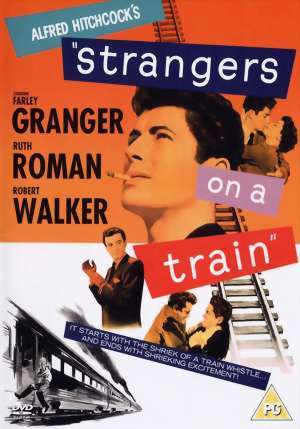
Strangers on a Train
Through all the movie business has been through, some things seem to never change. On-screen depictions of sex, violence and controversial subject matter have changed from decade to decade and era to era to the point where movies can get away with showing almost anything. But one thing remains more controversial than most, depictions of homosexuals in films. I never saw it, but Brokeback Mountain created quite a stir in its story of two gay cowboys. The problem wasn't that it was a bad movie, but that the characters were gay. That's all.
So in the 2000s if a movie caught heat for gay characters, what about Hollywood's Golden Age? Censors and studios cracked down on everything from sex and adultery and violence and everything in between. Directors -- the good ones at least -- found a way around this, making the subject matter a little more subtle to help certain things slip by the censors. One of the best directors, Alfred Hitchcock, found a way around sex, violence and in the case of 1951's Strangers on a Train, a gay character and possibly a gay relationship (or at least a crush).
On a train heading north to New York, two men -- complete strangers -- begin to talk to help pass the time. First, there's Guy Haines (Farley Granger), a famous tennis player, and Bruno Anthony (Robert Walker), a middle-aged man without much in the way of ambition. Both men have personal problems that could be solved if one person in their life just disappeared. Bruno reveals a theory he has; complete strangers with no ties in any way agree to kill someone in the other person's life. That way there's no evidence linking the person to the victim. Guy thinks nothing of it, shrugs it off, and leaves the train. Soon after though, he gets a visit from Bruno who states happily that he murdered Guy's wife Miriam (Kasey Rogers) who wouldn't divorce him. Now Bruno wants to know when will Guy keep up his end of the bargain and kill Bruno's father?
The gay character here is Walker's Bruno Anthony, a villain who balances the eerily calm with the crazy as he reveals all his theories and plans, one of them being is strategy to murder someone and get off scott-free. From the get-go, it's apparent Bruno is not quite all there. Something is just a little off with his character, whether it is his honesty or just his lack of a persona filter. The guy will say anything and everything. As for his background, it's how he says things, or walks, or stands that gives Bruno an effeminate feel to his make-up. Bruno seems to have a bit of a stalkerish crush on Guy and wants to help him however he can. It seems somewhat obvious now that Bruno's character is intended to be gay, but Hitchcock must have been subtle enough to slip that by the censors.
Of all of Hitchcock's legendary filmography, 'Strangers' is one of those held in highest regard up there in the top 5 or 10. I went in with high expectations as I usually do with a Hitchcock movie and did enjoy it, but I felt like I was missing something. The premise is typically strong pitting people's problems against each other and letting some psychological issues and personal beliefs and morals take over. What would you do in this situation? Would you react the same way Guy does and try to brush his problem under the rug by ignoring Bruno? Or would you run to the police? Hitchcock almost forces you to take sides in his stories and make you choose what you think should happen, not what will happen.
'Strangers' opens with a head of steam like few other movies have as Guy and Bruno meet on a northbound train. There is an awkwardness to these scenes that are extremely necessary to set the groundwork and build up the tension for what is to come. But from the moment Bruno kills Miriam (depicted as a woman who gets around a fair amount), the movie goes downhill. There are plotholes here you could drive a semi-truck straight through, holes that make you think you've missed something until you realize it's the movie and not you. These discrepancies are necessary for the story to move along and come together, but that doesn't mean they're good.
As good as Walker is as the villainous Bruno, the rest of the cast disappoints. Granger comes across as too whiny, maybe a little too weak so that when we should be feeling for his character's plight, it's just not there. Ruth Roman plays Anne, the woman Guy intended to marry before Miriam decided not to divorce him, while Hitchcock's daughter Patricia plays Barbara, Anne's inquisitive little sister. Roman's character pieces everything together a little too quickly, and Patricia is more annoying than interesting. We only meet Bruno's father once so that's never developed much at all, and Anne's father (Leo G. Carroll) is pretty clueless to everything going on.
After the strength of the beginning, the movie slowly falls downhill until the ending with a finale on a runaway merry-go-round. That's right, not a misprint there, a runaway merry-go-round. Watch it HERE with SPOILERS obviously. Defenders of the ending say it's a brilliant moment of comedy thrown in by a master of suspense in Hitchcock. I say it is a stupid, ridiculous way to end the story, acting like this carnival ride is going to shoot people off like a rocket ship. There's also the stupid cop who fires blindly into a CHILDREN'S RIDE, but that's a whole other review. It was a disappointing ending to a movie I wish I liked more.
Strangers on a Train <----trailer (1951): **/****
Thursday, June 17, 2010
The Lusty Men
When it comes to sports, I'll give just about anything a shot, and thanks to ESPN's family of networks I've gotten that shot at seeing all sorts of unique sporting events from the basics to fringe sports like bowling or billiards. Then there's rodeo, a sport I've never really understood and some of that may have to do with where I've lived most of my life, Illinois and Indiana. While not as violent as say bullfighting, rodeo has always rubbed me the wrong way for its treatment of animals.
TCM aired 1952's The Lusty Men last week, a story with the rodeo as the setting. Before I get into this movie, I should say I've seen and enjoyed other rodeo movies like Junior Bonner with Steve McQueen or J.W. Coop with Cliff Robertson. Some sports translate well to a movie form, football, basketball, baseball all come to mind, but I just don't think rodeo is one of them. Up close and personal, I imagine it's a lot better to view, but there's a main flaw I have trouble getting past when it comes to movie versions. That's for later though, let's talk story.
After one too many accidents on the rodeo circuit, past-his-prime cowboy Jeff McCloud (Robert Mitchum) gets a job as a ranch-hand where he meets fellow cowboy Wes Merritt (Arthur Kennedy). Wes instantly recognizes Jeff and begs him to teach him some techniques and strategies for being successful at rodeos. Married for two years to wife Louise (Susan Hayward), Wes is trying to save up $5,000 so they can buy a spread for themselves, but at his pay rate it will take years. With Jeff's help, he sees a way to get the money fast, by joining the rodeo. Louise is adamantly against it, but there's nothing she can do to stop her husband, sending him down a road she's worried he'll never come back down.
I was a little disappointed in the story here because for the first 90 minutes it is as predictable as possible. If you've ever seen a movie with a teacher/mentor and a youngster/student, you basically know where this one is going. McCloud and Merritt start off on the right foot, the younger cowboy idolizing his hero as he teaches him all he knows about the business. But the second Wes gets any taste of success, he begins to resent his teacher who he previously looked up to. He doesn't want to be held back and wants to explore this new world on his own.
If about 15 minutes you haven't figured out where this movie is going, shame on you. Wes does get a taste of the big-time after a lifetime of scraping by from month to month. At first all he wanted was a little place of his own, but now he's living on easy street so why should he go back to busting his hump? My only question in all of this was whether Mitchum's Jeff was going to pounce on Hayward's Louise. That issue is resolved late, and I give props to director Nicholas Ray for not taking the easy way out. The ending as is has one character making a sacrifice -- unintentionally so -- that ends up making the other two very happy.
Watching this predictable storyline, hopefully you'll be saved by the three starring performances. Mitchum plays his typical laid back, uber-cool guy who never gets too rattled by anything. He drifts along, letting Kennedy do the heavy lifting with the meatier role of the cowboy turned rodeo star. Through all their ups and downs though, the two still have a friendship that can't be broken up. A wordless scene late between them -- a smile and a wink here -- show it will take more than one fight to split them up. Hayward is the strongest part of the movie playing a woman who just wants to be happy with her husband, even though it seems he wants nothing to do with settling down. Also, Arthur Hunnicutt plays Booker Davis, a former rodeo star now a near-cripple. For the most part, Hunnicutt doesn't over-do it as his parts so often required him to do. Frank Faylen plays a stock owner traveling along with the rodeo.
Even with the rodeo movies I've enjoyed as mentioned above, my issue is with the actual rodeo scenes. One, studios aren't going to let stars like Mitchum, McQueen, Kennedy, and Robertson actually do any bronc riding or bulldogging. Instead, we get a quick shot of the star on a horse/bull and a quick cut to an actual cowboy in a long shot in the ring. Repeat this over and over to your heart's delight. I don't know now if CGI could help this, but it is always distracting and can be downright dull at times watching cowboys or stunt doubles take over instead of the actors.
While these rodeo scenes can be a little slow moving, the movie as a whole is still worth a watch. Ray has some fun with some interesting looking camerawork, and the actors are all solid -- especially Hayward -- in making these three characters full-fledged, 3-D, believable people and not just cardboard cutouts.
The Lusty Men <----TCM trailer (1952): ** 1/2 /****
Wednesday, June 16, 2010
Westward the Women
I'll be the first to admit it, I don't really like female characters in westerns. Talk about a blanket statement to start a review, ouch. There are exceptions of course, but too often they seem added on to appease a part of the audience or give the hero someone to talk to and fall in love with when he's not shooting it out with banditos or Indians. Maybe I should qualify my statement. It's not that I don't like female characters in westerns, I don't like poorly written, damsel in distress characters who are basically helpless/useless and they're to be saved.
Not the case with 1951's Westward the Women, a movie that plays on that idea. The story is one that's been used by several movies since including Savage Pampas and Blindman with the basic background being that there weren't many women in the west -- single, eligible women at least -- as Americans moved west to start new lives. 'Westward' differs from most westerns though because of its honesty in dealing with women in the west. The American west was an incredibly unpleasant place, and the weak just didn't survive. The women that went looking for husbands, new lives, a second chance were tough because they had to be.
Working to make a California valley a suitable place to live, owner Roy Whitman (John McIntire) wants the men working the valley to be able to start families, but the complete lack of women prevent that from happening. With a trail driver, Buck Wyatt (Robert Taylor), Whitman heads to Chicago where he recruits 138 women to travel west for husbands and a new life. The women are from all cultures and walks of life, but the belief in Manifest Destiny is strong, and they decide to brave the incredibly dangerous trail to get to California. Wyatt warns them of what is to come; Indians, horrific weather, low supplies of food and water, and even trailhands who might do anything to get with one of them.
What works best about this western from director William Wellman is its honesty in dealing with the subject matter. Wyatt states that if they're lucky 1/3 of the women will actually make it all the way to California while the other 2/3 will turn around and go back or even die along the way. And that's basically what happens. Wyatt's trailhands end up leaving the wagon train because Wyatt kills one who raped one of the women. Wyatt shoots him point blank three times in the chest without much warning. And his estimation is pretty dead-on, many of the women don't make it. So for honesty alone, this western gets points.
Taylor plays against his pretty-boy image as Buck Wyatt, a renowned trail driver who is going to do anything and everything to get this wagon train from Independence, Missouri to California. This is a tough character who has to revel in being hated because that hatred from the women motivates them. McIntire is all right in a smaller wasted part. The treat here is the portrayal of the women. We do meet a handful including Fifi Danon (Denise Darcel), a saloon girl with an eye on Buck, Patience Hawley (Hope Emerson), a rather large woman and widow who ends up becoming a second trail driver and mother to all the other women, and Rose Meyer (Beverly Dennis), a pregnant teenager shunned from her hometown looking for a second chance, among several others who get their chance to shine in a few scenes.
Out of necessity, these 138 women are forced to learn how to survive. Only a handful know how to handle a wagon or shoot a gun so the others must improvise and learn how to on the fly. They have to do this on the trail though so it's a bit of trial and error as they figure out what works and what doesn't work. Throw in that Wyatt's cowboys basically try to rape them whenever they get a chance, and we've got a not so pleasant trip. The cowboys eventually bail, forcing Wyatt, Whitman, one cowboy (Pat Conway) and Ito, the Japanese cook (Henry Nakamura) to protect the train, but when needed the women step up and shed their 'damsel in distress, please protect me' actions. Refreshing to see in a western, women being treated as equals.
Of course, even with a movie trying to show the best of these women, there are still some odd moments. Wellman often shows them bathing in creeks/rivers/waterholes with their dresses pulled up to their waists. It seems like he's saying 'Okay, men, sorry you had to see this movie, but check out the scenery!' There's also a fight late in the movie between two women -- that's right, a catfight! -- that doesn't fit the tone of the movie and seems tacked on. The trials and tribulations do become a little repetitive in the second hour because really, what else can we throw at these women?
The build-up to the ending is handled well because in a nice twist, the women may be more excited to see their husbands to be than the other way around. After four months on the trail, they insist Buck go into town and get them some nice things to wear so the men don't see them in their harried states (most still look pretty good to me all things considered). It's an ending that surprised me in its sweetness, and in a way that doesn't come across as sappy or over-sentimentalized. A western that has its flaws, but all things considered, it is different and for the better.
Westward the Women <----TCM trailer (1952): ***/****
Labels:
1950s,
John McIntire,
Robert Taylor,
westerns,
William Wellman
Tuesday, June 15, 2010
All the Pretty Horses
If I had to sit down and make a list of my top 10 or 20 favorite movies, it's a safe bet that about half of them would be westerns in one form or another. Most of those are typical westerns, stories set between the end of the Civil War and through the first 10 or 15 years of the 20th century. A smaller class of westerns is the modern western, movies like Lonely Are the Brave, Hud, Three Burials of Melquiades Estrada and Brokeback Mountain -- among many others. Maybe because these aren't based in the romantic old west there aren't as many, but an example of a good one is 2000's All the Pretty Horses.
Based on a Cormac McCarthy novel, it is a story of what the west used to be and longing to be a part of it. It is an interesting movie because it tries to be a western of the 1960s and at the same time is an anti-western, playing against many of the genre's tendencies. McCarthy's novel is an interesting read, but one that I questioned how it would be translated to the screen in the same way I wondered about The Road. Dialogue is sparse, imagery is heavy, and parts of the storyline demand audiences to make conclusions on their own. If that's not a recipe for success at the box office, I don't know what is. Making it worse, director Billy Bob Thornton turned in a finish cut somewhere between 3-4 hours only to have it cut down to 2 hours. A good jumping off point if there ever was one.
It's 1949 in San Angelo, Texas not far from the Rio Grande and the U.S./Mexico border. Young John Grady Cole (Matt Damon) and childhood friend Lacey Rawlins (Henry Thomas) decide to mount up one day and ride south into Mexico. They don't have a goal or destination in mind, they just want to see what life offers. Along the way, they meet a 12 or 13 year old kid, Jimmy Blevins (Lucas Black) riding a horse he claims is his, but John and Lacey remain suspicious, especially Rawlins who says they should leave him behind. Both with some experience as cowboys, Cole and Rawlins find work at a Mexican ranch owned by Hector de la Rocha (Ruben Blades), a very rich, very powerful man. Cole immediately falls for Rocha's daughter Alejandra (Penelope Cruz), but that's just the start of their problems as Blevins pops up one more time.
First off, any movie that is cut by an hour-plus is almost doomed to struggle in its storytelling. A 3-hour version seems appropriate having read the book to really dive into the characters, the setting, and the story. McCarthy's novel itself is episodic, never staying in one place too long before moving on. The movie is the same way, but each of these smaller episodes isn't given enough time to breath and develop -- something I'd most likely attribute to those studio-forced cuts. It's a road picture and a buddy movie (without the laughs) that is also a mystery, a romance, and a prison movie. Try fitting all that into two hours and you get a somewhat disjointed story that understandably can be a little confusing.
Where the movie does succeed is in the visuals and the casting. Working with cinematographer Barry Markowitz, Thornton makes the Texas border country and Northern Mexico (Texas and New Mexico locations) a treat to look at. Anyone who thinks Texas is one big desert should watch this movie and then reevaluate their opinion. The camerawork is full of color and shots that drift just long enough to let you take all the scenery in. There was also apparently a dust-up about the musical score, but the one that made it to the final cut is a perfect fit, full of Mexican-themed guitar and a softness and intimacy to it that is about as soothing as a score can be. Some critics complained that the cinematography and music was too self-indulgent, but I loved both aspects in giving the movie a deeper level.
Even though he was 30 years old making the movie, Damon still looks to be about 15, maybe 20 here, which is appropriate because his character is about to turn 20 years old. I've always been a fan of Damon, and this part is a good example of his on-screen persona. He does a good job inhabiting these characters without taking over the movie. His Cole is likable, honest, loyal, and a good friend even when it'd be easier to turn tail and run. With Thomas, he has a good, easy-going chemistry that two longtime friends would have. Black is a scene-stealer as Blevins, I just wish he was in the movie more (I had the same request in the book). Cruz -- besides being drop dead gorgeous -- makes the most of an underwritten part that requires her to look good. Too bad because her Alejandra in the book is much more developed.
The supporting cast is beyond solid, especially Blades as ranch owner Rocha, a man who bonds with Damon's Cole through their love of horses. Miriam Colon delivers in a quick two or three scenes as Alejandra's aunt looking out for her best interest. Julio Oscar Mechoso is perfectly evil as a Mexican captain of police, so subtle in his ways he doesn't come across as evil until you really listen to him. Also making one or two scene appearances are Robert Patrick as Cole's father, Sam Shepard as J.C. Franklin, his lawyer, and Bruce Dern as a judge looking for the truth in Cole's adventures and misadventures.
This is a movie that certainly isn't for everyone, but I would recommend reading McCarthy's novel before checking it out. It tends to explain things a little more smoothly and fills in some of the pieces that the movie was missing. Of course, it's hard to fault Thornton in his directing. Maybe his original version showed and explained these things I've brought up. Hopefully so and there's a director's cut floating around out there somewhere. Until then, at least check the novel out and give this maligned modern western a try.
All the Pretty Horses <----fan-made trailer (2000): ***/****
Labels:
2000s,
Billy Bob Thornton,
Bruce Dern,
Lucas Black,
Matt Damon,
Penelope Cruz,
Sam Shepard,
westerns
Monday, June 14, 2010
Darby's Rangers
Released in 1955 to waiting audiences, Battle Cry ruined author Leon Uris' source novel. I read the book and loved it, going into the movie with high expectations just because the book was that good. Well, the movie ruined one of the best books I've read in years. Sappy, overdone romances, and battle sequences that unceremoniously killed off characters (sometimes even offscreen). Released three years later in 1958, Darby's Rangers used the tagline 'Nothing Like it Since Battle Cry!' and somehow found a way to make a similar but much, much worse movie.
It is based on the true story of the founding of the 1st Ranger Battalion, an American commando unit from WWII fashioned after British commando units that ended up taking part in France, North Africa, Sicily and Italy. The story sounded like an easy home run for a studio, and a young, impressive cast was assembled to fill out the important roles. Just last week I reviewed The Devil's Brigade, a prime example of the 'unit picture,' and I had high hopes for this one. But instead of telling a hard-hitting, realistic look at this fighting unit, director William Wellman turns in a soap opera-ish story that almost completely disregards the actual development and fighting history of the battalion for a handful of wasted falling in love subplots. In other words, an unofficial companion piece to 1955's Battle Cry.
Early in 1942, Army captain William Darby (James Garner) is chosen to lead a new American fighting force, the 1st Ranger Battalion, where regular Army soldiers can volunteer to be trained similar to British commandos. Their job will be to lead beachheads and often work behind enemy lines, causing whatever havoc they can. The volunteers go through arduous training in England and by the end only 600 of the 1,500 remain. Their training is completed, and it's not long before the Battalion is shipping out to help join the war effort, including missions and fighting in North Africa, Sicily and Italy.
For several years, I've tried to track this movie down, one, because of the subject matter, and two, the casting. Along with James Garner, there's Jack Warden as the tough sergeant, Edd Byrnes as a lieutenant fresh out of West Point, and enlisted men that include Stuart Whitman, Peter Brown, Murray Hamilton, and Adam Williams. First off, Garner is almost a secondary character even though Darby is the commander and has his name in the title! Right in the middle of his TV success with Maverick, Garner is completely wasted here, making an occasional speech or address to his men before disappearing off-screen. Too bad because his scenes with loyal sergeant Jack Warden provide the few positive moments this movie actually has.
The cast does what they can with their characters, but they're hamstrung by the movie's inability to pick a tone. Instead, it bounces all around from slapstick, broad, physical comedy to steamy romance to hard-edged battle scenes. Pick one and go with it, but don't bounce among all three. Byrnes, Whitman and Brown are all given romantic subplots -- the same way the platoon in Battle Cry did -- that grind the story to a halt, especially Whitman's and Byrnes' stories. A quick 2-3 minute firefight is shown, then Warden's narration, then a 20-minute interlude as Whitman woos a British girl and Byrnes falls for an Italian girl he mistakes as a hooker...oops! Repeat this several times, and you've got a 122-minute movie about soldiers falling in love.
Then there's the comedy angle which would have been more appropriate in a Marx Brothers movie or a Three Stooges short. One character is introduced in a comedic fistfight full of over the top stunts and over exaggeration with funny sound effects and all. Then there's a running gag with one private -- played by the director's son, William Wellman Jr. -- who always fall asleep on the go and falls off the back of the troop truck and has to run to catch up. Pretty hilarious, huh? Wellman Jr. also gets one of the most overdone theatrical deaths I've ever seen. And on a non-comedic rant, there's also a drawling, ladies man of a private (played by Corey Allen) who is billeted with an English family, seduces the wife, forces himself on her, convinces her to leave her husband and then dies in a training exercise. It's a despicable character who is dispatched quickly -- thankfully -- and serves no real purpose for even being there.
The one saving grace I figured could be the actual scenes of the Battalion forming and then going into battle. The training sequences are handled well enough with a few nice montages, but the battle scenes are hampered by some very obvious indoor work. Wellman showed with 1949's Battleground that indoor battles can work very effectively, but it doesn't click here. Epic sequences of a battalion under attack is an actor or two with a few extras getting shot alongside them. SPOILERS The battalion is all but wiped out in Italy, but we never see more than a handful of Rangers and the two or three German machine gun pits firing down on them. END OF SPOILERS Disappointed in the scale and lack of emotion brought up in these scenes. What scenes do work are those of the battalion bonding, the quiet moments as they rest and recuperate, but they are few and far between.
After years of being unable to find this movie, the Warner Archive has made it available to purchase through a made-to order DVD. It's a great system offering over 500 previously unreleased movies, but Darby's Rangers is a good example of doing your research before you buy. Thankfully, I didn't buy this one. It had a lot of potential but wastes a good cast and never makes up it's mind as to what type of war movie it wants to be. A disappointing negative review for sure.
Darby's Rangers <----TCM clips (1958: */****
Sunday, June 13, 2010
The Fallen Sparrow
Before he died at the young age of 39, actor John Garfield sure packed a lot into a brief career. In just over 10 years, he was in 32 movies, some parts bigger than others and not all of them starring parts. But he carved out a niche for himself playing tough guys who remained likable despite their on-screen actions especially in The Postman Always Rings Twice where he's a wandering, murdering lover. In 1943's The Fallen Sparrow, he gets to play a character that reminded me in a lot of ways that reminded me of Leonardo DiCaprio in Shutter Island.
Garfield plays John McKittrick, 'Kit' to his friends, a man wrestling with his past demons. In the 1930s, McKittrick traveled to Spain and fought in the Spanish Civil War. Toward the end of the war, his battalion was involved in a bloody battle that resulted in a majority of the men being killed or captured. Kit has an item the enemy would love to get their hands on but refuses to give it up and is sent to a prison where he rots for two years, his captors torturing him physically and mentally. Finally he escapes with the help of a childhood friend and returns to the U.S. where he lives on a ranch in Arizona (it's hinted this is some sort of asylum). But even free from the prison, he's tortured by his memories of what happened in the prison, the sounds, the smells, all the little things get to him as he tries to cope.
Here's where the story kicks in because all of that background is handled in a few scenes of dialogue as information is slowly filtered out. Kit travels to New York when he receives word that a friend of his -- the one who helped him escape -- died when he accidentally fell to his death from a window on a top floor of a skyscraper. Kit doesn't believe it for a second and starts his own investigation. He meets all sorts of people who were at the party when his friend fell, but no one seems to be telling him the truth. It's just the start of a story that goes left and right with twists around every corner as Kit tries to reveal the truth while also struggling to keep his sanity.
My plot description was a little shorter than usual and for good reason. Even after finishing the movie, I wasn't quite sure what I'd just watched or what exactly happened. Foreshadowing the huge popularity of film noir that was to come, 'Sparrow's' story isn't content just to keep you guessing as to what is to come. This is a story that feels the need to confuse you. Characters are introduced and then drift in and out as needed, disappearing for extended segments and then reappearing when some new twist or reveal appears. Granted, I watched this movie in a couple different windows, but I'm usually able to keep up with most movies. Not so much here.
SPOILERS As for the twists and turns that I did keep up with, it's all pretty ridiculous. Garfield's Kit stumbles into a web of political intrigue with international spy rings, government agencies, blackmail, murder and Nazis hiding out in 1943 in NYC as refugees. Then as for the big reveal of who the actual bad guy is, I thought I'd missed something. From the get-go, their very first appearance it is obvious to a blind man who the Nazi killers really are. Then the story spends the next hour and a half getting to that point of the reveal. One worthwhile point mentioning, Hugh Beaumont (Ward Cleaver, the Beav's Dad on Leave it To Beaver) is one of the Nazi agents working with his 'dad' Walter Slezak. The reveal is so obvious it threw me off to the point where when the camera zooms in and the music swells I thought I'd missed something else. Nope, that was it, and I called it five minutes in like most moviegoers had to do when seeing this one.
But because of the good performances in this mess of a movie, I can't completely rip it to pieces. Garfield is a strong lead as he tries to piece all this crazy evidence together with everyone around him thinking he's completely lost his mind. Maureen O'Hara plays Toni Donne, a pawn in a much bigger picture who is forced to do things against her will. She of course falls in love with Kit right away in one of those ultra-believable romances that I'm such a fan of. Also look for a much thinner, very young John Banner as Anton, a mysterious piano player who knows more than he's letting on. It took me quite a while to figure him as Sgt. Schultz from Hogan's Heroes. This isn't going to be a very long, very detailed review because even with the solid cast, this one was a stinker. Pass and pass again.
The Fallen Sparrow <----trailer (1943): * 1/2 /****
Labels:
1940s,
Film Noir,
John Garfield,
Maureen O'Hara,
Walter Slezak
Subscribe to:
Posts (Atom)