How weird is too weird in a movie? I guess it depends on the individual viewer, and their tolerance for the odd, the weird, the off the wall. I'm usually up for just about anything with a movie, and try my best to go into every movie I watch with an open mind. Of course, if it is weird something has to grab me pretty early for me to stick with it. Early on in 1984's Repo Man a lot grabbed me, and I stuck it through to the end.
Maybe the weirdest, trippiest movie I've seen in awhile, and I loved it. I've long been aware of the movie having seen the DVD available at Blockbuster and having heard director Alex Cox's name involved with all sorts of cult classics and favorites. But with what little I knew, it didn't jump out and say 'WATCH ME!' Thankfully, TCM aired it in the last couple of weeks as part of their Friday night Underground series so I gave it a shot. The IMDB description listed sci-fi, action comedy as the type of movie so I knew going in this was going to be a doozy.
After losing his job at a grocery store, young punk Otto (Emilio Estevez) gets duped into stealing a car for veteran repo man, Bud (Harry Dean Stanton). It seems like easy money, and Otto is good at "stealing" cars back for the finance company so he latches on with the company. But as he quickly finds out, the life of a repo man is an intense one where everything rarely goes as smoothly as planned. Otto is plunged into a world where rival repo companies will turn on you for a buck, a mechanic with some interesting theories on aliens, time travel and man's existence, co-workers with their own takes on how to be the best at what they do, and of course, some UFO appearances (naturally of course). Some rogue scientist is on the loose with a trunk full of alien carcasses, but all Otto, Bud and all the repo men in L.A. know is that there's a $20,000 price tag on a wayward Chevy Malibu. All in a day's work.
First off, there is no way -- no way in HELL -- this movie should work. It just shouldn't. There are too many weird elements thrown together in a blender for it to be a quality finished product, yet somehow in the end all the weirdness works for the better. It is as low budget as a movie can be with some of the cheesiest special effects you'll ever see (especially the "alien glow," just watch and you'll understand) in a flick regardless of the decade it was released in. With no real coherent storyline other than a series of interconnecting scenes, director Cox embraces the weirdness. How else could you have made a movie like this without knowing how absolutely ridiculous the whole thing is? It is a cult classic and fan favorite for a reason. It is a movie unlike anything else I have ever seen.
For a weird movie, the tipping point between god-awful and god-awful but still entertaining is the cast in my eyes. Besides Dean Stanton and Estevez (more on them later), Cox uses a cast full of unknowns and character actors who are given a chance to step into the limelight. Just like Cox committing to making a ridiculous movie, the cast plays along, fully embracing it all as they deliver lines so immaculately perfect and bizarre you can't help but go along for the ride. Tracey Walter (<--- you know the face if not the name) is the biggest scene-stealer of them all as Miller, the mechanic with some interesting theories about man, the universe and all it has to offer. His scene where he explains his theories to Otto is as good as it gets. Also look for Vonetta McGee as Marlene, the suspicious secretary, Sy Richardson as Lite, fellow repo man extraordinaire, Fox Harris as rogue scientist J. Frank Parnell, and many more who all make the most of their appearances, some limited to just a quick scene or two.
Just 22 when he made Repo Man, Estevez wasn't known yet as the star of so many very 80s classic movies, but this was quite a start. Whether it is in the Young Gun movies or in the Mighty Ducks trilogy, I've long been a fan of Estevez. Comedy, drama, action, I like him. He was an underrated actor in my mind, and in a part like this where he could be easily overwhelmed by all the goings on around him, he rises to the top. His Otto is more than a little crazy himself, but with all the odd stuff he sees around him, he may be the sanest of them all. Great lead performance and a sign of what's to come for him. Also, he does that maniacal laugh of his that works so well for Otto. As for Dean Stanton, he must have looked like an old man since the day he was born, and as Otto's disheveled mentor is an inspired choice in casting. Their scenes together, driving around L.A. looking to repossess cars keep the movie grounded -- to a certain point -- while still providing some great laughs.
About halfway into the movie, I started questioning where exactly all this was going. How was Cox going to wrap it all up? He saves his best for last with an ending that of course makes no sense, but works the better for it. I thought about warning don't watch, SPOILERS, but I saw the movie and don't get it. Watching it out of context, you'll be lost, but watch it HERE if curious. The pairing of the music and the visual comes together in a way I could have never predicted. A crazy ending for a crazy movie.
Repo Man <---trailer (1984): *** 1/2 /****
The Sons of Katie Elder
"First, we reunite, then find Ma and Pa's killer...then read some reviews."
Friday, November 5, 2010
Thursday, November 4, 2010
Tension
Would it be reasonable to assume that a movie titled 'Tension' has well, tension? You'd think so, but 1949's Tension is missing it for the most part. Half a good movie is there in the 95-minute running time, but the second half limps to the finish with plot holes you could drive a school bus through, and some stupid decisions that no real person could or would ever make. Other than that? It's a decent movie.
There were times early on in this 1949 that I was reminded of Alfred Hitchcock's stories revolving around murder, deception and intrigue, especially classics like Dial M For Murder or Strangers on a Train. It keeps you guessing even when you have a sense of where it's going, and when you think you have everything figured out it throws you for a loop. But that is just the build-up to the actual twist because once it is revealed things start to fall apart, especially the ending.
Working long hours and odd shifts at a 24-hour pharmacy, meek, quiet pharmacist Warren Quimby (Richard Basehart) is doing everything he can to make his wandering wife, Claire (Audrey Totter), happy. No matter what Warren does though, Claire always ends up with another man, but Warren loves her too much and looks past every single one of her flaws so that he can still be with her. Finally, he's had enough though when he sees her with another man as she basically rubs it in his face. He comes up with a plan to murder the man and goes as far as creating a man out of thin air who will be pointed to as the murderer. Everything starts to come together, and it looks like the plan is going to work until Claire shoots the man instead, turning to Warren for help. Now the police are involved, and the evidence looks like it points to Warren.
The movie derails during the scene where Claire shows back up on Warren's doorstep, basically begging him to take her back. Warren has moved on, even starting to see a woman (Cyd Charisse) he meets when setting up this fake life. On a sidenote, what did Warren think was going to become of this relationship? At some point I'm guessing he'd have to come clean. Anyways, back to the story once Barry Sullivan and William Conrad show up as the bumbling yet still competent cops investigating the murder. Through all their idiotic actions, a picture of Warren in his alternate life is given to them, and they don't IMMEDIATELY recognize him. Now that's just good police work in my opinion. It gets better as they manipulate everyone involved to basically giving themselves up.
This keeps building and building as Warren and Charisse's Mary continue to meet, Sullivan's detective sees them and does nothing. Then after a whole movie of Totter's Claire being perfectly calm through all the ups and downs, she falls apart and does the stupidest thing possible; I'm assuming because they needed to wrap everything up, and the movie was getting a little long in the tooth. Sullivan's cop reveals a twist in the ending that if I understood it right, cancels everything out that just happened, making the confession he just got completely false. Who knows though? By then I could have been drifting in and out of the story. It's a film noir, and it's obvious who is or isn't going to pay. Basehart planned a murder but never actually killed someone. This movie is not going to kill off or send its most sympathetic character to jail.
Basehart is an underrated actor to begin with, and this is a part that gives him two roles to play. His Warren Quimby is a quiet man who goes about his job and work without ruffling any feathers. At some point in his past, he might have been more forthcoming and outgoing because he won Claire over, but he's just not the same anymore. His alter-ego is everything he wishes he could be, confident, cool and smooth. When the chips are down and his perfect plan hits the fan, he goes back to being skittish Warren who gets easily rattled. A solid performance(s) that rises above the often very dull story. Totter too is a scene-stealer, the femme fatale film noirs became known for.
Tension <---trailer (1949): **/****
Wednesday, November 3, 2010
Boiler Room
One of my favorite things to stumble across on a DVD after all those pointless making of features and director/actor commentaries is the all-knowing, all powerful alternate ending. Sometimes it's interesting to see what else a director thought about an ending, how they originally intended to shoot it. Then, a studio can veto it, or a test audience doesn't like it, and a new ending is shot that hopefully will please the masses more. As a member of the downbeat, surprise ending fan club, I'm all for those original endings that doesn't make everyone happy. I liked 2000's Boiler Room even if the actual ending disappointed. The alternate, original ending? Much better and much darker.
Now as a fan of sports I can explain how to figure out a pitcher's ERA or WHIP, as a movie fan I can explain the aspect ratios or how the western changed from the silent era through the spaghetti western transformation to the folksy 1970s movies. But I just can't wrap my head around big business, stock markets, and anything to do with inordinate amounts of monopoly money. Boiler Room deals with all three of those so a fair amount of the time I was quite a bit confused, but never enough to dislike the movie. It can be too flashy, too stylish at times, but an interesting if not always clear story is aided by some strong performances from an underrated cast.
A college dropout with no interests in school, Seth Davis (Giovanni Ribisi) runs an illegal casino out of his home in New York City. The money is flowing in, but it's only a matter of time before the authorities catch on and shut him down, sending him to the slammer. His judge father (Ron Rifkin) disapproves and is about to completely cut ties with his son when Seth is approached by an old friend (Jaime Kennedy) who works at an investment firm as a broker. Seth gets a job as a trainee at the high stakes firm, JT Marlin, and quickly rises through the ranks under his boss Greg (Nicky Katt). But right on the verge of hitting the big time where he can bring in accounts of his own, Seth starts to smell a rat. Things just aren't adding up as the unexplainable amounts of money start to roll in, and customers start complaining. What should he do though? Shut up and go along for the ride, or blow the whistle and take everyone down with him?
As someone who would need a "Dummy's Guide to Business," I'll freely admit that much of the movie that really delves into business, rips, stocks, the market, went over my head. I tried to keep up as best I could, but never really had a complete grasp of what's going on. I was never completely baffled at the goings on, but I've got to point that out. Maybe some business majors would keep up better than me, who knows? Saying that, the firm's owner (Tom Everett Scott) is up to some shady dealings that just don't make a lot of sense to me. Wouldn't the SEC, the FBI, and the government have caught on to these guys long before Seth shows up? How have they managed to keep up this scam all this time? Plot holes for sure, but the story does it's best to move along at a lightning pace past those holes.
The biggest challenge director Ben Younger has working against him is that his characters are basically the biggest assholes you've ever met. They are arrogant, homophobic, loud for the sake of being loud, passive aggressive, maniacally greedy, violent, and they'd stab their mother in the back if it earned them some extra dollars. I thought I was in trouble after the opening scene because with barely any introduction at all to these guys (all the brokers are male), I H-A-T-E-D them. They are presented as the type of guys you wouldn't bat an eye at before kicking them in the crotch. Thankfully, Younger offers at least a few glimpses of humanity in them, especially action star Vin Diesel as Chris, Seth's mentor but not his boss, proving once again he can act no matter how bad his movie selections of late have been. Nia Long plays Abbie, a secretary at the firm who starts seeing Seth and gets caught up in something bigger than she ever figured. Also look for Scott Caan as the ultimate type-A personality broker, the one you'd like to punch if you got a chance, and Ben Affleck as the firm's top recruiter who uses 'fuck' as a noun, adjective, verb and a lot more.
Through the good and the bad we see two main characters separate themselves from the pack, Ribisi's Seth and Katt's Greg. Seth quickly realizes how good he is at basically lying to anyone and everyone, but even as he does it knows he's not exactly on the straight and narrow with his new career choice. Ribisi is a phenomenal actor who I wish would do more mainstream roles, and his lead performance is the highlight of the movie. At times vulnerable and others ultra-sensitive, he's the heart of the movie, and despite his flaws I found myself rooting for him, especially to mend the strained relationship with his father. Greg on the other hand is basically evil incarnate. He's well-dressed, charming, and looks like a gentleman but bubbling just below the surface is a seething, possibly lunatic of a man. He's smooth in his badness, producing this great villain capable of violence and outbursts that catch everyone by surprise.
Then there's the ending, which works in terms of Seth's character and the identity he develops, but it left me feeling empty. It's the right choice for the character, but that's about it. SPOILERS STOP READING SPOILERS You want to see the brokers get taken down at JT Marlin, especially Greg and Scott's boss man. We never get to see that process though. On to the original ending Younger intended for, wrapping up a subplot between Seth and one of his "accounts," a family man (Taylor Nichols) who ends up entrusting all his money to Seth in a money scam. Like the ending in the movie as is, it doesn't show anything, leaving the viewer to wrap things up for themselves, but it works much better. There's a touch of irony thrown in, and a strong element of shock and surprise, maybe more so because we don't see the end result. I still liked the movie, but it could have been a notch higher if the original ending was left in untouched.
Boiler Room <---trailer (2000): ***/****
Labels:
2000s,
Ben Affleck,
Giovanni Ribisi,
Scott Caan,
Vin Diesel
Tuesday, November 2, 2010
He Ran All the Way
I usually try and come up with a unique intro for all my reviews, but I hit a wall every so often. It's usually in those movies that aren't particularly good or particularly bad. The classics and the awful ones are typically the easiest ones to write. It is the movies in the middle that don't leave a huge impression where I struggle to come up with something. That's all I could think of while watching 1951's He Ran All the Way, a film noir benefited by performances from its two stars.
A small-time thief with no aspirations to be anything else, Nick Roby (John Garfield) finds himself on the run after a payroll heist goes horrifically wrong. He gets his hand on over $20,000, but his partner is killed in the getaway, and Roby is forced to shoot a policeman. Believing the police have his description, Roby hides out in a community pool where he meets Peggy Dobbs (Shelley Winters), a young woman who works at a bakery and lives at home with her father (Wallace Ford), mother (Selena Royle), and younger brother (Robert Hyatt). He makes a quick impression on Peggy and gets an invite to her house. Looking for a place to hide out until the heat dies down, Roby kidnaps the Dobbs, but it feels like a matter of time until the police manhunt closes in for good. What will Roby do when he's backed into a corner?
Tortured crooks dealing with a variety of inner demons are nothing new in movies, especially film noirs where tortured individuals are almost a necessity to get in the door. Garfield's Nick Roby reminded me of a lot of those anti-heroes you'll see in any number of film noirs. He's in his 30s but has never amounted to much. His mother (Gladys George) is constantly berating him to get up and do something with his life, but Roby just doesn't seem interested in doing anything else than a life of crime. But even trapped by his own self, Roby is a worrier, a paranoid crook who somehow knows his final destination is not going to be a pleasant one. He's on his own with no one to turn to, always having had to fend for himself.
Which brings me to the good and bad parts of his kidnapping the Dobbs in their apartment. It starts off innocently enough as Roby is just looking for a place to lay low for a day or so. His paranoia and inner demons get the best of him as he convinces himself that everyone is against him and the cops are getting closer. Using my vast medical knowledge, all I can come up with is that he's some sort of schizophrenic. He goes from one end of the spectrum to the other with a snap of the finger. This really comes to fruition in the end as his paranoia finally gets the best of him, turning the one person on his side against him.
Two things drive me nuts here. One, Winters' character falls hard for Roby within about 18 minutes of meeting him. As they hole up in the apartment, the incredibly stupid duo decide to run away together because what they have is a true love. Really? That quickly? Is Winters' Peggy that frustrated with her life that a cop killer is her best option out there? From Roby's perspective, it kind of makes sense. He's always been alone and finally has met someone who likes him for what he is. Plot developments that make no real sense but are necessary for the sake of the story reek of laziness, and this was a big one.
The other thing is the actual kidnapping. Messed up and rather stupid crook that he is, Roby looks at this kidnapping as some sort of bizarre family get together. He buys them lots of food and gets pissed when the Dobbs refuse to touch the stuff. Roby threatens to SHOOT them if they don't eat. That's right, a cop killer being hunted down by the whole police force has a limit. Don't eat his food? Oh, you'd better watch out. It is a scene that I'm guessing is supposed to be tense but ends up being laughable instead. The premise that this kidnapped family is supposed to welcome their kidnapper as one of their own was just too much for me. I get it, Roby is a twisted, messed up individual, but there's a point where it isn't believable anymore.
An interesting premise here if nothing else, reminding me of movies like Suddenly and The Desperate Hours but not handled as well. Garfield's performance is worth watching even if it feels a little off at times, and Winters makes a believable character of this young woman looking for something more, something better out of life. The apartment setting is like an additional character and does add a dimension of claustrophobia to the proceedings. A mild recommendation but nothing more than that.
He Ran All the Way <---TCM clips (1951): ** 1/2 /****
Saturday, October 30, 2010
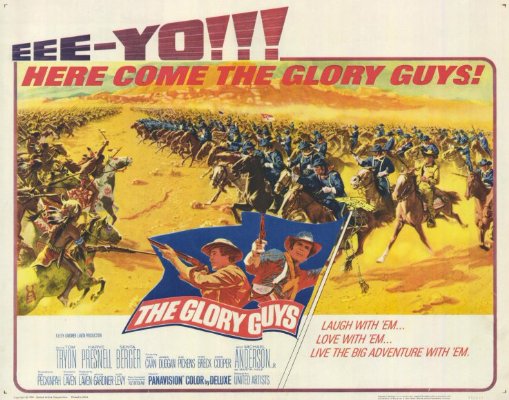
The Glory Guys
For over two years, I've been a Netflix member and have caught up with a lot of movies that were either impossible to find or I just wasn't willing to buy to actually see them. Over the two years, Netflix has added many features but maybe none better than the ability to watch a long list of movies instantly through your computer or even by downloading through your TV. There are some hidden gems among these many movies, but you've just got to find them. I stumbled across a western today I've long wanted to see, 1965's The Glory Guys.
I don't know how many years back, but I caught the last 10 or 15 minutes of this on TCM when I got home from school. Because it looked good and I was interested in seeing it again, it obviously hasn't been on TCM and of course is not available in any format. Thank you, Netflix, for making it available. With a screenplay by infamous director Sam Peckinpah, this western is a thinly veiled version of the massacre at the Little Big Horn when George Armstrong Custer and the 7th Cavalry were wiped out by a huge grouping of plains Indians. TV director Arnold Laven is listed as the movie's director, but rumors persist that Peckinpah handled some of the directing duties. For a western that is long forgotten, it has too many positives to be left behind as it is.
After fighting the Apaches in the southwest, Captain Demas Harrod (Tom Tryon) is transferred to Fort Doniphan by the orders of famed Indian fighter General Frederick McCabe (Andrew Duggan). He is assigned a company in the renowned 3rd Cavalry, but the men are a motley group of misfits with little experience with horses or firearms. With the help of his company sergeant, Gregory (Slim Pickens), Harrod goes about whipping the men into shape for the coming campaign. Harrod also finds himself in a fight for the hand of widowed gunslinger Lisa Woodard (the always lovely Senta Berger) against Army scout Sol Rogers (Harve Presnell). All their problems aside though, the 3rd Cavalry is part of a huge campaign meant to control the plains Indians for good, and Gen. McCabe is looking for glory in the process, no matter the cost in men.
Part of the reason this western has been forgotten over the last 45 years is the casting of the leads, Tryon and Presnell. Neither actor was a big star coming into 'Glory Guys' and neither would be afterward. They're the type of roles you can see much bigger names taking over, but for me I thought the two did solid jobs. Tryon can be a tad wooden at times, and Presnell's character is underwritten and underused, but they have a good chemistry together as they fight for Berger (and who'd blame them?). The unnecessary love triangle isn't as awful as it could have been thankfully, and besides a few scenes that kill momentum in the middle is left by the wayside.
More than a few things here reminded me of Peckinpah's other 1965 western, Major Dundee. The big ones are obvious, a cavalry story fighting Indians serving as the basis for both movies' story. But then there's the location filming in Durango, Mexico for both, and the casting of Berger, Pickens, and Michael Anderson Jr. in an eerily similar role to the one he played in Major Dundee. Whoever ended up directing more of 'Glory Guys,' there is the distinct feel of a Peckinpah movie whether it's seeing the same locations or just the dynamic among male characters. Peckinpah had a knack for tough, hard-edged male characters who fight and fight only to side with each other when the chips are down. There is a code among men like these, and they tend to live by it no matter the end result. So yes, it may be an average western, but it's elements like this that help lift it up a notch or two.
What works best when the story isn't focusing on the love triangle is the training and development of Harrod's D Company as they arrive at the fort only to turn into highly competent cavalry soldiers. Pickens is perfectly cast as tough Sgt. Gregory with Anderson Jr., a very young James Caan as brawling Irishman Anthony Duggan (the accent is must-hear), Adam Williams, and Erik Holland rounding out the recognizable faces in the company. Peckinpah's screenplay is at its best when dealing with the training and the camaraderie that develops among these men. The characters lean to outlines more than red-blooded characters, but Cann especially stands out, as does Anderson Jr. Tryon's Harrod pushes his men because he's seen Gen. McCabe's dangerous battlefield tactics and knows the better prepared his men are, the more likely they'll make it through alive. I wish more time could have been spent with D Company, but what's here is quality.
Now onto one of my self-named elements of movies I love, the sense of doom. With a story about an eventual massacre, you know where everything's going to end up. The last 45 minutes are dripping with tension as the 3rd Cavalry unknowingly rides to their doom. The actual battle is a spectacle to behold, hundreds of cavalry and Indians on horseback going toe to toe. Clearly some serious money was spent on the finale, an epic, well choreographed and constructed battle that would preview similar scenes in Major Dundee and The Wild Bunch. If you're a Netflix member, I recommend checking this one out, and if not, keep an eye out for it. How hard is it to find? I couldn't even find a trailer or a video clip.
The Glory Guys (1965): ***/****
Friday, October 29, 2010
Rush
Never a huge star in Hollywood circles by his own choice, Jason Patric has had an odd career over the past 25 years or so. He's been in some very successful movies, but it's rare you see him in more than a movie or two every couple of years. Whatever his reasoning, the movies he has made have generally been of a higher quality. They are rarely big blockbuster flicks, leaning more toward smaller, hard-hitting indie films, but I've yet to see one where Patric wasn't delivering a great performance. So even though I didn't really like 1991's Rush, I'll recommend it for his performance and one from his female co-star alone.
There has been a whole subculture of movies since the 1970s (and before I guess if you count gems like Reefer Madness) about drugs, junkies, and the world they live in. Almost by nature, these movies are going to be difficult to watch, more so depending on how graphic the depiction of drug use is. Rush is certainly uncomfortable to watch at times, and at a certain point it stops being interesting to watch because of that problem. It's a very voyeuristic look at two people struggling with addiction. There's very little entertaining about that because by a certain point you know where this story is going. There will be no happy ending here.
An undercover cop in a small Texas town, Jim Raynor (Patric) needs a new partner. He chooses Kristen Cates (Jennifer Jason Leigh), a young cop fresh out of the academy. Working undercover, the two officers will try to take down part of the local drug culture from the users and the low-level dealers all the way up the ladder to the suppliers and local kingpins that rule things. But to be convincing in their job, Jim and Kristen have to completely adapt the lifestyle they're trying to take down, meaning to save their own lives they often enough not only have to buy some heavy duty drugs but also use the drugs. Their only link to the police force, Captain Dodd (Sam Elliott), knows they have to do their job, but they tread that fine line and with pressure from above, the demands become harsher and harsher, pushing the two further down a road that it will be nearly impossible to come back from.
To the movie's credit, it feels authentic as Jim and Kristen are immersed in this seedy underworld of drug dealers and users. It feels like a 'Dummy's Guide to the Drug World' as we see all these people caught up in drug use, but more than that, the techniques, the never-ending paranoia, the relationships that develop, a little bit of everything. But after being introduced to all these different elements, Rush hits a roadblock. It becomes repetitive to the point where I found myself fast-forwarding through scenes. At least 15-20 minute probably could have been cut from the 120-minute running time because anyone with a couple of functioning brain cells can figure out how this story is going to end. That said, the final scene does deliver a great final twist so stick with the story all the way until the end.
Why I'll still give this a modest recommendation is Patric and Leigh. As veteran cop Jim Raynor, Patric gives his character this cool edge where he knows how tenuous his job is because if he pushes too far, he won't be a cop anymore, just a junkie. He of course, does push himself too far and ends up almost killing himself. It is alarming and disturbing to watch a character completely fall apart in front of you, realizing what he is doing all the time. It's a great part for Patric who with Leigh carry the movie. As young Kristen, Leigh still has an innocence about her, a naivete about what she's gotten herself into. Just on physical appearance alone, it is startling to watch both actors wither away as the drugs take over their lives and bodies.
Two supporting parts stand out including one more unique bit of casting. Elliott as Dodd makes the most of his part as the one remaining link Jim and Kristen have with the police force. His presence alone is a reassurance in his few scenes, especially because he used to do what Jim did and suffered through his own addictions and demons only to move on to a better life with a wife and kids. Dodd must balance out pressure from above with concerns over what his two officers have gotten themselves into. The other part is Max Perlich as Walker, a low-level drug dealer who is tied in with everyone and can supply anything given enough time. In the lonely world presented, Walker is just looking for a friend and finds it in Kristen, not knowing what trouble he's gotten himself into. Also look for Gregg Allman (of the Allman Brothers Band) as Gaines, the local kingpin who runs all the booze, drugs and sex in the area.
The movie itself is well-made, well-told and gritty enough to the point where it feels like a documentary at times. I wasn't expecting a pleasant, happy go lucky look at the drug culture in a small Texas town, but Rush passed my expectations of a dark, dreary, downright depressing look at two professionals pushing their own limits. It's hard to root for these two characters, and then the movie as a whole. Could have been a better finished product, but worth at least one watch for the quality acting.
Rush <---trailer (1991): ** 1/2 /****
Thursday, October 28, 2010
You Can't Win 'Em All
Because I'm not the laziest guy around, I'm not going to write the same exact intro for a review...even though I definitely could here. The transition from the 1960s to the 1970s hit some actors harder than others, and talented individuals found themselves in a situation where they had to reinvent themselves. I've covered the topic before with Rock Hudson and Audie Murphy among others, but the common denominator seemed to be to go to Europe or television to find work. Add recently passed Tony Curtis to the list.
Now I don't know how much Curtis' drinking and drug problems had to do with the detour his career went through in the late 1960s, but something certainly changed for the actor. Solid, worthwhile roles don't just dry up for no reason at all. So in the 1960s, Curtis tried both of the previously mentioned alternatives; he tried some TV work including working with Roger Moore in The Persuaders while also going to Europe for some roles, including 1970's underrated and forgotten You Can't Win 'Em All. I watched this a couple years ago and caught up with it this week as part of TCM's tribute to Curtis. I can't quite put my finger on it, but I really like the movie. It's a little different, a little weird, but always entertaining.
It's 1922 in Turkey and American Adam Dyer (Curtis) is rescued from his tiny, sinking fishing boat in the Mediterranean Sea by Jeff Corey (Charles Bronson), a fellow American with eyes on riches. The two like-minded individuals team up, and with Corey's crew of mercenaries (mostly WWI vets looking for $) get caught up in the Turkish Civil War. Adam and Jeff aren't picky about ideals or principles, just who's willing to pay more. They side with the Sultan of Turkey, undertaking a mission to transport some very important people out of the country before it can destabilize any more. The mercenaries will be well paid for their talents, but something just doesn't add up. The odds are stacked against them, and it seems that more is going on than meets the eye. Caught up in a bloody revolution though, can Adam, Jeff and Co. escape unscathed and with money and riches to boot?
Having watched this flick twice now, I couldn't explain why the story seemed so familiar. Well, reading some reviews over at IMDB helped that out like a train running me over. Directed by Peter Collinson, 'Win 'Em All' is basically a straight remake of 1954's Vera Cruz starring Gary Cooper and Burt Lancaster. Instead of post-Civil War Mexico, we're treated to post WWI Turkey with basically the same story, plot elements and characters. No complaints from me because I'm a big fan of Vera Cruz, but just enough is handled differently to set it apart that it an exciting, action-paced comedy buddy pic. It's not as dark as VC and knows it, reveling in the double crosses and backstabbings.
Working together for the first and only time unfortunately, Curtis and Bronson seem like an unlikely pair to cast as mercenaries ready to turn on the other at the drop of a hat. Their acting styles don't compare much, but somehow and some way it works. You know from the moment they're introduced that they may be partners, but they won't be very trusting partners. Each uses the other to their benefit, and they seem to know the arrangement. Adam and Jeff are always attempting to one-up the other right up until the very end, and thankfully 'Win 'Em All' doesn't go down the dark road Vera Cruz did in dealing with this rivalry. Their dialogue is great with plenty of snappy back and forths with some great one-liners, and the chemistry works perfectly. An unlikely pair, yes, but sometimes the unexpected produces the best results.
Having watched enough European-made movies, you see similar locations pop up in Italy, Spain, France and any number of other countries. And even in the fullscreen format TCM aired the movie in, you get a great sense of the beauty of Turkey where all of the movie was filmed. It's a funny thing, but you know what Turkey actually looks like? Turkey. This isn't an attempt to make the American west look like 1920s Turkey. The whole movie was filmed in country, and the locations are beyond gorgeous. Whether it is riding through a rocky, mountainous desert area or resting in a tiny village, this was a great visual movie. The endless scenes of a column of horsemen riding across the country could have been tedious, but there's enough to look at to keep you interested.
Now on to the fun stuff, the action, and there's plenty. For a lower budget movie, no expense was spared when the action hits the screen. Adam and Jeff's crew are outfitted with machine guns (always a good start) so as they traverse their way through the revolution they leave a trail of bodies in their wake. The requisite barroom brawl kicks things off, and then you can add an assault on an armored train, an artillery barrage on a besieged town, and a doozy of a finale on a boat about to be overwhelmed by the Turkish army. It's a good jumping off point for an action comedy that has that right tongue in cheek tone without overdoing it and with a solid cast to boot. Very hard to find, but keep your eye out for it on TCM from time to time. Can't wait that long? Start with Part 1 of 11 courtesy of Youtube with a similar looking print to the one I watched.
You Can't Win 'Em All (1970): ***/****
Labels:
1970s,
Charles Bronson,
Men on a Mission,
Tony Curtis
Wednesday, October 27, 2010
RocknRolla
Before I saw Sherlock Holmes last winter, my knowledge of Guy Ritchie was limited to knowledge of a couple cult classic British crime stories, his marriage to Madonna and subsequent disastrous movie starring Mrs. Ritchie. I liked Sherlock Holmes but didn't love it, and looking at his short list of movies none of them really jumped out at me, especially 2008's RocknRolla. I remember seeing the trailer and thinking it looked like an annoyingly ultra-stylish story that knows it's cool and is going to take every opportunity it gets to show you how cool it is. But then I really looked at the cast, and thought I had to at least give it a try. I'm glad I did.
Ritchie has taken all sorts of abuse over the years for everything from his directing style -- as a Tarantino rip-off -- to his not-so private life with Madonna. And even in a period piece about one of literature's most famous characters, Ritchie was able to make it an ultra-stylish period piece. Not having seen Snatch or Lock, Stock... but knowing their reputation, it seems Ritchie is most at home in the London underworld where heavy accents and dialects dominate and everyone and anyone will turn on you for a buck. RocknRolla is at times convoluted, at times overly concerned in its style, but in the end a very enjoyable, very entertaining British crime caper.
When a business deal goes south, two members of a British gang called the Wild Bunch, One Two (Gerard Butler) and Mumbles (Idris Elba), find themselves in needs of some quick cash, turning to an icy accountant (Thandie Newton) for some inside information. The man they owe, criminal kingpin Lenny Nelson (Tom Wilkinson), doesn't necessarily need the money, but principle is principle. Lenny, with right hand man Archy (Mark Strong), is caught up in a real estate deal with a Russian businessman (Karel Roden), who loans Lenny a famous, lucky painting of his until the deal can be completed. The painting wastes no time disappearing, and Lenny is up the creek, even more so when he finds out his stepson, drugged out rocker Johnny Quill (Toby Kebbell), is the thief. So it goes as all these crooks work to save their own backsides, a vicious cycle as One Two and Mumbles end up stealing the money that Lenny is due from the Russian, the painting playing a key role, and in the end everyone is going to run into each other.
Screwy enough for you? There were times as all these various storylines cross and re-cross that I wondered if I was watching a Seinfeld episode. But like the best Seinfeld episodes, Ritchie fixes everything in the end as all these characters, storylines and predicaments come together, everything tied up nicely with a bow. Confusing at times, surely, but never to the point where you feel lost. Because there is so much going on, you're not always sure quite where everything is going, but it's fun to go along for the ride. At a certain point, you just go along and enjoy some really cool characters interact in some very stylish ways. The London criminal underworld never looked so good.
The characters I included above covers about half the actual cast. Jeremy Piven and rapper Ludacris have two small parts as Johnny Quill's former manager roped into helping Lenny get his painting back. Tom Hardy plays Handsome Bob, a member of the Wild Bunch and friend of One Two and Mumbles. There's other characters that drift in and out, but those are the biggies. Two main storylines dominate all the action, Wilkinson and Strong as the kingpin and his tough as nails assistant trying to track down a stolen painting (the ridiculousness of the premise somehow works perfectly) while Butler, Elba and Hardy keep going after piles of money just waiting to be stolen.
Going away, my favorite parts of RocknRolla was the Wild Bunch. They have a great dynamic among all the members of a gang that isn't low-level crooks but isn't top-shelf thieves either. They're somewhere in between, knowing their place in the underworld. Butler has struggled finding good roles since the success of 300, but this is a very funny gem for him. Elba is equally perfect in an underused part as Mumbles, and Hardy (another great supporting part along with this summer's Inception) has a great twist to his character that produces some very funny results. The high point for the Wild Bunch is a robbery gone bad when two Chechnyan thugs do everything they can to protect the cash they're guarding. A running, chaotic chase scene with some great dark humor, knock down violence runs for almost 10 minutes and is the runaway favorite for the best scene in the movie. Watch a portion of it HERE. The end of course says the Wild Bunch will be back, and I'm looking forward to it.
As strong as the cast was, I was skeptical going into this movie and ended up really liking it. Almost every member of the cast is given their own chance to shine and none disappoint. Wilkinson is his smarmy, intimidating best, Strong's narration is dripping with subtle humor, Newton is a sexy femme fatale that film noir would be jealous of, Butler, Elba and Hardy have a chemistry that speaks to longtime friends, and in the big picture, the stylish elements never go overboard. Ritchie has a real winner here. If I can offer any advice, watch the trailer below, but don't hold it against the movie. Don't do what I did, and hold it against the movie.
RocknRolla <---trailer (2008): ***/****
Tuesday, October 26, 2010
Sex and the Single Girl
Screwball comedies are pretty hit or miss typically for me, but I give most the benefit of the doubt depending on the talent involved. The talent here made it worthwhile and caught my eye from the start. The premise is not surprisingly pretty ridiculous with some digs at sex, affairs and some necessary miscommunication and confusion as to who everyone is. It is 1964 so it can be pretty tame although gasp, 'virgin' is said once but never again. Pretty scandalous stuff, right? But despite a really stupid ending that pushed my limits, I still liked the flick almost in spite of itself, even as stupid as it is at times.
A managing editor for Dirt magazine (think TMZ but dirtier and in print), Bob Weston (Curtis) is the best at what he does; trashing celebrities with blatant lies that readers eat up. His next target? Dr. Helen Brown (Natalie Wood), a sex and relationship therapist who has gained fame from her best-selling book about how a single woman should live her life. Unfortunately for Bob, there's no easy way to prove that the very pretty Dr. Brown is living what she preaches. Has she even been in a serious relationship with a man? He finds his way in though, posing as his neighbor (Henry Fonda) who after 10 years of marriage is constantly fighting with his wife (Lauren Bacall). But in looking to reveal her as a fraud (surprise, surprise), Bob falls for her hard. Can he still win her over, admitting what he's been trying to do?
Like a lot of the 1960s screwball comedies I've seen, there's something a little off, a little disturbing with the story. Weston is basically trying to figure out if Helen is a virgin, and he's going to lie, cheat and steal his way into finding out the truth, at one point even resorting to just getting her drunk. The 1960s weren't as classy as I figured I guess. Thankfully, Weston develops actual feelings for her before he drunkenly takes advantage of her. The whole thing seems tame at times and oddly inappropriate at others. It never goes too far though because a movie where Tony Curtis takes advantage of Natalie Wood just doesn't seem quite right.
Finding that nice middle ground, director Richard Quine allows his actors to do their thing in getting the most laughs possible out of the story. Curtis treads that fine line between being a completely disgusting chauvinist and an overly charming ladies man. I've always thought of Wood as more cute than out of this world hot, but she really turns it on here. Maybe its the innocence of her character, but she's great in the part and looks gorgeous. In the 1960s, few actresses had as much comedic talent (dramatic talent too), and with Curtis you've got quite a pair together. Their scenes together are dialogue heavy, but it's great seeing them go back and forth with some really snappy exchanges.
Now as perfect as Curtis and Wood are together, I was surprised by the names I saw in the opening credits, especially considering I was just about to watch a screwball comedy. Henry Fonda and Lauren Bacall, really? The joke was on me I guess because they create the perfect subplot that at times is funnier than the main plot. Fonda is a hosiery salesman who looks at womens' legs for a living, and Bacall as his wife objects thinking he's just a pervert who likes looking at women's legs. They fight constantly, and Curtis' Weston has a source for information that he can turn around and pose as a husband in a troubled marriage. For two actors like Fonda and Bacall who typically stuck with drama, it's great to see them branch out. Are they great parts? No, not at all, but seeing talent like that work in a comedy is always worthwhile.
Because they can't all be winners, we have the third and final act of 'Sex and the Single Girl.' With mistaken identity that I Love Lucy would have been jealous of, all these different people cross paths and start chasing each other on the expressway outside Los Angeles in a variety of different cars. Look for Larry Storch in a laughably bad part as a motorcycle cop caught up in the craziness. The humor leading up to all this wasn't exactly high-brow, but this chase reminded me of the lowest kind of slapstick, almost like a chase you'd see in The Monkees or maybe Scooby Doo. The movie limps into the finish line because of the ending, but I'll still give it a mild recommendation.
Sex and the Single Girl <---TCM trailer (1964): ** 1/2 /****
Labels:
1960s,
Comedy,
Henry Fonda,
Lauren Bacall,
Natalie Wood,
Richard Quine,
Tony Curtis
Subscribe to:
Posts (Atom)