Released in 1967, Robert Aldrich's The Dirty Dozen came along at just the right terms for movie audiences with its cynical tone and generally pessimistic look at society and any sort of hierarchy and power. The story of 12 convicts chosen to take part in a suicide mission just before D-Day was unlike anything audiences had seen. To Aldrich's credit, he made the premise unique and damn entertaining. Really though, the idea of convicts turned commandos had been used countless times before.
Take 1964's The Secret Invasion from the master of schlock, low-budget B-movies, director Roger Corman. The cult director made a career of doing a lot with very little in terms of money in the budget as well as producing some 300-plus movies. But when given the chance, Corman showed what he was able to do with even a mid-sized budget like in 1964's The Secret Invasion, a WWII story that uses the same basic premise as Dirty Dozen. Don't be confused though, 'Invasion' is still a B-movie without any notion of being anything else. On the highly positive side, it's a prime example of how good a B-movie can be when everything goes right.
Stationed in Cairo in 1943, British Major Richard Mace (Stewart Granger) has assembled a dubious crew to help him on a dangerous mission in the Balkans. From prisons and penitentiaries all around the world, Mace has assembled a crew of criminals -- all experts in one way or another -- to join him. Just days away from the Allied invasion of Italy, Mace and his team will sneak into the Balkans and help an Italian general (Enzo Fiermonte) escape from a heavily guarded German prison. With the general's help, Mace hopes to turn the Italian forces against the Germans, making the Allied invasion even a little bit smoother. First though, the major has to worry about keeping his team of crooks in line, many of them willing to shoot him and escape the first chance they get.
Now with a B-movie -- even a really good one like this -- you can't expect a bunch of A-listers starring. Instead, you get something better. Actors you know and have seen countless times but usually in supporting roles. Some were past their prime and others still on the rise. Corman hits a home run with the casting of his dirty half-dozen including Raf Vallone as Rocca, a mafioso and expert planner of strategy, Mickey Rooney as Scanlon, an IRA explosives expert, Edd Byrnes as Fell, the master forger, Henry Silva as Durell, the hired assassin, and William Campbell as Saval, a master of disguise and deception. These were all solid character actors given a shot at starring roles, and the ensemble doesn't disappoint.
With any 'men on a mission' movie, there's a certain dark element that makes them intriguing. By the end, you know most if not all won't make it so early on make your choices. 'Invasion' certainly has some fun with this notion as to who survives and how. The cast is clearly having some fun with these cardboard cutouts for roles. Vallone as the reliable second in command speaks in that heavily accented English and certainly makes a positive impression, as does Silva as the dead-eyed killer. But by far, the most surprising and enjoyable part is for Rooney as the half-mad Irishman and explosives expert. Playing completely against type -- as he would do again two years later in B-movie Ambush Bay -- Rooney absolutely steals the movie.
As much as I like a good, old-fashioned long movie (even The Dirty Dozen was 150 minutes long), a quick-paced B-movie can be just as enjoyable. With his 95-minute movie here, Corman keeps the story going at all times with some snappy dialogue or a quick action set-piece. The story flies by and never really slows down. It's never long before the half-dozen find themselves in some sticky new situation they have to get out of. Along the way, they dodge either, work with some partisans, and then finally must fight their way out of the German fortress. Sounds easy, don't it?
Taking advantage of a bigger budget, Corman filmed in Yugoslavia and Croatia, giving the whole movie a unique, realistic feel to the proceedings. The on-location shooting is great, but Corman saves the best for last. Chased by hundreds of German soldiers, Mace's crew must escape up a seaside hill with the Germans close on their heels. He clearly spent some money on this battle sequence with an epic feel. Lots of extras working as German soldiers, explosions and shootouts galore, and some surprises as to who survives and who doesn't. It's a great action sequence, and Corman almost lulls you to sleep early with so little action. He certainly makes up for it in his finale.
I stumbled across this war flick at IMDB a few years back and am I ever glad I did. It's exciting right from the start -- opening scenes included below -- and never really slows down. Cool choices in casting, gorgeous locations, and a wham bang action finish. Maybe it doesn't have the high hopes a movie like The Dirty Dozen did, but from master director/producer Corman, this is about as good as a B-movie can be!
The Secret Invasion <---opening (1964): *** 1/2 /****
The Sons of Katie Elder

"First, we reunite, then find Ma and Pa's killer...then read some reviews."
Saturday, June 12, 2010

Friday, June 11, 2010
Dive Bomber

Considering the timing of the release of the movie -- August 1941 -- just a few months before the Japanese attack on Pearl Harbor makes this war flick a fascinating look into a pre-war United States armed forces. Made with the full backing of the U.S. Navy, the film almost seems like a dare to any possible enemies. "Come and get us, we're ready for you." And above all else, the planes are the reason to see this movie, and there are lots of them, but more on that later. Because remember, you can always have too much of a good thing.
Working as a flight surgeon in Hawaii, Dr./Lt. Doug Lee (Errol Flynn) loses a patient in surgery who blacked out during a dive bombing exercise and almost severed his spinal cord in the crash. Lee notices that this problem is facing pilots through the armed forces and starts to work on solving the issue. He goes through flight training and teams with Dr. Lance Rogers (Ralph Bellamy) as they begin to explore options on preventing dive bomber pilots from blacking out mid-dive. With help from a test pilot, Joe Blake (Fred MacMurray), the trio push the limits of how far and how high pilots can go, realizing a pressurized suit might be the best option in solving the problem.
In a movie centered around pilots and aviation, a certain amount of flying sequences are to be expected, but director Michael Curtiz doesn't know when to stop. I'm assuming to a certain point that with their full backing the Navy insisted on a set number of these sequences to show how skilled and talented their pilots were. And honestly, these flying scenes are something else as we see all sorts of formations and aerial tricks performed in the skies. But by the 10th or 12th time we see these long, uncut shots it all gets a little tedious. And with a movie that is far too long at 132 minutes, these scenes become more and more obvious as something worth cutting.
The flight sequences if nothing else balance the good and the bad, but I realized something about midway through the movie. You know what isn't that exciting to watch? Scientific experiments, even those dealing with flight and highly-trained pilots. The first hour is interesting as Lee, Rogers and Blake put aside their differences and work together. They make a big breakthrough that should help prevent pilots blacking out, and everything seems peachy. Then you realize there's another 70 minutes to go of more pressurized experiments and tedious aerial shots. Somebody should have snuck into the editing room with a pair of scissors and helped the movie out.
But as is so often the case with movies from Hollywood's Golden Age, producers and studios insisted on fleshing out so many things that are completely unnecessary to the essential story. Alexis Smith plays the cutest stalker around who keeps following Flynn's doctor/pilot wherever he's stationed. She's just so darn cute he doesn't seem bothered by her stalkerish tendencies. Then there's the comedic segments where Lee's assistant, Lucky (Allen Jenkins), has to avoid his recently divorced wife who is trying to get his money. He avoids her by hiding in an isolation ward not once, not twice, but three times in scenes that go on far too long. Oh, that 1940s humor, it is a humdinger!
Even with all those complaints, the movie has some interesting elements, most of them related to the casting. Playing a Navy doctor is a bit of a change of pace for ladies man Flynn, but it's a good change of pace. Bellamy is a good counter to the charming Flynn, and MacMurray is the arrogant a-hole who ends up coming around in the end because 'aw shucks, let's all be friends!' The three do have a good chemistry together and help move the slower parts along. My recommendation is watch the first hour, and then stop. You're going to see the same thing over and over again.
Dive Bomber <---trailer (1941): **/****

Thursday, June 10, 2010
Operation Crossbow

As much as WWII was about one Allied soldier facing one Axis soldier, there was a race at home to be the first country to develop the atom bomb. On less destructive levels, both sides tried to create weapons technology that could cause more death and destruction than the average grenade or artillery shell. Obviously, these advances were kept as top secret as possible, but that doesn't mean each side wasn't trying to one-up their enemy by playing a little defense courtesy of the Intelligence community doing a little sabotage.
It's midway through 1943, and the Germans have developed a new flying bomb that they plan to unleash on London and other English cities. The Allies are aware of the new development, and do their best to slow down the advances by consistently bombing German work sites where they believe the bombs to be built and launched. But as dangerous as the bombs are, the Germans have a new weapon in the late stages of development; the V-2 rocket, that could drastically change the course of the war, including the D-Day invasion. Facing such a huge game changer, Allied Intelligence is forced to use a desperate plan; send Allied agents into Germany disguised as engineers who will help develop the rockets.
You might have noticed there's not a single actor/actress listed in the plot description. Basically, it would have taken too long to include them and make that paragraph a behemoth to read. Like other big budget war movies, 'Crossbow' utilizes an ensemble cast with talent from all over the world taking part. And in terms of story, the ensemble works better because the plot is very episodic. The first 30 minutes is almost exclusively from the German perspective, the next 30 the Allied Intelligence, and the last hour mostly with the agents working deep undercover. Each of these segments could have been expanded for their own movie, but together they work to form a coherent storyline.
The cast listing is an odd one because producer Carlo Ponti listed his wife Sophia Loren as the lead when really she makes a 20-minute or so appearance and is an add-on more than anything else. That's not being critical of Loren because she's a fine actress, but big picture her part isn't essential to the movie. Starring as Germans the ensemble includes Paul Henreid and Helmut Dantine as two high-ranking German generals, Barbara Rutting as German aviator Hannah Reitsch, and Anthony Quayle as Bamford, a secret agent/spy. Allied Intelligence includes Richard Johnson, Trevor Howard, John Mills and Richard Todd as the men trying to halt the German advances. The agents sent into Germany include George Peppard, Jeremy Kemp and Tom Courtenay, all posing as deceased scientists so they can access the German rocket plants with Lilli Palmer playing a resistance contact.
The whole movie is a good example of a solid WWII ensemble, but the best and most interesting/exciting part is when the story follows these three agents. They are all forced to become someone else, knowing if they are caught they will be summarily shot on site. Even getting to that point is difficult as Peppard's Lt. Curtis finds out when the scientist he is posing as is visited by his wife (Loren). Courtenay's Henshaw is dealt a cruel twist of fate and must decide how much he is willing to sacrifice. Kemp's Bradley is dropped into Germany as a last-minute resort with little knowledge of the man he's impersonating. Their scenes as they try to dupe the Germans are tense and difficult to watch, those scenes where you get butterflies hoping everything doesn't hit the fan.
Crossbow's story covers a lot of ground -- almost a year and a half -- but never feels like we're being let out. Supposedly a much longer finished product was turned in by director Michael Anderson only to have it cut heavily to the movie we see now which clocks in at just under two hours. You can see where certain segments were cut, especially the German segment to open the movie, and other odd instances like Peppard gaining a bandage on his forehead, but we never see why. But these are little things, not big disturbances that could ruin the movie.
While the V-2 rocket was actually used by Germany in WWII -- over 3,000 were fired at England -- the movie does have to have some sort of resolution if not necessarily a happy ending. The finale is a whopper as Peppard and Kemp desperately try to pinpoint their underground location to a passing bomber force. The huge underground facilities sets look like something out of a James Bond movie and provide quite an ending to a strong story. Not as well know as some of its 1960s WWII counterparts, but definitely worth a watch or two.
Operation Crossbow <----trailer (1965): ***/****
Wednesday, June 9, 2010
Up in the Air

The economic struggles the world has gone through in the last half-decade or so sets the groundwork for this story. Companies and corporations worldwide were forced into firing thousands of employees because the money just wasn't there to pay them their salaries. Families and individuals alike were forced to improvise on the fly and adjust to their new job-less lives. But what about when a company/corporation wanted nothing to do with the actual firing process? That's where Up in the Air steps in with the always cool, always suave George Clooney handling the firing duties.
Working for a nameless company, middle-aged Ryan Bingham (Clooney) spends 300-plus days a year traveling across the country going from company to company helping them fire their employees one-by-one in a face to face situation. It's a horrific job, but Bingham is good at it, and even weirder than that, he likes it. Bingham lives out of his suitcase and dreads the time he has to spend at his bland, sparsely decorated apartment in Omaha. He's called back to headquarters though where a new hire fresh out of college, Natalie Keener (Anna Kendrick), has brought in a new technology that will erase the need for Ryan and his co-workers to travel to these places, instead firing people on a computer. But first, Ryan's boss (Jason Bateman) wants him to take Natalie on the road for a few weeks and show her how it's really done.
Nominated for a handful of Oscars including Best Picture, Best Directing, and three different acting categories, it's easy to see why director Jason Reitman's movie did so well critically and in theaters pulling in over $80 million. Just like Reitman's Juno, it's a slick, professionally made movie that reeks of talent in front of and behind the camera. The dialogue is quick and sharp as the characters talk in ways that ordinary people could never sound like, and the story has a visual edge as Ryan's airport/hotel life is shown in detail, quick cuts and all. This might sound negative, but it really isn't. It sounds like I'm resenting a movie that is well-made, but if anything it's too well-made.
Starting with the casting, the three main parts are all home run roles, all of them earning an Oscar nomination but none of them winning. Clooney is a great actor, and about as safe as an actor currently out there in terms of turning in a great performance. He somehow makes Ryan a likable character even though there's not much to root for in terms of personality, beliefs, or principles. Bingham is charming though and that always helps. He has an interesting relationship with a woman, Alex (Vera Farmiga), who is basically the female version of him. Neither is really looking for any sort of commitment, and in that way they bond. Playing Natalie, Kendrick is the anti-Ryan so she naturally clashes with him, especially forced to work with him on the road.
Joining Bateman in the supporting cast is a handful of comedic actors who get to show their dramatic chops off. In some cases, their appearances aren't anything more than a minute or two, but even with a limited amount of time they come across well. J.K. Simmons and Zach Galifianakis play two employees at different companies Ryan must fire, each of them handling the news in their own unique way. Melanie Lynskey and Danny McBride (in dramatic scene-stealing mode, one monologue especially) play Ryan's sister and her husband-to-be with Amy Morton playing the sister trying to bring the family together. Also look for Sam Elliott to make a quick appearance. In a nice touch, Reitman also had actual fired employees play themselves in many scenes, giving an authentic feel to these already difficult scenes.
For me I thought the movie was at its best when sticking with Ryan -- and later Natalie -- on the road as they travel from airport to airport, always moving to another company that needs help. There's drama, some dark humor thrown in, and a style that is visually pleasing and enjoyable to watch. The story goes downhill a bit at Ryan's sister's wedding though, and even though it features some fine moments, it feels a little off. The last 30 minutes featured a twist that I saw coming but was still bothered by it because one, it brings up some big plot holes, and two, I didn't like the revelation a character makes. Still, the first hour builds up a lot of credit so the struggles in the second half aren't a deal breaker.
The ending itself is far from a happy ending, but it works for the Ryan character. Depressing? You bet, but it comes together for me. Ryan's changed, but at the same time he hasn't. He wants something else, but maybe he is too scared to look for it, or maybe he just doesn't know where to start. It was a bit of a jarring ending, especially considering the last line. You may not like the ending -- I didn't -- but for a realistic, feasible way to end the story, it fits together.
Up in the Air <----trailer (2009): ***/****

Monday, June 7, 2010
The Road

Most recently, The Road was made into a feature length movie of the same name in 2009. Granted, it was in theaters for about 90 minutes -- if at all on Chicago's Southside -- so I didn't get a chance to see it, but the movie hit DVD last week. The book is a critical favorite, and McCarthy shows his ability to spin a simplistic story that can still be profound (maybe because of its simplicity). When I found out the novel was being made into a movie, I was suspicious at first. This post-apocalyptic novel is not full of action or dialogue, and to tell you the truth, not much happens at all. But somehow, just like the source novel, the film is worthwhile almost in spite of itself at times
Director John Hillcoat has made a movie that creates a tangible, very real look at what a post-apocalyptic world would look and feel like. He filmed all over the U.S. including Pennsylvania and Oregon and drops the viewer into this world. The only color we ever see is in a few quick flashbacks to a pre-apocalypse world while everything else is shot in shades of gray and brown. Nothing specific is ever mentioned as to what happened to the world, but plants are dying, animals are seemingly extinct, and the sky is always covered in dark, gloomy clouds. As one character points out, the world is dying, and we are too. Uplifting message, huh?
In this dreary God-forsaken world, a man (Viggo Mortensen) travels along the vacant roads with his young son (Kodi Smit-McPhee) just trying to survive from day-to-day. Food and water are scarce, and they trudge along looking for anything that might help them survive. It's been years since something happened to the world and almost destroyed civilization, leaving very few people alive. Those that are left? Some are like the father and son doing their best to survive. Others have joined together into roving gangs ready and willing to kill for any reason. The father and son travel south, hoping to eventually reach the coast and hopefully find a better place. But in this world, there's no guarantees of anything.
McCarthy's novel is simple and to the point in creating this sparsely-occupied world. Translating that to a 2-hour movie is/was a daunting task if you ask me because whole stretches in the novel are just descriptions of the things they find and places they walk through. That's really my only issue with the movie. To call it leisurely paced is a huge understatement. I realize the movie's trying to tell us and show us how these two people survive in this world, but it drags in a big way.
The movie is at its best when dealing with the trials and tribulations father and son must make their way through. Very few people are still alive, but when they do find them, it's every man for himself. It is kill or be killed, and look out for the individual first. In this vast, desolate world, someone trying to kill you could be anywhere waiting for their chance. When these moments do come along, they're the type of scenes that can send chills up and down your back like no thriller/horror movie ever could. These scenes show how alone this father and son really are. No one's there to help them. They're on their own. Maybe that's the purpose of the slower scenes -- to lull you into a comfort zone -- and in that sense, the deliberate pacing works.
Viggo Mortensen, besides having basically the coolest names ever, is one of the best actors around, and this is a performance that lets him show off his talent. His sole goal in life is not for himself to survive, but to help his son survive and keep going. This is a man who's survived for years -- and looks it too -- who is driven by that one desire and goal to help his son. 13-year old Smit-McPhee is impressive as well in his first big-budget movie. This is a boy who doesn't know any other existence, but still has a humanity and a belief in morality as they cross this ravaged world. Other parts include Charlize Theron (only in flashback) as Viggo's wife, Robert Duvall as Ely, a 90-year old nearly blind man they meet on the trail, and Guy Pearce and Molly Parker as a man and woman traveling south too.
As for McCarthy's ending, the movie sticks pretty close to what the novel presented. And as depressing as it could be taken, it offers some semblance of hope. All these apocalyptic, dystopian stories almost have to end with a remnant surviving, one last pocket of humanity that offers some sort of hope for the future -- however bleak that future may be. The moral of the story is this, I can't get a read on McCarthy at all, and maybe that's a good thing. His novels aren't always easy to read, and the movie translations can be difficult at times, but in the end they're worth it.
The Road <----trailer (2009): ***/****

Sunday, June 6, 2010
American Graffiti

It's a story Lucas based off of growing up as a teenager in California in the 1950s. Looking at the cast and even the main credits may throw you for a loop, making you think you're watching Happy Days: The Movie. Some of the storylines and characters will almost certainly seem cliched for younger audiences, but there's a funny thing about movie cliches. They've got to start somewhere, right? 'Graffiti' was one of the first as it tells the story of four teenagers and their adventures and misadventures in one late summer night. If a 1973 teen comedy doesn't sound appealing to you, I'd recommend 1998's Can't Hardly Wait which is basically a more modern remake of the same story.
The night before they're supposed to head east for their first semester of college, Steve (Ron Howard) and Curt (Richard Dreyfuss) meet up at the local burger joint early in the night. They've got big plans for their last night in town, but of course nothing goes smoothly. Steve wants to spend the night with his girlfriend Laurie (Cindy Williams) but gets things started off on the right foot by saying he'd like to date other girls at college. Curt is wavering about a decision if he should even go to college, all the while looking for a mysterious blonde. Two other friends, underclassmen Terry (Charles Martin Smith) goes cruising with Steve's car newly given to him, and John (Paul Le Mat), the town's designated cool kid is looking for challengers for a drag race while driving around a young girl (Mackenzie Phillips) who refuses to go home. No matter what happens, a lot of things could change before morning rolls around.
If you could bottle the late 1950s and early 1960s as a decade and sell it, American Graffiti could corner the market. Lucas -- writing and directing -- creates a feeling and look of the 50s/60s like few others have been able to. The soundtrack is full of classics from 'Rock Around the Clock' to 'Johnny B. Goode' and everything in between. Add in famous disc jockey Wolfman Jack, and you've got a winner. Everything from the souped-up cars to the lingo to the jeans and t-shirt look (cigarettes folded in the sleeve of course) feels authentic like you're there with the characters cruising through town on a warm late summer night.
The story is divided fairly equally among the four main characters, Steve, Curt, Terry and John, but thankfully Lucas decides to spend just a little more time with Terry and John -- by far the more interesting of the four characters. Terry is an underclassmen who meets Debbie (Candy Clark) and ends up feeding her every line in the book to try and convince her how cool he is. Naturally, nothing goes smoothly. John Milner is a couple years older than the others and though he's still the coolest guy around -- think of the Fonz -- he's beginning to wonder if his time has passed. The dynamic Le Mat and Phillips together is perfect and blends humor with drama flawlessly.
None of that is meant to say the other characters aren't interesting. The problem is it's clear from the start Steve and Laurie are going to end up together even with all the bickering they do. Howard and Williams -- a year before they'd work together on Happy Days -- do have some great chemistry, but their story is dull compared to the others. Dreyfuss' story is the weirdest as he starts off questioning what he should do with his life and ends up with the Pharaohs, a local gang of toughs (led by Bo Hopkins). This movie also starts a tradition where late 20-year olds play teenagers 10-15 years younger than they actually are. Also look for a scene-stealing Harrison Ford as Bob Falfa, an out of town drag racer, and Suzanne Somers as a mysterious blonde who puts a hex on Curt.
Now where it seems every teen comedy is a mindless sex romp, it can be refreshing to see a story as good as this one. A coming of age story can be just as interesting and entertaining -- although these characters are always looking for a little action even if it never ends well. Reading through the cast, I found a sequel to this one which seems weird. At the end, four weirdly out of place title cards explain what happened to the four main characters, two of them extremely depressing. Apparently the sequel wanted to explain those explanations. Stick with the original, it's about as good as a teen comedy can get.
American Graffiti <---trailer (1973): ***/****
Friday, June 4, 2010
Code Two
Did you ever watch an episode of CHiPs and think 'Man, I wish they made a movie about these guys?' Yeah, me neither. But if you did, 1953's Code Two might be just the movie for you except without Erik Estrada, way too tight biker pants, and police seducing women every chance they get. Almost serving as a public service announcement about how cool it is to be a motorcycle cop, Code Two has its moments in a quick 69-minute running time.
Made with a relatively unknown cast and with a smallish budget, 'Code' benefits from some cool on-location shooting in Los Angeles and the surrounding area which gives a nice window into 1950s California. Add on top of that some even cooler footage of vintage motorcycles whipping around the city, and you've basically got this movie with a ham-fisted storyline thrown in for good measure. Let's face it, what's a motorcycle cop movie without some ridiculous crime to solve?
Heading into the police academy, three officers-to-be dream of one day being motorcycle cops. First, there's Chuck O'Flair (Ralph Meeker), a cocky, fun-loving SOB who wants to prove he's the best. Second, there is Harry Whenlon (Jeff Richards), the boring All-American guy devoid of all personality. Last is Russ Hartley (Robert Horton), a husband looking to provide for his young family. But if these three crazy kids want to be motorcycle cops, first they've got to get through Jumbo Culdane (Keenan Wynn), the tough as nails veteran instructor who will throw everything in the book at them so they're ready for their jobs. Even if they do pass, they've got the extremely dangerous job of patrolling the streets ahead of them.
Nothing from that storyline isn't straight out of the movie script cookie cutter formula maker. Really, the plot is probably the last thing you'd look for in a movie like that. 'Code' at its best is with the trainees going through their equivalent of boot camp to get onto the LAPD and then their bike training to become motorcycle cops. There's some great footage of these training sequences with much of the cast -- especially Meeker and Wynn -- looking like they did much of their own riding whenever possible.
The cast is nothing special with the only characters of interest being Meeker's cocky Chuck and Wynn's tough as nails Jumbo. The All-American boy is about as cardboard as possible, and the family man cop tries to hide his job from his wife who worries about him. Thankfully, not too much time is devoted to either of them. Meeker does what he does best, play an a-hole, and while he's not particularly likable, he's at least interesting. Wynn looks to be enjoying himself the most as Jumbo -- think the police equivalent of a foul-mouthed (for the 50s at least) of a Marine drill sergeant.
The already mentioned ridiculous crime that has to be solved is a doozy. SPOILERS During a routine traffic stop, Harry gets knocked out and run over by a cattle truck (William Campbell is the killer), but little evidence other than a tire track is left behind to provide clues. Meeker's Chuck ends up breaking the case which even now having finished the movie makes me shake my head. In 1952 Los Angeles, some criminal organization is rustling cattle, transporting them in trucks, slaughtering them and butchering the meat, and apparently running some sort of illegal deli. Chuck tracks them down and gets in a shootout with a lot of nameless henchmen just waiting to get knocked off.
A completely forgettable movie but at least its entertaining. Also watch for a young uncredited Chuck Connors in just his fourth movie, making a quick appearance as a sheriff's deputy. Probably worthwhile for motorheads and for a nostalgic look at 1950s Los Angeles.
Code Two <----TCM trailer (1952): ** 1/2 /****
Thursday, June 3, 2010
Angel Face
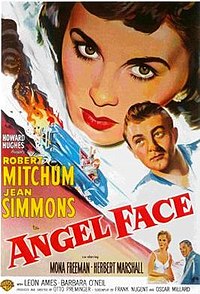
A later entry into the film noir chapter, 1952's Angel Face rides on Simmons' shoulders to keep the viewer guessing as to what's going on and what's going through her head. And I guess really that she's not the prototypical femme fatale, not in the typical sense of the definition when it comes to film noir. But whatever you want to call her part, it is impressive. Simmons' innocent, doe-eyed look brings you in thinking she's not capable of harming a fly, and then WHAM! There goes the fly. I'll add spoiler warnings for any twists -- and there are a few -- but be aware they're coming.
Working as an ambulance driver to save money for an exotic car garage, Frank Jessup (Robert Mitchum) is dispatched to a house in the hills outside Los Angelese. It's there he meets Diane Tremayne (Simmons), the daughter of the patient. Her stepmother almost asphyxiated when gas was pumped into her room. The police investigate but come to no conclusions. Frank puts it behind him, but Diane keeps popping up and the chemistry and romance begin (Frank seems awful clueless at times). She wants to help him start up his garage and offers him a better paying job as the family's chauffeur. He somewhat suspiciously accepts the job but finds out this family isn't all it is cracked up to be. Diane's father (Herbert Marshall) has remarried to a rich woman (Barbara O'Neil) who is jealous of the relationship he has with his daughter. Can Frank get out of this mess?
I was surprised throughout this movie at the way Simmons is able to pull off cute and innocent one scene and then throw you for a loop with a scene that clearly shows she's not all there in the head. One extended scene has Simmons walking through the house with a glaze over her face like she doesn't believe what's happened. SPOILER STOP READING SPOILER She wants to kill her stepmother, but in trying to set up an accident gets her father killed too. END OF SPOILER Director Otto Preminger doesn't go all the way in making Diane crazy though. A sub-plot with Frank's girlfriend Mary (Mona Freeman) dating co-worker Kenneth Tobey is generally let by the wayside, but made me think at some point we'd find out Diane killed her or set her up in some way.
Watching Simmons do her thing, I was reminded of Fatal Attraction with Michael Douglas and Glenn Close. Like I mentioned, Simmons doesn't go full-on crazy, but I'd wager Close had seen this movie at some point because the influences are all over the place. As for Mitchum, he's one of my favorite all-time actors, but this has to be his dumbest character ever. He never seems to catch on to what's actually happening around him. Even at a trial late in the movie, he seems disinterested in finding out the truth. There's a part of me wanting to scream at him 'Run for the hills, brother! She's nuts!' but of course stupid characters don't suddenly become aware of how stupid they are.
I did enjoy much of the movie, but some pacing problems exist. A long 15-20 minute scene is a courtroom scene late in the movie as Diane's lawyer (Leon Ames) does his best to acquit her and Frank with the district attorney (Jim Backus) doing his damnedest to throw the book at them. It's interesting enough as the two go back and forth, but Simmons and Mitchum are left in the background to grimace or look nervous every once in awhile. I'd bet neither says a word for 10-minutes plus during this segment. It doesn't help that Ames' defense lawyer is one of those slimy types you just want to pop in the face. After over an hour with Diane and Frank, the courtroom segment seems out of place and unnecessarily slows things down.
Following the trial and all its fallout, the ending comes as more of a shock in its violence than in a genuine surprise. About five minutes out, I called what was going to happen, and how Mitchum's Frank didn't see it coming I'll never know. But when it does come, it is a doozy, and a good one. Even with the slower parts, that's the movie as a whole; a good one. Strong directing from Preminger and Simmons and Mitchum have good chemistry together.
Angel Face <----(1952): ***/****
Wednesday, June 2, 2010
Role Models

Much of the talent working on Role Models came from a 90s cult TV show called The State, a group that has worked together countless times since. Watch Reno 911 and you'll see just about everyone from the cast working together again with this comedy. But that's the problem. There isn't a ton of comedy. It's a good movie, an enjoyable flick if nothing else, but it goes long stretches without actually producing any laughs. The cast is beyond talented, and the finale is pretty crazy, but I only came away liking the movie, not loving it.
A 10-year employee of Minotaur energy drink, 35-year old Danny (Paul Rudd) is having a mid-life crisis and on an epically bad day gets arrested with co-worker Wheeler (Seann William Scott) for a long list of felonies and crimes -- mostly minor ones that together add up. To avoid jail time, the two have to do 150 hours of community service at Sturdy Wings, an organization that pairs adults with little kids who need mentoring (think Big Brothers and Sisters). Neither is too enthused about the job, even more so when they meet their kids. Danny gets Augie (Christopher Mintz-Plasse), a teenager who is heavily involved in live action medieval/fantasy role-playing while Wheeler gets Ronnie (Bobb'e J. Thompson), a foul-mouthed boy who goes through "mentors" as quick as they're introduced.
The basis for the community service is ripe for the picking, and in terms of the relationships the story develops between the 'Bigs' and 'Littles' as Sturdy Wings call them, the movie is a winner. Danny and Augie find out both of them were forced to do this -- Danny by the judge and Augie by his mom (Kerri Kenney) and stepdad (Ken Marino) -- while Wheeler realizes Ronnie is just looking for a friend and ends up being honest with him, including THIS SCENE where they bond over their love of the female anatomy. This also comes courtesy of a bonding montage set to an ELO song. But for the most part, these scenes produce a chuckle here and there, but they're never hilarious, side-splitting laughs that the previews made this movie look like it was full of.
I've always been a big Paul Rudd fun, but for most of the first half or so he seems to be sleepwalking. Granted, the character kinda demands it, but he's not that funny either. His character is depressed, and doesn't have the same energy that his characters usually do like Knocked Up, Anchorman, or Wet, Hot American Summer. William Scott is the scene-stealer as Wheeler, a dude who loves what he does -- posing as a Minotaur mascot in energy drink presentations -- and ends up becoming a big brother/father figure to Ronnie. Their early scenes trying to convince kids not to do drugs -- drink Minotaur instead! -- are perfect, especially with Wheeler decked out in a furry mascot costume. Both Mintz-Plasse (of Superbad fame) and Thompson are hilarious and show that kid actors can be as funny as their adult counterparts.
Some other worthwhile supporting players include Jane Lynch as Gayle Sweeney, the former drug addict alcoholic now running Sturdy Wings, a woman who has quite the nose for sniffing out BS when it's presented, and easy on the eyes Elizabeth Banks as Beth, Danny's recent ex and lawyer. The whole breaking up subplot with Danny and Beth does drag though and takes away from the much-stronger parts of the movie. Also look for Joe Lo Truglio as Kuzzik, a fellow medieval/fantasy member who speaks as if he was a knight from the Middle Ages. The finale as the Medieval Battle Royale is priceless as Danny, Wheeler, Augie and Ronnie - dressed as members of Kiss -- do battle for victory.
Not a ton to say about this comedy. I really liked parts of it, and others fell flat. It is a funny movie because of the talent involved with the cast and crew, but it as if at a certain point they forgot to put more jokes or one-liners into the movie. Worth watching, but probably not a rewatch.
Role Models <----trailer (2008): ** 1/2 /****

Subscribe to:
Posts (Atom)