I'm kinda conflicted about Redbox. I like how easy it is, how cheap it is, and the variety. I can also appreciate that Redbox and Netflix have all but killed the video store. Still, you go with what you've got, and if I've learned anything from Redbox, it's that there's a whole lot of movies out there I've never, ever heard of. Straight to DVD, never released in theaters, it can be hit or miss so you've got to be on the lookout. Every once in awhile, you get a winner like 2013's Vehicle 19.
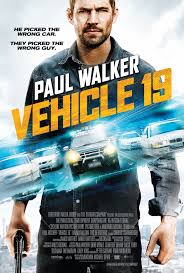
A plane lands in Johannesburg, South Africa, an American named Michael Woods (Paul Walker) getting off the plane and heading for the rental car company. He's in South Africa to try to patch things up with his ex-wife who divorced him after he was sentenced to 18 months in prison for a hit and run (one he still maintains his innocence of), just days removed from his release. Woods picks up his car, calls his ex and is off, but it doesn't take long before he realizes something is up. There's a cell phone that's not his receiving text messages with directions, there's a gun underneath the driver's seat and he's hearing noises from the trunk, a woman (Naima McLean) tied up and stashed away but very much alive. Michael isn't telling the whole truth though. He violated his parole to travel to South Africa and salvage his marriage. A voice at the other end of the phone tells him to simply follow orders, but what can he do? What should he do?
Now according to all-powerful Wikipedia (and they rarely steer me wrong), 'Vehicle' earned some $2 million-plus in theaters last year. Obviously, that's not a huge, national theatrical release, but it was in theaters at some point, huh? So trudging on, I stumbled across it on On-Demand and with Walker starring and a premise that sounded pretty cool -- even somewhat similar to the Fast and the Furious series -- so I gave it a shot. Go figure, I liked it. The reviews pretty uniformly ripped this flick from director/writer Mukunda Michael Dewil, one that was filmed on location in South Africa, quite the change of pace from your usual action movie hitting theaters. There is a different quality to it that simply put, just works. The soundtrack mixes South African rap/hip-hop (not so good) with a trance-like score (pretty decent), and things never slow down in an 85-minute movie.
All about the gimmick for this little-released action thriller. Almost the entire movie is set in the rental car that Walker's Woods accidentally picks up. In a rush to meet up with his ex-wife (Leyla Haidarian, heard over the phone more than seen in person), he basically hangs up on the rental office as they try to warn him he's taken the wrong car. From there, we're off. Movies with such a small "set" don't always work, but that claustrophobic, impending doom feeling here works really well as Woods stumbles deeper and deeper into something incredibly sinister involving human-trafficking and corruption through the government and police force. Are there some instances that stretch limits of reality? Sure, especially Woods seeking some help from some rather helpful gangsters. It builds the drama and the tension all the way through, that mystery permeating the story. What the hell is going on exactly?
We get that what the hell's going on mindset through one Paul Walker, a favorite movie star of mine. I recently reviewed another Walker venture, 2013's Hours, that I came away pretty impressed with. Over the last few years before his tragic death, Walker was definitely developing into a very respectable actor, not just a movie star. This was a cool, little part, and like Hours, the focus is almost entirely on Walker, scene in and scene out. It is certainly an interesting character -- some more development would have been lovely -- as he descends deeper and deeper into something he was never intended to be a part of. Can he survive it all? Can he even decipher what he's stumbled into? There's some nice touches from the American driving in a foreign country to the ex-con trying to prove he's innocent for any number of things. And come on now, it's a driving movie. Walker shot to fame in the Fast and Furious movies. He looks right at home in the driving sequences.
I think sometimes when a movie gets negative reviews, other reviewers simply read those reviews and regurgitate ideas into their own. I read several reviews that all criticized 'Vehicle' for its "incoherent action scenes." Literally, word for word. What movie were they watching? It is a movie built around one big, extended car chase. What's so incoherent about these scenes? Do we need to know the inner workings of Johannesburg as Woods navigates the city? No, not at all. If the complaint is the editing, then a whole lot of other, far more positively reviewed movies should have taken some heat. The entire story takes place over a couple hours as Woods' situation goes from bad to worse and then hellaciously worse.
Look, this movie doesn't rewrite the genre. Maybe it's not even that good, but I enjoyed it from beginning to end. It's exciting, keeps you guessing, and doesn't overstay its welcome. Ignore the almost universally negative reviews. This one was fun and worth a watch.
Vehicle 19 (2013): ***/****
The Sons of Katie Elder
"First, we reunite, then find Ma and Pa's killer...then read some reviews."
Thursday, May 15, 2014
Tuesday, May 13, 2014
Paul
Way back in 2004, audiences were introduced to Simon Pegg and Nick Frost in 2004's Shaun of the Dead. The comedy duo worked with director Edgar Wright again in Hot Fuzz and World's End, the trio's odd, smart sense of humor resonating with audiences. Pegg and Frost branched out in 2011, starring in Paul, a movie any science fiction fan will get a kick out of.
Lifelong friends with a love of science fiction, Graeme Willy (Pegg) and Clive Gollings (Frost) have traveled from England to San Diego for Comic-Con. That's not all for the trip though, the friends renting an RV and planning a trip across the southwest, hitting all sorts of extraterrestrial spots like Area 51 and Roswell. The trip goes pretty much as planned....at first. One night driving along, the RV crashes and when they get out to investigate, Graeme and Clive are stunned at what they find. An alien is standing in front of them, and he speaks English quite clearly (and with some attitude). The alien's name? Paul (voiced by Seth Rogen), and he's on the run from government agents. Paul has escaped from the facility he's been held at, and he intends to go home to his own planet. He bonds immediately with nerdy Graeme and Clive, but he needs their help. Will his two new friends help him get away and get to his spaceship?
I really do try to be honest with my reviews so here goes. When I saw the trailer for this sci-fi comedy a few years back, I thought it looked dumb. No, that's not enough. D-U-M-B. I avoided it the last couple years, finally caving and getting it on Netflix. The cast proved to be quite the motivating factor in the end! Well, as is so often the case, my complete refusal to listen to the "Don't judge a book by its cover" premise ended up being very, very wrong. I liked this movie from director Greg Mottola (Superbad, Adventureland). A lot. It was funny, surprisingly smart, and pretty sweet in the end -- with some dark, stupid humor mixed in for good measure. Yeah, the pretty deep, very talented cast helps, but there's more to it than that. With Pegg and Frost writing the script, you know you're getting a good final product.
The acting/writing duo actually came up with the idea for 'Paul' when they were filming Shaun of the Dead, and then it was just a matter of time until they could make it. The elements that worked in 'Shaun,' 'Fuzz' and 'World's' all translate here in an easy-going, natural chemistry. It never feels like Pegg and Frost are acting. This plays out like two old friends who know everything about each other -- some think they're gay, much to their surprise -- and are enjoying a vacation they've long talked about. Then throw in Rogen (who's excellent), and we've got quite the trio of characters. An alien who's been on Earth since the late 1940s, Paul is a great character. He's picked up all sorts of human touches from personal interactions to his often dirty conversations. Rogen even provided the motion capture movements for Paul, adding an oddly appropriate slacker look to the alien's actions. I loved the dynamic among the three, that chemistry providing the best laughs and carrying things throughout the 104-minute movie.
As a movie nerd, it was cool to watch this one develop. Pegg and Frost have said in countless interviews this movie was intended as a tribute of sorts to all the science fiction movies they love. It's a tribute to all those great science fiction movies from the 1970s and 1980s. By my count, I saw scenes with nods to Close Encounters, E.T. (obviously), Indiana Jones, Star Wars, Star Trek, Back to the Future and probably countless others I'm forgetting. The ending especially gives a big old nod to Close Encounters and E.T., a pretty cool ending overall. Even director Steven Spielberg makes a voice cameo, Paul serving as his unofficial "technical adviser" as he makes E.T. back in the early 1980s. And in a quick but essential cameo, sci-fi icon and Alien star Sigourney Weaver makes a fun appearance late. Science fiction fans will definitely get a kick out of this one.
There's more to that pretty cool cast that's worth mentioning. Jason Bateman has some fun as Agent Zoil (a kinda-sorta Men in Black), a government agent in pursuit and trying to bring Paul back. Bateman looks to be having a lot of fun in the tough guy part and with a good twist late. He's got two bumbling, inexperienced agents working with him, played nicely by Bill Hader and Joe Lo Truglio. Kristen Wiig puts a fun spin on the love interest, a woman who was raised highly religiously and is beginning to think she's got it all wrong. Her rookie attempts at swearing and cursing are especially good.There's also fun parts for Jane Lynch, David Koechner, Jeffrey Tambor, Blythe Danner, John Carroll Lynch and Jesse Plemons.
If you read some reviews about 'Paul,' you'll no doubt fall into quite the religious quagmire. The script from Pegg and Frost takes some digs at religious folks, those who believe what they believe even if evidence is presented that directly counters what they believe. I lean toward the non-believers side so I wasn't offended, but it's easy to see why some resented this movie's message. The religious characters are loony, crazy, off-the-wall individuals. As well, the action gets ratcheted up to some crazy levels over the last 30 minutes, goofy and over the top but never too much. A very pleasant surprise from beginning to end. Highly recommended.
Paul (2011): ***/****
Lifelong friends with a love of science fiction, Graeme Willy (Pegg) and Clive Gollings (Frost) have traveled from England to San Diego for Comic-Con. That's not all for the trip though, the friends renting an RV and planning a trip across the southwest, hitting all sorts of extraterrestrial spots like Area 51 and Roswell. The trip goes pretty much as planned....at first. One night driving along, the RV crashes and when they get out to investigate, Graeme and Clive are stunned at what they find. An alien is standing in front of them, and he speaks English quite clearly (and with some attitude). The alien's name? Paul (voiced by Seth Rogen), and he's on the run from government agents. Paul has escaped from the facility he's been held at, and he intends to go home to his own planet. He bonds immediately with nerdy Graeme and Clive, but he needs their help. Will his two new friends help him get away and get to his spaceship?
I really do try to be honest with my reviews so here goes. When I saw the trailer for this sci-fi comedy a few years back, I thought it looked dumb. No, that's not enough. D-U-M-B. I avoided it the last couple years, finally caving and getting it on Netflix. The cast proved to be quite the motivating factor in the end! Well, as is so often the case, my complete refusal to listen to the "Don't judge a book by its cover" premise ended up being very, very wrong. I liked this movie from director Greg Mottola (Superbad, Adventureland). A lot. It was funny, surprisingly smart, and pretty sweet in the end -- with some dark, stupid humor mixed in for good measure. Yeah, the pretty deep, very talented cast helps, but there's more to it than that. With Pegg and Frost writing the script, you know you're getting a good final product.
The acting/writing duo actually came up with the idea for 'Paul' when they were filming Shaun of the Dead, and then it was just a matter of time until they could make it. The elements that worked in 'Shaun,' 'Fuzz' and 'World's' all translate here in an easy-going, natural chemistry. It never feels like Pegg and Frost are acting. This plays out like two old friends who know everything about each other -- some think they're gay, much to their surprise -- and are enjoying a vacation they've long talked about. Then throw in Rogen (who's excellent), and we've got quite the trio of characters. An alien who's been on Earth since the late 1940s, Paul is a great character. He's picked up all sorts of human touches from personal interactions to his often dirty conversations. Rogen even provided the motion capture movements for Paul, adding an oddly appropriate slacker look to the alien's actions. I loved the dynamic among the three, that chemistry providing the best laughs and carrying things throughout the 104-minute movie.
As a movie nerd, it was cool to watch this one develop. Pegg and Frost have said in countless interviews this movie was intended as a tribute of sorts to all the science fiction movies they love. It's a tribute to all those great science fiction movies from the 1970s and 1980s. By my count, I saw scenes with nods to Close Encounters, E.T. (obviously), Indiana Jones, Star Wars, Star Trek, Back to the Future and probably countless others I'm forgetting. The ending especially gives a big old nod to Close Encounters and E.T., a pretty cool ending overall. Even director Steven Spielberg makes a voice cameo, Paul serving as his unofficial "technical adviser" as he makes E.T. back in the early 1980s. And in a quick but essential cameo, sci-fi icon and Alien star Sigourney Weaver makes a fun appearance late. Science fiction fans will definitely get a kick out of this one.
There's more to that pretty cool cast that's worth mentioning. Jason Bateman has some fun as Agent Zoil (a kinda-sorta Men in Black), a government agent in pursuit and trying to bring Paul back. Bateman looks to be having a lot of fun in the tough guy part and with a good twist late. He's got two bumbling, inexperienced agents working with him, played nicely by Bill Hader and Joe Lo Truglio. Kristen Wiig puts a fun spin on the love interest, a woman who was raised highly religiously and is beginning to think she's got it all wrong. Her rookie attempts at swearing and cursing are especially good.There's also fun parts for Jane Lynch, David Koechner, Jeffrey Tambor, Blythe Danner, John Carroll Lynch and Jesse Plemons.
If you read some reviews about 'Paul,' you'll no doubt fall into quite the religious quagmire. The script from Pegg and Frost takes some digs at religious folks, those who believe what they believe even if evidence is presented that directly counters what they believe. I lean toward the non-believers side so I wasn't offended, but it's easy to see why some resented this movie's message. The religious characters are loony, crazy, off-the-wall individuals. As well, the action gets ratcheted up to some crazy levels over the last 30 minutes, goofy and over the top but never too much. A very pleasant surprise from beginning to end. Highly recommended.
Paul (2011): ***/****
Monday, May 12, 2014
Three Outlaw Samurai
Well, the Internet has finally failed me. I just can't find a certain piece of information about something that I figured would be readily available. Okay, sorta. For quite awhile, 1964's Three Outlaw Samurai sat on my Netflix queue -- the saved portion -- as I waited for the new Criterion Collection DVD to become available. I'd read this 1964 samurai movie was a prequel to a highly successful Japanese TV series that ran for six seasons. Now that said....I can find very little about the show. As for the movie....READ ON!!!
A wandering ronin without a master or a job, a samurai Sakon Shiba (Tetsuro Tanba) notices a commotion out away from the road at a small, run-down mill. Naturally curious, Shiba investigates, finding three dirt-poor peasants inside, and they've kidnapped the daughter of the local magistrate, a particularly brutal man. Their goal of the kidnapping is simple, their village having come up with a petition that makes demands on how the village should be treated. Shiba decides to set up shop in the mill and see what comes of it. The magistrate is expecting a visit from the powerful Lord in the district and wants nothing to go wrong. He sends waves of samurais and hired killers at the mill and village to wipe out his opposition. Shiba finds out he may not be alone in his fight and curiosity as two other samurais, Sakura (Isamu Nagato) and Kikyo (Mikijiro Hira), deciding whether to join the fight and on which side.
I like samurais. There, I could end the review with that simple statement, but I won't. It's easy to compare samurais to wild west gunslingers, both living by their own code. Sure, that's somewhat idealized thanks to movies and pop culture, but it's there. These were men who drifted along -- in the case of samurais at least -- roving the roads, sworn to help and do good things. Cool premise, huh? I typically think so. Director Hideo Gosha turns in a stylish, interesting, if flawed story that I liked, but I had some issues with it. It's good, worth recommending, especially for samurai movie fans, but there's also some serious issues.
Not surprisingly, I thought the strongest part of 'Samurai' was....well, the samurai. The concept of the samurai is what works, including an at-times heavy-handed message. It's the variety here. Tanba's Shiba is the main focus, a curious, loyal man of his word who tries to do the right thing. When we meet him stumbling into the kidnapping, we're not quite sure of his motivations. Does he hope to intercede? Will he side with the peasants? Has he made his decision or does he just linger out of curiosity? We find out his answer eventually, but the mystery works. The other two outlaw samurais are similarly interesting but for different reasons. Nagato as Sakura is the scene-stealer, a down on his luck ronin who we meet being released from a jail cell. He's hit a rough patch, looks generally disheveled, but through it all, he wants to do what's right. Hira's Kikyo is the most underused, a samurai working for the corrupt, powerful lord, a samurai finally pushed too far.
A tweak on the men-on-a-mission movie, I thought this was going to be a movie about three outlaw samurai (You know, with the title and all). I didn't realize this was a prequel to the TV series -- that I can't find information about -- so that obviously affects how things go. 'Samurai' simply takes too long in uniting the three outlaws. They're not actually brought together until the last 10 minutes of a 93-minute movie. Gosha's movie does a good job presenting the three characters as individuals and not a collective group. Interesting, fascinating characters, very capable with their own principles and motivations, but I wish there was more of them. This is a movie with a lot of characters, a lot of twists, and things get fairly jumbled once the ball gets rolling.
That becomes my biggest issue. The characters are cool, the action scenes are stylish and surprisingly graphic and unceremonious, and the black and white cinematography adds to that very visual style. Beyond those three main characters though, I struggle to identity other people worth mentioning. The evil Lord is very evil. It seemed there was about 9 different female characters, all interested in one of the samurai, or not, or a peasant, and I lost track of what was going on. I struggled to keep up, simple as that. Some of that I can no doubt attest to my lack of familiarity with the Japanese cast. Characters seem to flit in and out of the story. The overarching message is pretty cool in terms of how dark it is. The Japanese Lord consistently breaks his word, betraying anyone in his way, anyone who will stop him from reaching the power he needs and wants. Lots of potential, an okay end result for me.
Three Outlaw Samurai (1964): ** 1/2 /****
A wandering ronin without a master or a job, a samurai Sakon Shiba (Tetsuro Tanba) notices a commotion out away from the road at a small, run-down mill. Naturally curious, Shiba investigates, finding three dirt-poor peasants inside, and they've kidnapped the daughter of the local magistrate, a particularly brutal man. Their goal of the kidnapping is simple, their village having come up with a petition that makes demands on how the village should be treated. Shiba decides to set up shop in the mill and see what comes of it. The magistrate is expecting a visit from the powerful Lord in the district and wants nothing to go wrong. He sends waves of samurais and hired killers at the mill and village to wipe out his opposition. Shiba finds out he may not be alone in his fight and curiosity as two other samurais, Sakura (Isamu Nagato) and Kikyo (Mikijiro Hira), deciding whether to join the fight and on which side.
I like samurais. There, I could end the review with that simple statement, but I won't. It's easy to compare samurais to wild west gunslingers, both living by their own code. Sure, that's somewhat idealized thanks to movies and pop culture, but it's there. These were men who drifted along -- in the case of samurais at least -- roving the roads, sworn to help and do good things. Cool premise, huh? I typically think so. Director Hideo Gosha turns in a stylish, interesting, if flawed story that I liked, but I had some issues with it. It's good, worth recommending, especially for samurai movie fans, but there's also some serious issues.
Not surprisingly, I thought the strongest part of 'Samurai' was....well, the samurai. The concept of the samurai is what works, including an at-times heavy-handed message. It's the variety here. Tanba's Shiba is the main focus, a curious, loyal man of his word who tries to do the right thing. When we meet him stumbling into the kidnapping, we're not quite sure of his motivations. Does he hope to intercede? Will he side with the peasants? Has he made his decision or does he just linger out of curiosity? We find out his answer eventually, but the mystery works. The other two outlaw samurais are similarly interesting but for different reasons. Nagato as Sakura is the scene-stealer, a down on his luck ronin who we meet being released from a jail cell. He's hit a rough patch, looks generally disheveled, but through it all, he wants to do what's right. Hira's Kikyo is the most underused, a samurai working for the corrupt, powerful lord, a samurai finally pushed too far.
A tweak on the men-on-a-mission movie, I thought this was going to be a movie about three outlaw samurai (You know, with the title and all). I didn't realize this was a prequel to the TV series -- that I can't find information about -- so that obviously affects how things go. 'Samurai' simply takes too long in uniting the three outlaws. They're not actually brought together until the last 10 minutes of a 93-minute movie. Gosha's movie does a good job presenting the three characters as individuals and not a collective group. Interesting, fascinating characters, very capable with their own principles and motivations, but I wish there was more of them. This is a movie with a lot of characters, a lot of twists, and things get fairly jumbled once the ball gets rolling.
That becomes my biggest issue. The characters are cool, the action scenes are stylish and surprisingly graphic and unceremonious, and the black and white cinematography adds to that very visual style. Beyond those three main characters though, I struggle to identity other people worth mentioning. The evil Lord is very evil. It seemed there was about 9 different female characters, all interested in one of the samurai, or not, or a peasant, and I lost track of what was going on. I struggled to keep up, simple as that. Some of that I can no doubt attest to my lack of familiarity with the Japanese cast. Characters seem to flit in and out of the story. The overarching message is pretty cool in terms of how dark it is. The Japanese Lord consistently breaks his word, betraying anyone in his way, anyone who will stop him from reaching the power he needs and wants. Lots of potential, an okay end result for me.
Three Outlaw Samurai (1964): ** 1/2 /****
Friday, May 9, 2014
A Fistful of Dollars
By 1964, the spaghetti western genre -- westerns typically made in Italy and Spain with Italian backing -- was alive and well, but not quite what people think of now. The genre was still in its infancy, light, even family-oriented westerns that were cheap knockoffs of American westerns. That changed in 1964, one movie kicking in the door and changing the genre and westerns as a whole in a huge way. The movie? 1964's A Fistful of Dollars.
In the small, south of the border town of San Miguel, a nameless gunfighter (Clint Eastwood) rides into town and promptly catches the attention of three gunfighters. He callously shoots them down in the street and heads to the saloon. There he meets the saloon owner, Silvanito (Jose Calvo), who fills him in on the town and its background. Things are run by two warring families, the Rojos, three brothers led by the maniacal, Ramon (Gian Maria Volonte), and the Baxters, led by the town sheriff, John (Wolfgang Lukschy). The two families are always going at it, and the mysterious gunfighter sits directly in the middle. Seeing a chance to make some serious money, the gunman pits the two families against each other, his job made that much easier when a troop of Mexican cavalry rides into San Miguel transporting a gold shipment headed for the U.S.
Wow, what a movie from director Sergio Leone as he kicks off his Dollars trilogy. A director with a handful of films to his name -- some credited, some not -- Leone put his name on the map with this western. This is unlike just about any western that came before it. Leave it to an Italian director working in Spain with an international cast and crew to rewrite the most American of genres. Tweaking Akira Kurosaw's Yojimbo, this is dark, dirty, brutally sadistic and cynical from the characters to the story and everything in between. There aren't so much good guys and bad guys, just less bad guys. No one is safe. The violence is aggressive, stylish and in your face. 'Fistful' helped propel the western into a new age, Leone's For a Few Dollars More and The Good, the Bad and the Ugly hitting theaters in the two years following. It all started here, and it starts in a big way.
A recognizable face from TV's Rawhide, Clint Eastwood was far from a star in 1964. He was a definite TV star and had some supporting parts in films, but in 1964, he signed on to star in this Euro-western with a director he knew little about. What a wise decision it was, Eastwood propelling to international stardom thanks in great part to the Leone westerns. This is the definition of a western anti-hero. He isn't typically interested in what's right or living up to his word. He's looking to survive, make some money and move on. He earned the nickname the Man with No Name -- he's called Joe here, Manco and Blondie in the other Dollars movies -- for these movies, a gunfighter and drifter who moves from job to job. For the most part, he's a man of few words, typically letting his six-shooter do his talking. He squints and stares, sometimes revealing that "I'm up to something" smirk.
Much of the character is in the visual. Eastwood's Man with No Name wears a hat pulled down tight on his head, a long poncho over his frame, a calfskin vest and denim shirt, tight blue jeans, and plain boots with his gunbelt worn low on his hip. His face is covered in a short beard, almost a five-o'clock shadow. Talk about doing a 180 from the typical white hat-wearing western hero. That's a big part of the spaghettis appeal, credit going to Leone in general. The west was hot, dirty and sweaty, and it reflects in the look of the movie. The Almeria locations, the wardrobes, the town sets, all these little things add up to the success of the movie. Oh, and there's that composer, Ennio Morricone, turning in a memorable score that he would top with the next two movies. A good score, but he would set the bar high with each passing movie. Listen to an extended sample HERE. It's all those little things that add up from the look to the style to soundtrack to the stylish opening credits, and they all add up here nicely.
Working again with Leone a year later as the villain in For a Few Dollars More, Volonte became one of the all-time great western villains as the psychotic, pot-smoking Indio. It took that crazy performance to keep this performance in the background. Volonte delivers a gem of a part as Ramon Rojo, the fiery leader of the Rojo family. He's a brutal, calculating killer who's a dead-shot with a rifle. In Eastwood's Joe, he sees an expert gunman who can cause problems. Snake-like, sinister and creepy, a great lead performance. His brothers include Sieghardt Rupp and Antonio Prieto Puerto, his gang including spaghetti regulars Benito Stefanelli, Aldo Sambrell and Mario Brega. Along with Lukschy as the Baxter patriarch, look for Margarita Lozano as his wife and Bruno Carotenuto as their oldest son, Antonio.
In a lot of ways, 'Fistful' feels like a dry run for what's to come. The cynicism, the style, the characters, the shootouts, Leone would improve on it all over the next two movies. The gunfights are quick and harsh, and the finale as Joe stands down Ramon, his brothers and their gang shows that style that would become iconic in 'FAFDM' and 'GBU.' The close-ups, sometimes extreme close-ups of faces and eyes, the violent fanning of the gun for rapid fire effect. It's all there. Is it a great movie? No, but it's really good. A modern comparison is easy, Christopher Nolan's Batman trilogy. Batman Begins is a really good movie, but the next two movies are simply better. That said, the first one had to lay out the groundwork for what was to come. An excellent movie, a huge turning point for where westerns would go in the mid to late 1960s.
A Fistful of Dollars (1964): ***/****
In the small, south of the border town of San Miguel, a nameless gunfighter (Clint Eastwood) rides into town and promptly catches the attention of three gunfighters. He callously shoots them down in the street and heads to the saloon. There he meets the saloon owner, Silvanito (Jose Calvo), who fills him in on the town and its background. Things are run by two warring families, the Rojos, three brothers led by the maniacal, Ramon (Gian Maria Volonte), and the Baxters, led by the town sheriff, John (Wolfgang Lukschy). The two families are always going at it, and the mysterious gunfighter sits directly in the middle. Seeing a chance to make some serious money, the gunman pits the two families against each other, his job made that much easier when a troop of Mexican cavalry rides into San Miguel transporting a gold shipment headed for the U.S.
Wow, what a movie from director Sergio Leone as he kicks off his Dollars trilogy. A director with a handful of films to his name -- some credited, some not -- Leone put his name on the map with this western. This is unlike just about any western that came before it. Leave it to an Italian director working in Spain with an international cast and crew to rewrite the most American of genres. Tweaking Akira Kurosaw's Yojimbo, this is dark, dirty, brutally sadistic and cynical from the characters to the story and everything in between. There aren't so much good guys and bad guys, just less bad guys. No one is safe. The violence is aggressive, stylish and in your face. 'Fistful' helped propel the western into a new age, Leone's For a Few Dollars More and The Good, the Bad and the Ugly hitting theaters in the two years following. It all started here, and it starts in a big way.
A recognizable face from TV's Rawhide, Clint Eastwood was far from a star in 1964. He was a definite TV star and had some supporting parts in films, but in 1964, he signed on to star in this Euro-western with a director he knew little about. What a wise decision it was, Eastwood propelling to international stardom thanks in great part to the Leone westerns. This is the definition of a western anti-hero. He isn't typically interested in what's right or living up to his word. He's looking to survive, make some money and move on. He earned the nickname the Man with No Name -- he's called Joe here, Manco and Blondie in the other Dollars movies -- for these movies, a gunfighter and drifter who moves from job to job. For the most part, he's a man of few words, typically letting his six-shooter do his talking. He squints and stares, sometimes revealing that "I'm up to something" smirk.
Much of the character is in the visual. Eastwood's Man with No Name wears a hat pulled down tight on his head, a long poncho over his frame, a calfskin vest and denim shirt, tight blue jeans, and plain boots with his gunbelt worn low on his hip. His face is covered in a short beard, almost a five-o'clock shadow. Talk about doing a 180 from the typical white hat-wearing western hero. That's a big part of the spaghettis appeal, credit going to Leone in general. The west was hot, dirty and sweaty, and it reflects in the look of the movie. The Almeria locations, the wardrobes, the town sets, all these little things add up to the success of the movie. Oh, and there's that composer, Ennio Morricone, turning in a memorable score that he would top with the next two movies. A good score, but he would set the bar high with each passing movie. Listen to an extended sample HERE. It's all those little things that add up from the look to the style to soundtrack to the stylish opening credits, and they all add up here nicely.
Working again with Leone a year later as the villain in For a Few Dollars More, Volonte became one of the all-time great western villains as the psychotic, pot-smoking Indio. It took that crazy performance to keep this performance in the background. Volonte delivers a gem of a part as Ramon Rojo, the fiery leader of the Rojo family. He's a brutal, calculating killer who's a dead-shot with a rifle. In Eastwood's Joe, he sees an expert gunman who can cause problems. Snake-like, sinister and creepy, a great lead performance. His brothers include Sieghardt Rupp and Antonio Prieto Puerto, his gang including spaghetti regulars Benito Stefanelli, Aldo Sambrell and Mario Brega. Along with Lukschy as the Baxter patriarch, look for Margarita Lozano as his wife and Bruno Carotenuto as their oldest son, Antonio.
In a lot of ways, 'Fistful' feels like a dry run for what's to come. The cynicism, the style, the characters, the shootouts, Leone would improve on it all over the next two movies. The gunfights are quick and harsh, and the finale as Joe stands down Ramon, his brothers and their gang shows that style that would become iconic in 'FAFDM' and 'GBU.' The close-ups, sometimes extreme close-ups of faces and eyes, the violent fanning of the gun for rapid fire effect. It's all there. Is it a great movie? No, but it's really good. A modern comparison is easy, Christopher Nolan's Batman trilogy. Batman Begins is a really good movie, but the next two movies are simply better. That said, the first one had to lay out the groundwork for what was to come. An excellent movie, a huge turning point for where westerns would go in the mid to late 1960s.
A Fistful of Dollars (1964): ***/****
Wednesday, May 7, 2014
Public Enemies
In
the age of the gangsters, the 1930s in Depression-era America, one name
stands out above the rest. Sure, there's Pretty Boy Floyd, the Barkers,
Baby Face Nelson, Machine Gun Kelly, Alvin Karpis, even Bonnie and
Clyde. But the name John Dillinger
stands out, Public Enemy No. 1, a gangster, bank robber and possible
killer who rose to notoriety in the early 1930s. I reviewed this movie
from 2009 that works as a quasi-biography, but rewatched it recently and
updated the review. Here were go with 2009's Public Enemies.
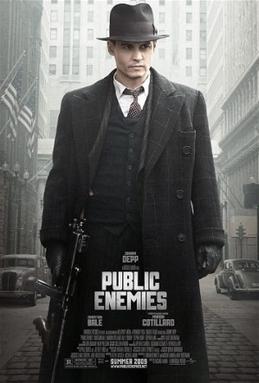
It's 1933 in Crown Point, Indiana and John Dillinger (Johnny Depp) has been caught and is just being brought to prison, or so his guards think. Instead, the notorious bank robber has arranged a breakout, a group from his gang busting out with him. With his gang back together again, Dillinger goes on a spree, robbing banks all over Chicago and into Indiana and Wisconsin. The gangster feels the noose tighten around his neck, his notoriety forcing the government's hand in bringing him to justice. The Bureau of Investigation (the FBI) is in its infancy, J. Edgar Hoover (Billy Crudup) placing a young but capable agent, Melvin Purvis (Christian Bale), in charge of bringing Dillinger to justice. Using all the technology available to them, Purvis and his agents do everything they can to capture Dillinger, but can the notorious bank robber continue his crime spree?
This 2009 crime thriller is based off a book of the same name, Public Enemies, by author Bryan Burrough. It's a great read, non-fiction at its best. Burrough's book covers a ton of ground about one of the more violent, turbulent times in American history. The 1930s were the time of the gangster, killers, bank robbers and thieves working on a grand scale with a trail of fast cars, money and riches and dead bodies. Almost every single one of them died bloody and violent. It was a bloody, violent, fascinating time in American history. Originally thought of as a miniseries, Burroughs turned his research into a book. With so many people, places and incidents, the film version was condensed to John Dillinger vs. Melvin Purvis. It's a wise choice because Burroughs' novel as is would have been overwhelming.
We meet other people, but this is Johnny Depp's movie as he brings John Dillinger to life. A sympathetic character? No, not quite. It is on the other hand a fascinating character to watch. The people who met him during his crime reign of terror, a lot of witnesses said he was charming, likable and friendly. One of the biggest movie stars around, Depp is the best thing going in this movie, making Dillinger a human being, not just a historical name. Depp's Dillinger seems to know the life he's chosen necessitates a live-fast, live-hard mentality. Knowledge of the historical facts or not, you just know Dillinger is leading a doomed life. Sooner or later, his luck will run out. It's really the only character here given any sort of development or characterization too, John given a love interest in Billie Frechette (Marion Cotillard), a coat check girl from a poor background who falls hard for the gangster, as does he for her. Depp and Cotillard have a believable, real chemistry, giving the story that necessary human element.
Who best to direct a high-arcing crime thriller? How about a director with movies like Heat, Thief, Last of the Mohicans and The Inside to his name? Michael Mann takes the helm here for this style-heavy period piece. 'Enemies' was filmed on location in Chicago and around the Midwest where much of the story actually took place. Chicago serving as a backdrop for a story is never a bad thing, giving an air of authenticity here. The suits, the hats, the gentleman gangsters, the cars, it all adds up a to a more than worthy time capsule to 1930s Depression-era America. If there's a fault, Mann is too interested in the style, not the substance. He shot with a digital format, giving those scenes an odd, fuzzy look. The editing is fast and hard -- almost schizophrenic -- to the point the movement is hard to follow. Replace some of that aggressive style which doesn't necessarily work with some more story and characterization, and then we're talking.
Depp's movie, no doubt, but in star power, Christian Bale isn't far behind. It's just star power though. Bale is a really good actor, but he's given little to do here. The real-life Melvin Purvis was a bit of a dunce, the movie choosing not to delve too much into that angle. Bale is okay, but it's a necessary, workmanlike part, nothing more. Crudup does a good job with his quick scenes as Hoover, a glorified cameo. As for Dillinger's gang, look for Jason Clarke, Stephen Dorff, David Wenham and another violent gangster, Stephen Graham as maniacal Baby Face Nelson. Stephen Lang is memorable as a Texas lawman, Charles Winstead, brought in to help Purvis, Rory Cochrane playing one of his fellow Chicago FBI agents. There's also quick parts for Channing Tatum, Carey Mulligan and Giovanni Ribisi, and in the case of Tatum and Mulligan, don't blink or you'll miss them. There's plenty of other appearances that probably deserve some attention, but they're not around long enough to mention.
That's one of the weaknesses in Mann's film. Condensing Burroughs' book and doing so with just one focus -- Dillinger -- is still a daunting task. I think it tries to accomplish too much. A year-plus of story, countless speaking roles, and a whole lot of history. Depp is excellent, that's not in question. The action is very exciting, especially the infamous Little Bohemia shootout. Mann does action and does it well. The heavy, automatic machine guns, the B.A.R.s, the heavy pistols, these are guns that pack a punch so there's something visceral and adrenaline-pumping in the action scenes. Something is missing though. It's cool, but the movie doesn't have a ton of heart. The last 30 minutes are the movie at its best, Purvis and the FBI closing in on Dillinger. One what-if scene has Dillinger walking into the Dillinger Squad office, surreal and cool. The same for Dillinger's death, a stylish, cool scene aided by Elliot Goldenthal's musical score.
A good movie but with some serious flaws. It could have been a classic, and maybe with a miniseries it would have been. Still, Johnny Depp is cooler than you.
Public Enemies (2009): ** 1/2 /****
Rewrite of July 2009 review
It's 1933 in Crown Point, Indiana and John Dillinger (Johnny Depp) has been caught and is just being brought to prison, or so his guards think. Instead, the notorious bank robber has arranged a breakout, a group from his gang busting out with him. With his gang back together again, Dillinger goes on a spree, robbing banks all over Chicago and into Indiana and Wisconsin. The gangster feels the noose tighten around his neck, his notoriety forcing the government's hand in bringing him to justice. The Bureau of Investigation (the FBI) is in its infancy, J. Edgar Hoover (Billy Crudup) placing a young but capable agent, Melvin Purvis (Christian Bale), in charge of bringing Dillinger to justice. Using all the technology available to them, Purvis and his agents do everything they can to capture Dillinger, but can the notorious bank robber continue his crime spree?
This 2009 crime thriller is based off a book of the same name, Public Enemies, by author Bryan Burrough. It's a great read, non-fiction at its best. Burrough's book covers a ton of ground about one of the more violent, turbulent times in American history. The 1930s were the time of the gangster, killers, bank robbers and thieves working on a grand scale with a trail of fast cars, money and riches and dead bodies. Almost every single one of them died bloody and violent. It was a bloody, violent, fascinating time in American history. Originally thought of as a miniseries, Burroughs turned his research into a book. With so many people, places and incidents, the film version was condensed to John Dillinger vs. Melvin Purvis. It's a wise choice because Burroughs' novel as is would have been overwhelming.
We meet other people, but this is Johnny Depp's movie as he brings John Dillinger to life. A sympathetic character? No, not quite. It is on the other hand a fascinating character to watch. The people who met him during his crime reign of terror, a lot of witnesses said he was charming, likable and friendly. One of the biggest movie stars around, Depp is the best thing going in this movie, making Dillinger a human being, not just a historical name. Depp's Dillinger seems to know the life he's chosen necessitates a live-fast, live-hard mentality. Knowledge of the historical facts or not, you just know Dillinger is leading a doomed life. Sooner or later, his luck will run out. It's really the only character here given any sort of development or characterization too, John given a love interest in Billie Frechette (Marion Cotillard), a coat check girl from a poor background who falls hard for the gangster, as does he for her. Depp and Cotillard have a believable, real chemistry, giving the story that necessary human element.
Who best to direct a high-arcing crime thriller? How about a director with movies like Heat, Thief, Last of the Mohicans and The Inside to his name? Michael Mann takes the helm here for this style-heavy period piece. 'Enemies' was filmed on location in Chicago and around the Midwest where much of the story actually took place. Chicago serving as a backdrop for a story is never a bad thing, giving an air of authenticity here. The suits, the hats, the gentleman gangsters, the cars, it all adds up a to a more than worthy time capsule to 1930s Depression-era America. If there's a fault, Mann is too interested in the style, not the substance. He shot with a digital format, giving those scenes an odd, fuzzy look. The editing is fast and hard -- almost schizophrenic -- to the point the movement is hard to follow. Replace some of that aggressive style which doesn't necessarily work with some more story and characterization, and then we're talking.
Depp's movie, no doubt, but in star power, Christian Bale isn't far behind. It's just star power though. Bale is a really good actor, but he's given little to do here. The real-life Melvin Purvis was a bit of a dunce, the movie choosing not to delve too much into that angle. Bale is okay, but it's a necessary, workmanlike part, nothing more. Crudup does a good job with his quick scenes as Hoover, a glorified cameo. As for Dillinger's gang, look for Jason Clarke, Stephen Dorff, David Wenham and another violent gangster, Stephen Graham as maniacal Baby Face Nelson. Stephen Lang is memorable as a Texas lawman, Charles Winstead, brought in to help Purvis, Rory Cochrane playing one of his fellow Chicago FBI agents. There's also quick parts for Channing Tatum, Carey Mulligan and Giovanni Ribisi, and in the case of Tatum and Mulligan, don't blink or you'll miss them. There's plenty of other appearances that probably deserve some attention, but they're not around long enough to mention.
That's one of the weaknesses in Mann's film. Condensing Burroughs' book and doing so with just one focus -- Dillinger -- is still a daunting task. I think it tries to accomplish too much. A year-plus of story, countless speaking roles, and a whole lot of history. Depp is excellent, that's not in question. The action is very exciting, especially the infamous Little Bohemia shootout. Mann does action and does it well. The heavy, automatic machine guns, the B.A.R.s, the heavy pistols, these are guns that pack a punch so there's something visceral and adrenaline-pumping in the action scenes. Something is missing though. It's cool, but the movie doesn't have a ton of heart. The last 30 minutes are the movie at its best, Purvis and the FBI closing in on Dillinger. One what-if scene has Dillinger walking into the Dillinger Squad office, surreal and cool. The same for Dillinger's death, a stylish, cool scene aided by Elliot Goldenthal's musical score.
A good movie but with some serious flaws. It could have been a classic, and maybe with a miniseries it would have been. Still, Johnny Depp is cooler than you.
Public Enemies (2009): ** 1/2 /****
Rewrite of July 2009 review
Tuesday, May 6, 2014
The Magnificent Seven
Why
do some movies stick with you more than others? I grew up watching
westerns and war movies from the 1950s and 1960s, movies that still
dominate my all-time Top 10, movies like The Alamo, The Great Escape,
The Dirty Dozen, The Good, the Bad and the Ugly, The Professionals and
several others. They still resonate now more than a few years later. Oh,
and of course, 1960's The Magnificent Seven.
Several years back I reviewed all four movies (the original and the 3
sequels), and it's been too long. Time for an updated review. The
original and still best, one of the best westerns ever and a personal
favorite.
South of the border in a small farming village, a bandit named Calvera (Eli Wallach) rides in and steals almost everything he and his gang of 40 bandits can carry, leaving just enough for the village to survive and start all over again. The villagers decide they've had about enough, riding north into Texas to buy guns so they can fight back against Calvera's gang. Instead, they meet Chris (Yul Brynner), a mysterious gunfighter clad in black who recommends they hire men rather than buy guns. Chris agrees to help, recruiting six other gunfighters from varying backgrounds, including an amiable drifter and gunfighter, Vin (Steve McQueen), to help out. The money is poor, the mission is more than difficult and the odds are stacked against them. Chris and the six gunslingers ride south, ready to help the village and fight off Calvera, odds be damned.
What a good movie. From director John Sturges (a master of 'Movies for Men'), 'Seven' came along at an interesting time for the western genre. Things, they were a'changing. Westerns were becoming more cynical, darker, more introspective, eventually transforming into the spaghetti western and the folksy, revisionist westerns of the 1970s. As fondly remembered as 'Seven' is now, it struggled in theaters in the U.S. upon its initial release, finding huge success in Europe and Asia before being re-issued in the U.S. several years later. It is an Americanized version of Akira Kurosawa's classic film, Seven Samurai, transplanting samurais for wild west gunfighters. It's interesting for any number of reasons, from the music to the budding star power on display, the dark tone to the exciting action scenes. A favorite of mine, a four-star review, and I won't really debate it. So there!
How about that casting?!? Much of the cast would go on to become huge stars, but here in 1960, they were relative unknowns. Brynner was the established star, The King and I, The Ten Commandments already to his name, and he's the pulse of the movie. His Chris is the unflappable leader of the group, a capable gunfighter who's also got all the qualities a leader should have. Loyal, strong, and tough. McQueen steps up to the plate in his first starring role. His Vin is easy-going, a drifter looking for work, quite good with his gun but maybe looking for something else in his life. Brynner and McQueen had a tumultuous relationship on the set -- McQueen trying to upstage the established star -- but the result is more than solid. Their chemistry crackles, their scenes together that perfect dynamic between the commander and his right-hand man. As the bandit Calvera, Wallach is an effortless scene-stealer, disappearing for huge stretches only to return with a vengeance.
And then there's the rest of the seven, because Brynner and McQueen weren't enough, right? Right?!? First, there's Charles Bronson as Bernardo O'Reilly, a half-Mexican, half-Irish gunman who has quite the reputation for cleaning up nasty jobs and his price is high...usually. He bonds with three boys from the village who "got him," promising to watch over him and care for his grave should he die in battle. Then, there's James Coburn as Britt, the laconic, knife-throwing specialist who has few equals with knife or gun. Coburn says about 30 words the entire movie and steals every scene he's in. Next, Robert Vaughn as Lee, a hired gun who's lost his edge, convinced he is facing his death. Next up, Brad Dexter as Harry Luck, a friendly gunslinger convinced there's more to the job than Chris is saying. Finally, there's Horst Buchholz as Chico, the young, unproven kid looking to make a name for himself with his more established cohorts.
As if that star power wasn't enough to carry a movie, I liked the characterization of these gunslingers more than anything. That's something I've picked up on repeated viewings as I got older. The portrayal of these hired guns is honest, not looking to glamorize these men. They're tied down by nothing, drift along from job to job, all the while risking their lives knowing that any job could be their last. What do they have? Their guns, their horse and maybe most importantly, their word. 'Seven' boasts one of my all-time favorite scenes, in westerns and films in general. Given a chance to run from a battle against seemingly insurmountable odds, they opt to stay. Coburn's Britt famously says "No one throws me my own guns and says run....Nobody." When offered the chance to run, Vaughn's Lee is told "Go ahead, Lee, you don't owe anything to anybody." His answer? "Except to myself." That's the essence and spirit of the movie. Men in a nasty situation doing what's right because it's what they should do, what is right. Profoundly simple, it always sticks with me, these men living by their code and what they believe in.
As for the villagers, look for Vladimir Sokoloff as the Old Man, the village patriarch who has little use for the whiny farmers, Jorge Martinez de Hoyos as Hilario, the fiery farmer ready to side with the gunmen, Pepe Hern and John Alonzo his close friends, Rico Alaniz as Sotero, the quasi-mayor of the village trying to weigh all his options and lastly, Rosenda Monteros as Petra, the young woman in the village who takes a liking to Buchholz's Chico. Also look for familiar western faces Robert J. Wilke and Whit Bissell in quick scenes.
More than anything else though, I think what's lasted the longest in the social conscience is composer Elmer Bernstein's musical score. The soundtrack is one of the all-time greats, the main theme a whistle-worthy track that will be running through your head for days. This is what big movie soundtracks can be. They add something to the movie itself, like a new but essential character. If you're not familiar with it (and even if you are), listen HERE. Just a great score, moving, adrenaline-pumping and emotional as needed. An all-time great score from an all-time great composer.
The story covers a lot of ground over its 128-minute running time. The story is fairly episodic, starting with the essential and entertaining recruiting of the team, Brynner's Chris seeking the gunmen out for the job. Each snippet gives each actor his chance to stand out on their own before becoming part of the group. Coburn's classic introduction especially stands out. From there, it's one great scene after another, both as entertainment value but also for delving into all the characters from the Seven to the villagers to Calvera. There isn't a ton of action, but the gunplay stands out, two featured sequences as the Seven tangle with Calvera's gang. It's the final battle that packs the emotional punch, the odds finally taking their toll on this group of gunfighters we've come to like and root for. It's a downbeat ending when you really consider it, but it's the right ending for this story and the characters.
Just a great movie. It was a favorite growing up and always will be. One of the best westerns ever, and an easy one to recommend for fans of the western genre or for someone just being introduced to the genre as a whole. A classic, plain and simple.
The Magnificent Seven (1960): ****/****
Rewrite of September 2009 review
South of the border in a small farming village, a bandit named Calvera (Eli Wallach) rides in and steals almost everything he and his gang of 40 bandits can carry, leaving just enough for the village to survive and start all over again. The villagers decide they've had about enough, riding north into Texas to buy guns so they can fight back against Calvera's gang. Instead, they meet Chris (Yul Brynner), a mysterious gunfighter clad in black who recommends they hire men rather than buy guns. Chris agrees to help, recruiting six other gunfighters from varying backgrounds, including an amiable drifter and gunfighter, Vin (Steve McQueen), to help out. The money is poor, the mission is more than difficult and the odds are stacked against them. Chris and the six gunslingers ride south, ready to help the village and fight off Calvera, odds be damned.
What a good movie. From director John Sturges (a master of 'Movies for Men'), 'Seven' came along at an interesting time for the western genre. Things, they were a'changing. Westerns were becoming more cynical, darker, more introspective, eventually transforming into the spaghetti western and the folksy, revisionist westerns of the 1970s. As fondly remembered as 'Seven' is now, it struggled in theaters in the U.S. upon its initial release, finding huge success in Europe and Asia before being re-issued in the U.S. several years later. It is an Americanized version of Akira Kurosawa's classic film, Seven Samurai, transplanting samurais for wild west gunfighters. It's interesting for any number of reasons, from the music to the budding star power on display, the dark tone to the exciting action scenes. A favorite of mine, a four-star review, and I won't really debate it. So there!
How about that casting?!? Much of the cast would go on to become huge stars, but here in 1960, they were relative unknowns. Brynner was the established star, The King and I, The Ten Commandments already to his name, and he's the pulse of the movie. His Chris is the unflappable leader of the group, a capable gunfighter who's also got all the qualities a leader should have. Loyal, strong, and tough. McQueen steps up to the plate in his first starring role. His Vin is easy-going, a drifter looking for work, quite good with his gun but maybe looking for something else in his life. Brynner and McQueen had a tumultuous relationship on the set -- McQueen trying to upstage the established star -- but the result is more than solid. Their chemistry crackles, their scenes together that perfect dynamic between the commander and his right-hand man. As the bandit Calvera, Wallach is an effortless scene-stealer, disappearing for huge stretches only to return with a vengeance.
And then there's the rest of the seven, because Brynner and McQueen weren't enough, right? Right?!? First, there's Charles Bronson as Bernardo O'Reilly, a half-Mexican, half-Irish gunman who has quite the reputation for cleaning up nasty jobs and his price is high...usually. He bonds with three boys from the village who "got him," promising to watch over him and care for his grave should he die in battle. Then, there's James Coburn as Britt, the laconic, knife-throwing specialist who has few equals with knife or gun. Coburn says about 30 words the entire movie and steals every scene he's in. Next, Robert Vaughn as Lee, a hired gun who's lost his edge, convinced he is facing his death. Next up, Brad Dexter as Harry Luck, a friendly gunslinger convinced there's more to the job than Chris is saying. Finally, there's Horst Buchholz as Chico, the young, unproven kid looking to make a name for himself with his more established cohorts.
As if that star power wasn't enough to carry a movie, I liked the characterization of these gunslingers more than anything. That's something I've picked up on repeated viewings as I got older. The portrayal of these hired guns is honest, not looking to glamorize these men. They're tied down by nothing, drift along from job to job, all the while risking their lives knowing that any job could be their last. What do they have? Their guns, their horse and maybe most importantly, their word. 'Seven' boasts one of my all-time favorite scenes, in westerns and films in general. Given a chance to run from a battle against seemingly insurmountable odds, they opt to stay. Coburn's Britt famously says "No one throws me my own guns and says run....Nobody." When offered the chance to run, Vaughn's Lee is told "Go ahead, Lee, you don't owe anything to anybody." His answer? "Except to myself." That's the essence and spirit of the movie. Men in a nasty situation doing what's right because it's what they should do, what is right. Profoundly simple, it always sticks with me, these men living by their code and what they believe in.
As for the villagers, look for Vladimir Sokoloff as the Old Man, the village patriarch who has little use for the whiny farmers, Jorge Martinez de Hoyos as Hilario, the fiery farmer ready to side with the gunmen, Pepe Hern and John Alonzo his close friends, Rico Alaniz as Sotero, the quasi-mayor of the village trying to weigh all his options and lastly, Rosenda Monteros as Petra, the young woman in the village who takes a liking to Buchholz's Chico. Also look for familiar western faces Robert J. Wilke and Whit Bissell in quick scenes.
More than anything else though, I think what's lasted the longest in the social conscience is composer Elmer Bernstein's musical score. The soundtrack is one of the all-time greats, the main theme a whistle-worthy track that will be running through your head for days. This is what big movie soundtracks can be. They add something to the movie itself, like a new but essential character. If you're not familiar with it (and even if you are), listen HERE. Just a great score, moving, adrenaline-pumping and emotional as needed. An all-time great score from an all-time great composer.
The story covers a lot of ground over its 128-minute running time. The story is fairly episodic, starting with the essential and entertaining recruiting of the team, Brynner's Chris seeking the gunmen out for the job. Each snippet gives each actor his chance to stand out on their own before becoming part of the group. Coburn's classic introduction especially stands out. From there, it's one great scene after another, both as entertainment value but also for delving into all the characters from the Seven to the villagers to Calvera. There isn't a ton of action, but the gunplay stands out, two featured sequences as the Seven tangle with Calvera's gang. It's the final battle that packs the emotional punch, the odds finally taking their toll on this group of gunfighters we've come to like and root for. It's a downbeat ending when you really consider it, but it's the right ending for this story and the characters.
Just a great movie. It was a favorite growing up and always will be. One of the best westerns ever, and an easy one to recommend for fans of the western genre or for someone just being introduced to the genre as a whole. A classic, plain and simple.
The Magnificent Seven (1960): ****/****
Rewrite of September 2009 review
Monday, May 5, 2014
O Brother, Where Art Thou?
Joel and Ethan Coen are the movie director equivalents of chameleons. They do a little bit of everything from a horrifically violent, dark crime thriller like No Country for Old Men to genuinely funny (and still horrifically dark) comedies like Burn After Reading with all sorts of classics and near-classics among their filmography from Fargo to Big Lebowski, Blood Simple to Raising Arizona. But how about a story based (even loosely) off of one of literature's greatest works? A daunting task for sure. That's 2000's O Brother, Where Art Thou?
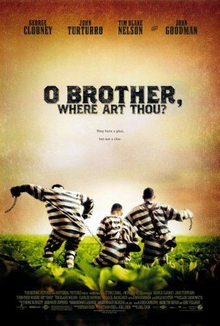
It's 1937 in the deep South and three convicts, Ulysses Everett McGill (George Clooney), Pete Hogwallop (John Turturro) and Delmar O'Donnell (Tim Blake Nelson), have managed a daring escape from their chain gang. Their reasoning? Everett told his fellow prisoners that he hid away a huge treasure from the robbery that ultimately landed him on the chain gang. He's only got a few days before the treasure's location is washed away, a valley being turned into a lake as part of a hydroelectric project. Chained together at their ankles, the fugitive trio is working against the clock, the road ahead of them full of obstacles both external and internal amidst a gubernatorial race as well. All sorts of people stand in their way, both those hoping to help them and those trying to stop them and in some cases, stop them. Time is running out, and Everett has a secret up his sleeve.
There just aren't too many directors out there with more visual and storytelling style than the Coen brothers. How many directors could pull off a transition from a poem from classic Greek mythology to a similar story in pre-WWII deep south with a heavy reliance on folk music, quirky characters and an episodic story that could be called downright random? Not too many as I sit here writing this review. The Coen Brothers on the other hand make it look pretty effortless. It is a fun movie from beginning to end, the generally random shifts in tone, humor and laughs moving things along at a brisk pace in a 107-minute movie. In other hands, things might have gotten bogged down but that certainly isn't the case here. A very solid, entertaining movie.
Through all the zaniness in the deep south, we follow our intrepid trio on their journey. The chemistry is pretty perfect, Clooney, Turturro and Nelson showing off that effortless chemistry that simply works. The Coen brothers also wrote the script, their quirky humor showing through in the three convicts. Clooney as the vain, motor-mouthed, ultra-confident Everett, the unofficial leader of the group. His preference for Dapper Dan hair pomade consistently gets him and his traveling companions in trouble, his insistence on looking his best (he wears a hair net to sleep to not muss his hair) providing some great moments. He uses $20 words when a $1 word would cut it. His long rambling monologues are pretty great, a man trying to show others how smart he is. Turturro as Pete is a bit of a wild card, prone to frustrating outbursts as their plan unravels. The best characterization goes to Blake Nelson as Delmar, the sweet, thoughtful and generally naive convict who simply has a nice, positive outlook on life.
These three out-there escaped convicts are searching for Everett's buried treasure from an armored car robbery. But naturally, what do they end up doing? They become renowned folk singers, Everett thinking quick on his feet to name themselves The Soggy Bottom Boys (based on The Foggy Mountain Boys, their hit song a cover of Man of Constant Sorrow. Whether it's the Soggy boys singing or T-Bone Burnett's folk-heavy soundtrack, the music is a hugely successful, essential ingredient to the movie's success. The music is always there, always catchy, driving the story forward, the score transitioning scene-to-scene. It's the music and style that works, the Coens using digital color correction to give 'Brother' an almost washed out, sepia look to the story. All those little things that add up to a really enjoyable movie.
We've got three crazy characters to follow across the south, but following Homer's footsteps in The Odyssey, our trio meets some odd characters on the road. Part of the fun is figuring out who's who in relation to the poem. We've got a loving-life bible salesman (John Goodman), a gubernatorial candidate (Charles Durning) seeking reelection, his hot-chasing opponent (Wayne Duvall), Everett's frustrated wife (Holly Hunter) and her new beau (Ray McKinnon), infamous gangster Baby Face Nelson (Michael Badalucco), down on his luck musician Tommy (musician Chris Thomas King), a blind radio programmer (Stephen Root), the sheriff (Daniel von Bargen) in hot pursuit, the blind seer (Lee Weaver) who warns the convicts of what awaits them and lastly, Pete's cousin (Frank Collison) who's curious why Pete just showed up...in chains.
When the Coens decide to do something, they commit to doing it right. From the set design and style to the script and the characters, their movies create these little worlds that are folksy and real and authentic. A very enjoyable movie with some great parts and a lot of laughs. An easy one to recommend.
O Brother, Where Art Thou? (2000): ***/****
It's 1937 in the deep South and three convicts, Ulysses Everett McGill (George Clooney), Pete Hogwallop (John Turturro) and Delmar O'Donnell (Tim Blake Nelson), have managed a daring escape from their chain gang. Their reasoning? Everett told his fellow prisoners that he hid away a huge treasure from the robbery that ultimately landed him on the chain gang. He's only got a few days before the treasure's location is washed away, a valley being turned into a lake as part of a hydroelectric project. Chained together at their ankles, the fugitive trio is working against the clock, the road ahead of them full of obstacles both external and internal amidst a gubernatorial race as well. All sorts of people stand in their way, both those hoping to help them and those trying to stop them and in some cases, stop them. Time is running out, and Everett has a secret up his sleeve.
There just aren't too many directors out there with more visual and storytelling style than the Coen brothers. How many directors could pull off a transition from a poem from classic Greek mythology to a similar story in pre-WWII deep south with a heavy reliance on folk music, quirky characters and an episodic story that could be called downright random? Not too many as I sit here writing this review. The Coen Brothers on the other hand make it look pretty effortless. It is a fun movie from beginning to end, the generally random shifts in tone, humor and laughs moving things along at a brisk pace in a 107-minute movie. In other hands, things might have gotten bogged down but that certainly isn't the case here. A very solid, entertaining movie.
Through all the zaniness in the deep south, we follow our intrepid trio on their journey. The chemistry is pretty perfect, Clooney, Turturro and Nelson showing off that effortless chemistry that simply works. The Coen brothers also wrote the script, their quirky humor showing through in the three convicts. Clooney as the vain, motor-mouthed, ultra-confident Everett, the unofficial leader of the group. His preference for Dapper Dan hair pomade consistently gets him and his traveling companions in trouble, his insistence on looking his best (he wears a hair net to sleep to not muss his hair) providing some great moments. He uses $20 words when a $1 word would cut it. His long rambling monologues are pretty great, a man trying to show others how smart he is. Turturro as Pete is a bit of a wild card, prone to frustrating outbursts as their plan unravels. The best characterization goes to Blake Nelson as Delmar, the sweet, thoughtful and generally naive convict who simply has a nice, positive outlook on life.
These three out-there escaped convicts are searching for Everett's buried treasure from an armored car robbery. But naturally, what do they end up doing? They become renowned folk singers, Everett thinking quick on his feet to name themselves The Soggy Bottom Boys (based on The Foggy Mountain Boys, their hit song a cover of Man of Constant Sorrow. Whether it's the Soggy boys singing or T-Bone Burnett's folk-heavy soundtrack, the music is a hugely successful, essential ingredient to the movie's success. The music is always there, always catchy, driving the story forward, the score transitioning scene-to-scene. It's the music and style that works, the Coens using digital color correction to give 'Brother' an almost washed out, sepia look to the story. All those little things that add up to a really enjoyable movie.
We've got three crazy characters to follow across the south, but following Homer's footsteps in The Odyssey, our trio meets some odd characters on the road. Part of the fun is figuring out who's who in relation to the poem. We've got a loving-life bible salesman (John Goodman), a gubernatorial candidate (Charles Durning) seeking reelection, his hot-chasing opponent (Wayne Duvall), Everett's frustrated wife (Holly Hunter) and her new beau (Ray McKinnon), infamous gangster Baby Face Nelson (Michael Badalucco), down on his luck musician Tommy (musician Chris Thomas King), a blind radio programmer (Stephen Root), the sheriff (Daniel von Bargen) in hot pursuit, the blind seer (Lee Weaver) who warns the convicts of what awaits them and lastly, Pete's cousin (Frank Collison) who's curious why Pete just showed up...in chains.
When the Coens decide to do something, they commit to doing it right. From the set design and style to the script and the characters, their movies create these little worlds that are folksy and real and authentic. A very enjoyable movie with some great parts and a lot of laughs. An easy one to recommend.
O Brother, Where Art Thou? (2000): ***/****
Friday, May 2, 2014
Hours
With some events -- both good and bad -- through history, the story resonates long after the event has passed. You remember where you were when you heard about it, watched it on TV, when someone informed you for the first time. I remember pretty clearly which class I was walking to when the effects of Hurricane Katrina rolled into Bloomington, Indiana. Torrential rail unlike anything I'd seen but nothing like the hell experienced by those in New Orleans during the hurricane. For a very interesting story about one man, check out 2013's Hours, a film that didn't get a theatrical release I'm aware of, but it certainly deserved one.
As Hurricane Katrina descends on New Orleans in August 2005, Nolan Hayes (Paul Walker) brings his pregnant wife, Abigail (Genesis Rodriguez), to the hospital as she deals with some horrific pain. Doctors tell him to wait in the waiting room, and an hour or so later he's dealt both amazingly good and horrifically bad news. He has a daughter, but Abigail died giving birth. Nolan doesn't know how to handle both pieces of news, but he doesn't have time to think. Katrina is throwing the brunt of its strength at the city -- including the hospital -- and almost the entire staff and every patient that can be moved is being evacuated. Nolan on the other hand is going nowhere. His prematurely born infant daughter is in an incubator that's helping her breathe. The doctor's estimate on when she can breathe on her own? Two days...hopefully. Responsible for running a backup generator with an ever-decreasing battery, Nolan keeps his daughter alive and waits. And waits. And waits for help.
Most of six months since his tragic, surprising death in November 2013, it's still hard to believe Paul Walker is dead. He will be in the next Fast and Furious in some fashion or another, and he has another movie scheduled to come out in the coming weeks, Brick Mansions. So for Walker fans, embrace these movies, appreciate them. Unless I missed it, I don't remember seeing this film from director Eric Heisserer (also writing the screenplay) in theaters at all. Why was that? No idea in the least. Probably because it isn't a movie that's going to break box office records. Instead, it's a brutally straightforward premise with a touch of realism and authenticity with Hurricane Katrina serving as a backdrop to a very emotional story. No theater run, no problem. This was a pretty good movie.
I would wager most people are aware of Paul Walker because of the Fast and Furious movies, myself included. I've never thought of him as a great actor, but more a likable, charming star with a solid on-screen presence. I know I'm not alone in that sentiment. Well, this movie does a good job proving otherwise. Paul Walker can act and can do it well. While there are other speaking parts, this is almost the film equivalent of a one-man show. Walker's Nolan is in every scene in the movie. This is an emotional part, a husband and new father forced to deal with a whole lot on his plate in a hellish situation. We see him get worn down over the course of the movie, see the exhaustion in his eyes and face as his impossible situation gets worse and worse. Movie star or actor -- your call -- Walker is a very natural on-screen presence so it's cool to see him embrace such a quality dramatic performance and run with it.
What works so well though isn't just the big moments. It's the quiet moments. The trailer (link below) would have you think this is an action-packed, thrill a minute kind of movie. It isn't. The moments that resonate are those of a father bonding with his newborn daughter, helpless and dependent on a machine to keep her breathing. He sits next to her and winds up the backup generator every three minutes so the battery won't run out. Nolan sits and simply talks to his daughter, telling her about him, about his life, her mom, and how they met. These could be sappy, even cheesy moments, but they work. We also get three or four quick flashback scenes as we see how Nolan met Abigail, them at a dinner party, getting ready for said party. It's just really quick scenes -- a minute or two here and there -- but it helps to humanize Nolan as he tries to bring his daughter through the ordeal. The situation is extreme enough that you're rooting for him, but that human element goes a long way.
Rodriguez is very good in a small part as Abigail, relegated to those handful of flashbacks. She has an excellent chemistry with Walker, two halfway decent looking people if there ever were. The rest of the cast is limited to small parts of the people Nolan meets during the storm, including a doctor, a nurse, a cook in the cafeteria, a rescue dog with an injury, three different looters (two more dangerous than the first) and a lone voice at the other end of the radio. This is Walker's movie, the focus is clearly on him, and he doesn't disappoint.
Wrapping up in 97 minutes, 'Hours' drags a little at times in the second half. There's only so much you can have him do in such a situation before it becomes either dull or repetitive. At the same time, Nolan seems to accomplish a lot in the 2-to-3 minutes he has before he's got to recharge the ever-dwindling battery. It needs to happen for the sake of the story so it's not a huge issue, but it is something I noticed as the story develops. These are flaws but nothing that cripples the movie as a whole. An interesting movie that deserved more of a theatrical release, more positive buzz in the news. Something, anything. It's an excellent, tense film with a highly emotional ending, including a great final shot. Definitely worth checking out.
Hours (2013): ***/****
As Hurricane Katrina descends on New Orleans in August 2005, Nolan Hayes (Paul Walker) brings his pregnant wife, Abigail (Genesis Rodriguez), to the hospital as she deals with some horrific pain. Doctors tell him to wait in the waiting room, and an hour or so later he's dealt both amazingly good and horrifically bad news. He has a daughter, but Abigail died giving birth. Nolan doesn't know how to handle both pieces of news, but he doesn't have time to think. Katrina is throwing the brunt of its strength at the city -- including the hospital -- and almost the entire staff and every patient that can be moved is being evacuated. Nolan on the other hand is going nowhere. His prematurely born infant daughter is in an incubator that's helping her breathe. The doctor's estimate on when she can breathe on her own? Two days...hopefully. Responsible for running a backup generator with an ever-decreasing battery, Nolan keeps his daughter alive and waits. And waits. And waits for help.
Most of six months since his tragic, surprising death in November 2013, it's still hard to believe Paul Walker is dead. He will be in the next Fast and Furious in some fashion or another, and he has another movie scheduled to come out in the coming weeks, Brick Mansions. So for Walker fans, embrace these movies, appreciate them. Unless I missed it, I don't remember seeing this film from director Eric Heisserer (also writing the screenplay) in theaters at all. Why was that? No idea in the least. Probably because it isn't a movie that's going to break box office records. Instead, it's a brutally straightforward premise with a touch of realism and authenticity with Hurricane Katrina serving as a backdrop to a very emotional story. No theater run, no problem. This was a pretty good movie.
I would wager most people are aware of Paul Walker because of the Fast and Furious movies, myself included. I've never thought of him as a great actor, but more a likable, charming star with a solid on-screen presence. I know I'm not alone in that sentiment. Well, this movie does a good job proving otherwise. Paul Walker can act and can do it well. While there are other speaking parts, this is almost the film equivalent of a one-man show. Walker's Nolan is in every scene in the movie. This is an emotional part, a husband and new father forced to deal with a whole lot on his plate in a hellish situation. We see him get worn down over the course of the movie, see the exhaustion in his eyes and face as his impossible situation gets worse and worse. Movie star or actor -- your call -- Walker is a very natural on-screen presence so it's cool to see him embrace such a quality dramatic performance and run with it.
What works so well though isn't just the big moments. It's the quiet moments. The trailer (link below) would have you think this is an action-packed, thrill a minute kind of movie. It isn't. The moments that resonate are those of a father bonding with his newborn daughter, helpless and dependent on a machine to keep her breathing. He sits next to her and winds up the backup generator every three minutes so the battery won't run out. Nolan sits and simply talks to his daughter, telling her about him, about his life, her mom, and how they met. These could be sappy, even cheesy moments, but they work. We also get three or four quick flashback scenes as we see how Nolan met Abigail, them at a dinner party, getting ready for said party. It's just really quick scenes -- a minute or two here and there -- but it helps to humanize Nolan as he tries to bring his daughter through the ordeal. The situation is extreme enough that you're rooting for him, but that human element goes a long way.
Rodriguez is very good in a small part as Abigail, relegated to those handful of flashbacks. She has an excellent chemistry with Walker, two halfway decent looking people if there ever were. The rest of the cast is limited to small parts of the people Nolan meets during the storm, including a doctor, a nurse, a cook in the cafeteria, a rescue dog with an injury, three different looters (two more dangerous than the first) and a lone voice at the other end of the radio. This is Walker's movie, the focus is clearly on him, and he doesn't disappoint.
Wrapping up in 97 minutes, 'Hours' drags a little at times in the second half. There's only so much you can have him do in such a situation before it becomes either dull or repetitive. At the same time, Nolan seems to accomplish a lot in the 2-to-3 minutes he has before he's got to recharge the ever-dwindling battery. It needs to happen for the sake of the story so it's not a huge issue, but it is something I noticed as the story develops. These are flaws but nothing that cripples the movie as a whole. An interesting movie that deserved more of a theatrical release, more positive buzz in the news. Something, anything. It's an excellent, tense film with a highly emotional ending, including a great final shot. Definitely worth checking out.
Hours (2013): ***/****
Thursday, May 1, 2014
Day of the Animals
A few years back, October 2009 to be exact, I reviewed a dud of a movie made on a clearly pretty tight budget that rose above its cheapness to be 'So bad it's really good.' Okay, at least funny in an unintentionally way. That movie? 1976's Grizzly. It was a surprise success at drive-ins with fans to the point that a year later the stars and director returned with a similarly schlocky, generally pretty bad flick again dealing with some angry killer animals. Here we go with 1977's Day of the Animals.
In the mountains in northern California, experienced trail guide and outdoor enthusiast Steve Buckner (Christopher George) is readying to take a group of hikers on a several day hike. It's a mini-vacation offered away from society with little in the way of supplies, a way of getting back to nature. His group includes about 15 people, most of them city folks enjoying their time away from city life. But being dropped off by helicopters high up in the mountains, Buckner and his group quickly discovers something is very, very wrong. Animals are attacking them at an almost non-stop pace. What's going on? Can they survive or will the waves of animals wipe them out? They don't know it, but down below in the lower altitude towns, the population is dealing with exactly the same issue. Humanity....seems....doomed!!!!
Yikes, what a dumb, really dumb movie. Having directed Grizzly the year before (with George also starring and returning), director William Girdler is at the helm of another ultra-low budget drive-in special. It was made for cheap and intended for some cheap thrills. Can't go wrong, right? Well, you would think so. I liked the B-movie/disaster movie potential, but it never comes together. What exactly is driving the animals mad? The possibility that humans use of aerosol cans is ripping apart the ozone layer (Okay, we're doing a good job of that) and....lets radiation beat down on the Earth that turns animals into vicious, unstoppable killers. Oh, and some humans too but not all humans because that would make the story rather predictable, wouldn't it? I like my B-movies ridiculous and over the top, but don't hit me with a message!
Still, I figured there was enough going on here to make it watchable. Following the disaster movie formula, 'Animals' brings together a group of disparate individuals and lets us start guessing as to who will survive and who is just fodder for the vicious animals. No huge star power here, but definitely some familiar names. Going back to TV's The Rat Patrol, I've always been a fan of George, and he's having fun. His friendly, charming trail guide doesn't stretch any acting muscles, but it's not meant to be. Some of his hiking group include Richard Jaeckel as a bird-watching, photography-loving professor, Leslie Nielsen as an advertising executive with some anger issues, Michael Ansara as the wise Indian who knows all, and Ruth Roman has a Mom trying to bond with her nature-loving son.
That's as far as the name recognition goes, but there are some other interesting parts. Mrs. Christopher George, Lynda Day George, plays a TV newswoman trying to get away from work, Paul Mantee as an aging NFL star with a serious medical issue, and everyone else from a married couple looking to mend some wounds, a young couple in love, and Roman's son who needs a father figure. Who will make it? Who won't? Will anyone? That's part of the fun.
It cracked me up more and more as the movie went along. The premise is pretty cool, a variation on the Lost Patrol idea with a group of individuals banding together to survive, an enemy hovering all around them waiting to pick them up. Something never clicks though. The low budget most affects the actual animal attacks with some very cheesy special effects. For the most part, the sense of doom works better than anything. We see animals moving parallel to George's group, waiting to strike. Cheap filmmaking technique? Animals can look pretty scary just filming them so all Girdler had to do was film animals walk around and set those scenes to impending doom music from composer Lalo Schifrin (his score a bright spot). There are some scares along the way, but never as good as it could have been.
That's the entire movie. I wanted to like it, but it doesn't work. It's mindlessly entertaining but it's also a tad sluggish and never really picks up any momentum. Sure, it's cool to see character actors like George, Jaeckel, Nielsen and Ansara get their shot, but there's a limit. My limit? Nielsen's ad executive progressively getting hit with radiation. That translates to him taking his shirt off (All that is MAN!!!) and threatening to kill the men, rape the women and fight all the animals. By far, the funniest scenes in the movie.
Day of the Animals (1977): * 1/2 /****
In the mountains in northern California, experienced trail guide and outdoor enthusiast Steve Buckner (Christopher George) is readying to take a group of hikers on a several day hike. It's a mini-vacation offered away from society with little in the way of supplies, a way of getting back to nature. His group includes about 15 people, most of them city folks enjoying their time away from city life. But being dropped off by helicopters high up in the mountains, Buckner and his group quickly discovers something is very, very wrong. Animals are attacking them at an almost non-stop pace. What's going on? Can they survive or will the waves of animals wipe them out? They don't know it, but down below in the lower altitude towns, the population is dealing with exactly the same issue. Humanity....seems....doomed!!!!
Yikes, what a dumb, really dumb movie. Having directed Grizzly the year before (with George also starring and returning), director William Girdler is at the helm of another ultra-low budget drive-in special. It was made for cheap and intended for some cheap thrills. Can't go wrong, right? Well, you would think so. I liked the B-movie/disaster movie potential, but it never comes together. What exactly is driving the animals mad? The possibility that humans use of aerosol cans is ripping apart the ozone layer (Okay, we're doing a good job of that) and....lets radiation beat down on the Earth that turns animals into vicious, unstoppable killers. Oh, and some humans too but not all humans because that would make the story rather predictable, wouldn't it? I like my B-movies ridiculous and over the top, but don't hit me with a message!
Still, I figured there was enough going on here to make it watchable. Following the disaster movie formula, 'Animals' brings together a group of disparate individuals and lets us start guessing as to who will survive and who is just fodder for the vicious animals. No huge star power here, but definitely some familiar names. Going back to TV's The Rat Patrol, I've always been a fan of George, and he's having fun. His friendly, charming trail guide doesn't stretch any acting muscles, but it's not meant to be. Some of his hiking group include Richard Jaeckel as a bird-watching, photography-loving professor, Leslie Nielsen as an advertising executive with some anger issues, Michael Ansara as the wise Indian who knows all, and Ruth Roman has a Mom trying to bond with her nature-loving son.
That's as far as the name recognition goes, but there are some other interesting parts. Mrs. Christopher George, Lynda Day George, plays a TV newswoman trying to get away from work, Paul Mantee as an aging NFL star with a serious medical issue, and everyone else from a married couple looking to mend some wounds, a young couple in love, and Roman's son who needs a father figure. Who will make it? Who won't? Will anyone? That's part of the fun.
It cracked me up more and more as the movie went along. The premise is pretty cool, a variation on the Lost Patrol idea with a group of individuals banding together to survive, an enemy hovering all around them waiting to pick them up. Something never clicks though. The low budget most affects the actual animal attacks with some very cheesy special effects. For the most part, the sense of doom works better than anything. We see animals moving parallel to George's group, waiting to strike. Cheap filmmaking technique? Animals can look pretty scary just filming them so all Girdler had to do was film animals walk around and set those scenes to impending doom music from composer Lalo Schifrin (his score a bright spot). There are some scares along the way, but never as good as it could have been.
That's the entire movie. I wanted to like it, but it doesn't work. It's mindlessly entertaining but it's also a tad sluggish and never really picks up any momentum. Sure, it's cool to see character actors like George, Jaeckel, Nielsen and Ansara get their shot, but there's a limit. My limit? Nielsen's ad executive progressively getting hit with radiation. That translates to him taking his shirt off (All that is MAN!!!) and threatening to kill the men, rape the women and fight all the animals. By far, the funniest scenes in the movie.
Day of the Animals (1977): * 1/2 /****
Labels:
1970s,
Christopher George,
Horror,
Leslie Nielsen,
Michael Ansara,
Richard Jaeckel
Subscribe to:
Posts (Atom)