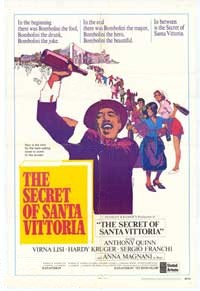
Sometimes you just have to hit me over the head to get your message or an idea across. Today's lesson? Something I've picked up over recent weeks as I've watched Ride, Vaquero!, Guns for San Sebastian, today's review for 1969's The Secret of Santa Vittoria, and hopefully a couple more soon that are sitting on my DVR. I've always liked Anthony Quinn a lot, but my goodness, could this guy act. Today's review is one that's unfortunately been forgotten over the years, a World War II drama with some laughs mixed in. Oh, and a scene-stealing part for Mr. Quinn.
It's the middle of World War II and Italian dictator Benito Mussolini has been deposed, leaving the country up for grabs by occupying German forces fighting the Allied advance. And then there's the mountain town of Santa Vittoria where a man named Italo Bombolini (Quinn) has lived his whole life. A drunk, a bit of a goof, he is well-liked if not well respected by the town. In fact, he's a bit of a punchline. Through a series of misunderstandings, Bombolini is named Mayor of the town. Ever one to embrace the spotlight, the jovial Italo takes the position but news soon reaches the town that German forces will occupy the town soon. What does the town hold dearest? What is it most known for? It's wine, made and bottled locally. Check that. A LOT of wine, 1.3 million bottles. The Germans no doubt want to get their hands on the product. What is Bombolini to do? With the Germans, including commander, Captain Von Prum (Hardy Kruger), fast approaching, the town comes up with a plan...to hide the wine. Can they do it without endangering their lives?
I remember clearly stumbling across this movie back in 2008. It was right in my period of awakening when it came to movies that....my goodness, there's HUNDREDS and THOUSANDS of movies out there I haven't seen. Sure, there are some duds (a lot of them I suppose), but then you come across gems like this. I loved this movie then and still love it now. The weirdest part? It hasn't held much of a reputation in the years since. So what can we take away from that thought? Go track down a copy. Look for it On-Demand. Check iTunes. Look on Turner Classic Movie's schedule. If you're a fan of Anthony Quinn, of war movies, of Italy, of wine, any and all, you'll like this movie. Go find it!
'Secret' comes from director Stanley Kramer who by 1969 had a long list of classic and near-classic films to his name. Personally, I put this WWII drama (with some comedy) at or near the top of that list. Yeah, it's a little broad at times, a little stereotypical, but never anything that cripples the message. This isn't a battlefront movie or a story about the horrors of war. It is about the people, the human beings that become involved in a cat and mouse game with....wine on the line? To these people in Santa Vittoria, that wine is their identity. It's what their town stands for. So when someone is going to come and just take it away, they decide to do something about it. The extended scene where the townspeople actually hide the wine through some ingenious thinking is one of the movie's highlights. I can't put my finger on why this movie doesn't have more of a following. One big reason to like it though is simple. It's different and tries to be different...and succeeds on all levels.
So, yeah, here we sit again. That Anthony Quinn fella, man, he could act. This performance is Quinn at his big, boisterous, loving life, larger than life persona. In another actor's hands, you might accuse him of chewing the scenery, but with Quinn, it never feels forced. His Italo Bombolini character is a scream. He loves life, loves wine, loves his family and friends...but he loves all those things at the cost of, well, a work ethic. Not the town drunk, this is a man who isn't taken very seriously by the town and its people. Thrust into a power position, he takes advantage, especially when news of the German's coming occupation is discovered. Quinn fills the screen with this manic energy no matter what the scene calls for. Pure joy and blind rage, he's able to flip the switch back and forth with ease and without driving the audience away. It's not a part remembered as his best or most memorable, but it's one of my favorites for a ridiculously talented actor.
There isn't a misfire in the entire cast. Not huge names, but some very talented actors and actresses. Anna Magnani is excellent as Rosa, Italo's wife who's grown sick of his antics and kicks him out their house, with Patrizia Valturri as their 16-year old daughter, Angela. Kruger is excellent too as the German commander, avoiding the cliches of the brutal German officer. He's a soldier, not a blood-crazy Nazi...but yeah, he's still got an intimidating edge. Also look for Virna Lisi as Caterina, a beautiful widow who's come back to her hometown, Sergio Franchi as a wounded Italian soldier and deserter who's come back to Santa Vittoria to heal (and hide), Renato Rascel as Babbaluche, Italo's best friend who's always ready with a criticism, and a young Giancarlo Giannini as Fabio, Italo's young friend, a college student and possible suitor for Angela.
Watching this WWII comedy-drama for a second time, I was reminded of some similarities with another classic war film, 1964's The Train. War is horrific in terms of lives loss, but at what point do other things become something worth risking lives? In 'Train,' it was priceless works of art. In 'Vittoria,' it's wine. It is handled in subtle fashion, but the question definitely makes you think. When push comes to shove, with a gun to your head, do you reveal a secret about hidden wine? It's an interesting question, one that definitely forces you to contemplate the lunacy of war.
Just an excellent movie. It was filmed on location in Anticoli Corrado and Capranica, Lazio in Italy. The town setting for Santa Vittoria is stunningly beautiful, as is the Italian countryside surrounding the town on all sides. It adds an additional layer to the film, a feeling of authenticity as if we've been transported to 1940s Italy. A tad slow at times at 140 minutes, the movie is at its strongest in the final hour-plus. The ending especially is highly memorable, Quinn stealing the scene and the show in general. Highly recommended. A forgotten gem.
The Secret of Santa Vittoria (1969): ****/****
The Sons of Katie Elder
"First, we reunite, then find Ma and Pa's killer...then read some reviews."
Showing posts with label Stanley Kramer. Show all posts
Tuesday, May 12, 2015
Monday, September 8, 2014
Oklahoma Crude
When I hear the name Stanley Kramer, I think of any number of movies. The 1960s were quite the decade for this director with movies like Judgment at Nuremberg, Mad, Mad World, Inherit the Wind and Guess Who's Coming to Dinner to his name. Oh, and that 1950s decade? The Defiant Ones and On the Beach. Quite a list, huh? And that's only listing some. I'm familiar with most of Kramer's movies as a director, have seen many of them and was at least aware of some others. One that qualifies as...well, none of those is and was 1973's Oklahoma Crude, a quasi-western with little reputation.
It's the 1910s and feisty Lena Doyle (Faye Dunaway) owns a chunk of land smack dab in the middle of the Oklahoma oil fields. She has put the time into the land, building a shack and a derrick and intends to tap the crude oil she believes is in the ground below her. There's a problem of course. A powerful oil magnate is scooping up land left and right, purchasing all the small-time owners. Well, most of them. Lena refuses to sell, claiming (rightfully so) that the land is hers. In hopes of protecting her investment, Lena gets some help from some unlikely places, including her estranged father, Cleon (John Mills) and a hired gun he hired, Mason (George C. Scott). Mason isn't quite sure what to make of the job, looking to make some quick and easy cash, but the little group is in for more than they planned on when the oil company sends out an enforcer, Hellman (Jack Palance), to make sure Lena sells.
Well, this was certainly an interesting movie if a heavily flawed one. I struggled through it at times and was rewarded with a far stronger second half of a 108-minute movie. Getting there can be a trial at times though, and even the last hour isn't as good as it could have been. Still, Kramer chooses an interesting story to tell and picks the right time to release it, the 1970s when audiences would have been all sorts of stirred up about a huge company strong-arming small businesses (I guess that'd land pretty well now in 2014 too). The development of the oil fields in Oklahoma in the early 1900s is an interesting enough historical period -- one that hasn't gotten its due in films, TV and books -- with plenty of dark, nasty material to dive into, but...
Kramer doesn't seem to be able to pick a tone, a voice and stick with it. Is it supposed to be truly dramatic and dark and unsettling? Or is it supposed to be goofy and fun and the kinda oddball romance story I typically hate? And that's where the problem is. It's both. The song that plays over the opening credits, Send a Little Love My Way, had me worried I was jumping into a folksy, disgustingly pleasant western that I do love so much. It wasn't, but it's a good forebearer of what's to come. The score from Henry Mancini is simply put, very obvious, big and loud and not appropriate for what the dark and depths of the story could have been. Instead, we get the Dunaway/Scott rivalry, the Dunaway/Mills fighting, Palance vs. the world, and all mixed in with some "I hate you until I love you" story and some all too painful comic relief. Oh, look, that naked guy got shot in the butt with buckshot!!! Yeah, it's too schizophrenic for its own good.
There is a saving grace, one that quickly popped up as the pleasant song mentioned above plays over the credits. Yeah, it's that cast thing. Dunaway, Scott, Mills and Palance?!? Yes, I will invest some time to see how this develops. The script doesn't always do this quartet a ton of favors, but there is a ton of talent here that manages to bring these characters to life. Dunaway's Lena is tough as nails, never been handed anything in her life, ready to fight for what's hers and screw anyone who gets in her way. Scott's Mason -- or Mase, his full name revealed late -- is harder to read, a worker and quasi-hired gun looking for a payday but just as interesting to see develop. I loved the energy Mills as Cleon brought to his part, a father who wasn't there for his daughter as she grew up. Now that he can help? He's going to do everything he can, even when that daughter tells him to screw off. And then there's Palance, doing what he does best, playing that near lunatic but very obsessed bad guy that you're never quite sure what he's capable of.
The human moments are not surprisingly, those that work best in Kramer's film. I especially liked the dynamic between Dunaway's Lena and Scott's Mase. It develops nicely -- but takes quite awhile getting there -- and for the most part manages to avoid all the pratfalls of a sappy story of two opposites who aren't so opposite. Mills is a scene-stealer and Palance is solid. The darkness of the second half is what the entire movie should have been. Filming out on the desolate, stark prairies, you get a sense of what these small-time drillers went through. Isolated and alone with no help in sight should it be needed. I simply wish Kramer would have committed, not trying to mix the light-hearted with the dark. At least if he kept it light, so be it. It's there. That's it. That's all. Enjoyable enough to recommend but far from a classic.
Oklahoma Crude (1973): ** 1/2 /****
Labels:
1970s,
Faye Dunaway,
George C Scott,
Jack Palance,
John Mills,
Stanley Kramer,
westerns
Monday, March 28, 2011
R.P.M.
The late 1960s and early 1970s, a time of political and cultural upheaval as Americans grew more intensely frustrated with the direction our country was taking. A sub-culture of people grew that was frustrated with the ways of the world, and maybe nowhere was that more evident than any college campuses, grounds for free thinking and free thought. Students were taught to think for themselves, not blindly go along with what older, powerful authority figures told them. That didn't always end well with public protests ending violently, and even shootings in some cases. A ripe picking ground for a movie if handled correctly. If.
At Hudson University, a large group of students led by two grad students, Rossiter (Gary Lockwood) and Steve (Paul Winfield) has peacefully taken over an administration building that holds key information necessary to the university. The only way they'll leave the building is if a list of their 12 demands are met, each and every one of them. For starters, the students want popular sociology professor, Franklin 'Paco' Perez (Anthony Quinn), to take over as university president. Curious to see if all the things he's learned and taught over his years as a professor are in fact true, he takes the job. Meeting and negotiating with the students, Perez is able to comply with nine of their 12 demands. But the students won't budge on the three, and no matter what the acting president thinks or wants, it doesn't seem like there is a way to compromise.
One of the biggest struggles this movie goes through is finding an appropriate, consistent tone throughout. Is it a folksy, out of the norm look at noble students trying to impact their world? Maybe. Singer-songwriter Melanie has a couple songs used in the soundtrack used over some montages of Perez walking around campus, painting a picture of an idyllic college with no problems. Or on the other hand, is it an indictment of the system, condemning both the students leading the charge and the board of directors trying to limit the damages done? Yes and no, because both sides are criticized if in a somewhat unbalanced way. For this story to work better, a stronger stance needed to be taken and not that gray area in the middle.
Instead of choosing, the tone and indictment leads more to painting the rebelling students as the heroic saviors of society. The board of directors are portrayed as old fogies who have no knowledge of what bothers their student body. A painfully obvious dig has Perez listening to the board, imagining them as clowns and jokers blathering on and on about the money, the stigma, the dilemma being caused. We get it. They're old and don't understand the younger generation. You don't need to hit us over the head with a mallet to get the idea across. Conversely, the students are presented as somewhat heroic, but in the end they just come off as pretentious know-it-alls, not noble idealists. They spout off all sorts of nonsense about their ideals and principles, ripping to pieces the one guy -- acting President Perez -- who's genuinely trying to help them because he sees their struggle. Good choice, make both sides look like idiots.
So in a pretentious, very talky movie, something good has to be going on at some point, doesn't it? Yes, and his name is Anthony Quinn. Even in some of the lower quality movies he starred in over the years, Quinn always seemed to rise above the dreck. The popular professor who makes his students think and question what they know is a somewhat cliched character, but it's based in the truth. I'd wager every college and maybe every department has a professor like that, one students seek out as opposed to avoiding them like the plague. Quinn's Perez comes from a modest background having had to work his way up through the ranks. He legitimately wants to help the students but knows almost from the start he's fighting a losing battle. The character does border on being too perfect, too likable, but amongst all the annoying, downright obnoxious characters, I didn't mind.
Also worth mentioning in supporting roles are Ann-Margret as Perez's grad student girlfriend, Rhoda, and Lockwood as Rossiter, the leader of the student revolution. At the height of her sex kitten days, Margret is wasted. She has to look sexy, strip down a couple times, and wear slinky outfits, at times serving as Perez's conscience and sounding board. A legitimately talented actress, she's just not given enough to do. Lockwood as Lossiter is the bright spot among the students, a thinker and an idealist who genuinely wants to accomplish something. A late scene between him and Quinn is a high point as they discuss the detours and turns the route has taken to get where they are.
The ending is what bothered me most though, one more not so subtle attempt to deliver a message. Pushed to the breaking point, the university has the police evacuate the building with tear gas and cops armed with billy clubs. The police chief (Graham Jarvis) expresses his concern that the plan won't go off as planned. Well, it goes off as well as expected. The takeover is riddled with slow-motion and extreme close-ups of pained students being tackled or hit by police. Oh, great, one more attempt to dig the system. A wasted effort from a typically very solid director.
R.P.M. <---one of many talky scenes (1970): * 1/2 /****
Labels:
1970s,
Ann-Margret,
Anthony Quinn,
Gary Lockwood,
Stanley Kramer
Tuesday, August 10, 2010
On the Beach
Not having lived through the Cold War, it's hard to fathom a life that always had a death cloud hanging over the world. If the U.S. and the Soviet Union did decide to go to war, it would have been over in minutes with no real winner thanks to weapons that guaranteed both sides would be wiped out. There was always that threat, that looming danger of what could be. Movies like Fail Safe, Dr. Strangelove, and The Bedford Incident are just some of the movies that have dealt with this subject, but it's the rarer film that deals with after that big what-if, like 1959's On the Beach.
An American submarine commanded by Capt. Dwight Towers (Gregory Peck) surfaces off the coast of Australia and docks. A nuclear holocaust has wiped out most of the world's population, but Australia was untouched by the apocalyptic fighting. Towers and the U.S.S. Sawfish arrive to find a country and a continent not quite sure what to do with themselves. Scientists and intellectuals predict that Australia has five or six months before radiation from the fallout reaches them, and then it will be a quick process of a week or two before all survivors are killed too. With possibly months to live, what do you do? Towers and his sub head north to see if there's any hope of survival, that the radiation may miss Australia.
First off, this has to qualify as one of the most depressing movies I've ever seen. Director Stanley Kramer creates quite a vision of what a post-apocalyptic world would be like. The whole purpose of the movie is to ask what would your reaction be if you knew you only had months to live? The vehicle of a nuclear fallout is how you to that question, but it works just as well dealing with mortality, we're all going to die. It's just a matter of when and how. The story is honest and doesn't try to whitewash anything here, these people are doomed and respond in different ways.
We see these reactions through a wide range of characters. Peck's Towers lost his wife and two kids back home but sees similarities in an Australian woman, Moira Davidson (Ava Gardner), who has nothing and no one to live for. A young navy officer (Anthony Perkins) deals with his wife (Donna Anderson) who refuses to admit that anything is wrong, and that down the road to avoid unspeakable pain she may have to take her life and that of her baby. An older scientist/doctor (Fred Astaire) copes by drinking and working on a Ferrari sports car he's purchased. No one reacts the same way, all responding individually to this horror that is presented.
Some moments provide these powerful instances of how the individual would respond. While patrolling outside San Francisco, Towers' sub has a member of the crew (John Meillon) who is a native of the city escape from the sub and swim ashore, knowing he will die in a matter of days instead of months waiting back in Australia. He tells Towers he wants to die at home, not in some strange place. The scene where the sailor talks with Peck (via loudspeaker) is an incredibly moving one. Just as moving, a scene where Astaire explains how this probably all started; one man probably looking at a computer screen swearing he saw a blip, an attack, and pushing the button or turning the key to assure the mutual destruction. Kramer's film has a lot of these powerful moments, both those two stand out from the rest.
For a movie that deals with the end of the world as we know it, in other words an epic scale, it also a very personal movie. It depends on your reaction to the end of the world, your feelings about knowing that death is coming and there's nothing you can do about it. My worry about halfway through the movie was that Kramer was waiting to pull the rug out from under the viewer, provide some sort of ridiculous solution that will allow these people to survive. My worries were unfounded, Kramer is too talented of a director to do that, force some happy ending on the viewer for a story that needs to have an unhappy one. The last 10 minutes are a perfect ending -- watch HERE -- including a final, very timely warning to 1959 viewers.
My one complaint, a minor one at that in relation to the whole movie, is that no one in Australia really tries to do anything to ensure survival. With five or six months, much could be accomplished whether it's bomb shelters or finding some protection from the radiation. Maybe it's naive to think that, probably only saving a few extra weeks or months, but all of Australia is content to go on with their lives as normal, drink a lot, go to the beach. Everyone just seems freakishly calm, no riots, no looting. They're all very mannerly about the end of the world. A minor flaw in an otherwise really effective movie, but one I felt I had to point out. Don't let it stop you from checking this one out.
On the Beach <----TCM trailer (1959): *** 1/2 /****
Labels:
1950s,
Anthony Perkins,
Apocalyptic,
Ava Gardner,
Fred Astaire,
Gregory Peck,
Stanley Kramer
Sunday, April 25, 2010
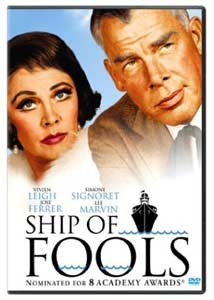
Ship of Fools
In 1933, the Nazi Party took over in Germany, a power that would run through the end of WWII in 1945. At the time, no one really could known what was coming with Adolf Hitler and the Nazis in charge of Germany, but it was a turning point in history for how it changed the world and the millions of lives it impacted. Even at first, did the German people know what they were voting for when the Nazi Party took office? We'll never know, but 1965's Ship of Fools explores the idea of what is to come.
Director Stanley Kramer made a name for himself with movies just like this, big pictures with big casts and some big ideas. 'Fools' has the feel of a 1970s disaster movie except without the disaster. Throw a group of people into a confined setting and let the fireworks begin. Here though, there's no fireworks. It is a movie that at 149-minutes is one of the most dialogue-heavy movies I've ever seen, some good and some bad. With a huge cast, lots of tumultuous relationships, and some bigger takes on love, prejudice, and common decency, 'Fools' has a lot going on, too much if you ask me. A streamlined version couldn't have hurt.
In 1933 in the port of Vera Cruz, Mexico, a German cruise ship leaves port bound for a quick stop in Cuba and then on home to mother Germany. On board is a good sample section of Germans, Jews, Austrians, a few Americans from a variety of backgrounds, and over 500 field workers being sent back to Cuba because the work has dried up. The Nazi Party has taken power in Germany, and the election is still at the forefront of discussion. The trip to Germany is expected to take almost a month, and on this trip, nothing is going to go smoothly.
Don't take any of that to mean this is an action movie, far from it. Here is just some of the characters involved. The ship's doctor (Oskar Werner) is coming off heart troubles and is generally depressed at the plight of the world, but he bonds with an upper-class woman (Simone Signoret) who helped arm a workers rebellion. A boorish German Austrian (Jose Ferrer) spouts the power of the Nazis and their plans to build a super race. A young American couple (George Segal and Elizabeth Ashley) try to figure out if they're meant to be together. A hard-edged, washed up American baseball player (Lee Marvin) tries to figure out what to do with his life, all the while talking often with a recent divorcee (Vivien Leigh). A German Jew salesman (Heinz Ruhmann) tries to shrug of the increasingly anti-Semitic feelings on board. The problem isn't with the strength of the casting -- all those mentioned turn in fine performances -- but with the fact that all those mentioned are about half of the storylines.
There is many more storylines with many more characters as Kramer attempts to show a wide variety of people, families, and individuals on board this second rate ship. It's just too much as the camera bounces from story to story -- some much better than others -- instead of focusing on the key, interesting ones. There's an odd inclusion of a Spanish flamenco group who are really nothing more than a pimp who sells his dancers and also feature two satanic little kids who at one point throw a dog overboard. Many of these characters could have been more interesting with some more development, but it felt like Kramer was more interested in quantity over quality, and he throws a lot at the viewer before quickly moving on to another subplot.
'Fools' is based off a novel, but to me it had the distinct feel of a stage play with almost nothing to distract from the always ongoing dialogue. Besides a tangent here and there, the 149-minutes is almost all dialogue, sometimes between two people and others among a group. With all these presentations of what love is and its power/effect, the story does tread that line between intellectual and pretentious, usually ending up on the right side. Michael Dunn (Dr. Loveless in Wild, Wild West) plays Glocken, the character who opens and closes the movie by addressing the viewer, telling us what we are to see and then summing it up. It was a performance that earned him an Oscar nomination, and for good reason. Dunn was a dwarf, and in any other movie he may have seemed out of place, but here he's probably the most normal of them all.
With such a dialogue-heavy movie, it's the actors/actresses who shine. Leigh in her last-ever movie is remarkable in a very strong performance. Werner isn't easy to like because he seems so down on himself and the world, but the character comes around in the end -- which is a downer. Signoret and Werner have a chemistry together that is unlike a typical budding movie romance. Ruhmann and Dunn have a similar chemistry -- hold the romance -- as two Jews forced to eat separately from the rest of the German passengers, both men able to laugh off the prejudice. A scene late in the movie as they discuss this growing prejudice is eerie because as viewers we of course know what is to come during the Holocaust.
If this was from any other director, the rating might have gone up, but Kramer has Mad, Mad World and Nuremberg to his name among others, and 'Fools' just doesn't live up to those expectations. It could have though, and that's what is disappointing. The potential is there for a great movie. Cut about 30 minutes and some of those extra, wasted characters, and you've got a gem of a movie. Still, it's not a bad movie, just one with some fairly major flaws. Check it out for the depth of a great cast and a window into 1933 and what was coming down the road. Don't be thrown off by the DVD either, this is not some light-hearted romance.
Ship of Fools <----trailer (1965): ** 1/2 /****
Labels:
1960s,
George Segal,
Jose Ferrer,
Lee Marvin,
Simone Signoret,
Stanley Kramer
Sunday, February 14, 2010
Judgment at Nuremberg
Less than 15 years removed from these tribunals, Stanley Kramer assembled a remarkable cast to tell the story of one of the actual Nuremberg trials in 1961's Judgment at Nuremberg. What's amazing about this movie is its honesty and frankness in dealing with the subject at hand, a touchy one at that in talking about the Holocaust. Kramer presents evidence, lets the characters tell their stories, and then makes a brave choice. He presents an option for you as a viewer to make up his/her own mind. What did these men on trial deserve? It's up to you.
Arriving in Germany, Maine district court judge Dan Haywood (Spencer Tracy) is preparing for the biggest trial he's ever presided over. It's 3 years since the end of the war, and four German judges (including Burt Lancaster) are on trial for their actions during WWII and the years leading up to it. Leading the prosecution is Colonel Tad Lawson (Richard Widmark), a WWII veteran who's prosecuted many of the German war criminals since the close of the war. His opponent on the defense is a intelligent, fiery German lawyer, Hans Rolfe (Maximilian Schell), who must present an incredibly difficult case that maybe even he does not believe.
Set almost entirely in a courtroom at Germany's Palace of Justice -- with a few quick detours -- Kramer's courtroom drama works as a series of linked vignettes dealing with one topic. Whole segments could be removed from the movie as a whole and still be worth watching on their own. At over 3 hours long, 'Nuremberg' is never rushed or too fast-paced with long, lingering shots from the camera as the testimony unfolds. Kramer allows his cast to get all the attention with only a few moments of in-your-face style from behind the camera, like an extreme zoom to a close-up of someone's face. It's a remarkable movie heavy on the dialogue that won an Oscar for its writing.
These courtroom vignettes would have worked as a stand alone, but assemble them together and you've got a classic. Two witnesses are called to the stand in two of the movie's strongest segments, Montgomery Clift as a German man forced to undergo a sterilization surgery during the war and Judy Garland as a young German woman involved in a controversial court ruling that Lancaster's Emil Janning ruled on. Both were nominated for their supporting roles -- more on that later -- in what amount to one or two scene appearances. Clift is absolutely heartbreaking (check out his testimony/part HERE) and nearly brought me to tears, and Garland is equally effective. The powers that be only gave them Oscar nominations, not the win, with best supporting actor and actress going to West Side Story's George Chakiris and Rita Moreno.
It blew my mind when I read that. I realize West Side Story is a classic -- never seen it myself -- but Clift and Garland provide some of the most effective, moving parts I've ever seen, and they got snubbed. Definitely two of the biggest such snubs in Oscar history. A bigger issue is that just about everyone in 'Nuremberg' deserved an Oscar win with Schell taking home the Best Actor. Schell has an impossible task in front of him, defending four men who helped send hundreds and maybe thousands of people to their deaths in the concentration camps. It's hard to side with his defense, but it makes you think. Provoking thought concerning something as inherently evil as the Holocaust is remarkable in itself.
Where else to start with this huge cast? Each star is given their moment to shine and not a one disappoints. Clift's testimony is early on and starts the ball rolling, and the momentum just keeps on building. Lancaster is silent for much of the movie, just a stoic presence in the dock, until he has an outburst and then gets his chance on the stand (watch it HERE). Tracy's world weary judge who's been voted out of his position back home has the biggest decision of them all, how to judge these men. And with bigger things at play, his decision is even tougher. His summation is a simple, beautifully effective description of the situation. Widmark gets the flashier part as the prosecuting attorney and makes him human, a veteran who was among the troops who liberated the concentration camps and now tries to understand the horrors and atrocities he saw. If that wasn't enough, Marlene Dietrich has a supporting role as a German widow.
The tribunal is making a judgment on these four men, but Kramer's movie explores more than just that. It is brought up several times that Germany and the German people are on trial too. On a much bigger level, 'Nuremberg' explores the Holocaust, human actions, and morality. How could people do such horrible things to another? Wouldn't they have to know they were doing something wrong? The good of the country, yes, or so they believe, but at what cost? One extended segment has Widmark on the stand showing film of the liberation of the camps as a silent court watches from their seats. It's startling in 2010 to see that footage, much less 50 years ago in 1962.
A perfect example of how powerful a movie can be with a combination of acting and story with strong direction. Performances from a long list of Hollywood heavyweights -- Tracy, Lancaster, Schell, Clift, Garland, Dietrich and Widmark -- and a story dealing with an impossible subject make this a must-see and a true classic.
Judgment at Nuremberg <----trailer (1961): ****/****

Subscribe to:
Posts (Atom)

.jpg)